Preprint
Article

This version is not peer-reviewed.

Real-World Fermented Foods and Their Impact on Gut and Brain Health: A Multi-Arm Intervention Study in Healthy Adults

Submitted:

04 January 2026

Posted:

07 January 2026

You are already at the latest version

Abstract

Fermented foods are increasingly recognized for their potential to support gut and brain health via microbiome modulation. However, most research focuses on isolated probiotics or lab-prepared products, leaving limited evidence for real-world fermented foods with live bacteria. This study evaluated the effects of three commercially available fermented foods—dairy kefir, coconut kefir, and fermented red cabbage and beetroot—on gastrointestinal, cognitive, and emotional outcomes in healthy adults. Over a 4-week randomized controlled intervention, cognitive function was assessed using the CANTAB, emotional health via validated self-report measures, and stool samples analysed using the Genova Diagnostics GI Effects test. Dairy kefir improved decision-making, sustained attention, working memory, reduced depression, anxiety and stress. The coconut kefir reduced waiting impulsivity, enhanced short-term memory, improved total mood, and increased butyrate-associated commensals, Faecalibacterium prausnitzii, Bifidobacterium spp., Lactobacillus spp., and Anaerotruncus colihominis, alongside elevated butyrate levels. The fermented red cabbage and beetroot improved sustained attention, working memory, reduced stress, improved total mood, and increased both butyrate and propionate. In contrast, the control group showed a rise in Fusobacterium spp. These findings support fermented foods as functional dietary interventions for gut–brain health.

Keywords: 
;  ;  ;  ;  ;  

1. Introduction

The health benefits of fermented foods have been extensively investigated in human studies [1,2,3,4,5,6] and reviewed across multiple domains [7,8,9,10,11,12,13,14,15]. As a result, fermented foods have been proposed for inclusion in dietary guidelines [10,16], with recent calls for establishing recommended daily intakes for those contributing live dietary microbes [17].While their benefits to gastrointestinal health are well recognized [12], emerging evidence suggests fermented foods may also support metabolic [1,4,18], cardiovascular [2], bone [3,19], immune [11], and brain health [20,21]. These effects are thought to arise from enhanced bioactive and nutritional content, probiotic activity, and increased gut microbiome diversity [13], with downstream modulation of the central nervous system [10]. Moreover, microbial metabolites produced during fermentation have been shown to influence the permeability of both the intestinal barrier [22,23] and the blood-brain barrier [24]. However, not all fermented foods appear to exert the same effects.
Fermented foods were first formally defined as “foods or beverages made through controlled microbial growth and enzymatic conversions of major and minor food components” [8] and later refined by the International Scientific Association for Probiotics and Prebiotics (ISAPP) as “foods made through desired microbial growth and enzymatic conversions of food components” [17]. Prior to these definitions, many published reviews on the health benefits of fermented foods included products such as freeze-dried encapsulated powders prepared via microbial fermentation but consumed in a non-living form. For instance, Byun et al. [1] used encapsulated freeze-dried Chungkookjang, Lim et al. [2] used heat-inactivated freeze-dried Kochujang, and Tu et al. [3] used grain-fermented kefir powder. These examples highlight the variability in what has been considered “fermented food” in research contexts. Consequently, there is a pressing need for randomized controlled trials investigating the health effects of differentiated fermented food categories that contain live microorganisms at the point of consumption [17].
Fermented foods containing live bacteria comprise complex, multi-kingdom microbial communities that function as symbiotic units, often undergoing dynamic succession processes [25]. Despite this complexity, a core microbiota has been identified across diverse fermented substrates, typically spanning three dominant phyla: Proteobacteria, Firmicutes, and Actinobacteria [26]. This shared microbial architecture has prompted speculation about the potential for consistent health benefits across fermented food types. However, standardization remains a challenge. Microorganisms used to initiate fermentation are not easily controlled, and significant batch-to-batch variability persists. While custom starter cultures with defined cell counts and activity are increasingly available, many fermentations still rely on naturally occurring microbes, resulting in wide variation in composition, biological activity, and nutritional properties [10].
These inconsistencies contribute to ongoing debate in the literature, with some studies reporting contrasting outcomes [27] and others questioning the strength of evidence altogether [14]. Further complicating progress, research on fermented foods with live bacteria is rarely industry-funded [28], and most studies focus on isolated probiotics in diseased populations. Additionally, different strains within the same genus or species may exert divergent effects on the host [29], and many intervention products are prepared under laboratory conditions that limit real-world applicability. As a result, there remains a distinct lack of evidence regarding the health effects of commercially available fermented foods with live bacteria in healthy populations.
Furthermore, fermented foods with live bacteria, like the gut microbiota, comprise resilient microbial communities capable of long-term coexistence through competitive and cooperative interspecies interactions [30]. The composition and functionality of these communities are influenced by multiple factors, including the type of substrate used [31], production methods [32], intrinsic properties of the final product [33], and geographical origin [34]. Given this variability, we hypothesize that the health effects of commercially available fermented foods with live bacteria will differ depending on both their microbial diversity and the nature of the fermented substrate.
To test these hypotheses, we conducted a single-blinded, randomized controlled, multi-arm, parallel-group intervention examining the effects of three fermented foods with live bacteria, dairy kefir, coconut kefir, and fermented red cabbage and beetroot, each produced in London and commercially available in UK retail at the time of study. These were compared to a control group (no intervention) to assess outcomes related to cognitive function, emotional wellbeing, gastrointestinal health and gut microbiota composition. Microbial profiling was performed using 16S rRNA gene amplicon sequencing targeting a defined panel of commensal taxa. Gastrointestinal biomarkers and microbiota data were obtained via the Genova Diagnostics (Europe) GI Effects Comprehensive Stool Profile, a clinical-grade assay accessible to registered healthcare practitioners (GI Effects Stool Profiles Test, Genova Diagnostics, Asheville, North Carolina) [35].

2. Materials and Methods

2.1. Participants

2.1.1. Recruitment Procedure

Prospective volunteers were sought by social media advertisement and 287 individuals expressed interest in participating. After reading the participant information sheet, 62 volunteers returned a signed consent form. The volunteers were screened using a health questionnaire. Individuals who were pregnant, breast feeding, had a history of cancer, inflammatory bowel disease, a mental health condition, intolerance to histamine and lactose, or vegan, were ineligible to participate. Volunteers also needed to be free of antibiotic use in the 2 weeks before the trial, not on any prescription medication, and not taking any probiotic capsules. 14 volunteers were screened out due to underlying health conditions, dietary preferences, and prescription medication. One volunteer withdrew before the study commenced due to not wanting to store the stool samples in their home fridge, and two withdrew due to inability to commit to full trial participation.
Forty-five healthy volunteers (18 male, 27 female) completed the entire 5-week study period (Figure 1). One participant’s data was excluded due to absent data across multiple measurements, and one participant’s data was excluded due to faecal occult blood present in both baseline and post intervention stool analyses. Baseline characteristics (mean ± SD) of the 43 individuals whose data were used for analysis and interpretation were: 26 female and 17 males; age 38.7 ± 7.9 years (range 20 – 52); body weight 65.9 ± 10.4 kg (range 49 – 90).
The study was fully explained to the volunteers, both verbally and in writing, and each gave their written, informed consent before participating. The study was conducted in accordance with the Declaration of Helsinki (2013), and the methodology was approved by the School of Applied Science Ethics Committee, London South Bank University (ETH1819-0142).

2.1.2. Randomisation and Group-Allocation Procedure

Two people not directly involved in the study used a simple randomisation web-tool [36] which apply the stratified block randomization method to randomize participants into 4 groups (A,B,C,D), stratified for gender (A Dairy Kefir, B Fermented red cabbage and beetroot, C Coconut Kefir, D Control). Blocks are small (size of 4) and balanced with predetermined group assignments, always keeping the numbers of participants in each group similar. This method is used to ensure a balance in sample size across groups over time.

2.1.3. Intervention Products

The three commercially available (in the UK) fermented food products with live bacteria were: (1) Life Shot 200 (Rhythm Health Ltd., UK) containing 100% pure organic coconut milk (coconut water and coconut pulp) fermented with a proprietary vegan starter culture and preserved with high hydrostatic pressure. (2) Organic dairy kefir (Carr Foods Ltd., UK) representing pasteurised organic cow’s milk fermented with proprietary dairy kefir grains. (3) Bottle Brush Ferments, The Purple One (Filthy Healthy Ltd., UK) is a fermented vegetable mix (red cabbage, beetroot and caraway seeds), traditionally fermented with pink Himalayan salt. Comparative analysis of their composition was conducted and is presented in Table 1.

2.1.4. Study Design and Procedure

The study adopted multi-arm, randomized control, blinded at one level, parallel group, pre-, mid- and post-intervention assessment design to investigate the effects of three different fermented foods containing live bacteria in comparison to a control group on emotional health, brain health and gastrointestinal health, as well as self-reported physiological and or psychological symptoms in healthy adults (See Figure 1 and Table 2). The researcher conducting data collection and analyses was blinded to the group allocation of the participants. The researchers administering the interventions and the participants could not be blinded due to the physical differences of the intervention products. Group sample size was restricted by available funding. Enrolment was on a rolling ‘first-come-first-served’ basis until target number (n=45) was reached. Participants started the trial immediately upon enrolment. Participants were advised to consume their habitual diet throughout the study period. They were required to visit the laboratory 5 times 1-week apart during a 5-week study period (see Table 2) and were required to avoid caffeine 2 hours before visits 1 – 4.
At visit 1, participants completed diet and lifestyle questionnaires, and a health and well-being questionnaire (MYMOP®) [37] and were familiarised with the cognitive function assessment. They received their first (pre-intervention) stool test kit.
At visit 2, (3-4 days after their first visit) participants returned their filled stool test kit, and undertook the battery of tests for baseline assessments of cognitive function, emotional and gastrointestinal health. Participants were given a 15-day Bristol Stool Scale chart capture document, and 2 x 1-week MYMOP® follow-up documents to take home, complete, and return at visit 3. Another member of the research team provided the participant with a 15-day supply of the product, according to their allocation. Participants in the intervention groups were instructed to consume one portion every day, and all participants were asked to maintain their normal diet and lifestyle. Participants were not asked to exclude any fermented foods from their diet if it was part of their regular food consumption pattern.
The same procedure was applied during visit 3, at day 15 after their second visit, when the participants returned for mid-line assessments and delivering their 15-day Bristol Stool Scale chart capture, and 2 x 1-week MYMOP® follow up documents to take home, complete, and return at visit 3. Notion of any adverse symptoms experienced was made, and the final 15-day supply of the respective product given.
On day 30 from the start of product intake, visit 4, participants returned for end of trial testing (end of intervention). They returned their final 2 completed MYMOP® follow-up documents, and the 15-day Bristol Stool Scale chart and received their second stool test kit which they had to complete the following morning.
Visit 5 took place 3 days later, when participants returned their filled stool test kits.

2.1.5. Data Collection

At the enrolment session, subjects completed a detailed diet and lifestyle questionnaire. Details of intake of fermented foods with live bacteria (other than the intervention products) and probiotic supplementation was captured at visits three and four. Participants were asked to complete a 7-day plant food diary.

2.1.5.1. MYMOP®

For quality of life measures the Measure Yourself Medical Outcome Profile [37] questionnaire (MYMOP®) was used, an individualised health-related quality of life evaluation instrument that is problem-specific. It enables an individual to measure change in self-chosen symptoms during an intervention. It required participants to specify one or two symptoms, psychological or physical, that concerns them most. The symptoms were rated on a 7-point Linkert scale, ranging from 0 (as good as it could be) to 6 (as bad as it could be). The second part of the questionnaire uses the same scale to assess whether the symptom(s) is limiting or preventing a daily activity (physical, social or mental). General feeling of wellbeing was rated too. A MYMOP® follow up questionnaire was used to rate the same symptom(s), activity and general feeling of wellbeing on a weekly basis during the intervention.

2.1.5.2. Cognitive Function

Three tests from the Cambridge Neuropsychological Test Automated Battery [38] were used to assess cognitive function. The computerised neurocognitive tests were presented on a touch-screen iPad running the CANTAB eclipse software. Subjects were seated at a comfortable height, approximately 0.5 m from the monitor, and were instructed to carry out the tasks by touching the screen. Each test started with a detailed visual display explanation and a guided practice session. Participants completed the battery in the following order:
(1) Delayed matching to sample (DMS): This task tests visual memory in a 4-choice delayed recognition memory paradigm, assessing both simultaneous visual matching ability and short-term visual recognition memory for non-verbalizable patterns.
(2) Rapid Visual Information Processing (RVP): A visual continuous performance task, using digits rather than letters, measuring sustained attention and working memory.
(3) Cambridge gambling task (CGT): Measures executive function for risk-taking behaviour and decision-making under uncertainty.

2.1.5.3. Emotional Health

The 12-item short form of the profile of mood states (POMS) [39] was used to measure subjective psychological symptoms, scoring six subscales of mood – Tension, Depression, Anger, Fatigue, Confusion, Vigour, as well as to calculate Total Mood Disturbance (TMD) index. The 21 item self-report questionnaire Depression, Anxiety and Stress Scale (DASS-21) [40] was used to measure the self-perceived negative emotional states of depression, anxiety and stress. The depression scale assessed dysphoria, hopelessness, devaluation of life, self-deprecation, and lack of interest/involvement, anhedonia and inertia. The anxiety scale assessed autonomic arousal, skeletal muscle effects, situational anxiety, and subjective experience of anxious affect, and the stress scale assessed difficulty in relaxing, nervous arousal, and being easily upset/agitated, irritable/over reactive and impatience.

2.1.5.4. Gastrointestinal Health

2.1.5.4.1. Faecal biomarkers and gut microbiome
The GI Effects Stool Profile, a proprietary multi-component laboratory assessment was used to measure digestive function, intestinal inflammation, as well as the gastrointestinal microbiota. Across 3 consecutive days before visit 2 (pre-intervention) and visit 5 (post-intervention) participants collected fresh stool samples (selecting from different parts of the stool), using a specialist kit (Genova Diagnostics, Asheville, North Carolina). The stool samples were collected at home and stored at refrigerated temperatures. The completed kits were shipped (at ambient temperature) within 24 – 48 hours of the last (3rd day) of sample collection to the clinical lab for analyses.
Genova Diagnostics evaluated samples, and data was collected from the GI Effects Comprehensive Digestive Stool Analysis Report. Inflammation and Immune biomarkers: Calprotectin, Eosinophil Protein X (EPX), Faecal secretory IgA; Gastrointestinal Microbiome biomarkers: Total Short Chain Fatty Acids (SCFA), n-Butyrate Concentration, n-Butyrate percentage, Acetate percentage, Propionate percentage, Beta-glucuronidase, 24 commensal bacteria (PCR), and Zonulin Family Peptide.
2.1.5.4.2. Self-reported stool consistency
The Bristol Stool Scale [41] is a diagnostic medical tool designed to classify the form of human stool into seven categories. It provides insights into gut health, particularly the transit time of stool through the colon.
Type 1-2: Hard, lumpy stools indicate slow transit and constipation.
Type 3-4: Smooth, sausage-like stools are considered normal and healthy.
Type 5-7: Soft to watery stools suggest rapid transit and is often linked to diarrhoea or incomplete digestion.
Participants were given a Bristol Stool Scale chart for 15 days at the start (Day 1) and midway (Day 15). They were asked to self-rate their stool consistency each day for 30 days at home and return the completed charts midway (Day 15) and at the end (Day 30).

2.2. Data Analyses

2.2.1. MYMOP®

All domains (symptom severity, activity, and wellbeing) can be analysed individually or as a total score, the profile score, that equals the mean of the sub scores recorded [37]. From the MYMOP® data, we collected participant-generated symptom changes, activity scores, the general wellbeing scores, and calculated the profile scores for each participant.

2.2.2. Cognitive Function

From the Delay Matching to Sample the total number of times a participant chose the correct answer on their first box choice (min 0, max 20) (DMSTC) was used for analysis; the total number of times a participant chose the correct answer on their first box choice for trials where the response stimuli appeared on the screen after a 0, 4 and 12 second delay after the target stimulus was shown (min 0, max 5) (DMSTC0, DMSTC4, DMSTC12); the percentage of assessment trials during which the participant chose the correct box on their first box choice (DMSPC); and the mean latency between the presentation of the response stimuli options and the participant selecting the correct box on their first attempt (DMSML). How good the participant was at detecting target sequences (min 0, max 1) (RVPA); the total number of correct hits (min 0, max 54) (RVPTH); the total number of false alarms (min 0, max 546) (RVPTFA); and the response latency on correct hits, measured in milliseconds (min 100, max 1900) (RVPML); and the total number of target sequences that were not responded to within the allowed time (min 0, max 54), were analysed for the Rapid Visual Processing (RVPTM). From the Cambridge Gambling Task the delay aversion total, which allows for the dissociation between risk taking and impulsivity by determining whether participants simply just place a bet at the first opportunity (min -0.9, max 0.9) (CGTDAVT); the mean decision time from presentation of the boxes to the participant’s selection of the colour on which to bet, measured in milliseconds (min 0) (CGTDMMT); decision making quality, which is the proportion (0-1) of all trials where the participant chose the majority box colour (min 0, max 1) (CGTDMGMT); and total risk taking, which is the mean proportion (0-1) of current points gambled, in which the number of boxes in each colour differed and the participant chose the majority box colour (CGTRTKMT) were analysed.

2.2.3. Emotional Health

The Profile of Mood State (POMS) [39] questionnaire was answered on a 5-point Linkert scale to evaluate six transient distinct mood sates namely, tension, depression, anger, fatigue, confusion and vigour, and scored accordingly - 0 = not at all, 1 = slightly, 2 = moderate, 3 = very, 4 = extremely. Total Mood Disturbance (TMD) was calculated by summing the totals for the negative subscales (tension, anger, depression) and then subtracting the totals for the positive subscale (vigour).
For the Depression and Stress and Anxiety scale (DASS21) subjects were assessed based on a 4-point Linkert scale - 0 = did not apply to me at all – NEVER, 1 = applied to me to some degree, or some of the time – SOMETIMES, 2 = applied to me to a considerable degree, or a good part of time – OFTEN, 3 = applied to me very much, or most of the time – ALMOST ALWAYS. The scores for each subscale of the DASS-21 questionnaire, depression, anxiety and stress, were categorised into five standard ranges – Normal, Mild, Moderate, Severe, and Extremely Severe.

2.2.4. GI Health

The following data were extracted from the Genova Diagnostics GI Effects Stool test to assess several characteristics of the individual’s GI health [35].

2.2.4.1. Inflammatory and Immune Biomarkers

Calprotectin. A calcium-binding protein with antimicrobial properties. It accounts for 60% of neutrophil cytosolic content and is found in monocytes and macrophages. Calprotectin is released from the intestinal mucosa into the stool in intestinal inflammation. The reference range for calprotectin for individuals aged between 10 and 59 years is <=50 mcg/g of stool [42].
Eosinophil Protein X (EPX), also known as eosinophil-derived neurotoxin (EDN). One of the four basic eosinophil granule proteins, and a marker of eosinophil activity. Eosinophils are specialized white blood cells that proliferate and accumulate in areas of inflammation. They are scarce in a steady state large intestine and increase only under intestinal inflammation. The reference range for EPX/EDN is <=4.6 mcg/g of stool [43].
Faecal secretory IgA (fSIgA). fSIgA is the most abundant class of antibody found in the human intestinal lumen and is used to assess gastrointestinal barrier function. The reference range for fSIgA is <=885 mcg/g of stool [43].

2.2.4.2. Gastro-Intestinal Metabolites

The GI microbiome biomarkers provide information regarding the health, function and diversity of the GI tract microbial cells. They indicate how well the microbiome is performing the metabolic functions that are shared with the human host.
Total short chain fatty acids (SCFA’s). SCFA’s are organic acids, of which propionate, acetate, and n-butyrate are the most abundant (≥95%). They maintain intestinal barrier function, provide fuel for colonocytes, regulate colonic absorption of water, electrolytes and nutrients, salvage unabsorbed carbohydrates, support commensal bacteria, and modulate anti-inflammatory antimicrobial activities. Optimal levels of SCFA’s have not been established. Higher levels are considered beneficial. The reference range for Total SCFA’s is >=23.3 micromole/g of stool [44].
n-Butyrate concentration and percentage. n-Butyrate is the primary fuel source for colonocytes, and an inadequate level is associated with poor colonic health. The reference range for n-Butyrate concentration is >= 3.6 micromole/g of stool; and n-Butyrate percentage is 11.8 – 33.3% [45].
Acetate percentage. Acetate is the most abundant SCFA in the colon and makes up more than half of the total SCFA’s. The reference range for Acetate percentage is 48.1 – 69.2% [46].
Propionate percentage. Propionate has anti-inflammatory effects. The reference range for Propionate percentage is <= 29.3% [46]
Beta-glucuronidase. β-glucuronidase is an enzyme which is produced by colonocytes and by some intestinal bacteria. It breaks down complex carbohydrates and increases bioavailability of plant polyphenols. The reference range for ẞ-glucuronidase is 368 – 3,266 U/g of stool [43].

2.2.4.3. Commensal Bacteria

24 Commensal gut bacteria (at genus or species levels) using PCR methodology was available from the Genova Diagnostics GI Effects Stool test at the time of conducting this intervention trial (Table 3).
Firmicutes/Bacteroidetes ratio (F/B ratio)
The Firmicutes/Bacteroides ratio calculation is made by adding the abundance of Anerotruncus colihominis, Butyrivibrio crossotus, Clostridium spp., Faecalibacterium prausnitzii, Lactobacillus spp., Pseudoflavonifractor spp., Roseburia spp., Ruminococcus spp., and Veillonella spp. This total is then divided by the sum of the Bacteroidetes-Prevotella group, Barnsiella, and Odoribacter species. Results are placed within a reference range based on a questionnaire-qualified healthy cohort. The reference range for F/B ratio is 12 – 620 [35].
Zonulin family peptide. Zonulin has been identified as a tight junction regulating protein. The reference range for Zonulin family peptide in stool is 22.3 – 161.1 ng/mL of stool [47].

2.2.4.4. Bristol Stool Scale

From the self-reported data, we analysed frequency and category change trends over the 30-day intervention period.

2.2.5. Intervention Products’ Metagenomics

The samples were analysed using metagenomics based on sequencing amplicons from the 16S rRNA genes from lactic acid bacteria, by Campden BRI (Chipping Campden) Ltd., UK, UKAS laboratory No. 1079. DNA was extracted using the ‘PowerFood’ DNA extraction system. Resulting extractions were quantified using a fluorometer (Qubit 3.0) and dilutions prepared for PCR. Primers designed to pick up the V3-V4 variable region of the 16S rRNA gene, checked using a Bioanalyser from Agilent, and then cleaned in a column-based system. Samples were sequenced on an Illumina MiSeq instrument. The reads were compared against databases of 16S ribosome genes using the Metagenomics package from Illumina’s Basespace program. The raw data was received from Campden BRI in excel.

2.3. Statistical Analyses

All raw data (completed paper-and-pencil questionnaires, laboratory reports, electronic data) was anonymised and organised and combined into individual participant data files using a general spreadsheet software (Microsoft Excel). Data in both the individual and the combined population files were structured into spreadsheets aligned with the objectives of the research (POMS, DASS-21, Cognitive Function, gut microbiome biomarkers, gut microbiome, bacteriology, parasitology and mycology, Bristol Stool Scale, and MYMOP®). Data for each functional measure were analysed as population means ± SD for each group and measurement point. Results were also analysed according to the diagnostic ranges for each functional measure. The percentage changes between the measurement points within the protocol were calculated for each individual and averaged across the groups.
Data were analysed using IBM SPSS Statistics for Windows, Version 25.0 (Armonk, NY). Unless otherwise stated, data were expressed as mean ± standard deviation (SD). Anthropometric characteristics were compared using One-way ANOVA for numerical values and Fisher’s Exact Test for nominal values. Habitual dietary intake of vegetables, fruit and fermented foods was evaluated using the Kruskall-Wallis test. Gut microbiome and metabolite measurements were reported as population medians with interquartile ranges (25th–75th percentile). Within-group comparisons between baseline and post-intervention values for each of the four groups were analysed using the Wilcoxon signed-rank test. CANTAB data for pre-, mid and post-intervention were analysed using the Related Samples Friedman’s two-way ANOVA by ranks. Between groups comparisons across pre-, mid and post-intervention time points were assessed using a two-way mixed ANOVA. POMS and DASS-21 were analysed using Friedman’s two-way ANOVA by ranks, with a Bonferroni correction applied for multiple comparisons. Correlation heatmaps were generated using Spearman’s correlation coefficients based on post-intervention data collected from all study participants. These visualizations were constructed using the OriginPro version 2018b.9 software (OriginLab Corporation, Northampton, MA, USA), using a custom colour gradient to reflect the strength and direction of correlations. A p-value of < 0.05 was considered statistically significant.

3. Results

3.1. Participant Group Comparisons

There were no significant differences between the groups in participant anthropometric characteristics, habitual dietary fruit, vegetable and fermented foods intake, and education levels (Table 4).

3.2. MYMOP ®

The symptom and activity types reported varied considerably between participants, making only the general wellbeing item suitable for group-level comparison. Analysis of the wellbeing change scores showed modest fluctuations across all groups, including the control group, with no consistent or intervention-specific effect observed. Data not shown.

3.3. Cognitive Function

3.3.1. Effects on Decision Making and Impulsivity (Executive Function)

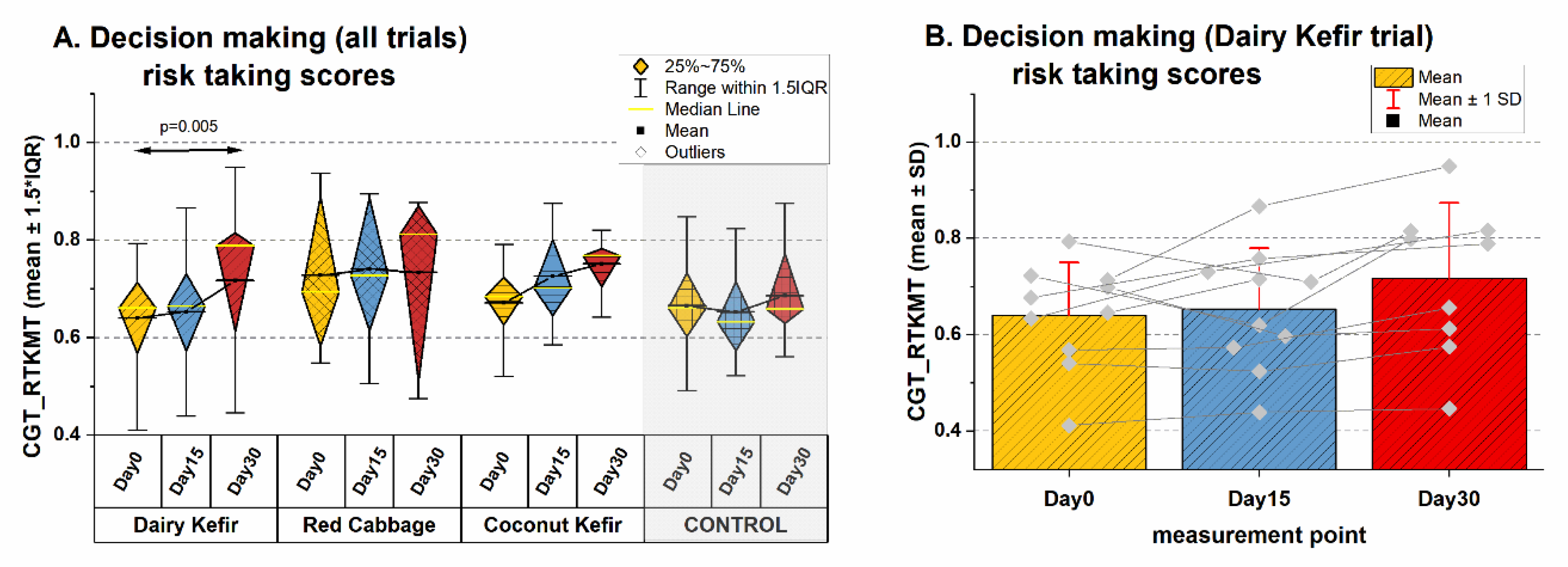
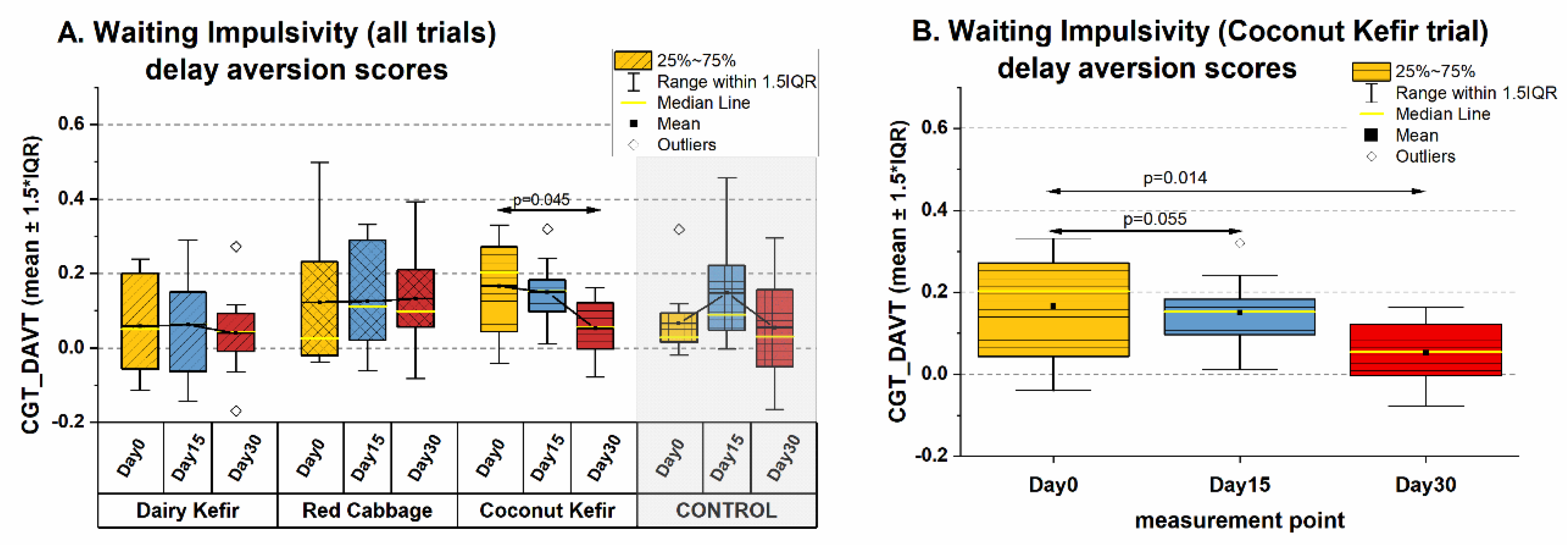
There were no statistically significant differences between the groups, p > 0.05. The two kefirs improved executive function. The Dairy Kefir participants improved their quality of decision making (CGTRTKMT) by 12% (χ2 (2) = 10.667, p .005) (Figure 2 A and B), and the Coconut Kefir elicited a 66% reduction in waiting impulsivity (CGTDAVT) (χ2 (2) =6.222, p = 0.045) (Figure 3 A and B). Pairwise comparisons showed the significant difference between time points for both measurements were between mid-point (Day 15) and end (Day 30), p = 0.014 and p = 0.055, respectively.

3.3.2. Effects on Short Term Memory

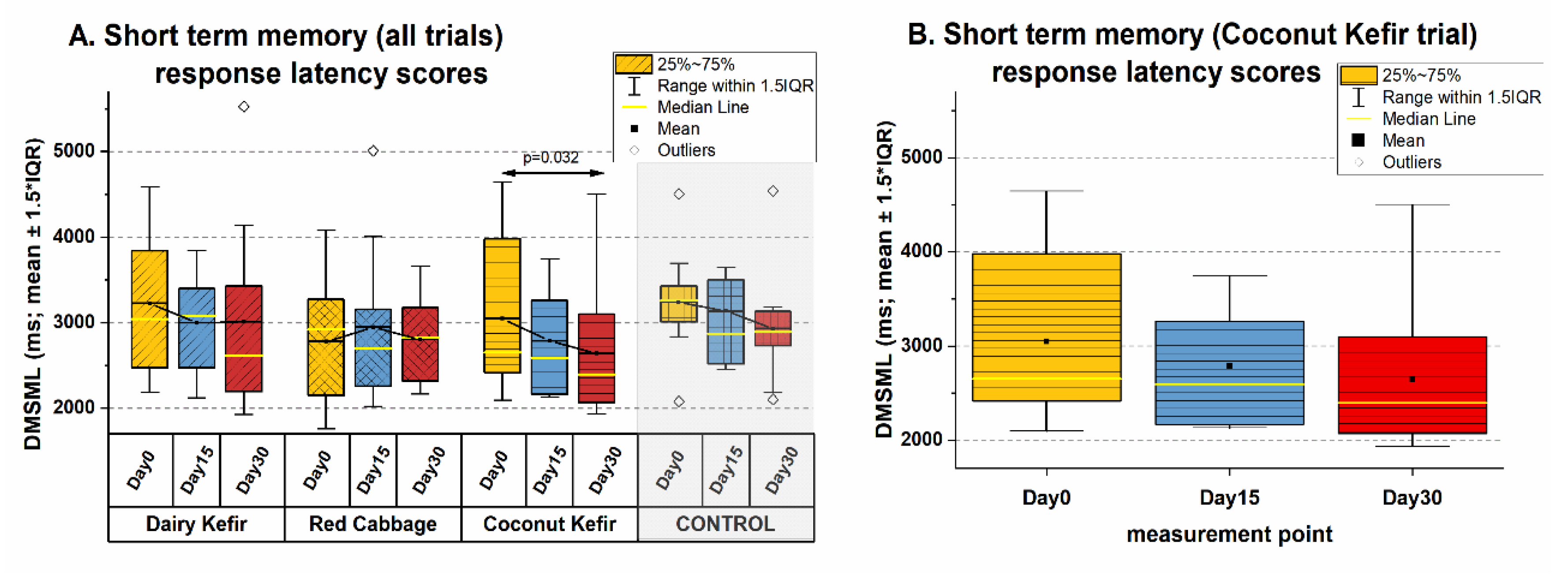
There were no statistically significant differences between the groups, p > 0.05. The Coconut Kefir group significantly reduced their response speed in delayed visual memory by 420 milliseconds, a mean reduction of 13%, (χ2 (2) = 6.889, p = 0 .032) (Figure 4 A and B).

3.3.3. Effects on Sustained Attention and Working Memory

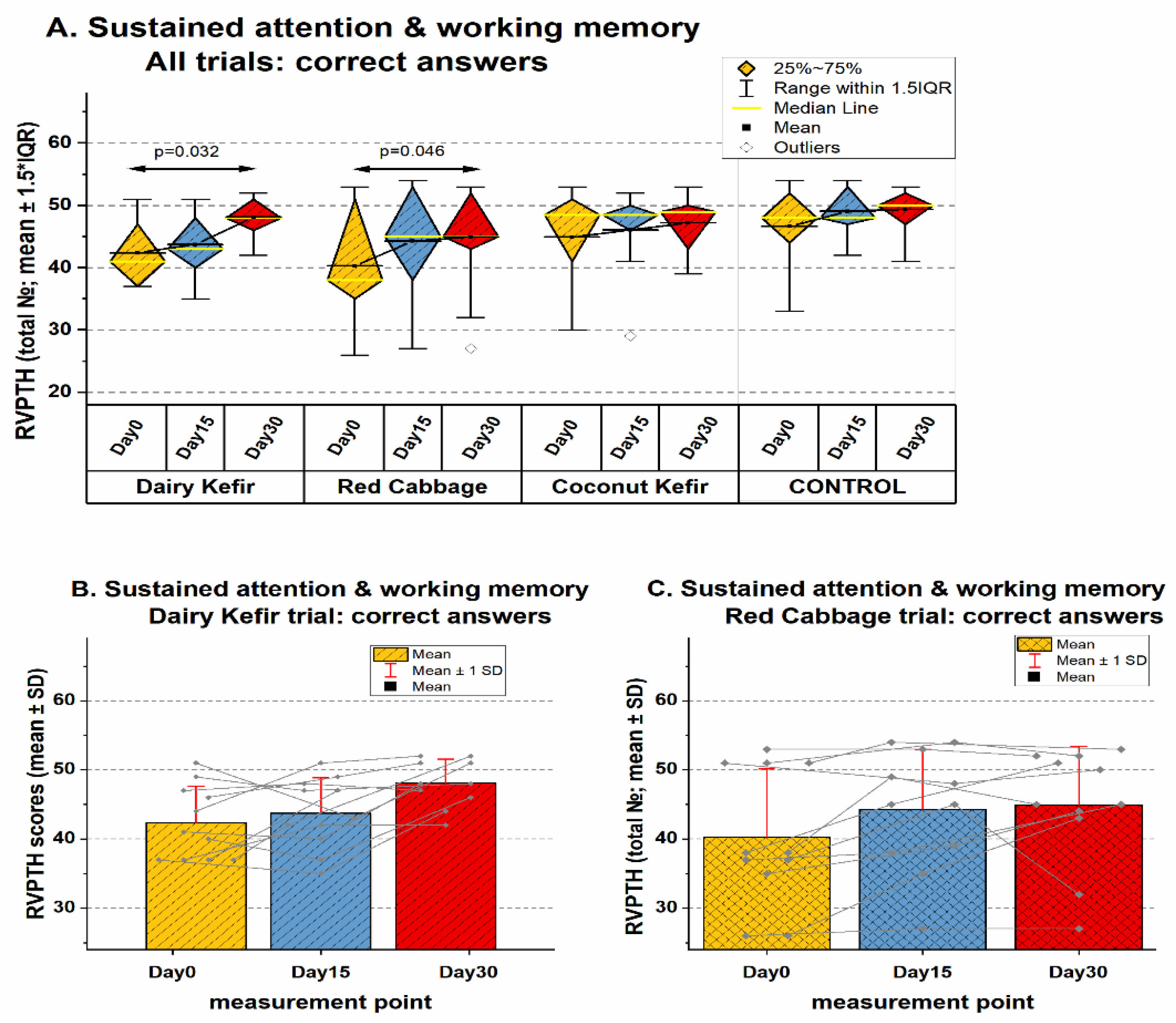
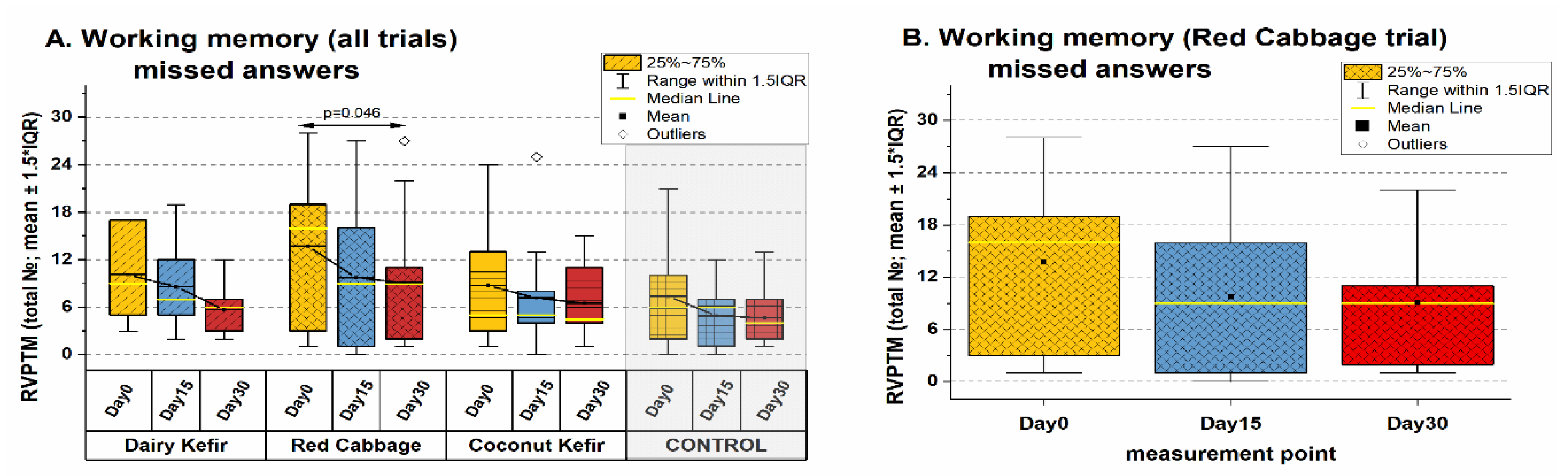
The Dairy Kefir and Fermented Red Cabbage elicited significant improvements in sustained attention and working memory. The Dairy Kefir group demonstrated a mean increase of 12% in total correct answers (χ2(2)=6.865, p = 0.032) (Figure 5 A and B), and the Fermented Red Cabbage and beetroot group a mean increase of 11% in correct answers (χ2(2)=6.143, p = 0.046) (Figure 5 A and C), in addition to a mean reduction of 44% in missed answers (χ2(2)=6.143, p = 0.046) (Figure 6 A and B).

3.4. Emotional Health

3.4.1. POMS

A significant reduction in Total Mood Disturbance (TMD) was observed in the Dairy Kefir group and the Control group. For the POMS subscales, confusion decreased significantly in the Coconut Kefir, Fermented Cabbage and beetroot, and Control groups. A significant between-group effect was observed for confusion in the Control group. No other within-group or between-group differences were observed for the remaining subscales (tension, depression, anger, vigour or fatigue). Data not shown.

3.4.2. DASS21

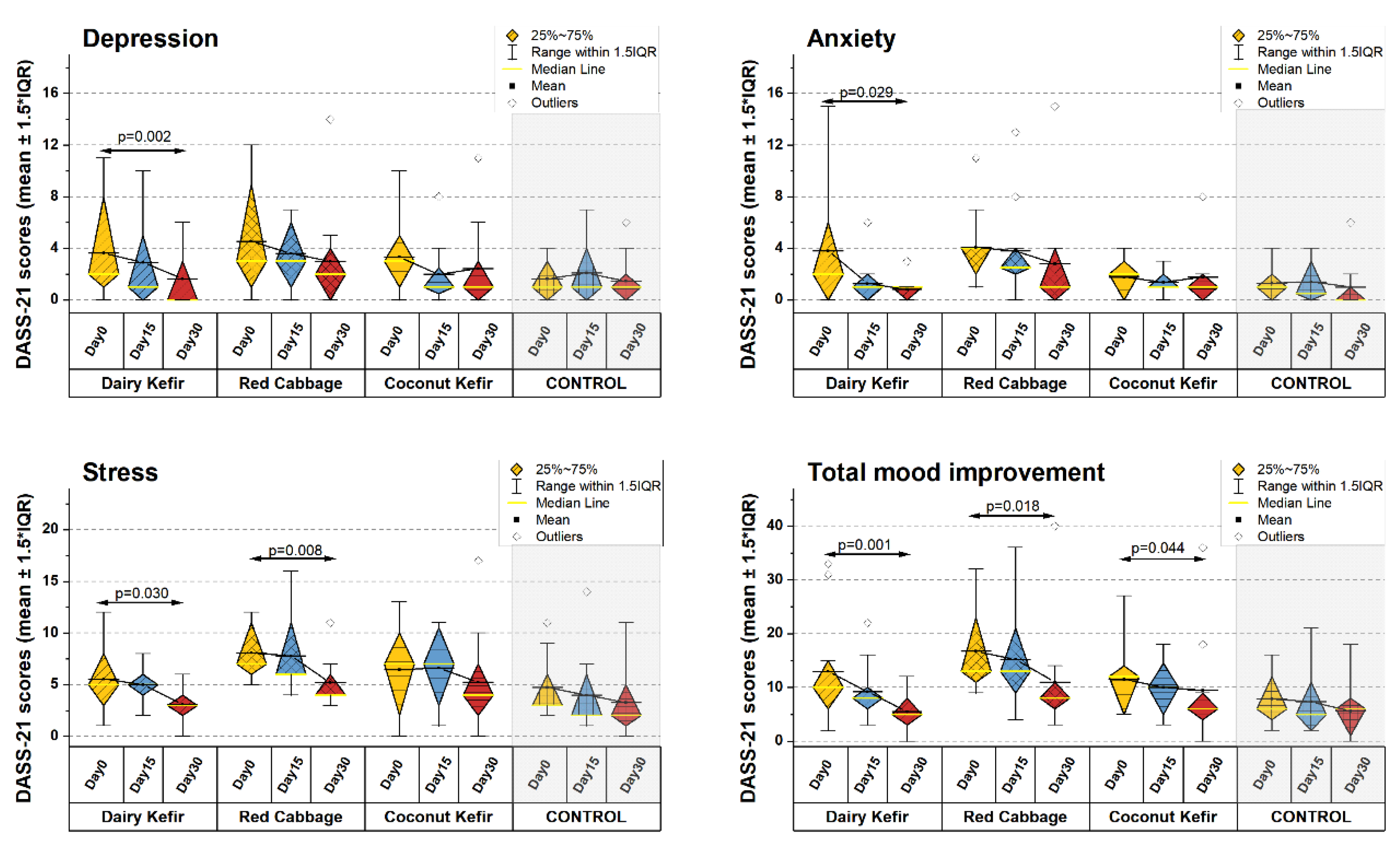
The effect of the Dairy Kefir exhibited significantly lower depression (χ2(2) = 12.25, p = 0.002), anxiety (χ2(2) = 7.09, p = 0.029), and stress (χ2(2) = 7.0, p = 0.030) scores at week 4, resulting in an overall significant mood improvement (Total DASS) (χ2(2) = 13.31, p = 0.001) (Figure 7). The participants receiving the Fermented Red Cabbage and beetroot experienced significantly less stress post-intervention, (χ2(2) = 9.77, p = 0.008), and significant improvement in overall mood (Total DASS), (χ2(2) = 8.05, p = 0.018) (Figure 7), and those receiving the Coconut Kefir, were significantly happier at week 4 (Total DASS), (χ2(2) = 6.25, p = 0.044) (Figure 7). There were no significant differences between the groups for either depression (p = 0.607), anxiety (p = 0.17), stress (p = 0.698), or total mood (p = 0.451). Participants in the control group were generally less depressed and anxious, with lower stress levels and a better overall mood at the start of the intervention.

3.5. Gastrointestinal Health

3.5.1. Bristol Stool Scale

No significant changes in stool frequency or consistency were observed within or between groups over the intervention period. Data not shown.

3.5.2. Effects on Short Chain Fatty Acids

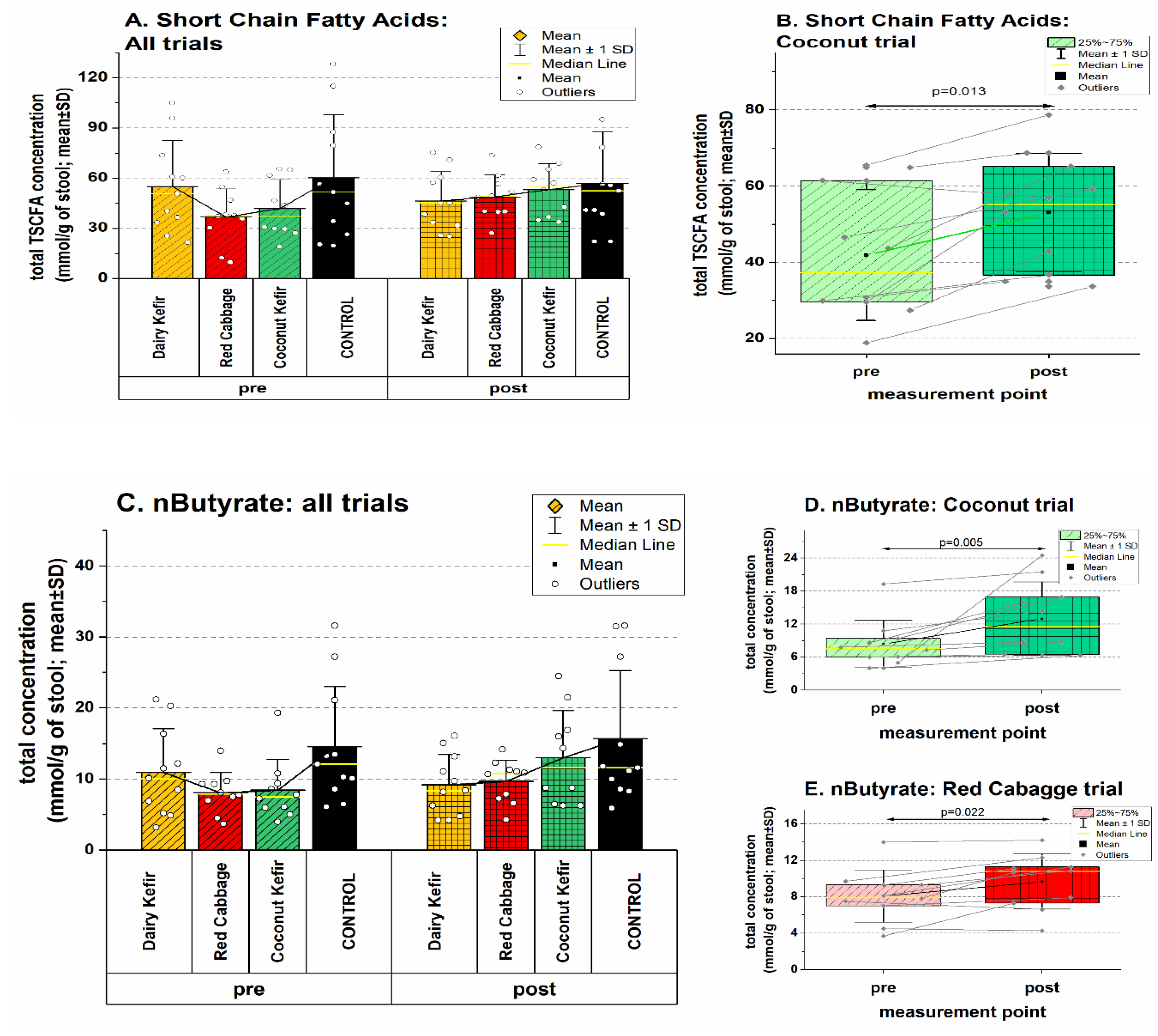
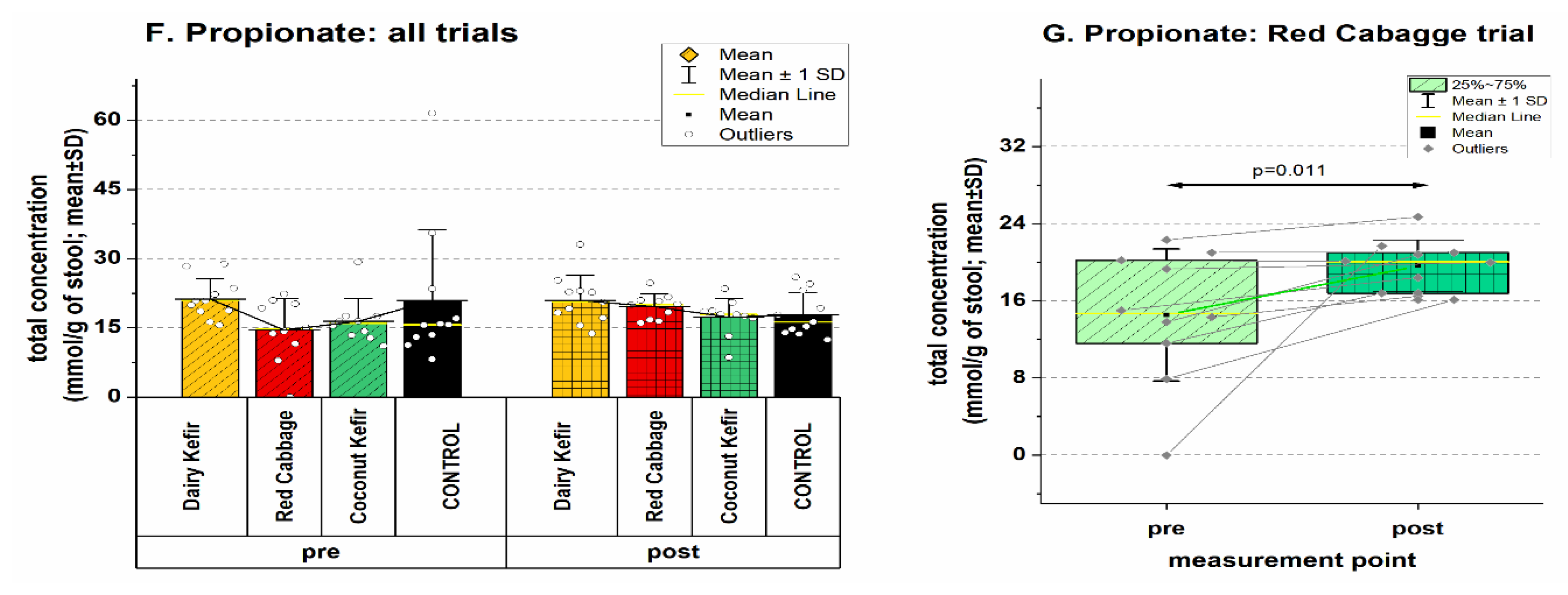
The Coconut Kefir elicited significant increases in total short chain fatty acids (p = 0.013) (Figure 8 A and B) and butyrate concentration (p = 0.005) (Figure 8 C and D), and the Fermented Red Cabbage elicited significant increases in butyrate (p = 0.022) (Figure 8 C and E) and propionate (p = 0.011) (Figure 8 F and G). There were no significant differences between groups for any of the SCFAs.

3.5.3. Inflammation and Immunity

There were no significant differences within or between groups post intervention for Calprotectin, EPX and FSigA (See Table S1 in Supplementary material).

3.5.4. Effects on Gut Microbiota

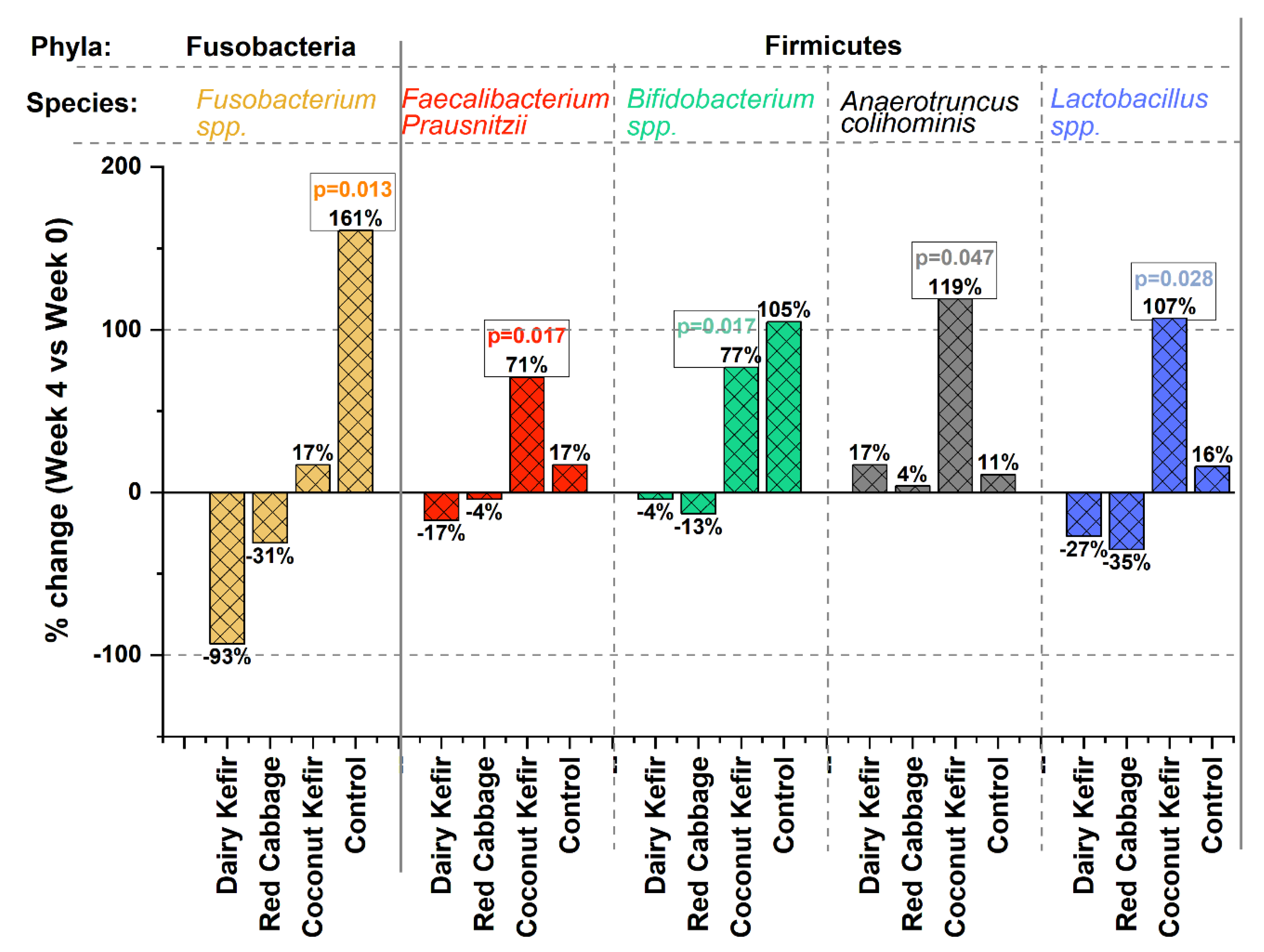
24 bacterial species were available for analyses from the Genova Diagnostics GI Effects laboratory reports (Table 3). The Coconut Kefir intervention elicited significant changes in the gut microbiome (Figure 9). We observed an increase in members from the Firmicutes phylum, Anaerotruncus colihominis (119% mean increase in cfu/g, z = 1.98, p = 0.047); Faecalibacterium prausnitzii (71% mean increase in cfu/g, z = 2.39, p = 0.017); Lactobacillus spp. (107% mean increase in cfu/g, z = 2.19, p = 0.028), and from the Actinobacteria phylum, Bifidobacterium spp. (77% mean increase in cfu/g, z = 2.39, p = 0.017). The control group experienced a significant increase in Fusobacterium spp. (161% mean increase in cfu/g, z = 2.49, p = 0.013) (Figure 9). The Dairy kefir and Fermented cabbage did not significantly change gut microbiota composition, and the Firmicutes/Bacteroidetes ratio was not significantly altered in this study in any of the groups (data not shown).

3.6. Correlation Analyses

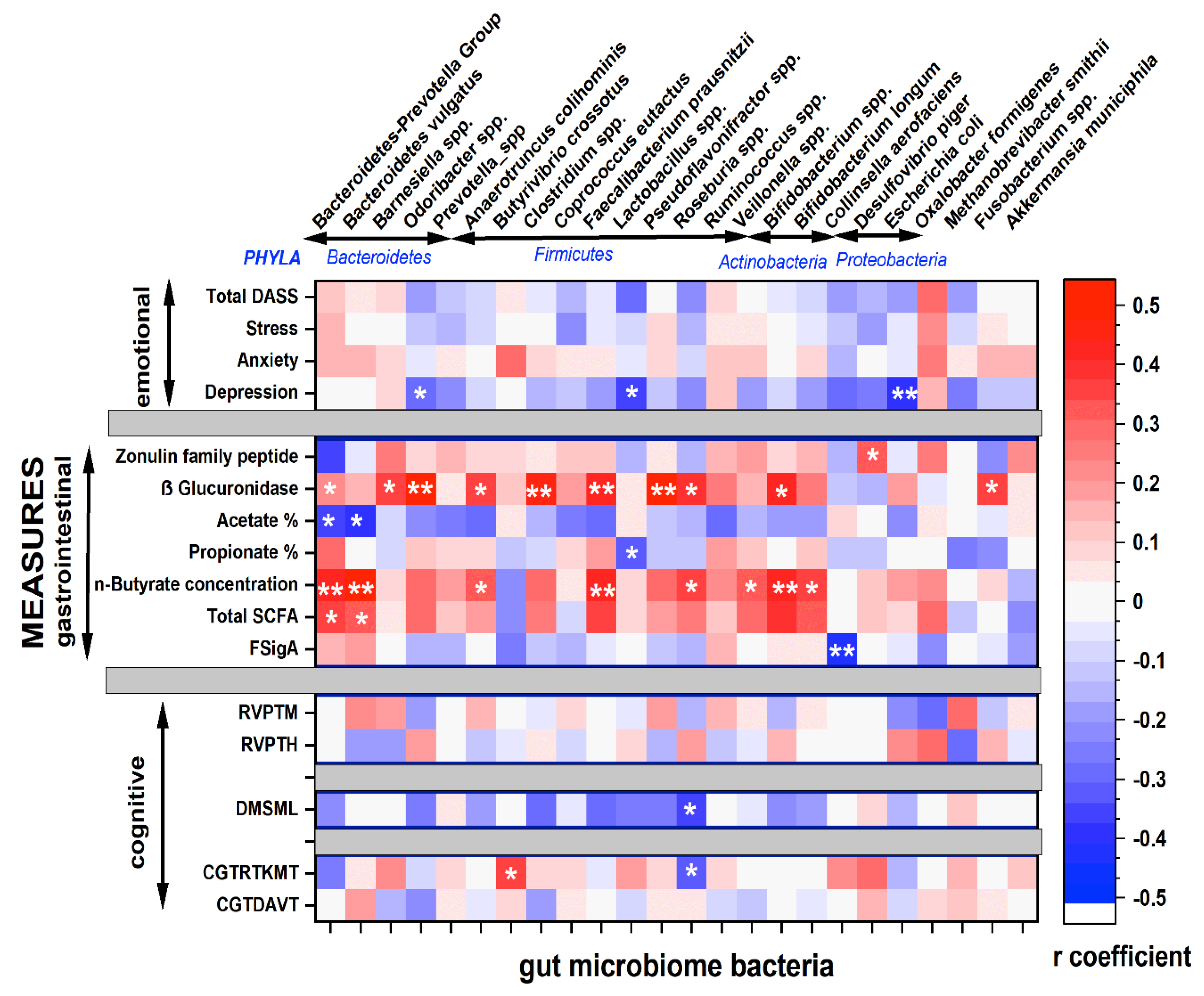
To test our hypothesis that health benefits from commercially available fermented foods with live bacteria will depend on both their microbial diversity and the fermented food substrate, we correlated measures of cognitive function, emotional health, gastro-intestinal health biomarkers and bacterial species. Figure 10 presents Spearman correlations between gut microbiota species and three target variables: Cognitive function scores, gastro-intestinal health biomarkers, and DASS-21 scores. Colour intensity reflects the magnitude of the correlation (p), with blue tones indicating negative correlations and red tones indicating positive correlations. Several variables showed statistically significant correlations (p <0.05) with moderate (R = > 0.3 – 0.45) to strong (R = > 0.5 – 0.74) Spearman’s rho values. See Figure S1 in Supplementary Material for correlations heatmap between emotional health, cognitive function and gastro-intestinal health biomarkers.

3.6.1. Cognitive Function

Roseburia spp. demonstrated negative associations with cognitive function (Decision making - CGTRTKMT, R = -.32, p = 0.04; short term memory -DMSML, R = -.35, p = 0.027), pointing to a potential role of this taxon in shaping cognitive trajectories (Figure 10). Additional findings linked gut-immune markers to cognitive performance. Short-term memory (DMSML) with fSigA (R = .36, p = 0.023), and GUS (R = -.34, p = 0.029), and sustained attention and working memory (RVPTH) with EPX (R = -.34, p = 0.029) (Supplementary Figure S1).

3.6.2. Emotional Health

Negative correlations emerged between depression and members of the gut microbiota, namely Odoribacter spp. (R = –.31, p = 0.048), Lactobacillus spp. (R = –.35, p = .022), and E. coli (R = –.40, p = .009) (Figure 10), pointing to a microbial signature potentially linked to emotional dysregulation. In contrast, depression was positively correlated with fSigA (R = .39, p = 0.009) and short-term memory (DMSML, R = .42, p = 0.007) (Supplementary Figure S1).

3.6.3. Gastro-Intestinal Health Biomarkers

Several notable correlations were observed between gut microbiota and SCFAs, particularly butyrate (Figure 10). Strong positive associations with butyrate were found across a range of taxa, including Bacteroidetes-Prevotella group (R = .44, p = 0.004), Bacteroidetes vulgatus (R = .56, p < 0.001), Anaerotruncus colihominis (R = .32, p = 0.041), Faecalibacterium prausnitzii (R = .42, p = 0.006), Roseburia spp. (R = .35, p = .024), Veillonella spp. (R = .32, p = 0.039), Bifidobacterium spp. (R = .42, p = .005), and Bifidobacterium longhum (R = .37, p = 0.016). Inverse relationships were revealed between acetate and the other SCFAs (Supplementary Figure S1): acetate-butyrate, (R = –.74, p = <0.001), and acetate-propionate (R = –.50, p = <0.001), and acetate and butyrate producing taxa (Figure 10), Bacteroidetes vulgatus (R = –.40, p = .011) and Bacteroidetes-Prevotella group (R = –.35, p = 0.025), suggesting acetate consumption during downstream butyrate synthesis. Further inverse correlations were also observed with acetate and EPX (R = -.40, p = 0.009) and fSigA (R = -.45, p = 0.002) (Supplementary Figure S1) linking higher acetate levels with reduced mucosal immune markers. Propionate, on the other hand, correlated positively with EPX (R = .54, p = <0.001) and fSigA (R = .42, p = 0.006) and zonulin family peptide (R = .49, p = 0.001) (Supplementary Figure S1) linking higher propionate levels with increased immune activation and gut permeability. In addition, a positive correlation was also observed between EPX and zonulin peptide family (R = .68, p = <0.001), indicating that higher eosinophil activity corresponds with increased gut permeability (Supplementary Figure S1).
Correlations involving microbial β-glucuronidase activity were also apparent. GUS is an enzyme responsible for cleaving glucuronic acid moieties from complex carbohydrates and conjugated metabolites, and it plays a critical role in modulating the bioavailability of compounds such as hormones, drugs, and inflammatory mediators within the gut lumen. GUS was positively associated with Bacteroidetes-Prevotella group (R = .35, p = 0.020), Odoribacter spp. (R = .54, p < 0.001), Barnesiella spp. (R = .35, p = 0.023), Bifidobacterium spp. (R = .44, p = .0003), and Fusobacterium spp. (R = .36, p = 0.017). Strong correlations were also observed with several Firmicutes members, including Clostridium spp. (R = .45, p = 0.002), Anaerotruncus colihominis (R = .36, p = 0.017), Faecalibacterium prausnitzii (R = .41, p = 0.006), Pseudoflavonifractor spp. (R = .56, p < 0.001), and Roseburia spp. (R = .37, p = 0.014) (Figure 10), as well as butyrate (R = .39, p = 0.011) (Supplementary Figure S1).

3.7. Intervention Products

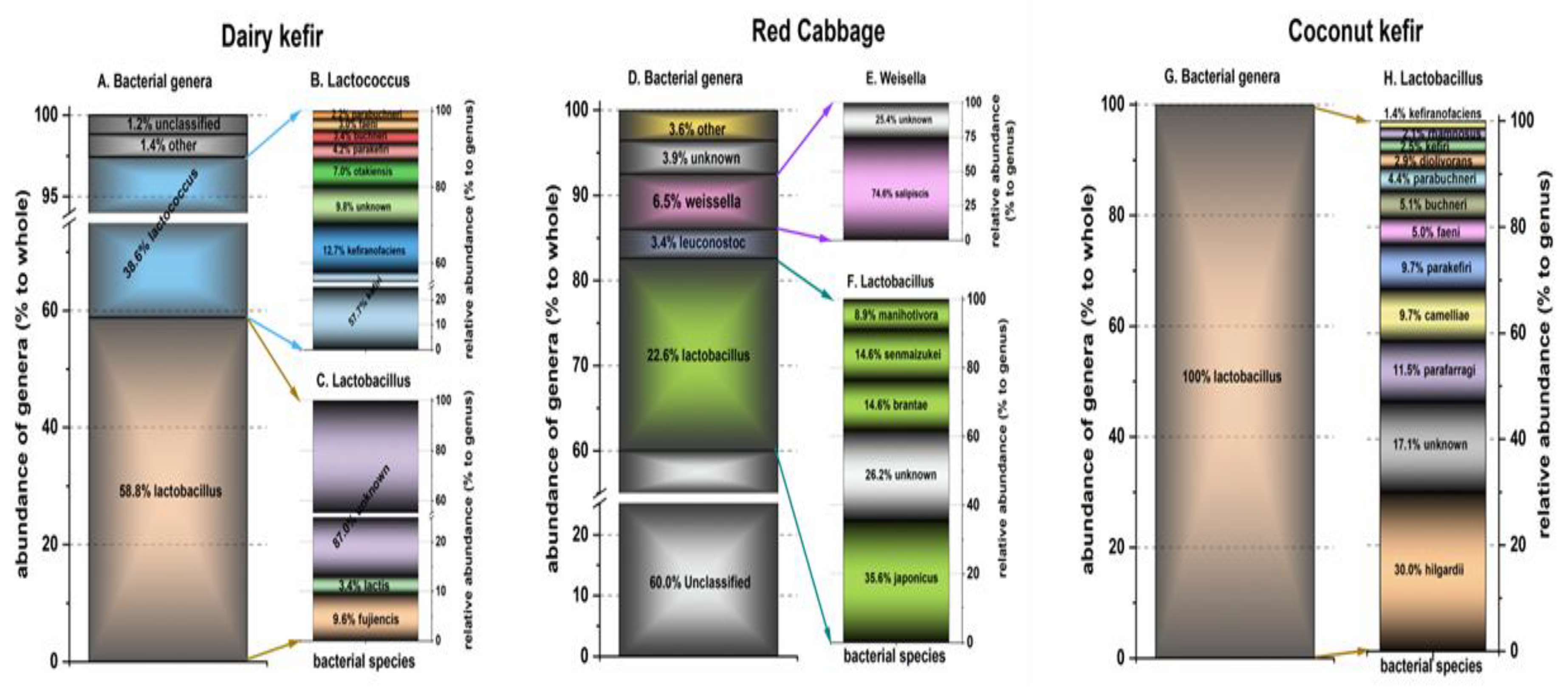
Only LAB taxa contributing more than 1% to the overall relative abundance were included in the analysis presented here (Figure 11). Many low-abundance taxa (<1%) were detected but are not shown.

3.7.1. Dairy Kefir

The dairy kefir shows a LAB community dominated primarily by Lactobacillus (58.8%) and Lactococcus (38.6%). The Lactobacillus species were largely unknown (87%), with notable contributions from L. fujiencis and L. lactis. The Lactococcus species were highly diverse, including L. Kefiranofaciens, L. kefiri, L. Otakiensis, L. parakefiri, L. buchneri, L. parabuchneri, and L. faeni. This profile reflects a typical LAB-rich environment of traditional dairy kefir, where both Lactocuccus and Lactobacillus play key roles in fermentation.

3.7.2. Fermented Red Cabbage and Beetroot

The fermented red cabbage and beetroot contained a broader variety of LAB genera but showed a high proportion of unclassified bacteria (60%).
Lactobacillus was the most abundant genus (22.6%), with species including L. japonicus, L. brantae, L. senmaizukei, and L. manihotivora. Weissella accounted for 6.5%, dominated by 75% W. salipiscis. Leuconostoc represented 3.4% of the community. This reflects the microbial diversity typical of spontaneous vegetable fermentations where early fermentation is often driven by Weissella and Leuconostoc.

3.7.3. Coconut Kefir

The coconut kefir was almost entirely composed of Lactobacillus (83.5%), with considerable species-level diversity, including L. hilgardii, L. parafaraggi, L. camelliae, L. parakefiri, L. faeni, L. buchneri, L. parabuchneri, L. diolivorans, L. kefiri, L. rhamnosus, and L. kefiranofaciens. This strongly Lactobacillus-dominated profile likely reflects substrate-driven selection during fermentation of coconut.

4. Discussion

This intervention trial investigated the effects of three distinct fermented foods containing live bacteria on cognitive performance, emotional health, and gastrointestinal health and. Although fermented foods are commonly regarded as health-promoting, they differ markedly in their microbial composition, flavour profiles, production methods, and geographical origins, factors that can shape their biological activity. Consistent with this variability, our findings support growing evidence that fermented foods with live microorganisms can exert measurable health effects. Crucially, and in line with our hypotheses, each product produced a unique pattern of outcomes across cognitive, emotional, and gastrointestinal domains. These differential effects aligned with clear differences in microbial communities and substrate characteristics, suggesting that specific fermentation-derived metabolic pathways and bioactive compounds were selectively engaged by each product.

4.1. Cognitive Function

The dairy kefir improved decision making, sustained attention and working memory, whereas the coconut kefir reduced waiting impulsivity and improved short-term memory. The fermented red cabbage and beetroot improved sustained attention and working memory (Figure 2, Figure 3, Figure 4 and Figure 5).
Our study demonstrates that dairy kefir significantly improved decision-making (Figure 3 and Figure 4A), sustained attention, and working memory (Figure 6A and B). These cognitive enhancements align with the known health benefits of kefir, which are attributed to its diverse bioactive compounds such as organic acids, bioactive peptides (including neurotransmitters), bacteriocins, and exopolysaccharides, as well as its unique microbiota [48].
Consistent with previous research, our findings support kefir’s role in enhancing cognitive function. Mohajeri et al. [49] reported improved cognition in healthy middle-aged women following a 19-day supplementation of 1g/day. Ton et al. [50] found that kefir (2ml/kg body weight), produced from grains and combined with strawberries, improved executive function and memory in Alzheimer’s patients, likely due to reduced systemic inflammation and oxidative stress, although the contribution of polyphenols from strawberries cannot be excluded. Van de Wouw et al. [51] demonstrated that kefir enhanced memory in mice via increased serotonergic signalling and GABA production.
In our study, we identified key microbial strains, Lactococcus lactis and Lactobacillus kefiri as members of the dairy kefir microbiome (Figure 11). These strains are known producers of GABA [30,52], a neurotransmitter that may enhance brain function either via vagus nerve stimulation or direct passage across the blood-brain barrier [52]. Notably, small amounts of GABA have been shown to cross the BBB [53].
Additional studies further support our findings. Noori et al. [54] observed memory improvements in a nicotine-cessation mouse model, potentially linked to increased serotonergic activity from tryptophan (TRP). Anwar et al. [55] reported enhanced memory in an Alzheimer’s rat model, attributed to elevated BDNF levels and reduced neuroinflammation.
Dairy kefir is known to be rich in the essential amino acid TRP [9,54,56,57]. Although we did not directly measure TRP content in the kefir used, previous analyses suggest levels ranging from 29–70 mg/100 ml [57,58], indicating that our participants likely consumed between 71 mg and 172.9 mg of TRP per portion. Given TRP’s role as the sole precursor to serotonin [59], and its ability to cross the blood-brain barrier [60], it is plausible that the TRP content in our dairy kefir contributed to the cognitive improvements observed in our participants. This interpretation is supported by prior studies demonstrating TRP’s influence on memory, decision-making, and executive function [62,63,64,65,66,67,68]. Our findings therefore add to the growing body of evidence suggesting that TRP intake, even at modest levels, may positively impact cognitive performance.
In addition, the cognitive improvements observed in our study may also involve the neuroactive metabolite of TRP, kynurenic acid (KynA). In vivo, dietary TRP is metabolised through three pathways, serotonin, indole and kynurenine (KYN), and approximately 95% proceed via the KYN pathway, where it is converted to kynurenic acid (KynA), a neuroprotective compound [69]. While systemic inflammation can shift this pathway toward the production of quinolinic acid (QA), a neurotoxic metabolite associated with memory impairment [70], KynA acts as a QA antagonist, potentially mitigating these effects. Previous studies have demonstrated low levels of KynA in individuals with Alzheimer’s disease [71], while recent rodent research has shown that even low doses of KynA can enhance memory [72]. Importantly, the KYN pathway is active in yeast and bacteria, and KynA has been detected in dairy kefir at concentrations ranging from 113.4 μg/L to 241.7 μg/L [57,73]. Although we did not measure KynA directly in our samples, its documented presence in dairy kefir suggests a plausible mechanism by which dairy kefir may support serotonergic neurotransmission and cognitive function.
Thus, the improved cognitive function observed in our study after taking dairy kefir for 30 days, is likely caused, in part, through GABA and TRP, and KynA driven improvement in serotonergic neurotransmission.
Furthermore, our study demonstrates the coconut kefir reduced waiting impulsivity and improved short-term memory (Figure 3 A and B). This improved cognitive function observed in the coconut kefir group is likely driven by the increased levels of butyrate, Lactobacillus, and Bifidobacterium (Figure 8 C and D, and Figure 9), which have been shown to influence modulatory neurotransmitter pathways. Research shows that dopamine (DA), serotonin (5-HT), and γ-Aminobutyric acid (GABA) reduce impulsivity [74,75,76,77,78], specifically in the Cambridge Gambling Task [79], and improve memory [80,81,82,83].
Building on this, several mechanisms may explain the cognitive improvements observed in our participants. For instance, butyrate, and oleic acid, a fatty acid found in coconuts [84], have been shown to activate intestinal vagal afferents [85], and stimulation of the vagal afferent fibres from the upper intestinal tract causes DA release in the brain [86]. The significant post-intervention increases in Bifidobacterium spp. and Lactobacillus spp. in the coconut kefir group (Figure 9) further support this, as these microbes are involved in DA and 5-HT metabolism. Lactobacillus spp. can produce 5-HT [87], Bifidobacterium spp. can produce DA [88], and both can produce TRP, a precursor to 5-HT [9,54,56,89]. Srivastav and colleagues [90] demonstrated a probiotic containing Lactobacillus and Bifidobacterium rescued dopaminergic neuronal loss in rats, hypothesized to be, in part, due to the increase in butyrate, and likely due to butyrate’s intrinsic histone deacetylase (HDAC) inhibiting actions [91]. Lactobacillus rhamnosus (now known as Lacticaseibacillus rhamnosus), one of the Lactobacillaceae species in the coconut kefir (Figure 11), demonstrated in vivo, to downregulate monoamine oxidase, an enzyme known to break down DA [90]. Moreover, enterochromaffin (EC) cells, located within the gut epithelia, store the largest pool of 5-HT in the body, and butyrate induce the release of 5-HT from EC cells [92]. Furthermore, butyrate can also incorporate colonic DA and produce serotonin through G-protein-coupled receptor (GPCR)-mediated pathways [93]. Two GPCRs that are expressed on enteroendocrine cells, including enteric and sympathetic neurons, are GPR41 (also known as FFAR3), and GPR43 (also known as FFAR2) [91]. Both FFAR2 and FFAR3 are preferentially activated by butyrate [94]. In addition, both Lactobacillus spp. [95] and Bifidobacterium spp. can produce GABA [88].
Taken together, the increases in Bifidobacterium spp., Lactobacillus spp., and butyrate, likely contributed to an improvement in cognitive function driven by their functional roles in dopaminergic, serotonergic and GABAergic systems. This is particularly noteworthy, as butyrate is emerging as a key neurological health enhancer [96].
Moreover, we observed significant correlations for ẞ-glucuronidase (GUS) and several significantly increased gut bacteria in the coconut kefir group, Anaerotruncus colihominis (R = .36, p = 0.017), Faecalibacterium prausnitzii (R = .41, p = 0.006), and Bifidobacterium spp. (R = .44, p = 0.003) (Figure 10). Notably, GUS activity increased by 69% in this group (Supplementary Table S1), although this change did not reach statistical significance (p > .05) (Table 6). Previous research has identified GUS as a key microbial enzyme involved in the production of biologically active DA and 5-HT [91,97]. Liu et al. [98] was the first study to report a correlation between gut microbiota and genes related to the 5-HT and DA pathways, and GUS activity appears to be one way in which gut microbiota can produce both DA and 5-HT [91,97]. Supporting this, Hata and colleagues [92] demonstrated in a murine model the deconjugation process of gut microbial GUS enhances the production of biologically active free 5-HT in the gut lumen, highlighting a plausible mechanism through which coconut kefir may influence cognitive function via the gut-brain axis.
Taken together, the coconut kefir intervention led to significant increases in butyrogenic commensals, which appear to play an important role in cognitive function through direct modulation of the gut-brain axis. Both bacterial GUS activity and butyrate production may represent key pathways for maintaining neurotransmitter concentrations that support cognitive performance.
In addition to microbial and SCFA changes (Figure 8), bioactive lipids in the coconut kefir may also have contributed to the observed cognitive improvements. Medium-chain triglycerides (MCTs), which make up over 50% of the total fat content in coconut [99], can cross the BBB and being oxidised within the brain, providing a direct energy source [100]. MCTs have been shown to increase brain energy by up to 9% [101], promote mitochondrial biogenesis in neurons [102], and enhance cognitive function, particularly memory, in both cognitively impaired and healthy individuals [100,103,104]. Although MCTs were not directly measured in the coconut kefir used in this study, the product contained 1.9 g of saturated fat per serving. Given that MCTs are saturated fats with shorter chain lengths [105], it is plausible that each serving contained up to 1 g of MCTs. Therefore, the potential contribution of MCTs to cognitive enhancement in this group cannot be ruled out.
Furthermore, our study demonstrates the fermented red cabbage and beetroot improved sustained attention and working memory (Figure 5 A and C). Whilst butyrate also increased significantly in the fermented red cabbage and beetroot group (Figure 8 C and E), as observed in the coconut kefir group, the cognitive improvements observed in the fermented red cabbage and beetroot group may additionally be influenced by the presence of red cabbage and beetroot bioactive phytochemicals. These compounds are known to possess antioxidant, anti-inflammatory, and neuroprotective properties, which may contribute to enhanced cognitive performance through mechanisms distinct from those observed in the kefir groups.
Red cabbage anthocyanins have been shown to positively influence the cognitive domains of attention and memory, reviewed by [106]. Preclinical studies suggest that anthocyanins can accumulate in brain regions associated with cognition within just a few weeks [107], and our findings align with previous research demonstrating anthocyanin-driven improvements in memory [108].
For example, Krikorian and colleagues [109] demonstrated significant improved memory in older adults with memory decline, while Lamport and colleagues [110], Haskell-Ramsay and colleagues [111], and Bowtell and colleagues [112] observed similar effects in healthy middle-aged and older adults, as well as young adults. In a rat model, anthocyanins demonstrated to cross the BBB, accumulate in various brain regions, and improve memory [113]. Importantly, Wiczkowski et al. [114] demonstrated that plasma polyphenol levels increased within 30 minutes of consuming fermented red cabbage, compared to a non-fermented product. This suggests that anthocyanins from fermented red cabbage are not only bioavailable but capable of entering the brain rapidly. Moreover, the non-fermented cabbage resulted in greater polyphenol losses via urine, highlighting the role of fermentation-associated microorganisms in enhancing anthocyanin bioavailability. Supporting this, Shukitt-Hale et al. [115] found that anthocyanins improved memory and increased DA release in ageing rats, further reinforcing their potential role in cognitive enhancement.
One of the ways polyphenols can exert direct influence in the brain appears to involve brain-derived neurotropic factor (BDNF). Polyphenol supplementation has demonstrated to increase BDNF expression in murine models, reviewed by [116], and several studies measuring memory, both human and rodent, reported the improvement in memory correlated with increased levels of BDNF [117,118]. BDNF and its role in synaptic plasticity [119,120], long-term potentiation (LTP) [121,122], and indeed neuronal survival, formation and growth of new neurons, as well as the formation of synapses [123], is widely shown to have a role in learning and memory in the adult central nervous system (CNS) [124,125,126,127]. In vitro, polyphenols were able to promote neurite growth through mechanisms involving BDNF [128], and in humans, polyphenol supplementation led to a substantial (143%) increase in plasma BDNF [129]. Additionally, butyrate has also demonstrated to enhance BDNF expression [125,130], and propionate, that also increased significantly in our fermented red cabbage and beetroot group (Figure 8 F), demonstrated to ameliorate memory in a diabetic rodent model [131], indicating a role for both butyrate and propionate in memory function.
It is important to note, a limitation in our study is we did not measure BDNF. We therefor recommend, any research wishing to explore the psychobiotic sensu stricto potential of fermented foods with polyphenols, should consider including BDNF as a biomarker.
Taken the above, the anthocyanins in the fermented red cabbage and beetroot likely had a direct impact on the brain regions that influence cognitive function, possibly involving the increased expression of neuroprotective BDNF.

4.2. Emotional Health

The dairy kefir reduced depression, anxiety and stress (Figure 7). The fermented red cabbage reduced stress (Figure 7), and all three products improved total mood (TDASS) (Figure 7).
Our study found that dairy kefir consumption significantly reduced symptoms of depression, anxiety, and stress (Figure 7). This aligns with previous findings, such as Pražnikar et al. [132], who reported mood improvements in overweight adults following dairy kefir intake, and Noori et al. [54], who observed reduced nicotine withdrawal-induced anxiety and depression in rats. The presence of Lactobacillus kefiranofaciens, a dominant strain in our dairy kefir, may explain these effects, given its role in modulating TRP metabolism and attenuating HPA axis hyperactivity [133]. Since stress and anxiety are linked to HPA axis dysregulation [134], our findings suggest that dairy kefir’s microbial composition may help restore neuroendocrine balance.
Moreover, our dairy kefir contained L. lactis and L. kefiri, both known GABA producers [135,136,137,138] which may contribute to the observed mood improvements. GABA’s inhibitory role in the gut-brain axis is well-documented in reducing stress-related behaviours [52,139]. Supporting this, Van de Wouw et al. [51] found that kefir reduced stress-induced corticosterone responses and improved colonic serotonergic signalling in mice. Additionally, Tillisch et al. [140] demonstrated that fermented milk products containing L. lactis altered brain activity in regions associated with emotion processing.
Taken together, our results suggest that the mood-enhancing effects of dairy kefir may be mediated through TRP and GABA pathways, influencing both the HPA axis and CNS. These findings build on existing literature by identifying specific microbial strains and mechanisms that may underlie dairy kefir’s psychobiotic potential.
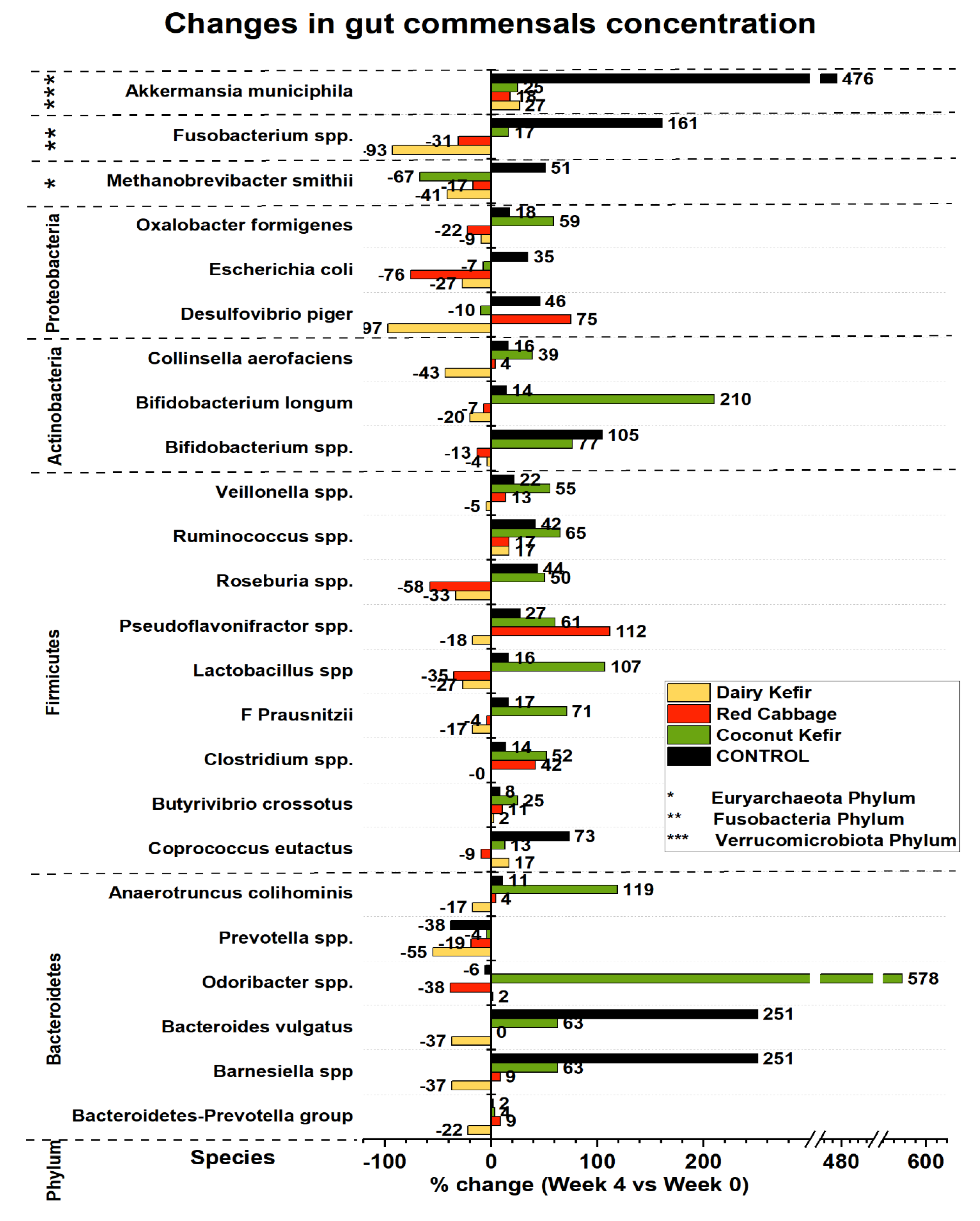
Although not statistically significant, our study observed notable antimicrobial modulation of the gut microbiota following dairy kefir consumption, including reductions in Lactobacillus spp. (−27%), Collinsella spp. (−43%), and Fusobacteria (−92%) (Figure 12). These shifts suggest a broad-spectrum antibacterial effect, consistent with kefir’s known antimicrobial properties [141,142,143,144,145,146,147]. Importantly, elevated levels of Lactobacillus spp. and Collinsella spp. have been associated with depressive symptoms [148,149,150] while Fusobacteria has been linked to bipolar disorder and its comorbid anxiety and depression [151,152]. Thus, the observed reductions in these taxa may reflect a microbiota-mediated pathway contributing to mood improvement.
The presence of Lactococcus lactis in our dairy kefir formulation (Figure 11) likely played a key role in this antimicrobial activity. As a fast fermenter with high acidification capacity [153], L. lactis produces lactic acid, bacteriocins [154,155,156], and hydrogen peroxide [157], all of which contribute to microbial suppression. These mechanisms may help explain the gut microbial shifts observed in our cohort and support the hypothesis that our dairy kefir’s antimicrobial effects are linked to its psychobiotic potential.
Taken together, our findings suggest that the mood-enhancing effects of our dairy kefir may be partially mediated by its ability to reshape the gut microbiota, reducing taxa associated with poor mental health and promoting a more neuroprotective microbial profile.
Furthermore, our study found that coconut kefir consumption significantly improved total mood scores (Figure 7), suggesting a broad psychobiotic effect. This improvement is likely mediated, at least in part, by the calming influence of GABA, given the significant post-intervention increase in Lactobacillus spp. observed in the coconut kefir group. Notably, Laticaseibacillus rhamnosus (formerly Lactobacillus rhamnosus), a lactic acid bacterium in our coconut kefir formulation (Figure 11), has been shown to modulate GABA receptor expression, reduce stress-induced corticosterone levels, enhance memory, and alleviate anxiety-like behaviour in mice via vagus nerve signalling [158]. Magnetic resonance spectroscopy further confirmed increased brain GABA levels following L. rhamnosus supplementation [159].
Additionally, Lactobacillus hilgardii, a dominant LAB species in our coconut kefir, is widely used in industrial bio-fermentation to produce bio-identical GABA [95], reinforcing the potential for GABAergic modulation. The presence of abundant GABA-producing genes in Lactobacillus spp. [95] supports the hypothesis that the coconut kefir’s microbial composition contributed to the observed mood improvements through inhibitory neurotransmission along the gut-brain axis.
Taken together, our findings suggest that our coconut kefir may exert its mood-enhancing effects via GABA-mediated pathways, facilitated by specific LAB strains with known neuroactive properties. This adds to the growing body of evidence supporting the psychobiotic potential of fermented non-dairy products.
In addition, we observed a significant moderate correlation between Odoribacter spp. and both GUS activity (R = .54, p < 0.001) and depression scores (R = −.31, p = 0.048) (Figure 10). Notably, in the coconut kefir group Odoribacter spp. increased by 575% post-intervention (p = > .05) (Figure 12), alongside a 46% reduction in intestinal inflammation (EPX) (p = > .05) (Supplementary Table S1), which also correlated significantly with depression (R = .52, p < 0.001) (Figure 10). Additionally, the coconut kefir group experienced a non-significant 69% increase in GUS activity (Supplementary Table S1), further supporting the link between microbial shifts and enzymatic function. These findings suggest that Odoribacter spp. may play a role in mood regulation through its influence on gut enzymatic activity and inflammation.
Previous studies have identified GUS enzymes in Odoribacter isolated from humans [160], and Edwinson et al. [161] demonstrated that elevated faecal GUS activity in humanised mice was associated with reduced intestinal proteolytic activity (PA) via GUS-mediated inhibition of proteases. Since high PA has been linked to increased intestinal inflammation and elevated anxiety and depression scores in humans [161], our findings support the hypothesis that GUS-producing commensals like Odoribacter may contribute to mood improvement by mitigating inflammatory processes.
Further supporting this, Odoribacter splanchnicus has been shown to exert anti-inflammatory effects in enterocytes in vitro [162]. The connection between intestinal inflammation and mood disorders is well established [89,163,164,165], and high PA has been implicated in epithelial barrier damage following antibiotic treatment [166] and in various gastrointestinal diseases [167,168]. Germ-free and microbiota-depleted murine models also exhibit elevated faecal PA, underscoring the microbiota’s role in modulating this activity [169].
Taken together, our results suggest that the increase in Odoribacter spp. and associated GUS activity may have contributed to reduced intestinal inflammation, which in turn may have supported the observed improvements in mood in our coconut kefir group.
Furthermore, our study demonstrated that fermented red cabbage and beetroot significantly reduced stress levels (Figure 7), an effect likely mediated by the combined influence of short-chain fatty acids (SCFAs), polyphenols, and GABA on the gut-brain axis (GBA). As previously discussed, this group also showed significant increases in butyrate and propionate (Figure 8 E and G), both SCFAs known to modulate neuroendocrine responses. SCFA supplementation has been shown to downregulate stress signalling and attenuate HPA axis responsiveness, key components of the GBA [170,171,172,173].
In addition to SCFAs, GABA likely contributed to the observed stress reduction. Several microbial strains present in our fermented red cabbage and beetroot, including Leuconostoc, and Weissella (Figure 11), are known GABA producers [52]. Wei and Marco [174] recently quantified GABA concentrations in fermented cabbage between 300 and 500 µg/mL after a 14-day ferment, with levels more than doubling post-fermentation. These findings support the hypothesis that microbial GABA production may play a role in stress attenuation, complementing the anti-inflammatory and neuroactive effects of SCFAs and polyphenols.
Taken together, our results suggest that our fermented red cabbage and beetroot may exert psychobiotic effects through multiple synergistic pathways, offering a promising dietary intervention for stress management.
Moreover, our study suggests that the stress-reducing effects observed in the fermented red cabbage and beetroot group may be partly mediated by anthocyanin-derived microbial metabolites, particularly 3-hydroxycinnamic acid. This compound, transformed by gut microbiota from red cabbage cyanidin -3-glucoside (CG3) [175], has demonstrated potent anti-stress properties, likely through anti-inflammatory mechanisms [25,116,150]. Given that stress is a known driver of neuroinflammation [176], and inflammation is a key pathway in GBA signalling, our findings support the hypothesis that fermented red cabbage and beetroot may modulate neurological health via anti-inflammatory action.
One mechanism may involve the vagus nerve, which activates the HPA axis in response to stress [177]. Neuroinflammation can impair negative-feedback regulation of the HPA axis [178], and gut-derived polyphenols have been shown to reduce neuroinflammation [179,180,181,182]. Notably, purple anthocyanins have demonstrated the ability to inhibit microglial activation, an inflammatory response linked to stress, possibly via stimulation of fractalkine secretion [183,184]. Fractalkine, a chemokine involved in synaptic plasticity [185], plays a critical role in microglial-neuronal crosstalk and helps maintain microglia in a resting state [186,187]. Meireles et al. [188] showed that CG3 significantly increased fractalkine levels in both rat and neuronal cell models, further supporting its neuroprotective potential.
Additionally, anthocyanins have been shown to stimulate TRP metabolism along the KYN pathway [189], a process increasingly recognized as a therapeutic target for stress-related disorders [190]. Dysregulation of this pathway contributes to neuroinflammation [191], and anthocyanins have been found to enhance cognitive resilience to stress [192]. For a comprehensive overview of polyphenol-mediated inflammasome inactivation, see Westfall and Pasinetti [150].
To our knowledge, this is the first study to demonstrate a significant reduction in stress following fermented red cabbage and beetroot consumption in healthy adults. This novel finding adds to a limited body of research on the psychobiotic potential of fermented vegetables. The observed improvement is likely mediated by a combination of GBA mechanisms, including increased levels of propionate and butyrate, elevated GABA production, and the neuroactive effects of red cabbage and beetroot anthocyanins. Stress is known to compromise intestinal barrier integrity, increasing permeability and triggering systemic and neuroinflammation [191,193]. SCFA supplementation has previously been shown to counteract stress-induced intestinal permeability and HPA axis dysregulation [170,171,172,173]. Additionally, Wei and Marco [174] demonstrated that fermented cabbage protects intestinal tissue from inflammatory damage in vitro, supporting its potential anti-inflammatory role.
Taken together, our findings suggest that fermented red cabbage and beetroot may exert stress-reducing effects through a multifaceted and synergistic mechanism involving microbial transformation of anthocyanins, production of SCFAs, polyphenol metabolism, and GABA synthesis. These pathways collectively contribute to enhanced TRP metabolism, improved gut barrier integrity, and reduced neuroinflammation, highlighting the potential of these fermented vegetables as psychobiotic interventions and functional foods for mental health support.

4.3. Gastrointestinal Health

The coconut kefir modified the gut microbiota (Figure 9) and increased butyrate (Figure 8 C and D) whereas the fermented red cabbage and beetroot increased butyrate and propionate (Figure 8 C,E,F and G). The control group experienced a significant increase in Fusobacterium spp. (Figure 9).
Our study demonstrates the coconut kefir significantly modified the gut microbiota (Figure 9) and increased butyrate levels (Figure 8 C and D). Key butyrate-associated commensals increased markedly in this group, including Faecalibacterium prausnitzii (71%), Bifidobacterium spp. (77%), Lactobacillus spp. (107%), and Anaerotruncus colihominis (119%) (Figure 9). These shifts suggest a robust enhancement of butyrogenic potential within the gut ecosystem.
Faecalibacterium prausnitzii, a major butyrate producer from the Firmicutes phylum, plays a central role in maintaining intestinal health [194,195,196]. Its growth is supported not only by dietary polysaccharides but also by cross-feeding interactions with lactate-producing bacteria such as Bifidobacterium spp. [197]. These Actinobacteria produce acetate and lactate via the bifid shunt pathway, which serve as substrates for butyrate synthesis [198]. Additionally, Bifidobacteriaceae express enzymes that convert succinate into butyrate [199], and kefir supplementation has been shown to increase faecal succinate in mice [51].
The prominence of Bifidobacterium spp. in our coconut kefir group is particularly noteworthy. Recognized as keystone species within the gut microbiota [200], their abundance is associated with host health and resilience. The concept of the “bifidogenic effect” [201] reflects their ability to promote beneficial microbial symbiosis and butyrate production. A decline in Bifidobacterium spp. is considered a marker of poor health [202], and their restoration has become a focus of microbiome-targeted therapies [197,201,203,204]. Adding to this evidence, the recent multiomics study of the world’s longest-lived individual (117 years) revealed a microbiome dominated by beneficial Bifidobacterium species, linking their presence to healthy aging and exceptional lifespan [205].
These microbial shifts observed in our coconut kefir group suggest active cross-feeding interactions, where lactate and acetate produced by Bifidobacterium spp. likely supported the growth of F. prausnitzii, a major butyrate producer. This dynamic is consistent with previously described syntrophic relationships between these taxa [197]. The elevation in butyrate is particularly noteworthy given its central role in gut and systemic health. As the preferred energy source for colonic epithelial cells [206], butyrate supports gut barrier integrity by upregulating junction adhesion molecules [196,207]. This function is critical, as compromised epithelial integrity has been linked to systemic inflammation and disease progression, including cardiac complications in COVID-19 [208,209].
Modulation of the gut microbiome to increase butyrate-producing bacteria is subject to significant research interest [210,211], due to butyrate’s association with the protection from a myriad of human diseases, including colorectal cancer [212], arthritis [213], diet-induced obesity [214,215,216] diabetes [217] and Alzheimer’s Disease reviewed in [218]. Moreover, butyrate’s immunomodulatory and anti-inflammatory properties extend beyond the gut, influencing neuroinflammation and metabolic regulation [219,220]. Its ability to maintain anaerobic conditions in the colon also helps suppress pathogenic bacteria near the epithelium [221], and low butyrate levels have been shown to trigger bacterial virulence gene expression [222].
Furthermore, in our study, the coconut kefir consumption led to a noteworthy 59% increase in Oxalobacter formigenes (p > 0.5) (Figure 12). Although not statistically significant, this bloom may be biologically meaningful given the emerging role of O. formigenes in gut and systemic health. This dominant oxalate-degrading commensal has been shown to express genes for butyrate production [223], utilize succinate and acetate, synthesize lactate, and contribute to carbohydrate metabolism [224,225]. It is also considered a key player in the gut-kidney axis [226]. Despite limited understanding of the factors governing its colonization, O. formigenes has been proposed as an ecological indicator of microbial diversity and resilience in human faecal samples [227]. Its enrichment in the coconut kefir group may reflect a favourable shift in microbial ecology, potentially contributing to the observed increase in butyrate and supporting broader gut health outcomes.
In addition, the coconut kefir group exhibited a non-significant 55% increase in Veillonella spp. (Figure 12) which may be biologically meaningful given the exceptionally high concentration of lactic acid bacteria (LAB) in the kefir (~10¹¹ CFU/g) (Table 1) and the resulting lactate-rich environment at the point of consumption. Veillonella spp. are known lactate-utilizers, and their proliferation suggests active lactate metabolism [228]. Notably, a non-significant 52% increase in Clostridium spp. was also observed (Figure 12). Members of this genus, particularly Clostridium butyricum, can convert lactate and acetate into butyrate [229]. These microbial shifts point to a lactate-driven butyrate synthesis pathway involving Veillonella spp. and Clostridium spp., which may have contributed to the observed improvements in gastrointestinal and emotional health in the coconut kefir group.
Taken together, our findings suggest that coconut kefir enhances butyrate production through microbial cross-feeding and enrichment of key butyrogenic commensals, alongside biologically meaningful, though non-significant, blooms in Veillonella spp. and Clostridium spp., which are known to participate in lactate-driven butyrogenic pathways. The presence of high LAB concentrations in the kefir likely created a lactate-rich environment that supported these microbial shifts. The increase in Bifidobacterium spp. observed in our study not only reinforces the coconut kefir’s potential as a functional food for gut and mental health but also aligns with emerging evidence linking these microbes to healthy aging and longevity. This dual role supporting SCFA synthesis and contributing to age-related resilience highlights the broader therapeutic promise of coconut kefir in microbiome-targeted interventions. The resulting elevation in butyrate, a key biomarker of gastrointestinal health, underscores the functional potential of coconut kefir in supporting both gut integrity and emotional well-being.
Furthermore, our study demonstrates that fermented red cabbage and beetroot significantly increased levels of butyrate and propionate (Figure 8 C,E,F and G). These increases are likely driven by a combination of microbial fermentation of dietary fibre and polyphenols, as well as the presence of exogenous SCFAs in the fermented product. Red cabbage and beetroot are both high-fibre foods rich in phenolic compounds, particularly anthocyanins in red cabbage [230,231] and polyphenols in beetroot [232]. Human faecal fermentation of cabbage cellulose has previously been shown to produce both propionate and butyrate in vitro [233], and polyphenols are recognized precursors of propionate [234].
Anthocyanins, a subgroup of polyphenols responsible for red, blue, and purple pigmentation, possess glycosidic structures that can be deconjugated by gut commensals using carbohydrate-active enzymes (CAZymes) such as GUS [235]. These microbial transformations facilitate SCFA production, particularly propionate and butyrate. Most polyphenols in whole foods are bound to indigestible cell wall polysaccharides, forming polyphenolic fibres that reach the colon largely intact. In fact, 80% – 95% of ingested anthocyanins are not absorbed and reach the colon [236,237,238,239]. In the colon, they are released by microbial CAZymes and fermented into SCFAs [240,241,242].
Interestingly, SCFAs themselves appear to enhance the absorption of microbiota-derived polyphenol metabolites, suggesting a synergistic relationship between dietary fibre, polyphenols, and SCFA production [242]. For example, Van Rymenant et al. [240] demonstrated that propionate and butyrate increased the bioavailability of hydroxycinnamic acid, a common metabolite derived from red cabbage anthocyanins. This interplay may help explain inconsistencies in the reported duplibiotic effects of polyphenols across in vivo studies, particularly when comparing whole-food sources to purified supplements. The chemical structure and extraction methodology of polyphenols significantly influence their bioactivity and fermentation potential [243,244].
Taken together, our findings suggest that the increase in SCFAs observed in the fermented red cabbage group reflects a complex and synergistic interaction between dietary fibre, polyphenols, and gut microbial metabolism, underscoring the value of whole-food fermentation in supporting gut and systemic health.
Although fermented red cabbage did not significantly modify overall gut microbiota composition, our study identified noteworthy blooms in Pseudoflavonifractor spp. (112%), Clostridium spp. (42%), and Barnesiella spp. (23%) (Figure 12). These taxa also showed significant correlations with gut microbial β-glucuronidase (GUS) activity: Pseudoflavonifractor spp. (R = .56, p < 0.001), Clostridium spp. (R = .45, p = 0.002), and Barnesiella spp. (R = .35, p = 0.023) (Figure 10). While GUS itself increased by 45% in this group, it did not reach statistical significance (Supplementary Table S1). Nonetheless, both Clostridium spp. and Barnesiella spp. are recognized members of the gastrointestinal GUSome [160], and functional metagenomic studies have confirmed GUS expression in Clostridium spp. [245,246,247]. These taxa also appear in the Carbohydrate Active Enzymes (CAZy) database, indicating their enzymatic capacity for polyphenol and fibre degradation [248].
Our findings align with previous studies showing similar microbial shifts following fermented cabbage intake [249,250], and polyphenol-driven increases in Barnesiella spp. and Clostridium spp. in rodent models [251,252,253,254]. Higher intake of anthocyanin-rich foods has also been associated with increased Clostridia abundance in humans [255], and Clostridium-rich microbiota have been linked to elevated butyrate production [256]. Similarly, Pseudoflavonifractor spp. has been shown to proliferate in response to purple anthocyanins [189] and is known to degrade flavonoids via polyphenol-associated enzymes (PAZymes), suggesting a role in microbial cross-feeding following GUS-mediated deconjugation [257,258]. We propose that the observed increases in propionate and butyrate in this group were driven by fibre and polyphenol-mediated modulation of gut microbiota expressing CAZymes, GUS, and PAZymes. The blooms in Pseudoflavonifractor spp., Barnesiella spp., and Clostridium spp. likely reflect syntrophic interactions, where certain microbes degrade anthocyanin-bound fibres, releasing substrates for fermentation by others [259].
Additionally, food substrate fermentation itself may have contributed to SCFA enrichment. Several studies have shown that fermentation can introduce or significantly increase butyrate and propionate in foods [260,261,262,263].
Fermented food microbiota can ferment the sugar moieties of anthocyanins following GUS-mediated deconjugation [264,265,266,267,268], leading to SCFA production [261]. Specifically, cyanidin-3-glucoside (CG3), the dominant anthocyanin in red cabbage, can be transformed by lactic acid bacteria into 3-hydroxycinnamic acid [269], which may then be further metabolized into phenylpropionic acid by LAB bacteria expressing polyphenol-associated enzymes (PAZymes), such as phenolic acid reductase. [269]. Importantly, phenylpropionic acid may serve as a precursor to propionate, potentially via the pentose phosphate pathway, as suggested by an inverse association between faecal phenylpropionic acid and propionate [270,271]. This pathway highlights a novel mechanism by which polyphenol metabolites may contribute to SCFA biosynthesis and host health.
While evidence on the colonic delivery of orally ingested SCFAs is mixed, several studies have demonstrated their detectability in faecal samples and plasma. Fang et al. [272] and Smith et al. [273] showed that butyrate and propionate supplementation restored SCFA levels and improved gut barrier function in mice. Conversely, Van de Wouw et al. [170] found no change in faecal SCFA levels, possibly due to rapid absorption [274,275]. Shimizu et al. [276] further demonstrated that dietary SCFA intake elevated plasma SCFA concentrations and exerted metabolic benefits in a high-fat-diet-induced obese mouse model.
Taken together, these findings suggest that the significant increase in butyrate and propionate observed in our fermented red cabbage group likely reflects a combination of microbial fermentation of polyphenolic fibres and the contribution of food-associated SCFAs, reinforcing its potential as a functional food for gut and metabolic health.
Interestingly, our control group exhibited a significant increase in Fusobacterium spp. (Figure 10), a genus commonly associated with pro-inflammatory states and gastrointestinal dysbiosis. In contrast, the dairy kefir group experienced a non-significant 92% reduction in Fusobacterium spp. (Figure 12). This finding is noteworthy, as Fusobacterium has been implicated in various pathological conditions, including colorectal inflammation and impaired mucosal barrier function [277]. The observed increase in the absence of fermented food intervention may reflect a natural drift in microbial composition toward less favourable profiles, underscoring the potential protective role of fermented foods with live bacteria. These results further support the hypothesis that regular consumption of fermented foods may help stabilize or improve gut microbial balance, particularly by suppressing the proliferation of potentially harmful taxa.
It is important to note that our study was limited to 24 gut commensal measurements provided by the Genova Diagnostics GI Effects laboratory test (Table 3, Figure 12). As a result, it is likely that other butyrate- and propionate-producing taxa not captured in our dataset, such as Eubacterium spp., may have contributed to the observed SCFA increases. Eubacterium has been identified as a key butyrate producer in the human gut [278], and its absence from our measurements highlights the need for broader microbial profiling in future studies.
Additionally, recent research supports the role of other unmeasured taxa in SCFA production. For example, Lachnospiraceae, a family of anaerobic bacteria known to convert lactate and acetate into butyrate [279], was shown to increase in healthy adults following fermented cabbage intake [280]. Data from the American Gut Project [281], involving 6,811 individuals, further demonstrated that Lachnospiraceae abundance was positively associated with self-reported regular consumption of fermented foods.
Beyond SCFA-producing taxa, our findings also highlight the relevance of other microbial functions, such as GUS which may play a beneficial role in cognitive function and emotional health. However, GUS also has important pharmacokinetic implications [282], underscoring its complex and context-dependent impact on systemic health.
The primary limitation of this study was the absence of shotgun metagenomic sequencing for the fermented food products used in the intervention. Although 16S rRNA profiling enabled broad taxonomic characterisation, shotgun sequencing would have provided higher-resolution insights into strain-level composition and functional gene content, including metabolic pathways and bioactive compound–producing capacities. Such information would have strengthened the mechanistic interpretation of the differential health effects observed across the three fermented foods. Future studies incorporating shotgun metagenomics of both products and participant samples will allow a more comprehensive understanding of how specific microbial functions contribute to cognitive, emotional, and gastrointestinal outcomes.

5. Conclusions

This intervention trial provides substantial evidence that commercially available fermented foods containing live bacteria can exert measurable and distinct effects on cognitive function, emotional health, and gastrointestinal health in healthy adults. While all three fermented foods, dairy kefir, coconut kefir, and fermented red cabbage and beetroot, demonstrated improvements in cognitive and emotional domains, only coconut kefir and fermented red cabbage and beetroot significantly enhanced gastrointestinal health, particularly through increased production of SCFAs.
The cognitive benefits observed were product-specific, with dairy kefir enhancing decision-making and sustained attention likely via GABA and tryptophan-mediated serotonergic pathways. Coconut kefir improved short-term memory and reduced impulsivity, potentially through butyrate-driven modulation of the gut-brain axis and increased levels of Lactobacillus and Bifidobacterium. Fermented red cabbage and beetroot contributed to cognitive improvements possibly through neuroprotective anthocyanins and SCFA production.
Emotional health outcomes also varied by product. Dairy kefir significantly reduced symptoms of depression, anxiety, and stress, likely through modulation of the HPA axis and GABAergic activity. Coconut kefir improved total mood scores, potentially via anti-inflammatory effects and microbial GABA production. Fermented red cabbage and beetroot uniquely reduced stress, marking a novel finding in the literature and suggesting a synergistic role of polyphenols, SCFAs, and microbial metabolites in mood regulation.
Gastrointestinal health improvements were most pronounced in the coconut kefir and fermented red cabbage and beetroot groups. Coconut kefir promoted butyrogenic bacterial blooms and cross-feeding interactions, while fermented red cabbage increased both butyrate and propionate, likely due to its fibre and polyphenol content and pre-existing SCFA levels in the product at consumption. Additionally, the significant increase in Fusobacterium spp. observed in the control group highlights the potential for unfavourable microbial shifts in the absence of dietary intervention, further reinforcing the stabilizing and health-promoting effects of fermented foods with live bacteria.
Taken together, these findings reinforce our hypothesis that health benefits from fermented foods are not uniform but depend on the microbial diversity and substrate composition of each product. This underscores the need for future randomized controlled trials that investigate differentiated fermented food categories using real-world products accessible to consumers. To advance this field, future research should explore how individual baseline microbiota profiles influence responsiveness to specific fermented foods. Personalized nutrition approaches, incorporating microbiome sequencing and metabolomic profiling, may unlock deeper insights into the mechanisms driving these effects and support tailored dietary recommendations for optimal cognitive, emotional, and gastrointestinal health.

Supplementary Materials

The following supporting information can be downloaded at the website of this paper posted on Preprints.org, Figure S1: Correlations Heatmap; Table S1: Gastrointestinal health biomarkers.

Author Contributions

Conceptualization, A.B; methodology, A.B., K.M, and NG; software, A.B. and K.M.; validation, A.B. and K.M; formal analysis, A.B.; investigation, A.B. data curation, A.B., K.M. and N.G.; writing—original draft preparation, A.B; writing—review and editing, A.B., K.M. and N.G.; visualization, A.B., K.M.; supervision, K.M., and N.G.; project administration, A.B.; funding acquisition, A.B. All authors have read and agreed to the published version of the manuscript.

Funding

This research was funded by South Bank Innovation’s London Agri-Food Innovation Clinic (LAFIC), which was set up to support and promote research and innovation in London’s food businesses. It was co-funded by London South Bank University and the European Regional Development Fund (ERDF 23R17P01763). Carr Foods Ltd., Rhythm Health Ltd., and Filthy Healthy Ltd. provided the intervention products.

Institutional Review Board Statement

The study was conducted in accordance with the Declaration of Helsinki and approved by the School of Applied Sciences Ethics Committee (SASEC) of London South Bank University, ETH1819-0142.

Informed Consent Statement

Informed consent was obtained from all subjects involved in the study.

Data Availability Statement

The data used to support the findings of this study can be made available by the corresponding author upon request.

Conflicts of Interest

A.B., K.M, and N.G. were employees of London South Bank University during the study period. We confirm that Carr Foods Ltd., Rhythm Health Ltd., and Filthy Healthy Ltd. had no influence on the study outcomes or publication.

Abbreviations

The following abbreviations are used in this manuscript:
5HT Serotonin
BBB Blood–Brain Barrier
BDNF Brain-Derived Neurotrophic Factor
CANTAB Cambridge Neuropsychological Test Automated Battery
CAZymes Carbohydrate-Active Enzymes
CG3 Cyanidin-3-glucoside
CGT Cambridge Gambling Task
CGTDAVT Cambridge Gambling Task – Delay Aversion
CGTDMGMT Cambridge Gambling Task – Decision-Making under Risk
CGTDMMT Cambridge Gambling Task – Delay Match-to-Memory
CGTRTKMT Cambridge Gambling Task – Risk-Taking Measure
CHO Carbohydrate
CNS Central Nervous System
DA Dopamine
DASS Depression Anxiety and Stress Scale
DMS Delayed Matching to Sample
DMSPC DMS – Percent Correct
DMSTC DMS – Total Correct
EC Enterochromaffin cells
EDN Eosinophil-Derived Neurotoxin
EPX Eosinophil Protein X
FFAR2 Free Fatty Acid Receptor 2
FFAR3 Free Fatty Acid Receptor 3
fSigA Fecal Secretory Immunoglobulin A
GABA Gamma-Aminobutyric Acid
GBA Gut–Brain Axis
GI Gastrointestinal
GPCR G-Protein-Coupled Receptor
GPR41 G-Protein-Coupled Receptor 41
GPR43 G-Protein-Coupled Receptor 43
GUS β-Glucuronidase
GUSome Glucuronidase Enzyme System
HDAC Histone Deacetylase
HPA Hypothalamic–Pituitary–Adrenal Axis
ISAPP International Scientific Association for Probiotics and Prebiotics
KYN Kynurenine
KynA Kynurenic Acid
LAB Lactic Acid Bacteria
MCT Medium chain triglycerides
MYMOP Measure Yourself Medical Outcome Profile
PA Proteolytic activity
PAZymes Polyphenol Active Enzymes
POMS Profile of Mood States
RVP Rapid Visual Processing
RVPA RVP – Omissions Accuracy
RVPML RVP – Mean Latency
RVPTFA RVP – Total False Alarms
RVPTH RVP – Total Hits
SCFA Short-Chain Fatty Acid
TDASS Total Depression, Anxiety and Stress Score
TMD Total Mood Disturbance
TRP Tryptophan

References

  1. Byun, M.; Yu, O.; Cha, Y.; Park, T. Korean traditional Chungkookjang improves body composition, lipid profiles and atherogenic indices in overweight/obese subjects: a double-blind, randomized, crossover, placebo-controlled clinical trial. European Journal of Clinical Nutrition 2016, 70(10), 1116–1122. [Google Scholar] [CrossRef]
  2. Lim, J; Jung, E; Choi, E; Jeong, D; Jo, S; Jin, J; et al. Supplementation with Aspergillus oryzae-fermented kochujang lowers serum cholesterol in subjects with hyperlipidemia. Clinical Nutrition 2015, 34(3), 383. [Google Scholar] [CrossRef] [PubMed]
  3. Tu, M; Chen, H; Tung, Y; Kao, C; Hu, F; Chen, C. Short-Term Effects of Kefir-Fermented Milk Consumption on Bone Mineral Density and Bone Metabolism in a Randomized Clinical Trial of Osteoporotic Patients. PLoS ONE 2015, 10(12). [Google Scholar] [CrossRef]
  4. Han, K; Bose, S; Wang, J; Kim, B; Kim, MJ; Kim, E; et al. Contrasting effects of fresh and fermented kimchi consumption on gut microbiota composition and gene expression related to metabolic syndrome in obese Korean women. Molecular Nutrition Food Res 2015, 59(5), 1004. [Google Scholar] [CrossRef] [PubMed]
  5. Özcan, H; Oskay, Ü; Bodur, AF. Effects of Kefir on Quality of Life and Sleep Disturbances in Postmenopausal Women. Holistic Nursing Practice 2019, 33(4), 207. [Google Scholar] [CrossRef]
  6. Pražnikar, ZJ; Kenig, S; Vardjan, T; Bizjak, MČ; Petelin, A. Effects of kefir or milk supplementation on zonulin in overweight subjects. Journal of Dairy Science 2020, 103(5), 3961. [Google Scholar] [CrossRef]
  7. Marsh, AJ; O’sullivan, O; Hill, C; Ross, RP; Cotter, PD. Sequencing-Based Analysis of the Bacterial and Fungal Composition of Kefir Grains and Milks from Multiple Sources. PLoS ONE 2013, 8(7). [Google Scholar] [CrossRef]
  8. Marco, ML; Heeney, D; Binda, S; Cifelli, CJ; Cotter, PD; Foligné, B; et al. Health benefits of fermented foods: microbiota and beyond. Current Opinion in Biotechnology 2017, 44, 94–102. [Google Scholar] [CrossRef]
  9. Peluzio, MDCG; Dias, MDME; Martinez, JA; Milagro, FI. Kefir and Intestinal Microbiota Modulation: Implications in Human Health. Front Nutr 2021, 8. [Google Scholar] [CrossRef]
  10. Melini, F; Melini, V; Luziatelli, F; Ficca, AG; Ruzzi, M. Health-Promoting Components in Fermented Foods: An Up-to-Date Systematic Review. Nutrients 2019, 11(5), 1189. [Google Scholar] [CrossRef] [PubMed]
  11. Stiemsma, LT; Nakamura, RE; Nguyen, JG; Michels, KB. Does Consumption of Fermented Foods Modify the Human Gut Microbiota? The Journal of Nutrition 2020, 150(7), 1680. [Google Scholar] [CrossRef]
  12. Dimidi, E; Cox, SR; Rossi, M; Whelan, K. Fermented Foods: Definitions and Characteristics, Impact on the Gut Microbiota and Effects on Gastrointestinal Health and Disease. Nutrients 2019, 11(8), 1806. [Google Scholar] [CrossRef]
  13. Leeuwendaal, NK; Stanton, C; O’toole, PW; Beresford, TP. Fermented Foods, Health and the Gut Microbiome. Nutrients 2022, 14(7). [Google Scholar] [CrossRef] [PubMed]
  14. Rul, F; Béra-Maillet, C; Champomier-Vergès, MC; El-Mecherfi, KE; Foligné, B; Michalski, MC; et al. Underlying evidence for the health benefits of fermented foods in humans. Food Funct 2022, 13(9), 4804. [Google Scholar] [CrossRef]
  15. Balasubramanian, R; Schneider, E; Gunnigle, E; Cotter, PD; Cryan, JF. Fermented foods: Harnessing their potential to modulate the microbiota-gut-brain axis for mental health. Neuroscience & Biobehavioral Reviews 2024, 158. [Google Scholar] [CrossRef]
  16. Bell, V; Ferrão, J; Pimentel, L; Pintado, M; Fernandes, T. One Health, Fermented Foods, and Gut Microbiota. Foods (Basel, Switzerland) 2018, 7(12), 195. [Google Scholar] [CrossRef] [PubMed]
  17. Marco, ML; Hill, C; Hutkins, R; Slavin, J; Tancredi, DJ; Merenstein, D; et al. Should There Be a Recommended Daily Intake of Microbes? The Journal of nutrition 2020, 150(12), 3061–3067. [Google Scholar] [CrossRef]
  18. Pedersen, MGB; Søndergaard, E; Nielsen, CB; Johannsen, M; Gormsen, LC; Møller, N; et al. Oral lactate slows gastric emptying and suppresses appetite in young males. Clinical Nutrition 2022, 41(2), 517. [Google Scholar] [CrossRef]
  19. Savaiano, DA; Hutkins, RW. Yogurt, cultured fermented milk, and health: a systematic review. Nutrition Reviews 2020, 79(5), 599. [Google Scholar] [CrossRef]
  20. Järbrink-Sehgal, E; Andreasson, A. The gut microbiota and mental health in adults. Current Opinion in Neurobiology 2020, 62, 102. [Google Scholar] [CrossRef]
  21. Casertano, M; Fogliano, V; Ercolini, D. Psychobiotics, gut microbiota and fermented foods can help preserving mental health. Food Research International 2021, 152. [Google Scholar] [CrossRef]
  22. Scott, SA; Fu, J; Chang, PV. Microbial tryptophan metabolites regulate gut barrier function via the aryl hydrocarbon receptor. Proc Natl Acad Sci USA 2020, 19376–19387. [Google Scholar] [CrossRef] [PubMed]
  23. Wei, L; Marco, ML. The fermented cabbage metabolome and its protection against cytokine-induced intestinal barrier disruption of Caco-2 monolayers. Appl Environ Microbiol 2025, 91(5). [Google Scholar] [CrossRef]
  24. Stachulski, AV; Knausenberger, NA; Shah, SN; Hoyles, L; Mcarthur, S. A host–gut microbial amino acid co-metabolite, p-cresol glucuronide, promotes blood–brain barrier integrity in vivo. Tissue Barriers 2022, 11(1). [Google Scholar] [CrossRef]
  25. Tan, Y; Zhong, H; Zhao, D; Du, H; Xu, Y. Succession rate of microbial community causes flavor difference in strong-aroma Baijiu making process. International Journal of Food Microbiology 2019, 311. [Google Scholar] [CrossRef] [PubMed]
  26. Leech, J; Cabrera-Rubio, R; Walsh, AM; Macori, G; Walsh, CJ; Barton, W; Finnegan, L; Crispie, F; O’Sullivan, O; Claesson, MJ; Cotter, PD. Fermented-Food Metagenomics Reveals Substrate-Associated Differences in Taxonomy and Health-Associated and Antibiotic Resistance Determinants. mSystems 2020, 5(6), e00522-20. [Google Scholar] [CrossRef] [PubMed] [PubMed Central]
  27. Bell, V; Ferrão, J; Fernandes, T. Nutritional Guidelines and Fermented Food Frameworks. Foods (Basel, Switzerland) 2017, 6(8), 65. [Google Scholar] [CrossRef] [PubMed]
  28. Salminen, S; Van Loveren, H. Probiotics and prebiotics: health claim substantiation. Microbial Ecology in Health & Disease 2012, 23(0). [Google Scholar] [CrossRef]
  29. Campana, R; Van Hemert, S; Baffone, W. Strain-specific probiotic properties of lactic acid bacteria and their interference with human intestinal pathogens invasion. Gut Pathog 2017, 9(1). [Google Scholar] [CrossRef]
  30. Blasche, S; Kim, Y; Mars, RAT; Machado, D; Maansson, M; Kafkia, E; et al. Metabolic cooperation and spatiotemporal niche partitioning in a kefir microbial community. Nat Microbiol 2021, 6(2), 196. [Google Scholar] [CrossRef]
  31. Du, R.; Xiong, W.; Xu, L.; Xu, Y.; Wu, Q. Metagenomics reveals the habitat specificity of biosynthetic potential of secondary metabolites in global food fermentations. Microbiome 2023, 11, 115. [Google Scholar] [CrossRef] [PubMed]
  32. Lee, M; Choi, Y; Lee, H; Hwang, S; Lee, HJ; Park, SJ; et al. Influence of Salinity on the Microbial Community Composition and Metabolite Profile in Kimchi. Fermentation 2021, 7(4). [Google Scholar] [CrossRef]
  33. Yang, X; Hu, W; Xiu, Z; Jiang, A; Yang, X; Saren, G; et al. Microbial Community Dynamics and Metabolome Changes During Spontaneous Fermentation of Northeast Sauerkraut From Different Households. Front Microbiol 2020, 11. [Google Scholar] [CrossRef] [PubMed]
  34. Van Reckem, E; Geeraerts, W; Charmpi, C; Van Der Veken, D; De Vuyst, L; Leroy, F. Exploring the Link Between the Geographical Origin of European Fermented Foods and the Diversity of Their Bacterial Communities: The Case of Fermented Meats. Front Microbiol 2019, 10. [Google Scholar] [CrossRef]
  35. Genova Diagnostics. GI Effects® Stool Profiles. n.d. Available online: https://www.gdx.net/products/gi-effects.
  36. Sealed Envelope Ltd. Randomisation and online databases for clinical trials. [cited 2025 Oct 11]. n.d. Available online: https://www.sealedenvelope.com.
  37. Paterson, C. Measuring outcome in primary care: A patient-generated measure, MYMOP, compared to the SF-36 health survey. BMJ 1996, 312(7037), 1016–1020. [Google Scholar] [CrossRef]
  38. Cambridge Cognition. CANTAB® cognitive assessment software [Internet]. [cited 2025 Oct 11]. Available online: https://www.cambridgecognition.com.
  39. McNair, D. M.; Lorr, M.; Droppleman, L. F. Manual for the Profile of Mood States; Educational and Industrial Testing Service: San Diego, CA, 1971; Available online: https://api.semanticscholar.org/CorpusID:67926195.
  40. Lovibond, S. H.; Lovibond, P. F. Manual for the Depression Anxiety Stress Scales, 2nd ed.; Psychology Foundation of Australia: Sydney, 1995. [Google Scholar]
  41. Lewis, S. J.; Heaton, K. W. Stool form scale as a useful guide to intestinal transit time. Scandinavian Journal of Gastroenterology 1997, 32(9), 920–924. [Google Scholar] [CrossRef]
  42. Pathirana, WGW; Chubb, SP; Gillett, MJ; Vasikaran, SD. Faecal Calprotectin. Clin Biochem Rev. 2018, 39(3), 77–90. [Google Scholar] [PubMed] [PubMed Central]
  43. Siddiqui, I; Majid, H; Abid, S. Update on clinical and research application of fecal biomarkers for gastrointestinal diseases. WJGPT 2017, 8(1). [Google Scholar] [CrossRef]
  44. Yamamura, R; Nakamura, K; Kitada, N; Aizawa, T; Shimizu, Y; Nakamura, K; et al. Associations of gut microbiota, dietary intake, and serum short-chain fatty acids with fecal short-chain fatty acids. Biosci Microbiota Food Health 1 2019, 39(1), 11–17. [Google Scholar] [CrossRef]
  45. Banasiewicz, T; Domagalska, D; Borycka-Kiciak, K; Rydzewska, G. Determination of butyric acid dosage based on clinical and experimental studies - a literature review. Prz Gastroenterol 2020, 15(2), 119–125. [Google Scholar] [CrossRef] [PubMed] [PubMed Central]
  46. Farup, PG; Rudi, K; Hestad, K. Faecal short-chain fatty acids - a diagnostic biomarker for irritable bowel syndrome? BMC Gastroenterol 2016, 16(1), 51. [Google Scholar] [CrossRef] [PubMed] [PubMed Central]
  47. Ching, Jian; Sonja, Kanerva; Sami, Qadri; Hannele, Yki-Järvinen; Anne, Salonen. In vitro Effects of Bacterial Exposure on Secretion of Zonulin Family Peptides and Their Detection in Human Tissue Samples. In Frontiers in Microbiology; 2022; Volume 13. [Google Scholar] [CrossRef]
  48. González-Orozco, Brianda D.; García-Cano, Israel; Jiménez-Flores, Rafael; Alvárez, Valente B. Milk kefir microbiota—Direct and indirect antimicrobial effects. Journal of Dairy Science 2022, 105(5), 3707–3715. [Google Scholar] [CrossRef]
  49. Mohajeri, MH; Wittwer, J; Vargas, K; Hogan, E; Holmes, A; Rogers, PJ; et al. Chronic treatment with a tryptophan-rich protein hydrolysate improves emotional processing, mental energy levels and reaction time in middle-aged women. Br J Nutr 2015, 113(2), 350. [Google Scholar] [CrossRef] [PubMed]
  50. Ton, AMM; Campagnaro, BP; Alves, GA; Aires, R; Côco, LZ; Arpini, CM; et al. Oxidative Stress and Dementia in Alzheimer’s Patients: Effects of Synbiotic Supplementation. Oxidative Medicine and Cellular Longevity 2020, 1. [Google Scholar] [CrossRef]
  51. Van De Wouw, M; Walsh, AM; Crispie, F; Van Leuven, L; Lyte, JM; Boehme, M; et al. Distinct actions of the fermented beverage kefir on host behaviour, immunity and microbiome gut-brain modules in the mouse. Microbiome 2020, 8(1). [Google Scholar] [CrossRef] [PubMed]
  52. Braga, JD; Thongngam, M; Kumrungsee, T. Gamma-aminobutyric acid as a potential postbiotic mediator in the gut–brain axis. npj Sci Food 2024, 8(1). [Google Scholar] [CrossRef]
  53. Boonstra, E; de Kleijn, R; Colzato, LS; Alkemade, A; Forstmann, BU; Nieuwenhuis, S. Neurotransmitters as food supplements: the effects of GABA on brain and behavior. Front Psychol 2015, 6, 1520. [Google Scholar] [CrossRef]
  54. Noori, N; Bangash, M; Motaghinejad, M; Hosseini, P; Noudoost, B. Kefir protective effects against nicotine cessation-induced anxiety and cognition impairments in rats. Adv Biomed Res 2014, 3(1). [Google Scholar] [CrossRef]
  55. Anwar, M; Ali, OS; Rahsed, LA; Badawi, A. The effect of using kefir grains and mesenchymal stem cells in LPS-induced Alzheimer’s disease neuroinflammatory model. Neurobiologia 2019, 10((25). [Google Scholar] [CrossRef]
  56. Farag, MA; Jomaa, SA; Abd El-Wahed, A.R.; El-Seedi, H. The Many Faces of Kefir Fermented Dairy Products: Quality Characteristics, Flavour Chemistry, Nutritional Value, Health Benefits, and Safety. Nutrients 2020, 12(2). [Google Scholar] [CrossRef]
  57. Yılmaz, C; Gökmen, V. Determination of tryptophan derivatives in kynurenine pathway in fermented foods using liquid chromatography tandem mass spectrometry. Food Chemistry 2017, 243, 420. [Google Scholar] [CrossRef]
  58. Liutkevičius, A; Šarkinas, A. Studies on the growth conditions and composition of kefir grains – as a food and forage biomass. Vet Zootec 2004, 25, 64–70. [Google Scholar]
  59. Jenkins, TA; Nguyen, JCD; Polglaze, KE; Bertrand, PP. Influence of Tryptophan and Serotonin on Mood and Cognition with a Possible Role of the Gut-Brain Axis. Nutrients 2016, 8(1). [Google Scholar] [CrossRef]
  60. Pratt, O.E. Kinetics of Tryptophan Transport Across the Blood-Brain Barrier. In Transport Mechanisms of Tryptophan in Blood Cells, Nerve Cells, and at the Blood-Brain Barrier. Journal of Neural Transmission; Baumann, P., Ed.; Springer: Vienna, 1979; Volume 15. [Google Scholar] [CrossRef]
  61. Mobini, S; Chiang, T; Ho, M; Bradshaw, CM; Szabadi, E. Effects of central 5-hydroxytryptamine depletion on sensitivity to delayed and probabilistic reinforcement. Psychopharmacology 2000, 152(4), 390. [Google Scholar] [CrossRef]
  62. Rogers, RD; Everitt, BJ; Baldacchino, A; Blackshaw, AJ; Swainson, R; Wynne, K; et al. Dissociable Deficits in the Decision-Making Cognition of Chronic Amphetamine Abusers, Opiate Abusers, Patients with Focal Damage to Prefrontal Cortex, and Tryptophan-Depleted Normal Volunteers: Evidence for Monoaminergic Mechanisms. Neuropsychopharmacology 1999. [Google Scholar] [CrossRef] [PubMed]
  63. Walderhaug, E; Magnusson, A; Neumeister, A; Lappalainen, J; Lunde, H; Refsum, H; et al. Interactive Effects of Sex and 5-HTTLPR on Mood and Impulsivity During Tryptophan Depletion in Healthy People. Biological Psychiatry 2007, 62(6), 593. [Google Scholar] [CrossRef] [PubMed]
  64. Sambeth, A; Riedel, WJ; Tillie, DE; Blokland, A; Postma, A; Schmitt, J. Memory impairments in humans after acute tryptophan depletion using a novel gelatin-based protein drink. J Psychopharmacol 2008, 23(1), 56. [Google Scholar] [CrossRef] [PubMed]
  65. Haider, S; Khaliq, S; Haleem, DJ. Enhanced serotonergic neurotransmission in the hippocampus following tryptophan administration improves learning acquisition and memory consolidation in rats. Pharmacological Report 2007, 59, 53–57. [Google Scholar]
  66. Suzuki, H; Yamashiro, D; Ogawa, S; Kobayashi, M; Cho, D; Iizuka, A; et al. Intake of Seven Essential Amino Acids Improves Cognitive Function and Psychological and Social Function in Middle-Aged and Older Adults: A Double-Blind, Randomized, Placebo-Controlled Trial. Front Nutr 2020, 7. [Google Scholar] [CrossRef]
  67. Juhasz, G; Downey, D; Hinvest, N; Thomas, E; Chase, D; Toth, ZG; et al. Risk-Taking Behavior in a Gambling Task Associated with Variations in the Tryptophan Hydroxylase 2 Gene: Relevance to Psychiatric Disorders. Neuropsychopharmacol 2009, 35(5), 1109. [Google Scholar] [CrossRef]
  68. Murphy, SE; Longhitano, CRE; Ayres, RE; Cowen, PJ; Harmer, CJ. Tryptophan supplementation induces a positive bias in the processing of emotional material in healthy female volunteers. Psychopharmacology 2006, 187(1), 121. [Google Scholar] [CrossRef] [PubMed]
  69. Ostapiuk, A; Urbanska, EM. Kynurenic acid in neurodegenerative disorders-unique neuroprotection or double-edged sword? CNS Neurosci Ther 2022, 28(1), 19–35. [Google Scholar] [CrossRef]
  70. Young, KD; Drevets, WC; Dantzer, R; Teague, TK; Bodurka, J; Savitz, J. Kynurenine pathway metabolites are associated with hippocampal activity during autobiographical memory recall in patients with depression. Brain, Behavior, and Immunity 2017, 56, 335. [Google Scholar] [CrossRef] [PubMed]
  71. Hartai, Z; Juhász, A; Rimanóczy, Á; Janáky, T; Donkó, T; Dux, L; et al. Decreased serum and red blood cell kynurenic acid levels in Alzheimer’s disease. Neurochemistry International 2006, 50(2), 308. [Google Scholar] [CrossRef] [PubMed]
  72. Martos, D; Tuka, B; Tanaka, M; Vécsei, L; Telegdy, G. Memory Enhancement with Kynurenic Acid and Its Mechanisms in Neurotransmission. Biomedicines 2022, 10(4). [Google Scholar] [CrossRef]
  73. Turski, M.P.; Turska, M.; Zgrajka, W.; et al. Presence of kynurenic acid in food and honeybee products. Amino Acids 2009, 36, 75–80. [Google Scholar] [CrossRef]
  74. Dalley, JW; Roiser, JP. Dopamine, serotonin and impulsivity. Neuroscience 2012, 215, 42. [Google Scholar] [CrossRef]
  75. Neufang, S; Akhrif, A; Herrmann, CG; Drepper, C; Homola, GA; Nowak, J; et al. Serotonergic modulation of ‘waiting impulsivity’ is mediated by the impulsivity phenotype in humans. Transl Psychiatry 2016, 6(11), e940. [Google Scholar] [CrossRef]
  76. Hayes, DJ; Jupp, B; Sawiak, SJ; Merlo, E; Caprioli, D; Dalley, JW. Brain γ-aminobutyric acid: a neglected role in impulsivity. Eur J of Neuroscience 2014, 39(11), 1921. [Google Scholar] [CrossRef]
  77. Prehn-Kristensen, A; Zimmermann, A; Tittmann, L; Lieb, W; Schreiber, S; Baving, L; et al. Reduced microbiome alpha diversity in young patients with ADHD. PLoS ONE 2018, 13(7). [Google Scholar] [CrossRef]
  78. Kayser, AS; Allen, DC; Navarro-Cebrian, A; Mitchell, JM; Fields, HL. Dopamine, Corticostriatal Connectivity, and Intertemporal Choice. Journal of Neuroscience 2012, 32(27), 9402. [Google Scholar] [CrossRef]
  79. Fujihara, K; Narita, K; Suzuki, Y; Takei, Y; Suda, M; Tagawa, M; et al. Relationship of γ-aminobutyric acid and glutamate + glutamine concentrations in the perigenual anterior cingulate cortex with performance of Cambridge Gambling Task. NeuroImage 2015, 109, 102. [Google Scholar] [CrossRef]
  80. Coray, R; Quednow, BB. The role of serotonin in declarative memory: A systematic review of animal and human research. Neuroscience & Biobehavioral Reviews 2022, 139. [Google Scholar] [CrossRef]
  81. Švob Štrac, D.; Pivac, N.; Mück-Šeler, D. The serotonergic system and cognitive function. Translational Neuroscience 2016, 7(1), 35–49. [Google Scholar] [CrossRef]
  82. Gasbarri, A.; Pompili, A. 3 - The Role of GABA in Memory Processes, in: Identification of Neural Markers Accompanying Memory; Elsevier Inc., 2014; pp. 47–62. [Google Scholar] [CrossRef]
  83. Shohamy, D; Adcock, RA. Dopamine and adaptive memory. Trends in Cognitive Sciences 2010, 14(10), 464. [Google Scholar] [CrossRef]
  84. Moigradean, Diana; Poiana, Mariana-Atena; Alda, Liana-Maria; Gogoasa, Ioan. Quantitative identification of fatty acids from walnut and coconut oils using GC-MS method. Journal of Agroalimentary Processes and Technologies 2013, 19, 459–463. [Google Scholar]
  85. Lal, S; Kirkup, AJ; Brunsden, AM; Thompson, DG; Grundy, D. Vagal afferent responses to fatty acids of different chain length in the rat. Am J Physiol Gastrointest Liver Physiol 2001, 281(4), G907–G915. [Google Scholar] [CrossRef] [PubMed]
  86. Han, W; Tellez, LA; Perkins, MH; Perez, IO; Qu, T; Ferreira, J; et al. A Neural Circuit for Gut-Induced Reward. Cell 2018, 175(3), 665. [Google Scholar] [CrossRef] [PubMed]
  87. O’mahony, SM; Clarke, G; Borre, YE; Dinan, TG; Cryan, JF. Serotonin, tryptophan metabolism and the brain-gut-microbiome axis. Behavioural Brain Research 2014, 277, 32. [Google Scholar] [CrossRef] [PubMed]
  88. Boonchooduang, N; Louthrenoo, O; Chattipakorn, N; Chattipakorn, SC. Possible links between gut–microbiota and attention-deficit/hyperactivity disorders in children and adolescents. Eur J Nutr 2020, 59(8), 3391. [Google Scholar] [CrossRef] [PubMed]
  89. Cryan, JF; Dinan, TG. Mind-altering microorganisms: the impact of the gut microbiota on brain and behaviour. Nat Rev Neurosci 2012, 13(10), 701. [Google Scholar] [CrossRef]
  90. Srivastav, S.; Neupane, S.; Bhurtel, S.; Katila, N.; Maharjan, S.; Choi, H.; Hong, J. T.; Choi, D. Y. Probiotics mixture increases butyrate, and subsequently rescues the nigral dopaminergic neurons from MPTP and rotenone-induced neurotoxicity. Journal of Nutritional Biochemistry 2019, 69, 73–86. [Google Scholar] [CrossRef]
  91. Hamamah, S; Aghazarian, A; Nazaryan, A; Hajnal, A; Covasa, M. Role of Microbiota-Gut-Brain Axis in Regulating Dopaminergic Signaling. Biomedicines 2022, 10(2). [Google Scholar] [CrossRef] [PubMed]
  92. Hata, T; Asano, Y; Yoshihara, K; Kimura-Todani, T; Miyata, N; Zhang, X; et al. Regulation of gut luminal serotonin by commensal microbiota in mice. PLoS ONE 2017, 12(7). [Google Scholar] [CrossRef]
  93. Chang, F; Siuti, P; Laurent, S; Williams, T; Glassey, E; Sailer, AW; et al. Gut-inhabiting Clostridia build human GPCR ligands by conjugating neurotransmitters with diet- and human-derived fatty acids. Nat Microbiol 2021, 6(6), 792. [Google Scholar] [CrossRef] [PubMed]
  94. Schlatterer, K; Peschel, A; Kretschmer, D. Short-Chain Fatty Acid and FFAR2 Activation – A New Option for Treating Infections? Front Cell Infect Microbiol 2021, 11. [Google Scholar] [CrossRef]
  95. Cui, Y; Miao, K; Niyaphorn, S; Qu, X. Production of Gamma-Aminobutyric Acid from Lactic Acid Bacteria: A Systematic Review. IJMS 2020, 21(3). [Google Scholar] [CrossRef] [PubMed]
  96. Kalkan, AE; Binmowyna, MN; Raposo, A; Ahmad, MF; Ahmed, F; Otayf, AY; et al. Beyond the Gut: Unveiling Butyrate’s Global Health Impact Through Gut Health and Dysbiosis-Related Conditions: A Narrative Review. Nutrients 2025, 17(8). [Google Scholar] [CrossRef]
  97. Asano, Y; Hiramoto, T; Nishino, R; Aiba, Y; Kimura, T; Yoshihara, K; Koga, Y; Sudo, N. Critical role of gut microbiota in the production of biologically active, free catecholamines in the gut lumen of mice. Am J Physiol Gastrointest Liver Physiol;Epub 2012, 303(11), G1288–G1295. [Google Scholar] [CrossRef] [PubMed]
  98. Liu, S.; Li, E.; Sun, Z.; Fu, D.; Duan, Y.; Li, H. Altered gut microbiota and short chain fatty acids in Chinese children with autism spectrum disorder. Scientific Reports 2020, 10, 10156. [Google Scholar] [CrossRef]
  99. Roopashree, PG; Shetty, SS; Suchetha Kumari, N. Effect of medium chain fatty acid in human health and disease. Journal of Functional Foods 2021, 87. [Google Scholar] [CrossRef]
  100. Ota, M; Matsuo, J; Ishida, I; Hattori, K; Teraishi, T; Tonouchi, H; et al. Effect of a ketogenic meal on cognitive function in elderly adults: potential for cognitive enhancement. Psychopharmacology 2016, 233(21-22), 3797. [Google Scholar] [CrossRef]
  101. Courchesne-Loyer, Alexandre; Fortier, Mélanie; Tremblay-Mercier, Jennifer; Chouinard-Watkins, Raphaël; Roy, Maggie; Nugent, Scott; Castellano, Christian-Alexandre; Cunnane, Stephen C. Stimulation of mild, sustained ketonemia by medium-chain triacylglycerols in healthy humans: Estimated potential contribution to brain energy metabolism. Nutrition 2013, 29(4), 635–640. [Google Scholar] [CrossRef] [PubMed]
  102. Hughes, SD; Kanabus, M; Anderson, G; Hargreaves, IP; Rutherford, T; Donnell, MO; et al. The ketogenic diet component decanoic acid increases mitochondrial citrate synthase and complex I activity in neuronal cells. Journal of Neurochemistry 2014, 129(3), 426. [Google Scholar] [CrossRef]
  103. Ota, M; Matsuo, J; Ishida, I; Takano, H; Yokoi, Y; Hori, H; et al. Effects of a medium-chain triglyceride-based ketogenic formula on cognitive function in patients with mild-to-moderate Alzheimer’s disease. Neuroscience Letters 2018, 690, 232. [Google Scholar] [CrossRef] [PubMed]
  104. Ashton, Jake S.; Roberts, James W.; Wakefield, Caroline J.; Page, Richard M.; MacLaren, Don P.M.; Marwood, Simon; Malone, James J. The effects of medium chain triglyceride (MCT) supplementation using a C8:C10 ratio of 30:70 on cognitive performance in healthy young adults. Physiology & Behavior 229(2021), 113252. [CrossRef]
  105. Aziz, Abdul; Aziz, Ramlan; Sarmidi, Muhammad; Suean, Chua; Annuar, Nur; Noor, Norhayati; Nor, Rorfarahiyah. Fermented coconut milk and coconut oil. In Handbook of Plant-Based Fermented Food and Beverage Technology, 2nd ed.; Hui, Y.H., Evranuz, E.Ö., Eds.; CRC Press, 2012; pp. 665–675. [Google Scholar] [CrossRef]
  106. Gardener, SL; Rainey-Smith, SR; Weinborn, M; Bondonno, CP; Martins, RN. Intake of Products Containing Anthocyanins, Flavanols, and Flavanones, and Cognitive Function: A Narrative Review. Front Aging Neurosci 2021, 13. [Google Scholar] [CrossRef]
  107. Willis, LM; Shukitt-Hale, B; Joseph, JA. Recent advances in berry supplementation and age-related cognitive decline. Current Opinion in Clinical Nutrition & Metabolic Care 2009, 12(1), 91. [Google Scholar]
  108. Ockermann, P; Headley, L; Lizio, R; Hansmann, J. A Review of the Properties of Anthocyanins and Their Influence on Factors Affecting Cardiometabolic and Cognitive Health. Nutrients 2021, 13(8). [Google Scholar] [CrossRef] [PubMed]
  109. Krikorian, R; Nash, TA; Shidler, MD; Shukitt-Hale, B; Joseph, JA. Concord grape juice supplementation improves memory function in older adults with mild cognitive impairment. Br J Nutr 2009, 103(5), 730. [Google Scholar] [CrossRef]
  110. Lamport, DJ; Lawton, CL; Merat, N; Jamson, H; Myrissa, K; Hofman, D; et al. Concord grape juice, cognitive function, and driving performance: a 12-wk, placebo-controlled, randomized crossover trial in mothers of preteen children. The American Journal of Clinical Nutrition 2016, 103(3), 775. [Google Scholar] [CrossRef]
  111. Haskell-Ramsay, CF; Stuart, RC; Okello, EJ; Watson, AW. Cognitive and mood improvements following acute supplementation with purple grape juice in healthy young adults. Eur J Nutr 2017, 56(8), 2621. [Google Scholar] [CrossRef] [PubMed]
  112. Bowtell, JL; Aboo-Bakkar, Z; Conway, ME; Adlam, AR; Fulford, J. Enhanced task-related brain activation and resting perfusion in healthy older adults after chronic blueberry supplementation. Appl Physiol Nutr Metab 2017, 42(7), 773. [Google Scholar] [CrossRef] [PubMed]
  113. Andres-Lacueva, C; Shukitt-Hale, B; Galli, RL; Jauregui, O; Lamuela-Raventos, RM; Joseph, JA. Anthocyanins in aged blueberry-fed rats are found centrally and may enhance memory. Nutr Neurosci 2005, 8(2), 111–120. [Google Scholar] [CrossRef] [PubMed]
  114. Wiczkowski, W; Szawara-Nowak, D; Romaszko, J. The impact of red cabbage fermentation on bioavailability of anthocyanins and antioxidant capacity of human plasma. Food Chemistry 2015, 190, 730. [Google Scholar] [CrossRef]
  115. Shukitt-Hale, Barbara; Carey, Amanda; Simon, Laura; Mark, David A.; Joseph, James A. Effects of Concord grape juice on cognitive and motor deficits in aging. Nutrition 2006, 22, 295–302. [Google Scholar] [CrossRef] [PubMed]
  116. Tayab, MA; Islam, MN; Chowdhury, KAA; Tasnim, FM. Targeting neuroinflammation by polyphenols: A promising therapeutic approach against inflammation-associated depression. Biomedicine & Pharmacotherapy 2022, 147. [Google Scholar] [CrossRef]
  117. Romo-Araiza, A; Gutiérrez-Salmeán, G; Galván, EJ; Hernández-Frausto, M; Herrera-López, G; Romo-Parra, H; et al. Probiotics and Prebiotics as a Therapeutic Strategy to Improve Memory in a Model of Middle-Aged Rats. Front Aging Neurosci 2018, 10. [Google Scholar] [CrossRef]
  118. Liu, P.; Zou, L.B.; Wang, L.H.; Wu, Y.F. Exercise improves memory impairment in a rat model of Alzheimer’s disease by increasing brain-derived neurotrophic factor expression. Neural Regeneration Research 2015, 10(10), 1615–1620. [Google Scholar] [CrossRef]
  119. Ryan, SM; Nolan, YM. Neuroinflammation negatively affects adult hippocampal neurogenesis and cognition: can exercise compensate? Neuroscience & Biobehavioral Reviews 2015, 61, 121. [Google Scholar] [CrossRef]
  120. Grande, I; Fries, GR; Kunz, M; Kapczinski, F. The Role of BDNF as a Mediator of Neuroplasticity in Bipolar Disorder. Psychiatry Investig 2010, 7(4). [Google Scholar] [CrossRef] [PubMed]
  121. Pang, PT; Lu, B. Regulation of late-phase LTP and long-term memory in normal and aging hippocampus: role of secreted proteins tPA and BDNF. Ageing Research Reviews 2004, 3(4), 407. [Google Scholar] [CrossRef]
  122. Skelly, DT; Griffin, ÉW; Murray, CL; Harney, S; O’boyle, C; Hennessy, E; et al. Acute transient cognitive dysfunction and acute brain injury induced by systemic inflammation occur by dissociable IL-1-dependent mechanisms. Mol Psychiatry 2018. [Google Scholar] [CrossRef]
  123. Canipe, LG; Sioda, M; Cheatham, CL. Diversity of the gut-microbiome related to cognitive behavioral outcomes in healthy older adults. Archives of Gerontology and Geriatrics 2021, 96. [Google Scholar] [CrossRef]
  124. Cunha, C; Brambilla, R; Thomas, KL; Kind, PC. A simple role for BDNF in learning and memory? Front Mol Neurosci 2010. [Google Scholar] [CrossRef] [PubMed]
  125. Heyck, M; Ibarra, A. Microbiota and memory: A symbiotic therapy to counter cognitive decline? Brain Circulation 2019, 5(3), 124–129. [Google Scholar] [CrossRef]
  126. Miranda, M; Morici, JF; Zanoni, MB; Bekinschtein, P. Brain-Derived Neurotrophic Factor: A Key Molecule for Memory in the Healthy and the Pathological Brain. Front Cell Neurosci 2019, 13. [Google Scholar] [CrossRef] [PubMed]
  127. Nieto, RR; Carrasco, A; Corral, S; Castillo, R; Gaspar, PA; Bustamante, ML; et al. BDNF as a Biomarker of Cognition in Schizophrenia/Psychosis: An Updated Review. Front Psychiatry 2021, 12. [Google Scholar] [CrossRef] [PubMed]
  128. Firuzi, O; Moosavi, F; Hosseini, R; Saso, L. Modulation of neurotrophic signaling pathways by polyphenols. DDDT 2015, 12. [Google Scholar] [CrossRef]
  129. Reyes-Izquierdo, T; Nemzer, B; Shu, C; Huynh, L; Argumedo, R; Keller, R; et al. Modulatory effect of coffee fruit extract on plasma levels of brain-derived neurotrophic factor in healthy subjects. Br J Nutr 2013, 110(3), 420. [Google Scholar] [CrossRef]
  130. Stilling, RM; Van De Wouw, M; Clarke, G; Stanton, C; Dinan, TG; Cryan, JF. The neuropharmacology of butyrate: The bread and butter of the microbiota-gut-brain axis? Neurochemistry International 2016, 99, 110. [Google Scholar] [CrossRef] [PubMed]
  131. Wu, Q.; Dong, J.; Cheng, Y.; Jiang, G. Propionate ameliorates diabetes-induced neurological dysfunction through regulating the PI3K/Akt/eNOS signaling pathway. bioRxiv 2021. [Google Scholar] [CrossRef]
  132. Pražnikar, ZJ; Kenig, S; Vardjan, T; Bizjak, MČ; Petelin, A. Effects of kefir or milk supplementation on zonulin in overweight subjects. Journal of Dairy Science 2020, 103(5), 3961. [Google Scholar] [CrossRef]
  133. Sun, Y; Geng, W; Pan, Y; Wang, J; Xiao, P; Wang, Y. Supplementation with Lactobacillus kefiranofaciens ZW3 from Tibetan Kefir improves depression-like behavior in stressed mice by modulating the gut microbiota. Food Funct 2019, 10(2), 925. [Google Scholar] [CrossRef]
  134. Sivamaruthi, BS; Kesika, P; Chaiyasut, C. Impact of Fermented Foods on Human Cognitive Function—A Review of Outcome of Clinical Trials. Sci Pharm 2018, 86(2). [Google Scholar] [CrossRef]
  135. Sahab, NRM; Subroto, E; Balia, RL; Utama, GL. γ-Aminobutyric acid found in fermented foods and beverages: current trends. Heliyon 2020, 6(11). [Google Scholar] [CrossRef] [PubMed]
  136. Xia, Y; Zha, M; Feng, C; Li, Y; Chen, Y; Shuang, Q. Effect of a co-fermentation system with high-GABA-yielding strains on soymilk properties: microbiological, physicochemical, and aromatic characterisations. Food Chemistry 2023, 423. [Google Scholar] [CrossRef]
  137. Hurtado-Romero, A; Del Toro-Barbosa, M; Gradilla-Hernández, MS; Garcia-Amezquita, LE; García-Cayuela, T. Probiotic Properties, Prebiotic Fermentability, and GABA-Producing Capacity of Microorganisms Isolated from Mexican Milk Kefir Grains: A Clustering Evaluation for Functional Dairy Food Applications. Foods 2021, 10(10). [Google Scholar] [CrossRef] [PubMed]
  138. Galli, V; Venturi, M; Mari, E; Guerrini, S; Granchi, L. Gamma-aminobutyric acid (GABA) production in fermented milk by lactic acid bacteria isolated from spontaneous raw milk fermentation. International Dairy Journal 2021, 127. [Google Scholar] [CrossRef]
  139. Hepsomali, P; Groeger, JA; Nishihira, J; Scholey, A. Effects of Oral Gamma-Aminobutyric Acid (GABA) Administration on Stress and Sleep in Humans: A Systematic Review. Front Neurosci 2020, 14. [Google Scholar] [CrossRef]
  140. Tillisch, K; Labus, J; Kilpatrick, L; Jiang, Z; Stains, J; Ebrat, B; et al. Consumption of Fermented Milk Product With Probiotic Modulates Brain Activity. Gastroenterology 2013, 144(7), 1394. [Google Scholar] [CrossRef] [PubMed]
  141. Moses, S.; Deeseenthum, S. Properties and benefits of kefir – A review. Songklanakarin Journal of Science and Technology 2015, 37(3), 275–282. [Google Scholar] [CrossRef]
  142. Diniz, RO; Garla, LK; Schneedorf, JM; Carvalho, JCT. Study of anti-inflammatory activity of Tibetan mushroom, a symbiotic culture of bacteria and fungi encapsulated into a polysaccharide matrix. Pharmacological Research 47(6), 563–568. [CrossRef] [PubMed]
  143. Rodrigues, KL; Caputo, LRG; Carvalho, JCT; Evangelista, J; Schneedorf, JM. Antimicrobial and healing activity of kefir and kefiran extract. International Journal of Antimicrobial Agents 2005, 25(5), 404. [Google Scholar] [CrossRef]
  144. Kim, D; Jeong, D; Kim, H; Kang, I; Chon, J; Song, K; et al. Antimicrobial Activity of Kefir against Various Food Pathogens and Spoilage Bacteria. Korean Journal for Food Science of Animal Resources 2016, 36(6), 787. [Google Scholar] [CrossRef]
  145. Gamba, RR; Yamamoto, S; Abdel-Hamid, M; Sasaki, T; Michihata, T; Koyanagi, T; et al. Chemical, Microbiological, and Functional Characterization of Kefir Produced from Cow’s Milk and Soy Milk. International Journal of Microbiology 2020, 1. [Google Scholar] [CrossRef]
  146. Demir, H. Comparison of traditional and commercial kefir microorganism compositions and inhibitory effects on certain pathogens. International Journal of Food Properties 2020, 23(1), 375. [Google Scholar] [CrossRef]
  147. Kim, D; Jeong, D; Kim, H; Seo, K. Modern perspectives on the health benefits of kefir in next generation sequencing era: Improvement of the host gut microbiota. Critical Reviews in Food Science and Nutrition 2018, 59(11), 1782. [Google Scholar] [CrossRef]
  148. Valles-Colomer, M.; Falony, G.; Darzi, Y.; Tigchelaar, E.F.; Wang, J.; Tito, R.Y.; Schiweck, C.; Kurilshikov, A.; Joossens, M.; Wijmenga, C.; Claes, S.; Van Oudenhove, L.; Zhernakova, A.; Vieira-Silva, S.; Raes, J. The neuroactive potential of the human gut microbiota in quality of life and depression. Nature Microbiology 2019, 4, 623–632. [Google Scholar] [CrossRef]
  149. Zheng, P; Zeng, B; Zhou, C; Liu, M; Fang, Z; Xu, X; et al. Gut microbiome remodeling induces depressive-like behaviors through a pathway mediated by the host’s metabolism. Mol Psychiatry 2016, 21(6), 786. [Google Scholar] [CrossRef]
  150. Westfall, S; Pasinetti, GM. The Gut Microbiota Links Dietary Polyphenols With Management of Psychiatric Mood Disorders. Front Neurosci 2019, 13. [Google Scholar] [CrossRef]
  151. Rong, H; Xie, X; Zhao, J; Lai, W; Wang, M; Xu, D; et al. Similarly in depression, nuances of gut microbiota: Evidences from a shotgun metagenomics sequencing study on major depressive disorder versus bipolar disorder with current major depressive episode patients. Journal of Psychiatric Research 2019, 113, 90. [Google Scholar] [CrossRef]
  152. Hopkins Medicine, J; Goes, FS. The Importance of Anxiety States in Bipolar Disorder. Curr Psychiatry Rep 2015, 17(2). [Google Scholar] [CrossRef]
  153. Li, W.; Ren, M.; Duo, L.; Li, J.; Wang, S.; Sun, Y.; Li, M.; Ren, W.; Hou, Q.; Yu, J.; Sun, Z.; Sun, T. Fermentation characteristics of Lactococcus lactis subsp. lactis isolated from naturally fermented dairy products and screening of potential starter isolates. Frontiers in Microbiology 2020, 11, 1794. [Google Scholar] [CrossRef] [PubMed]
  154. Santos, A; San, M; Sanchez, A; Torres, JM; Marquina, D. The Antimicrobial Properties of Different Strains of Lactobacillus spp. Isolated from Kefir. Systematic and Applied Microbiology 26(3), 434–437. [CrossRef] [PubMed]
  155. Bali, V; Panesar, PS; Bera, MB; Kennedy, JF. Bacteriocins: Recent Trends and Potential Applications. Critical Reviews in Food Science and Nutrition 2016, 56(5), 817. [Google Scholar] [CrossRef]
  156. Zhang, T; Zhang, Y; Li, L; Jiang, X; Chen, Z; Zhao, F; et al. Biosynthesis and Production of Class II Bacteriocins of Food-Associated Lactic Acid Bacteria. Fermentation 2022, 8(5). [Google Scholar] [CrossRef]
  157. Yüksekdağ, ZN; Beyatli, Y; Aslim, B. Determination of some characteristics coccoid forms of lactic acid bacteria isolated from Turkish kefirs with natural probiotic. LWT - Food Science and Technology 2004, 37(6), 663. [Google Scholar] [CrossRef]
  158. Bravo, JA; Forsythe, P; Chew, MV; Escaravage, E; Savignac, HM; Dinan, TG; et al. Ingestion of Lactobacillus strain regulates emotional behavior and central GABA receptor expression in a mouse via the vagus nerve. Proc Natl Acad Sci U S A 2011, 108(38), 16050. [Google Scholar] [CrossRef]
  159. Janik, R; Thomason, LAM; Stanisz, AM; Forsythe, P; Bienenstock, J; Stanisz, GJ. Magnetic resonance spectroscopy reveals oral Lactobacillus promotion of increases in brain GABA, N-acetyl aspartate and glutamate. NeuroImage 2015, 125, 988. [Google Scholar] [CrossRef]
  160. Pollet, RM; D’Agostino, EH; Walton, WG; Xu, Y; Little, MS; Biernat, KA; et al. An Atlas of β-Glucuronidases in the Human Intestinal Microbiome. Structure 2018, 25(7), 967. [Google Scholar] [CrossRef]
  161. Edwinson, AL; Yang, L; Peters, S; Hanning, N; Jeraldo, P; Jagtap, P; et al. Gut microbial β-glucuronidases regulate host luminal proteases and are depleted in irritable bowel syndrome. Nat Microbiol 2022, 7(5), 680. [Google Scholar] [CrossRef]
  162. Hiippala, K; Barreto, G; Burrello, C; Diaz-Basabe, A; Suutarinen, M; Kainulainen, V; et al. Novel Odoribacter splanchnicus Strain and Its Outer Membrane Vesicles Exert Immunoregulatory Effects in vitro. Front Microbiol 2020, 11. [Google Scholar] [CrossRef]
  163. Gao, X; Tang, Y; Lei, N; Luo, Y; Chen, P; Liang, C; et al. Symptoms of anxiety/depression is associated with more aggressive inflammatory bowel disease. Sci Rep 2021, 11(1). [Google Scholar] [CrossRef]
  164. Rea, K; Dinan, TG; Cryan, JF. The microbiome: A key regulator of stress and neuroinflammation. Neurobiology of Stress 2016, 4, 23. [Google Scholar] [CrossRef]
  165. Selinger, CP; Bannaga, AS. Inflammatory bowel disease and anxiety: links, risks, and challenges faced. CEG 2015. [Google Scholar] [CrossRef] [PubMed]
  166. Yoon, H; Schaubeck, M; Lagkouvardos, I; Blesl, A; Heinzlmeir, S; Hahne, H; et al. Increased Pancreatic Protease Activity in Response to Antibiotics Impairs Gut Barrier and Triggers Colitis. Cellular and Molecular Gastroenterology and Hepatology 2018, 6(3), 370. [Google Scholar] [CrossRef]
  167. Carroll, IM; Maharshak, N; Im, C. Enteric bacterial proteases in inflammatory bowel disease- pathophysiology and clinical implications. WJG 2013, 19(43). [Google Scholar] [CrossRef] [PubMed]
  168. Edgington-Mitchell, LE. Pathophysiological roles of proteases in gastrointestinal disease. [CrossRef]
  169. Edogawa, S; Edwinson, AL; Peters, SA; Chikkamenahalli, LL; Sundt, W; Graves, S; et al. Serine proteases as luminal mediators of intestinal barrier dysfunction and symptom severity in IBS. Gut 2019, 69(1), 62. [Google Scholar] [CrossRef]
  170. Van De Wouw, M; Boehme, M; Lyte, JM; Wiley, N; Strain, C; O’Sullivan, O; et al. Short-chain fatty acids: microbial metabolites that alleviate stress-induced brain–gut axis alterations. The Journal of Physiology 2018, 596(20), 4923. [Google Scholar] [CrossRef]
  171. Kelly, CJ; Zheng, L; Campbell, EL; Saeedi, B; Scholz, CC; Bayless, AJ; et al. Crosstalk between Microbiota-Derived Short-Chain Fatty Acids and Intestinal Epithelial HIF Augments Tissue Barrier Function. Cell Host & Microbe 2016, 17(5), 662. [Google Scholar] [CrossRef]
  172. Tong, L; Wang, Y; Wang, Z; Liu, W; Sun, S; Li, L; et al. Propionate Ameliorates Dextran Sodium Sulfate-Induced Colitis by Improving Intestinal Barrier Function and Reducing Inflammation and Oxidative Stress. Front Pharmacol 2016, 7. [Google Scholar] [CrossRef]
  173. Simeoli, R.; Montague, K.; Jones, H.R.; Castaldi, L.; Chambers, D.; Kelleher, J.H.; Kostovcikova, K.; Themistocleous, A.C.; McMahon, S.B.; Holton, J.L.; Malcangio, M. Exogenous short-chain fatty acids improve neuropathic pain via modulation of microglia and T cells. Nature Communications 2017, 8, 1692. [Google Scholar] [CrossRef]
  174. Wei, L; Marco, ML. The fermented cabbage metabolome and its protection against cytokine-induced intestinal barrier disruption of Caco-2 monolayers. Appl Environ Microbiol 2025, 91(5). [Google Scholar] [CrossRef] [PubMed]
  175. Ozdal, T; Sela, DA; Xiao, J; Boyacioglu, D; Chen, F; Capanoglu, E. The Reciprocal Interactions between Polyphenols and Gut Microbiota and Effects on Bioaccessibility. Nutrients 2016, 8(2). [Google Scholar] [CrossRef]
  176. Herman, FJ; Pasinetti, GM. Principles of inflammasome priming and inhibition: Implications for psychiatric disorders. Brain, Behavior, and Immunity 2019, 73, 66. [Google Scholar] [CrossRef]
  177. Howland, R.H. Vagus nerve stimulation. Current Behavioral Neuroscience Reports 2014, 1, 64–73. [Google Scholar] [CrossRef] [PubMed]
  178. Frank, M.G.; Miguel, Z.D.; Watkins, L.R.; Maier, S.F. Prior exposure to glucocorticoids sensitizes the neuroinflammatory and peripheral inflammatory responses to E. coli in rats. Brain, Behavior, and Immunity 2012, 26(3), 373–381. [Google Scholar] [CrossRef]
  179. Lee, J.C.; Simonyi, A.; Sun, A.Y.; Sun, G.Y. Magnolia polyphenols attenuate oxidative and inflammatory responses in neurons and microglial cells. Journal of Neuroinflammation 2013, 10, 15. [Google Scholar] [CrossRef]
  180. Lenzi, M.; Fimognari, C.; Hrelia, P. Sulforaphane: A promising molecule for fighting chronic disease. In Oxidative Medicine and Cellular Longevity; 2015; Volume 2015, p. 269378. [Google Scholar] [CrossRef]
  181. Cheruku, S.P.; Ramalingayya, G.V.; Chamallamudi, M.R.; Saxena, V. Catechin ameliorates doxorubicin-induced neuronal cytotoxicity in vitro and episodic memory deficit in vivo in Wistar rats. Neurological Sciences 2018, 39(7), 1243–1251. [Google Scholar] [CrossRef]
  182. Jiang, T.; Sun, Q.; Chen, S. Oxidative stress: A major pathogenesis and potential therapeutic target of antioxidative agents in Parkinson’s disease and Alzheimer’s disease. Progress in Neurobiology 2017, 147, 1–19. [Google Scholar] [CrossRef] [PubMed]
  183. Rojanathammanee, L.; Murphy, E.J.; Combs, C.K. Expression of fractalkine receptor CX3CR1 on microglia correlates with neuronal loss in a mouse model of Alzheimer’s disease. Journal of Neuroimmune Pharmacology 2013, 8(4), 807–818. [Google Scholar] [CrossRef]
  184. Jeong, J; Lee, WS; Shin, SC; Kim, G; Choi, B; Choi, YH. Anthocyanins Downregulate Lipopolysaccharide-Induced Inflammatory Responses in BV2 Microglial Cells by Suppressing the NF-κB and Akt/MAPKs Signaling Pathways. IJMS 2013, 14(1), 1502. [Google Scholar] [CrossRef]
  185. Fernando Valenzuela, C.; Kazlauskas, A.; Weiner, J.L. Roles of platelet-derived growth factor in the developing and mature nervous systems. Brain Research Reviews 1997, 23(1–2), 77–89. [Google Scholar] [CrossRef] [PubMed]
  186. Kettenmann, H; Kirchhoff, F; Verkhratsky, A. Microglia: New Roles for the Synaptic Stripper. Neuron 2013, 77(1), 10. [Google Scholar] [CrossRef] [PubMed]
  187. Wolf, Y; Yona, S; Kim, K; Jung, S. Microglia, seen from the CX3CR1 angle. Front Cell Neurosci 2013, 7. [Google Scholar] [CrossRef]
  188. Meireles, M; Marques, C; Norberto, S; Fernandes, I; Mateus, N; Rendeiro, C; et al. The impact of chronic blackberry intake on the neuroinflammatory status of rats fed a standard or high-fat diet. The Journal of Nutritional Biochemistry 2015, 26(11), 1166. [Google Scholar] [CrossRef]
  189. Marques, C; Fernandes, I; Meireles, M; Faria, A; Spencer, JPE; Mateus, N; et al. Gut microbiota modulation accounts for the neuroprotective properties of anthocyanins. Sci Rep 2018, 8(1). [Google Scholar] [CrossRef]
  190. Clarke, G; Sandhu, KV; Griffin, BT; Dinan, TG; Cryan, JF; Hyland, NP. Gut Reactions: Breaking Down Xenobiotic–Microbiome Interactions. Pharmacological Reviews 2019, 71(2), 198. [Google Scholar] [CrossRef]
  191. Kearns, R. Gut–Brain Axis and Neuroinflammation: The Role of Gut Permeability and the Kynurenine Pathway in Neurological Disorders. Cell Mol Neurobiol 2024, 44(1). [Google Scholar] [CrossRef]
  192. Ahles, S.; Joris, P.J.; Plat, J. Effects of Berry Anthocyanins on Cognitive Performance, Vascular Function and Cardiometabolic Risk Markers: A Systematic Review of Randomized Placebo-Controlled Intervention Studies in Humans. International Journal of Molecular Sciences 2021, 22(12), 6482. [Google Scholar] [CrossRef]
  193. Wasiak, J; Gawlik-Kotelnicka, O. Intestinal permeability and its significance in psychiatric disorders – A narrative review and future perspectives. Behavioural Brain Research 2023, 448. [Google Scholar] [CrossRef]
  194. Vital, M.; Howe, A.C.; Tiedje, J.M. Revealing the Bacterial Butyrate Synthesis Pathways by Analyzing (Meta)genomic Data. mBio 2014, 5(2), e00889-14. [Google Scholar] [CrossRef]
  195. Duncan, SH; Belenguer, A; Holtrop, G; Johnstone, AM; Flint, HJ; Lobley, GE. Reduced Dietary Intake of Carbohydrates by Obese Subjects Results in Decreased Concentrations of Butyrate and Butyrate-Producing Bacteria in Feces. Appl Environ Microbiol 2006, 73(4), 1073. [Google Scholar] [CrossRef]
  196. Parada Venegas, D; De La Fuente, MK; Landskron, G; González, MJ; Quera, R; Dijkstra, G; et al. Short Chain Fatty Acids (SCFAs)-Mediated Gut Epithelial and Immune Regulation and Its Relevance for Inflammatory Bowel Diseases. Front Immunol 2019, 10. [Google Scholar] [CrossRef]
  197. Rivière, A; Selak, M; Lantin, D; Leroy, F; De Vuyst, L. Bifidobacteria and Butyrate-Producing Colon Bacteria: Importance and Strategies for Their Stimulation in the Human Gut. Front Microbiol 2016, 7. [Google Scholar] [CrossRef]
  198. De Vuyst, L; Leroy, F. Cross-feeding between bifidobacteria and butyrate-producing colon bacteria explains bifdobacterial competitiveness, butyrate production, and gas production. International Journal of Food Microbiology 2011, 149(1), 73. [Google Scholar] [CrossRef] [PubMed]
  199. Esquivel-Elizondo, S.; Ilhan, Z.E.; Garcia-Peña, E.I.; Krajmalnik-Brown, R. Insights into Butyrate Production in a Controlled Fermentation System via Gene Predictions. mSystems 2017, 2(4), e00051-17. [Google Scholar] [CrossRef]
  200. Gotoh, A; Ojima, MN; Katayama, T. Minority species influences microbiota formation: the role of Bifidobacterium with extracellular glycosidases in bifidus flora formation in breastfed infant guts. Microbial Biotechnology 2019, 12(2), 259. [Google Scholar] [CrossRef] [PubMed]
  201. Kumar, H; Collado, MC; Wopereis, H; Salminen, S; Knol, J; Roeselers, G. The Bifidogenic Effect Revisited—Ecology and Health Perspectives of Bifidobacterial Colonization in Early Life. Microorganisms 2020, 8(12). [Google Scholar] [CrossRef]
  202. O’Callaghan, A; Van Sinderen, D. Bifidobacteria and Their Role as Members of the Human Gut Microbiota. Front Microbiol 2016, 7. [Google Scholar] [CrossRef]
  203. Wong, CB; Odamaki, T; Xiao, J. Insights into the reason of Human-Residential Bifidobacteria (HRB) being the natural inhabitants of the human gut and their potential health-promoting benefits. FEMS Microbiology Reviews 2020, 44(3), 369. [Google Scholar] [CrossRef]
  204. Malard, F; Dore, J; Gaugler, B; Mohty, M. Introduction to host microbiome symbiosis in health and disease. Mucosal Immunology 2020, 14(3), 547. [Google Scholar] [CrossRef]
  205. Santos-Pujol, E.; Noguera-Castells, A.; Casado-Pelaez, M.; García-Prieto, C.A.; Vasallo, C.; Campillo-Marcos, I.; et al. The Multiomics Blueprint of Extreme Human Lifespan. bioRxiv 2025. [Google Scholar] [CrossRef]
  206. Roedlger, EW. Role of anaerobic bacteria in the metabolic welfare of the colonic mucosa in man. Gut 1980, 21(9), 793. [Google Scholar] [CrossRef] [PubMed]
  207. Tabat, MW; Marques, TM; Markgren, M; Löfvendahl, L; Brummer, RJ; Wall, R. Acute Effects of Butyrate on Induced Hyperpermeability and Tight Junction Protein Expression in Human Colonic Tissues. Biomolecules 2020, 10(5). [Google Scholar] [CrossRef] [PubMed]
  208. Vancamelbeke, M; Vermeire, S. The intestinal barrier: a fundamental role in health and disease. Expert Review of Gastroenterology & Hepatology 2018, 11(9), 821. [Google Scholar] [CrossRef]
  209. Hoel, H; Heggelund, L; Reikvam, DH; Stiksrud, B; Ueland, T; Michelsen, AE; et al. Elevated markers of gut leakage and inflammasome activation in COVID-19 patients with cardiac involvement. J Intern Med 2020, 289(4), 523. [Google Scholar] [CrossRef]
  210. Clark, RL; Connors, BM; Stevenson, DM; Hromada, SE; Hamilton, JJ; Amador-Noguez, D; et al. Design of synthetic human gut microbiome assembly and butyrate production. Nat Commun 2021, 12(1). [Google Scholar] [CrossRef] [PubMed]
  211. Stoeva, MK; Garcia-So, J; Justice, N; Myers, J; Tyagi, S; Nemchek, M; et al. Butyrate-producing human gut symbiont, Clostridium butyricum, and its role in health and disease. Gut Microbes 2021, 13(1). [Google Scholar] [CrossRef]
  212. Fung, KYC; Cosgrove, L; Lockett, T; Head, R; Topping, DL. A review of the potential mechanisms for the lowering of colorectal oncogenesis by butyrate. Br J Nutr 2012, 108(5), 820. [Google Scholar] [CrossRef]
  213. Rosser, EC; Piper, CJM; Matei, DE; Blair, PA; Rendeiro, AF; Orford, M; et al. Microbiota-Derived Metabolites Suppress Arthritis by Amplifying Aryl-Hydrocarbon Receptor Activation in Regulatory B Cells. Cell Metabolism 2020, 31(4), 837. [Google Scholar] [CrossRef] [PubMed]
  214. Kimura, I; Ozawa, K; Inoue, D; Imamura, T; Kimura, K; Maeda, T; et al. The gut microbiota suppresses insulin-mediated fat accumulation via the short-chain fatty acid receptor GPR43. Nat Commun 2013, 4(1). [Google Scholar] [CrossRef] [PubMed]
  215. Li, Z.; Yi, C.-X.; Katiraei, S.; Kooijman, S.; Zhou, E.; Chung, C.K.; Gao, Y.; van den Heuvel, J.K.; Meijer, O.C.; Berbée, J.F.P.; Heijink, M.; Giera, M.; Willems van Dijk, K.; Groen, A.K.; Rensen, P.C.N.; Wang, Y. Butyrate reduces appetite and activates brown adipose tissue via the gut-brain neural circuit. Gut 2017, 67(7), 1269–1279. [Google Scholar] [CrossRef] [PubMed]
  216. Lin, H.V.; Frassetto, A.; Kowalik, E.J., Jr.; Nawrocki, A.R.; Lu, M.M.; Kosinski, J.R.; Hubert, J.A.; Szeto, D.; Yao, X.; Forrest, G.; Marsh, D.J. Butyrate and Propionate Protect against Diet-Induced Obesity and Regulate Gut Hormones via Free Fatty Acid Receptor 3-Independent Mechanisms. PLoS ONE 2012, 7(4), e35240. [Google Scholar] [CrossRef]
  217. Zhang, L; Du, J; Yano, N; Wang, H; Zhao, YT; Dubielecka, PM; et al. Sodium Butyrate Protects Against High Fat Diet-Induced Cardiac Dysfunction and Metabolic Disorders in Type II Diabetic Mice. J Cell Biochem 2018, 118(8), 2395. [Google Scholar] [CrossRef] [PubMed]
  218. Silva, YP; Bernardi, A; Frozza, RL. The Role of Short-Chain Fatty Acids From Gut Microbiota in Gut-Brain Communication. Front Endocrinol 2020, 11. [Google Scholar] [CrossRef]
  219. Siddiqui, MT; Cresci, GA. The Immunomodulatory Functions of Butyrate. JIR 2021, 14, 6025. [Google Scholar] [CrossRef]
  220. Matt, SM; Allen, JM; Lawson, MA; Mailing, LJ; Woods, JA; Johnson, RW. Butyrate and Dietary Soluble Fiber Improve Neuroinflammation Associated With Aging in Mice. Front Immunol 2018, 9. [Google Scholar] [CrossRef]
  221. De Vos, WM; Tilg, H; Van Hul, M; Cani, PD. Gut microbiome and health: mechanistic insights. Gut 2022, 71(5), 1020. [Google Scholar] [CrossRef]
  222. Sun, Y; O’riordan, MXD. Regulation of Bacterial Pathogenesis by Intestinal Short-Chain Fatty Acids. Advances in Applied Microbiology 2014, 93. [Google Scholar] [CrossRef]
  223. Zhao, C; Dong, H; Zhang, Y; Li, Y. Discovery of potential genes contributing to the biosynthesis of short-chain fatty acids and lactate in gut microbiota from systematic investigation in E. coli. npj Biofilms Microbiomes 2019, 5(1). [Google Scholar] [CrossRef] [PubMed]
  224. Fernández-Veledo, S; Vendrell, J. Gut microbiota-derived succinate: Friend or foe in human metabolic diseases? Rev Endocr Metab Disord 2019, 20(4), 439. [Google Scholar] [CrossRef]
  225. Daniel, SL; Moradi, L; Paiste, H; Wood, KD; Assimos, DG; Holmes, RP; et al. Forty Years of Oxalobacter formigenes, a Gutsy Oxalate-Degrading Specialist. Appl Environ Microbiol 2021, 87(18). [Google Scholar] [CrossRef] [PubMed]
  226. Ticinesi, A; Nouvenne, A; Chiussi, G; Castaldo, G; Guerra, A; Meschi, T. Calcium Oxalate Nephrolithiasis and Gut Microbiota: Not just a Gut-Kidney Axis. A Nutritional Perspective. Nutrients 2020, 12(2). [Google Scholar] [CrossRef]
  227. Liu, M.; Devlin, J.C.; Hu, J.; Volkova, A.; Battaglia, T.W.; Byrd, A.; Loke, P.; Li, H.; Ruggles, K.V.; Tsirigos, A.; Blaser, M.J.; Nazzal, L. Microbial genetic and transcriptional contributions to oxalate degradation by the gut microbiota in health and disease. eLife 2021, 10, e63642. [Google Scholar] [CrossRef] [PubMed]
  228. Zhang, S.-M.; Hung, J.-H.; Huang, S.-L. Nitrate promotes the growth and the production of short-chain fatty acids and tryptophan from commensal anaerobe Veillonella dispar in the lactate-deficient environment by facilitating the catabolism of glutamate and aspartate. NPJ Biofilms and Microbiomes 2024, 10(1). [Google Scholar] [CrossRef]
  229. Detman, A.; Mielecki, D.; Chojnacka, A.; Salamon, A.; Błaszczyk, M.K.; Sikora, A. Cell factories converting lactate and acetate to butyrate: Clostridium butyricum and microbial communities from dark fermentation bioreactors. Microbial Cell Factories 2019, 18(1), 36. [Google Scholar] [CrossRef]
  230. Wiczkowski, W; Szawara-Nowak, D; Topolska, J. Red cabbage anthocyanins: Profile, isolation, identification, and antioxidant activity. Food Research International 2013, 51(1), 303. [Google Scholar] [CrossRef]
  231. Podsędek, A; Redzynia, M; Klewicka, E; Koziołkiewicz, M. Matrix Effects on the Stability and Antioxidant Activity of Red Cabbage Anthocyanins under Simulated Gastrointestinal Digestion. BioMed Research International 2014, 2014, 1. [Google Scholar] [CrossRef]
  232. Chen, L; Zhu, Y; Hu, Z; Wu, S; Jin, C. Beetroot as a functional food with huge health benefits: Antioxidant, antitumor, physical function, and chronic metabolomics activity. Food Science & Nutrition 2021, 9(11), 6406. [Google Scholar] [CrossRef]
  233. Miller, T.L.; Wolin, M.J. Pathways of acetate, propionate, and butyrate formation by the human fecal microbial flora. Appl. Environ. Microbiol. 1996, 62, 1589–1592. [Google Scholar] [CrossRef]
  234. Colucci Cante, R; Nigro, F; Passannanti, F; Lentini, G; Gallo, M; Nigro, R; et al. Gut health benefits and associated systemic effects provided by functional components from the fermentation of natural matrices. Comp Rev Food Sci Food Safe 2024, 23(3). [Google Scholar] [CrossRef]
  235. Eker, ME; Aaby, K; Budic-Leto, I; Rimac Brnčić, S; El, SN; Karakaya, S; et al. A Review of Factors Affecting Anthocyanin Bioavailability: Possible Implications for the Inter-Individual Variability. Foods 2019, 9(1). [Google Scholar] [CrossRef] [PubMed]
  236. Gutiérrez-Díaz, I.; Fernández-Navarro, T.; Salazar, N.; Bartolomé, B.; Moreno-Arribas, M.V.; López, P.; Suárez, A.; González de los Reyes-Gavilán, C.; Gueimonde, M.; González, S. Could fecal phenylacetic and phenylpropionic acids be used as indicators of health status? J. Agric. Food Chem. 2018, 66, 10438–10446. [Google Scholar] [CrossRef]
  237. Aura, A; Martin-Lopez, P; O’leary, KA; Williamson, G; Oksman-Caldentey, K; Poutanen, K; et al. In vitro metabolism of anthocyanins by human gut microflora. Eur J Nutr 2004, 44(3), 133. [Google Scholar] [CrossRef]
  238. El Mohsen, MA; Marks, J; Kuhnle, G; Moore, K; Debnam, E; Srai, SK; et al. Absorption, tissue distribution and excretion of pelargonidin and its metabolites following oral administration to rats. Br J Nutr 2006, 95(1), 51. [Google Scholar] [CrossRef] [PubMed]
  239. Hill, A.; Veličković, D.; Garcia, A.; Temperton, N.; Saha, S.; Warden, C.; Kroon, P.A. Anthocyanins are not absorbed intact but reach the colon where they may exert health effects via microbial metabolism. Food & Function 2014, 5(6), 1132–1137. [Google Scholar] [CrossRef]
  240. Van Rymenant, E; Abrankó, L; Tumova, S; Grootaert, C; Van Camp, J; Williamson, G; et al. Chronic exposure to short-chain fatty acids modulates transport and metabolism of microbiome-derived phenolics in human intestinal cells. The Journal of Nutritional Biochemistry 2017, 39, 156. [Google Scholar] [CrossRef] [PubMed]
  241. Berkhout, MD; Plugge, CM; Belzer, C. How microbial glycosyl hydrolase activity in the gut mucosa initiates microbial cross-feeding. Glycobiology 2021, 32(3), 182. [Google Scholar] [CrossRef]
  242. Rodriguez-Gaza, C.; Henrissat, B.; Terrapon, N.; Lombard, V.; Crouch, L.I.; Gilbert, H.J. The CAZyome of human gut bacteria: Carbohydrate-active enzymes and their role in the microbiome. Microbiome 2021, 9, 61. [Google Scholar] [CrossRef]
  243. Ćurko, N.; Tomašević, M.; Cvjetko Bubalo, M.; Gracin, L.; Radojčić Redovniković, I.; Kovačević Ganić, K. Extraction of Proanthocyanidins and Anthocyanins from Grape Skin by Using Ionic Liquids. Food Technol. Biotechnol. 2017, 55(3), 429–437. [Google Scholar] [CrossRef] [PubMed]
  244. Ding, Y; Morozova, K; Scampicchio, M; Ferrentino, G. Non-Extractable Polyphenols from Food By-Products: Current Knowledge on Recovery, Characterisation, and Potential Applications. Processes 2020, 8(8). [Google Scholar] [CrossRef]
  245. Gloux, K; Berteau, O; El Oumami, H; Béguet, F; Leclerc, M; Doré, J. A metagenomic β-glucuronidase uncovers a core adaptive function of the human intestinal microbiome. Proc Natl Acad Sci U S A 2010, 108 (supplement_1), 4539. [Google Scholar] [CrossRef]
  246. Ting, NL; Lau, HC; Yu, J. Cancer pharmacomicrobiomics: targeting microbiota to optimise cancer therapy outcomes. Gut 2022, 71(7), 1412. [Google Scholar] [CrossRef]
  247. Dabek, M; Mccrae, SI; Stevens, VJ; Duncan, SH; Louis, P. Distribution of β-glucosidase and β-glucuronidase activity and of β-glucuronidase gene gus in human colonic bacteria. FEMS Microbiology Ecology 2008, 66(3), 487. [Google Scholar] [CrossRef]
  248. Drula, E; Garron, M; Dogan, S; Lombard, V; Henrissat, B; Terrapon, N. The carbohydrate-active enzyme database: functions and literature. Nucleic Acids Research 2021, 50(D1), D571. [Google Scholar] [CrossRef] [PubMed]
  249. Schropp, N; Bauer, A; Stanislas, V; Huang, KD; Lesker, T; Bielecka, AA; et al. The impact of regular sauerkraut consumption on the human gut microbiota: a crossover intervention trial. Microbiome 2025, 13(1). [Google Scholar] [CrossRef]
  250. Karačić, A; Zonjić, J; Stefanov, E; Radolović, K; Starčević, A; Renko, I; et al. Short-Term Supplementation of Sauerkraut Induces Favorable Changes in the Gut Microbiota of Active Athletes: A Proof-of-Concept Study. Nutrients 2024, 16(24). [Google Scholar] [CrossRef]
  251. Peng, L.; Zhang, Y.; Li, W.; Dai, T.; Nie, L.; Xie, J. Polyphenol Extract of Moringa oleifera Leaves Alleviates Colonic Inflammation in Dextran Sulfate Sodium-Treated Mice. Evid.-Based Complement. Altern. Med. 2020, 2020, 6295402. [Google Scholar] [CrossRef]
  252. Gu, Y.; Yang, X.; Yu, Y.; Li, H.; Shen, T.; Tang, Y. Dietary polyphenols promote growth of Barnesiella and Clostridium in the gut microbiota of rodents, contributing to improved metabolic outcomes. Journal of Functional Foods 2019, 57, 364–375. [Google Scholar] [CrossRef]
  253. Anhê, F.F.; Roy, D.; Pilon, G.; Dudonné, S.; Matamoros, S.; Varin, T.V.; Garofalo, C.; Moine, Q.; Desjardins, Y.; Levy, E.; Marette, A. A polyphenol-rich cranberry extract protects from diet-induced obesity, insulin resistance and intestinal inflammation in association with increased Akkermansia spp. population in the gut microbiota of mice. Gut 2015, 64(6), 872–883. [Google Scholar] [CrossRef]
  254. Fernandez, J.; Redondo-Blanco, S.; Gutiérrez-del-Río, I.; Miguélez, E.M.; Villar, C.J.; Lombó, F. Colon microbiota fermentation of dietary polyphenols: A review on their effects on human health. Food & Function 2018, 9(10), 5617–5631. [Google Scholar] [CrossRef]
  255. Jennings, A.; Koch, M.; Jensen, M.K.; Bang, C.; Kassubek, J.; Müller, H.P.; Nöthlings, U.; Franke, A.; Lieb, W.; Cassidy, A. The role of the gut microbiome in the association between habitual anthocyanin intake and visceral abdominal fat in population-level analysis. The American Journal of Clinical Nutrition 2023, 117(3), 492–502. [Google Scholar] [CrossRef] [PubMed]
  256. Baxter, N.T.; Schmidt, A.W.; Venkataraman, A.; Kim, K.S.; Waldron, C.; Schmidt, T.M. Dynamics of Human Gut Microbiota and Short-Chain Fatty Acids in Response to Dietary Interventions with Three Fermentable Fibers. mBio 2019, 10(1), e02566-18. [Google Scholar] [CrossRef] [PubMed]
  257. Rodriguez-Castaño, GP; Rey, FE; Caro-Quintero, A; Acosta-González, A. Gut-derived Flavonifractor species variants are differentially enriched during in vitro incubation with quercetin. PLoS ONE 2020, 15(12). [Google Scholar] [CrossRef]
  258. Goris, T; Cuadrat, RRC; Braune, A. Flavonoid-Modifying Capabilities of the Human Gut Microbiome—An In Silico Study. Nutrients 2021, 13(8). [Google Scholar] [CrossRef] [PubMed]
  259. Pudlo, N.A.; Urs, K.; Crawford, R.; Pirani, A.; Atherly, T.; Jimenez, R. Phenotypic and Genomic Diversification in Complex Carbohydrate-Degrading Human Gut Bacteria. mSystems 2022, 7(1), e01250-21. [Google Scholar] [CrossRef]
  260. Annunziata, G.; Arnone, A.; Ciampaglia, R.; Tenore, G.C.; Novellino, E. Short-Time Lactic-Acid Fermentation Improves the Nutraceutical Value of Black Tea Beverage. ResearchGate 2018. [Google Scholar] [CrossRef]
  261. Annunziata, G; Arnone, A; Ciampaglia, R; Tenore, GC; Novellino, E. Fermentation of Foods and Beverages as a Tool for Increasing Availability of Bioactive Compounds. Focus on Short-Chain Fatty Acids. Foods 2020, 9(8). [Google Scholar] [CrossRef]
  262. Uțoiu, E; Matei, F; Toma, A; Diguță, C; Ștefan, L; Mănoiu, S; et al. Bee Collected Pollen with Enhanced Health Benefits, Produced by Fermentation with a Kombucha Consortium. Nutrients 2018, 10(10). [Google Scholar] [CrossRef]
  263. Bhat, R; Suryanarayana, LC; Chandrashekara, KA; Krishnan, P; Kush, A; Ravikumar, P. Lactobacillus plantarum mediated fermentation of Psidium guajava L. fruit extract. Journal of Bioscience and Bioengineering 2014, 119(4), 430. [Google Scholar] [CrossRef]
  264. Lampe, JW. Interindividual differences in response to plant-based diets: implications for cancer risk. The American Journal of Clinical Nutrition 2009, 89(5), 1553S. [Google Scholar] [CrossRef]
  265. Padayachee, A; Netzel, G; Netzel, M; Day, L; Zabaras, D; Mikkelsen, D; et al. Binding of polyphenols to plant cell wall analogues – Part 2: Phenolic acids. Food Chemistry 2012, 135(4), 2287. [Google Scholar] [CrossRef]
  266. Hur, SJ; Lee, SY; Kim, Y; Choi, I; Kim, G. Effect of fermentation on the antioxidant activity in plant-based foods. Food Chemistry 2014, 160, 346. [Google Scholar] [CrossRef] [PubMed]
  267. Pellock, SJ; Walton, WG; Biernat, KA; Torres-Rivera, D; Creekmore, BC; Xu, Y; et al. Three structurally and functionally distinct β-glucuronidases from the human gut microbe Bacteroides uniformis. Journal of Biological Chemistry 2018, 293(48), 18559. [Google Scholar] [CrossRef] [PubMed]
  268. Dashnyam, P; Mudududdla, R; Hsieh, T; Lin, T; Lin, H; Chen, P; et al. β-Glucuronidases of opportunistic bacteria are the major contributors to xenobiotic-induced toxicity in the gut. Sci Rep 2018, 8(1). [Google Scholar] [CrossRef] [PubMed]
  269. Gaur, G; Oh, J; Filannino, P; Gobbetti, M; Van Pijkeren, J; Gänzle, MG. Genetic Determinants of Hydroxycinnamic Acid Metabolism in Heterofermentative Lactobacilli. Appl Environ Microbiol 2020, 86(5). [Google Scholar] [CrossRef]
  270. Gutiérrez-Díaz, I.; Fernández-Navarro, T.; Salazar, N.; Bartolomé, B.; Moreno-Arribas, M.V.; López, P.; Suárez, A.; de Los Reyes-Gavilán, C.G.; Gueimonde, M.; González, S. Could Fecal Phenylacetic and Phenylpropionic Acids Be Used as Indicators of Health Status? Journal of Agricultural and Food Chemistry 2018, 66(40), 10438–10446. [Google Scholar] [CrossRef]
  271. Deleu, S; Machiels, K; Raes, J; Verbeke, K; Vermeire, S. Short chain fatty acids and its producing organisms: An overlooked therapy for IBD? eBioMedicine 2021, 66. [Google Scholar] [CrossRef]
  272. Fang, W; Xue, H; Chen, X; Chen, K; Ling, W. Supplementation with Sodium Butyrate Modulates the Composition of the Gut Microbiota and Ameliorates High-Fat Diet-Induced Obesity in Mice. The Journal of Nutrition 2019, 149(5), 747. [Google Scholar] [CrossRef]
  273. Smith, PM; Howitt, MR; Panikov, N; Michaud, M; Gallini, CA; Bohlooly-Y, M; et al. The Microbial Metabolites, Short-Chain Fatty Acids, Regulate Colonic T reg Cell Homeostasis. Science 2013, 341(6145), 569. [Google Scholar] [CrossRef]
  274. Pouteau, E.; Nguyen, P.; Ballèvre, O.; Krempf, M. Production rates and metabolism of short-chain fatty acids in the colon and whole body using stable isotopes. Proceedings of the Nutrition Society 2003, 62(1), 87–93. [Google Scholar] [CrossRef] [PubMed]
  275. Van Der Beek, CM; Bloemen, JG; Van Den Broek, MA; Lenaerts, K; Venema, K; Buurman, WA; et al. Hepatic Uptake of Rectally Administered Butyrate Prevents an Increase in Systemic Butyrate Concentrations in Humans1–3. The Journal of Nutrition 2015, 145(9), 2019. [Google Scholar] [CrossRef]
  276. Shimizu, H; Masujima, Y; Ushiroda, C; Mizushima, R; Taira, S; Ohue-Kitano, R; et al. Dietary short-chain fatty acid intake improves the hepatic metabolic condition via FFAR3. Sci Rep 2019, 9(1). [Google Scholar] [CrossRef] [PubMed]
  277. Wang, N.; Fang, J.-Y. Fusobacterium nucleatum, a key pathogenic factor and microbial biomarker for colorectal cancer. Trends in Microbiology 2023, 31(1), 10–19. [Google Scholar] [CrossRef]
  278. Zhu, Q.; Hou, Q.; Huang, S.; Ou, Q.; Huo, D.; Peng, Y. Eubacterium rectale contributes to colorectal cancer initiation via promoting colitis. Gut Pathogens 2021, 13, 2. [Google Scholar] [CrossRef]
  279. Louis, P; Flint, HJ. Formation of propionate and butyrate by the human colonic microbiota. Environmental microbiology 2017, 19(1), 29–41. [Google Scholar] [CrossRef]
  280. Zonjić, J; Karačić, A; Brodić, I; Starčević, A; Renko, I; Krznarić, Ž; et al. The Short- and Long-Term Effects of a Short Course of Sauerkraut Supplementation on the Gut Microbiota of Active Athletes: A Pilot Follow-Up Study. Nutrients 2025, 17(5). [Google Scholar] [CrossRef] [PubMed]
  281. Taylor, B.C.; Lejzerowicz, F.; Poirel, M.; Shaffer, J.P.; Jiang, L.; Aksenov, A.; Litwin, N.; Humphrey, G.; Martino, C.; Miller-Montgomery, S. Consumption of fermented foods is associated with systematic differences in the gut microbiome and metabolome. mSystems 2020, 5(2), e00901-19. [Google Scholar] [CrossRef] [PubMed]
  282. Candeliere, F.; Raimondi, S.; Ranieri, R.; Musmeci, E.; Zambon, A.; Amaretti, A.; Rossi, M. β-Glucuronidase Pattern Predicted From Gut Metagenomes Indicates Potentially Diversified Pharmacomicrobiomics. Frontiers in Microbiology 2022, 13, 826994. [Google Scholar] [CrossRef] [PubMed]
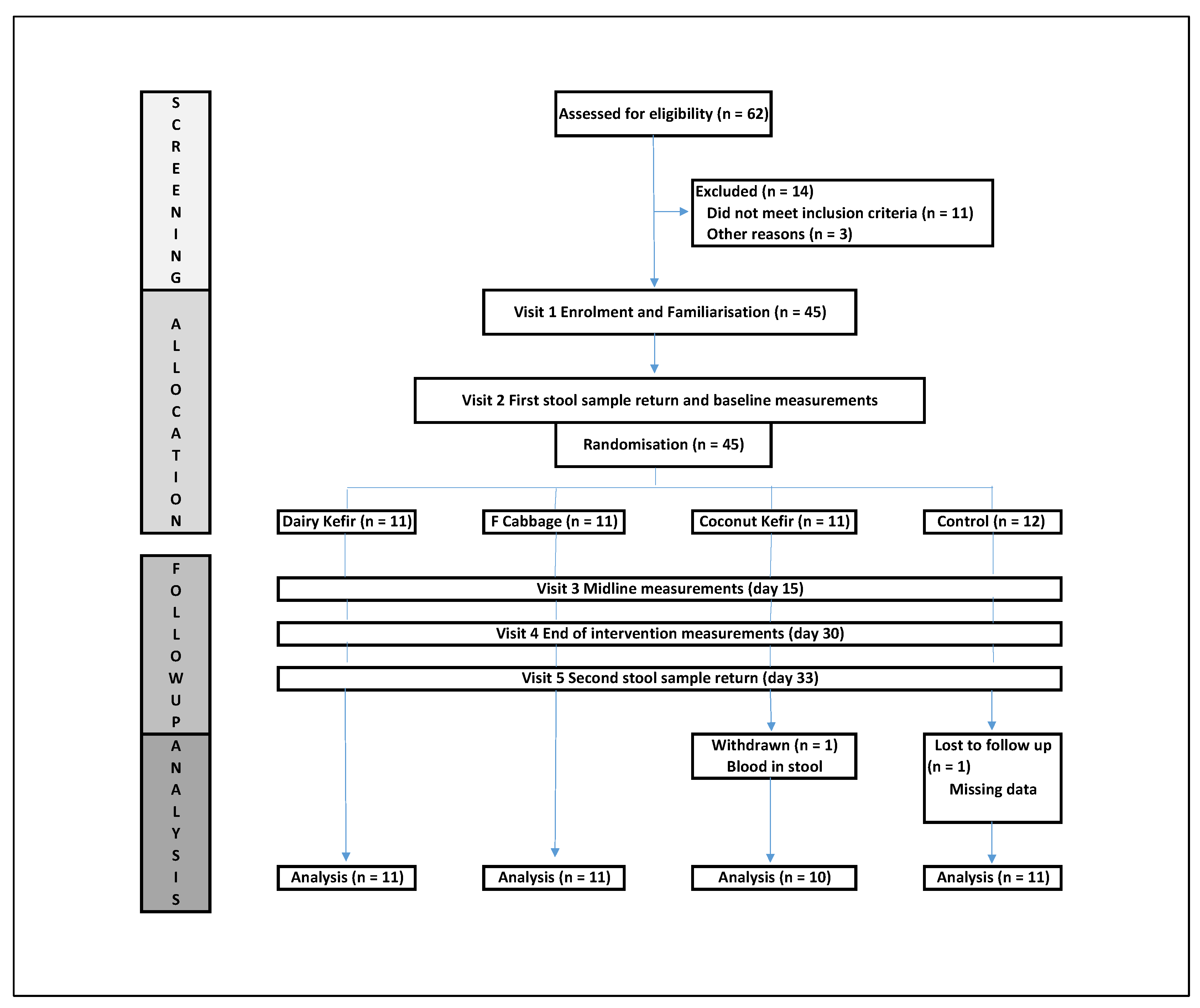
Figure 1. Flow chart of the study design.
Preprints 192881 g001
Figure 2. Effect of 4-week supplementation of Dairy Kefir, Fermented Red Cabbage and beetroot, Coconut Kefir or Control (no intervention) on risk taking for all groups(A), and the Dairy Kefir (B), as measured by the Cambridge Gambling Task (CGTRTKMT).
Preprints 192881 g002
Figure 3. Effect of 4-week supplementation of Dairy Kefir, Fermented Red Cabbage and beetroot, Coconut Kefir or Control (no intervention) on delay aversion for all groups (A), and the Coconut Kefir (B), as measured by the Cambridge Gambling Task (CGTDAVT).
Preprints 192881 g003
Figure 4. Effect of 4-week supplementation of Dairy Kefir, Fermented Red Cabbage and beetroot, Coconut Kefir or Control (no intervention) on short term memory for all groups (A), and the Coconut Kefir (B), as measured by the Delay Matching to Sample Task (DMSML).
Preprints 192881 g004
Figure 5. Effect of 4-week supplementation of Dairy Kefir, Fermented Red Cabbage and beetroot, Coconut Kefir or Control (no intervention) on sustained attention and working memory for all groups (A), and the Dairy Kefir (B), and the Fermented Red cabbage and beetroot (C), as measured by the Rapid Visual Processing Task (RVPTH).
Preprints 192881 g005
Figure 6. Effect of 4-week supplementation of Dairy Kefir, Fermented Red Cabbage and beetroot, Coconut Kefir or Control (no intervention) on sustained attention and working memory for all groups (A), and the Fermented Red cabbage and beetroot (C), as measured by the Rapid Visual Processing Task (RVPTM).
Preprints 192881 g006
Figure 7. Effect of 4-week supplementation of Dairy Kefir, Fermented Red Cabbage and beetroot, Coconut Kefir or Control (no intervention) on Depression, Anxiety, Stress and Total Mood Improvement as measured by the Depression Anxiety Stress Scale (DASS21).
Preprints 192881 g007
Figure 8. Effect of 4-week supplementation of Dairy Kefir, Fermented Red Cabbage and beetroot, Coconut Kefir or Control (no intervention) on total short chain fatty acids all groups (A), and Coconut Kefir group (B); butyrate all groups (C), and Coconut Kefir (D), and Fermented Red Cabbage and beetroot (E); propionate all groups (F), Fermented Red Cabbage and beetroot (G).
Preprints 192881 g008aPreprints 192881 g008b
Figure 9. Effect of 4-week supplementation of Dairy Kefir, Fermented Red Cabbage and beetroot, Coconut Kefir or Control (no intervention) on certain members of the gut microbiota. The Coconut Kefir significantly increased F. prausnitzii, Bifidobacterium spp., A. colihominis, and Lactobacillus spp. The Control group experienced a significant increase in Fusobacterium spp.
Preprints 192881 g009
Figure 10. Heat map illustrating the correlations between cognitive function (Cambridge Gambling Task, Delay Matching to Sample, Rapid Visual Information Processing as per the CANTAB battery), fSigA, Total SCFA, butyrate concentration, propionate and acetate percentages, GUS, zonulin family peptide, depression, anxiety, stress, Total DASS (DASS21) and 24 members of the gut microbiota after a 4 week intervention with Dairy Kefir, Fermented Red Cabbage and beetroot, Coconut Kefir, and Control (no intervention); n = 43; * P <0.05; ** P <0.01 (2-tailed).
Preprints 192881 g010
Figure 11. Stack bar charts illustrating the LAB genera and species in the 3 intervention products. Dairy Kefir, Red cabbage and beetroot, and Coconut kefir. The product samples were analysed using metagenomics based on sequencing amplicons from the 16S rRNA genes. PCR of V3 - V4. Analyses carried out of products at the point of consumption by Campden BRi, UK.
Preprints 192881 g011
Figure 12. Effect of 4-week supplementation of Dairy Kefir, Fermented Red Cabbage and beetroot, Coconut Kefir or Control (no intervention) on certain members of the gut microbiota. Data from Genova Diagnostics GI Effects.
Preprints 192881 g012
Table 1. Intervention products macro nutrients and lactic acid bacteria ( cfu/ml or g).
Dairy Kefir
Group A
Fermented Red Cabbage
Group B
Fermented Coconut Milk Group C
portion 247ml ~50g 100ml
Lactic Acid Bacteria (LAB), cfu/ml / cfu/g 105 106 1011
Energy 66.9kJ/16kCal 125kJ/30kCal 141kJ/34kCal
Total Fat 0.2g 0.9g 2.0g
Of which saturates 1.9g 0.4g 1.9g
CHO (carbohydrate) 4.2g 2.1g 2.8G
Of which sugars 3.8g No detectible amount 2.0g
Fibre No detectible amount 2.8g 1.7g
Protein 3.25g 2.0g 0.8g
Salt No detectible amount 1.56g No detectible amount
Legend: Cfu/ml or g = colony forming units per milliliter or gram of product.
Table 2. Schedule of the trial assessments.
Study Activities Screening Visit1 familiarisation Visit 2 baseline Visit 3 (day 15)
mid-line
Visit 4 (day 30) end Visit 5 post testing
Informed Consent x
Health Questionnaire x
Randomization x
Plant Food Diary x
Diet and Lifestyle Questionnaire x
Brain Health
Cognitive Function x x x x
Emotional Health
POMS x x x
DASS-21 x x x
Gastrointestinal Health
Bristol Stool Scale x receive x return/receive x return
Stool Test Kit receive x x
Stool Test Kit return x x
Quality of Life
MYMOP® x x follow-up x follow-up x follow-up
Product receive x x
Adverse Symptom Assessment x x
Legend: POMS (Profile of Mood State); DASS-21 (Depression, Anxiety, and Stress Scales-21); MYMOP® (Measure Yourself Medical Outcome Profile.
Table 3. Gastrointestinal microbiome commensal bacteria available from Genova Diagnostics GI Effects.
Phylum Genus Reference range (CFU/g stool)
Bacteroidetes Bacteroidetes-Prevotella group 3.4E6 – 1.5E9
Bacteroidetes vulgatus <=2.2E9
Barnsiella spp. <=1.6E8
Odoribacter spp. <=8.0E7
Prevotella spp. 1.4E5 – 1.6E7
Firmicutes Anaerotruncus colihominus <=3.2E7
Butyrivibrio cossotus 5.5E3 – 5.9E5
Clostridium spp. 1.7E8 – 1.5 E10
Coprococcus eutactus <=1.2E8
Faecalibacterium prausnitzii 5.8E7 – 4.7E9
Lactobacillus spp. 8.3E6 – 5.2E9
Pseudoflavonifractor spp. 4.2E5 – 1.3E8
Roseburia spp. 1.3E8 – 1.2E10
Ruminococcus spp. 9.5E7 – 1.6E9
Veillonella spp. 1.2E5 – 5.5E7
Actinobacteria Bifidobacterium spp. <=6.4E9
Bifidobacterium longum <=7.2E8
Collinsella formigenes 1.4E7 – 1.9E9
Proteobacteria Desolfovibrio piger <=1.8E7
Escherichia coli 9.0E4 – 4.6E7
Oxalobacter formigenes <=1.5E7
Euryarchaeota Methanobrevibacter smithii <=8.6E7
Fusobacteria Fusobacterium spp. <=2.4E5
Verrucomicrobia Akkermansia municiphila >=1.2E6
Legend: E indicates the exponent value (e.g., 7.3E6 equates to 7.3 x 10⁶ or 7,300,000). Data from Genova Diagnostics GI Effects.
Table 4. Participant anthropometric characteristics, habitual dietary fruit, vegetable and fermented foods intake, and education levels (mean (SD)).
Groups Dairy Kefir (A) Fermented Cabbage (B) Coconut Kefir (C) Control (D) Group difference p value
Anthropometric characteristics:
Age (years) 39.09(8.53) 38.64(8.56) 38.82(7.18) 38.55(8.68) .623
Age range (years) 20-49 27-52 25-48 25-51
Female/Male 6/5 7/4 7/4 7/4 .962
Body weight (kg) 65.1 (10.2) 70.6 (13) 66.2 (11.1) 61.5 (5.2) .595
Habitual dietary intake (portions):
Daily Vegetable 3.9(2.3) 4.7(2.3) 5.5(2.1) 6.7(3.0) .127
Daily Fruit 2.4(2.3) 1.4(3.0) 1.9(1.4) 1.8(1.0) .849
Weekly Fermented Foods 1.9(2.2) 1.9(3.1) 4.2(3.0) 2.8(2.4) .117
Education Levels
Left formal education <age 16 0 0 0 0 .215
Left Formal education at age 16 0 2 0 0
Left Formal education at age 17-18 1 0 3 2
Undergraduate degree or equivalent 8 8 7 6
Postgraduate degree or equivalent 1 0 1 0
Legend: Numerical variables compared using One way ANOVA; nominal values with Fisher’s Exact Test; Vegetable, Fruit, and Fermented Foods Kruskall-Wallis Test.
Disclaimer/Publisher’s Note: The statements, opinions and data contained in all publications are solely those of the individual author(s) and contributor(s) and not of MDPI and/or the editor(s). MDPI and/or the editor(s) disclaim responsibility for any injury to people or property resulting from any ideas, methods, instructions or products referred to in the content.
Copyright: This open access article is published under a Creative Commons CC BY 4.0 license, which permit the free download, distribution, and reuse, provided that the author and preprint are cited in any reuse.
Prerpints.org logo

Preprints.org is a free preprint server supported by MDPI in Basel, Switzerland.

Subscribe

Disclaimer

Terms of Use

Privacy Policy

Privacy Settings

© 2026 MDPI (Basel, Switzerland) unless otherwise stated