Submitted:
23 November 2026
Posted:
25 November 2026
Read the latest preprint version here
Abstract
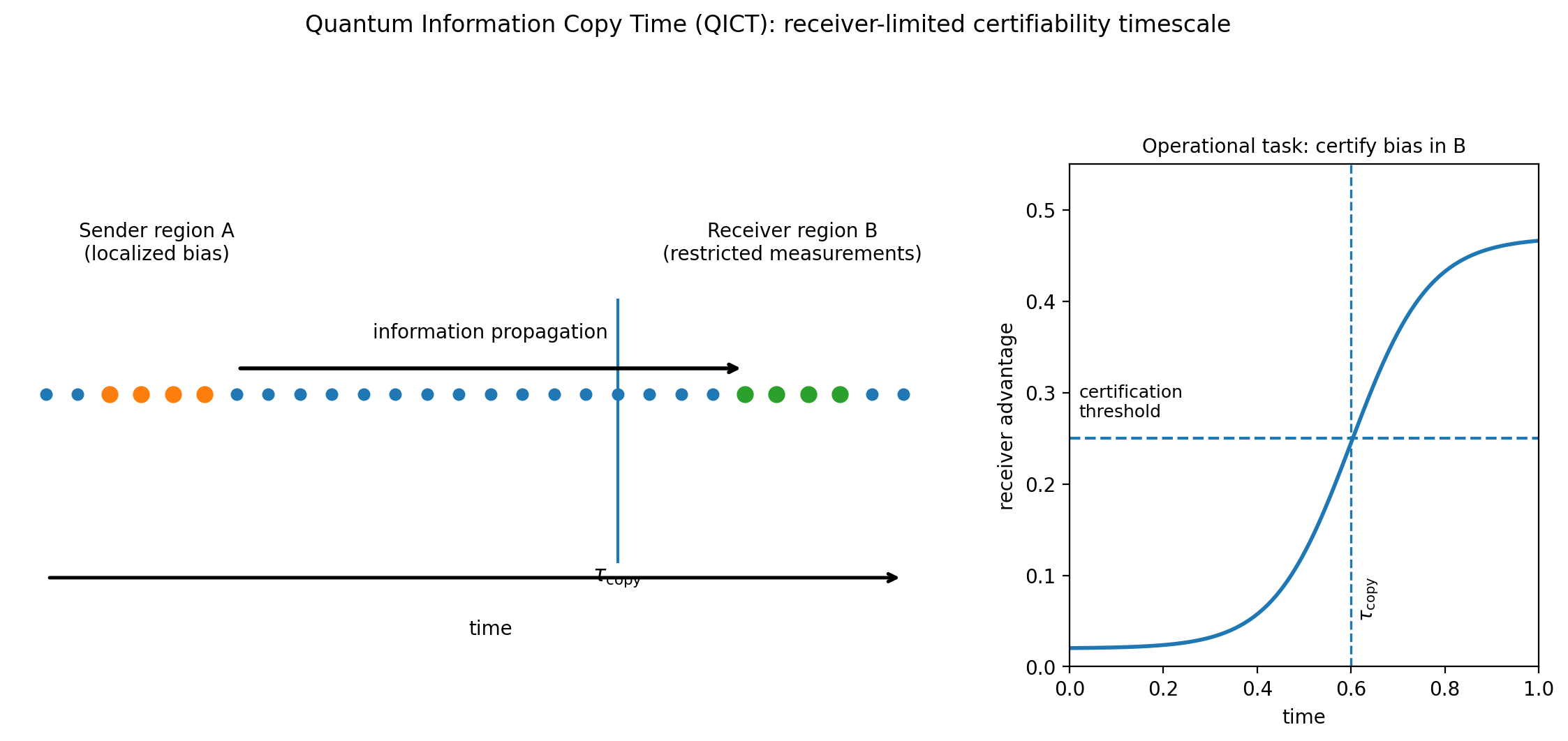
When does a localized change in preparation become distinguishable at a distant finite receiver? We define this time as the first passage of the receiver-state trace distance through a prescribed threshold, with the preparation and measurement protocol explicit. This single question connects stochastic exclusion, coherent propagation and thermal spin dynamics. In the diagonal sector of ensemble-averaged quantum symmetric exclusion, one-particle duality yields the exact finite-block likelihood and optimal decision rule. The lattice kernel determines a distance-dependent detection ceiling, two Lambert-W threshold crossings and the distinction between infinite-line diffusion and finite-ring equilibration. In a correlated-hopping spin chain, isolated excitations remain stationary while adjacent pairs propagate ballistically with an Airy first-crossing correction. A stability theorem specifies the profile convergence and early-time control required to infer operational arrival. Mori– Zwanzig reduction identifies memory and slow-mode overlap without assigning a dissipative gap to an exact unitary fast block. For the standard XXZ chain, a polarized one-magnon excitation has an exact Bessel receiver signal at every anisotropy. For thermal backgrounds, deterministic local spin resets give an exact one-site Helstrom signal and conserved-response sum rule for all anisotropies. At the XX point, the receiver law is independent of bath temperature and has a rigorous ballistic Airy first-crossing expansion. A separate transfer theorem states the precise scaling and early-tail hypotheses required to turn more general thermal transport profiles into arrival laws. The common structure is operational first passage, not a single dynamical exponent for all XXZ regimes.