Submitted:
25 November 2026
Posted:
27 November 2026
You are already at the latest version
Abstract
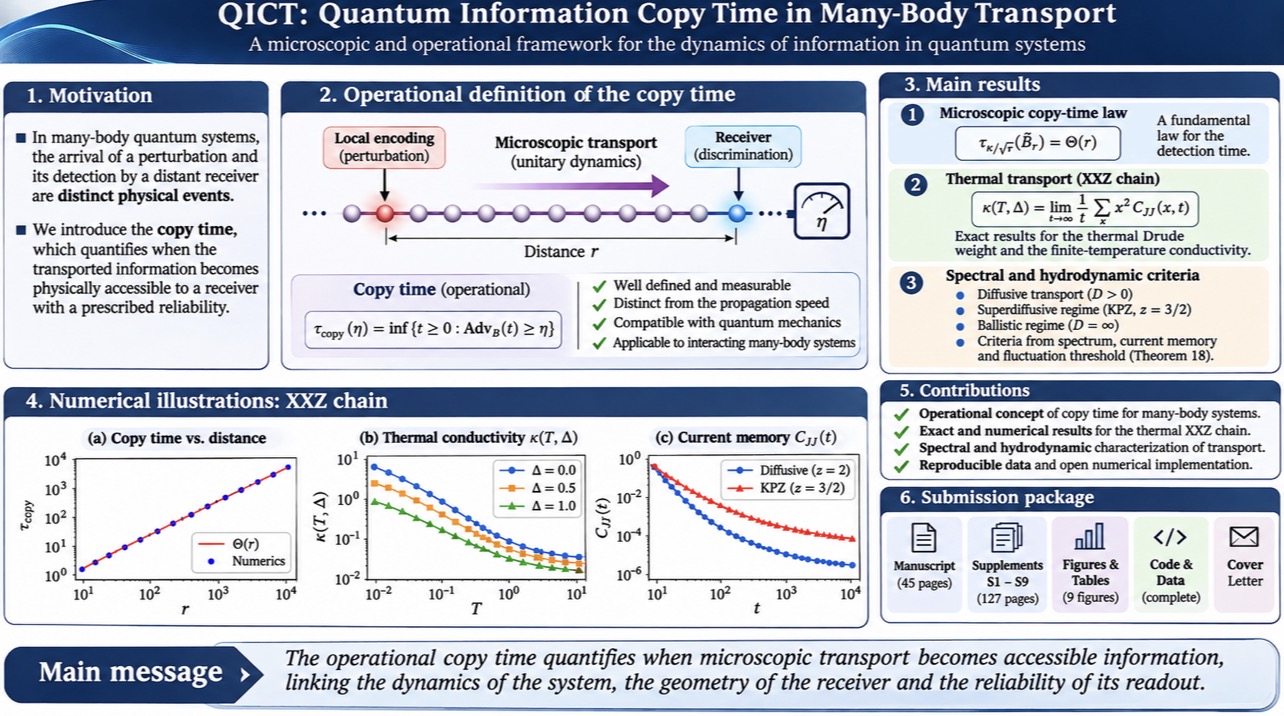
A disturbance may reach a distant region of a many-body system before a receiver can reliably detect it. The operational copy time quantifies detection through the first crossing of a prescribed discrimination threshold between two local preparations. For interacting thermal XXZ chains at sufficiently high positive temperature and small nonzero dimensionless magnetic bias, we combine a protected current with a physical local reset to establish ballistic detection by a spatial average of bounded binary occupation effects at threshold \(\eta_r = \kappa/\sqrt{r}\) for a receiver of width proportional to distance \(r\), with fixed field and temperature and sufficiently small \(\kappa > 0\). The inverse-square-root threshold is sharp in order among averages of a number of translated binary effects proportional to \(r\). For ensemble-averaged diagonal quantum symmetric exclusion, one-particle duality gives the exact finite-block likelihood, the optimal weighted occupation test and a Lambert-W diffusive first-passage coefficient; at half filling the signal grows as the square root of the width of a narrow mesoscopic receiver. In a correlated-hopping chain, single excitations are immobile whereas mobile pairs exhibit ballistic arrival with an Airy correction. Exact one-magnon and thermal XX solutions, thermodynamic locality bounds and rational finite-chain crossing certificates provide complementary benchmarks. At zero field, projected-current spectral criteria identify sufficient inputs for diffusive and KPZ first passage. The resulting laws connect microscopic transport, thermal fluctuations and the reliability of a finite receiver.