
Submitted:
30 December 2025
Posted:
05 January 2026
You are already at the latest version
Abstract
This article advances EcoTechnoPolitics as a transformational conceptual and policy rec-ommendation framework for hybridizing digital–green twin transitions under conditions of planetary polycrises. It responds to growing concerns that dominant policy approaches by supranational institutions—including the EU, UN, OECD, World Bank Group, WEF, and G20—remain institutionally siloed, technologically reductionist, and insufficiently attentive to ecological constraints. Moving beyond the prevailing digital–green twin transitions paradigm, the article coins EcoTechnoPolitics around three hypotheses: the need for planetary thinking grounded in (i) anticipatory governance, (ii) hybridization, and (iii) a transformational agenda beyond cosmetic digital–green alignment. The research question asks how EcoTechnoPolitics can enable planetary thinking beyond digital–green twin transitions under ecological and technological constraints. Methodologically, the study triangulates (i) an interdisciplinary literature review with (ii) a place-based analysis of two socially cohesive city-regions—the Basque Country and Portland (Oregon)—and (iii) a macro-level policy analysis of supranational digital and green governance frameworks. The results show that, despite planetary rhetoric around sustainability and digitalization, prevailing policy architectures largely externalize ecological costs and consolidate technological power. Building on this analysis, the discussion formulates transformational policy recommendations. The conclusion argues that governing plan-etary-scale ecotechnopolitical systems requires embedding ecological responsibility within technological governance.
Keywords:
EcoTechnoPolitics
; planetary thinking
; digital transition
; green transition
; anticipatory governance
; policy analysis
; territorial innovation
; digital justice
; techno-governance
; digital inclusion
1. Introduction: The Foundations for the EcoTechnoPolitics Beyond the Mainstream Digital-Green Twin Transitions Approach
Contemporary societies are confronting a convergence of ecological destabilisation, accelerated digitalisation, and institutional fragmentation that increasingly exposes the planetary limits of prevailing governance frameworks [1]. These dynamics unfold within what Yuk Hui conceptualises as the rise of machine sovereignty, whereby technological systems acquire de facto governing city-regional capacities that reconfigure political authority, decision-making, and accountability beyond traditional state-centric forms [2,3]. In parallel, Benjamin Bratton’s notion of the Stack foregrounds how planetary-scale computational infrastructures—spanning platforms, clouds, interfaces, and territories—produce new vertical arrangements of power that exceed existing institutional and democratic architectures [4].
Against this backdrop, the dominant policy narrative of “digital–green twin transitions” has gained traction across supranational institutions, yet remains largely technocratic, growth-oriented, and insufficiently attentive to the material, ecological, and political consequences of digital infrastructures [5,6,7,8,9,10,11,12,13,14,15]. While digital transformation is typically framed through efficiency, competitiveness, and innovation, and green transition through decarbonisation and environmental protection, their governance continues to be treated in parallel rather than as transformational processes [16,17]. This separation obscures how digital technologies simultaneously intensify resource extraction, energy consumption, and socio-economic inequalities, while ecological constraints increasingly condition the viability of digital systems themselves [18,19]. It is within this planetary conjuncture—marked by ecological limits, technological acceleration, and democratic strain—that EcoTechnoPolitics emerges as a necessary transformational framework for rethinking governance beyond the mainstream digital–green twin transitions approach [20,21].
Over the past decade, a dense constellation of supranational policy frameworks has sought to align digital transformation with sustainability, equity, and long-term socio-economic resilience. At the European level, the European Green Deal [5], the Digital Compass 2030 [6], and the Artificial Intelligence Act [7] articulate an ambitious agenda that links decarbonization, digital competitiveness, and risk-based technological regulation. Globally, this agenda is mirrored by multilateral commitments such as the Paris Agreement [8], the United Nations Roadmap for Digital Cooperation [9], and the ongoing process surrounding the Global Digital Compact [10], all of which frame digital technologies as critical enablers of sustainable development and global coordination. Parallel policy narratives advanced by the OECD and international financial institutions—including Towards Green Growth [11], Going Digital [12], the OECD Principles on Artificial Intelligence [13], and the World Development Report on data governance [14]—promote the integration of digital innovation, economic growth, and responsible governance, while influential forums such as the World Economic Forum’s Great Reset position digitalisation as a cornerstone of post-crisis economic renewal [15]. Taken together, these frameworks have consolidated the policy imaginary of “digital–green twin transitions,” yet they also reveal a tendency to privilege technological optimization, scalability, and growth-oriented recovery over deeper questions of ecological limits, power asymmetries, and democratic accountability—tensions that motivate the need for a more explicitly eco-technopolitical approach.
While the so-called “digital–green twin transitions” has become a dominant policy narrative across supranational institutions, national governments, and corporate agendas, its operationalization remains largely siloed, technocratic, and growth-oriented [22]. Digital transformation is frequently addressed through regulatory instruments focused on efficiency, competitiveness, and risk mitigation, whereas green transition policies tend to prioritize decarbonization, environmental protection, and industrial adjustment [23]. This separation obscures the ways in which digital infrastructures—data platforms, algorithmic systems, artificial intelligence (AI), and cloud computing—are themselves materially intensive, politically contested, and deeply implicated in the production of socio-economic inequalities and social exclusions [20]. As a result, existing approaches often fail to address questions of digital sustainability and justice that emerge at the intersection of digital and ecological change [21].
1.1. Aims
Hence, this article aims to advance and thus coin EcoTechnoPolitics as both [24], (i) a conceptual and (ii) a policy recommendation framework designed to move beyond the limitations of the twin digital–green nexus by foregrounding planetary thinking, digital justice, and territorially grounded socio-economic relations [25]. EcoTechnoPolitics starts from the premise that digital and ecological systems are co-constitutive: digital technologies shape environmental governance, resource extraction, and climate knowledge, while ecological constraints increasingly condition the material, energetic, and political viability of digital infrastructures [18,19]. Yet these interdependencies are governed across profoundly uneven scales [2,3,4]. Local communities, municipalities, and city-regions, such as Portland (Oregon) in the US and the Basque Country in Europe, experiment with participatory governance, data sovereignty initiatives, and localized equity practices, while global techno-governance regimes—dominated by transnational corporations, standardized platforms, and supranational regulatory frameworks—exercise disproportionate influence over data flows, algorithmic architectures, and infrastructural design [24]. This ecotechnopolitical scalar mismatch constitutes a central challenge for digital justice and for the resilience of the socio-economic fabric under conditions of planetary crisis [26].
1.2. Alignment with the Special Issue and Contributing to the Literature Gap
Recent scholarship published in Societies and related MDPI journals has considerably advanced understanding of how ecological transformation, social participation, and governance intersect, yet it also reveals a fragmented literature that closely mirrors the central concern of the Special Issue Digital Justice and the Socio-Economic Fabric: Localized Equity Practices Versus Global Techno-Governance. Empirical research on generational climate engagement demonstrates how eco-anxiety, environmental activism, and pro-environmental behaviour are shaped by lived experience and social positioning, foregrounding justice claims emerging from everyday practices rather than formal policy alone [27]. Relational sociological analyses further show how profound eco-political change reshapes social bonds, ethical responsibilities, and collective meaning-making, reinforcing the need to conceptualise justice as relational and situated under conditions of planetary crisis [28]. From a political sociology perspective, studies of civil intellectuals and eco-nationalistic movements highlight how environmental struggles are simultaneously struggles over power, sovereignty, and knowledge, particularly in contexts shaped by global asymmetries [29]. At the level of European governance, critical examinations of the European Green Deal reveal notable absences in academic and policy discourse on public participation, exposing tensions between ambitious sustainability agendas and democratic inclusion [30]. Complementary work on participatory experimentation, such as serious games for land-use planning, illustrates the potential of localized, community-based practices to foster environmental deliberation, while also demonstrating their dependence on broader governance and technological infrastructures [31]. Empirical evidence on trust in climate-sceptical governments further shows how institutional legitimacy conditions public participation and pro-environmental action, with direct implications for democratic innovation and digital justice [32]. Beyond Societies, parallel debates on proximity economies [33], sustainable entrepreneurship [34], social innovation governance within smart specialisation strategies [35], post-industrial and agro-based societal transitions [36], and learning processes in the Anthropocene [37] provide valuable insights into sustainability and socio-economic change, but tend to address ecological, economic, and technological dynamics in relative isolation. This article responds directly to this fragmentation—and to the core question posed by the Special Issue—by advancing EcoTechnoPolitics as an integrative framework that connects localized equity practices, participatory governance, and socio-economic resilience with the global techno-governance regimes shaping digital infrastructures and ecological futures. In doing so, it fills a critical gap in the literature by reframing digital justice as an ecotechnopolitical challenge unfolding across uneven scales, thereby contributing directly to the scope and aims of Societies and the Special Issue (https://www.mdpi.com/journal/societies/special_issues/HZ7N7A0EMW).
In contributing to Societies and to the Special Issue Digital Justice and the Socio-Economic Fabric: Localized Equity Practices Versus Global Techno-Governance, this article offers EcoTechnoPolitics as a conceptual bridge between micro-level social practices and macro-level governance structures for planetary thinking. It argues that advancing digital justice in the age of planetary ecological and technological interdependence requires moving beyond additive or parallel digital–green policies toward integrated, anticipatory, and territorially grounded governance frameworks. By doing so, EcoTechnoPolitics provides a lens for understanding how societies might rearticulate justice, sustainability, and democracy in the face of intertwined digital and ecological transformations.
1.3. Research Question
EcoTechnoPolitics thus foregrounds how decisions concerning data ownership, AI deployment, platform regulation, and digital public infrastructures are simultaneously decisions about environmental sustainability, social cohesion, and the organization of democratic life. These decisions are increasingly shaped by supranational techno-governance regimes and planetary computational infrastructures; yet they are enacted and contested within city-regional and territorial contexts where inequalities and ecological pressures are most acutely experienced. The framework, therefore, seeks to bridge the gap between macro-level policy imaginaries and micro-level practices of digital justice and ecological resilience through the subsidiarity principle.
Against this backdrop, the article is guided by the following research question:
How can EcoTechnoPolitics enable planetary thinking beyond the dominant digital–green twin transitions under conditions of ecological and technological constraint?
This question structures the article’s three hypotheses, methodological design, and policy analysis, and underpins the development of transformational policy recommendations advanced in the discussion.
1.4. Three Working Hypotheses
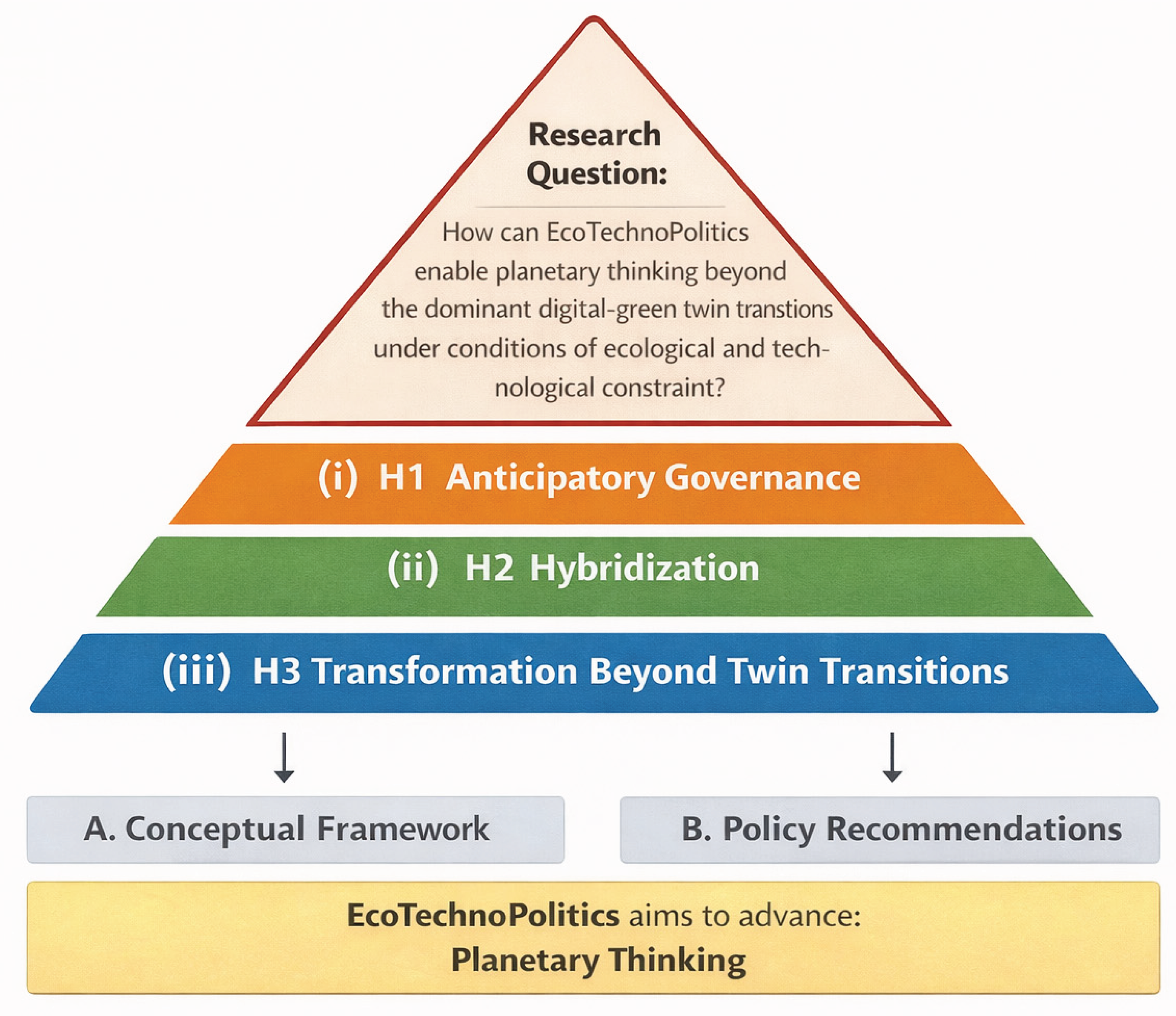
The research question is answered through three hypotheses: (i) anticipatory governance [38], (ii) hibridation [39], and (iii) transformation beyond cosmetic digital-green twin transitions [40,41].
Figure 1.
Introduction: Three Working Hypotheses, The Research Question, and Two Aims.
1.4.1. H1. Anticipatory Governance Hypothesis
EcoTechnoPolitics hypothesizes that anticipatory governance is not merely a technical exercise of foresight, but a deeply political and affective struggle over futurity itself. Building on Tutton’s conceptualization of futurelessness, the hypothesis holds that dominant digital–green transition frameworks often reproduce foreclosed futures by privileging technocratic, elite-driven imaginaries that diminish collective hope, agency, and democratic capacity under conditions of ecological crisis and socio-economic precarity [42]. Furthermore, scholarship addresses anticipation through the environmental precarity principle. Drawing on Appadurai’s notion of the capacity to aspire, EcoTechnoPolitics further posits that access to future-making is unevenly distributed, with marginalized communities frequently lacking the material, institutional, and cultural resources required to render their visions of the future legitimate and performative [43]. In line with Jasanoff’s critique of technocratic futurism, the hypothesis argues that prevailing anticipatory regimes tend to narrow the political imagination by consolidating authority over innovation narratives within expert and corporate domains [44].
By contrast, anticipatory governance arrangements that are reflexive, pluralistic, and territorially grounded—and that explicitly democratise the production of socio-technical imaginaries—are more likely to counter futurelessness, expand the capacity to aspire, and advance digital justice. From an ecotechnopolitical perspective, the hypothesis asserts that the redistribution of future-making power across uneven digital and ecological infrastructures is a necessary condition for transforming digital–green transitions beyond managerial adaptation toward genuinely transformative socio-economic pathways.
The anticipatory and hybrid ecotechnopolitical dynamics hypothesised above can be illustrated through contrasting yet comparable city-regional contexts such as Portland (Oregon) and the Basque Country [16,45]. In Portland, long-standing land-use planning instruments such as the Urban Growth Boundary, combined with climate action planning and digital innovation strategies, demonstrate an anticipatory governance orientation that seeks to internalise ecological limits within urban development [46]. However, these efforts coexist with platform-mediated mobility, data-driven urban services, and reliance on global digital infrastructures that constrain local democratic control, revealing the limits of anticipatory planning when embedded within planetary-scale techno-governance regimes. Portland thus exemplifies how local attempts at planetary thinking are negotiated within broader computational and economic architectures that shape what futures are deemed feasible [47].
Similarly, the Basque Country offers an illustrative case of eco-technopolitical hybridization across scales [39]. Strong traditions of cooperative organization, fiscal autonomy, and industrial policy have enabled experimentation with participatory governance, innovation systems, and a strong sustainable development policy. Yet these localized equity practices are increasingly articulated with supranational digital and green policy frameworks, global value chains, and platform-based infrastructures that reproduce growth imperatives and technological dependencies. From an EcoTechnoPolitics perspective, the Basque case highlights how anticipatory governance and hybridization can both enable democratic experimentation and simultaneously reproduce structural constraints.
Together, these examples support the hypothesis that advancing digital justice under planetary conditions depends not on isolated local innovation, but on reconfiguring how anticipatory governance and hybrid arrangements mediate the relationship between territorial practices and planetary techno-ecological systems [48].
1.4.2. H2. Hybridation Hypothesis
EcoTechnoPolitics hypothesizes that digital justice outcomes are more likely to emerge through hybridized governance arrangements operating across scales, rather than through exclusively local or global approaches. Under conditions of ecological crisis, technological acceleration, and institutional fragmentation, governance increasingly takes the form of ecotechnopolitical hybridization, combining localized equity practices—such as participatory governance, data sovereignty initiatives, cooperative institutions, and community-based experimentation—with selective engagement in, negotiation with, or constraint of global techno-governance regimes [49]. The hypothesis holds that justice is not produced at a single scale, but through the re-articulation of territorial socio-economic relations with planetary ecosystems and digital infrastructures [50].
From this perspective, hybridization reflects a structural response to radical uncertainty and competing socio-technical imaginaries. It arises from the limitations of both top-down governance models centered on competitiveness, policy transfer, and standardization, and bottom-up approaches grounded in municipalism, solidarity economies, and grassroots innovation. EcoTechnoPolitics interprets this condition as a form of anticipatory pragmatism, whereby institutions hedge between multiple possible futures without fully committing to any singular developmental paradigm and by taking into consideration the precautionary principle [51]. While such hybridization enables flexibility and adaptability in crisis contexts, the hypothesis cautions that it may also stabilize ambiguity and defer more transformative ecotechnopolitical change.
Illustrative experiences from socially cohesive city-regions—such as the Basque Country [16,39,45], or comparative governance analogues like Portland (Oregon)’s Urban Growth Boundary—suggest that hybridisation can simultaneously enable resilience and reproduce contradiction [46,47]. These cases indicate how territorially embedded governance traditions may sustain participatory practices, collective infrastructures, and public legitimacy, while also accommodating global market pressures, platform dependencies, and growth-oriented logics. EcoTechnoPolitics therefore hypothesises that hybridisation is inherently double-edged: it can function as an enabling condition for democratic experimentation and localized equity, yet also as a mechanism through which transformative imaginaries are selectively absorbed, reframed, or neutralised within dominant techno-economic regimes.
Ultimately, this hypothesis posits that eco-technopolitical hybridation constitutes a contested field of power, rather than a stable governance solution. Its emancipatory potential depends on whether hybrid arrangements merely manage contradiction or actively redistribute authority across digital infrastructures, ecological constraints, and territorial institutions. In this sense, the struggle over hybridisation is central to understanding how localized equity practices can meaningfully engage with, rather than be subsumed by, global techno-governance—directly addressing the core concern of the Special Issue on digital justice and the socio-economic fabric.
1.4.3. H3. Transformative Beyond Twin Transitions Hypothesis
EcoTechnoPolitics hypothesises that policy frameworks confined to the dominant “digital–green twin transitions” paradigm tend to generate predominantly cosmetic, compensatory, or legitimising forms of change, leaving intact the structural foundations of growth-centric political economy, extractive data regimes, and ecological degradation. While digital and green policies are increasingly articulated together, this articulation often functions to stabilise existing techno-economic arrangements rather than to transform them. Empirical research on AI and data practices demonstrates how sustainability ambitions are routinely undermined by data-intensive infrastructures that reproduce asymmetrical extraction, labour exploitation, and environmental externalisation, even when framed as socially responsible or ethical innovation [52].
From a political perspective, critical analyses show how AI and digital technologies are mobilised as instruments of certainty-making in conditions of crisis, narrowing political debate and masking unresolved ecological and social contradictions behind technocratic problem-solving narratives [53]. Similarly, scholarship on “green platform capitalism” reveals how technology firms strategically appropriate climate discourse to legitimise continued accumulation, effectively depoliticising ecological crisis while consolidating corporate power [54]. The epistemic dimensions of this dynamic are further exposed by research on digital information infrastructures, such as search engines, which actively shape ignorance and visibility around climate change, thereby constraining democratic deliberation and public understanding [55].
Against this backdrop, EcoTechnoPolitics posits that only explicitly transformative governance approaches—those that confront growth imperatives, reconfigure technological sovereignty, and embed ecological limits within digital policy—can advance digital justice beyond symbolic digital–green alignment. This hypothesis asserts that transformation requires moving from optimisation and mitigation toward structural reorientation of digital infrastructures, political economy, and democratic control under planetary constraints.
1.5. Structure of the Article
The remainder of this article is organised as follows. Section 2 reviews the interdisciplinary foundational and contemporary literatures that inform EcoTechnoPolitics, positioning planetary thinking at the intersection of digital justice, political economy, and ecological limits. As such, section 2 triangulates the study’s methodological approach, detailing the triangulation of (i) a literature review, (ii) a place-based analysis of two socially cohesive city-regions—the Basque Country and Portland (Oregon)—and (iii) a macro-level policy analysis of supranational digital and green governance frameworks. Section 3 presents the results of the macro-level policy analysis, identifying the dominant imaginaries, institutional logics, and key omissions through which supranational policy architectures rhetorically align sustainability and digitalisation while externalising ecological costs and consolidating technological power. Section 4 discusses these findings through the EcoTechnoPolitics framework and develops transformational policy recommendations grounded on the three hypotheses by clarifying how (i) anticipatory governance, (ii) hybridisation across scales, and (iii) transformational change provide a coherent analytical lens beyond the dominant digital–green twin transitions. Finally, Section 5 concludes by synthesising the ecotechnopolitical implications of governing planetary-scale digital infrastructures and reiterates the paper’s contribution to debates on planetary polycrisis.
2. Methods: Triangulating through Action Research
This section reviews the interdisciplinary foundational and contemporary literatures that inform EcoTechnoPolitics, positioning planetary thinking at the intersection of digital justice, political economy, and ecological limits. It brings together critical contributions from science and technology studies, political economy, urban and regional studies, environmental governance, and digital sociology to interrogate how digital infrastructures, ecological constraints, and democratic institutions are increasingly co-constituted at planetary scale. Rather than treating digitalisation and sustainability as parallel policy domains, the section foregrounds their entanglement within uneven power relations, material resource dependencies, and multi-scalar governance regimes. In doing so, this section also clarifies the article’s triangulated methodological approach:
First, it develops a critical (foundational and contemporary) literature review that synthesizes debates on anticipatory governance, technological sovereignty, platform capitalism, ecological limits, and digital justice.
Second, it introduces the place-based analytical lens by situating these debates within two socially cohesive city-regions—Basque Country and Portland—which serve as illustrative cases for examining how localized equity practices interact with planetary techno-governance structures.
Third, it connects these insights to a macro-level policy analysis of supranational digital and green governance frameworks, establishing the conceptual and empirical foundations for the hypotheses, results, and policy recommendations developed in the subsequent sections.
2.1. Methodological Rationale: Triangulation through Action Research to Establish EcoTechnoPolitics
Establishing EcoTechnoPolitics as both a conceptual innovation and a policy recommendation framework requires a methodological approach capable of engaging with theory, practice, and governance simultaneously. For this reason, the article adopts a triangulated methodology grounded in action research, which is particularly suited to contexts characterised by ecological uncertainty, technological acceleration, and institutional fragmentation [56,57,58,59]. Rather than treating EcoTechnoPolitics as an abstract analytical construct, this approach understands it as an emergent framework co-produced through critical inquiry, territorial engagement, and policy-oriented reflection [60,61,62].
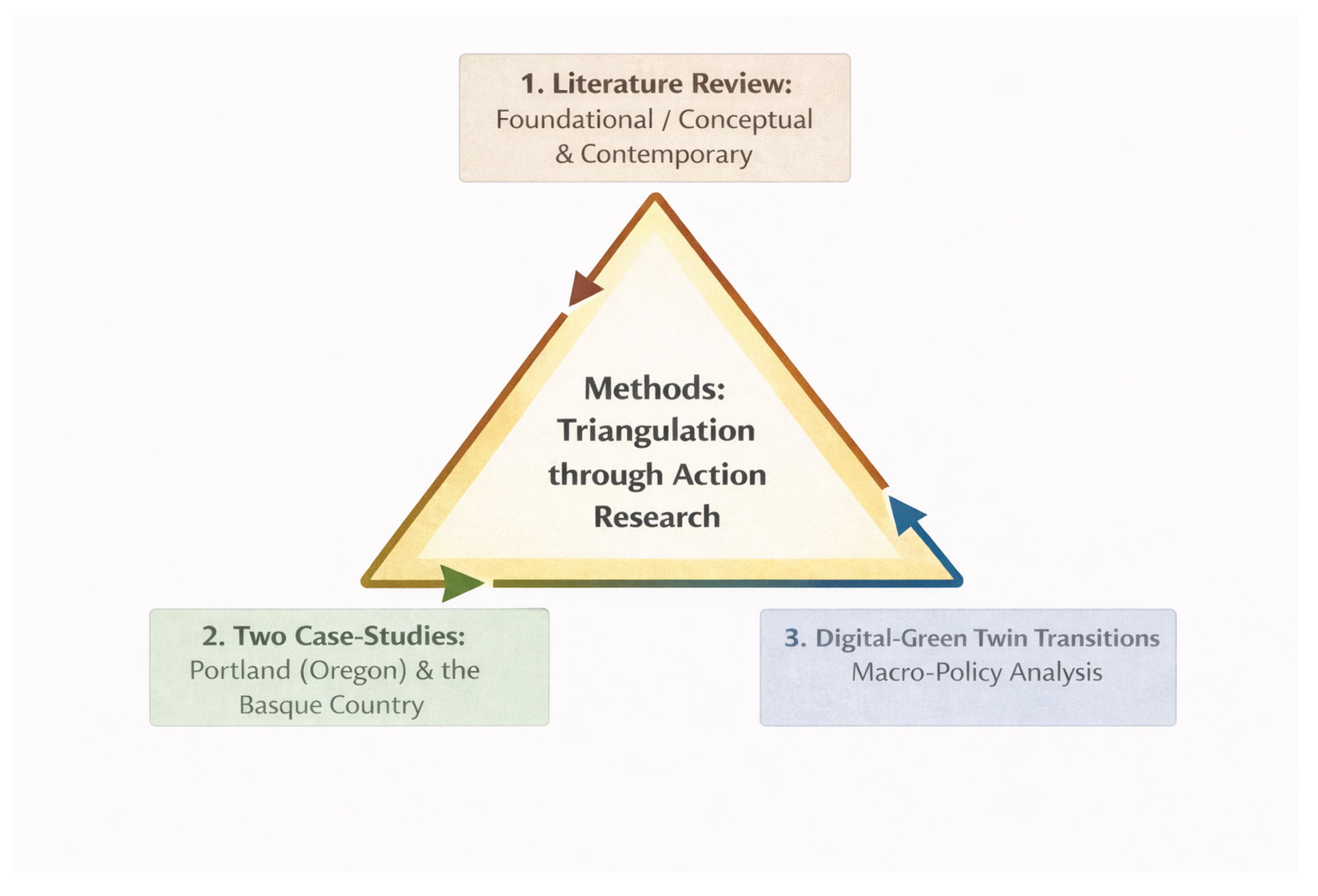
Triangulation is justified by the inherently multi-scalar and relational nature of ecotechnopolitical challenges [57]. No single method can adequately capture how planetary-scale digital infrastructures, supranational governance regimes, and localized practices of equity and participation interact [62]. Accordingly, the study triangulates three complementary components: (i) a critical (foundational-conceptual and contemporary) interdisciplinary literature review that synthesises debates on planetary thinking, digital justice, political economy, and ecological limits; (ii) a place-based analysis of socially cohesive city-regions—the Basque Country and Portland (Oregon)—as sites where ecotechnopolitical tensions are materially enacted and contested; and (iii) a macro-level policy analysis of supranational digital and green governance frameworks. This triangulation enables analytical cross-fertilization, allowing insights generated at one scale to be interrogated and refined through evidence from others [58].
The integration of action research further strengthens this design. EcoTechnoPolitics is advanced not only to interpret the world, but to intervene in it by informing governance choices, institutional design, and democratic experimentation. Action research provides an appropriate epistemological foundation because it foregrounds reflexivity, iterative learning, and engagement with real-world policy processes [60]. Through this lens, the Basque Country and Portland are not treated as passive case studies, but as active laboratories of anticipatory governance, hybridization, and constraint, where policy imaginaries and practices are continuously negotiated.
By combining triangulation with action research, the methodology aligns means and ends: EcoTechnoPolitics is produced through the same ecotechnopolitical principles it advocates—pluralism, territorial grounding, and anticipatory transformation. This methodological coherence is essential for moving beyond descriptive accounts of digital–green transitions toward a framework capable of supporting planetary thinking, digital justice, and ecological responsibility in practice.
Triangulation is adopted as a methodological necessity in order to capture the multi-scalar and cross-domain complexity of digital–ecological governance [56,57]. This approach is complemented by action research principles which pair inquiry with social change, producing knowledge that is emancipatory, reflexive, and co-constituted with practice [58,60]. Such an orientation aligns with interdisciplinary challenges where high uncertainty and competing socio-technical imaginaries demand plural and iterative modes of inquiry [1,61,62].
Figure 2.
Methods: Triangulation through Action Research.
2.2. Literature Review
The literature review proceeded in two interconnected phases.
First, a conceptual review synthesized foundational works on urbanism, planetary governance, and socio-technical transformations, drawing on early urban thinkers such as Geddes [63] and Mumford [64], and contemporary theorists including Hui’s Machine and Sovereignty [2], Bratton’s The Stack [4], Jackson’s sustainability political economy [22], Hamilton’s critique of climate denial [23], Latour’s Down to Earth [65], and Marres’ material participation framework [66]. These works inform the theoretical grounding of EcoTechnoPolitics by elucidating shifting relations between material infrastructures, digital systems, and emergent planetary modes of governance.
2.2.1. Foundational and Conceptual Literature Review
The foundational and conceptual literature informing EcoTechnoPolitics establishes a long-standing intellectual lineage that connects urbanism, political economy, technological systems, and ecological limits. As synthesised in Table 1, these works collectively foreground the co-evolution of cities, technologies, and environments, providing the historical and theoretical grounding necessary for articulating planetary thinking beyond the dominant digital–green twin transitions paradigm.
Early urban theorists such as Geddes [63] and Mumford [64] conceptualised cities as socio-ecological organisms rather than purely economic or technical artefacts. Their emphasis on regional planning, civic life, and ecological embeddedness prefigures contemporary concerns with territorial innovation and anticipatory governance. These perspectives are foundational for EcoTechnoPolitics insofar as they situate governance within material, environmental, and social constraints, challenging technocratic approaches that abstract digital transformation from its territorial and ecological contexts.
More recent theoretical contributions extend this urban–ecological lineage to the planetary scale, counterposing the re-naturalisation of nature to its objectification and commodification, as Hui’s work in Machine and Sovereignty [2] introduces planetary thinking as a philosophical response to computational systems that increasingly exercise governing functions, destabilising state-centric sovereignty. Similarly, Bratton’s concept of The Stack [4] provides a spatial and infrastructural model for understanding how digital platforms, clouds, interfaces, and territories reorganize power, jurisdiction, and governance vertically across scales. Together, these frameworks are central to EcoTechnoPolitics, as they reveal how digital infrastructures are not merely tools of transition but active political architectures shaping planetary governance.
From a political economy perspective, Jackson’s critique of growth-centric development [19] anchors EcoTechnoPolitics within post-growth and ecological economics, highlighting the incompatibility between infinite expansion and planetary limits. This critique is complemented by Hamilton’s analysis of climate denial [23], which exposes the cultural and political barriers that inhibit transformative responses to ecological crisis, even in the presence of scientific consensus. These insights reinforce the argument that digital–green transitions often function as legitimizing narratives rather than vehicles for systemic change.
Finally, Latour’s call for a terrestrial politics [65] and Marres’ concept of material participation [66] foreground the importance of situated practices, socio-technical mediation, and public engagement in environmental governance. These contributions inform EcoTechnoPolitics’ emphasis on digital justice, participatory governance, and the materiality of technological systems, underscoring that planetary governance must remain grounded in everyday practices and democratic contestation.
Taken together, the works synthesised in Table 1 provide the conceptual scaffolding for EcoTechnoPolitics. They justify the need for an ecotechnopolitical framework that integrates planetary-scale digital infrastructures with territorial governance, ecological limits, and democratic participation—thereby laying the groundwork for the subsequent analysis of contemporary literature, two case studies, and supranational policy regimes.
2.2.2. Contemporary Literature Review
Building on the foundational corpus (Section 2.2.1), the contemporary literature review maps how planetary-scale digital infrastructures are currently reshaping governance, knowledge, and justice claims in ways that directly condition the feasibility of EcoTechnoPolitics. Whereas Geddes and Mumford provide a long view on cities as socio-ecological and socio-technical formations, recent scholarship specifies the present-day mechanisms through which AI systems, platforms, and data infrastructures reorganize power across scales—often in tension with ecological limits and democratic accountability. As summarized in Table 2, three interlinked clusters are especially relevant.
First, a growing body of work interrogates the epistemic politics of algorithmic systems in climate and environmental governance. Studies show how algorithmic reasoning can stabilize hegemonic climate knowledge while narrowing what becomes visible, actionable, or contestable in public debate, thereby shaping the conditions of democratic participation and environmental decision-making [67,74,55]. This reinforces EcoTechnoPolitics’ claim that digital justice is not reducible to access but involves struggles over knowledge infrastructures and political voice under planetary crisis. Surprisingly, Dixson-Declève et al. [18] suggest access as the only solution in their report, which in itself is far from the ambition of this article by suggesting EcoTechnoPolitics.
Second, contemporary research clarifies the infrastructural and sovereignty dimensions of AI and data governance. Analyses of data mobility, fitness-for-use, and infrastructural fragility in decentralised ecosystems reveal how “data crises” are often governance crises, where technical constraints become distributional and territorial problems [68]. Parallel conceptual and policy contributions on AI sovereignty, platform capture, and “sovereignty-as-a-service” demonstrate how corporate infrastructures increasingly substitute for—or displace—public capacities, intensifying dependency and undermining accountability [72,75,76,86]. These debates directly inform the EcoTechnoPolitics emphasis on hybridisation across scales (H2), since neither municipal experimentation nor supranational regulation alone can address platform-jurisdictional power.
Third, the literature increasingly addresses anticipatory governance and institutional adaptation under uncertainty. Work on AI in strategic foresight, agentic government, and public-sector AI governance highlights how institutions attempt to manage risk, legitimacy, and innovation through future-oriented frameworks—yet often default to managerial approaches that narrow political imagination and depoliticize contestation [77,82,89]. Complementary global toolkits and comparative indicators (e.g., UNESCO–ITU–UNDP–AUC; OECD) provide operational languages for governance, but also risk translating justice and ecological limits into compliance checklists unless anchored in democratic practice and territorial responsibility [78,87]. This contemporary evidence base strengthens H1 by showing that anticipatory governance is a contested politics of futurity, not a neutral technique [38,39,77].
Across these clusters, Table 2 also evidences the central tension motivating H3: while policy and governance discourses increasingly invoke sustainability, ethics, and responsibility, critical scholarship documents how prevailing AI trajectories, institutional arrangements, and platform economies can externalise ecological costs, reproduce asymmetries, and legitimise techno-economic continuity rather than transformation [79,83,86]. Accordingly, this contemporary review positions EcoTechnoPolitics as a framework that must simultaneously (i) engage epistemic infrastructures, (ii) confront platform sovereignty and infrastructural dependency, and (iii) operationalise anticipatory governance as a democratic, multi-scalar struggle over ecological and technological futures—thereby preparing the ground for the place-based analysis and supranational policy analysis developed in subsequent sections (Table 2).
2.3. Two Case-Studies: Portland (Oregon) and the Basque Country
This section operationalizes EcoTechnoPolitics through a comparative, place-based analysis of two socially cohesive city-regions: Portland (Oregon) and the Basque Country [45]. Building on the conceptual foundations and contemporary debates reviewed in Section 2.2.1 and Section 2.2.2, the case studies translate planetary-scale ecotechnopolitical dynamics into territorially situated governance practices. The aim is not to provide causal evaluation or policy benchmarking, but to explore how distinct yet comparable governance traditions confront the tensions between ecological limits, digital infrastructures, and democratic authority under conditions of planetary polycrisis.
The selection of these cases follows a theoretically informed, heuristic logic rather than a representativeness criterion. Both Portland and the Basque Country are characterized by relatively high levels of social cohesion, strong public institutions, and long-standing traditions of territorial planning and collective governance [45]. These features make them particularly suitable for examining how boundary-making, anticipatory governance, and hybrid institutional arrangements function as mediating mechanisms between localized equity practices and planetary techno-governance regimes—central concerns of EcoTechnoPolitics.
2.3.1. Portland’s Urban Growth Boundary as a Governance Analogue
Portland’s Urban Growth Boundary (UGB) is mobilised in this article as a governance analogue rather than as a direct policy model [46,47]. Established in 1973 within Oregon’s statewide land-use planning framework, the UGB represents a paradigmatic intervention that institutionalises ecological limits through spatial boundary-setting. Following historical analyses of its evolution and governance culture, the UGB is interpreted here not merely as a land-use instrument, but as a boundary-making device that coordinates infrastructure investment, environmental protection, and metropolitan governance across scales.
Within the EcoTechnoPolitics framework, the analytical value of the UGB lies in its demonstration that limits can be politically constructed, democratically contested, and institutionally stabilised. The boundary functions as a socio-technical artefact that disciplines growth, redistributes development pressures, and aligns long-term ecological considerations with everyday planning decisions. Importantly, the UGB illustrates how anticipatory governance operates through constraint rather than optimisation—an insight that resonates with critiques of digital–green twin transitions premised on efficiency and scalability.
Methodologically, the Portland case is examined through structured document analysis drawing on primary planning documents, legal statutes, and secondary scholarship on the UGB’s performance, controversies, and institutional learning processes [45,46,47]. Instead, the UGB is used heuristically to enable analogical inference: it provides a conceptual lens for thinking about how similar boundary logics might be required to govern digital infrastructures, data flows, and algorithmic dependencies whose impacts transcend jurisdictional borders but materialize locally.
Figure 3.
Portland (Oregon).

2.3.2. The Basque Country as a Laboratory of Eco-Technopolitical Hybridisation
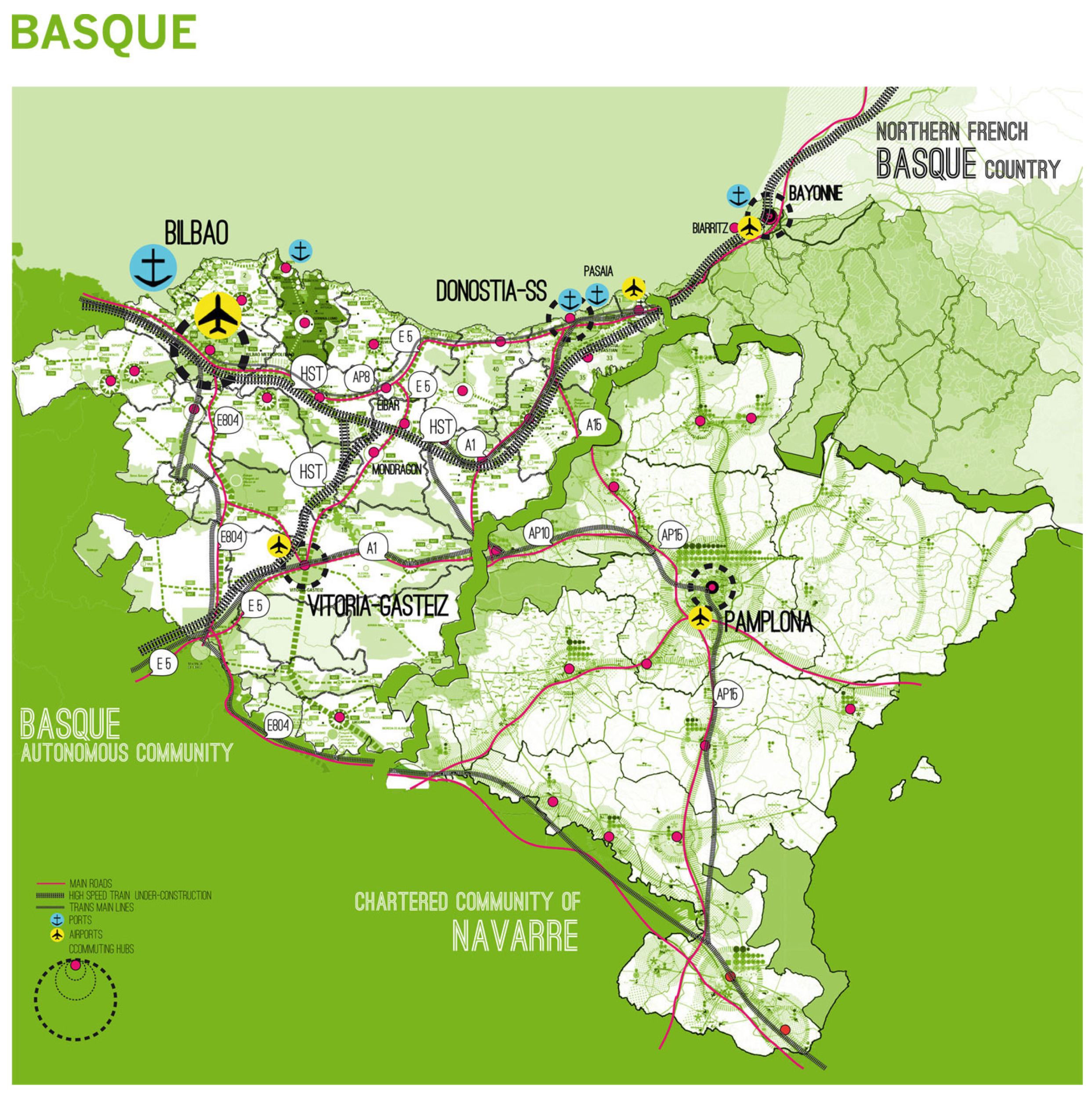
The Basque Country constitutes the primary empirical context for examining how EcoTechnoPolitics may emerge through hybridised, territorially grounded governance arrangements. Unlike Portland’s singular and formalised boundary instrument, the Basque case is characterised by a layered and polycentric governance ecology, combining historical territories, provincial councils, municipal consortia, cooperative institutions, and cross-border arrangements [38,39,45]. This configuration produces what can be described as a “soft boundary regime,” where limits, responsibilities, and sovereignties are negotiated through institutional density rather than fixed spatial demarcation.
Recent developments in the Basque Country—particularly in Gipuzkoa—highlight an explicit turn toward integrating digital governance, ecological transition, and democratic participation [16,20,38]. Initiatives such as data cooperatives, participatory digital rights frameworks, mission-oriented innovation strategies, and emerging Urban AI governance practices illustrate how digital infrastructures are increasingly framed as matters of public interest, social justice, and ecological responsibility [38]. These practices exemplify the hybridisation hypothesis (H2): governance unfolds through the selective articulation of local experimentation with supranational policy frameworks, EU regulations, and global technological platforms.
Crucially, the Basque case demonstrates how social cohesion and institutional trust condition the capacity of city-regions to experiment with eco-technopolitical arrangements [3]. Cooperative traditions, strong public sectors, and dense associational life provide civic infrastructures that support participatory governance and legitimation processes. At the same time, the case reveals persistent tensions: global platform dependencies, growth-oriented industrial logics, and supranational regulatory constraints continue to shape what forms of digital and ecological transformation are politically feasible [39].
Figure 4.
Basque Country.
2.3.3. Comparative Insights for EcoTechnoPolitics
Taken together, Portland and the Basque Country function as complementary laboratories for EcoTechnoPolitics. Portland exemplifies a “hard” boundary-based governance logic that internalises ecological limits through spatial planning, while the Basque Country illustrates a “soft,” multi-instrument approach that extends boundary-making into social, economic, and digital domains. Neither case offers a transferable blueprint; instead, their comparative value lies in revealing how multiscalar sovereignties are assembled, contested, and stabilised through different institutional configurations [2,4].
This comparative, conceptual–empirical design reinforces the article’s triangulated methodology. By juxtaposing an external governance analogue (Portland’s UGB) with an internally embedded territorial case (the Basque Country), the analysis generates analytical transferability rather than empirical generalization [45]. It shows how EcoTechnoPolitics can be operationalized as a framework for interpreting how city-regions mediate between planetary infrastructures and everyday socio-technical practices—an essential step for moving beyond abstract critiques of digital–green twin transitions.
In methodological terms, this section does not claim to measure governance outcomes or causal impacts. Instead, it contributes to theory-building by clarifying the conditions under which anticipatory governance, hybridisation, and transformative ambition may coalesce within socially cohesive city-regions. Future research may extend this approach through mixed-methods fieldwork, participatory observation, or computational governance modelling. Nonetheless, the cases presented here substantiate EcoTechnoPolitics as a territorially grounded, analytically robust, and politically actionable framework for planetary thinking beyond digital–green twin transitions (Table 3).
2.4. Digital-Green Twin Transitions Macro-Policy Analysis
Table 4 synthesizes the macro-level policy analysis by revealing a persistent structural gap between ecological and digital governance across major supranational institutions. While all six institutional arenas analysed—the European Commission, United Nations, OECD, World Bank Group, World Economic Forum, and G20—explicitly acknowledge the urgency of both green and digital transitions, the table demonstrates that this recognition rarely translates into integrated governance architectures. Instead, digital and ecological transitions are predominantly governed through parallel policy logics, distinct institutional mandates, and divergent political–economic assumptions.
A first cross-cutting insight from Table 4 concerns the asymmetry between regulatory depth and material awareness. In the European Union, for example, digital governance is highly developed in legal and regulatory terms, while ecological governance is framed through ambitious transformation agendas. Yet the two remain institutionally siloed: digital infrastructures are regulated primarily as market and risk objects, rather than as materially intensive, energy-dependent, and ecologically consequential systems. This separation exemplifies the core problem addressed by EcoTechnoPolitics: the failure to treat digital systems as part of the political economy of planetary limits, rather than as neutral enablers of sustainability.
Second, Table 4 highlights a normative–institutional mismatch that is particularly visible in multilateral settings such as the United Nations and the G20. At this level, planetary interdependence, climate justice, and digital inclusion are strongly articulated in normative terms, yet governance relies overwhelmingly on soft coordination, voluntary commitments, and multistakeholder processes. As a result, planetary-scale systems—both ecological and computational—are acknowledged rhetorically but governed weakly in practice. This reinforces Hypothesis 1 by showing that anticipatory governance at the supranational level often remains declarative, deferring difficult political decisions about limits, redistribution, and accountability.
Third, the table exposes how economic growth remains the implicit integrator of digital and green agendas in institutions such as the OECD, World Bank Group, and WEF. In these cases, integration occurs instrumentally—through indicators, benchmarks, finance mechanisms, or innovation narratives—rather than politically. Digitalisation is framed as an efficiency multiplier for sustainability, while ecological transition is rendered compatible with continued expansion. EcoTechnoPolitics identifies this as a central obstacle to transformation (H3): without confronting growth imperatives, power asymmetries, and extractive data regimes, “integration” risks becoming cosmetic rather than structural.
Crucially, Table 4 also shows that power and sovereignty are unevenly addressed across institutions. While the EU explicitly engages with questions of digital sovereignty and market power, ecological sovereignty—understood as the capacity to enforce planetary limits—is far less developed [2]. Conversely, institutions focused on development finance often emphasise capacity-building and access while under-theorising dependency, data extraction, and environmental externalisation. This fragmentation substantiates Hypothesis 2 by illustrating why hybrid, territorially grounded governance arrangements are emerging as pragmatic responses to supranational incoherence [5,6,7,8,9,10,11,12,13,14,15].
From an EcoTechnoPolitics perspective, the table therefore functions as more than a comparative overview. It provides empirical grounding for the claim that no existing supranational institution currently governs digital–green interdependence as an ecotechnopolitical system. What is missing is not awareness, ambition, or technical expertise, but an integrated framework capable of linking material limits, digital infrastructures, political economy, and democratic accountability across scales.
The policy recommendations referenced in Table 4 (and developed in Section 4) directly follow from this diagnosis. They argue for embedding ecological responsibility into digital governance, re-scaling authority toward socially cohesive territories, and re-politicising digital–green integration beyond managerial coordination. In this sense, Table 4 substantiates the article’s central argument: EcoTechnoPolitics is not an alternative policy domain, but a necessary integrative lens for governing planetary-scale digital and ecological transformations that existing macro-policy architectures are structurally unable to address on their own.
3. Results
The results show that, despite planetary rhetoric around sustainability and digitalization, prevailing policy architectures largely externalize ecological and social costs and consolidate technological power [92,93,94,95].
This results section consolidates the results emerging from the triangulated research design and clarifies how EcoTechnoPolitics is empirically and analytically produced through the interaction of theory, territorial practice, and macro-level policy analysis. Rather than treating literature review, case studies, and supranational policy analysis as sequential or additive components, the triangulation through action research enables iterative cross-validation and theory-building, allowing insights generated at one scale to reshape interpretation at others.
Across Section 2.2, Section 2.3 and Section 2.4, three convergent findings emerge as shown in Table 4.
First, the literature review demonstrates that contemporary debates on AI governance, digital sovereignty, and ecological transition increasingly recognise planetary interdependence, yet remain fragmented across disciplinary, institutional, and scalar boundaries. Foundational and contemporary scholarship converge on the diagnosis that digital infrastructures are materially intensive, politically consequential, and epistemically powerful, while ecological limits are increasingly unavoidable. However, the review also shows that these insights are rarely synthesized into an integrated governance framework capable of addressing digital and ecological systems as co-constitutive political economies rather than parallel policy domains.
Second, the place-based analysis of Portland and the Basque Country reveal how these theoretical tensions materialize in territorially situated governance practices. The two cases show that socially cohesive city-regions function as mediating arenas where planetary-scale infrastructures intersect with everyday decision-making, democratic legitimacy, and ecological constraint. Portland’s Urban Growth Boundary illustrates how anticipatory governance can institutionalize limits through boundary-making, while the Basque Country demonstrates how hybrid, polycentric arrangements can extend boundary logics into digital, social, and economic domains. Importantly, neither case resolves ecotechnopolitical tensions; instead, both expose the conditions under which anticipatory governance and hybridisation can either enable experimentation or reproduce dependency.
Third, the macro-policy analysis confirms that supranational governance architectures systematically lag behind these territorial dynamics. While institutions such as the EU, UN, OECD, World Bank Group, WEF, and G20 rhetorically acknowledge the digital–green nexus, they govern it through institutionally siloed, growth-oriented, and weakly enforceable mechanisms. This produces a structural misalignment: planetary-scale digital and ecological systems are recognized in principle but governed in practice through fragmented mandates that externalize ecological costs and consolidate technological power.
Triangulation through action research integrates these findings by revealing a shared structural pattern across scales: the absence of an operative framework capable of governing digital infrastructures as ecological–political systems under planetary constraints. EcoTechnoPolitics emerges precisely at this intersection—not as a normative add-on, but as an analytical and policy-oriented synthesis grounded in empirical tensions observed across literature, territories, and institutions.
From a methodological standpoint, this integration transforms triangulation into a productive epistemic mechanism. Insights from territorial experimentation challenge the adequacy of supranational policy imaginaries; macro-policy gaps clarify why local hybridisation emerges as a pragmatic response; and theoretical debates on anticipatory governance and sovereignty provide the conceptual language to interpret these dynamics as ecotechnopolitical rather than merely technical or administrative.
Table 5 synthesises this integration by mapping how each component of the triangulation contributes distinct yet interdependent insights to the construction of EcoTechnoPolitics. The table does not present results in the conventional empirical sense but rather consolidates analytical results that underpin the three working hypotheses tested in subsequent sections and structure the macro-policy results presented in Section 3.
By integrating results in this way, Section 2.5 performs a dual function. Methodologically, it demonstrates that triangulation through action research is not merely a robustness strategy but a theory-generative process. Analytically, it prepares the transition to Section 3 by clarifying that the macro-policy patterns examined there are not isolated policy failures, but expressions of deeper ecotechnopolitical misalignments identified across scales.
In this sense, EcoTechnoPolitics is both the outcome of the triangulated methodology and the interpretive lens through which the subsequent results and policy recommendations are developed.
4. Discussion: Transformational EcoTechnoPolitics Policy Recommendations for Planetary Thinking beyond Digital-Green Twin Transitions
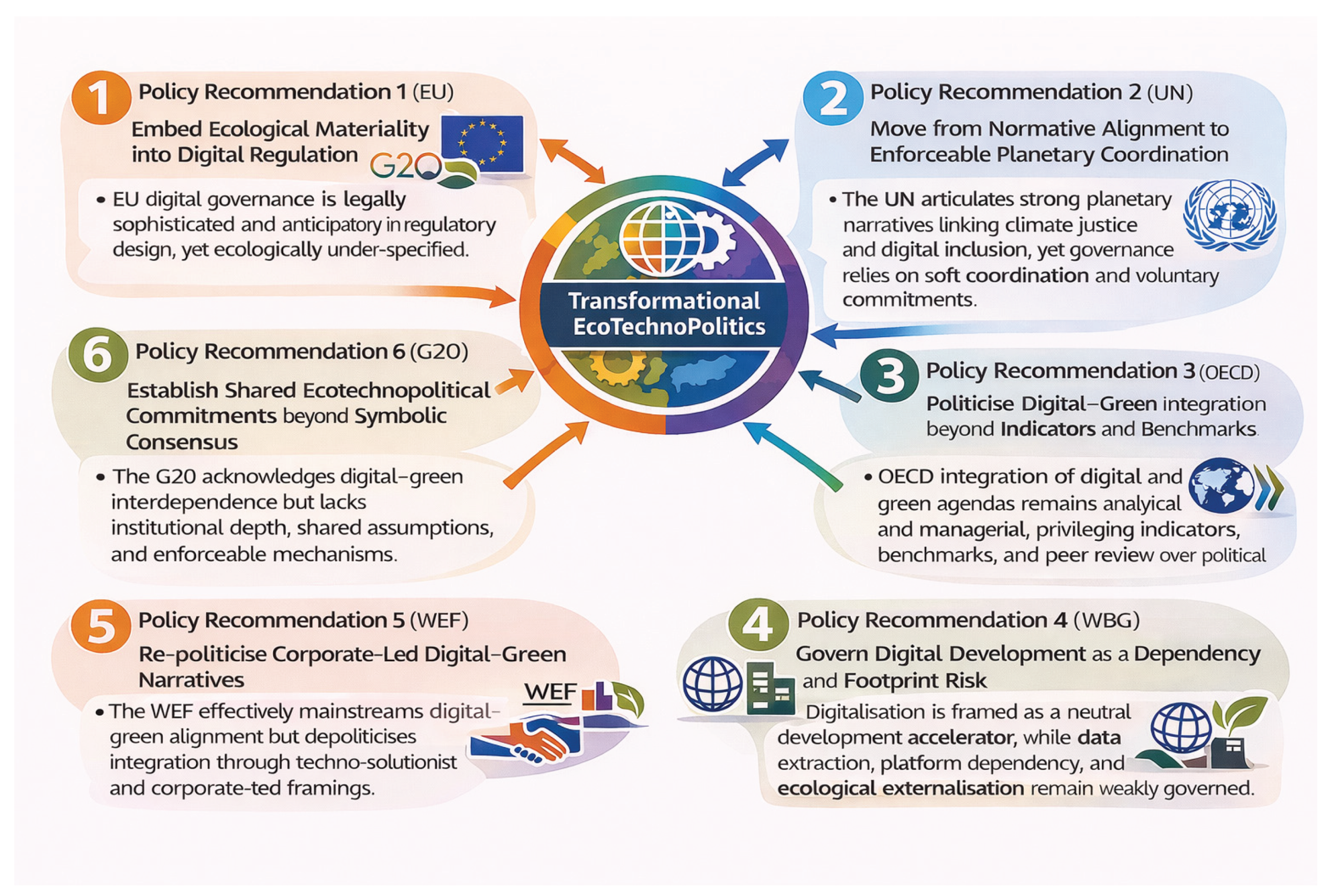
This section presents six EcoTechnoPolitics policy recommendations derived from the triangulated analysis of literature, place-based cases, and supranational policy architectures (Table 4 and Table 5). Each policy recommendations is structured as follows: (i) Result, (ii) Policy recommendation, (iii) Action Research recommendation, (iv) Action Research design, and (v) Working Hypotheses assessment. Each recommendation is systematically assessed against the three working hypotheses introduced in Section 1 (Figure 1): H1 Anticipatory Governance, H2 Hybridisation, and H3 Transformation beyond Cosmetic Digital–Green Twin Transitions.
Crucially, the hypotheses are not framed as propositions about current success, but as diagnostic hypotheses about structural conditions. Accordingly, confirmation of a hypothesis indicates that the empirical results demonstrate the necessity of that hypothesis for governing planetary digital–ecological systems.
4.1. Policy Recommendation 1 (European Union): Embed Ecological Materiality into Digital Regulation
Result 1: EU digital governance is legally sophisticated and anticipatory in regulatory design, yet ecologically under-specified. Digital infrastructures are primarily governed as market, competition, and risk objects, rather than as materially intensive systems embedded in planetary limits—despite mounting evidence of AI’s dual environmental and social footprint [92,93,94,95].
Policy recommendation 1: Integrate enforceable ecological materiality requirements into EU digital legislation (AI Act, Data Act, DSA/DMA), including lifecycle assessments, binding energy thresholds, and territorially grounded sustainability audits, aligned with debates on digital sovereignty and infrastructural power [96,97,98,99].
Action Research recommendation 1 (EU): From Risk-Based AI Regulation to Territorial Ecological Accounting of Digital Infrastructures
Action Research design 1: Establish Territorial Ecological AI Observatories (TEAIOs) in selected EU city-regions (e.g., Basque Country, Emilia-Romagna, North Rhine–Westphalia), co-governed by regional authorities, universities, civil society, and SMEs.
Core intervention:
- Co-produce live ecological accounts of AI systems deployed in public services (energy use, water use, material sourcing, rebound effects).
- Translate AI lifecycle impacts into territorial ecological thresholds rather than abstract compliance metrics.
H1 Anticipatory Governance:
- Uses scenario-based stress testing of AI deployment under future energy scarcity and climate constraints.
- Anticipates regulatory blind spots before they crystallise into lock-in.
H2 Hybridation:
- Connects EU-level regulation (AI Act, Data Act) with regional implementation and municipal procurement practices.
- Combines legal compliance with territorial political economy.
H3 Transformation beyond Twin Transitions:
- Shifts EU digital regulation from risk management to planetary boundary governance.
- Re-frames AI as an object of ecological budgeting, not merely algorithmic safety.
Working Hypothesis assessment 1:
H1 Anticipatory Governance — Confirmed.
The EU’s reliance on foresight, risk-based regulation, and future-oriented policy design confirms the necessity of anticipatory governance, even as current practices remain technocratic [93,99].
H2 Hybridisation — Confirmed.
The operationalisation of EU regulation through regions, municipalities, and city-regions demonstrates hybrid governance across scales, particularly in public-sector AI adoption [94,98].
H3 Transformation beyond Twin Transitions — Confirmed.
The persistent separation between digital regulation and ecological materiality empirically demonstrates the need for transformation beyond additive digital–green alignment [95].
4.2. Policy Recommendation 2 (United Nations): Move from Normative Alignment to Enforceable Planetary Coordination
Result 2: The UN articulates strong planetary narratives linking climate justice and digital inclusion, yet governance relies on soft coordination and voluntary commitments [96].
Policy recommendation 2: Complement normative frameworks (Global Digital Compact, SDGs) with enforceable ecotechnopolitical standards, accountability mechanisms, and science–policy interfaces to counter discursive dilution [99].
Action Research recommendation 2: From Soft Norms to Planetary Accountability Infrastructures
Action Research design 2: Create a UN Planetary Digital Commons Lab, operating as a transnational action-research platform linking UN agencies, Global South municipalities, indigenous data governance initiatives, and climate scientists.
Core intervention:
- Co-design enforceable minimum planetary standards for digital infrastructures (energy intensity, data extraction, ecological externalities).
- Pilot peer accountability mechanisms between territories rather than states.
H1 Anticipatory Governance:
- Focuses on long-term planetary risk trajectories rather than SDG reporting cycles.
- Anticipates geopolitical fragmentation by building horizontal governance capacity.
H2 Hybridation:
- Operates between UN normative authority and territorial experimentation.
- Embeds local epistemologies (e.g., indigenous ecological knowledge) into global governance.
H3 Transformation beyond Twin Transitions:
- Converts UN digital governance from declarative coordination into planetary stewardship architecture.
- Challenges the assumption that enforcement must be state-centric.
Working Hypothesis assessment 2:
H1 Anticipatory Governance — Confirmed.
The UN’s future-oriented planetary discourse confirms the centrality of anticipatory governance, even as institutional capacity remains limited [96].
H2 Hybridisation — Confirmed.
UN governance is inherently hybrid, operating through multilevel, multistakeholder arrangements across state and non-state actors [100,101].
H3 Transformation beyond Twin Transitions — Confirmed.
The gap between planetary rhetoric and enforceable governance demonstrates the structural necessity of moving beyond transition narratives toward transformative ecotechnopolitical coordination [92].
4.3. Policy Recommendation 3 (OECD): Politicise Digital–Green Integration beyond Indicators and Benchmarks
Result 3: OECD integration of digital and green agendas remains analytical and managerial, privileging indicators, benchmarks, and peer review over political economy and power relations [102,103,104].
Policy recommendation 3: Extend OECD frameworks to include political–economic analysis, territorial capability-building, and binding commitments on public digital infrastructure.
Action Research recommendation 3: From Indicators to Political-Economic Experiments in Digital–Green Integration
Action Research design 3: Launch OECD EcoTechnoPolitics Policy Sandboxes hosted by willing member regions rather than national ministries.
Core intervention:
- Replace benchmark-driven comparisons with political economy diagnostics of digital–green transitions.
- Test alternative models of digital public infrastructure ownership (cooperatives, public trusts).
H1 Anticipatory Governance:
- Examines how today’s digital investment choices shape future dependency and ecological lock-in.
- Uses foresight to test post-growth scenarios rather than growth-compatible transitions.
H2 Hybridation:
- Integrates OECD analytical capacity with territorial institutional experimentation.
- Allows regions to feed counter-evidence back into OECD policy frames.
H3 Transformation beyond Twin Transitions:
- Politicizes OECD governance by exposing distributional conflicts hidden by indicators.
- Moves integration beyond “what works” toward “for whom and at what ecological cost”.
Working Hypothesis assessment 3:
H1 Anticipatory Governance — Confirmed (managerial form).
Extensive foresight and long-term policy thinking confirm the relevance of anticipation, albeit framed as optimization [93].
H2 Hybridisation — Confirmed.
OECD governance depends on coordination across national, regional, and institutional actors [104].
H3 Transformation beyond Twin Transitions — Confirmed.
4.4. Policy Recommendation 4 (World Bank Group): Govern Digital Development as a Dependency and Footprint Risk
Result 4: Digitalization is framed as a neutral development accelerator, while data extraction, platform dependency, and ecological externalization remain weakly governed [95].
Policy recommendation 4: Embed sovereignty-sensitive digital architectures, ecological footprint assessments, and institutional accountability into development finance and GovTech programmes [93,94].
Action Research recommendation 4: From Digital Development to Sovereignty- and Footprint-Aware Digital Finance
Action Research design 4: Introduce Ecotechnopolitical Conditionality Pilots in selected GovTech and digital public infrastructure projects.
Core intervention:
-
Co-assess digital investments with recipient governments, civil society, and local researchers against:
- ○
- ecological footprint
- ○
- data dependency risks
- ○
- long-term institutional autonomy
- Tie funding tranches to governance capacity-building, not just service delivery.
H1 Anticipatory Governance:
- Explicitly models long-term dependency trajectories of platforms and vendors.
- Anticipates future fiscal and ecological costs rather than short-term efficiency gains.
H2 Hybridation:
- Operates across global finance, national policy, and municipal implementation.
- Blends development economics with political ecology and data sovereignty.
H3 Transformation beyond Twin Transitions:
- Repositions digital development as a risk domain, not a neutral accelerator.
- Breaks with extractive digitalisation pathways in development finance.
Working Hypothesis assessment 4:
H1 Anticipatory Governance — Confirmed (limited depth).
Development futures are actively imagined, but long-term lock-in risks remain under-anticipated [96].
H2 Hybridisation — Confirmed.
Governance operates through hybrid global–national–local arrangements [103].
H3 Transformation beyond Twin Transitions — Confirmed.
Instrumental digital–green integration empirically demonstrates the necessity of transformation beyond transition-oriented development paradigms [95].
4.5. Policy Recommendation 5 (World Economic Forum): Re-politicise Corporate-Led Digital–Green Narratives
Result 5: The WEF effectively mainstreams digital–green alignment but depoliticizes integration through techno-solutionist and corporate-led framings [105].
Policy recommendation 5: Condition public–private partnerships on enforceable public-interest governance, transparency, and engagement with alternative socio-economic imaginaries [106].
Action Research recommendation 5: From Techno-Solutionism to Contestable Futures Governance
Action Research design 5: Mandate Counter-Imaginary Assemblies alongside WEF digital–green initiatives.
Core intervention:
- Pair each WEF-led transition initiative with a civil-society–led counter-forum that produces alternative socio-technical futures.
- Require public documentation of conflicts, trade-offs, and rejected pathways.
H1 Anticipatory Governance:
- Treats future-making as a political struggle, not a consensus exercise.
- Surfaces suppressed or marginalised futures before they are foreclosed.
H2 Hybridation:
- Maintains public–private collaboration while reintroducing democratic friction.
- Connects corporate experimentation with territorial and labour perspectives.
H3 Transformation beyond Twin Transitions:
- De-legitimises greenwashing through forced epistemic pluralism.
- Re-politicises corporate climate–digital narratives.
Working Hypothesis assessment 5:
H1 Anticipatory Governance — Confirmed (elite-driven).
Future imaginaries are actively produced, confirming anticipation as a core governance mechanism.
H2 Hybridisation — Confirmed.
Governance is explicitly hybrid, blending public authority and private experimentation.
H3 Transformation beyond Twin Transitions — Confirmed.
The stabilisation of existing techno-economic power structures confirms the necessity of transformative EcoTechnoPolitics beyond corporate-led transitions.
4.6. Policy Recommendation 6 (G20): Establish Shared Ecotechnopolitical Commitments beyond Symbolic Consensus
Result 6: The G20 acknowledges digital–green interdependence but lacks institutional depth, shared assumptions, and enforceable mechanisms [105].
Policy recommendation 6: Adopt minimum shared commitments on AI and data infrastructure footprints, platform accountability, and territorial innovation capacity [101,102].
Action Research recommendation 6: From Symbolic Consensus to Shared Planetary Commitments
Action Research design 6: Establish a G20 Ecotechnopolitical Minimums Framework, tested through rotating territorial pilots.
Core intervention
- Agree on a small set of non-negotiable planetary constraints for AI and data infrastructures (energy ceilings, transparency of platform control).
- Test enforcement through mutual review among city-regions, not just states.
H1 Anticipatory Governance:
- Focuses on preventing future systemic collapse rather than managing present disagreement.
- Anticipates fragmentation by grounding commitments in practice.
H2 Hybridation:
- Links G20 coordination with subnational governance where implementation actually occurs.
- Encourages experimental convergence rather than rhetorical alignment.
H3 Transformation beyond Twin Transitions:
- Shifts G20 from agenda-setting to constraint-setting.
- Introduces planetary responsibility as a shared political obligation.
Working Hypothesis assessment 6:
H1 Anticipatory Governance — Confirmed (rhetorical form).
Long-term risks are acknowledged, confirming anticipation as a governance concern [105].
H2 Hybridisation — Confirmed.
The G20 operates as a coordination arena across heterogeneous governance regimes [101].
H3 Transformation beyond Twin Transitions — Confirmed.
Consensus-based governance and geopolitical compromise empirically demonstrate the need for transformation beyond symbolic digital–green integration [96].
4.7. Cross-Policy Synthesis: Working Hypotheses Validation
Methodological Coherence as Political Intervention
Across all six policy recommendations, Action Research is not a methodological add-on but a governance technology:
- It redistributes epistemic authority.
- It embeds ecological limits into decision-making.
- It treats uncertainty as a democratic condition, not a technical deficit.
In this sense, Action Research becomes the operational arm of EcoTechnoPolitics:
not evaluating transitions but reconfiguring how futures are governed under planetary constraint.
Across all six institutional arenas, the triangulated results produce a clear and coherent pattern:
H1 (Anticipatory Governance) is confirmed: anticipation is ubiquitous, though often technocratic or elite-driven [93,94,95,96,97,98,99].
H2 (Hybridisation) is confirmed: governance consistently unfolds through multi-scalar hybrid arrangements [94,98,101].
H3 (Transformation beyond Twin Transitions) is confirmed: the systematic inadequacy of current digital–green integration demonstrates the structural necessity of transformative EcoTechnoPolitics [95,96,97,106].
Taken together, these findings substantiate the article’s core contribution:
EcoTechnoPolitics is required not because anticipation or hybridisation are absent, but because—without transformation beyond twin transitions—they remain insufficient to govern planetary digital–ecological systems under conditions of polycrisis [26].
Figure 5.
Discussion: Transformational EcoTechnoPolitics Six Policy Recommendations for Planetary Thinking beyond Digital-Green Twin Transitions.
Figure 5.
Discussion: Transformational EcoTechnoPolitics Six Policy Recommendations for Planetary Thinking beyond Digital-Green Twin Transitions.
5. Conclusions: From Machine Sovereignty to EcoTechnoPolitics for Planetary Thinking
The conclusion argues that governing planetary-scale ecotechnopolitical systems requires embedding ecological responsibility within technological governance.
This article has argued that governing planetary-scale digital–ecological systems can no longer be adequately addressed through the dominant paradigm of digital–green twin transitions. Instead, the convergence of ecological destabilisation, accelerated digitalisation, and democratic strain requires a deeper reconfiguration of governance itself—one that this article conceptualises as EcoTechnoPolitics. By triangulating interdisciplinary literatures, place-based city-regional cases, and supranational policy architectures, the analysis demonstrates that prevailing approaches systematically externalise ecological costs while consolidating technological power, thereby reproducing the very conditions they claim to address.
At a conceptual level, the move from digital–green transitions to EcoTechnoPolitics responds directly to what Yuk Hui defines as machine sovereignty: the condition in which computational systems increasingly exercise governing functions that exceed and displace traditional political authority [2]. As shown throughout the article, planetary digital infrastructures—AI systems, data platforms, and cloud architectures—are no longer neutral tools of optimisation but active political actors that shape ecological extraction, social relations, and future imaginaries. Governing under conditions of machine sovereignty therefore demands not better alignment or coordination, but a transformation of how sovereignty, responsibility, and limits are understood and enacted.
This challenge is further illuminated by Benjamin Bratton’s notion of the Stack, which conceptualises digital infrastructures as a vertical, planetary-scale architecture that reorganises power across layers of territory, computation, and governance [4]. The macro-policy analysis confirms that supranational institutions implicitly operate within this stacked condition yet continue to govern through horizontally fragmented mandates and sectoral silos. EcoTechnoPolitics advances beyond this impasse by insisting that ecological limits, digital infrastructures, and political economy must be governed as a single ecotechnopolitical system, rather than as parallel domains loosely coupled through managerial coordination.
Normatively, the article’s contribution is grounded in Andrew Dobson’s distinction between weak and strong conceptions of environmental sustainability [108]. The empirical findings show that most digital–green policies remain aligned with weak sustainability, where ecological degradation is assumed to be substitutable through technological innovation and efficiency gains. EcoTechnoPolitics, by contrast, aligns with a strong sustainability perspective, recognising non-substitutable ecological limits and embedding them directly into technological governance. In this sense, the confirmation of Hypothesis H3 across all policy arenas does not signal success, but rather empirically demonstrates the structural necessity of moving beyond cosmetic transition narratives toward genuinely transformative governance.
This transformative imperative resonates strongly with José Manuel Naredo’s long-standing critique of the economic roots of ecological and social deterioration [40]. As the policy analysis reveals, growth-centric political economy remains the implicit integrator of digital and green agendas across institutions such as the OECD, World Bank Group, and World Economic Forum. EcoTechnoPolitics explicitly confronts this contradiction by reframing digital infrastructures as sites of political economy, material throughput, and distributive conflict, rather than as neutral enablers of sustainability. In doing so, it challenges the assumption that planetary crises can be resolved within unchanged accumulation regimes.
Substantively, the article makes three core contributions.
First, it demonstrates that anticipatory governance is already ubiquitous, but largely technocratic or elite-driven, confirming the need to democratise future-making under conditions of planetary constraint (H1). Second, it shows that hybrid governance arrangements across scales are not exceptions but structural features of contemporary ecotechnopolitical systems (H2). Third—and most critically—it establishes that the persistent inadequacy of digital–green integration empirically confirms the necessity of transformation beyond twin transitions (H3). Together, these findings position EcoTechnoPolitics not as an additional policy layer, but as an integrative framework capable of re-embedding ecological responsibility within technological governance.
While this article advances EcoTechnoPolitics as a conceptual and policy-oriented framework for planetary thinking beyond digital–green twin transitions, several limitations should be acknowledged, which also point toward a clear and cumulative future research agenda.
First, the study is deliberately theory-generative rather than hypothesis-testing in a positivist sense. The triangulated design—combining interdisciplinary literature review, place-based case analysis, and supranational policy analysis—prioritises analytical synthesis over causal inference. As a result, the article does not claim to measure policy effectiveness or quantify ecological or socio-economic outcomes. This limitation is inherent to action research and interpretive political economy approaches, which privilege reflexivity, contextualisation, and structural diagnosis over generalisable prediction [56,58,62]. Future research could therefore complement EcoTechnoPolitics with mixed-methods designs, including comparative indicators, environmental footprint modelling, or longitudinal policy evaluation, while remaining attentive to the risk of reducing transformation to metrics alone.
Second, the place-based analysis focuses on two socially cohesive city-regions—Portland (Oregon) and the Basque Country—selected for their strong planning traditions, institutional density, and democratic capacity. While analytically valuable, this focus limits the direct transferability of findings to contexts characterised by weaker institutions, authoritarian governance, or extreme socio-economic inequality. Comparative extensions to Global South city-regions, post-industrial regions with low social trust, or extractive frontier territories would deepen understanding of how EcoTechnoPolitics operates under more adverse conditions [40,107]. Such work would also help assess whether hybridisation functions as an emancipatory mechanism or as a stabiliser of dependency across different political–economic regimes.
Third, the macro-policy analysis centers on six influential supranational institutions (EU, UN, OECD, World Bank Group, WEF, G20). While these bodies shape dominant policy imaginaries, they do not exhaust the field of global techno-governance. Future research should therefore examine counter-hegemonic or alternative governance arenas, including indigenous data governance regimes, municipal networks, data cooperatives, and emerging South–South digital alliances [109,110]. This would extend EcoTechnoPolitics beyond institutional critique toward the mapping of plural ecotechnopolitical futures, in line with Dobson’s insistence on plural conceptions of sustainability and justice [108].
Fourth, although the article engages extensively with machine sovereignty (Hui) and planetary computation (Bratton), it does not empirically trace the internal design logics of specific AI systems, platforms, or data infrastructures. This reflects a conscious boundary choice, prioritising governance architectures over technical system audits. Future research could therefore integrate infrastructural ethnographies, STS-informed system audits, or computational political economy analyses to examine how ecological costs, labour relations, and power asymmetries are concretely encoded within digital systems [55,66].
Finally, EcoTechnoPolitics remains an open and evolving framework rather than a closed theory. Its value lies precisely in its capacity to travel across disciplines, scales, and policy arenas without collapsing complexity into a single model. Future research is therefore encouraged to refine, contest, and operationalize EcoTechnoPolitics through participatory action research, comparative regional studies, and experimental policy design. In doing so, scholars can test how anticipatory governance, hybridisation, and transformation beyond twin transitions interact under different ecological thresholds, technological trajectories, and democratic conditions [111].
In this sense, the limitations identified here do not weaken the article’s contribution. Rather, they reaffirm its central claim: that governing planetary digital–ecological systems require ongoing conceptual innovation, methodological pluralism, and politically situated inquiry. EcoTechnoPolitics is thus best understood not as an endpoint, but as a research programme for planetary thinking in the age of machine sovereignty and ecological constraint.
In conclusion, moving from machine sovereignty to EcoTechnoPolitics entails a shift from governing through technology toward governing technology itself as a planetary ecological–political system. This requires embedding ecological limits into digital regulation, re-scaling authority toward socially cohesive territories, and re-politicising digital–green integration beyond managerial consensus. By articulating this shift conceptually, empirically, and normatively, the article contributes to debates on planetary polycrisis by offering EcoTechnoPolitics as a necessary framework for rethinking justice, sustainability, and democracy in the age of planetary computation [112].
Author Contributions
Conceptualization, methodology, validation, formal analysis, investigation, resources, data curation, writing—original draft preparation, writing—review and editing, visualization, supervision, project administration, and funding acquisition, I.C. and I.E..; All authors have read and agreed to the published version of the manuscript.
Funding
This research was funded by (i) European Commission, Horizon 2020, H2020-MSCACOFUND-2020-101034228-WOLFRAM2: Ikerbasque Start Up Fund, 3021.23.EMAJ; (ii) UPV-EHU, Research Groups, IT 1541-22; (iii) Ayuda en Acci.n NGO, Innovation & Impact Unit, Research Contract: Scientific Direction and Strategic Advisory, Social Innovation Platforms in the Age of Artificial Intelligence (AI) (www.designingopportunities.org, accessed on 1 November 2025) and AI for Social Innovation. Beyond the Noise of Algorithms and Datafication Summer School Scientific Direction, 2–3 September 2024, Donostia-St. Sebastian, Spain (https://www.uik.eus/en/activity/artificial-intelligence-socialinnovation-ai4si, accessed on 1 July 2024), PT10863; (iv) Presidency of the Basque Government, External Affairs General Secretary, Basque Communities Abroad Direction, Scientific Direction and Strategic Advisory e-Diaspora Platform HanHemen (https://cordis.europa.eu/project/id/101120657, accessed on 1 November 2025), PT10859; (v) European Commission, Horizon Europe, ENFIELD European Lighthouse to Manifest Trustworthy and Green AI, HORIZON-CL4-2022-HUMAN-02-02-101120657; SGA oc1-2024-TES-01-01, https://cordis.europa.eu/project/id/101120657 (accessed on 1 November 2025). Invited Professor at BME, Budapest University of Technology and Economics (Hungary) (https://www.tmit.bme.hu/speechlab?language=en; accessed on 1 November 2025); (vi) Gipuzkoa Province Council, Etorkizuna Eraikiz 2024: AI’s Social Impact in the Historical Province of Gipuzkoa (AI4SI). 2024-LAB2-007-01. www.etorkizunaeraikiz.eus/en/ (accessed on 1 November 2025) and https://www.uik.eus/eu/jarduera/adimen-artifiziala-gizarte-berrikuntzarako-ai4si (accessed on 1 November 2025); (vii)Warsaw School of Economics SGH (Poland) by RID LEAD, Regional Excellence Initiative Programme (https://rid.sgh.waw.pl/en/grants-0 (accessed on 1 November 2025) and https://www.sgh.waw.pl/knop/en/conferences-and-seminars-organized-by-the-institute-ofenterprise (accessed on 1 November 2025) and https://www.sgh.waw.pl/knop/en/conferences-andseminars-organized-by-the-institute-of-enterprise (accessed on 1 November 2025); (viii) SOAM Residence Programme: Network Sovereignties (Germany) via BlockchainGov (www.soam.earth); (ix) Decentralization Research Centre (Canada) (www.thedrcenter.org/fellows-and-team/igor-calzada/ (accessed on 1 November 2025)); (x) The Learned Society of Wales (LSW) 524205; (xi) Fulbright Scholar-In-Residence (S-I-R) Award 2022-23, PS00334379 by the US–UK Fulbright Commission and IIE, US Department of State at the California State University; (xii) the Economic and Social Research Council (ESRC) ES/S012435/1 “WISERD Civil Society: Changing Perspectives on Civic Stratification/Repair”; (xiii) Gipuzkoa Province Council, Human Rights & Democratic Culture Directorate: Action Research Programme (PT10937) including xiii.1. Digital Inclusion & Generative AI International Summer School Scientific Direction, 15–16 July 2025, Donostia-St. Sebastian, Spain; xiii.2. Anticipatory AI Governance, and xiii.3. EcoTechnoPolitics (ETP); and (xiv) Astera Institute, Cosmik Data Cooperatives for Open Science. Views and opinions expressed however those of the author only and do not necessarily reflect those of these institutions. None of them can be held responsible for them.
Institutional Review Board Statement
Not applicable.
Informed Consent Statement
Not applicable.
Data Availability Statement
No data were used for the research described in the article.
Conflicts of Interest
The authors declare no conflicts of interest.
References
- Richardson, K.; Steffen, W.; Lucht, W.; Bendtsen, J.; Cornell, S.E.; Donges, J.F.; Drüke, M.; Fetzer, I.; Bala, G.; von Bloh, W.; et al. Earth beyond six of nine planetary boundaries . Sci. Adv. 2023, 9, eadh2458. [Google Scholar] [CrossRef] [PubMed]
- Hui, Y. Machine and Sovereignty: For a Planetary Thinking; University of Minnesota Press: Minneapolis, MN, USA; London, UK, 2024. [Google Scholar]
- Calzada, I. Benchmarking Future City-Regions Beyond Nation-States. Reg. Stud. Reg. Sci. 2015, 2(1), 351–362. [Google Scholar] [CrossRef]
- Bratton, B.H. The Stack: On Software and Sovereignty; MIT Press: Cambridge, MA, USA; London, UK, 2015. [Google Scholar]
- European Commission. The European Green Deal; European Commission: Brussels, Belgium, 2019. [Google Scholar]
- European Commission. Digital Compass 2030: The European Way for the Digital Decade; European Commission: Brussels, Belgium, 2021. [Google Scholar]
- European Union. Regulation (EU) 2024/of the European Parliament and of the Council Laying Down Harmonised Rules on Artificial Intelligence (Artificial Intelligence Act); European Union: Brussels, Belgium, 2024. [Google Scholar]
- United Nations. Paris Agreement; United Nations: New York, NY, USA, 2015. [Google Scholar]
- United Nations. Roadmap for Digital Cooperation; United Nations: New York, NY, USA, 2020. [Google Scholar]
- United Nations. Global Digital Compact: Process Documents; United Nations: New York, NY, USA, 2023. [Google Scholar]
- OECD. Towards Green Growth; OECD Publishing: Paris, France, 2011. [Google Scholar]
- OECD. Going Digital: Shaping Policies, Improving Lives; OECD Publishing: Paris, France, 2019. [Google Scholar]
- OECD. OECD Principles on Artificial Intelligence; OECD Publishing: Paris, France, 2019. [Google Scholar]
- World Bank. World Development Report 2021: Data for Better Lives; World Bank: Washington, DC, USA, 2021. [Google Scholar]
- World Economic Forum. The Great Reset; World Economic Forum: Cologny, Switzerland, 2020. [Google Scholar]
- Eizaguirre, I. Gobernanza para el Desarrollo Sostenible en Gipuzkoa. Doctoral Thesis, University of the Basque Country (UPV/EHU), Donostia–San Sebastián, Spain, 2024. [Google Scholar]
- Rodrigues, G.F. de C. 21st Century Energy and Legitimation of New Industries: Innovating for and Legitimating the Bioeconomy – A Study of the European Green Transition. PhD Thesis, University of Glasgow, Glasgow, UK, 2024. Available online: https://theses.gla.ac.uk/85117/ (accessed on 1 December 2025).
- Dixson-Declève, S.; Gaffney, O.; Ghosh, J.; Randers, J.; Rockström, J.; Stoknes, P.E. Earth for All: A Survival Guide for Humanity—A Report to the Club of Rome; New Society Publishers: Gabriola Island, BC, Canada, 2022. [Google Scholar]
- Jackson, T. Prosperity without Growth? The Transition to a Sustainable Economy; Sustainable Development Commission: London, UK, 2009. [Google Scholar]
- Calzada, I.; Eizaguirre, I. Digital Inclusion & Urban AI: Strategic Roadmapping and Policy Challenges. Discover Cities;Special Issue 2025, 2(73), 1–14. Available online: https://ssrn.com/abstract=5386270 (accessed on 1 November). [CrossRef]
- 21. Calzada, I. Data (Un)Sustainability: Navigating Utopian Resistance While Tracing Emancipatory Datafication Strategies. In Digital (Un)Sustainabilities. Promises, Contradictions, and Pitfalls of the Digitalisation–Sustainability Nexus; Certomá, C., Martelozzo, F., Iapaolo, F., Eds.; Routledge: Oxon, UK, 2024; pp. xx–xx. [Google Scholar] [CrossRef]
- Jackson, T. Prosperity without Growth: Foundations for the Economy of Tomorrow; Routledge: London, UK, 2016. [Google Scholar]
- Hamilton, C. Requiem for a Species: Why We Resist the Truth about Climate Change; Earthscan: London, UK, 2010. [Google Scholar]
- Calzada, I. Datafied Democracies and AI Economies Unplugged: Technopolitics in Smart Cities and Datafied Network States; Springer Nature: Cham, Switzerland, 2025; ISBN 978-3-032-11887-5. [Google Scholar]
- Fullerton, J.B. Regenerative Economics: Revolutionary Thinking for a World in Crisis; Vintage Books: New York, NY, USA, 2024. [Google Scholar]
- Martin, R.; Martinelli, F.; Clifton, J. Rethinking Spatial Policy in an Era of Multiple Crises. Cambridge J. Reg. Econ. Soc. 2022, 15(1), 3–21. [Google Scholar] [CrossRef]
- López-Rodríguez, M.D.; Lozano-Díaz, A.; Rodríguez-Puertas, R.; Fernández-Prados, J.S. Generational Climate Engagement in Liquid Modernity: Eco-Anxiety, Environmental Activism and Pro-Environmental Behavior Among Older Adults in Spain. Societies 2025, 15, 266. [Google Scholar] [CrossRef]
- Turner, C. Relationships and Relationality in Times of Profound Eco-Political Change. Societies 2025, 15, 102. [Google Scholar] [CrossRef]
- Huq, M.A. The Significance of Civil Intellectuals’ Activism: A Case of Eco-Nationalistic Social Movement in Bangladesh. Societies 2020, 10, 18. [Google Scholar] [CrossRef]
- Nagy, G.; Heiner, S.Á.; Kovács, Z. Exploring the Presence and Absence of Academic Discourse on Public Participation in the European Green Deal: A Central and Eastern European Perspective. Societies 2025, 15, 49. [Google Scholar] [CrossRef]
- Hennig, B.D.; Roberts, B.F.; Welling, J.T.; Pinal, M.; Ólafsson, J. Playing for the Planet? A Serious Game Approach to Land Use Planning with Students in Rural Iceland. Societies 2025, 15, 14. [Google Scholar] [CrossRef]
- Duradoni, M.; Severino, F.P.; Neri, G.; Fiorenza, M.; Lindemann, N.; Puddu, L.; Guazzini, A. Can Trust in Climate-Skeptical Governments Inhibit Pro-Environmental Action? Implications for Public Participation and Democratic Innovations. Societies 2025, 15, 26. [Google Scholar] [CrossRef]
- Tricarico, L.; Hausemer, P.; Gorman, N.; Squillante, F. Towards a Paradigm of Proximity Economy for Competitive and Resilient Cities and Territories. Soc. Sci. 2025, 14, 394. [Google Scholar] [CrossRef]
- Broccia, S.; Dias, Á.; Pereira, L. Sustainable Entrepreneurship: Comparing the Determinants of Entrepreneurial Self-Efficacy and Social Entrepreneurial Self-Efficacy. Soc. Sci. 2022, 11, 537. [Google Scholar] [CrossRef]
- Meyer, C. Social Innovation Governance in Smart Specialisation Policies and Strategies Heading towards Sustainability: A Pathway to RIS4? Soc. Sci. 2022, 11, 150. [Google Scholar] [CrossRef]
- Han, H.; Xia, S. An Agro-Based Society after Post-Industrial Society: From a Perspective of Economic Growth Paradigm. Soc. Sci. 2021, 10, 455. [Google Scholar] [CrossRef]
- Karlsson, R. Learning in the Anthropocene. Soc. Sci. 2021, 10, 233. [Google Scholar] [CrossRef]
- Calzada, I.; Eizaguirre, I. Anticipatory AI Governance in Practice: Data Sovereignty, Urban AI, and Trustworthy GenAI in the Basque Country. In Proceedings of the 2025 IEEE International Conference on Agentic AI (ICA) Data for Policy CIC–Zenodo. https://doi.org/10.5281/zenodo.17795535, Wuhan, China, 5–7 December 2025; Available online: https://youtu.be/GuHC40mw3y8 https://papers.ssrn.com/sol3/papers.cfm?abstract_id=5660050 (accessed on 1 November 2025).
- Beel, D.; Thompson, M.; Calzada, I.; Jones, I.R.; Jones, M.; Morgan, K. Anticipating Regional Futures? The Promises, Prospects and Pitfalls of the Basque Model. Camb. J. Reg. Econ. Soc.;Special Issue: Rethinking Regional Development in Polarised Times: Towards New Regional Futures? 2026. [Google Scholar]
- Naredo, J.M. Raíces económicas del deterioro ecológico y social: Más allá de los dogmas; Siglo XXI de España Editores: Madrid, Spain, 1987. [Google Scholar]
- Visvizi, A.; Witek-Hajduk, M.K.; Wautelet, Y. (Eds.) The Twin Digital and Green Transition; Edward Elgar Publishing: Cheltenham, UK, 2026. [Google Scholar]
- Tutton, R. The Sociology of Futurelessness. Sociology 2022, 57(2), 438–453. [Google Scholar] [CrossRef]
- Appadurai, A. The Capacity to Aspire: Culture and the Terms of Recognition. In Culture and Public Action; Rao, V., Walton, M., Eds.; Stanford University Press: Stanford, CA, USA, 2004; pp. 59–84. [Google Scholar]
- Jasanoff, S. The Ethics of Invention: Technology and the Human Future; W. W. Norton & Company: New York, NY, USA, 2016. [Google Scholar]
- Calzada, I. ¿Hacia una Ciudad Vasca? Aproximación desde la Innovación Social; Servicio Central de Publicaciones del Gobierno Vasco: Vitoria-Gasteiz, Spain, 2011; Available online: https://addi.ehu.es/handle/10810/61974 (accessed on 10 December 2025)ISBN 978-84-457-3180-2. [CrossRef]
- Poitras, L. The Urban Growth Boundary: Analysis of a Component of Portland’s 2040 Growth Concept. Portland, OR, USA, 2000. Available online: https://www.ucalgary.ca/ev/designresearch/projects/EVDS683-74/Planning_for_Urban_Growth/research/urban_growth_boundary_in_portland.pdf (accessed on 10 December 2025).
- Seltzer, E. Planning in the Portland Region: Lessons and Legacy. Paper presented at the Conference on Cities in North America, New York University, New York, NY, USA, June 1995; Available online: https://pdxscholar.library.pdx.edu/cgi/viewcontent.cgi?article=1068&context=metropolitianstudies (accessed on 10 December 2025).
- Scharenberg, A.; Barassi, V. Algorithmic Resistance in Europe and the Question of Collective Agency. In Proceedings of the 23rd Annual Conference of the Association of Internet Researchers (AoIR 2022), Dublin, Ireland, 2–5 November 2022; Association of Internet Researchers: Dublin, Ireland, 2022. [Google Scholar]
- Dunkelman, M.J. Why Nothing Works: Who Killed Progress—and How to Bring It Back; PublicAffairs: New York, NY, USA, 2024. [Google Scholar]
- Klein, E.; Thompson, D. Abundance: How We Build a Better World; Avid Reader Press: New York, NY, USA, 2024. [Google Scholar]
- Bridge, G. On Marxism, pragmatism and critical urban studies. Int. J. Urban Reg. Res. 2014, 38, 1644–1659. [Google Scholar] [CrossRef]
- Bates, J.; Fratczak, M.; Kennedy, H.; Medina Perea, I.; Ochu, E. Feeding the Machine: Practitioner Experiences of Efforts to Overcome AI’s Data Dilemma. Big Data & Society 2025, 12(4), 1–15. [Google Scholar] [CrossRef]
- Garibay-Petersen, C.; Lorimer, M.; Menzat, B. Creating Certainty Where There Is None: Artificial Intelligence as Political Concept. BigData & Society 2025, 12(4), 1–13. [Google Scholar] [CrossRef]
- Riemens, R. Greenwashing Silicon Valley: The Legitimization of Green Platform Capitalism through Tech-on-Climate Discourse. Big Data & Society 2025, 12, 1–18. [Google Scholar]
- Haider, J.; Rödl, M. Google Search and the Creation of Ignorance: The Case of the Climate Crisis. In Big Data & Society; January 2023; pp. 1–12. [Google Scholar] [CrossRef]
- Denzin, N.K. The Research Act: A Theoretical Introduction to Sociological Methods; McGraw-Hill: New York, NY, USA, 1978. [Google Scholar]
- Flick, U. Triangulation and Mixed Methods. In The SAGE Handbook of Qualitative Data Collection; Flick, U., Ed.; SAGE Publications: London, UK, 2018; pp. 527–544. [Google Scholar]
- Reason, P.; Bradbury, H. (Eds.) The SAGE Handbook of Action Research: Participative Inquiry and Practice, 2nd ed.; SAGE Publications: London, UK, 2008. [Google Scholar]
- Kemmis, S.; McTaggart, R.; Nixon, R. The Action Research Planner: Doing Critical Participatory Action Research; Springer: Singapore, 2014. [Google Scholar] [CrossRef]
- Brydon-Miller, M.; Greenwood, D.; Maguire, P. Why Action Research? Action Res. 2003, 1, 9–28. [Google Scholar] [CrossRef]
- Nowotny, H.; Scott, P.; Gibbons, M. Re-Thinking Science: Knowledge and the Public in an Age of Uncertainty; Polity Press: Cambridge, UK, 2001. [Google Scholar]
- Stirling, A. Keep It Complex. Nature 2010, 468, 1029–1031. [Google Scholar] [CrossRef]
- Geddes, P. Cities in Evolution: An Introduction to the Town Planning Movement and to the Study of Civics; Williams & Norgate: London, UK, 1915. [Google Scholar]
- Mumford, L. The City in History: Its Origins, Its Transformations, and Its Prospects; Harcourt, Brace & World: New York, NY, USA, 1961. [Google Scholar]
- Latour, B. Down to Earth: Politics in the New Climatic Regime; Polity Press: Cambridge, UK, 2018; ISBN 978-1-5095-3059-5. [Google Scholar]
- Marres, N. Material Participation: Technology, the Environment and Everyday Publics; Palgrave Macmillan: London, UK, 2012; ISBN 978-1-137-00955-5. [Google Scholar]
- Machen, R.; Nost, E. Thinking Algorithmically: The Making of Hegemonic Knowledge in Climate Governance. Trans. Inst. Br. Geogr. 2021, 46, 555–569. [Google Scholar] [CrossRef]
- Tonnarelli, F.; Mora, L. Data in Crisis: Mobility and Fitness-for-Use in Decentralized Ecosystems. Environmental Science & Policy 2025, 174, 104267. [Google Scholar] [CrossRef]
- Hawkins, Z.J.; Razavi, R.; Hodgman, M.; Weaver, J.; Lehdonvirta, V.; Page, M. From AI Sovereignty to AI Agency—Measuring Capability, Agency & Power: A Practical Tool for Policymakers. Tech Policy Design Institute; Canberra, Australia, 2025. Available online: http://www.techpolicy.au/ai-agency.
- Cugurullo, F.; Caprotti, F.; Cook, M.; Karvonen, A.; Marvin, S.; McGuirk, P. (Eds.) Artificial Intelligence and the City: Urbanistic Perspectives on AI; Routledge: London, UK, 2024. [Google Scholar]
- Copley, C.; Luger, J.; Thomas, L.; Dilaver, O. The Political Geographies of AI and the Manosphere. Political Geography 2025, xx, 1–6. [Google Scholar] [CrossRef]
- Bosoer, L.; Innerarity, D. Unpacking AI Sovereignty; STG Policy Papers 2025/18. In Florence School of Transnational Governance; European University Institute: Florence, Italy, 2025. [Google Scholar]
- Barron, D.; Marres, N.; Coldicutt, R.; Taylor, A.; Ganesh, M.I. AI in the Street: Lessons from Everyday Encounters with AI Innovation; Careful Industries: London, UK, 2025. [Google Scholar]
- Taylor, A.; Marres, N.; Bunz, M.; Phan, T.; Ganesh, M.I.; et al. Reciprocity Deficits: Observing AI in the Street with Everyday Publics. Urban Studies 2025, xx, 1–20. [Google Scholar]
- European Decentralisation Institute. Rebalancing Europe’s Digital Power: Decentralisation as a Practical Route to Digital Sovereignty; European Decentralisation Institute: Brussels, Belgium, 2025. [Google Scholar]
- Wilkinson, R.; Krasodomski, A.; Wilkinson, I. The Case for Expanding Digital Public Infrastructure: How Open, Scalable Technology Can Serve Citizens, Preserve Sovereignty and Save Money; Chatham House: London, UK, 2025. [Google Scholar]
- OECD; World Economic Forum. AI in Strategic Foresight: Reshaping Anticipatory Governance; OECD/WEF White Paper: Geneva, Switzerland; Paris, France, 2025. [Google Scholar]
- UNESCO; ITU; UNDP; African Union Commission. Data Governance Toolkit: Navigating Data in the Digital Age; Broadband Commission for Sustainable Development: Paris, France; Geneva, Switzerland; Addis Ababa, Ethiopia, 2025. [Google Scholar]
- Heitmann, M.; Hinrichsen, T.; Africa, D.; Sandbrink, J. Understanding AI Trajectories: Mapping the Limitations of Current AI Systems. UK AI Safety Institute Working Paper, 2025. [Google Scholar]
- Gassert, F.; Gawel, A.; Harfoot, M.; Mayer, A.; Singhal, K.; Stolle, F.; Vary, L. AI for Nature: How AI Can Democratize and Scale Action on Nature; World Resources Institute/Google: Washington, DC, USA, 2025. [Google Scholar]
- Paul, R.; Carmel, E.; Cobbe, J. Introduction to the Handbook on Public Policy and Artificial Intelligence: Vantage Points for Critical Inquiry. In Handbook on Public Policy and Artificial Intelligence; Edward Elgar: Cheltenham, UK, 2025; pp. 1–25. [Google Scholar]
- Barrett, K.; Greene, R. AI in State Government: Balancing Innovation, Efficiency, and Risk; IBM Center for The Business of Government: Washington, DC, USA, 2025. [Google Scholar]
- AI for a Planet Under Pressure; Galaz, V., Schewenius, M., Eds.; Stockholm Resilience Centre & Potsdam Institute for Climate Impact Research: Stockholm, Sweden, 2025; ISBN 978-91-89107-61-8. [Google Scholar]
- Daly, A.; Hagendorff, T.; Hui, L.; Mann, M.; Marda, V.; Wagner, B.; Wang, W.; Witteborn, S. Artificial Intelligence Governance and Ethics: Global Perspectives; Faculty of Law Research Paper No. 2019-15; Chinese University of Hong Kong: Hong Kong, China, 2019. [Google Scholar]
- Ulnicane, I.; Knight, W.; Leach, T.; Stahl, B.C.; Wanjiku, W.-G. Governance of Artificial Intelligence: Emerging International Trends and Policy Frames. In The Global Politics of Artificial Intelligence; Tinnirello, M., Ed.; Routledge: London, UK, 2022; pp. 29–48. [Google Scholar] [CrossRef]
- Grohmann, R.; Costa Barbosa, A. Sovereignty-as-a-Service: How Big Tech Companies Co-opt and Redefine Digital Sovereignty. Media, Culture & Society 2025, xx, 1–9. [Google Scholar] [CrossRef]
- OECD. OECD AI Capability Indicators: Technical Report; OECD Publishing: Paris, France, 2025. [Google Scholar] [CrossRef]
- McKay, F.; Williams, B.J.; Prestwich, G.; Treanor, D.; Hallowell, N. Public Governance of Medical Artificial Intelligence Research in the UK: An Integrated Multi-Scale Model. Research Involvement and Engagement 2022, 8, 21. [Google Scholar] [CrossRef]
- Ilves, L.; Kilian, M.; Peixoto, T.C.; Velsberg, O. The Agentic State: How Agentic AI Will Revamp 10 Functional Layers of Government and Public Administration; Global Government Technology Centre Berlin: Berlin, Germany, 2025. [Google Scholar]
- Purificato, E.; Bili, D.; Jungnickel, R.; Ruiz-Serra, V.; Fabiani, J.; Abendroth-Dias, K.; Fernández-Llorca, D.; Gómez, E. The Role of Artificial Intelligence in Scientific Research: A Science for Policy, European Perspective; Publications Office of the European Union: Luxembourg, 2025. [Google Scholar] [CrossRef]
- European Commission. Study on the Next Data Frontier: Generative AI, Regulatory Compliance and International Dimensions. In Executive Summary; Publications Office of the European Union: Luxembourg, 2025. [Google Scholar] [CrossRef]
- Koch, N. Green Nationalism from Above: Authoritarian State Power and the Greening of UAE Nationalism. Nations and Nationalism 2025, 31, 946–965. [Google Scholar] [CrossRef]
- Ruvalcaba-Gomez, E.A.; Garcia-Benitez, V.H. The Multiple Streams Framework: A Lens for Understanding Artificial Intelligence Adoption in the Public Sector. Policy & Internet 2025, 17, e70021. [Google Scholar] [CrossRef]
- Rodriguez Müller, A.P.; Tangi, L.; Lerusse, A. Understanding the Adoption of Artificial Intelligence in Local Government Decision-Making: The Influence of Institutional Pressures and Managerial Perceptions. Public Administration 2025, 1–17. [Google Scholar] [CrossRef]
- Tubaro, P. The Dual Footprint of Artificial Intelligence: Environmental and Social Impacts Across the Globe. Globalizations 2025, 1–18. [Google Scholar] [CrossRef]
- Chaturvedi, S.; Doyle, T. Climate Terror: A Critical Geopolitics of Climate Change; Palgrave Macmillan: London, UK, 2015. [Google Scholar] [CrossRef]
- Visvizi, A.; Kozlowski, K.; Calzada, I.; Troisi, O. Multidisciplinary Movements in AI and Generative AI: Society, Business, Education; Edward Elgar: Cheltenham, UK, 2025; ISBN 978-1-03535-865-6. [Google Scholar]
- Tilly, N.; Seepma, A.P.; Senadheera, S.; Yigitcanlar, T. Navigating publicness in digital innovation: Big data and AI adoption in European public sector organisations. Eur. J. Innov. Manag. 2025. [Google Scholar] [CrossRef]
- Coyle, D.; Kenny, M. How to get science back into policymaking. Nature 2025, 648, 275–276. [Google Scholar] [CrossRef]
- Adler-Nissen, R.; Eggeling, K.A. The discursive struggle for digital sovereignty: Security, economy, rights and the cloud project Gaia-X. J. Common Mark. Stud. 2024, 62, 993–1011. [Google Scholar] [CrossRef]
- Ulnicane, I.; Knight, W.; Leach, T.; Stahl, B.C.; Wanjiku, W.-G. Governance of artificial intelligence: Emerging international trends and policy frames. In The Global Politics of Artificial Intelligence; Tinnirello, M., Ed.; Routledge: London, UK, 2022; pp. 29–47. [Google Scholar] [CrossRef]
- The Cambridge Handbook of the Law, Ethics and Policy of Artificial Intelligence; Smuha, N.A., Ed.; Cambridge University Press: Cambridge, UK, 2025. [Google Scholar] [CrossRef]
- AI Innovations in Public Services: The Case of National Libraries; Mergel, I., Schmidt, C., Eds.; Springer Nature Switzerland AG: Cham, Switzerland, 2026. [Google Scholar] [CrossRef]
- OECD. Artificial Intelligence for Advancing Smart Cities; OECD Publishing: Paris, France, 2025. [Google Scholar]
- World Economic Forum. Four Futures for the New Economy: Geoeconomics and Technology in 2030; World Economic Forum: Cologny/Geneva, Switzerland, 2025. [Google Scholar]
- Morozov, E. El socialismo después de la IA. JacobinLat 2025, *14 Dec 2025. Traducción: Pedro Perucca. Available online: https://jacobinlat.com/2025/12/el-socialismo-despues-de-la-ia/ (accessed on 15 Dec 2025).
- Breznitz, D. Innovation in Real Places: Strategies for Prosperity in an Unforgiving World; Oxford University Press: Oxford, UK, 2021. [Google Scholar] [CrossRef]
- Dobson, A. Three Conceptions of Environmental Sustainability. In Justice and the Environment: Conceptions of Environmental Sustainability and Theories of Distributive Justice; Available online; Oxford University Press: Oxford, UK, 1998; (accessed on 28 December 2025). [Google Scholar] [CrossRef]
- Calzada, I. Decentralizing AI Economics for Poverty Alleviation: Web3 Social Innovation Systems in the Global South. AI 2025, 6, 309. [Google Scholar] [CrossRef]
- Calzada, I. The Political Economy of Web3 Platformization: Innovation Systems, Reaching the Moon, Governing the Ghetto. Digital 2025, 5, 62. [Google Scholar] [CrossRef]
- Scharenberg, A.; Barassi, V. Algorithmic Resistance in Europe and the Question of Collective Agency. In Proceedings of the 23rd Annual Conference of the Association of Internet Researchers (AoIR 2022), Dublin, Ireland, 2–5 November 2022; Association of Internet Researchers: Dublin, Ireland, 2022. [Google Scholar]
- Calzada, I. The Illusion of the Web3 Decentralization. In Data & Policy 2025; Available at SSRN; Cambridge University Press: Cambridge. [CrossRef]

Table 1.
Foundational and Conceptual Literature Review Informing EcoTechnoPolitics.
| Author / Work | Core Contribution | Conceptual Relevance to EcoTechnoPolitics |
Key Themes |
|---|---|---|---|
|
Geddes (1915) [63] Cities in Evolution |
Introduces cities as evolving socio-ecological organisms shaped by civic life, regional planning, and environmental constraints. | Provides historical grounding for understanding territorial innovation and the ecological embeddedness of governance. | Urbanism; Regional planning; Civic ecology. |
|
Mumford (1961) [64] The City in History |
Historicizes technological and urban development, emphasizing the interplay between social organization, technology, and ecological limits. | Frames cities as laboratories of socio-technical futures, informing the territorial dimension of EcoTechnoPolitics. | Urban technology; Social order; Eco-urbanism. |
|
Hui (2024) [2] Machine and Sovereignty |
Proposes planetary thinking as a philosophical response to computational sovereignty. | Introduces the planetary scale needed to analyse digital infrastructures and emerging techno-sovereignties. | Planetary governance; Techno-sovereignty; Philosophy of computation. |
|
Bratton (2015) [4] The Stack |
Conceptualises digital infrastructures as a multilayered architecture that reorganizes sovereignty and governance. | Offers an analytical model for understanding how digital systems create new jurisdictional and political spaces. | Computational layers; Platform sovereignty; Global digital architectures. |
|
Jackson (2016) [19] Prosperity Without Growth |
Critiques growth-centric economics and calls for ecological limits in socio-technical transitions. | Anchors EcoTechnoPolitics in sustainability political economy, connecting digital infrastructures with ecological constraints. | Ecological economics; Post-growth; Systemic sustainability. |
|
Hamilton (2010) [23] Requiem for a Species |
Examines cultural and political denial in the face of climate change. | Highlights sociopolitical barriers to ecological transitions, informing EcoTechnoPolitics’ attention to public reasoning. | Climate denial; Politics of sustainability; Social imaginaries. |
|
Latour (2018) [65] Down to Earth |
Argues for a politics grounded in terrestrial attachments in response to climate and geopolitical crises. | Strengthens the framework’s focus on situated, material practices within planetary ecological dynamics. | Terrestrial politics; Climate regimes; Geopolitical ecology. |
|
Marres (2012) [66] Material Participation |
Analyses how technologies shape public participation and environmental politics. | Supports the framework’s focus on socio-technical participation and material infrastructures in governance. | STS; Participation; Technopolitics; Environmental publics. |
Table 2.
Contemporary Literature Review Informing EcoTechnoPolitics.
| Author / Work | Core Contribution | Conceptual Relevance to EcoTechnoPolitics |
Key Themes |
|---|---|---|---|
|
Machen & Nost (2021) [67] Thinking Algorithmically |
Shows how algorithmic reasoning shapes hegemonic knowledge in climate governance. |
Highlights epistemic power in climate–AI interactions, central to analysing technopolitical authority. | Algorithmic governance; Knowledge politics; Climate policy. |
|
Tonnarelli & Mora (2025) [68] Data in Crisis |
Examines data mobility and fitness-for-use challenges in decentralized ecosystems. | Illuminates infrastructural fragilities in data governance, informing territorial digital strategies. | Data quality; Decentralised ecosystems; Data mobility. |
|
Hawkins et al. (2025) [69] From AI Sovereignty to AI Agency |
Introduces tools to measure capability and agency in AI systems for policymakers. | Offers operational metrics for evaluating techno-sovereignty and AI agency across scales. | AI capability; Agency; Policy assessment. |
|
Cugurullo et al. (2024) [70] Artificial Intelligence and the City |
Frames AI as an urbanistic force reshaping planning, governance, and city-making. | Grounds EcoTechnoPolitics in urban-scale AI transformations, linking digital infrastructures to territorial change. | Urban AI; Smart cities; Techno-urbanism. |
|
Copley et al. (2025) [71] Political Geographies of AI and the Manosphere |
Analyses how AI intersects with masculinist online cultures and political geographies. | Highlights cultural–territorial dimensions of AI, adding nuance to multiscalar sovereignty debates. | AI cultures; Political geography; Gendered technopolitics. |
|
Bosoer & Innerarity (2025) [72] Unpacking AI Sovereignty |
Provides a conceptual clarification of AI sovereignty in policy debates. | Directly informs the sovereignty dimension of EcoTechnoPolitics by theorising techno-jurisdictional claims. | AI sovereignty; Governance; Institutional theory. |
|
Barron et al. (2025) [73] AI in the Street |
Documents everyday encounters with AI systems in public spaces. | Reinforces EcoTechnoPolitics’ focus on situated socio-technical practices and public experience. | Everyday AI; Public encounters; STS. |
|
Taylor et al. (2025) [74] Reciprocity Deficits |
Shows how AI systems disrupt reciprocity between publics and infrastructures. | Reveals democratic and participatory gaps created by AI infrastructures. | Public participation; AI infrastructures; Reciprocity. |
|
European Decentralisation Institute (2025) [75] Rebalancing Europe’s Digital Power |
Advocates decentralisation as a route to digital sovereignty. | Supports territorial governance strategies aimed at redistributing digital power away from platforms. | Decentralisation; Digital sovereignty; European governance. |
|
Wilkinson et al. (2025) [76] Digital Public Infrastructure |
Argues for expanding open digital public infrastructure to preserve sovereignty. | Provides policy grounding for EcoTechnoPolitics’ infrastructural emphasis. | Digital public goods; Sovereignty; Infrastructure policy. |
|
OECD & WEF (2025) [77] AI in Strategic Foresight |
Links AI with anticipatory governance and long-term risk assessment. | Aligns with EcoTechnoPolitics’ concern for multiscalar foresight and governance innovation. | Foresight; Anticipatory governance; Risk. |
|
UNESCO–ITU–UNDP–AUC (2025) [78] Data Governance Toolkit |
Offers global guidance on ethical, inclusive, and development-sensitive data governance. | Supports the normative and global governance dimensions of EcoTechnoPolitics. | Data governance; Ethics; Global digital development. |
|
Heitmann et al. (2025) [79] Understanding AI Trajectories |
Maps technical limitations and developmental pathways of AI systems. | Clarifies technological constraints relevant for understanding planetary socio-technical transitions. | AI limitations; Trajectories; AI safety. |
|
Gassert et al. (2025) [80] AI for Nature |
Explores AI’s capacity to democratize environmental action. | Connects ecological and digital governance, strengthening EcoTechnoPolitics’ green–digital nexus. | AI for environment; Nature governance; Democratization. |
|
Paul, Carmel & Cobbe (2025) [81] Handbook on Public Policy and AI |
Provides critical frameworks for understanding public policy in AI governance. | Enhances conceptual clarity on institutional responsibilities in AI regulation. | AI policy; Institutions; Public governance. |
|
Barrett & Greene (2025) [82] AI in State Government |
Assesses how state governments balance innovation with governance risks. | Informs territorial-level decision-making processes relevant to AI governance. | Public sector AI; State governance; Risk management. |
|
Galaz & Schewenius (2025) [83] AI for a Planet Under Pressure |
Situates AI within planetary ecological crises and resilience debates. | Strengthens the planetary thinking dimension of EcoTechnoPolitics. | Planetary crises; Resilience; Eco-digital governance. |
|
Daly et al. (2019) [84] AI Governance and Ethics |
Reviews global perspectives on AI ethics and governance, especially across legal contexts. | Provides ethical grounding for democratic oversight in EcoTechnoPolitics. | AI ethics; Global governance; Legal perspectives. |
|
Ulnicane et al. (2022) [85] Governance of Artificial Intelligence |
Identifies emerging global policy frames and international governance trends. | Anchors EcoTechnoPolitics within evolving multilateral governance landscapes. | International AI policy; Governance frames; Global politics. |
|
Grohmann & Costa Barbosa (2025) [86] Sovereignty-as-a-Service |
Shows how Big Tech redefines sovereignty through infrastructural power. | Highlights risks of platform capture and techno-jurisdictional dependence. | Platform power; Digital sovereignty; Corporate governance. |
|
OECD (2025) [87] AI Capability Indicators |
Provides comparative metrics for national AI capabilities. | Helps analyse regional variation in AI capacity and dependency structures. | Capability metrics; National AI ecosystems; Benchmarking. |
|
McKay et al. (2022) [88] Public Governance of Medical AI |
Develops a multiscale governance model for medical AI innovation. | Offers analytical parallels to eco-technopolitical multiscalar arrangements. | Multi-scale governance; Medical AI; Public involvement. |
|
Ilves et al. (2025) [89] The Agentic State |
Proposes a model for how AI will transform ten functional layers of government. | Provides a future-oriented view of state transformation under AI—central for planetary governance debates. | AI agency; State transformation; Public administration. |
|
Purificato et al. (2025) [90] AI in Scientific Research |
Examines AI’s role in scientific knowledge production and validation. | Highlights epistemic implications for governance and institutional trust. | AI in science; Epistemic governance; Policy for science. |
|
Fullerton (2024) [25] Regenerative Economics |
Advocates regenerative economic models that prioritize ecological restoration. | Expands the green-economy dimension of EcoTechnoPolitics. | Regenerative economics; Sustainability; Ecological futures. |
|
European Commission (2025) [91] Next Data Frontier |
Analyses generative AI, regulatory compliance, and international data governance. | Supports the regulatory and geopolitical strands of EcoTechnoPolitics. | Generative AI; Regulatory governance; International dimensions. |
Table 3.
Comparative EcoTechnoPolitics Features of Portland (Oregon) and the Basque Country.
| Dimension | Portland, Oregon – Urban Growth Boundary (UGB) Model [46,47] |
Basque Country – Territorial Innovation [16,38,39,45] |
Comparative City-Regional [3] Insight for EcoTechnoPolitics |
|---|---|---|---|
| Territorial scale and configuration | Metropolitan region structured around a legally defined Urban Growth Boundary encompassing Portland and surrounding municipalities; strong focus on metropolitan coordination within a state-led planning framework. | Plurinuclear city-region with dense network of medium-sized cities and towns; historically fragmented administrative structure but high territorial interdependence and cross-border linkages (Basque Autonomous Community, Chartered Community of Navarre, NorthernFrench Pays Basque). | Both cases illustrate how polycentric regions use territorial instruments to manage growth and coherence; EcoTechnoPolitics reads them as laboratories of multiscalar sovereignty-making. |
| Boundary-making instrument | UGB institutionalized in 1973 as a hard spatial boundary to contain sprawl, protect farmland, and steer infrastructure investments; boundary periodically reviewed through technocratic and participatory procedures. | No single formal growth boundary; instead, layered governance arrangements (historical territories, provincial councils, municipal consortia, cross-border agreements) and emerging “soft” digital/data boundaries (data cooperatives, AI oversight schemes). | Portland provides a paradigmatic “hard” boundary device; the Basque Country offers a “soft,” multi-instrument boundary ecology. EcoTechnoPolitics treats both as boundary regimes structuring socio-technical transitions. |
| Planning paradigm and governance culture | Strong tradition of progressive regional planning, environmentalism, and public participation; UGB embedded in state-wide land-use goals and metropolitan planning organizations. | Long-standing culture of industrial policy, cooperativism, and anticipatory territorial strategies; recent turn toward sustainable governance, mission-oriented innovation, and human-rights-based institutional experiments. | Both rely on strategic planning and public institutions but differ in emphasis: land-use and environmental containment in Portland; integrated social, economic, environmentalist and rights-based innovation in the Basque Country. |
| Social cohesion and civic infrastructures | Civic activism central in shaping and defending the UGB; environmental NGOs, neighborhood associations, and planners co-produce planning culture, though socio-spatial inequalities persist. | High levels of social cohesion, dense associational life, and cooperative sector; strong public trust in provincial and local institutions, with emerging infrastructures for participation in digital and ecological transitions. | EcoTechnoPolitics leverages Portland’s activist–planning coalitions and the Basque cooperative/associational fabric (social capital) as different forms of civic infrastructure for governing planetary-scale technologies. |
| Ecological and climate framing | UGB framed around farmland protection, compact growth, transit-oriented development, and climate mitigation; land-use is the primary lever for sustainability. | Sustainability articulated through just transition, green industrial policy, territorial equity, and human-rights-based approaches; climate and biodiversity increasingly integrated into regional development and digital policy. | Portland exemplifies spatial–environmental containment; the Basque Country extends ecological transition into industrial, social, and digital domains—core to EcoTechnoPolitics’ green–digital nexus. |
| Digital, data, and AI governance orientation | Historically focused on physical planning; digital and data governance remain relatively decoupled from UGB logic, handled through separate smart city (digital rights, membership of Cities’ Coalition for Digital Rights advocated by United Nations) and innovation agendas. | Explicit turn toward digital rights, data sovereignty, Urban AI, and Generative AI governance (e.g., data cooperatives, participatory AI oversight, anticipatory governance projects) embedded in territorial strategy, particularly around smart mobility and health [38]. | Portland serves as an analogue for how boundary-setting could be translated into digital governance; the Basque Country shows how this translation is beginning to occur in practice. |
| Multiscalar sovereignty and institutional layering | UGB links municipal, metropolitan, and state levels; sovereignty negotiated through legal mandates, public hearings, and technical reviews within a federal system. | Sovereignty is layered across local, provincial, regional, state, European, and cross-border scales; digital and ecological issues negotiated through EU frameworks, regional policies, and local experimentation. | Both cases expose how sovereignty is assembled across scales rather than residing in a single level; EcoTechnoPolitics uses them to theorise “emergent multiscalar sovereignties” under digital–green transitions. |
| Role as governance analogue / laboratory | Functions as a paradigmatic case of boundary-based planning that disciplines growth and coordinates infrastructure; widely cited as a model for managing sprawl. | Functions as a testbed for integrated social, digital, and ecological innovation; positioned as a socially cohesive city-region experimenting with data sovereignty and anticipatory AI governance. | Together, Portland and the Basque Country offer complementary laboratories: one for classic spatial boundary governance, the other for eco-techno-political experimentation, jointly grounding the EcoTechnoPolitics framework. |
Table 4.
Digital-Green Twin Transitions Macro-Policy Analysis.
| Institution | ECO Green Transition |
TECHNO Digital Transition |
ECOTECHNOPOLITICS (Need for Integration) For Planetary Thinking |
| European Commission (EU) | Framed through the European Green Deal and Circular Economy Action Plan as a systemic transformation addressing climate change, biodiversity loss, and pollution via regulation, industrial policy, and investment. The transition is territorially implemented but centrally coordinated. | Framed through the Digital Compass 2030, DSA, DMA, Data Governance Act, Data Act, and AI Act as a competitiveness, sovereignty, and risk-management challenge, governed through binding regulation and market correction. | The EU explicitly promotes “twin transitions” but governs them via separate regulatory silos. Digital infrastructures (AI, data centres, platforms) are insufficiently treated as energy-, resource-, and power-intensive systems, indicating the need for an EcoTechnoPolitical framework that integrates political economy, materiality, and governance to be grounded at the local level (i.e., Basque Country). Policy Recommendation 1 (EU): Embed Ecological Materiality into Digital Regulation |
| United Nations (UN) | Through the Paris Agreement and the 2030 Agenda for Sustainable Development, the green transition is framed as a planetary boundary and climate justice issue, emphasising differentiated responsibilities, global coordination, and intergenerational equity. | Through the Roadmap for Digital Cooperation and the Global Digital Compact, digitalisation is framed as a global public good and development issue, focusing on inclusion, access, and multistakeholder governance. | The UN recognises the interdependence between sustainability and digitalisation but lacks enforcement capacity. The EcoTechnoPolitical gap arises from a normative–institutional mismatch: planetary-scale ecological and digital systems are acknowledged yet governed primarily through soft coordination. Policy Recommendation 2 (UN): Move from Normative Alignment to Enforceable Planetary Coordination |
| OECD | Through the Green Growth Strategy and environmental outlooks, the green transition is framed as compatible with economic growth, emphasising policy coherence, indicators, and peer review rather than binding constraints. | Through Going Digital and the OECD AI Principles, digital transformation is framed as an institutional coordination and trust challenge, addressed via benchmarks, principles, and soft-law convergence. | The OECD increasingly addresses the climate–digital nexus (e.g., AI energy use, data centres), but integration remains analytical rather than political. EcoTechnoPolitics is needed to address power asymmetries, distributional effects, and enforceable limits that lie beyond OECD’s mandate [3]. Policy Recommendation 3 (OECD): Politicise Digital–Green Integration beyond Indicators and Benchmarks |
| World Bank Group | Frames the green transition as a development and finance challenge, prioritising climate adaptation, resilience, and carbon markets in low- and middle-income countries. | Frames digitalisation as a development accelerator via digital public infrastructure, GovTech, and data-driven service delivery, focusing on state capacity building. | Integration is largely instrumental and project-based. EcoTechnoPolitical tensions—such as data extraction, digital dependency, and environmental externalisation—are under-theorised and weakly governed within development finance paradigms. Policy Recommendation 4 (WBG): Govern Digital Development as a Dependency and Footprint Risk |
| World Economic Forum (WEF) | Frames the green transition through corporate-led sustainability, ESG metrics, and net-zero commitments, emphasising public–private partnerships. | Frames digital transition as innovation-driven transformation (AI, platforms, Industry 4.0), privileging agility and experimentation over regulation. | While rhetorically merging green and digital agendas, the WEF depoliticises the relationship. EcoTechnoPolitics is obscured by techno-solutionist and managerial framings that marginalise questions of power, regulation, and democratic accountability. Policy Recommendation 5 (WEF): Re-politicise Corporate-Led Digital–Green Narratives |
| G20 (coordination forum) | Endorses climate commitments and green finance principles without binding enforcement, reflecting geopolitical compromise. | Addresses digitalisation through high-level principles on digital public infrastructure and AI, again without enforceability. | The G20 illustrates EcoTechnoPolitical fragmentation: interdependence is acknowledged rhetorically, but institutional depth, accountability mechanisms, and shared political-economy assumptions are lacking. Policy Recommendation 6 (G20): Establish Shared Ecotechnopolitical Commitments beyond Symbolic Consensus |
Table 5.
Integrated Results of the Triangulated Action Research Design.
| Section (Method Component) |
Analytical Contribution |
Interaction within Triangulation (How It Connects) |
Resulting Insight for EcoTechnoPolitics | Policy-Relevant Implication |
|---|---|---|---|---|
| 2.2.1 Foundational & Conceptual Literature | Establishes long-term theoretical grounding: planetary thinking, techno-sovereignty, ecological limits, and material participation | Provides the conceptual vocabulary (planetary scale, sovereignty, limits, technopolitics) used to interpret both territorial cases and supranational policies | Reveals that digital infrastructures are political–ecological systems, not neutral tools | Policies must explicitly treat digital infrastructures as materially and politically constrained systems |
| 2.2.2 Contemporary Literature | Maps current empirical debates on AI governance, data sovereignty, anticipatory governance, and platform power | Tests foundational concepts against present-day governance realities and institutional practices | Shows that integration of digital and green agendas remains managerial, fragmented, and growth-oriented | Necessitates a shift from soft coordination to enforceable, justice-oriented ecotechnopolitical governance |
| 2.3.1 Portland (UGB Governance Analogue) |
Demonstrates how anticipatory governance can institutionalise limits through boundary-making | Translates abstract notions of “limits” from theory into a concrete, territorially enacted governance mechanism | Shows that constraints can be democratically designed and stabilised | Inspires policy approaches that govern digital systems through boundary-setting (energy, data, scale limits) |
| 2.3.2 Basque Country (Hybrid Territorial Case) | Illustrates hybrid, polycentric governance integrating digital rights, ecological transition, and participation | Reveals how territorial experimentation negotiates supranational constraints and platform dependencies | Shows hybridisation as both enabling (experimentation) and constraining (dependency) | Supports territorially grounded, multi-level policy instruments rather than one-size-fits-all regulation |
| 2.4 Macro-Policy Analysis (EU, UN, OECD, WBG, WEF, G20) | Identifies structural fragmentation of digital–green governance at supranational level | Confirms that what territories experience as constraints are produced by macro-policy silos | Demonstrates systemic ecotechnopolitical gaps rather than isolated policy failures | Justifies EcoTechnoPolitics as an integrative framework guiding supranational and territorial policy alignment |
Disclaimer/Publisher’s Note: The statements, opinions and data contained in all publications are solely those of the individual author(s) and contributor(s) and not of MDPI and/or the editor(s). MDPI and/or the editor(s) disclaim responsibility for any injury to people or property resulting from any ideas, methods, instructions or products referred to in the content. |
© 2026 by the authors. Licensee MDPI, Basel, Switzerland. This article is an open access article distributed under the terms and conditions of the Creative Commons Attribution (CC BY) license (http://creativecommons.org/licenses/by/4.0/).
Copyright: This open access article is published under a Creative Commons CC BY 4.0 license, which permit the free download, distribution, and reuse, provided that the author and preprint are cited in any reuse.


