
Submitted:
03 January 2026
Posted:
05 January 2026
You are already at the latest version
Abstract
The recovery of water and other resources from urban water system (UWS) has long been practiced in many Mediterranean countries, but very little in Croatia, although EU policy is encouraging. The threats posed by climate change, the growing problem of water and food supply, the energy crisis, and environmental pollution encourage resources recovery by applying the circular economy principles within integrated resource management (IRM) framework. The paper analyzes UWS sustainable circulation processes of water, nutrients and energy and their components in coastal tourist areas that strengthening urban system (US) and environment sustainability. The concept that is explored in this paper use dissipative structures theory to analyze the complexity and sustainability of UWS, urban systems (US) and circular economy processes. The paper discusses the potential of UWS as a local resource of nutrients, water and energy, and considers a possible integrated approach to selecting a locally sustainable recovery concepts. It was established that at the heart of effective water, energy and nutrient management in urban areas lays the principle of IRM, which treats entire urban life support systems as an interconnected system. Fitting circular economy strategy within IRM framework increases efficiency of resource recovery, and overall sustainability of tourist environment, economy and ensure sustainable well-being.
Keywords:
1. Introduction
2. Material and Method
2.1. Methodology
2.2. Urban Water System Resource Recovery Potential
2.2.1. Urban Water System
2.2.2. Urban Water System Resources
3. Urban Water System Resources Recovery Concepts
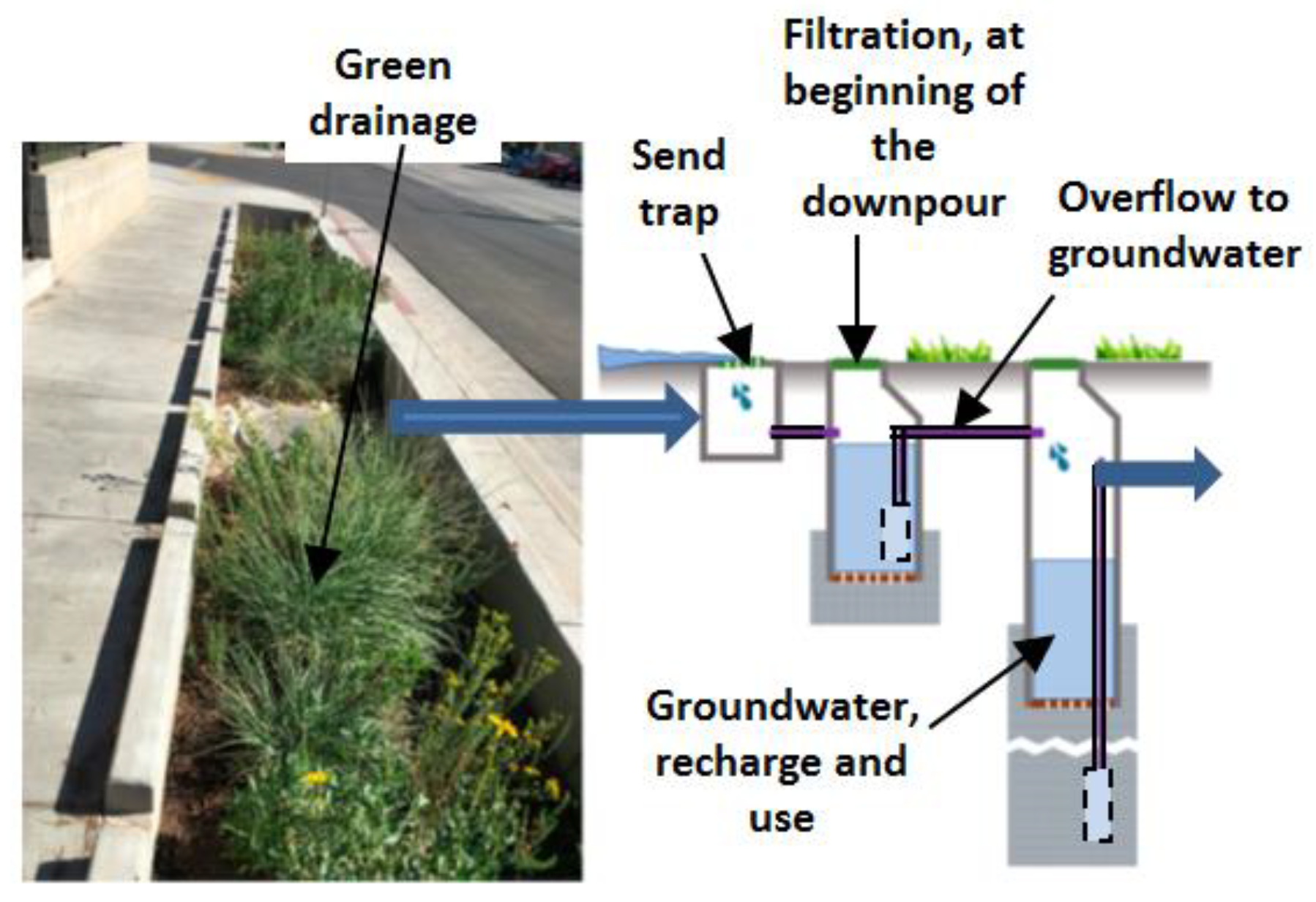
3.1. Storm Drainage System
3.2. Wastewater System
3.3. Water Supply System
3.4. Planning Integrated Recovery
4. Discussion
5. Conclusion
Funding
Institutional Review Board Statement
Informed Consent Statement
Data Availability Statement
Conflicts of Interest
Abbreviations
References
- UN: United Nation’s 2030 Agenda for Sustainable Development. Available online: https://unstats.un.org/sdgs/report/2020/The-Sustainable-Development-Goals-Report-2020.
- Wikipedia. Tourism in Croatia. Available online: https://en.wikipedia.org/wiki/Tourism_in_Croatia (accessed on 1 December 2025).
- Delgado, A.; Diego, J.R.; Carlo, A. A.; Midori, M. Water in Circular Economy and Resilience (WICER); World Bank: Washington, DC, 2021. [Google Scholar]
- Arab Centre for the Studies of Arid Zones and Dry Lands (ACSAD); GIZ. Training Manual on the Integrated Vulnerability Assessment Methodology. In Adaptation to Climate Change in the Water Sector in the MENA Region (ACCWaM) Programme. RICCAR Training Manual, Beirut, E/ESCWA/SDPD/2017/RICCAR/Manual; Deutsche Gesellschaft für Internationale Zusammenarbeit) and United Nations Economic and Social Commission for Western Asia (ESCWA).
- Ho, Mae-Wan. Circular Thermodynamics of Organisms and Sustainable Systems. MDPI Systems License CC BY 3.0. 2013, 1(3), 30–49DOI. [Google Scholar] [CrossRef]
- Mohammadkhani, M.; Masnavi, M.R.; Rezaei Hariri, M.T.; Mirmoghtadaee, M. : Integrated Urban Water Management (IUWM) Framework Codification in Architectural and Urban Design: The Case of Hashtgerd, Young Cities Project. Space Ontology International Journal 2020, Vol. 9(Issue 4), 29–41. [Google Scholar] [CrossRef]
- Margeta, J. Stormwater and wastewater: pollution load, protection measures; (in Croatian). University of Split, Faculty of Civil Engineering and Architecture: Split, 2007. [Google Scholar]
- Margeta, J. Sewerage of settlements; drainage and disposal of wastewater and stormwater. In Sveučilište u Splitu, Građevinsko-arhiktetonski fakultet; (in Croatian). 2009. [Google Scholar]
- Feng, C.; Uber, G.J.; Palycarpou, P.P. Input-Output Model of Water Quality in Water Distribution Systems. Conference: Joint Conference on Water Resource Engineering and Water Resources Planning and Management 2000, September 2000. [Google Scholar] [CrossRef]
- Ghimire, U.; Sarpong, G.; Gnaneswar, V. Gude, Transitioning Wastewater Treatment Plants toward Circular Economy and Energy Sustainability. ACS Omega 2021, 6, 11794−11803. [Google Scholar] [CrossRef] [PubMed]
- Almenar, J.B.; Elliot, T.; Rugani, B.; Philippe, B.; Gutierrez, T.N.; Sonnemann, G.; Geneletti, D. Nexus between nature-based solutions, ecosystem services, and urban challenges. Land Use Pol. 100(2021), 104898. [CrossRef]
- Water Europa, Technology and Innovation, towards a zero-pollution strategy for contaminates of emerging concern in urban water cycle. Available online: https://watereurope.eu/wp-content/uploads/2023/12/White-Paper-Zero-Pollution_online.pdf (accessed on 15 May 2025).
- Abbasi, T.; Tauseef, S; Abbasi, S. A. Anaerobic digestion for global warming control and energy generation—An overview. Renewable and Sustainable Energy Reviews 2012, 16, 3228–3242. [Google Scholar] [CrossRef]
- Luthy, G.L.; Sharvelle, S.; Dillon, P. Urban Stormwater to Enhance Water Supply. Environ. Sci. Technol. 2019, 53, 5534–5542. [Google Scholar] [CrossRef] [PubMed]
- Zan, F.; Iqbal, A.; Lu, X.; Wu, X.; Chen, G. ‘Food waste-Wastewater-Energy/Resource’ Nexus: Integrating food waste management with wastewater treatment towards urban sustainability. Water Res. 2020, 211, 118089. [Google Scholar] [CrossRef] [PubMed]
- European Investment Bank 10/2022: Wastewater as a resource. In Published by the European Investment Bank. [CrossRef]
- ESHA-European Small Hydropower Association. Energy Recovery in Existing Infrastructure with Small Hydropower Plants: Multipurpose Schemes-Overview and Examples. 2010. [Google Scholar]
- Kucukaly, S. Water supply lines as a source of small hydropower in Turkey: A Case study in Edremit. World Renewable Energy Congress, Sweden; 2011. [Google Scholar]
- Margeta, J.; Đurin, B. Innovative approach for achieving of sustainable urban water supply system by using of solar photovoltaic energy. Ingenieria e Investigación 2017, 37(1), 58. [Google Scholar] [CrossRef]
- Margate, J. A framework for application of renewable energy in urban water systems. Electronic Journal of the Faculty of Civil Engineering Osijek-e-GFOS 16, 1–10. [CrossRef]
- O’Connor, T.; Rodrigo, D.; Cannan, A. Total Water Management, the New Paradigm for Urban Water Systems. Presented at EWRI/ASCE World Environmental & Water Resources Congress 2010, Challenges of Change, Providence, RI, May 16 - 20, 2010. [Google Scholar]
- Williams, J. Circular cities: challenges to implementing looping actions. Sustainability 2019, 11(2), 423. [Google Scholar] [CrossRef]
- Panganiban, E.B.; et al. An Urban Water Infrastructure Management System Design with Storm Water Intervention for Smart Cities. International Journal of Advanced Computer Science and Applications 2022, Vol. 13(No. 4). [Google Scholar] [CrossRef]
- Tsatsou, A.; Frantzeskaki, N.; Malamis, S. Nature-based solutions for circular urban water systems: A scoping literature review and a proposal for urban design and planning. Journal of Cleaner Production 2023, 394, 136325. [Google Scholar] [CrossRef]
- Muliera, H.; van de Vena, P.; Kirchen, P. Circularity in the Urban Water-Energy-Nutrients-Food nexus. Energy Nexus 2022, 7, 100081. [Google Scholar] [CrossRef]
- Dezfooli, D.; Bolson, J.; Arabi, M.; Sukop, M.C.; Wiersema, I.; Millonig, S. A Qualitative Approach to Understand Transitions toward One Water in Urban Areas across North America. Water 2023, 15, 2499. [Google Scholar] [CrossRef]
- Kisser, et al. A review of nature-based solutions for resource recovery in cities. In Blue-Green Systems; IWA Publishing; Vol 2 No 1. [CrossRef]
- European Commission. Roadmap to a Resource Efficient Europe Brussels. 20.9.2011 COM(2011) 571 final.
- European Commission. A New Circular Economy Action Plan. For a Cleaner and More Competitive Europe. COM (2020) 98 final, Brussels, 11.3. 2020. Available online: https://eur-lex.europa.eu/legal-content/EN/TXT/?uri=COM%3A2020%3A98%3AFIN.
- Newell, P.J.; Ramaswami, A. Urban food–energy–water systems: past, current, and future research trajectories. Environ. Res. Lett. 2020, 15, 050201. [Google Scholar] [CrossRef]
- OECD. Handbook on Constructing Composite Indicators; Methodology and user guide. 2008. Available online: https://www.oecd.org/sdd/42495745.pdf.
Disclaimer/Publisher’s Note: The statements, opinions and data contained in all publications are solely those of the individual author(s) and contributor(s) and not of MDPI and/or the editor(s). MDPI and/or the editor(s) disclaim responsibility for any injury to people or property resulting from any ideas, methods, instructions or products referred to in the content. |
© 2026 by the authors. Licensee MDPI, Basel, Switzerland. This article is an open access article distributed under the terms and conditions of the Creative Commons Attribution (CC BY) license (http://creativecommons.org/licenses/by/4.0/).