

Submitted:
01 January 2026
Posted:
02 January 2026
You are already at the latest version
Preprints on COVID-19 and SARS-CoV-2
Abstract
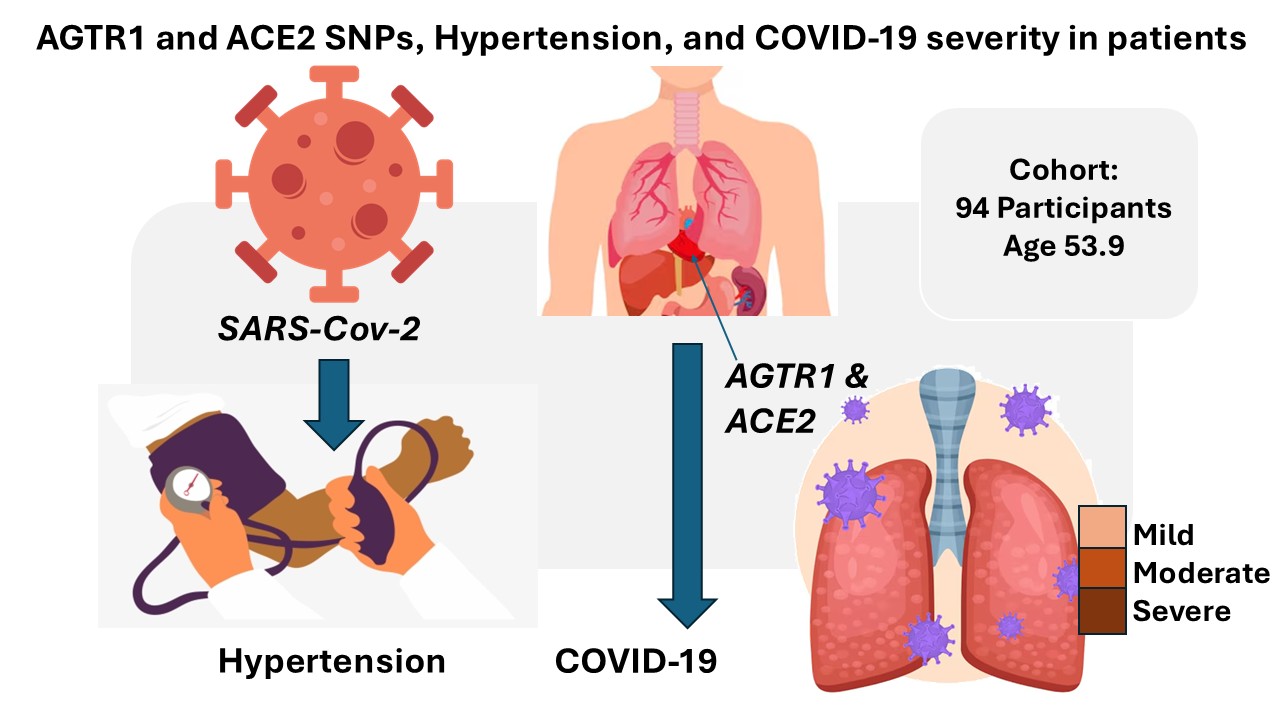
Background: Severe acute respiratory syndrome coronavirus 2 (SARS‑CoV‑2), the causative agent of Coronavirus disease 2019 (COVID-19), exploits the angioten-sin-converting enzyme 2 (ACE2) for cell entry, implicating the renin–angiotensin sys-tem (RAS) in disease pathogenesis. Hypertension (HT), a major comorbidity, is strongly influenced by genetic factors within RAS, including angiotensin ii receptor type 1 (AGTR1) and ACE2) polymorphisms. However, data on these variants in African pop-ulations remain scarce. This study investigated associations between AGTR1 and ACE2 single nucleotide polymorphisms (SNPs), HT, and COVID-19 severity in patients at A Tshwane Academic Hospital. Methods: We genotyped AGTR1 and ACE2 SNPs in 94 PCR-confirmed COVID-19 pa-tients using Matrix-Assisted Laser Desorption/Ionization Time-Of-Flight (MAL-DI-TOF) mass spectrometry. Clinical data were extracted from hospital records. Ordi-nal logistic regression models assessed relationships between SNPs, HT, and COVID-19 severity. Results: The cohort (mean age 53.9 years; HT prevalence 54.9%) exhibited mild (54.9%), moderate (18.6%), and severe (26.5%) COVID-19. The rs21068092 A genotype was significantly associated with reduced odds of severe disease (OR = 0.39, 95% CI: 0.14–1.08, p = 0.04), suggesting a protective effect. Other SNPs and clinical variables showed no significant associations. Conclusion: This first report on AGTR1 and ACE2 SNP profiles in COVID‑19 patients from Tshwane highlights rs2106809 as a potential protective marker. Age correlated with severity. Larger, multi‑ethnic studies are needed to confirm these findings.
Keywords:
AGTR1
; ACE2
; genotypes
; polymorphisms
; hypertension
; COVID-19
1. Introduction
COVID-19 is an infectious disease resulting from the SARS-CoV-2 virus. The majority of individuals infected with this virus experience mild to moderate respiratory symptoms and are able to recover without the necessity of specialized medical intervention (CDC, 2024) [1]. The initial cases of this respiratory illness were identified in Wuhan, Hubei Province, China, in late December 2019, with SARS-CoV-2 classified as a positive-sense single-stranded RNA virus [2]. The first confirmed case of COVID-19 in South Africa was documented on March 5, 2020, involving a traveler who had recently returned from Italy [3]. As of July 31, 2025, there have been 7,097,851 reported deaths worldwide attributed to COVID-19 [4]. The virus is transmitted primarily through airborne means, spreading between individuals via close contact, aerosols, and respiratory droplets, including those produced during coughing and sneezing [2]. Several factors contribute to the severity of COVID-19, including age, immune system status, and gender. Severe cases [5] are more commonly observed in individuals over the age of 65, particularly those with pre-existing conditions like HT and diabetes [6]. HT represents a significant global health challenge and is a prominent cause of mortality and disability [7]. The virus infiltrates human cells by binding to ACE2, a membrane protein that plays a crucial role in the RAS [5]. The ACE and ACE2 are homologue members of the angiotensin system and in which the ACE regulates the activities of the RAS [8]. ACE and ACE2 are both involved in key physiological processes related to COVID-19 and HT. In the case of SARS-CoV-2 infection, ACE2 acts as the main entry receptor for the virus, while ACE plays a critical role in regulating blood pressure, a central factor in HT [9]. AGTR1 has been shown to mediate the regulation of the classical RAS signalling pathway [10]. Variations in the ACE, ACE2, and AGTR1 genes may influence how HT and COVID-19 manifest in individuals. SNPs in ACE and ACE2 have been associated with heightened vulnerability to HT, while ACE2 variants located on the X chromosome have been linked to a greater prevalence of COVID-19 infection especially in male populations [9]. Epidemiological studies have produced conflicting findings, with some suggesting a direct causal link between these SNPs and HT, while others report no significant association [11]. Investigating SNPs in the AGTR1 gene may be crucial for identifying populations at increased risk for HT and COVID-19. Understanding the genetic variations linked to AGTR1 could support the development of host-targeted biomarkers and novel therapies, particularly for individuals experiencing severe COVID-19 in combination with HT. Given AGTR1’s role in regulating electrolyte balance and physiological homeostasis, SNP analysis may also reveal common variants associated with HT that contribute to disease severity and mortality [12]. Within African populations, SNPs in the AGTR1 gene have been more extensively investigated in Northern Africa than in Sub-Saharan regions. This highlights the need for further epidemiological research across the broader African context to better understand the distribution of SNPs that influence HT severity [13]. Therefore, this study aimed to evaluate the correlation between some of the AGTR1 and ACE2 SNPs with HT as well as the severity of COVID-19 in patients at A Tshwane Academic Hospital.
2. Materials and Methods
2.1. Study Population and Specimen Collection
A total of 94 laboratory-confirmed COVID-19 patients at A Tshwane Academic Hospital exhibiting varying degrees of disease severity (mild, moderate and severe) were enrolled in this study. Each participant had a nasopharyngeal swab collected using DNA/RNA Shield reagent, in addition to blood drawn into a DNA/RNA Shield Blood Collection Tube. These procedures were carried out by a qualified phlebotomist registered with the Health Professions Council of South Africa (HPCSA), following standardized techniques.
2.2. Hypertension and Other Comorbidities
Confirmed HT information was obtained from the participants' hospital records during their visits, with HT defined in accordance with the South African Hypertension Society (SAHS) guidelines as a reading of ≥ 140/90 mmHg [14]. Additionally, information on age, gender, diabetes mellitus (DM) and estimated glomerular filtration rate (eGRF) dichotomized as normal (>60 ml/min/m2) or low (<60 ml/min/m2) were collected.
2.3. Nucleic Acid Extraction & Genotyping
The ExtractMe viral RNA kit (EM39) from Blirt (172 Gdańsk, Poland) was used to extract viral RNA as previously reported by Kgatle et al. [15]. The Quick-DNA/RNA™ Blood Tube Kit (R1151) from Zymo Research (Irvine, California) was used to extract DNA from patient samples following the manufacturer's instructions. SARS-CoV-2 genotyping was performed using a previously described method [16]. AGTR1 and ACE2 SNP genotyping was conducted using MALDI-TOF mass spectrometry as previously outlined by Chalwe et al. [17]. The analysis focused on the rs5183 (AGTR1) rs5185 (AGTR1), rs5186 (AGTR1) and rs2106809 (ACE2) SNPs.
2.4. Statistical Analysis and Modelling
Characteristics were outlined using summary statistics, including mean, standard deviation (SD), proportions, and percentages of missing data. To address the issue of missing data, we utilized 10 multiple imputations via the Amelia II software package in R [18]. Specifically, we imputed datasets for age, gender, and DM. The results of our multivariable analysis were derived from these imputed datasets, which were combined according to Rubin’s rules [19]. COVID-19 severity was modeled as an ordinal outcome with three levels: Mild, Moderate, and Severe. Ordinal logistic regression (OLR) models were fitted using the MASS package [20], presuming a proportional odds logistic link. Our models were constructed separately for each imputed dataset. To tackle issues of quasi-complete separation and sparse genotype categories, we developed dominant genetic models for SNPs rs5183, rs1585, rs1586, and rs2106809 by merging heterozygous and homozygous categories. An adjusted OLR model was specified to include age, gender, DM, HT, eGFR and selected SNPs. Model coefficients and standard errors were extracted from each imputed dataset and pooled using Rubin’s rules to generate combined estimates, standard errors, confidence intervals, and p-values. Odds ratios (ORs) and 95% confidence intervals (CIs) were calculated by exponentiating the pooled log-odds estimates. Crude models were also fitted for each predictor individually to evaluate unadjusted associations with COVID-19 severity. These models were similarly pooled across imputations using Rubin’s rules. SNPs that did not converge or exhibited poor estimation in the adjusted models were excluded. Model performance was assessed using the Akaike Information Criterion (AIC), averaging the AIC values across imputations and computing AIC weights (AICw) to identify the most parsimonious model. The top-performing model underwent further analysis, and its findings, along with those from the crude analyses, were reported.
3. Results
3.1. Study Population
A total of 94 patients were included in the study. Table 1 presents the characteristics of patients in the study, including demographic, clinical variables, SNPs and COVID-19 severity. The cohort had a mean age of 53.9 years (SD = 12.8), with a near-equal gender distribution (52.9% male, 47.1% female). Comorbidities were prevalent, with 26.5% of participants diagnosed with DM and 54.9% with HT. The eGFR abnormalities were present in 20.6% of participants. Genotypic distributions for the SNPs were assessed. The rs1583 showed the highest frequency for allele A (42.2%), followed by GA (22.5%), None (26.5%), and G (8.8%). A Similar trend in variability was observed across other SNPs, including rs1585, rs1586 and rs2106809, indicative of genetic heterogeneity within the cohort. Regarding COVID-19 severity, 54.9% of participants experienced mild disease, 18.6% moderate, and 26.5% severe illness.
3.2. Crude and Adjusted Predictors of COVID-19 Severity
Ordinal logistic regression analyses were conducted to evaluate the association between clinical and genetic predictors and COVID-19 severity. Table 2 summarizes the results from both crude and adjusted models following multiple imputations. In the crude model, increasing age was significantly associated with higher odds of severe COVID-19 (OR = 1.06, 95% CI: 1.02–1.10, p = 0.001). Male gender also showed a significant association (OR = 1.47, 95% CI: 0.95–2.27, p = 0.04), although the confidence interval was wide. Low eGFR was also a significant predictor (OR = 1.96, 95% CI: 1.21–3.13, p = 0.002). In the adjusted model, age remained a significant predictor (OR = 1.06, 95% CI: 1.03–1.09, p < 0.001). However, the associations for gender and eGFR were attenuated and no longer statistically significant. Notably, the rs2106809 A genotype was significantly associated with reduced odds of severe disease (OR = 0.39, 95% CI: 0.14–1.08, p = 0.04), suggesting a potential protective effect. Other SNPs, including rs5183, did not show significant associations in the adjusted model. Model selection based on AICw identified age as the most informative predictor (AICw OR = 0.86, 95% CI: 0.77–0.97, p = 0.005), supporting its inclusion in the final model.
3.3. Sensitivity Analysis
A sensitivity analysis was performed using an alternative adjusted model that included dominant coding for SNPs with sparse genotype distributions (Supplementary Table S1). The model demonstrated a slightly improved fit (AIC = 227.28). Other clinical variables, including age, gender, DM, HT and eGFR were not statistically significant in this sensitivity model. Most SNPs, including rs5183 and rs5185, did not show consistent associations across models.
4. Discussion
The present study aimed to investigate the predictive relationships between the AGTR1 and ACE2 SNPs (rs5183, rs1585, rs1586, rs2106809) in relation to HT and the severity of COVID-19 among patients at A Tshwane Academic Hospital in Pretoria, South Africa. Among our participants, 54.9% experienced mild illness, 18.6% moderate, and 26.5% severe disease. These findings are consistent with those from a multicenter survey conducted in Osaka, Japan by Imoto et al. [21]. In previous reports, the high prevalence of mild COVID-19 cases has been attributed to widespread population immunity, which may result from vaccination and/or prior infections [22], the reduced virulence of the dominant variants during the study period [15,16] and the age of the participants [23]. This may help explain the results observed in our study.
In the crude model, advancing age was notably linked to increased chances of experiencing severe COVID-19. This is consistent with findings from Mueller et al. [23] and Hossain et al. [24]. They reported that the severity of COVID-19 and its outcomes are closely correlated with age, indicating that older adults (particularly those over 65) face significantly greater risks of hospitalization, severe illness (e.g. multi-organ failure), and mortality. These studies attribute this mainly to factors like age-related immune decline (immunosenescence), a higher prevalence of pre-existing health issues, and elevated baseline inflammation, among others [23,24]. This may provide insight into the results observed among our participants. These findings underscore the importance of age as a consistent and significant predictor of disease severity, corroborating previous literature that identifies older age as a major risk factor for adverse outcomes related to COVID-19 [23].
The male gender demonstrated a notable association as well. This aligns with findings from Zaher et al. [25] and Beegle et al. [26], who indicated that men are at a greater risk of experiencing severe illness, hospitalization, and mortality when compared to women, who may have higher incidences of long COVID. They linked this discrepancy to differences in immune responses across genders, hormonal influences (such as the protective effect of estrogen), and lifestyle factors (including higher smoking prevalence among men), which likely lead to men being more susceptible to severe health outcomes [25,26]. This finding may provide a plausible explanation for our results.
A low eGFR emerged as a significant predictor within our study population. Our results share similarities with those reported by Boruga et al. [27] and Cornelissen et al. [28], who observed that COVID-19 infection correlates with a decreased eGFR. The kidneys are often affected by infections through both direct and indirect mechanisms. Ahmadian et al. [29] noted that kidney involvement related to COVID-19 primarily presents as proteinuria and acute kidney injury (AKI). Damage to the kidneys caused by SARS-CoV-2 is likely to be multifaceted; it can directly infect podocytes and proximal tubular cells, and via the ACE2 pathway, can result in acute tubular necrosis, protein leakage into Bowman's capsule, collapsing glomerulopathy, and mitochondrial dysfunction. The dysregulation of immune responses driven by SARS-CoV-2, including cytokine storms, macrophage activation syndrome, and lymphopenia, may also contribute to AKI. Additional potential mechanisms for AKI include organ interactions, endothelial dysfunction, hypercoagulability, rhabdomyolysis, and sepsis [27,28,29]. These factors could help elucidate the findings presented in this paper.
HT emerged as the most prevalent underlying condition, affecting 54.9% of the participants in our study. This finding aligns with numerous reports in the literature, including those by Batiha et al. [30] and Sohrabivafa et al. [31]. Previous research has proposed several mechanisms by which COVID-19 may contribute to the development of hypertension [32,33]. For instance, SARS-CoV infection triggers inflammation that can harm blood vessels and the heart, consequently resulting in elevated blood pressure [34]. Furthermore, the virus interacts with the ACE2 receptor (AGTR1), a key component of the RAAS, which is crucial for regulating blood pressure. Disruption of this receptor can lead to HT [33]. Finally, COVID-19 can induce fluid imbalances within the body, causing either fluid retention or dehydration, both of which can influence blood pressure [35]. These factors may contribute to a clearer understanding of the findings presented in our study.
In addition to the previously mentioned factors, we performed an analysis examining the relationship between diabetes and the severity of COVID-19. Our findings did not reveal any statistically significant correlations that would support the conclusions drawn by Legris et al. [36].
Interestingly, in the adjusted model, only age continued to be a significant predictor when analyzing these same variables. The relationships for gender and eGFR weakened and were no longer statistically significant. The process of model selection, utilizing Akaike Information Criterion weights (AICw), determined that age was the most informative predictor, which justifies its inclusion in the final model.
The ACE 2 gene located on chromosome X (Xp22) has 18 exons and 20 introns that are identical to ACE exons [11,37]. The AGTR1 gene in addition to ACE2 is located on chromosome 3 (3q21-25) and comprise of 5 exons and 4 introns [38]. The ACE2 gene contains genetic polymorphisms that influence the clinical presentation of COVID-19. Specific SNPs such as rs2074192, rs1978124, rs2074809, and rs2074666 have been reported to contribute to the disease's severity and its pathological effects across various organs [39]. In the context of HT, ACE gene SNPs such as rs4341, rs4343, and rs4344 have demonstrated varying degrees of association with the condition. Multiple SNPs within the AGTR1 gene such as rs5183, rs5185, and rs5186 have been identified as being associated with differing levels of severity in individuals affected by both COVID-19 and HT [10,39]. The genotypic distributions for these SNPs were assessed in our population. The rs1583 showed the highest frequency for allele A (42.2%), followed by GA (22.5%), None (26.5%), and G (8.8%). A Similar trend in variability was observed across other SNPs, including rs1585, rs1586 and rs2106809, indicative of genetic heterogeneity within the cohort.
Our genetic analysis in the adjusted model revealed a potential protective effect of the rs2106809 A genotype, which was significantly associated with reduced odds of severe disease. The role of the rs2106809 gene variant in COVID-19 severity is complex and shows conflicting results across different populations and studies, with some finding it is associated with increased severity while others suggest a protective effect in specific contexts [39,40]. For instance, Matic et al. [41], reported the rs2106809 allele as a prominent protective factor for in-hospital death due to COVID-19, but only among females while Molina et al. [39] found that the rs2106809 SNP was associated with hospitalization. Our findings correspond well to those of Matic et al. [41] who also reported a possible protective role of the rs2106809 SNP. As evidenced by these reports, the effect of the rs2106809 variant on COVID-19 severity appears to be population-specific and may be influenced by complex factors such as sex, ethnicity, and gene-environment interactions. The present findings emphasize the need for further research in diverse populations to determine the exact role of the rs2106809 SNP.
Intriguingly, we found no significant relationship between HT and the other SNPs investigated in this study. This is in-line with the findings from Jafary et al. [42], who also reported no significant association between the SNPs and the risk of being hypertensive with other diseases and the risk of diabetes in unadjusted and adjusted models in patients with COVID-19. Our results, however, contradict those of other studies that indicated an association between ACE2 polymorphisms, HT and COVID [43,44]. Jafary et al. [42], indicated that one of the reasons for this result is that these SNPs are not in the coding region on ACE2 and therefore do not play a role in the structure and function of ACE2 receptor. These findings within our population may be attributed to the aforementioned factors.
5. Conclusions & Recommendations
To the best of our knowledge, this study is the first to detect the rs5183 (AGTR1), rs5185 (AGTR1), rs5186 (AGTR1), and rs2106809 (ACE2) SNPs and their association with HT and COVID-19 in patients at A Tshwane Academic Hospital. Our findings reveal that age is significantly associated with the severity of COVID-19. Furthermore, the rs2106809 A genotype may possibly confer protective effects against disease severity. We recommend further research in diverse and larger populations to enhance our understanding of the specific roles of these SNPs in disease progression and outcomes. Such studies may pave the way for future personalized treatments.
6. Limitations
This study had some limitations. Firstly, some SNPs showed sparse genotype distributions, which led to quasi-complete separation and unstable estimates. Secondly, the relatively small sample size, especially within genotype subgroups, limits statistical power and may have resulted in wide confidence intervals and non-significant findings. Lastly, there was some missing data which was dealt with using multiple imputations.
Supplementary Materials
The following supporting information can be downloaded at the website of this paper posted on Preprints.org, Table S1: Ordinal Logistic Regression Adjusted Model Results with Imputed Data for Predicting the Odds of Covid Severity.
Author Contributions
Conceptualization, J.M.C.; methodology, M.K., R.M., N.M., B.M. & P.M.; software, R.R.M. & J.M.C.; formal analysis, R.R.M.; investigation, J.M.C., R.R.M & M.K.; writing—original draft preparation, J.M.C., N.M., S.M. & M.K.; writing—review and editing, M.S.; visualization, R.R.M.; funding acquisition, M.K. All authors have read and agreed to the published version of the manuscript.
Funding
This study was funded by the Nuclear Medicine Research Infrastructure (NuMeRI) and the University of Pretoria (UP).
Institutional Review Board Statement
The University of Pretoria Research Ethics Committee approved this study (Ref No: 28/2021), and only patients who gave consent participated. It was conducted in accordance with the Declaration of Helsinki (DoH) on medical research involving human participants.
Informed Consent Statement
Informed consent was obtained from all subjects involved in the study.
Data Availability Statement
Dataset available on request from the authors.
Conflicts of Interest
The authors declare no conflicts of interest.
Abbreviations
The following abbreviations are used in this manuscript:
| AIC | Akaike Information Criterion |
| ACE2 | Angiotensin-converting enzyme 2 |
| AGTR1 | Angiotensin II Receptor Type 1 |
| COVID-19 | Coronavirus disease 2019 |
| DM | Diabetes mellitus |
| eGRF | estimated glomerular filtration rate |
| HPCSA | Health Professions Council of South Africa |
| HT | Hypertension |
| NuMeRI | Nuclear Medicine Research Infrastructure |
| OLR | Ordinal logistic regression |
| ORs | Odds ratios |
| RAS | Renin–angiotensin system |
| SARS-CoV-2 | Severe acute respiratory syndrome coronavirus 2 |
| SNPs | Single Nucleotide Polymorphisms |
| SAHS | South African Hypertension Society |
| UP | University of Pretoria |
References
- CDC. About COVID-19. Available online: https://www.cdc.gov/covid/about/index.html (accessed on 13 August 2025).
- Cascella, M.; Rajnik, M.; Aleem, A.; Dulebohn, S.C.; Di Napoli, R. Features, Evaluation, and Treatment of Coronavirus (COVID-19); StatPearls Publishing LLC: Online, 2023. [Google Scholar]
- Modisenyane, M.; Madikezela, L.; Mngemane, S.; Ramadan, O.P.; Matlala, M.; McCarthy, K.; Govender, N.; Nemungadi, T.; SilalI, S.P. COVID-19 response in South African communities: Screening, testing, tracing and movement modelling. SAMJ: South African Medical Journal 2022, 112, 366–370. [Google Scholar] [CrossRef]
- Mathieu, E.; Ritchie, H.; Rodés-Guirao, L.; Appel, C.; Gavrilov, D.; Giattino, C.; Hasell, J.; Macdonald, B.; Dattani, S.; Beltekian, D.; et al. COVID-19 Pandemic. Available online: https://ourworldindata.org/coronavirus (accessed on 13 August 2025).
- Xu, H.; Zhong, L.; Deng, J.; Peng, J.; Dan, H.; Zeng, X.; Li, T.; Chen, Q. High expression of ACE2 receptor of 2019-nCoV on the epithelial cells of oral mucosa. International Journal of Oral Science 2020, 12, 8. [Google Scholar] [CrossRef]
- Brodin, P. Immune determinants of COVID-19 disease presentation and severity. Nature Medicine 2021, 27, 28–33. [Google Scholar] [CrossRef] [PubMed]
- Martín-Fernández, J.; Alonso-Safont, T.; Polentinos-Castro, E.; Esteban-Vasallo, M.D.; Ariza-Cardiel, G.; González-Anglada, M.I.; Sánchez-Perruca, L.; Rodríguez-Martínez, G.; Rotaeche-del-Campo, R.; Bilbao-González, A. Impact of hypertension diagnosis on morbidity and mortality: a retrospective cohort study in primary care. BMC Primary Care 2023, 24, 79. [Google Scholar] [CrossRef]
- Herrera, P.; Cauchi, R.J. ACE and ACE2: insights from Drosophila and implications for COVID-19. Heliyon 2021, 7. [Google Scholar] [CrossRef] [PubMed]
- Faustine, I.; Marteka, D.; Malik, A.; Supriyanto, E.; Syafhan, N.F. Genotype variation of ACE and ACE2 genes affects the severity of COVID-19 patients. BMC Research Notes 2023, 16, 194. [Google Scholar] [CrossRef] [PubMed]
- Tayler, H.M.; MacLachlan, R.; Güzel, Ö.; Fisher, R.A.; Skrobot, O.A.; Abulfadl, M.A.; Kehoe, P.G.; Miners, J.S. Altered Gene Expression Within the Renin–Angiotensin System in Normal Aging and Dementia. The Journals of Gerontology: Series A 2023, 79. [Google Scholar] [CrossRef] [PubMed]
- Al-Eitan, L.; Al-Khaldi, S.; Ibdah, R.k. ACE gene polymorphism and susceptibility to hypertension in a Jordanian adult population. PLOS ONE 2024, 19, e0304271. [Google Scholar] [CrossRef]
- Cafiero, C.; Rosapepe, F.; Palmirotta, R.; Re, A.; Ottaiano, M.P.; Benincasa, G.; Perone, R.; Varriale, E.; D'Amato, G.; Cacciamani, A.; et al. Angiotensin System Polymorphisms' in SARS-CoV-2 Positive Patients: Assessment Between Symptomatic and Asymptomatic Patients: A Pilot Study. Pharmgenomics Pers Med 2021, 14, 621–629. [Google Scholar] [CrossRef] [PubMed]
- Mabhida, S.E.; Mashatola, L.; Kaur, M.; Sharma, J.R.; Apalata, T.; Muhamed, B.; Benjeddou, M.; Johnson, R. Hypertension in African Populations: Review and Computational Insights. Genes (Basel) 2021, 12. [Google Scholar] [CrossRef]
- Rayner, B.; Jones, E.; Veriava, Y.; Seedat, Y.K. South African Hypertension Society commentary on the American College of Cardiology/American Heart Association hypertension guidelines. Cardiovasc J Afr 2019, 30, 184–187. [Google Scholar] [CrossRef] [PubMed]
- Kgatle, M.; Das, R.; Lawal, I.; Boshomane, T.; Mokoala, K.; Gaspar, C.; Mbokazi, L.; Nkambule, N.; Gow, V.; Ndlovu, H.; et al. The SARS-COV-2 Seroprevalence among Oncology Patients. Journal of Clinical Medicine 2023, 12, 529. [Google Scholar] [CrossRef]
- Kgatle, M.; Chalwe, J.M.; van der Westhuizen, D.; Xu, S.; Damane, B.P.; Mathebela, P.; Ueckermann, V.; Mayaphi, S.; Rodrigues, H.G.; Moura-Alves, P.; et al. Detection of Neutralizing Antibodies in COVID-19 Patients from Steve Biko Academic Hospital Complex: A Pilot Study. COVID 2023, 3, 999–1010. [Google Scholar] [CrossRef]
- Chalwe, J.M.; Grobler, C.; Oldewage-Theron, W. Development of a Structural Equation Model to Examine the Relationships between Genetic Polymorphisms and Cardiovascular Risk Factors. Nutrients 2023, 15, 2470. [Google Scholar] [CrossRef]
- Honaker, J.; King, G.; Blackwell, M. Amelia: A Program for Missing Data. Journal Of Statistical Software 1998, 45. [Google Scholar] [CrossRef]
- Rubin, D.B. Multiple Imputation for Nonresponse in Surveys; Wiley, 2004. [Google Scholar]
- Venables, B.; Ripley, B. Modern Applied Statistics With S; 2002. [Google Scholar]
- Imoto, W.; Yamada, K.; Kawai, R.; Imai, T.; Kawamoto, K.; Uji, M.; Kanda, H.; Takada, M.; Ohno, Y.; Ohtani, H.; et al. A cross-sectional, multicenter survey of the prevalence and risk factors for Long COVID. Scientific Reports 2022, 12, 22413. [Google Scholar] [CrossRef]
- Stroz, S.; Kosiorek, P.; Zbroch, E.; Mikoluc, B.; Stasiak-Barmuta, A. Immune response variation in mild and severe COVID-19 patients. Qatar Medical Journal 2024, 2024. [Google Scholar] [CrossRef]
- Mueller, A.L.; McNamara, M.S.; Sinclair, D.A. Why does COVID-19 disproportionately affect older people? Aging (Albany NY) 2020, 12, 9959–9981. [Google Scholar] [CrossRef]
- Hossain, S.; Islam, S.; Kamruzzaman, M.; Shekhar, H.U. Exploring age-related influences on COVID-19 severity and therapeutic approaches for older patients. Aging and Health Research 2025, 5, 100259. [Google Scholar] [CrossRef]
- Zaher, K.; Basingab, F.; Alrahimi, J.; Basahel, K.; Aldahlawi, A. Gender Differences in Response to COVID-19 Infection and Vaccination. Biomedicines 2023, 11, 1677. [Google Scholar] [CrossRef]
- Beegle, K.; Demombynes, G.; de Walque, D.; Gubbins, P.; Veillard, J. COVID-19 increased existing gender mortality gaps in high-income more than middle-income countries. International Journal of Infectious Diseases 2024, 148, 107167. [Google Scholar] [CrossRef]
- Boruga, M.; Septimiu-Radu, S.; Nandarge, P.S.; Elagez, A.; Doros, G.; Lazureanu, V.E.; Stoicescu, E.R.; Tanase, E.; Iacob, R.; Dumitrescu, A.; et al. Kidney Function Tests and Continuous eGFR Decrease at Six Months after SARS-CoV-2 Infection in Patients Clinically Diagnosed with Post-COVID Syndrome. Biomedicines 2024, 12, 950. [Google Scholar] [CrossRef]
- Cornelissen, M.E.B.; Bloemsma, L.D.; Baalbaki, N.; Twisk, J.W.R.; Downward, G.S.; Maitland-van der Zee, A.-H. Estimated glomerular filtration rate in post COVID-19 patients at 3–6 months and 12–18 months after infection. Renal Failure 2025, 47, 2551737. [Google Scholar] [CrossRef]
- Ahmadian, E.; Hosseiniyan Khatibi, S.M.; Razi Soofiyani, S.; Abediazar, S.; Shoja, M.M.; Ardalan, M.; Zununi Vahed, S. Covid-19 and kidney injury: Pathophysiology and molecular mechanisms. Reviews in Medical Virology 2021, 31, e2176. [Google Scholar] [CrossRef]
- Batiha, G.E.-S.; Gari, A.; Elshony, N.; Shaheen, H.M.; Abubakar, M.B.; Adeyemi, S.B.; Al-kuraishy, H.M. Hypertension and its management in COVID-19 patients: The assorted view. International Journal of Cardiology Cardiovascular Risk and Prevention 2021, 11, 200121. [Google Scholar] [CrossRef] [PubMed]
- Sohrabivafa, M.; Sadeghi, R.; Feiz-Haddad, M.H. Worldwide Prevalence of Hypertension in Patients with COVID-19: A Meta-analysis and Systematic Review. Health Scope 2022, 11, e115665. [Google Scholar] [CrossRef]
- Teymourzadeh, A.; Abramov, D.; Norouzi, S.; Grewal, D.; Heidari-Bateni, G. Infection to hypertension: a review of post-COVID-19 new-onset hypertension prevalence and potential underlying mechanisms. Frontiers in Cardiovascular Medicine 2025, 12–2025. [Google Scholar] [CrossRef] [PubMed]
- Zhang, V.; Fisher, M.; Hou, W.; Zhang, L.; Duong, T.Q. Incidence of New-Onset Hypertension Post–COVID-19: Comparison With Influenza. Hypertension 2023, 80, 2135–2148. [Google Scholar] [CrossRef] [PubMed]
- Wong, R.S.Y. Inflammation in COVID-19: from pathogenesis to treatment. Int J Clin Exp Pathol 2021, 14, 831–844. [Google Scholar]
- Wrona, M.; Skrypnik, D. New-Onset Diabetes Mellitus, Hypertension, Dyslipidaemia as Sequelae of COVID-19 Infection—Systematic Review. International Journal of Environmental Research and Public Health 2022, 19, 13280. [Google Scholar] [CrossRef]
- Legris, P.; Vaillard, L.; Nonciaux, C.; Hourdain, P.; Taroux, M.; Petit, J.-M.; Vergès, B.; Bouillet, B. Diabetes is not associated with COVID-19-related mortality in older institutionalized people. Diabetes & Metabolism 2021, 47, 101235. [Google Scholar] [CrossRef] [PubMed]
- Saponaro, F.; Rutigliano, G.; Sestito, S.; Bandini, L.; Storti, B.; Bizzarri, R.; Zucchi, R. ACE2 in the Era of SARS-CoV-2: Controversies and Novel Perspectives. Frontiers in Molecular Biosciences 2020, 7–2020. [Google Scholar] [CrossRef]
- Liu, J.Y.; Yi, Y.Z.; Guo, Q.W.; Jia, K.X.; Li, X.C.; Cai, J.J.; Shen, Y.L.; Su, G.M.; Chen, X.; Zhang, X.Y.; et al. Associations of ACE I/D and AGTR1 rs5182 polymorphisms with diabetes and their effects on lipids in an elderly Chinese population. Lipids in Health and Disease 2024, 23, 231. [Google Scholar] [CrossRef]
- Sabater Molina, M.; Nicolás Rocamora, E.; Bendicho, A.I.; Vázquez, E.G.; Zorio, E.; Rodriguez, F.D.; Gil Ortuño, C.; Rodríguez, A.I.; Sánchez-López, A.J.; Jara Rubio, R.; et al. Polymorphisms in ACE, ACE2, AGTR1 genes and severity of COVID-19 disease. PLOS ONE 2022, 17, e0263140. [Google Scholar] [CrossRef]
- Karakaş Çelik, S.; Çakmak Genç, G.; Pişkin, N.; Açikgöz, B.; Altinsoy, B.; Kurucu İşsiz, B.; Dursun, A. Polymorphisms of ACE (I/D) and ACE2 receptor gene (Rs2106809, Rs2285666) are not related to the clinical course of COVID-19: A case study. Journal of Medical Virology 2021, 93, 5947–5952. [Google Scholar] [CrossRef]
- Matic, S.; Milovanovic, D.; Mijailovic, Z.; Djurdjevic, P.; Stefanovic, S.; Todorovic, D.; Vitosevic, K.; Canovic, V.; Popovic, S.; Dimitrijevic, N.M.; et al. ACE2 and TMPRSS2 genetic polymorphisms as potential predictors of COVID−19 severity and outcome in females. Frontiers in Medicine 2024, 11–2024. [Google Scholar] [CrossRef] [PubMed]
- Jafary, F.; Kazemi, M.; Zarean, M.; Khoshhali, M.; Karimian, M.; Fani, F.; Shahzamani, K. Association of angiotensin-converting enzyme 2 gene polymorphisms with hypertension and treatment response to hydroxychloroquine in Iranian people with coronavirus disease 2019: A cross-sectional study. Journal of International Medical Research 2025, 53, 03000605251375221. [Google Scholar] [CrossRef] [PubMed]
- Bosso, M.; Thanaraj, T.A.; Abu-Farha, M.; Alanbaei, M.; Abubaker, J.; Al-Mulla, F. The Two Faces of ACE2: The Role of ACE2 Receptor and Its Polymorphisms in Hypertension and COVID-19. Mol Ther Methods Clin Dev 2020, 18, 321–327. [Google Scholar] [CrossRef] [PubMed]
- Luo, Y.; Liu, C.; Guan, T.; Li, Y.; Lai, Y.; Li, F.; Zhao, H.; Maimaiti, T.; Zeyaweiding, A. Association of ACE2 genetic polymorphisms withhypertension-related target organ damages in south Xinjiang. Hypertension Research 2019, 42, 681–689. [Google Scholar] [CrossRef] [PubMed]

Table 1.
Study Summary Statistics.
| Variable | Value | Missing Percentage |
| Age (mean±sd) | 53.9±12.8 | ---- |
| Gender n(%) Male Female |
54 (52.9 %) 48 (47.1 %) |
--- |
| DM n(%) No Yes |
71 (69.6 %) 27 (26.5 %) |
3.9 |
| HT n(%) No Yes |
43 (42.2 %) 56 (54.9 %) |
2.9 |
| eGRF n(%) No Yes |
81 (79.4 %) 21 (20.6 %) |
--- |
| rs1583 n(%) None A GA G |
27 (26.5) 43 (42.2) 23 (22.5) 9 (8.8) |
--- |
| rs1585 n(%) None T GT |
41 (40.2) 4 (3.9) 57 (55.9) |
--- |
| rs1586 n(%) None A CA |
65(54.2%) 51(42.5%) 4(3.3%) |
|
| rs2106809 n(%) None A AG G |
25 (24.5 %) 61 (59.8 %) 12 (11.8 %) 4 (3.9 %) |
--- |
| Covid-19 Grades n(%) Mild Moderate Severe |
56 (54.9 %) 19 (18.6 %) 27 (26.5 %) |
--- |
Table 2.
Ordinal logistic regression analysis for COVID-19 Severity for crude and adjusted models after multiple imputation of model selected variables.
Table 2.
Ordinal logistic regression analysis for COVID-19 Severity for crude and adjusted models after multiple imputation of model selected variables.
| Crude | Adjusted | AICw | |||||||
| Variable | OR | 95%CI | p-value | OR | 95%CI | p-value | OR | 95%CI | p-value |
| Age | 1.06 | 1.02-1.10 | 0.001 | 1.06 | 1.03-1.09 | 0.000 | 0.86 | 0.77-0.97 | 0.005 |
| Gender (Female) | Reference | Reference | Reference | Reference | Reference | Reference | |||
| Gender (Male) | 1.47 | 0.95-2.27 | 0.04 | 0.89 | 0.45-1.75 | 0.69 | |||
| Diabetes (No) | Reference | Reference | Reference | Reference | Reference | Reference | |||
| Diabetes (Yes) | 1.14 | 0.60-2.13 | 0.65 | 1.08 | 0.60-1.94 | 0.77 | |||
| HT (No) | Reference | Reference | Reference | Reference | Reference | Reference | |||
| HT (Yes) | 1.47 | 0.91-2.38 | 0.06 | 0.78 | 0.37-1.69 | 0.43 | |||
| eGFR (Normal) | Reference | Reference | Reference | Reference | Reference | Reference | |||
| eGFR (Low) | 1.96 | 1.21-3.13 | 0.002 | 1.89 | 0.87-4.09 | 0.06 | |||
| rs5183 (None) | Reference | Reference | Reference | Reference | Reference | Reference | |||
| rs5183 (A) | 1.74 | 0.52-5.85 | 0.30 | 1.66 | 0.29-9.60 | 0.51 | |||
| rs5183 (GA) | 1.40 | 0.50-3.95 | 0.46 | 1.79 | 0.57-5.61 | 0.28 | |||
| rs5183 (G) | 1.84 | 0.81-4.20 | 0.09 | 0.70 | 0.22-2.21 | 0.49 | |||
| rs2106809 (None) | Reference | Reference | Reference | Reference | Reference | Reference | |||
| rs2106809 (A) | 1.37 | 0.57-3.31 | 0.41 | 0.39 | 0.14-1.08 | 0.04 | |||
| rs2106809 (AG) | 0.93 | 0.39-2.21 | 0.85 | 0.88 | 0.38-2.03 | 0.73 | |||
| rs2106809 (G) | 1.61 | 0.69-3.79 | 0.20 | 0.99 | 0.26-3.72 | 0.96 | |||
Note: Statistical significance set at p < 0.05; AIC=235.056.
Disclaimer/Publisher’s Note: The statements, opinions and data contained in all publications are solely those of the individual author(s) and contributor(s) and not of MDPI and/or the editor(s). MDPI and/or the editor(s) disclaim responsibility for any injury to people or property resulting from any ideas, methods, instructions or products referred to in the content. |
© 2026 by the authors. Licensee MDPI, Basel, Switzerland. This article is an open access article distributed under the terms and conditions of the Creative Commons Attribution (CC BY) license (http://creativecommons.org/licenses/by/4.0/).
Copyright: This open access article is published under a Creative Commons CC BY 4.0 license, which permit the free download, distribution, and reuse, provided that the author and preprint are cited in any reuse.


