
Preprint
Article

This version is not peer-reviewed.

Genetic Predictors of Response to Zolbetuximab in Gastric Adenocarcinoma

Submitted:

31 December 2025

Posted:

01 January 2026

You are already at the latest version

Abstract

Background/Objectives: The anti-CLDN18.2 antibody zolbetuximab has emerged as a novel therapeutic option for advanced gastric adenocarcinoma. However, robust predictive biomarkers for its efficacy remain an unmet need. Methods: Utilizing the Japanese Center for Cancer Genomics and Advanced Therapeutics database, we retrospectively analyzed the clinical and genomic profiles of 49 patients with gastric adenocarcinoma who received zolbetuximab-containing regimens. Due to Japanese health insurance regulations, these patients were deemed to have CLDN18.2-positive tumors. We explored the association between objective response rate (ORR) and concurrent genomic alterations, focusing on tumor mutational burden (TMB) and major mutations (TP53, ARID1A, CDH1). Results: The ORR to zolbetuximab-based therapy in this cohort was 22.2%. Statistical analysis revealed a trend toward higher clinical response in patients with lower TMB (median 1.82 in responders vs. 4.0 in non-responders; p=0.050). Furthermore, patients without a CDH1 single nucleotide variant also showed a suggestive trend toward better response (p=0.086). No significant associations were found with TP53 or ARID1A alterations (p=0.787 and p=0.239, respectively). Conclusions: Our findings suggest that low TMB and the absence of CDH1 variants may serve as potential predictive biomarkers for response to zolbetuximab in CLDN18.2-positive gastric cancer. Prospective validation is warranted to maximize patient selection for this targeted therapy.

Keywords: 
;  ;  ;  ;  

1. Introduction

Gastric cancer (GC) continues to pose a significant global health burden, ranking among the most common and lethal malignancies worldwide [1]. While conventional platinum and fluoropyrimidine-based chemotherapy remains foundational, the incorporation of targeted therapies, such as trastuzumab for ERBB2-amplified disease, and immune checkpoint inhibitors (ICI) has improved outcomes for advanced disease [2,3,4]. Despite these advancements, the search for novel druggable targets and robust predictive biomarkers to guide therapy remains an ongoing necessity. Claudin 18.2 (CLDN18.2) has emerged as one of the most exciting novel targets in GC. This tight junction protein is typically confined to the cell membrane's luminal surface in normal gastric mucosa but becomes exposed on the entire cell surface in malignant tissue, rendering it accessible to therapeutic antibodies [5]. CLDN18.2 expression is found in an estimated around 30% of GC tumors, frequently correlating with the diffuse histological subtype [6]. Zolbetuximab is a first-in-class chimeric monoclonal antibody specifically designed to bind to CLDN18.2. Its primary mechanism of action involves the induction of antibody-dependent cell-mediated cytotoxicity (ADCC), which leverages the patient's immune system to destroy tumor cells [7]. Promising results from phase III clinical trials (e.g., SPOTLIGHT, GLOW) have validated zolbetuximab's efficacy when combined with chemotherapy in first-line settings for CLDN18.2-positive advanced GC [8,9]. Given this, optimizing patient selection beyond simple CLDN18.2 positivity has become the next critical challenge. The Center for Cancer Genomics and Advanced Therapeutics (C-CAT) database in Japan integrates comprehensive genomic profiling data with associated clinical and treatment outcome information, providing an unparalleled opportunity for real-world evidence generation [10,11]. In Japan, the administration of zolbetuximab is currently restricted by health insurance policy to patients confirmed to be CLDN18.2-positive. Therefore, the cohort of zolbetuximab-treated patients within the C-CAT database serves as a pragmatic and highly relevant representation of a clinically defined CLDN18.2-positive GC population receiving this novel therapy. Identifying molecular factors that modulate ADCC efficacy is essential. Previous genomic studies have revealed that the effectiveness of standard chemotherapy can be negatively influenced by specific molecular alterations [12]. We hypothesized that co-occurring genomic alterations and metrics like tumor mutational burden (TMB) may influence the tumor cell's vulnerability to zolbetuximab-mediated ADCC. This study aimed to characterize the genomic landscape of zolbetuximab-treated patients in the C-CAT database and explore the potential of TMB and major concurrent gene alterations as predictive biomarkers for clinical response.

2. Materials and Methods

This retrospective cohort investigation utilized the C-CAT database (Ver. 20251021), Japan’s largest national cancer genomics repository [10]. The study focused on patients with gastric acancer (GC) who underwent comprehensive genomic profiling. The data retrieval period spanned from June 1, 2019, to October 19, 2025. The analytic cohort was specifically defined as N=49 patients with GC who had received zolbetuximab-containing regimens, representing the clinically ascertained CLDN18.2-positive subset based on Japanese public health insurance requirements. The C-CAT repository integrates results from five distinct genomic profiling platforms: the NCC Oncopanel System, FoundationOne CDx, FoundationOne Liquid CDx, Guardant360 CDx, and GenMine TOP Cancer Panel. These platforms offer varying capabilities in terms of gene coverage, specimen requirements (tissue or blood), and additional molecular features analysis, as detailed in Table 1.
Patient demographic characteristics, including age and sex, and histopathological parameters were methodically documented. Concurrent data collection encompassed therapeutic interventions, treatment line, metastatic sites, and lifestyle factors. The genomic evaluation included analysis of gene alterations, tumor mutational burden, and microsatellite instability status. Variant pathogenicity was assessed using established criteria and curated databases, consistent with C-CAT standards.
Treatment outcomes were recorded by site-specific physicians referencing the Response Evaluation Criteria in Solid Tumors (RECIST), and categorized into complete response (CR), partial response (PR), stable disease (SD), progressive disease (PD), or not evaluated (NE). The primary measure of treatment efficacy was the objective response rate (ORR), defined as the sum of CR and PR.
Exploratory statistical evaluations were meticulously conducted using Microsoft Excel 2021 and Statcel 5 (OMS Publishing Inc., Saitama, Japan). The primary aim was to explore potential correlations between genomic variants and therapeutic outcomes. Categorical data, specifically the presence or absence of a gene alteration (e.g., TP53 alteration), were assessed using the chi-square test to compare the ORR between subgroups. The quantitative data of TMB was compared between the responder group (CR+PR) and the non-responder group (SD+PD) using the t-test. For cases where TMB could not be determined, the mutation call count was used as a surrogate. All statistical procedures were performed using two-sided tests, and the findings were interpreted as exploratory in nature, due to the limited sample size characteristic of this rare molecularly-defined population.

3. Results

3.1. Overview of C-CAT Registered Cases and Gastric Cancer Cohort

The C-CAT database included a total of 110,125 registered cancer cases across various primary sites (Table 2). The specific GC cohort analyzed numbered 2,483 (Table 3). Within this focused GC cohort, the most frequent genomic alterations were observed in TP53 (1,757 cases), ERBB2 (568 cases), ARID1A (476 cases), and CDH1 (461 cases). For contextual comparison of therapeutic efficacy in the overall GC cohort, the ORR among evaluable patients to commonly utilized regimens were 44.7% for oxaliplatin-based chemotherapy, 28.9% for nivolumab-based therapy, and 62.5% for trastuzumab-based regimens.
The study periods for each genomic testing were as follows: NCC Oncopanel System (June 1, 2019 to October 17, 2025), FoundationOne® CDx (June 1, 2019 to October 18, 2025), FoundationOne® Liquid CDx (August 1, 2021 to October 19, 2025), Guardant360® CDx (July 24, 2023 to October 17, 2025), and GenMineTM TOP Cancer Panel (August 1, 2023 to October 17, 2025).

3.2. Patient and Genomic Characteristics of Zolbetuximab-Treated Cohort

The analytic cohort comprised N=49 patients who had received zolbetuximab-based regimens (Table 4). The patient population exhibited a median age of 62 years (range: 33–80 years), with 27 males and 22 females. Consistent with the use of comprehensive genomic profiling in advanced disease, the majority of tests utilized were FoundationOne CDx (N=32) and GenMine TOP Cancer Panel (N=9). Treatment was predominantly administered in the first-line setting (N=23, 46.9%). The disease presentation was characterized by a high incidence of peritoneal dissemination (N=34, 69.4%), reflecting an aggressive disease phenotype. The median TMB for this cohort was 4.0 mut/Mb (range: 0–16 mut/Mb). TP53 alterations were found in 31 cases (63.3%), CDH1 alterations in 20 cases (40.8%), and ARID1A alterations in 13 cases (26.5%). These high frequencies are consistent with established molecular patterns in advanced GC. The entire genomic landscape, illustrating the co-occurring alterations and individual patient responses, is detailed in Figure 1.
Preprints 192306 i001

3.3. Assessment of Treatment Efficacy and Genomic Predictors

The ORR for the zolbetuximab-based regimen was calculated from the 36 evaluable patients and was found to be 22.2% (CR 0, PR 8). The comparison of TMB values between responders and non-responders yielded a notable trend, which approached the threshold for statistical significance (p=0.050). The median TMB in the responder group was 1.82/Mb, which was substantially lower than the median TMB of 4.0 /Mb observed in the non-responder group. This finding suggests an inverse relationship where lower TMB may predict a more favorable clinical outcome to zolbetuximab therapy. Further investigation into specific concurrent gene alterations showed no statistically significant association between the overall presence of TP53 alterations, ARID1A, or all CDH1 alteration and the ORR to zolbetuximab. However, a focused exploratory analysis of CDH1 single nucleotide variants (SNV)—conducted to isolate the effect of specific types of inactivating mutations—demonstrated a trend that warrants attention. Patients who did not harbor a CDH1 SNV were observed to have a higher propensity for response (p=0.086). This finding might suggest that the precise molecular consequence of CDH1 alteration may differentially impact zolbetuximab efficacy, with SNV-driven loss of function potentially associated with resistance.

4. Discussion

This study utilized the C-CAT database, a powerful repository of real-world genomic and clinical data from Japan, to explore the molecular determinants of response to zolbetuximab in CLDN18.2-positive gastric cancer. Our meticulous exploratory analysis has provided compelling evidence, highlighting low TMB and the absence of CDH1 SNV as crucial complementary biomarkers for predicting a favorable outcome to this targeted ADCC-inducing therapy. The finding of a near-statistically significant inverse relationship between TMB and zolbetuximab efficacy is of particular translational importance. Conventional findings dictate that high TMB is associated with increased immunogenicity and predicts robust response to ICI [13]. Zolbetuximab, however, functions predominantly via ADCC [7], a mechanism distinct from T-cell checkpoint inhibition. The observation that lower TMB tumors, a group often refractory to ICI, show a better propensity for response to zolbetuximab may suggest a complementary role for this antibody in the broader therapeutic landscape of GC. A genomically stable, low TMB tumor may express CLDN18.2 in a more uniform or stable manner, making it an easier and more susceptible target for natural killer cell-mediated ADCC. This hypothesis challenges the conventional use of TMB and merits detailed prospective and mechanistic validation to establish low TMB as a negative predictive marker for this specific class of targeted therapy.
Complementary to these findings, the utilization of publicly accessible omics data, such as The Cancer Genome Atlas (TCGA) and spatial transcriptomics repositories, has provided additional context to the observed molecular phenotypes. Our preliminary analysis of the TCGA gastric adenocarcinoma cohort suggested that high CLDN18 expression, particularly when accompanied by high CDH1 expression (indicating retention of epithelial features), correlates with a modestly favorable overall survival, contrasting with CLDN18-positive tumors exhibiting low CDH1. This observation is further supported by exploratory spatial transcriptomics analysis of publicly available gastric cancer samples, which revealed a weak-to-moderate positive spatial correlation between CLDN18 and CDH1 mRNA expression in the tumor microenvironment (Suzuki, et al., Under Preparation). This body of evidence collectively indicates that the molecular context surrounding CLDN18 expression, specifically the retention of epithelial markers like E-cadherin, is critical to the resulting clinical and microenvironmental phenotype, warranting targeted mechanistic investigation into how retained cell-cell adhesion influences ADCC efficacy.
Equally significant is the trend observed with CDH1 alterations. The CDH1 gene, encoding E-cadherin, is central to epithelial integrity, and its inactivation is a key driver of diffuse-type GC and the metastatic process, particularly peritoneal dissemination, which was highly prevalent in our cohort. The importance of the CDH1 gene, together with CTNNA1, as a causative gene for hereditary diffuse gastric cancer has been increasingly recognized with the widespread adoption of cancer genome profiling tests [14,15]. The suggestive finding that the absence of a CDH1 SNV correlates with better zolbetuximab response implies that the molecular mechanism of E-cadherin loss is not universally inhibitory to ADCC.
Despite the generation of these compelling, clinically relevant hypotheses, several limitations necessitate cautious interpretation. The study is constrained by its retrospective, real-world design, introducing inherent selection biases related to which patients received cancer genomic testing. The modest sample size restricts the statistical power, dictating that the observed trends be considered exploratory rather than definitively proven. Moreover, while the CLDN18.2 positive status was inferred based on clinical administration under Japanese insurance rules, we lacked centralized pathological confirmation of the CLDN18.2 expression level or pattern for each patient in the database. Additionally, the potential for registration errors or inconsistencies across participating institutions cannot be entirely excluded, which may have affected data accuracy. Furthermore, detailed information regarding structural variants for CDH1 was not consistently available in the database, necessitating our exploratory focus specifically on single nucleotide variants. Furthermore, under Japanese insurance reimbursement criteria, cancer genomic profiling testing is authorized only for patients who have completed or are expected to complete standard treatment, creating an inherent selection bias that excludes patients who experienced early mortality during first-line therapy as well as those achieving prolonged disease control on front-line treatment. Finally, while focusing on GC, the molecular diversity within this cancer type means a degree of clinical heterogeneity remains a factor.
In conclusion, this C-CAT database analysis provides strong real-world evidence for the clinical relevance of complementary molecular features in predicting zolbetuximab response. The potential of low TMB and CDH1 SNV absence to enrich for responders suggests that the current standard molecular testing approach should be refined. Implementing comprehensive molecular profiling, which includes TMB and specific CDH1 variant assessment, prior to the initiation of zolbetuximab therapy could significantly improve patient selection and optimize the utility of this novel agent. Future efforts must focus on prospective clinical validation of these biomarkers and detailed mechanistic studies to fully elucidate the biological interplay between these genomic features and CLDN18.2-mediated ADC.

5. Conclusions

This database analysis provides strong real-world evidence for the clinical relevance of complementary molecular features in predicting zolbetuximab response. The potential of low TMB and CDH1 SNV absence to enrich for responders suggests that the current standard testing approach should be refined, supporting the implementation of comprehensive molecular profiling prior to the initiation of zolbetuximab therapy.

Author Contributions

Conceptualization, S.S., M.S., H.S. and Y.S.; methodology, S.S.; software, S.S. and Y.S.; validation, S.S.; formal analysis, S.S.; investigation, S.S.; resources, S.S., M.S. and H.S.; data curation, S.S.; writing—original draft preparation, S.S.; writing—review and editing, M.S., H.S., Y.S, K.S., Y.Y., K.T., R.K., T.F. and M.T.; visualization, S.S.; supervision, S.S.; project administration, S.S.; funding acquisition, S.S., M.S. and H.S. All authors have read and agreed to the published version of the manuscript.

Funding

This research was funded by Yamagata University, grant name YU-COE (M).

Institutional Review Board Statement

The study was conducted in accordance with the Declaration of Helsinki, and approved by the Institutional Review Board of Yamagata University (approval number:2023-105, 7 August 2023).

Informed Consent Statement

All participants provided informed consent. Written consents were obtained from patients at cancer genome designated hospitals.

Data Availability Statement

Data are contained within the article.

Acknowledgments

We express our deep appreciation to all the patients. For these English manuscripts and materials preparation, we used AI-powered language enhancement tools in order to improve English clarity and readability (Gemini, DeepL, Google Translation, and Claude).

Conflicts of Interest

The authors declare no conflicts of interest.

Abbreviations

The following abbreviations are used in this manuscript:
GC Gastric Cancer
ICI Immune Checkpoint Inhibitor
CLDN18.2 Claudin 18.2
ADCC Antibody-Dependent Cell-mediated Cytotoxicity
C-CAT Center for Cancer Genomics and Advanced Therapeutics
TMB Tumor Mutational Burden
RECIST Response Evaluation Criteria in Solid Tumors
CR Complete Response
PR Partial Response
SD Stable Disease
PD Progressive Disease
NE Not Evaluated
ORR Objective Response Rate
SNV Single Nucleotide Variant
TCGA The Cancer Gnome Atlas

References

  1. Siegel, R.L.; Kratzer, T.B.; Giaquinto, A.N.; Sung, H.; Jemal, A. Cancer statistics, 2025. CA Cancer J Clin 2025, 75, 10–45. [Google Scholar] [CrossRef] [PubMed]
  2. Bang, Y.J.; Van Cutsem, E.; Feyereislova, A.; Chung, H.C.; Shen, L.; Sawaki, A.; Lordick, F.; Ohtsu, A.; Omuro, Y.; Satoh, T.; et al. Trastuzumab in combination with chemotherapy versus chemotherapy alone for treatment of HER2-positive advanced gastric or gastro-oesophageal junction cancer (ToGA): a phase 3, open-label, randomised controlled trial. Lancet 2010, 376, 687–697. [Google Scholar] [CrossRef] [PubMed]
  3. Kang, Y.K.; Chen, L.T.; Ryu, M.H.; Oh, D.Y.; Oh, S.C.; Chung, H.C.; Lee, K.W.; Omori, T.; Shitara, K.; Sakuramoto, S.; et al. Nivolumab plus chemotherapy versus placebo plus chemotherapy in patients with HER2-negative, untreated, unresectable advanced or recurrent gastric or gastro-oesophageal junction cancer (ATTRACTION-4): a randomised, multicentre, double-blind, placebo-controlled, phase 3 trial. Lancet Oncol 2022, 23, 234–247. [Google Scholar] [CrossRef] [PubMed]
  4. Janjigian, Y.Y.; Kawazoe, A.; Bai, Y.; Xu, J.; Lonardi, S.; Metges, J.P.; Yanez, P.; Wyrwicz, L.S.; Shen, L.; Ostapenko, Y.; et al. Pembrolizumab plus trastuzumab and chemotherapy for HER2-positive gastric or gastro-oesophageal junction adenocarcinoma: interim analyses from the phase 3 KEYNOTE-811 randomised placebo-controlled trial. Lancet 2023, 402, 2197–2208. [Google Scholar] [CrossRef] [PubMed]
  5. Gao, J.; Wang, Z.; Jiang, W.; Zhang, Y.; Meng, Z.; Niu, Y.; Sheng, Z.; Chen, C.; Liu, X.; Chen, X.; et al. CLDN18.2 and 4-1BB bispecific antibody givastomig exerts antitumor activity through CLDN18.2-expressing tumor-directed T-cell activation. J Immunother Cancer 2023, 11. [Google Scholar] [CrossRef] [PubMed]
  6. Kubota, Y.; Shitara, K. Zolbetuximab for Claudin18.2-positive gastric or gastroesophageal junction cancer. Ther Adv Med Oncol 2024, 16, 17588359231217967. [Google Scholar] [CrossRef] [PubMed]
  7. Türeci; Mitnacht-Kraus, R.; Wöll, S.; Yamada, T.; Sahin, U. Characterization of zolbetuximab in pancreatic cancer models. Oncoimmunology 2019, 8, e1523096. [Google Scholar] [CrossRef] [PubMed]
  8. Shitara, K.; Lordick, F.; Bang, Y.J.; Enzinger, P.; Ilson, D.; Shah, M.A.; Van Cutsem, E.; Xu, R.H.; Aprile, G.; Xu, J.; et al. Zolbetuximab plus mFOLFOX6 in patients with CLDN18.2-positive, HER2-negative, untreated, locally advanced unresectable or metastatic gastric or gastro-oesophageal junction adenocarcinoma (SPOTLIGHT): a multicentre, randomised, double-blind, phase 3 trial. Lancet 2023, 401, 1655–1668. [Google Scholar] [CrossRef] [PubMed]
  9. Shah, M.A.; Shitara, K.; Ajani, J.A.; Bang, Y.J.; Enzinger, P.; Ilson, D.; Lordick, F.; Van Cutsem, E.; Gallego Plazas, J.; Huang, J.; et al. Zolbetuximab plus CAPOX in CLDN18.2-positive gastric or gastroesophageal junction adenocarcinoma: the randomized, phase 3 GLOW trial. Nat Med 2023, 29, 2133–2141. [Google Scholar] [CrossRef] [PubMed]
  10. Kohno, T.; Kato, M.; Kohsaka, S.; Sudo, T.; Tamai, I.; Shiraishi, Y.; Okuma, Y.; Ogasawara, D.; Suzuki, T.; Yoshida, T.; et al. C-CAT: The National Datacenter for Cancer Genomic Medicine in Japan. Cancer Discov 2022, 12, 2509–2515. [Google Scholar] [CrossRef] [PubMed]
  11. Suzuki, S.; Saito, Y. Genomic Analysis of Advanced Phyllodes Tumors Using Next-Generation Sequencing and Their Chemotherapy Response: A Retrospective Study Using the C-CAT Database. Medicina (Kaunas) 2024, 60. [Google Scholar] [CrossRef] [PubMed]
  12. Suzuki, S.; Seino, M.; Sato, H.; Saito, Y.; Saito, K.; Yamada, Y.; Takahashi, K.; Kumanishi, R.; Fukui, T. Potential Resistance to Oxaliplatin-Based Regimens in Gastric Cancer Patients with ERBB2 R678Q Mutation: Evidence from a National Genomic Database. Curr Issues Mol Biol 2025, 47. [Google Scholar] [CrossRef] [PubMed]
  13. Marabelle, A.; Fakih, M.; Lopez, J.; Shah, M.; Shapira-Frommer, R.; Nakagawa, K.; Chung, H.C.; Kindler, H.L.; Lopez-Martin, J.A.; Miller, W.H., Jr.; et al. Association of tumour mutational burden with outcomes in patients with advanced solid tumours treated with pembrolizumab: prospective biomarker analysis of the multicohort, open-label, phase 2 KEYNOTE-158 study. Lancet Oncol 2020, 21, 1353–1365. [Google Scholar] [CrossRef] [PubMed]
  14. Corso, G.; Comelli, G.; Veronesi, P.; Bianchi, B.; Petitto, S.; Polizzi, A.; Girardi, A.; Cioffi, A.; La Vecchia, C.; Bagnardi, V.; et al. Germline CDH1 variants in hereditary diffuse gastric cancer syndrome with focus on younger women. J Cancer Res Clin Oncol 2023, 149, 16147–16155. [Google Scholar] [CrossRef] [PubMed]
  15. Lobo, S.; Dias, A.; Pedro, A.M.; Ferreira, M.; Pinto-Oliveira, A.; São José, C.; Herrera-Mullar, J.; Pinto, N.; Colas, C.; Hüneburg, R.; et al. Hereditary diffuse gastric cancer spectrum associated with germline CTNNA1 loss of function revealed by clinical and molecular data from 351 carrier families and over 37 000 non-carrier controls. Gut 2025. [Google Scholar] [CrossRef] [PubMed]
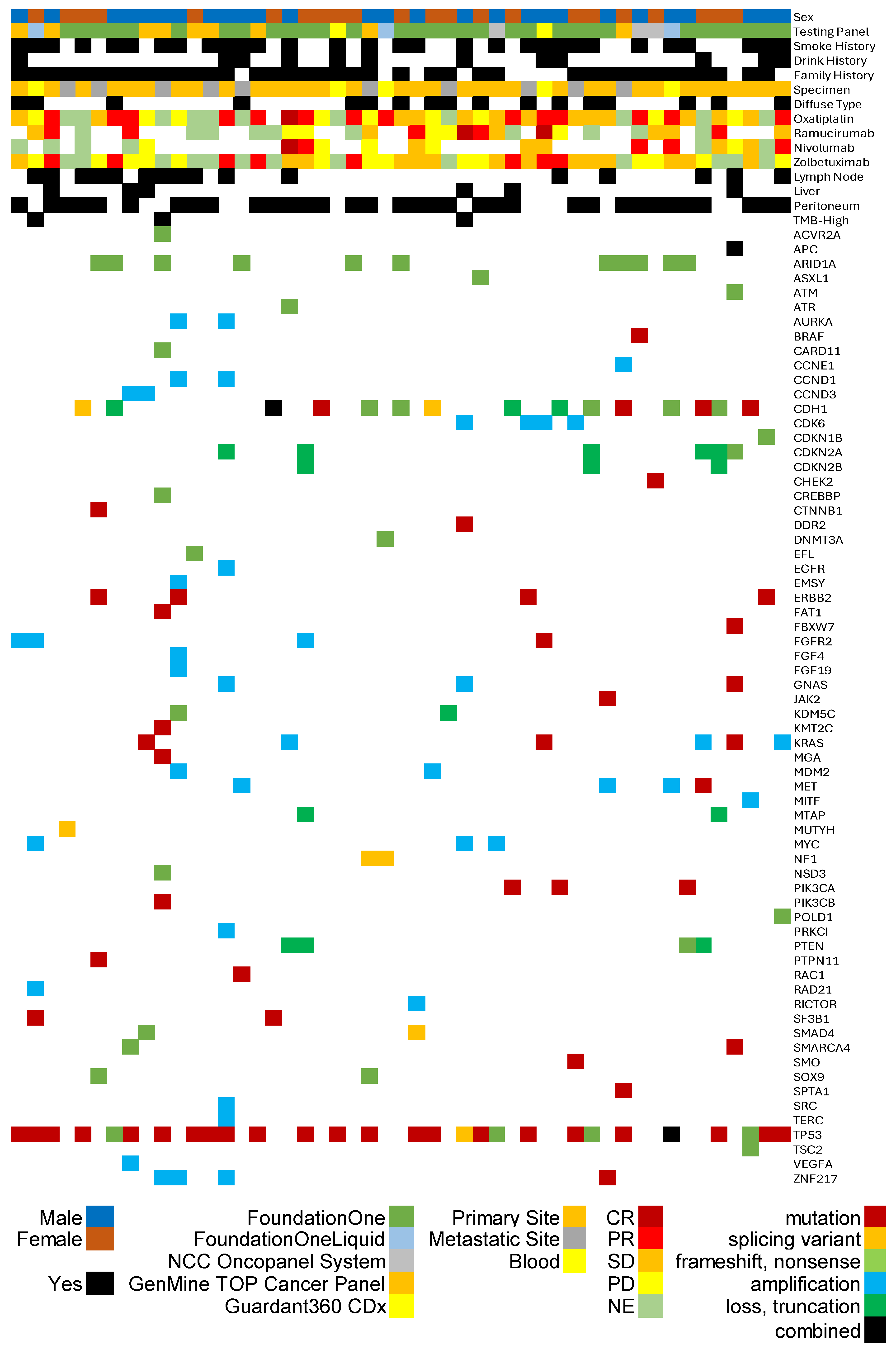
Figure 1. Genomic findings and chemotherapeutic treatment responses of gastric cancer cases treated with zolbetuximab-based regimens registered in the Center for Cancer Genomics and Advanced Therapeutics. Treatment responses were evaluated according to RECIST criteria and classified as PR (Partial Response), SD (Stable Disease), PD (Progressive Disease), or NE (Not Evaluated).
Preprints 192306 g001
Table 1. List of Cancer Genomic Tests Covered by Health Insurance in Japan.
Features FoundationOne
CDx
FoundationOne
Liquid CDx
NCC Oncopanel
System
Guardant360 CDx GenMine TOP
Cancer Panel
Sample Type FFPE Tissue Blood FFPE Tissue
and Blood
Blood FFPE Tissue
and Blood
Number of Genes 324 324 124 74 723
MSI Testing Yes Yes Yes * Yes Yes *
TMB Assesment Yes Yes Yes No Yes
Minimum Tumor
Content Required
20% N/A 20% N/A 20%
Required DNA Input 50 ng 2 tubes 50 ng 2 tubes** 50 ng
* Earlier models did not include MSI testing capability. ** Including a spare tube. FFPE: Formalin-Fixed Paraffin-Embedded, MSI: Microsatellite Instability, TMB: Tumor Mutational Burden, N/A: Not Applicable.
Table 2. Total cases background of registered in the Center for Cancer Genomics and Advanced Therapeutics database.
Total Cases (n = 110,125)
Primary Site Cancer GenomicsTest
Pancreas 17789 (16.2%) FoundationOne CDx 74409 (67.6%)
Colorectal 17595 (16.0%) FoundationOne Liquid CDx 16492 (15.0%)
Bile Duct 9679 (8.8%) NCC Oncopanel System 10078 (9.2%)
Breast 8846 (8.0%) GenMineTM TOP Cancer Panel 6132 (5.6%)
Lung 6646 (6.0%) Guardant360 CDx 2744 (2.5%)
Esophagus/Stomach 6593 (6.0%)
Prostate 6585 (6.0%) Age Group (years)
Ovary/Fallopian Tube 5822 (5.3%) 70-79 32843 (29.8%)
Soft Tissue 4151 (3.8%) 60-69 30868 (28.0%)
Uterus 3606 (3.3%) 50-59 23017 (20.9%)
Others 22843 (20.7%) 40-49 11212 (10.2%)
80-89 5338 (4.8%)
Sex 30-29 3700 (3.6%)
Male 55272 (50.2%) 20-29 1235 (1.1%)
Female 54878 (49.8%) 10-19 1047 (1.0%)
Unknown 5 (0.0%) 0-9 901 (0.8%)
90- 81 (0.1%)
Table 3. Gastric cancer cases background of registered in the Center for Cancer Genomics and Advanced Therapeutic.
Gastric Cancer Cases (n=2,483)
Cancer GenomicsTest Treatment Response to Oxaliplatin*
FoundationOne CDx 1736 (69.9%) Complete Response 28 (1.5%)
FoundationOne Liquid CDx 316 (12.7%) Partial Response 689 (37.8%)
NCC Oncopanel System 250 (10.1%) Stable Disease 662 (36.4%)
GenMineTM TOP Cancer Panel 121 (4.9%) Progressive Disease 442 (24.3%)
Guardant360 CDx 60 (2.4%) Not Evaluated 336
Sex Treatment Response toNivolumab*
Male 1650 (66.5%) Complete Response 19 (1.3%)
Female 833 (33.5%) Partial Response 388 (26.0%)
Stable Disease 515 (34.5%)
Age Group (years) Progressive Disease 573 (38.3%)
70-79 902 (36.3%) Not Evaluated 325
60-69 704 (28.4%)
50-59 374 (15.1%) Treatment Response to Zolbetuximab*
40-49 230 (9.3%) Complete Response 0
80-89 125 (5.0%) Partial Response 8 (22.2%)
30-39 111 (4.5%) Stable Disease 14 (38.9%)
20-29 30 (1.2%) Progressive Disease 14 (38.9%)
10-19 5 (0.2%) Not Evaluated 13
90- 2 (0.1%)
Pathological Classification
Diffuse 511 (20.6%)
Tubular 503 (20.3%)
Intestinal 232 (9.3%)
Mucinous 33 (1.3%)
Papillary 17 (0.7%)
Not Other Specified
or Unknown
1187 (47.8%)
*: Regimen containing indicated drug. The study periods for each genomic testing were as follows: NCC Oncopanel System (June 1, 2019 to October 17, 2025), FoundationOne® CDx (June 1, 2019 to October 18, 2025), FoundationOne® Liquid CDx (August 1, 2021 to October 19, 2025), Guardant360® CDx (July 24, 2023 to October 17, 2025), and GenMineTM TOP Cancer Panel (August 1, 2023 to October 17, 2025).
Table 4. Gastric Cancer Cases Treated with Zolbetuximab-based regimens background of registered in the Center for Cancer Genomics and Advanced Therapeutic.
Gastric Cancer Cases Treated with Zolbetuximab-based regimens (N=49)
Age Group (years; median 62) Metastatic Sites
60-69 14 (28.6%) Peritoneum 34 (69.4%)
70-79 12 (24.5%) Lymph Node 16 (32.7%)
50-59 8 (16.3%) Liver 6 (12.2%)
30-39 7 (14.3%)
40-49 7 (14.3%) Treatment Response to Oxaliplatin*
80-89 1 (2.0%) Complete Response 1 (2.7%)
Partial Response 14 (37.8%)
Sex Stable Disease 13 (35.1%)
Male 27 (55.1%) Progressive Disease 9 (24.3%)
Female 22 (44.9%) Not Evaluated 11
Smoking History Treatment Response toNivolumab*
No 30 (61.2%) Complete Response 1 (4.8%)
Yes 18 (36.7%) Partial Response 4 (19.0%)
Unknown 1 (2.0%) Stable Disease 5 (23.8%)
Progressive Disease 5 (23.8%)
Drinking History Not Evaluated 6
No 35 (71.4%)
Yes 12 (36.7%) Treatment Response to Zolbetuximab*
Unknown 2 (4.1%) Complete Response 0
Partial Response 8 (22.2%)
CancerTestingPanel Stable Disease 14 (38.9%)
FoundationOne CDx 32 (65.3%) Progressive Disease 14 (38.9%)
FoundationOne Liquid CDx 3 (6.1%) Not Evaluated 13
NCC Oncopanel System 3 (6.1%)
GenMineTM TOP Cancer Panel 9 (18.4%) Treatment Line of Zolbetuximab*
Guardant360 CDx 2 (4.1%) 1st line 23
2nd line 9
Pathological Classification 3rd line 5
Diffuse 17 (34.7%) 4th line 3
Tubular 7 (14.3%) 5th line or Later 8
Intestinal 1 (2.0%) unknown 1
Not Other Specified
or Unknown
22 (44.5%)
*: Regimen containing indicated drug. The study periods for each genomic testing were as follows: NCC Oncopanel System (June 1, 2019 to October 17, 2025), FoundationOne® CDx (June 1, 2019 to October 18, 2025), FoundationOne® Liquid CDx (August 1, 2021 to October 19, 2025), Guardant360® CDx (July 24, 2023 to October 17, 2025), and GenMineTM TOP Cancer Panel (August 1, 2023 to October 17, 2025).
Disclaimer/Publisher’s Note: The statements, opinions and data contained in all publications are solely those of the individual author(s) and contributor(s) and not of MDPI and/or the editor(s). MDPI and/or the editor(s) disclaim responsibility for any injury to people or property resulting from any ideas, methods, instructions or products referred to in the content.
Copyright: This open access article is published under a Creative Commons CC BY 4.0 license, which permit the free download, distribution, and reuse, provided that the author and preprint are cited in any reuse.
Prerpints.org logo

Preprints.org is a free preprint server supported by MDPI in Basel, Switzerland.

Subscribe

Disclaimer

Terms of Use

Privacy Policy

Privacy Settings

© 2026 MDPI (Basel, Switzerland) unless otherwise stated
