

Submitted:
30 December 2025
Posted:
31 December 2025
You are already at the latest version
Abstract
Background: Burnout among university students is a growing mental health concern, particularly during and after the COVID-19 pandemic. Academic, psychological, social, and individual factors contribute to burnout, but comprehensive synthesis across studies is limited. Methods: A systematic literature review was conducted following PRISMA guidelines. Scopus-indexed articles published between 2020 and 2025 were analyzed. Twenty-five empirical studies examining factors influencing burnout among university students were included. Key study characteristics, outcome variables, and associated factors were extracted and synthesized thematically. Results: Prevalence of burnout ranged from 38% to over 60% among university students. Academic factors such as high study load, curriculum demands, and prolonged study hours were common risk factors. Psychological factors including stress, anxiety, and depression also contributed to higher burnout levels. Protective factors included resilience, self-efficacy, social support, and academic engagement. Emerging challenges such as problematic social media use and digital distractions further exacerbated burnout by increasing mental fatigue, reducing concentration, and impairing sleep quality. Conclusion: Comprehensive institutional strategies including mental health support, workload management, resilience-building programs, promotion of social support, and interventions to reduce digital distractions are essential to mitigate burnout and promote student well-being. Future research should focus on longitudinal and experimental studies to evaluate intervention effectiveness across diverse educational contexts.
Keywords:
university students
; burnout
; academic stress
; protective factors
; systematic review
1. Introduction
1.1. Necessity of the Study
Burnout among university students has become an increasingly important mental health issue in the context of global higher education, particularly during the period from 2020 to 2025. This timeframe has been marked by the impact of the COVID-19 pandemic and the post-pandemic phase, which brought substantial changes to learning systems, social interaction patterns, and academic demands. The transition to online and hybrid learning, increased academic workload, and reduced social engagement have contributed to heightened psychological pressure among students.
A review of 25 studies indicates that burnout is a highly prevalent phenomenon across different countries and academic disciplines. Several studies report that more than half of university students experience symptoms of burnout, with prevalence rates ranging from approximately 38 percent to over 60 percent. Emotional exhaustion is the most frequently reported dimension of burnout, followed by cynicism toward academic activities and reduced academic efficacy. Academic pressure, prolonged study duration, perceived stress, and dissatisfaction with learning systems, including online learning, are consistently identified as major risk factors for student burnout. Several studies focused on medical and nursing students, who often experienced high levels of burnout due to academic pressure, prolonged study hours, and adaptation to online or hybrid learning environments.
In addition to academic factors, psychological and social variables play a significant role in influencing burnout among university students. Stress, anxiety, depression, and social media addiction are reported to be positively associated with higher levels of burnout. In contrast, protective factors such as self-efficacy, intrinsic motivation, resilience, good sleep quality, and social support from family, peers, and faculty members are associated with lower levels of burnout. These findings suggest that student burnout is not solely the result of academic demands, but rather emerges from the complex interaction of academic, psychological, social, and individual factors.
Despite the growing body of research on student burnout, existing studies remain largely fragmented. Many investigations focus on specific student populations, such as medical or nursing students, and are conducted within limited national or regional contexts. Moreover, most studies employ cross-sectional designs and examine risk factors in isolation, without providing an integrated synthesis of their interrelationships. Comprehensive literature that systematically integrates findings across countries and academic disciplines during the period from 2020 to 2025 remains limited. Therefore, a transparent and structured systematic literature review is necessary to develop a more comprehensive understanding of the factors influencing burnout among university students.
1.2. Purpose of the Study
The purpose of this study is to conduct a systematic literature review of studies published between 2020 and 2025 to identify and synthesize factors influencing burnout among university students. Specifically, this review aims to identify academic, psychological, social, and demographic factors that are most consistently associated with student burnout, analyze patterns of relationships among these factors based on empirical evidence from diverse national and disciplinary contexts, and summarize available evidence regarding protective factors and interventions that have the potential to reduce burnout levels. The findings of this study are expected to provide an evidence-based foundation for the development of policies and practices in higher education that better support student mental health and well-being.
2. Materials and Methods
2.1. Research Design
This study employed a Systematic Literature Review (SLR) design aimed at identifying, evaluating, and synthesizing research findings related to factors influencing burnout among university students. The SLR approach was selected because it enables a comprehensive and structured presentation of scientific evidence derived from relevant empirical studies within a defined time period. The implementation of the systematic review followed the Preferred Reporting Items for Systematic Reviews and Meta-Analyses (PRISMA) guidelines to ensure transparency, consistency, and reproducibility of the research process.
2.2. Research Procedure
The research procedure was conducted through several systematic stages. The first stage involved formulating the research questions focusing on factors influencing burnout among university students. The second stage consisted of developing a literature search strategy, including the selection of the database, determination of keywords, limitation of the publication period, and specification of article language. The third stage involved identifying and selecting articles based on predefined inclusion and exclusion criteria. The fourth stage was the assessment of article eligibility through full text review. The final stage involved analyzing and synthesizing the research findings, which were presented using narrative and thematic approaches.
2.3. Research Subject
The subjects of this study were not individuals directly, but rather scientific articles addressing burnout among university students. The research population comprised all scholarly publications relevant to the topic of burnout in university students. The research sample consisted of articles that met the inclusion criteria, namely empirical research articles examining factors influencing burnout among university students, published between 2020 and 2025, available in full text in English, and indexed in the Scopus database.
2.4. Data Collection
A literature search was conducted to identify scientific articles examining factors influencing burnout among university students. The search was performed using the international database Scopus, targeting articles published between January 2020 and October 2025.
The search strategy employed the following keyword combinations: (“university students” AND “burnout factors”) OR (“academic stress” AND “student burnout”). Keywords were used both as individual terms and in combination, in accordance with the search features available in the Scopus database.
The literature was limited to articles available in full text in English. Articles published in other languages were considered only if a full text English version was available.
The initial search yielded 35 articles. Subsequently, title and abstract screening was conducted to assess relevance to the research focus, and irrelevant articles were excluded at this stage. Articles that passed the screening process were then assessed for eligibility through full text review. Following the complete selection process, 25 articles met the inclusion criteria and were included in the final analysis. The article selection process is presented in the PRISMA flow diagram, as shown in Figure 1.
2.5. Literature Analysis and Presentation
Literature analysis was conducted using a thematic synthesis approach. Each selected article was analyzed to identify key study characteristics, including year of publication, country of origin, research design, burnout measurement instruments, and reported factors influencing burnout among university students. These factors were subsequently grouped into major themes, including academic pressure, social support, sleep quality, psychological demands, and individual factors.
The results of the analysis were presented in the form of a summary table of study characteristics and narrative descriptions to illustrate consistent findings as well as variations across studies. This approach aimed to provide a comprehensive understanding of dominant factors contributing to burnout among university students and to identify research gaps that warrant further investigation.
3. Results
3.1. General Characteristics of the Research
The final selection process based on the PRISMA flow resulted in 25 scientific articles included in this systematic review. All selected studies were international publications indexed in Scopus and published between 2020 and 2025.
In terms of publication year, most studies were published between 2021 and 2023, indicating increasing academic attention to student burnout, particularly in the post–COVID-19 pandemic period. Regarding geographical distribution, the majority of studies were conducted in Asia (China, India, Malaysia, South Korea, Kazakhstan, and Saudi Arabia), followed by Europe (Spain, Germany, Lithuania, and Croatia), the Americas, and several cross-national studies.
Concerning research design, most articles employed quantitative approaches with cross-sectional designs. In addition, several studies applied structural equation modeling (SEM), multivariate regression analysis, longitudinal designs, and instrument validation studies. No randomized controlled trials (RCTs) were identified, as the primary focus of the included studies was the exploration of associated factors and variable relationships rather than experimental interventions.
The study populations across all articles consisted of university students, predominantly medical and nursing students, followed by students from other health-related disciplines, education, STEM fields, and social sciences. Participants represented a wide range of academic years, from first-year students to those in their final year.
Sample sizes varied substantially, ranging from 74 participants to more than 22,000 respondents, indicating strong statistical power for identifying factors associated with student burnout. A summary of the general characteristics of the included studies is presented in Table 1.
3.2. Intervention-Related Characteristics
Although this review did not examine experimental interventions, all included studies analyzed factors or variables associated with student burnout, either as risk factors or protective factors.
The most frequently examined factors were academic-related stressors, including academic workload, study duration, curriculum demands, satisfaction with academic programs, and adaptation to online learning. These factors were consistently reported to have positive associations with burnout, particularly with the dimensions of emotional exhaustion and academic cynicism.
In addition to academic factors, many studies investigated psychological variables, such as stress, anxiety, depression, self-efficacy, self-esteem, resilience, and psychological capital. Stress, anxiety, and depression were consistently identified as strong predictors of burnout, whereas resilience, self-efficacy, and motivation functioned as protective factors.
Social and environmental factors were also commonly examined, including social support from family, peers, and significant others, academic engagement, quality of learning interactions, and social loneliness. Social support and engagement were shown to reduce burnout levels, while loneliness and interpersonal conflicts increased the risk of burnout.
More recent studies highlighted problematic social media use, social media addiction, and digital distraction as emerging contributors to academic burnout, primarily through increased mental exhaustion and reduced learning concentration.
3.3. Outcome Variables and Research Results Measurement Tools
The primary outcome variable across all included studies was student burnout, which was generally conceptualized as a multidimensional construct. The most frequently used measurement instrument was the Maslach Burnout Inventory–Student Survey (MBI-SS), assessing three core dimensions: emotional exhaustion, academic cynicism (or depersonalization), and academic efficacy.
In addition to the MBI-SS, several studies employed the Copenhagen Burnout Inventory (CBI), the Oldenburg Burnout Inventory (OLBI), and culturally adapted or validated academic burnout instruments. Instrument validation studies demonstrated good reliability and validity, as well as cross-cultural consistency in measuring student burnout.
Additional outcome variables commonly analyzed included depression, anxiety, stress, dropout intention, psychological well-being, resilience, and academic engagement. Overall findings consistently indicated that burnout was negatively correlated with psychological well-being, resilience, and engagement, and positively correlated with stress, anxiety, depression, and dropout intention.
Overall, findings from the 25 included studies demonstrate that student burnout is a multifactorial phenomenon, influenced by complex interactions among academic, psychological, social, and individual factors.
4. Discussion
This systematic review aimed to identify and analyze the factors influencing university student burnout based on 25 Scopus-indexed articles published between 2020 and 2025. Overall, the findings indicate that student burnout is a complex and multidimensional phenomenon, shaped by the interaction of academic, psychological, social, and individual factors.
Academic factors emerged as the primary determinants of burnout. High study load, curriculum demands, prolonged study hours, and pressure to achieve optimal academic performance were consistently associated with increased burnout (Le et al., 2025; Liu, Z. et al., 2023; Bolatov et al., 2022; Hwang & Kim, 2022). Students in demanding programs such as medical and nursing courses reported particularly high levels of emotional exhaustion and academic cynicism, often exacerbated by adaptation to online or hybrid learning environments during the COVID-19 pandemic (Obregon et al., 2020; Hunt et al., 2023). Dissatisfaction with academic programs and difficulty adapting to online learning also contributed to burnout (Liu, H. et al., 2023; Yan Jiang, 2021).
Psychological variables, including stress, anxiety, and depression, were consistently strong predictors of burnout (Cuevas-Caravaca et al., 2024; Basri et al., 2022; Sun et al., 2024). Students experiencing high levels of these negative emotions were more susceptible to burnout, while burnout itself could further compromise mental health. Positive psychological factors such as resilience, self-efficacy, self-esteem, and psychological capital functioned as protective mechanisms, enabling students to cope with academic pressure and maintain engagement (Basri et al., 2022; Liu, Z. et al., 2023; Gradiski et al., 2022).
Social and environmental factors significantly influenced burnout. Social support from family, peers, and significant others was negatively associated with burnout levels (Le et al., 2025; Reyes-de-Cózar et al., 2023), whereas high academic engagement and positive learning interactions reduced the risk of emotional exhaustion (Reyes-de-Cózar et al., 2023; Calcatin et al., 2022). Conversely, social isolation, interpersonal conflicts, and loneliness increased burnout vulnerability (Gradiski et al., 2022; Bolatov et al., 2022).
Recent studies highlighted the impact of problematic social media use and digital distractions on student burnout (Feng et al., 2025; Yan Jiang, 2021). Overuse of short-video apps and online platforms contributed to mental fatigue, impaired concentration, and reduced sleep quality, further aggravating academic burnout. These findings underscore the relevance of considering modern digital lifestyle factors in understanding student burnout.
The evidence suggests that comprehensive institutional strategies are necessary to mitigate burnout. These may include workload management, mental health support services, resilience-building programs, promotion of social support networks, and interventions to reduce digital distractions while enhancing positive academic engagement. Tailoring interventions to specific student populations—particularly high-risk groups such as medical and nursing students—can improve effectiveness.
This review has several limitations. The predominance of cross-sectional designs across included studies limits causal inference. Restricting the review to Scopus-indexed literature may introduce publication bias. Additionally, variability in burnout measurement instruments (MBI-SS, CBI, OLBI) complicates direct comparison of results. Future research should adopt longitudinal and experimental designs to evaluate causal relationships and intervention effectiveness, and include cross-cultural studies to better understand the dynamics of burnout in diverse educational contexts.
5. Conclusions
The systematic review of 25 Scopus-indexed studies from 2020 to 2025 shows that university student burnout is a multifactorial phenomenon influenced by academic psychological social and individual factors. The prevalence of burnout ranged from 38 percent to over 60 percent depending on the study and population. High academic demands prolonged study hours stress anxiety and depression were consistently identified as major risk factors as reported by le et al 2025 Liu, Z. et al 2023 Bolatov et al 2022 Cuevas-Caravaca et al 2024 and Basri et al 2022. Protective factors that reduced the likelihood of burnout included resilience self-efficacy social support from family peers and significant others and academic engagement as described by le et al 2025 Reyes-de-Cózar et al 2023 Gradiski et al 2022 and Calcatin et al 2022.
Emerging challenges such as problematic social media use and digital distractions further exacerbated burnout by increasing mental fatigue reducing concentration and interfering with sleep quality as highlighted by Feng et al 2025 and Yan Jiang 2021. These findings underscore the importance of implementing comprehensive interventions including mental health support workload management resilience-building programs promotion of social support and strategies to reduce digital distractions to prevent and mitigate burnout among university students.
Future research should prioritize longitudinal and experimental designs to evaluate causal relationships and the effectiveness of targeted interventions. Studies should also include diverse cultural and educational contexts to ensure that findings are generalizable and applicable across different student populations.
References
- Basri, S.; Hawaldar, I.T.; Nayak, R.; Rahiman, H.U. Do academic stress, burnout and problematic internet use affect perceived learning? Evidence from India during the COVID-19 pandemic. Sustainability 2022, 14(3), 1409. [Google Scholar] [CrossRef]
- Bolatov, A.K.; Seisembekov, T.Z.; Smailova, D.S.; Hosseini, H. Burnout syndrome among medical students in Kazakhstan. BMC Psychology 2022, 10(1), 193. [Google Scholar] [CrossRef] [PubMed]
- Calcatin, S.; Sinval, J.; Lucas Neto, L.; Marôco, J.; Gonçalves Ferreira, A.; Oliveira, P. Burnout and dropout intention in medical students: The protective role of academic engagement. BMC Medical Education 2022, 22(1), 83. [Google Scholar] [CrossRef] [PubMed]
- Castro, M.P.V.; Mancilla, K.R.M.; Olivares, J.I.M.; Meza, G.B.A.; Gutiérrez, R.J. Factorial invariance of the Maslach Burnout Inventory Student Survey (MBI-SS) in Chilean and Spanish university students. Revista Digital de Investigación en Docencia Universitaria 2023, 17(2), p. e1694. [Google Scholar] [CrossRef]
- Cuevas-Caravaca, E.; Sánchez-Romero, E.I.; Antón-Ruiz, J.A. Academic burnout, personality, and academic variables in university students. European Journal of Investigation in Health, Psychology and Education 2024, 14(6), 1561–1571. [Google Scholar] [CrossRef]
- Čorić, B.; Alajbeg, A. Burnout levels among student teachers in STEM fields. Hrvatska revija za rehabilitacijska istraživanja 2024, 60(2), 93–112. [Google Scholar] [CrossRef]
- Feng, T.; Wang, B.; Mi, M.; Ren, L.; Wu, L.; Wang, H.; Liu, X.; Wang, X. The relationships between mental health and social media addiction, and between academic burnout and social media addiction among Chinese college students: A network analysis. Heliyon 2025, 11, e41869. [Google Scholar] [CrossRef]
- Gradiski, I.P.; Borovecki, A.; Ćurković, M.; San-Martín, M.; Delgado Bolton, R.C.; Vivanco, L. Burnout in international medical students: Characterization of professionalism and loneliness as predictive factors of burnout. International Journal of Environmental Research and Public Health 2022, 19(3), 1385. [Google Scholar] [CrossRef]
- Hunt, S.; Simpson, J.; Letwin, L.; MacLeod, B. Is online learning during the COVID-19 pandemic associated with increased burnout in medical learners?: A medical school’s experience. PLoS ONE 2023, 18(5), e0285402. [Google Scholar] [CrossRef]
- Hwang, E.; Kim, J. Factors affecting academic burnout of nursing students according to clinical practice experience. BMC Medical Education 2022, 22(1), 346. [Google Scholar] [CrossRef]
- Jiang, Y. Problematic social media usage and anxiety among university students during the COVID-19 pandemic: The mediating role of psychological capital and the moderating role of academic burnout. Frontiers in Psychology 2021, 12, 612007. [Google Scholar] [CrossRef]
- Jordan, R.K.; Shah, S.S.; Desai, H.; Tripi, J.; Mitchell, A.; Worth, R.G. Variation of stress levels, burnout, and resilience throughout the academic year in first-year medical students. PLoS ONE 2020, 15(10), e0240667. [Google Scholar] [CrossRef]
- Kong, Y.; Somdee, T.; Yangyuen, S. Academic burnout and its association with psychological factors among medical students in Guangxi, China. Journal of Education and Health Promotion 2025, 14, 101. [Google Scholar] [CrossRef]
- Le, L.J.; Mansor, F.A.; Manogar, K.R.; Adam, S.K. Association of social support and burnout among undergraduate medical and health sciences students at a Malaysian university. Health Professions Education 2025, 11(1), 12. [Google Scholar] [CrossRef]
- Li, Y.; Cao, L.; Liu, J.; Zhang, T.; Yang, Y.; Shi, W.; Wei, Y. The prevalence and associated factors of burnout among undergraduates in a university. Medicine 2021, 100(27), e26589. [Google Scholar] [CrossRef] [PubMed]
- Liu, H.; Zhang, Z.; Chi, C.; Tao, X.; Zhang, M. Exploring the impact of the COVID-19 pandemic on academic burnout among nursing college students in China: A web-based survey. Medical Science Monitor Basic Research 2023, 29, e940997. [Google Scholar] [CrossRef]
- Liu, Z.; Xie, Y.; Sun, Z.; Liu, D.; Yin, H.; Shi, L. Factors associated with academic burnout and its prevalence among university students: A cross-sectional study. BMC Medical Education 2023, 23(1), 317. [Google Scholar] [CrossRef] [PubMed]
- Mahfouz, M.S.; Ali, S.A.; Alqahtani, H.A.; Kubaisi, A.A.; Ashiri, N.M.; Daghriri, E.H.; Alzahrani, S.A.; Sowaidi, A.A.; Maashi, A.M.; Alhazmi, D.A. Burnout and its associated factors among medical students of Jazan University, Jazan, Saudi Arabia. Mental Illness 2020, 12(2), 35–42. [Google Scholar] [CrossRef]
- Nebhinani, N.; Kuppili, P.P.; Mamta. Stress, burnout, and coping among first-year medical undergraduates. Journal of Neurosciences in Rural Practice 2021, 12(3), 483–489. [Google Scholar] [CrossRef] [PubMed]
- Obregon, M.; Luo, J.; Shelton, J.; Blevins, T.; MacDowell, M. Assessment of burnout in medical students using the Maslach Burnout Inventory-Student Survey: A cross-sectional data analysis. BMC Medical Education 2020, 20(1), 376. [Google Scholar] [CrossRef]
- Reyes-de-Cózar, S.; Merino-Cajaraville, A.; Salguero-Pazos, M.R. Avoiding academic burnout: Academic factors that enhance university student engagement. Behavioral Sciences 2023, 13(12), 989. [Google Scholar] [CrossRef]
- Rudinskaitė, I.; Mačiūtė, E.; Gudžiūnaitė, G.; Gerulaitytė, G. Burnout syndrome amongst medicine students in Lithuania and Germany. Acta Medica Lituanica 2020, 27(2), 53–60. [Google Scholar] [CrossRef] [PubMed]
- Sun, M.; Piao, M.; Jia, Z. The impact of alexithymia, anxiety, social pressure, and academic burnout on depression in Chinese university students: An analysis based on SEM. BMC Psychology 2024, 12(1), 757. [Google Scholar] [CrossRef] [PubMed]
- Xu, R.; Wang, Q.; Chin, N.S.; Teo, E.W. Analysis of learning motivation and burnout of Malaysian and Chinese college students majoring in sports in an educational psychology perspective. Frontiers in Psychology 2021, 12, 691324. [Google Scholar] [CrossRef] [PubMed]
- Yahya, M.S.; Abutiheen, A.A.; Al-Haidary, A.F. Burnout among medical students of the University of Kerbala and its correlates. Middle East Current Psychiatry 2021, 28(1), 78. [Google Scholar] [CrossRef]
Figure 1.
PRISMA flow diagram of the study selection process.
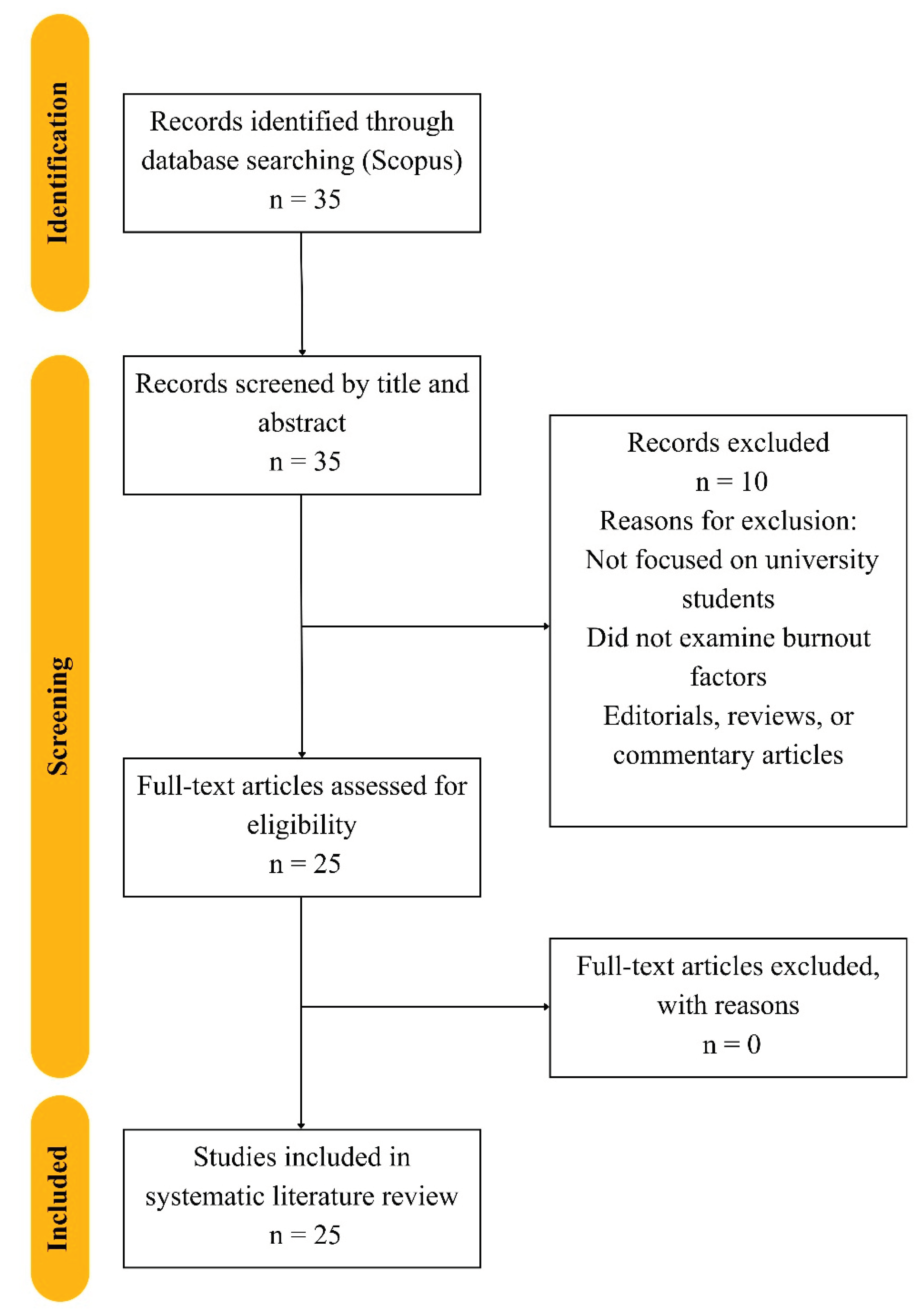

Table 1.
Characteristics of studies on factors influencing burnout among university students included in the literature review (n = 25).
Table 1.
Characteristics of studies on factors influencing burnout among university students included in the literature review (n = 25).
| No | Author(s) & Year | Country | Study Design | Participants | Burnout Measurement Tool | Key Factors Examined |
|---|---|---|---|---|---|---|
| 1 | Le et al., 2025 | Malaysia | Cross-sectional | 391 undergraduate medical and health sciences students | MBI-SS | Academic pressure, poor study hours, role overload, negative thoughts, social support (family, significant others) |
| 2 | Kong et al., 2025 | China | Cross-sectional | Medical students, majority female (55.3%), mean age 20.6 | MBI-SS | Study duration, perceived stress, family income, GPA, self-efficacy, self-esteem, motivation |
| 3 | Feng et al., 2025 | China | Network analysis | Chinese college students | MBI-SS | Anxiety, depression, stress, academic burnout, social media addiction, distraction by short-video apps |
| 4 | Čorić & Alajbeg, 2024 | Croatia | Cross-sectional | STEM student teachers | MBI-SS | Emotional exhaustion, cynicism, academic self-efficacy, gender, academic year, study program |
| 5 | Sun et al., 2024 | China | SEM | 599 university students | MBI-SS | Alexithymia, anxiety, social pressure, academic burnout, depression, gender differences |
| 6 | Cuevas-Caravaca et al., 2024 | Spain | Cross-sectional | Nursing & education students | MBI-SS | Emotional exhaustion, personality traits (neuroticism, conscientiousness, agreeableness, openness), study hours, academic year |
| 7 | Castro et al., 2023 | Chile & Spain | Cross-cultural validation | University students | MBI-SS | Factorial invariance, exhaustion, cynicism, academic efficacy, cross-cultural reliability |
| 8 | Hunt et al., 2023 | USA | Cross-sectional | 74 medical learners (online-only vs in-person) | MBI-SS | Learning environment, emotional exhaustion, cynicism, resilience, mindfulness, self-compassion |
| 9 | Reyes-de-Cózar et al., 2023 | Spain | Cross-sectional | 1st-year to postgraduate students (mean age 22) | MBI-SS | Student engagement, classroom interaction, exploration, intellectual challenges, relevance |
| 10 | Liu, Z. et al., 2023 | China | Cross-sectional | 22,983 university students | MBI-SS | Emotional exhaustion, cynicism, reduced personal accomplishment, gender, academic year, smoking |
| 11 | Liu, H. et al., 2023 | China | Web-based survey | 653 nursing students | MBI-SS | Academic year, specialty satisfaction, adaptation to online learning, COVID-19 impact, depression, resilience, professional identity |
| 12 | Gradiski et al., 2022 | International (28 countries) | Cross-sectional | 188 medical students | MBI-SS | Professionalism (empathy, lifelong learning), loneliness (family, social), exhaustion, cynicism, professional efficacy, academic year, living situation |
| 13 | Calcatin et al., 2022 | Not specified | Structural equation modeling | 532 medical students | MBI-SS | Burnout, dropout intention, academic engagement, moderation by engagement |
| 14 | Hwang & Kim, 2022 | Korea | Cross-sectional | Nursing students (with/without clinical practice) | MBI-SS | Stress, anxiety, depression, major satisfaction, clinical practice experience |
| 15 | Bolatov et al., 2022 | Kazakhstan | Cross-sectional | 736 medical students | CBI-S, OLBI-S | Gender, academic year, dropout thoughts, suicidal ideation, profession satisfaction, academic performance, interpersonal problems, smoking, accommodation, parental expectations, alcohol use, extracurricular activities, part-time job, somatic symptoms, depression, anxiety |
| 16 | Basri et al., 2022 | India | Structural model with multiple mediation | Students aged 21–27 (54.8% male) | Higher-order MBI construct | Stress, burnout, perceived learning, resilience, problematic internet use, multiple mediation pathways |
| 17 | Yan Jiang, 2021 | China | Cross-sectional | University students (COVID-19 affected vs non-affected) | MBI-SS | Problematic social media usage, anxiety, psychological capital, academic burnout (moderation/mediation) |
| 18 | Xu et al., 2021 | Malaysia & China | Cross-sectional | College students majoring in sports | MBI-SS | Learning motivation, academic burnout, internal/external factors, depression, low sense of achievement |
| 19 | Nebhinani et al., 2021 | India | Cross-sectional | First-year medical undergraduates | Two-/Three-dimensional burnout criteria | Stress, burnout prevalence, coping strategies (active coping, substance use), gender differences |
| 20 | Yahya et al., 2021 | Iraq | Cross-sectional | Medical students, University of Kerbala | MBI-SS | Emotional exhaustion, cynicism, professional efficacy, gender, legal substance use, family history of mental diseases |
| 21 | Li et al., 2021 | China | Cross-sectional | 860 undergraduate students | MBI-SS | Study burnout, emotional exhaustion, professional efficacy, gender, year level, residence, social/school/family/interpersonal factors |
| 22 | Rudinskaitė et al., 2020 | Lithuania & Germany | Cross-sectional | Medicine students | MBI-SS | Study-induced stress, mood, weakness, digestive problems, sleep duration, psychological help-seeking |
| 23 | Jordan et al., 2020 | USA | Longitudinal | 172 first-year medical students | MBI-SS | Stress, burnout (personal & work), resilience, gender differences, seasonal variation |
| 24 | Mahfouz et al., 2020 | Saudi Arabia | Cross-sectional | 440 medical students | MBI-SS | Personal, study-related, client-related burnout, age, gender, burnout knowledge, academic year, CGPA |
| 25 | Obregon et al., 2020 | USA | Cross-sectional | 273 medical students | MBI-SS | CY, EE, AE subscales, curriculum phase, wellness initiatives, motivation, gender differences |
Disclaimer/Publisher’s Note: The statements, opinions and data contained in all publications are solely those of the individual author(s) and contributor(s) and not of MDPI and/or the editor(s). MDPI and/or the editor(s) disclaim responsibility for any injury to people or property resulting from any ideas, methods, instructions or products referred to in the content. |
© 2026 by the authors. Licensee MDPI, Basel, Switzerland. This article is an open access article distributed under the terms and conditions of the Creative Commons Attribution (CC BY) license.
Copyright: This open access article is published under a Creative Commons CC BY 4.0 license, which permit the free download, distribution, and reuse, provided that the author and preprint are cited in any reuse.


