

Submitted:
15 March 2026
Posted:
16 March 2026
You are already at the latest version
Abstract
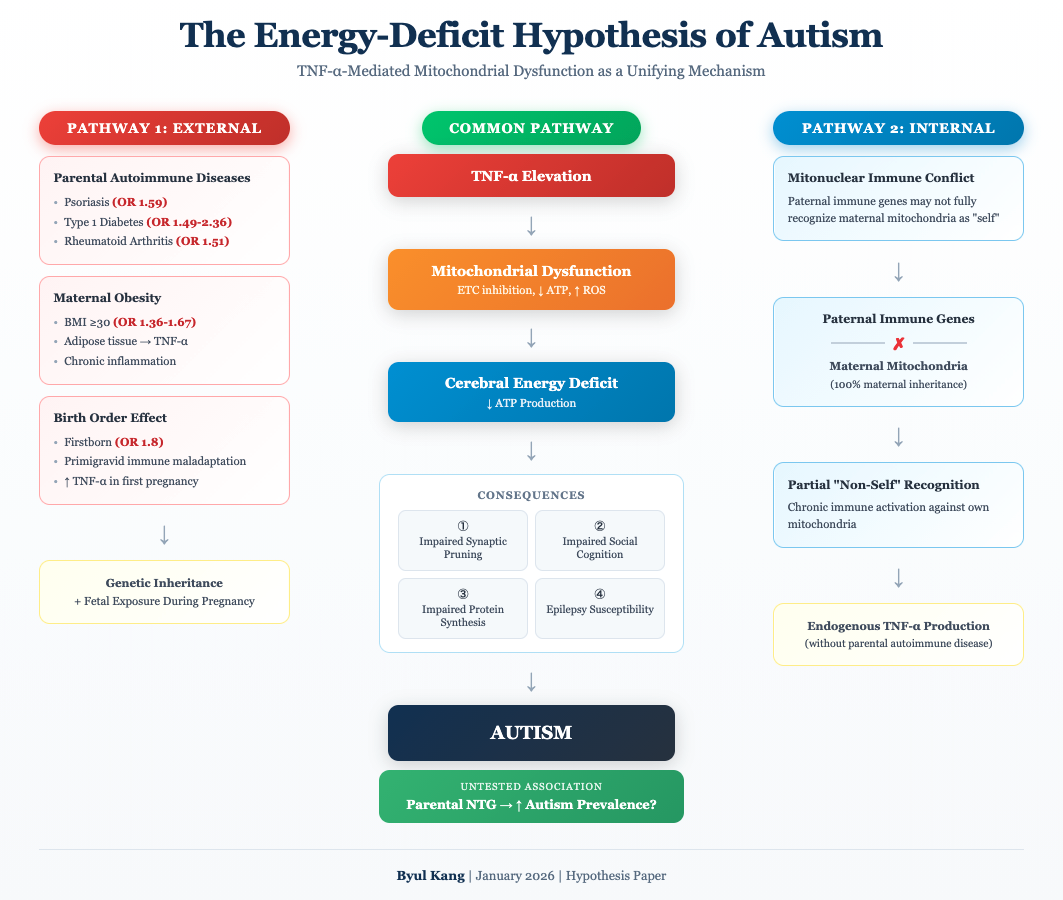
Background: Autism spectrum disorder (ASD) affects approximately 1-2% of childrenworldwide, yet its etiology remains incompletely understood. Emerging evidence suggeststhat offspring of parents with autoimmune diseases show elevated autism prevalence.Notably, children of parents with psoriasis (OR 1.59), type 1 diabetes (OR 1.49-2.36), andrheumatoid arthritis (OR 1.51) demonstrate particularly strong associations. Hypothesis: I propose that autism may be conceptualized as an immune-metabolic disorderin which TNF-α-mediated mitochondrial dysfunction contributes to cerebral energydeficiency. This energy deficit impairs three critical processes: (1) synaptic pruning duringneurodevelopment, (2) real-time social cognition including gaze processing and emotionrecognition, and (3) protein synthesis of critical synaptic scaffolding molecules.The proposed mechanism is TNF-α pathway dysregulation arising from inheritedinflammatory susceptibility and/or direct fetal exposure to elevated maternal TNF-α duringpregnancy.I further propose that the well-documented “firstborn effect” in autism reflects maternalimmune maladaptation during primigravid pregnancies. Additionally, for cases withoutparental autoimmune history, a speculative secondary mechanism is proposed: mitonuclearimmune conflict, where paternal immune genes may partially recognize maternalmitochondria as non-self, generating endogenous TNF-α.
Keywords:
autism spectrum disorder
; TNF-α
; mitochondrial dysfunction
; synaptic pruning
; protein synthesis
; SHANK3
; birth order
; maternal immune tolerance
; energy metabolism
; normal-tension glaucoma
; psoriasis
; type 1 diabetes
; neuroinflammation
; eye contact avoidance
; tissue-specific vulnerability
; hypotonia
; hyperlactatemia
Copyright: This open access article is published under a Creative Commons CC BY 4.0 license, which permit the free download, distribution, and reuse, provided that the author and preprint are cited in any reuse.


