

Submitted:
04 June 2026
Posted:
08 June 2026
You are already at the latest version
Abstract
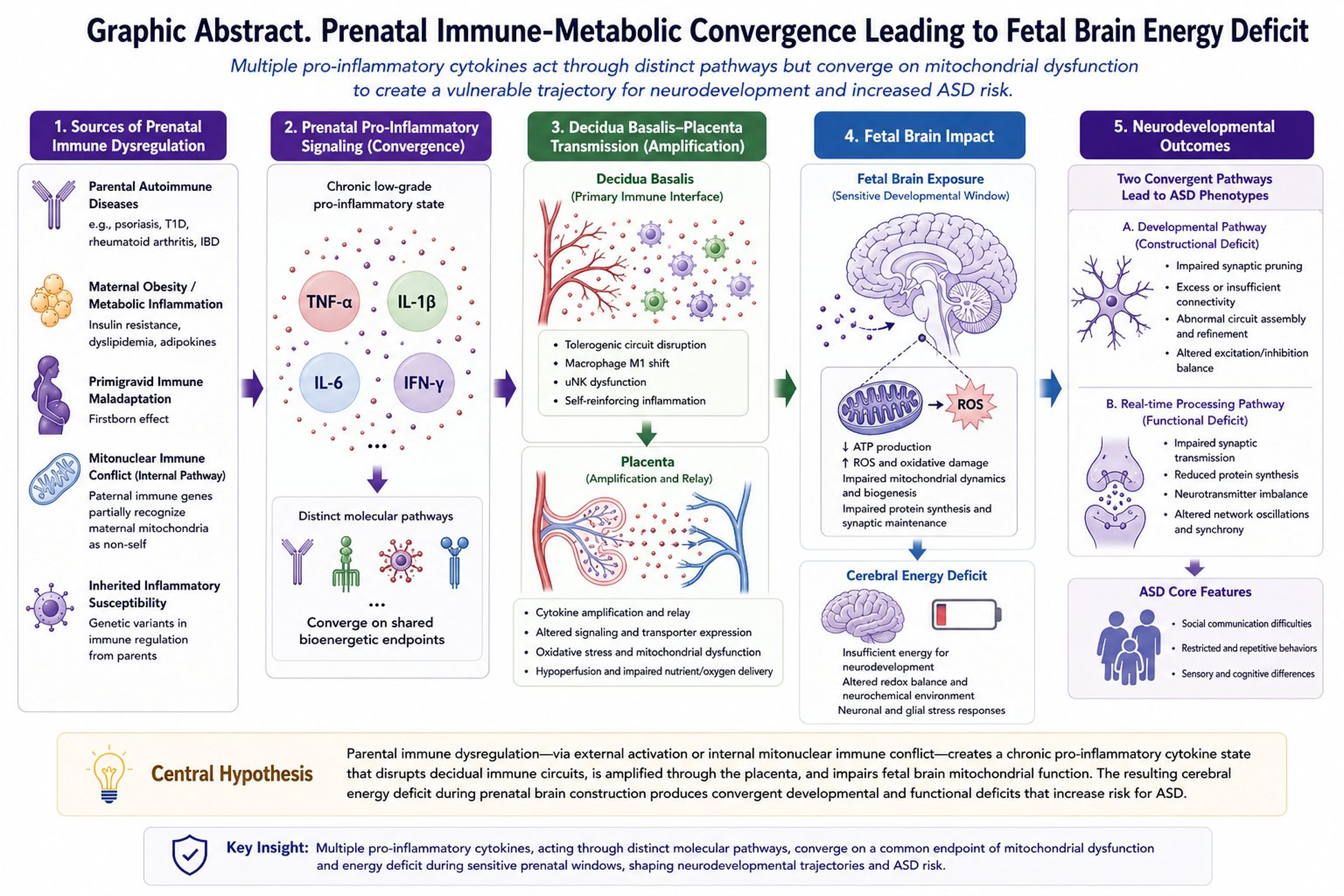
Background: Autism spectrum disorder (ASD) affects approximately 1-2% of children worldwide, yet its etiology remains incompletely understood. Emerging evidence suggests that offspring of parents with autoimmune diseases show elevated autism prevalence. Notably, children of parents or mothers with immune-related conditions, including psoriasis (OR 1.59), maternal type 1 diabetes (HR 2.36 in one large cohort study), and rheumatoid arthritis (OR 1.51), show elevated ASD-associated risk estimates.Hypothesis: I propose that autism may be conceptualized as an immune-metabolic disorder in which multiple pro-inflammatory cytokines—including TNF-α, IL-6, IL-1β, and IFN-γ—act through distinct molecular pathways yet converge on a common endpoint of mitochondrial dysfunction and cerebral energy deficiency. This convergence implies that it is the cumulative prenatal inflammatory burden, rather than any single cytokine, that drives the energy deficit. The resulting energy shortage may impair four critical processes: (1) synaptic pruning during neurodevelopment, (2) real-time social cognition including gaze processing and emotion recognition, (3) protein synthesis of critical synaptic scaffolding molecules, and (4) flexible hierarchical predictive inference. The last domain offers a unifying bioenergetic interpretation of restricted repetitive behaviors and insistence on sameness as a behavioral compensation for chronic cerebral energy constraint. Crucially, the resulting mitochondrial dysfunction is proposed to persist beyond birth, with the gap between cerebral energy demand and supply widening during the rapid brain growth of the first postnatal years. This developmental trajectory may help explain the typical emergence of clinical symptoms between 12 and 24 months of age, the selective vulnerability of high-metabolism brain regions, and the regressive pattern observed in a substantial subset of ASD cases.The proposed mechanism is a chronic low-grade pro-inflammatory cytokine state—clinically silent, yet biologically consequential—arising from inherited inflammatory susceptibility and/or direct fetal exposure to elevated maternal inflammatory signaling during pregnancy. Unlike high-grade inflammatory states in which maternal and fetal survival are acutely threatened, low-grade cytokine elevations may proceed without conspicuous symptoms or detectable clinical signs, particularly when chronic. Although seemingly quiet, such a state may be insufficient to endanger maternal or fetal survival, yet sufficient to disrupt fetal brain bioenergetics during sensitive gestational windows—producing neonates who appear outwardly healthy at term while their neurodevelopmental trajectories have already been altered.I further propose that the well-documented "firstborn effect" in autism reflects maternal immune maladaptation during primigravid pregnancies. Additionally, for cases without parental autoimmune history, a speculative secondary mechanism is proposed: mitonuclear incompatibility, in which paternally inherited nuclear genes encoding mitochondrial proteins may be imperfectly matched to the maternally inherited mitochondrial genome, impairing mitochondrial function and thereby generating endogenous pro-inflammatory (DAMP-driven) signaling.Implications: This framework may provide an integrative account of disparate observations about autism pathophysiology by uniting prenatal initiation with postnatal persistence into a single developmental trajectory. It suggests that pro-inflammatory immune pathways and mitochondrial dysfunction merit further investigation as candidate targets for risk modification, with the prenatal period offering opportunities for identification of high-risk pregnancies through parental autoimmune or inflammatory disease, and the early postnatal period offering an additional window for longitudinal characterization of mitochondrial and bioenergetic trajectories. If supported by sufficient subsequent evidence, prenatal cytokine monitoring and prospective postnatal mitochondrial assessment—neither of which is currently part of routine care—may merit consideration by the medical community as complementary candidate strategies for autism risk research.
Keywords:
autism spectrum disorder
; multi-cytokine convergence
; mitochondrial dysfunction
; chronic low-grade inflammation
; cerebral energy deficit
; neurodevelopment
Copyright: This open access article is published under a Creative Commons CC BY 4.0 license, which permit the free download, distribution, and reuse, provided that the author and preprint are cited in any reuse.


