

Submitted:
30 December 2025
Posted:
31 December 2025
You are already at the latest version
Abstract
This research aims to analyze the influence of digital literacy, government policies, and infrastructure on coffee productivity through technology adoption in Kerinci Regency. A random sampling method was employed, and the sample size was determined using the Slovin formula, resulting in 95 respondents. Both primary and secondary data sources were utilized. Data were collected through observations, interviews, and questionnaires, and analyzed using a multiple linear regression model with SPSS 16.0 for Windows. The findings reveal that digital literacy, government policy, and infrastructure each have a significant impact on coffee productivity. Moreover, these three variables collectively exert a significant simultaneous effect on coffee productivity.
Keywords:
digital literacy
; government policy
; infrastructure
; coffee productivity
; technology adoption
1. Introduction
Coffee is one of the leading commodities in the plantation sub-sector in Indonesia, which shows a relatively stable production level from year to year. (Santoso et al., 2021)This commodity also plays a vital role in providing employment and is a significant source of foreign exchange. Furthermore, coffee has very promising market potential, both domestically and internationally, making marketing development a key priority. This potential is evident in the rapid growth of various types of coffee shops in various regions, reflecting the growing demand and interest in coffee products. (Dasipah et al., 2021).
Kerinci Regency, located in Jambi Province, is known as one of Indonesia's leading coffee-producing regions, particularly for Arabica coffee, which boasts a distinctive flavor and high quality. The region's significant coffee plantation potential makes it a strategic commodity capable of supporting the regional economy and farmer welfare. However, despite its comparative advantage, coffee productivity in Kerinci Regency still faces various challenges, both in terms of technology, human resources, and supporting policies. Therefore, it is important to examine how digital literacy, government policies, and infrastructure influence coffee productivity through technology adoption.
Agriculture is one of the many facets of life that have been significantly altered by the development of digital technology. Digital literacy, which is the capacity of farmers to access, understand, and use information technology, is essential for improving agricultural output and marketing efficiency (Suhariyanti et al., 2024). Coffee farmers with higher digital literacy are generally more responsive to innovations, such as the adoption of digital farming tools, automated irrigation systems, and online marketing platforms (Syofya & Widayat, 2025). Nevertheless, in rural regions such as Kerinci Regency, the level of digital literacy among farmers remains relatively low, hindering the full utilization of agricultural digitalization opportunities.
Apart from digital literacy, government regulations are also essential in establishing an environment that facilitates higher coffee output. The government is responsible for creating regulations, incentives, and training programs that encourage the use of modern agricultural technologies (Jamil et al., 2023). In Kerinci Regency, the local government has implemented several initiatives, including strengthening farmer institutions, increasing access to capital, and providing technical training for coffee farmers. However, implementation difficulties, protracted bureaucracy, and a lack of cross-sector cooperation between the public, business, and educational sectors frequently restrict the efficacy of these initiatives.
Infrastructure is also a fundamental factor determining the success of increasing productivity in the coffee sector. Adequate infrastructure, including roads, internet connections, and harvest storage and processing facilities, can support supply chain efficiency and expand market access (Mayora Mayora et al., 2024). In many rural areas, limited infrastructure remains a classic problem affecting the competitiveness of agricultural products. Issues that must be resolved right once include unequal internet access, bad roads connecting to plantations, and a dearth of facilities for post-harvest processing (Sahputra et al., 2024).
In the context of globalization and digitalization, technology adoption is a key lever for increasing productivity and efficiency in the agricultural sector. Through technology adoption, farmers can obtain real-time weather information, perform soil fertility analysis, and digitally monitor crop growth. (Ardiana & Purnomo, 2021). Technology also opens up opportunities for the implementation of precision farming systems that can optimize the use of agricultural inputs and reduce production costs. (Ahmad Nasution et al., 2024). However, the level of technology adoption among coffee farmers in Kerinci Regency remains low due to limited knowledge, financial capacity, and access to training and information.
Digital literacy is closely linked to technology adoption, as understanding information technology is a key prerequisite for agricultural digitalization. Digitally literate farmers tend to be more responsive to innovations, such as agricultural sensors, crop monitoring apps, weather forecasting apps, and online marketing systems. (Sari & Nurmala Sari, 2025). On the other hand, low digital literacy can hinder the utilization of technological potential, which ultimately results in productivity stagnation. (Setiawan, 2024). Therefore, improving digital literacy must be a priority in technology-based agricultural development strategies.
Well-targeted government policies can also accelerate technology adoption among farmers. Through comprehensive policy support, the government can create a conducive ecosystem for agricultural innovation and digitalization. Programs such as digital training for farmers, subsidies for agricultural technology tools, and the development of local digital platforms can be catalysts for increasing coffee productivity. (Pardani et al., 2024). In addition, the government can also facilitate collaboration between farmers, academics, and industry players to create innovations that suit local needs. (Syaputra, 2021).
Adequate infrastructure is a key pillar for successful digitalization in the agricultural sector. Without a stable internet connection, access to digital technology will be limited. Similarly, the physical condition of infrastructure, such as roads and transportation, impacts the distribution of crops. (Mutiara et al., 2025). In Kerinci Regency, developing digital and physical infrastructure is urgently needed to ensure effective and inclusive technology adoption. Equitable access to infrastructure will provide equal opportunities for all farmers to participate in the digital agricultural ecosystem.
In relation to coffee productivity, technology adoption can have a direct impact on increasing yields and product quality. Through the application of technologies such as sensor-based soil and weather monitoring systems, farmers can make more accurate decisions in land management. Furthermore, the use of modern processing machinery can also improve the quality of coffee beans, thereby increasing their selling value and competitiveness in the global market. (Prastiwi, 2025). Thus, increased productivity is not only measured by production volume, but also by the quality and efficiency of the production process.
Kerinci Regency has significant potential for developing technology-based coffee farming due to its ideal agro-climatic conditions and good land quality. However, this potential has not been fully utilized due to limited human resources and supporting facilities. Low technology adoption is a major obstacle contributing to suboptimal coffee productivity. Therefore, the integration of digital literacy, government policies, and infrastructure is key to driving the transformation of coffee farming in this region.
Digital transformation in the coffee sector not only increases productivity but also impacts farmer welfare. With technology, farmers can access real-time market price information, sell their products directly to consumers, and reduce reliance on middlemen. This will strengthen farmers' bargaining power and create a more equitable value chain (Mariman et al., 2024). However, all of this can only be realized if digital literacy is improved and supported by adequate policies and infrastructure.
In the context of sustainable development, increasing productivity through technology adoption must also consider environmental and social aspects. The use of appropriate technology can help farmers implement environmentally friendly agricultural practices, such as efficient water and fertilizer management, and land conservation. (Martanto et al., 2024). Thus, agricultural digitalization is not only oriented towards increasing production but also towards the sustainability of the agricultural ecosystem itself.
Overall, the increase in coffee productivity in Kerinci Regency is the result of a complex interaction between digital literacy, government policies, and infrastructure through technology adoption mechanisms. These three factors are interrelated and mutually reinforcing. Digital literacy fosters farmers' ability to use technology, government policies provide direction and support, and infrastructure serves as the foundation that enables the process to run effectively. Without synergy between these three, sustainable productivity increases will be difficult to achieve.
Thus, this research has high relevance in the context of sustainable development, particularly in strengthening the competitiveness of national coffee commodities. Through increased digital literacy, the implementation of targeted policies, and the provision of adequate infrastructure, Kerinci Regency has the potential to become an example of a coffee-producing region that has successfully implemented a comprehensive digital transformation. These efforts are expected to achieve productive, efficient, and highly competitive coffee farming in the global market.
2. Research Methods
This study applied a random sampling method, in which sample members were randomly chosen from the entire population. The number of samples was determined using the Slovin formula, a method commonly employed to calculate sample size. The research utilized two data sources: primary and secondary data. Primary data were obtained through questionnaires distributed to coffee farmers in Kerinci Regency as the main respondents. Secondary data were collected through documentation by compiling various forms of information related to the research focus from multiple sources in Kerinci Regency, as well as from relevant literature such as books and academic journals. The study population consisted of 126 coffee farmers, and a total of 95 farmers were selected as the research sample. Data analysis was conducted by systematically organizing and interpreting data obtained from interviews, questionnaires, field observations, and other sources to facilitate understanding and communication of results. The analysis technique employed in this research was multiple linear regression analysis.
3. Results and Discussion
3.1. Classical Assumption Test
A statistical prerequisite for multiple linear regression analysis using ordinary least squares is the classical assumption test. While there are multiple independent variables in OLS, there is only one dependent variable. A number of traditional assumption tests are required to assess model accuracy: Heteroscedasticity, multicollinearity, and normality.
3.2. Normality Test
Based on the P-Plot normality test, the data are considered normally distributed when the plotted points are dispersed near the diagonal line and align with its direction.
As observed in Figure 1 above, the data is dispersed around the diagonal line, indicating a normal distribution pattern in the link between the variables of digital literacy, infrastructure, and government policy on coffee productivity. This suggests that the regression model has a normal distribution.
3.3. Multicollinearity Test
The multicollinearity test is conducted to identify whether there is a correlation or interdependence among the independent variables. A good regression model is characterized by the absence of strong intercorrelations between independent variables, indicating no signs of multicollinearity. A reliable way to detect multicollinearity is by checking Tolerance and VIF values, multicollinearity is absent if Tolerance > 0.10 and VIF ≤ 10.
Based on Table 1, the regression model is confirmed to be free from multicollinearity, as all tolerance values exceed 0.10. Specifically, the tolerance value for digital literacy is 0.784, for government policy is 0.741, and for infrastructure is 0.856. Similarly, the VIF values of all independent variables are below 10, with digital literacy at 1.275, government policy at 1.349, and infrastructure at 1.169. Consequently, it can be said that the regression model employed in this investigation does not contain multicollinearity.
3.4. Heteroscedasticity Test
The absence of heteroscedasticity is a prerequisite for a successful regression model. As long as this is present, heteroscedasticity will cast doubt (inaccuracy) on the regression analysis findings.
Based on Figure 2, the data points appear randomly dispersed above and below the zero line on both the X and Y axes without forming any distinct pattern. This shows that there is no heteroscedasticity in the regression model used in this investigation and is therefore appropriate for analyzing coffee productivity as influenced by digital literacy, government policy, and infrastructure.
3.5. Multiple Linear Regression Test
To assess the suitability model in describing the relationship between Digital Literacy (X1), Government Policy (X2), and Infrastructure (X3) as independent variables, and Coffee Productivity as the dependent variable (Y), a multiple linear regression analysis was conducted.
Based on Table 2 above, the constant value obtained is 1.218, for the Digital Literacy variable (X1) of 0.317, Government Policy (X2) of 0.504, and Infrastructure (X3) of 0.213. Thus, the resulting linear equation is as follows:
Y = 1.218 + 0.317 (X1) + 0.504 (X2) + 0.213 (X3) + e
3.6. T-Test (Partial Test)
Based on Table 3 above, it shows that the significance value of the Digital Literacy variable (X1) is 0.000 <0.05, and the t-count value > t table is 8.543 > 1.986. This explains that Digital Literacy significantly and partially has an influence on the Coffee Productivity variable. Thus, Ha is accepted and H0 is rejected. The significance value of the Government Policy variable (X2) is 0.000 <0.05, and the t count value > t table is 12.851 > 1.986. This explains that Government Policy significantly and partially has an influence on the Coffee Productivity variable. Thus, Ha is accepted and H0 is rejected. The significance value of the Infrastructure variable (X3) is 0.000 <0.05. And t count > t table is 4.462 > 1.986. This explains that Infrastructure significantly and partially has an influence on Coffee Productivity. Thus, Ha is accepted and H0 is rejected.
3.7. F Test (Simultaneous Test)
Based on Table 4 above, the significance value is 0.000 < 0.05 and the F count value is 180.830, so F count > F table, namely 180.830 > 2.70, which explains that Ha is accepted and H0 is rejected. Consequently, it can be said that Digital Literacy, Government Policy, and Infrastructure together (simultaneously) have an effect on Coffee Productivity in Kerinci Regency.
3.8. Coefficient of Determination Test
According to Table 5 above, the determinant coefficient (R-squared) has a value of 0.856. The value of 0.856 indicates that the Coffee Productivity variable (Y) can be explained by the Digital Literacy variable (X1), Government Policy (X2), and Infrastructure (X3) together by 85.6% and the remaining 14.4% is affected by other factors beyond the variables examined in this study..
4. Discussion
4.1. The Impact of Digital Literacy on Coffee Productivity Through Technology Adoption
Based on the research results, it shows that digital literacy has a partially significant effect on coffee productivity. This is because farmers' ability to understand and utilize digital technology encourages them to more quickly adopt modern agricultural innovations. Farmers with high digital literacy can access information related to cultivation, weather, markets, and coffee processing techniques more effectively. This increases work efficiency, reduces production costs, and improves the quality and quantity of harvests. Through the adoption of technologies such as agricultural applications, sensor devices, and digital marketing platforms, digital literacy is a key factor that significantly accelerates the increase in coffee productivity. Research by (Prayetno et al., 2024) Explained that improving digital literacy among farmer groups is highly relevant in the context of modern agriculture. With good digital literacy, farmers can utilize technology to access market information, monitor crop conditions, and improve efficiency in managing their agricultural businesses.
4.2. The Influence of Government Policy on Coffee Productivity Through Technology Adoption
Based on the research results, it shows that government policy has a significant effect on coffee productivity. This is because government support, such as digital training programs, subsidies for modern agricultural equipment, and agricultural infrastructure development, encourages farmers to more easily access and use technology. The right policies can accelerate the process of modernizing coffee farming, increase production efficiency, and strengthen farmers' ability to manage land productively. With policies that support innovation and digitalization, technology adoption becomes more widespread, so that coffee productivity increases significantly and sustainably.
The findings of this investigation are consistent with those of a study by (Kurniawan et al., 2021), said that the government's policy of promoting integrated Arabica coffee and organic farming can boost comparative and competitiveness and benefit farming enterprises.
4.3. The Impact of Infrastructure on Coffee Productivity Through Technology Adoption
Based on the research results, it shows that infrastructure has a partially significant effect on coffee productivity. This is because the availability of adequate infrastructure, such as internet networks, electricity, roads, and agricultural facilities, is the main basis for farmers in accessing and implementing modern technology. Good infrastructure facilitates the distribution of information, the use of digital agricultural tools, and online marketing of coffee products. With strong infrastructure support, the process of technology adoption runs more effectively, so that coffee productivity increases both in terms of quality and quantity.
The findings of this study are consistent with the research of (Katharina et al., 2024), which found that accessibility and agricultural infrastructure influence food productivity. Similarly, the results align with the study by (Budiarto et al., 2023), which revealed that accessibility has a positive and significant impact on consumers’ intention to purchase coffee.
4.4. The Influence of Digital Literacy, Government Policy, and Infrastructure on Coffee Productivity Through Technology Adoption
Based on the research results, it shows that digital literacy, government policy, and infrastructure together (simultaneously) have a significant effect on coffee productivity. This is because all three support each other in creating an efficient modern agricultural ecosystem. Digital literacy improves farmers' ability to use technology, government policy provides regulatory support and facilities, while infrastructure provides the means and facilities that enable optimal technology implementation. Simultaneously, the combination of these three factors accelerates the process of technology adoption, increases production efficiency, and encourages sustainable increases in coffee productivity.
5. Conclusions
Based on the research results, the following conclusions can be drawn:
- Digital literacy significantly impacts coffee productivity through technology adoption. Farmers with high digital literacy are quicker to adopt modern agricultural innovations, as they are able to effectively utilize technology to access information on cultivation, weather, markets, and coffee processing. This can increase efficiency, reduce costs, and improve the quality and quantity of the harvest, making digital literacy a key factor in increasing coffee productivity.
- Government policies significantly influence coffee productivity through technology adoption. Government support through digital training, subsidies for modern equipment, and infrastructure development can facilitate farmers' access to and use of technology. Policies that encourage innovation and digitalization accelerate agricultural modernization, increase efficiency, and expand technology adoption, resulting in sustainable coffee productivity gains.
- Infrastructure significantly impacts coffee productivity through technology adoption. Adequate infrastructure, such as internet access, electricity, roads, and agricultural facilities, facilitates farmers' access to and adoption of modern technology. This support facilitates information distribution and digital marketing, resulting in more effective technology adoption and increased coffee productivity in both quality and quantity.
- Digital literacy, government policy, and infrastructure simultaneously significantly influence coffee productivity through technology adoption. This is because digital literacy, government policy, and infrastructure mutually support each other, forming an efficient modern agricultural ecosystem. Together, these three accelerate technology adoption, increase production efficiency, and promote sustainable coffee productivity.
References
- Ahmad Nasution, F., Asria Nanda, S., & Muhammad Ridwan, T. (2024). Peran Internet of Things (IoT) (Fakhruddin Ahmad Nasution dkk. Jurnal Malikussaleh Mengabdi, 3(2), 410. [CrossRef]
- Ardiana, W., & Purnomo, D. (2021). Digitalisasi Infrastruktur Pertanian untuk Mendukung Ketersediaan Pangan Nasional Digitalization of Agricultural Infrastructure to Support National Food Security.
- Budiarto, B., Perdana, A. A. C., & Widowati, I. (2023). Analisis Pengaruh Akseptabilitas, Keterjangkauan, Aksesibilitas dan Kesadaran Terhadap Niat Beli Kopi di Umah Kopi Gayo Yogyakarta. Journal of Economics and Business UBS, 12(1), 587–596.
- Dasipah, E., Sukmawati, D., & Faturachman, D. P. (2021). Faktor Kelembagaan, Sosial Ekonomi Dan Penerapan (Adopsi) Teknologi Terhadap Keberhasilan Usahatani Kopi Arabika Java Preanger. Paspalum: Jurnal Ilmiah Pertanian, 9(1), 94. [CrossRef]
- amil, M. N. F., Abdika, M. F., Thaher, Y. Q. M., & Wikansari, R. (2023). Peran Pemerintah Dalam Meningkatkan Volume Ekspor Kopi. ECOMA: Journal of Economics and Management, 1(3), 132–138. [CrossRef]
- Katharina Martha Apriliani Wenggol, Fransina W. Ballo, & Maria Indriyani Hewe Tiwu. (2024). Pengaruh Infrastruktur Pedesaan Terhadap Produktivitas Pangan di Kecamatan Titehena Kabupaten Flores Timur. Inisiatif: Jurnal Ekonomi, Akuntansi Dan Manajemen, 3(3), 261–277. [CrossRef]
- Kurniawan, H., Elpawati, E., & Aminudin, I. (2021). Analisis Daya Saing Dan Dampak Kebijakan Pemerintah Dalam Budidaya Kopi Arabika Organik Terintegrasi (Studi Kasus Kegiatan Budidaya Kopi Arabika Organik dan Terintegrasi di Kelompok Tani Girisenang di Kabupaten Bandung, Jawa Barat). JAS (Jurnal Agri Sains), 5(2), 166. [CrossRef]
- Mariman, M., Gultom, D. T., Ibnu, M., Sayekti, W. D., & Yanfika, H. (2024). Pengaruh Tingkat Pemanfaatan Media Komunikasi Inovasi Baru (Cyber Extension) dalam Mewujudkan Keberdayaan Petani Kopi di Kabupaten Lampung Barat. Suluh Pembangunan : Journal of Extension and Development, 6(2), 148–159. [CrossRef]
- Martanto, M., Nur Aisyah, D., & Indriawan, R. (2024). Peluang Industri Pertanian Komoditas Kopi (Coffe) Di Kecamatan Seponti Kabupaten Kayong Utara Desa Sungai Sepeti. Jurnal Teknologi Pangan Dan Industri Perkebunan (LIPIDA), 4(2), 60–67. [CrossRef]
- Mayora Mayora, Ahmad Suja’i Tanjung, Anita Khairani Siregar, Rehulina Rehulina, Arini Alfa Hidayah, & Rofiil Harahap. (2024). Strategi Peningkatan Infrastruktur Desa untuk Mendorong Perekonomian di Desa Limau Manis Kecamatan Tanjung Morawa. Trending: Jurnal Manajemen Dan Ekonomi, 3(1), 177–185. [CrossRef]
- Mutiara, Malik, A., Asyiera, N., & Yanti, R. (2025). Analisis hubungan antara infrastruktur dan kinerja sektor pertanian di Pulau Sumatera: Review artikel. Jurnal Pendidikan Sosial Dan Humaniora, 4(2), 4397–4409.
- Pardani, N., Rangga, K. K., & Yanfika, H. (2024). Faktor-faktor yang Memengaruhi Tingkat Produktivitas Kopi di Kecamatan Sekincau Kabupaten Lampung Barat. Mimbar Agribisnis : Jurnal Pemikiran Masyarakat Ilmiah Berwawasan Agribisnis, 10(2), 1886. [CrossRef]
- PRASTIWI, R. E. K. A. (2025). Studi Dampak Ekonomi Adopsi Teknologi Pertanian Modern. Circle Archive, 1(7), 1–10.
- Prayetno, B. E., Lestaria, E., Sarinauli, B., Abidin, Z., & Yanti, S. (2024). Peningkatan Literasi Digital di Kalangan Kelompok Tani di Kampung Pinangan Kabupaten Aceh Tengah. Jurnal Masyarakat Indonesia (Jumas), 3(01), 28–33.
- Sahputra, I., Yurni, I., Agusniar, C., Nisa, F., & Sukiman, T. S. A. (2024). Pemanfaatan Teknologi Informasi Digital untuk Meningkatkan Produktivitas Petani. Jurnal Malikussaleh Mengabdi, 3(2), 452–459.
- Santoso, A. T., Dalmiyatun, T., & Kadhung Prayoga, K. (2021). Hubungan Perilaku Petani Dengan Adopsi Teknologi Pasca Panen Kopi Robusta Di Kabupaten Temanggung. Jurnal Ilmu Pertanian Tropika Dan Subtropika, 6(1), 22–32.
- Sari, M., & Nurmala Sari, Y. (2025). Pemanfaatan Internet of Things (IoT) dalam Meningkatkan Efektivitas. Jurnal Kolaboratif Sains, 8(5), 2658–2669. [CrossRef]
- Setiawan, H. A. (2024). Pengaruh Literasi Digital terhadap Pemanfaatan E-Commerce pada Hasil Pertanian Influence of Digital Literacy on the Utilization of E-Commerce in Agricultural Products. Jurnal Kolaboratif Sains, 7(5), 1598–1607.
- Suhariyanti, Sabrina Aulia Rahmah, Andi Maysarah, & Dewi Wahyuni. (2024). Pemanfaatan Warung Kopi Dalam Meningkatkan Literasi Digital Di Desa Klambir Hamparan Perak. Jurnal.
- Pengabdian Masyarakat, 3(1), 65–72. https://doi.org/10.70340/japamas.v3i1.129. [CrossRef]
- Syaputra, R. (2021). Strategi Pengembangan Kopi Robusta Di Kabupaten Merangin. Jurnal Khazanah Intelektual, 4(3), 866–888. [CrossRef]
- Syofya, H., & Widayat, P. (2025). Faktor yang Mempengaruhi Produktivitas dan Kesejahteraan Petani Kopi di Provinsi Jambi. Arus Jurnal Sosial Dan Humaniora, 5(1), 927–936. [CrossRef]
Figure 1.
Normality Test Results. Source: Data processed by researchers, 2025.
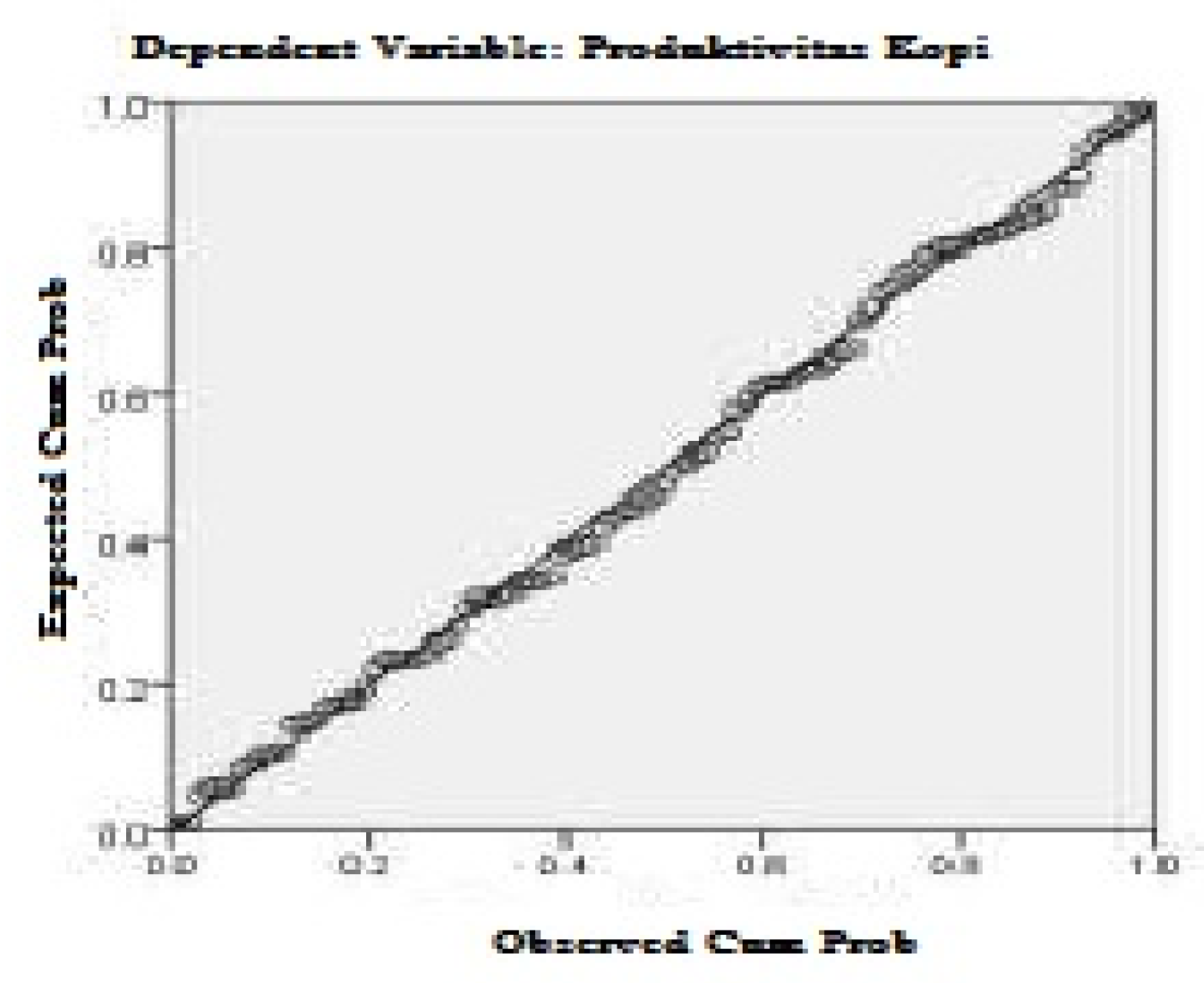
Figure 2.
Results of the Heteroscedasticity Test. Source: Data processed by researchers, 2025.
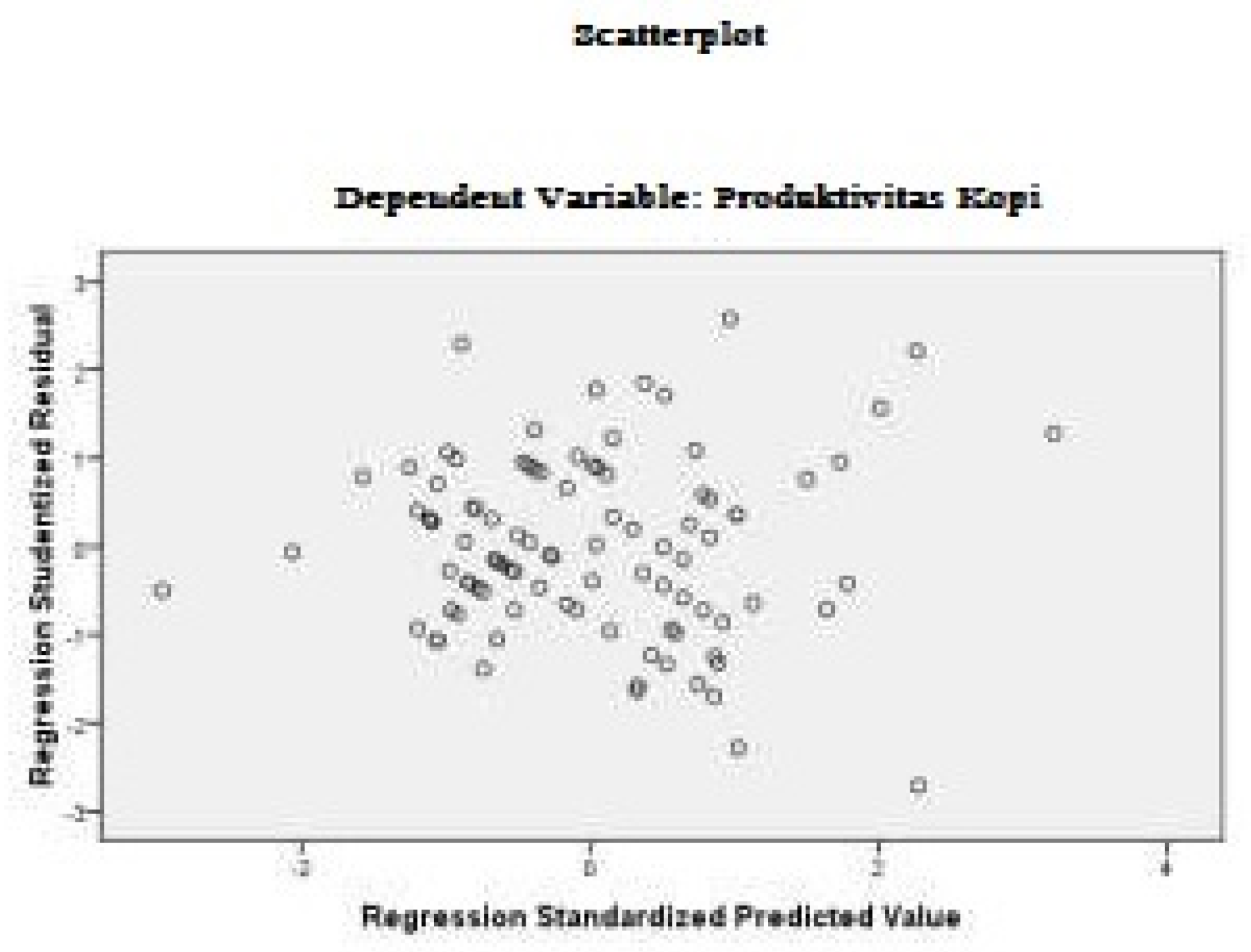

Table 1.
Multicollinearity Test Results Coefficientsa.
| Model | Unstandardized Coefficients | Standardized Coefficients | t | Sig. | Collinearity Statistics | ||
|---|---|---|---|---|---|---|---|
| B | Std. Error | Beta | Tolerance | VIF | |||
| 1 (Constant) | 1,218 | 1,223 | .996 | .322 | |||
| Digital Literacy | .317 | .037 | .382 | 8,543 | .000 | .784 | 1,275 |
| Government policy | .504 | .039 | .592 | 12,851 | .000 | .741 | 1,349 |
| Infrastructure | .213 | .048 | .190 | 4,462 | .000 | .856 | 1,169 |
| a. Dependent Variable: Coffee Productivity | |||||||
Source: Data processed by researchers, 2025.
Table 2.
Multiple Linear Regression Test Results Coefficientsa.
| Model | Unstandardized Coefficients | Standardized Coefficients | t | Sig. | |
|---|---|---|---|---|---|
| B | Std. Error | Beta | |||
| 1 (Constant) | 1,218 | 1,223 | .996 | .322 | |
| Digital Literacy | .317 | .037 | .382 | 8,543 | .000 |
| Government policy | .504 | .039 | .592 | 12,851 | .000 |
| Infrastructure | .213 | .048 | .190 | 4,462 | .000 |
| a. Dependent Variable: Coffee Productivity | |||||
Source: Data processed by researchers, 2025.
Table 3.
T-Test Results Coefficientsa.
| Model | Unstandardized Coefficients | Standardized Coefficients | T | Sig. | |
|---|---|---|---|---|---|
| B | Std. Error | Beta | |||
| 1 (Constant) | 1,218 | 1,223 | .996 | .322 | |
| Digital Literacy | .317 | .037 | .382 | 8,543 | .000 |
| Government policy | .504 | .039 | .592 | 12,851 | .000 |
| Infrastructure | .213 | .048 | .190 | 4,462 | .000 |
| a. Dependent Variable: Coffee Productivity | |||||
Source: Data processed by researchers, 2025.
Table 4.
F Test Results ANOVA.
| Model | Sum of Squares | Df | Mean Square | F | Sig. |
|---|---|---|---|---|---|
| 1 Regression | 492,130 | 3 | 164,043 | 180,830 | .000a |
| Residual | 82,552 | 91 | .907 | ||
| Total | 574,683 | 94 | |||
| |||||
Source: Data processed by researchers, 2025.
Table 5.
Results of the Determination Coefficient Test Model Summary.
| Model | R | R Square | Adjusted R Square | Standard Error of the Estimate |
|---|---|---|---|---|
| 1 | .925a | .856 | .852 | .95245 |
| ||||
Source: Data processed by researchers, 2025.
Disclaimer/Publisher’s Note: The statements, opinions and data contained in all publications are solely those of the individual author(s) and contributor(s) and not of MDPI and/or the editor(s). MDPI and/or the editor(s) disclaim responsibility for any injury to people or property resulting from any ideas, methods, instructions or products referred to in the content. |
© 2025 by the authors. Licensee MDPI, Basel, Switzerland. This article is an open access article distributed under the terms and conditions of the Creative Commons Attribution (CC BY) license (http://creativecommons.org/licenses/by/4.0/).
Copyright: This open access article is published under a Creative Commons CC BY 4.0 license, which permit the free download, distribution, and reuse, provided that the author and preprint are cited in any reuse.


