
Submitted:
30 December 2025
Posted:
30 December 2025
You are already at the latest version
Abstract
This study presents reflections from the Introduction to Sustainable Business course. Thirty-five students from various courses of the Faculty of Entrepreneurship and Business, Universiti Malaysia Kelantan, participated in this course for this semester. The course applied a service-learning pedagogical method to link lecture theory with real-world practice. Data were collected based on student reflections using both qualitative methods. Embedding the service-learning model in business courses focusing on sustainability is the first in the local context and is an interactive transformational innovation in education. Data were analyzed using WebQDA software to interpret the textual data. Based on the reflection, it was proven that this course has improved the students’ professional and personal development. This study is significant for enhancing education through service-learning. The findings also reveal gaps in soft skills like communication and teamwork, guiding educators on necessary improvements. Additionally, students showed positive attitudes toward community engagement, underscoring the role of service-learning in fostering social responsibility. This study underscores the potential of service-learning as an innovative approach to higher education, offering a replicable framework for promoting transformative learning and preparing graduates for the demands of sustainable business practice.
Keywords:
service-learning
; innovative education
; community engagement
; higher education
; sustainable future
1. Introduction
The increasing global emphasis on sustainability has transformed how businesses operate, shifting focus from purely profit-driven motives to a broader, more responsible approach that incorporates environmental, social, and economic [1]. As concerns about climate change, resource depletion, and corporate social responsibility grow, businesses must adopt sustainable practices to remain competitive and compliant with evolving regulatory frameworks [2]. In this context, future business leaders must be well-versed in sustainable business practices. Students entering the business world must be equipped with the knowledge and skills to navigate complex economic, regulatory, and consumer demands that require integrating sustainability into business operations. Universities, therefore, play a pivotal role in fostering this understanding through comprehensive education that blends theory with practical applications [3].
Service-learning is a form of experiential education that allows learners to deepen their understanding of concepts and theories by applying them in real-world settings [4]. Service-learning is a practical pedagogical approach that enhances traditional academic learning by incorporating community service into the curriculum [5]. This method bridges the gap between classroom theory and real-world practice, enabling students to gain hands-on experience while contributing positively to society. By engaging in service-learning projects, students develop critical thinking, problem-solving, and leadership skills, essential for addressing sustainable business practices' multifaceted challenges ([6]. In business education, service-learning allows theoretical knowledge to be applied to real-world sustainability challenges. This approach helps students understand the complexities of sustainable business and fosters a sense of civic responsibility and ethical decision-making [7]. Combining academic learning with practical experience, service-learning enriches students' educational journeys and prepares them for the demands of the modern business environment.
The Introduction to Sustainable Business course at Universiti Malaysia Kelantan is designed to provide students with a comprehensive understanding of sustainable business practices. The course aims to equip students with the tools to analyze and implement sustainable strategies that align with environmental and social responsibility while ensuring economic viability. Service-learning is a core component of the course, enhancing students' understanding of sustainability by integrating community-based projects. These projects allow students to work with local businesses and community organizations, tackling real-world sustainability challenges. The course objectives focus on developing students’ ability to assess business practices critically, devise solutions that promote sustainability, and apply their theoretical knowledge in practical settings. Through these experiences, students gain a deeper appreciation of sustainability's role in business and society.
Understanding the impact of service-learning programs on students’ development is essential for advancing pedagogical strategies in education. This study contributes to a deeper understanding of how service-learning fosters professional skills and ethical awareness. It highlights the importance of experiential learning in cultivating future leaders equipped to tackle sustainability challenges, using service-learning pedagogy in a sustainable business course. In this study, we also evaluate the pre-survey of students’ agreement, perception, and attitude towards community engagement and leadership among students. Furthermore, the paper considers the impact of these service-learning experiences on students' understanding of sustainable business practices and their personal growth. The study will focus on student reflections and pre-survey data to assess how the acceptance of the students towards the learning involving the community and outside the lecture class.
2. Materials and Methods
2.1. The Course and Context
The “Introduction to Sustainable Business (AEB30203)” is a 14-week 3-credit course offered to students at the Faculty of Entrepreneurship and Business, Universiti Malaysia Kelantan as an elective course. Universiti Malaysia Kelantan was established in 2007. This university was established as a component of the Ninth Malaysia Plan to support the quality of human capital development in the higher education sector. The Prime Minister announced the federal agreement on 31 March 2006 in the Ninth Malaysia Plan proposal. The establishment of the university was approved in the Cabinet Meeting on 14 June 2006. The cabinet has specified that the philosophy of the curriculum in UMK should be based on entrepreneurship and enterprise education in all the study programmes. Therefore, taglines such as "Entrepreneurship is Our Thrust" and "Entrepreneurial University" are widely used to promote the philosophy of this university. Specialized studies for short and moderate terms are grouped into three main fields of study;
- Entrepreneurship and Business;
- Creative Technology and Heritage;
- Agro-Based Industry and Earth Sciences
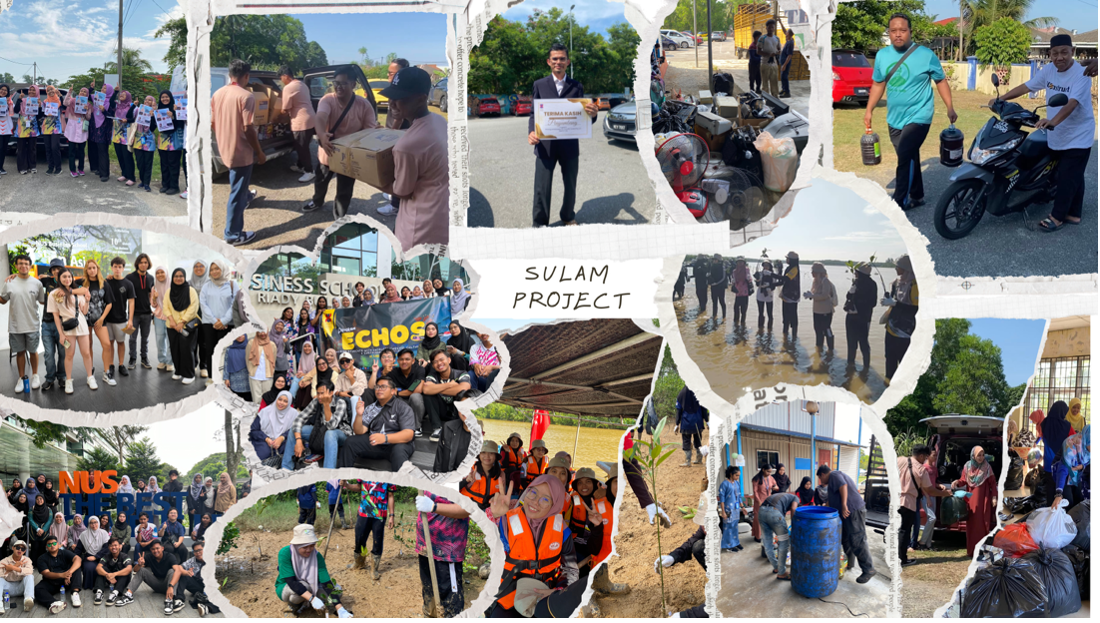
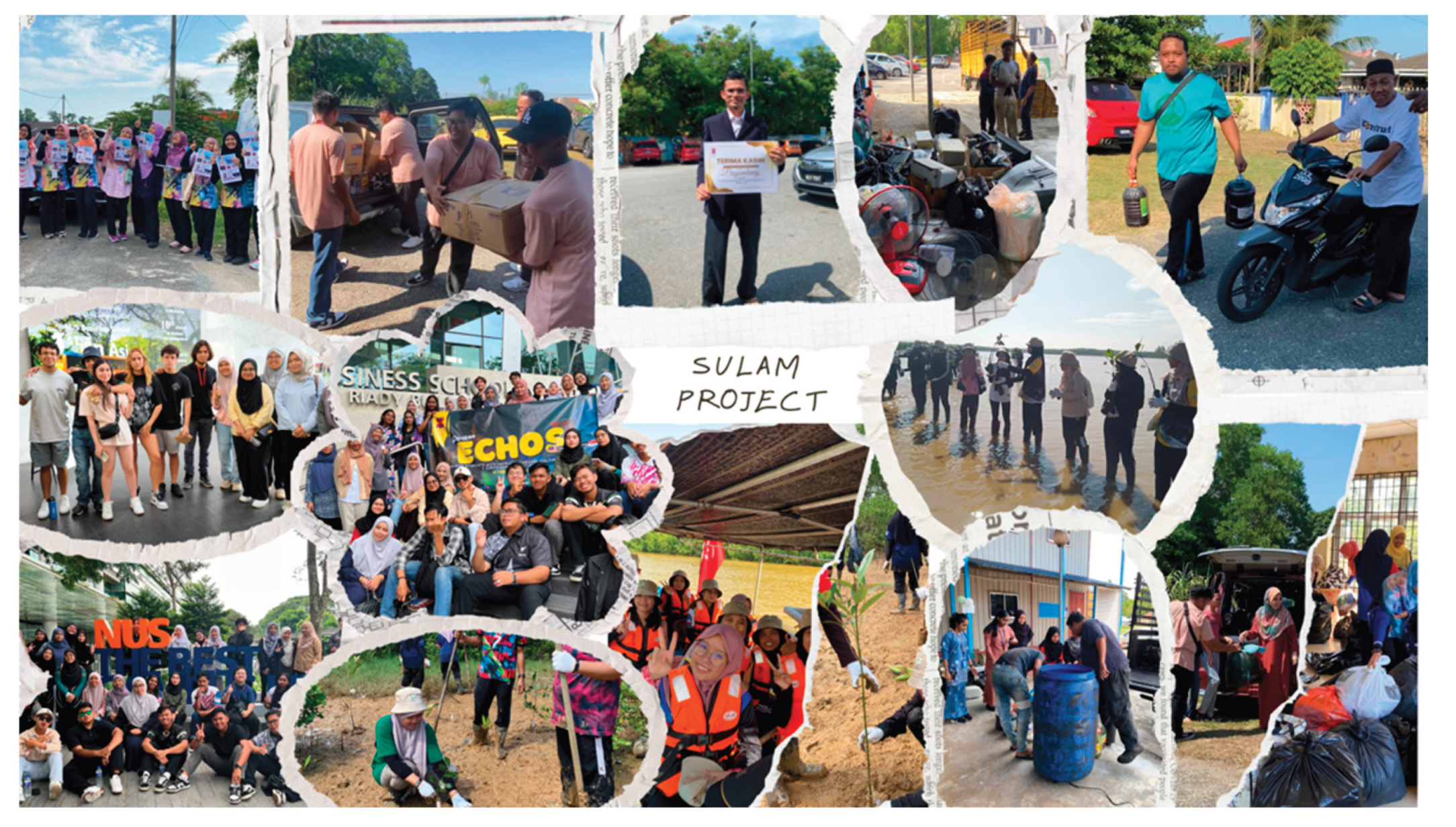
This course focuses on creating awareness about sustainability and how this action is important in business. The Service-Learning Malaysia-University for Society (SULAM), also known as service-learning, was implemented in the course to prepare the students to handle the program and address the issues in the community. This semester, the course was taught in a hybrid format with two lecturers working with 35 students. The lecturers created a series of prepared lectures, conversed with the students, and presented a way to assess student involvement and participation throughout the semester to facilitate hybrid learning. The course was taught through the service-learning component. This course included several field visits to the community partner organization to collaborate, which were timed to specific learning outcomes throughout the semester, and it was linked to the development of the primary assignment: the sustainable business model plan (30% of marks). The other essential activities included a reflective essay, in which students were asked in the early semester to post their learning experiences (20% of marks), to enhance the personal valuing of the self towards self-empowerment [8]. They also had to answer 10% of the quizzes from the 4 weeks of the topic lecture and get 20% marks from the community feedback. Another 20% of marks are from the practical exercise assessment based on the effort observed by the lecturer throughout the semester. Students who completed the tasks, participated in the debate, and actively participated in the lecture and program were awarded points for their practical exercise assessment. For the course taught in Semester February 2023/2024, a student-led project promoting the awareness of the circular economy and replanting the mangrove at Pantai Ndo to reduce soil erosion and promote good planetary health. At the end of semester, students had an educational trip to the National University of Singapore and other parts of Singapore to have an eye-opening experience on how the developed country implemented the sustainable practice and co-led with the faculty in organizing the community-based learning mini competition.
Figure 1.
Compilation of Students’ Activities in SULAM during Semester February 2023/2024.
2.2. Instrument
The reflection questions were designed and adapted from several guided reflection questions for service-learning [9], based on asking students to identify perceived learning outcomes from their service-learning experience.
2.3. Data Analysis
Post-project critical reflections were analyzed qualitatively using webQDA software. Students’ open-ended responses were coded into thematic categories derived from guided reflection. Thematic analysis involved iterative reading, coding, and categorization of text segments to identify recurring themes, subthemes, and patterns in perceived learning outcomes. Frequencies of coded segments were also computed to highlight dominant themes such as environmental awareness, practical skills, community engagement, and leadership. Integrating descriptive statistical analysis with qualitative coding allowed for a comprehensive understanding of the quantitative trends and the qualitative depth of students’ learning experiences.
3. Results
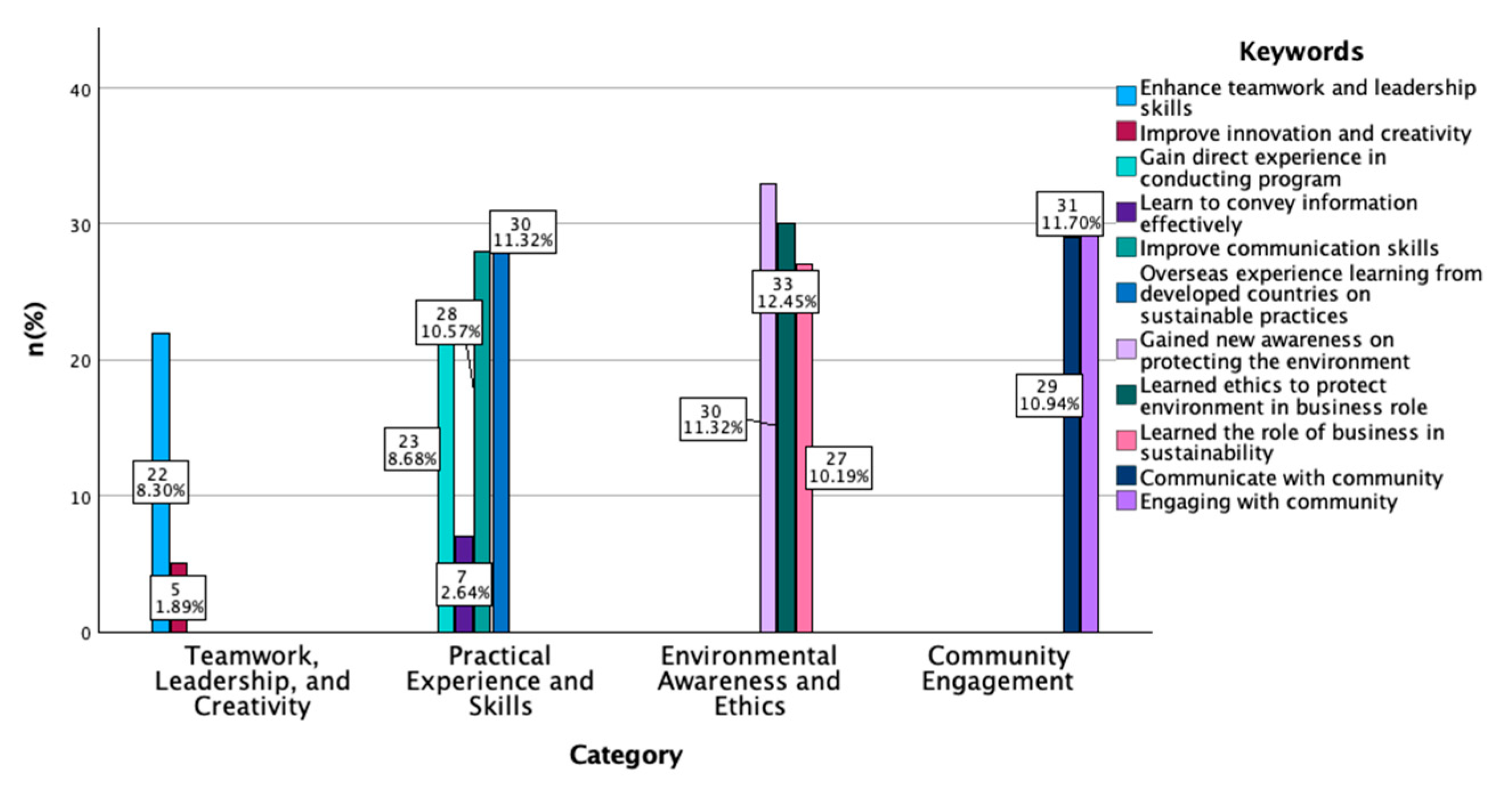
The result from Figure 2 reveals distinct patterns in how students prioritize different aspects of their reflections during the course. Environmental Awareness and Ethics stands out with the highest total count of 90, indicating a strong emphasis on gaining awareness about environmental protection and understanding the ethics of sustainability in business. This is followed by Practical Experience and Skills, which accumulated 88 responses, highlighting a significant focus on acquiring practical skills such as program management, communication, and learning from international practices. Community Engagement received 60 responses, demonstrating a notable interest in communicating with and engaging the community. Lastly, Teamwork, Leadership, and Creativity had 27 responses, predominantly centered on enhancing teamwork and leadership skills, with no recorded responses for other items in this category.
4. Discussion
Post-course reflections highlighted Environmental Awareness and Ethics (n=90) and Practical Experience and Skills (n=88) as dominant themes. The impact of the service-learning model was seen from the results as it interconnected the course learning objective of this course. Based on Marx et al. 2021, it is a creative way to connect the interdisciplinary approach in solving the community needs. By embedding environmental awareness and ethics in business students, it extends the students' personal growth. Another study reported that through service-learning, the students increased the chance to view the learning activities as meaningful, as personal responsibility was developing through the service-learning [10]. In line with the post-reflection, the course learning objective of this course was achieved, as most students reported gaining awareness of environmental issues and ethics.
The study presents valuable insights for students' reflection in Introduction to Sustainable Business, which was first offered in Semester February 2023/2024. Although with a limited sample size and as a pilot study, the results were aligned with much of the existing literature. Future studies should utilize the prospective and pre-post study designs to allow for more comparative analysis to analyze the changes in students' reflections based on semester and groups. Otherwise, a comparative study that considers diverse educational backgrounds would be valuable in identifying the impact of service-learning.
5. Conclusions
The findings from this study demonstrate that embedding a service-learning model in the Introduction to Sustainable Business course provides students with transformative learning experiences that extend beyond classroom knowledge. The reflections reveal that students place the most significant emphasis on developing environmental awareness and ethics, underscoring the importance of instilling sustainability values in future business leaders. This is closely followed by the acquisition of practical experience and skills, reflecting service-learning's effectiveness in equipping students with competencies relevant to real-world challenges. Furthermore, the attention given to community engagement highlights students’ growing recognition of their role as socially responsible citizens. At the same time, the responses related to teamwork, leadership, and creativity illustrate the added value of collaborative learning. Overall, the service-learning approach enriches academic knowledge and cultivates ethical, skilled, and community-oriented graduates who are better prepared to contribute to sustainable development.
6. Innovation
The innovation of this project lies in embedding a service-learning model within the Introduction to Sustainable Business course, transforming the way sustainability is taught and experienced by students. Unlike traditional lecture-based methods, this approach integrates real-life community engagement with academic knowledge, allowing students to apply sustainability concepts directly in addressing local business and environmental challenges. The model fosters interactive and transformative learning by emphasizing experiential activities, reflection, and collaboration with industry and community partners. This innovation equips students with practical skills and an entrepreneurial mindset for the green economy and strengthens the university's role as an active partner in societal development. The service-learning model offers a replicable framework that advances curriculum innovation, enhances student employability, and generates meaningful community impact by linking the triple bottom line into hands-on projects, like economic, social, and environmental dimensions.
Author Contributions
writing—original draft preparation, K.M.; writing—review and editing, H.H & N.N.N.M.; visualization, N.N.N.M; supervision, H.H; project administration, K.M, H.H & N.N.N.M. All authors have read and agreed to the published version of the manuscript.
Funding
This research received no external funding.
Acknowledgments
The authors would like to sincerely thank the Faculty of Entrepreneurship and Business, Universiti Malaysia Kelantan, for their continuous support and encouragement in implementing the SULAM project. Special thanks to all lecturers, student facilitators, and committee members involved throughout the planning and execution of the program. The success of this community-based project was made possible through the collaborative efforts of all parties.
Conflicts of Interest
The authors declare no conflict of interest.
References
- N. S. Reynolds and D. Holt, ‘Sustainable development and profit? A sensemaking perspective on hybrid organisations and their founders’, Bus Strategy Environ, vol. 30, no. 4, pp. 2147–2159, May 2021. [CrossRef]
- M. A. dos R. Cardillo and L. F. C. Basso, ‘Revisiting knowledge on ESG/CSR and financial performance: A bibliometric and systematic review of moderating variables’, Journal of Innovation and Knowledge, vol. 10, no. 1, Jan. 2025. [CrossRef]
- D. Rae, ‘Universities and enterprise education: responding to the challenges of the new era’, 2010.
- N. Izzati Asiyah Binti Adam and M. Binti Mohamed, ‘ONLINE JOURNAL FOR TVET PRACTITIONERS e-The Impact of Service-Learning (SULAM) On Civic Attitudes and Skills of Uthm Students’, 2024. [CrossRef]
- A.L. Phelps, ‘Stepping from service-learning to SERVICE-LEARNING pedagogy’, Journal of Statistics Education, vol. 20, no. 3, 2012. [CrossRef]
- P. Aramburuzabala and R. Cerrillo, ‘Service-Learning as an Approach to Educating for Sustainable Development’, Sustainability (Switzerland), vol. 15, no. 14, Jul. 2023. [CrossRef]
- R. Torelli, ‘Sustainability, responsibility and ethics: different concepts for a single path’, Social Responsibility Journal, vol. 17, no. 5, pp. 719–739, 2021. [CrossRef]
- D. Boud, R. Lawson, and D. G. Thompson, ‘Does student engagement in self-assessment calibrate their judgement over time?’, Assess Eval High Educ, vol. 38, no. 8, pp. 941–956, Dec. 2013. [CrossRef]
- Barbara. Jacoby and Jeffrey. Howard, Service-learning essentials : questions, answers, and lessons learned. John Wiley & Sons, 2015.
- J. M. Ho, I. S. H. Hii, and K. Y. Yip, ‘Service learning as a gateway to students’ sense of belonging in higher education: a case study of an international branch campus’, Higher Education, Skills and Work-based Learning, vol. 15, no. 7, pp. 171–185, 2025. [CrossRef]
Figure 2.
Results from students’ post-reflections using the WebQDA software for qualitative analysis.
Figure 2.
Results from students’ post-reflections using the WebQDA software for qualitative analysis.
Disclaimer/Publisher’s Note: The statements, opinions and data contained in all publications are solely those of the individual author(s) and contributor(s) and not of MDPI and/or the editor(s). MDPI and/or the editor(s) disclaim responsibility for any injury to people or property resulting from any ideas, methods, instructions or products referred to in the content. |
© 2025 by the authors. Licensee MDPI, Basel, Switzerland. This article is an open access article distributed under the terms and conditions of the Creative Commons Attribution (CC BY) license (http://creativecommons.org/licenses/by/4.0/).
Copyright: This open access article is published under a Creative Commons CC BY 4.0 license, which permit the free download, distribution, and reuse, provided that the author and preprint are cited in any reuse.


