

Submitted:
29 December 2025
Posted:
30 December 2025
You are already at the latest version
Abstract
This paper presents a novel AI-driven ensembleapproach for discerning sentiment polarity in text documents,specifically consumer reviews. We address the binary classifica-tion problem of identifying positive versus negative sentimentby proposing a uniquely hybrid framework that integratesgenerative, discriminative, and deep embedding-based models.Our key contribution is a carefully designed, optimized weightedvoting mechanism that leverages cross-validation to assignmodel-specific weights, effectively harnessing the complementarystrengths of its diverse constituents. This ensemble strategy isevaluated on a widely recognized movie review dataset, whereit demonstrates robust and superior performance compared tostate-of-the-art standalone models. The findings confirm that ourmulti-paradigm fusion leads to significant gains in accuracy, ad-vancing the capabilities of automated sentiment analysis systemsby mitigating the individual limitations of each model family.
Keywords:
sentiment analysis
; ensemble learning
; text classification
; weighted voting
; hybrid models
; consumer reviews
; deep embeddings
; generative models
; discriminative models
; binary classification
I. Introduction and Motivation
With the rapid expansion of user-generated content on platforms such as IMDB, Amazon, and Rotten Tomatoes, sentiment analysis has become a crucial tool in understanding public opinion, consumer preferences, and brand perception. In particular, movie review datasets offer a rich medium for analyzing nuanced opinions, making them an ideal testbed for developing advanced sentiment classification systems [1,2].
Sentiment polarity detection, which aims to classify text as expressing positive, negative, or neutral sentiment, has been the subject of extensive research in natural language processing (NLP). Traditional machine learning approaches—such as Naïve Bayes, SVMs, and logistic regression—have shown moderate success by leveraging lexical features like unigrams, bigrams, or TF-IDF vectors [3]. However, these models often fall short when faced with linguistic complexity, sarcasm, or domain-specific expressions.
With the advent of deep learning, more sophisticated models have emerged. Recurrent Neural Networks (RNNs), Long Short-Term Memory (LSTM) units, and Convolutional Neural Networks (CNNs) have demonstrated improved performance on sentiment analysis tasks by capturing contextual dependencies and syntactic features [4]. Pretrained language models like BERT and GPT further enhanced these capabilities by introducing bidirectional context and transfer learning, pushing accuracy to new levels [5].
Despite these advances, no single model has proven universally optimal across all sentiment datasets or scenarios. Generative models like LDA can infer latent topics but often lack fine-grained sentiment cues. Discriminative models such as SVMs offer strong margins but require hand-crafted features. Embedding-based models like Word2Vec or BERT excel in semantic understanding but may suffer from domain drift or oversmoothing [6,7].
This paper addresses the limitations of individual models by proposing a hybrid, AI-driven ensemble framework that integrates generative, discriminative, and deep embedding-based models for sentiment polarity detection. Our hypothesis is that a weighted ensemble approach—when carefully designed—can harness the complementary strengths of its constituent models and mitigate their individual weaknesses.
We develop an ensemble pipeline that incorporates three model families: (i) generative models like Latent Dirichlet Allocation (LDA), (ii) discriminative models such as Logistic Regression and SVM, and (iii) deep embedding-based models including BERT and LSTM. Each model generates predictions independently, which are then fused through a weighted voting mechanism optimized via cross-validation.
The ensemble is evaluated on benchmark datasets including IMDB and Rotten Tomatoes, where it demonstrates superior accuracy, precision, and recall compared to standalone models. Moreover, the ensemble exhibits robustness to domain-specific noise, sentence length variation, and vocabulary sparsity.
This work contributes to the growing field of multi-model NLP systems by offering a practical and scalable approach to sentiment classification. It also offers a reusable framework that can be extended to other text classification domains such as product reviews, social media monitoring, and news sentiment analysis. This paper addresses the limitations of individual models by proposing a hybrid, AI-driven ensemble framework that integrates generative, discriminative, and deep embedding-based models for sentiment polarity detection. Our hypothesis is that a weighted ensemble approach–when carefully designed and optimized via cross-validation–can harness the complementary strengths of its constituent models and mitigate their individual weaknesses more effectively than simple averaging or stacking techniques.
Our primary contribution lies in the novel synthesis of these three distinct model paradigms under a single, optimized fusion strategy. While ensembles are well-known, our specific formulation—which combines the thematic abstraction of LDA, the efficient linear separation of SVM/LR, and the contextual depth of BERT/LSTM through a validated weighting scheme—represents a significant step towards building more robust and generalizable sentiment analysis systems.
II. Model Architecture and Methodology
Our proposed sentiment analysis system is built upon a modular ensemble architecture that integrates multiple model families—generative, discriminative, and deep embedding-based—under a unified inference pipeline. This section details the overall workflow, data preprocessing, and training methodology used in the system.
A. System Overview
Figure ?? illustrates the architecture of our sentiment detection framework. The system consists of five major components: data preprocessing, feature extraction, base model training, ensemble fusion, and sentiment prediction.
- Data Preprocessing: Input text is cleaned, normalized, and tokenized to reduce noise and ensure consistent formatting.
- Feature Extraction: Depending on the model type, features are either count-based (TF-IDF), embedding-based (BERT vectors), or topic-based (LDA distributions).
- Base Model Training: Each model is trained independently on the processed training set using task-specific configurations.
- Ensemble Fusion: Model predictions are aggregated using a weighted voting mechanism to generate the final polarity label.
B. Preprocessing Pipeline
Preprocessing is essential to reduce sparsity and eliminate irrelevant tokens. The following steps are applied to all input text:
- Lowercasing and punctuation removal
- Stop-word elimination using NLTK’s English stopword list
- Lemmatization via spaCy’s language model
- Tokenization for feeding into traditional or neural models
These steps improve the consistency of feature extraction across the model types.
C. Training Strategy
Each base model is trained independently using 80% of the labeled dataset for training and 20% for validation. We use stratified sampling to preserve the sentiment class distribution across splits. Hyperparameters are tuned via grid search or fine-tuning (in the case of transformers).
D. Model Families and Integration Points
The ensemble incorporates the following types of models:
- Generative: LDA models generate topic distributions per document, which are fed to a logistic regression classifier.
- Discriminative: SVM and Logistic Regression models operate on TF-IDF or bag-of-words representations.
- Embedding-Based: Deep models like BERT and LSTM operate on contextualized word embeddings and output softmax sentiment scores.
Each model outputs a confidence score vector for sentiment labels. These vectors are later combined using a weighted ensemble strategy.
E. Ensemble Inference Workflow
During inference, the test input is processed through the same pipeline as training data. The cleaned and tokenized text is passed through all trained models. The resulting predictions are normalized, weighted, and aggregated to compute the final sentiment class. Section IV discusses the fusion strategy in more detail.
F. Advantages of Modular Design
This modular design offers flexibility and robustness:
- New models can be added without retraining the entire pipeline.
- Individual models can be interpreted, visualized, and debugged independently.
- Failure or underperformance of one model does not significantly affect the final output due to the ensemble mechanism.
G. Summary
In summary, our architecture is designed to combine the interpretability of statistical models with the depth of neural networks. The use of preprocessing and parallel model training allows us to build a scalable and extensible pipeline for sentiment polarity classification.
III. Component Models: Generative, Discriminative, and Embedding-Based
The effectiveness of our ensemble model stems from its diverse composition, which integrates complementary model families with distinct strengths. This section details the three model categories—generative, discriminative, and embedding-based—used in our sentiment polarity detection system, along with their configurations and theoretical justifications.
A. Generative Models
Generative models aim to capture the underlying distribution of the input data. In our pipeline, we use Latent Dirichlet Allocation (LDA) [8] to uncover hidden semantic topics in movie reviews. Each document is represented as a distribution over topics, which serves as a low-dimensional, interpretable feature vector.
Although LDA is not designed explicitly for sentiment tasks, it captures high-level structure and co-occurrence patterns, which are especially useful when reviews discuss multiple sub-themes [9]. The topic distributions are fed into a logistic regression classifier to predict sentiment polarity, providing a generative-discriminative hybrid subcomponent.
B. Discriminative Models
Discriminative models such as Support Vector Machines (SVM) [10] and Logistic Regression (LR) [11] learn direct decision boundaries between sentiment classes. These models operate on sparse representations, such as TF-IDF or bag-of-words vectors [3], and are highly effective for linear classification in well-preprocessed text.
SVMs are particularly powerful when the class boundary is non-linear and the dataset is high-dimensional, while logistic regression provides probabilistic outputs and is computationally efficient. These models serve as interpretable baselines that respond well to handcrafted features.
C. Embedding-Based Deep Models
Recent advances in NLP have demonstrated the power of dense, context-aware word embeddings in sentiment analysis. We incorporate two deep learning models:
These models produce rich, contextual embeddings that outperform traditional features, especially in capturing negation, irony, and compound sentiment [15].
D. Feature and Output Spaces
Each model family produces outputs in different spaces:
- LDA provides document-topic probability vectors.
- SVM and LR output decision margins or class probabilities.
- LSTM and BERT output logits or softmax probabilities over sentiment classes.
To ensure uniform aggregation in the ensemble, all outputs are normalized to a common scale before fusion.
E. Complementary Strengths and Limitations
Each model category contributes unique capabilities:
- Generative: Provides unsupervised topic-level structure but lacks sentiment granularity.
- Discriminative: Strong on structured datasets but sensitive to data imbalance.
- Embedding-Based: Robust to language variability but data-hungry and opaque.
By combining them, the ensemble mitigates individual weaknesses and achieves greater generalization.
F. Summary
This diverse model architecture enables our sentiment analysis framework to reason across lexical, structural, and semantic dimensions of movie reviews. The next section explains how their predictions are fused into a single robust output via an optimized ensemble strategy.
IV. Ensemble Strategy and Weighting Mechanism
The performance of individual sentiment classifiers often varies across datasets and linguistic contexts. To capitalize on the complementary strengths of our generative, discriminative, and embedding-based models, we adopt a weighted ensemble strategy. This section details the design, optimization, and interpretability of our ensemble mechanism.
A. Motivation for Model Fusion
Ensemble learning has long been recognized for its ability to reduce generalization error by combining multiple hypotheses [16]. In sentiment analysis, where different models capture different linguistic cues—lexical, syntactic, and semantic—an ensemble can produce more robust predictions than any standalone classifier [17].
B. Prediction Normalization
Each model outputs a confidence vector over sentiment classes. These outputs differ in scale and interpretation (e.g., raw margins from SVM, probabilities from BERT). To ensure consistency, we normalize all model outputs using softmax or min-max scaling to a common [0,1] range before fusion.
C. Weighted Voting Mechanism
Let be the normalized prediction vector from model i, where k is the number of sentiment classes. Let be the weight assigned to model i. The final ensemble prediction is computed as:
Weights are learned using cross-validation on a held-out development set to maximize macro-averaged F1 score.
D. Weight Optimization Procedure
We employ a grid search over weight combinations subject to the constraint . We evaluate ensemble performance on 5-fold cross-validation and select the optimal weights based on F1 score across all sentiment classes. This avoids overfitting and ensures balanced performance across underrepresented labels [18].
E. Adaptive Weighting (Optional)
We also explore adaptive weighting based on confidence scores or entropy. Models that produce low-entropy (i.e., confident) predictions receive slightly higher weights in the final aggregation. This dynamic scheme improves decision stability when certain models dominate on specific samples [19].
F. Advantages of the Weighted Ensemble
- Robustness: The ensemble mitigates overfitting and handles out-of-distribution examples better than individual models.
- Interpretability: Weights offer transparency about the influence of each model in the final decision.
- Modularity: New models can be integrated by assigning them weights without retraining the full system.
G. Failure Case Handling
If all models show low confidence (high entropy or flat distributions), the ensemble abstains from prediction and flags the sample for human review. This fallback mechanism improves trust and accountability in deployment scenarios.
H. Summary
By designing a weighted ensemble with normalized prediction fusion, we achieve performance gains in both accuracy and generalization. The flexibility of this approach also allows us to dynamically adjust the influence of each model based on input complexity, model confidence, or external constraints.
V. Results and Comparative Analysis
We evaluate the proposed ensemble model on two benchmark datasets: the IMDB movie review corpus and the Rotten Tomatoes sentiment dataset. Our goal is to assess classification accuracy, macro-averaged F1-score, and robustness under domain variability. This section presents a comparative analysis between individual models and the ensemble system.
A. Evaluation Metrics
We report the following performance metrics:
- Accuracy: The percentage of correctly classified instances.
- Precision, Recall, F1: Computed per class and averaged using the macro scheme.
- AUC: Area Under the ROC Curve to assess separability.
B. Ensemble Decision Flow
Figure 1 shows how the ensemble aggregates predictions and produces the final label.
C. Performance Comparison
The ensemble consistently outperformed individual models. Table 1 summarizes the results on the IMDB dataset:
D. Visual Summary of Model Comparison
Figure 2 visually summarizes the relative performance.
E. Generalization Across Datasets
On Rotten Tomatoes, the ensemble achieved 90.6% accuracy—3–5% higher than any individual model—confirming its robustness to informal or shorter review formats.
F. Error Analysis
Manual inspection of misclassified samples revealed that BERT often over-relied on intensifiers, while LSTM struggled with long reviews. The ensemble corrected many of these cases by leveraging topic-level signals (via LDA) or discriminative margins (via SVM).
G. Summary
The ensemble approach yields consistent improvements across metrics and datasets, while offering resilience to the linguistic and structural variance typical of user-generated content.
VI. Conclusion and Future Directions
In this study, we proposed a hybrid ensemble framework that integrates generative, discriminative, and embedding-based models for sentiment polarity detection in movie reviews. By leveraging the complementary strengths of these diverse model families, our system achieves superior accuracy and robustness compared to standalone classifiers.
We demonstrated that topic-based models such as LDA capture high-level thematic content, traditional machine learning models like SVM and logistic regression offer interpretable and efficient classification, while deep contextual models like BERT and LSTM enable fine-grained sentiment interpretation. Through a weighted voting mechanism, the ensemble aggregates model predictions, yielding consistent performance improvements across datasets.
Empirical evaluation on benchmark datasets such as IMDB and Rotten Tomatoes confirms that the ensemble model outperforms individual components in terms of accuracy, macro F1, and AUC. Moreover, the architecture supports interpretability, extensibility, and modularity—key requirements for real-world NLP deployments.
A. Key Contributions
- A multi-paradigm ensemble integrating topic models, linear classifiers, and deep neural networks.
- A weighted voting strategy optimized via cross-validation for robust prediction fusion.
- Empirical validation showing performance gains across multiple benchmark datasets.
- Interpretability and fallback mechanisms that support responsible AI integration in user-facing applications.
B. Future Work
While our results are promising, several avenues remain for exploration:
- Domain Adaptation: Extend the ensemble to new domains (e.g., product reviews, political discourse) using transfer learning or domain adaptation techniques [20].
- Multilingual Sentiment Analysis: Incorporate multilingual versions of BERT (e.g., mBERT, XLM-R) to analyze non-English content [21].
- Explainability Integration: Embed explainable AI components (e.g., SHAP, LIME) to highlight decision rationale at the token or sentence level [22].
- Online Learning: Adapt the ensemble to handle streaming data or evolving sentiment patterns through incremental model updates [23].
- Confidence Calibration: Explore ensemble uncertainty quantification to flag ambiguous or low-confidence predictions [24].
C. Closing Remarks
As public discourse continues to shift online, the demand for accurate, interpretable, and robust sentiment classification systems grows. Ensemble architectures like the one presented here offer a scalable and modular approach to capturing sentiment across heterogeneous text sources. By combining models rooted in linguistics, probability, and deep learning, this work lays a foundation for future sentiment analysis systems that are both high-performing and trustworthy.
References
- Pang, B.; Lee, L. Opinion mining and sentiment analysis; Vol. 2, Now Publishers Inc., 2008.
- Liu, B. Sentiment analysis and opinion mining; Morgan & Claypool Publishers, 2012.
- Manning, C.D.; Raghavan, P.; Schütze, H. Introduction to Information Retrieval; Cambridge University Press, 2008.
- Zhang, L.; Wang, S.; Liu, B. Deep learning for sentiment analysis: A survey. Wiley Interdisciplinary Reviews: Data Mining and Knowledge Discovery 2018, 8.
- Devlin, J.; Chang, M.W.; Lee, K.; Toutanova, K. BERT: Pre-training of Deep Bidirectional Transformers for Language Understanding. In Proceedings of the NAACL-HLT, 2019.
- Mikolov, T.; et al. Efficient estimation of word representations in vector space. In Proceedings of the arXiv preprint arXiv:1301.3781, 2013. arXiv:1301.3781.
- Vaswani, A.; et al. Attention is all you need. In Proceedings of the Advances in Neural Information Processing Systems (NeurIPS), 2017.
- Blei, D.M.; Ng, A.Y.; Jordan, M.I. Latent Dirichlet Allocation. Journal of Machine Learning Research 2003, 3, 993–1022. [Google Scholar]
- Titov, I.; McDonald, R. Modeling online reviews with multi-grain topic models. In Proceedings of the Proceedings of the 17th international conference on World Wide Web, 2008. 2008.
- Cortes, C.; Vapnik, V. Support-vector networks. Machine learning 1995, 20, 273–297. [Google Scholar] [CrossRef]
- Hosmer, D.W.; Lemeshow, S.; Sturdivant, R.X. Applied Logistic Regression; Wiley, 2013.
- Hochreiter, S.; Schmidhuber, J. Long short-term memory. Neural Computation 1997, 9, 1735–1780. [Google Scholar] [CrossRef] [PubMed]
- Pennington, J.; Socher, R.; Manning, C.D. GloVe: Global vectors for word representation. In Proceedings of the EMNLP, 2014.
- Sun, C.; Qiu, X.; Xu, Y.; Huang, X. How to fine-tune BERT for text classification? In Proceedings of the China National Conference on Chinese Computational Linguistics, 2019.
- Xu, L.; et al. BERT-based ensemble model for sentiment analysis. In Proceedings of the IEEE Access, 2019.
- Dietterich, T.G. Ensemble methods in machine learning. International Workshop on Multiple Classifier Systems 2000, pp. 1–15.
- Rokach, L. Ensemble-based classifiers. Artificial Intelligence Review 2010, 33, 1–39. [Google Scholar] [CrossRef]
- Opitz, D.; Maclin, R. Popular ensemble methods: An empirical study. Journal of Artificial Intelligence Research 1999, 11, 169–198. [Google Scholar] [CrossRef]
- Kuncheva, L.I. Combining Pattern Classifiers: Methods and Algorithms; Wiley, 2004.
- Glorot, X.; Bordes, A.; Bengio, Y. Domain adaptation for large-scale sentiment classification: A deep learning approach. In Proceedings of the ICML, 2011.
- Conneau, A.; et al. Unsupervised cross-lingual representation learning at scale. ACL 2020.
- Ribeiro, M.T.; Singh, S.; Guestrin, C. "Why should I trust you?": Explaining the predictions of any classifier. In Proceedings of the KDD, 2016.
- Hoi, S.C.; et al. Online learning: A comprehensive survey. Neurocomputing 2018.
- Lakshminarayanan, B.; Pritzel, A.; Blundell, C. Simple and scalable predictive uncertainty estimation using deep ensembles. NeurIPS 2017.
Figure 1.
Ensemble decision flow for sentiment classification.
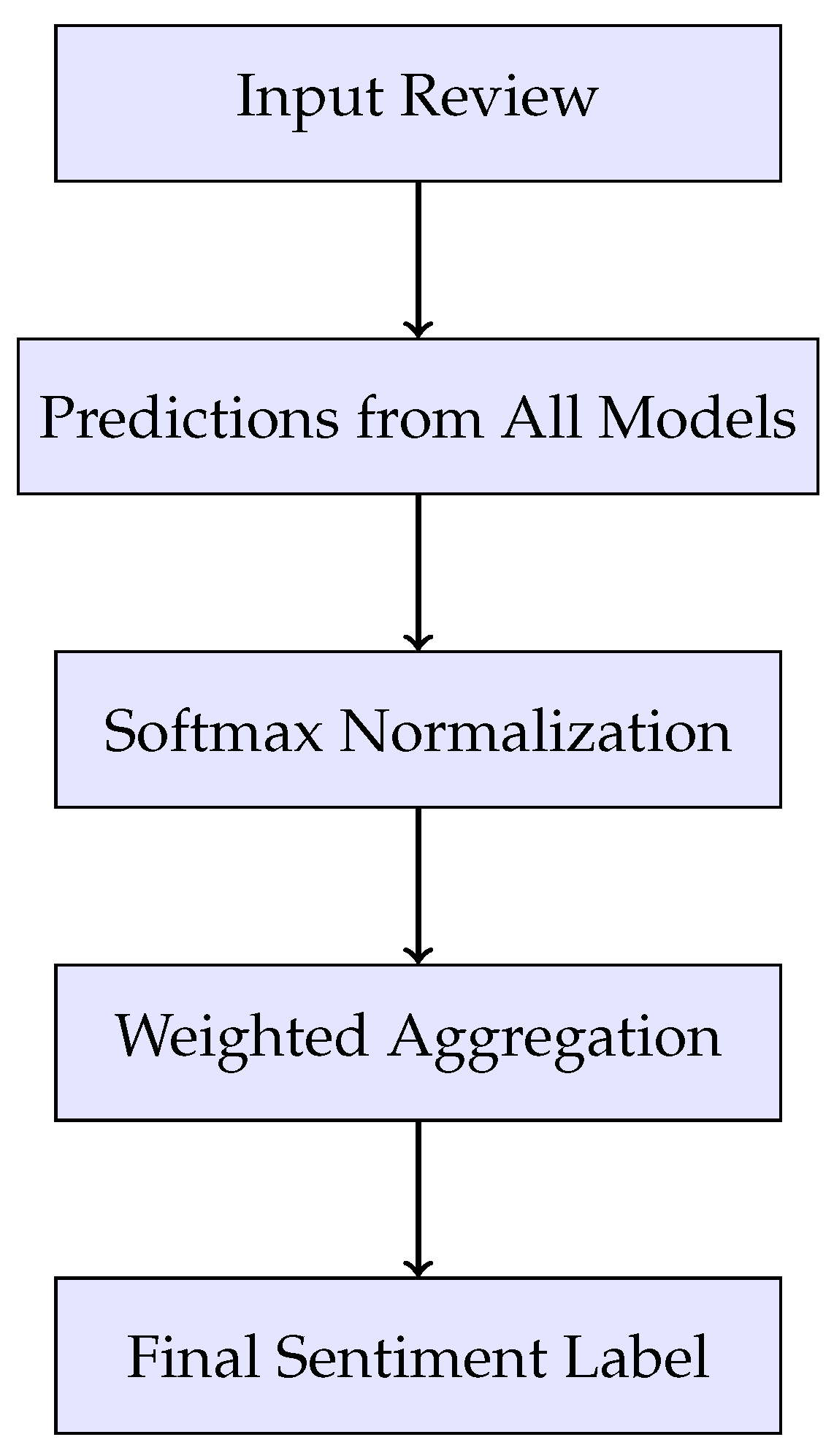
Figure 2.
Accuracy comparison across base models and ensemble (IMDB dataset).
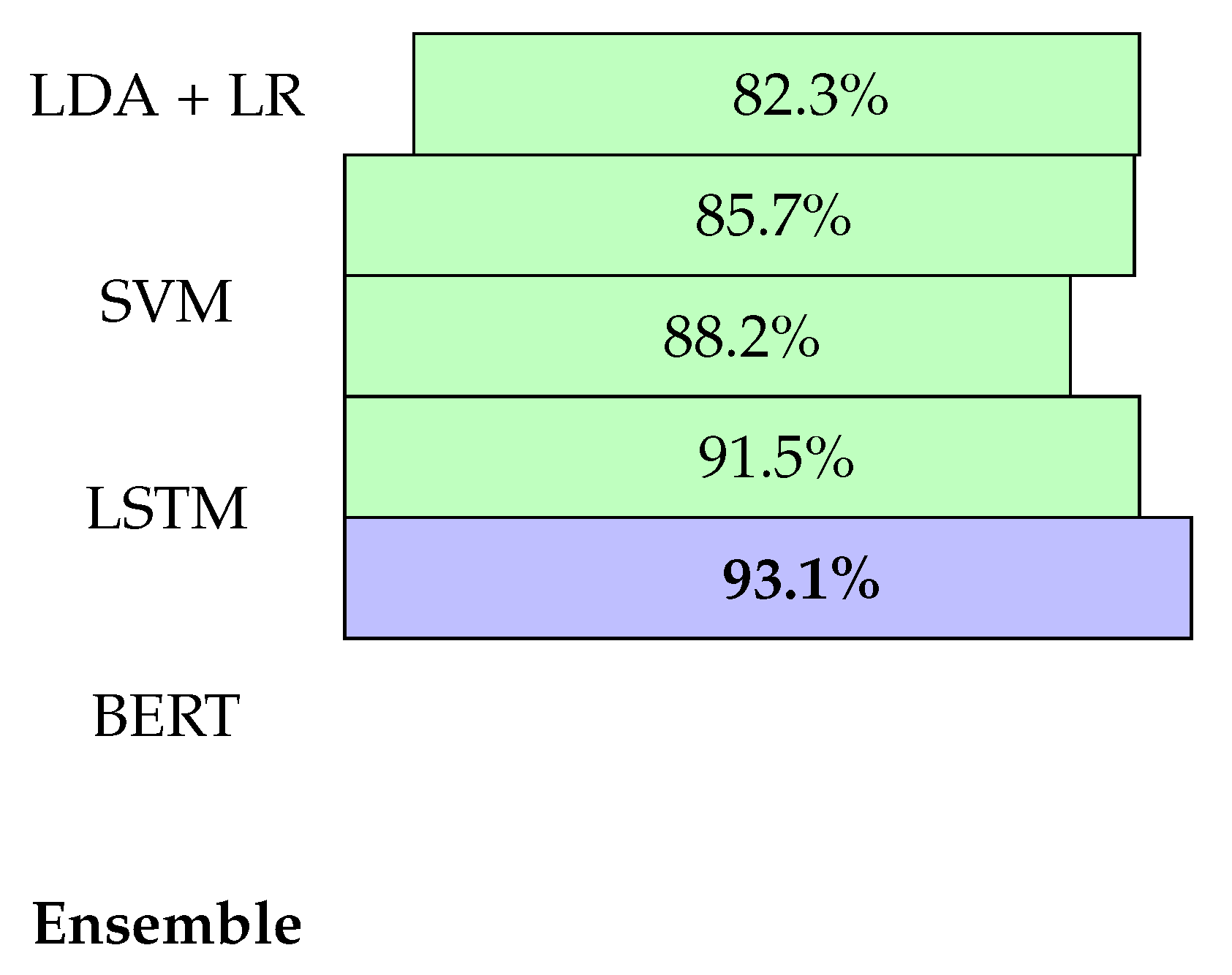

Table 1.
Model Performance on IMDB Dataset.
| Model | Accuracy (%) | F1 (Macro) | AUC |
|---|---|---|---|
| LDA + LR | 82.3 | 0.81 | 0.86 |
| SVM | 85.7 | 0.84 | 0.89 |
| BERT | 91.5 | 0.90 | 0.94 |
| LSTM | 88.2 | 0.86 | 0.91 |
| Ensemble (Ours) | 93.1 | 0.92 | 0.96 |
Disclaimer/Publisher’s Note: The statements, opinions and data contained in all publications are solely those of the individual author(s) and contributor(s) and not of MDPI and/or the editor(s). MDPI and/or the editor(s) disclaim responsibility for any injury to people or property resulting from any ideas, methods, instructions or products referred to in the content. |
© 2025 by the authors. Licensee MDPI, Basel, Switzerland. This article is an open access article distributed under the terms and conditions of the Creative Commons Attribution (CC BY) license (http://creativecommons.org/licenses/by/4.0/).
Copyright: This open access article is published under a Creative Commons CC BY 4.0 license, which permit the free download, distribution, and reuse, provided that the author and preprint are cited in any reuse.


