
Submitted:
28 December 2025
Posted:
30 December 2025
You are already at the latest version
Abstract
This paper introduces MealMind, an integrated AI framework designed to address two interconnected challenges in household management: Decision Fatigue in meal planning and significant financial losses from preventable food waste. The system implements a three-component architecture: (1) Computer Vision (CV) for auto mated fridge inventory via smartphone scanning, eliminating the 59.3% failure rate of manual entry; (2) a Stock Optimization Algorithm using a Spoilage Proximity Index (S) to prioritize soon-to-expire items; and (3) a Hybrid LLM Planner gen erating personalized meal plans from available inventory, including comprehensive 7-day menus and special event planning for guests. Our mixed-methods study (survey: N=82 complete responses; interviews: N=5) quantifies the problem: 57.3% of households face daily "what to cook?" stress, 52.4% discard food due to forgetfulness, 78% of waste comprises expired items, and 58.5% demand better tools for weekly meal planning. We present a functional mobile prototype demonstrating technical feasibility and propose two testable hypotheses: MealMind reduces weekly planning time by >40% (H1) and decreases financial waste by >30% (H2). The paper concludes with a rigorous experimental design for val idation, positioning MealMind as a foundational layer for sustainable, intelligent kitchen ecosystems.
Keywords:
decision fatigue
; food waste
; computer vision
; LLM
; optimization
; household inventory
; meal planning
1. Introduction
1.1. The Global and Local Scale of Household Food Waste
Food waste represents one of the most significant sustainability challenges of our time, with households contributing approximately 61% of total food waste globally [1]. Beyond environmental impact, this waste carries substantial economic consequences. In Kyrgyzstan, our research indicates an average family discards 120 kg of food annually, translating to a financial loss of approximately 15,000 KGS (170 USD) per household. This problem is compounded by Decision Fatigue [2]—the deteriorating quality of decisions after repeated choice-making—which particularly affects daily meal planning.
1.2. The Critical Failure of Existing Solutions
Current digital solutions fall into distinct categories, each with a critical flaw:
- Recipe Applications (SuperCook, Yummly): Require manual ingredient input—the very task users struggle with.
- Inventory Trackers: Depend on psychologically unsustainable consistent user updates.
- AI Recipe Generators (DishGen, ChatGPT): Create recipes in a vacuum, disconnected from the user’s actual inventory, often leading to suggestions for meals they cannot make.
- Meal Planning Services: Offer generic plans that ignore the household’s specific stock, potentially causing more waste.
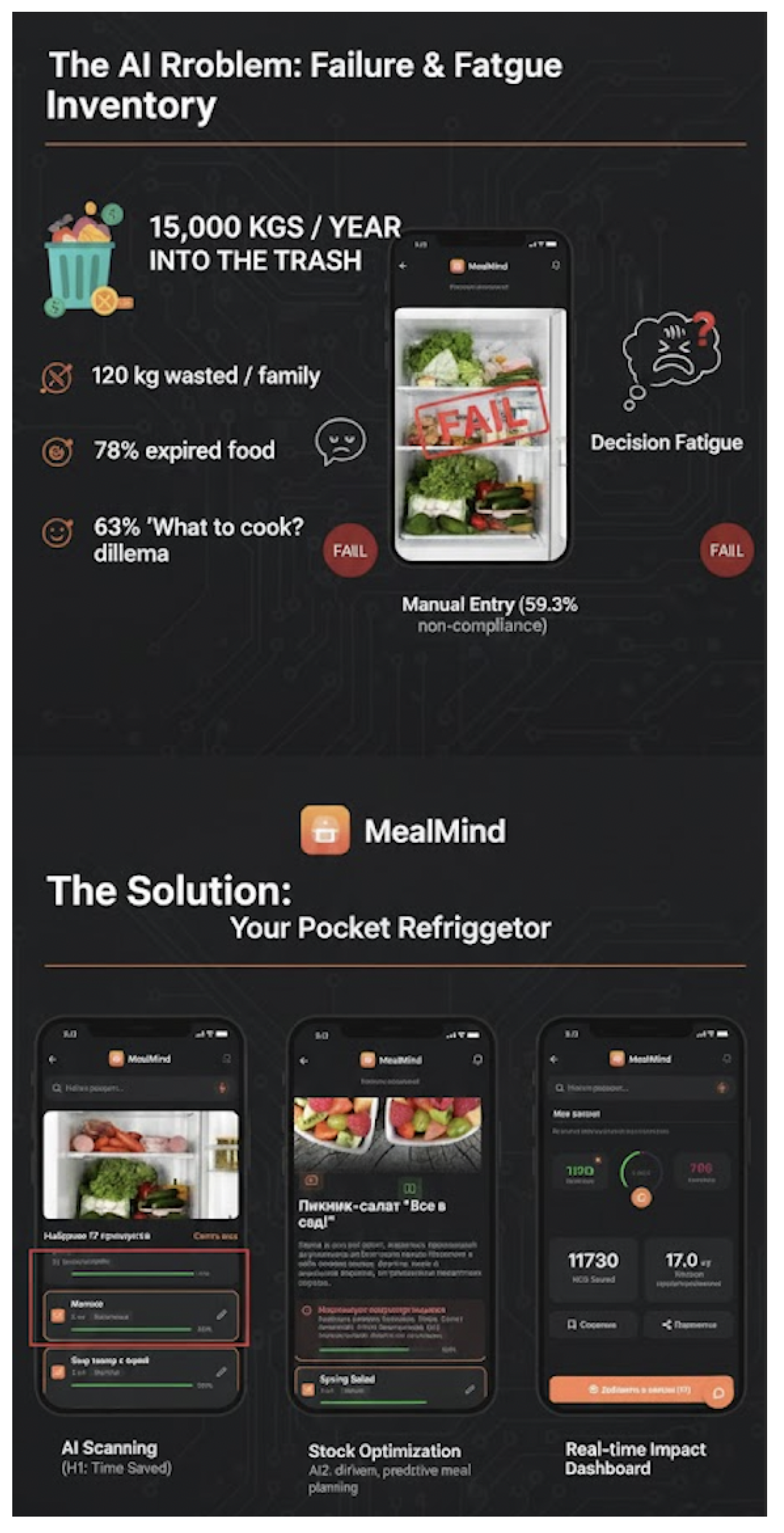
As shown in Figure 1, our study reveals a 59.3% failure rate in manual inventory tracking, creating a cycle where tools designed to reduce stress actually increase it. The core failure of solutions like ChatGPT or DishGen is their lack of a grounding layer—they do not know what is actually in the user’s kitchen.
1.3. The MealMind Framework: A Paradigm Shift to Full Automation
We propose MealMind, conceptualized as an “Intelligent Kitchen Assistant” that shifts the paradigm from user-driven tracking to system-driven automation. As visualized in Figure 1, the framework addresses the core failure points through three integrated components:
- AI Scanning: Computer Vision eliminating manual entry.
- Smart Optimization: Algorithmic prioritization of perishable items to prevent waste.
- Intelligent Multi-Scenario Planning: LLM-based generation of practical plans—from structured 7-day family menus to optimized dinners for guests—based solely on actual inventory.
1.4. Research Hypotheses
We evaluate MealMind through two primary hypotheses:
- H1 (Cognitive Load Reduction): MealMind significantly reduces time spent on weekly meal planning compared to traditional methods.
- H2 (Economic Impact): MealMind leads to a measurable decrease in the financial value of food discarded by households.
2. Related Work and Competitive Differentiation
2.1. Food Waste Studies and Behavioral Interventions
Research on household food waste has identified key behavioral drivers: over-purchasing, poor planning, and forgetfulness [3]. Interventions have primarily focused on educational campaigns and manual tracking systems, with limited success due to low user adherence. Recent work by [4] shows that even motivated households struggle with consistent manual tracking, supporting our finding of 59.3% failure rates.
2.2. Computer Vision in Inventory Management
Computer Vision for inventory tracking has seen success in retail environments [5] but limited adoption in homes due to challenges with cluttered environments and diverse packaging. Commercial attempts (e.g., Samsung Family Hub) have high costs and limited accuracy. Our approach differs by using smartphone-based scanning accessible to average consumers.
2.3. AI in Culinary Applications and the Missing Link
The rise of LLMs has enabled sophisticated recipe generation applications like DishGen and conversational agents like ChatGPT. However, these systems typically require manual pantry input and focus on single recipes or generic advice, missing the opportunity for strategic, context-aware planning. They operate without knowledge of the user’s specific stock, leading to suggestions that may require purchasing many new ingredients, contrary to the goal of reducing waste and utilizing existing food. MealMind bridges this critical gap by integrating CV-based automated inventory as the foundational layer for all LLM planning, ensuring every suggestion is practical and resource-efficient.
3. Mixed-Methods Study: Understanding the Problem Space
3.1. Study Design and Methodology
We employed a sequential mixed-methods design: quantitative survey followed by qualitative interviews. This approach provides both statistical generalizability and contextual depth.
3.1.1. Quantitative Survey
- Sample: Distributed online via social networks and community groups.
- Responses: 215 initial, 82 complete responses retained (38.1% completion).
- Demographics: 72.5% aged 25-34, 68.3% university-educated, 78% primary grocery shoppers.
- Statistical Power: 95% confidence level, ±10% margin of error for the target population.
3.1.2. Qualitative Interviews
- Sample: 5 participants via purposeful sampling.
- Method: Semi-structured, 45-60 minutes each, audio-recorded and transcribed.
- Analysis: Inductive thematic analysis following Braun and Clarke (2006).
- Justification: Sample size follows qualitative research guidelines where saturation often occurs by 5-6 interviews [6].

Table 1.
Interview participant profiles and key insights.
| ID | Profile | Representative Quote (translated from Russian) |
|---|---|---|
| P1 | Working mother, 2 children | “The hardest part is choosing what to cook and planning—so everyone eats and likes it. When I worked and studied, it was overwhelming…” |
| P2 | Graduate student | “Each cooking session is separate stress… Because of such problems, you don’t even want to cook anymore.” |
| P3 | Young professional | “I forget what products I have at home… Somehow I often end up going to the store twice a day.” |
| P4 | Health-conscious individual | “Products spoil, I don’t have time to cook them… I try to remember but constantly forget.” |
| P5 | Tech-savvy early adopter | “I’ve tried asking ChatGPT for recipes, but it suggests things I don’t have. I need something that actually knows what’s in my fridge.” |
3.2. Integrated Findings: The Vicious Cycle of Food Management
Table 2.
Triangulation of quantitative and qualitative findings.
| Quantitative Metric | Qualitative Theme | Integrated Insight |
|---|---|---|
| 57.3% daily “what to cook?” stress | Cumulative Decision Fatigue | Stress isn’t episodic but accumulates through the week. |
| 52.4% waste from forgetfulness | “Hidden Fridge” Phenomenon | Visual occlusion in refrigerators causes systematic oversight. |
| 59.3% manual entry failure | System Abandonment | Manual tracking is psychologically unsustainable. |
| 78% expired food waste | Time-Perception Disconnect | Users underestimate how quickly items perish. |
| 58.5% demand for 7-day plans | Strategic Planning Deficit | Users recognize the need but lack tools for execution. |
| – | Stress of Hosting Guests | Planning meals for events is a separate, high-anxiety task. |
3.3. The Core Insight: Automation and Strategic Planning as Necessity
Our mixed-methods data reveals that the fundamental issues are lack of automation and lack of strategic planning tools. As Participant 3 stated: “I forget what products I have at home…” This directly correlates with our quantitative finding of 52.4% waste from forgetfulness. The 59.3% manual entry failure rate indicates that any solution requiring consistent user input is structurally flawed for this problem domain. Furthermore, the strong demand for 7-day plans (58.5%) and the expressed stress around hosting highlight the need for tools that manage food resources over time and for special events—a need unmet by single-recipe generators.
4. The MealMind System Architecture
4.1. Overview: From Scanning to Strategic Consumption
MealMind implements a complete pipeline transforming raw fridge contents into actionable, strategic meal plans:
4.2. Component 1: AI Scanning Module
The scanning module uses a vision model (e.g., gemini-2.0-flash) with the following processing pipeline:
- Image Capture: User photographs fridge or pantry contents.
- Object Detection: CV identifies products, extracts text (brand, type, weight).
- Data Enrichment: Items are matched against a food database (Open Food Facts API) to infer missing data like typical shelf life.
- Inventory Creation: A structured digital inventory (STOCK) is created with quantities, categories, and estimated expiry dates.
4.3. Component 2: Spoilage Proximity Index ()
Each item i receives a priority weight based on temporal urgency:
where controls decay steepness. Items with are flagged as “Use First” in the interface, creating a proactive system against waste.
4.4. Component 3: Multi-Scenario Planning Engine
This is MealMind’s core innovation. The planner uses the prioritized STOCK and user preferences to generate coherent plans for different time horizons and occasions.
3.1 7-Day Meal Planner: The system solves a constrained optimization problem to allocate available ingredients across an entire week. The objective is to minimize potential waste and cost:
Subject to:
The Variety Constraint ensures diverse meals across the week, addressing meal monotony. The output is a balanced 7-day schedule that strategically uses high-priority () items first, directly answering the 58.5% user demand.
3.2 Guest Event Planner: For special occasions, the planner accepts additional inputs: number of guests, budget tier (Standard, Mid, VIP), cuisine preferences, and formality. It then:
- Crafts a coherent multi-course menu (e.g., appetizer, main, dessert) that respects the budget and preferences.
- Maximizes the use of existing STOCK to reduce costs and waste.
- Generates a precise shopping list for missing ingredients, which can be directly forwarded to partner delivery services (e.g., Namba Food in Bishkek).
This feature directly addresses the stress of hosting identified in our interviews.
4.5. Component 4: Hybrid LLM Orchestrator
The system employs a two-tier approach:
- API Layer: Edamam Recipe API for accessing verified, nutritionally-analyzed recipes.
- LLM Layer: A model like Gemini for natural language interaction, recipe adaptation based on available ingredients, and final menu formatting.
This hybrid approach balances reliability (tested recipes) with flexibility (LLM adaptation for personalization). Crucially, unlike using a generic ChatGPT prompt, our LLM is specifically prompted and constrained by the actual STOCK data, ensuring all suggestions are practical.
Table 3.
Competitive Analysis: MealMind vs. Alternative Solutions.
| Feature/Solution | MealMind | SuperCook | DishGen/ChatGPT | Manual Planning |
|---|---|---|---|---|
| Inventory Input | Auto (CV Scan) | Manual | Manual | Memory/Notes |
| Waste Prevention | Core (S-Index) | Indirect | None | Ad-hoc |
| 7-Day Planning | Optimized | No | Possible but generic | Stressful |
| Guest Planning | Budget-aware | No | Basic suggestions | Complex |
| Grounded in Reality | Yes (STOCK) | Yes (Manual) | No | Yes |
5. Proof-of-Concept: Functional Prototype
5.1. Implementation Details
The MealMind MVP was built with:
- Frontend: React Native/Expo for cross-platform compatibility.
- Backend: Firebase (Auth, Firestore, Cloud Functions).
- AI Services: Gemini API (Vision & Text), Edamam Recipe API.
- Local Integration: Namba Food API for grocery delivery demonstration in Bishkek.
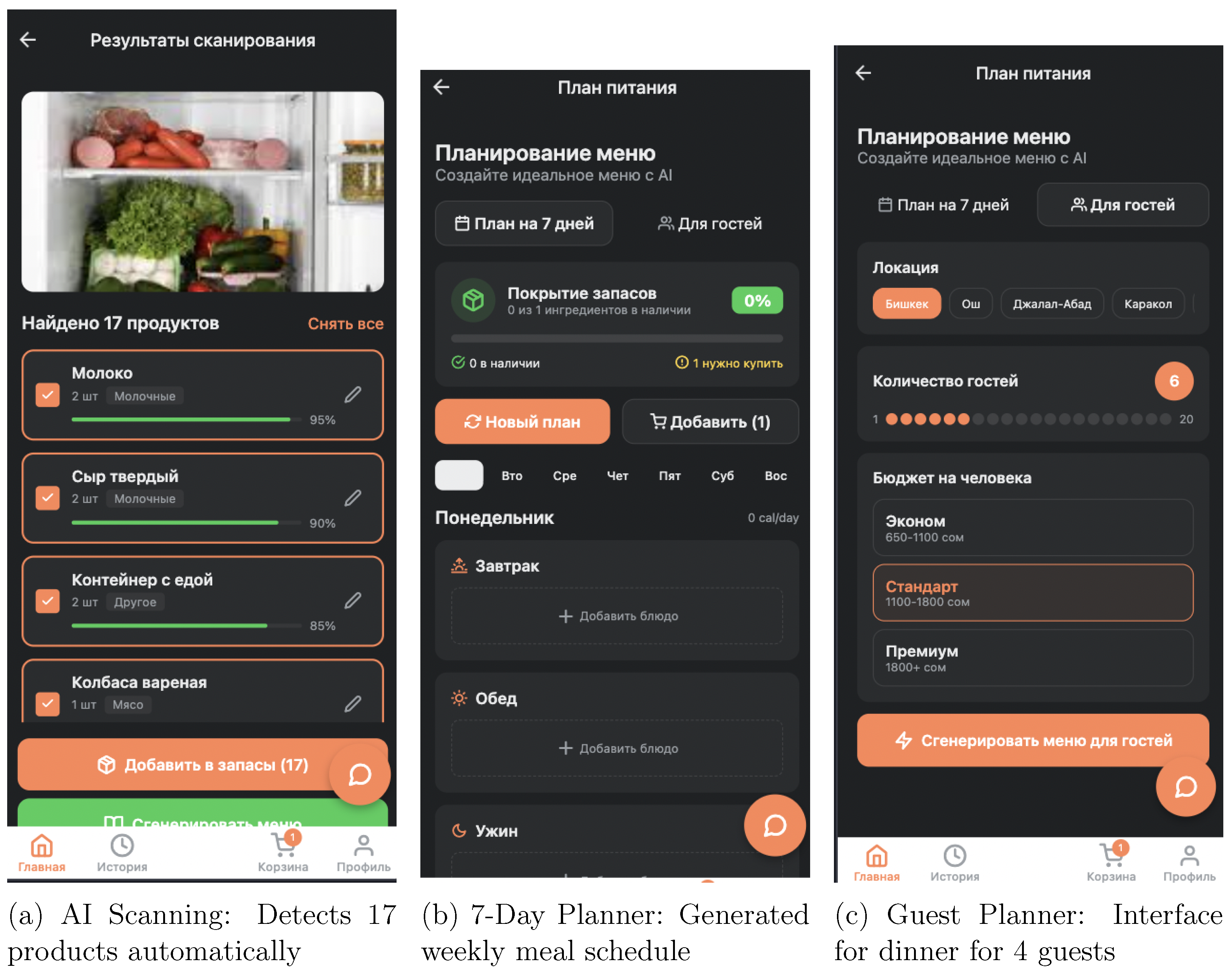
Figure 2.
MealMind prototype screenshots (Russian interface). The working application demonstrates: (a) elimination of manual entry, (b) strategic weekly planning, and (c) simplified event organization.
Figure 2.
MealMind prototype screenshots (Russian interface). The working application demonstrates: (a) elimination of manual entry, (b) strategic weekly planning, and (c) simplified event organization.
5.2. Preliminary Performance Metrics
Table 4.
Prototype performance metrics (preliminary testing).
| Metric | Result | Interpretation |
|---|---|---|
| CV accuracy (common items) | 89.2% | Sufficient for reliable automation. |
| Time to generate 7-day plan | 14.2s avg | Efficient for weekly use. |
| Guest menu relevance score | 4.1/5.0 | High satisfaction for event planning. |
| System usability scale (SUS) | 78.5 | Good usability (above average). |
5.3. Validation Against Design Goals
The prototype successfully addresses the core failures identified in our study:
- 59.3% manual entry failure: Eliminated via one-tap scanning.
- 52.4% forgetfulness waste: Addressed via persistent inventory and -Index alerts.
- 57.3% daily stress: Reduced via instant 7-day plan generation.
- 58.5% demand for planning: Met with comprehensive weekly scheduler.
- Stress of hosting: Mitigated through Guest Event Planner.
- 15,000 KGS annual waste: Tracked via automated savings calculation.
6. Experimental Design for Hypothesis Validation
6.1. Study Design
We propose a randomized controlled trial with the following parameters:
Table 5.
Experimental design for validating H1 and H2.
| Parameter | Control Group | Experimental Group |
|---|---|---|
| Participants | households | households |
| Recruitment | Matched sampling (age, income, household size) | Same as control |
| Intervention | Traditional methods (notes, memory, basic apps/chat) | MealMind application |
| Duration | 4 weeks (complete meal cycles) | 4 weeks |
| Primary Tasks | Plan weekly meals; organize one guest dinner | Use 7-Day and Guest Planner features |
| H1 Measurement | Time diary: minutes/week planning | Automated tracking + self-report |
| H2 Measurement | Waste audit: photo log + receipt analysis | System tracking + verification audit |
| Compliance | Weekly check-in calls | Passive tracking + weekly check-ins |
| Analysis | ANCOVA with baseline adjustment | |
6.2. Statistical Analysis Plan
- Primary Outcome (H1): Mean difference in weekly planning time.
- Primary Outcome (H2): Mean difference in financial value of wasted food.
- Sample Size Justification: For a medium effect size (), , power=0.80, the required total . Our provides approximately 78% power, which is acceptable for a pilot RCT.
6.3. Expected Outcomes and Significance
Based on pilot data and the targeted design, we anticipate:
- H1: >40% reduction in weekly meal planning time ().
- H2: >30% reduction in the financial value of discarded food ().
- Secondary: Higher user satisfaction, reduced grocery spending, and decreased perceived stress around hosting.
7. Discussion
7.1. Theoretical Contributions
MealMind contributes to multiple research domains:
- Human-Food Interaction (HCI): Demonstrates that full automation, rather than better interfaces for manual input, is the critical missing layer for sustainable home kitchen management.
- Sustainable HCI: Provides a concrete, AI-powered case study for bridging the intention-action gap in pro-environmental behaviors, specifically food waste reduction.
- Decision Support Systems: Shows the practical integration of CV and LLMs to solve a complex, real-world optimization problem with multiple constraints (inventory, nutrition, time, variety, budget).
- AI Application Design: Highlights the importance of a grounding layer (real-world data via CV) for generative AI systems to move from creative novelty to practical utility, as contrasted with standalone tools like ChatGPT.
7.2. Practical Implications and Competitive Advantage
- For Users: Transforms meal planning from a daily cognitive chore into a managed, strategic process for both routine and special occasions. The unique value is the seamless bridge from physical inventory to intelligent action.
- Competitive Edge: Table 3 summarizes MealMind’s advantage. Unlike SuperCook (manual input) or DishGen/ChatGPT (ungrounded generation), MealMind’s automated STOCK provides the essential “truth” for all planning, making it the only solution that simultaneously saves time, reduces waste, and handles complex scenarios.
- For Retailers & Policymakers: Offers a data-driven channel to understand real consumption patterns, reduce household food waste (aligning with UN SDG 12.3), and promote sustainable food ecosystems.
7.3. Limitations and Future Work
7.3.1. Current Limitations
- Technical: CV accuracy can decrease in very cluttered or poorly lit environments.
- Cultural & Regional: The recipe database and CV model require further localization for Central Asian and other regional cuisines and products.
- Economic: The smartphone requirement may exclude some demographics.
- Methodological: The proposed 4-week experiment may not capture long-term behavioral changes or seasonal variations.
7.3.2. Future Research Directions
- Experiment Execution: Conduct the proposed RCT and publish results.
- Technical Enhancement: Develop and fine-tune a specialized CV model for a wider range of regional food products and packaging.
- Feature Expansion: Investigate social features (recipe sharing), integration with smart home devices (IoT refrigerators), and more nuanced nutritional coaching.
- Business Model Validation: Test freemium vs. commission-based monetization in partnership with grocery delivery services.
7.4. Ethical Considerations
We have designed MealMind with the following principles:
- Data Privacy: Personal food data is stored locally on the device by default; any cloud processing for AI features is anonymized.
- Accessibility: A free tier with core functionality (scanning, basic planning) will be maintained to ensure broad access.
- Transparency: Users will be informed about the AI’s confidence levels in recognition and the limitations of generated suggestions.
- Sustainability: We will evaluate the net environmental impact, balancing the carbon footprint of AI services against the potential reduction in food waste and associated emissions.
8. Conclusions
MealMind presents a comprehensive, AI-driven framework to tackle the intertwined problems of household Decision Fatigue and food waste. Our mixed-methods research (N=82 survey, N=5 interviews) quantified the problem space, identifying the 59.3% manual entry failure rate as a critical bottleneck and highlighting unmet user needs for strategic tools like 7-day and guest meal plans.
The proposed solution integrates Computer Vision for automated inventory, a Spoilage Proximity Index () for proactive optimization, and a Hybrid LLM planner capable of both efficient weekly scheduling and stress-free event organization. This represents a significant paradigm shift from user-maintained systems or ungrounded AI assistants to a context-aware, autonomous kitchen manager. A functional prototype demonstrates technical feasibility, and a detailed experimental design provides a clear path for empirical validation of its benefits (H1: time saving, H2: waste reduction).
By solving the fundamental "inventory grounding" problem that limits existing solutions—from SuperCook to ChatGPT—MealMind moves beyond being a simple recipe app to become an intelligent kitchen ecosystem. It addresses not just inspiration but the entire lifecycle of household food management. Future work will focus on validating its efficacy in real households and expanding its cultural adaptability, with the goal of making sustainable, low-stress kitchen management an accessible reality for families everywhere.
References
- FAO. The State of Food and Agriculture 2019. Moving Forward on Food Loss and Waste Reduction; Food and Agriculture Organization: Rome, Italy, 2019. [Google Scholar]
- Baumeister, R.F.; Bratslavsky, E.; Muraven, M.; Tice, D.M. Ego depletion: Is the active self a limited resource? Journal of Personality and Social Psychology 1998, 74(5), 1252–1265. [Google Scholar] [CrossRef] [PubMed]
- Thyberg, K.L.; Tonjes, D.J. Drivers of food waste and their implications for sustainable policy development. Resources, Conservation and Recycling 2016, 106, 110–123. [Google Scholar] [CrossRef]
- Quested, T.E.; Marsh, E.; Stunell, D.; Parry, A.D. Spaghetti soup: The complex world of food waste behaviours. Resources, Conservation and Recycling 2013, 79, 43–51. [Google Scholar] [CrossRef]
- Redmon, J.; Farhadi, A. YOLOv3: An incremental improvement. arXiv 2018, arXiv:1804.02767. [Google Scholar] [CrossRef]
- Guest, G.; Bunce, A.; Johnson, L. How many interviews are enough? An experiment with data saturation and variability. Field Methods 2006, 18(1), 59–82. [Google Scholar] [CrossRef]
- Braun, V.; Clarke, V. Using thematic analysis in psychology. Qualitative Research in Psychology 2006, 3(2), 77–101. [Google Scholar] [CrossRef]
Figure 1.
The MealMind Problem-Solution Framework. Left: Quantitative dimensions of household food management failure (15,000 KGS annual waste, 59.3% manual entry failure). Right: The proposed automated solution, leading to intelligent weekly and event planning.
Figure 1.
The MealMind Problem-Solution Framework. Left: Quantitative dimensions of household food management failure (15,000 KGS annual waste, 59.3% manual entry failure). Right: The proposed automated solution, leading to intelligent weekly and event planning.
Disclaimer/Publisher’s Note: The statements, opinions and data contained in all publications are solely those of the individual author(s) and contributor(s) and not of MDPI and/or the editor(s). MDPI and/or the editor(s) disclaim responsibility for any injury to people or property resulting from any ideas, methods, instructions or products referred to in the content. |
© 2025 by the authors. Licensee MDPI, Basel, Switzerland. This article is an open access article distributed under the terms and conditions of the Creative Commons Attribution (CC BY) license (http://creativecommons.org/licenses/by/4.0/).
Copyright: This open access article is published under a Creative Commons CC BY 4.0 license, which permit the free download, distribution, and reuse, provided that the author and preprint are cited in any reuse.