

Submitted:
28 December 2025
Posted:
29 December 2025
You are already at the latest version
Abstract
This study explores the FitzHugh-Nagumo model, a mathematical system used to simulate the activity of neurons. We apply the Adomian Decomposition Method (ADM) to generate approximate solutions using polynomial series. While these formula-based approximations are highly accurate for capturing short-term changes, the analysis reveals a critical limitation: they eventually fail over longer timeframes. This is because the neuron model is designed to produce stable, repeating cycles (oscillations), whereas polynomial approximations naturally grow to infinity rather than looping back. Consequently, this analytical method cannot accurately reproduce the neuron's long-term, rhythmic behavior. To accurately capture the long-term dynamics and spiking behavior of the neuron, numerical integration approaches are the necessary and most reliable option.
Keywords:
Adomian Decomposition Method (ADM)
; Fitzhugh-Nagumo model
; analytical solutions
; approximations
System of FitzHugh-Nagumo Model (Xia et al. 2025):
The FitzHugh-Nagumo (FHN) model is proposed by Richard FitzHugh in 1961 which is further refined by Jin-ichi Nagumo. It is a mathematical model that describes the interaction between a membrane potential and a recovery variable.
where
The membrane potential
The recovery variable
: External stimulus current applied to the neuron.
: A small constant that separates the timescale where.
System parameters governing the dynamical behavior.
Let the initial conditions be
Let us introduce Adomian Decomposition Method (ADM) to solve the system (1a, b). Let’s define the linear operator and inverse linear operator such that
Now, applying linear operator in Eqs. (1a, b), we have
Then applying inverse linear operator of both sides of (2a, b), we get
This implies
Let the solution of and are
Also, assume that
Substitute all these values in Eqs. (3a, b), we get
Let us match terms from both sides, we get
Zeroth Term (n = 0):
For
Also, from Eq. (4b), we have (Dehghan et al. 2010):
It gives
Now, we will calculate the components:
Set n = 0 in (7a, b), we get
Applying the definition of inverse operator, we get
Substituting the values of, we get
Again, set n = 1 in (7a, b), we get
Applying the definition of inverse operator, we get
Now, from Eqs. (10a, b), we get
where
Substituting the values of, we get
Hence the approximate analytical solutions are
Although the Adomian Decomposition Method (ADM) yields explicit approximate analytical expressions for the FitzHugh-Nagumo system, its utility is fundamentally constrained by the mathematical nature of polynomial approximations. While ADM exhibits high accuracy in the short-term regime—effectively capturing the initial transient dynamics and local curvature similar to a Taylor expansion—it suffers from inevitable divergence over longer time horizons. This limitation arises because the FitzHugh-Nagumo model is a dissipative system characterized by a stable limit cycle (sustained oscillations), a behavior that cannot be faithfully represented by a finite polynomial which tends toward infinity.
Let us consider the system (1a, b),. Also, Also, consider the method “odeint” from the scipy.integrate library. Note, “odeint” is a Python wrapper for the LSODA solver. LSODA stands for Livermore Solver for Ordinary Differential equations with Automatic method switching. Using this, we get the following solutions:
Figure 1.
Variation of u, v for
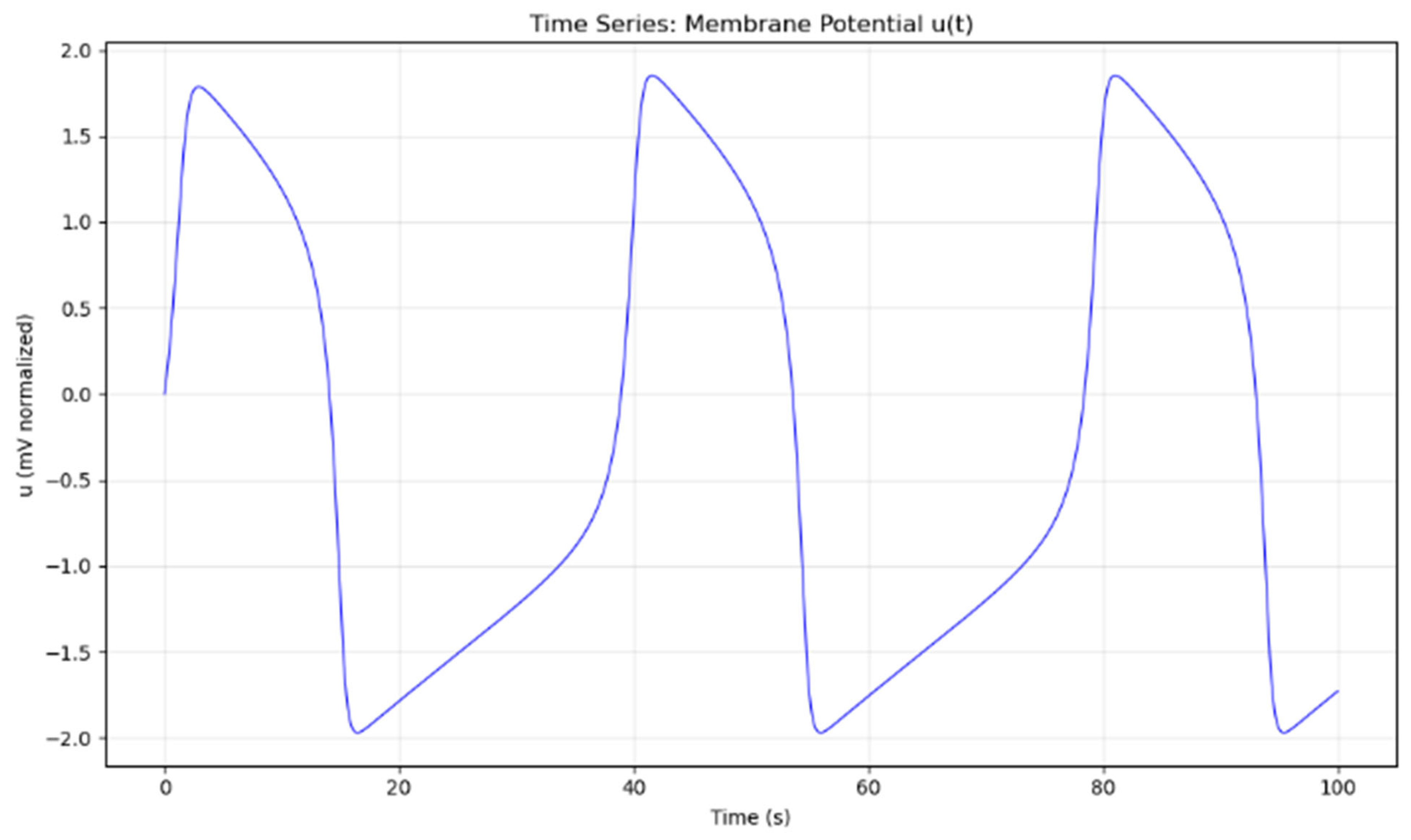
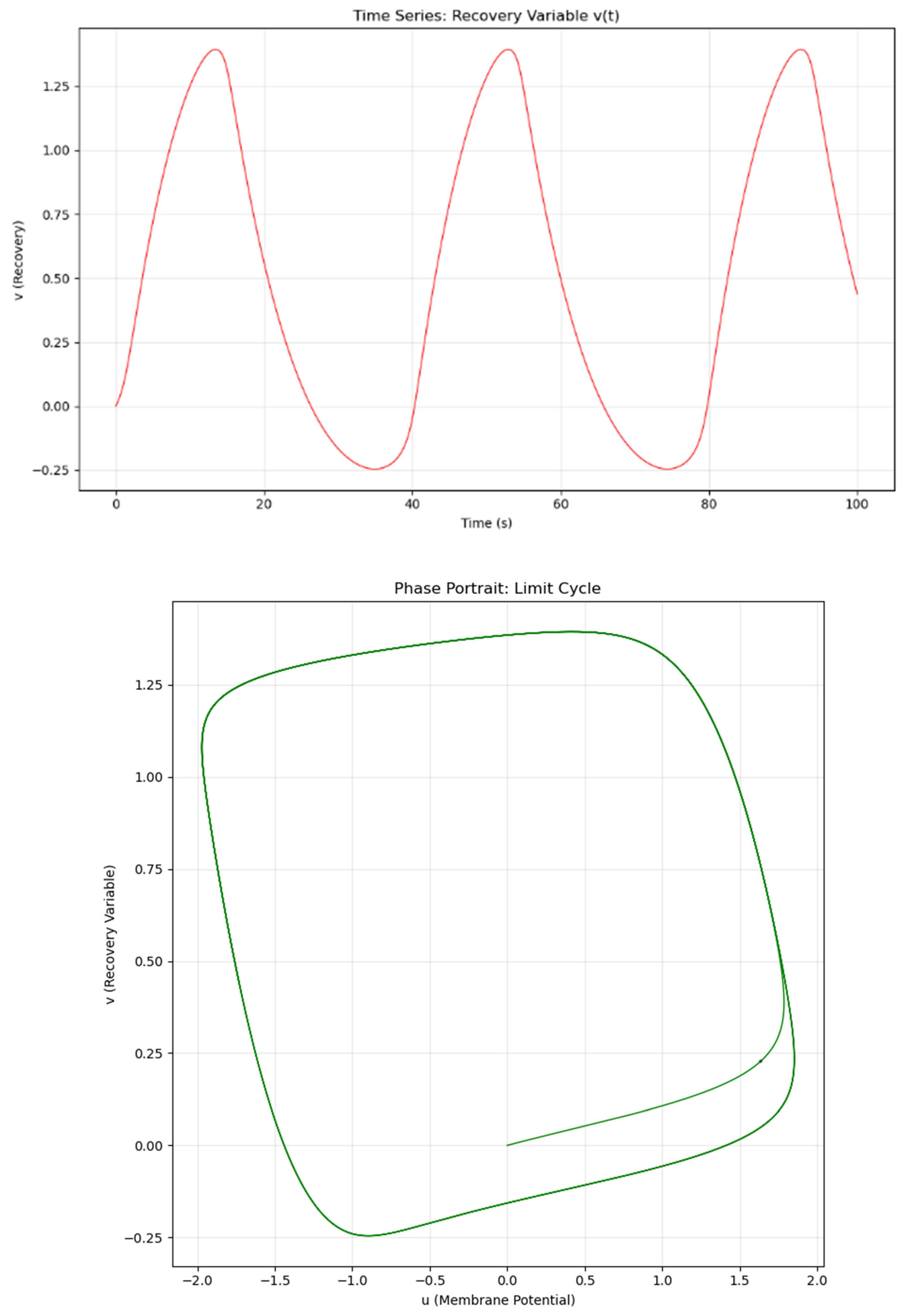
Figure 2.
Variation of u, v for
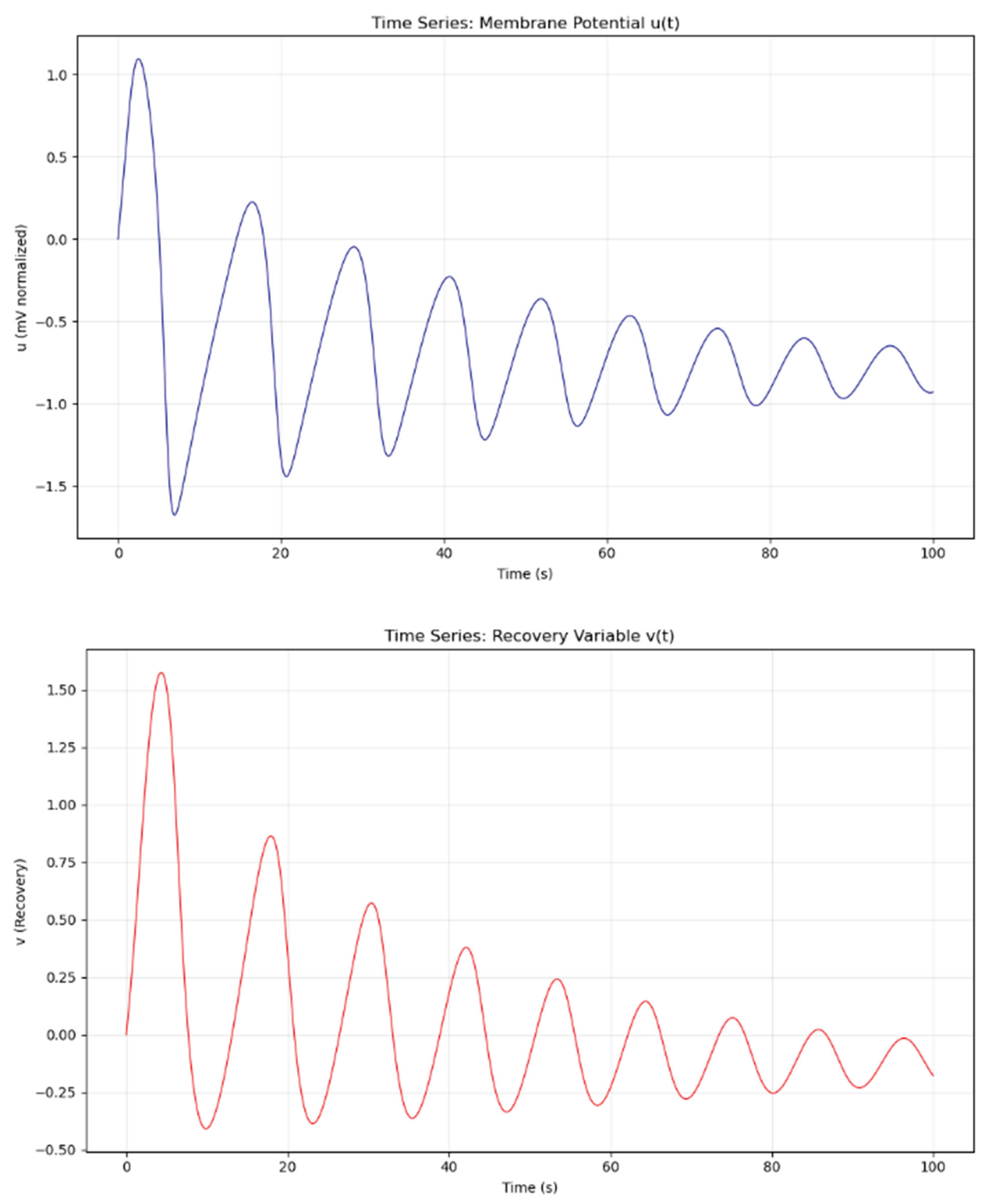
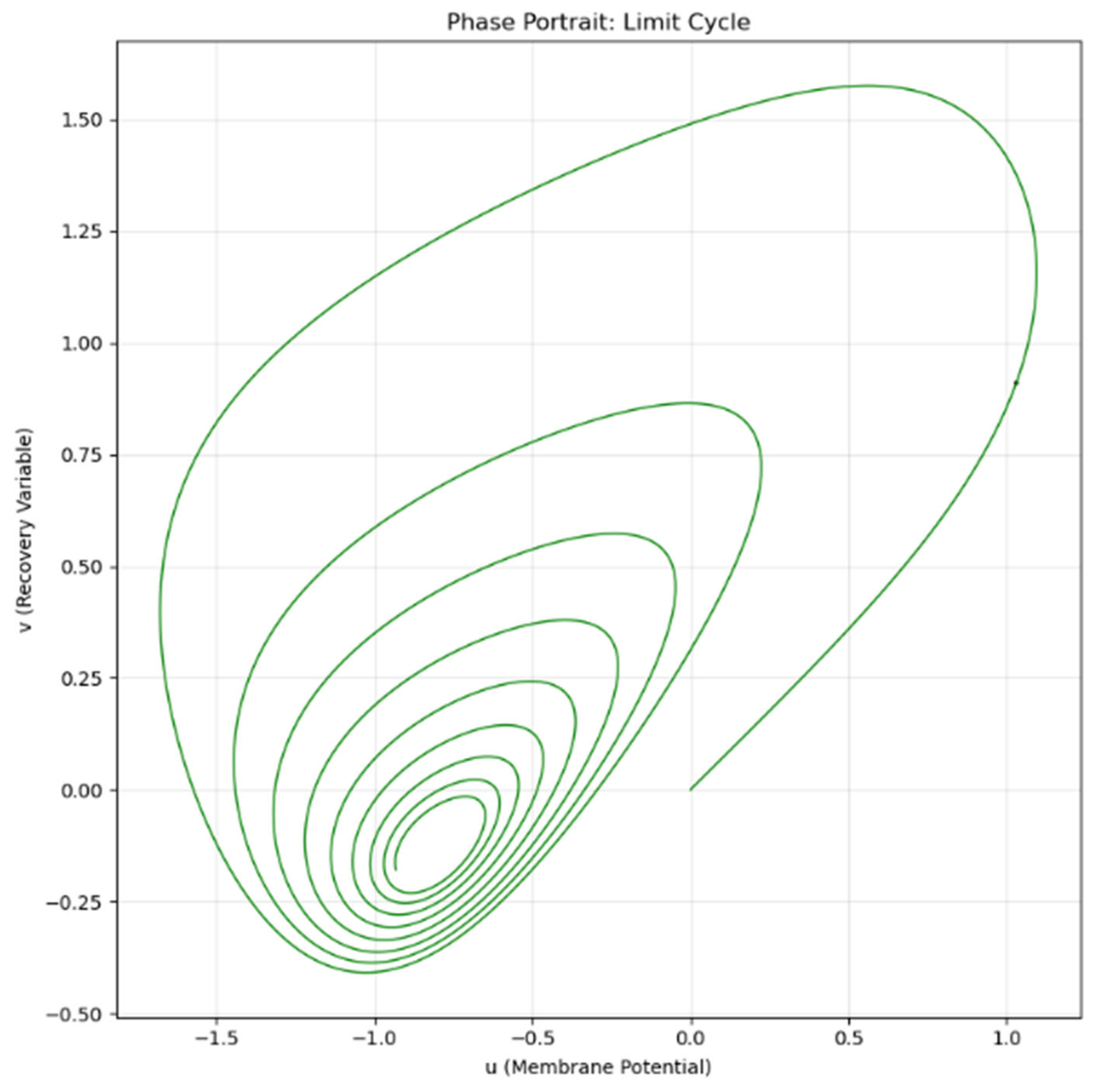
In conclusion, the FitzHugh-Nagumo equations in this study exhibit a stable limit cycle characterized by sustained periodic oscillations. Semi-analytical series methods (such as ADM, HPM, or VIM) rely on polynomial approximations, which inevitably diverge over long time horizons and cannot faithfully reproduce this periodic behavior. Consequently, it is infeasible to obtain a global exact analytical solution for this problem. To accurately capture the long-term dynamics and spiking behavior of the neuron, numerical integration approaches are the necessary and most reliable option.
References
- Dehghan, M.; Heris, J. M.; Saadatmandi, A. Application of semi-analytic methods for the Fitzhugh-Nagumo equation, which models the transmission of nerve impulses. Mathematical Methods in the Applied Sciences 2010, 33(11), 1384–1398. [Google Scholar] [CrossRef]
- Xia, Z.; Huang, X.; Gu, Y.; Saha, S. NeuroPhysNet: A FitzHugh-Nagumo-based physics-informed neural network framework for electroencephalograph (EEG) analysis and motor imagery classification. arXiv. 2025. Available online: https://arxiv.org/abs/2506.13222.
Disclaimer/Publisher’s Note: The statements, opinions and data contained in all publications are solely those of the individual author(s) and contributor(s) and not of MDPI and/or the editor(s). MDPI and/or the editor(s) disclaim responsibility for any injury to people or property resulting from any ideas, methods, instructions or products referred to in the content. |
© 2025 by the authors. Licensee MDPI, Basel, Switzerland. This article is an open access article distributed under the terms and conditions of the Creative Commons Attribution (CC BY) license (http://creativecommons.org/licenses/by/4.0/).
Copyright: This open access article is published under a Creative Commons CC BY 4.0 license, which permit the free download, distribution, and reuse, provided that the author and preprint are cited in any reuse.


