

Submitted:
23 December 2025
Posted:
24 December 2025
You are already at the latest version
Abstract
Since 2019, Spain has experienced one of the largest minimum-wage increases among developed economies, providing a valuable natural experiment to evaluate the effects of this policy. This article aims to conduct a systematic review using the PRISMA 2020 methodology to compile all available evidence from the Spanish case —including hard-to-access studies not published in academic journals— and to critically discuss the methodologies employed and the results obtained. The results reveal an increase in the lowest wages and less wage inequality, without substantial adverse effects on employment.
Keywords:
minimum wage
; Spain
; empirical analysis
; systematic review
; PRISMA methodology
; employment
; empirical evidence
1. Introduction
In recent decades, interest in the minimum wage (MW) has resurged worldwide. This renewed attention is largely explained by rising inequality in developed countries and the emergence of the so-called ‘working poor’ phenomenon. It is also linked to the weakening of unions and other institutions, as well as to the growing concentration of corporate power that has imposed increasingly unfavorable wages and working conditions in a globally dominant neoliberal context [1]. The evident ineffectiveness and shortcomings of so-called ‘competitive markets’ have led governments and other public institutions to intervene in order to guarantee workers’ rights and to mitigate inequality.
Regarding the problem of inequality, the most recent studies emphasize predistribution [2], in addition to redistribution when addressing the issue. Piketty suggests that policy discussions on inequality should focus on policies that affect pre-tax inequality, rather than focusing exclusively on tax redistribution [3]. The MW would be such a measure. To this end, the guarantee of the right to receive a fair minimum wage that ensures a decent life has been strengthened. In fact, corresponding legislation has been implemented or updated all over the world. In Europe, most countries have significantly increased their MW —this is the case in the United Kingdom, Germany, and many Eastern countries— within the framework of the new European Union legislation under its Social Pillar. Empirical studies on this measure have not found substantial adverse effects on employment, but they have found a significant effect on reducing income inequality and poverty. Will the same happen in Spain, a country that has traditionally had high unemployment in the very sectors most affected by the MW?
Spain, within the framework of European Union guidelines, has also entered this process of increasing the MW, especially since 2019, with a 22.3% rise that year that has continued in subsequent years. Since the announcement of this increase, some think tanks, economic institutions, and political parties rushed to warn about very significant effects on employment, despite the large number of empirical studies in other cases showing no impact or only a very minor impact. This, in turn, prompted a surge in studies examining the impact of these increases, particularly on employment. Yet, according to empirical research based on real data, the reality appears to have been quite different. Nevertheless, to settle this debate definitively, it is worth noting that no article has yet synthesized all these studies through a systematic review that summarizes and critically analyzes the available evidence, as has been done in countries such as Germany or the United Kingdom.
The present article aims to fill this gap. With the dual purpose of providing insight and fostering further research in this area, it is particularly relevant to compile these studies and highlight both their findings and limitations to guide future work. This review compiles and evaluates the empirical evidence on the effects of changes in the MW in Spain, with special attention to the 2019 increase. Doing so makes it possible to establish the foundations of what has been learned so far and to identify what remains to be explored. The central question is therefore: What does the empirical evidence suggest about the effects of minimum wage changes on employment, poverty, inequality, and other variables in the Spanish case?
To address this question, the PRISMA methodology was employed. This approach enables a systematic review of the scientific evidence in a comprehensive, explicit, and transparent manner, thereby minimizing, or at least reducing, bias. The methodology, widely used in other disciplines, has gained increasing application in economics (see, for example, [4,5]. Specifically, a search was conducted for all empirical studies analyzing the MW in Spain and its effects, covering more than 160 databases in addition to alternative sources such as cascade searches. An initial pool of 249 studies was identified. After the screening and selection process, the final sample consisted of 34 articles (14 of which examined the 2019 increase). The vast majority of these studies focused on employment outcomes. Overall, their results provide clear evidence of the MW’s positive effect on reducing inequality and poverty —the very objective of the policy— without producing substantial adverse effects on employment. This body of evidence helps to put an end to the controversy that has surrounded the MW increase in certain social and economic circles.
As a scientific contribution, this work offers a critical summary of all the evidence on the Spanish case, especially the methodologies used and the results obtained. The discussion of methodologies may be relevant because it delves into what works and what does not in practice in this type of study, which may be useful for other analyses. In any case, it is clear that the results are affected by changes in methodology, but only to a very limited extent, provided that the methods are applied rigorously and their limitations are considered. The results of the Spanish case corroborate what is already reflected in the international literature, i.e. raising the minimum wage —at least up to a certain level (60% of the average net wage of contract workers)— is a sound policy for reducing poverty and income inequality without affecting employment. This conclusion can be drawn after reviewing all the studies on the Spanish case, which has often been considered underexplored, although it is less so when taking into account documents not published in scientific journals —works that are difficult for the international scientific community to access.
However, further progress is needed in the analysis of other possible effects or channels through which companies have adjusted to this cost increase. Studies are still needed on the decision-making strategies of employers and employees in the face of a MW increase, as well as on the effects on macroeconomic variables beyond employment, such as productivity, inflation, and economic growth. This will allow us to contribute to a new theoretical understanding of the topic, which at present is limited to scattered and disjointed elements.
Evolution of the MW in Spain. Institutional aspects
The first regulation establishing a generalized interprofessional minimum wage in Spain was Decree 55/1963 of 17 January. It introduced a daily or monthly wage floor applicable to all sectors, occupational categories, and age groups. The Spanish Constitution of 1978, which reinitiated the democratic period, enshrined in Article 35 the right of every person to receive remuneration for productive work sufficient to meet their own needs and those of their family, although it made no explicit reference to the MW. The Workers’ Statute, approved in March 1980, became the basic law governing labor relations in Spain. It established and defined the main characteristics of the interprofessional MW and formalized the procedure for setting it annually by decree, after consultation with the social partners. In the same year, Spain acceded to the European Social Charter (ESC), which entered into force on 5 June 1980; much of its content was already reflected in the Constitution.
The evolution of the MW in Spain can be divided into three stages, marked by key milestones reflecting different contexts, policies, and events. The first milestone came in 1997 with the equalization of the MW by age. Initially, the MW was established in three age brackets with differentiated amounts for workers aged 16, 17, and 18 or over. In 1990, these became two groups (16–17 years old and 18 and over), and finally, Royal Decree 2015/1997 of 26 December established a general MW. Since then, the Interprofessional Minimum Wage has applied uniformly to all workers, regardless of age, sector, type of working day or contract, or territory. During this first stage, successive governments’ primary concern was inflation, and wage moderation was used as a tool to contain it.
A second stage began in 2004, when a significant policy shift occurred. Until then, the MW had remained at very low levels and functioned almost exclusively as a reference for calculating social benefits rather than as an effective wage floor for employed individuals. In 2004, however, its role as a tool for inflation control was abandoned, and attention turned to compliance with the European Social Charter (setting the MW at 60% of the average wage). The government announced a target of €800 by 2012, representing a 28% increase. To achieve this, the MW was initially raised by more than the rate of inflation. To mitigate the fiscal burden, the MW was no longer used as the reference for social benefits, and the Public Indicator of Multiple Effect Income (IPREM, for its acronym in Spanish) was created. From that point onward, the IPREM became the benchmark for social assistance in Spain, clearly decoupling it from the MW [5].
This upward trend was interrupted by the Great Recession of 2008 and did not resume until 2017, when efforts were made to recover some of the purchasing power lost due both to the 2008 crisis and to the 2012 labor reform. In any case, the MW remained relatively low during this period (see Figure 1 and Figure 2), and its overall impact on the working population was therefore limited.
Finally, in 2019 the MW was raised by 22.3% - Royal Decree 1462/2018 (of December 21) established the minimum wage at €900 per month in 14 payments (€12,600 per year), effective January 1, 2019, for full-time workers, an increase of 22.3% (21.3% in real terms)- marking the beginning of a significant shift in Spain’s minimum wage policy. With this increase, the Spanish government renewed its commitment to the target established by the European Social Charter: 60% of the average net wage. The Advisory Commission for the Analysis of the Minimum Wage (CAASMI, for its acronym in Spanish) was created in 2021 to establish the process for achieving this goal within a short period of time. This Commission has issued three reports so far (the most recent in January 2025), which have focused primarily on establishing the concepts involved, the method of calculation, and summarizing some studies on the effects of the measure. In fact, today, 2025, this goal is considered to have been achieved, so CAASMI's work consists of advising on determining how much the minimum wage should be increased annually to maintain this ratio, far from the level it represents in other European countries. The upward trend has continued, although the 2020 and 2022 crises interrupted progress in real terms and in relation to both the average and the median wage. This third stage is especially relevant, not only because of the magnitude of the increase but also because its incidence rose substantially —from 1.2% of workers in 2016 to more than 6% in 2019, and it is projected to reach around 10% by 2025. The data differs depending on the source used: Labor Force Survey or Continuous Sample of Working Lives. For example, for 2019, the Labor Force Survey estimates it at 7.6% and the Continuous Sample of Working Lives at 6.2% for full-time workers who work 30 days a month.
As a result of this policy shift, Spain’s recent trajectory has become similar to that of other EU countries, given that the goal of reaching 60% of the average wage is a European objective enshrined in the Social Charter and its implementing Directive.
Section 3 reports the results of applying the PRISMA methodology, compiling and analyzing all available studies for Spain, with special attention to those addressing minimum wage increases since 2019 (Appendix A offers a detailed description of the methodology). Section 4 presents a critical discussion of the objectives, methodologies, and findings of these studies and we conclude with the main results.
2. Materials and Methods
As noted in the introduction, the PRISMA methodology was applied to identify all studies analyzing empirical evidence on the MW in Spain. This approach ensures a systematic, explicit, and transparent collection process, minimizing bias and ensuring that the process can be independently verified. The detailed procedure and results are presented in Appendix A.
All empirical studies relevant to the research question were considered, including those published in peer-reviewed international journals indexed for scientific quality, as well as unpublished or institutionally published works not subject to peer review, that is, what is commonly referred to as gray literature. The latter required closer scrutiny to verify both their quality and their relevance to the research objectives. Theoretical, exploratory, declarative, or opinion-based works were excluded.
Specifically, a search was conducted for all empirical works analyzing the MW in Spain and its effects across 160 databases (including the major repositories) available through the Columbus University resource, as well as through cascade searches. This process yielded a large number of articles, from which an initial selection of 249 was made. Following the full screening and eligibility assessment, 34 articles were retained, 14 of which examined the 2019 increase. Although the 2019 event created a unique opportunity for experimental or quasi-experimental studies, the first articles published in scientific journals on the effects of this increase appeared only in 2024 [5,6,7]. For this reason, technical studies employing more robust methodologies beyond simple descriptive analysis were also considered.
3. Results
The identified studies can broadly be grouped into stages that coincide with significant changes in the MW. The first stage (up to 1999) reflects the equalization of the MW across age groups in the 1990s, which resulted in a sharp increase for adolescents (aged 16–19). The second stage (2004–2018) corresponds to the policy shift toward meeting the objectives of the European Social Charter, a process interrupted by the Great Recession of 2008 and subsequent austerity measures, and only tentatively resumed in 2017. The third stage relates to the sharp and sustained increase in the MW beginning in 2019. It should be noted that this classification refers to the period analyzed by each study, not to the year of publication. The works reviewed below are presented according to these stages. In Appendix B, a brief summary of each of these works is presented. For each, the following outline was applied: objec-tives and scope of study, methodology, and results, with some critical assessment which will be expanded on in the following section.
3.1. First Stage (Until 1999)
In this first stage, the MW had little impact on real wages because of its low level, except for the cohorts affected by age equalization between 1990 and 1998. The studies identified from this period focus precisely on that reform, examining whether it influenced the employment of adolescents, given that equalization represented a considerable real increase for these workers. Most of these works explicitly or implicitly aimed to identify adverse effects on younger workers, in line with the predictions of elementary neoclassical theory [8]. In total, 11 studies were selected (see Table 1). The majority were published in national or regional journals, with only one appearing internationally [9]. Most estimated traditional employment equations in which the MW index was the explanatory variable, complemented with additional controls reflecting seasonal, cyclical, and other effects. They generally relied on time series correlating employment (or unemployment) rates with MW trends, typically expressed through its relationship with the average wage (Kaitz index), and estimated via ordinary or generalized least squares (OLS or GLS). In short, they sought to estimate the elasticity of a hypothetical labor demand curve. Only three adopted a causal methodology [9,10,11]. The results, as will be shown later, are not particularly significant.
3.2. Second Stage (2004–2018)
A new phase began in 2004 with a shift in MW policy. Substantial increases took place in two specific periods: 2004–2008 and 2017–2018. Research in this stage was stimulated by the policy shift and again questioned the employment effects of MW increases. The studies analyzed the empirical evidence of real increases beginning in 2004 and those of 2017–2018. Many highlighted the need to assess the impact of these sharp rises. Between 2003 and 2009, the cumulative nominal increase in the MW was 38.3%, well above both average wage growth and the consumer price index [12]. Nevertheless, by the end of this period of so-called extraordinary increases, the MW in real terms merely returned to its 1980 level, and the Kaitz index remained below that benchmark (see Figure 1 and Figure 2).
Nine studies were identified for this period (see Table 2). Most focused on employment effects, and two specifically examined whether the increases disproportionately harmed young workers during the 2008 crisis. While these studies initially aimed to test neoclassical predictions, the authors were surprised to find such effects largely absent and sought alternative explanations, including the role of the favorable economic cycle. Following the international trend, some authors began attributing these discrepancies to monopsony conditions in labor markets. Methodologies became more varied than in the first stage: although most works still relied on aggregate time series regression, two studies from the Bank of Spain employed a quasi-experimental design using microdata from the Continuous Sample of Working Lives (MCVL, for its acronym in Spanish) [13] (the first version of this article was published in a Bank of Spain working paper in 2012 [14]) [15]. Only one article focused on the impact of MW increases on improving incomes for low-wage workers 17 [16].
3.3. Third Stage (Since 2019)
2019 marked an unprecedented milestone, with a 22.3% rise in the MW (21.3% in real terms) in a single year, followed by further increases. This abrupt and decisive policy change provides an excellent natural experiment for assessing the effects of a large MW increase on a growing share of workers. Initially, it generated mainly technical studies commissioned by institutions; more recently, it has also produced peer-reviewed academic research. Many of these works were motivated by concerns that such a sharp rise would cause a significant negative effect on employment.
These forecasts dominated discourse in several economic organizations and institutions, despite international evidence pointing to weak or insignificant effects. Notably, [15] for the Bank of Spain, as well as the Independent Authority for Fiscal Responsibility (AIReF, for its acronym in Spanish), projected major impacts. The Bank of Spain extrapolated from 2017 estimates and —despite acknowledging the limitations of the time period— forecast between 125,000 and 140,000 job losses. Later studies from the same institution [17] showed these estimates to be exaggerated. AIReF’s October 2018 report, prepared for the European Commission, projected between 24,000 and 40,000 job losses and considered other effects, such as inflation, exports, and GDP. A subsequent 2019 document, based on first-quarter data, found no impact on employment, though it raised the possibility of adjustments in hours worked rather than in jobs. A 2020 note from AIReF attempted to refine its earlier estimates but again used time-series correlation, yielding projected losses of 19,000–33,000 jobs. BBVA Research, for its part, provides a forecast with data prior to the increase, estimating that between 75,000 and 195,000 fewer jobs could be created in the two-year period 2019-2020 than in the absence of the increase in the MW that took place in 2019. They do not clarify where they deduce this forecast from, but it is possible to assume that it comes from an extrapolation of the results of the study by Archondo, García and Ulloa [18].
Simulation exercises, excluded from the present review for not being empirical, also analyzed distributional effects on income inequality and poverty. For instance, the La Caixa Foundation commissioned a study ([19] using EUROMOD simulations, which indicated highly positive effects on reducing inequality and poverty in 2019 and 2020: an average gain of about €80 per month for MW earners (roughly 10%, or 1.6 million workers) and more than 250,000 people lifted out of poverty. Grünberger et al. [20] conducted a similar EUROMOD-based analysis for 21 countries in the EU, also supporting the EU’s MFI directive. For Spain, they projected an 18% reduction in wage inequality and a 20% reduction in in-work poverty if the MW were set at 60% of the median wage. Subsequent studies using real data confirmed these findings, albeit with slightly smaller effects [5,21].
Other early technical works based on real but preliminary data also emerged. For example, a report by the Comisiones Obreras [22] trade union research center (2019) analyzed the January 2019 increase using first-quarter data from the Labor Force Survey in Spain, arguing that the results contradicted the Bank of Spain’s forecasts. More recently, the Foundation for Applied Economic Studies (FEDEA, for its acronym in Spanish) published a working paper [23] estimating the effects of the 2019 increase on firm-level employment dynamics using Firm-Worker Panel data (PET, Administrative database that matches information on companies and workers, prepared by the Spanish Social Security). They identified an upper bound for the aggregate effect: a slowdown in average employment growth of between 0.5 and 1.0 percentage points.
Despite the unique opportunity this event offered for experimental or quasi-experimental research, peer-reviewed academic studies appeared only in 2024 [5,6,7] For this reason, technical studies applying more rigorous methodologies beyond descriptive analysis were also considered in this review. In total, 14 works were selected (see Table 3). While employment effects remained the predominant focus (nine studies, some combined with other outcomes), four articles analyzed income inequality and poverty. More recently, other adjustment channels have been examined, including productivity [24], inflation, economic growth, firm bankruptcy [25], and institutional aspects such as the political drivers of MW increases [26] (this article has not been included in this selection because it uses an exploratory methodology for several countries and only deals with Spain in a tangential manner. However, it is mentioned here because it addresses a novel and interesting topic). Almost all studies concentrated on the 2019 reform, with only a few extending analysis to subsequent years (see Table 3).
The most frequently used data sources include the Continuous Sample of Working Lives for employment studies and the European Union Survey on Income and Living Conditions (EU-SILC) for inequality and poverty analyses of the corresponding microdata. These studies typically employed causal methodologies, often following preliminary descriptive analyses to contextualize results. The difference-in-differences approach predominated, with variations in dependent variables and the definition of treatment and control groups.
In short, the vast majority of studies have focused on analyzing the effect of minimum wage increases on employment, with only a few addressing inequality and poverty. The findings are sufficiently robust to demonstrate that the increases—especially since 2019—have raised the lowest wages and reduced wage inequality without significantly affecting employment. In fact, the most recent research, methodologically more sophisticated and published in peer-reviewed journals, shows a null or non-significant relationship between the 2019 increase in the minimum wage and the probability of job loss among the affected group. Moreover, as the international literature also highlights, in the Spanish case, minimum wage increases have had a markedly positive effect on reducing poverty and inequality in the lower income brackets. In aggregate terms, employment in Spain has grown significantly during this period, providing strong evidence that should settle a controversy that has long been sustained by certain societal groups.
4. Discussion
As outlined in the previous section, an exhaustive review was undertaken of all studies addressing the effects of the minimum wage (MW) in Spain, focusing exclusively on empirical methodologies that went beyond purely exploratory approaches. Following the PRISMA protocol, 34 studies were ultimately selected that attempted to measure or estimate the impact of MW increases in Spain.
It should be noted that not all of these works have been published in scientific journals. In the first and second stages, most appeared in national or even regional journals (seven and five studies, respectively), with very few in international journals (one and two, respectively) and only a limited number in institutional publications (three and two, respectively). By contrast, in the third stage, most contributions came in the form of institutional reports (nine studies). Only very recently (from 2024 onward) have studies begun to appear in international peer-reviewed journals (a total of five) (see Table 1, Table 2 and Table 3). This uneven trajectory has contributed to the perception that the Spanish case remains understudied. One of the contributions of this article is precisely to highlight works that might otherwise go unnoticed.
This section offers a critical discussion of the identified studies, focusing on the methodologies applied and the results obtained, concluding with several theoretical considerations. For detailed information on each paper, see Appendix B.
4.1. Methodologies and Data Sources
High-quality, reliable data are essential for conducting empirical analyses. Spain, like the rest of the EU, benefits from a wide range of robust data sources. Indeed, almost all of them have been used in the studies examined. A key issue, however, is whether the data were employed in aggregate form or whether microdata were available, which would allow for finer groupings tailored to the research objectives.
When aggregate data were used, the sources varied widely: for employment, the Labor Force Survey, the Quarterly Labour Cost Survey (ETCL, for its acronym in Spanish), the Four-Yearly Wage Structure Survey (ECEE, for its acronym in Spanish), the Employment Situation Survey (ECL, for its acronym in Spanish), the Wage Distribution Survey, and the Continuous Sample of Working Lives (MCVL, for its acronym in Spanish). When microdata were employed, the Continuous Sample of Working Lives was the most widely used for studies on employment, while the Living Conditions Survey (ECV, for its acronym in Spanish) was the primary source for analyses of wage and income inequality. Only one study ([16] relied on an original survey conducted in Valencia.
The methodologies applied have evolved substantially over time. Early works were largely descriptive or based on econometric correlations with aggregate data. More recently, the literature has shifted toward causal methodologies using quasi-experimental designs. In the first stage, almost all studies (except two) relied on econometric correlation. In the second stage, methods became somewhat more sophisticated, beginning to account for sectoral and regional heterogeneity. In the third stage, nearly all studies adopted causal methodologies—with the exception of Monray and Morillo [27] and Lacasa-Cazcarra [28]. Below, the focus is placed on the causal approaches, which are now dominant and provide the greatest insight.
The earliest works applying causal methodology appeared in the first stage [9,10,11]. Two further contributions used this approach in the second stage [13,15]. It was not until the third stage, however, that causal methodologies became widespread, though significant differences remained across studies. Most of these employed a treatment group (TG) and a control group (CG), generally using the difference-in-differences (DiD) technique. Identification strategies, however, varied, and the studies could be grouped accordingly.
- (a)
- Differential impact
Following the work by Card [29], Dolado et al. [9], Dolado and Felgueroso [10], and Galán and Puente [13] began to apply this methodology, later followed by Lacuesta, Izquierdo, and Puente [15], Barceló et al. [17], Fernández-Baldor [30], Hijzen et al. [31], and Gorjón et al. [6]. Although these studies distinguish between a treatment group (TG) and a control group (CG), the selection strategy is questionable. In most cases, differentiation is based on the varying intensity of the MW’s impact across regions or demographic groups —as in [32] for Germany— which does not guarantee that the groups are not also influenced by other unobserved variables. Moreover, this approach does not allow for precise estimation of the effect for the entire population affected.
Another strategy, as in [13], is to use the same groups but from earlier years as the CG. This, however, introduces bias since the economic conditions differed across periods, meaning that uncontrolled variables also affect employment in distinct ways.
Finally, a further limitation is the frequent definition of the TG as encompassing all workers earning at or below the new MW, without excluding those who were already earning below the previous threshold. This practice introduces measurement errors and cases of non-compliance. A more rigorous approach would restrict the TG to workers earning between the old and new MW levels.
Dependent variables also vary. For instance, ‘number of new workers hired’ may obscure changes linked to contract conversions from temporary to permanent, reducing turnover but not employment. Similarly, ‘probability of job loss’ does not capture alternative exits (retirement, self-employment, migration) or the hiring of replacement workers, which may leave firm-level employment unaffected.
- (b)
- Differential impact with matching
When using a control group with a salary higher than the minimum wage, matching is often used to ensure that the TG and CG have similar characteristics, assuming that they would behave in the same way if the change in the minimum wage had not occurred. In this line, some studies address comparability issues by applying matching techniques to TG and CG, such as Propensity Score Matching (PSM) or Coarsened Exact Matching (CEM). Fernández-Baldor [30] and Gorjón et al. [6] exemplify this approach. While these methods improve balance across observable characteristics (e.g., age, sex, sector, region), salary group differences inherently affect probabilities of job loss, which limits comparability.
- (c)
- Difference-in-differences with synthetic control method (SCM)
In this case, a comparable control group is sought by constructing a synthetic combination of neighboring countries that did not experience minimum wage increases. This approach is used in [7,24,25]. When only aggregate data are available and precision in defining treatment and control groups is limited, this can be an appropriate method—provided that all variables unrelated to the treatment are properly incorporated. The main limitation, however, is the assumption that European countries share sufficiently similar characteristics, which is far from realistic in many dimensions, particularly social, institutional, and cultural factors, in addition to purely macroeconomic ones that directly affect the phenomenon under study. For this reason, it is preferable to construct a control group within the same country, one that is also very similar to the treatment group.
- (d)
- Standard difference-in-differences (DiD)
The DiD approach was first applied in Spain by Antón and Muñoz de Bustillo [11]. However, their study faced problems in the choice of the control group (CG), since it relied on slightly older youth (18–20 years old) than the treatment group (TG, 16–17 years old), who may have been affected by spillover or transfer effects. The robustness test that extended the CG to 18–24-year-olds did not resolve this issue.
More recently, DiD has been used to analyze the 2019 reform by Arranz et al [21,33]), Elias and Riudavets [34], De Paz-Báñez et al. [5], and Sánchez-López et al. [35]. This is perhaps the most suitable strategy for evaluating the impact of the MW, and it is now the most widely used technique in the literature. These studies attempt to overcome earlier limitations by exploiting microdata from broad sources (Continuous Sample of Working Lives and Living Conditions Survey carried out in Spain). This allows them to define TG and CG with greater precision, avoiding reliance on differential exposure across groups or regions, and instead directly identifying the workers most affected.
In defining the TG, they exclude the left tail of the wage distribution to reduce measurement error and non-compliance, focusing only on workers earning between the old and the new MW. For comparisons, they use data from October of the previous year—rather than December— to minimize contamination from employers’ anticipatory decisions. For the counterfactual, the CG is chosen among workers just above the MW threshold for employment effects, and slightly above for inequality effects, to account for potential spillovers. All these studies test the parallel-trends assumption and apply robustness checks by varying TG and CG definitions and incorporating placebo tests.
Nonetheless, several limitations remain. It is difficult to distinguish exits from the Social Security system due to unemployment for other reasons, such as emigration or other forms of labor market exit. Retirement is only partially addressed by excluding individuals over 64 years old. Another limitation is that the data source does not provide reliable information on hours worked, preventing precise analysis of employment intensity. Attempts to use part-time employment as a proxy have been unsatisfactory due to widespread inaccuracies. This is the case of Elias and Riudavets[34], who adopt Cengiz’s wage-distribution methodology [36]. They construct wage distributions before and after the 2019 MW increase using data from the Continuous Sample of Working Lives, identifying workers who adjusted to the new threshold and those who dropped out. However, the absence of hours data limits their interpretation. Moreover, their reliance on the same individuals as CG in earlier years (2015 and 2016) introduces additional comparability problems, as noted above.
4.2. Results of the Studies
In relation to the results, it is necessary to take into account the situation during the different periods analyzed.
4.2.1. First Stage (up to 2004)
In the first stage, the analyses focused mainly on the effects on young people and adolescents, with a clear interest in demonstrating that equalizing the minimum wage was a mistake, since it would cause generalized drops in employment at those ages, following the most basic traditional economic theory. The empirical studies from that time do not confirm this hypothesis but instead provide ambiguous and insignificant results. Specifically, in this first stage, some studies found a reduction in adolescent employment—although very insignificant—and no effect on adults, not even in general terms [37]. Others observed the replacement of adolescent workers by young workers [9]; some found no effect [10,38,39,40], observed a smaller reduction in youth employment than in the period when there was no increase in the minimum wage, which implies a positive result for youth employment; Caparrós Ruiz and Navarro Gómez [41] found a positive relationship between employment and the minimum wage in the industrial sector. The work of Antón and Muñoz de Bustillo [11], which applied a causal methodology, reflected negative results for employment among 16- and 17-year-olds. However, since the control group consisted of slightly older youth (18–20 years old), these results may be contaminated because the effect of the minimum wage may also be present in the control group but in the opposite direction (transfer), as other works on this event also suggest [9]. In fact, the other study from this period that used a causal methodology did not find a significant effect [10]. Therefore, whether using correlational or causal methods, the results do not reveal any effect that would render the measure unviable; rather, they may be consistent with other measures pursued at the time to reduce adolescent dropout rates so that they could obtain more education. Nonetheless, despite not confirming their hypothesis, whether the results were positive, negative, or non-significant, all the studies concluded that equalizing the MW of adolescents and young adults was an error, without providing further explanation.
4.2.2. Second Stage (2004–2018)
In the second stage, studies continued to search for a decline in employment resulting from the rise in the minimum wage according to neoclassical theory. When they did not find one, they focused their analyses on groups assumed to be affected, such as young people or immigrants. However, the results remained inconclusive. Cebrián et al. [42] found no significant effect on employment among adolescents, young people, or the population as a whole, but predicted negative effects in the future if the government implemented a measure to equate the minimum wage for adolescents with that of adults. Blázquez, Llorente, and Moral [39], since they did not find employment effects, hypothesized a delay, but failed to confirm it. In fact, for the first and second quarters, the effect was positive; they only found a negative effect for the third quarter, but once the seasonal effect was subtracted, the result ceased to be significant. González Güemes et al. [12] examined immigrant employment, finding a certain negative effect in some groups with very low incidence. Galán and Puente [13] also reported a negative effect, not only for young people but also for those over 45 years old; although this study (as well as Arellano and Jansen [43]) had the drawback of mixing periods of prosperity and crisis (2005–2010). All the other works of this stage stopped in 2008 to avoid the impact of the Great Recession on the analysis. In their later work, Lacuesta, Izquierdo, and Puente [15] maintained these results and limitations. López-Tamayo et al. [44] analyzing the 2017 increase, attempt to explain the lack of relevant results through provincial disparities, using spatial models that reflect significant spatial dependence in total employment rates, which becomes more evident among young people. The challenge here is to isolate the influence of other variables correlated with regions of low wages, in addition to the MW. Only one work analyzes the effect on inequality and poverty during this period: Banyuls Llopis et al. [16] report positive results, showing that increases in the MW reduce inequality and poverty.
4.2.3. Third Stage (Since 2019)
In the third stage, the first studies were forecasts or extrapolations commissioned by non-scientific institutions on the effects of the 2019 minimum wage increase, before real data were available. These extrapolations predicted job losses ranging from 125,000 to 140,000 according to the Bank of Spain, and between 24,000 and 40,000 or 19,000 and 33,000 according to AIReF in two separate studies. In any case, for a group of 20 million workers, this represented a relatively insignificant reduction (between 0.1% and 0.3%), especially when compared with forecasts on inequality and poverty, which highlighted improved living conditions for those affected. In fact, projections in this regard [19,20] predict an 18% reduction in inequality among those affected (around 10% of all workers, approximately 1.6 million people) and a 20% reduction in in-work poverty (around 250,000 people lifted out of poverty). Nevertheless, the figures on potential job losses were magnified and emphasized in public debate, encouraging opposition to the measure in some sectors, while the positive projections on inequality and poverty received much less attention.
The results of studies with real data do not corroborate these forecasts. Regarding employment, the findings generally show non-significant or only very small negative or even positive effects. In any case, they report somewhat different outcomes depending on methodological specifications, since they analyze different aspects and some specifications are questionable, as previously noted. For example, studies using the differential impact methodology [17,31,6,30] typically find slightly negative effects. However, although some introduce matching techniques, they encounter problems with the definition of treatment and control groups, as noted above. When the treatment group is not bounded on the lower end of the wage distribution, these studies usually produce negative evidence that ceases to be significant when the distribution is properly bounded. Another issue is the use of new hiring as the dependent variable, which may be misleading if minimum wage increases also change working conditions, for instance, converting temporary contracts into permanent ones, thereby reducing turnover. In such cases, fewer hirings do not mean fewer jobs, but rather greater job stability. Similarly, December 2018 is often used as a comparison point, even though it may be distorted by employers’ anticipatory behavior and by being an atypical month. This problem can be mitigated by using an earlier month, such as October (see [5,33,35]), which avoids strong seasonality while remaining close to the policy change. Elias and Riudavets [34], following the methodology set by Cengiz et al. [36], also find negative but even less significant effects, though their study faces problems in defining the control group. Studies using synthetic control methods [7,25] do not detect employment effects. Monray and Morillo [27], using correlation methodology, even report an inverse relationship between the minimum wage and unemployment.
Studies applying difference-in-differences (DiD) techniques with microdata to determine treatment and control groups reach similar conclusions, finding no significant employment impact. For instance, Arranz et al. [33] and Sánchez-López et al. [35] determine that the large increase in the minimum wage in 2019 has no significant effect on the probability of remaining employed. Even when considering a broader period, as Sánchez-López et al. [35] do, full-time employment remains unaffected, despite the fact that the minimum wage in Spain has risen to about 60% of the average net salary. In summary, in the Spanish case, even with very significant increases in the minimum wage and with high coverage (close to 60% of the average net salary), the effect on employment is null or insignificant across methodologies. This constitutes clear empirical evidence consistent with many international studies.
The works analyzing income inequality and poverty are largely unanimous. As in the rest of the international literature, all highlight the positive effects of raising the minimum wage in reducing inequality and poverty. According to Arranz et al. [21], income increases by 8–10% in households with workers earning wages equal to or below the minimum wage, especially in the lowest deciles, and the probability of escaping poverty is around 40%. De Paz-Báñez et al. [5] find even stronger effects: income rises by about 18% for the affected group and by 3.7% as a spillover effect for low-wage workers earning just above the minimum wage. For Lacasa-Cazcarra [28], raising the minimum wage reduces inequality and, moreover, has no effect on inflation or unemployment; in fact, it coincides with increases in net employment and business profit margins. Gorjón et al. [6] also find positive results: specifically, a reduction in wage inequality and an increase in the income share of the lowest quintiles Hijzen et al. [31] report the same pattern.
Regarding other potential effects of the minimum wage increase, although the number of studies is still limited, the findings are promising. Improvements have been detected in productivity and capital investment rates; in public budgets through higher fiscal revenue [34]; and in business outcomes, with some studies reporting higher profit margins and increases in national wealth [28] On inflation, results are mixed: some identify upward pressure on prices [25], while others find no effect [28]. In any case, scientific consensus on these issues has yet to emerge.
Overall, studies with real data show that increases in the minimum wage significantly reduce wage and income inequality by raising the earnings of low-wage workers, who are predominantly in the lower deciles of the distribution. At the same time, they indicate that these increases have no substantial effect on employment, with at most minor reductions or insignificant increases.
4.3. Theoretical Frameworks
All these empirical studies have clearly influenced the evolution of the corresponding theoretical frameworks. Indeed, the framework itself has also undergone significant changes over time. In the first stage, it was explicitly neoclassical, and the objective of most studies was to corroborate this theory. In the second stage, however, it began to be questioned as empirical evidence increasingly contradicted neoclassical predictions, prompting the search for alternative explanations. Following international trends, markets came to be viewed as non-competitive, giving rise to the concept of monopsonistic markets, which acknowledged the possibility of employers setting wages unilaterally. Under this framework, the imposition of a minimum wage could be beneficial, not only by raising the earnings of low-wage workers but also by increasing employment.
By the final stage, this perspective had become predominant in the scientific community. Since 2019, not only has Spain’s minimum wage policy changed, but so too has the prevailing scientific and social consensus surrounding it. The ‘new consensus’ that emerged internationally during the 1990s—that the effect of the minimum wage on employment, if it exists, is very small and may even be positive—has been widely adopted. While in most cases the effect is not economically significant, it is sometimes statistically significant, and empirical evidence corroborates this.
Nonetheless, the theoretical framework continues to evolve, with increasing attention directed at alternative adjustment channels and employer strategies in response to higher labor costs. Recent studies have examined the effects on productivity, capital investment, and inflation [24,25,28]. However, this line of research remains incipient and far from reaching scientific consensus.
New theoretical approaches emphasize the role of alternative Channels of Adjustment (CoA) when minimum wage increases raise labor costs. The strategies adopted by economic actors—especially employers—are seen as diverse and flexible. Reductions in employment tend to be considered only as a last resort due to their disruptive implications, while priority is often given to other mechanisms such as raising productivity, narrowing profit margins, or adjusting prices (see [45,46]).
5. Conclusions
This article has undertaken a comprehensive effort to compile all studies that conduct empirical analyses of the effects of minimum wage variations in Spain. The PRISMA methodology was applied to ensure systematic, exhaustive, unbiased, and transparent identification, selection, and analysis of relevant works. Of the 249 articles initially screened, 34 were ultimately included. Only eight of these were published in international peer-reviewed journals (see Table 1, Table 2 and Table 3).
The vast majority of the studies (28 out of 34) analyze the impact of the minimum wage on employment. Only four focus primarily on the central policy objective of reducing inequality and poverty ([5,16,21,28]. Among the 28 employment-focused studies, three also address additional outcomes: income inequality [6], GDP [18], and wages and public accounts [34]. More recently, research has begun to examine impacts on productivity [24], inflation [25], and institutional dynamics —specifically, why governments decide to raise the minimum wage [26].
The analysis reveals a clear evolution in both research focus and theoretical and methodological approaches. Initially, studies concentrated almost exclusively on employment, working within a neoclassical framework that sought to validate predictions of job losses, using exploratory or correlational methods. Subsequently, the scope broadened to include inequality and poverty, while causal methodologies became more widespread. Since 2019, the literature has been more balanced, examining employment, inequality, and other adjustment channels. Methodologically, there has been a clear shift toward causal designs using microdata, enabling more precise and robust results.
Theoretical frameworks have also advanced, moving from simple neoclassical models to monopsonistic perspectives, and more recently to complex frameworks incorporating multiple adjustment channels and employer strategies. This evolution reflects attempts to open the ‘black box’ of how firms adapt to labor cost increases.
The findings are consistent and unanimous with regard to positive effects on income distribution: raising the minimum wage improves wages at the lower end of the distribution and reduces poverty. With respect to employment, the evidence is more nuanced but consistently shows only weak or negligible effects, even when increases are substantial and the minimum wage approaches 60% of the average wage —the benchmark advocated by international organizations, including the EU, for ensuring a living wage.
In conclusion, the Spanish case can now be considered sufficiently studied in terms of employment effects, while evidence on inequality and poverty remains more limited. Importantly, this article demonstrates that more studies exist than previously recognized, although many remain inaccessible internationally because they were not published in peer-reviewed journals. This visibility gap is beginning to close, with up to five international publications appearing in 2024 and 2025 (compared to only three prior to 2023).
Future research will need to focus on decision-making strategies by employers, workers, consumers, and public institutions, and on the broader macroeconomic consequences of these strategies, including effects on inflation, productivity, and long-term growth. Such efforts will contribute to the development of a more comprehensive theoretical framework, which remains fragmented and incomplete despite recent advances.
Author Contributions
Conceptualization, M.A.d.P.-B., M.J.A.-C., C.S.-L.; formal analysis, M.J.A.-C.; nvestigation, M.J.A.-C., M.A.d.P.-B; methodology, M.A.d.P.-B., M.J.A.-C., C.S.-L.; validation, M.A.d.P.-B., C.S.-L., writing—original draft preparation, M.J.A.-C, M.A.d.P.-B.; writing—review, editing, and supervision, M.A.d.P.-B.,M.J.A.-C., C.S.-L. All authors have read and agreed to the published version of the manuscript.
Funding
This research received no external funding.
Institutional Review Board Statement
Not applicable.
Informed Consent Statement
Not applicable.
Acknowledgments
I sincerely thank the University for the support provided throughout our research. Their support has been fundamental to the development of this work.
Conflicts of Interest
The authors declare no conflicts of interest.
Abbreviations
The following abbreviations are used in this manuscript:
| AIReF | Independent Authority for Fiscal Responsibility (for its acronym in Spanish) |
| CEM | Coarsened Exact Matching |
| CG | Control Group |
| Did | Difference-in-Differences |
| ECEE | Four-Yearly Wage Structure Survey (for its acronym in Spanish) |
| ECL | Employment Situation Survey (for its acronym in Spanish) |
| ECV | Living Conditions Survey (for its acronym in Spanish) |
| ESC | European Social Charter |
| ETCL | Quarterly Labour Cost Survey (for its acronym in Spanish) |
| EU-SILC | European Union Survey on Income and Living Conditions |
| FEDEA | Foundation for Applied Economic Studies (for its acronym in Spanish) |
| GLS | Generalized Least Squares |
| IPREM | Public Indicator of Multiple Effect Income (for its acronym in Spanish) |
| MCVL | Continuous Sample of Working Lives (for its acronym in Spanish) |
| MW | Minimum Wage |
| OLS | Ordinary Least Squares |
| PET | Firm-Worker Panel |
| PSM | Propensity Score Matching |
| SCM | Synthetic Control Method |
| TG | Treatment Group |
Appendix A. Systematic Review of the Effects of MW in Spain. Results of the PRISMA Methodology
The PRISMA methodology (Preferred Reporting Items for Systematic Reviews and Meta-Analyses) is designed to conduct bibliographic reviews in a systematic manner, ensuring that they are exhaustive, unbiased, complete, and accurate. It is inherently transparent and can be evaluated by other researchers, as all procedures, criteria, and results are explicitly specified and made available. The first version of the PRISMA methodology was introduced in 2009; the most recent version, adopted in this article, is from 2020. The report of the systematic review conducted for this study is provided in Appendix A.1, together with the corresponding flow diagram (Appendix A.2). The protocol used as the basis for this article is also included, although it has not been previously published (Appendix A.3), as well as the checklist of the methodology applied (Appendix A.4). All materials follow the criteria recommended by the PRISMA 2020 guidelines.
Appendix A.1. Systematic Review Report
Administrative information:
- Identification: Effects of the minimum wage. Systematic review of the evidence for Spain. Report on its implementation.
- Authors: María José Asensio Coto (asensio@uhu.es), Manuela A de Paz-Báñez (depaz@uhu.es) and Celia Sánchez-López (celia.sanchez@dege.uhu.es). a) All of them from the University of Huelva (Spain), Department of Economics; b) Each author contributed to this protocol: preparation and writing of the manuscript: MJAC, MADPB, and CSL; development and application of the selection criteria: MAJC, MADPB, and CSL; review and approval of the final document: MAJC, MADPB, and CSL
- Support: This research has not received funding or sponsorship other than that of the University of Huelva.
Introduction:
Justification. Despite the substantial increase in the minimum wage (MW) in Spain in 2019, relatively few empirical studies have examined its effects. Those that exist have been published mainly in gray literature and in Spanish, in contrast to experiences in other countries. For example, the introduction of the MW in Germany in 2015 prompted a large body of empirical analyses on its effects. It is therefore of considerable interest to bring together this less accessible body of Spanish studies and to establish the state of the art in this case. The Spanish experience is particularly relevant because it involves a large and sustained rise in the MW—reaching 60% of the mean net salary—in a country with persistently high unemployment among groups likely to be affected by MW increases. Beyond documenting existing evidence, compiling these studies can also help to identify research gaps and stimulate further work in this field.
Objectives. To compile and critically assess empirical evidence on the effects of minimum wage variations in Spain, with special emphasis on the 2019 increase. The guiding question is: What does the empirical evidence reveal about the effects of minimum wage variations on employment, poverty, inequality, and other variables in the Spanish case?
Methods: Eligibility criteria. All empirical studies relevant to the research question were considered, including those published in peer-reviewed scientific journals indexed to establish scientific quality, as well as unpublished works or those published by public or private institutions that are not peer-reviewed, that is, what is commonly referred to as gray literature. For the latter, since they had not undergone formal evaluation, a screening process was applied to ensure their quality and relevance to the research objective.
Selected specific methodologies. Given the limited empirical evidence on the effects of the minimum wage in Spain, all empirical methodologies were included in order to capture the widest possible range of relevant information. Both English and Spanish were used as reference languages. Non-empirical works —such as exploratory, declarative, or opinion-based studies, or those lacking a scientific method that clearly identifies their specifications and results— were excluded.
Information sources. Resources provided by the Columbus database were used. In collaboration with all Spanish universities, the EU, and universities worldwide, Columbus integrates a combined system of 165 publication databases (Columbus-UHU: https://guiasbuh.uhu.es/az.php). These include all major sources, such as WoS, Scopus, and ProQuest. Google Scholar and gray literature from public and private reference organizations were also reviewed. To ensure literature saturation, the reference lists of the included studies and the publications of the selected authors were screened to capture any additional relevant material (a 'cascade search'). The selected articles were reviewed by the working group, which also evaluated the search procedure to minimize bias. The initial formal search was conducted in October 2024 and was updated at the end of the review (May 2025) to ensure that the most recent contributions were incorporated.
Search strategy. After several exploratory searches to refine the keywords, the first formal search using individual keywords was conducted, specifically: 'minimum wage' and 'Spain' in the databases. Subsequently, combinations closely aligned with the systematic review question were used, such as 'minimum wage and Spain' and 'minimum wage and the Spanish case,' in both English and Spanish. These searches were replicated in Google Scholar under the same guidelines to identify unpublished studies or those available only in preliminary versions.
To reach the final set of papers considered, a large number of additional documents were screened that ultimately did not meet the minimum requirements established by the quality criteria. The initial search and screening were carried out by MJAC and MAPB, and subsequently supervised and evaluated by MAPB, MJAC, and CSL. All authors worked independently and reached consensus on any discrepancies.
Study record:
Selection process. All information collected from the documents, both quantitative and qualitative, was summarized in an Excel spreadsheet. Particular care was taken to identify duplicate studies, multiple versions of the same work, and other potential sources of data management bias. Each author repeated the search process independently, after which results were compared and discussed in cases of disagreement. Screening, eligibility, and inclusion and exclusion criteria were consistently applied in the final registry and summary of results. Relevant data extracted from the studies were independently reviewed by at least two members of the research team, with discrepancies resolved through discussion. Peer review was not required.
Data collection process. The most relevant data for each period were collected and compiled into an Excel spreadsheet.
Results and prioritization. Results were sought regarding changes in the minimum wage across all variables analyzed in a broad sense (see Section 3 and Section 4).
Data synthesis. A systematic narrative synthesis of the findings of each study is presented in Section 3, along with a summary Excel table specifying the most important characteristics of the results of each study.
Results of the systematic search and screening procedure. Bias analysis
Stage 1. Identification of works.
The initial searches were conducted in October 2024, yielding a total of 249 articles (202 in English and 47 in Spanish). The search was repeated in April 2025 to capture more recent publications, and two additional papers were identified. Duplicate entries and multiple versions of the same study were subsequently removed, retaining only the most recent version; 12 papers were eliminated for this reason. In total, 239 articles advanced to the second phase.
Stage 2. Screening and selection.
Screening was carried out to determine whether the studies were relevant to the research question. A total of 193 papers were excluded for not addressing the subject under study. The remaining 46 were carefully reviewed to reach the final selection, with 27 further papers excluded based on the following criteria:
- a)
- Reason 1: Not empirical, lacking a specific methodology, or merely exploratory, descriptive, declarative, or opinion-based (21 papers).
- b)
- Reason 2: No reference to the Spanish case (6 papers).
To saturate the search, the reference lists of the most relevant articles and authors were reviewed ('cascade review'). Through this process, and once the selection criteria were applied, a total of 15 additional works were identified that had not been located previously because they were either gray literature or unpublished. These studies were incorporated into the final body of evidence.
Appendix A.2. Flow diagram of the results of the PRISMA methodology
Figure A1.
Flow diagram of the results of the PRISMA methodology. From: Page MJ, McKenzie JE, Bossuyt PM, Boutron I, Hoffmann TC, Mulrow CD, et al. The PRISMA 2020 statement: an updated guideline for reporting systematic reviews. BMJ 2021; 372: n 71. doi: 10. 1136/ bmj. n 71. Haddaway, N. R., Page, M. J., Pritchard, C C, & McGuinness, L.A. (2022). PRISMA2020: An R package and Shiny app for producing PRISMA 2020-compliant flow diagrams, with interactivity for optimized digital transparency and Open Synthesis Campbell Systematic Reviews, 18, e1230. https://doi.org/10.1002/cl2.1230
Figure A1.
Flow diagram of the results of the PRISMA methodology. From: Page MJ, McKenzie JE, Bossuyt PM, Boutron I, Hoffmann TC, Mulrow CD, et al. The PRISMA 2020 statement: an updated guideline for reporting systematic reviews. BMJ 2021; 372: n 71. doi: 10. 1136/ bmj. n 71. Haddaway, N. R., Page, M. J., Pritchard, C C, & McGuinness, L.A. (2022). PRISMA2020: An R package and Shiny app for producing PRISMA 2020-compliant flow diagrams, with interactivity for optimized digital transparency and Open Synthesis Campbell Systematic Reviews, 18, e1230. https://doi.org/10.1002/cl2.1230

Appendix A.3. Protocol (PRISMA-P 2015)
Administrative information:
- Identification: Effects of the minimum wage. Systematic review of the evidence for Spain. Protocol for the systematic review.
- Registration: This is an unregistered protocol.
- Authors: María José Asensio Coto (asensio@uhu.es), Celia Sánchez-López (celia. sanchez@dege.uhu.es) and Manuela A de Paz-Báñez (depaz@uhu.es).
- All of them from the University of Huelva (Spain), Department of Economics.
- Each author contributed to this protocol: preparation and writing of the manuscript: MAPB, MJAC, and CSL; development and application of the selection criteria: MAPB, MAJC, and CSL; review and approval of the final document: MAPB, MAJC, and CSL
- 4.
- Amendment: This protocol has not changed since its inception.
Support:
- 5.
- Sources of funding and sponsorship: This research has not received funding or sponsorship other than that provided by the University of Huelva.
Introduction:
- 6.
- Justification
Despite the significant change in the minimum wage (MW) that took place in Spain in 2019, empirical studies on this reform have not been abundant at the scientific level, unlike in other countries such as Germany, where the 2015 implementation generated a large body of empirical analyses. However, it has been observed that there is gray literature that is difficult to access and mostly in Spanish that may provide valuable insights. For this reason, and with the aim not only of advancing understanding but also of stimulating research in this area, it is of great interest to compile these studies and identify gaps to guide future inquiry.
- 7.
- Objectives
To compile and assess empirical evidence on the effects of MW variations in Spain, with particular attention to the 2019 reform. The guiding question is: What does the empirical evidence reveal about the effects of MW changes on employment, poverty, inequality, and other variables in the Spanish context?
Methods:
- 8.
- Eligibility criteria. All empirical studies relevant to the research question were considered, including those published in peer-reviewed scientific journals indexed to establish scientific quality, as well as unpublished works or those commissioned and published by non-scientific public or private institutions —that is, what is commonly referred to as gray literature. For the latter, since they had not undergone formal evaluation, a prior screening was conducted to ensure their quality and relevance to the research objective. Particular attention was given to recent studies examining the most significant event (2019) and subsequent cases. Given the limited empirical evidence on the effects of the minimum wage in Spain, all empirical methodologies were included in order to capture the widest possible range of relevant information. Both English and Spanish were used as reference languages. Non-empirical studies—such as declarative or opinion-based works, or those lacking a scientific method that clearly identifies their specifications and results—were excluded.
- 9.
- Information sources. The search considered the 165 publication databases integrated into the Columbus-UHU metabase of the University of Huelva, which includes all major sources such as WoS, Scopus, and ProQuest (see full list at https://guiasbuh.uhu.es/az.php). Google Scholar and gray literature from public and private reference organizations were also reviewed. To ensure literature saturation, the reference lists of the included studies and the publications of the selected authors were screened to capture additional relevant material (a 'cascade search'). The selected articles were reviewed by the working group, which also evaluated the search procedure to minimize bias.
- 10.
- Search strategy. An exploratory search was initially conducted using individual keywords, specifically 'minimum wage' and 'empirical evidence.' Subsequently, combinations closely aligned with the systematic review question were applied, such as 'minimum wage and Spain' and 'minimum wage and the Spanish case,' in the selected bibliographic databases. These searches were then replicated in Google Scholar under the same guidelines to identify unpublished studies or those available only in preliminary versions. Undergraduate theses were excluded, while master's theses were considered. Once the keywords and final reference date had been clearly determined, the process was repeated. The search was updated toward the end of the review to ensure that the most recent work was incorporated. The initial work was carried out by MJAC and MAPB, and subsequently supervised and validated by MAPB, MJAC, and CSL.
Study record:
- 11.
- Selection process. All information collected from both quantitative and qualitative documents was summarized in an Excel spreadsheet. Reference and data management software (e.g., DistillerSR and EPPI-Reviewer) was not employed, as the expected number of references and the complexity of the data did not justify its use. Special care was taken with duplicate studies and other potential data management biases. Each author independently repeated the search process and then compared and discussed the results in case of disagreement. Similarly, the screening, eligibility, and inclusion and exclusion criteria were applied in the final report and summary of results. The extraction of relevant data from study results was independently reviewed by at least two members of the research team, with discrepancies resolved through discussion and, if necessary, arbitration. Contacting the authors of the studies was also considered if clarification was required. It should be noted that a meta-analysis of individual-level data was not planned.
- 12.
- Data items. The most relevant data were collected for each case study, including: the intensity of minimum wage increases or decreases in nominal and real terms; the relationship of the minimum wage to the mean and median wage; year of implementation; degree of compliance; percentage of the population directly or indirectly affected; causal effects of the measure; and contextual data such as economic growth or decline and consumer price fluctuations. Attention was given to identifying not only whether minimum wage variations had an effect, but also the intensity of the effect and the groups most affected: individuals earning the minimum wage prior to and after the treatment period; individuals not formally earning the minimum wage (non-compliance or those in the informal sector) but potentially influenced by the so-called 'beacon effect'; and individuals earning more than the minimum wage but indirectly affected by the 'carryover effect.'
- 13.
- Results and prioritization. Results were sought regarding changes in the MW across all variables analyzed in a broad sense.
- 14.
- Risk of bias in individual studies. Not applicable, as this was not a meta-analysis of individual studies.
- 15.
- Data synthesis. A systematic narrative synthesis of each study's findings is presented in an Excel summary table, specifying the most important characteristics of the results, and in the abstract for each work considered.
- 16.
- Meta-bias. Potential publication and reporting biases were assessed. Although these are difficult to determine with certainty, the evaluation was carried out by independent reviewers.
- 17.
- Confidence in the cumulative evidence. Confidence in the overall results of this systematic review was graded from high to low, based on the biases identified in the studies and, in particular, on the methodology applied: its consistency, accuracy, susceptibility to bias, robustness checks, and the presence of a control group, among other factors.
Appendix A.4. PRISMA 2020 Main Checklist
| Topic | No. | Item | Location where item is reported |
| TITLE | |||
| Title | 1 | Identify the report as a systematic review. | Appendix A |
| ABSTRACT | |||
| Abstract | 2 | See the PRISMA 2020 for Abstracts checklist | |
| INTRODUCTION | |||
| Rationale | 3 | Describe the rationale for the review in the context of existing knowledge. | Abstract, Section 1 Appendix A |
| Objectives | 4 | Provide an explicit statement of the objective(s) or question(s) the review addresses. | Appendix A |
| METHODS | |||
| Eligibility criteria | 5 | Specify the inclusion and exclusion criteria for the review and how studies were grouped for the syntheses. | Appendix A |
| Information sources | 6 | Specify all databases, registers, websites, organizations, reference lists and other sources searched or consulted to identify studies. Specify the date when each source was last searched or consulted. | Appendix A |
| Search strategy | 7 | Present the full search strategies for all databases, registers and websites, including any filters and limits used. | Appendix A |
| Selection process | 8 | Specify the methods used to decide whether a study met the inclusion criteria of the review, including how many reviewers screened each record and each report retrieved, whether they worked independently, and if applicable, details of automation tools used in the process. | Appendix A |
| Data collection process | 9 | Specify the methods used to collect data from reports, including how many reviewers collected data from each report, whether they worked independently, any processes for obtaining or confirming data from study investigators, and if applicable, details of automation tools used in the process. | Appendix A |
| Data items | 10 | List and define all outcomes for which data were sought. Specify whether all results that were compatible with each outcome domain in each study were sought (eg for all measures, time points, analyses), and if not, the methods used to decide which results to collect. | Section 3 and Section 4 Appendix A |
| 10b | List and define all other variables for which data were sought (eg participant and intervention characteristics, funding sources). Describe any assumptions made about any missing or unclear information. | Section 2 and Section 3 | |
| Study risk of bias assessment | 11 | Specify the methods used to assess risk of bias in the included studies, including details of the tool(s) used, how many reviewers assessed each study and whether they worked independently, and if applicable, details of automation tools used in the process. | Not applicable |
| Effect measures | 12 | Specify for each outcome the effect measure(s) (eg risk ratio, mean difference) used in the synthesis or presentation of results. | Not applicable |
| Synthesis methods | 13a | Describes the processes used to decide which studies were eligible for each synthesis (eg tabulating the study intervention characteristics and comparing against the planned groups for each synthesis (item 5)). | Not applicable |
| 13b | Describes any methods required to prepare the data for presentation or synthesis, such as handling of missing summary statistics, or data conversions. | Not applicable | |
| 13c | Describes any methods used to tabulate or visually display results of individual studies and syntheses. | Not applicable | |
| 13d | Describes any methods used to synthesize results and provide a rationale for the choice(s). If meta-analysis was performed, describe the model(s), method(s) to identify the presence and extent of statistical heterogeneity, and software package(s) used. | Not applicable | |
| 13 | Describes any methods used to explore possible causes of heterogeneity among study results (eg subgroup analysis, meta-regression). | Not applicable | |
| 13f | Describes any sensitivity analyzes conducted to assess robustness of the synthesized results. | Not applicable | |
| Reporting bias assessment | 14 | Describes any methods used to assess risk of bias due to missing results in a synthesis (arising from reporting biases). | Not applicable |
| Certainty assessment | 15 | Describes any methods used to assess certainty (or confidence) in the body of evidence for an outcome. | Appendix A |
| RESULTS | |||
| Study selection | 16 | Describe the results of the search and selection process, from the number of records identified in the search to the number of studies included in the review, ideally using a flow diagram. | Section 3 Appendix A |
| 16b | Cite studies that might appear to meet the inclusion criteria, but which were excluded, and explain why they were excluded. | Appendix A | |
| Study characteristics | 17 | Cite each included study and present its characteristics. | Section 3 |
| Risk of bias in studies | 18 | Present assessments of risk of bias for each included study. | Section 3 |
| Results of individual studies | 19 | For all outcomes, present, for each study: (a) summary statistics for each group (where appropriate) and (b) an effect estimate and its precision (eg confidence/credible interval), ideally using structured tables or plots. | Section 3 and Section 4 |
| Results of syntheses | 20 | For each synthesis, briefly summarize the characteristics and risk of bias among contributing studies. | Section 4 |
| 20b | Present results of all statistical syntheses conducted. If meta-analysis was done, present for each the summary estimate and its precision (eg confidence/credible interval) and measures of statistical heterogeneity. If comparing groups, describe the direction of the effect. | Section 3 | |
| 20c | Present results of all investigations of possible causes of heterogeneity among study results. | Section 4 and Section 5 | |
| 20d | Present results of all sensitivity analyzes conducted to assess the robustness of the synthesized results. | Section 4 | |
| Reporting biases | 21 | Present assessments of risk of bias due to missing results (arising from reporting biases) for each synthesis assessed. | Not applicable |
| Certainty of evidence | 22 | Present assessments of certainty (or confidence) in the body of evidence for each outcome assessed. | Not applicable |
| DISCUSSION | |||
| Discussion | 23a | Provide a general interpretation of the results in the context of other evidence. | Section 4 |
| 23b | Discuss any limitations of the evidence included in the review. | Section 4 | |
| 23c | Discuss any limitations of the review processes used. | Section 4 and Section 5 | |
| 23d | Discuss implications of the results for practice, policy, and future research. | Section 5 | |
| OTHER INFORMATION | |||
| Registration and protocol | 24 | Provide registration information for the review, including register name and registration number, or state that the review was not registered. | End of paper |
| 24b | Indicate where the review protocol can be accessed, or state that a protocol was not prepared. | End of paper | |
| 24c | Describe and explain any amendments to information provided at registration or in the protocol. | Not applicable | |
| Support | 25 | Describe sources of financial or non-financial support for the review, and the role of the funders or sponsors in the review. | End of paper |
| Competing interests | 26 | Declare any competing interests of review authors. | End of paper |
| Availability of data, code and other materials | 27 | Report which of the following are publicly available and where they can be found: template data collection forms; data extracted from included studies; data used for all analyses; analytical code; any other materials used in the review. | End of paper |
1st PRIMSA Abstract Checklist
| Topic | No. | Item | Reported? |
| TITLE | |||
| Title | 1 | Identify the report as a systematic review. | Yes |
| BACKGROUND | |||
| Objectives | 2 | Provide an explicit statement of the main objective(s) or question(s) the review addresses. | Yes |
| METHODS | |||
| Eligibility criteria | 3 | Specify the inclusion and exclusion criteria for the review. | Yes |
| Information sources | 4 | Specify the information sources (eg databases, registers) used to identify studies and the date when each was last searched. | Yes |
| Risk of bias | 5 | Specify the methods used to assess risk of bias in the included studies. | Yes |
| Synthesis of results | 6 | Specify the methods used to present and synthesize results. | Yes |
| RESULTS | |||
| Included studies | 7 | Give the total number of included studies and participants and summarize relevant characteristics of studies. | Yes |
| Synthesis of results | 8 | Present results for main outcomes, preferably indicating the number of included studies and participants for each. If meta-analysis was done, report the summary estimate and confidence/credible interval. If comparing groups, indicate the direction of the effect (ie which group is favored). | Yes |
| DISCUSSION | |||
| Limitations of evidence | 9 | Provide a brief summary of the limitations of the evidence included in the review (eg study risk of bias, inconsistency and imprecision). | Yes |
| Interpretation | 10 | Provide a general interpretation of the results and important implications. | Yes |
| OTHER | |||
| Funding | 11 | Specify the primary source of funding for the review. | Yes |
| Registration | 12 | Provide the register name and registration number. | Yes |
| Page MJ, McKenzie JE, Bossuyt PM, Boutron I, Hoffmann TC, Mulrow CD, et al.. The PRISMA 2020 statement: an updated guideline for reporting systematic reviews. MetaArXiv. 2020, September 14. DOI: 10. 31222/osf. io/v7gm2. For more information, visit: www.prisma-statement.org | |||
Appendix B. Summary Sheets of All the Works Considered in This Article
Below is a chronological summary of each included study, highlighting objectives, scope, methodology, and results, along with a brief critical assessment.
Pérez Domínguez (1995) [37] sought to demonstrate the negative employment effects of minimum wage implementation predicted by neoclassical theory, particularly among younger workers. Using data from 1985 to 1994 drawn from the Labor Force Survey and the Industry and Services Wage Survey, and applying ordinary least squares (OLS) regression, he estimated effects on employment, labor force participation, and unemployment for three age groups: adolescents (16–19), youth (16–24), and adults (25 and older). However, insufficient methodological detail was provided, and the analysis is correlational rather than causal. The estimated elasticities of the activity rate with respect to minimum wage changes were not significant for any age group, nor were any effects detected for adult employment. A high negative employment elasticity was observed for adolescents (–0.61), although the effect for youth was smaller (–0.20). Regarding unemployment, the estimates indicated increases of 0.25 and 0.11 percentage points, respectively, for a 1% rise in the minimum wage.
Dolado et al. (1996) [9] examined the effects of minimum wages across four European countries: France, the Netherlands, Spain, and the United Kingdom. For Spain, they analyzed the relationship between minimum wages and employment using data from the Wage Distribution Survey (1988, 1992), focusing on total employment and adolescent employment (16–19) following the 1990 minimum wage adjustment. They drew on data spanning 1967–1994 and estimated regressions relating the Kaitz index to employment changes. The results showed a positive relationship for all workers and a negative, though highly insignificant, relationship for young workers. In addition, examining the equalization of the adolescent minimum wage, they applied the 'differential impact' methodology by comparing changes in employment rates during 1990–1994 (post-reform) with the fraction of low-wage workers in 1989 (pre-reform) across regions. The findings suggested that the reform reduced youth employment while slightly increasing employment among older cohorts, indicating possible substitution effects.
González Güemes (1997) [40] also analyzed minimum wage effects on employment, focusing on adolescents (17–19), youth (20–24), and women. Using data from two periods (1976–1995 and 1981–1992) and estimating models with generalized least squares (GLS) and instrumental variables, he calculated employment elasticities with respect to minimum wage changes under alternative specifications of the Kaitz index (accounting for age, contract type, and sector). The results indicated reductions in adolescent employment, with elasticities ranging from –0.03 to –0.20 depending on specification, with more negative values during 1981–1992. For women, effects were zero or slightly negative, while for young men, results were zero or slightly positive. In the discussion, he attempted to interpret the anomalous positive results for young men, which contradicted theoretical expectations. He explicitly advised against the age equalization of minimum wages announced by the government for 1998.
Dolado and Felgueroso (1997) [10] analyzed the effect of the statutory minimum wage on employment and wage distribution in Spain. After examining the theoretical framework, they concluded that traditional economic theory could not predict the impact of the minimum wage, as it represents the exception rather than the rule. Consequently, they argued that only empirical evidence could provide insight into its actual effects. To this end, they proposed four approaches.
First, they employed a single-equation correlation model with control variables, which had already been applied in their 1996 study. Here, they merely summarized the earlier results and highlighted key issues: insufficient control of unobserved variables, potential endogeneity of the minimum wage (e.g., correlation with the business cycle), and problems inherent to the Kaitz index, which makes it unclear whether the observed correlation relates to the numerator (minimum wage) or the denominator (mean wage).
Second, they suggested a Card and Krueger-style 'natural experiment', though adapted to a 'differential impact' design because of the difficulty in identifying a valid control group. They summarized the 1996 experiment involving the 1990 minimum wage increase for minors in Spain, already discussed above.
Third, they analyzed earnings effects following the Meyer and Wise model [47,48]. However, the results were not statistically significant and raised conceptual problems, as the model assumes perfectly competitive markets.
Finally, they applied the 'disequilibrium' methodology [49], previously used by Neumark and Wascher [50] to assess minimum wage effects in monopsonistic labor markets. The results were again largely non-significant, as the statutory minimum wage for adult workers (the only group analyzed with the available data) had not been binding. As such, no conclusions could be drawn regarding the success or failure of the Spanish labor market. Overall, the evidence did not support the claim that the minimum wage contributed to Spain's high unemployment. Significant effects were only found for adolescents, though these could not be clearly attributed to the minimum wage. In any case, the authors emphasized that equalizing the minimum wage across all ages, as planned for 1998, lacked scientific justification.
Dolado, Felgueroso, and Jimeno (1999) [38] examined the effects of the 1998 equalization of the minimum wage across age groups. They focused on the youngest workers (16–17 years old), as negative employment effects were expected to be concentrated in this group, which had not been specifically analyzed in previous studies. Using data from 1990 to 1998, they estimated employment elasticities with respect to changes in the minimum wage for two groups: –0.23 for 16–17-year-olds and +0.18 for workers aged 18 and over. They confirmed the finding anticipated by González Güemes [40] regarding the sensitivity of estimates to the type of Kaitz index employed. In light of their results, the authors concluded that age-based equalization had not been an appropriate policy decision.
González Güemes and Pérez Domínguez (2001) [51] also sought empirical evidence of negative minimum wage effects on youth employment. They divided adolescents into two groups (16–17 and 18–19) to capture the potentially greater intensity of job losses among the youngest, given the age-based comparisons of the minimum wage in 1990 and 1998. Using data from 1981 to 1999, they estimated unemployment elasticities with respect to the minimum wage by modeling an unemployment function with different specifications of the Kaitz index. Their results showed an unemployment elasticity of +0.20 for the youngest group and –0.23 for 18–19-year-olds, suggesting possible substitution effects between the two groups. González Güemes et al. also published another work in 2000 [52], which is not considered here because it summarizes previous empirical work but does not provide new evidence.
Caparrós Ruiz and Navarro Gómez (2001) [53] analyzed the youth labor market from a labor supply perspective, focusing on young people’s decisions to enter the labor market or continue studying. Among the independent variables considered was variation in the minimum wage, introduced into a multinomial logit model. Although parental financial capacity and educational attainment were the most decisive variables, a higher Kaitz index was associated with a greater probability of leaving school and entering the labor market. When the minimum wage approached the regional mean, individuals were more likely to exit the educational system (since the opportunity cost of remaining increased) to work or wait for labor market opportunities. These results are consistent with those reported by Neumark and Wascher (1994).
Pérez Domínguez, González, and De Preada (2002) [54] estimated the joint effect of the minimum wage on key variables in the Spanish adolescent labor market: employment, activity, and unemployment rates. They employed correlation methodologies similar to earlier works but used simultaneous-equations econometric models to capture joint effects. Estimates were obtained using three-stage iterated least squares on quarterly data from 1981Q1 to 1999Q4. Employment, activity, and unemployment data were drawn from the Labor Force Survey, while wage data came from the Survey of Wages in Industry and Services. Results indicated that adolescent employment rates responded negatively and significantly to increases in the relative minimum wage: specifically, a 10% increase reduced the employment rate by 2.6–3%. Adolescent participation was influenced through two competing channels: a relative-gain effect (theoretically encouraging participation) and a discouragement effect (reducing participation). While the relative-gain effect was positive but negligible, the discouragement effect varied across model specifications, though it consistently showed the expected sign. Depending on the specification, a 10% increase in the minimum wage reduced participation by 2% or left it virtually unchanged. Finally, the estimates suggested that adolescent unemployment rates increased overall with higher minimum wages: a 10% increase raised the rate by 0.2 to 1 percentage point, depending on the model, reflecting differences in how discouragement effects were captured. Pérez Domínguez and González Güemes [55] authored another paper that is not included here, as it merely summarizes previous empirical research without contributing new evidence. Nevertheless, it is noted because it offers a useful synthesis of the entire period.
Caparrós Ruiz and Navarro Gómez (2002) [41] provided empirical evidence on the relationship between the evolution of the minimum wage and industrial employment in Spain. To this end, they used information from the Industrial Survey conducted by the National Statistics Institute from 1979 to 1992. Specifically, they estimated the relationship between employment and the MW using a panel of 88 industrial sectors. The results showed a positive relationship between employment and the MW, which may have indicated the presence of monopsonistic features in Spanish industry.
González Güemes et al. (2003) [56] also focused on the effects of the minimum wage on adolescent employment. They argued that previous empirical studies might not have captured the negative impact on employment due to the existence of lags not previously considered and, in the Spanish case, regional divergences. Using data from 1989–1998, they estimated several models (with and without spatial heterogeneity) that exploited both regional and temporal variation in the series. Their results highlighted that incorporating lags in the minimum wage was essential. Without them, the study would have concluded that the minimum wage had slightly positive effects on youth employment. Specifically, they found: (i) the national estimate did not yield significant results; (ii) when regional effects were included, the joint estimate was positive and significant; (iii) when lags were incorporated, negative effects appeared during the second and, especially, the third quarter, though these effects disappeared within a year. By autonomous regions, they estimated a negative effect in eight regions (Asturias, Cantabria, Castile and Leon, the Balearic Islands, Navarre, the Canary Islands, and the Basque Country); in two regions (Valencia and Catalonia), the cumulative effect remained positive and significant; and in the remaining regions, the effects were statistically insignificant.
Antón and Muñoz de Bustillo (2011) [11] assessed the impact of the minimum wage on youth employment, unemployment, and school enrollment in Spain. Using a difference-in-differences approach, they analyzed the convergence of the minimum wage for 16- and 17-year-olds with that of adults over the three-year period from 1995 to 1998. The 16–17 age group was defined as the treatment group and the 18–20 age group as the control group. This raised problems, since it assumed parallel trends between the two groups, which were neither demonstrated nor evident. Using an alternative control group (18–24) as a robustness test further weakened the assumption of parallel trends. Moreover, other studies discussed above [9,10] found evidence of employment transfers from 16–17-year-olds to older cohorts, which would have contaminated both control groups. The results indicated that employment was reduced by about 3 percentage points, unemployment increased by about 2 points, and the probability of school enrollment decreased by about 1.5 points. Finally, they concluded that 'the main corollary of the paper is that the rise in the MW of people aged 16 and 17 years old might have contributed to perpetuating the high rates of school failure and early school leaving and to depressing the labor market opportunities of this group.'
Cebrián et al. (2010) [42] analyzed the effect of increases in the minimum wage on employment using data from the Labor Situation Survey (ECL, for its acronym in Spanish) for the period 2000–2008. Employing a methodology similar to that of earlier studies (estimating the employment equation with OLS), they calculated the elasticity of the employment rate to changes in the Kaitz index. The independent variables included business cycle indicators, firm characteristics, and worker characteristics. Their results did not show a significant effect of changes in the Kaitz index on the employment rates of adolescents, young people, or the overall population. The authors argued that the negative effects of the minimum wage had been diluted in a context of strong economic growth during the analyzed period. Additionally, they conducted ex-ante simulations of the government’s planned path for raising the minimum wage from €600 to €800 per month between 2008 and 2012. Their estimates suggested that this could reduce employment by 3.8% over the following four years.
Banyuls Llopis et al. (2011) [16] was the only empirical study at this stage that evaluated whether the minimum wage improved the income of the lowest-wage earners, which was the stated objective of the policy. The empirical analysis focused exclusively on the province of Valencia, in three low-wage sectors, and was based on an ad hoc survey of representatives of business associations and workers directly involved in collective bargaining. The approach was institutional, examining the role of the minimum wage in collective bargaining agreements. The study concluded that the evolution of wages in these sectors had not been significantly affected by the sharp increase in the minimum wage between 2004 and 2008.
Blázquez Cuesta et al. (2011) examined the impact of the minimum wage on youth employment in Spain using data for the period 2000–2008. They developed an analytical framework that incorporated regional differences, lagged effects, and the seasonality of youth employment. To capture the influence of unobserved factors in labor supply and demand on youth employment rates, they built on prior literature and used the Kaitz Index for their analysis. The results showed, first, that the introduction or increase of the minimum wage could generate lagged effects on employment. When quarterly lags of the Kaitz Index were included, positive and significant effects appeared in the first and second lags, while a negative and significant effect emerged in the third lag. However, given the strong seasonality of youth employment in Spain, accounting for this factor was especially important. Once seasonality was incorporated, the negative impact observed in the third lag was no longer significant. The authors concluded that, when regional differences, lags, and seasonal variations were considered, there was no definitive evidence of negative effects of the minimum wage on youth employment during the study period. They argued that these results were consistent both with a monopsonistic labor market and with a perfectly competitive structure in which dynamic factors and structural changes in labor demand coexisted.
González Güemes et al. (2012) [12] continued their line of research, seeking empirical evidence of negative employment impacts in groups where such effects would be expected a priori to be stronger. They focused on immigrant workers, analyzing the period of minimum wage increases beginning in 2004. The data sources were the Labor Force Survey in Spain and the Quarterly Labor Cost Survey (ETCL, for its acronym in Spanish) for the period from the first quarter of 1996 to the fourth quarter of 2008. The econometric strategy introduced dynamic elements (an autoregressive model with distributed lags estimated by two-stage least squares). The explanatory variable remained the Kaitz Index, tested under different specifications, while the real minimum wage was also added as an explanatory variable. The groups analyzed were: all foreign workers, non-EU foreign workers, EU foreign workers, and Latin American immigrant workers. The authors estimated negative elasticities of around –0.7, with notable variation depending on the group, the lag considered, and the index specification, although the effects were less pronounced when using the real minimum wage index.
Arellano and Jansen (2014) [43] sought to determine whether the minimum wage had acted as an obstacle to hiring during the crisis. Using data from the Continuous Sample of Working Lives for 2007 and 2013, they compared wage distributions across years for a homogeneous group of temporary workers with contracts lasting more than 30 days. The evolution of the overall wage distribution was then compared with that of young people (16 to 24 years old). The methodology was purely descriptive. According to the authors, the results provided some evidence that increases in the minimum wage may have negatively affected youth employment. They explicitly recommended reconsidering a differentiated minimum wage for young workers in Spain.
Galán and Puente (2015) [13] also studied the effects on employment, using a quasi-experimental design in which the estimated variable was the individual probability of job loss. The aim was to identify the impact of minimum wage increases between 2005 and 2010 on this probability. Using longitudinal individual data from the above mentioned Continuous Sample of Working Lives covering the period 2000–2010, they defined 2000–2004 as the control period and 2005–2010 as the treatment period. Expecting stronger effects among low-productivity workers, they applied a differential impact approach, comparing the treated group (those with a wage in year t below the minimum wage in year t+1) with workers of slightly higher productivity and with equally low-productivity workers in years when the minimum wage had not increased. The authors found negative effects (a higher dismissal rate) for certain groups, especially younger and older adults. A novel finding was that older adults experienced the greatest increase in job loss probability compared to other age groups, including the youngest. Nevertheless, the methodology raised doubts. The definition of the control group with wages just above the minimum wage was not clearly specified, and the use of earlier years as a control group was problematic, as these periods differed markedly in macroeconomic conditions, mixing phases of significant economic growth with deep recession . Other issues included the failure to account for reasons of exit from Social Security records other than unemployment (e.g., retirement or death among older adults), and the lack of consideration for replacement workers being hired for vacated positions, given that the analysis focused on workers rather than jobs.
Archondo and García Ulloa (2017) [18] relied on data from the Four-Year Wage Structure Survey (ECEE, for its acronym in Spanish) to conduct an ex ante analysis of the potential effects of an 8% increase in the nominal minimum wage on employment and GDP. Their methodology consisted of simulation under different scenarios, defined by how other workers’ wage demands might respond, based on the structural VAR model estimated for Spain in Domenech, García, and Ulloa [57]. The results pointed to small but negative effects: in the long term, employment levels were reduced by between 0.1 and 0.2 percentage points, while GDP decreased by about 0.1 points. In a scenario that incorporated contagion effects on the rest of the wage distribution, the estimated impact rose to –1.9 points for employment and –1.4 points for GDP.
Using the same data source, they provide a quantification and typology of minimum wage earners (secondary and tertiary sectors) through an initial descriptive analysis, which they complete with an estimation of the factors that influence the probability of earning a salary less than or equal to the minimum wage through a regression analysis. The results can be summarized as follows: a) MW coverage in Spain is low (in 2016, only 1. 2% of employees in the secondary and tertiary sectors received remuneration less than or equal to the MW); b) it is observed that worker characteristics play a limited role in explaining the differences in coverage rates between employee groups; the specific characteristics of the company are more relevant in explaining the incidence of the minimum wage in Spain than worker characteristics.
Lacuesta, Izquierdo, and Puente (2019) [15] used individual data from the Continuous Sample of Working Lives. Since the 2017 increase was preceded by a period without adjustments to the minimum wage in Spain, they applied a quasi-experimental methodology already developed in a previous work [13] with the same weaknesses noted above. Data from 2013 to 2017 were used to estimate the effects of the 2017 increase in the interprofessional minimum wage on job loss. The estimated variable was the probability of being employed after one year, focusing exclusively on transitions from employment to non-employment. They found a total job loss attributable to the 2017 increase in the minimum wage of 0.1%, or 3.1% for the affected group of workers (12,000 workers out of approximately 384,000 affected). This job loss, together with the wage increase for those who remained employed, implied that aggregate wage income was virtually unchanged. Furthermore, these results were extrapolated to the 2019 increase in the minimum wage, which the authors themselves described as particularly risky, as discussed later.
López-Tamayo et al. (2022) [44] used data from 2006 to 2018, which included part of the years when minimum wage increases were implemented. Their approach differed from previous studies. They examined whether the low elasticity of youth employment with respect to minimum wages in Spain observed in earlier research could be explained by unaccounted spatial bias. Data were disaggregated at the provincial level (NUTS 3: 46 of Spain’s 52 provinces), using microdata from the Labor Force Survey for employment information and from the Tax Agency for wages. Several spatial models were applied to estimate employment rates by age group relative to the Kaitz index during the study period. Their results showed significant spatial dependence in the overall employment rate, with stronger effects for younger workers. No significant negative elasticity of youth employment in general (under 24 years old) was found after correcting for this bias, but a significant effect was identified for the youngest group (16–19 years old).
Barceló et al. (2021) [17], in a study conducted by the Bank of Spain, analyzed the impact of the 2019 minimum wage increase on employment. They applied methodologies ranging from exploratory and descriptive approaches to causal models. Using data from the Continuous Sample of Working Lives, the first analysis took new hires as the dependent variable, while the second estimated the probability of job loss following Galán and Puente’s methodology [13]. The authors deduced that employment growth was lower among low-wage groups, suggesting a stronger adverse impact for older workers and a more pronounced reduction in hours worked and job creation for younger cohorts. They acknowledged limitations in defining an adequate control group, for which they used various wage brackets for hires across the year. A further limitation was the dependent variable in the first analysis, which estimated the effect on new hires but not on potential dismissals and was highly sensitive to working conditions. In fact, the increase in the minimum wage may have led to fewer hires but also fewer dismissals, reducing transaction costs, as some studies suggest, without necessarily affecting overall employment. To address this, the probability of job loss or transition to other forms of work, such as self-employment, was estimated using the 2019 data from the Continuous Sample of Working Lives and Galán and Puente’s methodology [13]. Nevertheless, problems persisted in the treatment group, which included all workers earning less than the new minimum wage without excluding those below the previous threshold, thereby introducing possible non-compliance and errors. The results reflected a decline of several percentage points, depending on the model and dependent variable used.
Fernández-Baldor (2022) [30], in a master’s thesis published as a working paper at the Barcelona Institute of Economics (IEB, for its acronym in Spanish), built on Barceló et al. [17] but proposed an evaluation strategy that combined matching techniques (Propensity Score Matching, PSM) with a difference-in-differences model to assess the short-term impact of the 2019 minimum wage increase on employment. The study estimated job loss probabilities in the range of 0.38 pp (7.8%) to 0.44 pp (9.2%) for workers earning below the new threshold, corresponding to employment elasticities between -0.03 and -0.04. The results also suggested that most of the effect was concentrated among workers earning furthest from the new minimum wage. However, this study suffered from the same limitations as the one on which it was based.
Arranz et al. (2023) [33]. Originally published by the Institute for Fiscal Studies in 2022, this paper focused on the impact of the 2019 minimum wage increase in Spain on employment. As in previous studies, it used microdata from the Continuous Sample of Working Lives and applied the difference-in-differences (DiD) methodology. This addressed limitations in other causal studies that assumed the existence of treatment and control groups (TG and CG) was sufficient, without considering that these groups might not behave in parallel even if they shared common characteristics. The DiD technique captured this distinction by controlling for differences in parallel trends. The main finding was that the changes were not statistically significant: the 2019 increase in the minimum wage did not affect the probability of job loss, at least among full-time workers.
The divergence from earlier studies was explained by the use of more comparable treatment and control groups. Specifically, the treatment group was defined as those earning between the old and new minimum wages, excluding workers who in 2018 were already earning below the legal threshold due to non-compliance or sampling error. This made the two groups more comparable. Moreover, it accounted for the fact that lower-income groups were inherently less likely to remain employed, a factor captured by DiD but not by other methodologies such as matching techniques or fixed-effects regression.
Hijzen et al. (2023) [31]. Commissioned by the Organisation for Economic Co-operation and Development (OECD), this study examined the effects of the 2019 minimum wage increase in Spain on wages, employment, and unemployment. Like other studies, it relied on the Continuous Sample of Working Lives microdata and applied a DiD methodology similar to Dustmann et al. [32] for Germany, reaching broadly consistent conclusions. Compared with Barceló et al. [17] and Gorjón et al. [6], it found fewer negative effects. Specifically, among directly affected workers, the minimum wage increase raised full-time equivalent monthly income by a mean of 5.8% while reducing employment by only -0.6% (about 7,400 jobs), corresponding to a very low own-wage labor demand elasticity of -0.1. The income effects were stronger among workers with permanent contracts, while the employment effects were concentrated among those with fixed-term contracts. Consequently, the demand elasticity was higher for temporary workers (-0.14 versus -0.06).
Gonzálvez Salmerón (2023) [24]. This article investigated the impact of the 2019 minimum wage increase on firms' capital investment and total factor productivity in Spain. Using applied microeconometric causal regression techniques, it combined financial statement data from a large sample of firms with wage structure calculations. The findings indicated that the minimum wage increase boosted both the investment rate and productivity growth. Although the idea that a wage floor could enhance productivity might have appeared counterintuitive, the results suggested that this occurred through increased capital investment. The study emphasized that minimum wage policies could have long-term consequences for productivity, investment, and economic growth that extended beyond their short-term effects on employment.
Elias and Riudavets-Barcón (2023) [34]. This paper analyzed the effects of the 2017–2019 minimum wage increases on employment, wage distribution, and public finances. Using data from the Continuous Sample of Working Lives, it constructed wage distributions to estimate changes in employment stocks and flows, wages, payroll taxes, and unemployment benefits across the wage distribution. To capture the effect of the minimum wage increases, the authors compared wage distributions for December and January (the month when changes were introduced) in 2017, 2018, and 2019, as well as in 2015 and 2016 when the minimum wage was unchanged. The methodological contribution relative to previous Spanish studies was the explicit incorporation of the fiscal dimension, namely changes in tax revenues due to higher contributions. The study applied the approach of Cengiz et al. [36] and Giupponi et al. [58] but defined the control group as years without changes in Spain (2015 and 2016), rather than other U.S. states without wage hikes as in Cengiz et al. [36]. The findings indicated modest but statistically significant employment reductions (-0.027pp in 2019, -0.013pp in 2018, and -0.005pp in 2017), alongside improvements in wage distribution and an increase in public revenues.
The problem with this study was its choice of control group, which used the entire wage distribution, but for previous years in which other factors that influenced employment variation might have intervened, such as the timing of the economic cycle, aspects related to productivity, changes in public profits, etc. In fact, the years 2015 and 2016 in Spain corresponded to the beginning of the economic recovery after the 2008 crisis, while 2018 and 2019 were years of economic stability with lower growth. Furthermore, it only studied the effect in the very short term, in January compared to the previous December, when business decisions could have been anticipated or delayed and, therefore, those decisions would not have been captured in the study.
Gorjón et al. (2024) [6]. Originally prepared for ISEAK in 2021 [59], this paper analyzed the effects of the 2019 minimum wage increase in Spain on both employment and income inequality. Using microdata from the Continuous Sample of Working Lives, it applied a methodology similar to that of the Bank of Spain [13], complemented by coarsened exact matching (CEM). The main findings were that the 2019 increase had no impact on employment during the five months immediately following the policy change, but that a gradual negative effect emerged thereafter, although of limited magnitude. No significant reduction in employment intensity was observed. Conversely, the study found positive effects on income distribution, specifically a decline in wage inequality and an increase in the income share of the lowest quintiles.
Lacasa-Cazcarra (2025) [28]. This paper examined the effects of minimum wage increases on income inequality, among other variables, over a long period (2001–2021). Using census data from the Spanish Tax Agency (AEAT, for its acronym in Spanish), it applied graph-based analysis with several machine learning models. The results showed that the increase in the minimum wage reduced income inequality. Moreover, it did not generate inflation or higher unemployment. On the contrary, it was associated with rising net employment, stable prices, and higher corporate profit margins. Another conclusion was that increases in the minimum wage during the period studied contributed to overall national wealth by fostering both employment growth and corporate profitability. The paper thus proposed minimum wage policy as an effective instrument for wealth redistribution.
De Paz-Báñez et al. (2024). This study pursued two objectives: first, to conduct a systematic review (SR) of research on the effects of the minimum wage on inequality and poverty, and second, to analyze the Spanish case in 2019. The SR found that international studies were unanimous in reporting positive effects on inequality reduction and largely consistent, though not unanimous, in showing reductions in poverty. The empirical analysis used microdata from the Living Conditions Survey and applied a causal difference-in-differences approach. Results showed an income increase of about 20.6% among directly affected workers, and approximately 3.7% for those earning up to two-thirds of the median wage just above the minimum threshold. No effects were found for higher-wage groups. Overall, income inequality in Spain declined. The study reported an 18% rise in annual gross income among the low-income population relative to the control group. Moreover, it identified both spillover and beacon effects among groups near the treatment threshold, indicating that the 2019 increase benefited workers earning slightly above or below the new minimum, consistent with international findings on positive distributive impacts of wage floors.
Arnadillo et al. (2024) [7] assessed the effects of the 2019 Spanish minimum wage increase on the labor market using the synthetic control method (SCM). The method constructed a counterfactual Spanish labor market by combining data from selected European countries to approximate what would have happened in Spain absent the wage increase. Employment was measured using Eurostat’s Labor Force Survey (LFS), which provided harmonized quarterly data for all EU Member States. The outcome variable was the annual rate of change in the number of employed persons. Results indicated that the minimum wage increase had no measurable effect on employment. Robustness checks —such as excluding countries from the synthetic control group or disaggregating results by sex and age— confirmed the findings. However, a limitation was that the study assumed comparability between Spain and other European countries, an assumption that was questionable given significant social, institutional, and cultural differences in addition to purely economic ones.
Christl et al. (2024) [25]examined the effects of the 2019 minimum wage increase in Spain on labor market conditions, prices, and business failures. Quarterly aggregated data from Eurostat for the 27 EU member states were used, covering labor market indicators, inflation, and economic growth from Q1 2015 to Q3 2023, as well as bankruptcy declarations. The synthetic control method (SCM) was applied. For the control group, a synthetic composition of the remaining EU countries was constructed, with variations introduced to approximate the Spanish case as closely as possible, testing the assumption of parallel trends. No significant impact was found on the labor market situation of low-skilled individuals, suggesting that the increase did not result in substantial job losses or higher unemployment within this group. However, a significant rise in prices was observed, particularly in services and processed foods, with treatment effects reaching up to three percentage points in 2021 compared to the synthetic control group. A slight increase in bankruptcies in industry and construction was also detected during the COVID-19 pandemic. Nevertheless, it must be noted that the severe 2020 pandemic crisis and the inflationary shock of 2022 following Russia’s invasion of Ukraine introduced numerous additional measures, likely affecting outcomes in ways that differed between Spain and the 'donor group.' Consequently, these differences cannot necessarily be attributed to the minimum wage increase. In any case, the results are consistent with findings for Germany after the introduction of its minimum wage in 2015.
The main criticism of this study concerns the reliance on aggregated data and comparisons with other EU countries in the donor group, controlling only for certain variables. This leaves open the possibility that other unobserved factors evolved differently across countries and influenced the results, undermining their robustness. Moreover, the procedure for constructing the synthetic control group is not fully explained.
Monray and Morillo (2025) [27]. This study analyzed the impact of the minimum wage increase on unemployment using aggregated data from the Spanish LFS between 2010 and 2023. A correlation analysis was performed between the minimum wage and unemployment using the Pearson coefficient, followed by a one-way ANOVA test to approximate causality. A negative correlation was observed between the minimum wage and unemployment, with Pearson values ranging from -0.4 to -0.6 across most groups. The ANOVA test also indicated a reduction in unemployment among young men, despite the steady increases in the Spanish minimum wage in recent years. It should be stressed, however, that this test does not establish causality, serving only as a measure of correlation.
Arranz and García-Serrano (2025) [21]. Published by the Institute for Fiscal Studies in 2023, this paper examined the 2019 increase in the Spanish minimum wage with a focus on household income and poverty. It explored whether minimum wage earners belong predominantly to poorer households and whether a causal relationship exists between the minimum wage and escaping poverty. An initial descriptive analysis was conducted using microdata on individuals and households from the Living Conditions Survey carried out in Spain (LCS) for 2016–2019, which already reflected improvements in inequality and reductions in poverty. A difference-in-differences approach was then applied using two models: the first estimated the effect on inequality by comparing income growth in households with minimum wage earners against those without, while the second assessed the probability of escaping poverty.
The first model’s results indicated that the 2019 increase raised household income among treated households by approximately 8–10% (€600–€800 annually) relative to untreated households, controlling for other factors. The effect was strongest among households in the lowest two income deciles. The second model showed that the probability of escaping monetary poverty increased by 36–49% for treated households compared to untreated households after the reform, again controlling for other variables. These results reflect the concentration of minimum wage earners in lower-income households, particularly in the bottom third of the income distribution, as confirmed in both the descriptive section and in related studies.
Sánchez-López et al. (2025) [35]. This article presents the most recent research on the effect of the minimum wage on employment. While most studies analyzed only the impact of the large increase in 2019, subsequent increases have brought the minimum wage closer to 60% of the mean net salary. For this reason, it was considered relevant to analyze the effects of the following years. Although the increases were not as sharp, they approached the threshold that some consider significant for employment. The study uses microdata from the Continuous Sample of Working Lives up to 2023. To avoid the problems arising from combining crisis and non-crisis years, the years 2020 and 2021 were excluded. The methodology applied is difference-in-differences (DiD) to estimate the probability of job loss. The results indicate no significant effect, specifically regarding the 8% increase from 2022 to 2023, showing that even after the COVID-19 crisis, increases toward the target of a minimum wage equal to 60% of the mean net salary had no adverse impact.
References
- Azar, J.; Marinescu, I. Monopsony power in the labor market. In Handbook of Labor Economics; Dustmann, C., Lemieux, T., Eds.; Elsevier, 2024; Vol. 5. pp. 761–827. [Google Scholar]
- Hacker, J. The institutional foundations of middle-class democracy. Policy Network. 6 May 2011. Available online: http://www.policy-network.net/articles/3998/The-institutional-foundations-of-middle-class-democracy.
- Bozio, A.; Garbinti, B.; Goupille-Lebret, J.; Guillot, M.; Piketty, T. Predistribution versus Redistribution: Evidence from France and the United States. Am Econ J Appl Econ. 2024, 16(2), 31–65. [Google Scholar] [CrossRef]
- De Paz Báñez, M. A.; Asensio-Coto, M. J.; Sánchez López, C.; Aceytuno, M. T. Is there empirical evidence on how the implementation of a universal basic income (UBI) affects labor supply? A systematic review. Sustainability 2020, 12, 9459. [Google Scholar] [CrossRef]
- De Paz Báñez, M. A.; Sánchez López, C.; Asensio-Coto, M. J. Effects of the Minimum Wage (MW) on Income Inequality: Systematic Review and Analysis of the Spanish Case. Economies 2024, 12, 223. [Google Scholar] [CrossRef]
- Gorjón, L.; Martinez de Lafuente, D.; Romero, G. Employment effects of the minimum wage: evidence from the Spanish 2019 reform. SERIES 2024, 15, 1–55. [Google Scholar] [CrossRef]
- Arnadillo, J. J.; Fuenmayor, A.; Granell, R. The relationship between minimum wage and employment. A synthetic control method approach. Econ Labor Relat Rev. 2024, 35(3), 771–91. [Google Scholar] [CrossRef]
- Stigler, G. The Economics of Minimum Wage Legislation. Am Econ Rev. 1946, 36(3), 358–65. [Google Scholar]
- Dolado, J.; Kramarz, F.; Machin, S.; Manning, A.; Margolis, D.; Teulings, C. The Economic Impact of Minimum Wages in Europe. Econ Policy 1996, 11(23), 317–72. [Google Scholar] [CrossRef]
- Dolado, J. J.; Felgueroso, F. Los efectos de salario mínimo: evidencia empírica para el caso español. Moneda y Crédito 1997, 204, 213–63. [Google Scholar]
- Antón, J. I.; Muñoz de Bustillo, R. The impact of the minimum wage on Spanish youth: Evidence from a natural experiment. In MPRA Paper 33488; University Library of Munich: Munich, 2011; Available online: https://ideas.repec.org/p/pra/mprapa/33488.html.
- González Güemes, I.; Pérez, C.; Rodríguez, J. C. Los efectos del incremento del salario mínimo interprofesional en el empleo de los trabajadores inmigrantes en España. El trimestre económico 2012, 79(314), 379–414. [Google Scholar] [CrossRef]
- Galán, S.; Puente, S. Minimum Wages: Do They Really Hurt Young People? BE J Econ Anal Policy 2015, 15(1), 299–328. [Google Scholar] [CrossRef]
- Galán, S.; Puente, S. Minimum Wages: Do They Really Hurt Young People? Working Papers. Bank of Spain 2012, No. 1237. [Google Scholar]
- Lacuesta, A.; Izquierdo, M.; Puente, S. Un análisis del impacto de la subida del salario mínimo interprofesional en 2017 sobre la probabilidad de perder el empleo. In Documentos ocasionales/Banco de España; 2019; p. 1902. [Google Scholar] [CrossRef]
- Banyuls Llopis, J.; Cano Cano, E.; Aguado Bloise, E. La incidencia del salario mínimo interprofesional en sectores de bajos salarios. Cuadernos de Relaciones Laborales 2011, 29(2), 363–89. [Google Scholar] [CrossRef]
- Barceló, C.; Izquierdo, M.; Lacuesta, A.; Puente, S.; Regil, A.; Villanueva, E. Los efectos del salario mínimo interprofesional en el empleo: nueva evidencia para España. Bank of Spain 2021, Occasional Papers No. 2113. [Google Scholar]
- Archondo, I.; García, J. R.; Ulloa, C. Repercusiones del aumento del salario mínimo en España. In BBVA Research. Observatorio Económico España; 1 Mar 2017. [Google Scholar]
- Granell, R.; Fuenmayor, A.; Savall, T. El salario mínimo, una medida a favor del pacto social: los efectos del salario mínimo sobre el bienestar social, la pobreza y la desigualdad. Desigualdad y Pacto Social. Fundación La Caixa. 2022. Available online: https://elobservatoriosocial.fundacionlacaixa.org/es/-/el-salario-minimo-una-medida-a-favor-del-pacto-social.
- Grünberger, K.; Narazani, E.; Filauro, S.; Kiss, Á. Social and fiscal impacts of statutory minimum wages in EU countries: a microsimulation analysis with EUROMOD. IZA J Labor Policy 2022, 12(1). [Google Scholar] [CrossRef]
- Arranz, J. M.; García-Serrano, C. Assessing the impact of an increase in the minimum wage on household income and poverty. Soc Sci Res. 2025, p. 127. Available online: https://www.sciencedirect.com/journal/social-science-research.
- Comisiones Obreras. La subida del salario mínimo en 2019: Una visión territorial y por federaciones de CCOO. Report of the Economic Cabinet of the CCOO. Jun 2019. Available online: https://www.ccoo.es/ec4e2899c88ac9384a08bb3d6f9a1d4c000001.pdf.
- Casanova, J.; et al. Firm-Level Employment Dynamics and Minimum Wages: Evidence from Spain. In Foundation for Applied Economic Studies (FEDEA); 2025. [Google Scholar]
- Gonzálvez Salmerón, R. The effect of the 2019 minimum wage hike on Spanish firms. Presentation in Symposium on Spanish Economy, Salamanca, Spain, 2023. [Google Scholar]
- Christl, M.; Cubells Enguídanos, A.; Di Pietro, F. New answers to old questions: The effects of the minimum wage hike in Spain in 2019. GLO Discussion Paper No. 1533, 2024; Global Labor Organization (GLO): Essen. [Google Scholar]
- Cova, J. State intervention in low-wage work: Politics, social actors, and increased governmental control in the setting of the minimum. Eur J Ind Relat. 2025, 0(0), 1–24. [Google Scholar] [CrossRef]
- Monray, J.; Morillo, J. Minimum wage and effects on unemployment: The case of Spain and its implications on Simpson's paradox and geographical mobility. Int J Econ Finance 2025, 17(2), 26. [Google Scholar] [CrossRef]
- Lacasa-Cazcarra, M. Machine Learning Analysis of the Impact of Increasing the Minimum Wage on Income Inequality in Spain from 2001 to 2021. Recent Prog Sci Eng. 2025, 1(1), 005. [Google Scholar] [CrossRef]
- Card, D. Using Regional Variations in Wages to Measure the Effects of the Federal Minimum Wage. Ind Labor Relat Rev 1992. [Google Scholar] [CrossRef]
- Fernández-Baldor Laporta, P. The short-term impact of the minimum wage on employment: Evidence from Spain. IEB Working Paper, 2022;2022/06. [Google Scholar]
- Hijzen, A.; Montenegro, M.; Pessoa, A. S. Minimum wages in a dual labor market: Evidence from the 2019 minimum-wage hike in Spain. In OECD Social, Employment and Migration Working Papers No. 298; OECD Publishing: Paris, 2023. [Google Scholar]
- Dustmann, C.; Lindner, A.; Schönberg, U.; Umkehrer, M.; Vom Berge, P. Reallocation Effects of the Minimum Wage. Q J Econ. 2022, 137(1), 267–328. [Google Scholar] [CrossRef]
- Arranz, J. M.; García-Serrano, C.; Silva, A. M. Raiders of the Effect of Minimum Wage Hikes on Employment: An Impact Evaluation of the Large 2019 Increase on Job Retention in Spain. 2023. Available online: https://ssrn.com/abstract=4453228. [CrossRef]
- Elias, F.; Riudavets-Barcón, M. Employment, Wage and Public Budget Effects of Minimum Wage Policy. 2023. [Google Scholar]
- Sánchez López, C.; Asensio-Coto, M. J.; De Paz Báñez, M. A. The effect of the minimum wage on employment: The Spanish case; Forthcoming, 2025. [Google Scholar]
- Cengiz, D.; Dube, A.; Lindner, A.; Zipperer, B. The Effect of Minimum Wages on Low-Wage Jobs. Q J Econ. 2019, 134(3), 1405–54. [Google Scholar] [CrossRef]
- Pérez Domínguez, C. Los efectos del salario mínimo sobre el empleo y el desempleo: evidencia empírica para España. In Actas de las I Jornadas de Economía Laboral; Alcalá de Henares, Jun 1995. [Google Scholar] [CrossRef]
- Dolado, J. J.; Felgueroso, F.; Jimeno, J. F. Los problemas del mercado de trabajo juvenil en España: empleo, formación y salarios mínimos. Ekonomiaz Rev Vasca Econ. 1999, 43, 136–57. [Google Scholar] [CrossRef]
- Blázquez Cuesta, M.; Llorente, R.; Moral, J. Minimum Wage and Youth Employment Rates in Spain: New Evidence for the Period 2000-2008. In Working Papers in Economic Theory; Autonomous University of Madrid, 02 2009. [Google Scholar]
- González Güemes, I. Los efectos del salario mínimo sobre el empleo de adolescentes, jóvenes y mujeres: evidencia empírica para el caso español. Cuadernos Económicos de ICE 1997, 63, 31–48. [Google Scholar]
- Caparrós Ruiz, A.; Navarro Gómez, M. L. Influencia del salario mínimo en el empleo de la industria española. Cuadernos de Ciencias Económicas y Empresariales 2002, 29–40. [Google Scholar]
- Cebrián, I.; Pitarch, J.; Rodríguez, C.; Toharia, L. Análisis de los efectos del aumento del salario mínimo sobre el empleo de la economía española. Rev Econ Laboral 2010, 7(1), 1–37. [Google Scholar] [CrossRef]
- Arellano, F. A.; Jansen, M. Salario mínimo interprofesional y empleo juvenil ¿necesidad de cambios? ICE Rev Econ 2014, 1(881). Available online: http://www.revistasice.com/index.php/ICE/article/view/1734.
- López-Tamayo, J.; Melguizo, C.; Ramos, R. Minimum wages, youth employment and spatial Spillovers: New evidence for Spain. Appl Spatial Anal Policy 2022, 15(3), 891–917. [Google Scholar] [CrossRef]
- Hirsch, B. T.; Kaufman, B. E.; Zelenska, T. Minimum Wage Channels of Adjustment. Ind Relat. Doi. 2015, 54(2), 199–239. [Google Scholar] [CrossRef]
- Dube, A.; Lindner, A. Minimum wages in the 21st century. In Handbook of Labor Economics; Dustmann, C., Lemieux, T., Eds.; Elsevier, 2024; Vol. 5, pp. 261–383. [Google Scholar]
- Meyer, R.; Wise, D. Discontinuous distributions and missing persons: the minimum wage and unemployed youth. Econometrica 1983, 51, 1677–97. [Google Scholar] [CrossRef]
- Meyer, R.; Wise, D. The effects of the minimum wage on the employment and earnings of youth. J Labor Econ. 1983, 1, 66–100. [Google Scholar] [CrossRef]
- Quandt, R. E. The Econometrics of Disequilibrium; Basil Blackwell Ltd.: Oxford, 1988. [Google Scholar]
- Neumark, D.; Wascher, W. Minimum wage effects and low-wage labor markets: a disequilibrium approach. NBER Working Paper 1994, 4617. [Google Scholar] [CrossRef]
- González Güemes, I.; Pérez Domínguez, C. Equating out Minimum Wages in Spain by Age. In Estudios sobre la Economía Española, serie: Economía del Trabajo y Política Social; Fundación de Estudios de Economía Aplicada (FEDEA), 2001; p. 98. [Google Scholar]
- González Güemes, I. Salario mínimo y empleo en España; Universidad de Valladolid: Valladolid, 2000; ISBN 84-8448-080-1. [Google Scholar]
- Caparrós Ruiz, A.; Navarro Gómez, M. L. ¿Determina el salario mínimo seguir o no estudiando en España? Estud Econ Apl. 2001, 17(1), 107–24. [Google Scholar]
- Pérez, C.; González, I.; De Prada, L. Los efectos simultáneos del salario mínimo sobre el empleo, la participación y la tasa de paro de los adolescentes españoles. Moneda y Crédito 2002, 215, 225–45. [Google Scholar]
- Pérez Domínguez, C.; González Güemes, I. Salario mínimo y mercado de trabajo; Instituto de Estudios Económicos: Madrid, 2005. [Google Scholar]
- González Güemes, I.; Jiménez, S.; Pérez, C. Los efectos del salario mínimo sobre el empleo juvenil en España: nueva evidencia con datos de panel. Rev Astur Econ. 2003, 27, 147–68. [Google Scholar]
- Domenech, R.; Ramon Garcia, R.; Ulloa, C. Los efectos de la flexibilidad salarial sobre el crecimiento y el empleo. Working Paper 16/05, BBVA Bank, Economic Research Department. 2016. Available online: https://ideas.repec.org/p/bbv/wpaper/1605.html.
- Giupponi, G.; Joyce, R.; Lindner, A.; Waters, T.; Wernham, T.; Xu, X. The Employment and Distributional Impacts of Nationwide Minimum Wage Changes. J Labor Econ. 2024, 42(S1), S293–333. [Google Scholar] [CrossRef]
- De la Rica, S.; Gorjón, L.; De Lafuente, D. M.; Romero, G. El impacto de la subida del Salario Mínimo Interprofesional en la desigualdad y el empleo. ISEAK. 2021. Available online: http://t.ly/6HRYg.
Figure 1.
Evolution of the Minimum Wage, monthly wage (14 payments per year) in constant 2015 euros. Source: Authors’ elaboration based on data from INE (National Statistics Institute).
Figure 1.
Evolution of the Minimum Wage, monthly wage (14 payments per year) in constant 2015 euros. Source: Authors’ elaboration based on data from INE (National Statistics Institute).
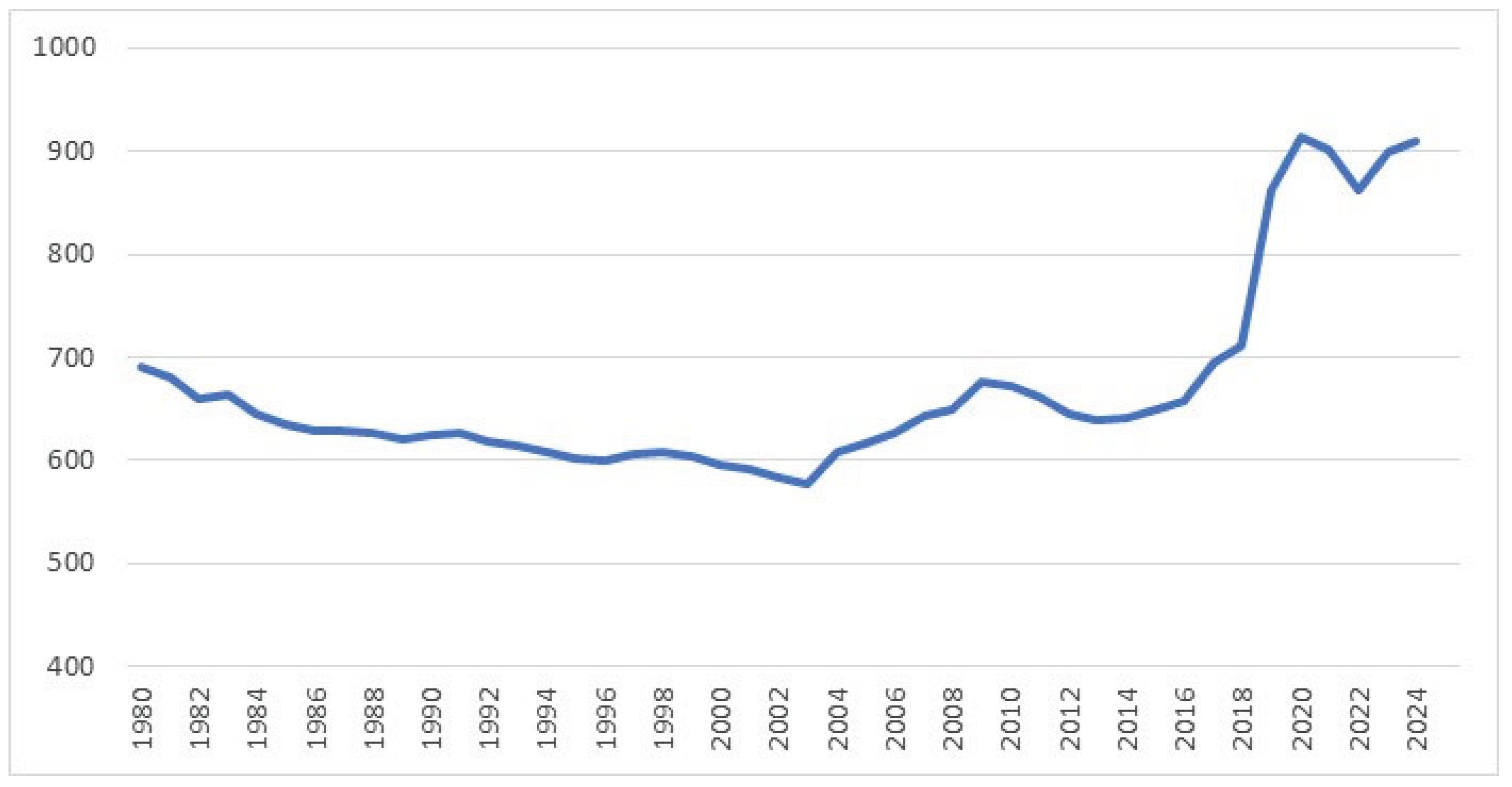
Figure 2.
Minimum wage as a percentage of the mean wage of full-time employees*. * Relationship between the Minimum Wage and the Mean and Median Wage, according to data from the Organisation for Economic Co-operation and Development (OECD). Source: Authors’ elaboration based on data from the Organisation for Economic Co-operation and Development (OECD).
Figure 2.
Minimum wage as a percentage of the mean wage of full-time employees*. * Relationship between the Minimum Wage and the Mean and Median Wage, according to data from the Organisation for Economic Co-operation and Development (OECD). Source: Authors’ elaboration based on data from the Organisation for Economic Co-operation and Development (OECD).
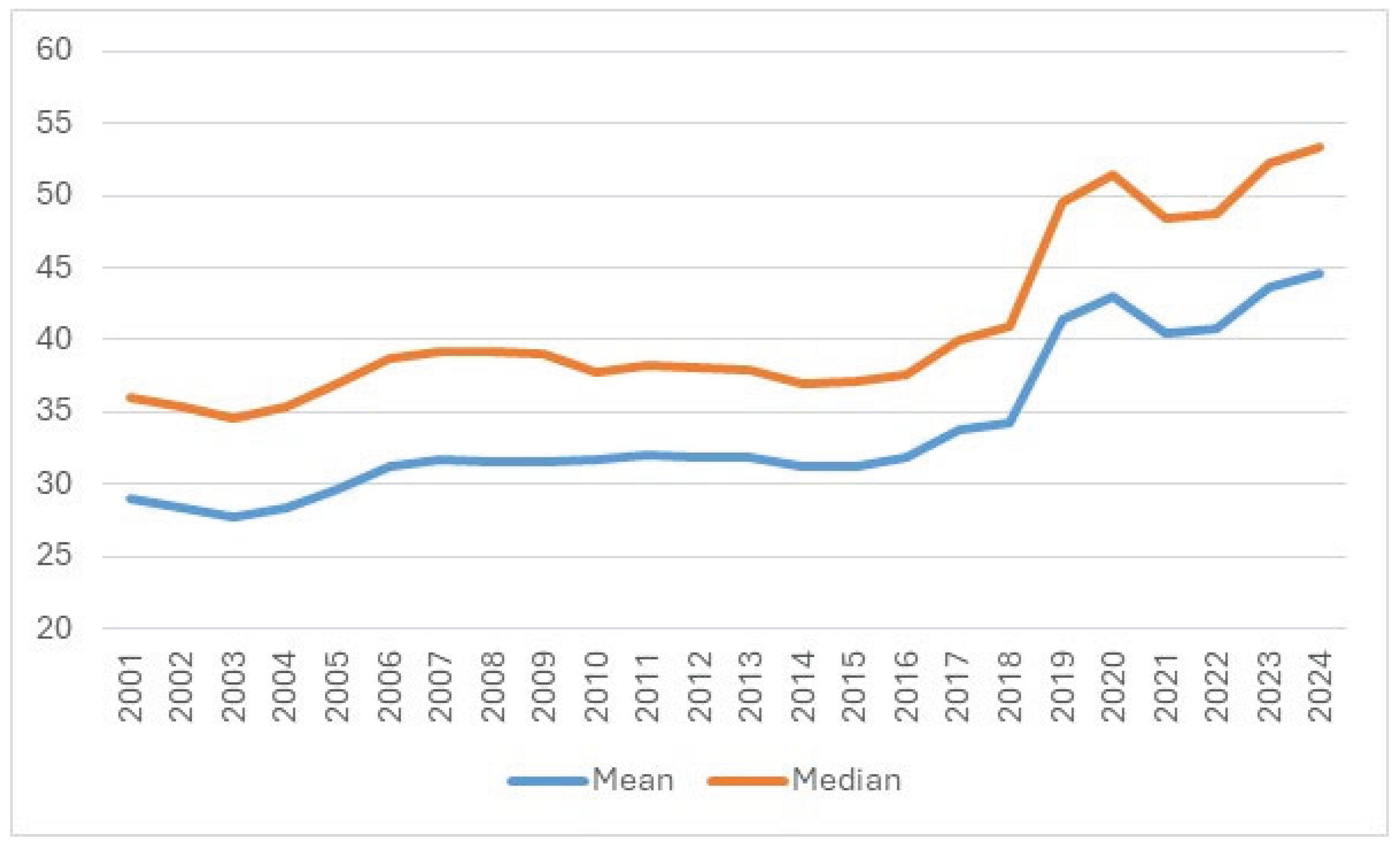

Table 1.
Selected works from the 1st stage (up to 1999).
| Order No. | Year of publication | Author | Period analyzed | Object of study |
|---|---|---|---|---|
| 1 | 1995 | Carlos Pérez Domínguez | 1985-1994 | Effects on employment, activity and unemployment of adolescents, young people and adults |
| 2 | 1996 | Juan José Dolado, Francis Kramarz, Stephen Machin, Alan Manning, David Margolis, Coen Teulings, Gilles Saint-Paul and Michael Keen** | 1967-1994 | Effects on employment |
| 3 | 1997 | Inmaculada González Güemes* | 1976-95 and 1981-92 | Effects on employment (youth, adolescents and women) |
| 4 | 1997 | Juan José Dolado and Florentino Felgueroso* | 1989-1995 | Effects on employment and wage distribution |
| 5 | 1999 | Juan José Dolado, Florentino Felgueroso and Juan Francisco Jimeno* | 1990-98 | Effects on youth employment |
| 6 | 2001 | Inmaculada González Güemes and Carlos Pérez Domínguez* | 1981-99 | Effects on adolescent employment |
| 7 | 2001 | Antonio Caparrós Ruiz and Mª Luisa Navarro Gómez* | 1993 | Effect on the labor supply of adolescents and young people |
| 8 | 2002 | Carlos Pérez Domínguez, Inmaculada González Güemes and Mª Dolores de Prada Moraga* | 1981-99 | Simultaneous effects of the minimum wage on employment, participation, and the unemployment rate of Spanish adolescents |
| 9 | 2002 | Antonio Caparrós Ruiz and Mª Luisa Navarro Gómez* | 1979-92 | Effect on industrial employment |
| 10 | 2003 | Inmaculada González Güemes, Sergi Jiménez Martín and Carlos Pérez Domínguez* | 1989-98 | Effect on adolescent employment |
| 11 | 2011 | José-Ignacio Antón and Rafael Muñoz de Bustillo | 1995-98 | Effect on employment, unemployment and school enrollment of adolescents |
* Published in a national or regional magazine. ** Published in an international scientific journal.
Table 2.
Selected works from the 2nd stage (2004-2017).
| Order No. | Year of publication | Author | Period analyzed | Object of study |
|---|---|---|---|---|
| 1 | 2010 | Inmaculada Cebrián, Joaquín Pitarch, César Rodríguez, Luis Toharia* | 2000/2008 | Effect on employment |
| 2 | 2011 | Josep Banyuls Llopis, Ernest Cano Cano, Empar Aguado Bloise * | 2004/2008 | Effect on the income of low-wage earners |
| 3 | 2011 | Maite Blázquez Cuesta, Raquel Llorente Heras and Julián Moral Carcedo* | 2000/2008 | Effect on youth employment |
| 4 | 2012 | Inmaculada González Güemes, Carlos Pérez Domínguez and Juan Carlos Rodríguez Caballero* | 1996/2008 | Effect on the employment of immigrants |
| 5 | 2014 | F Alfonso Arellano Espinar and Marcel Jansen* | 2007/2013 | Effects on the employment situation of younger workers |
| 6 | 2015 | Sofia Galán and Sergio Puente** | 2000-2010 | Effect on the probability of losing a job |
| 7 | 2017 | Ignacio Archondo, Juan Ramón García and Camilo Ulloa (BBVA) | 2017 | Effects on employment and GDP Type of recipients |
| 8 | 2019 | Aitor Lacuesta, Mario Izquierdo and Sergio Puente (BE) | 2013-2017 | Effects on job loss |
| 9 | 2022 | Jordi López - Tamayo, Celia Melguizo and Raúl Ramos** | 2006/2018 | Effects on youth employment |
* Published in a national magazine. ** Published in an international scientific journal.
Table 3.
Selected works from the 3rd stage (since 2019).
| Order No. | Year of publication | Author | Period analyzed | Object of study |
|---|---|---|---|---|
| 1 | 2021 | Cristina Barceló, Mario Izquierdo, Aitor Lacuesta, Sergio Puente, Ana Regil and Ernesto Villanueva (Bank of Spain) | 2019 | Effect on employment |
| 2 | 2022 | Pablo Fernández-Baldor Laporta (IEB) | 2019 | Effect on employment |
| 3 | 2023 | José M Arranz, Carlos García-Serrano and Ana M Silva (IEF) | 2019 | Effect on employment |
| 4 | 2023 | Alejandro Hijzen, Mateo Montenegro and Ana Sofía Pessoa (OECD) | 2019 | Effect on wages, employment and unemployment |
| 5 | 2023 | Rubén Gonzálvez Salmerón (unpublished) | 2019 | Effect on total productivity (TFP) and capital investment |
| 6 | 2023 | Ferrán Elías and Marc Riudavets-Barcóns (unpublished) | 2017/19 | Impact on employment, wages and public budgets |
| 7 | 2024 | Lucia Gorjón, David Martinez de Lafuente and Gonzalo Romero (ISEAK)* | 2019 | Effect on employment |
| 8 | 2024 | Manuela A. De Paz-Báñez, Celia Sánchez-López and María José Asensio-Coto* | 2019 | Effect on income inequality |
| 9 | 2024 | Juan J Arnadillo, Amadeo Fuenmayor and Rafael Granell* | 2019 | Effect on employment |
| 10 | 2024 | Michael Christl, Andrea Cubells Enguídanos and Filippo di Pietroc (GLO) | 2019 2015-2023 |
Effect on the labor market, prices and business bankruptcy |
| 11 | 2025 | Jorge Monray and Juan Morillo* | 2010-23 | Effect on unemployment |
| 12 | 2025 | José María Arranz and Carlos García-Serrano (IEF)* | 2016/19 | Effect on family income and poverty |
| 13 | 2025 | Celia Sánchez-López, María José Asensio-Coto and Manuela A. de Paz-Báñez (in press) | 2018-19, 2022-23 | Effect on employment |
* Published in a scientific journal.
Disclaimer/Publisher’s Note: The statements, opinions and data contained in all publications are solely those of the individual author(s) and contributor(s) and not of MDPI and/or the editor(s). MDPI and/or the editor(s) disclaim responsibility for any injury to people or property resulting from any ideas, methods, instructions or products referred to in the content. |
© 2025 by the authors. Licensee MDPI, Basel, Switzerland. This article is an open access article distributed under the terms and conditions of the Creative Commons Attribution (CC BY) license (http://creativecommons.org/licenses/by/4.0/).
Copyright: This open access article is published under a Creative Commons CC BY 4.0 license, which permit the free download, distribution, and reuse, provided that the author and preprint are cited in any reuse.


