

Submitted:
20 December 2025
Posted:
22 December 2025
You are already at the latest version
Abstract
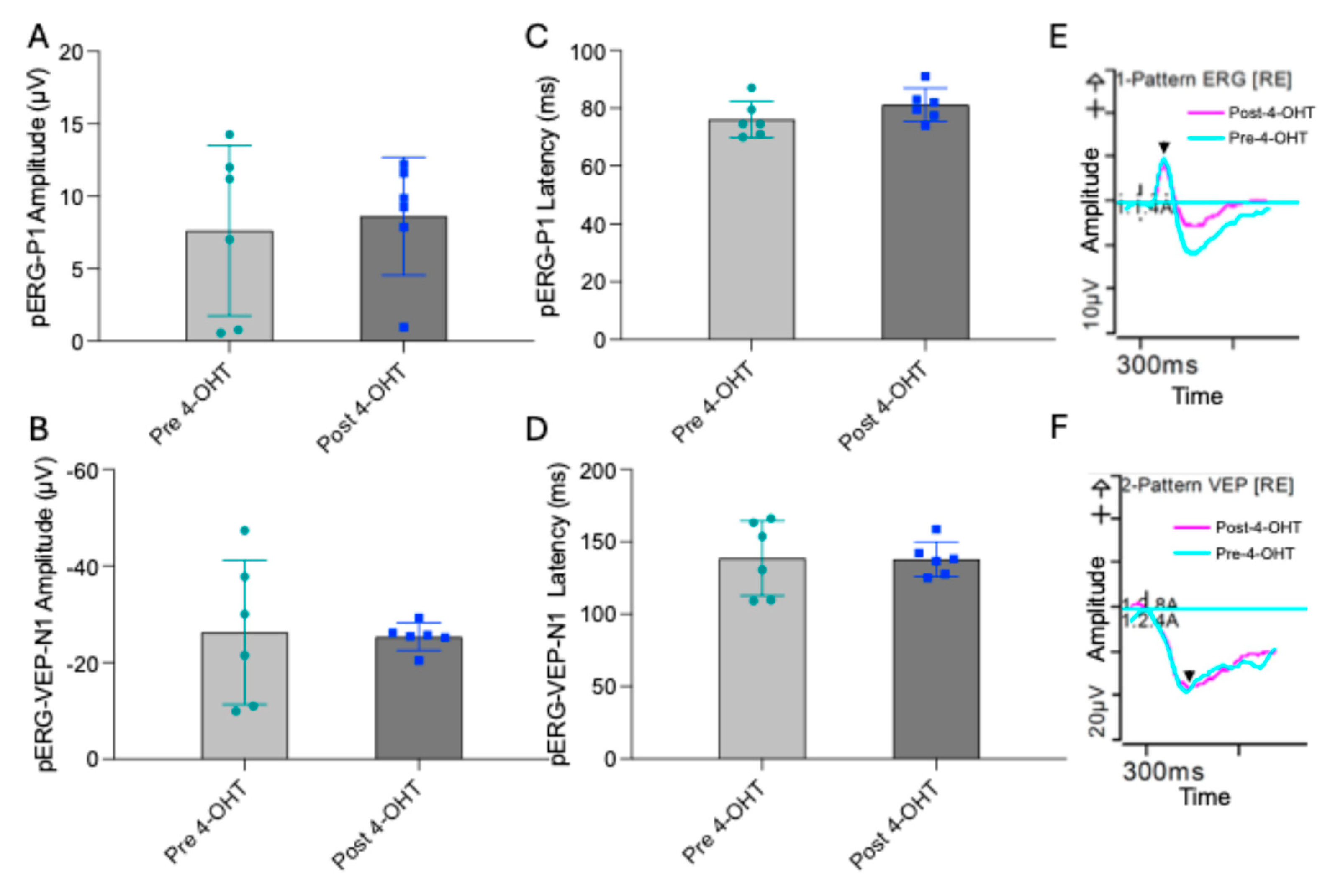
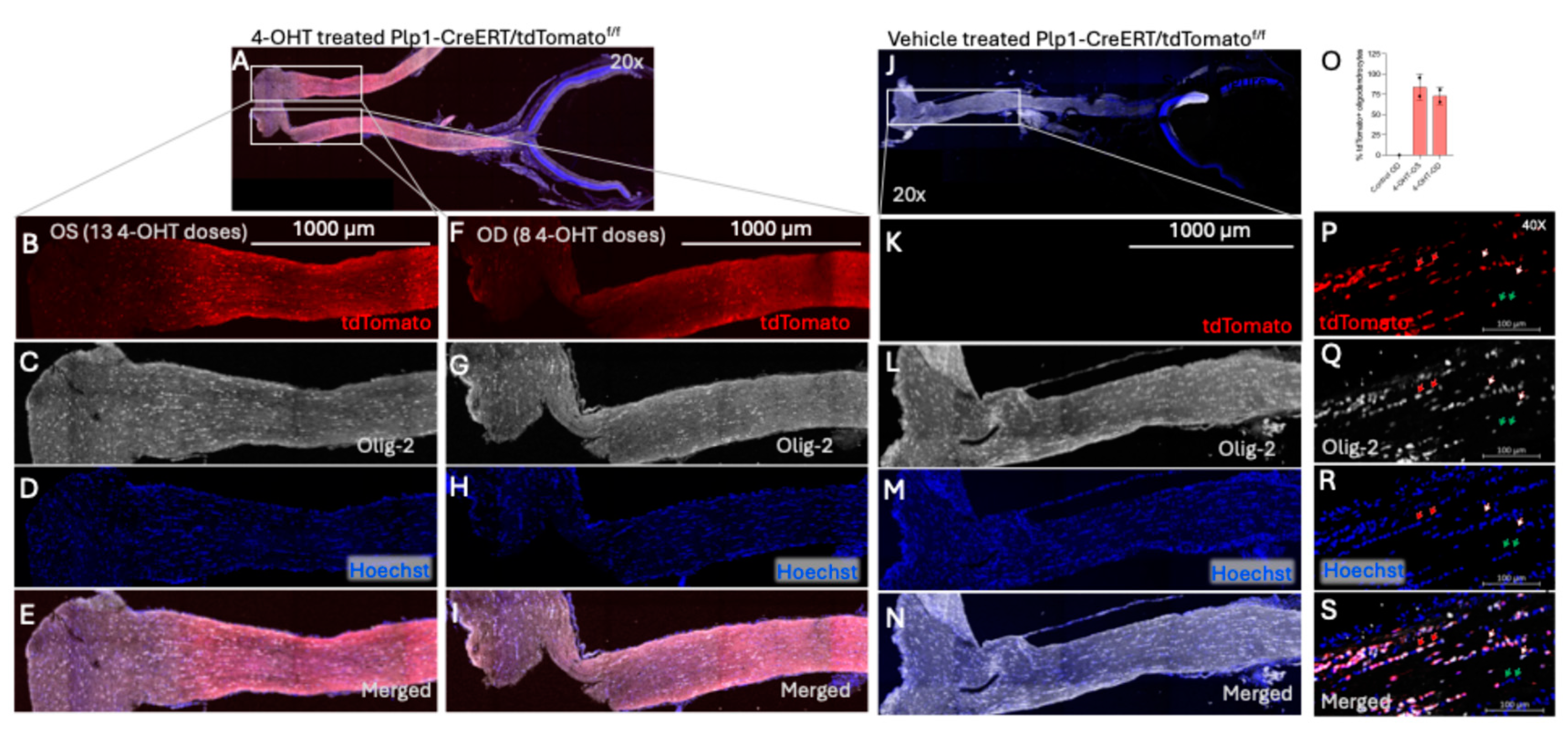
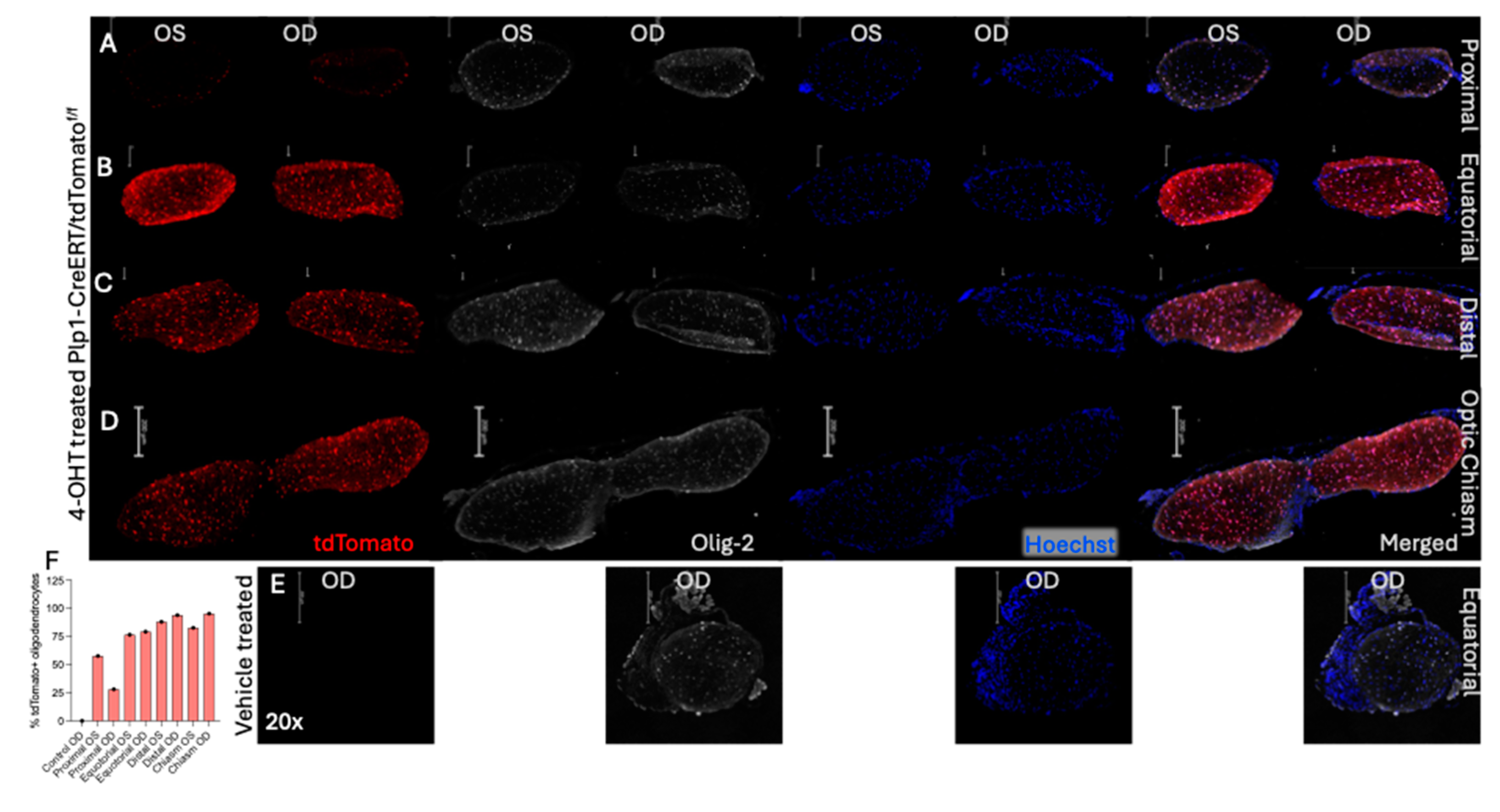
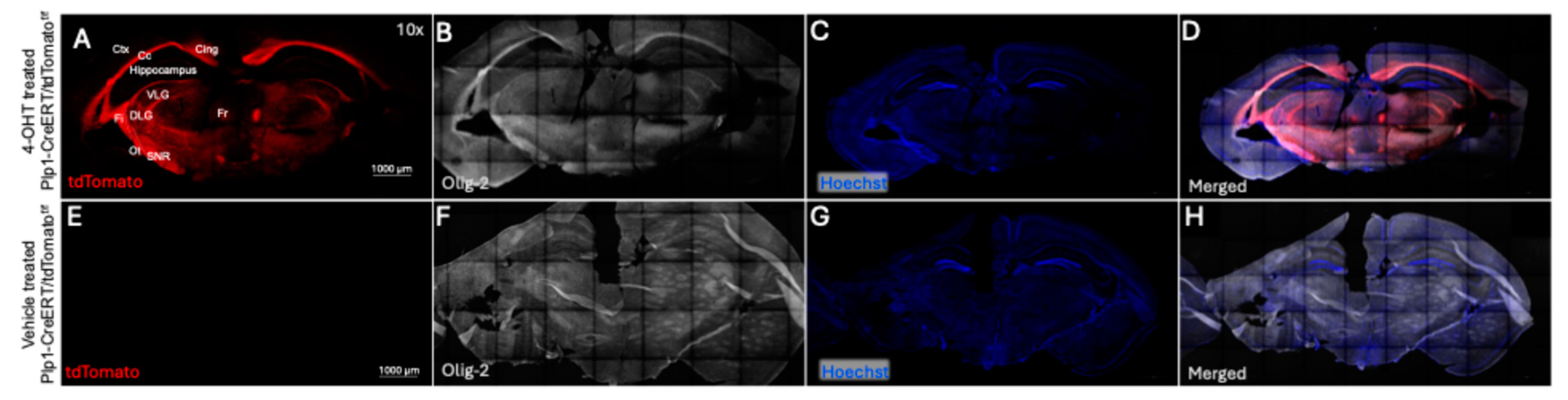
Inducible CreERT-mediated gene editing is a powerful tool for targeted gene manipulation, but systemic tamoxifen (Tam) administration can cause off-target effects and toxicity. Here we demonstrate that topical administration of 4-hydroxytamoxifen (4-OHT) eye drops in Plp1-CreERT/tdTomatof/f mice effectively induces CreERT-mediated recombination specifically in oligodendrocytes of the optic nerve, optic chiasm, and adjacent CNS regions including the optic tract, hippocampus, and corpus callosum. This localized approach achieves robust tdTomato expression in over 80% of oligodendrocytes without detectable retinal structural or functional abnormalities, as confirmed by electroretinography and fundus imaging. These findings demonstrate a safe, non-invasive method for spatially restricted gene editing in the visual pathway and certain brain areas, providing a valuable platform for investigating oligodendrocyte biology and demyelinating diseases while minimizing systemic side effects associated with Tam treatment.
Keywords:
Introduction
Methods
Animal
4-Hydroxytamoxifen (4-OHT)
Pattern ERG (pERG)
Anesthesia, Perfusion and Cryosection
Immunohistochemistry and Confocal Imaging
Results
4-OHT Eye Drops Have No Detectable Effect on Retinal Ganglion Cell Function
Topical 4-OHT Induced OLs Specific Recombination in the Optic Nerve of PLP1-CreERT Mice
Topical 4-OHT Induces OLs-Specific Cre Mediated Recombination in Brain
Discussion
Author Contributions
Acknowledgments
List of Abbreviations
References
- Ciapa, MA; Salaru, DL; Statescu, C; Sascau, RA; Bogdanici, CM. Optic Neuritis in Multiple Sclerosis-A Review of Molecular Mechanisms Involved in the Degenerative Process. Curr Issues Mol Biol. 2022, 44(9), 3959–79. [Google Scholar] [CrossRef] [PubMed]
- Cazzulino, AS; Martinez, R; Tomm, NK; Denny, CA. Improved specificity of hippocampal memory trace labeling. Hippocampus 2016, 26(6), 752–62. [Google Scholar] [CrossRef] [PubMed]
- Guenthner, CJ; Miyamichi, K; Yang, HH; Heller, HC; Luo, L. Permanent genetic access to transiently active neurons via TRAP: targeted recombination in active populations. Neuron 2013, 78(5), 773–84. [Google Scholar] [CrossRef] [PubMed]
- Hans, S; Kaslin, J; Freudenreich, D; Brand, M. Temporally-controlled site-specific recombination in zebrafish. PLoS One 2009, 4(2), e4640. [Google Scholar] [CrossRef] [PubMed]
- Leone, DP; Genoud, S; Atanasoski, S; Grausenburger, R; Berger, P; Metzger, D; et al. Tamoxifen-inducible glia-specific Cre mice for somatic mutagenesis in oligodendrocytes and Schwann cells. Mol Cell Neurosci. 2003, 22(4), 430–40. [Google Scholar] [CrossRef] [PubMed]
- Kruglov, O; Vats, K; Soman, V; Tyurin, VA; Tyurina, YY; Wang, J; et al. Melanoma-associated repair-like Schwann cells suppress anti-tumor T-cells via 12/15-LOX/COX2-associated eicosanoid production. Oncoimmunology 2023, 12(1), 2192098. [Google Scholar] [CrossRef] [PubMed]
- Doerflinger, NH; Macklin, WB; Popko, B. Inducible site-specific recombination in myelinating cells. Genesis 2003, 35(1), 63–72. [Google Scholar] [CrossRef] [PubMed]
- Halpage, J; DaSilva Pantoja, P; Mancarella, S. Prolonged tamoxifen-enriched diet is associated with cardiomyopathy and nutritional frailty in mice. Exp Physiol. 2024, 109(4), 513–23. [Google Scholar] [CrossRef] [PubMed]
- Ilchuk, LA; Stavskaya, NI; Varlamova, EA; Khamidullina, AI; Tatarskiy, VV; Mogila, VA; et al. Limitations of Tamoxifen Application for In Vivo Genome Editing Using Cre/ER(T2) System. Int J Mol Sci. 2022, 23(22). [Google Scholar] [CrossRef] [PubMed]
- Willems, A; De Gendt, K; Deboel, L; Swinnen, JV; Verhoeven, G. The development of an inducible androgen receptor knockout model in mouse to study the postmeiotic effects of androgens on germ cell development. Spermatogenesis 2011, 1(4), 341–53. [Google Scholar] [CrossRef] [PubMed]
- Patel, SH; O’Hara, L; Atanassova, N; Smith, SE; Curley, MK; Rebourcet, D; et al. Low-dose tamoxifen treatment in juvenile males has long-term adverse effects on the reproductive system: implications for inducible transgenics. Sci Rep. 2017, 7(1), 8991. [Google Scholar] [CrossRef] [PubMed]
- Huh, WJ; Khurana, SS; Geahlen, JH; Kohli, K; Waller, RA; Mills, JC. Tamoxifen induces rapid, reversible atrophy, and metaplasia in mouse stomach. Gastroenterology 2012, 142(1), 21–4 e7. [Google Scholar] [CrossRef] [PubMed]
- Boneva, SK; Gross, TR; Schlecht, A; Schmitt, SI; Sippl, C; Jagle, H; et al. Cre recombinase expression or topical tamoxifen treatment do not affect retinal structure and function, neuronal vulnerability or glial reactivity in the mouse eye. Neuroscience 2016, 325, 188–201. [Google Scholar] [CrossRef] [PubMed]
- Schlecht, A; Leimbeck, SV; Tamm, ER; Braunger, BM. Tamoxifen-Containing Eye Drops Successfully Trigger Cre-Mediated Recombination in the Entire Eye. Adv Exp Med Biol. 2016, 854, 495–500. [Google Scholar] [PubMed]
- Hou, J; Lin, CP; Intini, G. Activation of creER recombinase in the mouse calvaria induces local recombination without effects on distant skeletal segments. Sci Rep. 2021, 11(1), 8214. [Google Scholar] [CrossRef] [PubMed]
- Hayashi, S; McMahon, AP. Efficient recombination in diverse tissues by a tamoxifen-inducible form of Cre: a tool for temporally regulated gene activation/inactivation in the mouse. Dev Biol. 2002, 244(2), 305–18. [Google Scholar] [CrossRef] [PubMed]
Disclaimer/Publisher’s Note: The statements, opinions and data contained in all publications are solely those of the individual author(s) and contributor(s) and not of MDPI and/or the editor(s). MDPI and/or the editor(s) disclaim responsibility for any injury to people or property resulting from any ideas, methods, instructions or products referred to in the content. |
© 2025 by the authors. Licensee MDPI, Basel, Switzerland. This article is an open access article distributed under the terms and conditions of the Creative Commons Attribution (CC BY) license.