

Submitted:
15 March 2026
Posted:
16 March 2026
You are already at the latest version
Abstract
AI-enabled tourism platform services across East Asia often generate privacy concern while continuing to attract user participation. Rather than treating this pattern as a simple contradiction, this study interprets it as privacy satisficing, in which users remain willing to participate once platform conditions are perceived as sufficiently acceptable. Using a symmetric adult survey from Fujian, China (N = 185) and Busan–Gyeongnam, Korea (N = 187), the study examines how privacy concern and accountability visibility are associated with willingness to use AI-enabled tourism platform services. Diagnostic heat maps and bootstrap checks show generally high willingness to use (typically 0.70 or higher) across most conditions, with stronger accountability sensitivity in Busan–Gyeongnam and more stable participation in Fujian. The findings suggest that continued participation is shaped not only by privacy concern itself but also by perceived accountability visibility and operational reliability.
Keywords:
privacy satisficing
; AI-enabled tourism platform services
; accountability visibility
; operational reliability
; privacy concern
; tourism platforms
; East Asia
1. Introduction
Artificial intelligence (AI)-enabled platform services are increasingly embedded in tourism environments across East Asia, improving convenience, personalization, and service efficiency while also generating persistent privacy concern [1,2,3]. Although users are aware of potential privacy risks, many continue to use such services, a pattern widely described as the “privacy paradox” [4,5,9,21]. Existing research has primarily explained this phenomenon through individual-level mechanisms, including cognitive bias, misaligned risk–benefit evaluation, and habituation [6,9,21].
While these perspectives provide useful insights, they pay less attention to how continued use is shaped by the platform service environment itself. This limitation is particularly relevant in tourism-related digital contexts, where trust, convenience, and perceived operational reliability are closely intertwined [12,20,23]. In highly organized tourism-platform environments such as those observed in China and Korea, privacy-related decisions are therefore influenced not only by individual perception but also by whether the platform is perceived as understandable, accountable, and operationally reliable.
Drawing on bounded rationality, this study interprets continued participation not as the absence of concern but as a form of privacy satisficing: users remain willing to engage once platform conditions reach minimally acceptable levels of transparency and reliability, even when privacy concern persists [14,17,21]. From this perspective, the privacy paradox can be understood as a threshold-based acceptance pattern within tourism platform services rather than as a simple inconsistency in individual attitudes.
Figure 1.
Conceptual Framework. Notes. This figure summarizes the analytical structure of the study, linking platform conditions to diagnostic analysis and policy interpretation. It highlights threshold perceptions of transparency and reliability, the symmetric survey design in Fujian and Busan–Gyeongnam, and the analytical focus on accountability visibility and institutional continuity within tourism-related AI platform services. Subcells with n < 10 are reported for transparency but excluded from statistical inference.
Figure 1.
Conceptual Framework. Notes. This figure summarizes the analytical structure of the study, linking platform conditions to diagnostic analysis and policy interpretation. It highlights threshold perceptions of transparency and reliability, the symmetric survey design in Fujian and Busan–Gyeongnam, and the analytical focus on accountability visibility and institutional continuity within tourism-related AI platform services. Subcells with n < 10 are reported for transparency but excluded from statistical inference.
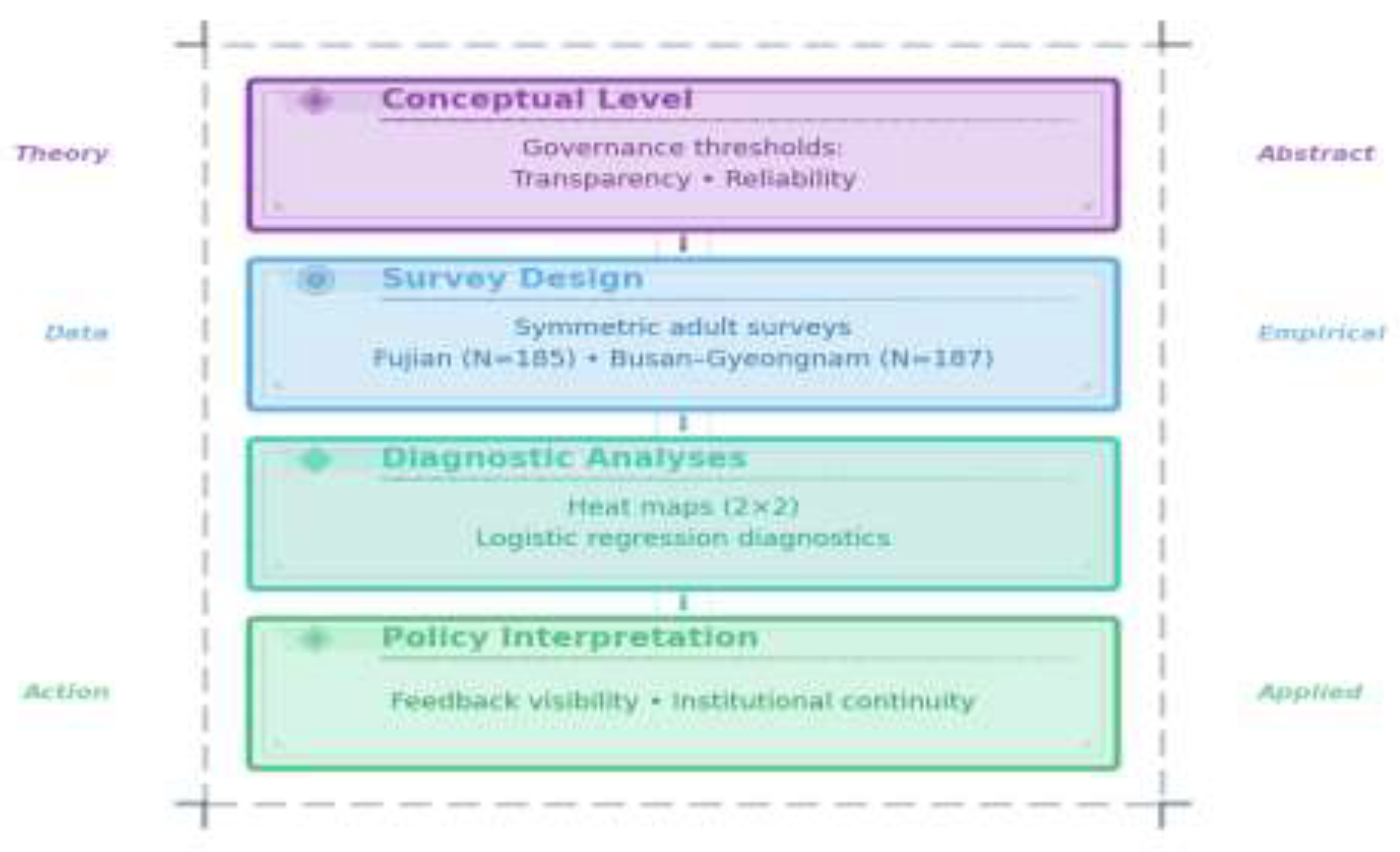
To examine this pattern, the study conducts a symmetric subnational survey in Fujian, China (N = 185) and Busan–Gyeongnam, Korea (N = 187). Both cases are treated as regional tourism-platform contexts in which AI-enabled services operate under different but broadly comparable institutional conditions. The analysis focuses on how privacy concern and accountability visibility jointly relate to users’ willingness to use AI-enabled tourism platform services.
Cross-regional diagnostic analyses reveal consistently high willingness to use AI services (typically 0.70 or higher) across most conditions, together with region-specific sensitivity differences. These patterns suggest that accountability visibility and institutional continuity function as practical contextual conditions that sustain continued participation [20,23]. The analysis is intentionally diagnostic and descriptive, and no causal claims are advanced.
This study makes three contributions.
- Third, it shows that continued participation in AI-enabled tourism platform services tends to persist once platform conditions are perceived as sufficiently acceptable, particularly in relation to accountability visibility (e.g., resolution proofs and traceable updates) and institutional continuity (e.g., reliable operations and maintenance capacity) [12,20,23].
The remainder of the paper presents the analytical framework, data and measures, empirical diagnostics, and implications for more trustworthy tourism-related AI platform services [1,2,3,16].
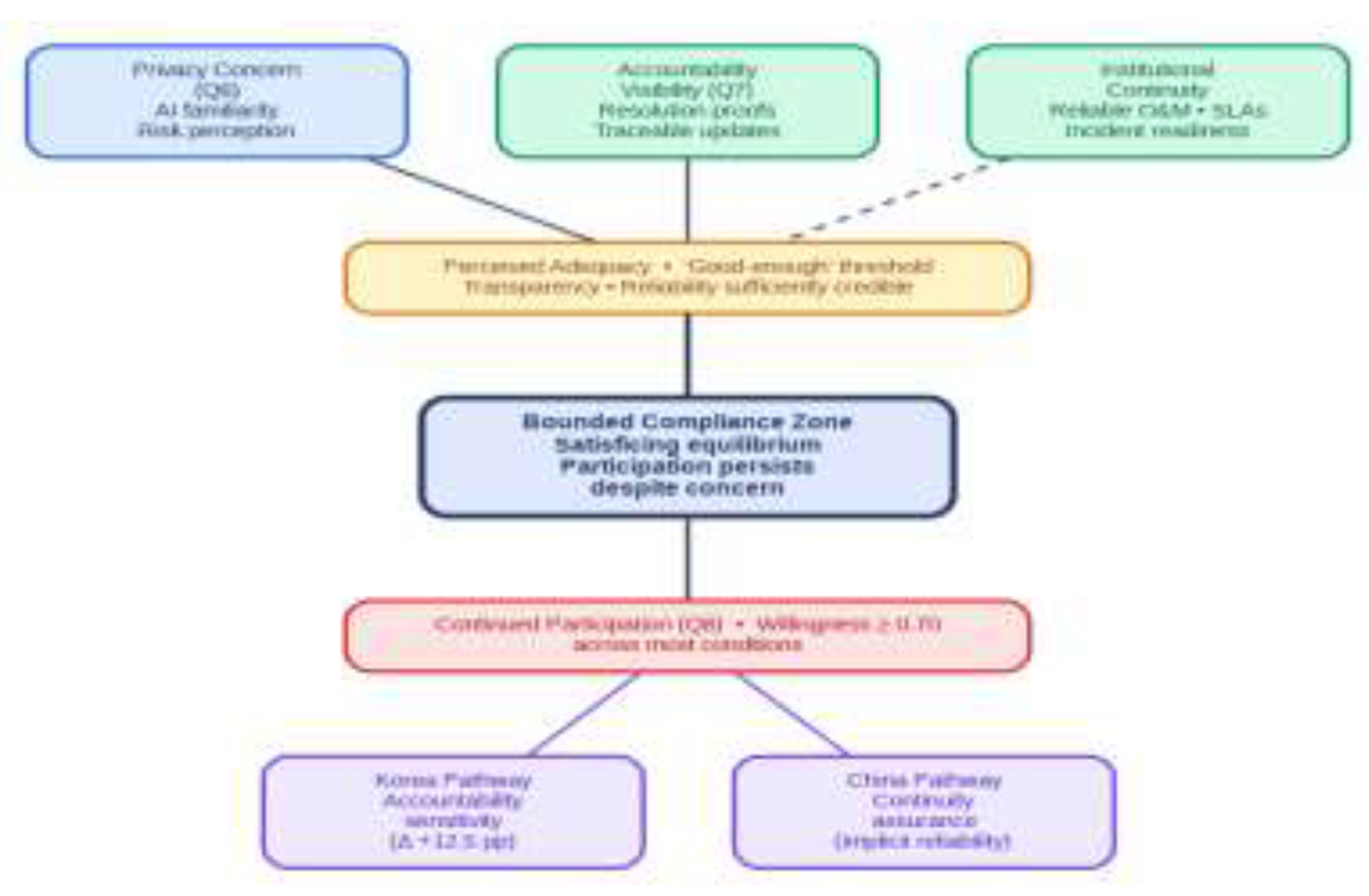
Figure 2.
Privacy Satisficing Map: Regional Pathways and Continued Participation. Notes. This figure illustrates how privacy concern (Q6), accountability visibility (Q7), and institutional continuity jointly shape perceived adequacy—that is, minimally acceptable thresholds of transparency and reliability. Once this threshold is reached, users tend to maintain participation despite ongoing concern, reflecting a pattern of privacy satisficing in tourism-related AI platform services (Q8; willingness 0.70 or higher). Although regional sensitivity patterns differ, both contexts converge toward continued participation.
Figure 2.
Privacy Satisficing Map: Regional Pathways and Continued Participation. Notes. This figure illustrates how privacy concern (Q6), accountability visibility (Q7), and institutional continuity jointly shape perceived adequacy—that is, minimally acceptable thresholds of transparency and reliability. Once this threshold is reached, users tend to maintain participation despite ongoing concern, reflecting a pattern of privacy satisficing in tourism-related AI platform services (Q8; willingness 0.70 or higher). Although regional sensitivity patterns differ, both contexts converge toward continued participation.
2. Literature Review and Theoretical Grounding
A substantial body of research explains the continued use of data-intensive digital services despite perceived privacy risk through individual-level mechanisms, including cognitive dissonance, risk–benefit miscalibration, trust heuristics, and habitual normalization [4,5,6,9,21]. These explanations clarify why users tolerate privacy-related risk at the micro level, but they pay less attention to the service environments in which users judge whether a platform remains acceptable to continue using. This limitation is particularly relevant in tourism-related digital services, where convenience, trust, and perceived operational reliability are closely intertwined and where behavioral intention remains a central concern in tourism research [12,20,22,23].
In tourism-platform contexts, privacy-related behavior is shaped not only by individual perception but also by platform conditions that influence reassurance and continued use. These conditions include the visibility of explanations and feedback, the traceability of responses, and the perceived reliability of service operation [1,2,7,20,23]. Transparency and feedback visibility can strengthen trust by signaling responsiveness and procedural clarity, while accountability-related cues—such as complaint handling, traceable updates, and explanation channels—shape whether privacy protection is regarded as sufficiently acceptable for continued participation [8,12,13,20,23]. From this perspective, the privacy paradox can be interpreted as a context-conditioned usage pattern rather than as a simple inconsistency in individual attitudes [12,16].
Building on bounded rationality and satisficing [14,17], continued platform use can be understood as a privacy satisficing outcome in which users accept adequate rather than optimal conditions under informational and contextual constraints. When accountability signals are visible and responsive, perceived adequacy may be reinforced. Participation may also persist when reassurance is provided through stable and reliable service routines, even without strong dialogic feedback [6,14,17,20]. Continued participation therefore reflects a pragmatic threshold of acceptance rather than a purely psychological contradiction. In this study, perceived adequacy is treated as a threshold condition linking platform cues to sustained participation [23].
This study extends prior discussions of trust and governance in AI-enabled smart tourism by focusing on cross-regional tourism-platform use under privacy concern [13,26]. Rather than advancing a system-wide theory, the analysis concentrates on two contextual conditions that may sustain participation: accountability visibility and institutional continuity. Accountability visibility refers to the extent to which users can perceive explanations, response channels, and traceable handling processes, whereas institutional continuity refers to the perceived stability and reliability of service operation over time. These contextual conditions align with prior discussions of platform embedding, feedback visibility, and responsibility coordination in East Asian digital platform environments [7,13]. Using a symmetric diagnostic design, the study examines how these cues relate to continued willingness to use without making causal claims.
Applied to AI-enabled tourism platform services in East Asia, this framework anticipates similar behavioral outcomes—continued participation despite privacy concern—emerging through different but comparable contextual pathways [1,3,10,18,20,23]. One pathway emphasizes accountability visibility through explanations, traceable resolution processes, and participatory feedback. The other emphasizes institutional continuity through stable operation, predictable maintenance routines, and service reliability. Comparative research on digital trust suggests that both pathways can sustain participation even if their relative salience differs across contexts [16,19,20,23]. Accordingly, the present design examines how privacy concern and accountability visibility jointly relate to willingness to use AI-enabled tourism services without assuming a single universal psychological mechanism [4,5,21].
Synthesizing this literature, the study proposes a privacy satisficing framework in which privacy concern does not automatically lead to service withdrawal. Instead, participation depends on whether users perceive platform conditions to be sufficiently acceptable, particularly in terms of accountability visibility and operational reliability [12,14,17,20,23]. This framework motivates a symmetric China–Korea survey and supports diagnostic expectations for threshold-based trust in AI-enabled tourism platform services [11,15]. Continued willingness to use is therefore expected to remain relatively high once either accountability visibility or institutional reliability reaches an acceptable level. At the same time, accountability visibility may be more salient in Korea, whereas institutional continuity may play a stronger role in China. Under higher privacy concern, willingness is thus expected to converge toward a practical “good-enough” threshold once at least one of these contextual conditions is perceived as adequate.
3. Methods and Data
This study employs a symmetric diagnostic survey comparing Fujian, China (N = 185) and Busan–Gyeongnam, Korea (N = 187) to examine how privacy concern (Q6) and accountability/explanation visibility (Q7) are associated with willingness to use AI-enabled tourism platform services (Q8). The design emphasizes cross-regional comparability and transparent treatment of sparse cells, consistent with prior comparative research on digital trust and platform use [19,20]. Subcells with n < 10 are reported for transparency and treated as diagnostic rather than inferential [11,15].
Three binary indicators are analyzed: privacy concern (Q6), accountability/explanation visibility (Q7), and willingness to use AI services (Q8), coded as 0 (low/absent) or 1 (high/present). For each region, we compute 2 × 2 conditional probabilities of Pr(HighUse = 1 | Q6, Q7) and a difference panel (Δ), defined as Busan–Gyeongnam minus Fujian in percentage points, to support cross-regional diagnostic comparison and threshold-based interpretation [11,15,17]. Descriptive statistics are reported in Table 1.
Regional patterns are visualized using dual-color heat maps and a difference panel (Δ) in Figure 3. Proportion estimates are reported with 95% confidence intervals computed using Wilson’s method, which is appropriate for small cells [11,15]. Sparse subcells (n < 10) are disclosed for transparency and treated as diagnostic only.
Across conditions, both regions show generally high willingness to use AI-enabled tourism platform services, with most cell probabilities at or above 0.70. The largest contrast (Δ = +12.5 percentage points) appears under low concern and high accountability visibility, suggesting stronger sensitivity to accountability-related reassurance in Busan–Gyeongnam. In Fujian, probabilities remain comparatively high across cells, a pattern more consistent with continuity-based reassurance than with condition-specific responsiveness [1,3,20,23].
To assess the stability of these patterns, diagnostic bootstrap resampling is conducted for each region’s 2 × 2 table and for the Δ panel. The results are presented in Figure 4 and Table 2. Across resamples, cell probabilities remain high and the direction of Δ is preserved, indicating directional robustness.
For completeness, region–variable chi-square tests and a diagnostic logistic specification including Q6, Q7, their interaction, and Region are also reported. These results are presented as pattern-consistent diagnostics rather than formal hypothesis tests, and sparse-cell limitations are explicitly acknowledged [15].

Table 3.
Chi-Square Tests by Region (Q6, Q7, Q8).
| Variable | Chi2 | df | p_value |
|---|---|---|---|
| Q6_CONCERN_LEVEL | 0.728 | 1 | 0.3939 |
| Q7_EXPLAIN_LEVEL | 63.026 | 1 | 0.0000 |
| Q8_WILLINGNESS | 2.548 | 1 | 0.1104 |
Table 4.
Logistic Regression (Diagnostic Only).
| Variable | Coef | Std.Err | z | p_value |
|---|---|---|---|---|
| Intercept | 0.171 | 0.325 | 0.53 | 0.5995 |
| Concern (Q6) | 1.723 | 0.343 | 5.02 | 0.0000 |
| Accountability (Q7) | 2.009 | 0.676 | 2.97 | 0.0030 |
| Q6 × Q7 | -1.774 | 0.758 | -2.34 | 0.0192 |
| Region (BG=1) | -0.113 | 0.302 | -0.37 | 0.7084 |
Ethics and data availability. This study uses fully anonymized adult survey data (N = 372) approved by the Institutional Review Board of Youngsan University under protocol YSUIRB-202511-HR-194-02 (effective 16 December 2025). The dataset represents an adult-only subset derived from previously authorized minimal-risk social-behavioral research, and no new data collection was conducted for the present analysis. For transparency and replication, de-identified cell matrices, Δ values, and bootstrap summaries are provided as supplementary CSV files [1,2,16,25].
The study reuses the same measurement structure as the related Satisficing Equilibrium (SE) study [26], but applies it in a reduced and explicitly descriptive specification. Item coding procedures were retained for consistency. Because the present study does not pursue scale development or causal modeling, detailed multicollinearity diagnostics are not repeated. Accountability-related cues are treated as contextual indicators of perceived platform adequacy rather than as stand-alone latent constructs.
4. Discussion
Prior research has explained continued platform use under privacy concern from two main perspectives: individual-level trade-off mechanisms, such as cognitive or calculus-based explanations, and contextual conditions shaping trust, including transparency, accountability, and operational reliability in digital environments [8,13,20,21,23]. Building on this literature, the present study adopts a diagnostic perspective to examine whether continued participation in AI-enabled tourism platform services can be understood as privacy satisficing under conditions of privacy concern.
The symmetric China–Korea comparison reveals three related patterns. First, continued participation is broadly consistent with a threshold-based interpretation of privacy satisficing. In both regions, users do not appear to withdraw from platform use simply because privacy concern is present. Instead, participation tends to persist once platform conditions are perceived as sufficiently acceptable, particularly in relation to accountability visibility and operational reliability. Continued use is therefore better interpreted as a pragmatic acceptance pattern than as a contradiction between concern and behavior.
Second, the diagnostic evidence from cell probabilities, heat maps, and bootstrap checks supports this threshold-based reading. Willingness to use remains high across most concern–accountability conditions, typically 0.70 or higher, and resampling preserves the overall direction of cross-regional contrasts. Although these results do not support causal inference, they indicate that privacy concern does not automatically lead to service withdrawal in tourism-platform settings. Instead, continued participation appears to depend on whether users perceive platform safeguards and service conditions as practically adequate.
Third, regional sensitivity differs descriptively. Busan–Gyeongnam shows greater responsiveness to accountability visibility, whereas Fujian exhibits comparatively stable participation across conditions. This pattern is compatible with the interpretation that users in Busan–Gyeongnam respond more strongly to visible reassurance cues, while users in Fujian rely more on continuity-based confidence in routine service operation. Despite these differences, both regions converge toward continued participation under elevated concern. The findings therefore shift the discussion from an individual-level privacy paradox toward context-conditioned participation thresholds in tourism platform use.
Practical Implications. Two practical implications follow for AI-enabled tourism platform services. First, accountability visibility should be made more recognizable at the user-interface level. Features such as traceable response records, explanation channels, and visible feedback handling can help users perceive that privacy concerns are acknowledged and addressed in practice. Second, operational continuity remains an important source of reassurance. When stable service operation aligns with visible accountability mechanisms, users are more likely to regard platform safeguards as sufficiently acceptable and to continue using the service despite ongoing privacy concern [8,20,21,23].
5. Interpretive Synthesis and Conclusions
The symmetric comparison between Fujian (N = 185) and Busan–Gyeongnam (N = 187) reveals a consistent behavioral pattern in AI-enabled tourism platform services. Users tend to continue participation despite privacy concern once minimum conditions of accountability visibility and operational reliability are perceived as sufficiently acceptable [20,23]. Diagnostic evidence from heat maps and bootstrap checks indicates generally high willingness to use AI-enabled tourism services (typically 0.70 or higher) across concern–accountability conditions, together with region-specific sensitivity differences. This pattern is most appropriately interpreted as privacy satisficing, that is, continued participation under boundedly acceptable platform conditions, rather than as a contradiction in individual psychology alone [14,17,21].
Regional pathways differ descriptively but converge in overall outcomes. In Fujian, continued participation appears more compatible with continuity-based reassurance, where stable service operation and predictable maintenance routines support engagement despite privacy concern [23]. In Busan–Gyeongnam, participation is more responsive to accountability visibility, including explanations, feedback closure, and recognizable response channels, consistent with prior findings that visible transparency cues strengthen institutional trust [20]. Despite these contextual differences, both regions converge toward sustained participation under privacy concern, supporting a threshold-based interpretation of platform use in which engagement persists once service conditions are perceived as sufficiently acceptable in practice [9,14,17,21].
Three conclusions follow from this diagnostic analysis.
First, privacy satisficing provides a more suitable interpretation of continued participation than privacy optimization. Users do not appear to seek ideal privacy conditions in tourism platform services; instead, they remain engaged once safeguards are perceived as credible enough to meet a practical threshold of acceptability [14,17,21].
Second, continued participation is shaped by contextual platform conditions. Where accountability visibility is salient, users place greater value on explanation, feedback, and procedural openness. Where continuity and operational reliability dominate, privacy concern may remain present but becomes more tolerable as long as service operation appears stable and predictable [20,23].
Third, the symmetric diagnostic design offers analytical value. Maintaining regional comparability and transparently reporting sparse subcells enables cross-regional comparison without overstating inference, which is particularly important in small-cell analyses [11,15].
Practical Implications.
Two practical implications follow for AI-enabled tourism platform services. In Fujian, strengthening visible feedback processes while maintaining long-term service continuity may help stabilize user acceptance under privacy concern [8,20]. In Busan–Gyeongnam, maintaining operational continuity within accountability-oriented service environments is especially important, as procedural instability may weaken reassurance even when explanation channels are available [20,23]. In both contexts, interface-level cues that make accountability visibility and service reliability more recognizable can help users assess whether platform safeguards are sufficiently acceptable for continued participation [7,20,23,24].
Limitations and Future Research
This study is diagnostic and cross-sectional, and some sparse cells are reported for transparency rather than for formal inference [11,15]. The findings should therefore be interpreted as pattern-based evidence rather than causal demonstration. Future research may extend the design to additional tourism-platform contexts, incorporate longitudinal observation, and examine how changes in accountability visibility or service continuity influence user thresholds of acceptable privacy conditions across region-specific service environments [18,20,23,24].
Overall, interpreting the privacy paradox through privacy satisficing provides a grounded explanation for why privacy concern and continued participation coexist in AI-enabled tourism platform services. Rather than assuming that privacy concern must disappear before users continue participation, the findings suggest that engagement persists once accountability visibility and operational reliability reach a level users regard as sufficiently acceptable. This perspective offers a practical basis for understanding trust formation in tourism-related digital platforms across different regional contexts [9,14,17,20,21,22,23].
References
- P. Suanpang and P. Pothipassa, “Integrating Generative AI and IoT for Sustainable Smart Tourism Destinations,” Sustainability, Vol. 16, p. 7435, 2024. [CrossRef]
- Florido-Benítez, L.; del Alcázar Martínez, B. How Artificial Intelligence (AI) Is Powering New Tourism Marketing and the Future Agenda for Smart Tourist Destinations. Electronics 2024, Vol. 13, 4151. [Google Scholar] [CrossRef]
- Siddik, A. B.; Forid, M. S.; Yong, L.; Du, A. M.; Goodell, J. W. Artificial Intelligence as a Catalyst for Sustainable Tourism Growth and Economic Cycles. Technol. Forecast. Soc. Change Vol. 210, 123875, 2025. [CrossRef]
- Hirschprung, R. S. Is the Privacy Paradox a Domain-Specific Phenomenon? Computers 2023, Vol. 12, 156. [Google Scholar] [CrossRef]
- Arzoglou, E. The Role of Privacy Obstacles in the Privacy Paradox: A System Dynamics Perspective. Systems 2023, Vol. 11, 205. [Google Scholar] [CrossRef]
- Wilde, G. J. S. The Theory of Risk Homeostasis: Implications for Safety and Health. Risk Anal. 1982, Vol. 2, 209–225. [Google Scholar] [CrossRef]
- Han, S.; So, G. Platform Disconnection in Rural Revitalization: A Multi-level Analysis with Reference to East Asia. Int. J. Internet Broadcast. Commun. (IJIBC) Vol. 17(No. 3), 183–196, 2025. [CrossRef]
- Jeon, S.-W.; Park, S.-W.; Ahn, Y. J.; Ryu, G.-H. A Study on User Perception of Tourism Platform Using Big Data. Int. J. Adv. Smart Converg. (IJASC) 2024, Vol. 13(No. 1), 108–113. [Google Scholar] [CrossRef]
- Lei, S. S. I.; Ye, S.; Law, R. “Will Tourists Take Mobile Travel Advice? Examining the Personalization–Privacy Paradox and Self-Construal,” Tourism Manag. Perspect. 2022, Vol. 41, 100949. [Google Scholar] [CrossRef]
- Jin, Z.; Wang, H.; Xu, Y. Artificial Intelligence as a Catalyst for Sustainable Tourism: A Case Study from China. Systems Vol. 13, 333, 2025. [CrossRef]
- Hosmer, D. W.; Lemeshow, S.; Sturdivant, R. X. Applied Logistic Regression, 3rd ed.; Wiley: Hoboken, NJ, USA, 2013. [Google Scholar] [CrossRef]
- Elshaer, I. A. Building Digital Trust and Rapport in the Tourism Industry: A Bibliometric Analysis and Detailed Overview. Information 2024, Vol. 15, 598. [Google Scholar] [CrossRef]
- Han, S.; Liao, J. From Disconnection to Coordination: The Triple-Tier Ethical Governance Model and Pathway Comparison of AI in Smart Tourism. Int. J. Internet Broadcast. Commun. (IJIBC) 2026, Vol. 18(No. 1), 305–319. [Google Scholar] [CrossRef]
- Lilly, G. Bounded Rationality: A Simon-Like Explication. J. Econ. Dyn. Control 1994, Vol. 18(No. 1), 205–230. [Google Scholar] [CrossRef]
- Mize, T. D. Best Practices for Estimating, Interpreting, and Presenting Average Marginal Effects. Sociol. Sci. 2019, Vol. 6, 81–117. [Google Scholar] [CrossRef] [PubMed]
- Zeqiri, A.; Ben Youssef, A.; Maherzi Zahar, T. The Role of Digital Tourism Platforms in Advancing Sustainable Development Goals in the Industry 4.0 Era. Sustainability Vol. 17(No. 8), 3482, 2025. [CrossRef]
- Simon, H. A. A Behavioral Model of Rational Choice. Q. J. Econ. 1955, Vol. 69, 99–118. [Google Scholar] [CrossRef]
- Jeon, S.-W.; Ryu, G.-H. A Study on the Sensitivity Analysis of Smart Tourism Using Social Media Big Data. Int. J. Adv. Smart Converg. (IJASC) 2024, Vol. 13(No. 4), 363–368. [Google Scholar] [CrossRef]
- Jeong, M.; Shin, H. H. Tourists’ Experiences with Smart Tourism Technology at Smart Destinations and Their Behavioral Intentions. J. Travel Res. 2020, Vol. 59(No. 8), 1467–1484. [Google Scholar] [CrossRef]
- Grimmelikhuijsen, S. G.; Porumbescu, G. A.; Hong, B.; Im, T. The Effect of Transparency on Trust in Government: A Cross-National Comparative Experiment. Public Adm. Rev. 2013, Vol. 73(No. 4), 575–586. [Google Scholar] [CrossRef]
- Acquisti, A.; Brandimarte, L.; Loewenstein, G. Privacy and Human Behavior in the Age of Information. Science 2015, Vol. 347(No. 6221), 509–514. [Google Scholar] [CrossRef]
- C. H. Ko, “A Study on Behavioral Intention of Ecotourists for Sustainable Growth of Ecotourism Sites: Focusing on Self-determination Theory and the Extended Theory of Planned Behavior with Sustainable Intelligence,” Int. J. Adv. Cult. Technol. (IJACT), Vol. 13, No. 1, pp. 7-21, 2025. [CrossRef]
- Gulati, S.; McDonagh, J.; Sousa, S.; Lamas, D. Trust Models and Theories in Human–Computer Interaction: A Systematic Literature Review. Comput. Hum. Behav. Rep. 2024, Vol. 16, 100495. [Google Scholar] [CrossRef]
- Jang, Y.; Lee, S. Research on Creating a Sustainable Citizen-Centered Cultural City: Focusing on Changwon City, South Korea. Int. J. Adv. Cult. Technol. (IJACT) Vol. 13(No. 3), 289–298, 2025. [CrossRef]
- Pop, L.; Nițu, A.; Ionescu, A.; Gheorghe, I. G. AI-Enhanced Strategies to Ensure New Sustainable Destination Tourism Trends among the 27 European Union Member States. Sustainability 2024, Vol. 16(No. 22), 9844. [Google Scholar] [CrossRef]
- S. Han, J. Liao, and G. So, “Satisficing Equilibrium and Multi-Actor Trust in Smart Tourism: Evidence from AI Governance,” Preprints, 2025. [CrossRef]
Figure 3.
Cross-Regional Heat Maps of Pr(HighUse = 1) and Δ (BG − FJ). Notes. Cells report Pr(HighUse = 1 | Q6, Q7) × 100. Δ denotes Busan–Gyeongnam minus Fujian in percentage points. Ninety-five percent confidence intervals are computed using Wilson’s method. Sparse subcells (n < 10) are reported for transparency only.
Figure 3.
Cross-Regional Heat Maps of Pr(HighUse = 1) and Δ (BG − FJ). Notes. Cells report Pr(HighUse = 1 | Q6, Q7) × 100. Δ denotes Busan–Gyeongnam minus Fujian in percentage points. Ninety-five percent confidence intervals are computed using Wilson’s method. Sparse subcells (n < 10) are reported for transparency only.
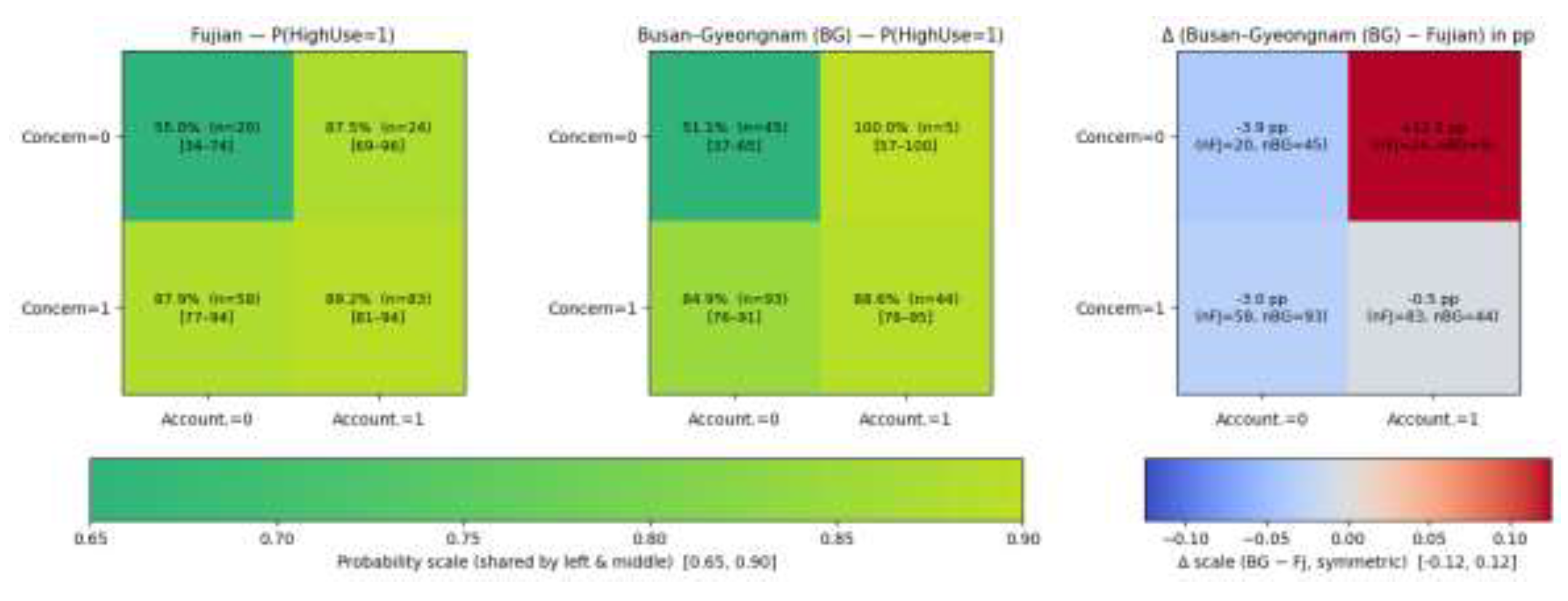
Figure 4.
Bootstrap Verification of Regional Probability Matrices. Notes. Panels show Fujian (left), Busan–Gyeongnam (middle), and Δ (right). Cells report bootstrap means of Pr(HighUse = 1 | Q6, Q7) × 100. Δ is reported in percentage points. Resampling confirms the stability of high-use probabilities and the directional consistency of regional differences.
Figure 4.
Bootstrap Verification of Regional Probability Matrices. Notes. Panels show Fujian (left), Busan–Gyeongnam (middle), and Δ (right). Cells report bootstrap means of Pr(HighUse = 1 | Q6, Q7) × 100. Δ is reported in percentage points. Resampling confirms the stability of high-use probabilities and the directional consistency of regional differences.
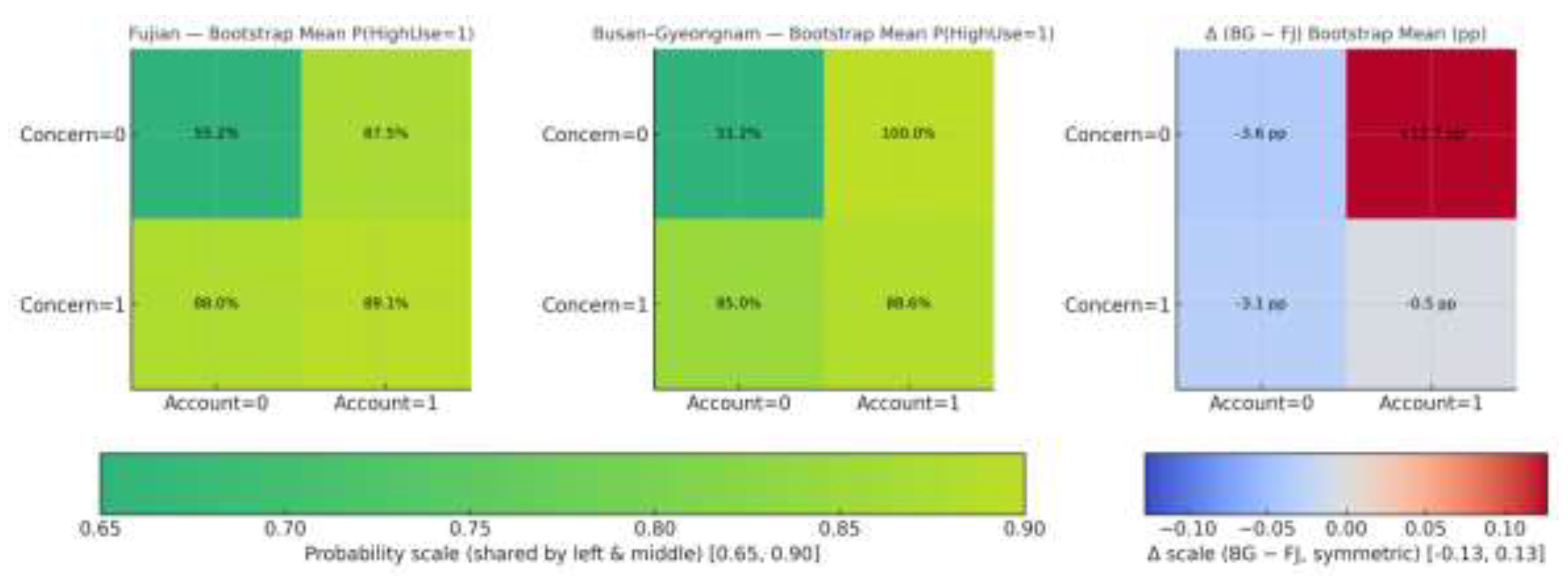
Table 1.
Descriptive Statistics of Survey Samples by Region.
| Region | N | Q6 Concern | Q7 Accountability | Q8 High Use |
| Fujian | 185 | 76.2% | 57.8% | 84.9% |
| Busan–Gyeongnam | 187 | 73.3% | 26.2% | 78.1% |
| Total | 372 | 74.7% | 41.9% | 81.5% |
Notes.Q6 = privacy concern; Q7 = accountability/explanation visibility; Q8 = willingness to use AI-enabled tourism platform services. Percentages are reported.
Table 2.
Bootstrap Means and 95% Confidence Intervals of Pr(HighUse = 1) by Region/Cell.
| Region | Concern | Account | mean | lo95 | hi95 | N |
|---|---|---|---|---|---|---|
| Fujian | 0 | 0 | 55.2% | 30.8% | 77.3% | 20 |
| Fujian | 0 | 1 | 87.5% | 71.9% | 100.0% | 24 |
| Fujian | 1 | 0 | 88.0% | 79.0% | 95.6% | 58 |
| Fujian | 1 | 1 | 89.1% | 81.9% | 95.3% | 83 |
| Busan–Gyeongnam | 0 | 0 | 51.2% | 36.4% | 65.3% | 45 |
| Busan–Gyeongnam | 0 | 1 | 100.0% | 100.0% | 100.0% | 5 |
| Busan–Gyeongnam | 1 | 0 | 85.2% | 77.1% | 92.4% | 61 |
| Busan–Gyeongnam | 1 | 1 | 88.9% | 81.8% | 94.9% | 76 |
Note. Subcells with n < 10, such as Busan–Gyeongnam under Concern = 0 and Account = 1, are reported for transparency but are not used for statistical inference.
Disclaimer/Publisher’s Note: The statements, opinions and data contained in all publications are solely those of the individual author(s) and contributor(s) and not of MDPI and/or the editor(s). MDPI and/or the editor(s) disclaim responsibility for any injury to people or property resulting from any ideas, methods, instructions or products referred to in the content. |
© 2026 by the authors. Licensee MDPI, Basel, Switzerland. This article is an open access article distributed under the terms and conditions of the Creative Commons Attribution (CC BY) license (http://creativecommons.org/licenses/by/4.0/).
Copyright: This open access article is published under a Creative Commons CC BY 4.0 license, which permit the free download, distribution, and reuse, provided that the author and preprint are cited in any reuse.


