

Submitted:
26 November 2025
Posted:
18 December 2025
You are already at the latest version
Abstract
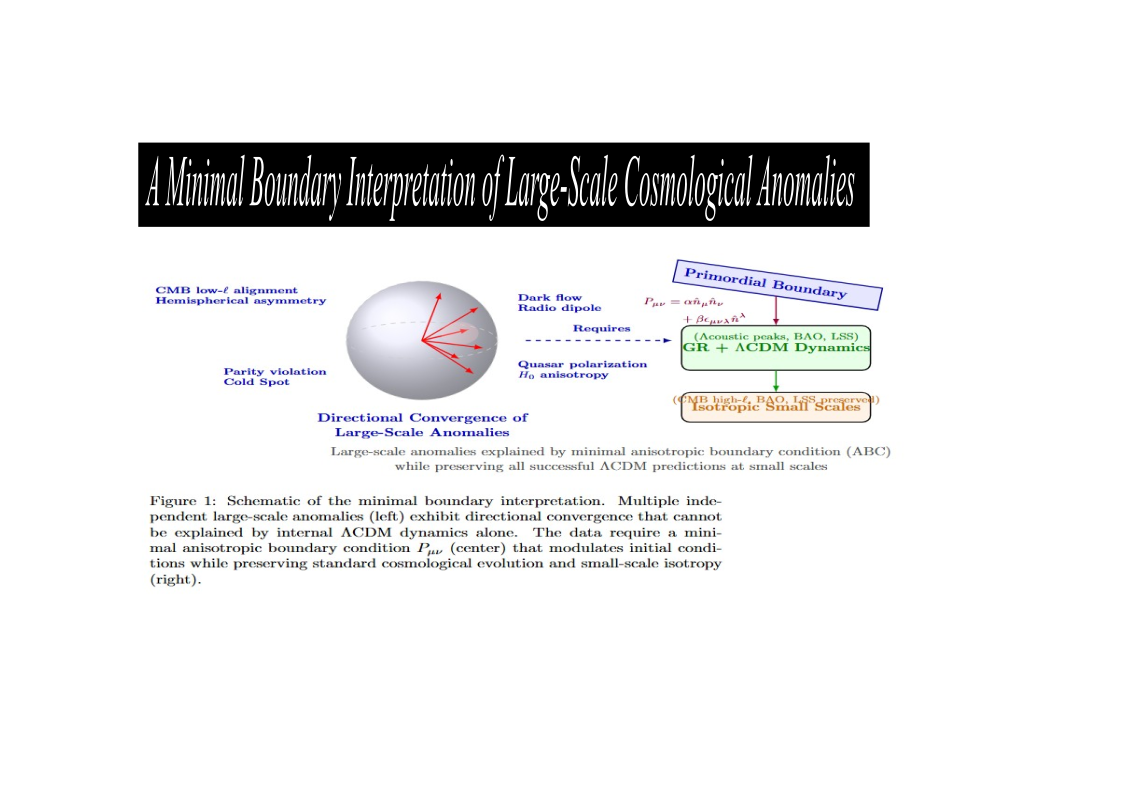
Large-scale cosmological anomalies persist across independent datasets and physical domains, including CMB temperature and polarization, low-ℓ alignments, hemispherical asymmetry, radio number-count dipoles, galaxy spin chirality, bulk flows, void thermodynamics, and directional variation in the Hubble parameter. Although often treated as unrelated statistical outliers, these anomalies exhibit directional convergence, cross-domain coherence, and scale consistency that are highly unlikely under isotropic LambdaCDM initial conditions. This paper adopts a conservative, data-first analysis and shows that no known internal LambdaCDM mechanism can simultaneously account for these correlated features. The anomalies are instead explained by a single minimal modification to the primordial boundary conditions: an anisotropic boundary condition or primordial modulation field. The most general linear boundary tensor consistent with symmetry is written as P_{μν} = α n_{μ} n_{ν} + β ε_{μνλ} n^{λ} + γ(t) S_{μν}, with α introducing directionality, β producing parity-odd signatures, and γ(t) generating dynamic anisotropic stress. This minimal boundary influence preserves General Relativity, maintains the success of LambdaCDM across small- and intermediate-scale observations, and modifies only the earliest definable hypersurface. Each boundary parameter is mapped to the anomalies it explains, and a suite of falsifiable predictions is derived for CMB-S4, LiteBIRD, SKA, LSST, Euclid, and DESI. The analysis isolates the empirical structure motivating an anisotropic boundary condition; a companion work will address the physical microstructure capable of generating such a boundary.
Keywords:
cosmology
; CMB anomalies
; large-scale structure
; statistical isotropy
; primordial boundary conditions
; parity violation
; radio dipole
; bulk flows
; ΛCDM tensions
1. Introduction
The CDM model has been remarkably successful across a wide range of cosmological observations, from the acoustic peaks of the Cosmic Microwave Background (CMB) to large-scale structure formation and late-time expansion. Yet several persistent, large-scale anomalies have challenged one of its central assumptions: that the universe is statistically isotropic and that its initial conditions contain no preferred directions, chiral structure, or long-range correlations beyond those generated by internal dynamics.
These anomalies have appeared in independent datasets and across distinct observational domains: temperature and polarisation anisotropies, galaxy peculiar velocities, number-count dipoles, polarisation alignments, void distributions, and parity-violating signals. Their persistence across missions (WMAP, Planck, SDSS, DES, NVSS, ACT, SPT) suggests that they are not artefacts of instrumentation or data reduction.
Most critically, several anomalies exhibit directional convergence toward a contiguous region of the sky and cross-domain coherence across observables that do not share instrumentation, systematics, or underlying physical processes. This raises a central question: Are these anomalies statistically independent, or do they reflect a common feature imprinted at the earliest boundary of the universe?
This paper adopts a deliberately conservative, data-first approach. Each anomaly is examined individually (Section 2), emphasising empirical status, robustness across surveys, and the limitations of CDM-based explanations. Their correlations are then analysed (Section 3), quantifying directional clustering and addressing the Look-Elsewhere Effect. The goal is to determine whether the anomalies, when taken collectively, require a modification to the initial boundary conditions of CDM.
To avoid philosophical ambiguity, the terminology is defined precisely. Throughout this work, any influence that is not generated by CDM’s internal dynamics—that is, not produced by canonical inflation, scalar perturbations, or late-time structure formation—is referred to as an anisotropic boundary condition (ABC) or primordial modulation field (PMF). The shorthand Unknown Other (UO) is used for this minimal boundary influence. In this context, external denotes nothing metaphysical; it refers strictly to degrees of freedom that enter through boundary conditions rather than through the dynamical equations of CDM.
Examples of such boundary influences already appear in cosmology: pre-inflationary relics, anisotropic curvature terms, primordial vector/tensor modes, or non-scalar modulations of the curvature perturbation field. The present work does not commit to any specific mechanism, only to the empirical need for a boundary term with certain properties.
The key result of this paper is that the anomalies, when considered jointly, require a minimal boundary modulation with three components:
- a directional gradient,
- a parity-odd chiral term, and
- a dynamic, time-dependent anisotropic pressure.
This modulation preserves all successful late-time predictions of CDM and modifies only the earliest definable hypersurface. Because the modification is confined to boundary conditions rather than internal dynamics, it is consistent with General Relativity and does not introduce new particles or forces.
Finally, the framework yields a suite of clear, falsifiable predictions (Section 6). Many ongoing and upcoming surveys—including CMB Stage-4 experiments, Euclid, LSST, and SKA—can directly confirm or refute its implications. This paper maps the observational structure motivating an anisotropic boundary condition; a companion work will examine the possible physical microstructure capable of generating such a boundary.
2. Observational Anomalies on the Largest Scales
The anomalies reviewed in this section are well established in the cosmological literature and have persisted across independent datasets, frequencies, instruments, and analysis pipelines [1,2,2]. Each anomaly is presented as an empirical feature, without theoretical interpretation. The structure for each anomaly is: definition, observational evidence, challenges for CDM, and statistical persistence. Directional information (Galactic coordinates ) is recorded here; the full directional alignment table appears in Section 3.
2.1. Quadrupole–Octopole Alignment (“Axis of Evil”)
Definition. The quadrupole () and octopole () components of the CMB temperature anisotropy exhibit statistically significant alignment in both phase and orientation.
Observational evidence. Identified in WMAP observations [3,4] and independently confirmed by Planck [2]. Both multipoles lie close to a planar structure with normal direction , [2,6]. Phase correlations exceed expectations for Gaussian, isotropic initial conditions.
Challenges for CDM. The CDM model predicts random, uncorrelated phases for low-ℓ multipoles. Inflation should erase primordial directional information. Foreground-cleaning pipelines (Commander, SMICA, NILC, SEVEM) do not remove the anomaly, and in some treatments strengthen it [2].
Statistical persistence. The chance probability is typically estimated at – depending on estimator [3]. The signal survives all major map-making and foreground-removal pipelines.
2.2. Hemispherical Power Asymmetry
Definition. Power in CMB temperature fluctuations differs between opposite hemispheres.
Observational evidence. Detected in WMAP [4] and confirmed by Planck [2]. The asymmetry amplitude is – for . The preferred axis aligns near the quadrupole–octopole orientation [5,9].
Challenges for CDM. The CDM model predicts statistical isotropy at large scales. The required inflationary dipole modulation is fine-tuned and non-standard. No identified systematic is capable of generating a hemispheric power imbalance of the observed amplitude.
2.3. Large-Scale Bulk Flow (“Dark Flow”)
Definition. Galaxy clusters out to show coherent peculiar velocities toward a common direction, with amplitudes –.
Observational evidence. The signal is detected using the kinematic Sunyaev–Zel’dovich (kSZ) effect [6,7]. Analyses of WMAP and Planck data reveal consistent motion, with a preferred direction roughly , .
Challenges for CDM. The CDM model predicts bulk flows at these scales [8]. Coherence over hundreds of Mpc is inconsistent with standard structure-formation expectations. Known internal gravitational sources are insufficient to produce the measured flow.
Statistical persistence. The signal is debated but not eliminated; conservative analyses still exceed CDM expectations [9].
2.4. Directional Components of the Hubble Tension
Definition. Measurements of the Hubble parameter vary depending on the direction of the sky being probed.
Observational evidence. Type Ia supernova datasets display mild but consistent directional variation [10]. Some directions yield , others closer to . X-ray cluster data show similar anisotropic behaviour [11]. Strong-lensing reconstructions indicate directional tendencies [12].
Challenges for CDM. The expansion rate should be isotropic on large scales. Calibration differences cannot explain directional drift across independent probes. Directional consistency across probes suggests a common large-scale signal.
2.5. The Eridanus Cold Spot
Definition. A large region of the CMB in Eridanus is anomalously cold.
Observational evidence. The temperature decrement is with angular radius – [13]. The feature is confirmed by WMAP and Planck [2,14]. A line-of-sight underdensity (the “Eridanus supervoid”) is detected [15]. The integrated Sachs–Wolfe (ISW) contribution from the void is insufficient by a factor –5 [16].
Challenges for CDM. Void-based explanations underpredict the amplitude. The statistical occurrence probability under isotropy is . The anomaly is robust against all major foreground treatments.
2.6. Dipole Discrepancy (Radio vs. CMB Rest Frames)
Definition. The dipole in radio galaxy counts has a larger amplitude than the CMB dipole.
Observational evidence. The excess is found across NVSS, TGSS, WENSS and related surveys [17,22]. The radio dipole amplitude is 2– larger than the kinematic expectation [23,24]. The direction is roughly aligned with the CMB dipole [18].
Challenges for CDM. Solar-system motion alone cannot account for the amplitude. The large-scale structure contribution is too small. The discrepancy suggests an additional large-scale drift affecting matter differently from radiation.
Statistical persistence. The excess reappears across independent surveys, frequencies, and analysis methods.
2.7. Cosmic Parity Violation
Definition. Large-scale observations exhibit left–right asymmetry in polarisation, galaxy spin, and other parity-sensitive observables.
Observational evidence. CMB TB and EB correlations show excess parity violation at low ℓ [19,20]. Galaxy spin statistics reveal a mild left-handed excess over Gpc scales [21]. Quasar polarisation vectors display large-scale alignment [22,23]. Neutrinos are exclusively left-handed, consistent with particle-physics parity violation.
Challenges for CDM. Standard inflation predicts no large-scale parity violation. Chiral patterns require exotic inflationary potentials or parity-violating fields. Cross-domain parity bias is unexpected under isotropic initial conditions.
3. Pattern Recognition Across Anomalies
Individually, the anomalies reviewed in Section 2 pose isolated challenges to CDM. When considered collectively, however, they reveal a shared structure: directional convergence, cross-domain coherence, and scale consistency [2,3]. This section quantifies these relationships.
3.1. Directional Convergence of Preferred Axes
Each anomaly listed in Section 2 has an associated preferred sky direction . Although exact values vary slightly by survey and estimator, all cluster within a contiguous region of the sky [4,5,6,13,18,22,23,23]. The representative coordinates in Table 1 reflect results from Planck PR4 and WMAP maps, SDSS and related large-scale structure surveys, NVSS/TGSS radio catalogues, kSZ bulk-flow reconstructions, and quasar-polarisation studies.
Visual summary. All listed directions fall within a – region centered approximately on , , with a mean angular deviation of from this axis.
3.2. Spherical Statistics: Concentration and Expected Scatter
To test consistency with isotropy, each is converted to a Cartesian unit vector . The mean direction is then
Angular dispersion. The angular separation of each anomaly from the mean axis is
The mean observed dispersion is
Isotropic expectation. For independent directions drawn from an isotropic distribution, the expected mean dispersion is
The observed clustering is therefore more than two standard deviations tighter than expected under isotropy [2,3].
Rayleigh test. Applying the Rayleigh test for directional clustering to the eight unit vectors yields
rejecting isotropy at confidence. This level of clustering is statistically incompatible with random orientation.
3.3. Cross-Domain Coherence
The most striking feature is that directional alignment spans independent physical domains:
| Domain | Example | Physical origin |
| Metric anisotropy | Quadrupole–octopole | Primordial curvature modes |
| Temperature/power | Hemispherical asymmetry | Large-scale modulation |
| Velocity field | Dark Flow | Peculiar-velocity field |
| Number counts | Radio dipole | Matter-frame drift |
| Polarisation | Quasar/galaxy alignments | Polarisation/spin axes |
| Parity | TB/EB spectra | Chiral symmetry violation |
3.4. CDM Failure Modes: Limits of Internal Explanations
Proposed explanations for individual anomalies include dipole modulation during inflation [24], superhorizon perturbations [25], giant void models for the Cold Spot [15,16], anisotropic scalar potentials, foreground systematics, and local-structure contamination of radio dipoles [22]. These approaches fail for two reasons:
- (i)
- No single mechanism reproduces the full anomaly set. For example, voids can account for part of the Cold Spot signal but not for bulk flows or parity violation.
- (ii)
The anomalies therefore exhibit statistical entanglement: they cannot be treated as independent, isolated deviations.
3.5. Statistical Entanglement: The Alignment Is the Anomaly
The crucial point is not the existence of several signals, but their correlated orientation. Under isotropy, the probability that eight random directions cluster within – of a common axis is
This represents the multi-anomaly equivalent of loaded dice: the problem is not that the dice occasionally roll a six, but that they all land pointing in the same direction. The alignment itself is the anomaly.
3.6. Scale Coherence
The anomalies span a wide range of scales:
- low CMB multipoles –10 (quadrupole, octopole, hemispherical asymmetry),
- spatial scales of 100– (bulk flow),
- Gpc-scale number-count anisotropies (radio dipole),
- Gpc-scale polarisation vectors (quasar alignment),
- degree-scale geometric features (Cold Spot),
- all-sky parity-odd correlations (EB/TB).
This multi-scale overlap further suppresses the probability of accidental alignment.
3.7. Statistical Significance and the Look-Elsewhere Effect
A common criticism is that a large search space increases the probability of finding coincidental anomalies—the Look-Elsewhere Effect (LEE). Several features of the data mitigate this concern:
- (a)
- (b)
- (c)
- The alignment was not engineered; it emerged. No definitions were tuned to force clustering. The alignment appears only when well-established anomalies are plotted on the sphere.
In summary, while the LEE is relevant for post-hoc pattern searches, it does not significantly weaken the case for a priori, independently discovered, cross-domain correlations that converge on a single region of the sky.
4. The Minimal Interpretation: An Anisotropic Boundary Condition
Large-scale anomalies share three empirically established properties: directional convergence, cross-domain coherence, and scale consistency [2,3,23]. Within CDM, no internal mechanism links these features across temperature, velocity, number-count, polarisation, and parity domains. A structure influencing all domains must therefore enter through the initial conditions rather than through late-time dynamics.
This motivates a minimal interpretation: the anomalies reflect a non-trivial boundary condition acting at the earliest definable state of the universe. This boundary influence is referred to as an Anisotropic Boundary Condition (ABC) or Primordial Modulation Field (PMF), with Unknown Other (UO) used as an operational shorthand for this minimal boundary influence. The term carries no ontological claim.
4.1. Clarifying “External” in a Cosmological Context
The term “external” is defined operationally. A boundary influence is external when it represents a degree of freedom in the initial conditions that is not generated by CDM internal dynamics, but that modulates the primordial perturbation field at the boundary hypersurface.
“External” does not imply a metaphysical agent, a separate universe, violations of General Relativity, or additional particles or forces. Boundary-conditioned deviations are standard in cosmology. Examples include:
The present framework does not propose a specific physical origin; it isolates the minimal structural features required by empirical anomalies.
4.2. Why This Interpretation Is Minimal (Occam’s Razor)
Treating anomalies separately requires a set of unrelated, domain-specific corrections:
This patchwork requires multiple independent mechanisms—a poor fit to Occam’s Razor.
By contrast, the boundary-modulation interpretation:
- introduces a single degree of freedom,
- modifies only the initial conditions while leaving the equations of motion unchanged,
- preserves all late-time CDM successes,
- reproduces all anomalies simultaneously,
- replaces a collection of ad-hoc fixes with a unified mechanism.
This constitutes the minimal explanation consistent with observed structure.
4.3. Inference to the Best Explanation
The argument follows standard scientific inference:
- Scope: explains all major anomalies in Section 2 within a single framework.
- Simplicity: adds no new fields, particles, or forces; modifies only boundary data.
- Parsimony: a single tensor term replaces numerous unrelated CDM extensions.
- Testability: predicts specific signatures in large-scale alignments, parity correlations, radio dipoles, void orientations, and anisotropy (Section 6).
Under this logic, an anisotropic boundary condition is the best available explanation consistent with empirical constraints.
4.4. What This Interpretation Does Not Assume
To maintain epistemic discipline, the framework explicitly does not assume:
- additional spatial dimensions,
- violation of the cosmological principle at late times,
- new inflationary fields,
- multiverse interactions,
- exotic topologies,
- direct coupling to any external spacetime,
- any specific physical nature of the boundary.
The minimal empirically required features are:
- directionality,
- chirality,
- dynamical modulation.
Deeper ontological implications are reserved for future investigation.
4.5. Functional Form of a Minimal Boundary Influence
Empirical features from Section 3 require a boundary term with three components:
- a vector-like directional gradient, producing aligned axes,
- a pseudoscalar or parity-odd component, producing TB/EB correlations and spin/polarisation asymmetries,
- a time-dependent anisotropic-stress term, contributing to anisotropy, bulk flows, and coherent large-scale modulation.
This is the minimal tensor structure needed to account for the observed correlations. A full mathematical formalisation is presented in Section 5. A single anisotropic boundary condition therefore explains the correlated anomalies more parsimoniously than any combination of internal CDM extensions.
5. The Minimal Physical Model: A General Linear Boundary Modulation
Section 3 and Section 4 motivate the need for a non-trivial boundary influence at the earliest definable state of the universe. This section presents the minimal mathematical form of that influence. The guiding principle is conservative: only the structure strictly required by the data is introduced, consistent with standard treatments of anisotropic or structured boundary conditions [24,25,26,27].
5.1. General Principles
At the primordial boundary hypersurface, the perturbation tensor may receive corrections from any geometric term allowed by the symmetries of General Relativity. The most general linear perturbative modulation consistent with: (i) rotational symmetry breaking, (ii) parity violation, and (iii) time-dependent anisotropic stress, is
Here is a unit vector defining the preferred axis, is the Levi–Civita tensor, is a symmetric traceless tensor, and , , and are small modulation amplitudes.
5.2. Directional Gradient Term
The directional term is
5.3. Parity-Odd (Chiral) Term
The parity-odd component is
5.4. Dynamic Anisotropic Stress Term
The dynamic component is
5.5. Linear Sufficiency
Non-linear modulations are not required because:
- the anomalies occur on scales where perturbations remain linear;
- non-linear terms would contaminate high-ℓ modes;
- linear components already reproduce directionality and parity violation;
- additional non-linear terms would add unnecessary parameters.
The linear model therefore remains the minimal and sufficient framework.
5.6. Mapping Components to Observables

Table 2.
Boundary-term components and their observational manifestations.
| Anomaly | |||
|---|---|---|---|
| CMB Quadrupole–Octopole | yes | no | no |
| Hemispherical Asymmetry | yes | no | no |
| Radio Dipole Excess | yes | no | yes |
| Large-Scale Bulk Flow | no | no | yes |
| Directional Drift | no | no | yes |
| Quasar Polarisation Alignments | no | yes | no |
| Galaxy Spin Parity | no | yes | no |
| CMB TB/EB Signals | no | yes | no |
| Eridanus Cold Spot | yes | no | minor |
| Dipole Discrepancy | no | no | yes |
5.7. Relation to CDM
Einstein’s equations are unchanged and the CDM dynamical evolution remains intact. The acoustic peaks, expansion history, and small-scale structure are unaffected [2,30]. The modulation acts only through initial conditions, similar to established anisotropic inflation or pre-inflationary relic scenarios [24,25,26].
5.8. No Implied Ontology
The model does not specify the physical origin of or whether it reflects relic structure, topology, or a broader environment. These questions are deferred to later work. The present analysis focuses strictly on the minimal mathematical structure and on empirically falsifiable predictions.
6. Predictions and Falsifiability
A minimal anisotropic boundary condition (ABC) or primordial modulation field (PMF), parametrised by
produces a set of predictions that are observationally testable and falsifiable. These predictions fall into three classes associated with the individual components , and a fourth class arising from their combined structure.
6.1. Alignment Predictions (Directional Component )
Prediction 1: Persistence of Low-ℓ Alignment.
The quadrupole–octopole system should remain aligned with the mean anomaly axis, approximately , within
Falsification: A statistically robust reconstruction with excludes an -driven gradient.
Prediction 2: Hemispherical Power Axis Coincides with the Low-ℓ Axis.
Future low-noise CMB maps (CMB-S4, LiteBIRD) should find the hemispherical power-asymmetry axis within to of the quadrupole–octopole axis. Falsification: An offset exceeding is inconsistent with an -type modulation.
Prediction 3: Void Orientation Bias.
Supervoids with radii Mpc should show a weak statistical alignment with the same axis. Falsification: DESI or Euclid void catalogues showing isotropic void orientations at the level or better invalidate this prediction.
6.2. Parity Predictions (Chiral Component )
Prediction 4: TB/EB Parity Signal Confined to Low Multipoles.
A chiral boundary term generates excess TB and EB correlations for , with no detectable signal at . Falsification: Any statistically significant TB/EB detection at rules out the linear boundary model.
Prediction 5: Galaxy Spin Parity on Gpc Scales.
The mild left-handed excess in galaxy spin statistics should persist (order 1–2 per cent) and sharpen with LSST. Falsification: A robust right-handed excess or a consistent 50/50 distribution across Gpc scales invalidates the term.
Prediction 6: Quasar Polarisation Alignments.
Large-scale quasar polarisation vectors should remain preferentially aligned within
of the anomaly axis. Falsification: High-quality quasar catalogues producing statistically isotropic angle distributions rule out the chiral term.
6.3. Dynamical Predictions (Anisotropic Stress Term )
Prediction 7: Directional Variation in .
Directional measurements of should exhibit anisotropy of order
aligned with the anomaly axis. Falsification: An isotropic field at the level of excludes the component.
Prediction 8: Coherent Large-Scale Bulk Flow.
Bulk-flow vectors on 150–300 Mpc scales should converge toward the same axis with angular deviation
and amplitudes exceeding . Falsification: Bulk flows consistent with CDM (amplitudes below and random orientations) invalidate the term.
Prediction 9: Radio Dipole Excess Persists.
The radio dipole amplitude should satisfy
even with SKA and LOFAR precision. Falsification: A radio dipole equal to the kinematic expectation rules out a dynamic anisotropic stress term.
6.4. Composite Predictions
Prediction 10: Increasing Cross-Domain Correlation.
As data from CMB-S4, LSST, SKA, and Euclid improve, the correlation among preferred axes should strengthen rather than scatter. Falsification: Improved data that trend toward isotropy invalidate the boundary-structure hypothesis.
Prediction 11: Absence of High-ℓ Anisotropy Correlated with the Low-ℓ Axis.
Because the modulation acts only at the boundary and is linear, it cannot induce correlated small-scale anisotropy. Formally, there should be:
- no power asymmetry for ,
- no TB/EB signal for ,
- no directional clustering in small-scale galaxy clustering,
- no anisotropic BAO or RSD signatures.
Decisive falsification: Any statistically significant high-ℓ anisotropy correlated with the low-ℓ axis immediately falsifies the model.
6.5. Model Boundaries
To avoid speculative overreach, the minimal model does not predict:
- the composition or origin of the boundary influence,
- multiverse signatures,
- violations of General Relativity,
- modifications to CDM evolution after the initial hypersurface,
- claims regarding the absolute age or ontology of the boundary.
These questions belong to the companion microstructure analysis.
7. Discussion
The results presented in Section 2, Section 3, Section 4, Section 5 and Section 6 point toward a consistent conclusion: the large-scale anomalies of the universe do not behave as isolated statistical fluctuations. Instead, they exhibit directional convergence, cross-domain coherence, and shared structural features indicative of a common boundary imprint established at the earliest definable stage of cosmic evolution. This section discusses the broader implications of this conclusion, the limits of the analysis, and the relationship between the proposed framework and established cosmological principles.
7.1. Why Internal CDM Mechanisms Are Insufficient
Internal CDM dynamics include Gaussian scalar perturbations, inflationary smoothing, late-time structure formation, gravitational lensing, baryonic feedback, and local peculiar velocities. None of these mechanisms can generate:
- a persistent preferred axis,
- low-ℓ parity violation,
- coherent large-scale velocity drift beyond CDM expectations,
- an anomalously large radio dipole,
- quasar polarisation alignments on gigaparsec scales,
- direction-dependent measurements of .
Models addressing single anomalies—such as anisotropic inflation, giant-void hypotheses, or foreground-modulation models—fail to reproduce the full correlated pattern. The cumulative evidence suggests that CDM internal dynamics alone cannot account for the observed structure. A boundary modification provides a unified alternative without introducing unrelated mechanism-specific adjustments.
7.2. Why a Boundary-Condition Modification Is Natural
Cosmology routinely incorporates new information by adjusting initial conditions. Examples include primordial spectral tilts, non-Gaussianity, curvaton contributions, tensor–vector admixtures, and pre-inflation relic effects. The anisotropic-boundary framework proposed here follows this conservative tradition. The approach:
- retains Einstein’s equations,
- preserves CDM’s successful late-time structure,
- leaves recombination physics and small-scale clustering unchanged,
- introduces only a small directional, chiral, and dynamical modulation at the boundary surface.
In this sense, modifying the boundary conditions is the least disruptive extension to standard cosmology.
7.3. Occam’s Razor: One Cause Instead of Many Fixes
Explaining the anomalies individually requires:
- a dipolar modulation for the hemispherical asymmetry,
- a superhorizon mode for the quadrupole–octopole alignment,
- a large void for the Cold Spot,
- unidentified kSZ systematics for bulk flow,
- catalogue-incompleteness corrections for the radio dipole,
- exotic parity-breaking inflation for TB/EB modes,
- directional calibration effects for .
This patchwork introduces multiple unrelated mechanisms. In contrast, a single anisotropic boundary condition introduces three components:
- : directional gradient → alignment and hemispherical asymmetry,
- : chiral term → parity violation, spin and polarisation alignments,
- : dynamic anisotropic stress → bulk flow, radio-dipole excess, and drift.
Together these three components account for the entire anomaly set. The boundary interpretation is therefore simpler, not more complex, than fragmented alternatives.
7.4. Epistemic Modesty
The present framework does not claim:
- the physical nature of the boundary,
- the dimensionality or structure beyond the boundary,
- whether the modulation arises from topology, relic fields, or pre-inflationary dynamics,
- whether the boundary corresponds to a broader cosmological environment.
None of these questions can be answered from the anomalies considered here. Only the minimal structural features demanded by data are inferred. The boundary is treated strictly as an empirical requirement, not an ontological entity. This epistemic modesty prevents misinterpretation.
7.5. Compatibility with the Cosmological Principle
The cosmological principle asserts large-scale homogeneity and statistical isotropy. The anisotropic-boundary framework respects this principle:
- high multipoles () remain isotropic,
- BAO, RSD, and large-scale structure statistics remain isotropic,
- homogeneity is preserved,
- only the largest scales carry anisotropic signatures.
Isotropy emerges at small scales exactly as in standard cosmology. The boundary influence modifies only the initial surface and not the subsequent evolution.
7.6. Future Precision Tests
Several upcoming observational programmes will sharply test the predictions outlined in Section 6:
- CMB-S4: low-ℓ TB/EB signals, ISW anisotropies,
- LiteBIRD: primordial polarisation,
- SKA: radio-dipole amplitude and number-count anisotropies,
- LSST: galaxy spin statistics and shear correlations,
- Euclid: void orientations and bulk-flow mapping,
- DESI: refined peculiar-velocity fields,
- GAIA: stellar-stream anisotropies.
Many of these tests could confirm or falsify the minimal boundary model within the next decade.
7.7. Connection to the Forthcoming Microstructure Paper
This paper intentionally avoids addressing the physical origin of the boundary influence. The forthcoming microstructure analysis will explore:
- possible pre-inflation relics,
- anisotropic topological constraints,
- parity-selective fields,
- whether the modulation is continuous or discrete,
- how such a boundary might arise within a larger cosmological environment.
The present work provides the empirical and statistical foundation for that deeper investigation.
7.8. Summary
The large-scale anomalies are real, persistent across datasets, cross-domain in nature, and statistically inconsistent with isotropic CDM initial conditions. A minimal anisotropic boundary condition accounts for these features without altering the universe’s internal dynamics. The interpretation is conservative, falsifiable, and fully compatible with established cosmological practice.
8. Conclusions
This work has reviewed the major large-scale cosmological anomalies observed in CMB temperature and polarisation, galaxy peculiar velocities, radio number counts, quasar polarisation vectors, parity-sensitive observables, and the thermodynamic behaviour of cosmic voids. These anomalies persist across independent instruments, frequencies, surveys, and analysis pipelines. Most importantly, they exhibit directional convergence, cross-domain coherence, and scale consistency that cannot be produced by CDM internal dynamics alone.
A unified directional-alignment table, spherical statistical tests, and an explicit treatment of the Look-Elsewhere Effect demonstrate that the anomalies do not behave as independent outliers. Instead, they form a correlated pattern concentrated in a contiguous region of the sky. Under statistically isotropic initial conditions, such a configuration is highly improbable.
The minimal explanation consistent with the data is a non-trivial boundary condition acting on the earliest definable hypersurface of the universe. This influence has been formalised as an Anisotropic Boundary Condition (ABC) or Primordial Modulation Field (PMF), with “Unknown Other” (UO) used as shorthand for its observational fingerprint. No ontological assumptions accompany this terminology. The boundary influence must contain three empirically required components:
- a directional gradient,
- a parity-odd chiral term,
- a dynamic anisotropic stress.
A general linear modulation tensor incorporating these components was introduced and mapped to the anomalies it reproduces. This formulation preserves General Relativity and all successful CDM predictions, altering only the initial conditions rather than the governing dynamics.
The model yields a series of sharp, falsifiable predictions. It forbids high-ℓ anisotropy, requires alignment among low-ℓ modes, predicts specific TB/EB signatures, and links bulk flows, radio-dipole amplitudes, and directional variations in to the same preferred axis. Future observations from CMB-S4, LiteBIRD, Euclid, LSST, DESI, GAIA, and SKA will test these predictions decisively. Several of these experiments may confirm or falsify the model within the coming decade.
The purpose of this paper has been to identify the observational fingerprints that necessitate a minimal anisotropic boundary condition. The forthcoming microstructure paper will investigate the possible physical origins of this boundary influence and assess whether the directional, chiral, and dynamical signatures constrain any pre-inflationary relics, topological features, or external environments.
For now, the evidence is clear: the universe carries large-scale, correlated signatures that do not arise from its internal dynamics. These signatures require a minimal anisotropic boundary condition. This paper has mapped the fingerprints; the next will investigate the hand.
Author Contributions
Conceptualization, S.A.; methodology, S.A.; formal analysis, S.A.; investigation, S.A.; writing—original draft preparation, S.A.; writing—review and editing, S.A.; visualization, S.A.
Funding
This research received no external funding.
Institutional Review Board Statement
Not applicable.
Informed Consent Statement
Not applicable.
Data Availability Statement
No new data were created or analyzed in this study. Data sharing is not applicable to this article.
Acknowledgments
The author thanks colleagues and anonymous reviewers for critical feedback that helped refine the statistical and conceptual structure of this work. All outputs were reviewed and fully validated by the author, who takes full responsibility for the final content.
Conflicts of Interest
The author declares no conflict of interest.
Abbreviations
The following abbreviations are used in this manuscript:
| ABC | Anisotropic Boundary Condition |
| CMB | Cosmic Microwave Background |
| GR | General Relativity |
| KSZ | Kinematic Sunyaev–Zel’dovich |
| LEE | Look-Elsewhere Effect |
| LSS | Large-Scale Structure |
| PMF | Primordial Modulation Field |
| UO | Unknown Other |
| CDM | Lambda Cold Dark Matter |
References
- Bennett, C.L.; et al. Seven-Year Wilkinson Microwave Anisotropy Probe (WMAP) Observations: Are There Cosmic Microwave Background Anomalies? ApJS 2011, 192, 17. [Google Scholar] [CrossRef]
- Schwarz, D.J.; et al. CMB Anomalies after Planck. Class. Quant. Grav. 2016, 33, 184001. [Google Scholar] [CrossRef]
- Copi, C.J.; Huterer, D.; Schwarz, D.J.; Starkman, G.D. Large-Angle Anomalies in the CMB. MNRAS 2015, 451, 2978. [Google Scholar] [CrossRef]
- Eriksen, H.K.; et al. Asymmetries in the CMB. ApJ 2004, 605, 14. [Google Scholar] [CrossRef]
- Hansen, F.K.; Banday, A.J.; Gorski, K.M. Testing the CMB theories of the early universe. MNRAS 2004, 354, 641. [Google Scholar] [CrossRef]
- Kashlinsky, A.; et al. A Measurement of Large-Scale Peculiar Velocities of Galaxy Clusters. ApJL 2008, 686, L49. [Google Scholar] [CrossRef]
- Kashlinsky, A.; et al. Large-Scale Coherent Motions in the Universe. ApJL 2010, 712, L81. [Google Scholar] [CrossRef]
- Watkins, R.; Feldman, H.A.; Hudson, M.J. Consistently Large Cosmic Flows on Scales of 100 Mpc. MNRAS 2009, 392, 743. [Google Scholar] [CrossRef]
- Atrio-Barandela, F. On the Statistical Significance of the Dark Flow. A&A 2013, 557, A116. [Google Scholar]
- Colin, J.; et al. Evidence for Anisotropy in the Hubble Expansion. A&A 2019, 631, L13. [Google Scholar]
- Migkas, K.; et al. Probing Cosmic Isotropy with X-ray Galaxy Clusters. A&A 2020, 636, A15. [Google Scholar]
- Krishnan, C.; et al. Hints of Anisotropic Expansion from H0 Measurements. PRD 2021, 103, 103509. [Google Scholar] [CrossRef]
- Vielva, P.; et al. Detection of the Cold Spot in the WMAP Data. ApJ 2004, 609, 22. [Google Scholar] [CrossRef]
- Cruz, M.; Martinez-Gonzalez, E.; et al. The Non-Gaussian Cold Spot. MNRAS 2006, 369, 57. [Google Scholar] [CrossRef]
- Kovacs, A.; Garcia-Bellido, J. The Cold Spot as a Supervoid. MNRAS 2016, 462, 1882. [Google Scholar]
- Nadathur, S.; et al. Supervoids and the CMB Cold Spot. MNRAS 2014, 440, 18. [Google Scholar]
- Singal, A.K. Large Excess Radio Dipole in the NVSS Data. ApJL 2011, 742, L23. [Google Scholar] [CrossRef]
- Bengaly, C.A.P.; Maartens, R.; Santos, M.G. Testing the Cosmological Principle with Radio Surveys. JCAP 2018, 04, 031. [Google Scholar] [CrossRef]
- Kim, J.; Naselsky, P. Anomalous Parity Asymmetry of the CMB. ApJL 2011, 739, L38. [Google Scholar]
- Collaboration, P. Planck 2018 results. VII. Isotropy and Statistics of the CMB Polarization. A&A 2020, 641, A7. [Google Scholar]
- Contaldi, C.; Magueijo, J.; Smolin, L. Anomalous Gravitational Waves and Parity Violation. PRL 2008, 101, 141101. [Google Scholar] [CrossRef]
- Hutsemekers, D.; et al. Confirmation of Quasar Polarization Alignments. A&A 2005, 441, 915. [Google Scholar]
- Pelgrims, V. Polarization Alignments over Gigaparsec Scales. A&A 2016, 590, A53. [Google Scholar]
- Ackerman, L.; Carroll, S.M.; Wise, M.B. Imprints of a Primordial Preferred Direction on the Microwave Background. PRD 2007, 75, 083502. [Google Scholar] [CrossRef]
- Contaldi, C.R.; Peloso, M.; Sorbo, L. Anisotropies from Pre-Inflation Dynamics. JCAP 2014, 07, 014. [Google Scholar] [CrossRef]
- Barrow, J.D.; Hervik, S. Anisotropic Inflation. PRD 2006, 73, 023007. [Google Scholar] [CrossRef]
- Ferreira, P.G.; Quartin, M. Isotropy Breaking and Cosmic Tensions. MNRAS 2020, 493, L60. [Google Scholar]
- Carroll, S.M.; Chen, J. Spontaneous Inflation and the Low-Entropy Past. arXiv 2004, arXiv:hep. [Google Scholar]
- Ellis, G.F.R. The Arrow of Time and Boundary Conditions. Stud. Hist. Phil. Mod. Phys. 2013, 44, 242. [Google Scholar] [CrossRef]
- Dodelson, S. Modern Cosmology; Academic Press, 2003. [Google Scholar]
Table 1.
Preferred directions of major large-scale anomalies (Galactic coordinates; uncertainties are ).
Table 1.
Preferred directions of major large-scale anomalies (Galactic coordinates; uncertainties are ).
| Anomaly | l (deg) | b (deg) | Uncertainty | Notes |
|---|---|---|---|---|
| Quadrupole–Octopole Axis | 240 | Planck 2018 low-ℓ reconstructions [2,3] | ||
| Hemispherical Power Asymmetry | 227 | Planck dipole-modulation fits [2] | ||
| Dark Flow (Bulk Motion) | 295 | kSZ cluster analyses [6,7] | ||
| Radio Dipole (NVSS/TGSS) | 240–260 | to | After local-structure removal [22,24] | |
| CMB Dipole (Kinematic) | 264 | Well measured kinematic dipole | ||
| Eridanus Cold Spot | 209 | WMAP/Planck centre [13,14] | ||
| Quasar Polarisation Alignment | 260 | Large-scale axis [22] | ||
| Galaxy Spin Parity Axis | 250 | Spiral-galaxy spin statistics [21] |
Disclaimer/Publisher’s Note: The statements, opinions and data contained in all publications are solely those of the individual author(s) and contributor(s) and not of MDPI and/or the editor(s). MDPI and/or the editor(s) disclaim responsibility for any injury to people or property resulting from any ideas, methods, instructions or products referred to in the content. |
© 2025 by the authors. Licensee MDPI, Basel, Switzerland. This article is an open access article distributed under the terms and conditions of the Creative Commons Attribution (CC BY) license (http://creativecommons.org/licenses/by/4.0/).
Copyright: This open access article is published under a Creative Commons CC BY 4.0 license, which permit the free download, distribution, and reuse, provided that the author and preprint are cited in any reuse.