Preprint
Case Report

This version is not peer-reviewed.

Primary Uterine NUT Carcinoma: A Case Report and Literature Review

Submitted:

16 December 2025

Posted:

18 December 2025

You are already at the latest version

Abstract

Nuclear protein in testis (NUT) carcinoma is a rare, aggressive, and poorly differentiated epithelial malignancy characterized by the rearrangement of NUTM1 (NUT middle carcinoma family member 1) on 15q14. It primarily originates along the midline structures, including the head, neck, thorax, and mediastinum. Although NUT carcinoma of the pelvic gynecological organs is exceedingly rare, reported cases have been limited to primary or metastatic ovarian tumors. Here, we present the first documented case of primary uterine NUT carcinoma. A 53-year-old postmenopausal woman presented with abnormal uterine bleeding and a uterine mass. She underwent a total abdominal hysterectomy with bilateral salpingo-oophorectomy. The initial postoperative histopathological evaluation suggested undifferentiated endometrial sarcoma; however, subsequent immunohistochemical (IHC) analysis and fluorescence in situ hybridization revealed NUTM1 rearrangement, confirming the diagnosis of NUT carcinoma. The patient experienced tumor recurrence six months postoperatively and succumbed to the disease nine months later. The pathological diagnosis was challenging; the presence of abrupt squamous differentiation prompted further IHC analysis, leading to the definitive diagnosis. Primary uterine NUT carcinoma may be misdiagnosed as other undifferentiated uterine tumors due to its rarity and histological overlap. Given the diagnostic challenges, NUT IHC staining and molecular testing for NUTM1 rearrangement should be considered in undifferentiated uterine tumors with ambiguous histopathological features.

Keywords: 
;  ;  ;  ;  

1. Introduction

Nuclear protein in testis (NUT) carcinoma is a rare, highly aggressive, and poorly differentiated epithelial malignancy characterized by the rearrangement of NUTM1 (NUT midline carcinoma family member 1) on 15q14 [1]. It was first described in 1991 as a thymic carcinoma in young adults with a t(15;19)(q15;p13) translocation [2]. Since its initial identification, NUT carcinoma has been increasingly recognized through numerous case reports. Although it primarily arises along the midline of the body, most commonly in the head and neck, thorax, and mediastinum, it has also been reported in extramidline sites, including the lung, salivary glands, pancreas, bladder, kidney, adrenal glands, ovary, and bone [1,3,4]. Although NUT carcinoma predominantly affects adolescents and young adults, it can occur at any age, ranging from infancy to the eighth decade of life [5]. The prognosis remains extremely poor, with a median overall survival of only 6.7 months in the absence of a standardized effective therapy [6].
Only a few cases of NUT carcinoma involving pelvic gynecological organs have been reported, all of which were either primary or metastatic ovarian NUT carcinomas [4,7,8,9,10]. To the best of our knowledge, this study presents the first reported case of primary uterine NUT carcinoma.

2. Case Report

A 53-year-old postmenopausal female (gravida 3, para 2) presented with abnormal uterine bleeding and was referred to our institution with a suspected uterine fibroid or sarcoma. Her past medical history was unremarkable except for a previous surgical abortion. Pelvic magnetic resonance imaging (MRI) revealed a 7.4-cm mass located within the posterior wall of the lower uterine body (Figure 1A, B). Diffusion-weighted imaging (DWI) demonstrated a high signal within a cystic component, suggestive of degenerative, necrotic, or malignant tissue (Figure 1C). Given the well-defined borders of the mass and the absence of overt invasion or metastasis, our initial differential diagnosis included cellular leiomyoma and low-grade endometrial stromal sarcoma. Laboratory tests, including tumor markers (LDH 173 U/L, CEA 1.3 ng/mL, CA 19-9 13 U/mL, and CA-125 7 U/mL), were within normal limits, and both endocervical and endometrial smears were negative. Endometrial biopsy did not indicate malignancy.
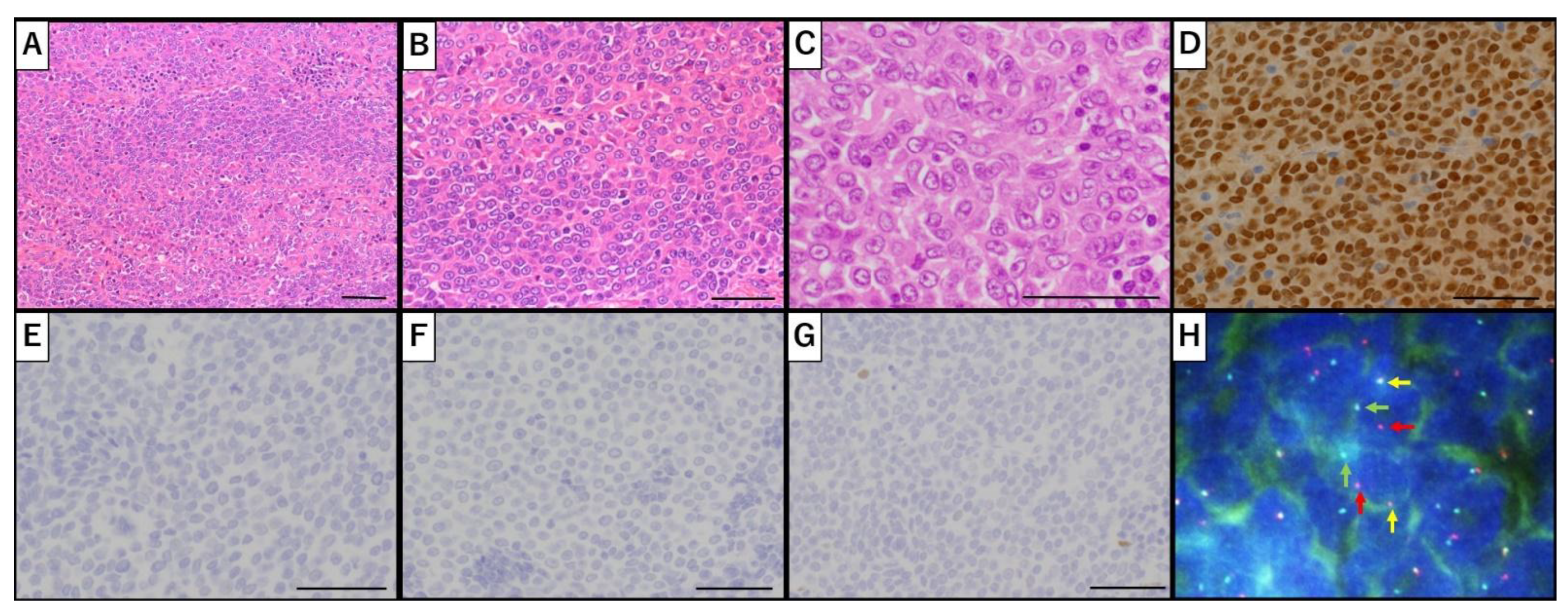
Approximately 3 months after the initial referral, the patient underwent an abdominal total hysterectomy with bilateral salpingo-oophorectomy. Intraoperatively, the uterine mass was mobile and free of adhesions, extrauterine invasion, or metastasis. Histopathological evaluation revealed uniformly round tumor cells with moderate amounts of amphophilic cytoplasm and centrally located, enlarged nuclei with prominent nucleoli arranged in a loosely cohesive pattern (Figure 2A, B). Although the tumor invaded deeply into the myometrium, no evidence of extrauterine extension was observed. A broad IHC panel was performed to evaluate various uterine tumors; however, the findings remained inconclusive, with undifferentiated carcinoma, high-grade endometrial stromal sarcoma, and undifferentiated uterine sarcoma all being considered (Table 1). Subsequent review in collaboration with the pathology team revealed focal squamous differentiation (Figure 2C), prompting additional immunostaining for NUT, which demonstrated diffuse positivity (Figure 2D). Moreover, NUTM1-break-apart signals were confirmed by fluorescence in situ hybridization (FISH), which genetically proved NUTM1-rearrangement of the tumor (Figure 2H). Given the possibility that the NUT carcinoma might have originated from other sites (e.g., head and neck or thorax), a fluorodeoxyglucose positron emission tomography (FDG-PET) scan was performed; however, no abnormal FDG uptake suggestive of a primary or residual tumor was identified. Thus, a final diagnosis of primary uterine corpus NUT carcinoma was established. Ascites cytology was negative.
Considering the lack of effective postoperative treatments for NUT carcinoma, the patient was closely monitored with follow-up visits every 2 months. Six months postoperatively, small nodules were detected on the vaginal wall and pelvic floor; pathological analysis confirmed recurrent NUT carcinoma. FDG-PET further revealed disseminated nodules in the abdominal and retroperitoneal cavities, pleural metastases with associated effusions, and multiple mediastinal and cervical lymph node metastases. A computed tomography scan of the brain did not reveal any metastatic lesions. Comprehensive genomic profiling was proposed to identify potential therapeutic options; however, acknowledging the grim prognosis, the patient declined further invasive diagnostics and opted to focus solely on palliative care. Following a unilateral percutaneous nephrostomy performed for ureteral stricture secondary to pelvic seeding, she was transferred to a palliative care unit at another institution. The patient ultimately succumbed to her disease 15 months after the initial surgery.

3. Discussion

NUT carcinoma is well recognized in head and neck surgery; however, its occurrence in gynecology remains exceptionally rare. We conducted a literature review for NUT carcinoma cases in pelvic gynecological organs, including case reports, systematic reviews, meta-analyses, randomized controlled trials, and clinical trials. Various databases were consulted: all cases from Web of Science overlapped with those from PubMed, and no cases were identified from Cochrane Library (Supplementary Figure S1). Currently, only six cases of primary or metastatic ovarian NUT carcinoma have been documented (Table 2) [4,7,8,9,10,11]. To the best of our knowledge, this report represents the first case of primary uterine NUT carcinoma.
A preoperative suspicion of NUT carcinoma was Impossible. In our patient, a non-contrast MRI, performed owing to her history of asthma, suggested cellular leiomyoma or low-grade endometrial stromal sarcoma. Although gadolinium-enhanced imaging might have accentuated necrotic features within the mass, such findings could nonetheless have been interpreted as benign. In addition, normal blood tests and negative results from cytology and endometrial biopsy contributed little to clinical suspicion, leaving only intermittent uterine bleeding and a high signal on DWI as indicators of an underlying malignancy. In the absence of distant metastasis or lymphadenopathy, diagnostic surgery became the sole method to establish a definitive diagnosis.
Postoperative pathological evaluation further underscored the diagnostic challenges. NUT carcinoma typically exhibits nests and sheets of primitive round cells with prominent nucleoli, enlarged nuclei, frequent mitoses, and areas of necrosis, features that were present in our case [5]. Regarding IHC in typical NUT carcinoma, cytokeratins (AE1/AE3, CK7, CK20) are expressed in 75% of the cases, whereas p63 or p40 are observed in nearly 50%, consistent with squamous cell carcinoma. However, this indicates that cytokeratins and p40/p63 can be negative, as observed in our case. Moreover, in some cases, neuroendocrine markers (e.g., S100, synaptophysin, chromogranin A) are reported to be positive [12]. In our case, an extensive panel of IHC stains initially suggested a diagnosis of undifferentiated carcinoma, high-grade endometrial stromal sarcoma, or undifferentiated uterine sarcoma, yet none yielded a definitive diagnosis. It was only after obtaining a second pathological opinion from a specialist oncology center—where abrupt squamous differentiation, a hallmark of NUT carcinoma, was identified—that additional NUT staining was performed, revealing diffuse positivity. The NUT test is an important basis for diagnosis, showing 87% sensitivity, nearly 100% specificity, a negative predictive value of 99%, and a positive predictive value of 100% [12]. Given that squamous differentiation is observed in only about 30% of NUT carcinoma cases [13], routine NUT IHC staining is crucial when evaluating poorly differentiated malignant uterine neoplasms. Based on our experience, it is possible that some tumors previously classified as undifferentiated or dedifferentiated carcinoma, high-grade endometrial stromal sarcoma, or undifferentiated uterine sarcoma may indeed represent NUT carcinoma. Although no established treatment exists, the dismal prognosis associated with NUT carcinoma mandates prompt treatment decisions grounded in accurate diagnosis.
At the molecular level, NUT carcinoma is characterized by rearrangements of the NUTM1 gene. Recent genomic profiling has revealed that most NUTM1 fusions involve BRD4 (bromodomain-containing protein 4) on 19p13.1 (70–80%), with less frequent associations observed with BRD3 (bromodomain-containing protein 3) (15%), NSD3 (nuclear receptor binding SET domain protein 3) (6%), ZNF532/ZNF592 (Z4 zinc-finger protein family) (2%), and unidentified partners (7%) [14,15,16,17]. However, diffuse positivity on NUT IHC staining does not automatically confirm NUT carcinoma, as CIC::NUTM1 sarcoma cases have also been reported since 2018 [18]. To further confirm the diagnosis, we performed FISH to analyze the CIC::NUTM1-rearrangement, which yielded negative results (Supplementary Figure S2). The differential diagnosis of CIC::NUTM1 sarcoma relies on certain key features: 1) younger age of onset, 2) higher likelihood of central nervous system involvement, 3) absence of abrupt squamous differentiation, and 4) immunohistochemical expression of ETS variant transcription factor 4 (ETV4) as well as vimentin with negative p63 and p40 [19]. In our case, these criteria also support the diagnosis of NUT carcinoma.
Primary uterine NUT carcinoma can be misdiagnosed as other undifferentiated uterine tumors owing to its rarity and histological overlap. Considering the diagnostic challenge, NUT IHC staining and molecular testing for NUTM1 rearrangement should be considered in undifferentiated uterine tumors with ambiguous histopathological features.

Supplementary Materials

The following supporting information can be downloaded at the website of this paper posted on Preprints.org, Figure S1: PRISMA flow chart for literature search; Figure S2: Negative results for the CIC-break-apart on Fluorescence in situ hybridization (FISH).

Author Contributions

Conceptualization, T.S. and I.K.; methodology, T.S. and I.K.; validation, T.S., I.K., K.E. and A.U.; investigation, T.S. and I.K.; resources, N.K., T.F., J.W., R.H., K.N., Y.N., K.T. and K.M.; data curation, N.K., T.F., J.W., R.H., K.N., Y.N., K.T. and K.M.; writing—original draft preparation, T.S.; writing—review and editing, T.S.; visualization, T.S. and A.U.; supervision, W.Y. All authors have read and agreed to the published version of the manuscript.

Institutional Review Board Statement

The study was conducted in accordance with the Declaration of Helsinki and approved by the Institutional Ethics Committee of Keio University School of Medicine (protocol code: 20070081 and date of approval: October 18, 2022).

Informed Consent Statement

Informed consent was obtained from all subjects involved in the study. Written informed consent has been obtained from the patient to publish this paper.

Data Availability Statement

The data presented in this study are available on request from the corresponding author due to privacy.

Acknowledgments

We would like to express my sincere gratitude to Dr. Hajime Okita and Dr. Yuji Nakayama from the Division of Diagnostic Pathology, Keio University School of Medicine, for their valuable guidance and insightful discussions on this case.

Conflicts of Interest

The authors declare no conflicts of interest.

Abbreviations

The following abbreviations are used in this manuscript:
NUT Nuclear protein in testis
NUTM1 NUT midline carcinoma family member 1
IHC Immunohistochemical
MRI magnetic resonance imaging
DWI Diffusion-weighted imaging
FISH Fluorescence in situ hybridization
FDG-PET Fluorodeoxyglucose positron emission tomography

References

  1. French, C.A. Pathogenesis of NUT midline carcinoma. Annu Rev Pathol 2012, 7, 247–265. [Google Scholar] [CrossRef] [PubMed]
  2. Kubonishi, I.; Takehara, N.; Iwata, J.; Sonobe, H.; Ohtsuki, Y.; Abe, T.; Miyoshi, I.; Novel, T. Novel t(15;19)(q15;p13) chromosome abnormality in a thymic carcinoma. Cancer Res 1991, 51, 3327–3328. [Google Scholar] [PubMed]
  3. French, C. NUT midline carcinoma. Nat Rev Cancer 2014, 14, 149–150. [Google Scholar] [CrossRef] [PubMed]
  4. Jung, M.; Kim, S.I.; Kim, J.W.; Jeon, Y.K.; Lee, C. NUT carcinoma in the pelvic cavity with unusual pathologic features. Int J Gynecol Pathol 2022, 41, 292–297. [Google Scholar] [CrossRef] [PubMed]
  5. Moreno, V.; Saluja, K.; Pina-Oviedo, S. NUT Carcinoma: clinicopathologic features, Molecular Genetics and epigenetics. Front Oncol 2022, 12, 860830. [Google Scholar] [CrossRef] [PubMed]
  6. Bauer, D.E.; Mitchell, C.M.; Strait, K.M.; Lathan, C.S.; Stelow, E.B.; Lüer, S.C.; Muhammed, S.; Evans, A.G.; Sholl, L.M.; Rosai, J.; et al. Clinicopathologic features and long-term outcomes of NUT midline carcinoma. Clin Cancer Res 2012, 18, 5773–5779. [Google Scholar] [CrossRef] [PubMed]
  7. Jiang, H.; Wang, C.; Hou, Z.; Wang, Y.; Qiao, J.; Li, H. Case report: NUT carcinoma with MXI1::NUTM1 fusion characterized by abdominopelvic lesions and ovarian masses in a middle-aged female. Front Oncol 2022, 12, 1091877. [Google Scholar] [CrossRef] [PubMed]
  8. Stevens, T.M.; Morlote, D.; Xiu, J.; Swensen, J.; Brandwein-Weber, M.; Miettinen, M.M.; Gatalica, Z.; Bridge, J.A. NUTM1-rearranged neoplasia: a multi-institution experience yields novel fusion partners and expands the histologic spectrum. Mod Pathol 2019, 32, 764–773. [Google Scholar] [CrossRef] [PubMed]
  9. Ball, A.; Bromley, A.; Glaze, S.; French, C.A.; Ghatage, P.; Köbel, M. A rare case of NUT midline carcinoma. Gynecol Oncol Case Rep 2012, 3, 1–3. [Google Scholar] [CrossRef] [PubMed]
  10. Higashino, M.; Kinoshita, I.; Kurisu, Y.; Kawata, R. Supraglottic NUT carcinoma: a case report and literature review. Case Rep Oncol 2022, 15, 980–987. [Google Scholar] [CrossRef] [PubMed]
  11. Dragoescu, E.; French, C.; Cassano, A.; Baker, S.., Jr.; Chafe, W. NUT midline carcinoma presenting with bilateral ovarian metastases: a case report. Int J Gynecol Pathol 2015, 34, 136–142. [Google Scholar] [CrossRef] [PubMed]
  12. Lantuejoul, S.; Pissaloux, D.; Ferretti, G.R.; McLeer, A. NUT carcinoma of the lung. Semin Diagn Pathol 2021, 38, 72–82. [Google Scholar] [CrossRef] [PubMed]
  13. Chau, N.G.; Ma, C.; Danga, K.; Al-Sayegh, H.; Nardi, V.; Barrette, R.; Lathan, C.S.; DuBois, S.G.; Haddad, R.I.; Shapiro, G.I.; et al. An anatomical site and genetic-based prognostic model for patients with nuclear protein in testis (NUT) midline carcinoma: analysis of 124 patients. JNCI Cancer Spectr 2020, 4, pkz094. [Google Scholar] [CrossRef] [PubMed]
  14. French, C.A.; Ramirez, C.L.; Kolmakova, J.; Hickman, T.T.; Cameron, M.J.; Thyne, M.E.; Kutok, J.L.; Toretsky, J.A.; Tadavarthy, A.K.; Kees, U.R.; et al. BRD-NUT oncoproteins: a family of closely related nuclear proteins that block epithelial differentiation and maintain the growth of carcinoma cells. Oncogene 2008, 27, 2237–2242. [Google Scholar] [CrossRef] [PubMed]
  15. French, C.A.; Rahman, S.; Walsh, E.M.; Kühnle, S.; Grayson, A.R.; Lemieux, M.E.; Grunfeld, N.; Rubin, B.P.; Antonescu, C.R.; Zhang, S.; et al. NSD3-NUT fusion oncoprotein in NUT midline carcinoma: implications for a novel oncogenic mechanism. Cancer Discov 2014, 4, 928–941. [Google Scholar] [CrossRef] [PubMed]
  16. Agaimy, A.; Haller, F.; Renner, A.; Niedermeyer, J.; Hartmann, A.; French, C.A. Misleading germ cell phenotype in pulmonary NUT carcinoma harboring the ZNF532-NUTM1 fusion. Am J Surg Pathol 2022, 46, 281–288. [Google Scholar] [CrossRef] [PubMed]
  17. Shiota, H.; Elya, J.E.; Alekseyenko, A.A.; Chou, P.M.; Gorman, S.A.; Barbash, O.; Becht, K.; Danga, K.; Kuroda, M.I.; Nardi, V.; et al. ‘Z4’ complex member fusions in NUT carcinoma: implications for a novel oncogenic mechanism. Mol Cancer Res 2018, 16, 1826–1833. [Google Scholar] [CrossRef] [PubMed]
  18. Watson, S.; Perrin, V.; Guillemot, D.; Reynaud, S.; Coindre, J.M.; Karanian, M.; Guinebretière, J.M.; Freneaux, P.; Le Loarer, F.; Bouvet, M.; et al. Transcriptomic definition of molecular subgroups of small round cell sarcomas. J Pathol 2018, 245, 29–40. [Google Scholar] [CrossRef] [PubMed]
  19. Sun, J.; Wang, L. CIC. CIC::NUTM1 sarcoma misdiagnosed as NUT carcinoma: A case report and literature review. Oral Oncol 2024, 156, 106787. [Google Scholar] [CrossRef] [PubMed]
Figure 1. Pelvic MRI findings (A, B) Pelvic MRI (T2 weighted) reveals a 7.4-cm mass situated within the posterior wall of the lower uterine body. (C) Diffusion-weighted imaging (DWI) shows a high signal within the cystic component, suggestive of degenerative, necrotic, or malignant tissue.
Preprints 189981 g001
Figure 2. Molecular pathological findings (A) Uniformly spherical tumor cells proliferate in a solid pattern (×200, Bar=50 µm). (B) Tumor cells demonstrate centrally located, enlarged nuclei and prominent nucleoli (×400, Bar=50 µm). (C) Focal squamous differentiation is noted, representing less than 5% of the tumor (×400, Bar=50 µm). (D) Both diffuse and strong NUT expression are observed. (×400, Bar=50 µm). (E) AE1/AE3 and (F) p40 are negative, whereas (G) p63 expression is rare (×400, Bar=50 µm). (H) The NUTM1-break-apart signals on fluorescence in situ hybridization (FISH). NUT carcinoma demonstrated one red/green fusion signal (yellow arrows) and one red/green separate signal (red/green arrows), indicating NUTM1-rearrangement.
Preprints 189981 g002
Table 1. Immunohistochemical details
Proteins Results Significance
NUT Positive (diffuse) Strong diffuse positivity is diagnostic for NUT carcinoma.
AE1/AE3 Negative Positivity indicates the epithelial origin of the tumor.
p40 Negative Specific marker for squamous cell carcinoma.
p63 Positive (rare) Marker of squamous and myoepithelial differentiation.
β-catenin Negative Nuclear positivity is observed in Wnt pathway-activated tumors, such as desmoid-type fibromatosis or solid-pseudopapillary neoplasm.
cyclin D1 Positive Overexpression is associated with cell cycle progression, as observed in various malignancies, including sarcomas.
ER Positive Estrogen receptor positivity suggests hormone responsiveness, as usually observed in gynecologic tumors.
PgR Positive Progesterone receptor positivity; usually co-expressed with ER and supports hormone sensitivity.
WT-1 Positive (focal) WT-1 is expressed in ovarian serous tumors and some mesothelial and stromal tumors.
desmin Positive (rare) Marker of muscle differentiation; rare positivity may indicate limited myogenic features.
αSMA Negative Expressed in smooth muscle and myofibroblast differentiation.
CD10 Negative Usually positive in endometrial stromal sarcoma and some renal tumors.
CD34 Negative Typically positive in vascular tumors.
myogenin Negative Myogenic regulatory factor; negativity rules out rhabdomyosarcoma.
INSM1 Negative Sensitive marker for neuroendocrine differentiation.
S100 Negative Marker of neural or melanocytic origin.
CD99 Positive (focal) Expressed in Ewing sarcoma and other small round-cell tumors.
NKX2 Negative Expressed in Ewing sarcoma.
SALL4 Negative Marker for germ cell tumors.
BCOR Non-specific Nuclear expression may indicate BCOR-rearranged sarcomas; interpretation should be carefully performed.
inhibinα Negative Marker of sex cord-stromal differentiation; negativity argues against such origin.
Melan A Negative Melanocytic marker; negative in non-melanocytic tumors.
HMB45 Negative Marker of melanocytic differentiation.
CD45 Negative Leukocyte common antigen; negativity rules out hematolymphoid origin.
CD117 Negative Positive in GIST and some germ cell tumors.
ARID1A Retained Retained expression suggests no loss-of-function mutation in the SWI/SNF chromatin remodeling complex.
ARID1B Retained
INI-1 Retained
BRG1 Retained
PMS2 Retained Mismatch repair proteins; retained expressions suggest microsatellite stability.
MSH6 Retained
Ki-67 70% Proliferation index: higher values suggest aggressive behavior.
Table 2. Six cases of NUT carcinoma in pelvic gynecological organs.
Case Author Year Age, Sex Clinical
Primary Site
Pelvic
Gynecological
Lesion
Gene Fusion IHC Initial
Serum CA125
Surgery Chemotherapy /
Radiotherapy
Progression-Free Survival Overall Survival
1 Jiang et al. [7] 2023 53, F Ovary Bilateral ovary MXI1::NUTM1 NUT(+), ER/PgR(+), p40(-), p63(-),
Pan CK(-)
469 Diagnostic laparoscopy; IDS (TAH, bilateral SO, omentectomy, PLN, small intestine resection) 3 cycles of Paclitaxel, Carboplatin, and Bevacizumab (NAC) <SD> 6 months 8 months (DOD)
2 Jung et al. [4] 2021 54, F Ovary Bilateral ovary involving uterus (12×12 cm) NUT(+), ER/PgR(+), p40(-), p63(-),
Pan CK (faint +),
Vimentin (focal +)
502 2 cycles of Bleomycin, Etoposide, and Cisplatin <PD> 2 months NA
3 Stevens et al. [8] 2019 32, F Ovary and lung Ovary BRD4::NUTM4 NUT(+), AE1/AE3(+) NA NA NA NA
4 Ball et al. [9] 2012 19, F Ovary and lung Left ovary (15×12 cm) BRD4::NUTM4 NUT(+), p63(+), WT-1(-) NA 4 cycles of Bleomycin, Etoposide, and Cisplatin <PD> 5 months (DOD)
5 Higashi-no et al. [10] 2022 22, F Supraglottis Right ovary (12 cm) NUT(+), p40(+), AE1/AE3(+), CK20(-) 125 Right SO Chemoradiotherapy (Cisplatin) <PD>;
Cetuximab and Paclitaxel <PD>;
Nivolumab <PD>
0.5 months 7.5 months (DOD)
6 Dragoescu et al. [11] 2015 38, F Lung Bilateral ovary (left 10 cm, right 2.7 cm) NUT(+), ER(-), p63(+), CK5/6(+),
CK7 (focal +), CK20(-)
88 Video-assisted right pleural biopsy; bilateral SO Whole-brain external beam radiotherapy 2.5 months (DOD)
Disclaimer/Publisher’s Note: The statements, opinions and data contained in all publications are solely those of the individual author(s) and contributor(s) and not of MDPI and/or the editor(s). MDPI and/or the editor(s) disclaim responsibility for any injury to people or property resulting from any ideas, methods, instructions or products referred to in the content.
Copyright: This open access article is published under a Creative Commons CC BY 4.0 license, which permit the free download, distribution, and reuse, provided that the author and preprint are cited in any reuse.
Prerpints.org logo

Preprints.org is a free preprint server supported by MDPI in Basel, Switzerland.

Subscribe

Disclaimer

Terms of Use

Privacy Policy

Privacy Settings

© 2025 MDPI (Basel, Switzerland) unless otherwise stated