

Submitted:
18 December 2025
Posted:
18 December 2025
You are already at the latest version
Abstract
Geopolymer mortars were produced from recycled concrete powder (RCP) and recycled brick powder (RBP) at a 30/70 wt% ratio, activated with a hybrid alkaline solution (NaOH/Na₂SiO₃/KOH) and reinforced with sisal (Agave) fibers at 0–2 wt%. Mechanical performance (compression and flexural) and microstructure–phase evolution were as-sessed by XRD, FTIR, and SEM-EDS after low-temperature curing. Sisal addition de-livered a strength–toughness balance, with an intermediate dosage (~1–1.5 wt%) providing the best overall performance; higher dosages induced packing loss and fiber clustering. Microstructural evidence indicates the coexistence and co-crosslinking of N-A-S-H and C-(A)-S-H gels promoted by the RCP, which densifies the matrix and enhances fiber–matrix anchorage. Fractographic features support a crack-bridging/pull-out mechanism responsible for the improvement without penaliz-ing early-age strength. The study identifies a practical advantage of sisal reinforcement in RCP/RBP geopolymer mortars and links it to gel chemistry and interfacial phenom-ena, providing a reproducible pathway toward fiber-reinforced, low-embodied-carbon geopolymers derived from construction and demolition waste and suitable for durable construction applications.
Keywords:
geopolymer mortar
; recycled brick powder (RBP)
; recycled concrete powder (RCP)
; sisal fibre
; alkali activation
; construction and demolition waste (CDW)
; N-A-S-H
; C-(A)-S-H
; SEM-EDS
; XRD
; FTIR
1. Introduction
The construction sector is a structural driver of materials consumption, energy demand, and greenhouse-gas emissions. Its heavy reliance on Portland cement amplifies the embodied-CO2 of the built environment, motivating the development of low-carbon binders and circular strategies that valorize construction and demolition waste (CDW) as secondary raw materials [3,4]. In the Peruvian context, sustained growth of construction activity and a specific regulatory framework for CDW and solid-waste management create an opportunity to close material loops and divert CDW from informal dumping to higher-value uses [14,22,23,24,30,45].
Within this agenda, alkali-activated materials (AAMs) and geopolymers have emerged as promising alternatives: aluminosilicate networks can form at ambient or moderately elevated temperatures from a broad spectrum of precursors (industrial by-products and mineral residues), delivering mechanical performance and durability comparable to ordinary Portland cement (OPC) with lower embodied CO2 when precursors, alkalinity, and curing are properly tuned [13,66,67,69,70,71]. Among CDW-derived precursors, recycled brick powder (RBP) contributes reactive glassy fractions rich in Si–Al, whereas recycled concrete powder (RCP) supplies residual Ca; in combination, they facilitate the coexistence/co-crosslinking of N-A-S-H and C-(A)-S-H gels at early ages, favouring consolidation and strength development when workability and setting are controlled [63,79,82].
As with other brittle cementitious systems, geopolymers exhibit limited flexural toughness, with sensitivity to crack initiation and propagation. Fiber reinforcement is a proven route to enhance damage tolerance via crack bridging, deflection, and frictional pull-out, increasing post-peak energy dissipation [18,35,66]. Among natural fibers, sisal (Agave sisalana) stands out for its high specific stiffness, regional availability, and reasonable alkali compatibility after conditioning; in mortar-like matrices, multiple studies report dosage windows where gains in flexure/toughness outweigh porosity penalties—provided dispersion, workability, and deaeration are ensured [28,42,49,60,72,89].
Aim and contribution. This work formulates RBP/RCP = 70/30 wt% geopolymer mortars, activated with a NaOH/Na2SiO3/KOH system and reinforced with sisal fibers (0–2 wt%), to: (i) quantify the strength–toughness compromise in compression (ASTM C109) and flexure (ASTM C348), and (ii) link microstructure to properties using XRD/FTIR/SEM-EDS, thereby rationalizing the optimum fiber content from hybrid-gel chemistry and fiber–matrix interfacial interactions. The contribution is threefold: (a) delineate a reproducible, process-aware dosage window for sisal (property–processability) in RBP/RCP systems; (b) explain post-peak behaviour through fractography and the co-evolution of N-A-S-H/C-(A)-S-H; and (c) translate findings into design/processing guidelines (late “rain” addition, flow control, gentle deaeration, constant A/S) that facilitate scalability of CDW-derived geopolymers with lower embodied CO2 [13,18,28,35,49,60,63,66,67,69,70,71,72,79,82,89].
2. Materials and Methods
2.1. Raw Materials and Preparation
Construction-and-demolition waste (CDW) from a disposal site in Trujillo (Peru) was processed to obtain recycled brick powder (RBP; Spanish RBP) and recycled concrete powder (RCP). Both precursors were crushed, milled, and sieved to pass No. 400 (≈38 μm). Their oxide compositions (XRF) are listed in Table 1 (major oxides: SiO2, Al2O3, CaO, Fe2O3, Na2O, K2O, MgO; LOI). Prior to mixing, powders were equilibrated in a desiccator (23–25 °C) for ≥24 h.
2.2. Fibres and Alkaline Reagents
Sisal fibres (Agave sisalana) were sourced locally (Moche, Trujillo), extracted by water retting and manual pressing, cut to ≈1 cm, dried to constant mass at ambient conditions, and stored in sealed bags. No chemical surface treatment was applied.
Alkaline activator: A ternary activator NaOH/Na2SiO3/KOH with a mass split 0.10/0.60/0.30 was used at A/S = 0.485, i.e., 485 g of activator per 1000 g of binder (RBP+RCP) (Table 2). Pellets NaOH (≥98 wt%) and KOH (≥90 wt%) were dissolved separately in deionized water and then mixed with the commercial Na2SiO3 solution (nominal Ms ≈ 3.2, reference ρ ≈ 1.38 g·mL−1 at 20 °C). Per 1000 g of binder, the component masses were: NaOH 48.5 g (effective 47.53 g), Na2SiO3 291.0 g, KOH 145.5 g (effective 130.95 g). From these declared masses (purity-corrected), the strong-base charge is:
- n(NaOH)=47,53/40,00=1,188 mol
- n(KOH)=130,95/56,1056=2,334 mol
- n(OH-) =3,522 por 1000 g de aglomerante.
2.3. Mix Design and Experimental Plan
The binary binder was RBP/RCP = 70/30 wt%. Sisal fibre dosages (by binder mass) were 0.0, 1.0, 1.5, and 2.0 wt%. The activator-to-solids ratio (A/S) was kept constant at 0.485 for all series. Binder-to-sand ratio was 1:3 (by mass). For each condition, n = 5 specimens were fabricated per test. Table 2 summarises the compositions; Figure 1 outlines the workflow.
2.4. Mixing, Casting, and Curing
Mixing was carried out in a mortar mixer. Sequence: (1) dry-blend RBP–RCP for ~2 min; (2) add the activator gradually (~2 min) and continue until uniform consistency; (3) add fibres “in rain” during the final third of mixing to promote dispersion and minimise bundling. Specimens: 50 × 50 × 50 mm cubes (compression) and 40 × 40 × 160 mm prisms (three-point bending). Gentle tapping/brief vibration was used for deaeration. Demoulding at 24 ± 2 h. Curing: 40 °C for 72 h in an oven (low-temperature curing), then sealed storage (bags) to the test ages 7, 14, and 28 days.
2.5. Mechanical Testing
Compression (ASTM C109): 50 mm cubes; loading rate ≈ 0.5 MPa s−1; ages 7, 14, and 28 days. Maximum stress and failure mode were recorded.
Three-point bending (ASTM C348): 40 × 40 × 160 mm prisms; span L = 120 mm; loading rate 50 N s−1. Flexural strength (MOR) was computed as:
where is the maximum load, the span, and and are the specimen width and height, respectively. Results are reported as mean ± SD (n = 5) with error bars in the figures (Tukey superscripts where applicable). Flexural and compression tests were performed on a semi-automatic ADR Touch SOLO 2000 machine with digital display (ELE International), capacity 2000 kN (≈450,000 lbf).
2.6. Stereomicroscopy of Fracture Surfaces
A Euromex NexiusZoom NZ.1902-S stereomicroscope (10×) with incident and oblique illumination (~20–40°) was used to observe flexural fracture surfaces. Samples were handled dry, cleaned with oil-free air, and imaged under constant lighting per batch to highlight relief, active fibres (bridging/pull-out), and porosity while avoiding specular glare (diffuser as needed).
2.7. X-Ray Diffraction (XRD): Grinding, Mounting, and Scan
Representative matrix fragments (avoiding fibres) from broken specimens were dried at 60 ± 2 °C for 24 h, cooled in a desiccator (1 h), and ground to pass No. 200 (≈75 μm) to reduce preferred orientation. Measurements used Cu Kα radiation (λ = 1.5406 Å), 5–70° (2θ), step ~0.02°, and a counting time per step sufficient for an adequate signal-to-noise ratio. Crystalline phases were identified and the amorphous hump (≈20–35° 2θ) was analysed (position/FWHM) as a proxy for gel polymerisation. Powders were stored sealed with silica gel until analysis.
2.8. Fourier-Transform Infrared Spectroscopy (FTIR)
Spectra were collected in 4000–400 cm−1, resolution ~4 cm−1, ≥32 scans, using ATR. We monitored O–H/H–O–H bands (~3400 and ~1640 cm−1), the T–O–T band (T = Si, Al) near ~1000 cm−1 (downshift/broadening associated with polycondensation), and carbonates (~1450 and ~870 cm−1). Sampling, drying, grinding, and storage followed Section 2.7 to ensure consistency.
2.9. Scanning Electron Microscopy and EDS (SEM-EDS)
Polished cross-sections were prepared from representative fragments (bent prisms): diamond saw cutting, vacuum impregnation (low-viscosity epoxy), and progressive polishing (P320→P4000; finish with alumina 1.0/0.3 μm). When required, a conductive coating (C or Au) was applied.
Instrument: Thermo Scientific Axia ChemiSEM (real-time EDS integration), 15 kV accelerating voltage, working distance ~10 mm. Secondary- and backscattered-electron images and EDS maps (Si, Al, Ca, Na, K) were acquired to distinguish N-A-S-H/C-(A)-S-H domains and the interfacial transition zone (ITZ). Micrographs include scale bars and, where relevant, annotations of bridging/pull-out/debonding.
2.10. Data Treatment and Statistical Analysis
For each (fibre content × age) combination, n = 5 replicates were tested. Normality (Shapiro–Wilk) and homoscedasticity (Levene) were verified. Group comparisons by fibre content used one-way ANOVA, followed by Tukey’s HSD (α = 0.05). Along with mean ± SD, 95% confidence intervals (95% CI) and effect size (η2) are reported. In figures, superscript letters denote statistically distinct groups; p-values and η2 are provided in supplementary tables.
For bending, MOR was computed as in Section 2.5; load–deflection curves were recorded to qualitatively discuss post-peak response (area under the curve). Ambient conditions during testing were 23–25 °C to minimise temperature/humidity variability.
3. Results
3.1. Mechanical Properties
3.1.1. Compressive Strength (7–14–28 Days)
Compressive strength of 50 mm cubes increased with curing age for all mixtures (RBP/RCP = 70/30 wt%; sisal = 0.0–2.0 wt%), consistent with progressive gel formation and matrix densification. The effect of fibre content was non-linear: relative to 0.0%, strength peaked at 1.0% sisal and then declined at 2.0% (Figure 2). This behaviour is attributed to two competing effects: (i) crack-bridging and frictional load transfer at the fibre–matrix interface at low–moderate dosages; and (ii) loss of packing and connected porosity due to fibre clustering at high dosages, which weakens matrix continuity.
Group statistics (mean ± SD, n = 5) and 95% CI are reported in Table 3 (Tukey superscripts at α = 0.05). One-way ANOVA showed significant differences among fibre contents at all ages; effect sizes (η2) indicated large practical magnitude.
3.1.2. Flexural Strength (Three-Point Bending)
For 40 × 40 × 160 mm prisms tested at L = 120 mm, bending confirmed a beneficial dosage window (1.0–1.5 wt%), with the best response around 1.5% (Figure 3). At 2.0%, performance decreased, in line with induced defects (porosity, fibre bundles) that reduce the effective section and are particularly detrimental under bending (Figure 4). At ~1.5%, load–deflection curves exhibited a longer post-peak segment and gradual decay, consistent with crack bridging and progressive pull-out of embedded fibres. Group statistics (mean ± SD, n = 5) with 95% CI and Tukey letters (α = 0.05) are reported in Table 4.
3.1.3. Compression–Flexure Correlation
Averaged by mixture, the relative gain was greater in flexure than in compression for 1.0–1.5% fibres, indicating that sisal is most effective in tension-dominated mechanisms (crack opening). The decline at 2.0% was more pronounced in flexure, consistent with the stronger penalty of connected porosity and fibre clustering when tensile responses govern.
3.2. Fracture Morphology in Bending (28 Days)
Macroscopic observations (Figure 4) show a systematic evolution of the fracture mode with fibre content:
- 0.0%: straight fracture plane, low tortuosity, minimal branching;
- 1.0%: more sinuous crack path and moderate pull-out;
- 1.5%: high density of active fibres (bridges), secondary branching, visible extraction lengths;
- 2.0%: fibre agglomerates and connected pores near the fracture plane.
These features align with the increased toughness and post-peak capacity at 1.5%, and with the loss of performance at 2.0% due to processing-induced defects.
The higher density of active bridges and visible extraction lengths at ~1.5 wt% mirrors interfacial conditions reported for sisal after mild alkaline conditioning, where pull-out-dominated failure increases post-peak toughness; the trend reverses when over-treatment or excessive fibre content introduces defects.
3.3. X-Ray Diffraction (XRD)
Diffractograms (Figure 5) showed a broad amorphous hump at 2θ ≈ 20–35°, typical of alkali-activated matrices, together with quartz/cristobalite peaks inherited from RBP and minor residual phases from RCP. From 7 to 28 days, the hump stabilised/intensified without the emergence of dominant new crystalline phases, suggesting greater aluminosilicate network polymerisation. The Ca contribution from RCP is consistent with hybrid gels C-(A)-S-H coexisting with N-A-S-H, which rationalises the age-related strength gain. Differences between 0.0% and 2.0% fibres were subtle in crystalline mineralogy, though small changes in disorder (hump position/width) are plausible.
3.4. Fourier-Transform Infrared Spectroscopy (FTIR)
Spectra (Figure 6) displayed O–H/H–O–H bands (~3400 and 1640 cm−1) from structural/surface water and carbonates (~1450 and 870 cm−1) due to superficial carbonation in alkaline media. The T–O–T band (T = Si, Al) centred near ~1000 cm−1 downshifted and broadened with age, in line with polycondensation and increased short-range order of the gel. Features compatible with C-(A)-S-H (≈700–600 cm−1) support the hybrid nature of the system (consistent with XRD). No new bands attributable to deleterious fibre–matrix reactions were observed.
3.5. Scanning Electron Microscopy and EDS (SEM-EDS)
Micrographs (Figure 7) revealed a transition from a heterogeneous texture with gel domains and residual particles (7 days) to a denser, more continuous microstructure (28 days). EDS maps (Si, Al, Ca, Na, K) showed distributions consistent with N-A-S-H/C-(A)-S-H domains and an interfacial transition zone (ITZ) that appeared tighter at 28 days. No thick amorphous coatings on fibres or evidence of significant sisal degradation were observed at the tested ages.
3.6. Statistical Summary (Assumptions, ANOVA, Tukey)
Parametric assumptions were satisfied (Shapiro–Wilk, p > 0.05; Levene, p > 0.98). Fibre content significantly affected compression and flexure at 7–28 days (one-way ANOVA, p < 0.001; η2 ≈ 0.89–0.93). Tukey’s HSD (α = 0.05) confirmed patterns consistent with the mechanical/fractographic reading:
- Compression (all ages): 1.0% (a) > 0.0% (b) = 1.5% (b) > 2.0% (c).
- Flexure: 1.0% = 1.5% (a) > 2.0% (b) > 0.0% (c) at 7–14 days; and 1.0% = 1.5% (a) > 2.0% = 0.0% (b) at 28 days.
4. Discussion
4.1. Optimal Sisal Dosage: A Bridging–Porosity Compromise
The mechanical trends delineate a clear reinforcement window at ~1.0–1.5 wt% sisal. In this range, crack-bridging and progressive pull-out dissipate energy and stabilise the post-peak response, producing larger relative gains in flexure (MOR) than in compression—consistent with the fibre’s action under tension-dominated mechanisms (crack opening) [41,42,43,44,45,46,47,61,69]. At 2.0 wt%, workability decreases and fibre bundles (clustering) with connected porosity appear, reducing the effective load-bearing section; these defects penalise bending more than compression and explain the MOR drop [61,65,69]. This bridging–porosity balance also rationalises why 1.0 wt% tops compressive strength, whereas ~1.5 wt% maximises flexural performance: at low–moderate contents, frictional load transfer at the fibre–matrix interface dominates; beyond the threshold, shadowing between bundles, air occlusion and loss of packing undermine matrix continuity [41,42,43,44,45,46,47,61,65,69]. Macroscopic fracture images (Figure 4)—more tortuous crack paths and a higher density of active bridges at 1.5%, versus agglomerates/pores near the crack plane at 2.0%—and the statistical hierarchy (ANOVA/Tukey, Table 3 and Table 4; Supplementary S1–S4) support this interpretation.
Recent literature on sisal-reinforced geopolymers shows that, at moderate fibre contents, crack bridging and pull-out account for the increase in ductility/toughness and the stabilisation of the post-peak response; moreover, calibrated constitutive parameters (microplane model) are available to reproduce this behaviour and support the dosage window identified here [70].
In parallel, comparative reviews indicate that natural fibres in geopolymeric matrices improve damage tolerance relative to unreinforced matrices, reinforcing the need to limit the fibre dosage to avoid packing defects [71].
4.2. Hybrid Gel Chemistry Enabled by RBP/RCP (70/30)
The binary precursor RBP/RCP = 70/30 (wt%) favours the co-existence and co-reticulation of N-A-S-H (fed by the amorphous, Al–Si-rich fraction in RBP) with C-(A)-S-H (promoted by Ca carried by RCP) [34,35,36,37,38,39,40]. This synergy explains: (i) the stabilisation/intensification of the amorphous hump in XRD from 7 to 28 days without dominant new crystalline phases; (ii) the downshift/broadening of the T–O–T FTIR band consistent with increased polycondensation; and (iii) the denser texture and a tighter ITZ at 28 days in SEM-EDS [34,35,36,37,38,39,40,85,90,94]. Prior work on alkali-activated systems with ceramic residues and concrete fines reports similar hybrid gel behaviour and early-age strength gain driven by Ca, together with improved interfacial anchoring for fibre pull-out, while the crystalline assemblage remains broadly comparable across fibre dosages [34,35,36,37,38,39,40,85,90,95].
Reference chemical and mineralogical data explain the observed co-reticulation: RCP supplies CaO and cementitious phases (calcium silicates, portlandite), favouring C-(A)-S-H domains, whereas RBP/CBP, rich in SiO2–Al2O3, promotes N-A-S-H formation; this combination is consistent with an amorphous hump at 2θ ≈ 20–35° and with denser microstructures [72].
4.3. Microstructure–Property Integration
The spectroscopic (FTIR), diffraction (XRD) and microscopic (SEM-EDS) signatures converge with the mechanical curves: increases in short-range order of the gel and microstructural continuity match the 7→28 day rise in both compressive and flexural strengths [34,35,36,37,38,39,40,85,90,97]. Fractographically, ~1.5 wt% exhibits higher crack tortuosity, secondary branching and visible extraction lengths, consistent with a longer post-peak segment and higher work of fracture; at 2.0 wt%, connected porosity and bundles near the crack plane coherently explain the lower MOR despite broadly similar crystalline assemblages across fibre contents [41,42,43,44,45,46,47,61,65,69,85,90,97].
Studies with optimized RCP/CBP (≡RBP) replacements report strength gains and densification due to filler effects and residual reactivity (e.g., 25 wt% RCP increases compressive strength by ≈15% vs. the control), whereas high replacement levels dilute the reactive binder and increase porosity, degrading the matrix— a finding consistent with our sensitivity to workability and entrapped air as the fibre content rises [72].
4.3.1. Mechanistic Evidence from Sisal-Reinforced Polymer Composites and Relevance to RBP/RCP Mortars
Studies on sisal-reinforced thermoset laminates show that a mild alkaline treatment (~6 wt% NaOH) enhances fibre wettability and micro-roughness, increasing frictional sliding and the work of pull-out; as a result, tensile/flexural/impact strengths improve and the post-peak response stabilises. In contrast, stronger alkali (~10 wt% NaOH) damages the fibre surface and reduces properties [NN]. Although our matrix is inorganic (geopolymer RBP/RCP), the interfacial mechanism is transferable: a denser ITZ—supported here by hybrid N-A-S-H / C-(A)-S-H gel co-reticulation—promotes anchorage and controlled debonding/pull-out, which is consistent with our tortuous crack paths and higher bridge density at ~1.5 wt% sisal (Figure 3 and Figure 4) and the extended post-peak segment in MOR. Conversely, the drop at 2.0 wt% is coherent with bundle formation and connected porosity, which penalise bending despite broadly similar crystalline assemblages. These mechanistic links motivate future exploration of mild mercerisation (≤6 wt% NaOH, short times) for sisal prior to mixing, provided compatibility with the alkaline activator and gel chemistry is verified [98].
4.4. Design and Processing Implications (Addressing Reviewers’ Requests)
To sustain the optimum around ~1.5 wt% and improve reproducibility and processing robustness, the data support the following good practices:
- Matrix control. Maintain A/S and curing (T/RH) as specified; the degree of gelation governs ITZ quality and thus the pull-out vs. fibre-rupture balance [34,35,36,37,38,39,40,85,90,94]. These measures align with the statistical evidence (large effect sizes η2; significant differences among dosages), the fracture morphologies, and the mechanistic map requested by reviewers: mechanism → statistics → practical guidance (Figure 2, Figure 3 and Figure 4; Table 3 and Table 4; ).
- At the rheological level, RCP—and more markedly RBP/CBP—increase water/activator demand and absorption due to their fineness and porosity; therefore, tuning the A/S ratio and applying gentle de-airing are critical to prevent connected porosity and to preserve the optimal fibre window [72].
- Regarding durability, CBP (≡RBP) has been reported to show better acid resistance, whereas RCP contributes thermal stability; both effects are consistent with our observations of a denser matrix and a more effective fibre–matrix interface [72].
- Surface treatment (future work). Consider mild mercerisation (≤6 wt% NaOH, short exposure) to enhance interfacial anchorage without fibre damage, by analogy with sisal composites; verify compatibility with the N-A-S-H / C-(A)-S-H hybrid gel chemistry of the RBP/RCP system before scaling [98].
4.5. Limitations and Scope
This study used n = 5 per condition, focused on 7–28-day performance of mortar-scale specimens under quasi-static loading. Random fibre orientation and length variability add dispersion. While internal validity is strengthened by the agreement among mechanics, XRD/FTIR/SEM-EDS, and fracture morphology, extrapolation to larger elements and aggressive environments (wet–dry cycles, chlorides, sulfates, carbonation) requires further work. Future extensions should quantify the density of active bridges (image analysis on fracture), explore sisal surface treatments (alkaline/silane) and assess durability [41,42,43,44,45,46,47,48,49,50,51,52,85,90,97].
Evidence on RBP/WCBP-based geopolymers in pastes and mortars (30–100 MPa under optimal conditions) and on concretes using brick powder as an SCM supports the technological feasibility of C&D-waste routes, although the replacement level and curing govern the workability–strength trade-off [99].
4.6. Relevance for Low-Carbon Construction
Identifying a reproducible reinforcement window in RBP/RCP-based geopolymer mortars provides a practical route to lower-CO2, fibre-toughened binders derived from construction and demolition waste. The ~1.0–1.5 wt% range delivers an efficient strength–toughness balance with processing guidance to avoid porosity pitfalls, making these mortars promising for non-structural/semi-structural components where flexural capacity and post-peak behaviour are decisive [22,23,24,25,26,27,28,29,30,31,32,33,34,35,36,37,38,39,40,41,42,43,44,45,46,47,48,49,50,51,52,85,90,97].
5. Conclusions
- System viability (RBP/RCP). Geopolymer mortars with RBP/RCP = 70/30 wt%, activated with NaOH/Na2SiO3/KOH at A/S = 0.485, develop strength from 7→28 days, evidencing a consolidated, workable matrix suitable for low-carbon construction uses.
-
Non-linear sisal effect and optimal window. Sisal reinforcement shows a non-linear response with an optimal window at ~1.0–1.5 wt%:
- -
- Compression: peak performance at ~1.0 wt% versus 0%.
- -
- Flexure (MOR) and toughness: peak at ~1.5 wt%, with a longer post-peak segment and gradual load decay.
- Penalty at 2.0 wt%. At 2.0 wt%, fibre clustering and connected porosity reduce the effective load-bearing section, penalising flexure more than compression, confirming that the net benefit hinges on dispersion and de-airing control.
- Hybrid gel chemistry and densification. The RBP/RCP blend promotes coexistence and co-reticulation of N-A-S-H and C-(A)-S-H gels (Ca contributed by RCP), consistent with: (i) a better-defined amorphous hump in XRD without dominant new crystalline phases; (ii) downshift/broadening of the T–O–T FTIR band indicating greater polycondensation; and (iii) a denser microstructure and tighter ITZ in SEM-EDS at 28 days.
- Fractography–mechanics correlation. At ~1.5 wt%, tortuous crack paths, bridging and visible pull-out explain the higher fracture work and post-peak capacity; at 2.0 wt%, bundles/pores near the crack plane align with the observed MOR decrease.
-
Robust statistical support. Assumptions were met (Shapiro–Wilk, Levene). Fibre content significantly affected the response (ANOVA, p < 0.001; large η2). Tukey patterns matched the mechanical reading:
- Key practical takeaway. For RBP/RCP matrices under this study’s conditions, ~1.5 wt% sisal is recommended when flexure/toughness is critical; ~1.0 wt% is advantageous for compression. Performance depends on proper dispersion, brief de-airing, and ~1 cm fibre length, while keeping A/S and curing constant.
- Contribution to circularity. The system valorises C&D waste (RBP and RCP) and provides a reproducible route to fibre-toughened, lower-CO2 geopolymer mortars, suitable for non-structural/semi-structural elements where flexural capacity and post-peak behaviour are decisive.
Within the present scope (n = 5, 7–28 days, mortar-scale specimens, quasi-static loading), these conclusions are consistent and traceable to the mechanical results, XRD/FTIR/SEM-EDS, and the statistical analysis. Extrapolation to larger elements and durability under aggressive environments will require dedicated future work.
Supplementary Materials
The following supporting information can be downloaded at the website of this paper posted on Preprints.org.
Author Contributions
Conceptualization, Alexander Vega-Anticona and Oscar Graos-Alva; methodology, Marisol Contreras-Quiñones; validation, Oscar Graos-Alva, Aldo Castillo-Chung and Alexander Ve-ga-Anticona; formal analysis, Aldo Castillo-Chung and Marisol Contreras-Quiñones; investiga-tion, Oscar Graos-Alva, Marisol Contreras-Quiñones and Alexander Vega-Anticona; resources, Oscar Graos-Alva and Aldo Castillo-Chung; data curation, Marisol Contreras-Quiñones; writ-ing—original draft preparation, Alexander Vega-Anticona; writing—review and editing, Alex-ander Vega-Anticona; project administration. All authors have read and agreed to the published version of the manuscript.
Acknowledgments
To the National University of Trujillo, which through the CANON-2022 Competitive Fund Projects. “ALKALINE ACTIVATION OF PASTES AND MORTARS FROM CONSTRUCTION DEBRIS AND CALCAREOUS ORGANIC REMAINS FOR THEIR REUSE: A GREEN ALTERNATIVE TO THE PROBLEM OF CONSTRUCTION WASTE POLLUTION” and “ECOLOGICAL REINFORCEMENT BASED ON SANSEVIERIA TRIFASCIATA FIBERS FOR POLYESTER MATRICES AND ALKALINE CEMENT MORTARS: AN ENVIRONMENTALLY FRIENDLY AND SOCIALLY PROMOTING ALTERNATIVE” financed the equipment necessary for the results of this research article. To the Composite Materials Laboratory of the School of Materials Engineering at the National University of Trujillo.
Conflicts of Interest
The authors declare no conflicts of interest.
Abbreviations
The following abbreviations are used in this manuscript:
AAM — Alkali-Activated Materials
ANOVA — Analysis of Variance
A/S — Activator-to-Solids mass ratio
ATR — Attenuated Total Reflectance (in FTIR-ATR)
BSE — Backscattered Electrons (SEM imaging mode)
C-(A)-S-H — Calcium (Aluminum) Silicate Hydrate gel
C&DW — Construction & Demolition Waste
CI — Confidence Interval (e.g., 95% CI)
CRediT — Contributor Roles Taxonomy
EDS — Energy-Dispersive X-ray Spectroscopy
FTIR-ATR — Fourier Transform Infrared Spectroscopy with ATR
ITZ — Interfacial Transition Zone
KOH — Potassium Hydroxide
MOR — Modulus of Rupture (flexural strength)
Ms — Silicate Modulus of sodium silicate (SiO2/Na2O)
Na2SiO3 — Sodium Silicate (commercial solution)
NaOH — Sodium Hydroxide
N-A-S-H — Sodium Alumino-Silicate Hydrate gel
OPC — Ordinary Portland Cement
RBP — Recycled Brick Powder
RCP — Recycled Concrete Powder
RH — Relative Humidity
SD — Standard Deviation
SE — Secondary Electrons (SEM imaging mode)
SEM-EDS — Scanning Electron Microscopy with EDS
Shapiro–Wilk — Normality test (W statistic)
Tukey HSD — Tukey’s Honestly Significant Difference post hoc test
wt% — Weight Percent
XRD — X-ray Diffraction.
References
- Pacheco-Torgal, F.; Jalali, S. Earth construction: Lessons from the past for future eco-efficient construction. Constr. Build. Mater. 2012, 29, 512–519. [Google Scholar] [CrossRef]
- Huntzinger, D.N.; Eatmon, T.D. A life-cycle assessment of Portland cement manufacturing: comparing the traditional process with alternative technologies. J. Clean. Prod. 2009, 17, 668–675. [Google Scholar] [CrossRef]
- Gartner, E. Industrially interesting approaches to ‘low-CO2’ cements. Cement and Concrete Research 2004, 34, 1489–1498. [Google Scholar] [CrossRef]
- Ober, J. A. Mineral Commodity Summaries 2017, U.S. Geological Survey. Reston, VA, 2017. [Google Scholar]
- Fernandez Pales, A.; Leung, Y. Technology Roadmap - Low-Carbon Transition in the Cement Industry. International Energy Agency, 2018. [Google Scholar]
- IEC. “Informe Económico de la Construcción Nº 76”. 2024. [Google Scholar]
- Schreiber, F. A. El sector construcción en Perú registra un crecimiento del 3,8% durante el primer trimestre del año. Infobae. 2024. [Google Scholar]
- BCRP. “INFORME DE ACTUALIZACIÓN DE PROYECCIONES MACROECONÓMICAS 2024-2027”. 2024. [Google Scholar]
- INEI, Perú: Anuario de Estadísticas Ambientales 2021; Lima, Perú, 2021.
- BCRP, Caracterización del departamento de La Libertad; Trujillo, Perú, 2023.
- INEI. Características de las viviendas particulares y los hogares, acceso a servicios básicos. 2018. [Google Scholar]
- Decreto Legislativo N.º 1278, Ley de Gestión Integral de Residuos Sólidos; Diario Oficial El Peruano: Lima, Perú, 2016.
- Reglamento de la Ley de Gestión Integral de Residuos Sólidos. Decreto Supremo N.º 014-2017-MINAM; Diario Oficial El Peruano. Lima, Perú, 2017.
- Reglamento para la Gestión y Manejo de Residuos de las Actividades de Construcción y Demolición. Decreto Supremo N.º 003-2013-VIVIENDA; Diario Oficial El Peruano. Lima, Perú, 2013.
- Andrew, R. Global CO2 emissions from cement production, 1928–2018. In Earth System Science Data Discussions; 2019; pp. 1–67. [Google Scholar]
- El-Salamony, A.-H.R.; Mahmoud, H.M.; Shehata, N. Enhancing the efficiency of a cement plant kiln using modified alternative fuel. Environ. Nanotechnology, Monit. Manag. 2020, 14. [Google Scholar] [CrossRef]
- Hasanbeigi, A.; Morrow, W.; Masanet, E.; Sathaye, J.; Xu, T. Energy efficiency improvement and CO2 emission reduction opportunities in the cement industry in China. Energy Policy 2013, 57, 287–297. [Google Scholar] [CrossRef]
- Bajpai, R.; Choudhary, K.; Srivastava, A.; Sangwan, K.S.; Singh, M. Environmental impact assessment of fly ash and silica fume based geopolymer concrete. J. Clean. Prod. 2020, 254. [Google Scholar] [CrossRef]
- Cong, P.; Cheng, Y. Advances in geopolymer materials: A comprehensive review. J. Traffic Transp. Eng. English Ed. 2021, 8, 283–314. [Google Scholar] [CrossRef]
- Das, S.; Mohapatra, A.; Rath, A. Geo-polymer Concrete-Green Concrete for the Future-A Review. 2014. [Google Scholar]
- Chen, R.; Ahmari, S.; Zhang, L. Utilization of sweet sorghum fiber to reinforce fly ash-based geopolymer. J. Mater. Sci. 2013, 49, 2548–2558. [Google Scholar] [CrossRef]
- Cheng, T.-W.; Chiu, J.P. Fire-resistant geopolymer produced by granulated blast furnace slag. Miner. Eng. 2003, 16, 205–210. [Google Scholar] [CrossRef]
- Salih, M.A.; Ali, A.A.A.; Farzadnia, N. Characterization of mechanical and microstructural properties of palm oil fuel ash geopolymer cement paste. Constr. Build. Mater. 2014, 65, 592–603. [Google Scholar] [CrossRef]
- Ahmari, S.; Ren, X.; Toufigh, V.; Zhang, L. Production of geopolymeric binder from blended waste concrete powder and fly ash. Constr. Build. Mater. 2012, 35, 718–729. [Google Scholar] [CrossRef]
- Pacheco-Torgal, F.; Castro-Gomes, J.; Jalali, S. Tungsten mine waste geopolymeric binder: Preliminary hydration products investigations. Constr. Build. Mater. 2009, 23, 200–209. [Google Scholar] [CrossRef]
- Vásquez, A.; Cárdenas, V.; Robayo, R.A.; de Gutiérrez, R.M. Geopolymer based on concrete demolition waste. Adv. Powder Technol. 2016, 27, 1173–1179. [Google Scholar] [CrossRef]
- Zawrah, M.; Gado, R.; Feltin, N.; Ducourtieux, S.; Devoille, L. Recycling and utilization assessment of waste fired clay bricks (Grog) with granulated blast-furnace slag for geopolymer production. Process. Saf. Environ. Prot. 2016, 103, 237–251. [Google Scholar] [CrossRef]
- Atiş, C.; Görür, E.; Karahan, O.; Bilim, C.; İlkentapar, S.; Luga, E. Very high strength (120MPa) class F fly ash geopolymer mortar activated at different NaOH amount, heat curing temperature and heat curing duration. Constr. Build. Mater. 2015, 96, 673–678. [Google Scholar] [CrossRef]
- Mo, B.-H.; Zhu, H.; Cui, X.-M.; He, Y.; Gong, S.-Y. Effect of curing temperature on geopolymerization of metakaolin-based geopolymers. Appl. Clay Sci. 2014, 99, 144–148. [Google Scholar] [CrossRef]
- Allahverdi, A.; Mehrpor, K.; Najafi, y E. Taftan Pozzolan-Based Geopolymer Cement. Int. J. Eng. Sci. 2008, 19, 1–5. [Google Scholar]
- McLellan, B.C.; Williams, R.P.; Lay, J.; van Riessen, A.; Corder, G.D. Costs and carbon emissions for geopolymer pastes in comparison to ordinary portland cement. J. Clean. Prod. 2011, 19, 1080–1090. [Google Scholar] [CrossRef]
- Tchadjie, L.N.; Ekolu, S.O. Enhancing the reactivity of aluminosilicate materials toward geopolymer synthesis. J. Mater. Sci. 2017, 53, 4709–4733. [Google Scholar] [CrossRef]
- Shehata, N.; Sayed, E.T.; Abdelkareem, M.A. Recent progress in environmentally friendly geopolymers: A review. Sci. Total. Environ. 2021, 762, 143166. [Google Scholar] [CrossRef]
- Singh, B.; Ishwarya, G.; Gupta, M.; Bhattacharyya, S. Geopolymer concrete: A review of some recent developments. Constr. Build. Mater. 2015, 85, 78–90. [Google Scholar] [CrossRef]
- Ranjbar, N.; Zhang, M. Fiber-reinforced geopolymer composites: A review. Cem. Concr. Compos. 2020, 107, 103498. [Google Scholar] [CrossRef]
- Singh, A.; Wang, Y.; Zhou, Y.; Sun, J.; Xu, X.; Li, Y.; Liu, Z.; Chen, J.; Wang, X. Utilization of antimony tailings in fiber-reinforced 3D printed concrete: A sustainable approach for construction materials. Constr. Build. Mater. 2023, 408, 133689. [Google Scholar] [CrossRef]
- Van Gorkum, C. CO2 emissions and energy consumption during the construction of concrete structures. 2010. [Google Scholar]
- Pacheco-Torgal, F.; Jalali, S. Cementitious building materials reinforced with vegetable fibres: A review. Constr. Build. Mater. 2011, 25, 575–581. [Google Scholar] [CrossRef]
- Chen, L.; Chen, Z.; Xie, Z.; Wei, L.; Hua, J.; Huang, L.; Yap, P.-S. Recent developments on natural fiber concrete: A review of properties, sustainability, applications, barriers, and opportunities. Dev. Built Environ. 2023, 16. [Google Scholar] [CrossRef]
- Noman, M.T.; Petru, M.; Louda, P.; Kejzlar, P. Woven Textiles Coated with Zinc Oxide Nanoparticles and Their Thermophysiological Comfort Properties. J. Nat. Fibers 2021, 19, 4718–4730. [Google Scholar] [CrossRef]
- Shaikh, F.U.A. Review of mechanical properties of short fibre reinforced geopolymer composites. Constr. Build. Mater. 2013, 43, 37–49. [Google Scholar] [CrossRef]
- Jamshaid, H.; Mishra, R.; Militky, J.; Pechociakova, M.; Noman, M.T. Mechanical, thermal and interfacial properties of green composites from basalt and hybrid woven fabrics. Fibers Polym. 2016, 17, 1675–1686. [Google Scholar] [CrossRef]
- Arisoy, B. Development and fracture evaluation of high performance fiber reinforced lightweight concrete. 2002. [Google Scholar]
- Zhao, Q.; Nair, B.; Rahimian, T.; Balaguru, P. Novel geopolymer based composites with enhanced ductility. J. Mater. Sci. 2007, 42, 3131–3137. [Google Scholar] [CrossRef]
- Natali, A.; Manzi, S.; Bignozzi, M. Novel fiber-reinforced composite materials based on sustainable geopolymer matrix. Procedia Eng. 2011, 21, 1124–1131. [Google Scholar] [CrossRef]
- Puertas, F.; Amat, T.; Fernández-Jiménez, A.; Vázquez, T. Mechanical and durable behaviour of alkaline cement mortars reinforced with polypropylene fibres. Cem. Concr. Res. 2003, 33, 2031–2036. [Google Scholar] [CrossRef]
- Noman, M.T.; Ashraf, M.A.; Jamshaid, H.; Ali, A. A Novel Green Stabilization of TiO2 Nanoparticles onto Cotton. Fibers Polym. 2018, 19, 2268–2277. [Google Scholar] [CrossRef]
- Al-Oraimi, S.; Seibi, A. Mechanical characterisation and impact behaviour of concrete reinforced with natural fibres. Compos. Struct. 1995, 32, 165–171. [Google Scholar] [CrossRef]
- Ramakrishna, G.; Sundararajan, T. Impact strength of a few natural fibre reinforced cement mortar slabs: a comparative study. Cem. Concr. Compos. 2005, 27, 547–553. [Google Scholar] [CrossRef]
- Ribeiro, R.A.S.; Ribeiro, M.G.S.; Sankar, K.; Kriven, W.M. Geopolymer-bamboo composite – A novel sustainable construction material. Constr. Build. Mater. 2016, 123, 501–507. [Google Scholar] [CrossRef]
- Korniejenko, K.; Frączek, E.; Pytlak, E.; Adamski, M. Mechanical Properties of Geopolymer Composites Reinforced with Natural Fibers. Procedia Eng. 2016, 151, 388–393. [Google Scholar] [CrossRef]
- Naveen, J.; Jawaid, M.; Amuthakkannan, P.; Chandrasekar. [PubMed]
- Sathish, S.; Karthi, N.; Prabhu, L.; Gokulkumar, S.; Balaji, D.; Vigneshkumar, N.; Farhan, T.A.; AkilKumar, A.; Dinesh, V. A review of natural fiber composites: Extraction methods, chemical treatments and applications. Mater. Today: Proc. 2021, 45, 8017–8023. [Google Scholar] [CrossRef]
- Kumar, P.S.S.; Allamraju, K.V. A Review Of Natural Fiber Composites [Jute, Sisal, Kenaf]. Mater. Today: Proc. 2019, 18, 2556–2562. [Google Scholar] [CrossRef]
- Wei, J.; Meyer, C. Degradation mechanisms of natural fiber in the matrix of cement composites. Cem. Concr. Res. 2015, 73, 1–16. [Google Scholar] [CrossRef]
- Silva, G.; Kim, S.; Bertolotti, B.; Nakamatsu, J.; Aguilar, R. Optimization of a reinforced geopolymer composite using natural fibers and construction wastes. Constr. Build. Mater. 2020, 258. [Google Scholar] [CrossRef]
- Correia, E.A.S.; Torres, S.M.; Alexandre, M.E.d.O.; Gomes, K.C.; Barbosa, N.P.; de Barros, S.R. Mechanical Performance of Natural Fibers Reinforced Geopolymer Composites. Mater. Sci. Forum 2013, 758, 139–145. [Google Scholar] [CrossRef]
- Wongsa, A.; Kunthawatwong, R.; Naenudon, S.; Sata, V.; Chindaprasirt, P. Natural fiber reinforced high calcium fly ash geopolymer mortar. Constr. Build. Mater. 2020, 241. [Google Scholar] [CrossRef]
- Izquierdo, I.S.; Izquierdo, O.S.; Ramalho, M.A.; Taliercio, A. Sisal fiber reinforced hollow concrete blocks for structural applications: Testing and modeling. Constr. Build. Mater. 2017, 151, 98–112. [Google Scholar] [CrossRef]
- Bai, T.; Liu, B.; Wu, Y.; Huang, W.; Wang, H.; Xia, Z. Mechanical properties of metakaolin-based geopolymer with glass fiber reinforcement and vibration preparation. J. Non-Crystalline Solids 2020, 544. [Google Scholar] [CrossRef]
- Zhang, S.; Zheng, C.; Wang, X.; He, R.; Li, S. Fabrication and characterization of recycled construction waste bricks modified with sisal fibers. Alex. Eng. J. 2024, 105, 1–11. [Google Scholar] [CrossRef]
- Shcherban’, E.M.; Stel’makh, S.A.; Beskopylny, A.N.; Meskhi, B.; Efremenko, I.; Shilov, A.A.; Vialikov, I.; Ananova, O.; Chernil’nik, A.; Elshaeva, D. Composition, Structure and Properties of Geopolymer Concrete Dispersedly Reinforced with Sisal Fiber. Buildings 2024, 14, 2810. [Google Scholar] [CrossRef]
- Alomayri, T.; Shaikh, F.; Low, I. Characterisation of cotton fibre-reinforced geopolymer composites. Compos. Part B: Eng. 2013, 50, 1–6. [Google Scholar] [CrossRef]
- Khedari, J.; Suttisonk, B.; Pratinthong, N.; Hirunlabh, J. New lightweight composite construction materials with low thermal conductivity. Cem. Concr. Compos. 2001, 23, 65–70. [Google Scholar] [CrossRef]
- Beskopylny, A.N.; Shcherban’, E.M.; Stel’makh, S.A.; Mailyan, L.R.; Meskhi, B.; Evtushenko, A.; El’shaeva, D.; Chernil’nik, A. Improving the Physical and Mechanical Characteristics of Modified Aerated Concrete by Reinforcing with Plant Fibers. Fibers 2023, 11, 33. [Google Scholar] [CrossRef]
- Cheng, Z.; Yan, W.; Sui, Z.; Tang, J.; Yuan, C.; Chu, L.; Feng, H. Effect of Fiber Content on the Mechanical Properties of Engineered Cementitious Composites with Recycled Fine Aggregate from Clay Brick. Materials 2021, 14, 3272. [Google Scholar] [CrossRef]
- Kong, K.; Mesticou, Z.; Michel, M.; Larbi, A.S.; Junes, A. Comparative characterization of the durability behaviour of textile-reinforced concrete (TRC) under tension and bending. Compos. Struct. 2017, 179, 107–123. [Google Scholar] [CrossRef]
- Guo, X.; Pan, X. Mechanical properties and mechanisms of fiber reinforced fly ash–steel slag based geopolymer mortar. Constr. Build. Mater. 2018, 179, 633–641. [Google Scholar] [CrossRef]
- Lv, C.; Liu, J.; Guo, G.; Zhang, Y. The Mechanical Properties of Plant Fiber-Reinforced Geopolymers: A Review. Polymers 2022, 14, 4134. [Google Scholar] [CrossRef]
- Qu, W.; Niu, B.; Lv, C.; Liu, J. A Review of Sisal Fiber-Reinforced Geopolymers: Preparation, Microstructure, and Mechanical Properties. Molecules 2024, 29, 2401. [Google Scholar] [CrossRef] [PubMed]
- Benfratello, S.; Cirello, A.; Palizzolo, L.; Sanfilippo, C.; Valenza, A. Experimental Analysis and Numerical Modelling of the Mechanical Behavior of a Sisal-Fiber-Reinforced Geopolymer. Appl. Sci. 2024, 14, 5216. [Google Scholar] [CrossRef]
- Tahwia, A.M.; Abdellatief, M.; Salah, A.; Youssf, O. Valorization of recycled concrete powder, clay brick powder, and volcanic pumice powder in sustainable geopolymer concrete. Sci. Rep. 2025, 15, 1–22. [Google Scholar] [CrossRef] [PubMed]
- Ardanuy, M.; Claramunt, J.; Filho, R.D.T. Cellulosic fiber reinforced cement-based composites: A review of recent research. Constr. Build. Mater. 2015, 79, 115–128. [Google Scholar] [CrossRef]
- Shcherban’, E.M.; Stel’makh, S.A.; Mailyan, L.R.; Beskopylny, A.N.; Smolyanichenko, A.S.; Chernil’nik, A.; Elshaeva, D.; Beskopylny, N. Influence of Polymer Fibers on the Structure and Properties of Modified Variatropic Vibrocentrifuged Concrete. Polymers 2024, 16, 642. [Google Scholar] [CrossRef]
- Duxson, P.; Fernández-Jiménez, A.; Provis, J.; Lukey, G. C.; Palomo, A.; van Deventer, J. AAS technology: The current state of the art. Journal of Materials Science 2006, 42, 2917–2933. [Google Scholar] [CrossRef]
- Ren, X.; Zhang, L. Experimental Study of Geopolymer Concrete Produced from Waste Concrete. J. Mater. Civ. Eng. 2019, 31, 1–14. [Google Scholar] [CrossRef]
- Sajan, P.; Jiang, T.; Lau, C.; Tan, G.; Ng, K. Combined effect of curing temperature, curing period and alkaline concentration on the mechanical properties of fly ash-based geopolymer. Clean. Mater. 2021, 1, 100002. [Google Scholar] [CrossRef]
- Osholana, T.S.; Dludlu, M.K.; Oboirien, B.; Sadiku, R. Enhanced reactivity of geopolymers produced from fluidized bed combustion bottom ash. South Afr. J. Chem. Eng. 2020, 34, 72–77. [Google Scholar] [CrossRef]
- Seo, J.; Kim, S.; Jang, D.; Kim, H.; Lee, H. Internal carbonation of belite-rich Portland cement: An in-depth observation at the interaction of the belite phase with sodium bicarbonate. J. Build. Eng. 2021, 44. [Google Scholar] [CrossRef]
- Adesanya, E.; Ohenoja, K.; Luukkonen, T.; Kinnunen, P.; Illikainen, M. One-part geopolymer cement from slag and pretreated paper sludge. J. Clean. Prod. 2018, 185, 168–175. [Google Scholar] [CrossRef]
- Tome, S.; Nana, A.; Tchakouté, H.K.; Temuujin, J.; Rüscher, C.H. Mineralogical evolution of raw materials transformed to geopolymer materials: A review. Ceram. Int. 2024, 50, 35855–35868. [Google Scholar] [CrossRef]
- Ezzat, M.; Khater, H.; Elnagar, A. Enhanced characteristics of alkali activated slag/grog geopolymer bricks. International Journal of Scientific and Engineering Research 2016, 7. [Google Scholar]
- Ye, J.; Zhang, W.; Shi, D. Properties of an aged geopolymer synthesized from calcined ore-dressing tailing of bauxite and slag. Cem. Concr. Res. 2017, 100, 23–31. [Google Scholar] [CrossRef]
- Samantasinghar, S.; Singh, S.P. Fresh and Hardened Properties of Fly Ash–Slag Blended Geopolymer Paste and Mortar. Int. J. Concr. Struct. Mater. 2019, 13, 47. [Google Scholar] [CrossRef]
- Sasui, S.; Kim, G.; Nam, J.; Koyama, T.; Chansomsak, S. Strength and Microstructure of Class-C Fly Ash and GGBS Blend Geopolymer Activated in NaOH & NaOH + Na2SiO3. Materials (Basel) 2019, 13, 59. [Google Scholar]
- Labaied; Douzane, O.; Lajili, M.; Promis, G. “Bricks Geopolymer Based on Olive Waste Fly Ash: Mechanical Properties,” Bio-Based Building Materials. In ICBBM 2023, RILEM Bookseries; Amziane, S., Merta, I., Page, J., Eds.; Springer: Cham, 2023; vol. 45. [Google Scholar]
- Villaquirán Caicedo, M. A.; de Gutiérrez, R. M. Synthesis of ternary geopolymers based on metakaolin, boiler slag and rice husk ash. Dyna (Medellín, Colombia) 2016, 82, 104–110. [Google Scholar] [CrossRef]
- Arellano-Aguilar, R.; Burciaga-Díaz, O.; Gorokhovsky, A.; Escalante-García, J.I. Geopolymer mortars based on a low grade metakaolin: Effects of the chemical composition, temperature and aggregate:binder ratio. Constr. Build. Mater. 2014, 50, 642–648. [Google Scholar] [CrossRef]
- Li, J.; Mailhiot, S.; Kantola, A.M.; Niu, H.; Sreenivasan, H.; Telkki, V.-V.; Kinnunen, P. Longitudinal single-sided NMR study: Silica-to-alumina ratio changes the reaction mechanism of geopolymer. Cem. Concr. Res. 2022, 160. [Google Scholar] [CrossRef]
- Ng, H.-T.; Heah, C.-Y.; Liew, Y.-M.; Abdullah, M. A. B.; Ng, Y.-S. Microstructural analysis of fly ash-based geopolymers with various alkali concentration. IOP Conference Series: Materials Science and Engineering 2019, 551, 012090. [Google Scholar] [CrossRef]
- Kai, M.-F.; Dai, J.-G. Understanding geopolymer binder-aggregate interfacial characteristics at molecular level. Cem. Concr. Res. 2021, 149. [Google Scholar] [CrossRef]
- Chen, Z.; Li, J.-S.; Zhan, B.-J.; Sharma, U.; Poon, C.S. Compressive strength and microstructural properties of dry-mixed geopolymer pastes synthesized from GGBS and sewage sludge ash. Constr. Build. Mater. 2018, 182, 597–607. [Google Scholar] [CrossRef]
- Yip, C.K.; Lukey, G.C.; Van Deventer, J.S.J. The coexistence of geopolymeric gel and calcium silicate hydrate at the early stage of alkaline activation. Cem. Concr. Res. 2005, 35, 1688–1697. [Google Scholar] [CrossRef]
- Duxson, P.; Mallicoat, S.; Lukey, G.; Kriven, W.; van Deventer, J. The effect of alkali and Si/Al ratio on the development of mechanical properties of metakaolin-based geopolymers. Colloids Surfaces A: Physicochem. Eng. Asp. 2007, 292, 8–20. [Google Scholar] [CrossRef]
- Maddalena, R.; Li, K.; Chater, P.A.; Michalik, S.; Hamilton, A. Direct synthesis of a solid calcium-silicate-hydrate (C-S-H). Constr. Build. Mater. 2019, 223, 554–565. [Google Scholar] [CrossRef]
- Chindaprasirt, P.; Jaturapitakkul, C.; Chalee, W.; Rattanasak, U. Comparative study on the characteristics of fly ash and bottom ash geopolymers. Waste Manag. 2009, 29, 539–543. [Google Scholar] [CrossRef]
- Elimbi, A.; Tchakoute, H.; Njopwouo, D. Effects of calcination temperature of kaolinite clays on the properties of geopolymer cements. Constr. Build. Mater. 2011, 25, 2805–2812. [Google Scholar] [CrossRef]
- Olhan, S.; Antil, B.; Khatkar, V.; Behera, B. Mechanical, thermal, and viscoelastic behavior of sisal fibre-based structural composites for automotive applications: Experimental and FEM analysis. Compos. Struct. 2023, 322, 117427. [Google Scholar] [CrossRef]
- Sharmin, S.; Biswas, W.K.; Sarker, P.K. Exploring the Potential of Using Waste Clay Brick Powder in Geopolymer Applications: A Comprehensive Review. Buildings 2024, 14, 2317. [Google Scholar] [CrossRef]
Figure 1.
Experimental workflow: activator preparation (dissolution of NaOH/KOH, addition of Na2SiO3, resting) → dry mixing of RBP/RCP (70/30 by mass) → gradual addition of the activator (A/S = 0.485) → “rain” addition of 0–2 wt% sisal (of the binder) during the final third of mixing (dispersion, minimising bundles) → casting and deaeration (50 mm cubes; 40 × 40 × 160 mm prisms) → curing at 40 °C × 72 h and sealed storage to 7/14/28 d → mechanical testing (ASTM C109, ASTM C348) → characterisation (XRD, FTIR-ATR, SEM-EDS using Axia ChemiSEM).
Figure 1.
Experimental workflow: activator preparation (dissolution of NaOH/KOH, addition of Na2SiO3, resting) → dry mixing of RBP/RCP (70/30 by mass) → gradual addition of the activator (A/S = 0.485) → “rain” addition of 0–2 wt% sisal (of the binder) during the final third of mixing (dispersion, minimising bundles) → casting and deaeration (50 mm cubes; 40 × 40 × 160 mm prisms) → curing at 40 °C × 72 h and sealed storage to 7/14/28 d → mechanical testing (ASTM C109, ASTM C348) → characterisation (XRD, FTIR-ATR, SEM-EDS using Axia ChemiSEM).
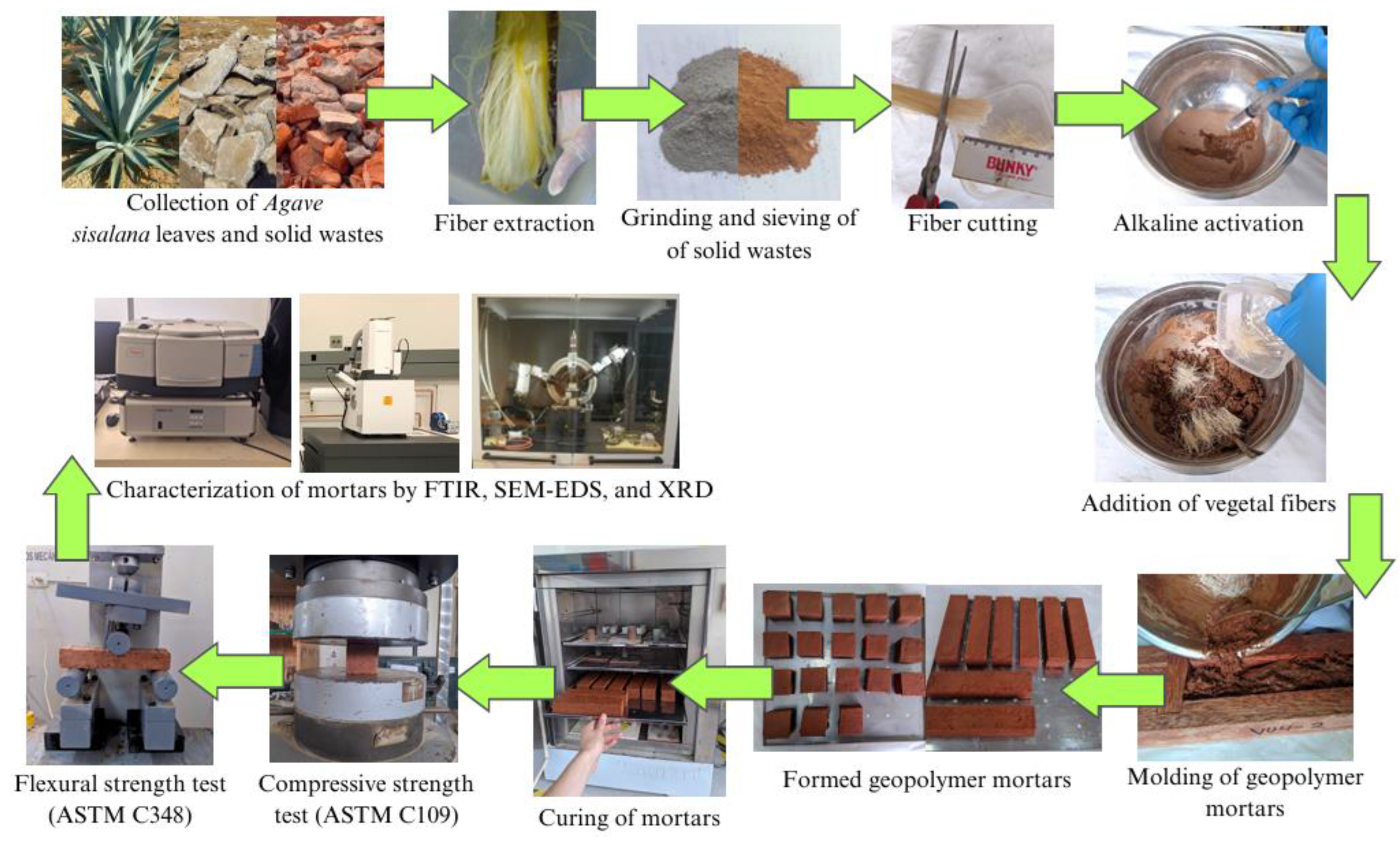
Figure 2.
Compressive strength at 7, 14, and 28 days for RBP/RCP mortars with 0.0–2.0 wt% sisal (mean ± SD; n = 5).
Figure 2.
Compressive strength at 7, 14, and 28 days for RBP/RCP mortars with 0.0–2.0 wt% sisal (mean ± SD; n = 5).
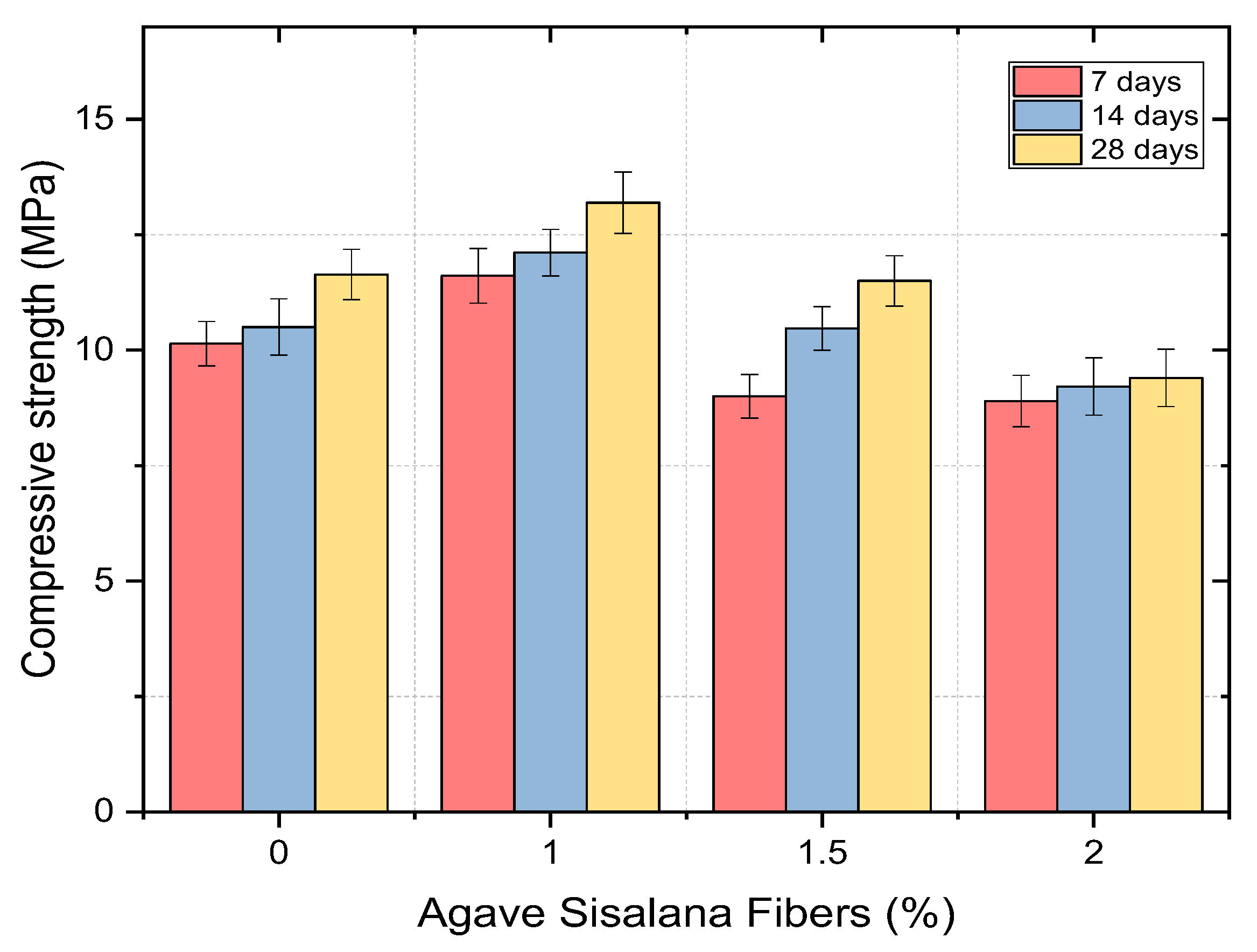
Figure 3.
Flexural strength (MOR) at 7, 14, and 28 days (mean ± SD; n = 5).
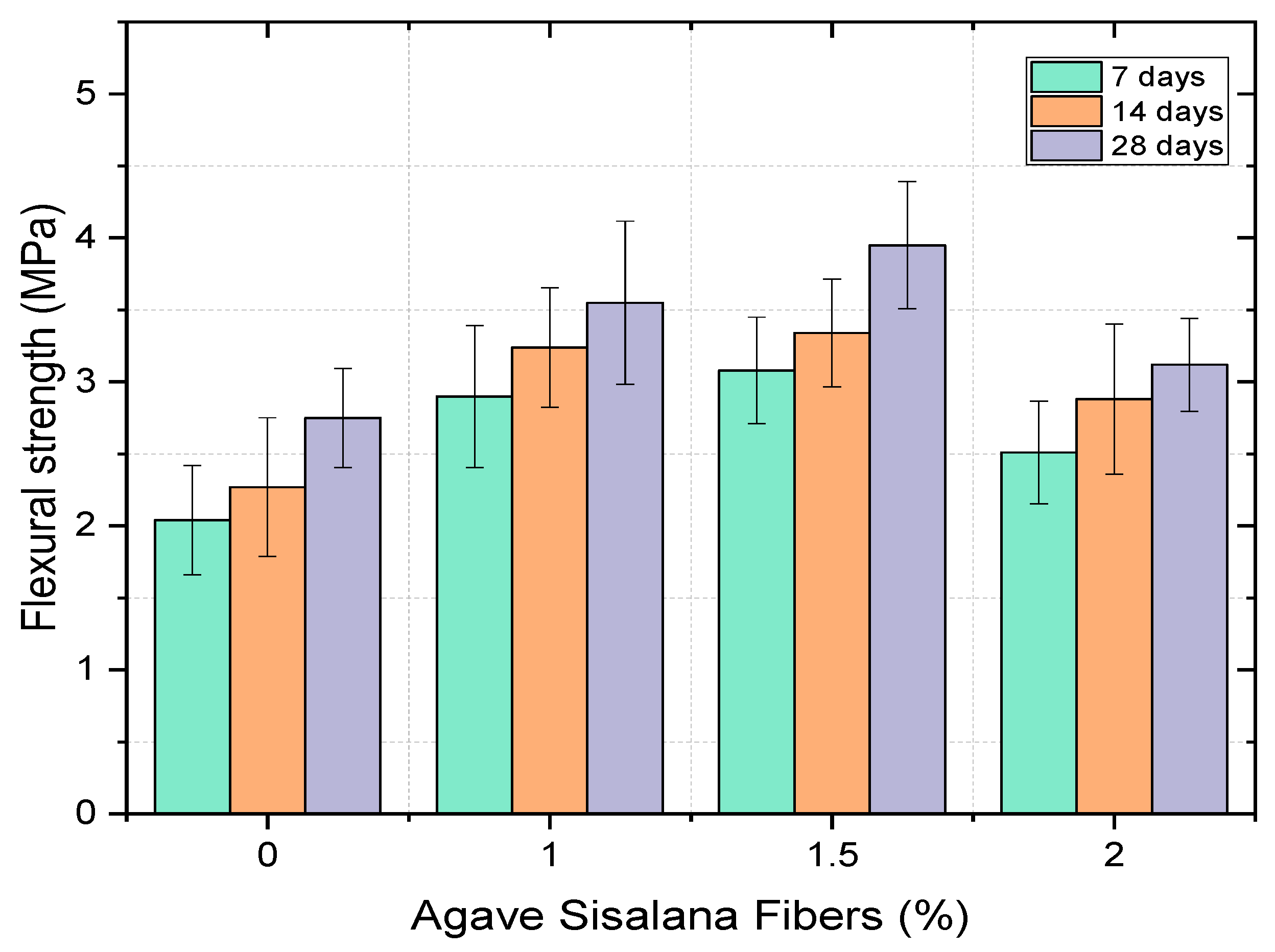
Figure 4.
Representative flexural fracture cross-sections: (a) 0.0%; (b) 1.0%; (c) 1.5%; (d) 2.0%.
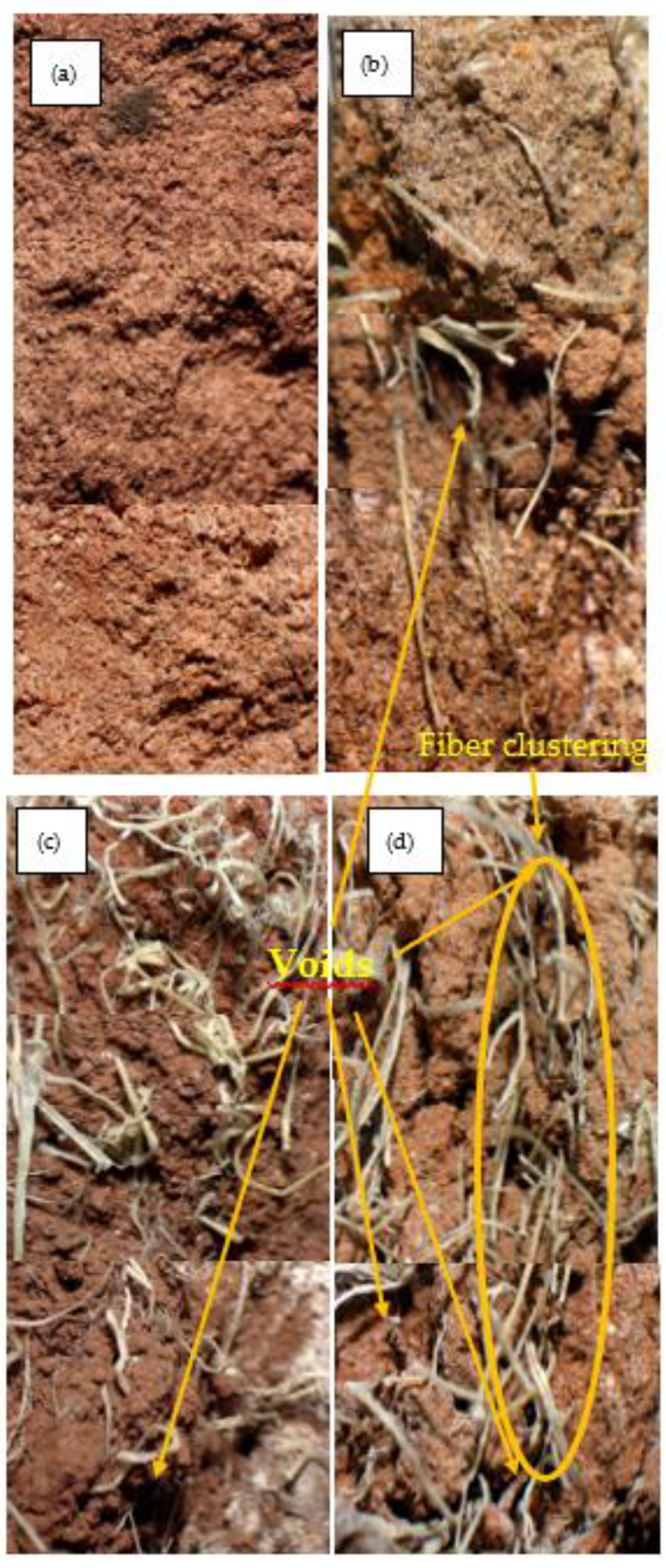
Figure 5.
XRD (5–70° 2θ) of RBP/RCP mortars at 7–28 days.
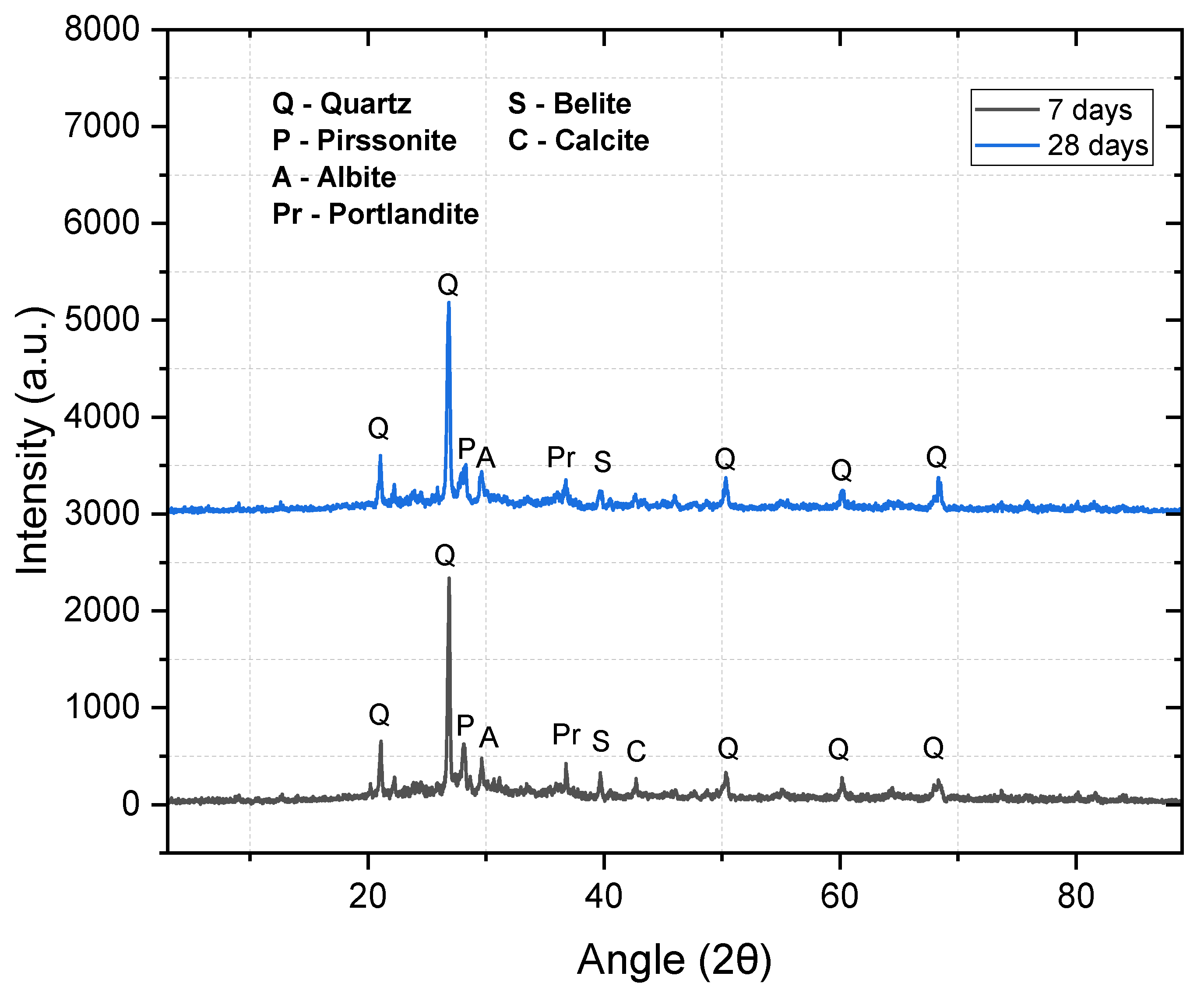
Figure 6.
FTIR-ATR (4000–400 cm−1) at 7–14–28 days.
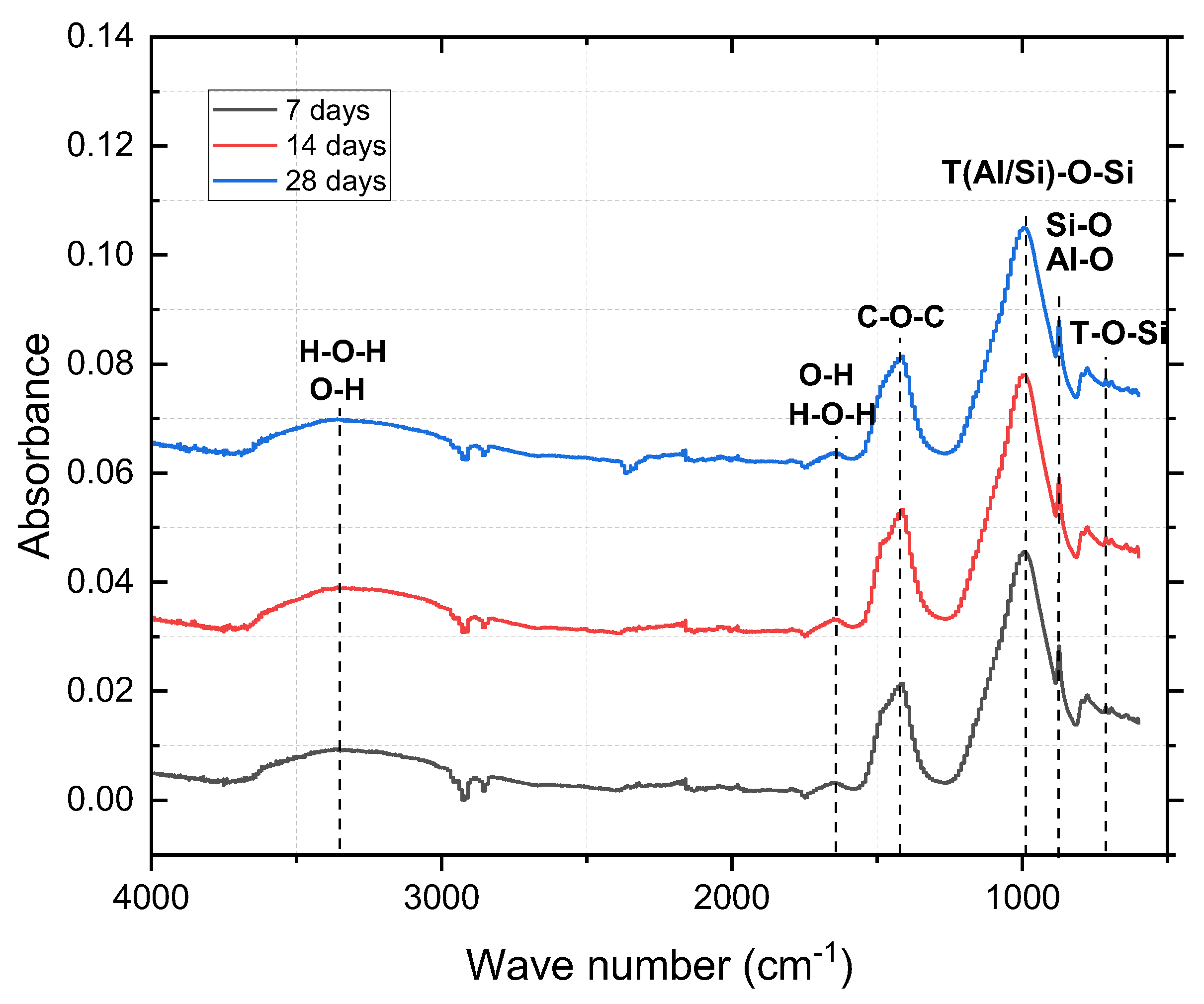
Figure 7.
SEM-EDS microscopies of geopolymer mortars. a) 7 days; b) 28 days.
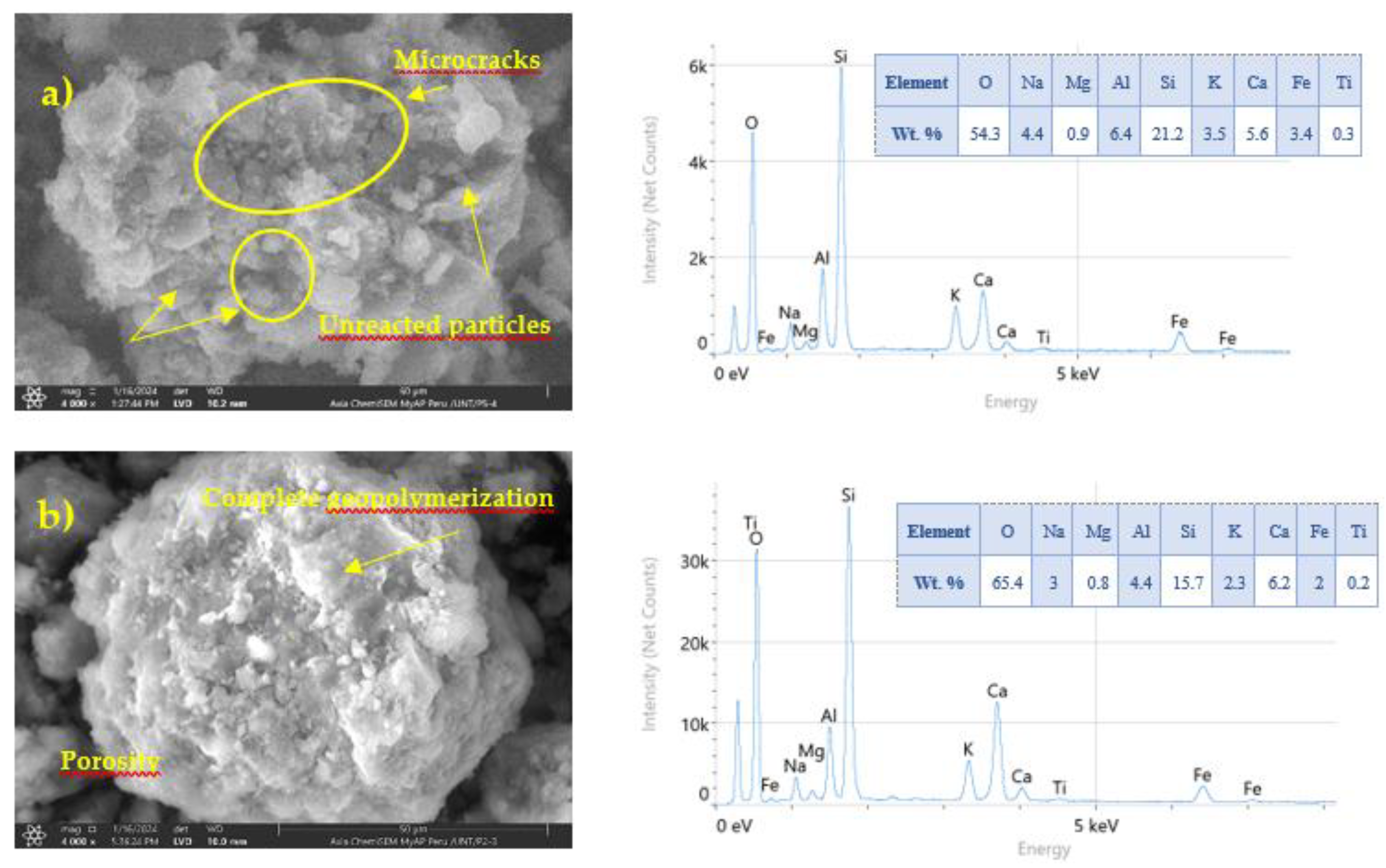

Table 1.
Chemical characterization (oxides compound) of RPC and RBP.
| RPC | RBP | ||
|---|---|---|---|
| Óxides | wt% | Óxides | wt% |
| SiO2 | 51.21 | SiO2 | 55.21 |
| CaO | 23.78 | Al2O3 | 19.17 |
| Al2O3 | 10.45 | Fe2O3 | 8.21 |
| Fe2O3 | 5.01 | K2O | 2.74 |
| MgO | 2.46 | MgO | 1.79 |
| K2O | 2.14 | CaO | 1.59 |
| Na2O | 1.27 | Na2O | 1.87 |
| SO3 | 1.98 | ||
| TiO2 | 0.81 | ||
| P2O5 | 0.51 | ||
| MnO | 0.27 | ||
Table 2.
Mix compositions of geopolymer mortars (reference batch normalised to 1,000 g of binder). Binder:sand = 1:3 (by mass). Activator-to-solids ratio (A/S) = 0.485 with respect to the binder. Mass split of the ternary activator: 0.10 NaOH: 0.60 Na2SiO3 (commercial solution): 0.30 KOH.
Table 2.
Mix compositions of geopolymer mortars (reference batch normalised to 1,000 g of binder). Binder:sand = 1:3 (by mass). Activator-to-solids ratio (A/S) = 0.485 with respect to the binder. Mass split of the ternary activator: 0.10 NaOH: 0.60 Na2SiO3 (commercial solution): 0.30 KOH.
| Mix ID | Sisal (wt% of binder) | RBP in binder (wt%) | RCP in binder (wt%) | Binder (g) | Sisal (g) | Sand (g) | A/S (by binder mass) | Activator total (g) | NaOH (g) | Na2SiO3 (g) | KOH (g) |
|---|---|---|---|---|---|---|---|---|---|---|---|
| M1SF0 | 0 | 70 | 30 | 1000 | 0 | 3000 | 0.485 | 485 | 48.5 | 291 | 145.5 |
| M2SF10 | 1 | 70 | 30 | 1000 | 10 | 3000 | 0.485 | 485 | 48.5 | 291 | 145.5 |
| M3SF15 | 1.5 | 70 | 30 | 1000 | 15 | 3000 | 0.485 | 485 | 48.5 | 291 | 145.5 |
| M4SF20 | 2 | 70 | 30 | 1000 | 20 | 3000 | 0.485 | 485 | 48.5 | 291 | 145.5 |
Notes: (i) A/S is defined with respect to the binder (RBP + RCP), excluding sand and fibres; (ii) NaOH/KOH pellets are dissolved separately and then mixed with Na2SiO3; the listed masses refer to the activator components as prepared.
Table 3.
Compressive strength (MPa) — mean ± SD [95% CI]; Tukey letters by age.
| Age | Sisal content | Compression (MPa) — Mean ± SD [95% CI] | Tukey letter |
|---|---|---|---|
| 7d | 0% | 10.14 ± 0.35 [9.71, 10.57] | b |
| 7d | 1.0% | 11.61 ± 0.52 [10.96, 12.26] | a |
| 7d | 1.5% | 9.00 ± 0.38 [8.53, 9.47] | b |
| 7d | 2.0% | 8.90 ± 0.53 [8.24, 9.56] | c |
| 14d | 0% | 10.50 ± 0.40 [10.00, 11.00] | b |
| 14d | 1.0% | 12.11 ± 0.44 [11.56, 12.66] | a |
| 14d | 1.5% | 10.47 ± 0.51 [9.84, 11.10] | b |
| 14d | 2.0% | 9.21 ± 0.43 [8.68, 9.74] | c |
| 28d | 0% | 11.64 ± 0.39 [11.16, 12.12] | b |
| 28d | 1.0% | 13.19 ± 0.50 [12.57, 13.81] | a |
| 28d | 1.5% | 11.50 ± 0.49 [10.89, 12.11] | b |
| 28d | 2.0% | 9.40 ± 0.47 [8.82, 9.98] | c |
Table 4.
Flexural strength, MOR (MPa) — mean ± SD [95% CI]; Tukey letters by age.
| Age | Sisal content | Flexural strength, MOR (MPa) — Mean ± SD [95% CI] | Tukey letter |
|---|---|---|---|
| 7d | 0% | 3.28 ± 0.16 [3.09, 3.48] | c |
| 7d | 1.0% | 4.52 ± 0.25 [4.21, 4.84] | a |
| 7d | 1.5% | 4.42 ± 0.10 [4.29, 4.54] | a |
| 7d | 2.0% | 3.83 ± 0.15 [3.65, 4.02] | b |
| 14d | 0% | 3.42 ± 0.08 [3.32, 3.52] | c |
| 14d | 1.0% | 4.88 ± 0.10 [4.76, 5.01] | a |
| 14d | 1.5% | 4.96 ± 0.38 [4.49, 5.43] | a |
| 14d | 2.0% | 4.12 ± 0.11 [3.98, 4.26] | b |
| 28d | 0% | 3.94 ± 0.24 [3.65, 4.23] | b |
| 28d | 1.0% | 5.38 ± 0.20 [5.13, 5.63] | a |
| 28d | 1.5% | 5.54 ± 0.26 [5.22, 5.86] | a |
| 28d | 2.0% | 4.16 ± 0.46 [3.58, 4.73] | b |
Disclaimer/Publisher’s Note: The statements, opinions and data contained in all publications are solely those of the individual author(s) and contributor(s) and not of MDPI and/or the editor(s). MDPI and/or the editor(s) disclaim responsibility for any injury to people or property resulting from any ideas, methods, instructions or products referred to in the content. |
© 2025 by the authors. Licensee MDPI, Basel, Switzerland. This article is an open access article distributed under the terms and conditions of the Creative Commons Attribution (CC BY) license (http://creativecommons.org/licenses/by/4.0/).
Copyright: This open access article is published under a Creative Commons CC BY 4.0 license, which permit the free download, distribution, and reuse, provided that the author and preprint are cited in any reuse.


