

Submitted:
12 December 2025
Posted:
17 December 2025
You are already at the latest version
Abstract
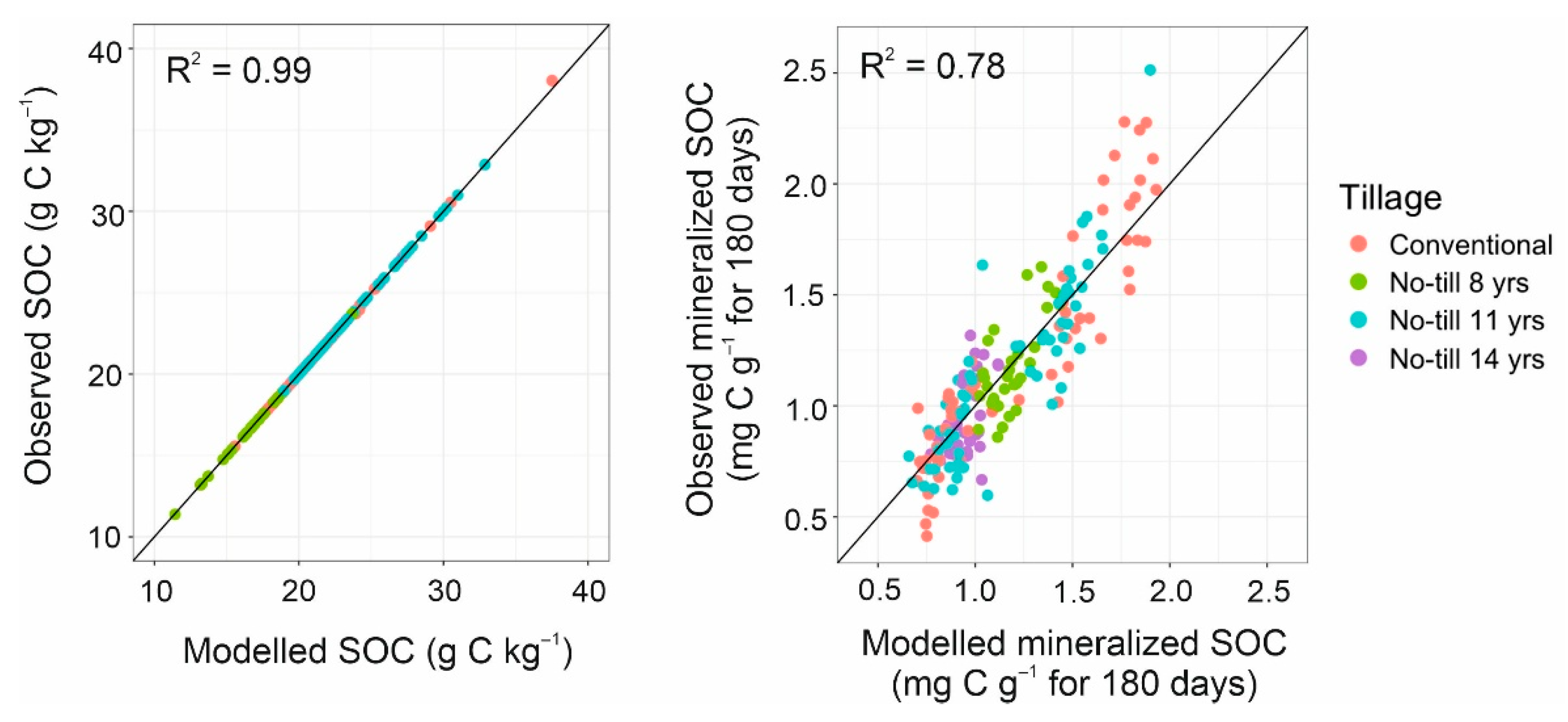
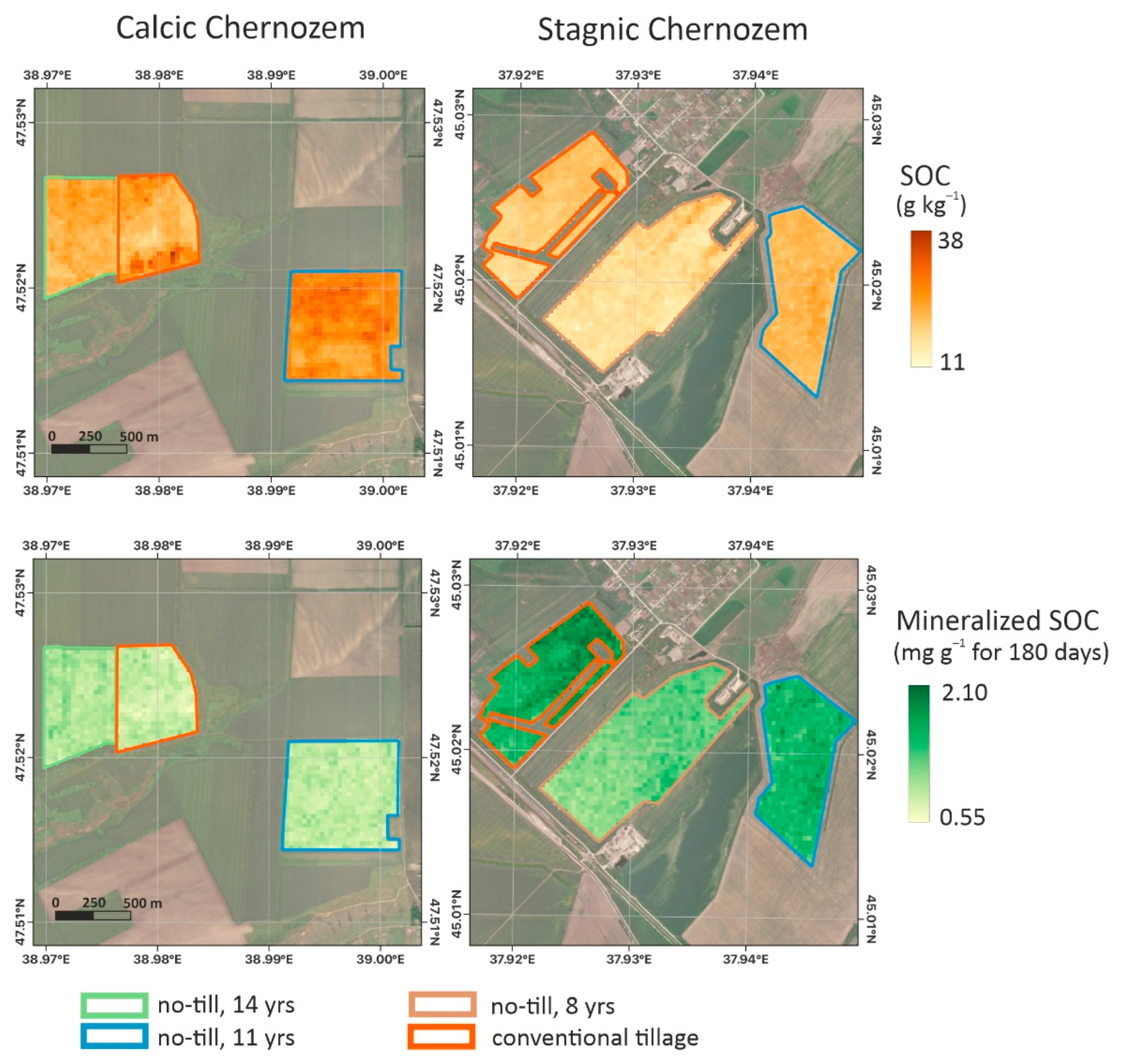
Adapting agriculture to long-term accrual of organic carbon (С) is beneficial both for ensuring food security and for mitigating climate change. This study quantified the responses of total soil C content and its constituent pools to implementing no-tillage (NT) versus conventional tillage (CT) on farms with contrasting water regimes. The farms were chosen at two sites in the Russian steppe zone: Rostov with non-waterlogged Calcic Chernozem (CCH; sunflower-wheat rotation) and Krasnodar with periodic waterlogged Stagnic Chernozem (SCH; maize-wheat rotation). At each site, we surveyed the 0–10 cm and 10–30 cm soil layers in one continuous CT field and two short-term NT fields (8–14 years). The average C content in CCH was higher than in SCH (22.5 vs 17.7 g kg–1). For both sites, NT showed the potential for an increase in C content (by 12–16%) relative to CT only in the 0–10 cm topsoil. Microbial-available C pool (mineralized for 180 days of soil incubation) was most sensitive to tillage systems, unlike unchanged particle-size pools. Specifically, it increased from CT to NT for CCH (by 7–16%), but it showed a decreased trend for SCH (by 11–29%), possibly due to the worsening of soil aeration in the periodically flooded regime. Gradient boosting machine models accurately predicted the spatial distribution of topsoil C content (R2 = 0.99) and its microbial-available pool (R2 = 0.78%) across the farmland area. The mutual drivers of both parameters were topography (elevation) and vegetation distribution (near-infrared surface reflectance). These outcomes are useful for developing site-specific management strategies to effectively restore C stocks in Chernozem soils.
Keywords:
1. Introduction
2. Materials and Methods
2.1. Study Area
2.2. Soil Sampling Design
2.3. Determination of Soil Organic Carbon Stocks
2.4. Particle-Size Fractionation of Soil Organic Carbon
2.5. Analysis of Soil Microbial-Available Carbon Pool
2.6. Statistical Data Analysis and Field-Scale Mapping
3. Results
3.1. Soil Bulk Density and Organic Carbon Stocks
3.2. Particle-Size and Microbial-Available Pools of Soil Organic Carbon
3.3. Predictive Modeling and Mapping of Topsoil Organic Carbon
4. Discussion
4.1. SOC Content: Effects of Tillage System and Water Regime
4.2. SOC Quality: РОM to MAOM Ratio and Microbial-Available C Pools
4.3. Study Limitations and Further Prospects
5. Conclusions
Author Contributions
Funding
Data Availability Statement
Acknowledgments
Conflicts of Interest
Appendix A

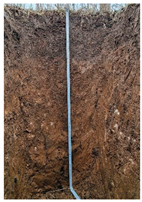 |
Layer (cm) |
pH |
CaCO3 (%) |
SOC (%) |
Clay (%) |
Silt (%) |
Sand (%) |
BD (g cm–3) |
| Calcic Chernozem (Rostov site) | ||||||||
| 0–5 | 8.3 | 5.7 | 3.21 | 19 | 75 | 6 | 1.04 | |
| 5–10 | 8.4 | 5.6 | 2.77 | 20 | 76 | 4 | 1.05 | |
| 10–20 | 8.5 | 7.4 | 2.56 | 20 | 77 | 3 | 1.23 | |
| 20–30 | 8.6 | 9.6 | 2.61 | 18 | 79 | 3 | 1.27 | |
| 30–50 | 8.6 | 11.1 | 2.55 | 17 | 79 | 3 | 1.24 | |
| 50–70 | 8.7 | 15.0 | 2.26 | 16 | 80 | 3 | 1.40 | |
| 70–100 | 8.7 | 15.7 | 2.05 | 17 | 80 | 3 | 1.48 | |
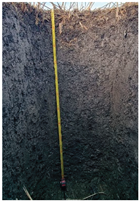 |
Stagnic Chernozem (Krasnodar site) | |||||||
| 0–5 | 7.3 | 0.05 | 2.40 | 18 | 73 | 9 | 1.20 | |
| 5–10 | 7.1 | 0.05 | 1.95 | 19 | 73 | 8 | 1.23 | |
| 10–20 | 7.1 | 0.06 | 1.84 | 19 | 74 | 8 | 1.36 | |
| 20–30 | 7.3 | 0.05 | 1.76 | 19 | 74 | 7 | 1.34 | |
| 30–50 | 7.4 | 0.06 | 1.66 | 18 | 74 | 8 | 1.34 | |
| 50–70 | 7.5 | 0.07 | 1.20 | 18 | 73 | 9 | 1.51 | |
| 70–100 | 8.1 | 0.98 | 0.89 | 17 | 73 | 10 | 1.55 | |
| Soil | Tillage† | pH | SOC:N | P (mg kg–1) | K (mg kg–1) |
|---|---|---|---|---|---|
| Calcic Chernozem |
CT | 7.98 ± 0.17 | 11.0 ± 0.3 | 1.58 ± 0.56 | 293 ± 20 |
| NT11 | 8.02 ± 0.02 | 14.1 ± 0.4 | 1.22 ± 0.22 | 448 ± 20 | |
| NT14 | 7.99 ± 0.02 | 11.8 ± 0.1 | 1.56 ± 0.09 | 326 ± 11 | |
| Stagnic Chernozem |
CT | 7.05 ± 0.10 | 12.1 ± 0.1 | 6.75 ± 0.70 | 309 ± 18 |
| NT8 | 7.11 ± 0.12 | 12.3 ± 0.2 | 4.67 ± 0.52 | 266 ± 38 | |
| NT11 | 7.39 ± 0.10 | 11.8 ± 0.1 | 2.88 ± 0.41 | 285 ± 14 |
References
- IUSS Working Group WRB. World Reference Base for Soil Resources 2014: International soil classification system for naming soils and creating legends for soil maps; Schad, P., Huysteen, C., Micheli, E., Eds.; Food and Agriculture Organization: Rome, Italy, 2015. [Google Scholar]
- Liu, X.; Lee Burras, C.; Kravchenko, Y.S.; Duran, A.; Huffman, T.; Morras, H.; Studdert, G.; Zhang, X.; Cruse, R.M.; Yuan, X. Overview of Mollisols in the world: distribution, land use and management. Can. J. Soil. Sci. 2012, 92, 383–402. [Google Scholar] [CrossRef]
- Boincean, B.; Dent, D. Farming the Black Earth: Sustainable and climate-smart management of Chernozem soils; Springer International Publishing: Cham, Switzerland, 2019. [Google Scholar]
- Xu, X.; Pei, J.; Xu, Y.; Wang, J. Soil organic carbon depletion in global Mollisols regions and restoration by management practices: a review. J Soils Sediments 2020, 20, 1173–1181. [Google Scholar] [CrossRef]
- Just, C.; Armbruster, M.; Barkusky, D.; Baumecker, M.; Diepolder, M.; Döring, T.F.; Heigl, L; Honermeier, B.; Jate, M.; Merbach, I.; Rusch, C.; Schubert, D.; Schulz, F.; Schweitzer, K.; Seidel, S.; Sommer, M.; Spiegel, H.; Thumm, U.; Urbatzka, P.; Zimmer, J.; Kögel-Knabner, I.; Wiesmeier, M. Soil organic carbon sequestration in agricultural long-term field experiments as derived from particulate and mineral-associated organic matter. Geoderma 2023, 434, 116472. [Google Scholar] [CrossRef]
- Angst, G.; Mueller, K.E.; Castellano, M.J.; Vogel, C.; Wiesmeier, M.; Mueller, C.W. Unlocking complex soil systems as carbon sinks: multi-pool management as the key. Nat Commun 2023, 14, 2967. [Google Scholar] [CrossRef]
- Lützow, M.v.; Kögel-Knabner, I.; Ekschmitt, K.; Matzner, E.; Guggenberger, G.; Marschner, B.; Flessa, H. Stabilization of organic matter in temperate soils: mechanisms and their relevance under different soil conditions – a review. Eur. J. Soil Sci. 2006, 57, 426–445. [Google Scholar] [CrossRef]
- Sollins, P.; Swanston, C.; Kramer, M. Stabilization and destabilization of soil organic matter—a new focus. Biogeochemistry 2007, 85, 1–7. [Google Scholar] [CrossRef]
- Lavallee, J.M.; Soong, J.L.; Cotrufo, M.F. Conceptualizing soil organic matter into particulate and mineral-associated forms to address global change in the 21st century. Glob Chang Biol 2020, 26, 261–273. [Google Scholar] [CrossRef] [PubMed]
- Powlson, D.S.; Stirling, C.M.; Jat, M.L.; Gerard, B.G.; Palm, C.A.; Sanchez, P.A.; Cassman, K.G. Limited potential of no-till agriculture for climate change mitigation. Nature Clim Change 2014, 4, 678–683. [Google Scholar] [CrossRef]
- Du, Z.; Angers, D.A.; Ren, T.; Zhang, Q.; Li, G. The Effect of no-till on organic C storage in Chinese soils should not be overemphasized: a meta-analysis. Agric. Ecosyst. Environ. 2017, 236, 1–11. [Google Scholar] [CrossRef]
- Ogle, S.M.; Alsaker, C.; Baldock, J.; Bernoux, M.; Breidt, F.J.; McConkey, B.; Regina, K.; Vazquez-Amabile, G.G. Climate and soil characteristics determine where no-till management can store carbon in soils and mitigate greenhouse gas emissions. Sci Rep 2019, 9, 11665. [Google Scholar] [CrossRef]
- Lal, R.; Reicosky, D.C.; Hanson, J.D. Evolution of the plow over 10,000 years and the rationale for no-till farming. Soil Till Res. 2007, 93, 1–12. [Google Scholar] [CrossRef]
- Li, Y.; Chang, S.X.; Tian, L.; Zhang, Q. Conservation agriculture practices increase soil microbial biomass carbon and nitrogen in agricultural soils: a global meta-analysis. Soil Biol. Biochem. 2018, 121, 50–58. [Google Scholar] [CrossRef]
- Li, Y.; Song, D.; Liang, S.; Dang, P.; Qin, X.; Liao, Y.; Siddique, K.H.M. Effect of no-tillage on soil bacterial and fungal community diversity: a meta-analysis. Soil Till Res. 2020, 204, 104721. [Google Scholar] [CrossRef]
- Ma, L.; Wang, X.; Fang, Y.; Vancov, T.; Jin, X.; Gao, Q.; Dong, W.; Du, Z. No-tillage farming for two decades increases plant- and microbial-biomolecules in the topsoil rather than soil profile in temperate agroecosystem. Soil Till Res. 2024, 241, 106108. [Google Scholar] [CrossRef]
- Briedis, C.; De Moraes Sá, J.C.; Lal, R.; Tivet, F.; Franchini, J.C.; De Oliveira Ferreira, A.; Da Cruz Hartman, D.; Schimiguel, R.; Bressan, P.T.; Inagaki, T.M.; et al. How does no-till deliver carbon stabilization and saturation in highly weathered soils? CATENA 2018, 163, 13–23. [Google Scholar] [CrossRef]
- Blanco-Moure, N.; Gracia, R.; Bielsa, A.C.; López, M.V. Long-term no-tillage effects on particulate and mineral-associated soil organic matter under rainfed Mediterranean conditions. Soil Use Manag. 2013, 29, 250–259. [Google Scholar] [CrossRef]
- Conceição, P.C.; Dieckow, J.; Bayer, C. Combined role of no-tillage and cropping systems in soil carbon stocks and stabilization. Soil Till Res. 2013, 129, 40–47. [Google Scholar] [CrossRef]
- Fabrizzi, K.P.; Morón, A.; García, F.O. Soil carbon and nitrogen organic fractions in degraded vs. non-degraded Mollisols in Argentina. Soil Science Soc of Amer J 2003, 67, 1831–1841. [Google Scholar] [CrossRef]
- Malhi, S.S.; Nyborg, M.; Goddard, T.; Puurveen, D. Long-term tillage, straw management, and nitrogen fertilization effects on organic matter and mineralizable carbon and nitrogen in a Black Chernozem soil. Commun Soil Sci Plant Anal 2012, 43(20), 2679–2690. [Google Scholar] [CrossRef]
- Iheshiulo, E.M.-A. Soil organic matter and aggregate stability dynamics under major no-till crop rotations on the Canadian prairies. Geoderma 2024, 442, 116777. [Google Scholar] [CrossRef]
- Leuthold, S.J.; Lavallee, J.M.; Basso, B.; Brinton, W.F.; Cotrufo, M.F. Shifts in controls and abundance of particulate and mineral-associated organic matter fractions among subfield yield stability zones. Soil 2024, 10(1), 307–319. [Google Scholar] [CrossRef]
- Nunes, M.R.; Denardin, J.E.; Pauletto, E.A.; Faganello, A.; Pinto, L.F.S. Mitigation of clayey soil com-paction man-aged under no-tillage. Soil Till Res. 148, 119–126. [CrossRef]
- Khitrov, N.; Smirnova, M.; Lozbenev, N.; Levchenko, E.; Gribov, V.; Kozlov, D.; Rukhovich, D.; Kalinina, N.; Koroleva, P. Soil cover patterns in the forest-steppe and steppe zones of the east european plain. Soil Sci. Annu. 2019, 70, 198–210. [Google Scholar] [CrossRef]
- Minasny, B.; McBratney, A.B. A Conditioned Latin Hypercube method for sampling in the presence of ancillary information. Comput. Geosci. 2006, 32, 1378–1388. [Google Scholar] [CrossRef]
- Farr, T.G.; Rosen, P.A.; Caro, E.; Crippen, R.; Duren, R.; Hensley, S.; Kobrick, M.; Paller, M.; Rodriguez, E.; Roth, L.; et al. The Shuttle Radar Topography Mission. Rev. Geophys. 2007, 45, 2005RG000183. [Google Scholar] [CrossRef]
- Beven, K.J.; Kirkby, M.J. A Physically based, variable contributing area model of basin hydrology. Hydrological Sciences Bulletin 1979, 24, 43–69. [Google Scholar] [CrossRef]
- R: A Language and Environment for Statistical Computing. R Foundation for Statistical Computing. 2024. Available online: https://cran.r-project.org/ (accessed on 10 August 2025).
- Roudier, P.; Beaudette, D.E.; Hewitt, A.E. A conditioned Latin hypercube sampling algorithm incorporating operational constraints. In Digital Soil Assessments and Beyond. Proceedings of the 5th Global Workshop on Digital Soil Mapping, Sydney, Australia, 10-13 April 2012. [Google Scholar]
- Blagodatskiy, S.A.; Blagodatskaya, Y.V.; Gorbenko, A.Yu.; Panikov, N.S. A rehydration method of determining the biomass of microorganisms in soil. Soviet Soil Science 1987, 19, 119–126. [Google Scholar]
- Semenov, V.M.; Kravchenko, I.K.; Ivannikova, L.A.; Kuznetsova, T.V.; Semenova, N.A.; Gispert, M.; Pardini, J. Experimental determination of the active organic matter content in some soils of natural and agricultural ecosystems. Eurasian Soil Sc. 2006, 39, 251–260. [Google Scholar] [CrossRef]
- Fox, J.; Weisberg, S. An R Companion to Applied Regression, third ed.; AGE Publications Inc: Thousand Oaks CA, 2019. [Google Scholar]
- Signorell, A. DescTools: Tools for Descriptive Statistics. R package version 0.99.60.24, 2025. Available online: https://github.com/andrisignorell/desctools (accessed on 15 September 2025).
- Wickham, H. Ggplot2: Elegant Graphics for Data Analysis., 2nd ed.; Springer International Publishing.: Cham, 2016. [Google Scholar]
- Friedman, J.H. Greedy function approximation: a gradient boosting machine. Ann. Statist. 2001, 29, 1189–1232. [Google Scholar] [CrossRef]
- Xu, H. Modification of normalised difference water index (NDWI) to enhance open water features in remotely sensed imagery. Int. J. Remote Sens. 2006, 27, 3025–3033. [Google Scholar] [CrossRef]
- Ermida, S.L.; Soares, P.; Mantas, V.; Göttsche, F.-M.; Trigo, I.F. Google Earth Engine open-source code for land surface temperature estimation from the Landsat series. Remote Sens. 2020, 12, 1471. [Google Scholar] [CrossRef]
- Gorelick, N.; Hancher, M.; Dixon, M.; Ilyushchenko, S.; Thau, D.; Moore, R. Google Earth Engine: planetary-scale geospatial analysis for everyone. Remote Sens. Environ. 2017, 202, 18–27. [Google Scholar] [CrossRef]
- Kuhn, M. Building predictive models in R using the Caret package. J. Stat. Soft. 2008, 28, 1–26. [Google Scholar] [CrossRef]
- Ruis, S.J.; Blanco-Canqui, H. How does no-till affect soil-profile distribution of roots? Can. J. Soil. Sci. 2024, 104, 350–361. [Google Scholar] [CrossRef]
- Pausch, J.; Kuzyakov, Y. Carbon input by roots into the soil: quantification of rhizodeposition from root to ecosystem scale. Glob Chang Biol 2018, 24, 1–12. [Google Scholar] [CrossRef] [PubMed]
- Lorenz, K.; Lal, R. The depth distribution of soil organic carbon in relation to land use and management and the potential of carbon sequestration in subsoil horizons. Adv. Agron. 2005, 88, 35–66. [Google Scholar] [CrossRef]
- Hartmann, M.; Six, J. Soil structure and microbiome functions in agroecosystems. Nat Rev Earth Environ 2023, 4, 4–18. [Google Scholar] [CrossRef]
- Padbhushan, R.; Sinha, A.K.; Kumar, U.; Bhattacharya, P.M.; Poddar, P.; Kumar, A.; Singh, Y.K.; Kumar, R.; Jha, A.K.; Parmar, B.; et al. Soil carbon sequestration and yield sustainability in the lowland Terai Region of India. J Soil Sci Plant Nutr 2025, 25, 6820–6839. [Google Scholar] [CrossRef]
- Witzgall, K.; Vidal, A.; Schubert, D.I.; Höschen, C.; Schweizer, S.A.; Buegger, F.; Pouteau, V.; Chenu, C.; Mueller, C.W. Particulate organic matter as a functional soil component for persistent soil organic carbon. Nat Commun 2021, 12, 4115. [Google Scholar] [CrossRef]
- Veloso, M.G.; Dick, D.P.; Costa, J.B.D.; Bayer, C. Cropping systems including legume cover crops favour mineral–organic associations enriched with microbial metabolites in no-till soil. Soil Research 2019, 57, 851–858. [Google Scholar] [CrossRef]
- Veloso, M.G.; Angers, D.A.; Chantigny, M.H.; Bayer, C. Mineral–organic associations are enriched in both microbial metabolites and plant residues in a subtropical soil profile under no-tillage and legume cover cropping. Soil Research 2022, 60, 590–600. [Google Scholar] [CrossRef]
- Angst, G.; Mueller, K.E.; Nierop, K.G.J.; Simpson, M.J. Plant- or microbial-derived? A review on the molecular composition of stabilized soil organic matter. Soil Biol. Biochem. 2021, 156, 108189. [Google Scholar] [CrossRef]
- Kan, Z.; Liu, W.; Liu, W.; Lal, R.; Dang, Y.P.; Zhao, X.; Zhang, H. Mechanisms of soil organic carbon stability and its response to no-till: a global synthesis and perspective. Glob Chang Biol 2022, 28, 693–710. [Google Scholar] [CrossRef]
- Sae-Tun, O.; Bodner, G.; Rosinger, C.; Zechmeister-Boltenstern, S.; Mentler, A.; Keiblinger, K. Fungal biomass and microbial necromass facilitate soil carbon sequestration and aggregate stability under different soil tillage intensities. Appl. Soil Ecol. 2022, 179, 104599. [Google Scholar] [CrossRef]
- Olson, K.R.; Al-Kaisi, M.M.; Lal, R.; Lowery, B. Experimental consideration, treatments, and methods in determining soil organic carbon sequestration rates. Soil Sci. Soc. Am. J. 2014, 78, 348–360. [Google Scholar] [CrossRef]

| Site (Soil) | Tillage† | FA (ha) | Elev (m a.s.l.) | Slope (°) | Crops | |
|---|---|---|---|---|---|---|
| 2022 | 2023 | |||||
| Rostov (Calcic Chernozem) |
CT | 33 | 68 ± 6 | 1.9 ± 0.9 | Sunflower | Wheat |
| NT11 | 55 | 67 ± 3 | 1.8 ± 0.9 | Sunflower | Wheat | |
| NT14 | 35 | 68 ± 5 | 1.7 ± 0.7 | Sunflower | Wheat | |
| Krasnodar (Stagnic Chernozem) |
CT | 45 | 12 ± 3 | 1.5 ± 0.9 | Wheat | Wheat |
| NT8 | 74 | 11 ± 3 | 1.2 ± 0.8 | Wheat | Corn | |
| NT11 | 49 | 8 ± 2 | 1.4 ± 0.8 | Corn | Wheat | |
Disclaimer/Publisher’s Note: The statements, opinions and data contained in all publications are solely those of the individual author(s) and contributor(s) and not of MDPI and/or the editor(s). MDPI and/or the editor(s) disclaim responsibility for any injury to people or property resulting from any ideas, methods, instructions or products referred to in the content. |
© 2025 by the authors. Licensee MDPI, Basel, Switzerland. This article is an open access article distributed under the terms and conditions of the Creative Commons Attribution (CC BY) license (http://creativecommons.org/licenses/by/4.0/).