

Submitted:
17 December 2025
Posted:
18 December 2025
You are already at the latest version
Abstract
Cnidium monnieri (L.) Cusson is a species of Umbelliferae plants, and it is one of China's traditional medicinal herbs, widely distributing in China owing to its strong adaptability in fields. In this article, the research progress on the taxonomy, distribution, cultivation techniques, active components and the analysis methods, antibacterial and insecticidal properties, and ecological applications of C. monnieri were reviewed. The main active components in C. monnieri are coumarins (mainly osthole) and volatile compounds, exhibiting multiple pharmacological activities, e.g., anti-inflammatory, antibacterial, antioxidant, anti-tumor, and immune-regulating effects. Some modern analytical techniques (e.g., HPLC, GC-MS, and UPLC-QTOF-MS) have enabled more precise detection and quality control of these chemical components in C. monnieri. The specific active constituents in C. monnieri (e.g., coumarins and volatile components) exhibite significant inhibitory effects against various pathogenic fungi and insect pests. Simultaneously, the resources provided during its flowering stage (e.g., pollen and nectar) and the specific volatiles it releases can attract natural enemies, such as ladybugs, lacewings, and hoverflies, thereby enhancing ecological control of insect pests in farmland through a "push-pull" strategy. Additionally, C. monnieri has the ability to accumulate heavy metals, e.g., Zn and Cu, indicating its potentially valuable for ecological restoration in agroecosystem. Overall, C. monnieri has medicinal, ecological, and economic values. Future research should focus on regulating the active component synthesis, understanding ecological mechanisms, and developing standardized cultivation systems to enhance its application in modernized traditional Chinese medicine and green agriculture production.
Keywords:
functional plant
; Cnidium monnieri
; active compounds
; insecticidal and antibacterial property
; ecological control
1. Introduction
Cnidium monnieri (L.) Cusson is one of the most commonly used traditional Chinese medicinal herbs. Its flowering stage is from April to July, and the fruiting stage is from June to October annually. C. monnieri is widely distributed across North China, Northeast China, East China, and the Yangtze River Basin etc., commonly found in crop fields, roadsides, wastelands, hillsides, river and lake banks, as well as bushwoods. It is adapted to altitudes of 1300-3200 m, prefers moist and cold environment, germinates in spring and matures in early summer annually. And C. monnieri has low fertility demands, exhibits strong adaptability, and possesses robust reproductive capacity primarily through seed propagation and with rapid natural dispersal. Consequently, it can form large populations in suitable habitats [1]. Modern pharmacological studies have confirmed that osthole (commonly known as cnidiadin) is the main active component in C. monnieri, possessing various medicinal functions such as anti-inflammatory, antibacterial, anti-tumor, and immune-regulating effects [2,3]. Furthermore, C. monnieri has unique ecological functions in agricultural production, its coumarins and volatile oils exhibit repellent or inhibitory effects against various farmland insct pests and can attract natural enemies of insect pests, such as ladybugs, lacewings, and hoverflies. These natural enemies inhabit, feed on insect pests and reproduce on C. monnieri plants, thereby effectively controlling of population abundances of insect pests, indicating great potential for promotion in green agriculture [4,5]. Additionally, studies have found that C. monnieri possesses certain biotransport and enrichment capabilities for heavy metals like zinc (Zn) and copper (Cu) in the forest understory environment of ecologically restored heavy metal-contaminated areas [6].
In recent years, much more attention is paid on the standardized cultivation of Chinese medicinal herbs and ecological agriculture, The research on C. monnieri has gradually expanded from traditional medicinal plant studies to multidisciplinary fields. As a functional plant, research on the active components of C. monnieri, the mechanisms of antibacterial and insecticidal action, and the field ecological regulation functions have become a research focus [7]. However, the current systematic understanding of C. monnieri is not comprehensive, and knowledge regarding its taxonomic resources, cultivation techniques, active components and analytical methods, field application value, and ecological functions remains incomplete. Therefore, this article systematically reviews the species classification, field application and cultivation techniques, types and functions of active components, analysis methods for active components, antibacterial and insecticidal property, natural enemy conservation capacity, and other application values of C. monnieri. Combined with the latest research progress, it also prospects the future industrial development trends and application of C. monnieri in order to guide the efficiently ecological utilization of this functional plant C. monnieri.
2. Species Classification and Distribution of C. monnieri
C. monnieri is a representative species of the genus Cnidium within the subfamily Apioideae of the family Apiaceae, and it is phylogenetically related to the genera such as Angelica and Apium [8,9]. Apiaceae is an important family of dicotyledonous plants, comprising about 450 genera and over 3500 species worldwide, widely distributed in temperate and subtropical regions. The genus Cnidium has only a few species worldwide, mainly distributed in Eurasia, and China is one of its important distribution centers. Traditional taxonomy primarily distinguishes C. monnieri based on the morphological characteristics (e.g., fruit morphology, inflorescence structure, and leaf shape), establishing its systematic position within Apiaceae. In recent years, with the development of molecular systematics, some scholars have used the sequences from ribosomal DNA internal transcribed spacers and chloroplast genes to confirm its stable taxonomic status and reveal its species-specific characteristics among some morphologically similar species [10].
In general, B. rapa seeds are frequently employed in seed dormancy inhibitor validation experiments due to their non-dormant nature, high germination percentage, ease of germination, and short germination period [24]. In this study, the seeds of B. rapa (cv. Zaofeng No.1) were commercially bought from the local market for the following experiment to validate the inhibitory effects of the organic solvent extracts from C. monnieri seeds on seed germination. For B. rapa, its germination percentage was ≥95.0%, moisture content was ≤7.0%, and purity was ≥98.0%.
From a morphological perspective, C. monnieri is an annual herb with pinnately divided leaves, a typical compound umbel inflorescences, predominantly white flowers, and elliptical schizocarps with longitudinal ridges [1]. For C. monnieri, its height is 30-80 cm, the root is conical and relatively slender; the stem is upright or obliquely ascending, multibranching and hollow with deep longitudinal ridges and a rough surface; the lower leaves have short petioles and the leaf sheath is short and broad with membranous margins; the upper leaves are entirely sheathed, and leaf blade outline is ovate to triangular-ovate with 3-8 cm long and 2-5 cm wide [11]. The compound umbel of C. monnieri is 2-3 cm in diameter with 6-10 bracts, linear to linear-lanceolate and about 5 mm long, membranous margins with fine cilia; the umbel rays are unequal with 0.5-2 cm length, and the bracteoles are numerous and linear with 3-5 mm length, and its margins are finely ciliate; its umbellules have 15-20 flowers with white petals and inflexed ligule at apex while without calyx teeth; the stylopodium is slightly prominent and downward curvature with 1-1.5 mm long styles; the schizocarps are oblong with 1.5-3 mm length and 1-2 mm width, and the cross-section is nearly pentagonal with 5 primary ribs, and the ventral surface of the endosperm is flat [12]. The plant and its compound umbels with numberous flowers attracting ladybugs, and those mature flowers and seeds of C. monnieri are shown in Figure 1. The growth and development process of C. monnieri includes eight stages, including germination, seedling, tillering, jointing, bud stage, flowering, fruiting, and maturation [13].
Based on the morphological and chemical characteristics, C. monnieri can be classified into three types,, the first type is characterized by smaller fruits with angular furanocoumarins as main components while lacking osthole or linear furanocoumarins, and it is distributed in the provinces of Heilongjiang, Inner Mongolia and Northern Liaoning; the second type is characterized by larger fruits with osthole and linear furanocoumarins as main components while lacking angular furanocoumarins, and it is mainly distributed in the provinces of Fujian, Zhejiang and Jiangsu; the third type is characterized by fruit size intermediate between the first two types, it contains osthole, linear furanocoumarins and angular furanocoumarins, and it is distributed in the provinces of Shaanxi, Hebei and Henan [14]. C. monnieri is the primary source of the Chinese medicinal material “Shechuangzi”. Although the cultivated and wild resources of C. monnieri are currently relatively abundant, its wild populations face threats of decline due to environmental changes and over-harvesting just like many medicinal herbs [15]. Therefore, the standardized cultivation of C. monnieri should be vigorously promoted in order to enhance its comprehensive application capabilities, which is urgent needs for achieving sustainable utilization of C. monnieri.
3. Cultivation Techniques and Field Management of C. monnieri
C. monnieri grows by natural seeding that the mature seeds drop down from the plants and germinate in situ. Simultaneously, it can also be planted throughout the year, and it does not require vernalization from sowing to maturity, just need suitable light, soil and moisture for seedling. When the accumulated temperature on the soil surface reaches 15°C in spring, the seeds can germinate as soon as contacting with water [16]. The growth cycle of C. monnieri is relatively long, so it is a "day-neutral" plant that means its flowering is not influenced by day length. The growth period of C. monnieri also varies depending on geographical location. In the provinces of Jiangsu and Zhejiang, it is about 200 days with the seedling stage in November, and its vigorous growth period is in April of the following year, and the flowering period is from mid-April to early May, the fruit maturation period is in mid-May, and the plants wither from late May to early June. C. monnieri is mostly distributed in low-altitude river valleys, field edges, wetlands, grasslands, hills, and mountainous areas, preferring open, sunny, moist and well-drained sandy soils with companion plants mainly being common weeds [17].
The cultivation of C. monnieri begins with land selection and preparation. C. monnieri prefers warm and humid environment, and has wide adaptability. And it is cold-resistant and drought-tolerant, and it is more suitable to choose sunny gentle slopes and well-drained sandy loam or clay loam. Previous crops are typically rice, corn, sorghum, cotton etc. After harvesting the previous crops, the soil is deep ploughed and supplied sufficient base fertilizer with well-rotted farmyard manure, and the treated soil is ready for sowing [16]. In northern regions of China, C. monnieri is planted from mid-to-late April in spring, the seeds are mixed with an appropriate amount of sifted fine sand evenly and sowed in drills, with row spacing of 35-40 cm and plant spacing of 15 cm, open shallow furrows 1.5-2 cm deep, and cover with 1 cm-layer soil; After sowing, C. monnieri is promptly watered and covered with a thin layer of straw to maintain soil moisture; and the seedlings emerge in about 2 weeks [16]. C. monnieri can also be planted from August to October in autumn. When C. monnieri seedlings grow to 10 cm height, they were thined and the seedlings are set at a plant spacing of 15 cm. After emergence, timely watering is essential to maintain soil moisture and promote seedling growth; additionally, the soil is loosen promptly and combined with thinning for weeding. In the seedling stage, manual weeding is primary to prevent weeds from suppressing seedlings and consuming soil nutrients. In the middle and late stages, intertillage weeding can be performed to keep soil loose, free of other weeds, and with good aeration, benefiting for plant growth of C. monnieri. On the other hand, early-stage fertilization should focus on nitrogen fertilizer to promote the growth of roots, stems, and leaves of C. monnieri. During the flowering period, phosphorus fertilizer and calcium superphosphate are applied with 20-30 kg per mu to promote fruit maturation and increase yield. After C. monnieri plants show buds, applying 5 kg of urea plus 5 kg of potassium dihydrogen phosphate per mu to promote flower bud differentiation and fruiting. In terms of water management, during the seedling stage, drought should be met with timely watering to ensure uniform seedlings; and timely irrigation should be provided during droughts to meet water needs, while during periods of heavy rainfall or field waterlogging, drainage should be performed promptly to prevent diseases and root rot [18].
During the growth season, C. monnieri is susceptible to various insect pests and diseases, e.g., powdery mildew, red spider mites, and aphids [1,16,18]. Powdery mildew appears as white powdery spots on leaves, stems, and flower stalks with black cleistothecia overwintering in the late stage. Control measures generally involve removing residual plant debris, ensuring ventilation, controlling nitrogen, and applying lime sulfur mixture or triazole fungicides (e.g., triadimefon 800x dilution) at the initial onset; rotate with benomyl 1000x dilution if necessary. Adults and nymphs of the red spider mites mostly feed on the back of leaves and spin webs, commonly causing damage during hot and dry seasons, severely affecting yield and medicinal quality, which can be control using specific acaricides combined with drip irrigation; Aphids can cause damage by sucking, leading to leaf curling, chlorosis, and potential virus transmission, which can be control by natural enemies supplemented by plant-derived osthole for suppression [1,16,18].
4. Types and Functions of Active Components in C. monnieri
4.1. Coumarin Compounds and Their Functions
The main active components in C. monnieri are coumarin compounds, primarily osthole, which constitute the principal material basis for its pharmacological efficacy. Coumarins are derivatives of 1,2-benzopyrone, encompassing a class of natural products with diverse molecular structures. Modern phytochemical studies show that C. monnieri possesses broad pharmacological activities and contains various coumarin compounds, including osthole, isopimpinellin, psoralen, isopsoralen, imperatorin, etc. [1,12,19,20,21]. To date, 48 coumarin compounds have been isolated and identified from C. monnieri. Based on structural differences, they can be classified into three categories, i.e., simple coumarins, linear furanocoumarins, and angular furanocoumarins [22].
Simple coumarin compounds have a core structure consisting of a benzene ring fused with a pyrone ring. Among them, osthole is the representative of simple coumarins, the primary active component of C. monnieri, with a wide range of pharmacological activities [23]. As a coumarin compound, osthole possesses the core coumarin structure along with an isopentenyl side chain, and isoprenoid compounds play important roles as phytoalexins in disease resistance [2,20,24]. Linear furanocoumarins refer to coumarins where the benzene ring, α-pyrone ring, furan ring or pyran ring is linearly arranged, often with substituents at the 5 and 8 positions. Representative compounds include osthole, xanthotoxin, xanthotoxol, imperatorin, bergapten, isoimperatorin, isopimpinellin, etc. [21,23,25,26]. Angular furanocoumarins refer to coumarins where the α-pyrone ring, benzene ring, furan ring or pyran ring forms an angular arrangement, with substituents typically on the furan ring. The angular furanocoumarins with a double bond at the 8 position include angelicin and 2'-acetylangelicin, the angular furanocoumarins without a double bond at the 8 position include columbianetin, cnidiadin and columbianadin, and the ngular furanocoumarins with substituents at the 8 and 9 positions include archangelicin, edultin, cniforin etc. [21,23,25].
Coumarin compounds are the core active substances of C. monnieri, with a pharmacodynamic profile primarily including anti-inflammatory, antimicrobial, antipruritic and skin barrier protection, bone metabolism regulation, anti-tumor, and smooth muscle regulation. Many studies have shown that coumarin compounds can downregulate the expression of pro-inflammatory factors by inhibiting inflammatory signaling pathways (e.g., NF-κB/MAPK), thereby alleviating inflammation induced by bacteria, fungi, and allergic reactions [1,2,20]. Furanocoumarins are widely used to treat vitiligo and psoriasis due to their photosensitizing properties [27]. Some coumarin substances with hydroxyl and methoxy groups also possess antioxidant effects and are often used in cosmetics production [28].
4.2. Volatile Components and Their Olfactory Functional Effects of C. monnieri
In addition to coumarins, C. monnieri contains significant amounts of oleic acid, linoleic acid, and volatile oils etc., all these volatile components are important secondary metabolites of C. monnieri, playing a key role in the aroma formation of the medicinal material and its biological activities [29]. The main components of volatile components in C. monnieri plants include β-eudesmol, bornyl acetate, p-cymene, limonene, linalool, caryophyllene, and γ-terpinene, these substances collectively determine the pungent aroma and characteristic fragrance profile of the medicinal material [1,3,7]. Using Gas Chromatography-Mass Spectrometry (GC-MS) to analyze the chemical composition of volatile components in C. monnieri plants, 50 components were identified, accounting for 86% of the total volatile composition; among them, the compound with the highest relative content was trans-calamenene, followed by selinene [30]. In the volatile components of C. monnieri, the relative content of sesquiterpene components is over 85%, esters over 7%, and terpene alcohols over 2% [7]. Xiang et al. (1999) firstly isolated and identified β-eudesmol and bornyl acetate from C. monnieri. Additionally, the volatile components of C. monnieri also contains small amounts of ketones, ethers, aldehydes, and benzene derivatives [30,31]. And Zhu et al. (2008) analyzed the volatile components of C. monnieri collected from the provinces of Anhui and Henan, there were 36 components identified in Anhui samples while 45 components identified in Henan samples, with only 28 common components with significant differences in relative content [32].
The volatile components of C. monnieri serve not only as an important material basis for pharmacological activity but also play a dual role in natural ecosystems, inclduing plant defense and signaling. As a traditional medicinal plant, C. monnieri is primarily used for insecticidal and antipruritic purposes, and modern research suggests that the material basis is the volatile oil components, providing new guidance for traditional usage patterns [26]. Beyond pharmacological effects, the volatile components of C. monnieri also has important ecological functions, and its main components are mostly bioactive terpenoids which can act as chemical signaling molecules in plant defense system. When subjected to pest damage or mechanical injury, they are rapidly released, facilitating inter-plant information exchange through odor, thereby inducing defense responses in neighboring plants or directly repelling phytophagous insects [33]. Some monoterpenes, e.g., limonene, p-cymene, and linalool, have been proven to have significant repellent activity against insect pests, capable of interfering with the chemotactic behavior of phytophagous insects, and these compounds can attract certain natural enemies, helping to establish an ecological balance among host plants, insect pests and natural enemies [34].
4.3. Other Active Components of C. monnieri
In addition to the primary active substances (e.g., coumarins and volatile components), C. monnieri contains various other bioactive components, including flavonoids, fatty acids, polysaccharides, sterols, and organic acids, these substances collectively constitute the diversified basis for the pharmacological and ecological functions of C. monnieri [1,20,23,26]. Although these active components are present in relatively low amounts, they play important complementary and synergistic roles in pharmacological and ecological functions of C. monnieri. Duan et al. (2015) isolated 10 chromone compounds from the 75% ethanol extract from C. monnieri plants, identified as cnidimoside A, cnidimol B, peucedanocoumarin, 7-O-β-glucosylscoparone, cimifugin, 5-hydroxychromone-7-O-β-glucoside. C. monnieri also contains some steroidal substances, including campesterol, stigmasterol and γ-sitosterol, and possess certain medicinal values [35,36]. Meanwhile, relatively high contents of oleic acid (28.85%) and linoleic acid (10.95%) have been detected in C. monnieri, and these two unsaturated fatty acids not only participate in maintaining cell membrane structure and signal transduction but also have anti-inflammatory and cardiovascular protective effects [29,37]. In addition, small amounts of steroidal compounds (e.g., β-sitosterol, stigmasterol) and triterpenoids (e.g., oleanolic acid, ursolic acid) have been identified from C. monnieri, and these components have been confirmed to have lipid-lowering, anti-inflammatory, and anti-tumor [29,37].
The types and functions of active components in C. monnieri are summarized in Table 1. Overall, these compounds participate in antioxidant, immune regulation, metabolic balance, and tissue protection processes through multiple pathways. Future research should systematically analyze the metabolic networks of these active components and their interactions with major active groups using multi-omics technologies, providing a deeper scientific basis for fully elucidating the pharmacodynamic material basis of C. monnieri..
5. Identification and Analytical Methods for Bioactive Compounds in C. monnieri
As a species of the Apiaceae family with high medicinal value, C. monnieri possesses a complex pharmacodynamic material basis, encompassing known chemical components such as coumarins, volatile oils, flavonoids, polysaccharides, fatty acids, sterols, and other active substances. Significant differences in polarity, volatility, photostability, and content among these components make the systematic analysis of chemical composition as a crucial aspect of C. monnieri research [1,31]. To accurately elucidate the structural characteristics and content variations of different types of compounds, establishing scientific, sensitive, and reproducible analytical and identification methods has become a important foundation in modern research on traditional Chinese medicine herbs.
Currently, a relatively comprehensive system for analyzing and identifying the bioactive compounds in C. monnieri has been established, the commonly used methods are listed in Table 2. These include chromatographic separation techniques, such as Gas Chromatography (GC), Mass Spectrometry (MS), High-Performance Liquid Chromatography (HPLC) and its hyphenation with MS (GC-MS), and Liquid Chromatography-Mass Spectrometry (LC-MS) [22,32,39,40], and spectroscopic methods centered on Ultraviolet-Visible spectroscopy (UV-Vis), Fourier Transform Infrared spectroscopy (FTIR), Nuclear Magnetic Resonance spectroscopy (NMR) [28,41,42], as well as emerging techniques like Ultra-Performance Liquid Chromatography-Quadrupole Time-of-Flight Tandem Mass Spectrometry (UPLC-QTOF-MS) and UPLC-Orbitrap-MS for metabolomics and multi-dimensional chemometric analysis [43,44]. Additionally, novel techniques, e.g., Supercritical Fluid Extraction (SFE) and Capillary Electrophoresis (CE), are gradually applied to the quality control and compositional studies of C. monnieri and related medicinal materials [45,46,47]. The synergistic application of these analytical and identification methods provides essential technical support for the systematic profiling, structural elucidation, and quality assessment of the complex chemical constituents in C. monnieri.
5.1. Chromatographic Analysis Methods
In addition to coumarins, C. monnieri contains significant amounts of oleic acid, linoleic acid, and volatile oils etc., all these volatile components are important secondary metabolites of C. monnieri, playing a key role in the aroma formation of the medicinal material and its biological activities [29]. The main components of volatile components in C. monnieri plants include β-eudesmol, bornyl acetate, p-cymene, limonene, linalool, caryophyllene, and γ-terpinene, these substances collectively determine the pungent aroma and characteristic fragrance profile of the medicinal material [1,3,7]. Usi Due to the complex chemical composition of C. monnieri, the traditional chemical reactions and spectroscopic analyses often struggle to achieve effective separation and accurate quantification of the chemical constituents. Consequently, a series of modern analytical methods based on chromatographic separation principles have been developed, and chromatographic analysis is one of the earliest and most widely used technical approaches in the chemical study of C. monnieri, initially employing traditional methods such as GC and Thin-Layer Chromatography (TLC). TLC is commonly used for the identification of coumarins in C. monnieri fruits and the preparations, while GC technology is widely applied in the analysis of volatile components, playing a significant role in quality control and identification of C. monnieri [29,49]. Wang et al. (1996) used GC-MS to identify and analyze the chemical composition of the volatile components from C. monnieri fruits, and detected 34 components and identified 33 components. Subsequently, Cai et al. (1999) used capillary GC to determine the content of 9 coumarin components, including osthole and imperatorin in C. monnieri fruits [29,57].
With the advancement of chromatographic detection technology, HPLC has become the primary method for detecting coumarins in C. monnieri. By utilizing the differential distribution, adsorption, and molecular recognition in different stationary and mobile phase systems, HPLC enables the efficient separation, identification, and quantification of major chemical components from complex extracts. This technique offers advantages, e.g., high separation efficiency, strong sensitivity and accurate quantification, allowing for simultaneous multi-component detection and quality control [22,48,49,50]. Song L. et al. (2016) optimized the traditional HPLC method using a Hedra ODS-2 column, a methanol-0.1% formic acid water mobile phase, and an 8-step gradient elution, they successfully separated and identified 6 major coumarins in C. monnieri within 1 h, including xanthotoxin, isopimpinellin, bergapten, imperatorin, osthole, and isoimperatorin [49]. However, this method could not detect coumarin components present in low concentrations in C. monnieri.
5.2. Spectroscopic and Spectrometric Analysis Methods
Spectroscopic methods play a significant role in the detection and identification of C. monnieri components, particularly in structural elucidation and compound confirmation. Through the comprehensive application of various spectroscopic techniques, information on functional-group characteristics, molecular-skeleton types, and stereochemistry can be obtained to provide evidences for structural confirmation. Among these, UV-Vis is one of the earliest qualitative analysis tools used for the rapid identification of absorption peaks of coumarin compounds [52,58]. Munir et al. (2022) used FTIR to analyze the functional groups in the ethanol extract of C. monnieri [53]. The results showed characteristic absorption peaks for hydroxyl (-OH), carbonyl (C=O), C-O-C, and aromatic rings in the spectrum, indicating the presence of various alcohols, phenols, and coumarin compounds in C. monnieri, providing structural information support for the identification of its chemical components. Chen et al. (2019) used ^1H- and ^ {13}C-NMR techniques to determine the structure of the isolated imperatorin, thereby verifying the purity and structural characteristics of this coumarin compound [51]. MS is widely used for molecular weight determination and structural characterization of complex extracts and metabolites from C. monnieri. Particularly, Liquid Chromatography-Mass Spectrometry (LC-MS) demonstrates significant advantages in the rapid identification of multiple components and metabolic profiling studies [59]. In summary, the application of the aforementioned spectroscopic and spectrometric techniques enables qualitative analysis, structural confirmation, and component profiling of the active ingredients in C. monnieri, providing a reliable basis for research on its pharmacodynamic material basis.
5.3. Metabolomics Analysis
In addition to coumarins, C. monnieri contains significant amounts of oleic acid, linoleic acid, and volatile oils etc., all these volatile components are important secondary metabolites of C. monnieri, playing a key role in the aroma formation of the medicinal material and its biological activities [29]. The main components of volatile components in C. monnieri plants include β-eudesmol, bornyl acetate, p-cymene, limonene, linalool, caryophyllene, and γ-terpinene, these substances collectively determine the pungent aroma and characteristic fragrance profile of the medi With the integration of modern analytical chemistry and systems biology, metabolomics has become an important technical means for elucidating the complex chemical composition of Chinese herbal medicines and the underlying causes of their quality variations [54]. Compared to traditional single-compound analysis methods that focus only on a few target components, metabolomics can cover both targeted and non-targeted metabolites, mining the dynamic interactions among multiple components. Ji et al. (2024) emphasized the comprehensive coverage and advantages of metabolic profiling techniques in the quality control of traditional Chinese medicine herbs [55]. Lin et al. (2025) utilized UPLC-Q-TOF-MS-based metabolomics to investigate the metabolic changes of active substances (e.g., osthole) in C. monnieri [56]. With the rapid development of omics technologies, metabolomics has gradually been applied to the comprehensive study of secondary metabolites in C. monnieri. For instance, non-targeted metabolomics combined with LC-MS/MS or GC-MS has been used to reveal the distribution characteristics and relative abundance of various secondary metabolites in C. monnieri [48,56].
Overall, the introduction of metabolomics analytical techniques has shifted the chemical composition research of C. monnieri from traditional single-component detection towards systematic, holistic, and dynamic profiling. These methods can reveal the intrinsic relationships among various metabolites at a holistic level combined with chemometrics and the integration of multi-omics information, ultimately enable the systematic identification of quality variations, distribution of active components, and efficacy-related metabolic pathways in C. monnieri [54,55]. With the continuous advancement of high-resolution mass spectrometry technologies and data mining algorithms, metabolomics will promote the transition of C. monnieri quality assessment from empirical evaluation to scientific characterization at the molecular level, providing more solid technical support for the elucidation of its pharmacodynamic material basis and further development.
6. Antibacterial and Insecticidal Property of C. monnieri and Ecological Functions on Natural Enemy Conservation
As a traditional medicinal herb and functional plant, C. monnieri has been widely used in the medical field due to its rich content of active substances, e.g., coumarins, volatile oils, flavonoids, fatty acids, polysaccharides, sterols, and organic acids, known for their anti-inflammatory, anti-allergic, antioxidant, and other effects [20]. In recent years, with the rapid development of green and ecological agriculture, increasing research focus has turned to the ecological service function of C. monnieri to control of insect pests and diseases in farmland ecosystems, including antibacterial and insecticidal property, insecticidal activity or interference with the behavior of insect pests, and its role in enhancing biological control efficacy by providing food resources and habitats for natural enemies. Numerous studies have shown that C. monnieri possesses insecticidal activity against plant pathogenic bacteria, and it can inhibit or repel agricultural insect pests, and simultaneously, as a flowering plant with compound umbels, its long flowering period, diverse nectar, and specific volatile compounds can attract and sustain population abundances of natural enemies, e.g., parasitic wasps and hoverflies, and predacious lacewings, and ladybugs. For instance, many studies have promoted C. monnieri as a "functional plant" for ecological pest management in wheat fields and other crops [15,49,53,60,61,62].
6.1. Antibacterial Activity of C. monnieri
C. monnieri exhibits certain antibacterial and antifungal properties, and osthole and linear furanocoumarins among its active components are the effective antifungal constituents [63]. The 95% ethanol crude extract from C. monnieri showed strong inhibitory activity against the mycelial growth of Peronophthora litchii, with an inhibition rate of 53.79% at 5 mg/mL [40]. And Liu et al. (2023) found that the 95% ethanol extract from C. monnieri had an antibacterial activity against Botrytis cinerea with an inhibition rate of 31%, showing no significant difference compared with the inhibition rate of azoxystrobin (49.3%) [64]. Research on the inhibitory effect of different osthole concentrations on B. cinerea indicated that the strongest inhibition occurred at a concentration of 5 mg/mL, with an inhibition rate of 93.15% [64]. Shi et al. (2004) discovered that osthole treatment caused hyphal breakage in Fusarium graminearum, and osthole at 50 μg/mL significantly inhibited its spore germination; after treatment with 100 μg/mL osthole for 24 hours, massive hyphal breakage occurred, soluble protein content increased, glucose content showed a "V"-shaped change, and chitinase activity and chitin content increased [65]. Furthermore, Zheng et al. (2021) reported that osthole significantly inhibits various plant pathogenic fungi (e.g., Fusarium moniliforme, Thanatephorus cucumeris), causing disordered fungal structure and damage to organelles [66]. Hu et al. (2023) further indicated that osthole disrupted the integrity of the cell wall and cell membrane in fungi such as Fusarium oxysporum [67]. Comparing the antibacterial activity of C. monnieri extracts with different solvents revealed that the inhibition rate against mycelial growth of various plant pathogenic fungi exceeded 65%, demonstrating its broad-spectrum antibacterial activity [40,66,68].
6.2. Insecticidal Activity of C. monnieri
For agricultural pest control, the main active component osthole and its derivatives in C. monnieri exhibit insecticidal, antifeedant, and developmental inhibitory activities in in vitro and laboratory bioassays [4,69]. As a botanical insecticide, osthole primarily acts through contact toxicity, and stomach poison activity as a secondary mode. The insecticidal solution is absorbed through the insect's integument to affect the nervous system, and ultimately leads to death due to exhaustion [4,70]. Osthole shows good contact toxicity and antifeedant effect against agricultural pests, e.g., spider mites and peach-potato aphids. For example, Dong et al. (2023) found that osthole had toxic effects on the 1st-instar nymphs and adults of spider mites and peach-potato aphids through leaf contacting and choice experiments, exhibiting a dose-dependent effect [4]. Simultaneously, it significantly prolonged the developmental period of both insect pests and reduced their reproductive capacity [4].
In addition, the structurally modified derivatives of osthole have also demonstrated superior activity against insect pests. Li et al. (2021) esterified the lactone ring of osthole, obtaining several ester derivatives, some of which showed 1.6-1.8 times higher insecticidal activity against Mythimna separata than that of osthole [71]. Other studies reported the synthesis of oxime ester derivatives from osthole, which exhibited higher mortality rate in inhibition test against certain important insect pests [69]. In summary, osthole and its derivatives from C. monnieri not only possess inherent insecticidal and behavioral interference activities but also show significantly enhanced efficacy after necessary molecular structural modifications. This provides a theoretical basis and research direction for application of C. monnieri or its extracts into botanical pesticides.
6.3. Ecological Function of C. monnieri on Natural Enemy Conservation
As a typical functional plant, planting C. monnieri in crop fields can significantly enhance the abundance and stability of natural enemy insects (e.g., lacewings, hoverflies, ladybugs, and parasitic wasps), thereby improving its natural enemy conservation capacity. Concurrently, the agricultural management associated with intercropping C. monnieri is simplified. C. monnieri itself has strong adaptability, its seeds are not prone to becoming weeds, and it possesses ornamental value, making it a preferred functional plant for ecological control of insect pests in crop fields and orchards [5,15,72]. For instance, the ladybug Harmonia axyridis conserved on C. monnieri plants preys of insect pests, e.g., wheat aphids, cotton aphids, peach-potato aphids, and mites in wheat fields, effectively reducing the pest control burden for grain and fruit farmers. In areas surrounding cotton fields and orchards, intercropping C. monnieri with supplementary plants (e.g., hairy vetch and Orychophragmus violaceus) can further conserve natural enemies, thereby effectively reducing damage from the spirea aphid in apple orchards [15,73].
Volatiles from C. monnieri (e.g., o-diethylbenzene and p-diethylbenzene) have significant attractive effects on natural enemies (e.g., ladybugs), promoting the migration of much more natural enemies from C. monnieri to the crop fields, thereby enhancing the biological control level of farmland insect pests [5,15,62]. On the other hand, the complex umbel structure and intricate branching and leaves of C. monnieri provide more ecological niches, offering better habitats and breeding environments for natural enemies. Additionally, there are aphids of Semiaphis heraclei on C. monnieri plants to continue conserving natural enemies for the next crop cycle, thus serving as a effective bridge from the previous crop to the subsequent crop. As supplementary food sources for natural enemies, pollen and nectar of C. monnieri provide a favorable habitat for natural enemy insects to complete their generations [5,15,61,73]. Some studies indicate that resource competition and intraguild predation exist among natural enemy insects, and the natural enemies conserved on C. monnieri can migrate into crop fields to prey of insect pests, and the high attractiveness of farmland insect pests further exacerbates the migration of natural enemies from C. monnieri plants to crop fields, further enhancing the level of biological control of insect pests in farmland [15,73,74].
7. Other Applications of C. monnieri
7.1. Ecological Restoration Values
With the advancement of agricultural green transformation and ecological civilization construction, the role of medicinal and functional plants in modern agriculture and environmental management is gradually shifting from just production objects to ecosystem function regulators [75,76]. Beyond traditional functions, e.g., photosynthesis and material cycling, these plants are increasingly being applied in areas, e.g., soil remediation, microecological regulation, and biodiversity maintenance [77,78]. In farmland ecosystems, plants form complex interaction networks with soil microorganisms and environmental factors, and root exudates regulate plant-soil feedback by influencing microbial communities, while leaf volatiles and litter affect soil physicochemical properties and microbial community structure through their impact on soil microorganisms and environmental factors [79,80]. In heavy metal contaminated or degraded soil environments, certain plants with strong environmental adaptability and accumulation capacity can absorb, immobilize, or stabilize pollutant elements through phytoremediation processes, thereby restoring ecological functions while reducing pollution risks [81,82,83,84,85,86].
In recent years, the problem of excessive heavy metals in soil has become increasingly prominent with the accumulation of pesticides, chemical fertilizers, and industrial pollutants in agricultural production. Screening medicinal plants with ecological restoration potential has become an important direction for green remediation [87,88]. C. monnieri not only has strong tolerance, a well-developed root system, but also exhibits certain accumulation and translocation capacities for various heavy metal elements (e.g., Cd, Pb, Cu, Zn) [6,89]. Chen et al. (2021) compared the metal absorption capacities of various herbaceous plants; the results indicated that the translocation factors of C. monnieri for Zn and Cu were 0.8-1.57 and 0.67-1.13 respectively, indicating a certain upward transport ability [6]. Therefore, C. monnieri can serve as a candidate herbaceous species for the ecological remediation of heavy metal-contaminated forest understories, capable of tolerating pollution while accumulating metal elements in the aboveground parts, facilitating the dual use of ecological remediation and medicinal application.
7.2. Landscape and Ecological Service Values
C. monnieri has high potential usage not only in ecological pest control and medicinal applications but also holding significant "added value" in farmland ecosystems. In terms of ecological landscaping, as an Apiaceae plant, its open compound umbel structure and prolonged flowering period provide good nectar and pollen source value, offering nutrients and habitat resources for pollinators and predatory insects, e.g., bees, hoverflies, and parasitic wasps. For ornamental and greening purposes, the slender branches, white inflorescences, and moderate plant size of C. monnieri make it suitable as a border plant or ornamental flower strip for beautifying agricultural landscapes [5,15,61].
7.3. Economic and Edible Values
In terms of economic value, due to its traditional medicinal status, C. monnieri holds development potential in fields such as traditional Chinese medicine, health products, and skincare products. Literature reports indicate that the active components of C. monnieri possess anti-inflammatory, antibacterial, antioxidant, and vasodilation-regulating activities [2,23,26]. Before flowering, the stems and leaves of C. monnieri are verdant, lush, tender in texture, and have a unique aroma. They are rich in nutrients, e.g., vitamins, minerals, and dietary fiber, which are beneficial to human health, and they can be consumed as high-quality wild vegetable, and the leaves and young shoots of C. monnieri can also be used as condiments [90].
In summary, the other ecological and economic values of C. monnieri are manifested at multiple levels, it can serve as a nectar/pollen source plant to enhance ecological services in farmland, as a landscape plant to improve the aesthetic appeal of farmland, and as an economic plant to enhance the utilization potential of its traditional Chinese medicine and derived products. Future integration of these comprehensive values of C. monnieri within ecological agricultural systems could achieve a “win-win” or even “multi-win” situation for both ecological benefits and economic interests.
8. Future Prospects on the Research of C. monnieri
C. monnieri possesses medicinal, ecological, and economic values, and the research on C. monnieri is gradually expanding from traditional pharmacological aspects to molecular mechanisms and ecological functions. The coumarins, volatile componments, and other secondary metabolites of C. monnieri constitute its main active material basis, exhibiting various biological activities, e.g., anti-inflammatory, antibacterial, antioxidant, insecticidal, and repellent effects [2,20]. However, systematic research on the biosynthetic regulatory pathways and action mechanisms of these active components is still lacking, and the pharmacodynamic material basis requires further elucidation. Future studies should integrate metabolomics and molecular biology approaches to deeply elucidate the secondary metabolic network and the regulatory mechanisms of key gene expression [55,56]. Its strong accumulation and translocation capacity in heavy metal-contaminated soil also indicates potential value for ecological restoration [6]. On the other hand, the natural enemy conservation and pest control functions of C. monnieri in farmland ecosystems provide important technical support for ecological agriculture [5,15]. Future research could further expand in standardized cultivation, quality control, and comprehensive utilization of C. monnieri, aiming to synergistically enhance its medicinal value and ecological benefits, thereby providing theoretical and technical support for the functional plant transformation in Chinese medicinal material production and its application in green pest control.
Author Contributions
S.S. (Shulian Shan), Q.W. (Qiantong Wei), C.L. (Chongyi Liu) and S.Z. (Sirui Zhao): Writing—Original draft, Investigation; F.C. (Fajun Chen), H.C. (Hongying Cui) and F.G. (Feng Ge): Project administration, Funding acquisition, Writing—Review & Editing. All authors have read and agreed to the published version of the manuscript.
Funding
This study was funded by the National Key R&D Program of China (2023YFD1400800).
Data Availability Statement
No data obtained in this study.
Conflicts of Interest
The authors declare no conflict of interest.
References
- Huang, Y.; Luo, M.; Wang, Y.; Li, Y. Progress in plant biology research of Fructus Cnidii. Journal of Tropical and Subtropical Botany 2020, 28, 644–650. [Google Scholar]
- Zhang, Z.-R.; Leung, W.N.; Cheung, H.Y.; Chan, C.W. Osthole: a Review on its bioactivities, pharmacological properties, and potential as alternative medicine. Evidence-Based Complementary and Alternative Medicine 2015, 2015, 919616. [Google Scholar] [CrossRef]
- Sun, M.; Sun, M.; Zhang, J. Osthole: an overview of its sources, biological activities, and modification development. Medicinal Chemistry Research 2021, 30, 1767–1794. [Google Scholar] [CrossRef]
- Dong, F.; Chen, X.; Men, X.; Li, Z.; Kong, Y.; Yuan, Y.; Ge, F. Contact toxicity, antifeedant activity, and oviposition preference of osthole against agricultural pests. Insects 2023, 14, 725. [Google Scholar] [CrossRef] [PubMed]
- Huang, S.; Zhang, W.; Zhang, Y.; Jia, H.; Zhang, X.; Li, H.; Zhang, J.; Ge, F.; Cai, Z. Volatile chemical cues emitted by an agricultural companion plant (Cnidium monnieri) attract predatory lacewings (Chrysoperla sinica). Biological Control 2024, 192, 105516. [Google Scholar] [CrossRef]
- Chen, C.; Qu, H.; Hu, L.; Chen, G. Heavy metals accumulation capacity of herbaceous species under ecological rehabilitation forest in severely polluted soil. Journal of Hunan Ecological Science 2021, 8, 8–14. [Google Scholar]
- Li, Y.-M.; Jia, M.; Li, H.-Q.; Zhang, N.-D.; Wen, X.; Rahman, K.; Zhang, Q.-Y.; Qin, L.-P. Cnidium monnieri: a Review of traditional uses, phytochemical and ethnopharmacological properties. The American journal of Chinese medicine 2015, 43, 835–877. [Google Scholar] [CrossRef]
- Liao, C.; Downie, S.; Li, Q.; Yan, Y.; He, X.; Zhou, B. New insights into the phylogeny of Angelica and its allies (Apiaceae) with emphasis on east asian Species, inferred from nrDNA, cpDNA, and morphological evidence. Systematic Botany 2013, 38, 266–281. [Google Scholar] [CrossRef]
- Ren, T.; Aou, X.; Tian, R.; Li, Z.; Peng, C.; He, X. Complete chloroplast genome of Cnidium monnieri (Apiaceae) and comparisons with other tribe selineae species. Diversity 2022, 14, 323. [Google Scholar] [CrossRef]
- Downie, S.R.; Katz-Downie, D.S.; Watson, M.F. A phylogeny of the flowering plant family Apiaceae based on chloroplast DNA Rpl16 and rpoC1 intron sequences: towards a suprageneric classification of subfamily Apioideae. American Journal of Botany 2000, 87, 273–292. [Google Scholar] [CrossRef]
- Wu, G.; Zeng, M.; Ji, Y.; Chen, Z.; Liang, J.; Chen, X. Herbalogical study of Cnidium monnieri fruit. Chinese Journal of Ethnomedicine and Ethnopharmacy 2017, 26, 72–75. [Google Scholar]
- Li, L.; Yuan, C.; Ding, Z.; Zhou, T. A taxonomic study on the genus Cnidium in China. Acta Botanica Boreali-Occidentalia Sinica 13 63-69+89-90.
- Qin, L.; Zhang, H.; Zheng, S.; Zhou, H.; Qiao, C.; Su, Z. Pharmacogonstical studies on Cnidium fruits. Academic Journal of Naval Medical University 1996, 17, 281–283. [Google Scholar]
- Zhang, Q. Studies on plant resources, intraspecific variations of Fructus cnidii and its antiosteoporotic effects. Doctoral dissertation, Naval Medical University, Shanghai, China, 2001. [Google Scholar]
- Li, M.; Li, M.; Wang, L.; Li, M.; Wei, J. Apiaceae medicinal plants in China: a review of traditional uses, phytochemistry, bolting and flowering (BF), and BF control methods. Molecules 2023, 28, 4384. [Google Scholar] [CrossRef]
- Lian, L.; Lou, F.; Huang, D. Cultivation techniques of Cnidium monnieri. Rural Scientific Experiment 2002, 22. [Google Scholar]
- Zhang, Q.; Zheng, H.; Qing, L.; Chen, L.; Li, W. Biological character and resources of Cnidium monnieri. Chinese Wild Plant Resources 20 2001. [Google Scholar]
- Zhang, Y. Medicinal plant cultivation (the 14th five-year plan textbook for higher education in traditional Chinese medicine industry); China Press of Traditional Chinese Medicine: Beijing; China, 2021. [Google Scholar]
- Zhang, Q.; Qin, L.; He, W.; Van Puyvelde, L.; Maes, D.; Adams, A.; Zheng, H.; De Kimpe, N. Coumarins from Cnidium monnieri and their antiosteoporotic activity. Planta medica 2007, 73, 13–19. [Google Scholar] [CrossRef]
- Sun, Y.; Yang, A.W.H.; Lenon, G.B. Phytochemistry, ethnopharmacology, pharmacokinetics and toxicology of Cnidium monnieri (L.) Cusson. International journal of molecular sciences 2020, 21, 1006. [Google Scholar] [CrossRef]
- Yuan, S.; Liu, M.; Duan, X.; Zheng, Y. Research progress on the processing history, chemical constituents and pharmacological effects of Cnidii Fructus. Chinese Wild Plant Resources 2023, 42, 74–81. [Google Scholar]
- Li, Y.; Zhang, Q.; Qin, L.; Li, H.; Zhang, N.; Jia, M. Determination of Three Coumarin Constituents in Cnidium monnieri fruit by high-performance liquid chromatography. Journal of Chinese Medicinal Materials 2015, 38, 1441–1443. [Google Scholar]
- Chen, Y.; Zhang, G.; Yu, Z. The advancement in the chemical and pharmacological study of the fruits of Cnidium monnieri. J. Shenyang Pharm. Univ 2006, 23, 256–260. [Google Scholar]
- Tsivileva, O.M.; Koftin, O.V.; Evseeva, N.V. Coumarins as fungal metabolites with potential medicinal properties. Antibiotics 2022, 11, 1156. [Google Scholar] [CrossRef]
- Lian, Q. Research progress on the chemical constituents and pharmacological effects of Cnidium Monnieri fruit. Journal of Chinese Medicinal Materials 2003, 26, 141–144. [Google Scholar]
- Tian, B.; Qu, X.; Lin, Y.; Yuan, H.; Song, Y. Research progress on chemical constituents and pharmacological effects of Cnidium monnieri fruit. Pharmacy and Clinics of Chinese Materia Medica 2020, 11, 70–73+80. [Google Scholar]
- Ceska, O.; Chaudhary, S.; Warrington, P.; Ashwood-Smith, M. Photoactive furocoumarins in fruits of some umbellifers. Phytochemistry 1986, 26, 165–169. [Google Scholar] [CrossRef]
- Chang, C.-I.; Hu, W.-C.; Shen, C.-P.; Hsu, B.-D.; Lin, W.-Y.; Sung, P.-J.; Wang, W.-H.; Wu, J.-B.; Kuo, Y.-H. 8-Alkylcoumarins from the fruits of Cnidium monnieri protect against hydrogen peroxide induced oxidative stress damage. International Journal of Molecular Sciences 2014, 15, 4608–4618. [Google Scholar] [CrossRef]
- Wang, H.; Ge, F.; Li, J.; Huang, X.; Li, Y.; Hui, G.; Wu, H.; Zhang, G. Applied study of supercritical-CO2 fluid extraction in extracting volatile constituents of Cnidium monnieri seeds. Journal of Chinese Medicinal Materials 1996, 19, 84–86. [Google Scholar]
- Qiu, Q.; Cui, Z.; Liu, T.; Dong, Y. Determination of chemical constituents of the essential oil from Cnidium monnieri by GC-MS. Journal of Chinese Medicinal Materials 2002, 25, 561–563. [Google Scholar] [PubMed]
- Xiang, R.; Zhang, X.; Han, Y.; Xia, C.; Yin, X.; Liu, D.; Huang, G.; Wang, H. Study on the active constituents of the water extract of traditional chinese medicine Cnidium monnieri. Chinese Traditional and Herbal Drugs 1999, 30, 813–815. [Google Scholar]
- Zhu, Y.; Gu, Y.; Zhu, L. Analysis of the essential oil from Cnidium monnieri in two different producing areas by GC-MS. China Pharmacy 2008, 2603–2605. [Google Scholar]
- Ma, D.; Dou, D.; Liu, F. Potential and application of plant volatile organic compounds in agricultural disease control. Chinese Journal of Pesticide Science 2022, 24, 682–691. [Google Scholar]
- Jia, Z.; Qiu, Y.; Zhao, Y.; Yan, X.; Xue, M.; Zhao, H. Advances of research on repellency and attraction of plant volatiles to insects. Shandong Agricultural Sciences 54 2022. [Google Scholar]
- Duan, X.; Zhang, Y.; He, P.; Ma, Z.; Fei, L. Chomones from fruit of Cnidium monnieri and their effects on proliferation of UMR106 cells. Chinese Traditional and Herbal Drugs 2015, 46, 3310–3313. [Google Scholar]
- Zhang, X.; Zhou, M.; Zhang, G.; Guan, J.; Gong, Z. Comparison of supercritical CO₂ fluid extraction and ethyl acetate extraction for chemical constituents from Cnidium monnieri fruit. Fine Chemicals 2006, 23, 1216–1220. [Google Scholar]
- Das, U.N. Essential fatty acids-a review. Current pharmaceutical biotechnology 2006, 7, 467–482. [Google Scholar] [CrossRef]
- Chen, J.; Liao, X.; Gan, J. Review on the protective activity of osthole against the pathogenesis of osteoporosis. Frontiers in Pharmacology 2023, 14, 1236893. [Google Scholar] [CrossRef] [PubMed]
- Zhou, Y.; Li, Y.; Wang, L. Analysis of chemical components of the essential oil from Fructus cnidii. Journal of Guangxi University (Natural Science Edition) 2005, 263–266. [Google Scholar]
- Song, G.; Cai, D.; Wang, S.; Zeng, L. Study on inhibitory effects of some plant crude extracts on Peronophythora litchi. Journal of Huizhou University 2016, 36, 18–21. [Google Scholar]
- Zhao, J.; Zhou, M.; Liu, Y.; Zhang, G.; Luo, Y. Chromones and coumarins from the dried fructus of Cnidium monnieri. Fitoterapia 2011, 82, 767–771. [Google Scholar] [CrossRef]
- Li, J.; Chan, W. Investigation of the biotransformation of osthole by liquid chromatography/tandem mass spectrometry. Journal of Pharmaceutical and Biomedical Analysis 2013, 74, 156–161. [Google Scholar] [CrossRef]
- Jia, M.; Li, Y.; Zhai, X.; Yang, Y.; Li, C.; Zhang, Q.; Qin, L. Qualitative analysis and quality evaluation of Cnidium monnieri using UHPLC-ESI-Q-TOF/MS. Chinese Herbal Medicines 2016, 8, 323–330. [Google Scholar] [CrossRef]
- Chen, X.; Liu, H.; Shen, L.; Li, D.; Zhang, B.; Ji, X.; Tian, X.; Qiu, Z.; Zheng, G.; Hu, J. Untargeted UPLC-MS-Based metabolomics analysis reveals the metabolic profile of intrahepatic cholangiocarcinoma process and the intervention effect of osthole in mice. Pharmacological Research-Modern Chinese Medicine 2022, 3, 100096. [Google Scholar] [CrossRef]
- Zhao, L.; Zhang, X.; Tan, X.; Wu, M.; Xianga, B. Comparison of micellar electrokinetic capillary chromatography and high performance liquid chromatography on fingerprint of Cnidium monnieri. Chemical and pharmaceutical bulletin 2006, 54, 897–901. [Google Scholar] [CrossRef]
- Chen, Q.; Li, P.; Yuan, F.; Cheng, F.; He, J.; Liu, J.; Zhang, Z. Identification and quantification of the volatile constituents in Cnidium monnieri using supercritical fluid extraction followed by GC-MS. Journal of Separation Science 2009, 32, 252–257. [Google Scholar] [CrossRef]
- Liu, B.; Wu, Y.; Qian, G.; Chang, Y. Optimum extraction of osthole and imperatorin from the fruits of Cnidium monnieri (L.) Cusson by supercritical fluid. Separation Science and Technology 2013, 48, 652–658. [Google Scholar] [CrossRef]
- Chen, Y.; Fan, G.; Zhang, Q.; Wu, H.; Wu, Y. Fingerprint analysis of the fruits of Cnidium monnieri extract by high-performance liquid chromatography–diode array detection–electrospray ionization tandem mass spectrometry. Journal of pharmaceutical and biomedical analysis 2007, 43, 926–936. [Google Scholar] [CrossRef] [PubMed]
- Song, L.; Li, J.; Jiang, Y.; Chen, Y.; Ma, L.; Jin, H.; Chang, Y. Simultaneous determination of coumarins and fingerprint analysis in Cnidium monnieri (L.) Cusson. Tianjin Journal of Traditional Chinese Medicine 2016, 33, 368–372. [Google Scholar]
- Liu, B.-B.; Wu, H.-L.; Chen, Y.; Wang, T.; Yu, R.-Q. Rapid and interference-free quantification of nine coumarins in Cnidii Fructus using hplc-dad assisted with second-order calibration model. Microchemical Journal 2022, 179, 107458. [Google Scholar] [CrossRef]
- Chen, Y.-H.; Guo, D.-S.; Lu, M.-H.; Yue, J.-Y.; Liu, Y.; Shang, C.-M.; An, D.-R.; Zhao, M.-M. Inhibitory effect of osthole from Cnidium monnieri on tobacco mosaic virus (TMV) infection in Nicotiana glutinosa. Molecules 2019, 25, 65. [Google Scholar] [CrossRef] [PubMed]
- Meng, X.; Li, Q.; Zhu, W.; Duan, Y.; Guo, Y. Progress on analytical methods for coumarins in medicinal plants. Botanical Research 2017, 6, 10. [Google Scholar] [CrossRef]
- Munir, N.; Mehmood, Z.; Shahid, M.; Aslam, S.; Abbas, M.; Mehboob, H.; Al-Mijallia, S.H.; Jahangeer, M.; Badar, Q. ul A. Phytochemical constituents and in vitro pharmacological response of Cnidium monnieri; a natural ancient medicinal herb. Dose-Response 2022, 20, 15593258221115543. [Google Scholar] [CrossRef]
- Lee, K.-M.; Jeon, J.-Y.; Lee, B.-J.; Lee, H.; Choi, H.-K. Application of metabolomics to quality control of natural product derived medicines. Biomolecules & therapeutics 2017, 25, 559. [Google Scholar]
- Ji, P.; Yang, X.; Zhao, X. Application of metabolomics in quality control of traditional chinese medicines: a review. Frontiers in Plant Science 2024, 15, 1463666. [Google Scholar] [CrossRef] [PubMed]
- Lin, W.; Chen, L.; Zhang, Z.; Miao, X.; Zhao, L.; Zhu, Y.; Ouyang, H.; He, J. Metabolomics study on the antitumor effect of osthole on HepG2 cells using UPLC-Q-TOF-MS/MS. Biomedical Chromatography 2025, 39, e70215. [Google Scholar] [CrossRef] [PubMed]
- Cai JinNa, C.J.; Zhang Liang, Z.L.; Wang ZhengTao, W.Z.; LuoShan, Xu; Fang, Du; GuoJun, Xu. Variation and regularity of coumarin constituents in. Fructus cnidii collected from different regions of China 1999. [Google Scholar]
- Sen, K.; Bagchi, P. Studies on the ultraviolet absorption spectra of coumarins and chromones. II. hydroxy derivatives1. The Journal of Organic Chemistry 1959, 24, 316–319. [Google Scholar] [CrossRef]
- Yuan, Z.; Xu, H.; Wang, K.; Zhao, Z.; Hu, M. Determination of osthol and its metabolites in a phase I reaction system and the Caco-2 cell model by HPLC-UV and LC–MS/MS. Journal of pharmaceutical and biomedical analysis 2009, 49, 1226–1232. [Google Scholar] [CrossRef]
- Yu, B.; Cai, J.; Wu, J.; Xu, G. Studies on the quality of Cnidium monnieri-compariaon of antibacterial action. China Journal of Chinese Materia Medica 1991, 16, 451–453+510. [Google Scholar]
- Su, W.; Ouyang, F.; Li, Z.; Yuan, Y.; Yang, Q.; Ge, F. Cnidium monnieri (L.) Cusson flower as a supplementary food promoting the development and reproduction of ladybeetles Harmonia axyridis (Pallas) (Coleoptera: Coccinellidae). Plants 2023, 12, 1786. [Google Scholar] [CrossRef]
- Zhu, X.; Song, Z.; Jiang, X.; Wei, Q.; Shan, S.; Xiao, X.; Chen, F. Behavioral responses of coccinella septempunctata to Cnidium monnieri and its volatiles infested by Semiaphis heraclei. Chinese Journal of Ecology 2025, 44, 1761–1771. [Google Scholar]
- Gao, L.; Zhu, H.; Zhao, Y.; Lv, H.; Liu, C. Advances in antimicrobial activity of coumarins. Current Biotechnology 2017, 7, 116–120. [Google Scholar]
- Liu, J.; Li, Y.; Yue, J.; Wang, H.; Shang, C.; Liu, Y.; Shi, J.; Li, E.; Zhao, M.; Zheng, H. Inhibitory effect of osthole from chinese traditional drug Cnidium monnieri on the Botrytis cinerea in greenhouse tomato. Molecular Plant Breeding 2023, 1–10. [Google Scholar]
- Shi, Z.; Shen, S.; Xu, L.; Fan, Y. Inhibition mechanism of osthol to plant fungus pathogens. Chinese Journal of Pesticide Science 2004, 6, 28–32. [Google Scholar]
- Zheng, H.; Chen, Y.; Guo, Q.; Wei, H.; Yue, J.; Zhou, H.; Zhao, M. Inhibitory effect of osthole from Cnidium monnieri (L.) Cusson on Fusarium oxysporum, a common fungal pathogen of potato. Molecules 2021, 26, 3818. [Google Scholar] [CrossRef]
- Hu, K.; Li, R.; Mo, F.; Ding, Y.; Zhou, A.; Guo, X.; Li, R.; Li, M.; Ou, M.; Li, M. Natural product osthole can significantly disrupt cell wall integrity and dynamic balance of Fusarium oxysporum. Pesticide Biochemistry and Physiology 2023, 196, 105623. [Google Scholar] [CrossRef]
- Yin, C.; Zhang, Y.; Deng, X.; Long, W. Study on biological activity of extracts from Cnidium monnieri etc. chineseherb extracts to several kinds of fungi. Journal of Jinggangshan University (Natural Science) 2005, 26, 33–34. [Google Scholar]
- Ren, Z.; Lv, M.; Li, T.; Hao, M.; Li, S.; Xu, H. Construction of oxime ester derivatives of osthole from Cnidium monnieri, and evaluation of their agricultural activities and control efficiency. Pest Management Science 2020, 76, 3560–3567. [Google Scholar] [CrossRef]
- Lv, M.; Ding, H.; Xu, H. Osthole: a coumarin with dual roles in biology and chemistry. Biology 2025, 14, 588. [Google Scholar] [CrossRef]
- Li, S.; Lv, M.; Sun, Z.; Hao, M.; Xu, H. Optimization of osthole in the lactone ring: structural elucidation, pesticidal activities, and control efficiency of osthole ester derivatives. Journal of Agricultural and Food Chemistry 2021, 69, 6465–6474. [Google Scholar] [CrossRef]
- Yang, Q.; Ou, Y.; Meng, X.; Ge, F. Discovery and utilization of a functional plant, rich in the natural enemies of insect pests, in northern China. Chinese Journal of Applied Entomology 2018, 55, 942–947. [Google Scholar]
- Cai, Z.; Ouyang, F.; Chen, J.; Yang, Q.; Desneux, N.; Xiao, Y.; Zhang, J.; Ge, F. Biological control of Aphis spiraecola in apples using an insectary plant that attracts and sustains predators. Biological Control 2021, 155, 104532. [Google Scholar] [CrossRef]
- Lucas, É.; Coderre, D.; Brodeur, J. Intraguild predation among aphid predators: characterization and influence of extraguild prey density. Ecology 1998, 79, 1084–1092. [Google Scholar] [CrossRef]
- Lin, W.; Chen, T. Transition of agricultural systems to ecologicalizaton and new vision of modern eco-agriculture development in China. Chinese Journal of Eco-Agriculture 2019, 27, 169–176. [Google Scholar]
- Zhang, Y.; Long, H. Agricultural production transition and its environmental effects: research progress and prospect. Journal of Natural Resources 2022, 37, 1691–1706. [Google Scholar] [CrossRef]
- Yang, Q.; Wu, Z.; Chen, J.; Liu, X.; Wang, W.; Liu, Y. Research status of phytoremediation of heavy metals contaminated soil and prospects of water and fertilizer regulating technology. Ecology and Environmental Sciences 2015, 24, 1075–1084. [Google Scholar]
- Xiang, C.; Luo, D.; Guo, L.; Du, J.; Liu, S.; Pu, S. Advances in plant-microbial combined remediation of chemically-degraded soils. Chinese Journal of Soil Science 2024, 55, 288–300. [Google Scholar]
- Chauhan, P.; Sharma, N.; Tapwal, A.; Kumar, A.; Verma, G.S.; Meena, M.; Seth, C.S.; Swapnil, P. Soil microbiome: diversity, benefits and interactions with plants. Sustainability 2023, 15, 14643. [Google Scholar] [CrossRef]
- Molefe, R.R.; Amoo, A.E.; Babalola, O.O. Communication between plant roots and the soil microbiome; involvement in plant growth and development. Symbiosis 2023, 90, 231–239. [Google Scholar] [CrossRef]
- Rajkumar, M.; Sandhya, S.; Prasad, M.; Freitas, H. Perspectives of plant-associated microbes in heavy metal phytoremediation. Biotechnology advances 2012, 30, 1562–1574. [Google Scholar] [CrossRef]
- Ali, H.; Khan, E.; Sajad, M.A. Phytoremediation of heavy metals—concepts and applications. Chemosphere 2013, 91, 869–881. [Google Scholar] [CrossRef]
- Philippot, L.; Raaijmakers, J.M.; Lemanceau, P.; Van Der Putten, W.H. Going back to the roots: the microbial ecology of the rhizosphere. Nature reviews microbiology 2013, 11, 789–799. [Google Scholar] [CrossRef] [PubMed]
- Bardgett, R.D.; Van Der Putten, W.H. Belowground biodiversity and ecosystem functioning. Nature 2014, 515, 505–511. [Google Scholar] [CrossRef] [PubMed]
- Patel, V.P.; Kherud, R.R.; Hajare, N.R.; Vavhal, V.V.; Sarode, S.S.; Baacchav, K.R. Recent developments in microbe–plant-based bioremediation. Microbiome-Assisted Bioremediation 2024, 313–325. [Google Scholar]
- Tharanath, A.C.; Upendra, R.S.; Rajendra, K. Soil symphony: a comprehensive overview of plant–microbe interactions in agricultural systems. Applied Microbiology 2024, 4, 1549–1567. [Google Scholar] [CrossRef]
- Wang, S.; Zheng, J. Phytoremediation for heavy metal contamination in soil metal hyperaccumulator and their genetic engineering. Chinese Journal of Eco-Agriculture 2007, 15, 190–194. [Google Scholar]
- Guan, X.; Su, Y.; A, N.; Ou, C.; Jiang, S.; Soran, D.; Wang, J.; Dang, X. Research progress on remediation of heavy metal pollution in farmland soils at home and abroad - based on citespace knowledge map analysis. Chinese Journal of Soil Science 2024, 55, 573–583. [Google Scholar]
- Wang, Y.; Yu, Y.; Wang, X.; Zhang, Q. Study on selective concentration of seven metallic elements from Cnidium monnieri (L∙) Cusson. Guangdong Trace Elements Kexue 2001, 8, 65–67. [Google Scholar]
- Wang, H. The serpent-associated plant: Cnidium monnieri. Inner Mongolia Forestry 2025, 42–44. [Google Scholar]
Figure 1.
The plant (A) and its compound umbels with numberous flowers (B) and those with lady beetles (C), the mature flowers (D) and harvested seeds (E) of Cnidium monnieri (L.) Cusson (Note: Plant height is 30-80 cm; The diameter of compound umbels is 2.0-3.0 cm; The seed length is 1.0-1.5 mm and width is 0.5–0.8 mm).
Figure 1.
The plant (A) and its compound umbels with numberous flowers (B) and those with lady beetles (C), the mature flowers (D) and harvested seeds (E) of Cnidium monnieri (L.) Cusson (Note: Plant height is 30-80 cm; The diameter of compound umbels is 2.0-3.0 cm; The seed length is 1.0-1.5 mm and width is 0.5–0.8 mm).
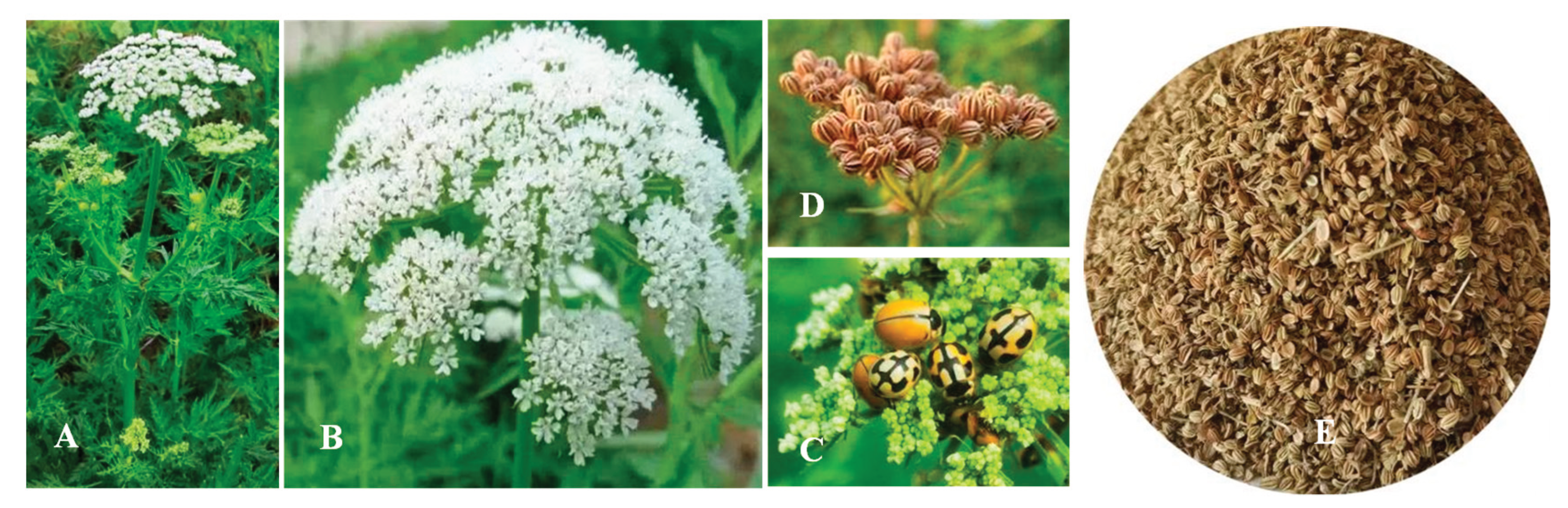

Table 1.
Types and functions of active components in Cnidium monnieri.
| Product categories | Representative compounds | Main Functions and Roles | References |
|---|---|---|---|
| Coumarin-type compounds | Osthole | Exhibiting multiple pharmacological activities, e.g., anti-inflammatory, antibacterial, antitumor, antioxidant, and smooth muscle–modulating effects. It can downregulate the expression of pro-inflammatory cytokines by inhibiting the NF-κB/MAPK signaling pathways. | [1,2,20] |
| Isoimperatorin; Imperatorin | Hacing antibacterial, anti-inflammatory, and antioxidant activities, and inhibiting the growth of pathogenic fungi. | [23,26] | |
| Psoralen; Isopsoralen | Exhibiting remarkable photosensitizing activity and it is used for the treatment of skin disorders, e.g., vitiligo and psoriasis. | [27] | |
| Xanthotoxin; Xanthotoxol | Photosensitizing furanocoumarin with antifungal and antitumor activities. | [23,25] | |
| Oxypeucedanin; Columbianetin | An angular furanocoumarin with anti-inflammatory and neuroprotective activities. | [21,25] | |
| Angelol; Cniforin B | Involved in immune regulation and metabolic homeostasis. | [21,23] | |
| Volatile components | β-Eudesmol | Exhibiting anti-inflammatory, antibacterial, and insect-repellent activities. | [7,31] |
| Bornyl acetate | Possessing soothing, sedative and antibacterial effects, and contributing to the characteristic aroma profile. | [1,31] | |
| p-Cymene; Limonene | Exhibiting significant repellent activity and it can interfere with the chemotactic behavior of herbivorous insects. | [33,34] | |
| Linalool | Exhibiting attractant effects on natural enemy insects and contributing to the maintenance of ecological balance. | [34] | |
| Caryophyllene; γ-Terpinene | Participating in plant defense responses and exhibiting antibacterial and antioxidant activities. | [7,30] | |
| Other active components | Flavonoids(e.g., Chromones, cnidimoside A, cnidimol B) | Exhibiting antioxidant, anti-inflammatory, and immunomodulatory activities. | [23,35] |
| Fatty acid constituents (e.g., oleic acid and linoleic acid) | Involving maintenance of cell membrane structure and signal transduction, and exhibiting anti-inflammatory and cardioprotective functions. | [29,37] | |
| Steroidal compounds (e.g., brassicasterol, stigmasterol, and β-sitosterol) | Lipid-lowering, anti-inflammatory,and antitumor activities | [7,36] | |
| Triterpenoid compounds (e.g., oleanolic acid and ursolic acid) | Antitumor, antioxidant, and tissue-protective activities | [38] | |
| Polysaccharides and organic acids | Possessing immunomodulatory and antioxidant activities and synergistically enhancing pharmacological effects. | [1,20] |
Table 2.
Identification and analytical methods of active constituents in C. monnieri.
| Method category | Representative techniques | Analytical principles /detection basis |
Advantages | Limitations | Main applications | References |
|---|---|---|---|---|---|---|
| Chromatographic analysis | TLC, HPLC, GC, GC-MS, LC-MS | Separation and detection are achieved based on differences in compound partitioning, adsorption, and molecular recognition between the stationary and mobile phases. | High separation efficiency, strong sensitivity, accurate quantification, and suitability for multi-component detection | Complex sample pretreatment and high instrument requirements; limited detection of thermally unstable or highly polar compounds. | Qualitative and quantitative analysis of major active constituents of Cnidium monnieri, including coumarins and volatile oils | [22,29,48,49,50] |
| Spectroscopic/ spectrometric analysis | UV-Vis, FTIR, NMR, MS, HPLC-MS | Structural elucidation is performed based on characteristic molecular absorption, vibrational transitions, nuclear magnetic resonance signals, and ion-fragmentation patterns. | Rapid analysis, low sample consumption, and the ability to provide structural and functional-group information | The resolution is limited and requires validation in combination with other techniques; signal overlap may occur in certain complex samples. | Structural elucidation and functional-group identification of coumarins, phenols, alcohols, and other constituents in Cnidium monnieri | [41,51,52,53] |
| UHPLC–HRMS | UPLC-QTOF-MS, UPLC-Orbitrap-MS | Ultra-high-performance liquid chromatography coupled with high-resolution mass spectrometry enables molecular-mass determination and structural identification of components. | Extremely sensitivity and high resolution, suitable for both targeted and untargeted analyses | The instruments are expensive and data processing is complex; specialized software is required for interpretation. | Systematic analysis of the complex extracts and metabolite profile of Cnidium monnieri | [43,44] |
| Metabolomics analysis | LC-MS/MS, GC-MS, UPLC-QTOF-MS, Chemometrics | It enables systematic detection of changes in multiple metabolites within biological samples, and, through integration with statistical and pathway analyses, reveals compositional differences. | Comprehensive and systematic, capable of revealing metabolic pathways, and suitable for quality evaluation and differential analysis | The data volume is large and interpretation is complex; validation in combination with conventional analytical methods is required. | Revealing the metabolic characteristics and quality differences of active constituents in Cnidium monnieri | [54,55,56] |
| Other emerging techniques | Supercritical fluid extraction, Capillary electrophoresis | Detection is achieved through the high solvation capacity of supercritical fluids or the separation capability provided by an electric field. | High extraction efficiency, environmentally friendly and safe; electrophoresis is suitable for the analysis of small molecules and ions. | The degree of method standardization is low; it is not suitable for non-polar macromolecular compounds. | Sample preparation of Cnidium monnieri extracts and multicomponent separation | [45,46,47] |
Disclaimer/Publisher’s Note: The statements, opinions and data contained in all publications are solely those of the individual author(s) and contributor(s) and not of MDPI and/or the editor(s). MDPI and/or the editor(s) disclaim responsibility for any injury to people or property resulting from any ideas, methods, instructions or products referred to in the content. |
© 2025 by the authors. Licensee MDPI, Basel, Switzerland. This article is an open access article distributed under the terms and conditions of the Creative Commons Attribution (CC BY) license (http://creativecommons.org/licenses/by/4.0/).
Copyright: This open access article is published under a Creative Commons CC BY 4.0 license, which permit the free download, distribution, and reuse, provided that the author and preprint are cited in any reuse.


