
Submitted:
15 December 2025
Posted:
18 December 2025
You are already at the latest version
Abstract
CAR receptor engineering has progressed from “add a costimulatory domain” to a disciplined, multi-parameter design problem spanning extracellular geometry, intracellular network wiring, and safety control layers. Using the provided schematic of CAR generations (Figure 1) as a conceptual anchor, this mini-review summarizes the current state of CAR design from first-generation ITAM-only receptors to armored/TRUCK concepts and cytokine-receptor/JAK–STAT–coupled “fifth-generation” constructs. TRUCK designs formalized the principle of antigen-triggered payload delivery to reshape the tumor microenvironment. Fifth-generation architectures exemplified by IL-2Rβ/STAT-recruiting CARs attempt to integrate activation, costimulation, and STAT transcriptional programming in an antigen-dependent manner. We highlight design variables that often dominate in vivo behavior yet are underappreciated in “generation” shorthand: hinge/spacer and transmembrane selection, Fc receptor interactions, receptor clustering/tonic signaling, and exhaustion dynamics influenced by CD28 versus 4-1BB signaling. Finally, we frame NKG2D-based CAR approaches as a case study where target biology forces architectural choices (multi-ligand recognition, endogenous adaptor signaling, fratricide risk and ligand dynamics), illustrating how modern CAR design must be co-developed with biomarker strategy and control mechanisms to achieve a favorable therapeutic index.
Keywords:
CAR design
; TRUCK
; fifth-generation CAR
; JAK–STAT
; hinge/spacer
; tonic signaling
; CD28
; 4-1BB
; synNotch
; switchable CAR
; safety switch
; NKG2D
; DAP10
1. Why CAR Receptor Design Remains a Moving Target
Despite transformative clinical outcomes in selected hematologic malignancies, CAR efficacy and safety remain inconsistent across targets and disease contexts. Increasingly, failures are attributable not to “wrong antigen” alone, but to receptor-level properties: synapse geometry, signal strength and persistence, tonic signaling/exhaustion, and inadequate controllability. Design has therefore shifted toward an engineering mindset: CARs are modular synthetic receptors whose performance is tuned by choices across all domains, not only the scFv and costimulatory module.
2. Interpreting Figure 1: What “Generations” Capture—and What They Omit
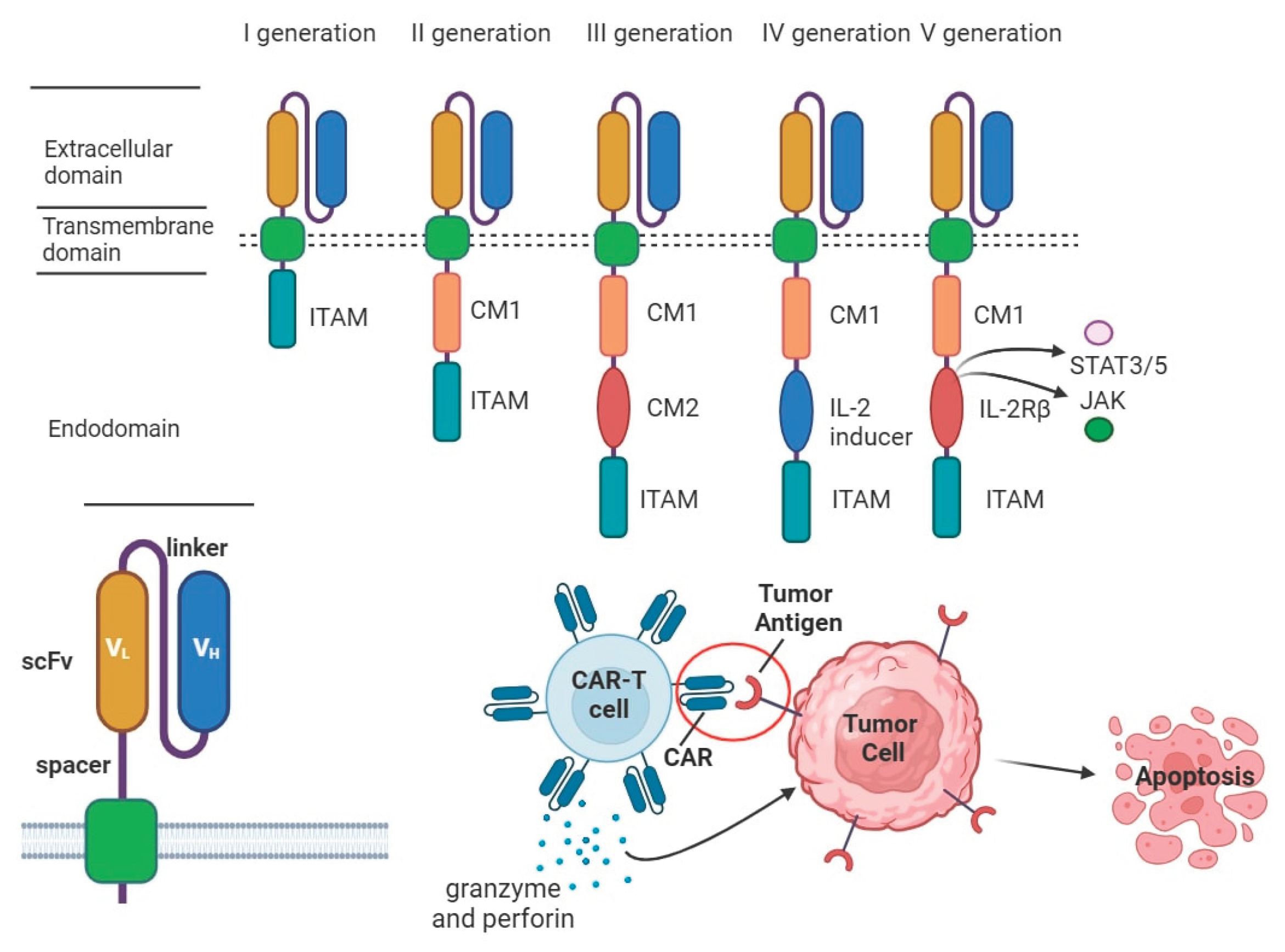
Figure 1 summarizes a widely used taxonomy of CAR “generations” spanning (i) intracellular signaling complexity (ITAM only → costimulation → payloads → JAK–STAT coupling) and (ii) the canonical modular structure (recognition domain, spacer/hinge, transmembrane, endodomain). This framing remains useful as a teaching tool, but it can obscure the reality that clinical behavior frequently hinges on parameters not explicitly shown as “generation upgrades,” particularly hinge/spacer and transmembrane choices, and the propensity for antigen-independent clustering (tonic signaling).
3. Intracellular Signaling Status: From ITAM-Only to Integrated STAT Programs
3.1. First Generation: ITAM-Only Activation
First-generation CARs typically rely on CD3ζ ITAM signaling (Figure 1). These constructs established feasibility but often showed limited expansion/persistence, motivating additional costimulatory wiring.
3.2. Second and Third Generations: Costimulation as “Signal Quality Control”
The field largely converged on second-generation CARs incorporating one costimulatory domain, most commonly CD28 or 4-1BB, with third-generation designs adding two costimulatory modules. Practical differences between CD28 and 4-1BB signaling include distinct activation kinetics, differentiation programs, and exhaustion susceptibility under persistent stimulation.
A key mechanistic insight is that tonic CAR signaling can drive exhaustion, and 4-1BB costimulation can mitigate exhaustion relative to CD28 in tonic-signaling contexts. This result is now reflected in routine development practice: receptor constructs are screened for tonic signaling early, and signaling domains are selected with chronic stimulation in mind, not only peak cytotoxicity.
3.3. Fourth Generation (TRUCKs/Armored CARs): Antigen-Triggered Payload Delivery
TRUCK designs formalized the idea that CAR engagement can trigger local delivery of immune modulators (classically IL-12), aiming to remodel suppressive tumor stroma rather than relying solely on intrinsic CAR-T cytotoxicity. This concept has broadened beyond IL-12 to diverse payloads (cytokines, chemokines, checkpoint antagonists), but the core design principle remains: conditional, antigen-coupled “signal 3” programming in situ.
3.4. Fifth Generation: CARs That Couple Activation to JAK–STAT Signaling
Fifth-generation designs aim to integrate cytokine-receptor signaling motifs into CAR endodomains. A canonical example incorporates truncated IL-2Rβ and a STAT3-recruiting motif, enabling antigen-dependent activation of STAT3/5 pathways layered onto CD3ζ and costimulation. The engineering motivation is clear: rather than exposing patients to systemic cytokines or constitutive transgenes, these receptors attempt to deliver STAT-driven transcriptional programs only when antigen is engaged.
4.“. Non-Signaling” Domains That Frequently Dominate Function In Vivo
4.1. Hinge/Spacer: Synapse Geometry, Epitope Access, and Unintended Fc Biology
Spacer length and composition can determine whether a CAR efficiently engages membrane-proximal versus membrane-distal epitopes and can materially affect selectivity and potency. IgG-derived spacers can create unwanted interactions with Fcγ receptors unless engineered to remove Fc binding, which may impair persistence or alter activation in vivo.
4.2. Transmembrane Domain: Stability and Receptor Interactions
Transmembrane selection affects surface expression, stability, and the propensity for receptor interactions that can shape signaling behavior. Recent experimental work also highlights that hinge and transmembrane pairing can be decisive for activity in some contexts.
4.3. Tonic Signaling: A Design Failure Mode That Is Now Actively Engineered Against
Antigen-independent clustering of CARs can produce persistent CD3ζ phosphorylation and early exhaustion. Contemporary receptor engineering therefore treats tonic signaling as a primary safety/efficacy liability, influenced by binder format, hinge/TM choices, and signaling-domain composition.
5. Programmability and Control Layers: The “Current Status” Beyond Generations
5.1. Logic Gating with synNotch Circuits
Logic gating strategies aim to improve tumor selectivity by requiring combinatorial antigen conditions. synNotch receptors can convert recognition of antigen A into inducible expression of a CAR against antigen B, effectively implementing an AND gate through a transcriptional intermediate.
5.2. Switchable/Universal CAR Platforms
Split and adaptor-based CAR systems decouple antigen recognition from signaling, enabling re-targeting without re-engineering cells and allowing titratable control of activation strength. SUPRA CAR is a prominent example of a split, universal, and programmable framework.
5.3. Safety Switches and Inhibitory Control
Given the reality of unpredictable toxicities, conditional elimination mechanisms such as inducible caspase-9 have strong clinical precedent as emergency “off switches.” Separately, inhibitory CARs (iCARs) using PD-1 or CTLA-4 intracellular domains were introduced to suppress activation in off-target contexts rather than reacting after toxicity occurs.
6. NKG2D as a Case Study: When Target Biology Dictates Receptor Architecture
NKG2D-based CAR strategies are a useful stress test for modern design thinking because they combine potential advantages (broad, multi-ligand tumor coverage) with distinctive liabilities (ligand inducibility, ligand dynamics, and self-targeting risks).
6.1. Clinical Translation and the Adaptor-Signaling Premise
Clinical-stage NKG2D CAR approaches (e.g., CYAD-01) use an NKG2D-based recognition module to target NKG2D ligands and have been evaluated in early clinical studies, including the THINK trial. A recurring design theme is exploitation of endogenous adaptor biology (DAP10) to provide an integrated costimulatory component, effectively coupling target biology to signaling architecture.
6.2. Fratricide and Product Fitness: Design Adaptation via Ligand Knockdown
Activated T cells can transiently express NKG2D ligands during manufacturing/activation, creating a fratricide risk for multi-ligand NKG2D targeting. A next-generation approach (CYAD-02) incorporated an shRNA targeting MICA/MICB to reduce self-ligand expression and improve persistence characteristics. This exemplifies a broader principle: for multi-ligand systems, product-intrinsic antigen biology can become a first-order determinant of persistence.
6.3. Signal Augmentation and Comparative Architectures
Recent preclinical work has explored NKG2D/Dap10-12 CAR configurations and compared them with clinical-stage analogs, supporting continued innovation in adaptor-coupled signaling architectures for solid tumors. Collectively, these studies illustrate that NKG2D programs are rarely “just another CAR”: they require explicit integration of ligand biology, persistence engineering, and (often) enhanced control layers due to ligand inducibility under inflammation.
7. A Practical Mini-Checklist for CAR Receptor Development in 2025
Across targets (including NKG2D), high-quality programs increasingly standardize:
- Geometry optimization: hinge/spacer/TM variants benchmarked against epitope location and target density.
- Tonic signaling screens: early detection and mitigation, with domain choices informed by exhaustion risk.
- Control layers: at least one robust safety mechanism (e.g., iCasp9) for higher-risk targets and/or switchable logic for solid tumors.
- Programmability strategy: synNotch/logic gating or switchable receptor systems when single-antigen specificity is insufficient.
- Target-biology co-design: for NKG2D, explicit plans for ligand dynamics and fratricide mitigation (e.g., ligand knockdown).
8. Conclusions and Outlook
I–V generation arc (Figure 1) remains a helpful shorthand for how CAR signaling has expanded—from ITAM-only activation to costimulation, payload delivery, and cytokine-receptor/JAK–STAT integration. However, the “current status” of CAR receptor design is best summarized as a convergence toward full-stack receptor engineering: extracellular geometry and binder biophysics, signaling-network wiring that anticipates chronic stimulation, and programmable control layers that improve specificity and manage risk.
NKG2D-based CARs underscore that no receptor architecture is target-agnostic. Multi-ligand targeting can mitigate antigen escape, but introduces ligand inducibility and product fitness constraints that demand architectural adaptations and biomarker-aware development. The next wave of improvements is therefore likely to come from combinations of (i) rational signal integration (including STAT coupling where appropriate), (ii) stringent tonic signaling control, and (iii) programmable specificity (logic gating and/or switchable systems) rather than incremental “generation” upgrades alone.
Funding
This work was funded by the subsidy allocated to Kazan Federal University for the state assignment in the sphere of scientific activities (project number FZSM-2023-0011).
References
- Obajdin, J.; et al. Solid tumor immunotherapy using NKG2D-based adaptor CAR T cells. Cell Reports Medicine 2024, 5, 101827. [Google Scholar] [CrossRef] [PubMed]
- Chmielewski, M.; Abken, H. TRUCKs: the fourth generation of CARs. Expert Opinion on Biological Therapy 2015, 15, 1145–1154. [Google Scholar] [CrossRef] [PubMed]
- Chmielewski, M.; Abken, H. CAR T cells transform to trucks: chimeric antigen receptor–redirected T cells engineered to deliver inducible IL-12 modulate the tumour stroma to combat cancer. Cancer Immunology, Immunotherapy 2012, 61, 1269–1277. [Google Scholar] [CrossRef] [PubMed]
- Kagoya, Y.; et al. A novel chimeric antigen receptor containing a JAK–STAT signaling domain mediates superior antitumor effects. Nature Medicine 2018, 24, 352–359. [Google Scholar] [CrossRef] [PubMed]
- Long, A. H.; et al. 4-1BB costimulation ameliorates T cell exhaustion induced by tonic signaling of chimeric antigen receptors. Nature Medicine 2015, 21, 581–590. [Google Scholar] [CrossRef] [PubMed]
- Roybal, K. T.; et al. Engineering T Cells with Customized Therapeutic Response Programs Using Synthetic Notch Receptors. Cell 2016, 167, 419–432.e16. [Google Scholar] [CrossRef] [PubMed]
- Cho, J. H.; Collins, J. J.; Wong, W. W. Universal Chimeric Antigen Receptors for Multiplexed and Logical Control of T Cell Responses. Cell 2018, 173, 1426–1438.e11. [Google Scholar] [CrossRef] [PubMed]
- Liu, D.; Zhao, J.; Song, Y. Engineering switchable and programmable universal CARs for CAR T therapy. Journal of Hematology & Oncology 2019, 12, 69. [Google Scholar] [CrossRef] [PubMed]
- di Stasi, A.; et al. Inducible Apoptosis as a Safety Switch for Adoptive Cell Therapy. New England Journal of Medicine 2011, 365, 1673–1683. [Google Scholar] [CrossRef] [PubMed]
- Fedorov, V. D.; Themeli, M.; Sadelain, M. PD-1– and CTLA-4–Based Inhibitory Chimeric Antigen Receptors (iCARs) Divert Off-Target Immunotherapy Responses. Science Translational Medicine 2013, 5. [Google Scholar] [CrossRef] [PubMed]
- Guedan, S.; Calderon, H.; Posey, A. D.; Maus, M. v. Engineering and Design of Chimeric Antigen Receptors. Molecular Therapy - Methods & Clinical Development 2019, 12, 145–156. [Google Scholar] [CrossRef] [PubMed]
- Jonnalagadda, M.; et al. Chimeric Antigen Receptors With Mutated IgG4 Fc Spacer Avoid Fc Receptor Binding and Improve T Cell Persistence and Antitumor Efficacy. Molecular Therapy 2015, 23, 757–768. [Google Scholar] [CrossRef] [PubMed]
- Sallman, D. A.; et al. CYAD-01, an autologous NKG2D-based CAR T-cell therapy, in relapsed or refractory acute myeloid leukaemia and myelodysplastic syndromes or multiple myeloma (THINK): haematological cohorts of the dose escalation segment of a phase 1 trial. The Lancet Haematology 2023, 10, e191–e202. [Google Scholar] [CrossRef] [PubMed]
- Curio, S.; Jonsson, G.; Marinović, S. A summary of current NKG2D-based CAR clinical trials. Immunotherapy Advances 2021, 1. [Google Scholar] [CrossRef] [PubMed]
- Fontaine, M.; et al. Next Generation NKG2D-based CAR T-cells (CYAD-02): Co-expression of a Single shRNA Targeting MICA and MICB Improves Cell Persistence and Anti-Tumor Efficacy in vivo. Blood 2019, 134, 3931–3931. [Google Scholar] [CrossRef]
Figure 1.
Evolution of CAR receptor architectures across I–V generations (schematic provided by the authors). The figure depicts canonical CAR modular structure—extracellular binding domain (e.g., scFv VH/VL), spacer/hinge, transmembrane region, and intracellular endodomain—and a commonly used “generation” taxonomy: I (CD3ζ ITAM-only), II (single costimulatory module, CM1, plus ITAM), III (dual costimulation, CM1+CM2, plus ITAM), IV (payload/“armored” design; example shown as an inducible cytokine program), and V (integration of cytokine-receptor/JAK–STAT signaling motifs; example shown as IL-2Rβ/JAK with STAT3/5 recruitment layered onto CAR activation). Representative exemplars include TRUCK concepts and IL-2Rβ/STAT-recruiting CARs.
Figure 1.
Evolution of CAR receptor architectures across I–V generations (schematic provided by the authors). The figure depicts canonical CAR modular structure—extracellular binding domain (e.g., scFv VH/VL), spacer/hinge, transmembrane region, and intracellular endodomain—and a commonly used “generation” taxonomy: I (CD3ζ ITAM-only), II (single costimulatory module, CM1, plus ITAM), III (dual costimulation, CM1+CM2, plus ITAM), IV (payload/“armored” design; example shown as an inducible cytokine program), and V (integration of cytokine-receptor/JAK–STAT signaling motifs; example shown as IL-2Rβ/JAK with STAT3/5 recruitment layered onto CAR activation). Representative exemplars include TRUCK concepts and IL-2Rβ/STAT-recruiting CARs.
Disclaimer/Publisher’s Note: The statements, opinions and data contained in all publications are solely those of the individual author(s) and contributor(s) and not of MDPI and/or the editor(s). MDPI and/or the editor(s) disclaim responsibility for any injury to people or property resulting from any ideas, methods, instructions or products referred to in the content. |
© 2025 by the authors. Licensee MDPI, Basel, Switzerland. This article is an open access article distributed under the terms and conditions of the Creative Commons Attribution (CC BY) license (http://creativecommons.org/licenses/by/4.0/).
Copyright: This open access article is published under a Creative Commons CC BY 4.0 license, which permit the free download, distribution, and reuse, provided that the author and preprint are cited in any reuse.


