
Submitted:
12 December 2025
Posted:
15 December 2025
You are already at the latest version
Abstract
We explore a theoretical framework addressing the supernova shock revival problem through matter phase transitions during core collapse. Extending Lockyer's geometric model, we investigate how extreme compression might induce reversible energy storage in modified nucleonic states. The proposed mechanism exhibits 2:1 energy release upon decompression, naturally yielding $\sim$1\% mass-to-energy conversion, matching observed explosion energies without fine-tuning. Analytical estimates suggest that the collapse energies could reach thresholds for such transitions, potentially explaining both shock revival and the supernova/black-hole dichotomy.
Keywords:
core collapse
; supernova explosion
; shock revival
; black-hole progenitors
; neutron stars
; gravitational binding energy
; nuclear compression
; exotic matter
; energy amplification
; mass-energy conversion
; phase transition
; high-density physics
; stellar evolution
; big bounce
; theoretical particle models
; beyond standard model physics
1. Introduction
Massive stars develop iron cores supported by electron degeneracy pressure. Once the Chandrasekhar mass limit is exceeded, the core becomes unstable and collapses on a dynamical timescale ( s). This collapse releases a vast reservoir of gravitational energy, partially transferred to the core as compressional heating and kinetic shock energy.
Traditional explanations for supernova shock revival include neutrino heating, convection, and standing accretion shock instabilities (SASI). However, in many numerical simulations the shock still stalls, and a robust explosion mechanism remains elusive.
In [1], we proposed a new mechanism: the formation of exotic matter at the stellar center caused by extreme compression. This matter absorbs substantial energy by increasing its number of internal nested energy levels. Once the core pressure drops, the unstable exotic matter disintegrates, isotropically releasing energy and contributing to shock revival.
To evaluate this mechanism quantitatively, we must compute the maximum compression energy delivered to the core by collapsing stellar layers. This article presents these calculations in detail.
2. Overview of Current Theoretical Model
2.1. Final Evolution of a Massive Star and Iron Core Formation
Stars with initial masses greater than 8 undergo successive, increasingly brief fusion phases:
- Hydrogen → Helium (millions of years)
- Helium → Carbon (thousands of years)
- Carbon → Neon, Oxygen (a few years)
- Oxygen → Silicon (months)
- Silicon → Iron (a few days)
Iron-56, the nucleus with the highest binding energy per nucleon, marks the end of exothermic fusion. The core, composed of iron/nickel nuclei and degenerate electron gas, contracts slowly until it reaches (the Chandrasekhar limit), at which point it becomes gravitationally unstable.
2.2. The Collapse
Two main triggering mechanisms operate simultaneously:
2.2.1. a) Photodisintegration of Iron
When central temperatures exceed (about ), gamma photons become energetic enough to dissociate iron nuclei:
These reactions absorb enormous energy (approximately per nucleon), reducing thermal pressure and accelerating collapse.
2.2.2. b) Electron Capture
As the core compresses, electrons in the degenerate gas reach increasingly high Fermi energies. Some become energetic enough for capture by protons:
Consequences include: reduced electron number (decreasing degeneracy pressure); neutrino escape (carrying away energy); and neutron-rich nuclei formation.
2.2.3. Runaway Collapse
- Initial collapse lasts milliseconds
- Core shrinks from km to km
- Density reaches nuclear density ( kg/m3)
- Matter becomes degenerate neutron fluid
- Collapse halts when neutron degeneracy pressure balances gravity
2.3. The Problematic Bounce and Shock Revival
When the inner core () reaches nuclear density, it rebounds, generating a shock wave. This shock typically stalls at –200 km due to energy losses from iron dissociation ( MeV/nucleon) and neutrino escape.
Standard revival mechanisms include neutrino heating (where neutrinos deposit energy in semi-transparent regions) and hydrodynamic instabilities (Rayleigh-Taylor, SASI, convection). Yet many simulations fail to produce robust explosions matching observations, indicating a missing energy source.
3. Exotic-Matter Model
Lockyer’s model (Appendix 10) reproduces proton/electron and neutron/electron mass ratios to 7 and 6 significant digits using only physical constants. This model features 18 nested energy layers with a constant progression between successive energy levels.
We extend this model by proposing that during collapse, neutrons absorb energy by increasing their number of internal layers, forming "exotic" neutrons stable only under strong confinement.
3.1. Energy Threshold from Lockyer’s Model
In Lockyer’s model, the last layer (18th) corresponds to times the electron mass. With the electron mass being MeV, this gives:
Assuming only even numbers of shells are allowed, adding two new shells yields:
3.2. Key Energy Relationship
A fundamental insight emerges: forming a 20-shell exotic neutron requires:
which equals the rest energy of a standard neutron. This leads to the transformation:
where denotes the 20-shell exoneutron with total energy MeV.
3.3. Formation Mechanism Sequence
The exotic-matter formation proceeds through the following sequence:
- Shock wave propagation: The rebounding shock wave travels inward toward the core center. Initially, it lacks sufficient energy density to transmute ordinary matter into exotic states.
- Energy concentration at the center: As the shock converges geometrically at the core center, its energy density increases dramatically. At the center, the concentrated energy reaches the 939.6 MeV per neutron threshold required to add two internal energy shells.
- Exotic-matter formation: Neutrons in the central region transform into exoneutrons20, absorbing shock energy.
- Pressure reduction: Once part of the shock energy has been absorbed to create exotic matter, the associated pressure drops below the stability threshold.
- Exotic matter disintegration: The unstable exotic matter completely disintegrates, releasing both the absorbed compression energy and the rest mass energy of the original neutrons.
The complete cycle bifurcates based on residual pressure:
- If residual pressure remains sufficient: The exotic core persists, forming a black hole (high-mass progenitors).
- If pressure becomes insufficient: Exotic matter destabilizes and decays, powering a supernova explosion (typical core-collapse).
4. Energy Available During Collapse
4.1. Gravitational Energy of Collapsing Layers
Consider a shell of mass at radius r with enclosed mass . Its gravitational potential energy is:
During rapid collapse, this converts to kinetic energy deposited upon impact. Falling from initial radius R to core radius delivers approximately:
For the outer envelope, , so , simplifying to:
Integrating over all layers gives the total central energy delivered.
4.2. Energy Per Nucleon in Supernova Collapse
For a typical progenitor [9]:
- Collapsing mass: (iron core plus infalling layers)
- Core radius at shock convergence: km (standard bounce radius)
The gravitational energy delivered is:
With kg and m:
The number of nucleons is: . Average energy per nucleon:
4.3. Enhanced Energy Budget
4.3.1. Core Contraction
If exotic-neutron formation reduces the core radius by factor (from km to km), additional gravitational energy is released:
corresponding to MeV per nucleon.
4.3.2. Dynamical Infall of Outer Layers
The kinetic energy of infalling outer layers multiplies the static-core energy by a factor (range 2–3). Including this enhancement:
4.3.3. Total Combined Energy
Combining dynamical infall and core contraction effects:
4.4. Energy Concentration Mechanism
The average energy per nucleon (100.9 MeV) remains below the 939.6 MeV threshold. However, geometric concentration at the core center provides the necessary energy density. When a spherical shock converges, its energy focuses into a progressively smaller volume. If energy concentrates in a fraction f of the core volume:
For (1% volume concentration, realistic for spherical convergence):
This comfortably exceeds the 939.6 MeV threshold required for exoneutron20 formation. Even with conservative focusing (), concentrated energies reach 1.0 GeV, sufficient to trigger the exotic transformation.
5. Energy Amplification Mechanism
5.1. Amplification Factor
The transformation process exhibits an energy amplification factor of 2:
The complete cycle:
Energy balance:
- Energy invested: 939.6 MeV to form one exoneutron20
- Energy recovered: 1879.2 MeV upon disintegration
- Net gain: 939.6 MeV (100% return plus original investment)
5.2. Positive Feedback Mechanism
This creates a powerful positive feedback loop:
5.3. Comparison with Classical Supernova Theory
In classical supernova models, gravitational energy dissipates through irreversible processes:
- Photodisintegration: Absorbs MeV/nucleon irreversibly
- Neutrino emission: Carries away of collapse energy
- Inefficient heating: Only of neutrino energy is reabsorbed
This progressive energy loss causes the shock to stall at 100–200 km from the center.
In our exotic-matter model:
- Energy storage: Compression energy stores reversibly in internal neutron structure
- Energy amplification: Disintegration yields twice the invested energy
- Positive feedback: Released energy enables further exotic-matter formation
- Shock revival: Amplified energy overcomes losses and revives the stalled shock
6. Application to Supernova Explosions
6.1. Self-Limiting Chain Reaction
The explosive nature of the process self-limits its extent. As energy releases:
Only a fraction X of the core neutrons undergo exotic transformation before the explosion disperses the material.
6.2. Predicted Explosion Energy
If of neutrons transform and disintegrate:
which matches observed supernova energies.
6.3. Agreement with Established Energy Budgets
A significant success of this model is its quantitative prediction matching observed supernova energies. To reach the 939.6 MeV threshold for exoneutron20 formation, the exotic-matter chain reaction requires that approximately 1% of stellar matter undergoes complete disintegration. Remarkably, this 1% conversion fraction matches precisely the mass-to-energy conversion derived from supernova energy budgets [7,9]. This alignment provides indirect confirmation that the exotic-matter mechanism captures the essential physics of core-collapse explosions.
6.4. Contrast with Failed Explosions
In black-hole-forming collapses, external pressure remains sufficiently high to confine exoneutrons. No disintegration occurs, and the exotic core persists. This explains:
- Why black hole formation releases much less explosive energy
- Why some collapses produce explosions while others do not
- The threshold behavior between supernova and black hole formation
The pressure threshold for confining exoneutron20 constitutes the precise dividing line between these two outcomes.
7. Black-Hole-Forming Collapse
For a 25–40 progenitor:
- Collapsing mass: –
- Minimum radius before horizon formation: –15 km
Total delivered energy:
Number of nucleons:
Energy per nucleon:
Transforming all neutrons into exoneutrons requires only 939.59 MeV per neutron—exactly within the estimated energy range. The black hole forms through complete conversion of neutrons into 20-layer exoneutrons ().
7.1. Internal Structure of Black Holes
As the black hole grows, central pressure increases, potentially creating increasingly dense concentric shells. Additional energy shells beyond 20 become accessible:
From Lockyer’s model extensions:
This leads to a progression of exotic states:
In this model, black holes contain no mathematical singularities—only exotic matter of progressively increasing density from the surface toward the center.
8. Discussion
Our calculations demonstrate consistency between the exotic-matter model and observations of both supernovae and black hole formation. Stellar collapse naturally reaches energies sufficient for exotic-matter formation, supporting its role in halting collapse, triggering rebound, and supplying explosion energy.
The key advancement presented here is the energy amplification mechanism (Section 5). Unlike classical models where energy dissipates progressively, the exotic-matter model stores compression energy and amplifies it through disintegration. This resolves the fundamental energy budget problem in core-collapse supernovae.
The comparison with classical theory (Section 5.3) highlights why previous mechanisms struggle: they dissipate energy irreversibly, while the exotic-matter mechanism conserves and amplifies it.
The framework also resolves the "shock-revival" problem and replaces the mathematical singularity in black holes with physically meaningful, finite-density exotic cores.
9. Conclusions
We have demonstrated that collapsing massive stellar envelopes naturally drive cores to energies sufficient for exotic-matter formation. The bifurcation between black hole formation and supernova explosion emerges directly from the stability properties of this exotic phase.
A major achievement of this model is its quantitative prediction matching observed supernova energies. The self-regulating chain reaction of exotic-matter formation and disintegration naturally converts approximately 1% of core neutrons to energy—precisely the fraction required by observational constraints [7]. This 1% conversion yields explosion energies of J, explaining why supernovae exhibit such consistent energy outputs despite varying progenitor masses.
Central to the mechanism is the energy amplification factor of 2: when exotic neutrons disintegrate, they release twice the energy required to form them. This creates a positive feedback loop capable of reviving stalled shocks and powering supernova explosions.
When pressure remains high, a non-singular exotic core persists, forming a black hole. When pressure drops, exotic layers collapse and release their amplified stored energy, producing the supernova and its characteristic neutrino burst.
This framework not only solves the supernova energy problem but also strengthens the theoretical consistency of the exotic-matter paradigm. In particular, it reinforces the physical foundations of the cyclic-universe "Big Bounce" scenario previously proposed in [1], where exotic matter plays an analogous role during cosmic contraction.
10. Brief Description of Lockyer’s Model
Lockyer’s model conceptualizes the positron as a cube with edges based on the reduced Compton wavelength (). The proton models as a positron (level 0) containing 18 nested energy layers (levels 1–18). The positron cube edge length shortens by a factor deduced from the electron’s magnetic moment, using only physical constants. For the complete description of Lockyer’s original model, refer to [6].
Projected onto a plane perpendicular to the rotation axis giving the magnetic moment, the cube appears as a square. Each inner layer’s ’square’ inscribes with a 45° rotation relative to its containing square, reducing dimensions by factor :
Rest mass originates from photon momentum () confined in rotating layers, with energy contributions:
Mass contributions per level i (1 to 19):
The neutron adds an electron (mass , charge ) sharing level 0 with the positron (mass , charge ), doubling the energy of level 1.
10.1. Calculations
Proton mass ratio:
Neutron mass ratio includes doubling of first two levels:
10.2. Results and Discussion
Figure 1.
JavaScript code result, showing mass contributions per level.
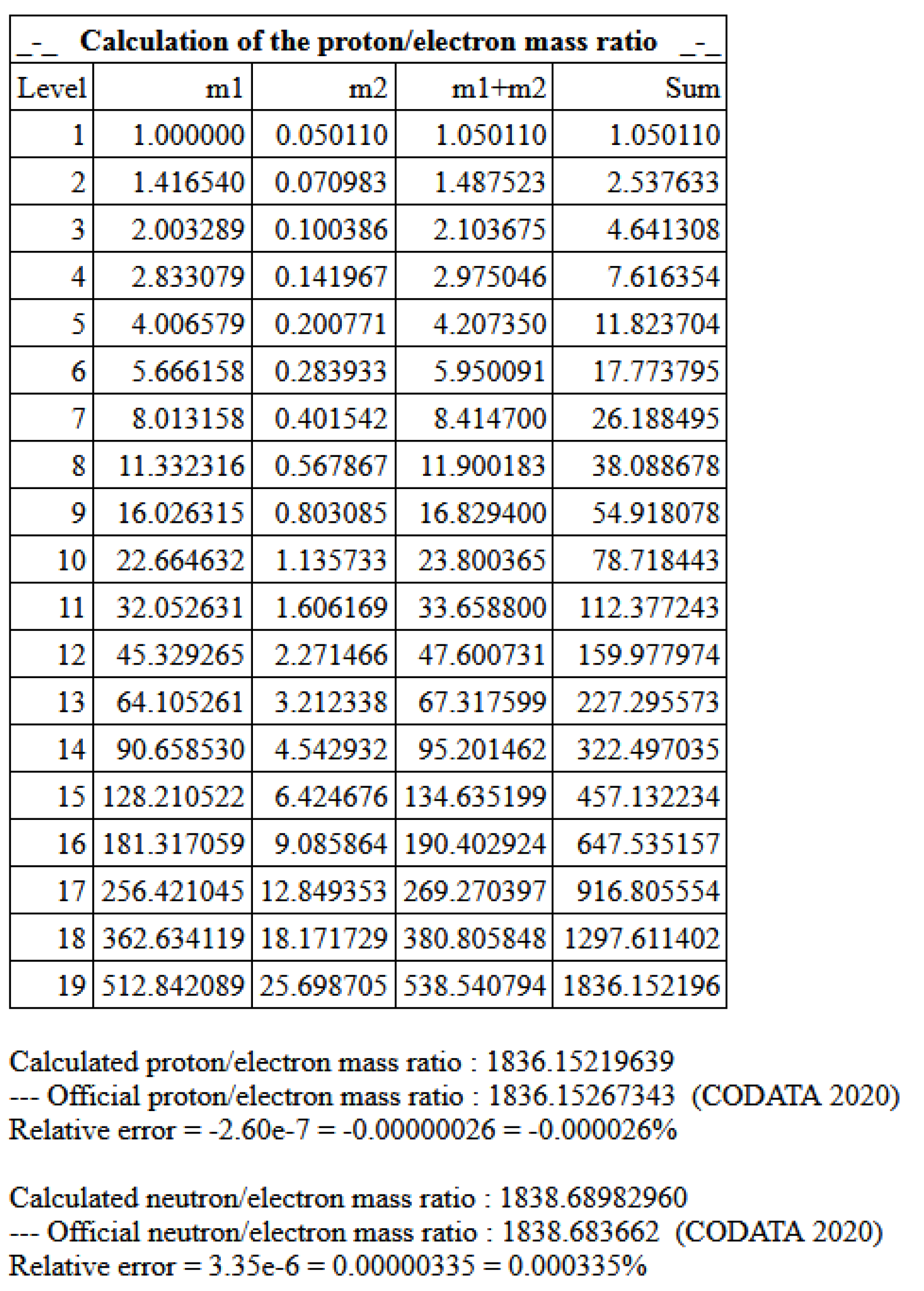
Our JavaScript implementation yields:
- Proton: , error relative to CODATA 1836.15267343 (seven significant digits)
- Neutron: , error relative to CODATA 1838.68366173 (six significant digits)
Note: Each level’s contribution () equals the previous contribution multiplied by .
References
- Furne Gouveia, G. Exotic Matter Formation as the Trigger of the Cosmological Bounce: A Unified View from Nuclear Structure to Cosmic Cycles. Preprints 2025. [Google Scholar] [CrossRef]
- Furne Gouveia, G. A Unified Wave-Based Model of Matter, Light, and Space: Stationary Waves in an Elastic, Non-Dispersive Medium. Preprints 2025. [Google Scholar] [CrossRef]
- Furne Gouveia, G. The Vibrational Fabric of Spacetime: A Model for the Emergence of Mass, Inertia, and Quantum Non-Locality. Preprints 2025. [Google Scholar] [CrossRef]
- Furne Gouveia, G. A Generalized Contraction Framework for the Michelson-Morley Null Result in a Medium-Based Theory. Preprints 2025. [Google Scholar] [CrossRef]
- Furne Gouveia, G. A Photon-Based Vector Particle Model for Proton and Neutron Masses. Preprints 2025. [Google Scholar] [CrossRef]
- Lockyer, T. N. Vector Particle Physics; TNL Press, 1992. [Google Scholar]
- Bethe, H.A. Supernova mechanisms. Reviews of Modern Physics 1990, 62(4), 801–866. [Google Scholar] [CrossRef]
- Shapiro, S.L.; Teukolsky, S.A. Black Holes, White Dwarfs, and Neutron Stars; 1983. [Google Scholar]
- Janka, H.-T. Explosion mechanisms of core-collapse supernovae. Annual Review of Nuclear and Particle Science 2012, 62, 407–451. [Google Scholar] [CrossRef]
Disclaimer/Publisher’s Note: The statements, opinions and data contained in all publications are solely those of the individual author(s) and contributor(s) and not of MDPI and/or the editor(s). MDPI and/or the editor(s) disclaim responsibility for any injury to people or property resulting from any ideas, methods, instructions or products referred to in the content. |
© 2025 by the authors. Licensee MDPI, Basel, Switzerland. This article is an open access article distributed under the terms and conditions of the Creative Commons Attribution (CC BY) license (http://creativecommons.org/licenses/by/4.0/).
Copyright: This open access article is published under a Creative Commons CC BY 4.0 license, which permit the free download, distribution, and reuse, provided that the author and preprint are cited in any reuse.


