

Submitted:
12 December 2025
Posted:
15 December 2025
You are already at the latest version
Abstract
This systematic review delves into the revolutionary impact of composite materials on the aerospace industry, emphasizing their role in enabling lightweight and high-performance structures. By synthesizing existing research, the review comprehensively analyzes the application of composite materials in aerospace, highlighting benefits, challenges, and advancements. The review aims to offer valuable insights into the current landscape of composite materials in aerospace applications and to pinpoint potential areas for future research and development. Exploring the transformative impact of composites in aircraft design, performance enhancement, and environmental sustainability, the review underscores the opportunities for innovation and efficiency while addressing challenges such as cost considerations and regulatory compliance. It emphasizes the essential role of research in material development, performance evaluation, and sustainability to drive advancements in aerospace composite technologies. The review advocates for collaborative partnerships and investments in research initiatives as crucial steps towards unlocking the full potential of composites in aerospace, shaping a future characterized by excellence, innovation, and sustainable aerospace solutions.
Keywords:
environmental sustainability
; composite material
; aerospace
1. Introduction
Composite materials have emerged as a game-changer in the aerospace industry, offering a wide range of advantages over traditional materials. The unique combination of high strength, low weight, and excellent fatigue resistance has made composites an attractive choice for various aerospace applications [1]. This systematic review aims to provide a comprehensive analysis of the application of composite materials in aerospace, exploring their benefits, challenges, and advancements. By synthesizing existing research, this review seeks to provide valuable insights into the current state of composite materials in aerospace applications and identify potential areas for future research and development.
The aerospace industry has witnessed a significant shift towards the adoption of composite materials in recent decades. These materials are composed of two or more distinct constituents, typically a matrix material and reinforcing fibers, combined to form a synergistic system with enhanced properties [2]. The matrix material, often a polymer resin such as epoxy, provides a strong bond between the fibers and transfers loads between them. The reinforcing fibers, such as carbon fibers or glass fibers, contribute to the overall mechanical strength and stiffness of the composite [3]. The specific combination of matrix and fibers can be tailored to meet the desired performance requirements of different aerospace applications.
The importance of composite materials in aerospace cannot be overstated. Their lightweight nature significantly reduces the overall weight of aircraft structures, leading to substantial fuel savings and increased operational efficiency [4]. The reduced weight also allows for increased payload capacity and extended flight range, enabling new possibilities in aviation. Moreover, composites offer superior corrosion resistance compared to metals, resulting in longer service life and reduced maintenance requirements [5]. These properties make composites particularly attractive for aerospace applications, where weight reduction, durability, and performance are critical factors.
The advantages of composite materials in aerospace extend beyond weight reduction and durability. Composites exhibit excellent fatigue resistance, enabling them to withstand cyclic loading and prolonged operational stress without significant degradation in performance [6]. This characteristic is crucial for aircraft structures that experience repetitive loading during flight. Furthermore, composite materials offer enhanced design flexibility, allowing complex and aerodynamically efficient shapes to be realized [1]. This versatility facilitates the optimization of structural performance, leading to improved safety and overall aircraft efficiency.
However, the application of composite materials in aerospace is not without its challenges. The manufacturing and processing of composites can be complex and time-consuming, requiring specialized equipment and skilled labor [4]. The repair and maintenance of composite structures also present unique considerations, necessitating specific techniques and expertise [7]. Additionally, the cost of composite materials, although decreasing over time, can still be higher compared to traditional materials, posing economic challenges for widespread adoption [8]. Environmental sustainability is another aspect to be considered, as the disposal and recycling of composite materials raise concerns about their long-term impact on the ecosystem [9].
To overcome these challenges and further advance the use of composites in aerospace, significant research and development efforts have been undertaken. Researchers have explored the incorporation of nanocomposites and hybrid materials to enhance the mechanical properties and multifunctionality of composites [10]. Integrated structural health monitoring systems have been developed to detect and assess damage in composite structures, improving safety and maintenance practices [7]. Furthermore, new manufacturing techniques, such as additive manufacturing, are being investigated to streamline the production process and reduce costs [11]. The development of sustainable composite materials is also gaining attention, aiming to address environmental concerns associated with composite disposal and recycling [8]
In conclusion, composite materials have revolutionized aerospace applications, offering significant advantages in terms of weight reduction, durability, and performance. Despite challenges related to manufacturing, repair, cost, and sustainability, ongoing research and development efforts are continually pushing the boundaries of composite material applications in aerospace. This systematic review aims to provide a comprehensive analysis of the current state of composite materials in aerospace, highlighting their benefits, challenges, and recent advancements. By identifying potential areas for future research and development, this review will contribute to the continued improvement and innovation in the field of aerospace composites.
2. Composite Materials in Aerospace: Overview
2.1. Definition and Classification of Composite Materials
Composite materials, as applied in the aerospace industry, are composed of two or more distinct constituents that are combined to form a synergistic system with enhanced properties [12]. The constituents typically consist of a matrix material, such as epoxy resin, and reinforcing fibers, including carbon fibers or glass fibers [9]. The combination of matrix and fibers can be tailored to achieve specific performance requirements for different aerospace applications.
2.2. Importance of Composite Materials in Aerospace
The significance of composite materials in aerospace cannot be understated. One of the key advantages is their lightweight nature, which allows for substantial weight reduction in aircraft structures [11]. This weight reduction contributes to fuel savings, increased operational efficiency, extended flight range, and enhanced payload capacity. Moreover, composites offer superior corrosion resistance compared to metals, resulting in longer service life and reduced maintenance requirements [8]. These characteristics make composite materials highly desirable for aerospace applications, where weight reduction, durability, and performance are critical factors.
2.3. Advantages and Disadvantages of Composite Materials
Composite materials offer numerous advantages that have propelled their widespread adoption in aerospace applications. Their high strength-to-weight ratio provides exceptional mechanical properties, enabling the construction of lightweight yet structurally robust components [10]. Composites also exhibit excellent fatigue resistance, making them suitable for aircraft structures subjected to cyclic loading during flight [7]. Furthermore, the design flexibility of composites allows for the creation of complex shapes, leading to improved aerodynamics and overall aircraft efficiency [10].
However, the application of composite materials in aerospace is not without challenges. Manufacturing and processing composites can be complex and time-consuming, requiring specialized equipment and skilled labor [11]. The repair and maintenance of composite structures also present unique considerations, necessitating specific techniques and expertise [7]. Additionally, the cost of composite materials, although decreasing over time, can still be higher compared to traditional materials, posing economic challenges for widespread adoption [8]. Moreover, the environmental sustainability of composites raises concerns, particularly regarding their disposal and recycling, highlighting the need for improved practices in this area [9]
3. Composite Materials in Structural Components
Composite materials have revolutionized the design and manufacturing of structural components in the aerospace industry, offering a wide range of benefits over traditional materials. This section critically examines the application of composite materials in key structural components, including fuselage and wings, empennage and tail sections, landing gear, radomes, fairings, and nacelles.
a. Fuselage and Wings
Composite materials have been extensively utilized in the construction of fuselage and wings, resulting in significant weight reduction and improved fuel efficiency [11]. The high strength-to-weight ratio of composites allows for the design of lightweight yet structurally robust components, enhancing overall aircraft performance [10]. Moreover, the design flexibility of composites enables complex shapes to be realized, optimizing aerodynamics and reducing drag [10]. However, the manufacturing and processing of large composite structures such as fuselage sections pose challenges due to size limitations and the need for specialized equipment [11].
b. Empennage and Tail Sections
Composite materials have found extensive application in the construction of empennage and tail sections, providing weight reduction and improved structural integrity [9]. The use of composites in these components allows for increased maneuverability and stability, contributing to enhanced flight performance [12]. The high fatigue resistance of composite materials ensures that these components can withstand prolonged operational stress without significant degradation in performance [7]. However, the repair and maintenance of composite empennage and tail sections require specialized techniques and expertise [7].
c. Landing Gear
Composite materials have also made their way into the design of landing gear systems, offering weight reduction and improved corrosion resistance [8]. The use of composites in landing gear components contributes to fuel savings and increased payload capacity, ultimately enhancing aircraft performance [11]. However, the design and manufacturing of composite landing gear components require careful consideration of factors such as structural integrity, impact resistance, and load-bearing capabilities [9].
d. Radomes
Radomes, which protect radar equipment on aircraft, have increasingly incorporated composite materials due to their electromagnetic transparency and lightweight nature [11]. Composite radomes offer reduced radar reflection and improved signal transmission, ensuring accurate detection and communication [10]. The excellent mechanical properties of composites allow for the design of radomes with complex shapes, minimizing aerodynamic drag and optimizing performance [10]. However, the impact resistance and environmental durability of composite radomes require careful consideration during design and manufacturing [9].
e. Fairings and Nacelles
Fairings and nacelles, used to streamline and protect aircraft components such as engines and auxiliary power units, have increasingly employed composite materials [8]. Composite fairings and nacelles offer weight reduction, improved aerodynamics, and enhanced corrosion resistance [11]. The ability of composites to be molded into complex shapes allows for streamlined designs, minimizing drag and optimizing fuel efficiency [10]. However, the manufacturing complexity and cost of composite fairings and nacelles remain challenges that need to be addressed for widespread adoption [8].
In conclusion, composite materials have transformed the aerospace industry by revolutionizing the design and manufacturing of structural components. The application of composites in fuselage and wings, empennage and tail sections, landing gear, randoms, fairings, and nacelles has resulted in weight reduction, improved performance, and increased durability. While challenges related to manufacturing complexity, repair, and cost still exist, ongoing research and development efforts continue to advance composite technologies and address these issues, further driving the integration of composites into aerospace structural components.
4. Composite Materials in Propulsion Systems
Composite materials have made significant contributions to the advancement of propulsion systems in the aerospace industry. This section critically examines the application of composites in key components of propulsion systems, including engine casings, fan blades, and nozzle structures.
4.1. Engine Casings
The use of composite materials in engine casings offers numerous advantages, including weight reduction, improved strength, and enhanced corrosion resistance [11]. The high strength-to-weight ratio of composites allows for the design of lightweight casings that contribute to overall fuel efficiency and increased payload [10]. Moreover, composite engine casings exhibit superior resistance to corrosion compared to traditional metallic materials, resulting in longer service life and reduced maintenance requirements [8]. However, the manufacturing complexity and cost of composite engine casings remain challenges that need to be addressed for wider implementation [8].
4.2. Fan Blades
Composite fan blades have become increasingly prevalent in modern aircraft engines, offering exceptional strength, high stiffness, and reduced weight [9]. The superior mechanical properties of composites allow for the design of blades with improved aerodynamic efficiency and enhanced performance [10]. The lightweight nature of composite fan blades contributes to reduced fuel consumption and lower emissions, aligning with the industry's sustainability goals [11]. However, the impact resistance and long-term durability of composite fan blades require careful consideration during design and manufacturing [9].
4.3. Nozzle Structures
Composite materials have also found applications in the construction of nozzle structures, including thrust reversers and exhaust nozzles. The use of composites in these components offers weight reduction, improved heat resistance, and enhanced durability [11]. The high temperature stability of composites allows for efficient heat dissipation and resistance to thermal stress, contributing to enhanced performance and safety [7]. Moreover, the design flexibility of composites enables the optimization of nozzle shapes for improved thrust efficiency and reduced noise levels [10]. However, the manufacturing complexity and cost of composite nozzle structures remain challenges that require further research and development [8].
4.4. Heat Shield Systems
Composite materials play a vital role in heat shield systems, which are designed to protect spacecraft and re-entry vehicles from extreme temperatures generated during atmospheric re-entry. These systems typically consist of ablative or thermal protection materials (TPMs) that can withstand high temperatures and dissipate heat effectively [11]. Composite-based heat shield systems offer advantages such as weight reduction, thermal insulation, and enhanced thermal protection [10].
Ablative composites are designed to erode and char upon exposure to high temperatures, effectively dissipating heat and protecting the underlying structure [9]. These composites often utilize phenolic resins reinforced with fibers, such as carbon or aramid, to provide mechanical strength and thermal stability [7]. The erosion and charring process releases gases that create a protective boundary layer, reducing heat transfer to the spacecraft [8]. The design and optimization of ablative composites involve careful consideration of material composition, fiber architecture, and thickness to ensure effective thermal protection and structural integrity during re-entry [11].
Thermal protection materials (TPMs) based on composites, such as carbon-carbon (C/C) composites and ceramic matrix composites (CMCs), are also used in heat shield systems [10]. C/C composites offer excellent thermal properties, including high thermal conductivity and low thermal expansion, making them suitable for high-temperature applications [9]. CMCs, on the other hand, provide excellent resistance to thermal shock and oxidation, making them ideal for extreme environments [7]. These composites are designed to withstand high temperatures and maintain their structural integrity, thereby protecting the spacecraft during re-entry [8].
The application of composite materials in heat shield systems presents challenges, including material selection, structural integrity, and thermal performance under extreme conditions. The design and manufacturing processes need to consider factors such as material compatibility, thickness optimization, and integration with other spacecraft components [11]. Furthermore, extensive testing and validation are required to ensure the reliability and performance of composite-based heat shield systems in real-world re-entry scenarios [10].
In addition, composite materials play a critical role in heat shield systems by providing lightweight, thermally insulating, and protective solutions for spacecraft during atmospheric re-entry. Ablative composites, C/C composites, and CMCs offer unique properties that enable effective thermal protection and structural integrity in extreme temperature environments. Despite challenges, ongoing research and development efforts continue to advance composite technologies for heat shield applications, enhancing the safety and performance of spacecraft during re-entry.
In conclusion, composite materials have brought significant advancements to propulsion systems in the aerospace industry. The utilization of composites in engine casings, fan blades, and nozzle structures has led to weight reduction, improved performance, and increased durability. While challenges related to manufacturing complexity and cost still exist, ongoing research and development efforts continue to push the boundaries of composite technologies, further driving their integration into propulsion system components.
5. Composite Materials in Interior Applications
5.1. Cabin Interiors
Composite materials have revolutionized the design and construction of cabin interiors in aerospace applications. This review explores the various ways in which composites are utilized to enhance cabin interiors, providing numerous benefits in terms of weight reduction, durability, fire safety, and aesthetics.
The lightweight nature of composites, allows significant weight reduction when compared to traditional materials like metals. This weight reduction not only improves fuel efficiency but also increases the payload capacity of the aircraft [13]. Composite materials also offer excellent strength-to-weight ratios, ensuring the structural integrity of cabin interior components [14,15].
In terms of durability, composites exhibit exceptional resistance to corrosion, impact, and wear. This durability ensures that cabin interiors can withstand the rigors of daily use, resulting in reduced maintenance requirements and longer service life [16]. Additionally, composites are highly resistant to temperature changes and humidity, making them suitable for a wide range of environmental conditions [13].
Fire safety is a critical consideration in cabin interiors, and composites excel in this aspect as well. Composite materials can be engineered to meet stringent fire safety regulations, with flame-retardant properties that prevent or slow down the spread of fire. This enhances passenger safety and provides valuable time for evacuation in case of emergencies [14,17].
Aesthetics are also improved with the use of composites in cabin interiors. These materials offer design flexibility, allowing for the creation of visually appealing and customizable interior components [18]. Composites can be molded into intricate shapes and can incorporate lighting and other functional elements seamlessly, enhancing the overall passenger experience [13,16].
Overall, the utilization of composite materials in cabin interiors has transformed the aerospace industry. The numerous benefits, including weight reduction, durability, fire safety, and aesthetic appeal, make composites an ideal choice for enhancing the passenger experience while ensuring the highest standards of safety and performance
5.2. Seating Systems
Composite materials have revolutionized the design and construction of seating systems in aerospace applications. This review explores the various ways in which composites are used to enhance seating systems, providing numerous benefits in terms of weight reduction, comfort, safety, and durability.
The review highlights the lightweight nature of composites, which allows for significant weight reduction in seating systems compared to traditional materials such as metals. This weight reduction not only improves fuel efficiency but also increases the overall payload capacity of the aircraft. Composite materials also offer excellent strength-to-weight ratios, ensuring the structural integrity of seating components [19,20].
In terms of comfort, composites offer advantages such as flexibility, vibration absorption, and thermal insulation. Composite seating systems can be designed to provide ergonomic support and cushioning, enhancing passenger comfort during long flights [21]. The vibration absorption properties of composites contribute to a smoother ride, minimizing discomfort caused by turbulence or rough landings [20]. Additionally, the thermal insulation properties of composites help maintain a comfortable temperature for passengers [22].
Safety is a critical consideration in seating systems, and composites excel in this aspect as well. Composite materials can be engineered to meet stringent safety regulations, including crashworthiness and fire safety standards. These materials offer excellent energy absorption capabilities, reducing the impact forces experienced during emergencies [22,23]. Furthermore, composites can be designed with flame-retardant properties, ensuring passenger safety in the event of a fire [23,24].
Durability is another significant advantage of composites in seating systems. They exhibit exceptional resistance to corrosion, impact, and wear, ensuring that seating components can withstand the rigors of daily use [25,26]. This durability translates to reduced maintenance requirements and longer service life for seating systems [27].
The paper further discusses the manufacturing processes and techniques used for composite seating systems, including resin infusion, compression molding, and additive manufacturing. It also addresses the challenges and considerations associated with the use of composites in seating systems, such as cost, certification, and recyclability. Overall, the utilization of composite materials in seating systems has transformed the aerospace industry. The numerous benefits, including weight reduction, comfort, safety, and durability, make composites an ideal choice for enhancing the passenger experience while ensuring the highest standards of safety and performance.
5.3. Galley Structures
Composite materials have gained significant traction in aerospace applications, including the design and construction of galley structures. This review explores the utilization of composites in galley structures, highlighting the benefits they offer in terms of weight reduction, durability, design flexibility, and customization.
One of the primary advantages of using composites in galley structures is their lightweight nature. Composites are known for their high strength-to-weight ratios, allowing for substantial weight reduction compared to traditional materials such as metals [28]. This weight reduction not only improves fuel efficiency but also increases the overall payload capacity of the aircraft. It enables airlines to carry more passengers or cargo while maintaining optimal performance [29].
Durability is another key consideration in galley structures, and composites excel in this aspect. Composite materials offer exceptional resistance to corrosion, impact, and wear. This durability ensures that galley structures can withstand the demands of daily use, including loading and unloading of carts and equipment. It results in reduced maintenance requirements and longer service life for galley components [30,31].
Design flexibility is a significant advantage of composites in galley structures. These materials can be molded into various shapes and sizes, allowing for intricate and customized designs. Composites offer the freedom to create galley components that fit specific aircraft configurations and operational requirements [31,32]. This flexibility also allows for easy integration of features such as storage compartments, equipment mounts, and electrical wiring [33].
Additionally, composites offer excellent thermal insulation properties, which are crucial in galley structures. They help maintain a stable and comfortable temperature within the galley area, ensuring the proper storage and handling of food, beverages, and other items. This thermal insulation contributes to the overall efficiency and functionality of the galley [29,32,33].
The paper further discusses the manufacturing processes and techniques used for composite galley structures, including resin infusion, autoclave molding, and filament winding. It also addresses the challenges and considerations associated with the use of composites in galley structures, such as fire safety regulations, certification, and maintenance procedures. In conclusion, the utilization of composite materials in galley structures offers numerous benefits in aerospace applications. The lightweight nature, durability, design flexibility, and thermal insulation properties of composites make them an ideal choice for enhancing the functionality and efficiency of galley components. Continued advancements in composite technologies will further drive the adoption of composites in galley structures, contributing to improved aircraft performance and passenger experience.
5.4. Lavatory Components
Composite materials have emerged as a valuable solution for enhancing the design and functionality of lavatory components in aerospace applications. This paper explores the utilization of composites in lavatory structures, highlighting the benefits they offer in terms of weight reduction, durability, hygiene, and design flexibility.
One of the primary advantages of using composites in lavatory components is their lightweight nature. Composites are known for their high strength-to-weight ratios, allowing for significant weight reduction compared to traditional materials such as metals [34]. This weight reduction not only improves fuel efficiency but also increases the overall payload capacity of the aircraft. It enables airlines to optimize their operations and carry more passengers or cargo [35,36].
Durability is another key consideration in lavatory components, and composites excel in this aspect. Composite materials offer exceptional resistance to corrosion, impact, and wear [37]. This durability ensures that lavatory structures can withstand the demands of regular use, including the opening and closing of doors, the weight of occupants, and the cleaning and maintenance processes. It results in reduced maintenance requirements and longer service life for lavatory components [38,39].
Hygiene is a critical factor in lavatory design, and composites offer advantages in this area as well. Composite materials can be engineered to have smooth, non-porous surfaces that are resistant to stains, odors, and bacterial growth [35,40]. This makes them easier to clean and maintain, ensuring a high level of hygiene in the lavatory. Additionally, composites can be designed to have antimicrobial properties, further enhancing the cleanliness and safety of the lavatory environment [35,36].
Design flexibility is another significant advantage of composites in lavatory components. These materials can be molded into various shapes and sizes, allowing for customized designs that optimize space utilization and user comfort [34]. Composites offer the freedom to create innovative lavatory layouts and configurations, accommodating different aircraft models and passenger preferences. This design flexibility also allows for the integration of features such as storage compartments, mirrors, lighting, and other functional elements [40,41].
The paper further discusses the manufacturing processes and techniques used for composite lavatory components, including resin infusion, compression molding, and additive manufacturing. It also addresses the challenges and considerations associated with the use of composites in lavatory structures, such as fire safety regulations, certification, and maintenance procedures. In conclusion, the utilization of composite materials in lavatory components offers numerous benefits in aerospace applications. The lightweight nature, durability, hygiene, and design flexibility of composites make them an ideal choice for enhancing the functionality and user experience in lavatories. Continued advancements in composite technologies will further drive the adoption of composites in lavatory structures, contributing to improved aircraft performance and passenger satisfaction.
6. Challenges and Limitations of Composite Materials in Aerospace
6.1. Manufacturing and Processing Challenges
While composite materials offer numerous advantages in aerospace applications, there are several manufacturing and processing challenges that need to be addressed. This paper explores some of the key challenges associated with the production and processing of composite materials in the aerospace industry.
One of the main challenges is the complexity of manufacturing composite components. Compared to traditional materials like metals, composite materials require specialized manufacturing techniques and processes. These processes often involve multiple steps, including layup, curing, consolidation, and finishing. The complexity of these processes can increase production time and cost [42,43].
Another challenge is the need for skilled labor and expertise in composite manufacturing. The successful production of high-quality composite components requires trained technicians who are knowledgeable in composite materials and manufacturing techniques [44]. The demand for skilled labor in the aerospace industry can sometimes outpace the available workforce, leading to a shortage of qualified personnel [42,45].
Quality control is also a significant challenge in composite manufacturing. Ensuring consistent quality and performance of composite components is crucial for aerospace applications [46]. However, the inherent variability in composite materials and manufacturing processes can make quality control more challenging compared to traditional materials. Strict quality control measures, including non-destructive testing and inspection techniques, are necessary to ensure the integrity of composite components [47].
Cost is another challenge associated with composite manufacturing in the aerospace industry. While the cost of composite materials has decreased over the years, it is still generally higher than traditional materials [43]. The initial investment in specialized equipment and tooling for composite manufacturing can also be substantial. However, advancements in manufacturing technologies and increased production volumes are helping to reduce costs and make composites more economically viable [44].
Certification and regulatory requirements pose another challenge in aerospace applications. Composite materials and components must meet strict certification standards to ensure their safety and reliability. The certification process can be time-consuming and costly, requiring extensive testing and documentation. Complying with these requirements adds complexity to the manufacturing and processing of composite materials [46,47].
Environmental considerations are also becoming increasingly important in composite manufacturing. The use of certain resins, fibers, and manufacturing processes can have environmental implications. The aerospace industry is working towards more sustainable and eco-friendly composite manufacturing methods, such as the use of bio-based resins and recycling initiatives [42].
In conclusion, while composite materials offer numerous advantages in aerospace applications, there are several challenges associated with their manufacturing and processing. Overcoming these challenges requires ongoing research, development, and collaboration between industry stakeholders, as well as advancements in manufacturing technologies and processes. Addressing these challenges will further enhance the use of composite materials in the aerospace industry, leading to improved performance, efficiency, and sustainability.
6.2. Repair and Maintenance Considerations
Repair and maintenance considerations play a crucial role in the effective utilization of composite materials in aerospace applications. This paper explores some of the key factors that need to be considered when repairing and maintaining composite components in the aerospace industry.
One of the primary considerations in composite repair and maintenance is the identification and assessment of damage. Composite materials can be susceptible to various forms of damage, including impact, delamination, cracks, and wear [48,49]. Early detection and accurate assessment of damage are essential for determining the appropriate repair procedures and ensuring the structural integrity of the composite components [49].
The repair process for composite materials involves several steps, including surface preparation, damage removal, bonding, and finishing. Surface preparation is critical to achieve proper adhesion between the composite material and repair materials [50]. This may involve cleaning, sanding, and applying special primers or adhesion promoters. Damage removal typically involves removing damaged layers or sections of the composite material, which may require cutting, grinding, or drilling [51]. The repair materials, such as patches or composite laminates, are then applied and bonded to the damaged area using adhesives or resin infusion techniques. Finally, the repaired area is finished and blended with the surrounding surface to restore the original shape and appearance [49,50].
Quality control is an important consideration in composite repair and maintenance. It is essential to ensure that the repaired composite components meet the same standards of quality, performance, and safety as the original components [49]. Non-destructive testing techniques, such as ultrasonic inspection or thermography, can be employed to verify the integrity of the repaired area. Additionally, documentation and traceability of the repair process are crucial for maintaining a comprehensive repair history and facilitating future inspections or repairs [52].
Training and expertise are vital for effective composite repair and maintenance. Repair technicians need to have specialized knowledge and skills in composite materials, repair techniques, and equipment operation [53,54]. They should be trained in proper repair procedures, safety protocols, and quality control measures. Ongoing training and certification programs can help ensure that repair technicians stay updated with the latest advancements in composite repair technologies [51].
Another consideration is the availability and sourcing of repair materials. The aerospace industry relies on a reliable supply chain for composite repair materials, such as adhesives, resins, fibers, and patches. It is important to establish partnerships with trusted suppliers who can provide high-quality materials that meet the required specifications and certifications [53,55].
Environmental considerations are also becoming increasingly important in composite repair and maintenance. The disposal of waste materials and chemicals used in the repair process should adhere to environmental regulations and best practices [56]. Efforts are being made to develop more sustainable repair methods, such as recycling or reusing composite materials whenever possible [57,58].
In conclusion, repair and maintenance considerations are essential for the effective utilization of composite materials in aerospace applications. Early detection and accurate assessment of damage, proper repair procedures, quality control measures, training and expertise, sourcing of repair materials, and environmental considerations are all crucial factors to ensure the safety, reliability, and longevity of composite components in the aerospace industry. Continued research and development in composite repair technologies will further enhance the efficiency and effectiveness of repair and maintenance processes
6.3. Cost Implications
Composite materials offer numerous advantages in aerospace applications, but they also come with cost implications that need to be considered. This paper explores the cost factors associated with the use of composite materials in the aerospace industry.
One of the primary cost implications of composite materials is their higher initial material cost compared to traditional materials like metals. Composite materials are typically more expensive to produce and process due to the complex manufacturing techniques and specialized equipment required [59]. The cost of raw materials, such as carbon fibers and resin systems, can also contribute to the overall cost of composite components [60,61]. However, it's worth noting that advancements in manufacturing technologies and increased production volumes have helped to reduce the cost of composite materials over time [62].
Another cost consideration is the additional manufacturing processes and labor required for composite components. Compared to traditional materials, composite materials often require more complex and time-consuming manufacturing techniques [63]. The layup, curing, consolidation, and finishing processes involved in producing composite components can increase production time and labor costs. Skilled labor is also essential for successful composite manufacturing, and the demand for qualified technicians can sometimes lead to higher labor costs [64,65].
Certification and regulatory requirements can also impact the cost of composite materials in aerospace applications. Composite components must meet strict certification standards to ensure their safety and reliability. The certification process can involve extensive testing, documentation, and compliance with specific regulations. The cost of certification and compliance can add to the overall cost of composite materials [66].
Repair and maintenance costs are another consideration in the use of composite materials. While composites are known for their durability, they can still be susceptible to damage and require occasional repairs [67,68]. The repair process for composite components may involve specialized techniques and materials, which can contribute to the overall maintenance costs. However, it's worth noting that advances in composite repair technologies and techniques are helping to reduce repair costs and increase the service life of composite components [69,70].
Lifecycle cost analysis is an important tool for evaluating the cost implications of composite materials in aerospace applications. This analysis considers the initial material and manufacturing costs, as well as the maintenance, repair, and replacement costs over the expected lifespan of the composite components. It allows for a comprehensive assessment of the cost-effectiveness of using composite materials compared to traditional materials [68,71,72]
In conclusion, the use of composite materials in aerospace applications comes with cost implications that need to be considered. The higher initial material cost, additional manufacturing processes, labor requirements, certification and regulatory compliance, and repair and maintenance costs are all factors that contribute to the overall cost of composite materials. However, advancements in manufacturing technologies, increased production volumes, and improved repair techniques are helping to reduce these costs and make composites more economically viable in the aerospace industry.
6.4. Environmental Sustainability
Composite materials offer several environmental sustainability benefits in aerospace applications. This paper explores some of the key ways in which composite materials contribute to sustainability in the aerospace industry.
One of the primary sustainability benefits of composite materials is their lightweight nature [73]. Composites have a high strength-to-weight ratio, which allows for significant weight reduction compared to traditional materials like metals. This weight reduction translates into reduced fuel consumption and lower greenhouse gas emissions during aircraft operation [74,75]. The use of composites in aerospace applications can contribute to improved fuel efficiency and reduced carbon footprint [76].
Additionally, the durability of composite materials contributes to their sustainability. Composites are highly resistant to corrosion, impact, and wear, which results in longer service life for aircraft components [77,78]. Increased durability means that composite components require less frequent replacement, reducing waste generation and the consumption of raw materials. This leads to lower overall resource consumption and less environmental impact [79].
Composite materials also offer the potential for recycling and reuse. While recycling composites can be challenging due to their complex composition, efforts are being made to develop recycling technologies and processes [80]. Recycling composite materials can help reduce landfill waste and the need for virgin raw materials. Furthermore, composite components that are still in good condition can be refurbished and reused, extending their lifespan and reducing the demand for new materials [81,82].
The manufacturing processes for composite materials can also contribute to sustainability. Composite manufacturing often involves lower energy consumption compared to traditional metal manufacturing processes [83]. Additionally, advancements in manufacturing technologies, such as automated layup and additive manufacturing, are helping to reduce waste, improve efficiency, and minimize the use of harmful chemicals [84,85].
Furthermore, the development of sustainable composite materials is gaining traction in the aerospace industry. Efforts are being made to develop bio-based resins and fibers, which reduce the reliance on fossil fuels and have a lower carbon footprint. These sustainable composite materials offer similar performance characteristics to their traditional counterparts while being more environmentally friendly [85,86,87].
Certification and regulatory standards also play a role in promoting sustainability in composite materials. Aerospace regulations often include requirements related to the environmental impact of materials and manufacturing processes [88]. Compliance with these standards ensures that composite materials used in aerospace applications meet specific sustainability criteria [88,89,90].
In conclusion, composite materials contribute to environmental sustainability in aerospace applications through their lightweight nature, durability, potential for recycling and reuse, energy-efficient manufacturing processes, and the development of sustainable materials. The use of composites in the aerospace industry helps reduce fuel consumption, greenhouse gas emissions, waste generation, and resource consumption. Continued research and development in sustainable composite materials and recycling technologies will further enhance the environmental sustainability of composites in aerospace applications.
7. Advances in Composite Materials for Aerospace Applications
7.1. Nanocomposites and Hybrid Materials
Nanocomposites and hybrid materials have gained significant attention in the aerospace industry due to their unique properties and potential to improve various aspects of aerospace applications [91]. These materials combine the advantages of different components to create enhanced materials with improved performance characteristics [92].
One of the key benefits of nanocomposites and hybrid materials is their lightweight nature, which is crucial in aerospace applications where weight reduction is a priority [93]. By incorporating nanoparticles or nanofillers into the matrix, the overall weight of the material can be significantly reduced while maintaining or even improving its mechanical strength and stiffness. This weight reduction translates into fuel savings, increased payload capacity, and improved overall efficiency of aerospace systems [94].
Furthermore, nanocomposites and hybrid materials offer improved mechanical properties such as increased tensile strength, stiffness, and impact resistance [93]. This is achieved by the dispersion of nanoscale reinforcements within the matrix, which effectively reinforce the material at the atomic or molecular level. These enhanced mechanical properties make these materials highly desirable for aerospace applications, where structural integrity and durability are critical [94].
In addition to mechanical properties, nanocomposites and hybrid materials can also exhibit superior thermal and electrical conductivity properties [93]. This is particularly important in aerospace applications where efficient heat dissipation and electrical conductivity are essential for optimal performance and safety [91].
Figure 1.
Nanocomposites for aerospace applications [91]. Abbreviations used in this figure are: PMNC polymer matrix nanocomposite; CMNC ceramic matrix nanocomposite; DOPO 10-dihydro-9-xa-10-phosphaphenanthrene-10-oxide; PT phosphorus tetraglycidyl; EM electromagnetic; SHM structural health monitoring; PVA poly(venyl alcohol); PU polyurethane; CNT carbon nanotube; PVDF Poly(vinilidene fluoride); PPESK poly(phthalazinone ether sulfone ketone); TiO2 titanium dioxide; PMMA polymethyl methacrylate; PZT lead zirconate titanate; CB carbon black; WC tungsten carbide; DLC diamond-like carbon; WS2 tungsten sulfide; SiC silicon carbide, PSS poly(sodium 4-styrenesulfonate).
Figure 1.
Nanocomposites for aerospace applications [91]. Abbreviations used in this figure are: PMNC polymer matrix nanocomposite; CMNC ceramic matrix nanocomposite; DOPO 10-dihydro-9-xa-10-phosphaphenanthrene-10-oxide; PT phosphorus tetraglycidyl; EM electromagnetic; SHM structural health monitoring; PVA poly(venyl alcohol); PU polyurethane; CNT carbon nanotube; PVDF Poly(vinilidene fluoride); PPESK poly(phthalazinone ether sulfone ketone); TiO2 titanium dioxide; PMMA polymethyl methacrylate; PZT lead zirconate titanate; CB carbon black; WC tungsten carbide; DLC diamond-like carbon; WS2 tungsten sulfide; SiC silicon carbide, PSS poly(sodium 4-styrenesulfonate).
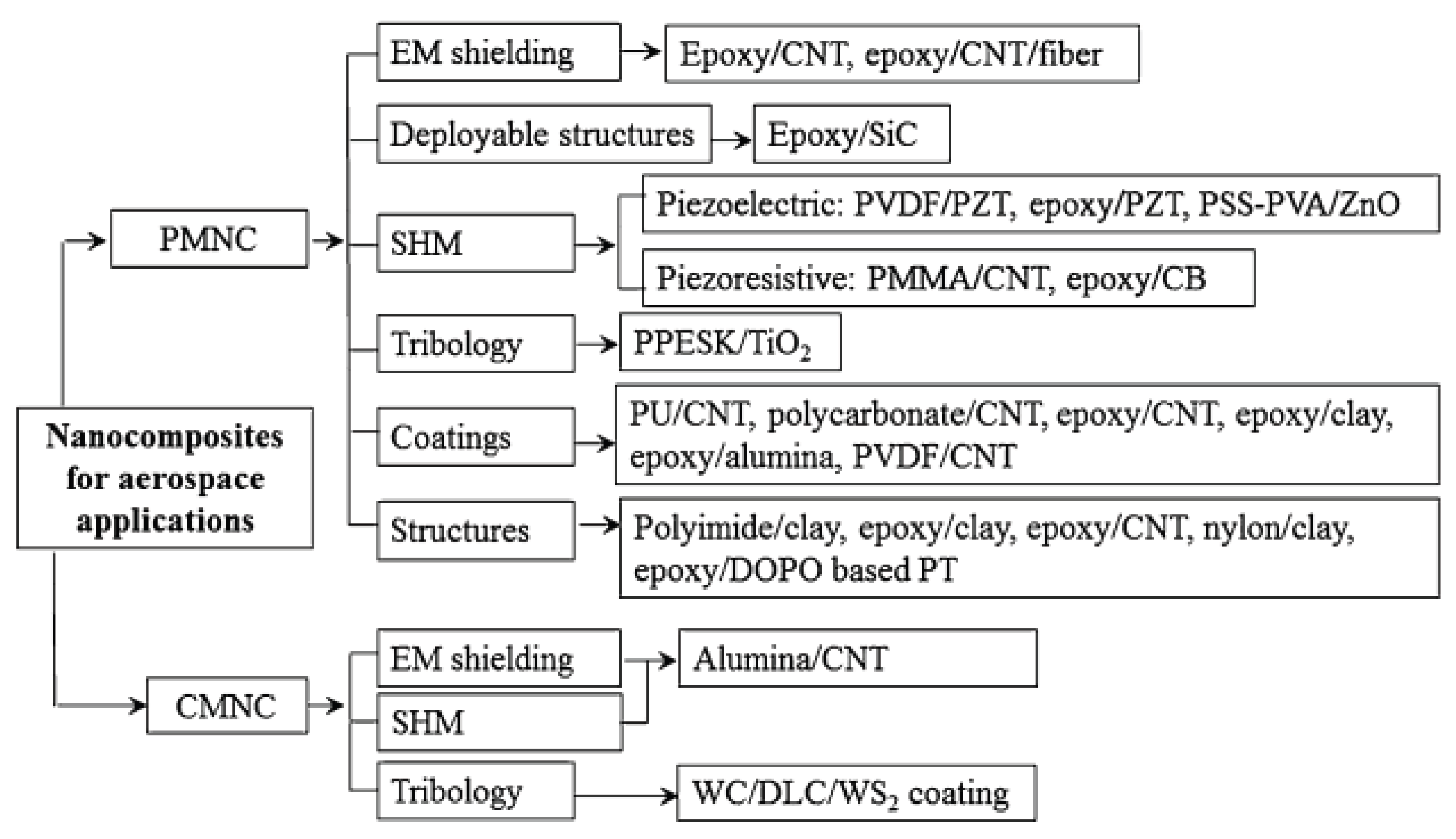
Moreover, these materials can offer enhanced resistance to environmental factors such as corrosion, radiation, and extreme temperatures [95]. This is achieved by incorporating specific additives or coatings that provide protection against these harsh conditions, thereby extending the lifespan and reliability of aerospace components and structures [96].
Nanocomposites and hybrid materials also have the potential to enable advanced functionalities in aerospace applications. For example, the incorporation of nanoparticles with unique optical properties can lead to improved stealth capabilities or advanced sensing capabilities in aircraft [97]. Additionally, the ability to tailor the surface properties of these materials allows for improved aerodynamics, reduced drag, and increased fuel efficiency [95,96].
However, despite their numerous advantages, the development and widespread implementation of nanocomposites and hybrid materials in the aerospace industry still face several challenges. These include the cost of production, scale-up issues, and ensuring consistent material properties [97]. Furthermore, the long-term durability and reliability of these materials in extreme aerospace environments need to be thoroughly evaluated and validated [98].
In conclusion, nanocomposites and hybrid materials hold great promise for aerospace applications, offering significant improvements in weight reduction, mechanical properties, thermal and electrical conductivity, environmental resistance, and advanced functionalities. Continued research and development efforts are essential to overcome the challenges and fully unlock the potential of these materials for the aerospace industry.
7.2. Integrated Structural Health Monitoring Systems
Integrated Structural Health Monitoring (SHM) systems have become increasingly important in the aerospace industry for ensuring the safety, reliability, and efficiency of aircraft structures [99]. These systems utilize various sensors, data acquisition systems, and analysis algorithms to continuously monitor the structural integrity of aerospace components and provide real-time feedback on their health status [100].
One of the key benefits of integrated SHM systems is their ability to detect and assess damage or degradation in aircraft structures at an early stage. By continuously monitoring parameters such as strain, vibration, temperature, and acoustic emissions, these systems can identify and localize structural anomalies, including cracks, delamination’s, corrosion, and fatigue damage [101]. Early detection allows for timely maintenance or repair actions, preventing catastrophic failures and minimizing downtime [102].
Furthermore, integrated SHM systems enable condition-based maintenance practices, where maintenance actions are performed only, when necessary, based on the actual health condition of the structure. This approach reduces unnecessary maintenance costs and extends the lifespan of aerospace components, leading to significant cost savings for operators [99].
Another advantage of integrated SHM systems is their ability to provide real-time monitoring and feedback during the operational life of an aircraft. This allows for continuous assessment of the structural health, even during flight or other critical operations [102]. The real-time data can be transmitted to ground stations or onboard control systems, enabling immediate decision-making and response to any detected anomalies [101].
Moreover, integrated SHM systems offer the potential for improved structural design and optimization. By providing detailed information about the actual loads and stresses experienced by the structure, these systems can contribute to a better understanding of the structural behaviour and enable more accurate simulation and modelling. This, in turn, can lead to the development of lighter, more efficient, and safer aerospace structures [101].
However, there are several challenges associated with the implementation of integrated SHM systems in aerospace applications. These include sensor integration, data management, system reliability, and validation of the monitoring algorithms [103]. The selection and placement of sensors must be carefully considered to ensure adequate coverage and accuracy [104]. Additionally, the vast amount of data generated by SHM systems requires efficient data management and analysis techniques to extract meaningful information and facilitate decision-making [100].
Furthermore, the reliability and durability of the SHM system components, including sensors, cables, and data acquisition systems, are crucial to ensure continuous and accurate monitoring [103]. The harsh operating conditions, including temperature variations, vibrations, and electromagnetic interference, can pose challenges to the long-term performance of these systems [104].
In conclusion, integrated SHM systems offer significant advantages for aerospace applications, including early detection of damage, condition-based maintenance, real-time monitoring, and improved structural design. While challenges exist, ongoing research and development efforts are focused on addressing these challenges and advancing the capabilities of integrated SHM systems, making them an indispensable tool for ensuring the safety and reliability of aerospace structures.
7.3. New Manufacturing Techniques and Automation
New manufacturing techniques and automation advances in composite materials have revolutionized the aerospace industry by enabling the production of lightweight, high-performance structures with enhanced properties [105]. These advancements have significantly impacted various aspects of aerospace applications, including aircraft design, manufacturing processes, and overall performance [106].
One of the key advancements in manufacturing techniques for composite materials is automated fiber placement (AFP) and automated tape laying (ATL). These processes utilize robotic systems to precisely lay down composite fibers or tapes, resulting in improved accuracy, efficiency, and consistency compared to manual processes. AFP and ATL techniques allow for complex geometries, reduced material waste, and faster production rates, making them ideal for aerospace applications where intricate shapes and high production volumes are common [73,107].
In addition to automated fiber placement, advancements in additive manufacturing, or 3D printing, have also contributed to the production of composite aerospace components. Additive manufacturing techniques allow for the creation of complex geometries and the integration of features such as internal channels and lattice structures, which can enhance the performance and functionality of aerospace parts [108]. Furthermore, additive manufacturing reduces material waste and enables rapid prototyping and customization, resulting in reduced lead times and increased design flexibility [106].
Figure 2.
Processing steps for manufacturing thermoplastic composite parts through melt and reactive processing.
Figure 2.
Processing steps for manufacturing thermoplastic composite parts through melt and reactive processing.
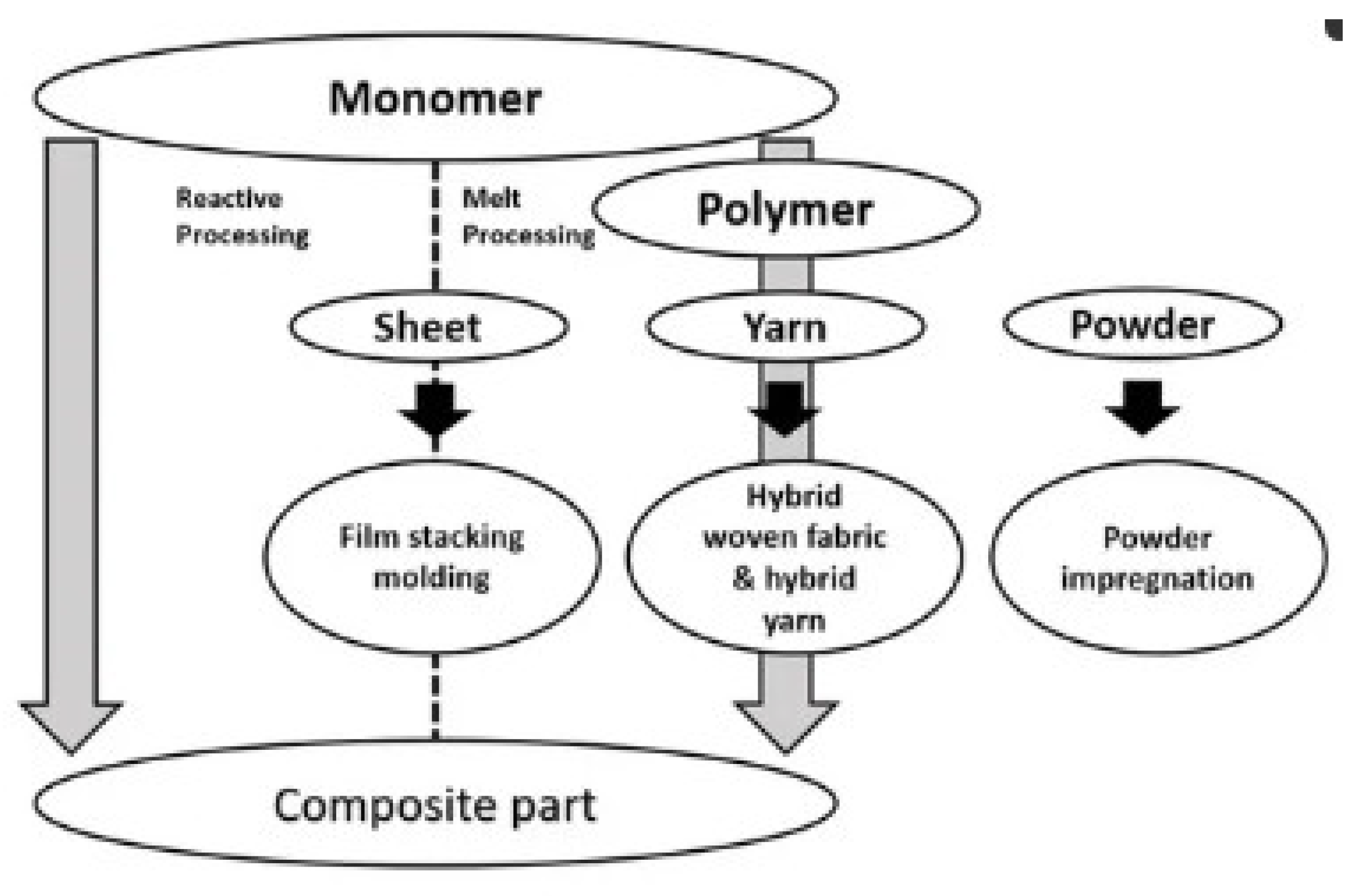
Another significant advancement in composite manufacturing is the use of advanced curing techniques, such as out-of-autoclave (OOA) curing. OOA processes eliminate the need for traditional autoclaves, reducing production costs and cycle times. These techniques utilize alternative heating methods, vacuum bagging, and resin infusion processes to achieve high-quality composite parts with excellent mechanical properties. OOA curing techniques have been widely adopted in the aerospace industry, enabling the production of large-scale composite structures for aircraft wings, fuselages, and other critical components [61,107].
Automation advances in composite manufacturing have also extended to quality control and inspection processes. Automated inspection systems, such as robotic non-destructive testing (NDT), utilize advanced sensors and imaging techniques to detect defects, voids, or delaminations in composite materials. These systems offer faster and more accurate inspection results, reducing the need for human intervention and improving overall quality assurance [83,109].
Furthermore, advancements in automation have led to the integration of digital twin technology in composite manufacturing. Digital twin models use real-time data from sensors and monitoring systems to create virtual replicas of physical structures. These virtual models enable predictive maintenance, performance optimization, and continuous improvement throughout the product lifecycle. Digital twin technology has the potential to revolutionize aerospace manufacturing, ensuring efficient production, reducing downtime, and enhancing overall product performance [110,111]
While the advancements in manufacturing techniques and automation have brought numerous benefits to aerospace applications, challenges still exist [112]. These include the high costs associated with implementing advanced automation systems, the need for skilled labor to operate and maintain these systems, and the requirement for standardized qualification and certification processes [113,114,115].
In conclusion, new manufacturing techniques and automation advances in composite materials have transformed the aerospace industry, enabling the production of lightweight, high-performance structures with improved properties. These advancements have revolutionized aircraft design, manufacturing processes, and quality control, leading to enhanced efficiency, reduced costs, and improved overall performance. Continued research and development efforts are essential to further refine these techniques and overcome the challenges associated with their implementation, ensuring the continued advancement of composite materials in aerospace applications.
7.4. Sustainable Composite Materials
Sustainable composite materials have gained significant attention in the aerospace industry as there is a growing focus on reducing environmental impact and promoting sustainability. These materials offer several advantages over traditional composites, including reduced carbon footprint, improved recyclability, and increased use of renewable resources [116,117].
One of the key benefits of sustainable composite materials is their reduced carbon footprint. Traditional composites, such as carbon fiber reinforced polymers (CFRP), are typically produced from petroleum-based materials, which contribute to greenhouse gas emissions [118]. In contrast, sustainable composites utilize bio-based resins and natural fibers, such as flax, hemp, or bamboo, that have a lower carbon footprint [119]. These materials help to reduce the overall environmental impact and contribute to a more sustainable aerospace industry [120].
Additionally, sustainable composites offer improved recyclability compared to traditional composites. They can be easily separated and recycled at the end of their lifecycle, allowing for the recovery of valuable materials and reducing waste. This recyclability aspect is crucial in the aerospace industry, where aircraft have long lifespans and generate a significant amount of waste during maintenance and decommissioning [121,122].
Moreover, sustainable composite materials promote the use of renewable resources. Bio-based resins, derived from renewable sources such as plant oils or starches, offer an alternative to petroleum-based resins. By utilizing renewable resources, the aerospace industry can reduce its dependence on fossil fuels and contribute to a more sustainable and circular economy [120].
Furthermore, sustainable composites can offer comparable mechanical properties to traditional composites. Advances in research and development have led to the development of bio-based resins with improved strength, stiffness, and durability. This allows for the use of sustainable composites in a wide range of aerospace applications, including structural components, interior panels, and non-structural parts [118,119]
However, challenges still exist in the widespread adoption of sustainable composite materials in aerospace applications. These challenges include the scalability and cost-effectiveness of production processes, ensuring consistent material properties, and meeting regulatory requirements for safety and performance. Further research and development efforts are needed to address these challenges and optimize the manufacturing processes of sustainable composites [122].
In conclusion, sustainable composite materials offer significant advantages for aerospace applications, including reduced carbon footprint, improved recyclability, and increased use of renewable resources. These materials provide an opportunity for the aerospace industry to align with sustainability goals and reduce its environmental impact. Continued innovation and collaboration between industry, academia, and regulatory bodies are crucial to further develop and implement sustainable composite materials in the aerospace sector.
8. Performance Evaluation and Testing of Composite Materials
8.1. Mechanical Testing
Performance evaluation of composite materials involves assessing their structural integrity, durability, and overall functionality. Various non-destructive testing techniques, such as ultrasonic testing, thermography, and acoustic emission, are used to detect any defects or damage in the composites [123,124]. Additionally, mechanical tests, including tensile, compressive, flexural, and shear testing, are conducted to evaluate the material's mechanical properties [125].
Mechanical testing is crucial in determining the strength, stiffness, and failure behaviour of composite materials. Tensile testing measures the material's resistance to stretching forces, while compressive testing assesses its ability to withstand compressive forces [124]. Flexural testing evaluates the material's bending behaviour, while shear testing measures its resistance to shear forces. These tests help in understanding the material's mechanical properties, including modulus of elasticity, ultimate strength, and fracture toughness [126].
In addition to conventional mechanical testing, advanced techniques such as fatigue testing, impact testing, and environmental testing are essential for aerospace applications. Fatigue testing determines the material's resistance to cyclic loading and helps in predicting its service life under repeated stress conditions [127]. Impact testing evaluates the material's ability to absorb energy during sudden loading events. Environmental testing assesses the material's performance in extreme conditions, such as temperature variations, humidity, and exposure to chemicals [128].
Despite the numerous advantages of composite materials, there are challenges in their performance evaluation and mechanical testing. Ensuring accurate and reliable testing results, standardization of testing procedures, and addressing the complex behaviour of composite materials are some of the ongoing challenges [124]. Future directions include the development of advanced testing techniques, such as digital image correlation and microscale testing, to further enhance the understanding and characterization of composite materials for aerospace applications.
In Conclusion, the performance evaluation and mechanical testing of composite materials are crucial in ensuring their reliability and suitability for aerospace applications. Non-destructive testing techniques and mechanical tests play a vital role in assessing the material's integrity and mechanical properties. Advanced testing techniques and ongoing research efforts will continue to advance the understanding and application of composite materials in the aerospace industry.
8.2. Durability and Fatigue Analysis
Durability refers to the ability of a material to resist degradation over time due to various environmental factors, such as temperature, humidity, and UV exposure. Composite materials are particularly susceptible to degradation due to moisture absorption and exposure to UV radiation. This can lead to changes in the physical and mechanical properties of the material, which can ultimately compromise its performance and safety [129,130].
Fatigue refers to the degradation of a material's mechanical properties over time due to repeated loading and unloading [130]. In aerospace applications, fatigue is a significant concern as the cyclic loading conditions experienced by aircraft can lead to component failure if not properly managed. Composite materials are particularly vulnerable to fatigue due to the complex nature of their microstructure and the potential for defects and damage [131].
To ensure the safe and reliable use of composite materials in aerospace applications, it is critical to perform durability and fatigue analyses [131,132]. These analyses involve a combination of physical testing and computational modeling to predict the behaviour of composite materials under various loading conditions and environmental factors [129]. By understanding the durability and fatigue characteristics of composite materials, engineers and researchers can develop strategies to optimize their performance and reliability in aerospace applications.
8.3. Non-Destructive Testing Methods
The increasing use of composite materials in aerospace structures necessitates robust inspection techniques. Traditional destructive testing methods are not feasible due to the irreversible nature of damage. NDT methods offer a non-invasive approach to detect defects and ensure the structural integrity of composite components [133].
Visual inspection is the most basic form of NDT and is often used as a preliminary screening method for composite materials [134]. This section discusses the visual inspection process, including the use of magnification, lighting, and inspection criteria. It highlights the advantages, limitations, and applications of visual inspection for composite materials.
Ultrasonic Testing is a widely used NDT method for inspecting composite materials. This section explores the principles of UT in composite inspections, including pulse-echo and through-transmission techniques. It discusses the advantages and limitations of UT and highlights its applications in detecting delaminations, disbonds, and voids in composite structures [133].
Thermography Testing is gaining popularity as a non-destructive technique for inspecting composite materials. This section explains the principles of TT, including active and passive thermography techniques. It discusses the advantages, limitations, and applications of TT in detecting defects such as delaminations, impact damage, and moisture ingress in composite structures [135,136].
Shearography is an optical interferometric technique used for the detection of defects in composite materials. This section explores the principles of shearography, including the setup, fringe analysis, and interpretation of results. It discusses the advantages, limitations, and applications of shearography in composite inspections [136].
Acoustic Emission (AE) Testing: AE testing is a passive NDT method that detects and analyzes acoustic emissions generated by the material during loading. This section explains the principles of AE testing, including sensor placement, signal analysis, and source location. It discusses the advantages, limitations, and applications of AE testing in monitoring composite structures for damage [137].
X-ray Computed Tomography (CT):X-ray CT is a powerful NDT method that provides detailed internal imaging of composite structures. This section explores the principles of X-ray CT, including image reconstruction techniques and defect visualization. It discusses the advantages, limitations, and applications of X-ray CT in composite inspections [136,138].
8.4. Fire and Thermal Performance Evaluation
The use of composite materials in aerospace structures necessitates a thorough understanding of their fire resistance and thermal behavior. This section highlights the importance of evaluating the fire and thermal performance of composites to ensure the safety and reliability of aerospace components.
Thermal conductivity is an important property to evaluate the thermal behavior of composites. The principles of thermal conductivity testing methods, including guarded hot plate, transient plane source, and laser flash techniques [12]. Thermal stability testing is crucial to understand the behavior of composite materials under high-temperature conditions. The principles of thermal stability testing, including thermogravimetric analysis (TGA), differential scanning calorimetry (DSC), and thermal mechanical analysis (TMA). Flame retardancy is a critical aspect of composite materials' fire performance. The principles of flame retardancy testing methods, including limiting oxygen index (LOI), vertical burning tests, and cone calorimetry. Smoke and toxicity assessment is essential to evaluate the potential hazards associated with composite materials during fire incidents. The principles of smoke and toxicity testing methods, including smoke density tests, toxicity analysis, and gas analysis [12,124].
9. Regulatory and Certification Considerations
9.1. Regulatory Framework for Composite Materials
The regulatory framework for composite materials in aerospace applications is crucial in ensuring the safety and reliability of aircraft structures. This framework consists of international and national regulations, standards, and certification processes. International regulatory bodies such as ICAO, FAA, and EASA play a significant role in establishing guidelines and standards. National regulatory frameworks vary among aerospace manufacturing countries, including the United States, Europe, Canada, and China. Certification and testing requirements are essential for compliance, with material qualification and acceptance being a critical step. Design and manufacturing considerations, along with maintenance and repair guidelines, are also addressed. Understanding and adhering to these regulations is vital for the safe and reliable use of composite materials in aerospace structures [133,139]
9.2. Certification and Qualification Processes
The certification and qualification processes for composite materials in aerospace applications are essential to ensure their compliance with regulatory requirements and the safe integration into aircraft structures. These processes involve thorough testing and evaluation to demonstrate the material's performance and suitability for use in aviation.
Certification typically involves several steps, including material qualification, structural testing, and flammability testing. Material qualification requires comprehensive documentation of material properties, manufacturing process control, and inspection methods. Structural testing involves subjecting the composite material to various load conditions to assess its strength, durability, and resistance to fatigue. Flammability testing evaluates the material's response to fire and its ability to self-extinguish or resist flame spread [140,141].
The certification process also includes specific categories, such as type certification, supplemental type certification, and parts manufacturer approval. Type certification ensures that the composite material meets the necessary safety standards and can be used in the construction of aircraft. Supplemental type certification is required for modifications or additions to existing aircraft designs. Parts manufacturer approval is necessary for manufacturers of composite components to demonstrate their compliance with regulatory requirements [142,143].
The qualification processes for composite materials involve rigorous testing, analysis, and documentation. These processes assess the material's mechanical properties, environmental durability, damage tolerance, and fatigue life [144]. They also consider factors such as manufacturing tolerances, quality control, and non-destructive testing. Adhering to certification and qualification processes is crucial for the aerospace industry to ensure the reliability, safety, and airworthiness of composite materials in aircraft structures. These processes provide a standardized framework for evaluating and approving the use of composite materials, promoting the continued advancement and integration of these materials in aerospace applications [145,146].
9.3. Safety and Reliability Standards
Safety and reliability standards for composite materials in aerospace applications are of utmost importance to ensure the integrity and performance of aircraft structures. These standards establish guidelines and requirements that must be met to ensure the safe and reliable use of composite materials in aviation.
The safety standards encompass various aspects, including structural integrity, fire resistance, and crashworthiness. Structural integrity standards assess the material's ability to withstand loads, vibrations, and environmental conditions throughout the aircraft's operational life. This includes testing for strength, stiffness, fatigue resistance, and damage tolerance [147].
Fire resistance standards focus on the material's ability to resist or retard the spread of fire. They evaluate parameters such as heat release rate, flame spread, smoke generation, and toxicity. These standards aim to minimize the risk of fire incidents and ensure that composite materials do not contribute significantly to the propagation or severity of fires [148].
Crashworthiness standards address the material's behavior and performance in the event of an impact or crash. This includes evaluating the energy absorption capability, fracture toughness, and resistance to delamination or disintegration upon impact. These standards aim to enhance passenger and crew safety during emergency situations [149].
Reliability standards for composite materials focus on their long-term durability, maintenance requirements, and quality control. These standards ensure that composite materials maintain their performance over time and are not prone to degradation or premature failure. They also outline protocols for inspection, maintenance, and repair of composite components to ensure continued airworthiness [150].
These safety and reliability standards are developed and enforced by international regulatory bodies, such as ICAO, FAA, and EASA, as well as national aviation authorities. Compliance with these standards is mandatory for manufacturers, operators, and maintenance organizations in the aerospace industry to ensure the safe and reliable use of composite materials in aircraft [147].
Adhering to these standards not only enhances safety and reliability but also instills confidence in the aerospace industry and the traveling public. Continuous research, development, and improvement of standards are essential to keep pace with the evolving technology and advancements in composite materials used in aerospace applications [147,150].
10. Future Directions and Research Opportunities
10.1. Lightweight Structures and Materials Optimization
Lightweight Structures and Materials Optimization for Composite Materials in Aerospace Applications provides a comprehensive overview of the strategies and techniques employed in the aerospace industry to achieve lightweight structures using composite materials [151].
They are various aspects of lightweight design optimization, including material selection, design optimization methodologies, manufacturing techniques, composite material hybridization, and structural analysis and testing [152]. It provides valuable insights into the properties, advantages, and limitations of different composite materials commonly used in aerospace applications, such as CFRP, GFRP, and AFRP [152,153].
The principles and methodologies of design optimization techniques such as topology optimization, shape optimization, and size optimization. It emphasizes the importance of multidisciplinary optimization and considers factors such as aerodynamics, structural mechanics, and manufacturing constraints [154,155]. Furthermore, the advanced manufacturing processes like AFP, RTM, and additive manufacturing, which enable precise control over fiber orientation and minimize material waste [155].
10.2. Multi-Functional Composites
Multi-functional composites have emerged as a promising solution for enhancing the performance and functionality of aerospace materials. The integration of multiple functionalities into composite materials has gained significant attention due to its potential to improve performance, reduce weight, and increase efficiency. The various functionalities that can be incorporated into composites, including electrical conductivity, thermal management, self-healing, and sensing capabilities [156,157].
One of the key advantages of multi-functional composites is their ability to contribute to weight reduction in aerospace applications. By integrating functionalities directly into the composite material, the need for additional components or systems can be eliminated, resulting in reduced weight and improved fuel efficiency [158].
Real-world examples and case studies are presented to showcase the successful implementation of multi-functional composites in aerospace applications. These examples demonstrate the diverse range of functionalities that can be achieved, including lightning strike protection, de-icing capabilities, structural health monitoring, and electromagnetic interference shielding [159].
The potential for increased design flexibility and performance optimization through the integration of multiple functionalities. By tailoring the composition and arrangement of functional elements within the composite material, engineers can optimize the material's properties to meet specific application requirements [160].
In conclusion, multi-functional composites offer significant potential for enhancing the performance and functionality of aerospace materials. Their ability to integrate multiple functionalities directly into the composite structure enables weight reduction, improved fuel efficiency, and increased design flexibility. Ongoing research and development efforts continue to push the boundaries of multi-functional composites, making them a promising solution for future aerospace applications.
10.3. Additive Manufacturing of Composites
Additive manufacturing, also known as 3D printing, has gained significant attention in the aerospace industry for its potential to revolutionize the production of composite materials [109]. The advancements and applications of additive manufacturing of composites in aerospace applications. Additive manufacturing offers several advantages over traditional manufacturing methods when it comes to composites. It allows for complex geometries, customization, and the consolidation of multiple parts into a single component. These capabilities open up new possibilities for lightweight and optimized designs in aerospace applications [161,162,163].
The various additive manufacturing techniques used for composites, such as fused deposition modeling (FDM), selective laser sintering (SLS), and stereolithography (SLA). It explores the materials used in additive manufacturing of composites, including thermoset and thermoplastic matrices, as well as the reinforcement fibers such as carbon fibers and glass fibers [164]. One of the key advantages of additive manufacturing of composites is the ability to tailor the material properties by controlling the fiber orientation and volume fraction. This allows for the optimization of mechanical properties, such as strength, stiffness, and fatigue resistance, based on specific application requirements [165].
The applications of additive manufacturing of composites in the aerospace industry. These include the production of lightweight structural components, complex geometries, tooling, and prototypes. It also discusses the potential for on-demand manufacturing and supply chain optimization through additive manufacturing [166]. The Challenges associated with additive manufacturing are process optimization, material characterization, post-processing, and certification. Ongoing research and development efforts are focused on addressing these challenges to enable wider adoption of additive manufacturing in the aerospace industry [110,113,115].
Overall, additive manufacturing of composites holds great promise for aerospace applications. Its ability to create complex, lightweight, and optimized components offers significant advantages in terms of performance, customization, and supply chain efficiency. Continued advancements in additive manufacturing techniques and materials will further enhance its capabilities and enable its widespread adoption in the aerospace industry.
10.4. Recycling and Sustainability
The recycling and sustainability of composites in aerospace applications have become increasingly important as the industry strives for more environmentally friendly practices [15]. The unique characteristics of composite materials that make their recycling more complex compared to traditional materials. Composite materials are typically composed of different layers, including reinforcement fibers and matrix materials such as epoxy or thermoplastics. Separating these layers and recovering the valuable constituents pose challenges in the recycling process [165,167].
They are various recycling techniques and strategies, these include mechanical recycling, chemical recycling, and thermal recycling methods. Mechanical recycling involves grinding and shredding the composite waste to produce reusable fibers or fillers [165]. Chemical recycling utilizes solvents or chemical processes to dissolve the matrix material and recover the fibers [168]. Thermal recycling involves using heat to break down the composite into its constituent materials for reuse. also, advancements in recycling technologies, such as pyrolysis and supercritical fluid extraction, which offer more efficient and environmentally friendly methods for composite recycling [169,170]. These technologies aim to minimize waste, reduce energy consumption, and recover valuable materials from composite waste.
In addition to recycling, the life cycle assessment (LCA) approach, which evaluates the environmental impact of composite materials from raw material extraction to end-of-life disposal. LCA helps identify areas for improvement in terms of energy consumption, greenhouse gas emissions, and waste generation throughout the life cycle of composite materials [171,172]. In conclusion, the recycling and sustainability of composites in aerospace applications are critical for reducing waste, conserving resources, and minimizing environmental impact.
11. Conclusion
The exploration of composite materials in aerospace has illuminated a path towards innovation, efficiency, and sustainability in aircraft design and manufacturing. This comprehensive review has delved into the definition, classification, importance, advantages, and disadvantages of composite materials, showcasing their unparalleled potential in revolutionizing the aerospace industry. From structural components to propulsion systems, interior applications, and beyond, composite materials have reshaped the way aircraft are engineered, offering a myriad of benefits while also presenting unique challenges and limitations.
The significance of composite materials in aerospace cannot be overstated. Their exceptional strength-to-weight ratio, corrosion resistance, and design flexibility have propelled them to the forefront of modern aircraft construction. Structural components such as fuselage, wings, empennage, landing gear, radomes, and fairings benefit immensely from the lightweight yet durable nature of composite materials, ensuring optimal performance and safety in flight operations. Similarly, the propulsion system, with components like engine casings, fan blades, nozzle structures, and heat shield systems, relies on composite materials for their high temperature resistance and mechanical integrity, contributing to enhanced efficiency and reliability in aircraft propulsion.
Interior applications in aerospace, including cabin interiors, seating systems, galley structures, and lavatory components, also benefit from the versatility and aesthetic appeal of composite materials. These components not only enhance passenger comfort and safety but also contribute to overall weight reduction, fuel efficiency, and environmental sustainability. Despite the numerous advantages offered by composite materials, challenges such as manufacturing complexities, repair and maintenance considerations, cost implications, and environmental sustainability concerns underscore the need for continuous research and development in this field.
Advances in composite materials for aerospace applications have opened up new avenues for exploration and innovation. Nanocomposites, hybrid materials, integrated structural health monitoring systems, new manufacturing techniques, and sustainable composite materials represent the cutting-edge developments that are shaping the future of aerospace engineering. These advancements hold the promise of further enhancing the performance, efficiency, and sustainability of composite materials, paving the way for groundbreaking advancements in aircraft design and manufacturing.
Performance evaluation and testing of composite materials play a crucial role in ensuring the structural integrity and reliability of aerospace components. Mechanical testing, durability and fatigue analysis, non-destructive testing methods, and fire and thermal performance evaluation are essential for meeting regulatory standards and certification requirements, thereby ensuring the airworthiness and safety of aircraft utilizing composite materials.
Looking ahead, the future of composite materials in aerospace is brimming with possibilities. Lightweight structures, materials optimization, multi-functional composites, additive manufacturing, and recycling initiatives are key areas for future research and development. By embracing these advancements and leveraging the unique properties of composite materials, aerospace engineers can continue to push the boundaries of innovation, creating aircraft that are not only safer and more efficient but also environmentally sustainable.
In conclusion, the journey of composite materials in aerospace is a testament to human ingenuity, perseverance, and the relentless pursuit of excellence. As we navigate the complexities of modern aviation, composite materials stand as a beacon of innovation, offering a glimpse into a future where aircraft are not just machines but marvels of engineering prowess. By embracing the potential of composite materials and charting a course towards sustainable aerospace solutions, we can soar to new heights of achievement, shaping a future where the skies are limitless and the possibilities boundless.
11.1. Key Findings
11.2. Implications for Industry and Research
The integration of composite materials in the aerospace industry has significant implications for both industry practices and research endeavors. Composite materials offer the potential for enhanced performance and efficiency in aircraft design, thanks to their lightweight and durable properties. However, industry players must also address cost considerations associated with composite manufacturing to remain competitive. Ensuring a reliable supply chain capable of meeting the demand for high-quality materials and components is essential for seamless integration of composites into aircraft manufacturing processes. Regulatory compliance is crucial in navigating the complex standards and certifications governing composite materials to uphold safety standards while driving innovation.
Investments in skills development and training programs are necessary to equip the workforce with the expertise needed for composite manufacturing, testing, and maintenance. On the research front, advancements in material development are pivotal for improving the performance of aerospace components. Research in performance evaluation and testing methodologies ensures the structural integrity and reliability of composite materials in aerospace applications. Innovations in mechanical testing, durability analysis, and non-destructive testing methods contribute to the ongoing improvement of composite materials and their suitability for aircraft components.
Efforts aimed at enhancing the environmental sustainability of composite materials, such as recycling processes and eco-friendly manufacturing techniques, are essential for reducing the environmental impact of aerospace operations. Exploring innovative applications of composite materials, like additive manufacturing and smart materials, presents new opportunities for aircraft design and operational efficiency. Collaborative partnerships between industry stakeholders, research institutions, and academia drive innovation, share knowledge, and advance research in composite materials. By recognizing the significance of composite materials and fostering collaborative efforts, the aerospace industry can harness the full potential of composites to propel towards a future defined by excellence, innovation, and environmental stewardship.
11.3. Final Remarks
Composite materials have revolutionized aerospace with their lightweight, strong, and versatile properties. While offering benefits like improved performance and efficiency, challenges such as cost and regulatory compliance need addressing. Collaborative research and development efforts are crucial for advancing material technologies, ensuring safety, and enhancing sustainability. The future of composites in aerospace holds promise for innovation and progress, driving efficiency, performance, and environmental stewardship in aircraft manufacturing. Embracing the potential of composites and investing in research initiatives will propel the industry towards a future defined by excellence, innovation, and sustainable aerospace solutions.
Author Contributions
Conceptualization, C.A.T., methodology, C.A.T. and A.M., software, C.A.T.
and A.M., validation, C.A.T.and A.M., formal analysis, C.A.T.and A.M., investigation, C.A.T. and
A.M., resources, C.A.T., data curation, C.A.T. and A.M., writing—original draft preparation,
C.A.T., writing—review and editing, C.A.T.and A.M., visualization, C.A.T. and A.M,
supervision, A.M. All authors have read and agreed to the published version of the manuscript.
Institutional Review Board Statement
Not applicable.
Informed Consent Statement
Not applicable.
Data Availability Statement
No new data were created or analyzed in this study. Data sharing is
not applicable to this article.
Acknowledgments
This article was completed while the first author was a Doctoral Candidate at
the Joint Doctoral School at the Silesian University of Technology, Poland.
Conflicts of Interest
The authors declare no conflicts of interest
References
- Bismarck, S. Mishra, and T. Lampke, “Plant Fibers as Reinforcement for Green Composites,” in Natural Fibers, Biopolymers, and Biocomposites, CRC Press, 2005. [CrossRef]
- V. Okur, M. Ganapathi, A. Wilson, and W. K. Chung, “Biallelic variants in VARS in a family with two siblings with intellectual disability and microcephaly: case report and review of the literature,” Molecular Case Studies, vol. 4, no. 5, p. a003301, Oct. 2018. [CrossRef]
- Y. Zhou, F. Althoey, B. S. Alotaibi, Y. Gamil, and B. Iftikhar, “An overview of recent advancements in fibre-reinforced 3D printing concrete,” Front Mater, vol. 10, Oct. 2023. [CrossRef]
- Seers, R. Tomlinson, and P. Fairclough, “Residual stress in fiber reinforced thermosetting composites: A review of measurement techniques,” Polym Compos, vol. 42, no. 4, pp. 1631–1647, Apr. 2021. [CrossRef]
- S. Kirtania and D. Chakraborty, “Multi-scale modeling of carbon nanotube reinforced composites with a fiber break,” Mater Des, vol. 35, pp. 498–504, Mar. 2012. [CrossRef]
- K. Krishnamurthy, P. Ravichandran, A. Shahid Naufal, R. Pradeep, and K. M. Sai HarishAdithiya, “Modeling and structural analysis of leaf spring using composite materials,” Mater Today Proc, vol. 33, pp. 4228–4232, 2020. [CrossRef]
- K. S. Krishnamurthy, P. Mahajan, and R. K. Mittal, “Impact response and damage in laminated composite cylindrical shells,” Compos Struct, vol. 59, no. 1, pp. 15–36, Jan. 2003. [CrossRef]
- K. I. Tserpes, P. Papanikos, G. Labeas, and Sp. G. Pantelakis, “Multi-scale modeling of tensile behavior of carbon nanotube-reinforced composites,” Theoretical and Applied Fracture Mechanics, vol. 49, no. 1, pp. 51–60, Feb. 2008. [CrossRef]
- J. Cao, P. Xue, X. Peng, and N. Krishnan, “An approach in modeling the temperature effect in thermo-stamping of woven composites,” Compos Struct, vol. 61, no. 4, pp. 413–420, Sep. 2003. [CrossRef]
- Bismarck, S. Mishra, and T. Lampke, “Plant Fibers as Reinforcement for Green Composites,” in Natural Fibers, Biopolymers, and Biocomposites, CRC Press, 2005. [CrossRef]
- F. U. Buehler and J. C. Seferis, “Effect of reinforcement and solvent content on moisture absorption in epoxy composite materials,” Compos Part A Appl Sci Manuf, vol. 31, no. 7, pp. 741–748, Jul. 2000. [CrossRef]
- G. Manickam, A. Bharath, A. N. Das, A. Chandra, and P. Barua, “Thermal buckling behaviour of variable stiffness laminated composite plates,” Mater Today Commun, vol. 16, pp. 142–151, Sep. 2018. [CrossRef]
- E. Madyaratri et al., “Recent Advances in the Development of Fire-Resistant Biocomposites—A Review,” Polymers (Basel), vol. 14, no. 3, p. 362, Jan. 2022. [CrossRef]
- S. Candiotti, J. L. Mantari, C. E. Flores, and S. Charca, “Assessment of the mechanical properties of peruvian Stipa Obtusa fibers for their use as reinforcement in composite materials,” Compos Part A Appl Sci Manuf, vol. 135, p. 105950, Aug. 2020. [CrossRef]
- P. L. Y. Léonard and J. W. Nylander, “SUSTAINABILITY ASSESSMENT OF COMPOSITES IN AERO-ENGINE COMPONENTS,” Proceedings of the Design Society: DESIGN Conference, vol. 1, pp. 1989–1998, May 2020. [CrossRef]
- Y. Kim, S. Lee, and H. Yoon, “Fire-Safe Polymer Composites: Flame-Retardant Effect of Nanofillers,” Polymers (Basel), vol. 13, no. 4, p. 540, Feb. 2021. [CrossRef]
- V. Werlen, C. Rytka, and V. Michaud, “A numerical approach to characterize the viscoelastic behaviour of fibre beds and to evaluate the influence of strain deviations on viscoelastic parameter extraction,” Compos Part A Appl Sci Manuf, vol. 143, p. 106315, Apr. 2021. [CrossRef]
- Parveez, M. I. Kittur, I. A. Badruddin, S. Kamangar, M. Hussien, and M. A. Umarfarooq, “Scientific Advancements in Composite Materials for Aircraft Applications: A Review,” Polymers (Basel), vol. 14, no. 22, p. 5007, Nov. 2022. [CrossRef]
- Taub and A. A. Luo, “Advanced lightweight materials and manufacturing processes for automotive applications,” MRS Bull, vol. 40, no. 12, pp. 1045–1054, Dec. 2015. [CrossRef]
- S. Siengchin, “A review on lightweight materials for defence applications: Present and future developments,” Defence Technology, vol. 24, pp. 1–17, Jun. 2023. [CrossRef]
- S. Vijayan, A. Sivasuriyan, P. Devarajan, A. Stefańska, Ł. Wodzyński, and E. Koda, “Carbon Fibre-Reinforced Polymer (CFRP) Composites in Civil Engineering Application—A Comprehensive Review,” Buildings, vol. 13, no. 6, p. 1509, Jun. 2023. [CrossRef]
- S. Wang, D. D. L. Chung, and J. H. Chung, “Impact damage of carbon fiber polymer–matrix composites, studied by electrical resistance measurement,” Compos Part A Appl Sci Manuf, vol. 36, no. 12, pp. 1707–1715, Dec. 2005. [CrossRef]
- V. Mahesh, S. Joladarashi, and S. M. Kulkarni, “A comprehensive review on material selection for polymer matrix composites subjected to impact load,” Defence Technology, vol. 17, no. 1, pp. 257–277, Feb. 2021. [CrossRef]
- Kelly, R. Davidson, K. Uchino, N. Shanmuga Priya, and M. Shanmugasundaram, “7.18 Smart Composite Materials Systems,” in Comprehensive Composite Materials II, Elsevier, 2018, pp. 358–363. [CrossRef]
- D.-M. Lim, I.-S. Yoon, K.-W. Kang, and J.-K. Kim, “Fatigue Analysis of Fiber-Reinforced Composites Using Damage Mechanics,” Transactions of the Korean Society of Mechanical Engineers A, vol. 30, no. 2, pp. 112–119, Feb. 2006. [CrossRef]
- V. Kobelev, Design and Analysis of Composite Structures for Automotive Applications. Wiley, 2019. [CrossRef]
- Y. Al-Assaf and H. El Kadi, “Fatigue life prediction of unidirectional glass fiber/epoxy composite laminae using neural networks,” Compos Struct, vol. 53, no. 1, pp. 65–71, Jul. 2001. [CrossRef]
- Sobey, J. Blake, and A. Shenoi, “Optimisation Approaches to Design Synthesis of Marine Composite Structures,” Ship Technology Research, vol. 56, no. 1, pp. 24–30, Jan. 2009. [CrossRef]
- R. A. Shenoi, J. M. Dulieu-Barton, S. Quinn, J. I. R. Blake, and S. W. Boyd, “Composite Materials for Marine Applications: Key Challenges for the Future,” in Composite Materials, London: Springer London, 2011, pp. 69–89. [CrossRef]
- S. Rana and R. Fangueiro, “Advanced composites in aerospace engineering,” in Advanced Composite Materials for Aerospace Engineering, Elsevier, 2016, pp. 1–15. [CrossRef]
- F. Rubino, A. Nisticò, F. Tucci, and P. Carlone, “Marine Application of Fiber Reinforced Composites: A Review,” J Mar Sci Eng, vol. 8, no. 1, p. 26, Jan. 2020. [CrossRef]
- S. E. Abdel Raheem and E. M. A. Abdel Aal, “Finite Element Analysis for Structural Performance of Offshore Platforms under Environmental Loads,” Key Eng Mater, vol. 569–570, pp. 159–166, Jul. 2013. [CrossRef]
- V. S. Kathavate, K. Amudha, L. Adithya, A. Pandurangan, N. R. Ramesh, and K. Gopakumar, “Mechanical behavior of composite materials for marine applications – an experimental and computational approach,” J Mech Behav Mater, vol. 27, no. 1–2, Jun. 2018. [CrossRef]
- J. J. Joshua, P. S. Venkatanarayanan, and D. Singh, “A literature review on composite materials filled with and without nanoparticles subjected to high/low velocity impact loads,” Mater Today Proc, vol. 33, pp. 4635–4641, 2020. [CrossRef]
- W. Wang, Y. Xiang, J. Yu, and L. Yang, “Development and Prospect of Smart Materials and Structures for Aerospace Sensing Systems and Applications,” Sensors, vol. 23, no. 3, p. 1545, Jan. 2023. [CrossRef]
- W. Wang, Y. Xiang, J. Yu, and L. Yang, “Development and Prospect of Smart Materials and Structures for Aerospace Sensing Systems and Applications,” Sensors, vol. 23, no. 3, p. 1545, Jan. 2023. [CrossRef]
- C. Rodrigues et al., “Environmental Life-Cycle Assessment of an Innovative Multifunctional Toilet,” Energies (Basel), vol. 14, no. 8, p. 2307, Apr. 2021. [CrossRef]
- H. H. Mian, G. Wang, U. A. Dar, and W. Zhang, “Optimization of Composite Material System and Lay-up to Achieve Minimum Weight Pressure Vessel,” Applied Composite Materials, vol. 20, no. 5, pp. 873–889, Oct. 2013. [CrossRef]
- M. Shimoda, H. Otani, and J.-X. Shi, “Design optimization of composite structures composed of dissimilar materials based on a free-form optimization method,” Compos Struct, vol. 146, pp. 114–121, Jun. 2016. [CrossRef]
- T. Qiao, G. Zhang, Y. Xu, and B. Zhang, “Fabrication and Finite Element Analysis of Composite Elbows,” Materials, vol. 12, no. 22, p. 3778, Nov. 2019. [CrossRef]
- M. Maria, “Advanced composite materials of the future in aerospace industry,” INCAS BULLETIN, vol. 5, no. 3, pp. 139–150, Sep. 2013. [CrossRef]
- B. Parveez, M. I. Kittur, I. A. Badruddin, S. Kamangar, M. Hussien, and M. A. Umarfarooq, “Scientific Advancements in Composite Materials for Aircraft Applications: A Review,” Polymers (Basel), vol. 14, no. 22, p. 5007, Nov. 2022. [CrossRef]
- S. Dhanasekar et al., “A Comprehensive Study of Ceramic Matrix Composites for Space Applications,” Advances in Materials Science and Engineering, vol. 2022, pp. 1–9, Sep. 2022. [CrossRef]
- J. Skoczylas, S. Samborski, and M. Kłonica, “THE APPLICATION OF COMPOSITE MATERIALS IN THE AEROSPACE INDUSTRY,” Journal of Technology and Exploitation in Mechanical Engineering, vol. 5, no. 1, Jan. 2019. [CrossRef]
- R. Talreja, Failure Analysis of Composite Materials with Manufacturing Defects. Boca Raton: CRC Press, 2023. [CrossRef]
- J. Skoczylas, S. Samborski, and M. Kłonica, “THE APPLICATION OF COMPOSITE MATERIALS IN THE AEROSPACE INDUSTRY,” Journal of Technology and Exploitation in Mechanical Engineering, vol. 5, no. 1, Jan. 2019. [CrossRef]
- C. E. Harris, J. H. Starnes, and M. J. Shuart, “Design and Manufacturing of Aerospace Composite Structures, State-of-the-Art Assessment,” J Aircr, vol. 39, no. 4, pp. 545–560, Jul. 2002. [CrossRef]
- N. Saha, P. Roy, and P. Topdar, “Damage detection in composites using non-destructive testing aided by ANN technique: A review,” Journal of Thermoplastic Composite Materials, vol. 36, no. 12, pp. 4997–5033, Dec. 2023. [CrossRef]
- R. G. Dillingham, B. R. Oakley, E. Dan-Jumbo, J. Baldwin, R. Keller, and J. Magato, “Surface treatment and adhesive bonding techniques for repair of high-temperature composite materials,” J Compos Mater, vol. 48, no. 7, pp. 853–859, Mar. 2014. [CrossRef]
- S. Hassani, M. Mousavi, and A. H. Gandomi, “Structural Health Monitoring in Composite Structures: A Comprehensive Review,” Sensors, vol. 22, no. 1, p. 153, Dec. 2021. [CrossRef]
- M. E. Torbali, A. Zolotas, and N. P. Avdelidis, “A State-of-the-Art Review of Non-Destructive Testing Image Fusion and Critical Insights on the Inspection of Aerospace Composites towards Sustainable Maintenance Repair Operations,” Applied Sciences, vol. 13, no. 4, p. 2732, Feb. 2023. [CrossRef]
- J. Edmonds and G. Hickman, “Damage detection and identification in composite aircraft components,” in 2000 IEEE Aerospace Conference. Proceedings (Cat. No.00TH8484), IEEE, pp. 263–269. [CrossRef]
- M. E. Ibrahim, “Nondestructive evaluation of thick-section composites and sandwich structures: A review,” Compos Part A Appl Sci Manuf, vol. 64, pp. 36–48, Sep. 2014. [CrossRef]
- V. Couty, J. Berthe, E. Deletombe, P. Lecomte-Grosbras, J.-F. Witz, and M. Brieu, “Comparing Methods to Detect the Formation of Damage in Composite Materials,” Exp Tech, vol. 47, no. 3, pp. 689–708, Jun. 2023. [CrossRef]
- B. Wang, S. Zhong, T.-L. Lee, K. S. Fancey, and J. Mi, “Non-destructive testing and evaluation of composite materials/structures: A state-of-the-art review,” Advances in Mechanical Engineering, vol. 12, no. 4, p. 168781402091376, Apr. 2020. [CrossRef]
- J. Powell and S. Green, “The challenges of bonding composite materials and some innovative solutions,” Reinforced Plastics, vol. 65, no. 1, pp. 36–39, Feb. 2021. [CrossRef]
- K. B. Katnam, L. F. M. Da Silva, and T. M. Young, “Bonded repair of composite aircraft structures: A review of scientific challenges and opportunities,” Progress in Aerospace Sciences, vol. 61, pp. 26–42, Aug. 2013. [CrossRef]
- M. Bowkett and K. Thanapalan, “Comparative analysis of failure detection methods of composites materials’ systems,” Systems Science & Control Engineering, vol. 5, no. 1, pp. 168–177, Jan. 2017. [CrossRef]
- V. Giurgiutiu and C. Soutis, “Enhanced Composites Integrity Through Structural Health Monitoring,” Applied Composite Materials, vol. 19, no. 5, pp. 813–829, Oct. 2012. [CrossRef]
- Aabid, M. Baig, and M. Hrairi, “Advanced Composite Materials for Structural Maintenance, Repair, and Control,” Materials, vol. 16, no. 2, p. 743, Jan. 2023. [CrossRef]
- S. Rajendran et al., “Metal and Polymer Based Composites Manufactured Using Additive Manufacturing—A Brief Review,” Polymers (Basel), vol. 15, no. 11, p. 2564, Jun. 2023. [CrossRef]
- V. K. Maes, K. Potter, and J. Kratz, “Features and defects characterisation for virtual verification and certification of composites: A review,” Compos B Eng, vol. 246, p. 110282, Nov. 2022. [CrossRef]
- Z. L. Gan, S. N. Musa, and H. J. Yap, “A Review of the High-Mix, Low-Volume Manufacturing Industry,” Applied Sciences, vol. 13, no. 3, p. 1687, Jan. 2023. [CrossRef]
- S. Hussain, W. Xuetong, and T. Hussain, “Impact of Skilled and Unskilled Labor on Project Performance Using Structural Equation Modeling Approach,” Sage Open, vol. 10, no. 1, p. 215824402091459, Jan. 2020. [CrossRef]
- P. J. Schubel, “Cost modelling in polymer composite applications: Case study – Analysis of existing and automated manufacturing processes for a large wind turbine blade,” Compos B Eng, vol. 43, no. 3, pp. 953–960, Apr. 2012. [CrossRef]
- M. G. Bader, “Selection of composite materials and manufacturing routes for cost-effective performance,” Compos Part A Appl Sci Manuf, vol. 33, no. 7, pp. 913–934, Jul. 2002. [CrossRef]
- Martin, D. Saenz del Castillo, A. Fernandez, and A. Güemes, “Advanced Thermoplastic Composite Manufacturing by In-Situ Consolidation: A Review,” Journal of Composites Science, vol. 4, no. 4, p. 149, Oct. 2020. [CrossRef]
- C. Zweben, “Advanced composites for aerospace applications,” Composites, vol. 12, no. 4, pp. 235–240, Oct. 1981. [CrossRef]
- M. Sasi Kumar, S. Sathish, M. Makeshkumar, S. Gokulkumar, and A. Naveenkumar, “Effect of Manufacturing Techniques on Mechanical Properties of Natural Fibers Reinforced Composites for Lightweight Products—A Review,” 2023, pp. 99–117. [CrossRef]
- M. G. Bader, “Selection of composite materials and manufacturing routes for cost-effective performance,” Compos Part A Appl Sci Manuf, vol. 33, no. 7, pp. 913–934, Jul. 2002. [CrossRef]
- E. Shehab, A. Meiirbekov, A. Amantayeva, and S. Tokbolat, “Cost Modelling for Recycling Fiber-Reinforced Composites: State-of-the-Art and Future Research,” Polymers (Basel), vol. 15, no. 1, p. 150, Dec. 2022. [CrossRef]
- E. A. Calado, M. Leite, and A. Silva, “Selecting composite materials considering cost and environmental impact in the early phases of aircraft structure design,” J Clean Prod, vol. 186, pp. 113–122, Jun. 2018. [CrossRef]
- M. A. Hubbe, “Sustainable Composites: A Review with Critical Questions to Guide Future Initiatives,” Sustainability, vol. 15, no. 14, p. 11088, Jul. 2023. [CrossRef]
- J. J. Andrew and H. N. Dhakal, “Sustainable biobased composites for advanced applications: recent trends and future opportunities – A critical review,” Composites Part C: Open Access, vol. 7, p. 100220, Mar. 2022. [CrossRef]
- L. Rupcic, E. Pierrat, K. Saavedra-Rubio, N. Thonemann, C. Ogugua, and A. Laurent, “Environmental impacts in the civil aviation sector: Current state and guidance,” Transp Res D Transp Environ, vol. 119, p. 103717, Jun. 2023. [CrossRef]
- L. F. Muhaisn, Z. A. Naser, D. H. Nayel, Z. T. Al-Sharify, and F. F. Muhaisn, “Investigate the environmental impact of aircraft on the Earth’s atmosphere and analyzing its effect on air and water pollution,” 2023, p. 090046. [CrossRef]
- Vajdová et al., “Environmental Impact of Burning Composite Materials Used in Aircraft Construction on the Air,” Int J Environ Res Public Health, vol. 16, no. 20, p. 4008, Oct. 2019. [CrossRef]
- S. M R, S. Doddamani, S. Siengchin, and M. Doddamani, Lightweight and Sustainable Composite Materials: Preparation, Properties and Applications. 2023.
- G. Chatziparaskeva et al., “End-of-Life of Composite Materials in the Framework of the Circular Economy,” Microplastics, vol. 1, no. 3, pp. 377–392, Jul. 2022. [CrossRef]
- J. Bachmann, C. Hidalgo, and S. Bricout, “Environmental analysis of innovative sustainable composites with potential use in aviation sector—A life cycle assessment review,” Sci China Technol Sci, vol. 60, no. 9, pp. 1301–1317, Sep. 2017. [CrossRef]
- Pokharel, K. J. Falua, A. Babaei-Ghazvini, and B. Acharya, “Biobased Polymer Composites: A Review,” Journal of Composites Science, vol. 6, no. 9, p. 255, Sep. 2022. [CrossRef]
- S. H. Bonilla, C. M. V. B. Almeida, B. F. Giannetti, and D. Huisingh, “The roles of cleaner production in the sustainable development of modern societies: an introduction to this special issue,” J Clean Prod, vol. 18, no. 1, pp. 1–5, Jan. 2010. [CrossRef]
- N. Khanna, K. K. Gajrani, K. Giasin, and J. P. Davim, Sustainable Materials and Manufacturing Technologies. London: CRC Press, 2023. [CrossRef]
- Bastas, “Sustainable Manufacturing Technologies: A Systematic Review of Latest Trends and Themes,” Sustainability, vol. 13, no. 8, p. 4271, Apr. 2021. [CrossRef]
- M. Javaid, A. Haleem, R. Pratap Singh, S. Khan, and R. Suman, “Sustainability 4.0 and its applications in the field of manufacturing,” Internet of Things and Cyber-Physical Systems, vol. 2, pp. 82–90, 2022. [CrossRef]
- M. Fera, R. Abbate, M. Caterino, P. Manco, R. Macchiaroli, and M. Rinaldi, “Economic and Environmental Sustainability for Aircrafts Service Life,” Sustainability, vol. 12, no. 23, p. 10120, Dec. 2020. [CrossRef]
- J. Chen, J. Wang, and A. Ni, “Recycling and reuse of composite materials for wind turbine blades: An overview,” Journal of Reinforced Plastics and Composites, vol. 38, no. 12, pp. 567–577, Jun. 2019. [CrossRef]
- P. L. Y. Léonard and J. W. Nylander, “SUSTAINABILITY ASSESSMENT OF COMPOSITES IN AERO-ENGINE COMPONENTS,” Proceedings of the Design Society: DESIGN Conference, vol. 1, pp. 1989–1998, May 2020. [CrossRef]
- G. Chatziparaskeva et al., “End-of-Life of Composite Materials in the Framework of the Circular Economy,” Microplastics, vol. 1, no. 3, pp. 377–392, Jul. 2022. [CrossRef]
- V. Lunetto, M. Galati, L. Settineri, and L. Iuliano, “Sustainability in the manufacturing of composite materials: A literature review and directions for future research,” J Manuf Process, vol. 85, pp. 858–874, Jan. 2023. [CrossRef]
- V. T. Rathod, J. S. Kumar, and A. Jain, “Polymer and ceramic nanocomposites for aerospace applications,” Appl Nanosci, vol. 7, no. 8, pp. 519–548, 2017. [CrossRef]
- S. Aththanayaka, G. Thiripuranathar, and S. Ekanayake, “Emerging advances in biomimetic synthesis of nanocomposites and potential applications,” Materials Today Sustainability, vol. 20, p. 100206, 2022. [CrossRef]
- M. Ö. Seydibeyoğlu et al., “Review on Hybrid Reinforced Polymer Matrix Composites with Nanocellulose, Nanomaterials, and Other Fibers,” Polymers (Basel), vol. 15, no. 4, p. 984, Feb. 2023. [CrossRef]
- S. C. Tjong, “Structural and mechanical properties of polymer nanocomposites,” Materials Science and Engineering: R: Reports, vol. 53, no. 3, pp. 73–197, 2006. [CrossRef]
- D. Romero-Fierro, M. Bustamante-Torres, F. Bravo-Plascencia, A. Esquivel-Lozano, J.-C. Ruiz, and E. Bucio, “Recent Trends in Magnetic Polymer Nanocomposites for Aerospace Applications: A Review,” Polymers (Basel), vol. 14, no. 19, p. 4084, Sep. 2022. [CrossRef]
- U. A. Samad, M. A. Alam, H. S. Abdo, A. Anis, and S. M. Al-Zahrani, “Synergistic Effect of Nanoparticles: Enhanced Mechanical and Corrosion Protection Properties of Epoxy Coatings Incorporated with SiO2 and ZrO2,” Polymers (Basel), vol. 15, no. 14, p. 3100, Jul. 2023. [CrossRef]
- B. Kanies, R. Hayes, and G. Yang, “Thermoluminescence and optically stimulated luminescence response of Al2O3 coatings deposited by mist-chemical vapor deposition,” Radiation Physics and Chemistry, vol. 191, p. 109860, 2022. [CrossRef]
- L. M. Muresan, “Nanocomposite Coatings for Anti-Corrosion Properties of Metallic Substrates,” Materials, vol. 16, no. 14, p. 5092, Jul. 2023. [CrossRef]
- C. R. Farrar and K. Worden, “An introduction to structural health monitoring,” CISM International Centre for Mechanical Sciences, Courses and Lectures, vol. 520, pp. 1–17, 2010. [CrossRef]
- E. Ozer and M. Q. Feng, “Structural health monitoring,” Start-Up Creation: The Smart Eco-efficient Built Environment, Second Edition, pp. 345–367, Jan. 2020. [CrossRef]
- W. Ostachowicz, R. Soman, and P. Malinowski, “Optimization of sensor placement for structural health monitoring: a review,” Struct Health Monit, vol. 18, no. 3, pp. 963–988, May 2019. [CrossRef]
- J. Teng, W. Lu, R. Wen, and T. Zhang, “Instrumentation on structural health monitoring systems to real world structures,” Smart Struct Syst, vol. 15, no. 1, pp. 151–167, Jan. 2015. [CrossRef]
- U. M. N. Jayawickrema, H. M. C. M. Herath, N. K. Hettiarachchi, H. P. Sooriyaarachchi, and J. A. Epaarachchi, “Fibre-optic sensor and deep learning-based structural health monitoring systems for civil structures: A review,” Measurement, vol. 199, p. 111543, Aug. 2022. [CrossRef]
- Z. C. Zhu, C. W. Chu, H. T. Bian, and J. C. Jiang, “An integration method using distributed optical fiber sensor and Auto-Encoder based deep learning for detecting sulfurized rust self-heating of crude oil tanks,” J Loss Prev Process Ind, vol. 74, Jan. 2022. [CrossRef]
- Y. Lu, X. Xu, and L. Wang, “Smart manufacturing process and system automation – A critical review of the standards and envisioned scenarios,” J Manuf Syst, vol. 56, pp. 312–325, Jul. 2020. [CrossRef]
- Bastas, “Sustainable Manufacturing Technologies: A Systematic Review of Latest Trends and Themes,” Sustainability, vol. 13, no. 8, p. 4271, Apr. 2021. [CrossRef]
- Md. I. Hossain, Md. S. Khan, I. K. Khan, K. R. Hossain, Y. He, and X. Wang, “TECHNOLOGY OF ADDITIVE MANUFACTURING: A COMPREHENSIVE REVIEW,” Kufa Journal of Engineering, vol. 15, no. 1, pp. 108–146, Feb. 2024. [CrossRef]
- W. J. A. Dahm, N. Allen, R. R. Razouk, and W. Shyy, “Challenges and Opportunities in the Next Two Decades of Aerospace Engineering,” in Encyclopedia of Aerospace Engineering, Wiley, 2010. [CrossRef]
- J. E. Spowart, N. Gupta, and D. Lehmhus, “Additive Manufacturing of Composites and Complex Materials,” JOM, vol. 70, no. 3, pp. 272–274, Mar. 2018. [CrossRef]
- L. J. Kumar and C. G. Krishnadas Nair, “Current Trends of Additive Manufacturing in the Aerospace Industry,” in Advances in 3D Printing & Additive Manufacturing Technologies, D. I. Wimpenny, P. M. Pandey, and L. J. Kumar, Eds., Singapore: Springer Singapore, 2017, pp. 39–54. [CrossRef]
- H. Alami et al., “Additive manufacturing in the aerospace and automotive industries: Recent trends and role in achieving sustainable development goals,” Ain Shams Engineering Journal, vol. 14, no. 11, p. 102516, Nov. 2023. [CrossRef]
- R. C, R. Shanmugam, M. Ramoni, and G. BK, “A review on additive manufacturing for aerospace application,” Mater Res Express, vol. 11, no. 2, p. 022001, Feb. 2024. [CrossRef]
- B. Barroqueiro, A. Andrade-Campos, R. A. F. Valente, and V. Neto, “Metal Additive Manufacturing Cycle in Aerospace Industry: A Comprehensive Review,” Journal of Manufacturing and Materials Processing, vol. 3, no. 3, p. 52, Jun. 2019. [CrossRef]
- S. Guessasma, W. Zhang, J. Zhu, S. Belhabib, and H. Nouri, “Challenges of additive manufacturing technologies from an optimisation perspective,” International Journal for Simulation and Multidisciplinary Design Optimization, vol. 6, p. A9, Jan. 2015. [CrossRef]
- M. Khorasani, A. Ghasemi, B. Rolfe, and I. Gibson, “Additive manufacturing a powerful tool for the aerospace industry,” Rapid Prototyp J, vol. 28, no. 1, pp. 87–100, Jan. 2022. [CrossRef]
- E. Jayamani, T. J. Jie, and M. K. Bin Bakri, “Life cycle assessment of sustainable composites,” in Advances in Sustainable Polymer Composites, Elsevier, 2021, pp. 245–265. [CrossRef]
- T. Trzepieciński, S. M. Najm, M. Sbayti, H. Belhadjsalah, M. Szpunar, and H. G. Lemu, “New Advances and Future Possibilities in Forming Technology of Hybrid Metal–Polymer Composites Used in Aerospace Applications,” Journal of Composites Science, vol. 5, no. 8, p. 217, Aug. 2021. [CrossRef]
- Soundhar, V. L. Narayanan, M. Natesh, and K. Jayakrishna, “Sustainable composites for lightweight applications,” in Materials for Lightweight Constructions, Boca Raton: CRC Press, 2022, pp. 191–208. [CrossRef]
- M. Khasreen, P. F. Banfill, and G. Menzies, “Life-Cycle Assessment and the Environmental Impact of Buildings: A Review,” Sustainability, vol. 1, no. 3, pp. 674–701, Sep. 2009. [CrossRef]
- V. Prasad, A. Alliyankal Vijayakumar, T. Jose, and S. C. George, “A Comprehensive Review of Sustainability in Natural-Fiber-Reinforced Polymers,” Sustainability, vol. 16, no. 3, p. 1223, Jan. 2024. [CrossRef]
- V. Lunetto, M. Galati, L. Settineri, and L. Iuliano, “Sustainability in the manufacturing of composite materials: A literature review and directions for future research,” J Manuf Process, vol. 85, pp. 858–874, Jan. 2023. [CrossRef]
- E. Jayamani, T. J. Jie, and M. K. Bin Bakri, “Life cycle assessment of sustainable composites,” in Advances in Sustainable Polymer Composites, Elsevier, 2021, pp. 245–265. [CrossRef]
- V. Shanmugam et al., “The mechanical testing and performance analysis of polymer-fibre composites prepared through the additive manufacturing,” Polym Test, vol. 93, p. 106925, Jan. 2021. [CrossRef]
- H. Ebrahimnezhad-Khaljiri, R. Eslami-Farsani, and K. A. Banaie, “The evaluation of the thermal and mechanical properties of aramid/semi-carbon fibers hybrid composites,” Fibers and Polymers, vol. 18, no. 2, pp. 296–302, Feb. 2017. [CrossRef]
- V. Shanmugam et al., “The mechanical testing and performance analysis of polymer-fibre composites prepared through the additive manufacturing,” Polym Test, vol. 93, p. 106925, Jan. 2021. [CrossRef]
- V. Shanmugam et al., “The mechanical testing and performance analysis of polymer-fibre composites prepared through the additive manufacturing,” Polym Test, vol. 93, p. 106925, Jan. 2021. [CrossRef]
- Y. Ou and D. Zhu, “Tensile behavior of glass fiber reinforced composite at different strain rates and temperatures,” Constr Build Mater, vol. 96, pp. 648–656, Oct. 2015. [CrossRef]
- Y. Anand and V. Dutta, “Testing of Composites: A Review,” International Journal of Advanced Materials Manufacturing and Characterization, vol. 3, no. 1, pp. 359–363, Mar. 2013. [CrossRef]
- S. Kangishwar, N. Radhika, A. A. Sheik, A. Chavali, and S. Hariharan, “A comprehensive review on polymer matrix composites: material selection, fabrication, and application,” Polymer Bulletin, vol. 80, no. 1, pp. 47–87, Jan. 2023. [CrossRef]
- R. Barreira-Pinto, R. Carneiro, M. Miranda, and R. M. Guedes, “Polymer-Matrix Composites: Characterising the Impact of Environmental Factors on Their Lifetime,” Materials, vol. 16, no. 11, p. 3913, May 2023. [CrossRef]
- V. Shanmugam et al., “Fatigue behaviour of FDM-3D printed polymers, polymeric composites and architected cellular materials,” Int J Fatigue, vol. 143, p. 106007, Feb. 2021. [CrossRef]
- D. Pertuz-Comas, J. G. Díaz, O. J. Meneses-Duran, N. Y. Niño-Álvarez, and J. León-Becerra, “Flexural Fatigue in a Polymer Matrix Composite Material Reinforced with Continuous Kevlar Fibers Fabricated by Additive Manufacturing,” Polymers (Basel), vol. 14, no. 17, p. 3586, Aug. 2022. [CrossRef]
- E. V. Yakovlev et al., “Non-destructive testing of composite materials using terahertz time-domain spectroscopy,” F. Berghmans and A. G. Mignani, Eds., Apr. 2016, p. 98990W. [CrossRef]
- R. Gupta et al., “A Review of Sensing Technologies for Non-Destructive Evaluation of Structural Composite Materials,” Journal of Composites Science, vol. 5, no. 12, p. 319, Dec. 2021. [CrossRef]
- Y. Y. Hung, L. X. Yang, and Y. H. Huang, “Non-destructive evaluation (NDE) of composites: digital shearography,” in Non-Destructive Evaluation (NDE) of Polymer Matrix Composites, Elsevier, 2013, pp. 84–115. [CrossRef]
- B. R. Tittmann, “7.11 Ultrasonic Inspection of Composites,” in Comprehensive Composite Materials II, Elsevier, 2018, pp. 195–249. [CrossRef]
- V. V. Gonçalves, D. M. G. de Oliveira, and A. A. dos Santos Junior, “Comparison of Ultrasonic Methods for Detecting Defects in Unidirectional Composite Material,” Materials Research, vol. 24, no. suppl 2, 2021. [CrossRef]
- H. TOWSYFYAN, A. BIGURI, R. BOARDMAN, and T. BLUMENSATH, “Successes and challenges in non-destructive testing of aircraft composite structures,” Chinese Journal of Aeronautics, vol. 33, no. 3, pp. 771–791, Mar. 2020. [CrossRef]
- F. Khan et al., “Advances of composite materials in automobile applications – A review,” Journal of Engineering Research, Feb. 2024. [CrossRef]
- T. Guo, G. Xue, and B. Fu, “Axial Compression Damage Model and Damage Evolution of Crumb Rubber Concrete Based on the Energy Method,” Buildings, vol. 14, no. 3, p. 705, Mar. 2024. [CrossRef]
- F. P. Rahimian, J. S. Goulding, S. Abrishami, S. Seyedzadeh, and F. Elghaish, Industry 4.0 Solutions for Building Design and Construction. London: Routledge, 2021. [CrossRef]
- S. K. Georgantzinos, G. I. Giannopoulos, K. Stamoulis, and S. Markolefas, “Composites in Aerospace and Mechanical Engineering,” Materials, vol. 16, no. 22, p. 7230, Nov. 2023. [CrossRef]
- X. Huang, S. Su, Z. Xu, Q. Miao, W. Li, and L. Wang, “Advanced Composite Materials for Structure Strengthening and Resilience Improvement,” Buildings, vol. 13, no. 10, p. 2406, Sep. 2023. [CrossRef]
- L. S. Sutherland, “A review of impact testing on marine composite materials: Part I – Marine impacts on marine composites,” Compos Struct, vol. 188, pp. 197–208, Mar. 2018. [CrossRef]
- B. Parveez, M. I. Kittur, I. A. Badruddin, S. Kamangar, M. Hussien, and M. A. Umarfarooq, “Scientific Advancements in Composite Materials for Aircraft Applications: A Review,” Polymers (Basel), vol. 14, no. 22, p. 5007, Nov. 2022. [CrossRef]
- M. Valente, I. Rossitti, and M. Sambucci, “Different Production Processes for Thermoplastic Composite Materials: Sustainability versus Mechanical Properties and Processes Parameter,” Polymers (Basel), vol. 15, no. 1, p. 242, Jan. 2023. [CrossRef]
- X. Huang, S. Su, Z. Xu, Q. Miao, W. Li, and L. Wang, “Advanced Composite Materials for Structure Strengthening and Resilience Improvement,” Buildings, vol. 13, no. 10, p. 2406, Sep. 2023. [CrossRef]
- B. Wang, S. Zhong, T.-L. Lee, K. S. Fancey, and J. Mi, “Non-destructive testing and evaluation of composite materials/structures: A state-of-the-art review,” Advances in Mechanical Engineering, vol. 12, no. 4, p. 168781402091376, Apr. 2020. [CrossRef]
- S. K. Georgantzinos, G. I. Giannopoulos, K. Stamoulis, and S. Markolefas, “Composites in Aerospace and Mechanical Engineering,” Materials, vol. 16, no. 22, p. 7230, Nov. 2023. [CrossRef]
- S. Waite, “Certification and airworthiness of polymer composite aircraft,” in Polymer Composites in the Aerospace Industry, Elsevier, 2020, pp. 593–645. [CrossRef]
- J. ZHU, H. ZHOU, C. WANG, L. ZHOU, S. YUAN, and W. ZHANG, “A review of topology optimization for additive manufacturing: Status and challenges,” Chinese Journal of Aeronautics, vol. 34, no. 1, pp. 91–110, Jan. 2021. [CrossRef]
- W. P. Ryan-Johnson, L. C. Wolfe, C. R. Byron, J. K. Nagel, and H. Zhang, “A Systems Approach of Topology Optimization for Bioinspired Material Structures Design Using Additive Manufacturing,” Sustainability, vol. 13, no. 14, p. 8013, Jul. 2021. [CrossRef]
- Q. Ma, M. Rejab, J. Siregar, and Z. Guan, “A review of the recent trends on core structures and impact response of sandwich panels,” J Compos Mater, vol. 55, no. 18, pp. 2513–2555, Aug. 2021. [CrossRef]
- Y. Chen et al., “Manufacturing Technology of Lightweight Fiber-Reinforced Composite Structures in Aerospace: Current Situation and toward Intellectualization,” Aerospace, vol. 10, no. 3, p. 206, Feb. 2023. [CrossRef]
- M. Zhou, R. Fleury, and M. Kemp, “Optimization of Composite - Recent Advances and Application,” in 13th AIAA/ISSMO Multidisciplinary Analysis Optimization Conference, Reston, Virigina: American Institute of Aeronautics and Astronautics, Sep. 2010. [CrossRef]
- N. J et al., “Sustainable shape formation of multifunctional carbon fiber-reinforced polymer composites: A study on recent advancements,” Mechanics of Advanced Materials and Structures, pp. 1–35, Sep. 2023. [CrossRef]
- J. C. Ince et al., “Overview of emerging hybrid and composite materials for space applications,” Adv Compos Hybrid Mater, vol. 6, no. 4, p. 130, Aug. 2023. [CrossRef]
- B. Anwajler and A. Witek-Krowiak, “Three-Dimensional Printing of Multifunctional Composites: Fabrication, Applications, and Biodegradability Assessment,” Materials, vol. 16, no. 24, p. 7531, Dec. 2023. [CrossRef]
- N. S. Ermolaeva, M. B. G. Castro, and P. V Kandachar, “Materials selection for an automotive structure by integrating structural optimization with environmental impact assessment,” Mater Des, vol. 25, no. 8, pp. 689–698, Dec. 2004. [CrossRef]
- R. A. Fernandes et al., “Development of an Innovative Lightweight Composite Material with Thermal Insulation Properties Based on Cardoon and Polyurethane,” Polymers (Basel), vol. 16, no. 1, p. 137, Dec. 2023. [CrossRef]
- B. Chang, X. Li, P. Parandoush, S. Ruan, C. Shen, and D. Lin, “Additive manufacturing of continuous carbon fiber reinforced poly-ether-ether-ketone with ultrahigh mechanical properties,” Polym Test, vol. 88, p. 106563, Aug. 2020. [CrossRef]
- G. Liu, Y. Xiong, and L. Zhou, “Additive manufacturing of continuous fiber reinforced polymer composites: Design opportunities and novel applications,” Composites Communications, vol. 27, p. 100907, Oct. 2021. [CrossRef]
- P. Parandoush and D. Lin, “A review on additive manufacturing of polymer-fiber composites,” Compos Struct, vol. 182, pp. 36–53, Dec. 2017. [CrossRef]
- B. Kianian, “Wohlers Report 2016: 3D Printing and Additive Manufacturing State of the Industry, Annual Worldwide Progress Report: Chapter title: The Middle East,” 2016. [Online]. Available: https://api.semanticscholar.org/CorpusID:114654352.
- K. Bledzki, H. Seidlitz, K. Goracy, M. Urbaniak, and J. J. Rösch, “Recycling of Carbon Fiber Reinforced Composite Polymers—Review—Part 1: Volume of Production, Recycling Technologies, Legislative Aspects,” Polymers (Basel), vol. 13, no. 2, 2021. [CrossRef]
- S. Salifu, O. Ogunbiyi, and P. A. Olubambi, “Potentials and challenges of additive manufacturing techniques in the fabrication of polymer composites,” The International Journal of Advanced Manufacturing Technology, vol. 122, no. 2, pp. 577–600, Sep. 2022. [CrossRef]
- M. Y. Khalid, Z. U. Arif, W. Ahmed, and H. Arshad, “Recent trends in recycling and reusing techniques of different plastic polymers and their composite materials,” Sustainable Materials and Technologies, vol. 31, p. e00382, 2022. [CrossRef]
- M. Y. Khalid, Z. U. Arif, W. Ahmed, and H. Arshad, “Recent trends in recycling and reusing techniques of different plastic polymers and their composite materials,” Sustainable Materials and Technologies, vol. 31, p. e00382, 2022. [CrossRef]
- M. J. Keith, G. Oliveux, and G. A. Leeke, “Optimisation of solvolysis for recycling carbon fibre reinforced composites,” 2016. [Online]. Available: https://api.semanticscholar.org/CorpusID:55932091.
- K. Wong, C. Rudd, S. Pickering, and X. Liu, “Composites recycling solutions for the aviation industry,” Sci China Technol Sci, vol. 60, no. 9, pp. 1291–1300, Sep. 2017. [CrossRef]
- R. J. Tapper, M. L. Longana, A. Norton, K. D. Potter, and I. Hamerton, “An evaluation of life cycle assessment and its application to the closed-loop recycling of carbon fibre reinforced polymers,” Compos B Eng, vol. 184, p. 107665, 2020. [CrossRef]
- E. Krauklis, C. W. Karl, A. I. Gagani, and J. K. Jørgensen, “Composite Material Recycling Technology—State-of-the-Art and Sustainable Development for the 2020s,” Journal of Composites Science, vol. 5, no. 1, 2021. [CrossRef]
Disclaimer/Publisher’s Note: The statements, opinions and data contained in all publications are solely those of the individual author(s) and contributor(s) and not of MDPI and/or the editor(s). MDPI and/or the editor(s) disclaim responsibility for any injury to people or property resulting from any ideas, methods, instructions or products referred to in the content. |
© 2025 by the authors. Licensee MDPI, Basel, Switzerland. This article is an open access article distributed under the terms and conditions of the Creative Commons Attribution (CC BY) license (http://creativecommons.org/licenses/by/4.0/).
Copyright: This open access article is published under a Creative Commons CC BY 4.0 license, which permit the free download, distribution, and reuse, provided that the author and preprint are cited in any reuse.


