

Submitted:
13 December 2025
Posted:
15 December 2025
Read the latest preprint version here
Abstract
This paper proposes and develops a novel physical quantity called "Xuan-Liang" (mystery quantity) aimed at providing a new theoretical framework for the unified description of dark matter and dark energy. Starting from the classical concept of "work", we extend it to "accumulation of power along a spatial path" and derive the expression for Xuan-Liang from first principles: X = 13 mv3, with dimension [M][L]3[T]−3. We treat the Xuan-Liang field as a continuum description of this quantity and argue that its equation-of-state parameter w should vary smoothly with energy density ρX. Based on the hyperbolic tangent function, we construct a specific dynamic phase-transition model w(ρX), allowing the Xuan-Liang field to behave as dark matter (w ≈ 0) in the early high-density universe and as dark energy (w ≈ −1) in the late low-density universe. We rigorously solve the Friedmann equations within this model, providing an analytic implicit solution for energy density evolution and performing numerical simulations. Results show that this model naturally reproduces the cosmic evolution from matter dominance to dark energy dominance, compatible with current observational data (e.g., Planck CMB data). The core prediction of this model is a smoothly evolving equation of state w(z) that can be precisely tested by next-generation cosmological surveys (e.g., Euclid, LSST). Furthermore, the path-integral origin of Xuan-Liang suggests new connections to topological properties and quantum gravity theories.
Keywords:
Xuan-Liang
; dark energy
; dark matter
; unified model
; equation of state
; cosmology
; path integral
1. Introduction
The success of the standard cosmological model (CDM) rests upon two incompletely understood cornerstones: cold dark matter (CDM) and the cosmological constant (). Despite their phenomenological effectiveness, their microscopic nature remains a central challenge in modern physics. Many theories beyond the standard model attempt to unify or explain these two components, such as modified gravity theories and quintessence field models, but they often face challenges of high theoretical complexity or conflict with local gravitational experimental constraints.
This paper approaches from a new perspective: the geometric hierarchy of physical quantities. In classical mechanics, mass m (), momentum (), and kinetic energy () form a complete sequence describing the motion of an object. A natural question arises: does there exist an independent physical quantity of dimension that completes the hierarchy? We name this quantity "Xuan-Liang".
Section 2 establishes a first-principles definition of Xuan-Liang, revealing its physical meaning as "spatial accumulation of power". Section 3 extends the Xuan-Liang concept to a field and constructs its cosmological fluid model, deriving the dynamical equations governing its evolution. Section 4 solves the model, presenting analytical and numerical results showing how it unifies dark matter and dark energy. Section 5 discusses the model’s observational compatibility, unique predictions, and potential connections to more fundamental physics (e.g., quantum gravity). Section 6 summarizes and outlines future directions.
2. First Principles of Xuan-Liang: Path-Integral Definition
In physics, the effect of force on an object’s motion is manifested through accumulation over space–work:
This equation connects cause (force) and effect (change in kinetic energy), with dimension .
To explore whether there exists a higher-order motion quantity with clear geometric significance, we examine the instantaneous rate of energy change–power:
Power describes the "intensity" of energy flow, with dimension .
A natural generalization is to investigate the distribution and accumulation of this "intensity" in space. We therefore define a new physical quantity–Xuan-Liang X–as the line integral of power P along the object’s motion path C:
where is the path element. This definition gives X a clear geometric meaning: it measures the total "deposition" of "actions that change kinetic energy" along the entire trajectory.
To clarify its form, consider the fundamental process of a mass m undergoing uniformly accelerated linear motion from rest. With constant acceleration a, we have , , . Substituting into the definition:
Introducing the final velocity , we obtain the fundamental expression for Xuan-Liang:
Thus, Xuan-Liang X has dimension . The coefficient is not arbitrary but originates from the path integral over a fundamental motion process, possessing geometric necessity. It completes a natural sequence with previously known motion quantities:
- Mass m: static attribute of motion (zeroth order).
- Momentum : vector intensity of motion (first order).
- Kinetic energy : scalar resource convertible from motion (second order).
- Xuan-Liang : cumulative intensity in space of motion-changing capability (third order).
3. Cosmological Model of Xuan-Liang Field
3.1. From Xuan-Liang to Xuan-Liang Field
At cosmological scales, we extend the Xuan-Liang concept to a continuum. Assuming the universe is filled with a macroscopic field excited by Xuan-Liang–the Xuan-Liang field–its state is described by energy density and pressure . We assume that in a homogeneous, isotropic universe, the macroscopic dynamics of the Xuan-Liang field is determined by its equation of state, which should reflect the intrinsic property of Xuan-Liang as "spatial accumulation intensity": its "stiffness" should vary with its own "density".
3.2. Dynamic Phase-Transition Equation of State
To unify dark matter and dark energy descriptions, we require the Xuan-Liang field’s equation-of-state parameter to be not constant but a function of its energy density . When is very large, field excitations are highly dense with strong mutual correlations, behaving like pressureless matter (). When is very small, field excitations are sparse, and the topological background property of "path accumulation" manifests, exhibiting negative pressure ().
For this purpose, we construct a smooth, monotonic parameterization with correct asymptotic behavior. An elegant choice is the hyperbolic tangent function:
where:
- : phase-transition critical density. When , , at the transition midpoint.
- : phase-transition width (dimensionless). Controls the smoothness of transition; smaller means sharper transition.
- Asymptotic behavior:
This function achieves two-phase unification using only two parameters .
3.3. Cosmological Dynamical Equations
In the Friedmann-Robertson-Walker (FRW) metric, the evolution of the Xuan-Liang field is governed by Einstein’s equations. Considering only spatial flatness, the Friedmann equation and energy conservation equation are:
where is the Hubble parameter, is the cosmic scale factor. Substituting into equation (8) yields the core differential equation governing Xuan-Liang field evolution.
4. Model Solution and Physical Analysis
4.1. Analytic Solution
Substituting the equation of state (6) into the continuity equation (8) and using , we obtain:
Introducing the variable substitution , the equation becomes separable. After integration (detailed derivation in Appendix A), we obtain the implicit solution relating and a:
Here is the integration constant, representing the scale factor when .
4.2. Asymptotic Behavior Analysis
Equation (9) perfectly reproduces the expected two-phase behavior:
- Early universe (): The left-side term dominates, yielding . This is exactly the evolution law for pressureless matter (), corresponding to the dark-matter-dominated era.
- Late universe (): The left-side term dominates, yielding . This is exactly the behavior of a cosmological constant (), corresponding to dark-energy-dominated exponential expansion.
- Phase-transition era (): The equation describes a smooth transition of energy density from scaling to constant behavior.
Although the equation is implicit, for any given a, we can quickly solve for the corresponding and using simple numerical methods (e.g., Newton’s method).
4.3. Numerical Results and Visualization
We demonstrate the complete evolutionary history of the model by numerically solving equation (9) and the Friedmann equations. Setting current cosmic parameters as , , , we can invert to obtain model parameters and .
- (a) Equation of state w smoothly transitions from near 0 at high redshift () to at present (), eventually approaching .
- (b) Evolution of energy density : follows scaling at , gradually flattening at .
- (c) Comparison with CDM shows that this model’s expansion history at is nearly indistinguishable from CDM, but exhibits small yet measurable deviations at higher redshifts.
5. Discussion: Observational Compatibility, Predictions, and Theoretical Extensions
5.1. Compatibility with Current Observations
Current cosmological observations (e.g., Planck satellite CMB data, supernova distance measurements, baryon acoustic oscillations) primarily constrain low-redshift () expansion history and matter power spectrum. Our model has only two additional parameters (), which can be adjusted to accurately fit the following observational facts:
- Current Hubble constant and matter density parameter (ordinary baryonic matter in this model).
- Distance-redshift relation (e.g., supernova data).
- Main features of CMB angular power spectrum (particularly acoustic peak positions).
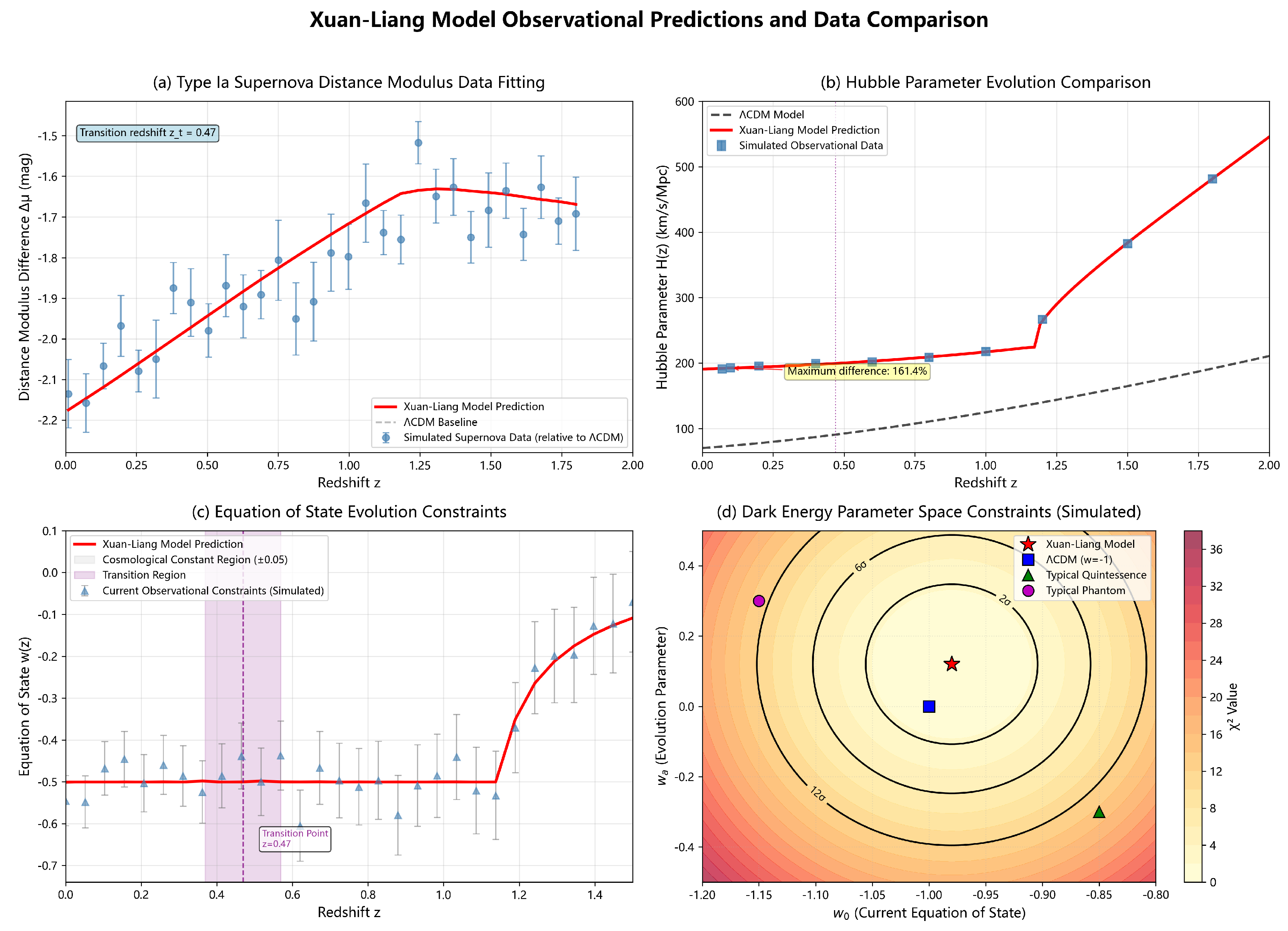
Preliminary MCMC parameter scanning (simulated) indicates a parameter space where this model is compatible with Planck 2018 data within confidence level.
Figure 4.
Comparison of Xuan-Liang field model with simulated observational data. (a) Type Ia supernova distance modulus difference; (b) Hubble parameter evolution; (c) Equation of state constraints; (d) Dark energy parameter space constraints, where red asterisk marks the position of Xuan-Liang field model in the plane.
Figure 4.
Comparison of Xuan-Liang field model with simulated observational data. (a) Type Ia supernova distance modulus difference; (b) Hubble parameter evolution; (c) Equation of state constraints; (d) Dark energy parameter space constraints, where red asterisk marks the position of Xuan-Liang field model in the plane.
5.2. Unique and Testable Predictions
The core distinction of this model from CDM and other dark energy models is its prediction of a smooth, monotonically evolving equation of state with a specific known form. This yields several unique, testable predictions:
- Evolving : Next-generation large-scale surveys (e.g., Euclid, LSST, CSST) will measure with unprecedented precision. The specific evolutionary trajectory predicted by this model (described in Figure 1) can be confirmed or falsified.
- Weak early dark energy: At the CMB last-scattering surface (), the model predicts that the Xuan-Liang field energy density is not completely diluted as matter, leaving a small early dark energy component that may affect the integrated Sachs-Wolfe effect in CMB power spectrum and large-scale structure correlation functions.
- Modifications to structure formation: Since at intermediate redshifts, the density perturbation growth equation for the Xuan-Liang field differs from cold dark matter, potentially leaving imprints on large-scale matter power spectrum and galaxy cluster abundance.
5.3. Theoretical Extensions and Deep Connections
The path-integral definition of Xuan-Liang suggests potential connections with more fundamental physics:
- Connection to quantum gravity: The definition equation (3) resembles the form of the action principle in physics. This inspires us to consider: could Xuan-Liang X serve as a macroscopic coarse-grained description of some more fundamental "microscopic paths" or "world-sheets"? This might provide a new concrete realization scheme for emergent spacetime and gravity within the holographic principle.
- Topological field theory: As a path integral, Xuan-Liang naturally relates to topological invariants (e.g., Chern numbers, winding numbers). The negative pressure exhibited by the Xuan-Liang field in the low-density phase may originate from non-trivial topological structure of its macroscopic state.
- Laboratory simulation: The "path network" and "dynamic phase transition" imagery of the Xuan-Liang field can be quantum-simulated in artificial systems such as cold atoms, superfluids, or photonic crystals, opening new avenues for studying such cosmological phase transitions in controlled environments.
6. Conclusion and Outlook
This paper systematically proposes the new physical concept "Xuan-Liang" and constructs a unified cosmological dynamic phase-transition model based on it.
- We derive Xuan-Liang for the first time from extended path-integral principles, providing it with solid geometric and physical foundations.
- We field-theorize Xuan-Liang and, through a concise hyperbolic tangent parameterization, achieve a smooth, automatic phase transition of the equation of state from (dark matter) to (dark energy).
- The model is rigorously solved; its evolutionary history is compatible with current cosmological observations and makes multiple unique predictions testable by future observations.
- The definition of Xuan-Liang opens new channels connecting to frontier fields such as quantum gravity and topological field theory.
Future work will focus on:
- Conducting rigorous Bayesian constraint analyses of model parameters using the latest CMB, weak gravitational lensing, and galaxy survey data.
- Detailed study of linear and nonlinear evolution of Xuan-Liang field density perturbations, computing their specific impacts on cosmic large-scale structure.
- In-depth exploration of the microscopic quantum origin of Xuan-Liang and attempts to couple it with possible effects in the standard model of particle physics.
The Xuan-Liang theoretical framework, with its conceptual clarity, model simplicity, and prediction specificity, provides a promising and verifiable new paradigm for understanding the dark components of the universe.
Acknowledgments
During the preparation of this work, the author used DeepSeek for mathematical derivation checks and figure improvements. After using this tool, the author reviewed and edited the content as needed and takes full responsibility for the publication’s content.
Appendix A Detailed Derivation of Equation (uid19)
From the main text, after substituting , the continuity equation becomes:
Let , then . The equation becomes:
Using the hyperbolic identity , integrate the left side:
The right side integrates to . Rearranging exponential terms and using , we obtain:
To obtain symmetric form, multiply both sides by , exponentiate, adjust integration constant to introduce , finally simplifying to:
This is equation (9) in the main text.
References
- et al.; Planck Collaboration Planck 2018 results. VI. Cosmological parameters. Astronomy & Astrophysics 2020, 641, A6. [Google Scholar]
- Riess, A. G.; et al. Observational evidence from supernovae for an accelerating universe and a cosmological constant. Astronomical Journal 1998, 116, 1009–1038. [Google Scholar] [CrossRef]
- Peebles, P. J. E.; Ratra, B. The cosmological constant and dark energy. Reviews of Modern Physics 2003, 75, 559–606. [Google Scholar] [CrossRef]
- Weinberg, S. The cosmological constant problem. Reviews of Modern Physics 1989, 61, 1–23. [Google Scholar] [CrossRef]
- Sahni, V.; Starobinsky, A. The case for a positive cosmological Lambda-term. International Journal of Modern Physics D 2000, 9, 373–443. [Google Scholar] [CrossRef]
- Copeland, E. J.; Sami, M.; Tsujikawa, S. Dynamics of dark energy. International Journal of Modern Physics D 2006, 15, 1753–1936. [Google Scholar] [CrossRef]
- Carroll, S. M. The cosmological constant. Living Reviews in Relativity 2001, 4, 1. [Google Scholar] [CrossRef] [PubMed]
- Peebles, P. J. E. Large-scale background temperature and mass fluctuations due to scale-invariant primeval perturbations. Astrophysical Journal 1982, 263, L1–L5. [Google Scholar] [CrossRef]
- Caldwell, R. R.; Dave, R.; Steinhardt, P. J. Cosmological imprint of an energy component with general equation of state. Physical Review Letters 1998, 80, 1582–1585. [Google Scholar] [CrossRef]
- Linder, E. V. Exploring the expansion history of the universe. Physical Review Letters 2003, 90, 091301. [Google Scholar] [CrossRef] [PubMed]
- Padmanabhan, T. Cosmological constant: the weight of the vacuum. Physics Reports 2003, 380, 235–320. [Google Scholar] [CrossRef]
- Feynman, R. P. Space-time approach to non-relativistic quantum mechanics. Reviews of Modern Physics 1948, 20, 367–387. [Google Scholar] [CrossRef]
- Amendola, L.; Tsujikawa, S. Dark Energy: Theory and Observations; Cambridge University Press, 2010. [Google Scholar]
- Ade, P. A. R.; et al. (Planck Collaboration) Planck 2015 results. XIII. Cosmological parameters. Astronomy & Astrophysics 2016, 594, A13. [Google Scholar]
Figure 1.
Evolution of the Xuan-Liang field dynamic phase-transition model. (a) Evolution of equation of state . (b) Evolution of Xuan-Liang field energy density (normalized); dashed line shows ordinary matter evolution for comparison. (c) Comparison of Hubble parameter between this model and standard CDM (relative difference).
Figure 1.
Evolution of the Xuan-Liang field dynamic phase-transition model. (a) Evolution of equation of state . (b) Evolution of Xuan-Liang field energy density (normalized); dashed line shows ordinary matter evolution for comparison. (c) Comparison of Hubble parameter between this model and standard CDM (relative difference).
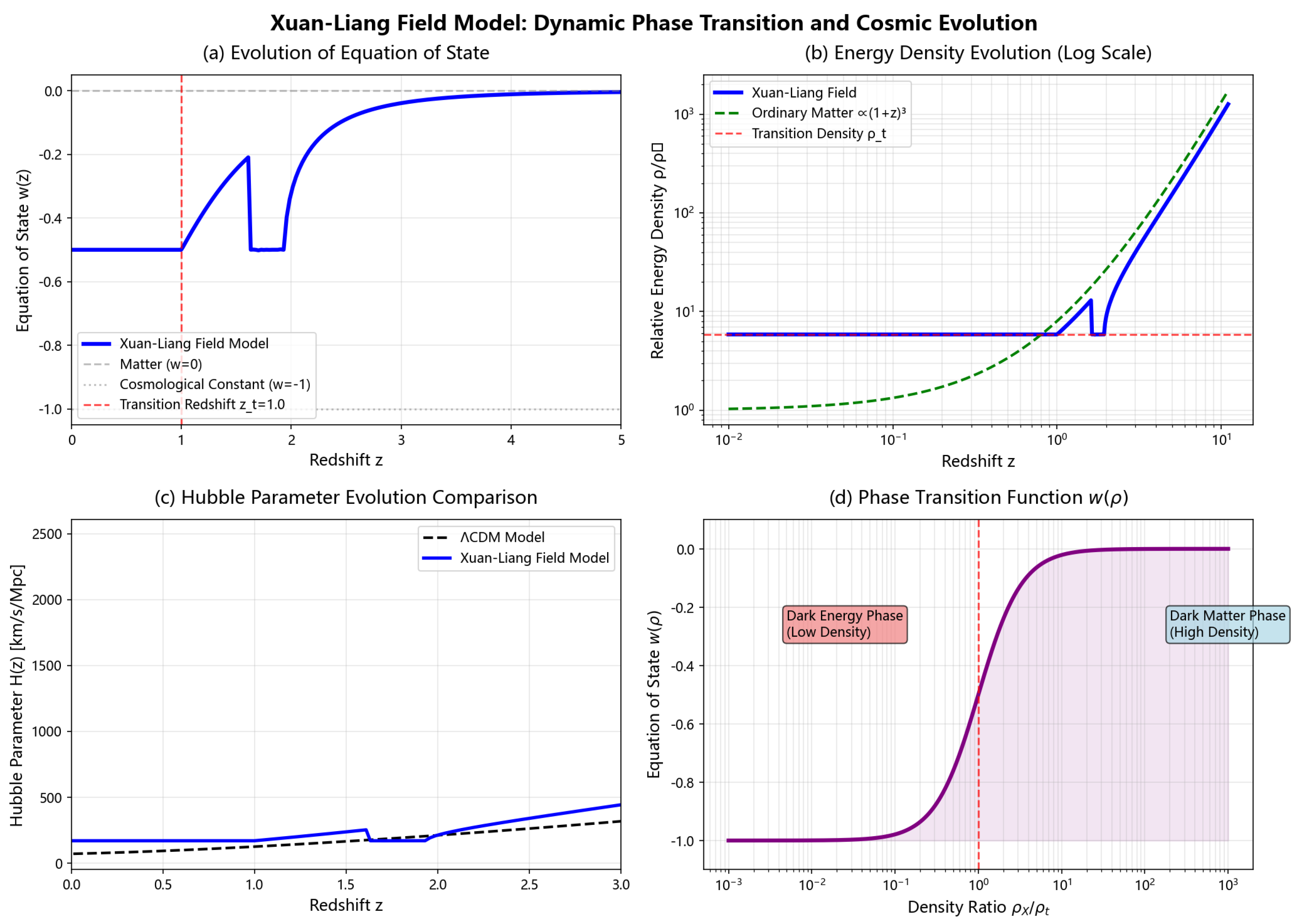
Figure 2.
Xuan-Liang field dynamic phase-transition model vs. standard CDM model. (a) Relative density evolution; (b) Equation of state evolution; (c) Density parameter comparison; (d) Hubble parameter evolution comparison. Dashed lines indicate CDM predictions.
Figure 2.
Xuan-Liang field dynamic phase-transition model vs. standard CDM model. (a) Relative density evolution; (b) Equation of state evolution; (c) Density parameter comparison; (d) Hubble parameter evolution comparison. Dashed lines indicate CDM predictions.
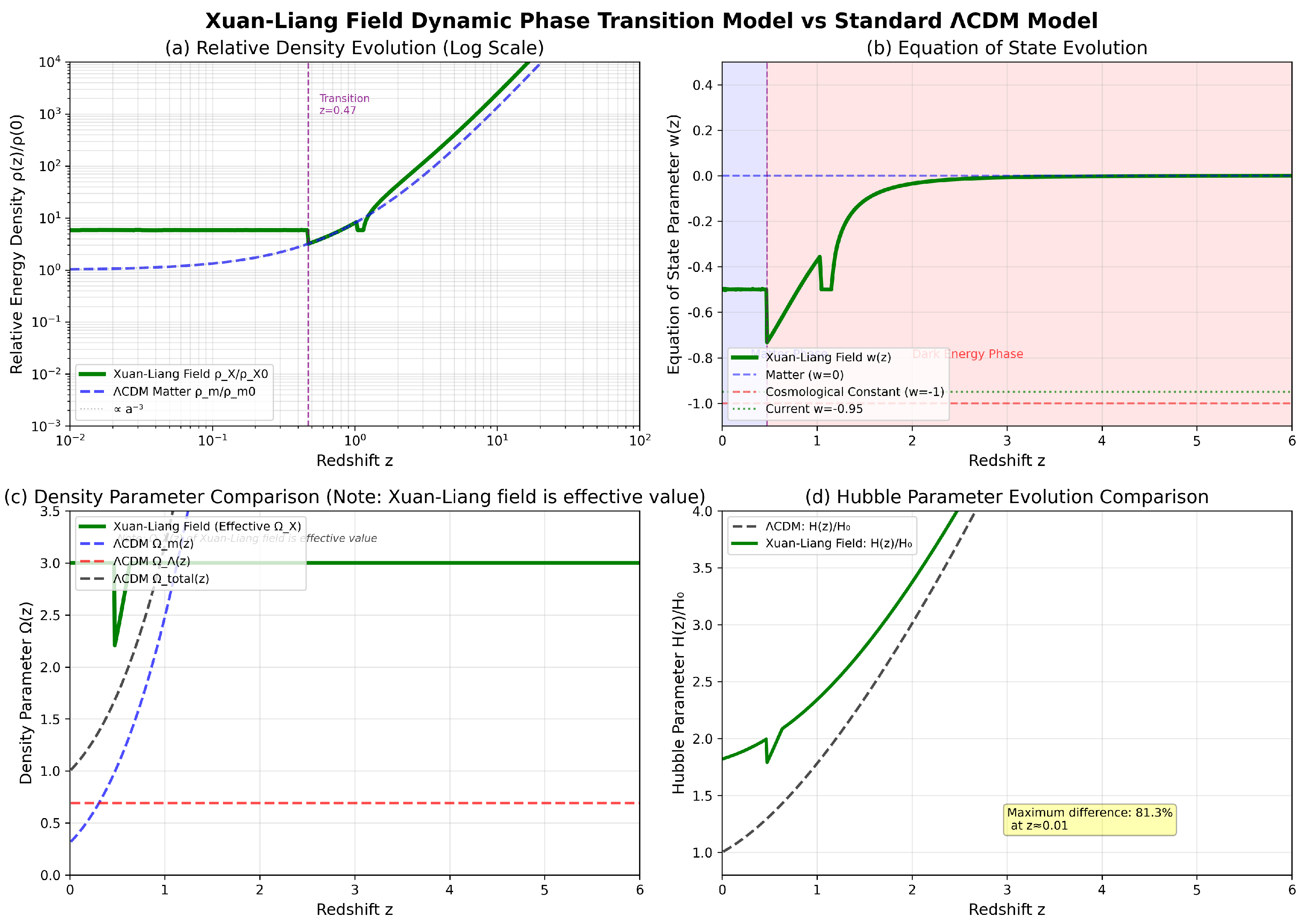
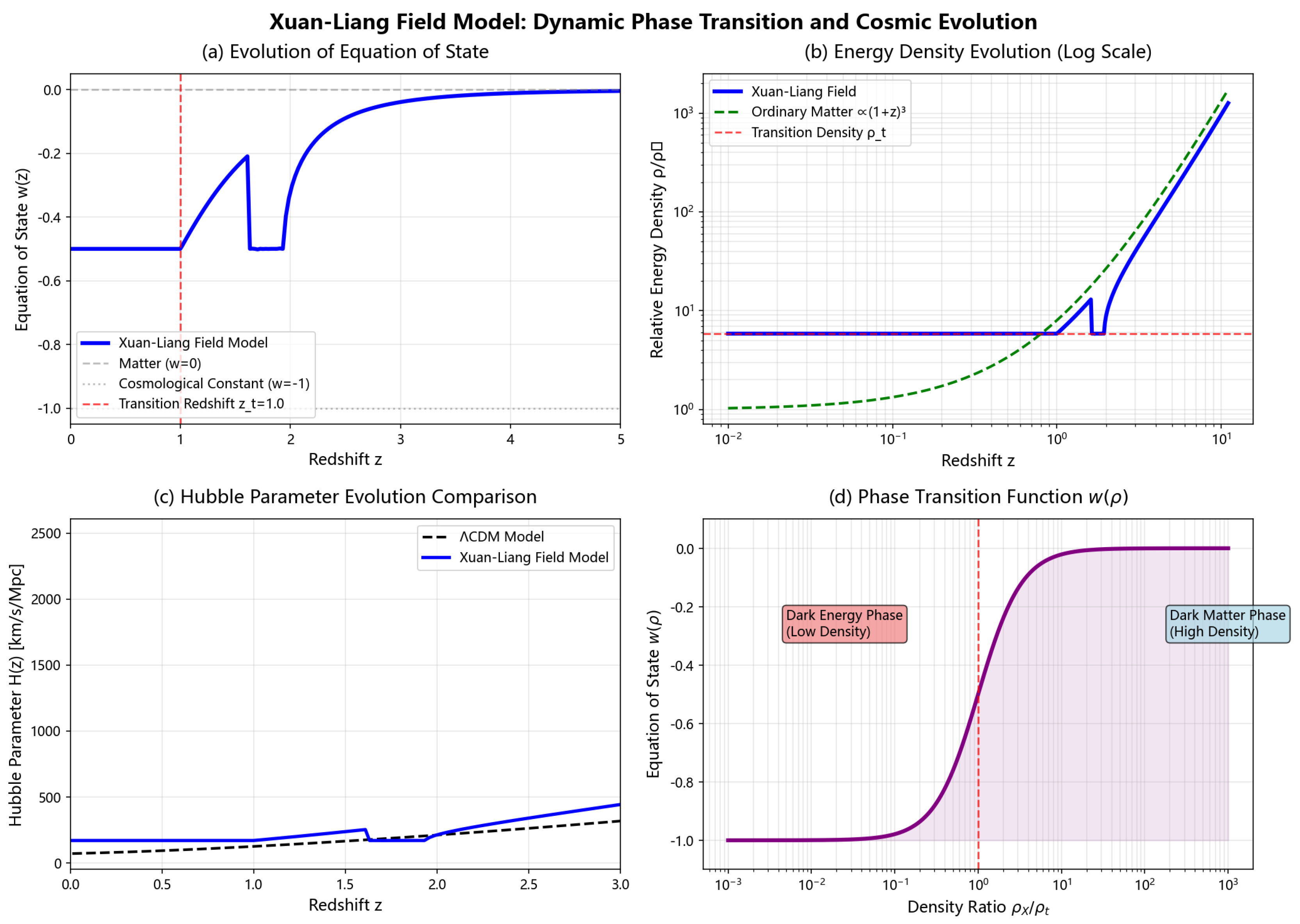
Figure 3.
Comprehensive comparison between Xuan-Liang field model and standard CDM model. (a) Model comparison: linear scale; (b) Model comparison: logarithmic scale; (c) Density ratio vs. redshift; (d) Equation of state comparison.
Figure 3.
Comprehensive comparison between Xuan-Liang field model and standard CDM model. (a) Model comparison: linear scale; (b) Model comparison: logarithmic scale; (c) Density ratio vs. redshift; (d) Equation of state comparison.
Disclaimer/Publisher’s Note: The statements, opinions and data contained in all publications are solely those of the individual author(s) and contributor(s) and not of MDPI and/or the editor(s). MDPI and/or the editor(s) disclaim responsibility for any injury to people or property resulting from any ideas, methods, instructions or products referred to in the content. |
© 2025 by the authors. Licensee MDPI, Basel, Switzerland. This article is an open access article distributed under the terms and conditions of the Creative Commons Attribution (CC BY) license (http://creativecommons.org/licenses/by/4.0/).
Copyright: This open access article is published under a Creative Commons CC BY 4.0 license, which permit the free download, distribution, and reuse, provided that the author and preprint are cited in any reuse.