

Submitted:
03 June 2026
Posted:
05 June 2026
You are already at the latest version
Abstract
The transits of Venus occur in couples each 105/122 years: the observed ones are 1639; 1761-1769; 1874-1882, and 2004-2012. The next couple will be in 2117-2125. We would need all four contacts to determine the solar diameter accurately. The black-drop phenomenon blurred always the internal contacts, so we developed a parabolic analysis of the chords drawn by the disk of Venus on the solar limb. The extrapolation to zero gives the contact timings. We tested this method with some high quality images obtained in 2004 and 2012, and we applied it to the observations of 2012 in visual band (Huairou Solar Observing Station, hazy weather) and H-alpha (Shen Zen Astronomical Observatory). To exclude a reduction of the measured diameter by the haze, we made two series of measures at the Clementine Gnomon (Rome) and at PHYSIS telescope (Rome), under various sky transparencies and with diffraction limited instruments. The haze, and the low altitudes above the horizon reduced the accuracy at all first contacts examined, without changing the solar diameter. Our measures obtained in China during the transit of 2012 yielded a photospheric radius R¤P=959.33”±0.06”, based on 76+75 images diffraction limited; compatible with the chromospheric radius measured at the base of the spiculae was R¤C=959.78”±0.11”, relying on 7+5 diffraction-limited series of images.
Keywords:
transits of Venus
; solar diameter
; optics
; atmospheric optics
; black-drop effect
; clementine gnomon
; meridian diameter
; PHYSIS telescope
1. Introduction: Transits of Venus and Mercury Along the History
Venus and Mercury have orbital periods in resonance with the Earth, and their transits across the Sun’s disk occur regularly at their orbital nodes. Venus transited on the Sun at its orbital descending node on 8 June 2004 and 6 June 2012; after 105 year it will occur at the ascending node on 10-11 December 2117 and 8 December 2125. Then, 122 year after, another descending node’s 8-years couple of transits and so on. For Mercury there are about 13 transits per century, distributed in May (descending node) and November (ascending node) [1].
The transit of a planet in front of the Sun has been, along the history, the occasion for studying (1) the accuracy of the ephemerides (2) the angular dimension of the planet (3) the diameter of the Sun (4) the distance Earth-Sun (5) the Venus’ atmosphere (6) the black-drop optical phenomenon. Since only seven transits of Venus have been observed along the history, the same issues have been addressed for the transits of Mercury, with increased observational uncertainties, due to the small angular diameter of the planet (9”-12” versus 58”-63” of Venus, with respect to 2”-3” of normal daytime seeing, estimated at the zenith).
Einhard [2] invoked erroneously the passage of Mercury on the Sun to explain a dark spot seen on the Sun for seven days in the nineth century.
Johannes Kepler (1571-1630) in publishing his Tabulae Rudolphinae [3], forecasted the transits of Mercury for 1631 [4] and a miss of the Venus’ one for 1639.
The predictions of these transits should have been accurate in space and time within the solar disk (±16′) and the transit’s duration (±3 hr), and verified through the telescope. That’s why their historical records started only in XVII century.
Pierre Gassendi on 7 November 1631 observed firstly a transit of Mercury. The dimension of Mercury in front of the solar disk was decidedly smaller than he expected to see [5,6]. Jeremy Horrocks [7], improving the calculation of Kepler, and his colleague William Crabtree observed on 4 December 1639 the beginning of the transit of Venus across the Sun, verifying its angular dimension and the corrections of Horrocks to the ephemerides of Kepler [8].
The other Venus’ transits have been observed at different stages of the history of modern astronomy [9]. If Celestial Mechanics was the focus since 1639 Venus transit, the accurate measure of the Astronomical Unit for 1761-69 and 1874-82 transits, become the main goal after the Halley’s advice [10]. The planetary atmosphere of Venus was discovered in 1761 and again studied in 2012 and the Earth’s atmosphere and black-drop optics was discovered in 1769 and again under scrutiny in 2004 and 2012 [9].
The sunlight reduction during the transits of 2004 and 2012 was exploited to better understand extrasolar planetary transits observational issues, having the details of the solar surface fully available, unlike the stars [11]. Our interest into observing the transits of 2004 and 2012 was the accurate measure of the solar diameter, through the comparison between the observed timing and the calculated ephemerides.
For 2012 we were prepared to overcome the black-drop phenomenon [12,13], following an idea developed for the transit of 2004 [14]. An unexpectedly hazy sky re-proposed the problem of filters possibly cutting out the outer part of the solar diameter, and examined in solar eclipses and Baily’s beads observations [15].
Since the observations of the Sun under various meteorological conditions are normally discarded (unless there are some unique phenomena like the planetary transits) we studied a new series of measures realized at the Clementine Gnomon in Santa Maria degli Angeli e dei Martiri Basilica in Rome [16], from November 2025 to February 2026. The result of this study verifies within the experimental uncertainty, that haze and clouds’ veils do not reduce the perceived solar diameter, validating the results obtained under the hazy sky in 2012 transit at Huairou Solar Observing Station (HSOS).
This paper is structured as following: section (2) the data of last two Venus Transits 2004 (2.1 Italy, 2.2 Greece). 2012 (2.3 China: Sen Zen; 2.4 China Huairou 2.5 Greece) -Section (3) the black drop and the algorithm to overcome it; section (4) the data on solar diameter measured with the Clementine Gnomon dealing with clear and veiled skies; (5) the solar diameters with PHYSIS telescope under clouds; (6) the Conclusions. This paper was prepared for celebrating the XL anniversary of HSOS establishment [17].
2. The Transits of Venus with the Chords’ Method
The scope of that method is to obtain the four times of the ingress of Venus on the solar disk, t1 and t2, and the ones of the egress, t3 and t4. The historical problem of the black-drop, which blurs the internal contacts t2 and t3, should have been overcome by extrapolating to zero the intersections of Venus with the solar limb.
The first observations suitable of such treatment were the one of Giovanni Di Giovanni (Avezzano, Italy) made in visual band and the one of Anthony Ayiomamitis (Athens, Greece) in Hα.
The Solar Diameter is obtained from at least two exact timings of the Venus transits one at the ingress (t1 and/or t2) and the second one at the egress (t3 and/or t4). The hypothesis that the Sun is spherical, which is true within a few parts in 106 [18], is implicitly included in that approach.
We exploited the definite mathematical function describing the length of the chord:
obtained by moving through a disk of radius R (of Venus) at velocity v, an horizontal line representing the solar limb, assumed of infinite radius. The third parameter t0 is the instant when the chord C(t0)=2∙R, it is equal to the diameter of Venus, exactly at middle ingress/egress, so that t1+t2=t0i for the ingress and the same t3+t4=t0e for the egress.
C2(t)/4=R2-v2t02+2v2∙t0∙t-v2∙t2
2.1. The Transit of 8 June 2004 in Visual Band
Costantino Sigismondi observed the whole transit of 8 June 2004 from Rome. The black-drop during the egress at 13:05 UTC+2 was studied with Alessandro Scimia and Stefano Converso: both of them 20 seconds after my definition of internal contact still found space between Venus and the solar limb; the simultaneous observation was performed by projection.
Giovanni Di Giovanni recorded the transit of Venus in 2004 in Avezzano (Italy) with a refracting telescope 70/1000 mm equipped with a mylar solar filter. The webcam was a ToUcam Pro Philips with pixels of 5.6μm. The theoretical resolution was 1.15”/pixel. Each of the chords of Venus on the solar disk was measured on an image obtained by stacking 15 images, with the aim to reduce the black drop. C2 (t)/4 in pixel and times t [±0.3 s] are represented in Figure 4.
Figure 1.
The chords C2/4 of G. Di Giovanni’s transit in 2004; Sci.Pi.optimize analysis.
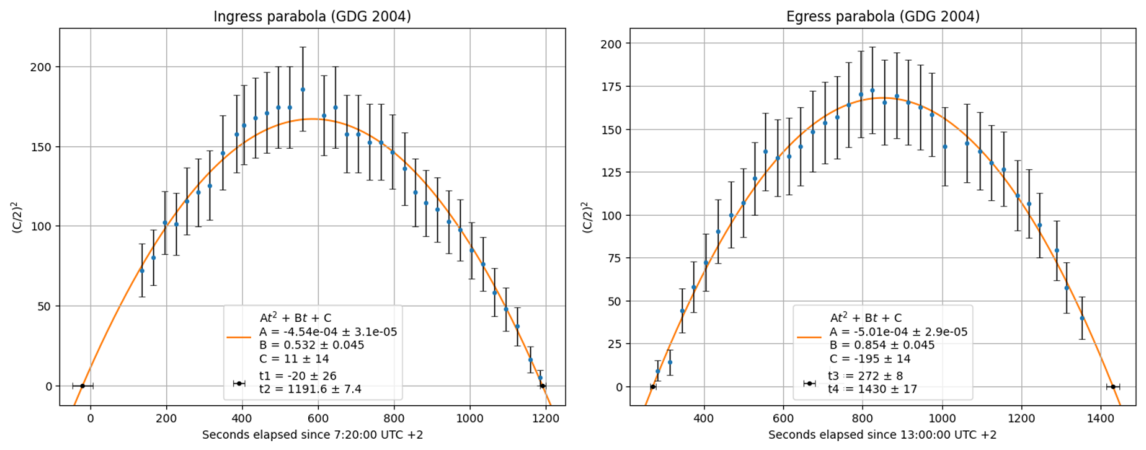

Table 1.
Ingress and egress of Venus at Avezzano on 8 June 2004; data obtained by Giovanni di Giovanni on his images [14]. The solutions for C(t)=0 are t=t1, 2, 3, 4, reported in the table.
Table 1.
Ingress and egress of Venus at Avezzano on 8 June 2004; data obtained by Giovanni di Giovanni on his images [14]. The solutions for C(t)=0 are t=t1, 2, 3, 4, reported in the table.
| Source | Ingress t1 | Ingress t2 | Egress t3 | Egress t4 | |
|---|---|---|---|---|---|
| Ephemerides XJ 1 | 7:20:14 | 7:39:48 | 13:04:33 | 13:23:44 | |
| GDG-2004 2 | 7:19:44.5 | 7:39:41.9 | 13:04:25.3 | 13:23:54.9 | |
| O-C [s] 3 | -29.5 | -6.1 | -7.7 | +10.9 | |
| Solar Diameter | 959.55”±0.18” | ||||
| GDG-2004_P 4 | 7:19:40±26 | 7:39:51.6±7.4 | 13:04:32±8 | 13:23:50±17 | |
| O-C_P [s] 5 | -34 | +3.6 | -1 | +6 | |
| Solar Diameter 6 | 959.40”±0.18” | ||||
1 XJ stands for http://xjubier.free.fr/en/site_pages/VenusTransitCalculator.html (13 april 2026) 2 Excel fits; 3 O-C stands for Observed- Calculated with Excel fits, for XJ ephemerides. 4 fit with curve fit() of sciPy.optimize; 4,5 P stands for scyPy.optimize fits; 6 calculated for the internal contact only.
2.2. The Transit of 2004 in Hα Band
Anthony Ayiomamits recorded in Athens the transit of Venus in Hα.
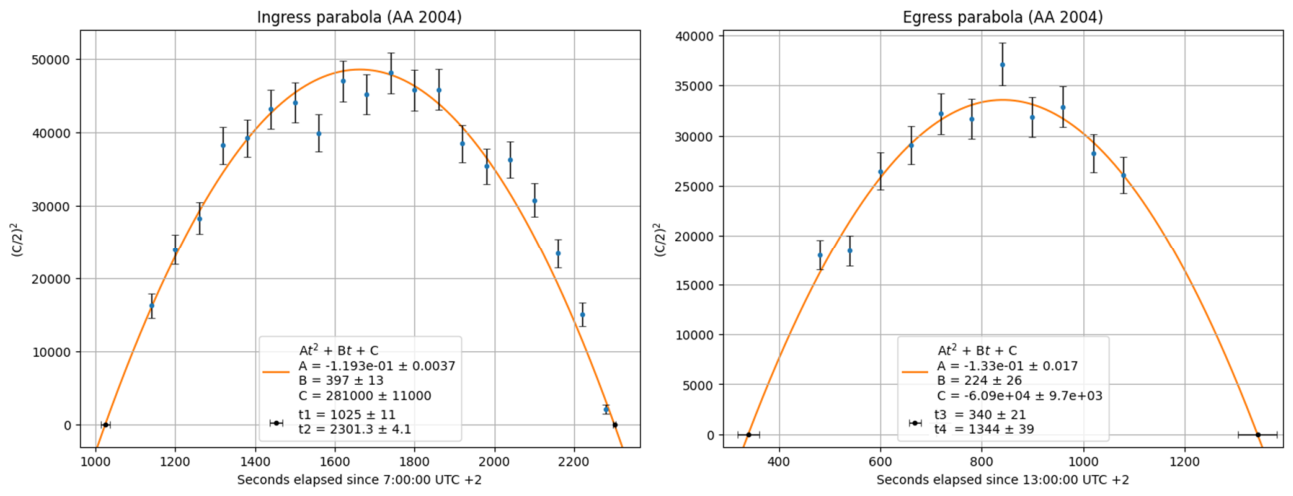
We analyzed the original raw images of the ingress and the egress, taken each minute.
Figure 2.
The chords C2/4 of A. Ayiomamits in 2004, with the Sci.Pi.optimize fit analysis.
Instrumentation: TeleVue Pronto refractor (70mm aperture and 480mm focal length) with an h-alpha system by Coronado (SolarMax 60 ERF, BF10 blocking filter and a T-Max Tuner) as well as a CEMAX 2x Barlow which yielded an effective focal length of 960mm and f-ratio of 13.7. The camera used was a Canon EOS 300D (APS-C CMOS sensor) with a pixel size of 7.38 μm and a pixel array of 3072x2048 pixels. Image’s scale 1.59”/pixel. All exposures were at 1/50 sec at ISO 800.
Table 2.
Ingress and egress of Venus at Athens on 8 June 2004; data obtained by Anthony Ayiomamitis. The solutions for C(t)=0 are t=t1, 2, 3, 4, reported in the table.
Table 2.
Ingress and egress of Venus at Athens on 8 June 2004; data obtained by Anthony Ayiomamitis. The solutions for C(t)=0 are t=t1, 2, 3, 4, reported in the table.
| Source | Ingress t1 | Ingress t2 | Egress t3 | Egress t4 | |
|---|---|---|---|---|---|
| Ephemerides1, 2, 3 | 7:19:58 | 7:39:33 | 13:04:19 | 13:23:34 | |
| AA-2004 4 | 7:16:48.2 | 7:38:50.5 | 13:05:44.1 | 13:22:16.3 | |
| O-C [s] 7 | -189.8 | -42.5 | +85,1 | -77,7 | |
| Solar diameter 9 | 964.56”±1.78” | 965.91”±0.94”” | |||
| AA-2004_P 5 | 7:17:05±11 | 7:38:21.3±4.1 | 13:05:40±21 | 13:22:24±39 | |
| O-C_P [s] 8 | -173 | -71,7 | +81 | -70 | |
| Solar diameter 9 | 964.16”±1.78” | 967.15”±0.94” |
1 XJ stands for http://xjubier.free.fr/en/site_pages/VenusTransitCalculator.html (13 april 2026). These ephemerides are prepared for the visual band. Hα is expected to exceed the visual diameter. 2 Calsky.org ephemerides (visited 2015, no more available, always in white light) 3 Fred Espenak’s ephemerides for white light and reported in https://www.perseus.gr/Astro-Planet-Ven-Tr2004.htm (visited on 21 April 2026). 4 Excel fits; 5 fit with curve fit() of sciPy.optimize; 6 σ calculated with Excel fits 7 O-C stands for Observed- Calculated with Excel fits, for XJ ephemerides. 8 P stands for scyPy.optimize fits. 9 Calculated both for internal and external contacts.
2.3. The Transit of 6 June 2012 in Hα Band at Shen Zen
These data are a courtesy by Wang Dong at the Shen Zen Astronomical Observatory, with the H-alpha telescope. The images are of excellent quality (Figure 3).
SZAO site info: Latitude N22°28’56.28” Longitude E114°33’21.60” Altitude 200m
2012 Venus Transit Observation. Camera: The Imaging Source DMK51
Telescope: Lunt 100 H-alpha solar telescope + Takahashi TOA130 + 0.7× focal reducer
Takahashi TOA130 native focal length: 1000 mm; after focal reduction: 700 mm.
Images We have videos composed each by 40-150 images, 8 for ingress and 9 for egress. We selected the first images of the videos, with the corresponding timing, obtaining a set of 7 data for the ingress and 5 for the egress. The pixel to arcseconds scale is 1.235”/pixel.
The measures of C(t) in pixels, directly from the images, filled the values of C2(t)/4 in the graphics in Figure 5.
Figure 4.
The chords measured on the images of 2012 ingress and egress of Venus, SZAO H-alpha.
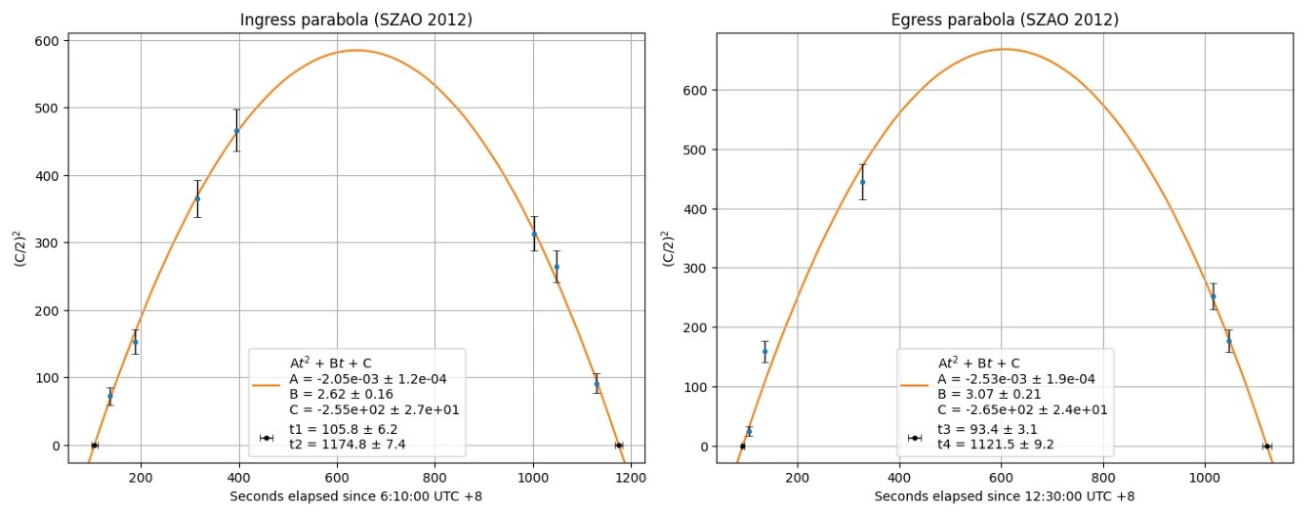
Figure 5.
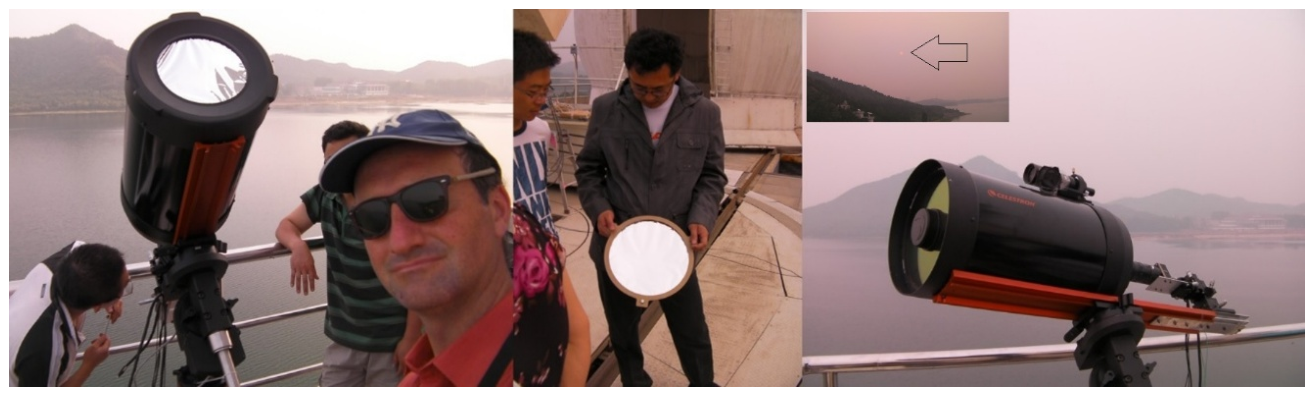
Composite: The telescope prepared with the Sun filter; the filter removed; the SC11” telescope of diameter 280 mm/ f10 with a 200 mm filter ready for the Venus’ ingress. Left: Xiaofan Wang and Costantino Sigismondi (with sunglasses) center Wenbian Xie handling the mylar filter. The ingress was observed without filter, while the egress was filtered. The arrow in the box shows the Sun just before the beginning of the transit, barely visible to the naked eye.
Figure 5.
Composite: The telescope prepared with the Sun filter; the filter removed; the SC11” telescope of diameter 280 mm/ f10 with a 200 mm filter ready for the Venus’ ingress. Left: Xiaofan Wang and Costantino Sigismondi (with sunglasses) center Wenbian Xie handling the mylar filter. The ingress was observed without filter, while the egress was filtered. The arrow in the box shows the Sun just before the beginning of the transit, barely visible to the naked eye.
For both ingress and egress the zeroes of the parabola C(t) are the four contact times, summarized in Table 3, with comparison with the ephemerides.
2.4. The Transit of 6 June 2012 in Visual Band at Huairou
The transit of 2012 has been prepared carefully, to exploit the last occasion in this century to measure the solar diameter with the Venus transit. A larger telescope, and the facility of the Huairou Solar Observing Station in China were at our disposition. Since the transit started low in the sky, a C11 telescope was equipped above the observing tower, to cover all the 6 hours of transit from t1 to t4. The main telescope was unable to point the Sun at t1, but we have the egress, with an estime of t3.
Instrumentation: For recording the contact timing we used a CGE 1100 (C11) 28 cm/f10 Schmidt-Cassegrain telescope Celestron, equipped with a mylar filter of 20 cm, as in Figure 5. The filter was removed for the ingress, because of a strong haze. The camera was a B2020 with 2048x2048 pixels of size 7.4 μm with 0.545”/pixel at 2800 mm, a field reducer was added to adapt the camera to the telescope, obtaining a final 1.306”/pixel, measured with the full disk of Venus, 57.8”, on the Sun (Figure 6 and Figure 7).
Images For the ingress we obtained 1204 images of 401x201 pixels, one per second, taken with a ZWO astronomical camera, from 6:09 to 6:30 local time with a minute gap at 6:27, and 1199 images from 12:30 to 12.50 for the egress. The angular resolution of these images is 1.306”/pixel, so that the diameter of Venus of 57.81” is extended on 44.24 pixel. It is not a diffraction-limited configuration, but it is very good for the typical daytime seeing.
A selection of 76/75 images respectively for ingress/egress and separated averagely by 5 s was made by visual inspection, and for each of them the chord C(t) was obtained by the coordinates in pixel of the Venus-Solar Limb intersections.
The measures of C(t) in pixels, directly from the images, filled the values of C2(t)/4 in the graphics in Figure 8.
For both ingress and egress the zeroes of the parabola C(t) are the four contact times, summarized in Table 4, with comparison with the ephemerides.
2.5. The Egress of 2012 in Hα in Athens
Anthony Ayiomamitis recorded the egress of Venus 2012 in Athens.
Images: He used a AP 160/f7.5 StarFire EDF refractor (native focal length = 1200mm, as measured by CCD plate solving = 1202mm) AP 2x Conv Barlow, realizing a photographic focal length = 2400mm. The Image Scale is 0.705”/pixel. The Camera—Canon EOS 5D Mark I, full-frame sensor (4368x2912 pixels), 8.20 μm per pixel. Exposure of the Photography—1/100 sec, ISO 100, Baader ND5 filter, Baader UV/IR-Cut filter.
Figure 9.
The chords measured on the images of 2012 egress of Venus in Athens.
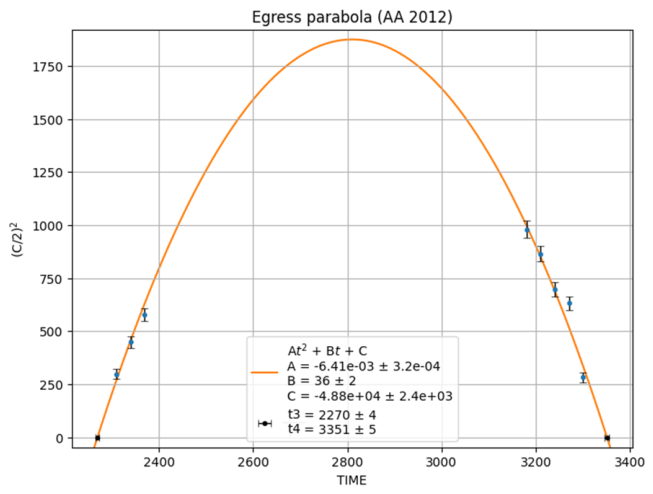
Table 5.
Egress of Venus in Athens, only t=t 3, 4 are reported in the table.
| Source | Ingress t1 | Ingress t2 | Egress t3 | Egress t4 | |
|---|---|---|---|---|---|
| Ephemerides XJ 1 | 7:38:01 | 7:55:28 | |||
| AA-2012 2 | 7:37:48.4 | 7:55:57.8 | |||
| O-C [s] 2 | -12.6 | 29.8 | |||
| AA 2012_P 3 | 7:37:50±4 | 7:55:51±5 | |||
| O-C_P [s] 4 | -11 | 23 |
1 XJ stands for http://xjubier.free.fr/en/site_pages/VenusTransitCalculator.html (13 april 2026) 2, Excel fits; 3, 4 fit calculated with curve fit() of sciPy.optimize.
No accurate solar diameter can be derived without t1 or t2, which occurred below the horizon of Athens. We used these data to verify the fitting methods.
3. The Black-Drop Effect Blurring the Contacts
The diffraction of the telescope, and atmospheric conditions (seeing) affect the t2 and t3 through the black drop effect [13]. Diffraction, low contrast and the seeing affect the t1 and t4.
The black-drop is due to an interplay between the solar limb darkening and the point-spread function of the telescope. This effect is also occurring on spacebased measurements [13], the seeing contributes to enlarge the observed effect. By means of the extrapolation to zero of the chords described by Venus with the solar limb, through a parabolic fit, we aimed to eliminate the influence of the seeing on the black-drop in our measurements.
The measures of solar parallax in the 18th century remained uncertain due to the differences of several seconds were reported at the internal contacts, as in Cook and Green, 1771 [12]. The first external contact is necessarily delayed by the time necessary to detect the portion of Venus already on the Sun’s disk. The angular velocity of Venus (and also Mercury) during the transits is typically on the order of 0.055”/s; the daytime seeing has been evaluated around ρ= 3.6” at egress ρ= 3.4”. At 55 mas/s of angular velocity 65 s are necessary to cover 3.6”, then for the disk of Venus to become visible.
With digital images we can move forward and backward the video, but the first and the last contacts remain extremely noisy of the 6 June 2012 Transit at HSOS.
The black-drop occurs at the internal contacts of the transits of Venus and Mercury across the Sun, depending also on the atmospheric seeing, and making uncertain the determinations of the internal and external contacts times of the planetary disk with the solar limb (Figure 10). Moreover the solar limb itself has a smooth edge, with a smooth contrast with the sky. The clouds cover may further reduce this contrast.
The right images of the Figure 10 have been extracted from a video recorded in the control room of the HSOS/MCST. The contact time was evaluated at naked eye as t3 = 12:32:08:3 about seven seconds after the ephemerides time in Table 4.1
A video of the 4th contact obtained by the images’ sequence shows the typical problems occurring with low contrast and seeing at the solar limb.2 The hazy conditions of the 2012 transit of Venus made our visual-band observations noisy for the scope of identifying the Venus aureola [21].
4. Clearness of the Atmosphere and Solar Diameter Measurements
We have two Case Studies: at the Pinhole-Meridian Line of St. Maria degli Angeli (1702) and with the PHYSIS (Portable H-alpha Visual ICRANet Solar Imagery System) refracting 90 mm telescope.
A fundamental distinction has to be done between the historical observations and the transit of 2012. Before video recording the timing of the contacts was made visually [22]. Only one time was judged as the contact’s one. For reference when we look a sea sunset at the telescope, the timing of the contact of the Sun’s disk with the sea, by eye may be significant different from the one extrapolated from the video. This is an example in which a black-drop-like effect acts.
A second difference is on the diameter’s measures of the solar image with respect to the sky background and the one made during the planetary transit, which exploits the contacts timings.
The meteorological conditions during the contacts of the Mercury transits were taken into account by A. Wittmann [23] who recalled also some observations of sunspots undergoing black-drop effect, during their occultation by the Moon’s limb.
A good refractor, well equipped for the solar observation, and an experienced observer may grant a one-second accuracy on the timing of a planetary transit. This is the base of the re-analysis made by I. I. Shapiro on twenty-three transits of Mercury, used to demonstrate the absence of variations of the solar diameter from 1631 to 1973 [24].
It is therefore reliable to have included some cloudy or foggy transits, since their observing opportunity was unique and it was compulsory to observe the transit in any case. There may be situations with hazy atmosphere in which the ingress/egress phases have been well discernable and the solar diameter was under-estimated.
The experiment conducted in St. Maria degli Angeli Meridian Line in Rome [25] in 2025 and 2026 aimed to determine whether hazy conditions reduce the extension of perceived solar diameter.
Theoretically, the effect of a filter reduces the apparent solar diameter, either by naked eye or by defining the limb of the Sun by the inflexion point of the radial profile of intensity, only if the filter cuts out the inflexion point itself [15]. In Santa Maria degli Angeli we verified that it does not occur with cloudy conditions, until the solar limb remains visible, by using the largest images available along the year from November to February (Figure 11, with the observer’s scale), projected on the white marbles of meridian line.
The meridian line of the Basilica of St. Maria degli Angeli in Rome is a giant pinhole-camera built in 1701-1702 to measure accurately the altitude and the dimension of the solar image formed on the 45-m meridian line, with astrometric purposes [26].
Cloudy days (with the Sun through thick veil, but the limbs are discernable), veiled and serene days have been considered, to have consistent data with all the planetary transits. The average meridian diameters of 10 measures per day over the white marbles are reported with their standard deviations. The best cases with σ<2 mm have been on sunny days 4, 11,12 December 2025 (and 6 April 2026), are due to a relatively low local air turbulence. The pinhole meridian dimension corresponds with 24” or 12 mm at 47 m and at an angle of projection of 26° and 25° (Sun’s meridian altitude in December), with a characteristic diffraction amplitude through the pinhole of 8”.
The limbs of the Sun appeared red with these optimal conditions (Figure 4 right panel), because the red light is much deviated by diffraction through the pinhole, than the other spectral components. The cloudy measures of the diameter are generally smaller than the ones made in clear, serene days, but also the turbulent ones are smaller than the steady ones, in agreement with the simulations described by Wittmann [23].
In general, the air turbulence reduces the measured diameter in all cases. The effective pinhole (its meridian diameter) changes from 14.7 mm to 11.4 mm, and the solar diameter ranged from 730 to 1085 mm. In Figure 8 the data are normalized to 959.63” of standard meridian solar diameter. The projected meridian diameter of the pinhole, ranges from 39” to 24”. The diffraction through such dimension in white light is respectively 6.8” and 8”. The averaged errorbars represented in Figure 12, correspond to 6.3”±1.5”, so that all measures are made near the pinhole’s optical diffraction limit, regardless of the conditions of the sky. The length of the measured diameter has been corrected by the penumbral effect reducing the perceived diameter by 0.43 times the pinhole’s diameter, here for the first time quantitatively quantified.
The errorbars represent the standard deviations of the sets of 10-15 daily measures, made under various contrasts of the image. The hazy data correspond to the presence of the 22° halo around the Sun. A clouds’ veil could act as a filter cutting the outermost parts of the solar diameter below the visibility threshold, but we did not find any change of the measured solar diameter correlated with the sky transparency.
During some historical planetary transits: the planet becomes discernable only when the ingress already started, because both the solar limb and the planet appear less sharp.
5. Measures with the PHYSIS Refracting Telescope
In this section we extend the result obtained in St. Maria degli Angeli to the nearest arcsecond: the measured solar diameter does not change under hazy conditions, provided that the limb of the Sun is discernable.
The PHYSIS (Portable H-alpha and Visual ICRANet Solar Imagery System) Refractor 90 mm/f 5.5 has been equipped with two green filters (Baader solar continuum filters λ≈540±10 nm) and camera ASI220MM 1280x980 working with 100 ms/gain 71. The diameter of the Sun has been estimated with the distance between the inflexion points of the Limb Darkening Function. On 13 April 2026 with the Sun’s altitude 32°22’±11’.the diameters under clouds were all 1235 pixel with 1914.1” of theoretical angular solar diameter. The images are in Figure 13.
The constancy of the diameter in pixel, within one part over 1235, for this differential experiment (same observing conditions within a few minutes) confirms the results obtained in st. Maria degli Angeli meridian line, always obtained on the horizontal diameters, therefore unaffected by the differential refraction.
6.. the Solar Diameter During the Transits of Venus
The angular resolution of the original images used for computing the timings in 2004 and 2012 was 1.6”/pixel (2004, Hα) 1.1”/pixel (2004, visual band) and 1.3”/pixel (2012, visual). C. S. used the chords of 2004 visual gently provided by G. Di Giovanni, without the original images, while the chords of 2004 Hα and 2012 have been measured by us on the original images.
The ephemerides were obtained from the webpage http://xjubier.free.fr/en/site_pages/VenusTransitCalculator.html (visted 22 april 2026) based upon F. Espenak’s ephemerides. Calsky ephemerides have been available in the past, they did not depart from more than 1 second from these.
We assume a perfect UTC timing for all the images we analyzed, and for the chords provided in 2004 by G. Di Giovanni.
The ingress/egress timing were obtained by fitting a parabola on the squared chords. We expected to reduce the uncertainty on such times through the extrapolations of the chords to zero. The t1 resulted the time with the largest errorbars σ≈7-10 s in all three cases. The other three times for Huairou have all σ≈1 s, making this the most accurate experiment.
The solar radii obtained in the various steps are reported in the Table 1, Table 2, Table 3 and Table 4.
In the conclusions we report the weighted averages of each experiment (internal and external contacts, photospheric and chromospheric radii).
7. Conclusions and Perspectives
The transit of Venus is a lifetime event: a couple in 8 years spaced by more than a century. One century from now, 8 December 2125, there will occur the second transit of the 22nd century. The transit of Venus offered many opportunities for research as optical tests, simulation of exoplanet transits with real data, measuring of the solar diameter, measures of the Venus aureola by analyzing the forward scattering of sunlight on its mesosphere [21,27,28,29]. Because of the haze we did not detect the Venus aureola, due to the poor contrast offered by the sky, even subtracting one image to another.
We analyzed the hazy 2012 transit in white light observed at Huairou Solar Observing Station, reconsidering the black-drop phenomenon. We analyzed also the images of the same transit in Hα obtained in Shen Zen Astronomical Observatory.
The photospheric radius of the Sun obtained with the Venus transit measured in Huairou [29] resulted R¤P = 959.33”±0.06” below the standard 959.63” solar radius at 1 AU [30] and not in excess as the successive measures from total eclipses [31,32] suggested.
The chromospheric radius measured at the base of the spiculae’s prairie resulted R¤C = 959.78”±0.11” measured with Hα line imagery.
The corresponding analyses in 2004 yielded R¤P = 959.48”±0.12” and R¤CS = 966.06”±0.60” in Hα line, including the spiculae. These 2004 data are to be considered as a references, either for the method of analysis and for the study of the observing problems. The photospheric radius in 2004 has been estimated upon chords obtained by stacking 10 images each, while in 2012 we used single images and dedicated experiments realized in two Astronomical Observatories: Huairou SOS and Shen Zen AO.
With the data obtained at the historical meridian line of Santa Maria degli Angeli, we have confirmed that hazy meteorological conditions do not reduce the perceived solar diameter, according to the simulations of Wittmann [23]. Only if the solar limb is not discernable, the diameter appear reduced if we identify it with the inflexion point of the limb darkening function, which results therefore heavily cut out by the clouds.
For the solar astrometry we found a photospheric radius 959.33”±0.06” in 2012 significantly lower 0.3” than the standard radius 969.63”. This is compatible with the chromospheric radius 959.78”±0.11” measured at the base of the spiculae in Hα.
Author Contributions
Contributions: C. S. conceived the structure of the paper and wrote it, A. B. contributed to the statistical analysis; X. W. and W. X. organized the observation at Huairou caring of the logistic and the instrumentation; A. A. gave us the images in H-alpha of 2004 and 2012; W. D. . W. D. gave us the H-alpha images of 2012.
Funding
No funds. ICRANet financed C. S. for the travel in China in 2012.
Data Availability Statement
We can provide the files of the Chords’ data upon request.
Acknowledgments
Costantino Sigismondi wrote this paper as homage to his Science Professor, Maria Salvatori Buzzanca, remembering the observation of the Transit of Venus of 8 June 2004 made together. She turned 90 years old on 15 December 2025, with the same original enthusiasm toward observational Astronomy! Thanks to Giovanni di Giovanni for providing their data in 2004.
Conflicts of Interest
The authors declare no conflicts of interest.
| 1 |
https://youtu.be/E0IBZdN0KXw video of the egress recorded with the telescope centered in 5324.19 Å with the original voices, in clear English the “internal contact” is claimed by Costantino Sigismondi and it is possible to understand clearly the problem of this evaluation. An audio in Italian has been also recorded during the 2004 Venus egress in Rome, and mentioned in section 2.1 |
| 2 | This video is saved on youtube https://youtu.be/4CdWCesgvNs. |
References
- C. Sigismondi, Francesca Binaglia, Laura Bellitto, Paolo Colona, Donatello Di Carlo, Rita Fioravanti, Pietro Oliva, Sabina Fiorenzi, Pietro Alessandro Giustini, TRANSITI ECLISSI ED OCCULTAZIONI TRA LA MINERVA ED IL COLLEGIO ROMANO evento organizzato da Costantino Sigismondi in occasione dello storico transito di Venere sul Sole 8 giugno 2004, Roma, Biblioteca Nazionale Casanatense, 8 Giugno 2004. Available online:(accessed on 11 december 2025).
- https://accademiadellestelle.org/wp-content/uploads/2016/03/Saros-Transito-di-Venere-alla-Casanatense.pdf.
- Einhard, Vita Caroli Magni. 32 (c. 817–36). Available online: https://thelatinlibrary.com/ein.html (accessed on 11 December 2025).
- Kepler, J., Tabulae Rudolphinae, J. Sauri, Ulmae (1627).
- Kepler, J., De rarismirisque Anni 1631 Phaenomenis which included an Admonitio ad Astronomos, J. Bartschio, Lipsiae (1629).
- Gassendi, P., Mercvrivs in sole visvs, et Venvs invisa, Parisiis, anno 1631 pro voto, & admonitione Keppleri, Parisiis, (1631).
- Gassendi and the Transit of Mercury. Nature 128, 787–788 (1931). [CrossRef]
- Hevelius, J., Venus in Sole Observata Liverpoliae A Jeremia Horroxio Anno 1639 24 Novembris, Styl. Jul. Delineata vero à Johanne Hevelio, S. Reiniger, Gedani (1662).
- Jeremiah Horrocks and the Transit of Venus . Nature 62, 257–258 (1900). [CrossRef]
- Sigismondi, C., Solar diameter with 2012 Venus Transit, proc. of the Fourth French-Chinese meeting on Solar Physics Understanding Solar Activity: Advances and Challenges, 15–18 November, 2011 Nice, France; (2013). Available online: https://arxiv.org/pdf/1201.4011 (accessed on 11 december 2025). [CrossRef]
- Spencer Jones, H., Edmond Halley 1656-1742, Nature 149, 69-71 (1942) (accessed on 12 april 2026).
- Sigismondi, C., Transits of Venus 2004 and 2012 and solar diameter from ground: Method, results and perspectives for Mercury transit of 2016, Proc. of the Fourteenth Marcel Grossmann Meeting On Recent Developments in Theoretical and Experimental General Relativity, Astrophysics, and Relativistic Field Theories, held 12-18 July 2015 in Rome, Italy. Edited by Massimo Bianchi, Robert T Jantzen and Remo Ruffini. Published by World Scientific Publishing Co. Pte. Ltd., 2018. ISBN #9789813226609, pp. 3688-3693 (2018).
- Cook, J. and C. Green, ‘Observations made at King George Island, in the South Seas’ by Charles Green and James Cook (1771). online:https://makingscience.royalsociety.org/items/l-and-p_5_257/paper-observations-made-at-king-george-island-in-the-south-seas-by-charles-green-and-james-cook?page=1(accessed on 11 December 2025).
- Pasachoff, J. M., G. Schneider and L. Golub, Theblack-drop explained, proc. IAU Colloquium 196, W. Kurtz ed. Cambridge University Press (2005). Available online: https://articles.adsabs.harvard.edu/pdf/2005IAUCo.196..242P(accessed on 11 December 2025).
- Di Giovanni, G., Effetto black drop e istanti dei contatti nel transito di Venere sul Sole, Astronomia. La rivista dell’Unione Astrofili Italiani (ISSN 0392-2308), N. 2, p. 15–19 (marzo-aprile 2005).
- Sigismondi, C., The Quest of Solar Diameter, ICRANet Workshop 25 (2008), https://www.icra.it/ICRA_Networkshops/INW25_Stueckelberg3/Talks/Sigismondi.pdf (accessed on 12 April 2026).
- Sigismondi, C., A. Brucato and G. Andreasi-Bassi, Solar Astrometry in Rome at the End of the Maunder Minimum, Universe 2025, 11(6), 186. [CrossRef]
- Huairou Solar Observing Station HSOS https://english.nao.cas.cn/research/researchdivisions/solarphysics/202103/t20210321_265685.html (accessed on 12 April 2026).
- Rozelot, J. P., Kosovicev, A. and A. Kilcic, Solar oblateness & asphericities temporal variations: outstanding some unsolved issuesIAUS 354, 232 (2020) https://arxiv.org/pdf/2501.10821 (accessed on 12 April 2026).
- Sigismondi, C., Caldarella, E. and C. Cicillini, Convoluzione tra oscuramento al bordo e diffrazione, nell’eclissi solare parziale del 21 giugno 2020, Gerbertus vol. 13 p. 87-96 (2020) https://www.icra.it/gerbertus/2020/Gerb-13-2020-Sigismondi-Parziale-87-96.pdf (visited 13/4/2026).
- Sigismondi, C., Ayiomamitis, A., Wang, X., Xie, W., Carinci, M. and A. Mimmo, ArXiv https://arxiv.org/pdf/1507.03622 (accessed on 12 April 2026).
- Tanga, P., et al., The Venus Twilight Experiment: Probing The Mesosphere In 2004 And 2012, American Astronomical Society, DPS meeting #44, id.508.07 (2012).
- Sigismondi, C. and H. Altafi, Visual and Hα measurements of solar diameter of 9 may 2016 mercury transit, Gerbertus 9, 13-20 (2016). https://www.icra.it/gerbertus/2018/Gerb-11-2018-SigismondiAltafi-Mercury-13-20.pdf (access 12 Dec. 2025).
- Wittmann, A., Numerical Simulation of the Mercury Transit Black Drop Phenomenon, Astronomy and Astrophysics, Vol. 31, p. 239 (1974). Available online: https://articles.adsabs.harvard.edu/pdf/1974A%26A....31..239W (accessed on 11 December 2025).
- Shapiro, I. I., 1980. Is the Sun Shrinking? Science, 208: 51–53. [CrossRef]
- Sigismondi, C., Brucato, A., Andreasi-Bassi, G., Solar Astrometry in Rome at the End of the Maunder Minimum, Universe 2025, 11(6), 186. [CrossRef]
- Sigismondi, C., Science with historical instruments: the Clementine Gnomon in St. Maria degli Angeli in Rome, BALMER 3, 35-42 (2025) Available online: https://www.icra.it/BALMER/2025/Balm-3-2025-Sigismondi-Gnomon-35-42.pdf(accessed on 11 December 2025).
- C. Sigismondi, Transits of Venus and the Astronomical Unit: Four Centuries of Increasing Precision, Proc. of the Thirteenth Marcel Grossmann Meeting: On Recent Developments in Theoretical and Experimental General Relativity, Astrophysics and Relativistic Field Theories—Proceedings of the MG13 Meeting on General Relativity (in 3 Volumes). Edited by ROSQUIST KJELL ET AL. Published by World Scientific Publishing Co. Pte. Ltd., 2015. ISBN #9789814623995, pp. 2064-2066 (2015).
- C. Sigismondi, X. Wang, P. Rocher, E. Reis-Neto, Venus Transits: History and Opportunities for Planetary, Solar and Gravitational Physics, Proc. of the Thirteenth Marcel Grossmann Meeting: On Recent Developments in Theoretical and Experimental General Relativity, Astrophysics and Relativistic Field Theories—Proceedings of the MG13 Meeting on General Relativity (in 3 Volumes). Edited by ROSQUIST KJELL ET AL. Published by World Scientific Publishing Co. Pte. Ltd., 2015. ISBN #9789814623995, pp. 2369-2371 (2015).
- Xie, W., C. Sigismondi, X. Wang and P. Tanga, Venus transit, aureole and solar diameter, Solar and Astrophysical Dynamos and Magnetic Activity, Proceedings of the International Astronomical Union, IAU Symposium, Volume 294, pp. 485-486 (2013). Available online: https://articles.adsabs.harvard.edu/pdf/2013IAUS..294..485X (access 11 December 2025).
- A. Auwers, A., “Der Sonnendurchmesser und der Venusdurchmessernach den Beobachtungenan den Heliometernder deutschen Venus-Expeditionen”, AstronomischeNachrichten, 128, Issue 20, 361 (1891).
- P. Lamy, et al., A Novel Technique for Measuring the Solar Radius from Eclipse Light Curves—Results for 2010, 2012, 2013, and 2015, Solar Physics 290, 2617 (2015). [CrossRef]
- L. Quaglia, et al., Estimation of the Eclipse Solar Radius by Flash Spectrum Video Analysis Ap J S 256, 36 (2021) (link) (accessed on 11 December 2025).
Figure 3.
The disk of Venus at 6:28:49 UTC+8 of 6 June 2012 at Shen Zen Astron. Obs. The forest of spiculae is clearly visible at the solar limb, 4-5 pixel wide, after stacking 77 images. The original video has been processed to false colors, with Astrosurface 4.0 free software, to evidence the prominences and the spiculae. The box is 3x magnified.
Figure 3.
The disk of Venus at 6:28:49 UTC+8 of 6 June 2012 at Shen Zen Astron. Obs. The forest of spiculae is clearly visible at the solar limb, 4-5 pixel wide, after stacking 77 images. The original video has been processed to false colors, with Astrosurface 4.0 free software, to evidence the prominences and the spiculae. The box is 3x magnified.
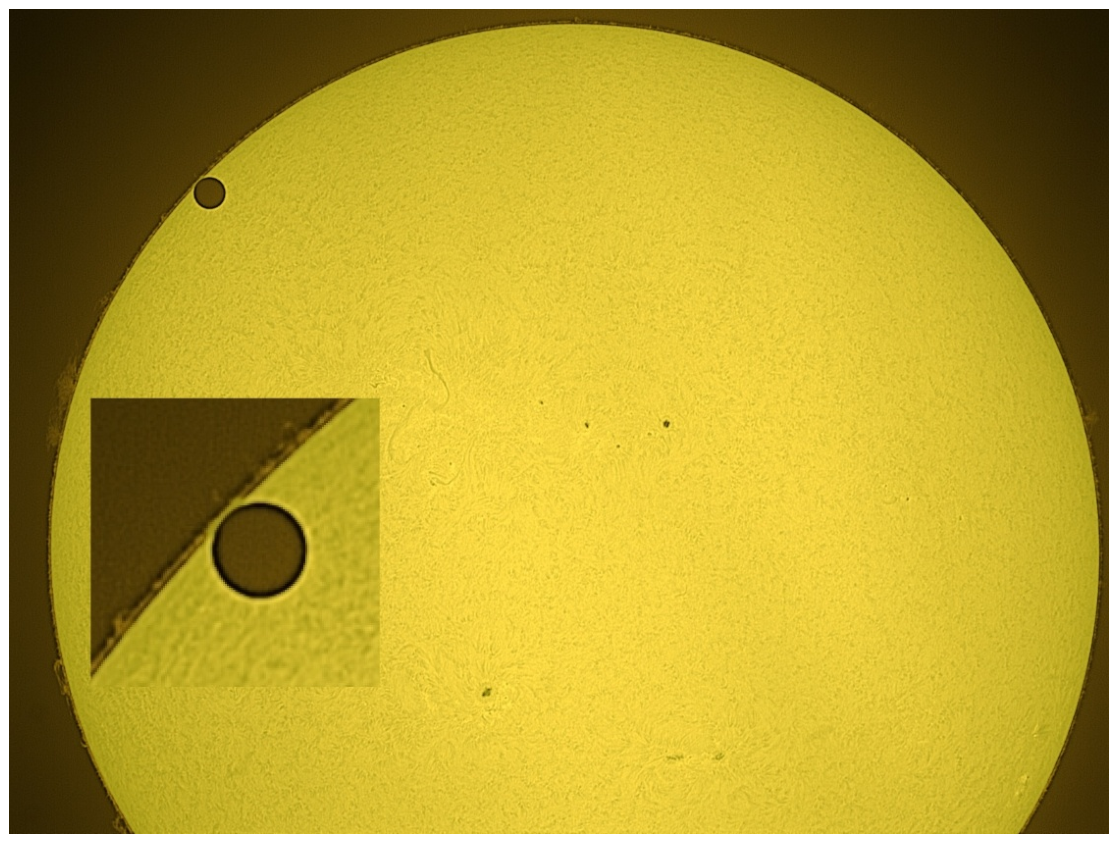
Figure 6.
The diameter of egressing Venus measured from this image 43-44 pixels FWHM corresponding to 57.8”, the scale is 1.3”/pixel; the intensity curve decays in 6 pixel or 7.8”. Histogram made with IRIS 5.59 (https://buil.astrosurf.com/iris-software.html, visited on 30 April 2026).
Figure 6.
The diameter of egressing Venus measured from this image 43-44 pixels FWHM corresponding to 57.8”, the scale is 1.3”/pixel; the intensity curve decays in 6 pixel or 7.8”. Histogram made with IRIS 5.59 (https://buil.astrosurf.com/iris-software.html, visited on 30 April 2026).
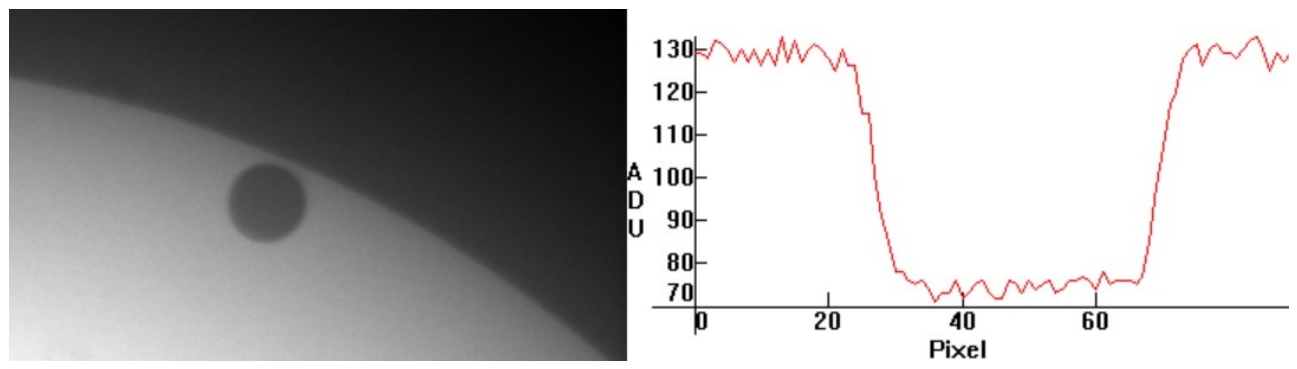
Figure 7.
Composite: Histograms of the radial intensity including the disk of Venus, at the internal contacts, in the images of C11 telescope. The disk is brighter than the atmospheric corona (glare) out of the solar limb in both cases.
Figure 7.
Composite: Histograms of the radial intensity including the disk of Venus, at the internal contacts, in the images of C11 telescope. The disk is brighter than the atmospheric corona (glare) out of the solar limb in both cases.
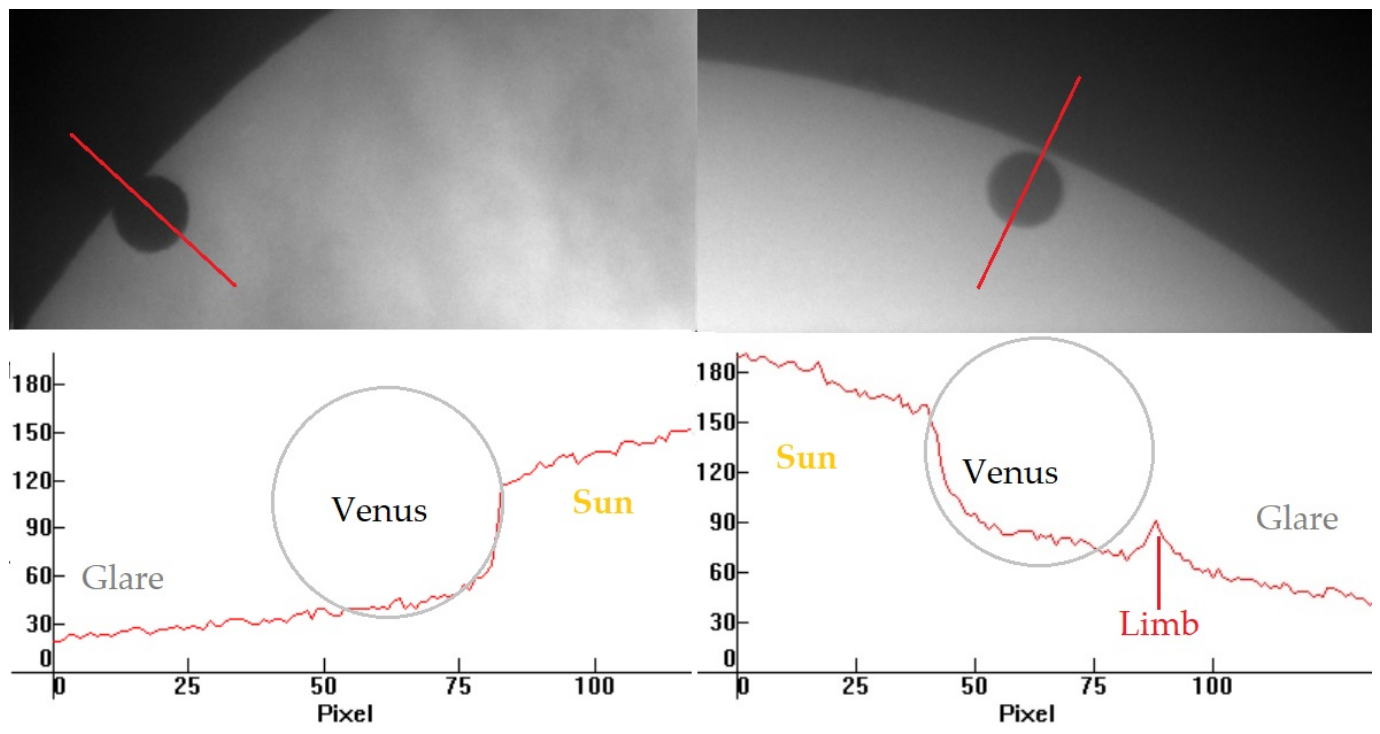
Figure 8.
The chords measured on the images of 2012 ingress and egress of Venus, HSOS C11 special telescope.
Figure 8.
The chords measured on the images of 2012 ingress and egress of Venus, HSOS C11 special telescope.
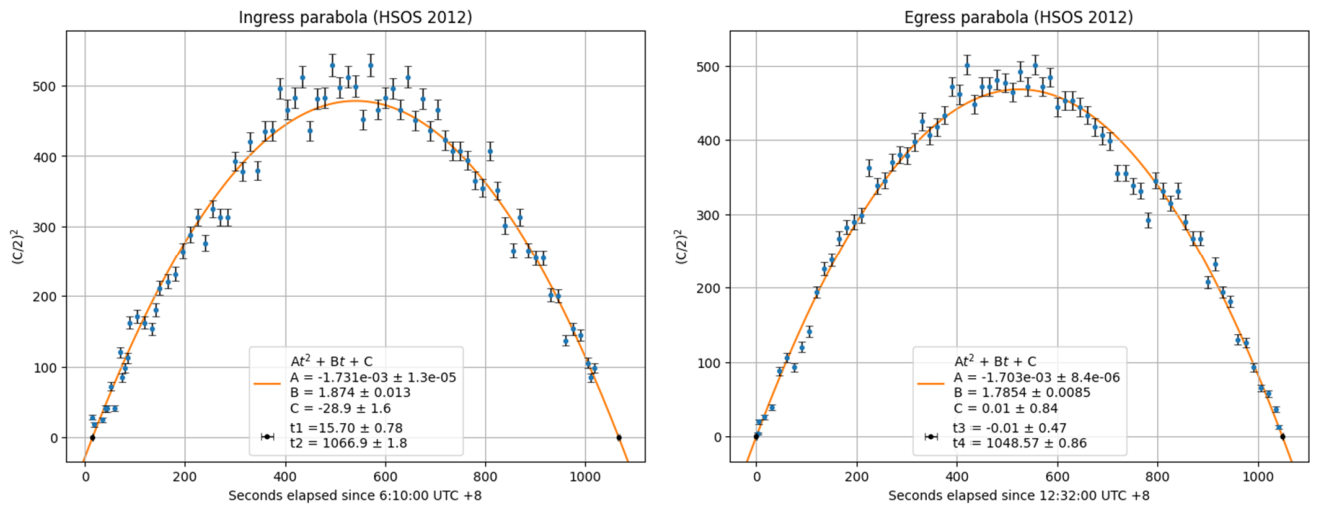
Figure 10.
Venus’ second and third (internal) contacts of 6 June 2012 at Huairou: left with SC11”, centre and right with the Multi-Channel Solar Telescope (MCST) at Fe I 5324.19 Ångstrom. The solar limb darkening smooth profile with Venus is shown in green.
Figure 10.
Venus’ second and third (internal) contacts of 6 June 2012 at Huairou: left with SC11”, centre and right with the Multi-Channel Solar Telescope (MCST) at Fe I 5324.19 Ångstrom. The solar limb darkening smooth profile with Venus is shown in green.
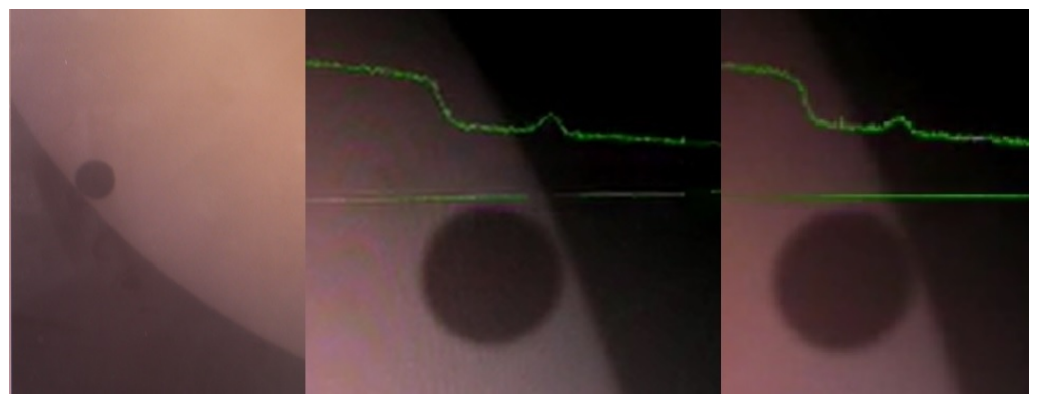
Figure 11.
C. Sigismondi measures the projected image on the 1702 Clementine Gnomon in Santa Maria degli Angeli in Rome (21 Nov 2025 left, 27 Nov 2025 right).
Figure 11.
C. Sigismondi measures the projected image on the 1702 Clementine Gnomon in Santa Maria degli Angeli in Rome (21 Nov 2025 left, 27 Nov 2025 right).
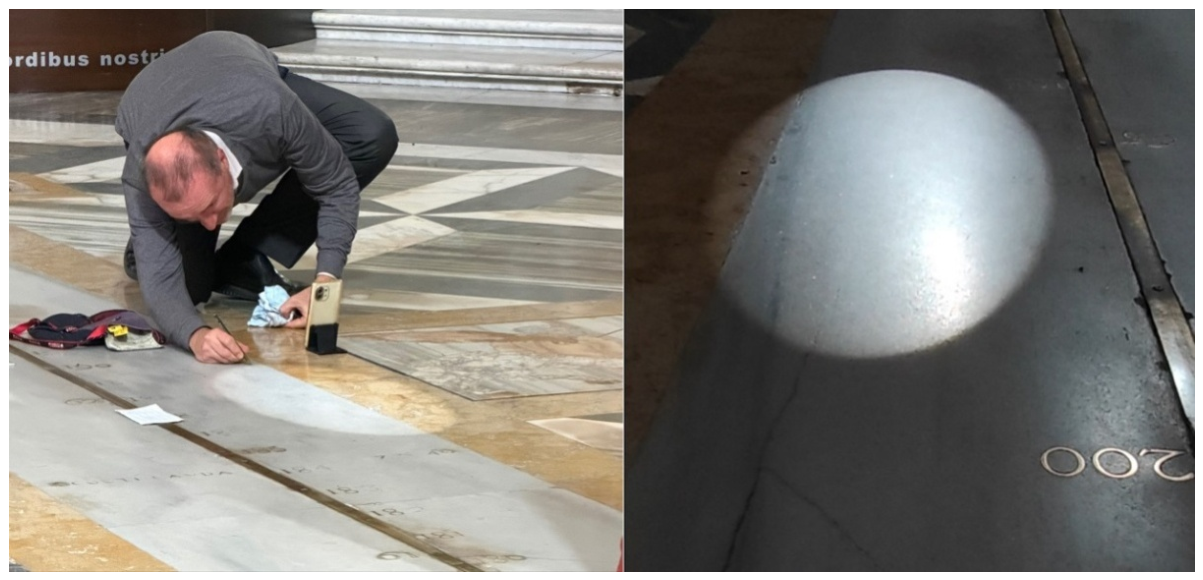
Figure 12.
The solar diameter’s discrepancies (normalized to 1AU) in arcseconds. The meteo conditions are represented with orange dots: 0: clear, 10 hazy; 20 clouds. In abscissa are the days from 1 November 2025 to all February 2026. St. Maria degli Angeli meridian line in Rome.
Figure 12.
The solar diameter’s discrepancies (normalized to 1AU) in arcseconds. The meteo conditions are represented with orange dots: 0: clear, 10 hazy; 20 clouds. In abscissa are the days from 1 November 2025 to all February 2026. St. Maria degli Angeli meridian line in Rome.
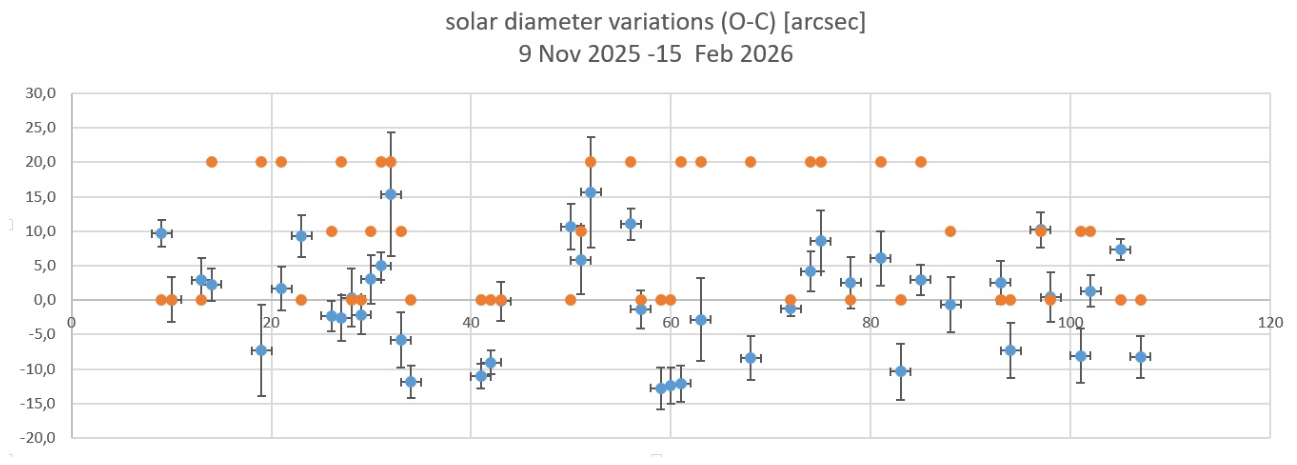
Figure 13.
The images obtained on 13 April 2026, with different clouds’ thickness. The measures of the solar diameter made in the same position on the focal plane did not differ by one single pixel. The horizontal diameter here is the celestial E-W, i. e. inclined 45°42’±6’ with respect to the horizon of Rome.
Figure 13.
The images obtained on 13 April 2026, with different clouds’ thickness. The measures of the solar diameter made in the same position on the focal plane did not differ by one single pixel. The horizontal diameter here is the celestial E-W, i. e. inclined 45°42’±6’ with respect to the horizon of Rome.
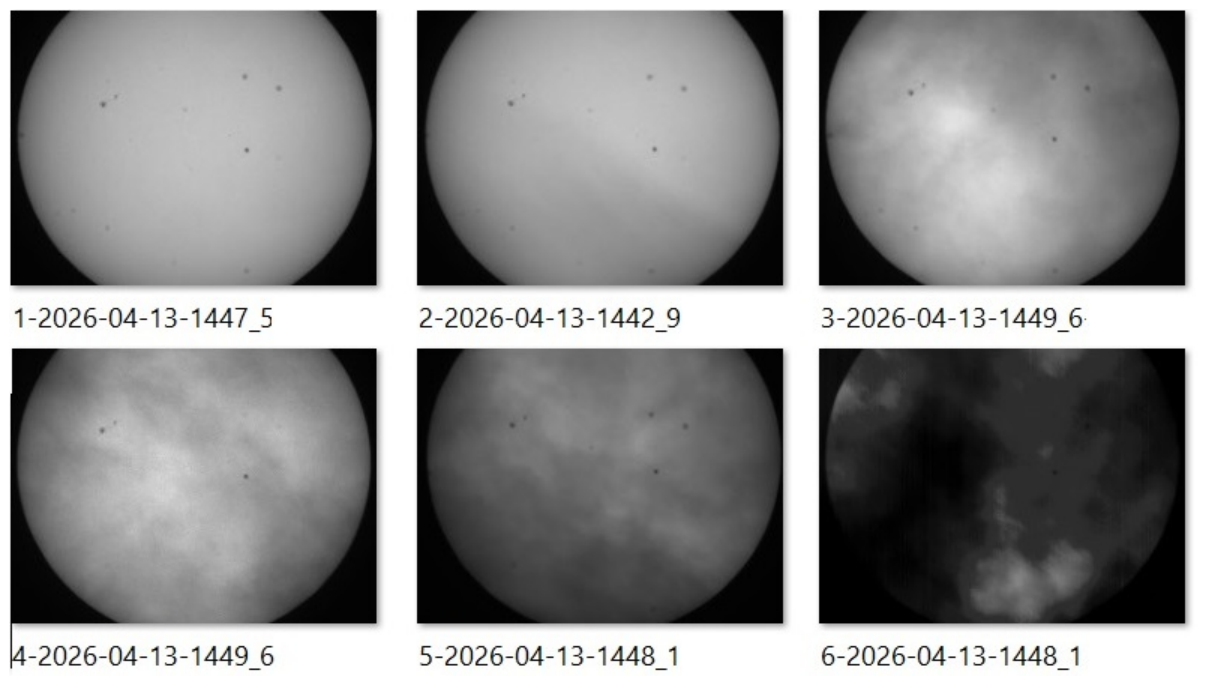
Table 3.
Ingress and egress of Venus at Shen Zen Astronomical Observatory on 6 June 2012, at the base of the spiculae.
Table 3.
Ingress and egress of Venus at Shen Zen Astronomical Observatory on 6 June 2012, at the base of the spiculae.
| Source | Ingress t1 | Ingress t2 | Egress t3 | Egress t4 | |
|---|---|---|---|---|---|
| Ephemerides XJ 1 | 6:11:52 | 6:29:36 | 12:31:23 | 12:48:46 | |
| SZAO-2012 2 | 6:11:47.8±4 | 6:29:35.9±2 | 12:31:23.1±2 | 12:48:49.4±3 | |
| O-C | -4.2 | -0.1 | +0.1 | +3.4 | |
| Solar diameter 3 | 959.94”±0.18” | 959.64”±0.16” | |||
| SZAO 2012_P 4 | 6:11:45.8±6.2 | 6:29:34.8±7.4 | 6:31:33.4±3.1 | 6:48:41.5±9.2 | |
| O-C | -6.2 | -1.2 | 10.4 | -4.5 | |
| Solar diameter 3 | 959.70”±0.34” | 960.14”±0.46” |
1 XJ stands for http://xjubier.free.fr/en/site_pages/VenusTransitCalculator.html (4 May 2026). These ephemerides are prepared for the visual band. Hα is expected to exceed the visual diameter. 2 Excel fits; 3 fits limited to 20 points after/before the contacts. 3 Calculated only from the external contacts. 4 fit with curve fit() of sciPy.optimize. 4 P stands for scyPy.optimize.
Table 4.
Ingress and egress of Venus at Huairou Solar Observing Station on 6 June 2012; data obtained at HSOS. The solutions for C(t)=0 are t=t1, 2, 3, 4, reported in the table.
Table 4.
Ingress and egress of Venus at Huairou Solar Observing Station on 6 June 2012; data obtained at HSOS. The solutions for C(t)=0 are t=t1, 2, 3, 4, reported in the table.
| Source | Ingress t1 | Ingress t2 | Egress t3 | Egress t4 |
|---|---|---|---|---|
| Ephemerides XJ 1 | 6:10:03.2 | 6:27:41.8 | 12:32:03.0 | 12:49:24.3 |
| HSOS-2012 2 | 6:10:21.4 | 6:27:40.6 | 12:32:01.0 | 12:49:23.0 |
| Solar diameter 9 | 959.39±0.08” | |||
| HSOS 2012_20 3 | 6:10:11.3 | 6:27:41.4 | 12:32:01.0 | 12:49:23.0 |
| Solar diameter 9 | 959.09±0.08” | |||
| HSOS 2012_P 4 | 6:10:15.7 | 6:27:46.9 | 12:32:00.0 | 12:49:28.6 |
| Solar diameter 9 | 959.27±0.08” | |||
| σ_P [s] 5 | 0.8 | 1.8 | 0.5 | 0.9 |
| O-C [s] 6 | 18.2 | -1.2 | -2.0 | -1.3 |
| O-C_20 [s] 7 | 8.1 | -0.4 | -2.0 | -1.3 |
| O-C_P [s] 8 | 12.5 | 5.1 | -3.0 | +4.3 |
1 XJ stands for http://xjubier.free.fr/en/site_pages/VenusTransitCalculator.html (13 april 2026) 2, 3 Excel fits; 3 fits limited to 20 points after/before the contacts. 4 fit with curve fit() of sciPy.optimize 5 σ calculated on excel fits 6 O-C stands for Observed- Calculated, for XJ ephemerides. 7 Values referred to the 20-points fits before/after the contacts. 8 P stands for scyPy.optimize. 9 Calculated only with the internal contacts.
Disclaimer/Publisher’s Note: The statements, opinions and data contained in all publications are solely those of the individual author(s) and contributor(s) and not of MDPI and/or the editor(s). MDPI and/or the editor(s) disclaim responsibility for any injury to people or property resulting from any ideas, methods, instructions or products referred to in the content. |
© 2026 by the authors. Licensee MDPI, Basel, Switzerland. This article is an open access article distributed under the terms and conditions of the Creative Commons Attribution (CC BY) license (http://creativecommons.org/licenses/by/4.0/).
Copyright: This open access article is published under a Creative Commons CC BY 4.0 license, which permit the free download, distribution, and reuse, provided that the author and preprint are cited in any reuse.


