

Submitted:
09 December 2025
Posted:
12 December 2025
You are already at the latest version
Abstract
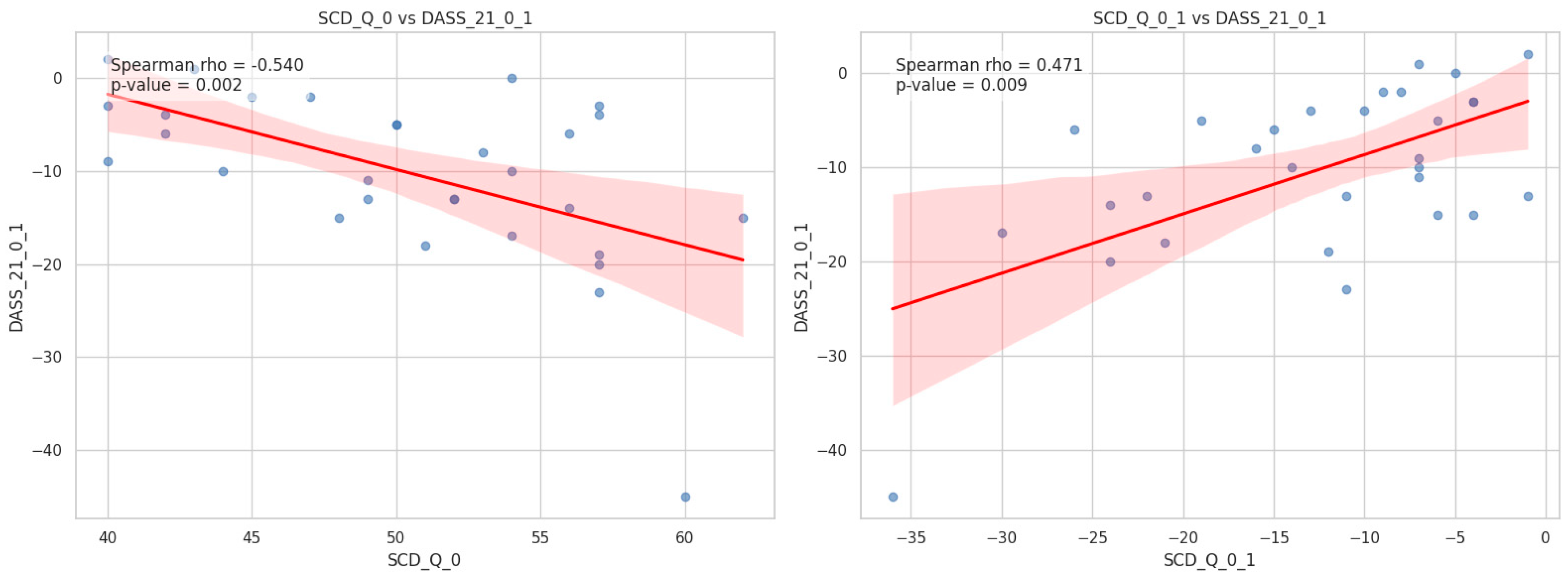
Background: Interventions targeting the gut–brain axis offer potential for mitigating Subjective Cognitive Decline (SCD), a critical window for Alzheimer’s prevention. This study evaluated the effects of a novel probiotic supplement, ExoBDNF, on cognitive function, sleep, and emotional distress in adults with SCD. Methods: In this 9-week open-label study, participants received ExoBDNF supplementation. Efficacy was assessed using the SCD-Questionnaire (SCD-Q), DASS-21, PSQI, MoCA, and a computerized cognitive battery measuring inhibition (Go/No-Go), flexibility (Task Switching), and working memory. Results: Post-intervention analyses revealed significant improvements in subjective cognition (SCD-Q, p < 0.001), sleep quality (PSQI, p < 0.001), and emotional distress (DASS-21, p < 0.001). Objective cognitive performance also improved, with significant gains in MoCA scores (p = 0.047) and executive function metrics. Spearman correlation analysis indicated a significant link between cognitive and emotional changes: longitudinal reductions in SCD scores correlated with concurrent reductions in emotional distress (rho = 0.471, p = 0.009). Furthermore, higher baseline SCD scores predicted greater improvement in emotional outcomes (rho = -0.540, p = 0.002). Conclusion: ExoBDNF supplementation significantly enhanced cognitive performance, sleep quality, and emotional well-being. The findings demonstrate that improvements in subjective cognition are closely tied to alleviated emotional distress, supporting the gut–brain axis as a viable therapeutic target for early-stage cognitive decline.
Keywords:
1. Introduction
2. Method
2.1. Participants
2.2. Inclusion Criteria
2.3. Exclusion Criteria
2.4. Study Procedures
2.5. Outcome Measurement
2.6. Statistics
3. Results

| Variables | Baseline (Mean ± SD) |
Week 9 (Mean ± SD) |
Paired t-test/ Wilcoxon signed-rank test |
P |
|---|---|---|---|---|
| Age | 40.97 ± 12.05 | |||
| Sex (Female): n (%) | 21 (70%) | |||
| Questionnaire | ||||
| SCD-Q | 50.6 ± 6.4 | 37.9 ± 8.4 | t = 7.8 | < 0.001 |
| TCQ | 7.7 ± 3.1 | 3.4 ± 2.3 | t = 7.3 | < 0.001 |
| PSQI | 8.5 ± 2.3 | 6.3 ± 2.9 | t = 4.0 | < 0.001 |
| DASS-21 | 22.0 ± 12.6 | 11.6 ± 9.0 | z = – 4.5 | < 0.001 |
| MoCA | 27.5 ± 2.0 | 28.3 ± 2.3 | z = – 2.0 | 0.047 |
| MMSE | 29.1 ± 1.2 | 29.2 ± 1.0 | z = – 0.6 | 0.542 |
| Cognitive Test Battery | ||||
| Go/No Go | ||||
| correction rate (%) | 95.0 ± 6.3 | 97.3 ± 6.0 | z = – 2.0 | 0.046 |
| reaction time (s) | 640.0 ± 97.1 | 627.5 ± 71.8 | z = 0.5 | 0.600 |
| Task-switching | ||||
| correction rate (%) | 95.7 ± 5.2 | 96.4 ± 8.3 | z = – 1.9 | 0.053 |
| reaction time (s) | 1063.0 ± 287.0 | 919.3 ± 215.7 | z = – 3.8 | < 0.001 |
| Working memory | ||||
| correction rate (%) | 50.8 ± 20.1 | 52.0 ± 20.8 | z = – 0.3 | 0.779 |
| reaction time (s) | 3827.0 ± 908.6 | 3542.5 ± 555.2 | z = – 2.1 | 0.039 |
3.1. Subjective Cognitive Outcomes
3.2. Psychological and Sleep Measures
3.3. Global Cognitive Function
3.4. Computerized Cognitive Test Battery
3.4.1. Go/No-Go (Attention and Inhibitory Control)
3.4.2. Task-Switching (Cognitive Flexibility)
3.4.3. Working Memory (Corsi Block-Tapping)
3.5. Correlation Between SCD-Q and DASS-21 Data
4. Discussion
5. Conclusions
Author Contributions
Funding
Institutional Review Board Statement
Informed Consent Statement
Data Availability Statement
Acknowledgments
Conflicts of Interest
Abbreviations
| SD | standard deviation |
| SCD-Q | Subjective Cognitive Decline Questionnaire |
| TCQ | Taiwan Cognition Questionnaire |
| PSQI | Pittsburgh Sleep Quality Index |
| DASS-21 | Depression Anxiety Stress Scales-21items |
| MoCA | Montreal Cognitive Assessment |
| MMSE | Mini-Mental State Examination |
References
- Klimova, B.; Valis, M.; Kuca, K. Cognitive decline in normal aging and its prevention: a review on non-pharmacological lifestyle strategies. Clin Interv Aging 2017, 12, 903–910. [Google Scholar] [CrossRef]
- Taylor, C.A.; Bouldin, E.D.; McGuire, L.C. Subjective Cognitive Decline Among Adults Aged ≥45 Years - United States, 2015-2016. MMWR Morb Mortal Wkly Rep 2018, 67, 753–757. [Google Scholar] [CrossRef]
- Tuigunov, D.; Sinyavskiy, Y.; Nurgozhin, T.; Zholdassova, Z.; Smagul, G.; Omarov, Y.; Dolmatova, O.; Yeshmanova, A.; Omarova, I. Precision Nutrition and Gut-Brain Axis Modulation in the Prevention of Neurodegenerative Diseases. Nutrients 2025, 17. [Google Scholar] [CrossRef]
- Khan, M.T.; Zohair, M.; Khan, A.; Kashif, A.; Mumtaz, S.; Muskan, F. From Gut to Brain: The roles of intestinal microbiota, immune system, and hormones in intestinal physiology and gut-brain-axis. Mol Cell Endocrinol 2025, 607, 112599. [Google Scholar] [CrossRef]
- Kim, C.S. Roles of Diet-Associated Gut Microbial Metabolites on Brain Health: Cell-to-Cell Interactions between Gut Bacteria and the Central Nervous System. Adv Nutr 2024, 15, 100136. [Google Scholar] [CrossRef]
- Doroszkiewicz, J.; Groblewska, M.; Mroczko, B. The Role of Gut Microbiota and Gut-Brain Interplay in Selected Diseases of the Central Nervous System. Int J Mol Sci 2021, 22. [Google Scholar] [CrossRef]
- Barber, T.M.; Valsamakis, G.; Mastorakos, G.; Hanson, P.; Kyrou, I.; Randeva, H.S.; Weickert, M.O. Dietary Influences on the Microbiota-Gut-Brain Axis. Int J Mol Sci 2021, 22. [Google Scholar] [CrossRef]
- Castells-Nobau, A.; Mayneris-Perxachs, J.; Fernández-Real, J.M. Unlocking the mind-gut connection: Impact of human microbiome on cognition. Cell Host Microbe 2024, 32, 1248–1263. [Google Scholar] [CrossRef] [PubMed]
- Kezer, G.; Paramithiotis, S.; Khwaldia, K.; Harahap, I.A.; Čagalj, M.; Šimat, V.; Smaoui, S.; Elfalleh, W.; Ozogul, F.; Esatbeyoglu, T. A comprehensive overview of the effects of probiotics, prebiotics and synbiotics on the gut-brain axis. Front Microbiol 2025, 16, 1651965. [Google Scholar] [CrossRef] [PubMed]
- Barrio, C.; Arias-Sánchez, S.; Martín-Monzón, I. The gut microbiota-brain axis, psychobiotics and its influence on brain and behaviour: A systematic review. Psychoneuroendocrinology 2022, 137, 105640. [Google Scholar] [CrossRef] [PubMed]
- Hwang, Y.K.; Oh, J.S. Interaction of the Vagus Nerve and Serotonin in the Gut-Brain Axis. Int J Mol Sci 2025, 26. [Google Scholar] [CrossRef]
- Dicks, L.M.T. Gut Bacteria and Neurotransmitters. Microorganisms 2022, 10. [Google Scholar] [CrossRef]
- Xu, J.; Lu, Y. The microbiota-gut-brain axis and central nervous system diseases: from mechanisms of pathogenesis to therapeutic strategies. Front Microbiol 2025, 16, 1583562. [Google Scholar] [CrossRef]
- Lai, Y.; Dhingra, R.; Zhang, Z.; Ball, L.M.; Zylka, M.J.; Lu, K. Toward Elucidating the Human Gut Microbiota-Brain Axis: Molecules, Biochemistry, and Implications for Health and Diseases. Biochemistry 2022, 61, 2806–2821. [Google Scholar] [CrossRef]
- Kasarello, K.; Cudnoch-Jedrzejewska, A.; Czarzasta, K. Communication of gut microbiota and brain via immune and neuroendocrine signaling. Front Microbiol 2023, 14, 1118529. [Google Scholar] [CrossRef]
- Aijaz, M.; Ahmad, M.; Ahmad, S.; Afzal, M.; Kothiyal, P. The gut-brain axis: role of gut microbiota in neurological disease pathogenesis and pharmacotherapeutics. Naunyn Schmiedebergs Arch Pharmacol 2025. [Google Scholar] [CrossRef] [PubMed]
- Wang, Y.; Hu, L.; Gao, B.; Yang, R.; Huang, Y.; Li, P.; Shang, N. Lactococcus lactis-derived extracellular vesicles: A novel nanodelivery system enhance the properties of nisin Z. Food Chem 2025, 489, 144776. [Google Scholar] [CrossRef]
- Park, S.; Mok, J.; Yu, H.M.; An, H.J.; Choi, G.H.; Lee, Y.S.; Kwon, K.J.; Choi, S.J.; Kim, K.H.; Kim, S.J.; et al. Comparative and pharmacological investigation of bEVs from eight Lactobacillales strains. Sci Rep 2025, 15, 27263. [Google Scholar] [CrossRef]
- Lee, Y.R.; Park, K.M.; Lee, N.K.; Paik, H.D. Neuroprotective effects of Lactiplantibacillus plantarum and Pediococcus pentosaceus strains against oxidative stress via modulation of Nrf2-mediated antioxidation and anti-apoptosis. Brain Res 2025, 1866, 149925. [Google Scholar] [CrossRef] [PubMed]
- Nair, A.B.; Jacob, S. A simple practice guide for dose conversion between animals and human. J Basic Clin Pharm 2016, 7, 27–31. [Google Scholar] [CrossRef] [PubMed]
- Tsai, C.L.; Chou, K.H.; Lee, P.L.; Liang, C.S.; Kuo, C.Y.; Lin, G.Y.; Lin, Y.K.; Hsu, Y.C.; Ko, C.A.; Yang, F.C.; et al. Shared alterations in hippocampal structural covariance in subjective cognitive decline and migraine. Front Aging Neurosci 2023, 15, 1191991. [Google Scholar] [CrossRef]
- Rami, L.; Mollica, M.A.; García-Sanchez, C.; Saldaña, J.; Sanchez, B.; Sala, I.; Valls-Pedret, C.; Castellví, M.; Olives, J.; Molinuevo, J.L. The Subjective Cognitive Decline Questionnaire (SCD-Q): a validation study. J Alzheimers Dis 2014, 41, 453–466. [Google Scholar] [CrossRef]
- Moret-Tatay, C.; Zharova, I.; Iborra-Marmolejo, I.; Bernabé-Valero, G.; Jorques-Infante, M.J.; Beneyto-Arrojo, M.J. Psychometric Properties of the Subjective Cognitive Decline Questionnaire (SCD-Q) and Its Invariance across Age Groups. Int J Environ Res Public Health 2023, 20. [Google Scholar] [CrossRef] [PubMed]
- Adolphe, M.; Sawayama, M.; Maurel, D.; Delmas, A.; Oudeyer, P.-Y.; Sauzéon, H. An Open-Source Cognitive Test Battery to Assess Human Attention and Memory. Frontiers in Psychology 2022, 13–2022. [Google Scholar] [CrossRef]
- Crum, R.M.; Anthony, J.C.; Bassett, S.S.; Folstein, M.F. Population-based norms for the Mini-Mental State Examination by age and educational level. Jama 1993, 269, 2386–2391. [Google Scholar] [CrossRef] [PubMed]
- Freitas, S.; Simões, M.R.; Alves, L.; Santana, I. Montreal cognitive assessment: validation study for mild cognitive impairment and Alzheimer disease. Alzheimer Dis Assoc Disord 2013, 27, 37–43. [Google Scholar] [CrossRef] [PubMed]
- Pinto, T.C.C.; Machado, L.; Bulgacov, T.M.; Rodrigues-Júnior, A.L.; Costa, M.L.G.; Ximenes, R.C.C.; Sougey, E.B. Is the Montreal Cognitive Assessment (MoCA) screening superior to the Mini-Mental State Examination (MMSE) in the detection of mild cognitive impairment (MCI) and Alzheimer's Disease (AD) in the elderly? Int Psychogeriatr 2019, 31, 491–504. [Google Scholar] [CrossRef]
- Lacy, M.; Kaemmerer, T.; Czipri, S. Standardized mini-mental state examination scores and verbal memory performance at a memory center: implications for cognitive screening. Am J Alzheimers Dis Other Demen 2015, 30, 145–152. [Google Scholar] [CrossRef]
- Yen, Y.-C.; Chiu, N.-Y.; Hwang, T.-J.; Su, T.-P.; Yang, Y.-K.; Chen, C.-S.; Li, C.-T.; Su, K.-P.; Lai, T.-J.; Chang, C.-M. A Multi-Center Study for the Development of the Taiwan Cognition Questionnaire (TCQ) in Major Depressive Disorder. Journal of Personalized Medicine 2022, Vol. 12, 359. [Google Scholar] [CrossRef]
- Henry, J.D.; Crawford, J.R. The short-form version of the Depression Anxiety Stress Scales (DASS-21): construct validity and normative data in a large non-clinical sample. Br J Clin Psychol 2005, 44, 227–239. [Google Scholar] [CrossRef]
- Mollayeva, T.; Thurairajah, P.; Burton, K.; Mollayeva, S.; Shapiro, C.M.; Colantonio, A. The Pittsburgh sleep quality index as a screening tool for sleep dysfunction in clinical and non-clinical samples: A systematic review and meta-analysis. Sleep Med Rev 2016, 25, 52–73. [Google Scholar] [CrossRef]
- Lee, M.T.; Chang, W.Y.; Jang, Y. Psychometric and diagnostic properties of the Taiwan version of the Quick Mild Cognitive Impairment screen. PLoS One 2018, 13, e0207851. [Google Scholar] [CrossRef]
- Adu, P.; Popoola, T.; Iqbal, N.; Medvedev, O.N.; Simpson, C.R. Validating the depression anxiety stress scales (DASS-21) across Germany, Ghana, India, and New Zealand using Rasch methodology. J Affect Disord 2025, 383, 363–373. [Google Scholar] [CrossRef]
- Kim, R.H.; Paulino, Y.C.; Kawabata, Y. Validating Constructs of the Depression, Anxiety, and Stress Scale-21 and Exploring Health Indicators to Predict the Psychological Outcomes of Students Enrolled in the Pacific Islands Cohort of College Students. Int J Environ Res Public Health 2024, 21. [Google Scholar] [CrossRef] [PubMed]
- Hinz, A.; Glaesmer, H.; Brähler, E.; Löffler, M.; Engel, C.; Enzenbach, C.; Hegerl, U.; Sander, C. Sleep quality in the general population: psychometric properties of the Pittsburgh Sleep Quality Index, derived from a German community sample of 9284 people. Sleep Med 2017, 30, 57–63. [Google Scholar] [CrossRef] [PubMed]
- Tsai, P.S.; Wang, S.Y.; Wang, M.Y.; Su, C.T.; Yang, T.T.; Huang, C.J.; Fang, S.C. Psychometric evaluation of the Chinese version of the Pittsburgh Sleep Quality Index (CPSQI) in primary insomnia and control subjects. Qual Life Res 2005, 14, 1943–1952. [Google Scholar] [CrossRef]
- Dzierzewski, J.M.; Perez, E.; Ravyts, S.G.; Dautovich, N. Sleep and Cognition: A Narrative Review Focused on Older Adults. Sleep Med Clin 2022, 17, 205–222. [Google Scholar] [CrossRef]
- Price, R.B.; Duman, R. Neuroplasticity in cognitive and psychological mechanisms of depression: an integrative model. Mol Psychiatry 2020, 25, 530–543. [Google Scholar] [CrossRef]
- Liu, N.; Yang, D.; Sun, J.; Li, Y. Probiotic supplements are effective in people with cognitive impairment: a meta-analysis of randomized controlled trials. Nutr Rev 2023, 81, 1091–1104. [Google Scholar] [CrossRef] [PubMed]
- Guo, H.; Liang, Y.; Qin, X.; Luo, Q.; Gong, X.; Gao, Q. Effects of probiotics on cognitive function across the human lifespan: a meta-analysis. Eur J Clin Nutr 2025. [Google Scholar] [CrossRef]
- Hsu, Y.C.; Huang, Y.Y.; Tsai, S.Y.; Kuo, Y.W.; Lin, J.H.; Ho, H.H.; Chen, J.F.; Hsia, K.C.; Sun, Y. Efficacy of Probiotic Supplements on Brain-Derived Neurotrophic Factor, Inflammatory Biomarkers, Oxidative Stress and Cognitive Function in Patients with Alzheimer's Dementia: A 12-Week Randomized, Double-Blind Active-Controlled Study. Nutrients 2023, 16. [Google Scholar] [CrossRef] [PubMed]
- Eastwood, J.; Walton, G.; Van Hemert, S.; Williams, C.; Lamport, D. The effect of probiotics on cognitive function across the human lifespan: A systematic review. Neurosci Biobehav Rev 2021, 128, 311–327. [Google Scholar] [CrossRef]
- Fekete, M.; Lehoczki, A.; Major, D.; Fazekas-Pongor, V.; Csípő, T.; Tarantini, S.; Csizmadia, Z.; Varga, J.T. Exploring the Influence of Gut-Brain Axis Modulation on Cognitive Health: A Comprehensive Review of Prebiotics, Probiotics, and Symbiotics. Nutrients 2024, 16. [Google Scholar] [CrossRef]
- Yeh, T.-C.; Huang, C.C.; Chung, Y.-A.; Park, S.Y.; Im, J.J.; Lin, Y.-Y.; Ma, C.-C.; Tzeng, N.-S.; Chang, H.-A. Resting-State EEG Connectivity at High-Frequency Bands and Attentional Performance Dysfunction in Stabilized Schizophrenia Patients. Medicina 2023, Vol. 59, 737. [Google Scholar] [CrossRef]
- Hung, C.-C.; Lin, K.-H.; Chang, H.-A. Exploring Cognitive Deficits and Neuromodulation in Schizophrenia: A Narrative Review. Medicina 2024, Vol. 60, 2060. [Google Scholar] [CrossRef] [PubMed]
- Doron, S.; Snydman, D.R. Risk and safety of probiotics. Clin Infect Dis 2015, 60 Suppl 2, S129–134. [Google Scholar] [CrossRef]
- Liu, X.; Ning, L.; Fan, W.; Jia, C.; Ge, L. Probiotics and Cognitive-Related Health Outcomes: An Umbrella Review of Systematic Reviews and Meta-Analyses of Randomized Controlled Trials. Nutr Rev 2025, 83, 2144–2158. [Google Scholar] [CrossRef] [PubMed]
Disclaimer/Publisher’s Note: The statements, opinions and data contained in all publications are solely those of the individual author(s) and contributor(s) and not of MDPI and/or the editor(s). MDPI and/or the editor(s) disclaim responsibility for any injury to people or property resulting from any ideas, methods, instructions or products referred to in the content. |
© 2025 by the authors. Licensee MDPI, Basel, Switzerland. This article is an open access article distributed under the terms and conditions of the Creative Commons Attribution (CC BY) license (http://creativecommons.org/licenses/by/4.0/).