

Submitted:
09 December 2025
Posted:
11 December 2025
You are already at the latest version
Abstract
Background: The search for meaning (Logos) is widely recognized as a primary determinant of resilience. However, current psychological models often fail to account for the metabolic cost of maintaining coherent narratives in high-entropy environments. Objective: This article introduces the Neuro-Existential Architecture System (NEAS), a unified framework synthesizing Viktor Frankl’s Logotherapy with the Free Energy Principle and Spatiotemporal Neuroscience. We aim to demonstrate how the "Spiritual Self-Pattern" functions not as a metaphysical add-on, but as a thermodynamic necessity for optimizing the brain's predictive dynamics. Methods: Integrating the Resonance-Inference Model (RIM) with theories of Affective Criticality (Tucker & Luu) and Population Clocks (Buonomano), we distinguish between two hierarchical modes of regulation: a semantic Master Prior (Logos) that operates via belief updating, and a structural Master Prior (Spirit) that operates via precision control. We operationalize the spiritual dimension using Michael von Brück’s definition: "consciousness becoming aware of itself."(Brück, personal communication). Results: We identify that while Logos provides the vector of resilience (direction), it remains metabolically expensive and falsifiable. The structural integration of Spirit (awareness of awareness) shifts the system into a state of "Affective Criticality," optimizing information processing and minimizing allostatic load. This integration prevents pathological states defined as "Frozen Priors" (fanaticism) or "Decoupled Narratives" (depression). Conclusions: Meaning is a bio-energetic imperative. The NEAS provides a mechanistic grammar for understanding spiritual practices as "technologies of enactment" that train the brain to maintain viability at the edge of chaos.
Keywords:
1. Public Significance Statement
2. Introduction: The Crisis of Capacity and the Architecture of Resilience
3. Beyond Narrative: The Missing "Glue" in Self-Theories
3.1. The Goal: Introducing the Neuro-Existential Architecture System (NEAS)
- Hierarchical Predictive Processing (Friston, 2010): Providing the computational grammar of how the brain minimizes free energy (entropy).
- Spatiotemporal Neuroscience (Northoff, 2016): Explaining how the brain’s intrinsic timescales construct the feeling of continuity.
- The Resonance-Inference Model (RIM): A recently proposed framework that integrates affective dynamics with active inference (Leidig, 2025).
3.2. Theoretical Foundation: The Physics of Existence
3.3. The Free Energy Principle: From Representation to Enactment
3.3. The Semantic Master Prior: Frankl’s Logos
- Model A (Nihilism): "This suffering is random and meaningless." High immediate likelihood (matches the chaos), but low prior probability (violates the drive for coherence). Result: Passivity and Entropy.
- Model B (Logos): "This suffering is a test/task." Lower immediate likelihood (requires interpretation), but extremely high prior value (preserves agency). Result: Action and Negentropy. The "Will to Meaning" is the neuro-computational bias that forces the selection of Model B. By choosing the model that preserves agency, the organism minimizes long-term expected free energy (Risk), even if short-term surprise remains high.
3.4. The Metabolic Bottleneck: The Cost of Semantic Control
- The Conflict: The system burns energy to maintain the model while the world screams the opposite.
- The Consequence: If this conflict persists, the "metabolic bottleneck" is reached. The system depletes its glycogen reserves (astrocyte-neuron lactate shuttle). The result is either Rigidity (the system locks the prior, becoming dogmatic to block out reality) or Collapse (the prior shatters, leading to depression or nihilism).
4. The Neuro-Existential Architecture System (NEAS): From Narrative Content to Structural Capacity
4.1. Level 1: The Narrative Self – Explicit Sense-Making
4.2. Level 2: The Spiritual Self-Pattern – Implicit Sense-Sensing
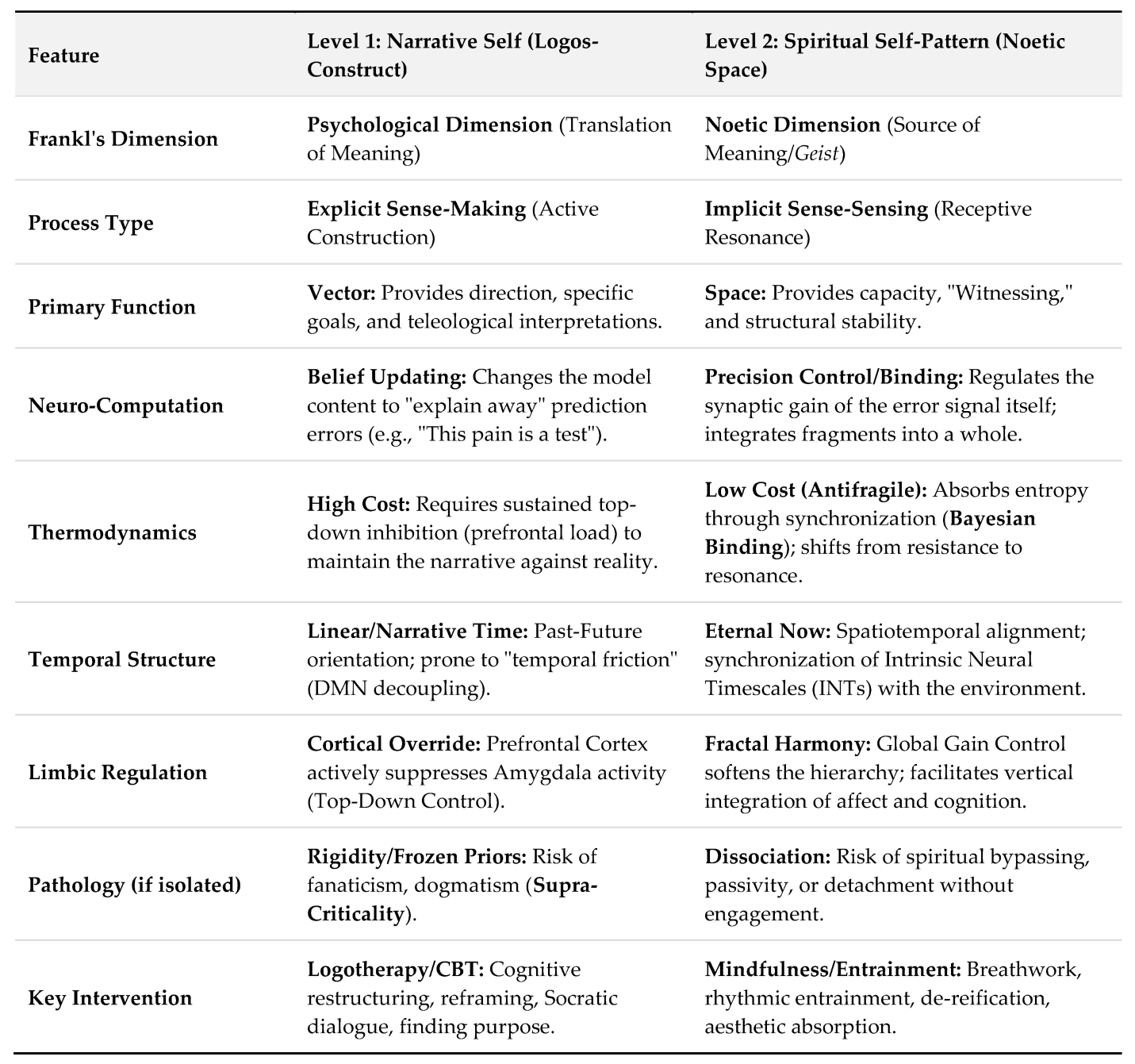
- Level 1 (Logos-Construct) is optimized for Action: it burns energy to impose order on the world (High Cost/High Precision).
- Level 2 (Noetic Space) is optimized for Reception: it saves energy by aligning with the world (Low Cost/Antifragile).
- The transition from pathology to health is defined as the successful nesting of the expensive Action-mode within the efficient Reception-mode.
4.3. Hierarchical Integration: Embedding Vector Within Space
- Dissociated Spirituality: If the system cultivates the Spiritual Self-Pattern (Space) without Logos (Vector), it risks drifting into passive detachment or "Spiritual Bypassing." The organism has capacity but no direction; it is calm but ineffective in the world.
- Rigid Fanaticism (Frozen Priors): Conversely, if the system relies solely on Logos (Vector) without the buffering capacity of Spirit, it becomes rigid. In the language of Active Inference, this corresponds to a "Frozen Prior"—a model with pathologically high precision that refuses to update despite contradictory evidence. The organism has direction but no capacity to absorb the shocks of reality; it breaks under pressure.
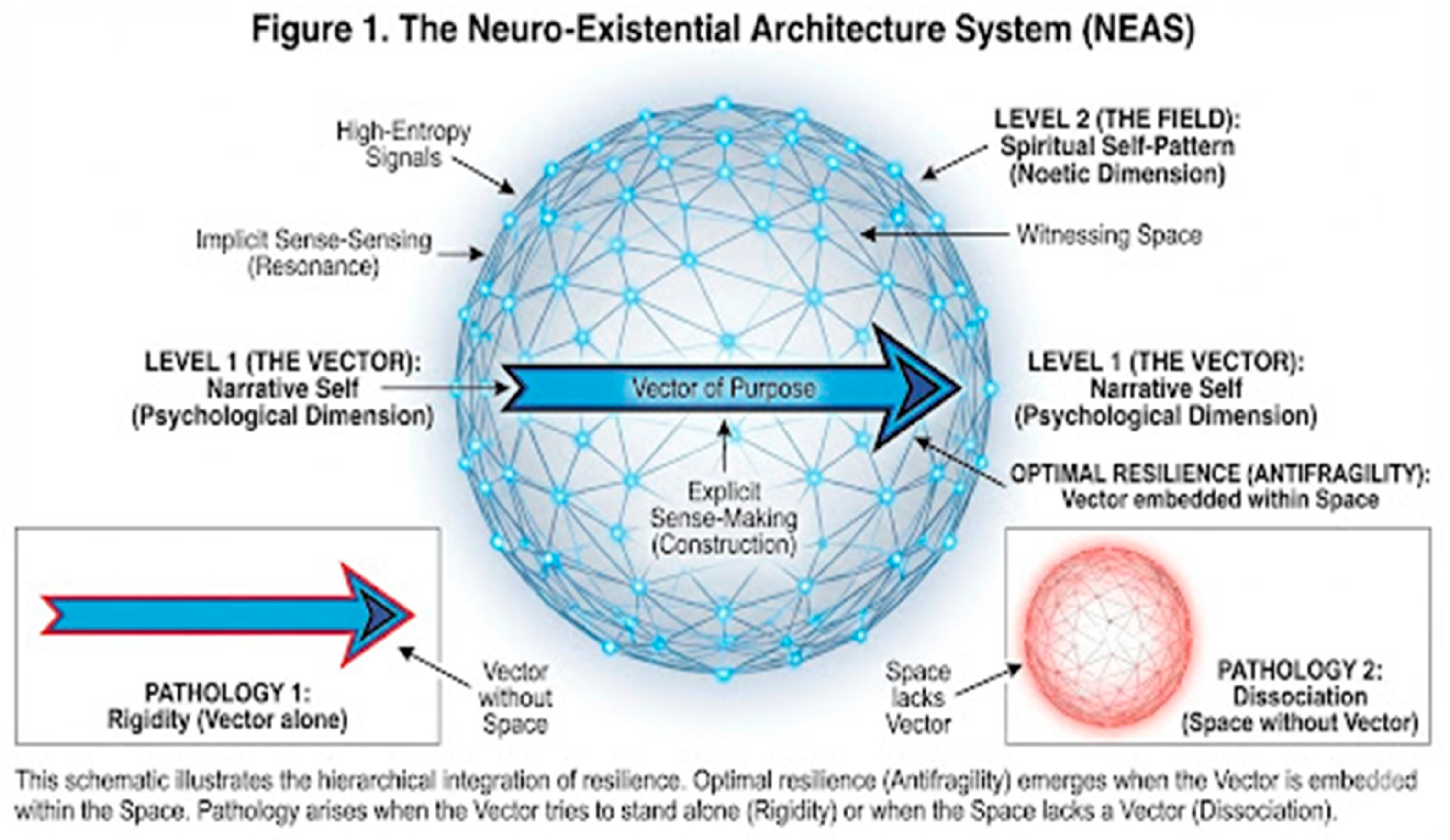
- Level 2 (The Field): The outer, spherical mesh represents the Spiritual Self-Pattern (Noetic Dimension). It functions as a high-capacity "Witnessing Space" that absorbs high-entropy signals via Implicit Sense-Sensing (Resonance).
- Level 1 (The Vector): The inner, directed arrow represents the Narrative Self (Psychological Dimension). It functions as a semantic "Vector of Purpose" that organizes action via Explicit Sense-Making (Construction).
- Integration: Optimal resilience (Antifragility) emerges when the Vector is embedded within the Space. Pathology arises when the Vector tries to stand alone (Rigidity) or when the Space lacks a Vector (Dissociation).
4.4. Neurodynamic Mechanisms: Enacting the Deep Self
4.5. Chrono-Architecture: From Neural Trajectories to the Eternal Now
4.6. Fractal Affect Logic: The Bioenergetics of Trust
4.7. Affective Criticality: The Dual-Limbic Geometry of Consciousness
The Architecture of Duality: Papez vs. Yakovlev
5. Clinical Implications: Technologies of Enactment
5.1. From Coping to Transformation: The Physics of Change
5.2. De-Reification: Bayesian Binding in Action
5.3. Thalamocortical Entrainment: The Rhythm of Stability
5.4. Distinction from ACT: Integration vs. Dissociation
6. Conclusion from Survival to Flourishing–The Integrated Architecture
6.1. The Synthesis: Logos as Vector, Spirit as Space
- Logos asks: "What is the meaning of this suffering?" (Interpretation)
- Spirit asks: "How can I hold this suffering without breaking?" (Capacity)
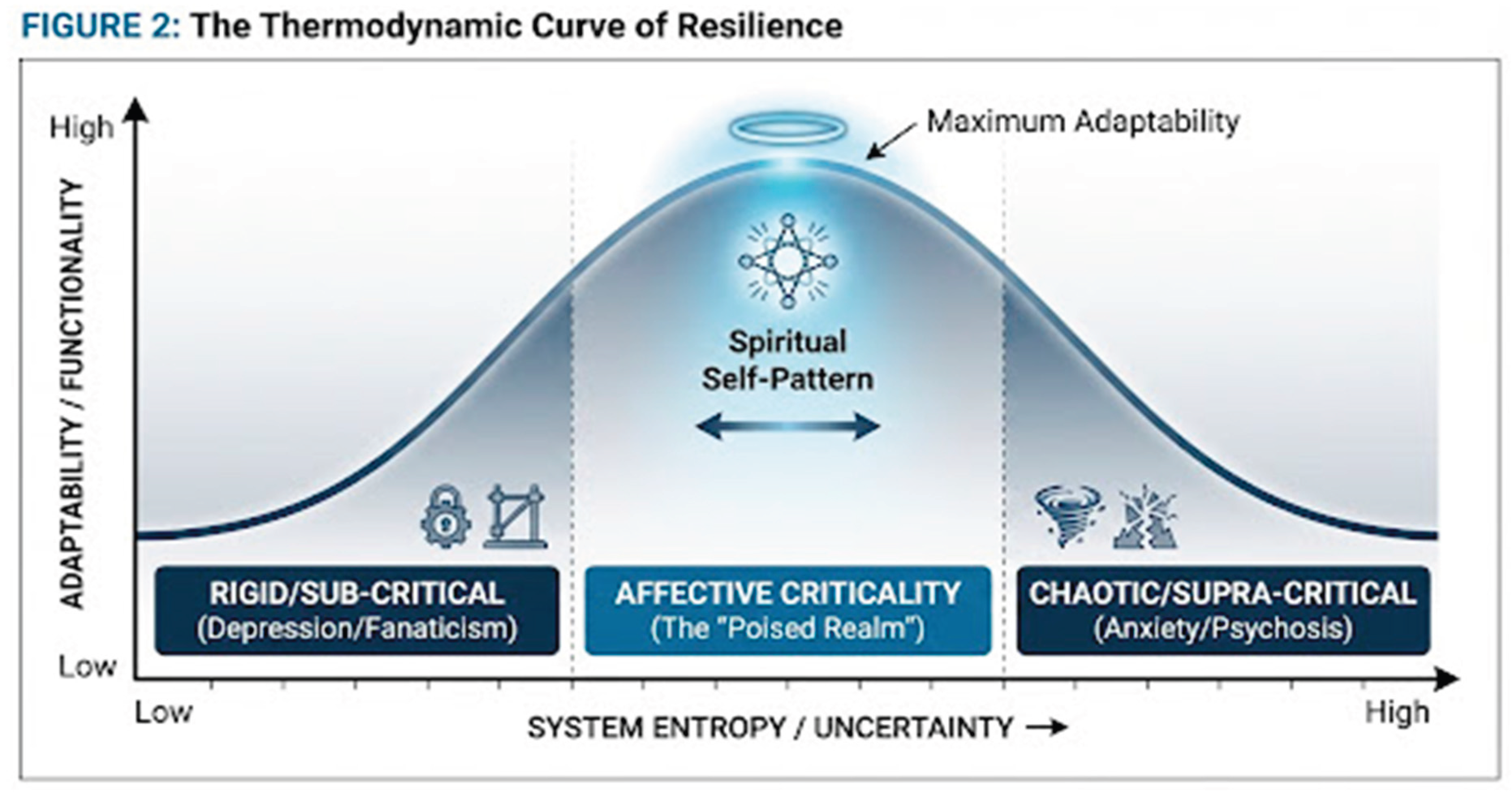
- By integrating these two, NEAS offers a model where the direction of meaning is sustained by the energy of resonance. Following Tucker, Luu, and Friston (2025), we identify this integrated state as Affective Criticality: the delicate poise where the Excitatory "Thrust" of Logos (Papez Circuit) is perfectly balanced by the Inhibitory "Friction" of Reality (Yakovlev Circuit).
6.2. Limitations and Future Directions
- Metabolic Efficiency: Does the activation of the "Spiritual Self-Pattern" (via aesthetic induction) lower glucose uptake in the dlPFC during cognitive reappraisal tasks?
- Criticality Signatures: Does the "Deep Self" state correlate with neural avalanche distributions following a power law (1/f scaling), as predicted by the criticality hypothesis?
- E-I Balance: Can we observe a simultaneous activation of REM-like (excitatory) and NREM-like (inhibitory) neural signatures during states of spiritual absorption, confirming the "Dual-Limbic" model of consciousness?
6.3. A New Grammar for Psychotherapy
6.4. AI Use Declaration
References
- Attwell, D.; Laughlin, S.B. An energy budget for signaling in the grey matter of the brain. Journal of Cerebral Blood Flow & Metabolism 2001, 21(10), 1133–1145. [Google Scholar] [CrossRef] [PubMed]
- Bastos, A.M.; Usrey, W.M.; Adams, R.A.; Mangun, G.R.; Fries, P.; Friston, K.J. Canonical microcircuits for predictive coding. Neuron 2012, 76(4), 695–711. [Google Scholar] [CrossRef] [PubMed]
- Beck, A.T. Cognitive therapy and the emotional disorders; International Universities Press, 1976. [Google Scholar]
- Beggs, J.M.; Plenz, D. Neuronal avalanches in neocortical circuits. Journal of Neuroscience 2003, 23(35), 11167–11177. [Google Scholar] [CrossRef] [PubMed]
- Beni, M.D. Structuring the self: The pattern theory of self and the predictive processing framework. Consciousness and Cognition 2019, 74, 102787. [Google Scholar]
- Blanke, O.; Metzinger, T. Full-body illusions and minimal phenomenal selfhood. Trends in Cognitive Sciences 2009, 13(1), 7–13. [Google Scholar] [CrossRef]
- Bruineberg, J.; Kiverstein, J.; Rietveld, E. The anticipating brain is not a scientist: The free-energy principle from an ecological-enactive perspective. Synthese 2018, 195(6), 2417–2444. [Google Scholar] [CrossRef]
- Buonomano, D.V. Your brain is a time machine: The neuroscience and physics of time; W. W. Norton & Company, 2017. [Google Scholar]
- Buonomano, D.V.; Maass, W. State-dependent computations: Spatiotemporal processing in cortical networks. Nature Reviews Neuroscience 2009, 10(2), 113–125. [Google Scholar] [CrossRef]
- Ciompi, L. Die emotionalen Grundlagen des Denkens: Entwurf einer fraktalen Affektlogik; Vandenhoeck & Ruprecht, 2016. [Google Scholar] [CrossRef]
- Farb, N.A.; Segal, Z.V.; Mayberg, H.; Bean, J.; McKeon, D.; Fatima, Z.; Anderson, A.K. Attending to the present: Mindfulness meditation reveals distinct neural modes of self-reference. Social Cognitive and Affective Neuroscience 2007, 2(4), 313–322. [Google Scholar] [CrossRef]
- Feldman, H.; Friston, K.J. Attention, uncertainty, and free-energy. Frontiers in Human Neuroscience 2010, 4, 215. [Google Scholar] [CrossRef]
- Frankl, V.E. Man’s search for meaning; (Original work published 1946); Beacon Press, 2006. [Google Scholar]
- Friston, K. The free-energy principle: A unified brain theory? Nature Reviews Neuroscience 2010, 11(2), 127–138. [Google Scholar] [CrossRef]
- Friston, K.J.; Stephan, K.E.; Montague, R.; Dolan, R.J. Computational psychiatry: The brain as a phantastic organ. The Lancet Psychiatry 2014, 1(2), 148–158. [Google Scholar] [CrossRef] [PubMed]
- Gallagher, S. A pattern theory of self. Frontiers in Human Neuroscience 2013, 7, 443. [Google Scholar] [CrossRef] [PubMed]
- Haken, H. Synergetics: Computers and cognition; Springer, 1991. [Google Scholar]
- Hayes, S.C.; Luoma, J.B.; Bond, F.W.; Masuda, A.; Lillis, J. Acceptance and commitment therapy: Model, processes and outcomes. Behaviour Research and Therapy 2006, 44(1), 1–25. [Google Scholar] [CrossRef] [PubMed]
- Heck, D.H.; McAfee, S.S.; Liu, Y.; Babajani-Feremi, A.; Rezaie, R.; Freeman, W.J.; Galuske, R.A.W.; Kozma, R. Breathing as a fundamental rhythm of brain function. Frontiers in Neural Circuits 2017, 10, 115. [Google Scholar] [CrossRef]
- Hohwy, J. The predictive mind; Oxford University Press, 2013. [Google Scholar]
- Kauffman, S.A. The origins of order: Self-organization and selection in evolution; Oxford University Press, 1993. [Google Scholar]
- Kim, E.S.; Sun, J.K.; Park, N.; Kubzansky, L.D.; Peterson, C. Purpose in life and reduced risk of myocardial infarction among older US adults with coronary heart disease: A two-year follow-up. Journal of Behavioral Medicine 2013, 36(2), 124–133. [Google Scholar] [CrossRef]
- Kirchhoff, M.; Parr, T.; Palacios, E.; Friston, K.; Kiverstein, J. The Markov blankets of life: Autonomy, active inference and the free energy principle. Journal of the Royal Society Interface 2018, 15(138), 20170792. [Google Scholar] [CrossRef]
- Koelsch, S. Brain correlates of music-evoked emotions. Nature Reviews Neuroscience 2014, 15(3), 170–180. [Google Scholar] [CrossRef]
- Kyselo, M. The body social: An enactive approach to the self. Frontiers in Psychology 2014, 5, 986. [Google Scholar] [CrossRef]
- Laukkonen, R.E.; Friston, K.J.; Chandaria, S. Bayesian binding and the spiritual self: A predictive processing account of non-dual awareness [Preprint]. PsyArXiv Preprints 2025. [Google Scholar] [CrossRef]
- Leidig, G. The spiritual self-pattern: A neurocognitive extension of the Resonance-Inference Model for psychotherapy [Preprint]. In PsyArXiv Preprints; 12 August 2025. [Google Scholar] [CrossRef]
- Lewis, T.; Amini, F.; Lannon, R. A general theory of love; Vintage, 2000. [Google Scholar]
- Lutz, A.; Slagter, H.A.; Dunne, J.D.; Davidson, R.J. Attention regulation and monitoring in meditation. Trends in Cognitive Sciences 2008, 12(4), 163–169. [Google Scholar] [CrossRef]
- McEwen, B.S.; Akil, H. Revisiting the stress concept: Implications for affective disorders. Journal of Neuroscience 2020, 40(1), 12–21. [Google Scholar] [CrossRef]
- Northoff, G. Neuro-philosophy and the healthy mind: Learning from the unwell brain; W. W. Norton & Company, 2016. [Google Scholar]
- Northoff, G. The spontaneous brain: From the mind–body to the world–brain problem; MIT Press, 2018. [Google Scholar]
- Northoff, G.; Huang, Z. How do the brain’s time and space structure consciousness and its disorders? Spatiotemporal neuroscience. Theory & Psychology 2017, 27(4), 499–524. [Google Scholar]
- Ramstead, M.J.; Kirchhoff, M.D.; Friston, K.J. A tale of two densities: Active inference is enactive inference. Adaptive Behavior 2020, 28(4), 225–239. [Google Scholar] [CrossRef] [PubMed]
- Ryff, C.D.; Singer, B.H.; Love, G.D. Positive health: Connecting well-being with biology. Philosophical Transactions of the Royal Society of London. Series B: Biological Sciences 2004, 359(1449), 1383–1394. [Google Scholar] [CrossRef] [PubMed]
- Scalabrini, A.; Huang, Z.; Mucci, C.; Northoff, G. How the brain’s spontaneous activity creates the self: The REST-self model. Physics of Life Reviews 2020, 34–35, 116–118. [Google Scholar]
- Schiepek, G.; Eckert, H.; Weihrauch, S. Synergetik in der Psychologie: Selbstorganisation verstehen und gestalten; Hogrefe, 2016. [Google Scholar]
- Taleb, N.N. Antifragile: Things that gain from disorder; Random House, 2012. [Google Scholar]
- Tucker, D.M.; Luu, P. Cognition and neural development; Oxford University Press, 2012. [Google Scholar]
- Tucker, D.M.; Luu, P.; Friston, K.J. The criticality of consciousness: Excitatory–inhibitory balance and dual memory systems in active inference. Entropy 2025, 27(8), 829. [Google Scholar] [CrossRef]
- Tucker, D.M.; Luu, P.; Pribram, K.H. Social and emotional self-regulation. Annals of the New York Academy of Sciences 1995, 769(1), 213–239. [Google Scholar] [CrossRef]
- Varela, F.J.; Thompson, E.; Rosch, E. The embodied mind: Cognitive science and human experience; MIT Press, 1991. [Google Scholar]
- Vlemincx, E.; Van Diest, I.; Van den Bergh, O. A sigh of relief or a sigh to relieve: The psychological and physiological relief effect of deep breaths. Physiology & Behavior 2013, 120, 159–165. [Google Scholar]
- Welwood, J. Toward a psychology of awakening: Buddhism, psychotherapy, and the path of personal and spiritual transformation; Shambhala Publications, 2000. [Google Scholar]
- Williams, J. Stand out of our light: Freedom and resistance in the attention economy; Cambridge University Press, 2018. [Google Scholar]

Disclaimer/Publisher’s Note: The statements, opinions and data contained in all publications are solely those of the individual author(s) and contributor(s) and not of MDPI and/or the editor(s). MDPI and/or the editor(s) disclaim responsibility for any injury to people or property resulting from any ideas, methods, instructions or products referred to in the content. |
© 2025 by the author. Licensee MDPI, Basel, Switzerland. This article is an open access article distributed under the terms and conditions of the Creative Commons Attribution (CC BY) license (https://creativecommons.org/licenses/by/4.0/).