1. Introduction
Industrialization is a key driver of economic growth for any country. In recent years, its progress has become increasingly intertwined with the development of the Information and Communication Technology (ICT) sector. Advancements in ICT, along with greater trade openness, have significantly contributed to the expansion of the industrial sector and overall economic activities. However, as industrial growth continues to accelerate through ICT development, it also leads to increased demands for energy and trade. At the same time, in the modern era, the world faces many environmental problems. One of the main problems is industrial development alongside other sectors, which has led to increased emission levels. On a global scale, per capita carbon emissions amounted to 4.7 tons in 2023 and surged to 4.8 tons in 2024. But in Lithuania, per capita CO₂ emissions decreased from 4.37 to 4.17 tons between 2023 and 2024 (Our World in Data (OWID), 2024). The research objective is to examine whether the industrial sector in Lithuania is a curse or a blessing for environmental sustainability. Globally, there is an increasing trend in economic growth due to the rise in human activity, labor, and the creation of products and services (An et al., 2021; Bekun et al., 2019; Wang et al., 2021; Wu et al., 2022).
In recent years, the role of the ICT sector has significantly increased globally, but at the same time, understanding the connection between ICT and carbon emissions is necessary because it is important to determine whether ICT is helping environmental sustainability or becoming a harmful factor for the environment. The Regional Comprehensive Economic Partnership (RCEP) made trade and technology grow together, but now there’s a discussion about whether this growth is environmentally friendly (Yu & Du, 2023). ICT plays two roles: it helps industrialization and boosts economic growth, but it also has a big impact on the environment (X. Wang et al., 2022). Some scholars believe there is a contrasting relationship between the development of the ICT industry and the amount of CO₂ emissions released into the air. However, other scholars emphasize that ICT is an essential element for growing the green economy, as we globally face climate change (Ben Lahouel et al., 2021). ICT plays a big role in developed countries, but its effect on the environment is still unclear (Raihan et al., 2022). According to the World Bank, the level of ICT has increased globally, and similarly, in Lithuania, the level of ICT has increased in the past few years (World Bank, 2025).
Over the past few years, many academic researchers have examined the relationship between CO2 emissions and trade openness (Udeagha et al., 2023b, 2023a; Udeagha et al., 2022). Global trade may be one of the most significant factors influencing environmental quality (Mutascu, 2018; Shahbaz et al., 2017). While some research studies have explained that trade also contributes 20-30 percent of carbon emissions, it is necessary to reduce trade emissions for sustainable environmental practices (Danae Kyriakopoulou et al., 2023). In addition, trade emissions are imported and exported through trade in goods within an economy, known as net CO2 emissions, embedded in trade. A country or region's net importer of CO2 emissions is shown by a positive value, whilst its net exporter is indicated by a negative value (Our World in Data, 2022). One of the most important worldwide concerns of the current period is striking a balance between the growth in the economy of industrial countries and the requirement to preserve the environment. This issue results from the requirement for social economic progress, which makes it possible for people to live in society with ever higher standards of living (Laszlo, 2023). However, economic expansion also contributes to rising pollution levels and declining environmental standards (Surya et al., 2020). Furthermore, numerous papers have established that human economic activity is the primary producer of greenhouse gases. Nonetheless, economic expansion and fossil fuel consumption have a positive relationship with CO2 emissions (Jiang et al., 2019; Lv et al., 2019; Wang et al., 2022).
This research fills the scientific gap, as the literature review shows there is still a gap in exploring the relationship between industrialization, ICT, trade openness, economic growth and per capita carbon emissions. This research addresses this gap and also provides valuable insights for future scholars who may study these areas in other regions or countries. This research contributes to the understanding of the relationship between industrialization, ICT, trade openness, and economic growth, and their effects on the environment. In the modern era, economic activities have increased due to ICT, and this is linked with other sectors, such as the industrial sector, through ICT and trade openness. This research focuses on Lithuania. Lithuania is one of the top economies in the Baltic region and in Europe, with a total population of 2.9 million and an area of 65,300 sq. km. It is a developed country with a strong economy, ranking 35th on the Human Development Index. Lithuania has the largest ICT industry in the Baltic States, with great potential for both local and foreign businesses to grow. According to Statista (2022), in Lithuania, agriculture accounted for about 4 % of GDP in 2022, with industry and services accounting for 25% and 61 % of GDP, respectively. In the recent past, emissions from the industrial sector have also increased. The ICT sector plays an important role in the development of other sectors, generating 5.3% of Lithuania's GDP. The industry has an annual average growth rate of 14%, with 61% of ICT exports going to the EU. Additionally, 91% of the share of services exported is ICT-related. Moreover, this research not only contributes to Lithuania but also holds international significance for the Baltic States, the European Union, and neighbouring countries. It also benefits other regions working on ICT development and the enhancement of ICT in other sectors. This research has the following objectives:
To analyze the effect of industrialization, ICT, trade openness, economic growth, and per capita carbon emissions in Lithuania.
To develop a model and estimate the short-run and long-run relationships between per capita carbon emissions and other variables (industrialization, ICT, trade openness, economic growth) in Lithuania.
To examine whether the connection between industrialization, ICT, trade openness, economic growth and per capita carbon emissions is a blessing or a curse for the environment in Lithuania.
2. Materials and Methods
The aim of this research is to explore the relationship between industrialization, ICT, trade openness, economic growth, and per carbon emissions in Lithuania from 2000 to 2024. This study provides valuable insights for policymakers by investigating the long-run and short-run impacts of these variables. To achieve the research objectives, the study employs the Autoregressive Distributed Lag (ARDL) econometric method. This method is the most appropriate approach to examine both long-run and short-run relationships between the variables. Before applying the ARDL model, certain conditions must be fulfilled. To confirm these prerequisites, the Augmented Dickey-Fuller (ADF) and Phillips-Perron (PP) unit root test is used to check whether the variables (industrialization, ICT, trade openness, economic growth, and per capita carbon emissions) are stationary. Once the variables are confirmed to be stationary, the next condition is to test for cointegration among them. The ARDL bounds test is applied to determine whether a cointegration relationship exists. If the variables are cointegrated, it indicates a long-term equilibrium relationship. Overall, if these conditions are met, the ARDL model is applied for further investigation.
This research also conducts multiple diagnostic tests to enhance the validity of the ARDL model results and ensure there are no issues with the model. The first part of the analysis is divided into two sections: the first section uses the ADF and PP unit root test to determine whether the variables are stationary; the second section confirms the cointegration relationship among the variables using the ARDL bounds test. The second part investigates the long-run and short-run relationships using the ARDL model. The third part includes multiple diagnostic tests: the Breusch-Godfrey serial correlation test checks for the presence of serial correlation; the Breusch-Pagan-Godfrey test examines heteroscedasticity; the Ramsey RESET test assesses whether the model is correctly specified. Moreover, the Variance Inflation Factor (VIF) is used to identify multicollinearity among the variables.
This research is divided into four sections. The first section is the Introduction, which covers the background of the study. The second section is the Literature Review, which explains the findings of previous studies and their relevance to the current research. The third section is Methodology, which describes the methods used and explains how various tests are applied to achieve the research objectives. The final section discusses the Research Findings, draws conclusions based on the results, and provides insightful recommendations for policymakers along with a roadmap for future researchers.
2.1. CO2 and Industrialization
In the past few years, the industrial sector has contributed to the growth of the country. However, at the same time, this development has created other environmental issues. The study by Patel et al., (2023) reveals that industrial production is the main cause of carbon emissions. Many environmental economics scholars have examined the association between industrialization and CO2 emissions (Aquilas et al., 2024; Ghazouani, 2022; Hocaoglu et al., 2011; Lei et al., 2024; Patel et al., 2023; Rehman et al., 2023; Salahodjaev et al., 2023; Song et al., 2023; Voumik et al., 2023). According to (Salahodjaev et al., 2023), the empirical findings of a study conducted in OIC member nations between 1995 and 2020 indicate that industrialization has a positive influence on CO2 emissions. Similarly, another research investigated the South Asia region period from 1972 to 2021, and the results indicated that industrialization helped to increase CO2 emissions (Voumik et al., 2023). However, single-country research conducted in Tunisia using data from 1980 to 2016 found that industrialization worsened environmental conditions (Ghazouani, 2022).
CO2 and Information Communication and Technology.
In recent years, carbon emissions and ICT have shown dual impacts. Some studies show that it has a positive impact, while others indicate a negative one. Some study authors have found that ICT is helpful for environmental sustainability.Based on previous research, the relationship between CO₂ emissions and ICT remains debatable. In emerging economies, ICT helps reduce emission levels and enhance environmental sustainability (Iqbal et al., 2024). According to (Ben Lahouel et al., 2024), in MENA countries, ICT not only contributes to environmental sustainability but also serves as a solution to environmental problems. Another similar study found that in 26 high-income countries, ICT supports environmental sustainability and helps reduce emission levels (Shahnazi et al., 2024). Some scholars have found that ICT can harm the environment and increase emission levels. According to (Lee et al., 2024), ICT does not always lead to a reduction in carbon emissions. Its environmental impact may vary depending on the existing levels of emissions. Moreover, in China, ICT contributes to the rise in emission levels and is considered one of the main factors driving this increase (Xie et al., 2024). In African regions, ICT has also been associated with increased emission levels. More investment in the ICT sector is needed to help reduce these emissions (Onyeneke et al., 2024).
CO2 and Trade openness.
In the past, numerous academic studies have examined the link between CO2 emissions and trade openness, but the outcomes are not consistent. For instance, Thuy et al., (2022). The outcomes studied show that no significant influence show CO2 emissions and trade openness in 64 developed countries between 2003 and 2017. Other scholars' studies show that trade openness in Africa is linked to higher CO2 emissions in West, South, and North Africa, but has the opposite effect on East and Central African CO2 emissions (Mignamissi et al., 2024). Additionally, using the ARDL approach, the regression findings demonstrate that trade openness have a considerable influence on sustainability of environment in Serbia for the period of 1995–2019 (Mitić et al., 2024). The outcomes of a research study conducted in India show that, in the short term, trade openness have an adverse correlation with CO2 emissions but a close correlation with CO2 emissions in the long term (Goswami et al., 2023). In addition, the result shows that in BRICS countries, trade openness as an element damages the environment (Chhabra et al., 2023).
CO2 and Economic Growth.
Economic expansion is geographically correlated with CO2 emissions (Radmehr et al., 2021). Moreover, many studies explain that growth in economy and CO2 emissions have a positive correlation (Aydoğan et al., 2020). Meanwhile, other studies have found that growth in economy and increased energy have a close effect on CO2 emissions related to greenhouse gases (Nosheen et al., 2021). However, there is a positive association among the growth in economy and CO2 emissions in developed countries in Asia and Europe (Sharma et al., 2024). For instance, in Turkey, research outcomes reveal that a 1% raise in CO2 emissions findings in a 0.553 and 0.297 raise in economic expansion. In an easy way, it implies that Turkey's economic expansion may have a detrimental short-term and long-term influence on CO2 emissions if it does not incorporate renewable energy (Çobanoğulları, 2024).
This research contributes to the economics literature and also provides a roadmap for future scholars who may extend this study to other regions. (i) The uniqueness of this research lies in its investigation of the long-run and short-run relationships between industrialization, ICT, trade openness, and economic growth on per carbon emissions in Lithuania, a member of the Baltic States and the European Union. (ii) Per capita emissions (in tons) are used as proxies to measure CO₂ levels. (iii) To achieve the research objectives, this study employs the Augmented Dickey-Fuller and Phillips-Perron unit root tests, ARDL bounds testing, Variance Inflation Factor (VIF) test, ARDL model, and diagnostic tests. The main goal of this research is to examine the long-run and short-run relationships between industrialization, ICT, trade openness, and economic growth, and their impact on carbon emissions in Lithuania.
Research Methodology.
This research adopts a quantitative approach using time series data collected from reliable sources such as the World Bank (WB) and Our World in Data (OWID) databases, covering the period from 2000 to 2024. The dependent variable in this study is per capita carbon emissions, while the main independent variables are industrialization, ICT, trade openness, and economic growth. The goal of this research is to investigate the long-run and short-run impacts of industrialization, ICT, trade openness, economic growth, and per capita carbon emissions in Lithuania. To achieve these goals, this study employs the Autoregressive Distributed Lag (ARDL) method. The ARDL method offers several advantages for this research. It is suitable for small data sets and provides valid results without errors. One of its main advantages is that it is the best approach for analysing both long-run and short-run relationships between the primary variables and other independent variables. Moreover, before employing the ARDL model, certain conditions must be met. The ADF and PP unit root tests determine whether the variables are stationary at level or first difference. Additionally, the ARDL bounds test confirms the existence of cointegration among the variables. If these conditions are satisfied, the ARDL method is used for further investigation in this study.
To enhance the accuracy of the research outcomes, several diagnostic tests are employed. The Breusch-Godfrey serial correlation test checks for serial correlation in the regression model. If the test results indicate no serial correlation, it suggests that the model is correctly specified, and the results are reliable. Similarly, the Breusch-Pagan-Godfrey test confirms heteroscedasticity. If the variance of errors is constant and the test indicates no heteroscedasticity, it suggests that the model’s standard errors are reliable, ensuring accurate statistical inferences and valid results. Likewise, the Ramsey RESET test checks whether the regression model is correctly specified, ensuring that the relationship between variables is accurately represented. If the test shows that the model is well-specified, it implies no misspecifications or omitted variables, leading to reliable results.
3. Results
Table 1 presents detailed information on the variables and their respective data sources.
3.1. Model Formulation to Investigate Both the Long-Run and Short-Run Impact of Industrialization, ICT, Trade Openness and Economic Growth on Per Capita Emissions in Lithuania
General equations
The econometric research model can be presented in Equation (1).
Where:
The variables at time t that represent per capita carbon emissions, industrialization, ICT, trade openness and economic growth are , , , and trespectively.
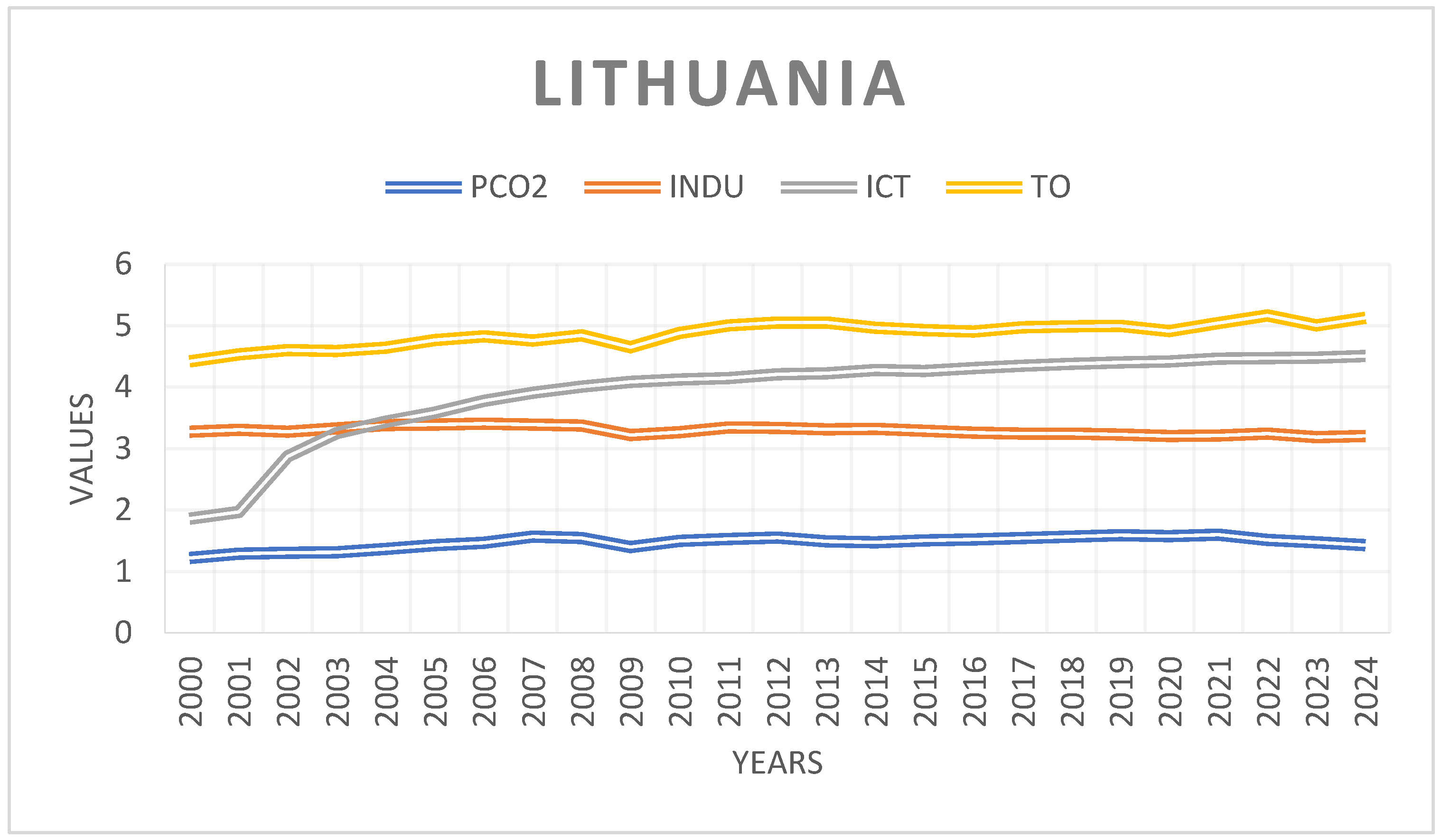
Trend Analysis of the Variables from 2000 to 2024 in Lithuania.
Trend analysis refers to the process of examining data over time to identify patterns, trends, or changes in variables (such as industrialization, ICT, trade openness and per capita emissions).
Figure 1.
Trend analysis of the study variables in Lithuania from 2000 to 2024 (i.e., Per capita emissions, Industrialization, ICT and Trade openness) Source: (Prepared by author’s 2025).
Figure 1.
Trend analysis of the study variables in Lithuania from 2000 to 2024 (i.e., Per capita emissions, Industrialization, ICT and Trade openness) Source: (Prepared by author’s 2025).
ARDL Model Approach.
To achieve the research objectives, this study employs the ARDL (Autoregressive Distributed Lag) econometric approach, which has been widely used in previous studies (Alam & Hossain, 2024; Ashfaq et al., 2024; Çobanoğulları, 2024). The ARDL model was initially introduced by Pesaran, M. H., Shin, (1999) and later developed further by Pesaran et al., (2001). This model is considered one of the most effective econometric tools for analyzing both long-run and short-run relationships among variables. In this study, the ARDL model is utilized, and the analysis is conducted using the EViews 12 Student Version software. There are several important limitations that must be met when applying this ARDL model. The first limitation involves ensuring the stationarity of the research variables. For this purpose, the Augmented Dickey-Fuller (ADF) unit root test, developed by Dickey et al., (1981), is used to determine whether the variables are stationary. Similarly, the Phillips-Perron unit root test, developed by Peter C. B. Phillips and Pierre Perron in 1988, is also used to test for stationarity. Furthermore, this study applies to the ARDL bounds testing method proposed by Pesaran et al., (2001) to investigate cointegration among the variables. One of the key advantages of the ARDL method is its flexibility can be applied regardless of whether the data series are integrated at level I(0), first difference I(1), or a combination of both (Raihan, 2023). Additionally, the ARDL model is particularly suitable for small sample sizes, making it an ideal choice for this research (Pesaran et al., 2001). The following Equation (2) presents the ARDL bounds testing framework.
Wherever
shows the 1st change,
the white noise, and
the component of drift. To investigate the lag period, the study applies the Akaike information criterion (AIC). To further investigate the short run impacts, the analysis first applies the ECM to explore the long-term correlation between the variables. Equation (3), which follows, displays the ECM form of Equation (2).
where, for short-run dynamics,
stands for the ECM coefficients and
for the initial variation. The error-correcting model shows the value of long-run stability variation following a short-run shock.
Evaluating the Stationarity of Variables through ADF and PP Unit Root Test.
To ensure the stability of every factor is important while examining and investigating research in econometric techniques (Harvey et al., 2001). The present research uses the ADF and PP unit root test, and the test results are indicated in
Table 2.
The PP unit root test is considered a robust test and is used to verify the results of the ADF unit root test. In this research, ICT and per capita emissions are found to be stationary at both the level and first difference, according to both the ADF and PP tests. Other variables, such as industrialization, trade openness, and economic growth, are stationary at the first difference based on both tests. With the first condition for applying the ARDL model fulfilled, the next step is to conduct the ARDL bounds test.
To examine the existence of a cointegration relationship among the variables (ARDL bound test).
Table 3 illustrates the outcomes of the ARDL bound test analysis. The value of the F-statistic, 15.89768, exceeds both upper and lower limits at the 10%, 5%, 2.5% and 1 % statistical significance level.
Based on the ARDL bounds test outcomes, cointegration is found to exist among the variables. Therefore, the results of both the ADF and PP unit root tests, along with the ARDL bounds test, indicate that applying the ARDL model is appropriate for examining the long-run and short-run relationships between the variables.
Autoregressive Distributed Lag (ARDL) Model: Long-Run and Short-Run Effects.
Table 4 and
Table 5 summarize the present research findings, based on the ARDL model, which show that industrialization has a positive and statistically significant effect on per capita CO₂ emissions in both the long run and the short run. In addition, a 1% increase in the level of industrialization results in a long-run and short-run increase in CO₂ emissions of 0.3771% and 0.8990%, respectively. The research results show that the short-run impact of industrialization is greater than the long-run impact. Furthermore, the research outcomes show that ICT has a positive relationship between per capita carbon emissions. This means that a 1% increase in ICT usage leads to an increase in per capita CO₂ emissions of 0.3310% in the long run and 0.0028% in the short run.
However, the short-run results are weak, as the coefficient is statistically insignificant. The study also indicates that trade openness contributes to a decrease in per capita CO₂ emissions in both the long run and the short run. According to the findings, a 1% increase in carbon emissions leads to a 0.9191% decrease in trade openness in the long run, whereas in the short run, a 1% increase in carbon emissions is associated with a 0.4669% increase in trade openness. Moreover, economic growth has a positive relationship with per capita carbon emissions in both the long and short run. The research results show that economic growth in Lithuania accelerates per capita CO₂ emissions. For instance, a 1% increase in economic growth results in a significant rise in per capita CO₂ emissions by 0.1417% in the long run and 0.7853% in the short run.
Table 5 illustrates the outcomes of the short-run equation of the ARDL model. The short-run and long-run stability relations reveal an ECT value of -0.6873. Based on the results, the adjustment spread is approximately 69%.
Diagnostic test.
The outcomes of the diagnostic tests are shown in
Table 6. The present research uses several diagnostic tests to confirm the validity of the ARDL model results and shows that there are no errors, the model is correctly specified, and the results are reliable. Moreover, the Breusch-Godfrey Serial Correlation LM Test findings indicate that there is no serial correlation.
Similarly, the results of the Breusch-Pagan-Godfrey test show that there is no heteroscedasticity among the research variables, and the model’s standard errors are reliable, ensuring accurate statistical inferences and valid results. Additionally, the Ramsey RESET test results confirm that the model is correctly specified.
Variance Inflation Factor (VIF).
In the present research, we use the Variance Inflation Factor (VIF) test to detect multicollinearity.
The VIF test is used to determine the presence of multicollinearity among the explanatory variables, and the outcomes are shown in
Table 7.
A common rule of thumb for VIF is that if the value is less than 10, it indicates no significant multicollinearity issues. From
Table 7, the VIF test results show that all VIF values are below 10. Therefore, our findings follow the rule of thumb, indicating that there are no serious multicollinearity issues in the model.
4. Discussion
This research uses the ARDL econometric method to achieve the research objectives. Based on the literature review, industrial development in recent years has contributed to global emission levels. The findings of the study indicate that industrialization has a positive relationship with per capita CO₂ emissions in Lithuania. In Lithuania, the industrial sector contributes approximately 25.74% to the country’s GDP. While this sector help to economic growth, the demand for industrial production processes requires more energy, recently consuming about 31% of electricity, which has led to increased emission levels from industry. Several scholarly studies align with our findings (Ali et al., 2025; J. Chen et al., 2024; K. Chen et al., 2024). If this trend of greenhouse gas emissions from the industrial sector continues over the next few years, it will pose a serious threat to environmental sustainability in Lithuania. In the modern era, the development of industry is linked to the ICT sector, as ICT tools help to industrial production. Regarding the connection between ICT and emissions, scholarly research outcomes are inconsistent and fall into three perspectives: one perspective is that ICT contributes to environmental quality; the second is that ICT still damages the environmental quality; and the third is that ICT has no significant effect. The results of this research indicate that ICT has a positive impact on per capita emissions. Our findings align with the second perspective, as ICT and per capita emissions are positively related. The development of the ICT sector in Lithuania has advanced, and this sector contributes to both the energy sector and ICT-related activities. Some previous studies support our research findings (Lee et al., 2024; Rahman & Ferdaous, 2024; Uddin et al., 2024; Yahyaoui, 2022). Access to ICT has become easier in the modern era. People use ICT tools for various activities, and in Lithuania, most activities rely on ICT. As the role of ICT increases, so does energy consumption. Although this contributes to higher development levels, it also leads to an increase in emission levels. There is still debate among scholars about whether trade openness contributes to environmental sustainability. This is partly due to the import of ICT tools from other countries, which support sectors such as industry and energy, and are interconnected. However, the findings of this research confirm that trade has a negative impact on per capita emissions. Trade openness contributes to the level of environmental sustainability in Lithuania. Furthermore, the findings of this research are similar to those of other studies (Aldegheishem, 2024; Ghazouani & Maktouf, 2024; Q. Wang et al., 2024; Zhou et al., 2025). In the recent past, most countries have focused on economic growth while overlooking other factors that harm the environment. As a result, the world is now facing serious environmental threats. The findings of this research reveal a direct connection between economic growth and per capita emissions, indicating that as economic growth increases, environmental degradation also intensifies. These findings are consistent with several previous studies (Cao et al., 2022; Kongkuah et al., 2021; Raihan, 2024).. Additionally, due to political challenges and conflicts among global economic powers, the focus remains on increasing growth while neglecting environmental concerns.
5. Conclusions
This present research examines the impact of industrialization, ICT, trade openness, and economic growth on per capita CO₂ emissions in Lithuania from 2000 to 2024. In recent years, different studies have shown mixed impacts regarding the effects of industrialization, ICT, trade openness, and economic growth on per capita carbon emissions. The research findings show that industrialization has a positive relationship with per capita CO₂ emissions, indicating that industrialization positively contributes to emission levels in Lithuania. ICT and economic growth are also positively linked with per capita CO₂ emissions, indicating that these factors contribute to rising emission levels in Lithuania. Moreover, trade openness helps to increase the level of environmental sustainability in Lithuania. The ARDL econometric approach is used to investigate the long-run and short-run interconnections between industrialization, ICT, trade openness, and economic growth on per capita carbon emissions in Lithuania. This method is a favourable approach to examine the long-run and short-run impacts between the variables and per capita emissions. The ADF and PP unit root test findings show that the research variables (industrialization, ICT, trade openness, economic growth, and per capita emissions) are stationary at both the level (indicating that data is stable and does not have a trend over the period) and the first difference (indicating that changes are stable and there is not upward or downward trend). The PP unit root test outcomes are robust and confirm the ADF unit root test findings. Moreover, the ARDL bounds test findings confirm that the research variables (industrialization, ICT, trade openness, economic growth, and per capita emissions) are cointegrated and have long-run relationships (i.e., if the F-statistic value is greater than the upper and lower limits, cointegration exists). These two conditions are important to satisfy before employing the ARDL econometric approach. Since both tests (ADF and PP unit root tests and ARDL bounds test) are favourable, the ARDL econometric model is used for further investigation. This research uses several diagnostic tests to increase the robustness of the ARDL findings. The Breusch-Godfrey test confirms the absence of serial correlation in the model’s residuals, indicating that the model is correctly specified. The Breusch-Pagan-Godfrey test addresses heteroscedasticity, confirming the reliability of the model’s standard errors, with no issues found in this research model. The Ramsey RESET test examines the accuracy of the relationship among the research variables and confirms that the model is correctly specified. Additionally, the Variance Inflation Factor (VIF) test checks for multicollinearity to confirm that the independent variables are not excessively correlated, and no multicollinearity is found between the variables.
This research investigates whether industrialization, ICT, trade openness, and per capita carbon emissions are a blessing or a curse for the environment in Lithuania. The findings indicate a positive relationship between industrialization, ICT, economic growth, and per capita carbon emissions, suggesting that these factors contribute to environmental degradation in Lithuania. On the other hand, trade openness shows a negative relationship with emissions, indicating that it has a positive impact (blessing) on environmental sustainability. Overall, the results shows that while industrialization, ICT, and economic growth may pose environmental challenges, trade openness appears to support environmental sustainability in Lithuania. Based on the research outcomes, several short-run and long-run policy recommendations are made for the case of Lithuania to support environmental sustainability. Short-term strategy: Industry, ICT, and trade policies must be interconnected, as these sectors are closely linked through the production process. In Lithuania, many sectors operate through ICT development, and the role of ICT is increasing across all areas. However, industry requires energy for production and tools for development, which are often acquired through trade. Therefore, the adoption of green technology and renewable energy must be expanded in both the industrial and ICT sectors. As a result, this will contribute to national development and promote environmental sustainability in Lithuania. Long-term strategy: In the modern era, the role of industrialization is increasing alongside ICT development in driving a country’s growth. While industrial development is important, it must be aligned with factors that support environmental sustainability in Lithuania. In recent years, emissions from the industrial sector in Lithuania have increased. This level can be reduced with greater use of green energy and green technologies that support environmental goals. Moreover, green industrial transformation, investment in low-carbon technologies, and energy-efficient machinery in the industrial sector are essential. Promoting the circular economy through waste reuse, recycling processes, and investing in ICT projects that support industrial development and clean energy production will also contribute to long-term sustainability.
This research analyzes the relationship between industrialization, ICT, trade openness, and economic growth on per capita emissions in Lithuania. It provides direction for future economics scholars who investigate similar research in the same country with different variables or in other regions. Moreover, this research has some limitations that can be addressed in future studies. Since this is a single-country case study, future scholars can expand the research to include the Baltic states and the European Union. Future research can also incorporate other variables such as energy use (both non-renewable and renewable), urbanization, and foreign direct investment, and employ alternative econometric techniques such as BARDL and VECM.
References
- Alam, M. B., & Hossain, M. S. (2024). Investigating the connections between China’s economic growth, use of renewable energy, and research and development concerning CO2 emissions: An ARDL Bound Test Approach. Technological Forecasting and Social Change, 201. [CrossRef]
- Aldegheishem, A. (2024). The impact of air transportation, trade openness, and economic growth on CO2 emissions in Saudi Arabia. Frontiers in Environmental Science, 12. [CrossRef]
- Ali, J., Wu, X., Kakar, S. K., Yani, S., Jahanger, A., & Rehman, M. (2025). Exploring the Relationship Between Industrialization, Electricity Consumption, and Carbon Emissions Across 35 Asian Countries: A Panel Quantile ARDL Approach. Natural Resources Forum. [CrossRef]
- An, H., Razzaq, A., Haseeb, M., & Mihardjo, L. W. W. (2021). The role of technology innovation and people’s connectivity in testing environmental Kuznets curve and pollution heaven hypotheses across the Belt and Road host countries: new evidence from Method of Moments Quantile Regression. Environmental Science and Pollution Research, 28(5). [CrossRef]
- Aquilas, N. A., Ngangnchi, F. H., & Mbella, M. E. (2024). Industrialization and environmental sustainability in Africa: The moderating effects of renewable and non-renewable energy consumption. Heliyon, 10(4). [CrossRef]
- Ashfaq, S., Liangrong, S., Waqas, F., Gulzar, S., Mujtaba, G., & Nasir, R. M. (2024). Renewable energy and green economic growth nexus: Insights from simulated dynamic ARDL. Gondwana Research, 127. [CrossRef]
- Aydoğan, B., & Vardar, G. (2020). Evaluating the role of renewable energy, economic growth and agriculture on CO2 emission in E7 countries. International Journal of Sustainable Energy, 39(4). [CrossRef]
- Bekun, F. V., Alola, A. A., & Sarkodie, S. A. (2019). Toward a sustainable environment: Nexus between CO2 emissions, resource rent, renewable and nonrenewable energy in 16-EU countries. Science of the Total Environment, 657. [CrossRef]
- Ben Lahouel, B., Taleb, L., Ben Zaied, Y., & Managi, S. (2021). Does ICT change the relationship between total factor productivity and CO2 emissions? Evidence based on a nonlinear model. Energy Economics, 101. [CrossRef]
- Ben Lahouel, B., Taleb, L., Managi, S., & Guesmi, K. (2024). The threshold effects of ICT on CO2 emissions: evidence from the MENA countries. Environmental Economics and Policy Studies, 26(2). [CrossRef]
- Cao, H., Khan, M. K., Rehman, A., Dagar, V., Oryani, B., & Tanveer, A. (2022). Impact of globalization, institutional quality, economic growth, electricity and renewable energy consumption on Carbon Dioxide Emission in OECD countries. Environmental Science and Pollution Research, 29(16). [CrossRef]
- Chen, J., Wu, W., & Nguea, S. M. (2024). Combining the effects of industrialization and oil prices on CO2 emissions: What role do renewable energy, urbanization and financial crisis play? Sustainable Development. [CrossRef]
- Chen, K., Qammar, R., Quddus, A., Lyu, N., & Alnafrah, I. (2024). Interlinking dynamics of natural resources, financial development, industrialization, and energy intensity: Implications for natural resources policy in emerging seven countries. Resources Policy, 90. [CrossRef]
- Chhabra, M., Giri, A. K., & Kumar, A. (2023). Do trade openness and institutional quality contribute to carbon emission reduction? Evidence from BRICS countries. Environmental Science and Pollution Research, 30(17). [CrossRef]
- Çobanoğulları, G. (2024). Exploring the link between CO2 emissions, health expenditure, and economic growth in Türkiye: evidence from the ARDL model. Environment, Development and Sustainability. [CrossRef]
- Danae Kyriakopoulou, Georgina Kyriacou, & Natalie Pearson. (2023, June 12). How does trade contribute to climate change and how can it advance climate action? Grantham Research Institute on Climate Change and the Environment.
- Dickey, D. A., & Fuller, W. A. (1981). Likelihood Ratio Statistics for Autoregressive Time Series with a Unit Root. Econometrica, 49(4). [CrossRef]
- Ghazouani, T. (2022). The Effect of FDI Inflows, Urbanization, Industrialization, and Technological Innovation on CO2 Emissions: Evidence from Tunisia. Journal of the Knowledge Economy, 13(4). [CrossRef]
- Ghazouani, T., & Maktouf, S. (2024). Impact of natural resources, trade openness, and economic growth on CO2 emissions in oil-exporting countries: A panel autoregressive distributed lag analysis. Natural Resources Forum, 48(1). [CrossRef]
- Goswami, A., Kapoor, H. S., Jangir, R. K., Ngigi, C. N., Nowrouzi-Kia, B., & Chattu, V. K. (2023). Impact of Economic Growth, Trade Openness, Urbanization and Energy Consumption on Carbon Emissions: A Study of India. Sustainability (Switzerland), 15(11). [CrossRef]
- Harvey, D. I., Leybourne, S. J., & Newbold, P. (2001). Innovational outlier unit root tests with an endogenously determined break in level. Oxford Bulletin of Economics and Statistics, 63(5). [CrossRef]
- Hocaoglu, F. O., & Karanfil, F. (2011). Examining the link between carbon dioxide emissions and the share of industry in GDP: Modeling and testing for the G-7 countries. Energy Policy, 39(6). [CrossRef]
- Iqbal, K., Hassan, S. T., Geng, Y., & Cai, C. (2024). Impact of Green Technological Innovations, ICT, and Renewable Energy on CO 2 Emissions in Emerging Economies. International Journal of Energy Research, 2024(1). [CrossRef]
- Jiang, Z., Ding, Z., Zhang, H., Cai, W., & Liu, Y. (2019). Data-driven ecological performance evaluation for remanufacturing process. Energy Conversion and Management, 198. [CrossRef]
- Kongkuah, M., Yao, H., Fongjong, B. B., & Agyemang, A. O. (2021). The role of CO2 emissions and economic growth in energy consumption: empirical evidence from Belt and Road and OECD countries. Environmental Science and Pollution Research, 28(18). [CrossRef]
- Laszlo, T. (2023). Correlation of Greenhouse Gas Emissions with Economic Growth in the European Union (2010-2019). International Journal of Energy Economics and Policy, 13(4). [CrossRef]
- Lee, H. S., Yap, L. T., Lee, S. Y., & Har, W. M. (2024). The Impacts of ICT and innovation on Carbon Dioxide Emissions in G20 Countries. IOP Conference Series: Earth and Environmental Science, 1303(1). [CrossRef]
- Lei, Q., Yu, H., & Lin, Z. (2024). Understanding China’s CO2 emission drivers: Insights from random forest analysis and remote sensing data. Heliyon, 10(7). [CrossRef]
- Lv, J., Gu, F., Zhang, W., & Guo, J. (2019). Life cycle assessment and life cycle costing of sanitary ware manufacturing: A case study in China. Journal of Cleaner Production, 238. [CrossRef]
- Mignamissi, D., Possi Tebeng, E. X., & Momou Tchinda, A. D. (2024). Does trade openness increase CO2 emissions in Africa? A revaluation using the composite index of Squalli and Wilson. Environment Systems and Decisions. [CrossRef]
- Mitić, P., Kojić, M., Minović, J., Stevanović, S., & Radulescu, M. (2024). An EKC-based modelling of CO2 emissions, economic growth, electricity consumption and trade openness in Serbia. Environmental Science and Pollution Research International, 31(4). [CrossRef]
- Mutascu, M. (2018). A time-frequency analysis of trade openness and CO2 emissions in France. Energy Policy, 115. [CrossRef]
- Nosheen, M., Iqbal, J., & Khan, H. U. (2021). Analyzing the linkage among CO2 emissions, economic growth, tourism, and energy consumption in the Asian economies. Environmental Science and Pollution Research, 28(13). [CrossRef]
- Onyeneke, R. U., Chidiebere-Mark, N. M., & Ayerakwa, H. M. (2024). Impact of Information and Communication Technologies and Renewable Energy Consumption on Carbon Emissions in Africa. Carbon Research, 3(1). [CrossRef]
-
Our world in data. (2022). [CrossRef]
- Our World in Data (OWID). (2024). Our World in Data. https://ourworldindata.org/.
- Patel, N., & Mehta, D. (2023). The asymmetry effect of industrialization, financial development and globalization on CO2 emissions in India. International Journal of Thermofluids, 20. [CrossRef]
- Pesaran, M. H., Shin, Y. (1999). An autoregressive distributed lag modelling approach to cointegration analysis. Econometrics and Economic Theory in the 20th Century: The Ragnar Frisch Centennial Symposium., March 3-5, 1995.
- Pesaran, M. H., Shin, Y., & Smith, R. J. (2001). Bounds testing approaches to the analysis of level relationships. Journal of Applied Econometrics, 16(3). [CrossRef]
- Radmehr, R., Henneberry, S. R., & Shayanmehr, S. (2021). Renewable Energy Consumption, CO2 Emissions, and Economic Growth Nexus: A Simultaneity Spatial Modeling Analysis of EU Countries. Structural Change and Economic Dynamics, 57. [CrossRef]
- Rahman, M. N., & Ferdaous, J. (2024). Linkages between ICT diffusion, renewable energy consumption, and carbon emissions: a comparative analysis of SAARC, MENA, and OECD countries. Environmental Science and Pollution Research, 31(9). [CrossRef]
- Raihan, A. (2023). The influences of renewable energy, globalization, technological innovations, and forests on emission reduction in Colombia. Innovation and Green Development, 2(4). [CrossRef]
- Raihan, A. (2024). The interrelationship amid carbon emissions, tourism, economy, and energy use in Brazil. Carbon Research, 3(1). [CrossRef]
- Raihan, A., Tanchangya, T., Rahman, J., Ridwan, M., & Ahmad, S. (2022). The influence of Information and Communication Technologies, Renewable Energies and Urbanization toward Environmental Sustainability in China. Journal of Environmental and Energy Economics, 1(1), 11–23. [CrossRef]
- Rehman, A., Ma, H., Ahmad, M., Işık, C., & Ozturk, I. (2023). Estimating interlinks of carbon emissions from transportation, industrialization, and solid/liquid fuels with economic progress: evidence from Pakistan. International Journal of Environmental Science and Technology, 20(2). [CrossRef]
- Salahodjaev, R., Djalilov, B., Kobiljonov, I., Otajonov, S., & Kasimova, N. (2023). Industrialization and CO2 Emissions: Accounting for the role of Renewable Energy in OIC Member States. International Journal of Energy Economics and Policy, 13(5). [CrossRef]
- Shahbaz, M., Nasreen, S., Ahmed, K., & Hammoudeh, S. (2017). Trade openness–carbon emissions nexus: The importance of turning points of trade openness for country panels. Energy Economics, 61. [CrossRef]
- Shahnazi, R., Jamshidi, N., & Shafiei, M. (2024). Informal economy and CO2 emissions: threshold effects of information and communication technology. Clean Technologies and Environmental Policy. [CrossRef]
- Sharma, K., Bal, D. P., & Mohanty, S. (2024). The dynamic relationship between nuclear energy, CO2 emissions, and economic growth: evidence from the richest countries in Europe and Asia. Environmental Science and Pollution Research, 31(10). [CrossRef]
- Song, M. J., Seo, Y. J., & Lee, H. Y. (2023). The dynamic relationship between industrialization, urbanization, CO2 emissions, and transportation modes in Korea: empirical evidence from maritime and air transport. Transportation, 50(6). [CrossRef]
- Surya, B., Ahmad, D. N. A., Sakti, H. H., & Sahban, H. (2020). Land use change, spatial interaction, and sustainable development in the metropolitan urban areas, south Sulawesi province, Indonesia. Land, 9(3). [CrossRef]
- Thuy, D. P. T., & Nguyen, H. T. (2022). Effects of trade openness on environmental quality : Evidence from developing countries. Research Square.
- Uddin, M., Rashid, M. H. U., Ahamad, S., & Ehigiamusoe, K. U. (2024). Impact of militarization, energy consumption, and ICT on CO2 emissions in G20 countries. Environment, Development and Sustainability, 26(5). [CrossRef]
- Udeagha, M. C., & Breitenbach, M. C. (2023a). Exploring the moderating role of financial development in environmental Kuznets curve for South Africa: fresh evidence from the novel dynamic ARDL simulations approach. Financial Innovation, 9(1). [CrossRef]
- Udeagha, M. C., & Breitenbach, M. C. (2023b). On the asymmetric effects of trade openness on CO2 emissions in SADC with a nonlinear ARDL approach. Discover Sustainability, 4(1). [CrossRef]
- Udeagha, M. C., & Muchapondwa, E. (2022). Investigating the moderating role of economic policy uncertainty in environmental Kuznets curve for South Africa: Evidence from the novel dynamic ARDL simulations approach. Environmental Science and Pollution Research, 29(51). [CrossRef]
- Voumik, L. C., Mimi, M. B., & Raihan, A. (2023). Nexus Between Urbanization, Industrialization, Natural Resources Rent, and Anthropogenic Carbon Emissions in South Asia: CS-ARDL Approach. Anthropocene Science, 2(1). [CrossRef]
- Wang, Q., Zhang, F., & Li, R. (2024). Free trade and carbon emissions revisited: The asymmetric impacts of trade diversification and trade openness. Sustainable Development, 32(1). [CrossRef]
- Wang, W. Z., Liu, L. C., Liao, H., & Wei, Y. M. (2021). Impacts of urbanization on carbon emissions: An empirical analysis from OECD countries. Energy Policy, 151. [CrossRef]
- Wang, X. G., & Yan, L. (2022). Driving factors and decoupling analysis of fossil fuel related-carbon dioxide emissions in China. Fuel, 314. [CrossRef]
- Wang, X., Tian, N., & Wang, S. (2022). The Impact of Information and Communication Technology Industrial Co-Agglomeration on Carbon Productivity with the Background of the Digital Economy: Empirical Evidence from China. International Journal of Environmental Research and Public Health, 20(1). [CrossRef]
- World Bank. (2025). World Development Indicators.
- Wu, B., Fang, H., Jacoby, G., Li, G., & Wu, Z. (2022). Environmental regulations and innovation for sustainability? Moderating effect of political connections. Emerging Markets Review, 50. [CrossRef]
- Xie, X., Liu, Y., Jiang, X., & Wang, Z. X. (2024). Natural resources utilization, ICT growth, and renewable energy consumption: Pathways to sustainable development in China. Resources Policy, 89. [CrossRef]
- Yahyaoui, I. (2022). Does the Interaction Between ICT Diffusion and Economic Growth Reduce CO2 Emissions? An ARDL Approach. Journal of the Knowledge Economy. [CrossRef]
- Yu, Y., & Du, Y. (2023). Does ICT change the relationship between trade openness and CO2 emissions? Evidence for RCEP countries. Environment, Development and Sustainability. [CrossRef]
- Zhou, R., Guan, S., & He, B. (2025). The Impact of Trade Openness on Carbon Emissions: Empirical Evidence from Emerging Countries. Energies, 18(3). [CrossRef]
|
Disclaimer/Publisher’s Note: The statements, opinions and data contained in all publications are solely those of the individual author(s) and contributor(s) and not of MDPI and/or the editor(s). MDPI and/or the editor(s) disclaim responsibility for any injury to people or property resulting from any ideas, methods, instructions or products referred to in the content. |
© 2025 by the authors. Licensee MDPI, Basel, Switzerland. This article is an open access article distributed under the terms and conditions of the Creative Commons Attribution (CC BY) license (http://creativecommons.org/licenses/by/4.0/).