
Submitted:
05 February 2026
Posted:
09 February 2026
You are already at the latest version
Abstract
Quantum entanglement is conventionally characterized as a structural
property of tensor-product Hilbert spaces, with limited emphasis on its
geometric or gauge-theoretic organization.
Within standard quantum field theory on a fixed classical spacetime
background, we show that entanglement can be represented as a
global compatibility constraint acting on internal degrees of freedom in
the gauge-bundle formulation of the Standard Model.
This representation is encoded by a vacuum-level internal gauge
structure $\Xi(x)$ that is locally pure gauge, dynamically inert, and
acts exclusively on internal fibers, leaving all local dynamics and the
Standard Model Lagrangian unchanged.
We formalize this perspective as a vacuum internal gauge structure
(VIGS) and prove a corresponding structural result—the Vacuum
Internal Gauge Theorem—which establishes that global compatibility
relations associated with $\Xi$ act only on internal Hilbert-space
factors and preserve locality and no-signaling within the regime
considered here.
The framework complements standard Hilbert-space and algebraic
descriptions of entanglement by making explicit how global internal
correlations can be organized geometrically without invoking nonlocal
dynamics.
Finally, we identify an experimentally accessible operational signature,
based on correlated versus independent internal-frame scrambling, that
distinguishes this geometric representation within existing entanglement
platforms.
Keywords:
quantum entanglement
; internal degrees of freedom
; gauge bundles
; vacuum internal gauge symmetry
; global compatibility constraints
; no-signaling
; operational tests of entanglement
1. Introduction
Quantum entanglement is one of the most distinctive features of quantum theory, yet its physical interpretation remains conceptually elusive. Experimentally, entanglement is observed through correlations among well-defined quantum subsystems—such as spin, polarization, internal atomic states, or quantized mode indices—while remaining fully consistent with relativistic locality and the absence of superluminal signaling. Standard quantum mechanics and quantum field theory describe these correlations with extraordinary precision, but typically treat entanglement as a structural property of Hilbert-space tensor products, rather than as the manifestation of an explicit geometric or symmetry-based compatibility principle.
Much of the conceptual unease surrounding entanglement arises when entangled subsystems are spatially separated. A common—often implicit— assumption is that all physically relevant degrees of freedom are associated directly with spacetime localization and are therefore subject to relativistic causal constraints. When this assumption is applied indiscriminately, entanglement may appear to require some form of nonlocal influence acting across spacetime. By contrast, quantum correlations among internal constituents of a single composite system—such as electrons in an atom or quarks in a hadron—are rarely regarded as problematic, despite being governed by the same quantum principles.
A consistent empirical pattern underlies this contrast. All confirmed entanglement experiments involve degrees of freedom that admit a well-defined internal Hilbert-space structure. Spin and polarization entanglement were established in early Bell tests [1,6] and continue to be confirmed in modern loophole-free experiments [17]. Entanglement of internal atomic and ionic states is central to quantum metrology and information platforms [8,44], while photonic entanglement is routinely realized through polarization or discrete mode indices, such as orbital angular momentum [27]. Even in scenarios described using spatial language—such as path or motional entanglement—the relevant quantum subsystems are operationally represented by quantized modes or finite-dimensional representation spaces, rather than by classical spacetime variables themselves.
This pattern suggests that the apparent tension between entanglement and spacetime locality reflects a misidentification of the degrees of freedom involved. Internal degrees of freedom—such as spin, flavor, polarization, or mode labels—are quantum degrees of freedom described by Hilbert spaces, but they are not geometric degrees of freedom in the sense of spacetime positions or metric variables. Instead, they are associated with representation spaces arising from internal symmetries, gauge structure, or kinematic representation theory. Global relations among such internal degrees of freedom are therefore not constrained by relativistic causal structure in the same way as interactions mediated through spacetime geometry.
Standard theoretical formulations already encode this distinction, but they do not make it explicit. In Hilbert-space language, entanglement is defined through the non-factorization of tensor-product states [19], while algebraic quantum field theory encodes entanglement via correlations between operator algebras associated with spacelike-separated regions [16,39]. These approaches are mathematically precise and empirically successful, but they typically leave implicit the geometric or symmetry-based origin of the global compatibility constraints that physical states obey.
In this work we revisit entanglement from the perspective of the gauge-bundle formulation of quantum field theory, restricting attention throughout to standard quantum field theory on a fixed classical spacetime background. No modification of the Standard Model Lagrangian is introduced, and no new particles, forces, or propagating degrees of freedom are postulated. Within this scope, we show that the internal gauge-bundle structure of the Standard Model already permits a natural geometric representation of global compatibility relations among internal quantum subsystems.
Central to our discussion is a vacuum-level internal gauge structure, denoted by , which is locally pure gauge and therefore dynamically inert. Crucially, is not an additional physical field, a new interaction, or an extension of the Standard Model. Rather, it serves as a convenient representation of global internal-frame compatibility that is already implicit in the gauge-bundle formulation. The Standard Model gauge theory defines a global internal gauge bundle over the entire spacetime manifold, including regions occupied by matter fields as well as vacuum regions devoid of dynamical excitations. In this sense, internal gauge structure exists globally, not only within localized particles.
The role of in this work is to make explicit a global internal compatibility structure that is ordinarily left implicit in discussions of entanglement. Locally, such structure is physically unobservable and can always be gauged away; its significance is purely global and organizational. By representing this vacuum-level internal structure explicitly, we provide a geometric language for describing how global internal correlations may be consistently defined across spacetime without altering local dynamics or introducing new degrees of freedom.
From this viewpoint, entanglement is understood as a global compatibility condition acting on internal Hilbert-space factors, rather than as a nonlocal interaction propagating through spacetime. This interpretation does not replace the standard Hilbert-space or algebraic descriptions of entanglement, nor does it modify their quantitative predictions. Instead, it clarifies why nonlocal quantum correlations can coexist with strict spacetime locality: the relevant correlations are enforced by internal compatibility constraints rather than by spacetime-mediated influences.
Finally, we emphasize that while the present analysis is strictly confined to the Standard Model effective framework on a fixed spacetime background, the explicit geometric representation of internal compatibility developed here is motivated by broader reconstruction-based approaches in which such global constraints are not merely kinematic but arise from an underlying microphysical process. In particular, within the Real-Now-Front (RNF) reconstruction framework, global compatibility conditions are generated and maintained by a non-metric, massively parallel reconstruction dynamics [25]. The present work, however, does not assume or rely on this deeper mechanism. At the Standard Model level considered here, the internal structure is treated purely as a structural and organizational element of the gauge-bundle formulation, not as an ontic or dynamical agent.
The novelty of the present work should be understood in this explicitly limited and conservative sense. We do not introduce new dynamical mechanisms, physical degrees of freedom, or modifications of the Standard Model. Rather, the contribution lies in making explicit a vacuum-level internal gauge structure that is already permitted—but usually left implicit—within the gauge-bundle formulation of the Standard Model, and in showing how this structure can be used to geometrically organize global internal compatibility relations associated with quantum entanglement. While the quantitative content of entanglement remains unchanged, the explicit identification of a locally pure-gauge vacuum internal frame and its associated global compatibility constraints provides a new geometric and organizational perspective that is absent from standard Hilbert-space, algebraic quantum field theory, and reference-frame treatments.
The paper is organized as follows. In Sec. 2 we clarify the conceptual scope of the present work and fix the terminology used throughout, including the distinction between internal representation degrees of freedom and geometric spacetime variables. In Sec. 3 we review the gauge-bundle formulation of internal degrees of freedom in the Standard Model and emphasize features of the internal gauge structure that are usually left implicit. In Sec. 4 we make explicit the role of global internal-frame compatibility and introduce the vacuum internal gauge structure as a convenient representation of this feature. Section 5, Section 6 and Section 7 develop the geometric representation of entanglement in terms of vacuum gauge bridges and analyze its structural consequences within fixed-background quantum field theory. In Sec. 8 we relate this perspective to standard Hilbert-space, algebraic, and information-theoretic formulations of entanglement. Finally, Sec. 9 discusses the scope, limitations, and broader implications of the framework and outlines directions for future investigation. Technical details, including a rigorous mathematical formulation of the compatibility constraints and an explicit finite-dimensional worked example illustrating their operational consequences, are provided in the Appendices.
2. Conceptual Scope and Terminology
Because the discussion in this paper spans multiple descriptive frameworks—ranging from operational quantum-information language to geometric and gauge-theoretic formulations—it is essential to fix the terminology used throughout. Several terms employed here, most notably “internal” and “external” degrees of freedom, appear in the literature with different meanings depending on context. The purpose of this section is therefore not to redefine established concepts, but to specify precisely how these terms are used within the present framework.
The distinctions introduced below are organizational and representation-theoretic in nature. They serve to clarify which structures are treated as internal representation spaces associated with gauge or kinematic symmetries, and which are treated as elements of the classical spacetime background in the effective description adopted here. No claim is made that one class of degrees of freedom is “more quantum” than another, nor that any degree of freedom discussed here is excluded from the standard quantum-mechanical formalism.
2.1. Internal Representation Degrees of Freedom
Throughout this paper, internal degrees of freedom refer to quantum degrees of freedom associated with representation spaces of symmetry groups—such as internal gauge groups or kinematic representation groups—rather than with spacetime geometry itself. In the gauge-theoretic formulation of quantum field theory, such degrees of freedom are naturally described as fibers of associated vector bundles over spacetime.
Canonical examples include spin, flavor, color, isospin, polarization, and discrete mode or representation labels of quantized fields. In geometric terms, these degrees of freedom reside in vector-space fibers attached to spacetime points, and symmetry transformations act fiberwise without reference to spacetime separation. It is in this representation-theoretic and fiber-based sense that the term “internal” is used here.
Importantly, the use of the term “internal” does not imply that such degrees of freedom are isolated from spacetime dynamics, nor that they are independent of spacetime localization in practical descriptions. Rather, it reflects the fact that their quantum structure is defined by representation labels and symmetry actions, not by spacetime geometry or metric relations.
2.2. Geometric and Spacetime Degrees of Freedom
By contrast, geometric degrees of freedom are those associated directly with the spacetime manifold and its classical geometric structure. These include spacetime position, classical trajectories, metric components, curvature, and other quantities defined on the base manifold itself rather than on internal fibers.
Within the scope of this work, spacetime geometry is treated as a fixed classical background, as is standard in quantum field theory on flat or curved spacetime. This choice reflects the effective-theory setting of the present analysis and does not constitute a statement about the fundamental quantum or classical nature of spacetime in more general contexts.
The distinction drawn here should therefore not be interpreted as a claim that geometric or spacetime-related degrees of freedom cannot be described quantum mechanically in other frameworks. Rather, it fixes the level of description adopted in this paper and separates representation-theoretic quantum structure from background geometric structure for clarity of exposition.
2.3. Quantized Modes and Commonly Used “External” Variables
In both experimental and theoretical practice, quantum states and correlations are often described using variables such as spatial paths, motional states, normal modes, or collective excitations (for example, phonons or cavity modes). In the present framework, such variables are treated as internal representation degrees of freedom whenever they correspond to quantized modes or discrete labels spanning a well-defined quantum state space.
For instance, path entanglement in interferometric settings is operationally described by a finite-dimensional Hilbert space spanned by mode labels (such as “left” and “right” paths), rather than by continuous spacetime coordinates themselves. Likewise, phonons and other collective excitations arise from normal-mode decompositions of many-body systems and admit internal quantum numbers and state spaces. Although these modes may be spatially localized or motivated by geometric considerations, their quantum structure resides in the mode indices and representation labels, not in spacetime geometry as such.
This classification reflects a representation-theoretic distinction rather than an experimental or operational one. Degrees of freedom commonly referred to as “external” in experimental contexts may be treated as internal here if they form part of a quantized subsystem with a well-defined internal representation space.
2.4. Scope and Terminological Intent
The terminology adopted in this section is intended solely to fix language and conceptual scope for the discussion that follows. It does not deny, revise, or reinterpret established experimental results or standard quantum-mechanical descriptions, nor does it assert that entanglement is restricted to a particular class of degrees of freedom.
By fixing these distinctions explicitly, we aim to avoid ambiguity in later sections and to make clear which structures are treated as internal representation spaces and which belong to the external classical geometric background within the gauge-bundle language employed in this work.
3. Internal Gauge Bundles in the Standard Model
In the geometric formulation of the Standard Model, matter fields are described as sections of vector bundles associated with a principal internal gauge bundle over spacetime [4,14,31,43]. Let denote a spacetime manifold equipped with a fixed Lorentzian metric, and let
be the internal gauge group of the Standard Model. The corresponding principal G-bundle
encodes the internal gauge structure, with typical fiber G. A connection one-form A on P represents the Yang–Mills gauge potential [46] and determines the local dynamics of the gauge fields through its curvature.
Given a unitary representation on a finite-dimensional complex vector space , one obtains an associated vector bundle
whose fibers carry the internal representation degrees of freedom of matter fields, such as color, isospin, hypercharge, or spinor components. A matter field is then a smooth section
and gauge transformations act fiberwise through the representation , independently at each spacetime point.
By contrast, geometric quantities such as spacetime position, proper time, curvature, and metric relations are defined on the base manifold and its tangent and cotangent bundles, rather than on the internal bundle . The Standard Model thus naturally distinguishes between internal representation degrees of freedom, associated with symmetry groups acting on fibers, and geometric degrees of freedom associated with the spacetime manifold itself. This distinction is structural rather than dynamical and is already built into the standard gauge-bundle formulation.
While the local gauge dynamics are fully determined by the connection A and its curvature, the bundle formulation also admits global features that are typically left implicit. In particular, the choice of global internal frames or trivializations of the principal bundle, when they exist, does not affect local gauge-invariant observables and carries no curvature. Such structure is locally pure gauge and dynamically inert, but it may encode global compatibility relations among internal fibers at different spacetime points.
In the following sections, we make this implicit structural feature explicit by introducing a convenient notation, denoted by , to represent global internal-frame compatibility at the level of the vacuum. The object is not an additional physical field, does not enter the Standard Model Lagrangian, and introduces no new propagating degrees of freedom. Rather, it serves as a bookkeeping device that makes explicit a class of global internal compatibility conditions that are already permitted within the standard gauge-bundle framework.
Seen from this perspective, the Standard Model vacuum already possesses the structural ingredients required to support such global internal relations at the level of state-space organization. The introduction of simply renders these relations explicit, providing a geometric language for discussing global internal compatibility without altering any aspect of the established local dynamics or empirical content of the theory.
4. Explicit Vacuum Internal Gauge Structure
Before introducing formal definitions, it is useful to clarify the conceptual status of the vacuum internal gauge structure discussed in this work. In the standard gauge-theoretic formulation of the Standard Model, internal symmetries act on the internal orientation of matter fields: each charged field carries internal reference frames (such as color, weak isospin, or phase), and gauge transformations rotate these frames fiberwise [31,43]. The corresponding internal gauge bundle, however, is defined globally over spacetime. Its fiber structure exists at every spacetime point, including vacuum regions in which no dynamical excitations of the matter fields are present.
What is usually left implicit in this formulation is any explicit representation of vacuum-level internal-frame compatibility across spacetime. While local gauge freedom ensures that internal frame choices carry no local physical significance, the gauge-bundle framework allows the possibility of globally consistent identifications among internal fibers that do not affect local dynamics.
The present work does not modify Standard Model dynamics or introduce new fields. Instead, it makes explicit a structural feature already permitted within the gauge-bundle formulation: namely, the possibility of representing global internal compatibility by a locally pure-gauge vacuum frame choice. We denote this explicit representation by , which serves as a convenient geometric notation for vacuum-level internal compatibility.
Vacuum internal frame representation
Let denote the typical fiber of the associated internal bundle introduced in the previous section. We consider a smooth map
which assigns to each spacetime point an automorphism of the internal representation space. Formally, may be viewed as a choice of internal reference frame for the vacuum at x, acting on the same internal degrees of freedom as matter fields.
The object is not introduced as an independent dynamical field. It carries no local energy density, does not enter the Standard Model Lagrangian, introduces no new excitations, and does not alter the equations of motion. Its role is purely representational: it provides an explicit way of encoding global internal compatibility relations that are otherwise implicit in the global gauge-bundle structure.
Gauge covariance and local triviality
Under a local gauge transformation , matter fields transform as . Consistently, the vacuum frame representation is taken to transform covariantly as
placing it in the adjoint representation of the internal gauge group. This transformation law ensures that carries no gauge-invariant local content.
To formalize the statement that is locally pure gauge while remaining a frame representation (rather than a connection), we introduce the associated Lie-algebra-valued one-form
where D denotes the standard gauge-covariant derivative acting on -valued objects. Equation (2) has the familiar form induced by a choice of local frame. Its curvature is defined as
We say that is locally pure gauge (or locally flat) if
When condition (4) holds, then on any simply connected neighborhood there exists a gauge transformation such that
for some constant internal frame . In this sense, is locally gauge-equivalent to a constant choice of internal frame and is therefore locally unobservable and dynamically inert. This is entirely analogous to flat (pure-gauge) configurations in Yang–Mills theory and standard bundle geometry [3,31,45].
Global internal compatibility
Although locally trivial, a locally flat internal-frame representation may still encode nontrivial global information through bundle topology, boundary conditions, or holonomy data associated with flat connections [3,45]. In the present framework, this global compatibility data constitutes the only physically relevant content associated with .
Such global internal relations do not act as forces, interactions, or signals. Rather, they specify how internal frames in spatially separated regions may be consistently identified at the level of state space organization. When applied to composite quantum systems, these compatibility relations can be represented as global constraints acting on internal Hilbert-space factors, as formalized in Section 6 and Appendix A. Within the fixed background and standard quantum field theory regime considered here, this provides a geometric perspective on how entanglement correlations may be organized without invoking nonlocal dynamics or modifying local equations of motion.
In summary, the vacuum internal gauge structure represented by does not extend the Standard Model or introduce new physical degrees of freedom. It renders explicit a globally allowed but usually implicit feature of the internal gauge-bundle formulation, providing a geometric language for discussing global internal compatibility within standard quantum field theory on a fixed spacetime background. A schematic illustration of this structure is shown in Figure 1.
5. Vacuum Gauge Bridges
As discussed above, the vacuum internal gauge structure represented by is locally pure gauge and therefore carries no gauge-invariant local content, in direct analogy with flat gauge configurations in ordinary gauge theory [3,45]. Nevertheless, locally trivial gauge-bundle structures may encode nontrivial global relations among internal degrees of freedom supported in spatially separated regions. In gauge-theoretic terms, this mirrors the well-known fact that flat connections can implement global frame identifications or holonomy data without generating local curvature [14,23].
To provide a concise geometric description of such global internal relations, we introduce the notion of a vacuum gauge bridge. The term is intended purely as a descriptive label for global compatibility conditions within the internal gauge bundle, and does not refer to a physical interaction, coupling, or dynamical channel.
- Definition.
Let be disjoint spacetime regions supporting matter fields with internal fibers and , respectively. A vacuum gauge bridge between A and B is a gauge-invariant global compatibility relation
for which there exists a globally defined, locally flat internal-frame representation (satisfying ) such that
Equivalently, selects joint internal states that respect a chosen global internal-frame alignment.
- Geometric interpretation.
From a geometric perspective, a vacuum gauge bridge specifies how internal representation spaces associated with regions A and B may be consistently identified at the global level, despite the absence of any local curvature, interaction, or transport process. Because is locally flat, this compatibility does not arise from dynamical propagation or signal exchange, but from the global structure of the internal gauge bundle. This is directly analogous to familiar situations in gauge theory where globally meaningful identifications persist even when the local field strength vanishes [45].
- Example: spin singlet.
As a simple illustration, consider two spin- systems localized in regions A and B. The spin-singlet condition
can be expressed as a global compatibility constraint acting on the internal representation spaces. When the internal spin frames at A and B are identified by a locally flat , the admissible joint states form the familiar one-dimensional antisymmetric subspace of encountered in standard treatments of spin entanglement [37,43]. In this representation, specifies a vacuum-level identification of internal frames, while the entangled structure itself remains exactly that of the usual Hilbert-space description.
- Local triviality and absence of dynamical cost.
Because is locally gauge-trivial, vacuum gauge bridges generate no local gauge curvature, carry no stress–energy, and introduce no propagating degrees of freedom. All pointwise gauge-invariant quantities constructed from vanish identically. The presence of a bridge is reflected solely in global restrictions on admissible joint internal states, closely paralleling the treatment of entanglement in algebraic quantum field theory, where correlations are properties of joint states rather than consequences of dynamical linkages between spacetime regions [39].
- Interpretive scope.
Within the scope of the present work, vacuum gauge bridges provide a geometric language for representing global internal compatibility conditions that are otherwise described algebraically in standard quantum theory. They do not constitute an independent mechanism for generating entanglement, nor do they modify local dynamics or empirical predictions. Instead, they offer an organizational perspective that clarifies how familiar entangled structures can be consistently described within the gauge-bundle framework while maintaining strict locality of all physical interactions. A schematic illustration of this notion is shown in Figure 2.
6. Structural Consequences of Vacuum Internal Gauge Compatibility
In this section we state and interpret the central structural result of the present work. The result concerns the role of a globally defined, locally flat internal-frame representation in organizing entanglement within standard quantum field theory on a fixed classical spacetime background. No new dynamics, interactions, or physical principles are introduced. Rather, the theorem below makes explicit how global internal compatibility relations—already permitted by the gauge-bundle formulation—may be represented geometrically and related to standard notions of entanglement.
A mathematically explicit formulation, together with rigorous proofs, is provided in Appendix A. There, global internal compatibility is represented by a constraint projector acting on internal Hilbert-space factors, fully consistent with standard tensor-product and algebraic formulations of quantum theory.
Setup and assumptions
Let be the Standard Model principal bundle with structure group
and let
denote the associated internal bundle whose fibers carry internal representation degrees of freedom such as spin, polarization, flavor, and internal atomic states, as in the standard geometric formulation of gauge theories [14,23,31].
Throughout this section, spacetime geometry—encoded by the metric and curvature tensors—is treated as a fixed classical background, as in quantum field theory on curved or flat spacetime [41]. No quantum geometric degrees of freedom are assumed, and no claims are made concerning quantum gravity or spacetime dynamics.
We consider a globally defined internal-frame representation
which is locally pure gauge (flat) and serves as an explicit representation of global internal compatibility already permitted within the gauge-bundle framework, as discussed in the previous sections.
Vacuum Internal Gauge Theorem
Theorem 1
(Vacuum Internal Gauge Theorem). Within standard quantum field theory on a fixed classical spacetime background, let Ξ be a globally defined, locally flat internal-frame representation acting on the internal bundle . Then the following statements hold:
- 1.
-
Localization of compatibility. All global compatibility relations represented by Ξ act exclusively on internal representation spaces. For disjoint spacetime regions , such relations may be represented as subsetswith no action on spacetime geometric variables.
- 2.
- Relation to entangled states. Within the fixed-background regime considered here, entangled states may be represented as joint internal states subject to global compatibility constraints encoded by Ξ. This representation is fully equivalent to the standard Hilbert-space definition of entanglement and introduces no new entanglement mechanism.
- 3.
- Locality and no-signaling. Local operations supported in a spacetime region act only on the corresponding internal Hilbert-space factor and cannot modify the global compatibility relations represented by a flat Ξ. Consequently, the standard no-signaling property of quantum theory is preserved.
- 4.
- Geometric degrees of freedom. Because Ξ carries no representation on the spacetime tangent or cotangent bundles, the compatibility relations it represents do not act on classical geometric variables such as spacetime position, metric components, or curvature tensors.
Sketch of proof
The proof follows directly from standard properties of gauge-bundle geometry together with elementary features of Hilbert-space factorization.
- Because takes values in and is locally pure gauge, it induces no local curvature and no dynamical coupling. Its only nontrivial content is global and representation theoretic, acting on internal fibers. This establishes item (1).
- In a finite-dimensional Hilbert-space model, global internal compatibility may be represented by a constraint projector acting nontrivially only on internal tensor factors. This yields item (2) and is made explicit in Appendix A.
- External geometric quantities carry no representation of the internal gauge group and therefore lie outside the action of . This establishes item (4).
A precise finite-dimensional formulation and complete proofs of all four statements are given in Appendix A.
Taken together, Theorem 1 clarifies how a vacuum internal gauge structure may be used as a geometric representation of global internal compatibility within standard quantum field theory. The result is structural and regime-specific: it introduces no new dynamics and makes no claims beyond fixed-background quantum field theory, but it renders explicit how entanglement correlations may be organized geometrically without modifying established physical principles.
7. Geometric Representation of Entanglement
Within the framework developed above, the vacuum internal gauge structure provides a geometric way of representing quantum entanglement as a global compatibility condition acting on internal representation degrees of freedom, as defined in Sec. 2. This representation introduces no new interaction, dynamical influence, or modification of the Standard Model equations of motion. Because is locally pure gauge, it generates no excitations and carries no local physical content, remaining fully consistent with relativistic locality and the standard dynamical structure of quantum field theory [16,43].
The purpose of this section is to clarify how such global internal compatibility relations may be expressed geometrically and how they relate to standard descriptions of entanglement within the fixed background regime considered here.
Physical State Space and Global Compatibility
Let denote the Hilbert space associated with the Standard Model in its conventional formulation [35,43]. In the present geometric language, global internal-frame compatibility associated with may be encoded by a constraint condition
which selects quantum states compatible with a given global internal alignment.
For composite systems localized in disjoint spacetime regions A and B, this condition may be represented as a restriction on admissible joint internal states,
This construction is formally analogous to the use of global constraints or superselection structures in algebraic quantum field theory [16], but here it serves solely as a geometric representation of compatibility relations already present in the standard formalism. No modification of operator algebras, state spaces, or measurement rules is implied.
Time Evolution, Locality, and Fragility
Time evolution is generated by the unmodified Standard Model Hamiltonian,
so local dynamics proceed exactly as in conventional quantum field theory. Because is locally gauge-trivial, local interactions act independently within each spacetime region and cannot alter the global internal compatibility relation represented by .
When local dynamics, measurements, or environmental interactions drive a composite system into a state incompatible with a given global internal alignment, the corresponding geometric representation no longer applies. In this sense, the framework naturally reflects the empirically observed fragility of entanglement while preserving strictly local dynamics and without invoking any nonlocal collapse rule or modification of the Hamiltonian.
Bell Correlations as Global Internal Constraints
Violations of Bell inequalities [6,11] may be represented in this framework as consequences of a single global compatibility condition linking internal representation degrees of freedom across separated spacetime regions. No signal, force, or propagating influence connects these regions; all local observables remain causal and gauge covariant.
This interpretation is fully consistent with the coexistence of Bell correlations and microcausality in relativistic quantum field theory [39]. The nonlocal character of the correlations reflects a global constraint on admissible joint internal states, rather than any breakdown of spacetime locality in the underlying dynamics.
Taken together, the vacuum internal gauge structure provides a concrete geometric language for organizing entanglement correlations already present in standard quantum theory. It functions as a representation of global internal compatibility, not as an additional physical mechanism for generating or maintaining entanglement.
7.1. Internal Versus Geometric Degrees of Freedom
As fixed in Sec. 2, internal representation degrees of freedom reside in the fibers of the associated internal bundle , while geometric degrees of freedom are associated with the spacetime manifold and its classical background structure. Because takes values in and transforms only under internal gauge conjugation, it acts exclusively on internal representation spaces.
Within the fixed-background regime adopted here, the global compatibility relations represented by therefore apply only to internal Hilbert-space factors and have no action on classical geometric variables. Degrees of freedom often described as “external” in operational contexts—such as paths, modes, or collective excitations—are treated as internal whenever they correspond to quantized subsystems with well-defined internal state spaces, as discussed in Sec. 2. This is a representational choice made for clarity rather than a reinterpretation of experimental practice.
7.2. Remarks on Gravitational Degrees of Freedom
Throughout this work, spacetime geometry and gravity are treated as classical backgrounds, in the standard sense of quantum field theory on curved or flat spacetime [7,41]. Within this regime, gravitational degrees of freedom enter only through the external geometric sector and are not modeled as independent quantum subsystems.
Accordingly, the global internal compatibility relations represented by do not act on classical geometric variables such as the spacetime metric or its curvature. This statement is explicitly regime-scoped and does not constitute a claim about the fundamental quantization of gravity or the existence of quantum gravitational degrees of freedom, which lie outside the scope of the present analysis.
The geometric representation developed here remains compatible with existing and proposed experiments on gravitationally mediated entanglement, in which entanglement is inferred through internal degrees of freedom of matter systems rather than through direct quantum states of the gravitational field [9,29].
It is important to distinguish the present framework from existing treatments of entanglement based on shared reference frames or relational descriptions. In standard approaches, correlated internal-frame alignment is typically modeled as classical side information, experimental calibration, or an implicitly shared external reference, and is not attributed any structural status within the quantum field-theoretic description itself. Relational quantum-mechanical formalisms likewise emphasize observer-relative descriptions without assigning geometric meaning to vacuum-level internal structure. By contrast, the vacuum internal gauge perspective developed here does not reinterpret correlations or introduce additional relational postulates. Its novelty lies in the observation that correlated internal alignment can be represented geometrically as a flat, vacuum-level internal gauge structure—locally pure gauge, dynamically inert, and globally defined—within the existing gauge-bundle formulation of the Standard Model. In this sense, the framework does not alter the content of entanglement theory, but reorganizes it: correlations ordinarily treated as external reference-frame information are instead encoded as global internal compatibility permitted by the gauge structure itself.
8. Relation to Standard Entanglement Formalisms
This section clarifies how the geometric language introduced in this work interfaces with standard formalisms of quantum entanglement. The intent is not to propose an alternative definition of entanglement or to reinterpret established results, but to fix terminology and to make explicit the formal compatibility between the present representation and widely used Hilbert-space and algebraic descriptions. This is particularly important because different communities employ different conventions regarding “internal” and “external” degrees of freedom.
8.1. Hilbert-Space and Algebraic Frameworks
In conventional quantum mechanics and quantum field theory, entanglement is defined through the tensor-product structure of composite Hilbert spaces and is characterized using Schmidt decompositions, reduced density matrices, and correlation measures [19]. In algebraic quantum field theory (AQFT), the same phenomenon is encoded through the non-factorization of operator algebras associated with spacelike separated regions [16,39].
The geometric constructions introduced in this paper leave these formalisms entirely unchanged. All statements concerning entangled states, Bell correlations, and information-theoretic properties are those of the standard Hilbert-space or algebraic descriptions. The role of the vacuum internal gauge structure is solely to provide a geometric representation of certain global internal compatibility relations that are otherwise expressed abstractly in these frameworks.
8.2. Constraint Projectors as a Representational Tool
Global compatibility conditions associated with the vacuum internal gauge structure are represented mathematically by constraint projectors acting on internal Hilbert-space factors. These projectors should be understood as a representational device for encoding global constraints, not as additional dynamical elements, physical mechanisms, or superselection rules beyond those already present in the standard formalism.
Similar uses of projectors arise in many areas of quantum theory, including the treatment of constrained systems, symmetry sectors, boundary conditions, and effective descriptions of composite systems. In the present context, the use of projectors reorganizes the description of joint internal states in a manner that is natural from the gauge-bundle perspective, without altering operator algebras, Hamiltonians, measurement postulates, or causal structure.
8.3. Photons, Phonons, and Collective Excitations
Photon polarization, phonons, and other collective excitations provide useful illustrations of the terminological conventions adopted here. At the classical level, these systems are often described using geometric or spatial language—for example, polarization vectors, vibrational displacements, or propagation modes—which can motivate an “external” interpretation [2,20].
At the quantum level, however, such systems are described in terms of quantized modes carrying discrete labels (such as helicity, polarization, branch index, or pseudo-spin) that arise from symmetry and representation-theoretic structure of the underlying theory [32,43]. These labels define finite- or countable-dimensional Hilbert spaces on which entanglement, factorization, and global constraints are naturally formulated.
In particular, phonons and other quasiparticles possess internal state spaces associated with mode indices and symmetry representations, even though they emerge from collective motion of a material medium [2]. Recent work has made this structure explicit, demonstrating that phonons can carry well-defined polarization, pseudo-spin, and angular-momentum-like quantum numbers, and can participate in entanglement and quantum information protocols [36,49].
In this work, photon polarization, phonon polarization, pseudo-spin, and analogous mode labels are therefore treated as internal representation degrees of freedom in a strictly representation-theoretic sense: they label states within a quantized subsystem and admit tensor-product factorization and global compatibility constraints. They are not treated as classical geometric variables tied directly to spacetime coordinates or trajectories.
This terminological choice does not deny the emergent or collective nature of such excitations, nor does it challenge the validity of geometric or operational descriptions commonly used in experiments. Rather, it reflects the fact that entanglement experiments involving photons, phonons, or other collective modes operate on quantized internal state spaces—such as polarization, helicity, or mode indices—and are therefore fully compatible with the internal-degree-of- freedom classification employed here [10,48].
The distinction emphasized throughout this work concerns the level at which global compatibility relations are represented—internal Hilbert-space factors versus external classical geometry—rather than the physical origin, dynamical description, or empirical accessibility of the degrees of freedom involved.
8.4. Gravitationally Mediated Entanglement and the Role of External Degrees of Freedom
Recent theoretical proposals and experimental efforts have explored the possibility that entanglement between spatially separated systems may be generated through gravitational interaction alone, most prominently in the Bose–Marletto–Vedral (BMV) framework [9,29]. In these scenarios, two massive quantum systems interact exclusively via their mutual gravitational field and are predicted to develop entanglement, which is subsequently diagnosed through internal degrees of freedom such as spin, path, or interferometric phase labels. These results are widely interpreted as evidence that gravity cannot be modeled as a purely classical, information-free mediator.
It is important, however, to distinguish carefully between the role of gravity as an interaction channel and the degrees of freedom in which entanglement is operationally observed. In all existing and proposed BMV-type experiments, entanglement witnesses, Bell-type correlations, and coherence measures are defined entirely in terms of internal degrees of freedom of the matter systems involved. To date, no experiment directly measures entanglement of spacetime metric degrees of freedom or reconstructs quantum states of the gravitational field itself. Rather, gravitational interaction induces relative phases and correlations that become manifest exclusively within the internal Hilbert-space factors of the matter subsystems.
This observation has a clear structural interpretation within the framework developed in the present work. Within the fixed-background regime considered here, external geometric degrees of freedom—including spacetime position, causal structure, and classical metric fields—enter only through their influence on local dynamics and interaction phases. They do not constitute independent quantum subsystems capable of supporting entanglement in the operational sense. Entanglement resides in internal quantum degrees of freedom, even when its generation is mediated by gravitational interaction.
From this perspective, gravitationally mediated entanglement experiments demonstrate that gravity cannot be treated as a purely classical, stochastic, or information-free channel. They do not, however, establish that spacetime geometry itself must possess entangled quantum degrees of freedom. The experimental results are therefore consistent with the existence of nonclassical mediators that preserve coherence and relational structure without introducing an independent Hilbert space of dynamical geometric degrees of freedom.
The present analysis does not deny the possibility that a complete theory of quantum gravity may involve genuinely quantum geometric degrees of freedom or entanglement of the spacetime metric. Such questions lie outside the scope of fixed-background quantum field theory and beyond the operational content of current experiments. Our claim is more limited and regime-specific: within the Standard Model framework on a classical spacetime background, and within the empirical reach of existing gravitationally mediated entanglement experiments, entanglement is observed and characterized through internal degrees of freedom, in agreement with the internal-compatibility perspective developed in this work.
8.5. Operational Diagnostic: Correlated Versus Uncorrelated Frame Scrambling
A frequent criticism of geometric or structural reformulations of entanglement is that they merely relabel standard Hilbert-space properties without leading to operationally distinct consequences. Within the explicitly limited scope of the present work—standard quantum field theory on a fixed spacetime background—this criticism is well founded: the vacuum gauge-bridge framework does not introduce new physical dynamics or modify observable predictions.
Nevertheless, the framework provides a useful interpretive diagnostic for understanding a well-known operational distinction in entanglement experiments, namely the different effects of correlated versus uncorrelated internal-frame scrambling. This distinction is already familiar from the literature on quantum reference frames and twirling, but it acquires a clear geometric interpretation in the present gauge-bundle language.
Let be a bipartite state prepared to violate a Bell inequality in some internal degree of freedom, such as photon polarization or spin. Consider unknown internal-frame rotations drawn from a compact group G, represented by local unitary actions and on the corresponding internal Hilbert-space factors.
Interpretive role within the gauge-bridge framework.
The distinction between Eqs. (6) and (7) is not a new physical prediction of the present framework; it is a well-established feature of quantum reference-frame theory. What the vacuum gauge-bridge representation adds is a geometric interpretation of this distinction: correlated scrambling corresponds to the persistence of a global internal-frame compatibility relation, while independent scrambling corresponds to its absence.
Within standard quantum field theory, this interpretation is purely organizational and carries no additional empirical content. It provides a coherent geometric language for understanding why entanglement is robust under shared internal-frame uncertainty but fragile under independent frame misalignment, without introducing new dynamics or modifying the Standard Model.
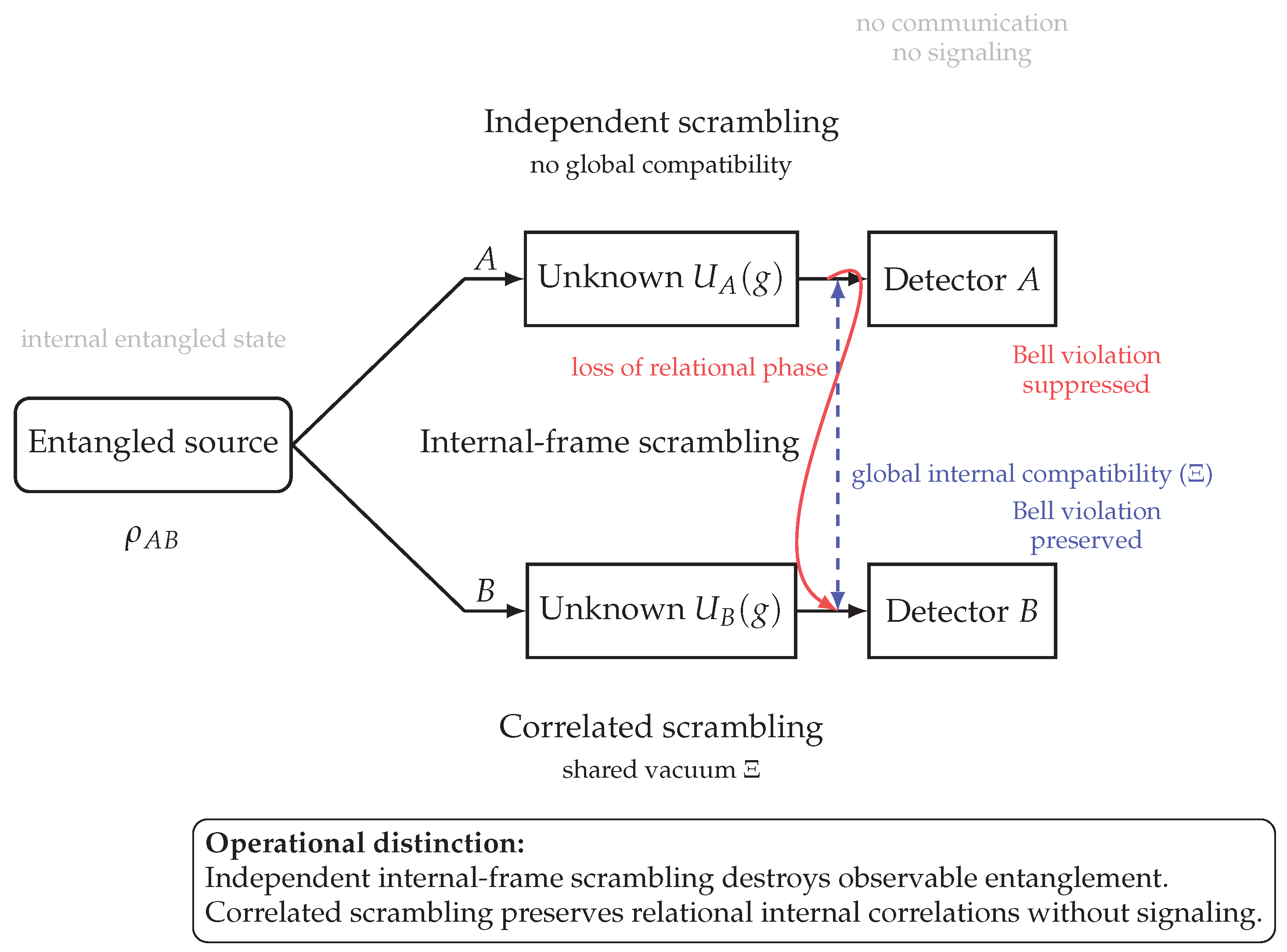
A schematic illustration of correlated versus independent internal-frame scrambling in the gauge-bundle picture is shown in Figure 3.
9. Discussion and Outlook
In this work we have developed a geometric perspective on quantum entanglement within the gauge-bundle formulation of the Standard Model. By making explicit a globally defined but locally pure-gauge internal frame structure of the vacuum, we have shown how global compatibility relations among internal representation degrees of freedom may be described without altering any local dynamics or introducing new physical interactions.
Within this perspective, entanglement is understood as a property of joint internal states that satisfy a global internal compatibility condition. This viewpoint neither replaces the standard Hilbert-space formalism of entanglement nor introduces new causal mechanisms. Instead, it provides a complementary geometric language that organizes well-established entanglement phenomena while preserving strict relativistic locality, gauge invariance, and all empirical predictions of standard quantum field theory.
- Nonlocal Correlations and Locality
As in conventional quantum theory, Bell-inequality-violating correlations [6] coexist with strict relativistic causality. Because the vacuum internal gauge structure is locally gauge-trivial and carries only global equivalence-class information, local operations in one spacetime region cannot alter the compatibility relations it represents elsewhere. Accordingly, the standard no-signaling property of relativistic quantum field theory is preserved [16]. The geometric picture developed here offers an intuitive way of visualizing the coexistence of global correlations and local dynamics, without modifying either.
- Internal Versus Geometric Degrees of Freedom
A central organizing feature of the framework is the distinction between internal representation degrees of freedom—associated with symmetry and gauge structure—and geometric degrees of freedom residing on the spacetime manifold. Within the fixed-background regime adopted in this work, the global compatibility relations represented by the vacuum internal gauge structure act exclusively on internal Hilbert-space factors. This reflects a representational choice appropriate to standard quantum field theory on a classical spacetime background, rather than a statement about the fundamental status of spacetime degrees of freedom in more general theoretical settings.
This perspective is consistent with the empirical fact that all experimentally verified entanglement phenomena are accessed through internal quantum variables—such as spin, polarization, or internal atomic states—even in experiments probing relativistic separation or gravitational mediation.
- Scope and Relation to Gravity
Throughout this work, spacetime geometry and gravity are treated as classical backgrounds, as is standard in quantum field theory on curved or flat spacetime. Questions concerning the quantization of gravity, the entanglement properties of hypothetical quantum geometric degrees of freedom, or the emergence of spacetime itself lie outside the scope of the present analysis. The geometric representation developed here should therefore be understood as an effective and regime-specific framework rather than as a universal statement about all possible theories of quantum gravity.
Within its intended domain, the framework remains compatible with existing and proposed experiments on gravitationally mediated entanglement, which infer entanglement through internal degrees of freedom of matter systems rather than through direct quantum states of the gravitational field [9,29].
- Relation to Broader Theoretical Programs
The construction presented here is deliberately minimal. It makes explicit a global internal compatibility structure already permitted within the gauge-bundle formulation of the Standard Model, without extending its dynamical content or postulating new physical entities. As such, it may serve as a useful organizational framework independent of any particular microscopic theory.
Related ideas concerning global compatibility, vacuum organization, or constraint-based structure have appeared in more speculative approaches to fundamental physics, including reconstruction-based or emergent spacetime programs [25]. The present work does not assume or depend on such frameworks. Instead, it isolates a purely structural feature that already exists within fixed-background quantum field theory. Whether deeper microscopic mechanisms give rise to similar global compatibility relations is an open question and a natural topic for future investigation.
In summary, the vacuum internal gauge perspective developed in this work does not seek to replace standard accounts of quantum entanglement, but to organize them within a coherent geometric language fully compatible with the Standard Model and fixed-background quantum field theory. By clarifying the role of global internal compatibility within the existing gauge structure—and by explicitly delimiting the regime in which geometric degrees of freedom are treated as external—it contributes to a more transparent conceptual understanding of quantum entanglement while leaving all established local physics unchanged.
Author Contributions
All authors have read and agreed to the published version of the manuscript.
Funding
This research received no external funding.
Data Availability Statement
The original contributions presented in this study are included in the article. Further inquiries can be directed to the corresponding author.
Conflicts of Interest
The author declares no conflicts of interest.
Abbreviations
The following abbreviations are used in this manuscript:
| VIGS | Vacuum Internal Group Symmetry |
| DOF | degrees of freedom |
Appendix A. Mathematical Representation of Vacuum Internal Compatibility
This appendix provides an explicit mathematical setting in which the vacuum internal compatibility structure discussed in the main text can be represented within standard Hilbert-space quantum mechanics. The purpose of this construction is not to introduce new dynamics, new interactions, or additional physical principles, but to demonstrate that the geometric perspective developed in the main text admits a precise and internally consistent realization using familiar quantum-mechanical tools.
The formulation relies on standard tensor-product factorization, constraint-projector techniques, and locality arguments widely employed in quantum information theory and algebraic quantum field theory (AQFT) [16,32,39]. For conceptual clarity, we work with finite-dimensional internal Hilbert spaces; extensions to field-theoretic or infinite-dimensional settings proceed by standard limiting and algebraic methods and introduce no conceptual novelty [42].
Throughout this appendix, spacetime geometry is treated as a fixed classical background, in accordance with the regime assumed in the main text.
Appendix A.1. Hilbert-Space Factorization
Let M be a fixed spacetime manifold and let denote two spacelike-separated regions. To each region we associate internal and external Hilbert spaces
with . The total Hilbert space admits the standard tensor-product decomposition
as routinely employed in quantum information theory [32].
In the geometric language of the main text, the internal Hilbert spaces may be viewed as finite-dimensional representations associated with the fibers of the internal bundle , consistent with the standard fiber-bundle formulation of gauge theories [23,31].
External Hilbert spaces encode geometric, positional, or background degrees of freedom and, by assumption, carry no representation of the internal gauge group.
Appendix A.2. Vacuum Internal Compatibility and Constraint Projectors
Let G be a compact Lie group and a unitary representation acting on internal degrees of freedom. A globally defined, locally flat internal-frame representation may then be associated with a gauge-equivalence class of internal automorphisms, subject to a flatness condition in the usual gauge-theoretic sense [3,45].
In the finite-dimensional model, such a global internal-frame alignment is represented by a constraint subspace
together with an associated orthogonal projector onto this subspace. This construction mirrors standard treatments of global constraints, symmetry restrictions, and superselection structures in quantum theory [12,16] and is purely representational.
The corresponding projector on the full Hilbert space is defined as
which acts trivially on all external degrees of freedom.
Definition A1
(Compatible state space). A state is said to be compatible with Ξ if
This condition provides a concrete realization of the global internal compatibility relation discussed in the main text. States that fail to satisfy this condition correspond to situations in which the geometric representation of compatibility no longer applies (for example, due to decoherence or disentanglement), without implying any modification of local dynamics or causal structure.
Appendix A.3. Structural Properties
The following propositions summarize structural features of this representation. They establish, in an explicit Hilbert-space setting, the statements collected in Section 6 of the main text.
Proposition A.1
(Localization of constraints). If Ψ is compatible with Ξ, then
That is, the compatibility constraint acts exclusively on the internal Hilbert-space sector.
Proof.
From Eq. (A2), acts as the identity on . The range of the projector is therefore . □
Proposition A.2
(Internal localization of correlations). For a pure state Ψ compatible with Ξ, any correlations imposed by the compatibility constraint may appear only in the internal Hilbert-space factors. External degrees of freedom remain unrestricted by .
Proof.
Consider a Schmidt decomposition of with respect to the factor ordering in Eq. (A1). Since , only the internal Schmidt vectors are constrained, while external factors remain arbitrary. □
Proposition A.3
(Compatibility with no-signaling). Let be a completely positive trace-preserving map acting only on degrees of freedom localized in region A and preserving the constraint subspace . Then
so local operations in A do not alter expectation values of observables in region B.
Proof.
Proposition A.4
(External-sector neutrality). If a sector of the theory carries no representation of the internal gauge group G, then the compatibility projector acts trivially on that sector.
Proof.
By construction, is proportional to the identity on all Hilbert-space factors transforming trivially under G. No compatibility constraint can therefore act on such degrees of freedom. □
- Relation to the Vacuum Internal Gauge Theorem. Propositions A.1–A.4 together establish the four structural statements summarized in Section 6 and formulated there as the Vacuum Internal Gauge Theorem. They demonstrate that vacuum internal compatibility can be represented explicitly within standard Hilbert-space quantum mechanics, without introducing new dynamics, modifying local operator algebras, or altering the causal structure of the theory.
These results should be understood as structural consistency checks within a specified regime, rather than as independent physical postulates. They show that the geometric perspective developed in the main text is mathematically well defined, conservative, and fully compatible with standard quantum theory.
An explicit two-qubit example realizing the compatibility projector construction and its operational consequences is worked out in Appendix B.
Appendix B. Worked Example: Two-Qubit Internal Frame Compatibility
This appendix presents a concrete finite-dimensional example illustrating how vacuum internal compatibility can be represented explicitly within standard Hilbert-space quantum mechanics. The purpose of this example is purely demonstrative: it shows, in the simplest nontrivial setting, how correlated versus independent internal-frame scrambling leads to operationally distinct outcomes, and how this distinction is naturally encoded by a compatibility projector acting solely on internal degrees of freedom.
No new physical assumptions are introduced. All constructions employed here are standard in quantum information theory and reference-frame analysis, and the example is fully consistent with conventional treatments of symmetry averaging and Bell correlations.
Appendix B.1. Setup
Consider a bipartite quantum system with internal Hilbert space
representing, for example, the polarization or spin degrees of freedom of two qubits localized in spacelike-separated regions A and B. External degrees of freedom (such as spatial position, timing, or apparatus states) are suppressed throughout, as they play no role in the internal compatibility analysis.
Let the system be prepared in the singlet Bell state
with corresponding density operator . The singlet state is distinguished by being invariant under joint rotations and therefore provides a natural minimal setting for illustrating global internal-frame compatibility.
The relevant internal symmetry group is , acting on each qubit via the fundamental representation. A group element acts as
Appendix B.2. Independent Internal-Frame Scrambling
Suppose that, from run to run, the two subsystems experience independent unknown internal-frame rotations , drawn from the Haar measure and not tracked experimentally. The effective observed state is then the independently twirled state
It is well known that such independent twirling maps any two-qubit state to the maximally mixed state,
which is separable and admits no Bell-inequality violation. All basis-dependent phase relations responsible for entanglement are erased because no shared internal reference frame exists between the two subsystems.
Operationally, this corresponds to complete loss of Bell visibility in the absence of reference-frame information, a standard result in studies of reference-frame misalignment and decoherence.
Appendix B.3. Correlated Internal-Frame Scrambling
Now consider correlated scrambling, in which both subsystems experience the same unknown internal-frame rotation from run to run. The effective state is
For the singlet state (A5), this correlated twirling leaves the state invariant:
This invariance follows from the fact that the singlet spans the total-spin-zero subspace, which is invariant under joint rotations. Entanglement is preserved because only the global internal frame is randomized; the relative internal orientation between the two qubits remains fixed.
Operationally, Bell-inequality violations remain observable up to a global relabeling of measurement settings.
Appendix B.4. Constraint-Projector Representation
The distinction between independent and correlated scrambling can be represented geometrically by introducing a compatibility subspace
together with the associated orthogonal projector
The corresponding projector on the full Hilbert space is
which acts trivially on all external degrees of freedom.
States compatible with the vacuum internal alignment represented by satisfy
exactly as in Definition A.1 of Appendix A. Independent scrambling drives states outside the range of , while correlated scrambling preserves it.
Appendix B.5. Interpretation
This worked example demonstrates explicitly how global internal compatibility may be represented as a constraint acting solely on internal Hilbert-space factors. No new dynamics are introduced, no nonlocal signaling is implied, and all results coincide exactly with standard quantum mechanics.
The vacuum internal gauge perspective provides a geometric language for organizing these facts: correlated scrambling corresponds to a shared global internal alignment class, while independent scrambling corresponds to the absence of such compatibility. The operational distinction between the two cases underlies the experimental signature discussed in Section 8.5.
References
- A. Aspect, J. Dalibard, and G. Roger, “Experimental test of Bell’s inequalities using time-varying analyzers,” Phys. Rev. Lett. 49, 1804 (1982). [CrossRef]
- N. W. Ashcroft and N. D. Mermin, Solid State Physics (Holt, Rinehart and Winston, New York, 1976).
- M. F. Atiyah and R. Bott, “The Yang–Mills equations over Riemann surfaces,” Phil. Trans. R. Soc. A 308, 523–615 (1983).
- J. C. Baez and J. P. Muniain, Gauge Fields, Knots and Gravity, World Scientific (1994).
- S. D. Bartlett, T. Rudolph, and R. W. Spekkens, “Reference frames, superselection rules, and quantum information,” Rev. Mod. Phys. 79, 555 (2007). [CrossRef]
- J. S. Bell, “On the Einstein–Podolsky–Rosen paradox,” Physics 1, 195–200 (1964). [CrossRef]
- N. D. Birrell and P. C. W. Davies, Quantum Fields in Curved Space, Cambridge University Press (1982).
- R. Blatt and D. Wineland, “Entangled states of trapped atomic ions,” Nature 453, 1008–1015 (2008). [CrossRef]
- S. Bose et al., “Spin entanglement witness for quantum gravity,” Phys. Rev. Lett. 119, 240401 (2017). [CrossRef]
- D. Bouwmeester et al., “Experimental quantum teleportation,” Nature 390, 575–579 (1997). [CrossRef]
- J. F. Clauser, M. A. Horne, A. Shimony, and R. A. Holt, “Proposed experiment to test local hidden-variable theories,” Phys. Rev. Lett. 23, 880 (1969). [CrossRef]
- P. A. M. Dirac, Lectures on Quantum Mechanics, Yeshiva University Press (1964).
- G. A. Durkin and J. P. Dowling, “Local and global distinguishability in quantum interferometry,” Phys. Rev. Lett. 99, 070801 (2007). [CrossRef]
- T. Frankel, The Geometry of Physics, 3rd ed., Cambridge University Press (2011).
- M. Giustina et al., “Significant-Loophole-Free Test of Bell’s Theorem with Entangled Photons,” Phys. Rev. Lett. 115, 250401 (2015). [CrossRef]
- R. Haag, Local Quantum Physics, Springer (1992).
- B. Hensen et al., “Loophole-free Bell inequality violation using electron spins separated by 1.3 km,” Nature 526, 682–686 (2015). [CrossRef]
- A. S. Holevo, Statistical Structure of Quantum Theory, Springer (2001).
- R. Horodecki, P. Horodecki, M. Horodecki, and K. Horodecki, “Quantum entanglement,” Rev. Mod. Phys. 81, 865–942 (2009). [CrossRef]
- J. D. Jackson, Classical Electrodynamics, 3rd ed. (Wiley, New York, 1998).
- E. Joos et al., Decoherence and the Appearance of a Classical World in Quantum Theory, Springer (2003).
- C. Kiefer and D. Polarski, “Emergence of classicality for primordial fluctuations: Concepts and analogies,” Annalen Phys. 7, 137–158 (1998). [CrossRef]
- S. Kobayashi and K. Nomizu, Foundations of Differential Geometry, Vol. 1, Wiley (1963).
- K. Kraus, “General state changes in quantum theory,” Ann. Phys. 64, 311 (1971). [CrossRef]
- B. Li, "Geometric Origin of Quantum Waves from Finite Action," Quantum Rep. 2025, 7, 61. https://doi.org/10.3390/quantum7040061. [CrossRef]
- G. Lindblad, “On the generators of quantum dynamical semigroups,” Commun. Math. Phys. 48, 119 (1976). [CrossRef]
- A. Mair, A. Vaziri, G. Weihs, and A. Zeilinger, “Entanglement of the orbital angular momentum states of photons,” Nature 412, 313–316 (2001). [CrossRef]
- J. Maldacena and L. Susskind, “Cool horizons for entangled black holes,” Fortsch. Phys. 61, 781–811 (2013). [CrossRef]
- C. Marletto and V. Vedral, “Gravitationally induced entanglement between two massive particles is enough to witness quantum gravity,” Phys. Rev. Lett. 119, 240402 (2017). [CrossRef]
- C. W. Misner, K. S. Thorne, and J. A. Wheeler, Gravitation, W. H. Freeman (1973).
- M. Nakahara, Geometry, Topology and Physics, 2nd ed., Taylor & Francis (2003).
- M. A. Nielsen and I. L. Chuang, Quantum Computation and Quantum Information, Cambridge University Press (2000).
- J.-W. Pan et al., “Multiphoton entanglement and interferometry,” Rev. Mod. Phys. 84, 777–838 (2012). [CrossRef]
- A. Peres, Quantum Theory: Concepts and Methods, Kluwer (1995).
- M. E. Peskin and D. V. Schroeder, An Introduction to Quantum Field Theory, Addison–Wesley (1995).
- A. O. Prokofiev and M. D. Kiselev, “Phonon entanglement in solid-state systems,” Phys. Rev. B 97, 104302 (2018).
- J. J. Sakurai and J. Napolitano, Modern Quantum Mechanics, 2nd ed., Addison–Wesley (2011).
- A. Shimony, “Degree of entanglement,” Ann. N.Y. Acad. Sci. 755, 675–679 (1995). [CrossRef]
- S. J. Summers and R. Werner, “Bell’s inequalities and quantum field theory. I. General setting,” J. Math. Phys. 28, 2440–2447 (1985). [CrossRef]
- M. Van Raamsdonk, “Building up spacetime with quantum entanglement,” Gen. Rel. Grav. 42, 2323–2329 (2010). [CrossRef]
- R. M. Wald, General Relativity, University of Chicago Press (1984).
- R. M. Wald, Quantum Field Theory in Curved Spacetime and Black Hole Thermodynamics, University of Chicago Press (1994).
- S. Weinberg, The Quantum Theory of Fields, Vol. I, Cambridge University Press (1995).
- D. Leibfried, R. Blatt, C. Monroe, and D. Wineland, “Quantum dynamics of single trapped ions,” Rev. Mod. Phys. 75, 281–324 (2003). [CrossRef]
- T. T. Wu and C. N. Yang, “Concept of nonintegrable phase factors and global formulation of gauge fields,” Phys. Rev. D 12, 3845–3857 (1975). [CrossRef]
- C. N. Yang and R. L. Mills, “Conservation of isotopic spin and isotopic gauge invariance,” Phys. Rev. 96, 191–195 (1954). [CrossRef]
- H. D. Zeh, The Physical Basis of the Direction of Time, Springer (2007).
- A. Zeilinger, “Experiment and the foundations of quantum physics,” Rev. Mod. Phys. 71, S288–S297 (1999). [CrossRef]
- L. Zhang and Q. Niu, “Angular momentum of phonons and the Einstein–de Haas effect,” Phys. Rev. Lett. 112, 085503 (2014). [CrossRef]
- W. H. Zurek, “Decoherence, einselection, and the quantum origins of the classical,” Rev. Mod. Phys. 75, 715–775 (2003). [CrossRef]
Figure 1.
Schematic illustration of the vacuum internal gauge structure used in the VIGS framework. A globally defined but locally pure-gauge internal frame exists over the spacetime manifold M, while each spacetime point retains full local gauge freedom in its internal fiber . Because is flat (), internal frames at spatially separated points are globally compatible without introducing curvature, energy, or propagating degrees of freedom. Unlike standard shared-reference-frame treatments, the global internal alignment shown here is not classical side information or experimental coordination, but a vacuum-level gauge structure that is locally unobservable. This structure provides the geometric basis for vacuum gauge bridges and entanglement without modifying local dynamics or spacetime locality.
Figure 1.
Schematic illustration of the vacuum internal gauge structure used in the VIGS framework. A globally defined but locally pure-gauge internal frame exists over the spacetime manifold M, while each spacetime point retains full local gauge freedom in its internal fiber . Because is flat (), internal frames at spatially separated points are globally compatible without introducing curvature, energy, or propagating degrees of freedom. Unlike standard shared-reference-frame treatments, the global internal alignment shown here is not classical side information or experimental coordination, but a vacuum-level gauge structure that is locally unobservable. This structure provides the geometric basis for vacuum gauge bridges and entanglement without modifying local dynamics or spacetime locality.
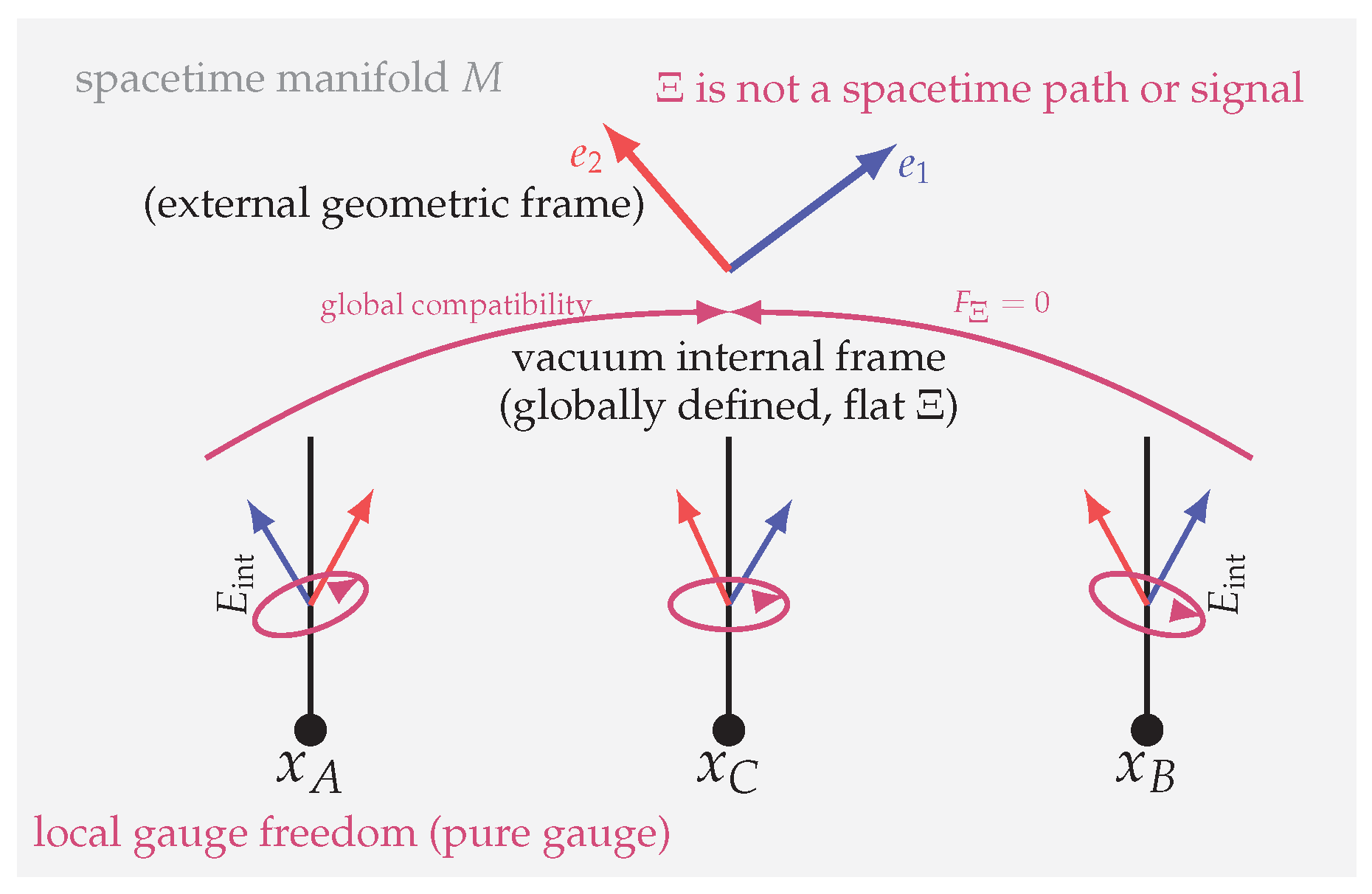
Figure 2.
Vacuum gauge bridge between internal fibers. Two spacelike-separated regions A and B possess internal fibers and associated with the Standard Model gauge bundle. A globally defined but locally pure-gauge vacuum structure () induces a vacuum gauge bridge that encodes a global internal compatibility relation between internal degrees of freedom. This bridge is not a spacetime channel, carries no energy or curvature, and does not mediate interactions or signals. External geometric degrees of freedom reside entirely on the spacetime manifold M, admit no such compatibility structure, and therefore do not participate in entanglement within the fixed-background regime considered here.
Figure 2.
Vacuum gauge bridge between internal fibers. Two spacelike-separated regions A and B possess internal fibers and associated with the Standard Model gauge bundle. A globally defined but locally pure-gauge vacuum structure () induces a vacuum gauge bridge that encodes a global internal compatibility relation between internal degrees of freedom. This bridge is not a spacetime channel, carries no energy or curvature, and does not mediate interactions or signals. External geometric degrees of freedom reside entirely on the spacetime manifold M, admit no such compatibility structure, and therefore do not participate in entanglement within the fixed-background regime considered here.
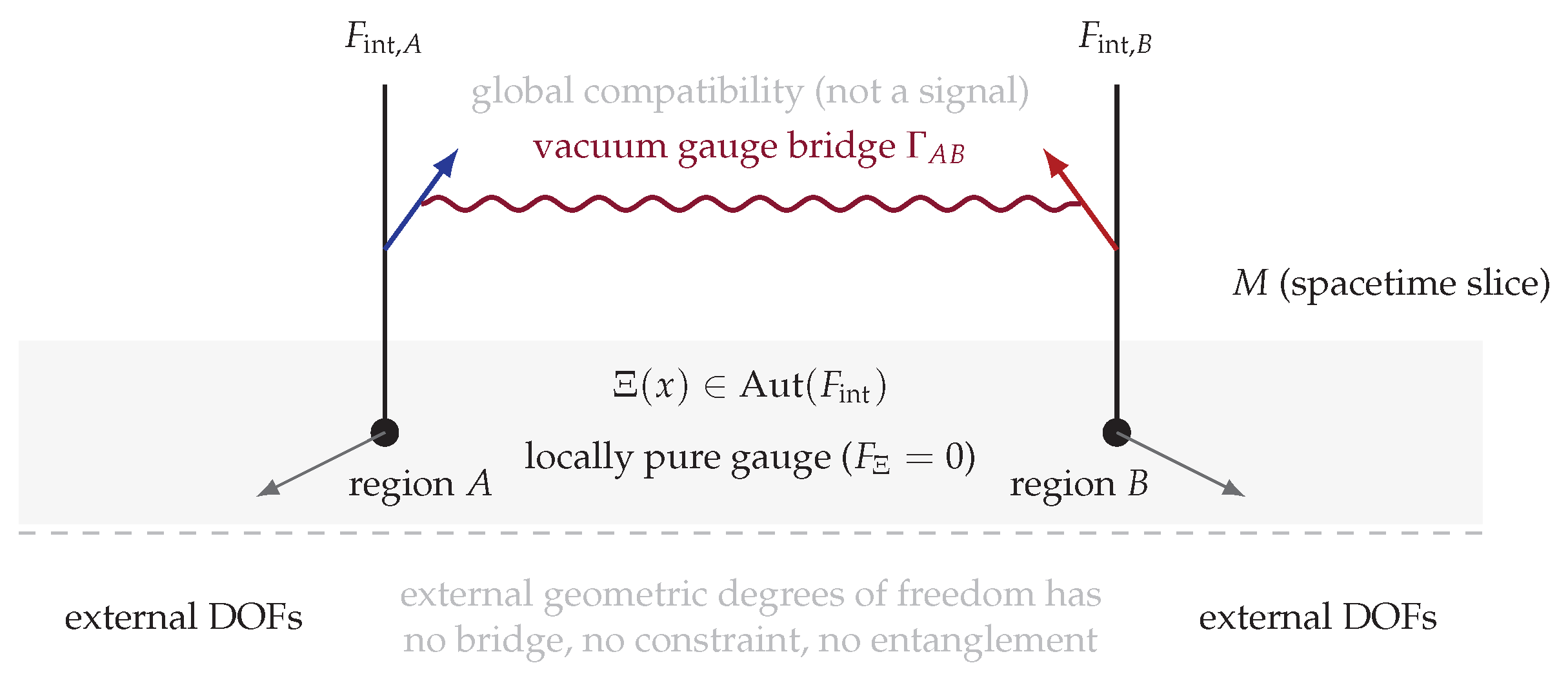
Figure 3.
Operational signature distinguishing independent and correlated internal-frame scrambling. An entangled internal state is distributed to two distant measurement stations. Each arm undergoes unknown internal-frame rotations. If the rotations are independent, relational phase information is lost and Bell-inequality violations are suppressed by effective twirling. If the rotations are correlated, corresponding to a shared vacuum-level internal compatibility structure , relative internal correlations are preserved and Bell violations remain observable. No communication, signaling, or dynamical interaction is involved; the distinction reflects the presence or absence of global internal compatibility.
Figure 3.
Operational signature distinguishing independent and correlated internal-frame scrambling. An entangled internal state is distributed to two distant measurement stations. Each arm undergoes unknown internal-frame rotations. If the rotations are independent, relational phase information is lost and Bell-inequality violations are suppressed by effective twirling. If the rotations are correlated, corresponding to a shared vacuum-level internal compatibility structure , relative internal correlations are preserved and Bell violations remain observable. No communication, signaling, or dynamical interaction is involved; the distinction reflects the presence or absence of global internal compatibility.
Disclaimer/Publisher’s Note: The statements, opinions and data contained in all publications are solely those of the individual author(s) and contributor(s) and not of MDPI and/or the editor(s). MDPI and/or the editor(s) disclaim responsibility for any injury to people or property resulting from any ideas, methods, instructions or products referred to in the content. |
© 2026 by the authors. Licensee MDPI, Basel, Switzerland. This article is an open access article distributed under the terms and conditions of the Creative Commons Attribution (CC BY) license (http://creativecommons.org/licenses/by/4.0/).
Copyright: This open access article is published under a Creative Commons CC BY 4.0 license, which permit the free download, distribution, and reuse, provided that the author and preprint are cited in any reuse.


