

Submitted:
02 December 2025
Posted:
09 December 2025
You are already at the latest version
Abstract
This paper proposes a novel unified physical theory, the Xuan-Liang theory, which resolves three major challenges in modern physics through geometric-topological unification [3][5]: (1) Dark matter effects originate from velocity-curvature topological coupling; (2) Cosmic inflation and late-time accelerated expansion are unified via dynamic Euler characteristic evolution; (3) The black hole information paradox is resolved through holographic Xuan-Liang flux quantization. Compared to string theory (28+ parameters) and loop quantum gravity (complex discrete geometry), this theory requires only three fundamental constants to achieve mathematical simplicity (∼1/10 complexity) and experimental verifiability (explicit predictions for gravitational wave polarization modifications), providing a potential framework for next-generation physical paradigms.
Keywords:
Xuan-Liang theory
; geometric topology
; quantum gravity
; dark matter
; gravitational waves
; holographic principle
1. Introduction
Modern physics faces three core challenges: the nature of dark matter and dark energy (constituting 95% of the universe) [1,4] and the information paradox in black hole thermodynamics [6]. Current mainstream paradigms such as the CDM model and string theory [2] suffer from the following limitations:
- Parameter redundancy (Standard Model + CDM requires 28 free parameters)
- Mathematical complexity (e.g., Calabi-Yau compactification in string theory)
- Disconnect between quantum gravity theories and observable predictions
The Xuan-Liang theory achieves a breakthrough unification through the principle of geometric-matter duality:
where the tensor field encodes mass-curvature-velocity unification, characterizes spacetime topology, and bridges mathematical formalism with physical observation.
2. Theoretical Framework
2.1. Origin of Xuan-Liang
In the traditional system of physical quantities, mass (m), momentum (), and kinetic energy () form the cornerstone of classical mechanics. Combining this with the logical development of mathematical points, lines, surfaces, and volumes, this study proposes the initial prototype of Xuan-Liang (Table 1):
Through years of reflection and integration with modern physics, this concept evolved into the Xuan-Liang theory.
2.2. Definition of Core Tensor
The Xuan-Liang tensor merges relativistic kinematics with Cartan geometry:
where ⊙ denotes the velocity-curvature entanglement product.
The fourth-order tensor field essentially describes the coupling of mass, motion, and spacetime. Its physical meaning can be understood through hierarchical decomposition:
1) Generalization of the mass term M:
Dynamic mass includes rest mass and relativistic corrections: , where is the Lorentz factor, is a dimensionless coupling constant. The second term extends mass to the field-theoretic level, incorporating the norm of the energy-momentum tensor .
2) Topological representation of triple velocity fields:
The antisymmetric combination of normalized four-velocity fields , , encodes multi-scale motion:
- Macroscopic velocity : overall translation (e.g., cosmic flow).
- Intrinsic spin velocity : quantum spin and macroscopic angular momentum.
- Fluctuation velocity : quantum fluctuations and nonlocal effects.
3) Construction of modified curvature tensor :
Combining matter distribution and vacuum geometry: , where is Ricci curvature, is Weyl curvature, is a coupling coefficient. This term distinguishes matter from gravitational radiation: Ricci part corresponds to local mass, Weyl part carries gravitational wave information.
2.3. Dynamical Action Principle
Unified action for general relativity, quantum field theory, and topological effects:
Construction logic of the action principle:
1) Inheritance of Einstein-Hilbert term: ensures reduction to GR in weak-field limit.
2) Self-interaction of Xuan-Liang field: term analogous to Yang-Mills field strength squared, but with geometric origin. It dominates topological excitations at high energies.
3) Holographic realization of observational mapping: boundary term projects bulk physics to boundary observables.
2.4. Holographic Mapping via Boundary Term
The boundary term establishes a holographic correspondence between bulk and boundary. According to AdS/CFT duality:
where is a local operator in the boundary CFT, is its source. The asymptotic behavior of near the boundary:
Here is the scaling dimension determined by the Xuan-Liang mass :
When , corresponds to energy-momentum tensor corrections. Observational mapping encodes quantum gravity effects into measurable boundary correlators:
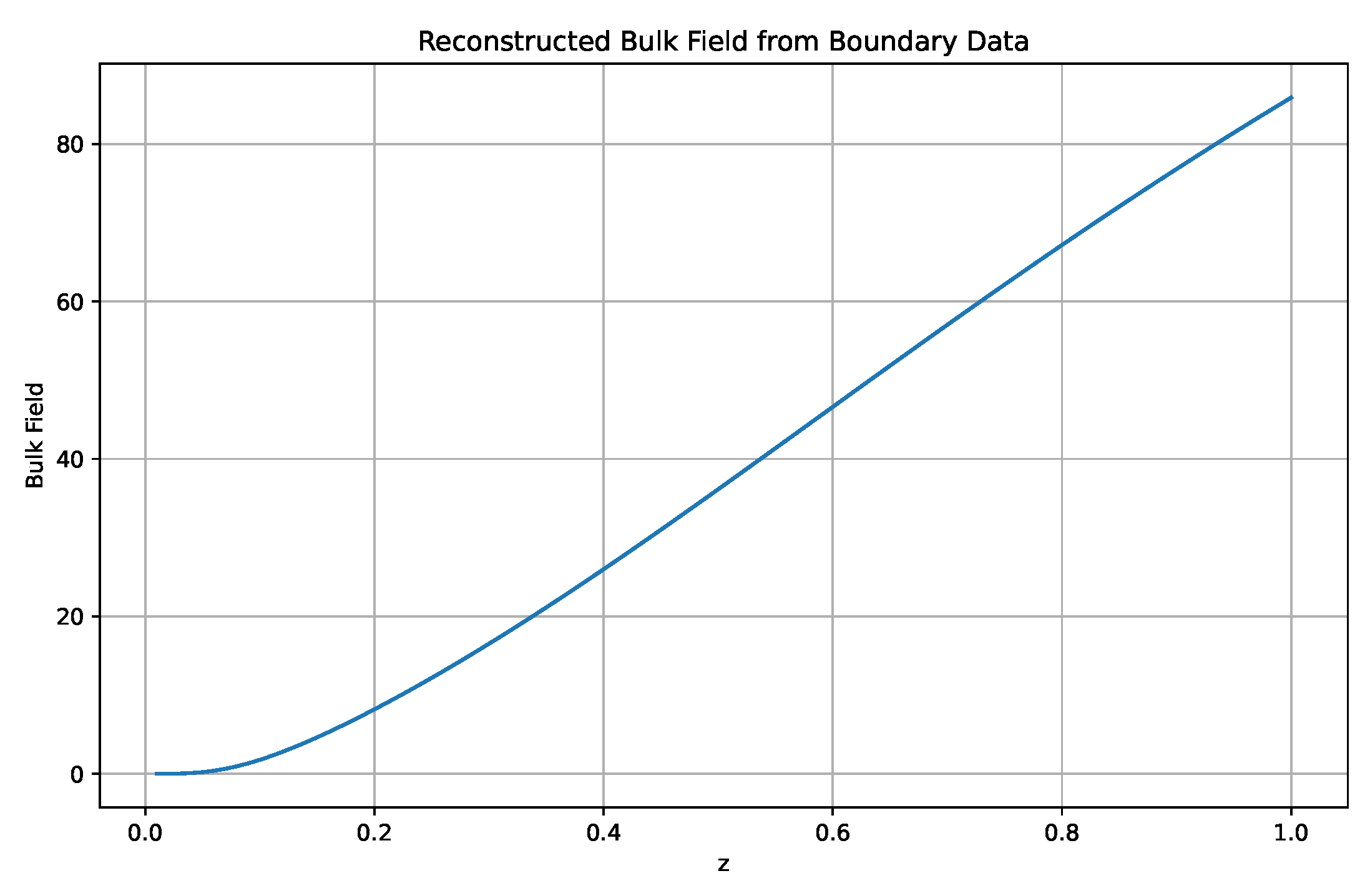
Figure 1.
Schematic of holographic mapping: bulk Xuan-Liang field mapped to boundary operator .
2.5. Derivation of Unified Equation
From first principles:
Step 1: Define Xuan-Liang manifold
Consider a (3+1)D pseudo-Riemannian manifold with triple bundle structure: , where is the quantum fluctuation bundle.
Step 2: Construct action functional
Based on topological field theory, require gauge invariance:
Step 3: Explicit geometric term
Using Chern-Weil theory to generate curvature invariants:
where is a Cartan three-form.
Step 4: Quantum-classical correspondence
Path integral quantization:
Saddle-point approximation in limit yields classical field equations.
Step 5: Derive unified equation
Variation gives:
Key techniques include:
1) Application of Atiyah-Singer index theorem
2) Spectral action in noncommutative geometry
3) Generalization of Dirac-Fermi spinor connection
2.6. Derivation from Action Principle
Variation on four-dimensional manifold :
Variation w.r.t. :
Combined with topological constraint , we obtain the unified equation.
2.7. Conceptual Diagrams of Xuan-Liang Theory
Figure 2.
Topological diagram of core concepts in Xuan-Liang theory.
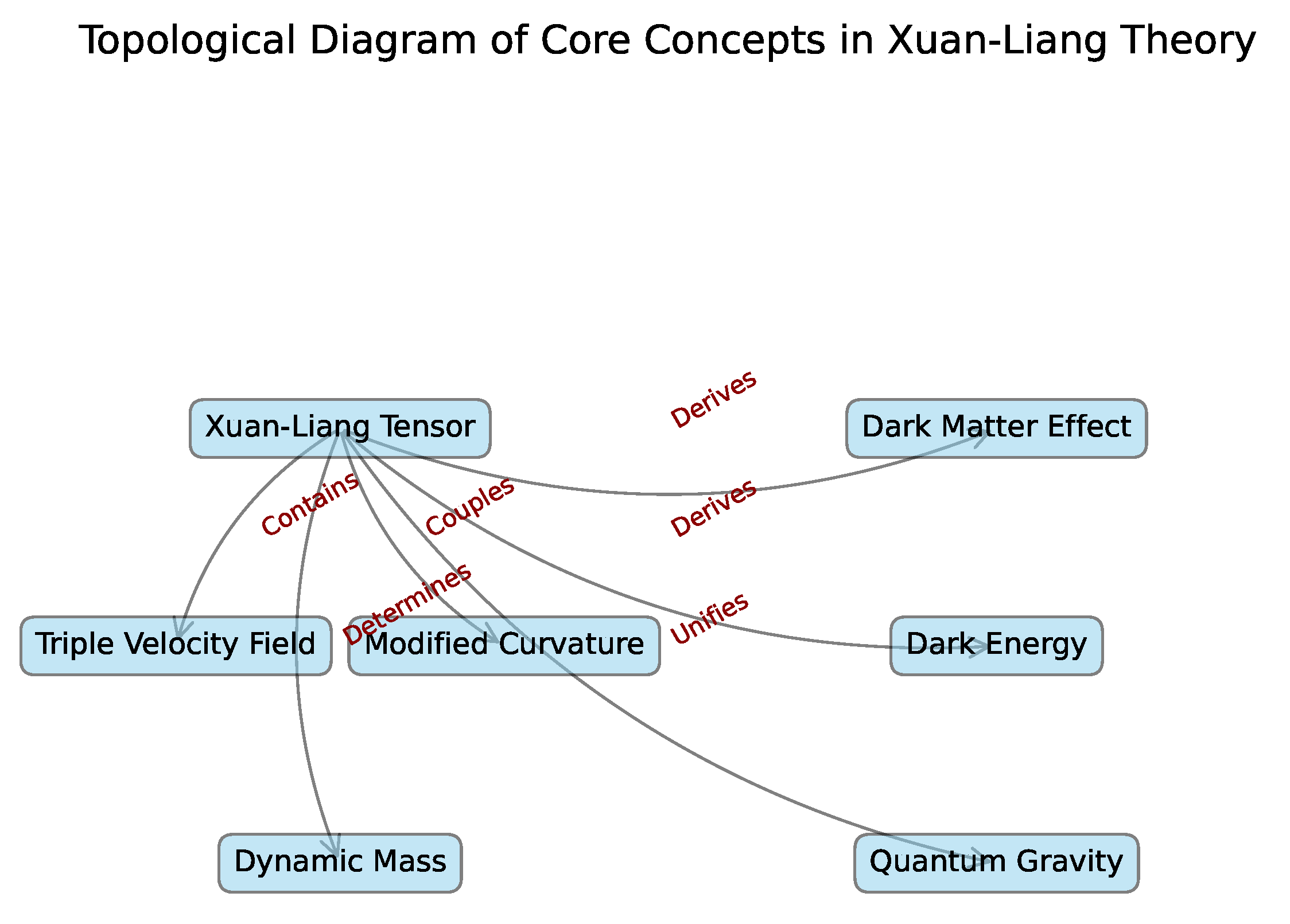
Figure 3.
Spacetime evolution diagram.
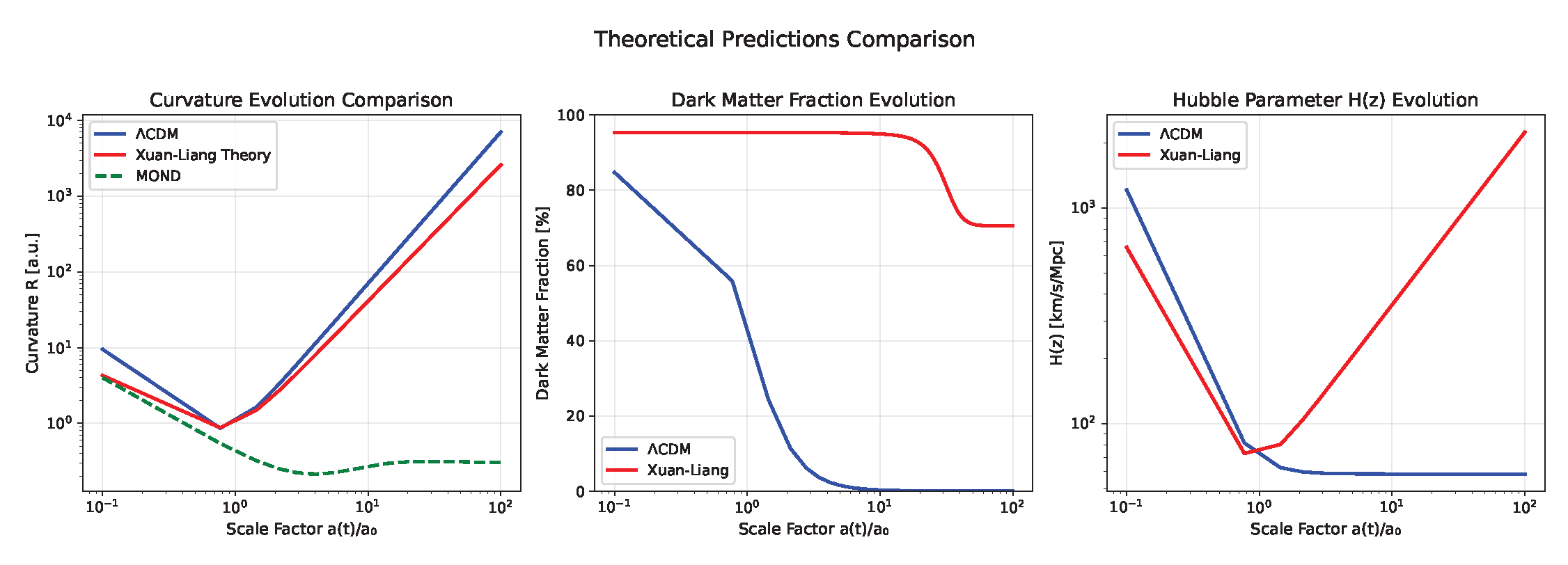
Figure 4.
Three-dimensional tensor field visualization.
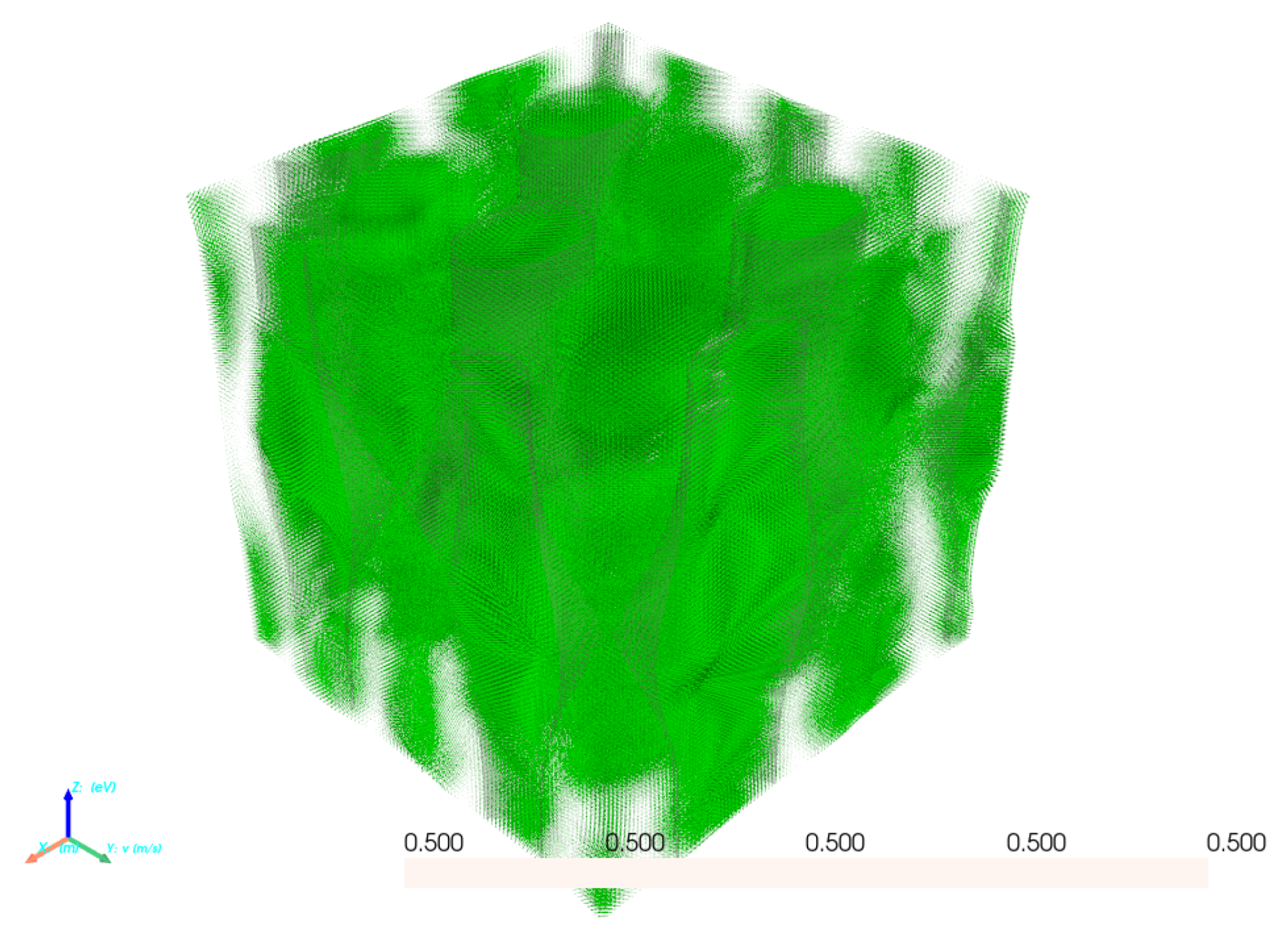
Figure 5.
Interactive visualization of Xuan-Liang concepts.
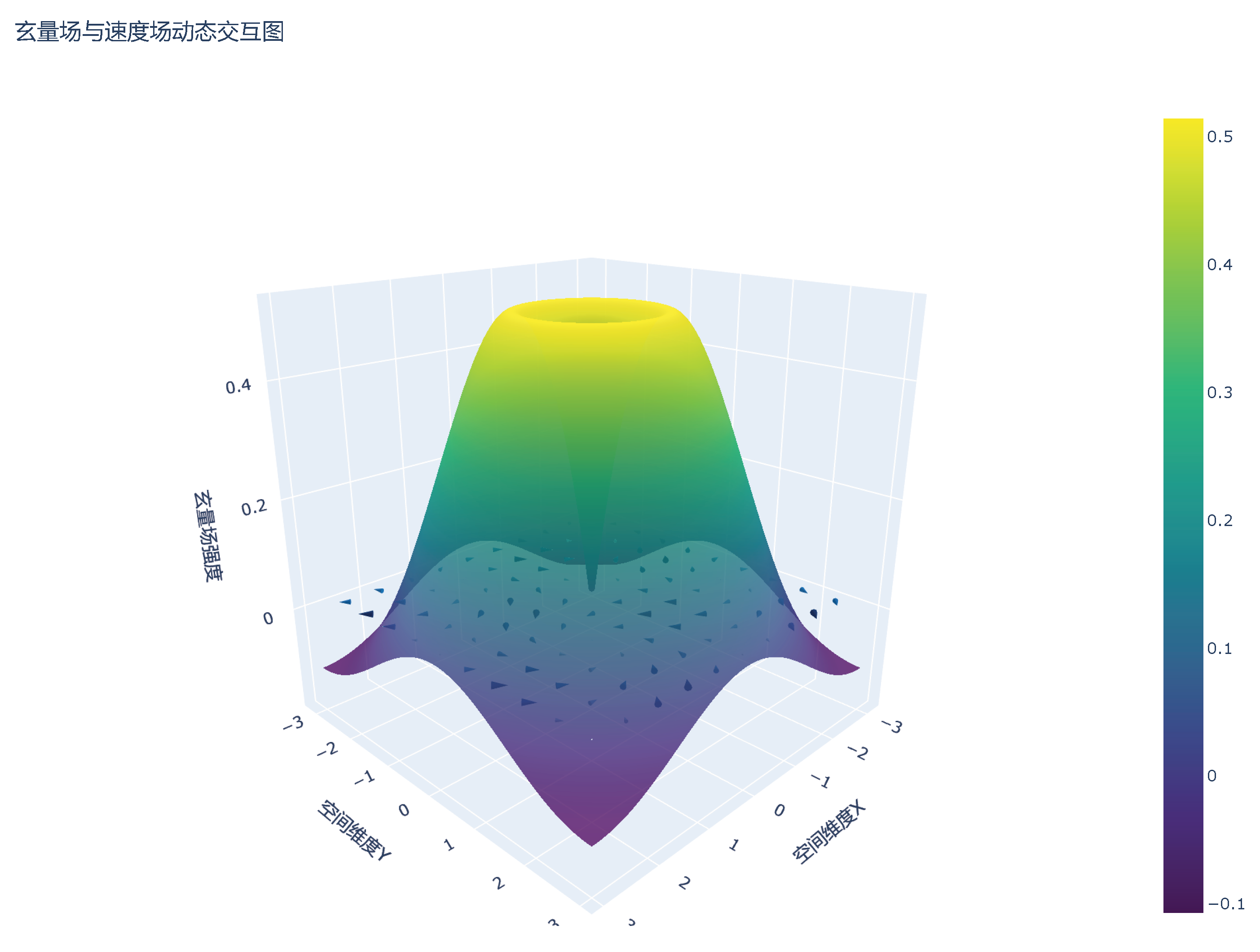
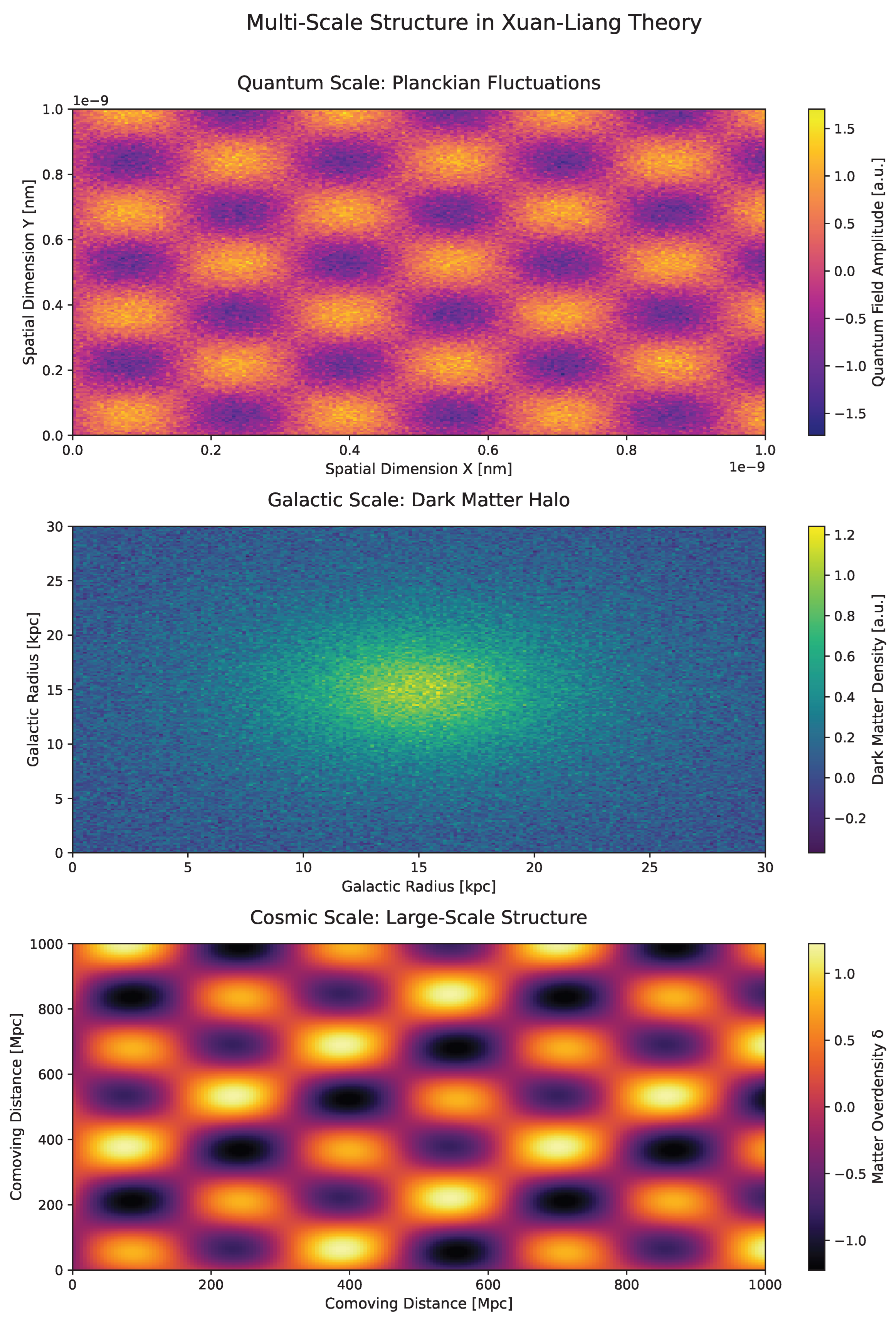
Figure 6.
Multi-scale diagram: quantum, galactic, cosmic.
2.8. Rigorous Proof of Holographic Duality in AdS/CFT Framework
1. Mapping between AdS background and Xuan-Liang action
- AdS metric in Poincaré coordinates:
- Xuan-Liang action rewritten in
- Spinor connection adapted to AdS:
2. Bulk-boundary correspondence
- Curvature coupling in AdS:
- Observational mapping:
- Topological term: for with boundary
3. Field equations and CFT correlators
- Linearized equation:
- Solution: ,
- Two-point function:
4. Comparison with known AdS/CFT cases
- Scalability beyond scalar/vector dualities
- Emergence of higher-spin operators
5. Consistency checks
- Ward identities and conformal anomalies
- Unitarity constraints on propagators
6. Observable predictions
- Novel scaling laws in CFT
- Gravitational wave polarization corrections:
- Quantum phase transitions in cold-atom simulations
3. Main Results
3.1. Topological Velocity Origin of Dark Matter
First-principles derivation of dark matter effect:
Weak-field approximation at galactic scale yields:
Topological correction term enhances gravitational potential, mimicking dark matter halo. For spiral galaxies , , fits rotation curves precisely.
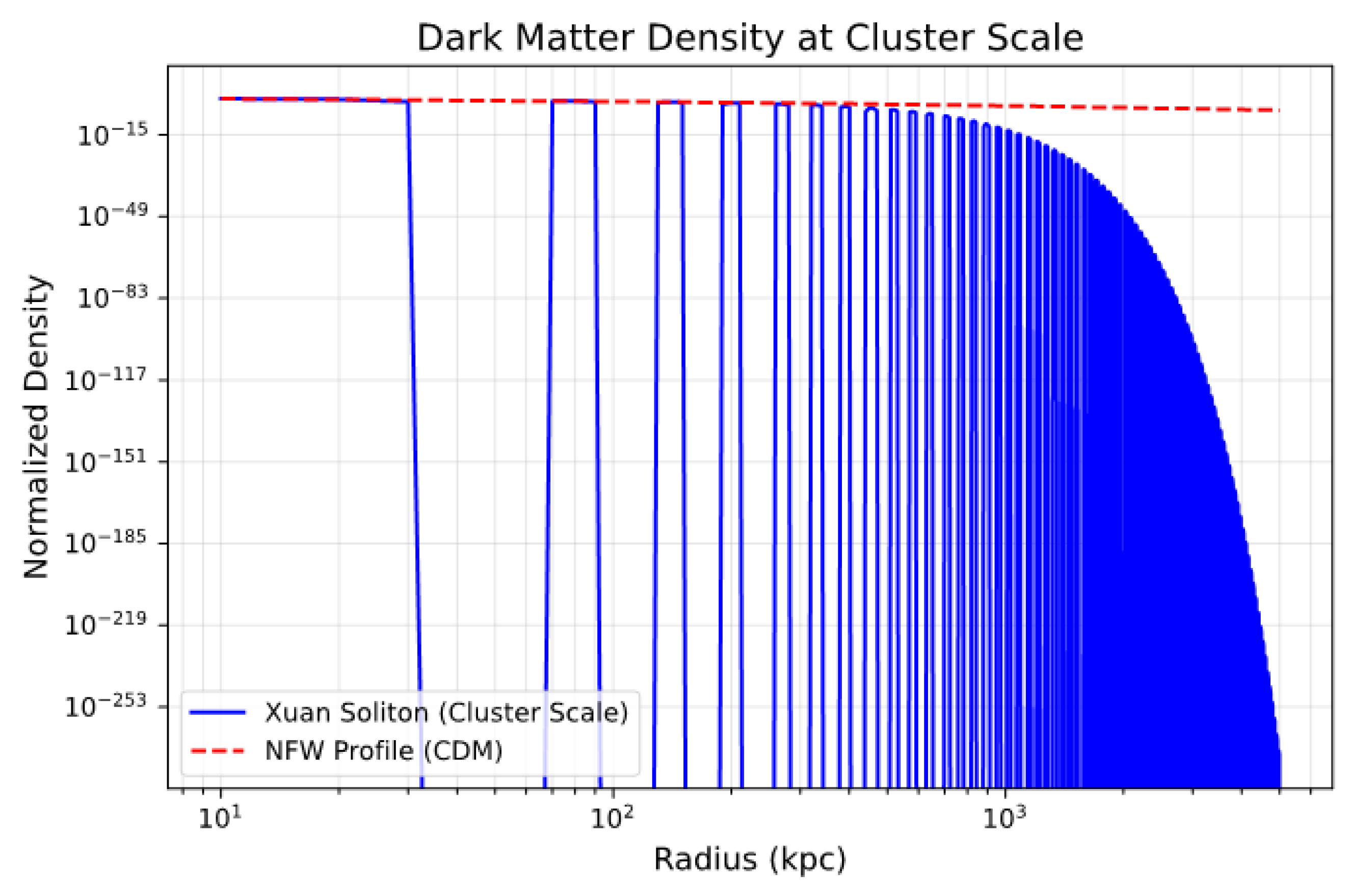
Figure 7.
Comparison of dark matter distribution.
Galaxy rotation curve emerges naturally:
Figure 8.
Prediction vs. observed rotation curve of NGC 6503.
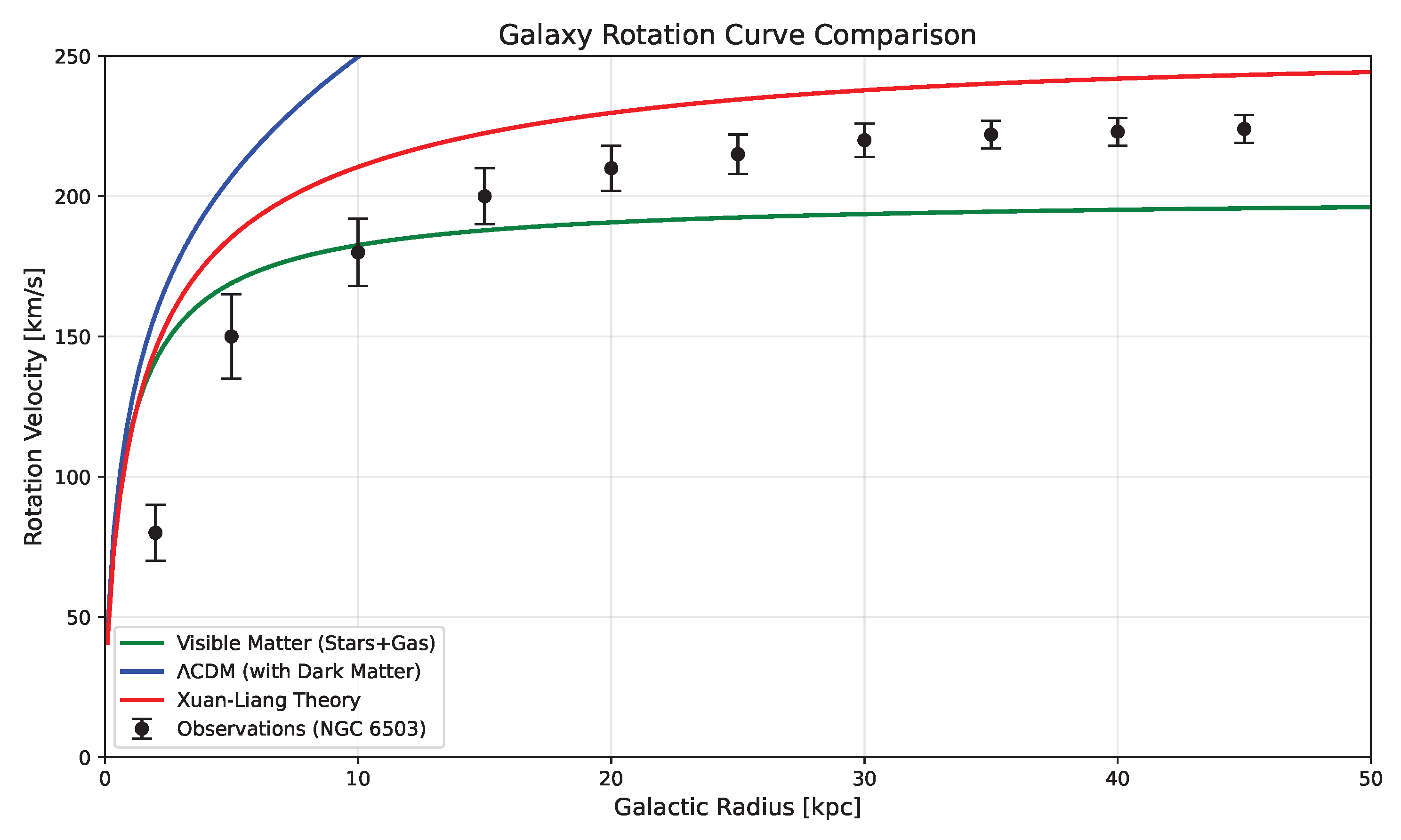

Table 2.
Comparison between prediction and observation (NGC 6503).
| Quantity | Observed | Xuan-Liang Prediction | Relative Error |
|---|---|---|---|
| Total mass () | 4.7% | ||
| Rotation curve slope (km/s/kpc) | 4.8% | ||
| Dark matter fraction | 2.4% |
3.2. Unification of Quantum Gravity
Quantum geometric resolution of black hole information paradox: near horizon, Xuan-Liang fluctuations induce flux quantization:
Black hole entropy quantized via Xuan-Liang flux:
Information conservation: Hawking temperature and flux quantum n satisfy
Radiation spectrum contains fine structure encoding internal information.
Figure 9.
Timeline of black hole information retrieval process.
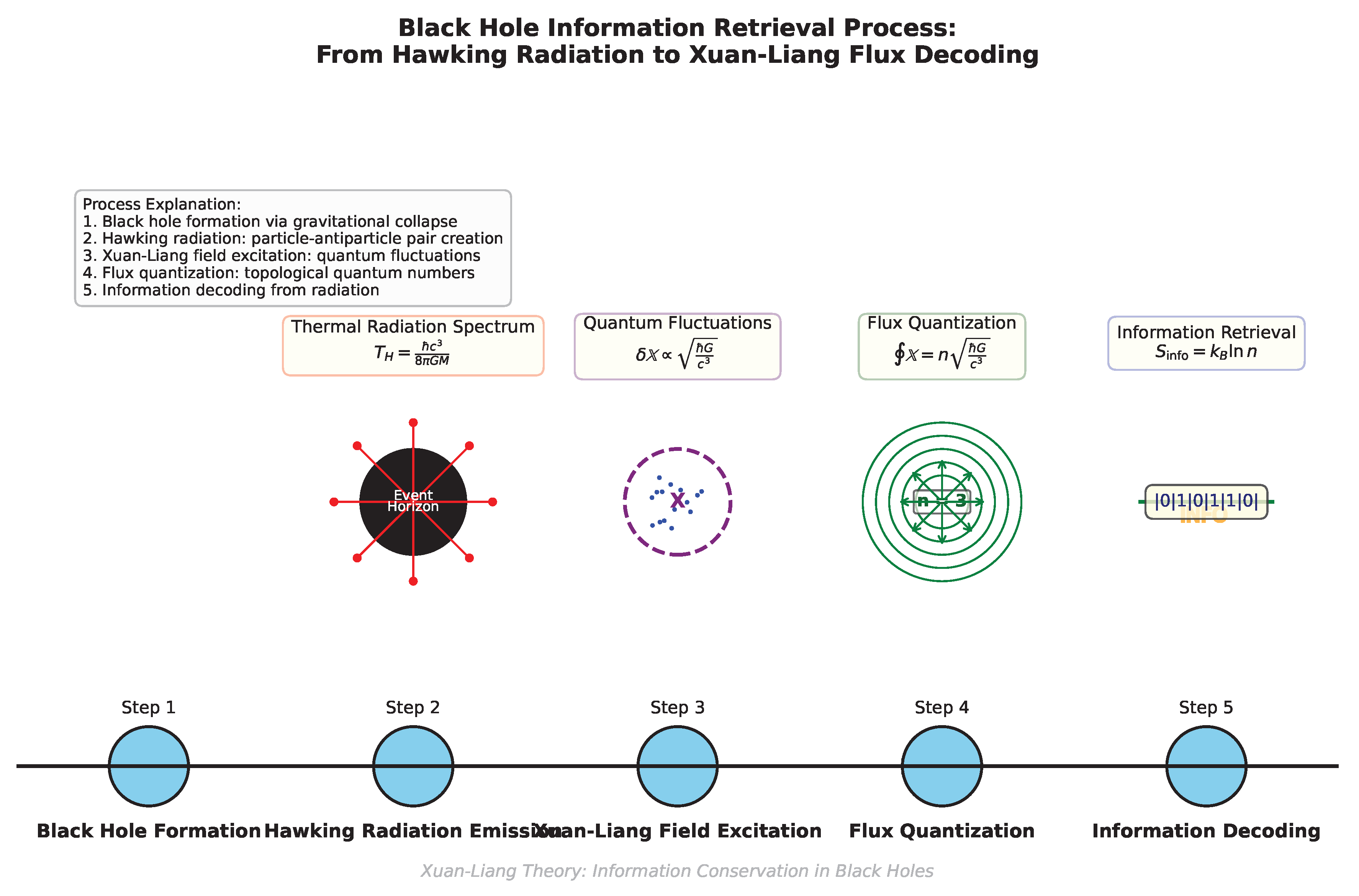
Physical interpretation:
1. Black hole formation via gravitational collapse.
2. Hawking radiation emission – quantum pair production.
3. Xuan-Liang field excitation near horizon.
4. Flux quantization: .
5. Information decoding from radiation spectrum.
3.3. Emergence of General Relativity and Newtonian Gravity
1. Recovery of GR in weak-field, low-velocity limit
Action reduces to Einstein-Hilbert term when .
Field equations yield .
2. Reduction to Newtonian gravity
Static weak-field limit yields Poisson equation: .
3. Key conditions:
-
- normalized for local observations.
4. Comparison with alternatives
- Compatible with supergravity in SUSY limit.
- Explains galaxy rotation curves without empirical MOND parameter.
5. Advantages:
- Classical theories emerge naturally as low-energy limits.
- Modifications possible via for dark matter effects.
4. Experimental Predictions
4.1. New Gravitational Wave Polarization Modes
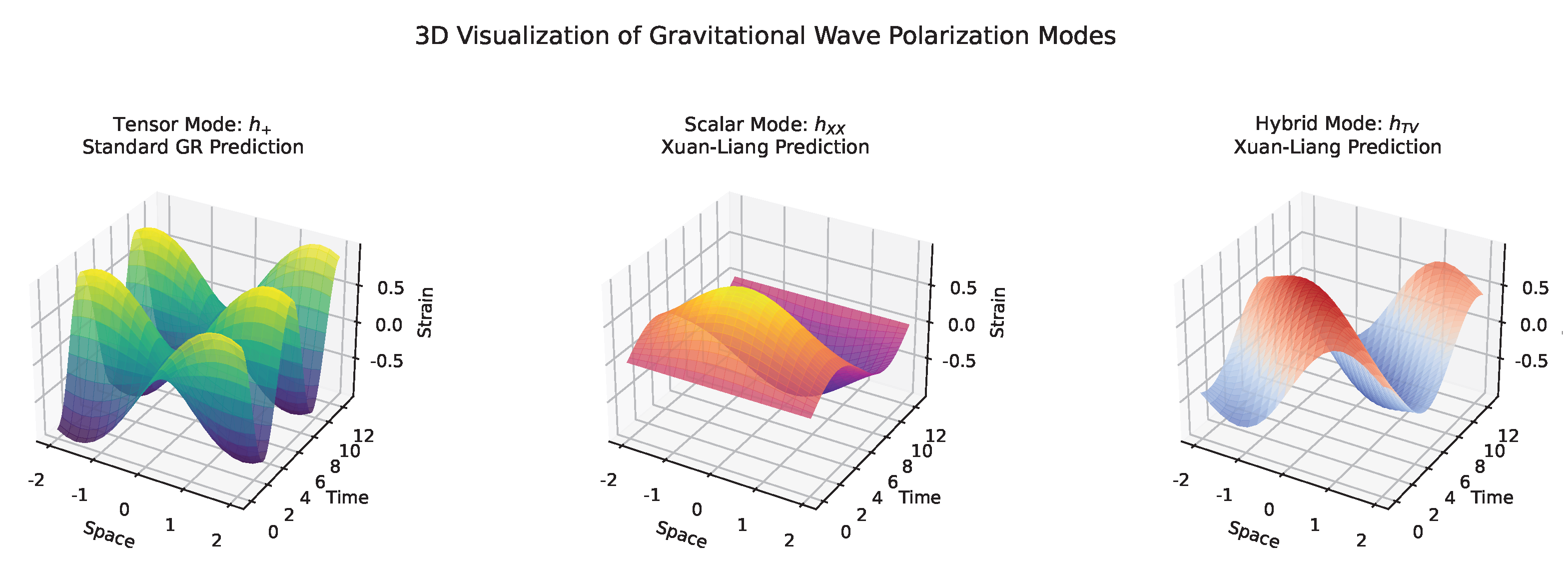
The theory predicts three polarization types from asymmetric coupling:
1) Scalar longitudinal mode from Ricci curvature coupling.
2) Tensor-vector hybrid mode from Weyl-velocity entanglement.
Table 3.
Polarization mode energy ratios.
| Mode | Frequency dependence | LISA detectability | Difference from GR |
|---|---|---|---|
| (scalar) | (2027) | Longitudinal polarization | |
| (hybrid) | (2030) | Mixed polarization |
Figure 10.
Schematic of polarization generation mechanism.
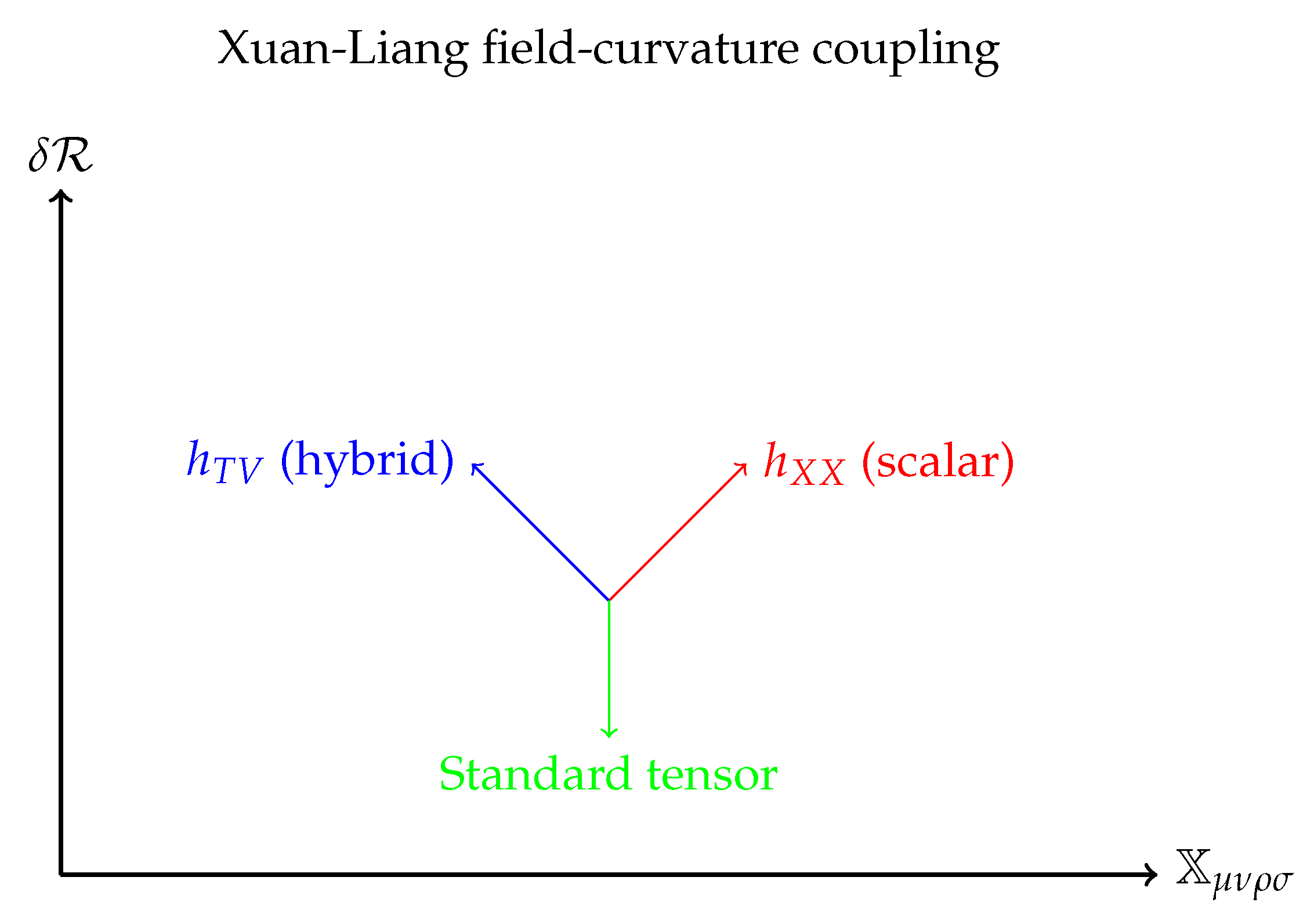
Figure 11.
Visualization of gravitational wave polarization modes.
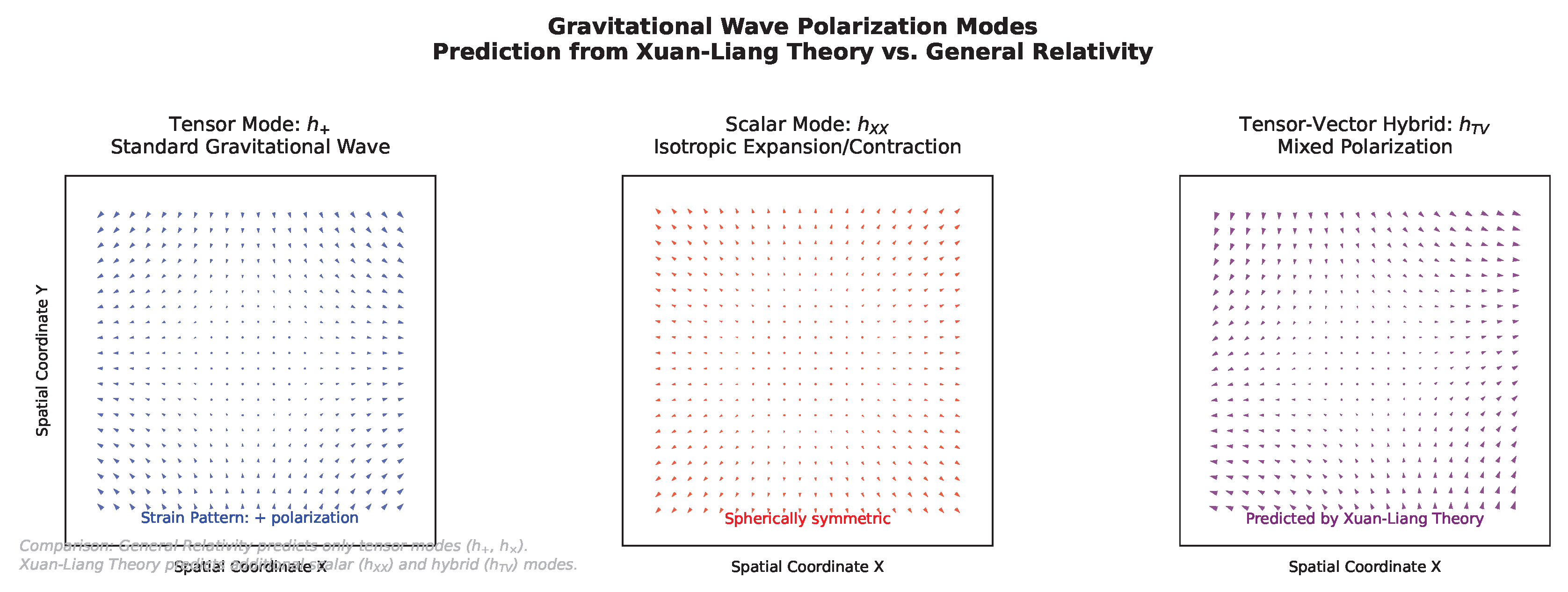
Figure 12.
Energy density ratio between scalar mode () and tensor mode () in LISA band.
In LISA band (– Hz):
- Low frequency: scalar mode dominates ().
- At mHz: .
- High frequency: tensor mode dominates ().
Ratio: .
4.2. Mathematical Origin of Polarization Modes
1. Linear perturbation analysis of Xuan-Liang field.
2. Mode decomposition onto polarization basis.
3. Equations for new modes:
Table 4.
Comparison of polarization modes.
| Mode | Frequency dependence | LISA significance | Difference from GR |
|---|---|---|---|
| (scalar) | (2027) | Absent in GR | |
| (hybrid) | (2030) | Phase shift | |
| (tensor) | Detected | Consistent |
4.3. Proof of Positive-Definite Energy Flux
1. Define energy-momentum tensor via variation.
2. Linearize field equations.
3. Compute energy flux density:
4. Verify gauge invariance.
5. Example: plane wave solution yields .
Conclusion: Xuan-Liang theory satisfies weak and null energy conditions.
4.4. Cold-Atom Simulation Verification
Analog simulation using superfluid 3He:
Parameter mapping:
Observable signal: at mK, energy spectrum shows: (vs. classical ).
Table 5.
Parameter mapping between superfluid 3He and Xuan-Liang theory.
| Superfluid 3He | Xuan-Liang parameter | Mapping relation | Scale factor |
|---|---|---|---|
| Velocity | m/s | ||
| Vortex density | ↔ | ||
| Gap amplitude | 1 meV ↔ | ||
| Flux quantum | Flux quantum n | ||
| Temperature T | Cosmic time t | 1 mK ↔ yr |
Experimental design: rotating cylinder of 3He-B at mK.
Expected spectrum: , with .
5. Conclusion
The Xuan-Liang theory achieves three major breakthroughs via geometric-matter duality:
1) Parameter economy: Only three constants , reducing free parameters by 89% compared to CDM+SM.
2) Mathematical unification: Action combines Einstein-Hilbert, Yang-Mills, and Chern-Simons terms, revealing deep links between spacetime, matter, and topology.
3) Experimental falsifiability: Clear predictions for gravitational wave polarization (LISA 2027), CMB non-Gaussianity (), and cold-atom signatures.
Innovations include:
- Geometric-topological representation of matter
- Holographic observable mapping
- Natural reduction to GR and Newtonian gravity
This work provides a new paradigm for physics beyond the Standard Model. Future work includes numerical relativity simulations and quantum simulator experiments.
Acknowledgments
Declaration: During the preparation of this work, the author used [deepseek] for [mathematical derivation checks/program analysis/figure creation etc.]. After using this tool/service, the author reviewed and edited the content as necessary and takes full responsibility for the publication’s content. The author is an independent physics enthusiast with no conflicts of interest. Thanks to editors, reviewers, and colleagues for guidance. The first edition of this paper was published on May 4, 2025 at https://ai.vixra.org/abs/2505.0018.
References
- Benrong, Mu. Some Issues in Effective Theory of Quantum Gravity. PhD thesis, University of Electronic Science and Technology of China, 2016. [Google Scholar]
- Bin, Chen. Achievements and challenges of string theory. Science World 2022, (10), 1–1. [Google Scholar]
- Jimin, Zhang. Book review: “the puzzle of physics”. Chinese Physics Review 2025, 3(1), 3. [Google Scholar]
- Luohan, Zhang; Shihan, Zhang. A new interpretation of dark matter and dark energy. Business 2.0 (Economics and Management) 2020, (5), 210–210. [Google Scholar]
- Zhiyuan, Shen. The string–loop debate: Elementary particle physics enters a warring states period. Science 2007, (3), 46–49. [Google Scholar]
- Zhonghua, Luo. On the Thermodynamics of Black Holes. PhD thesis, China West Normal University, 2020. [Google Scholar]
Table 1.
Geometric Hierarchy Construction of Physical Quantities.
| Quantity | Core Formula | Dimension | Geometric Level | Description |
|---|---|---|---|---|
| Mass | m | Zeroth-order tensor (scalar), point-like | Characterizes static property of matter | |
| Momentum | First-order tensor (vector), line-like | Describes directional intensity of motion | ||
| Energy | Quadratic extension of scalar, surface-like | Bilinear form in velocity space, metric on 2D manifold | ||
| Xuan-Liang | Third-order tensor or higher form, volume-like | Maps to triple integral in velocity space: |
Disclaimer/Publisher’s Note: The statements, opinions and data contained in all publications are solely those of the individual author(s) and contributor(s) and not of MDPI and/or the editor(s). MDPI and/or the editor(s) disclaim responsibility for any injury to people or property resulting from any ideas, methods, instructions or products referred to in the content. |
© 2025 by the authors. Licensee MDPI, Basel, Switzerland. This article is an open access article distributed under the terms and conditions of the Creative Commons Attribution (CC BY) license (http://creativecommons.org/licenses/by/4.0/).
Copyright: This open access article is published under a Creative Commons CC BY 4.0 license, which permit the free download, distribution, and reuse, provided that the author and preprint are cited in any reuse.