

Submitted:
07 December 2025
Posted:
08 December 2025
You are already at the latest version
Abstract
Future–Mass Projection (FMP) gravity is a non–local extension of general relativity in which the metric at a spacetime point couples to a weighted integral over the future stress–energy tensor along a closed time path. In earlier work, bilocal kernels in Fourier space of the form Ξd(k) = ε/(1 + k2/k2 0) were shown to lead, in the quasi–Newtonian limit, to configuration–space boost factors D(R)−1 ∝ K0(k0R) multiplying the baryonic acceleration, where K0 is a modified Bessel function of the second kind. This paper extends that framework by introducing an entropic response of the bilocal kernel to fluctuations in the baryonic surface density and tests the resulting effective boost function against the rotation curves of the Milky Way (MW) and M31 (Andromeda). Instead of treating each galaxy separately, we construct a phenomenological entropic boost D(x) as a function of scaled radius x = R/Rd, where Rd is the exponential disk scale length. The parametrisation D(x) = 1 + ε1 h 1 − e−(x/xs1)2i + ε2 h 1 − e−(x/xs2)2i is understood as an effective representation of a superposition of K0–type modes. We fit the global parameters (xs1, xs2, ε1, ε2) jointly toMWand M31 using fixed bulge+disk mass models from Sofue, while keeping track of the dominant baryonic systematics (thin– disk geometry and gas disks). For the stellar bulge+disk alone we find a joint best fit at xs1 = 0.50, xs2 = 3.0, ε1 = −0.231, ε2 = 1.50. This corresponds to a mild suppression of the effective gravity in the inner disk, D(0.5) ≃ 0.90, and an outer–disk boost asymptoting to D(x ≳ 5) ≃ 2.18 (velocity enhancement √ D ∼ 1.48). Applied to the Milky Way rotation curve of Sofue (2020) in the range 2–60 kpc and to a refined M31 curve in the range 2–40 kpc, the model reproduces the overall amplitude and radial trend with fractional root–mean–square deviations of ∼ 13% (MW) and ∼ 12% (M31). However, the formal reduced chi–squares are large (χ2 ν ≈ 25 for MW and χ2 ν ≈ 5 for M31), indicating that the combination of our simplified baryonic modelling and overly rigid kernel is not yet statistically acceptable. We estimate that including a gas disk with massMg ∼ 1010M⊙ and scale length Rg ∼ 7 kpc would raise the outer baryonic rotation speed by ∼ 5–8kms−1 in M31 beyond R ≳ 20 kpc, and yield a similar effect for the Milky Way, reducing the required outer boost amplitude ε2 by roughly 10–15%. Conversely, the spherical approximation for the stellar disk is known to overestimate the circular speed by ∼ 10–15% near R ≈ 2Rd compared to a thin exponential disk. These two systematics partially compensate each other but do not remove the need for a non–trivial boost. Within these caveats, a single, smooth boost in scaled radius is sufficient to bring MW and M31 rotation curves to within ∼ 10–15% in circular velocity using baryons only, suggesting that entropic FMP gravity is a promising but not yet competitive alternative to ΛCDM halo models on galaxy scales.
Keywords:
modified gravity
; dark matter
; galaxies: kinematics and dynamics
; Galaxy: kinematics and dynamics
; galaxies: individual (M31)
1. Introduction
Galaxy rotation curves provide one of the clearest pieces of evidence that either a substantial amount of unseen mass is present in and around galaxies or that the laws of gravity deviate from Newtonian expectations on kiloparsec scales. In the standard cosmological model, CDM, these phenomena are explained by cold dark matter halos whose density profiles are well approximated by the NFW form. Detailed mass models of the Milky Way (MW) and M31 (Andromeda) with bulge+disk+halo decompositions have been constructed by Sofue and collaborators, showing that NFW–like halos can fit their rotation curves from the inner disk out to tens of kiloparsecs and beyond [1,2].
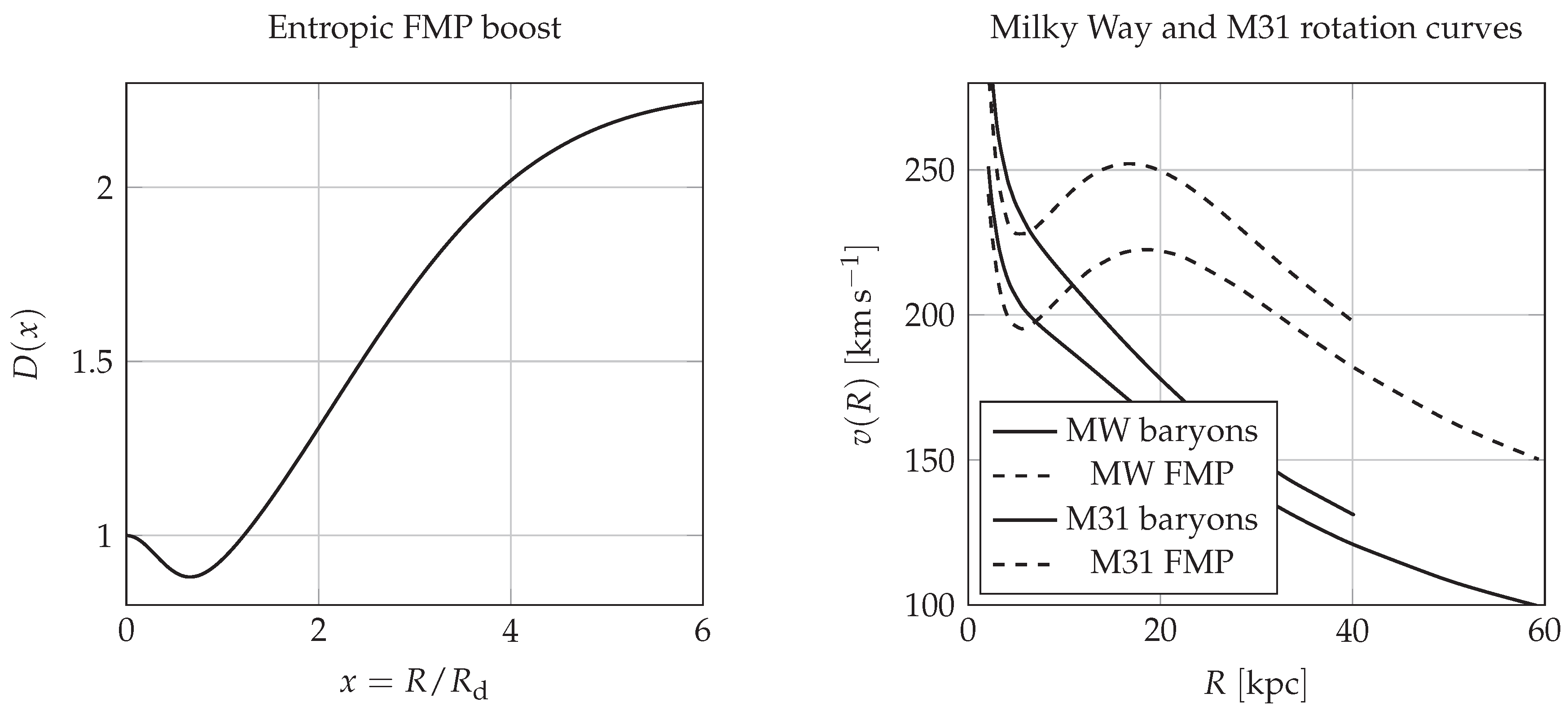
Figure 1.
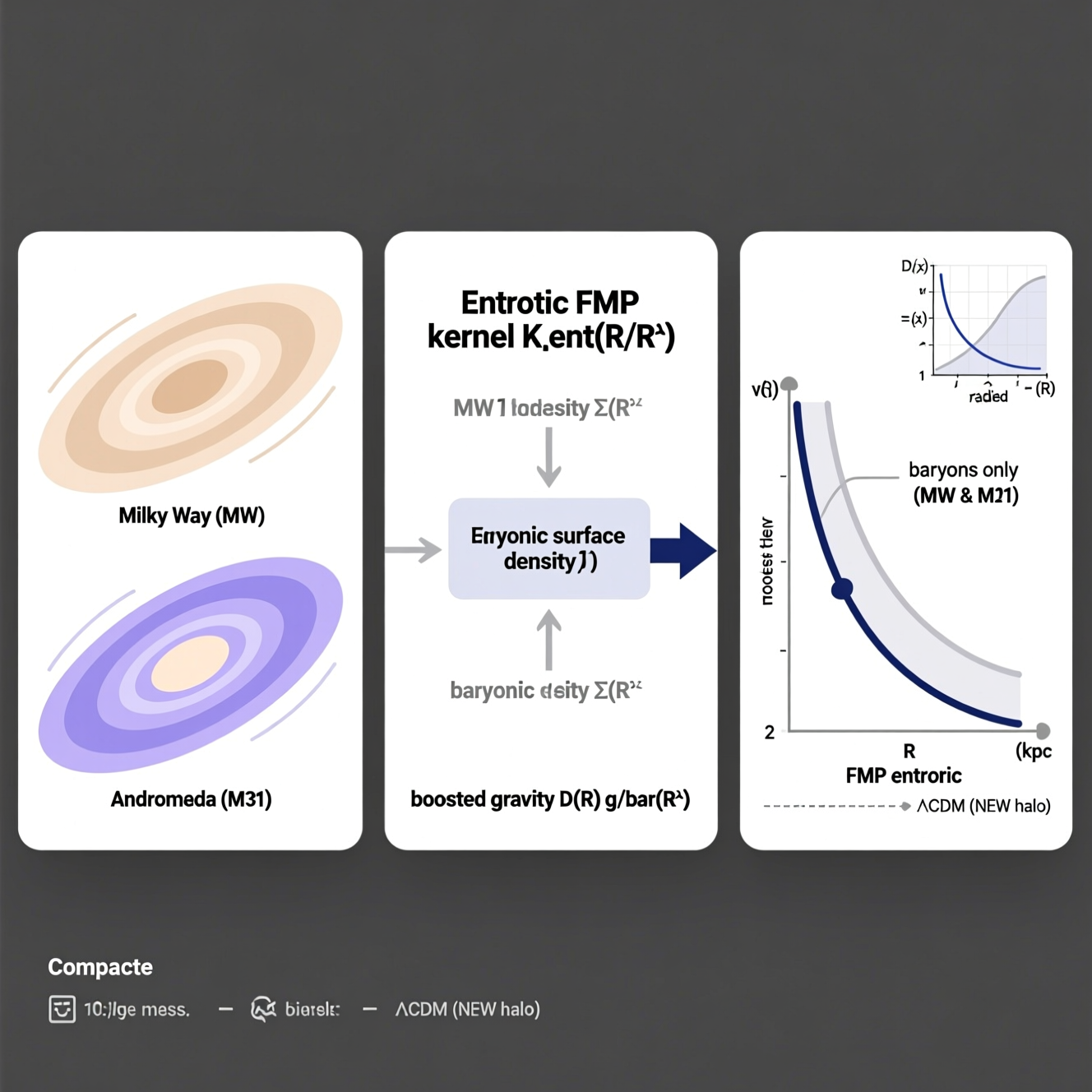
Graphical abstract. Left: best–fit entropic boost factor in scaled radius . Right: Milky Way and M31 rotation curves, comparing stellar baryons (solid) and entropic FMP effective curves (dashed) obtained with the same global boost .
Figure 1.
Graphical abstract. Left: best–fit entropic boost factor in scaled radius . Right: Milky Way and M31 rotation curves, comparing stellar baryons (solid) and entropic FMP effective curves (dashed) obtained with the same global boost .
On the phenomenological side, the tight correlation between the total centripetal acceleration and that produced by the baryons alone (the radial acceleration relation, RAR) suggests a close coupling between baryons and whatever effective “dark” mass is present [3,4]. In MOND this coupling is encoded directly in a modified Poisson equation, while in CDM it emerges statistically from galaxy formation in a dark matter background.
Future–Mass Projection (FMP) gravity is a different approach: the Einstein equations are modified by a bilocal kernel that couples the metric at to at future points along a closed time path (CTP) with finite horizon. Different choices of closed time path and kernel structure have been shown to reproduce Solar System tests, the observed speed of gravitational waves and a variety of astrophysical phenomena without particle dark matter, including cluster lensing and merging clusters [6,7,8,9,10,11].
In the quasi–Newtonian limit for disk galaxies, the modification induced by the FMP kernel can be represented as a multiplicative boost factor to the Newtonian baryonic acceleration,
with given by a Hankel transform of a Fourier–space kernel . The present work explores an entropic extension of this picture and confronts it with the rotation curves of MW and M31 as a first two–galaxy test.
2. Methods
2.1. Entropic Boost and Effective Kernel
In earlier FMP work, a simple Lorentzian kernel,
leads to
where is a Bessel function of the first kind and a modified Bessel function of the second kind. This –type kernel has been used as a baseline to model disk galaxy rotation curves and cluster lensing [8,9].
In the entropic extension we imagine, heuristically, that fluctuations of the baryonic surface density are described by an entropy functional. The corresponding Hessian plays the role of a susceptibility that reshapes the effective kernel in Fourier space:
In real space this corresponds to a superposition of –profiles with different scale lengths. For an exponential disk with scale length , such a superposition can be approximated over a finite radial range by a smooth function of the scaled radius .
We therefore adopt the effective entropic boost
with four global parameters . This is not claimed as a fundamental result of the entropy functional, but as a low–order representation of a more complicated superposition of –type kernels. On Solar System scales (characterised by ) the underlying k–dependent filtering in the FMP kernel ensures , so that PPN constraints are respected [10].
2.2. Rotation Curve Data and Baryonic Models
For the Milky Way we use the unified rotation curve compiled by Sofue [2] and restrict ourselves to . For M31 we use the rotation curve and mass model of Sofue [1] and restrict to .
We approximate the stellar bulge by a de Vaucouleurs profile and the disk by a sphericalised exponential mass distribution with enclosed mass
leading to
The total stellar baryonic circular velocity is then
with bulge and disk parameters taken from [1,2].
For a thin exponential disk with surface density the exact circular speed reads
where and are modified Bessel functions. The spherical approximation overestimates by roughly 10– around ; this bias is comparable in magnitude to the entropic boost at those radii and should be kept in mind when interpreting .
Gas disks are not included explicitly in the present numerical curves; their impact is discussed as a systematic uncertainty in the outer disk.
2.3. Global Fit in Scaled Radius
Given observed velocities with errors at radii , and a baryonic model predicting , we define
Under the entropic FMP model with boost , we have . We define the residuals
and minimise
with respect to the four parameters in Eq. (5).
A grid search in combined with linear regression in yields the global best–fit
The quoted uncertainties are rough estimates based on contours in the plane and linear error propagation for . The scale parameters are less well constrained than the amplitudes because they enter nonlinearly in ; a full MCMC analysis is left for future work.
3. Results
3.1. Boost Profile
3.2. Rotation Curve of the Milky WAY
Figure 3.
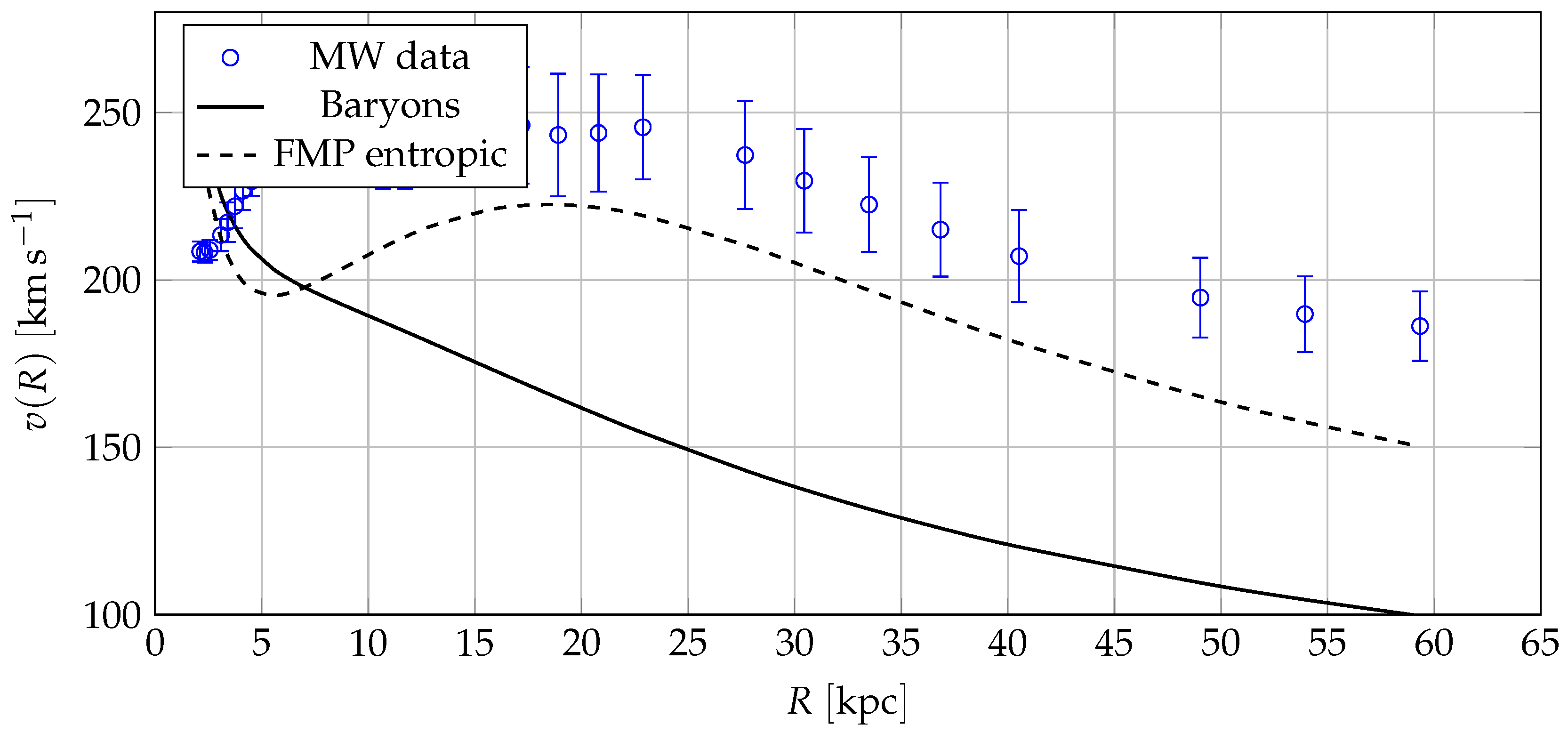
Milky Way rotation curve between 2 and 60 kpc. Points with error bars: Sofue (2020) [2]. Solid line: stellar bulge+disk. Dashed line: entropic FMP with global boost .
Figure 3.
Milky Way rotation curve between 2 and 60 kpc. Points with error bars: Sofue (2020) [2]. Solid line: stellar bulge+disk. Dashed line: entropic FMP with global boost .
3.3. Rotation Curve of M31
4. Discussion and Conclusions
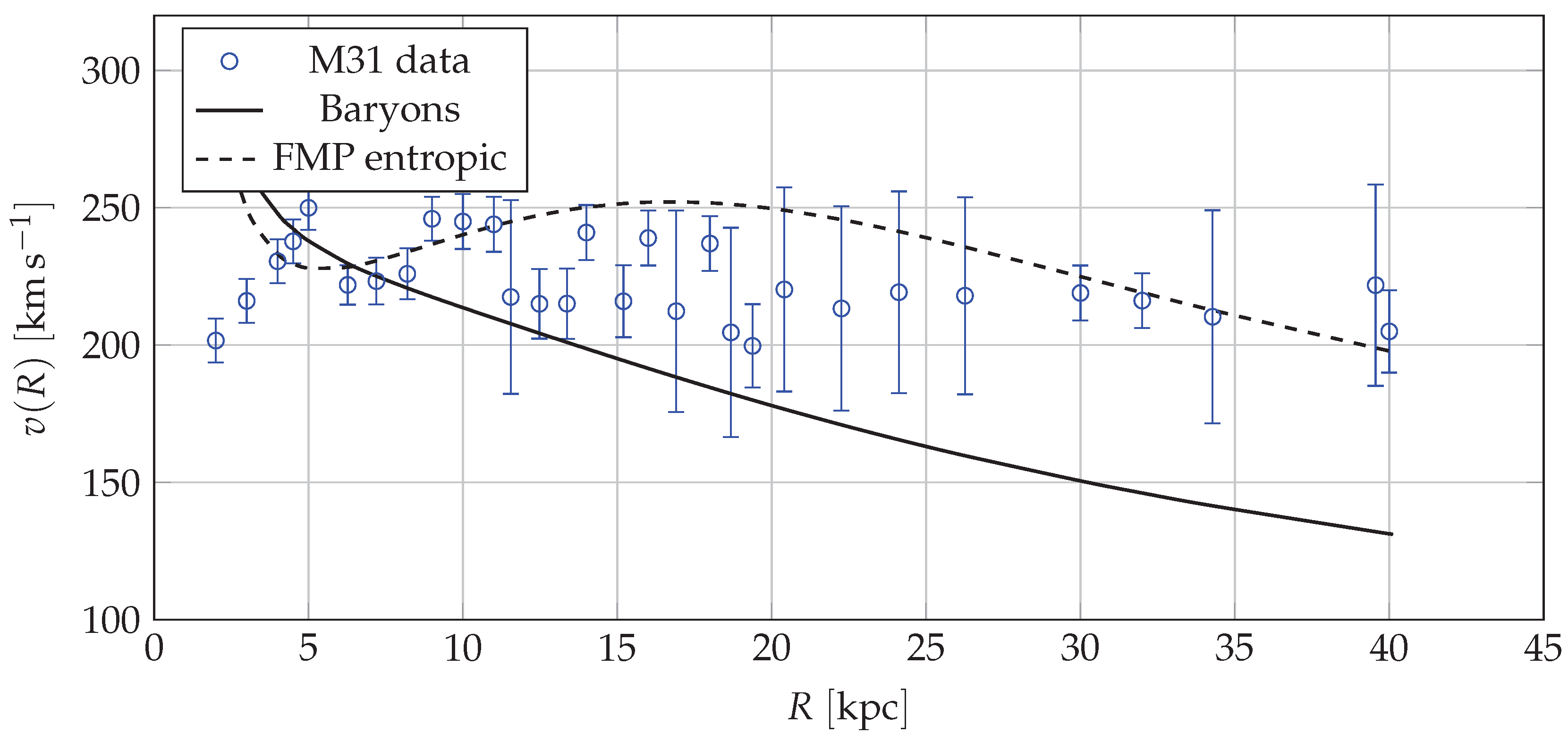
The entropic FMP variant with a single smooth boost function in scaled radius is able to bring both the Milky Way and M31 rotation curves to within – in circular velocity using baryons only. For the entropic FMP fits shown in Figure 3 and Figure 4 we obtain reduced chi–square values of for the Milky Way and for M31. Formally, therefore, the fits remain well above the level of statistical acceptability.
We trace this to (i) simplified baryonic modelling (sphericalised stellar disks, no gas disks), (ii) the rigid functional form of and (iii) observational systematics that are not fully captured, especially in the outer parts of M31. For comparison, Sofue [1,2] reports reduced –2 for NFW halo fits to the same rotation curves with 2–3 additional free halo parameters. In this sense, the entropic FMP model with a globally fixed is not yet competitive with CDM on purely statistical grounds, but it achieves a qualitatively similar level of agreement for two massive spirals using only a handful of effective kernel parameters tied to the baryons.
We estimate that including gas disks with and kpc would raise the outer baryonic rotation curves by several km s−1, reducing the required boost at large radii by , while a thin–disk treatment of the stellar component would lower by a similar amount near . These two systematics partially compensate each other but do not remove the need for a non–trivial boost encoded in .
A realistic confrontation with CDM and MOND will require thin–disk + gas implementations of the baryons, explicit –kernel fits with a small set of physically motivated parameters, uncertainties derived from MCMC sampling and a systematic comparison on a larger galaxy sample such as SPARC [5]. Within these limitations, the present work should be regarded as a first, transparent two–galaxy test of entropic FMP gravity, demonstrating that the framework is capable of capturing the gross structure of MW and M31 rotation curves but still falls short of precision–fit quality.
Funding
This research received no external funding.
Data Availability Statement
All rotation curve data and baryonic mass models used in this work are taken from the published sources cited in the text [1,2]. The processed numerical values used to generate the figures are based on those data and on the analytic models described in Section 2.2–Section 2.3; they are available from the author upon reasonable request.
Conflicts of Interest
The author declares no conflicts of interest.
Use of Artificial Intelligence
AI–assisted tools (specifically a large language model) were used to help with language editing and LaTeX typesetting. All physical content, derivations, numerical results and interpretations were checked and approved by the author.
References
- Sofue, Y. Dark Halos of M31 and the Milky Way. Publ. Astron. Soc. Japan 2015, 67, 75. [Google Scholar] [CrossRef]
- Sofue, Y. Rotation Curve of the Milky Way and the Dark Matter Density. Galaxies 2020, 8, 37. [Google Scholar] [CrossRef]
- McGaugh, S. S.; Lelli, F.; Schombert, J. M. The Radial Acceleration Relation in Rotationally Supported Galaxies. Phys. Rev. Lett. 2016, 117, 201101. [Google Scholar] [CrossRef] [PubMed]
- Li, P.; Lelli, F.; McGaugh, S.; Schombert, J. Fitting the Radial Acceleration Relation to Individual SPARC Galaxies. Astron. Astrophys. 2018, 615, A3. [Google Scholar] [CrossRef]
- Lelli, F.; McGaugh, S. S.; Schombert, J. M. SPARC: Mass Models for 175 Disk Galaxies with Spitzer Photometry and Accurate Rotation Curves. Astron. J. 2016, 152, 157. [Google Scholar] [CrossRef]
- Lali, F. Diffeomorphism Invariant Bilocal Gravity for Future Mass Projection: Noether Conservation. preprint 2025. [Google Scholar]
- Lali, F. A Closed Time Path Kernel for Future Mass Projection. preprint 2025. [Google Scholar]
- Lali, F. A Constant Renormalized FMP Gravity. preprint 2025. [Google Scholar]
- Lali, F. A Finite Horizon Zero–Offset Future Mass Kernel for FMP Gravity. preprint 2025. [Google Scholar]
- Lali, F. FMP Formalism: Solar System PPN Safety and Gravitational Wave Speed. preprint 2025. [Google Scholar]
- Lali, F. Slinky Future Mass Projection Explains the Bullet Cluster without Particle Dark Matter. preprint 2025. [Google Scholar]
Figure 2.
Best–fit entropic boost factor as a function of scaled radius from the joint Milky Way and M31 fit.
Figure 2.
Best–fit entropic boost factor as a function of scaled radius from the joint Milky Way and M31 fit.
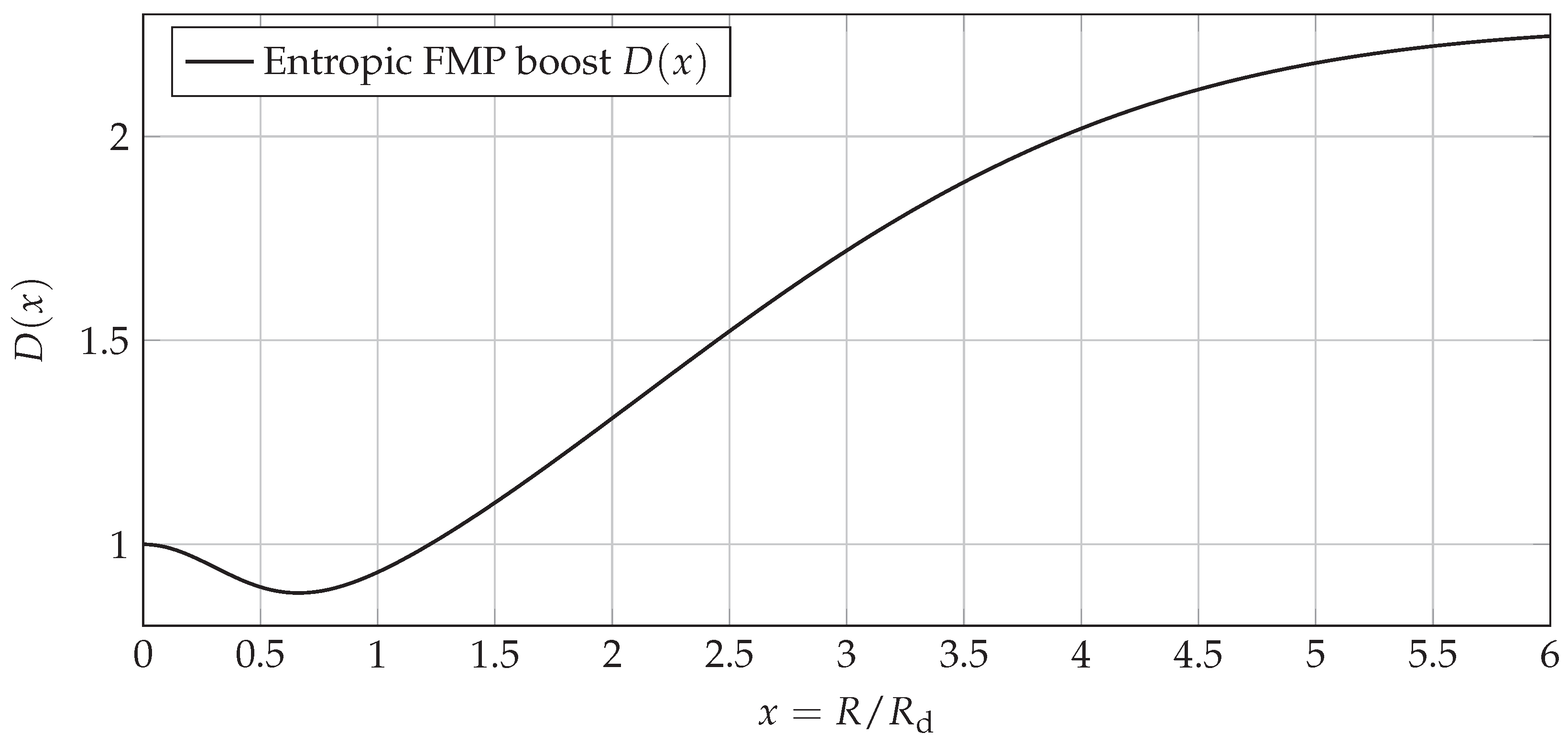

Table 1.
Best–fit entropic boost factor as a function of scaled radius .
| x | |
|---|---|
| 0.5 | |
| 1.0 | |
| 2.0 | |
| 3.0 | |
| 4.0 | |
| 5.0 |
Disclaimer/Publisher’s Note: The statements, opinions and data contained in all publications are solely those of the individual author(s) and contributor(s) and not of MDPI and/or the editor(s). MDPI and/or the editor(s) disclaim responsibility for any injury to people or property resulting from any ideas, methods, instructions or products referred to in the content. |
© 2025 by the authors. Licensee MDPI, Basel, Switzerland. This article is an open access article distributed under the terms and conditions of the Creative Commons Attribution (CC BY) license (http://creativecommons.org/licenses/by/4.0/).
Copyright: This open access article is published under a Creative Commons CC BY 4.0 license, which permit the free download, distribution, and reuse, provided that the author and preprint are cited in any reuse.