

Submitted:
07 December 2025
Posted:
09 December 2025
You are already at the latest version
Abstract
Currently, prostate specific membrane antigen ligands are one of the most widely used platforms for creating compounds targeting prostate cancer tumor cells. In this mini-review, we have collected and systematized existing approaches to the synthesis of PSMA ligands based on DCL urea, as the most widely used vector platform. The main approaches to each stage of the synthesis of PSMA inhibitors of various structures are considered in detail, and existing synthetic techniques are collected and analyzed.
Keywords:
prostate cancer
; target delivery
; prostate-specific membrane antigen
; DCL
; peptide synthesis
1. Introduction
Prostate cancer is the second most newly diagnosed cancer among men.[1] Due to the presence of serious side effects of classical therapies,[2,3,4] approaches aimed at creating drugs capable of delivering therapeutic or diagnostic agents selectively into tumor tissues have been actively developing in recent years. Compounds targeting PSMA have become widespread in the case of prostate cancer, due to the fact that this protein is overexpressed in tumor tissues.[5,6,7,8] Currently, an extensive range of PSMA ligands of various nature and conjugates based on them is presented in the literature,[9,10,11,12,13,14,15,16] however, compounds based on N-[N-[(S)-1,3-dicarboxypropyl]carbamoyl]-(S)-L-lysine occupy a special place among them (compound 1 Figure 1). Based on this ligand, the drugs PSMA-11, PSMA-617 and Pylarify™ have been developed, approved by the FDA for use in the treatment of prostate cancer.[17,18,19]
So far, a number of reviews have examined in detail both the data on the inhibitory activity of DCL-based PSMA ligands [9,10,16] and the effect of specific functional fragments on this property.[20] The systematization and analysis of data on the biological activity of diagnostic and therapeutic conjugates based on these ligands has also been carried out.[11,12,13,14,15,21] The aim of this work is to systematize the approaches presented in the literature for the preparation of PSMA inhibitors based on DCL urea. It is worth noting that this mini-review does not address the data presented in the patent literature, as well as approaches to the synthesis of conjugates based on PSMA inhibitors (with the exception of some examples).
The DCL ligand is a urea derivative of glutamic acid and lysine. Based on the data presented in the literature on the structure of PSMA and the mechanism of binding of various ligands to the protein,[9,22,23,24] the structure of DCL can be divided into three fragments (Figure 2): P1’ is the residue of glutaric acid responsible for binding to the S1 pocket; ZBG (zinc-binding group) is the urea region, responsible for the interaction with zinc atoms; P1 is a fragment of 6-aminohexanoic acid that binds to the S1 pocket.[16] In this case, only the carboxyl group is directly involved in protein binding in the P1 fragment, which allows for various modifications of the ε-amino group.
Effective binding to PSMA requires the presence of three carboxylic functional groups in fragments P1 and P1’, as has been shown in the literature.[25,26] This imposes a number of additional restrictions when choosing a synthetic strategy. In this regard, protective groups in these positions are actively used to obtain DCL-based ligands. Moreover, more structurally complex PSMA ligands may include additional functional groups in the structure of the linker and other fragments, which also need to be protected to prevent the appearance of side reactions.
Based on all of the above and the fact that the choice of a synthetic strategy for the production of PSMA ligands depends on the design of the final inhibitor and conjugate based on it, four main steps in the synthesis of such compounds can be distinguished (Figure 3). The first stage involves obtaining a protected form of DCL urea, and the protective group for the ε-amino group of lysine must be orthogonal to the protective groups for carboxylic fragments in order to be able for its selective removal. At the second stage, the protective group at the lysine nitrogen atom is removed, which allows for subsequent modification. The third stage involves modification of the obtained primary amine based on the design of the target inhibitor. At this stage, an additional aromatic fragment and/or a linker can be introduced. The fourth stage involves the removal of protective groups to obtain the target ligand, however, in some cases this stage may be preceded by conjugation of the protected form of the ligand with a therapeutic or diagnostic agent.
It is also worth noting the strategies for obtaining PSMA ligands and conjugates based on them through complete solid-phase synthesis. This option for obtaining target compounds differs slightly from the above scheme and will be considered separately in this review.
2. Methods of Creating a Urea Fragment
As mentioned above, the first step in the synthesis of PSMA ligands is the creation of a urea fragment to produce a protected form of urea DCL. The synthesis of this compound from di-(tert-butyl)-protected glutamic acid and lysine protected by a tert-butyl group on the carboxyl group and a benzyloxycarbonyl group on the ε-amino group has become the most widespread. However, there are a number of examples in the literature suggesting the use of other protective groups.
2.1. Approaches to the Synthesis of DCL Urea Protected by Tert-Butyl- and Cbz-Groups
As already outlined above, the strategy using tri-(tert-butyl) and Cbz-protected form of DCL urea has become the most widespread in the synthesis of PSMA ligands. Among the methods presented in the literature, two approaches for obtaining this compound have become the most common. The first option involves the use of triphosgene to create a urea bridge,[27,28,29,30,31,32,33,34,35,36,37,38,39,40,41,42,43,44,45,46,47,48,49,50,51,52,53] and the second – CDI.[41,54,55,56,57,58] There are also two less popular approaches using DSC and para-nitrochloroformate, but they have received rather limited distribution. [59,60,61,62,63,64]
The triphosgene approach involves, at the first stage, obtaining di-tert-butyl isocyanate of protected glutamic acid 2a (Route A, Scheme 1) or isocyanate of tert-butyl ester N(ε)-Cbz-L-lysine 2b (Route B, Scheme 1) and then reacting it with the second amino acid to obtain compound 3 (Scheme 1).
The hydrochlorides of protected amino acids are used as starting compounds, and therefore the base is used in significant excess. Also, the excess base is necessary for the binding of hydrogen chloride, which is released as a byproduct during the formation of isocyanate. DIPEA and Et3N are most often used as the base, although in some cases pyridine or sodium bicarbonate, as well as their combination, are used.
The main side reaction at this stage is the formation of symmetrical urea 3a or 3b (Figure 4) containing two residues of protected glutamic acid or two residues of protected lysine.
To prevent this side process, two techniques are used: gradual addition of triphosgene to a solution of di-tert-butyl ester of glutamic acid under strong cooling (from -78°C to -90°C) [27,28,29,30,31,32,33,34,35,36,37,38,39,40] and the addition of lysine to the triphosgene solution at moderate cooling.[41,42,43,44,45,46,47,48,49,50,51,52,53] It is worth noting that a more labor-intensive approach with cooling to -78°C and below allows obtaining the target compound 3 with a slightly higher yield (in the sources presented, the yield at this stage is 56-92%). At the same time, the preparatively simpler version with moderate cooling yields slightly lower yields (28-82%). Both described methods are easily scalable and allow synthesizing the target compound 3 in quantities from hundreds of milligrams [30,46] to tens of grams.[37,53]
It is not possible to identify the dependence of the yield of this stage on the base used. For the Strongly cooled method, the use of triethylamine has become the most widespread, while in the case of the moderately cooled method, DIPEA is more often used.
It should be noted that in [46] the authors separately isolate the intermediate isocyanate 2a by extraction. In the rest of the presented papers, isocyanate is generated in situ.
In all the cases presented, the isolation of the target product 3 in an individual form (if it was carried out) is carried out by column chromatography.
The following approach, which has been relatively widely used in practice, involves the use of CDI to create a urea group (Scheme 2).[41,54,55,56,57,58] In the first stage, the initial protected amino acid is reacted with CDI to produce an activated derivative of 4a (Route A and B) or 5 (Route C). After that, compound 4a or 5 is reacted with the second amino acid to produce the target urea 3. In a number of studies, the resulting derivative 4a is reacted with methyl triflate (MeOTf) to produce the corresponding methylimidazolyl triflate 4b (Scheme 2, Route A),[41,55] which in turn is reacted with the second amino acid to form the target urea.
In all the Considered sources, except one ([56]) the second amino acid and base are introduced into the reaction when cooled to 0°C, and the reaction itself is carried out when heated to 40°C. At the same time, it was not possible to identify the dependence of the reaction yield on the heating duration. The yield of target compound 3 in the publications under review ranged from 69% to 95%. The presented approach is quite easy to scale and makes it possible to obtain compound 3 both in the amount of hundreds of milligrams,[57] and in the amount of tens of grams with good yields.[58]
In most of the methods presented in the literature, the reaction of obtaining derivatives of 4a and 5 is carried out in the presence of triethylamine and DMAP, however, in [56] the authors propose a method without using a base and DMAP at the stage of obtaining compound 4a. Unlike other sources, the reaction with CDI is carried out in a mixture of DMF/MeCN (1/5), and not in dichloromethane. Also, the authors carried out the subsequent preparation of compound 3 without heating. At the same time, they managed to achieve the highest yield among all the mentioned works (95%).
The only example of work in which the production of protected urea DCL is carried out according to Route 3 is presented in [58]. Also, the authors used DBU as a base in the reaction of derivative 5 with protected glutamic acid. However, it is not possible to identify any significant advantages of this synthesis variation, the output of the scheme proposed by the authors was 80%.
Another approach used for the synthesis of compound 3 involves the use of disuccinimidyl carbonate (Scheme 3).[59,60,61]
At the first stage, a carbamate derivative is obtained, which is isolated and subsequently reacted with the second amino acid. In all the sources presented, the first stage involves a reaction between DSC and protected glutamic acid to form compound 6, which is reacted with protected lysine in the presence of triethylamine in DCM. The yield of this method is 53-76%. The data presented in the literature is insufficient to talk about the possibility or impossibility of scaling this method.
Another approach applied to obtain compound 3 is the synthesis using para-nitrophenyl chlorophyormate.[62,63,64] This Method involves the production of carbamate 7 in situ, which subsequently reacts with protected lysine (Scheme 4). This technique is based on an approach that was previously used to produce carboxypeptidase G2 inhibitors.[65]
This method makes it possible to obtain protected DCL urea with fairly high yields (86-90%). However, the data presented in the literature is insufficient to talk about the possibility or impossibility of scaling this method.
2.2. Synthesis of the PMB-Protected form of Urea DCL
Approaches to obtaining other protected forms of DCL urea should be considered separately. Outside of the patent literature, only one alternative approach is presented, which involves the use of para-methoxybenzyl protection for the carboxyl groups of the resulting urea and Boc-protection for the ε-amino group of lysine.[66,67,68,69] The method proposed by the authors involves the preparation of compound 10 from N-(ε)-Boc-N-(α)-Fmoc-L-lysine (Scheme 5). At the first stage, the PMB ester of protected lysine is obtained, and the subsequent removal of the Fmoc protective group with the α-amino group to obtain derivative 8. Bis-4-methoxybenzyl ether hydrochloride of L-glutamic acid is reacted with triphosgene under conditions similar to those used in the preparation of compound 3 according to Scheme 1, Route A After that, the isocyanate 9 obtained in situ is reacted with compound 8, due to which the target protected urea 10 is obtained. The total yield of the described scheme, presented in [66] was 48% in three stages. The yield of the last stage (production of urea 10) was 62%, which is quite moderate.
3. Existing Approaches to Removing the Protective Group at the E-Amino Group of Lysine
The second stage of the synthesis of PSMA ligands involves the removal of the protective group at the ε-amino group of lysine. Based on the data presented above, the largest number of examples presented in the literature suggests the removal of the Cbz group at this stage. At the same time, an example of the use of Boc protection for the ε-amino group of lysine is presented in the literature, and the conditions for the selective removal of this group will be considered separately.
3.1. Removing the Cbz Protectiv Group
In the synthesis of PSMA ligands, acid-labile protective groups are used for carboxylic groups of amino acid residues. In this regard, it is not possible to remove the Cbz-protective group using acids such as hydrochloric,[70,71] hydrobromic,[70] trifluoromethanesulfonic [72] or methanesulfonic.[73] Thus, the main approach is using hydrogenolysis (Scheme 6). The most widespread methods are using hydrogen and palladium on charcoal as a catalyst.[27,28,29,30,31,32,34,35,36,38,39,44,45,46,49,50,52,53,56,58,59,61,63,74] An approach using ammonium formate as a hydrogen donor is also often used.[37,40,41,42,43,48,51,55,75,76,77] In addition to these two most common methods, there are examples of the use of 1,4-cyclohexadiene and hydrazine hydrate.[47,60] The yield of the reaction is high in many cases (>90%),[38,41] however, in some examples the yield of hydrogenolysis was <70%.[31,42]
In the case of the hydrogen method, 10% palladium on charcoal is most often used as a catalyst. There is an example of a method using 5% Pd/C, but the authors do not provide the yield of the target product.[58] Palladium hydroxide can be used as an alternative.[46] Hydrogenolysis under such conditions made it possible to obtain compound 11 with a yield of 99%.
The solvents used are methanol, a mixture of methanol and water, ethanol, a mixture of ethanol and toluene, or ethyl acetate. However, it is not possible to find any dependence of the reaction yield on the solvent used.
In the case of methods using ammonium formate, in all the examples considered, 10% palladium on сharcoal is used as a catalyst, and ethanol is used as a solvent.
Hydrogenolysis using 1,4-cyclohexadiene is carried out in an inert atmosphere, with palladium on charcoal as a catalyst.[60] The yield of compound 11 was 85%.
The hydrazine hydrate method also involves the use of Pd/C and makes it possible to obtain a target compound with a yield of 89%.[47]
In the overwhelming majority of cases, filtration through celite is used to remove catalyst residues. However, in many examples, additional purification of compound 11 using column chromatography is not performed.
3.2. Removal of the Boc-Protective Group at the ε-Amino Group
In the case of compound 10, the removal of the protective group at the e-amino group of lysine is carried out according to Scheme 7.[66,67,68,69] Due to the fact that Boc and PMB protective groups are acid-labile, the conditions proposed by the authors for removing the Boc group do not give a high yield (45%).[66]
The proposed method involves dissolving the initial compound 10 in ethyl acetate, cooling the reaction mixture to 0-2 °C, and then adding a solution of para-toluenesulfonic acid monohydrate in ethanol. Further mixing is carried out at room temperature for 2 hours. The authors isolate product 12 in the form of tosylate by column chromatography.
4. Modification of the ε-Amino Group of Lysine
Considering the methods of modification of the ε-amino group of the lysine fragment, two large groups of possible modifications can be distinguished.
The first group implies the introduction of an aromatic fragment into this position. This modification is carried out due to the fact that near the S1 pocket there is a hydrophobic subpocket capable of interacting with aromatic fragments and increasing the efficiency of ligand binding to the protein.[78] Based on this, such fragments can be introduced into the ligand structure to increase the affinity to PSMA. At the same time, these fragments can be used as a point of subsequent functionalization with a radioisotope of halogen (125I or 18F) if there is a suitable prosthetic group in their structure (for example, Sn(n-Bu)3).
The second large group of subsequent modifications includes the introduction of a linker into ligand structure. It is aimed on removing the therapeutic or diagnostic load to the required distance from the urea fragment responsible for direct binding to the active site of PSMA. The linker can also additionally increase the efficiency of binding to the protein due to the interaction of fragments of the side chain with hydrophobic pockets in the tunnel leading to the active site of PSMA.[79] For this purpose, amino acid fragments containing aromatic fragments (e.g. phenylalanine and tyrosine) can be introduced into the linker. Also, the linker structure has a significant effect on the physical, physico-chemical and pharmacokinetic properties of the final PSMA inhibitors and conjugates based on them. In this regard, in some cases linkers have a rather complex structure.
In some cases, PSMA ligands also contain an aromatic fragment at the ε-amino group of lysine and a linker, which also affects the approaches used for their synthesis.
4.1. Existing Synthetic Approaches to the Introduction of an Aromatic Fragment
Speaking about approaches to the modification of the ε-amino group of urea DCL by various substituents containing an aromatic fragment, five main ways can be distinguished, presented in Scheme 8. The first of them is the alkylation of the nitrogen atom. It is carried out due to the reaction of reducing amination with the corresponding benzaldehyde. The second direction involves the acylation of the amino group with aryl-containing carboxylic acid or its derivatives. The third and fourth approaches involve the creation of a urea or sulfamide bridge between the aromatic fragment and the lysine residue. The fifth approach also involves acylation of the ε-amino group of lysine, however, the aromatic fragment is contained in the side chain of the amino acid (for example, L-naphthylalanine in the structure of PSMA-617, Figure 1).
The approach involving alkylation of the ε-amino group of lysine by a reductive amination reaction makes it possible to further modify the nitrogen atom by introducing a linker into the ligand structure and is widely described in the literature. Thus, in [41] 13a-j derivatives were synthesized (Scheme 9).
The authors carried out the reaction in dichloroethane, and sodium triacetoxyborohydride was used as a reducing agent. Moreover, only for compound 13j, which contains a trimethylstannyl group in the para-position, the yield values of this stage are given, which amounted to 38%.
The procedure with STAB using was also applied in [32] to obtain compounds 13d-f, as well as a similar compound with a hydroxyl group in the para-position. The yield of the target compounds ranged from 40% to 74%.
The synthesis of compound 13d using sodium cyanoborohydride as a reducing agent was described in [80,81]. The reaction was carried out in methanol with the addition of acetic acid and the yield was 48%.
Carrying out this reaction is possible using sodium borohydride. Thus, in [38,82] the authors reproduced the synthesis of compounds 13d, 13f-g, and 13i using NaBH4. Under the proposed conditions, the yield of these compounds was 68-90%. At the same time, new compounds were synthesized containing both halogen atoms in the benzyl fragment and functional groups of a different nature (carboxy-, nitro-, alkoxy- and others). The reaction yield for the new ligands ranged from 30 to 88%, depending on the example.
In addition to substituted benzaldehydes, heterocyclic fragments can also be introduced by this method. In [66] compound 14 was obtained using the reduction amination reaction (Scheme 10). In this case, the reaction was carried out under the conditions necessary to obtain a dialkylated product. Two pyridine fragments were necessary to obtain complexes with rhenium and technetium based on the compound 14.
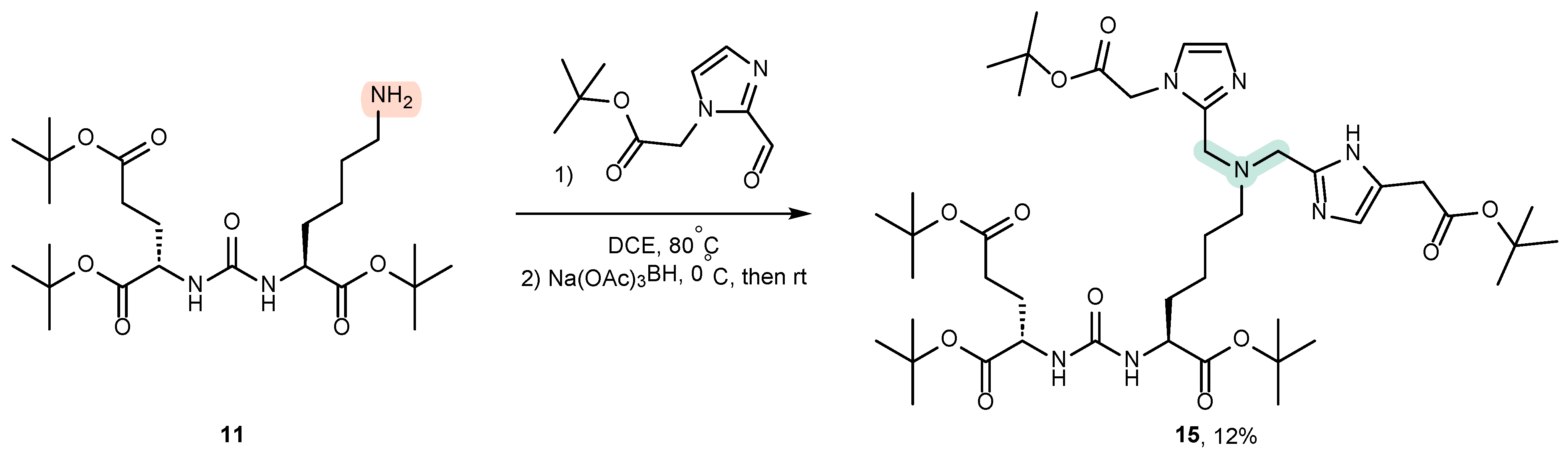
Using a similar Method, compound 15 containing two fragments of N-substituted imidazole was synthesized in [83]. However, using the proposed technique made it possible to obtain a target compound with a rather low yield (12%).
Scheme 11.
Synthesis of compound 15.
In the future, in Section 4.2, approaches to the modification of alkylated derivatives of urea DCL will be discussed.
The second approach to the introduction of aromatic fragments into the ligand structure is based on the acylation of the ε-amino group of lysine with various aryl- and hetaryl-containing acids. Various carboxylic acid derivatives such as NHS and TFP esters or activators such as HBTU, HATU and others are often used to carry out this reaction.
This approach is often used to introduce fragments suitable for creating compounds labeled 18F or 125I based on them. In [67] the authors synthesized compounds 16a-d and 17 by acylation of compound 12 with the corresponding NHS esters (Scheme 12). Compounds 16a-b contain non-radioactive isotopes of iodine and fluorine and were synthesized to study the inhibition activity of compounds of a similar structure. Compound 16c is a protected derivative labeled 18F. Compound 16d contains in its structure a tri-n-butylstannyl group, which is subsequently necessary for labeling with the isotope 125I. Compound 17 also contains a prosthetic group, however, unlike the series of compounds 16, it is a derivative of nicotinic acid.
Due to the use of compound 12 in the form of tosylate, the acylation reaction was carried out in the presence of a base. In all the cases presented, triethylamine was used as the base.
In all cases, the reaction took place with a fairly high yield (except for compound 16c, it was introduced into the next stage without additional purification and no yield is given for it). It is also worth noting that this reaction proceeds quite quickly – from 30 minutes to 2 hours. Moreover, in all cases, except for connection 16c, it was carried out without heating.
TFP esters can also be used instead of NHS esters. This variant of acylation is somewhat more represented in the works of DCL modification. For example, a similar approach is used in the synthesis of the drug Pylarify (compound 18a, Scheme 13), described in [69]. In the case of compound 18a, the authors do not provide yield, as they did not obtain it individually. In the case of an analog with a natural isotope of fluorine 18b, the yield of the acylation reaction was 65%. The PMB-protected form DCL 12 is used as the starting compound.
Similar conditions are applied to obtain compound 19, which contains an oxyfluorosulfonyl group in its structure.[84] Also, the authors obtained dimeric derivatives containing two carboxyl groups in meta-positions to the SO3F group. Under similar conditions, they also used TFP ester and the product was isolated with a yield of 75%
TFP esters were also used to introduce aromatic fragments containing a trimethylammonium group in the ring into the structure, which was subsequently replaced by 18F (compounds 20 and 21a-c).[85,86] Synthetic details of the preparation of compound 20 are not given in [86]. In [85] it was possible to obtain derivatives of 21a-c with yields from 77% to 95%. The reactions were carried out at room temperature for 2 hours, and the isolation did not involve the use of column chromatography, which makes the proposed method quite simple from a preparative point of view.
It is worth noting that TFP esters can be reacted directly with DCL urea 1, which does not contain protective groups. In [87] the authors obtained a series of 22a-c derivatives (Scheme 14) containing the isotope 18F.
The authors note that the acylation stage is possible only in anhydrous ethanol. In an aprotic or aqueous solvents, there is a significant decrease in radiochemical conversion (0-15%). Subsequent purification of the target compounds using solid-phase extraction or high-performance liquid chromatography allowed us to obtain products with good radiochemical yields (12-25%, without correction for decay) and radiochemical purity (>98%).
It is also possible to use chlorohydrides for the acylation of the ε-amino group of lysine, which was shown in [88,89] using the example of 9-carboxyfluorene (Scheme 15). A distinctive feature of these studies is that the aromatic fragment is introduced after the amino group of lysine is modified by the linker fragment. The introduction of the linker was carried out due to reductive amination. In the case of [88] 5-azidopentanal is introduced as a fragment of the linker, to obtain secondary amine 23 (yield 56%). The product was reacted with 9H-carboxy-9-fluorene chloroanhydride to obtain compound 24 with a yield of 64%. Further approaches to linker modification will be discussed later.
In [89] he authors carried out the reaction of reductive amination of compound 11 and the methyl ester of 3-oxopropanoic acid to obtain amine 25 (yield 67%), after which it was acylated with 9H-carboxy-9-fluorene chloroanhydride. Thus, compound 26 was obtained with 73% yield.
The presence of tert-butyl substituents at the carboxyl groups of urea 11 also allows for acylation using various amide coupling agents (TBTU, HATU, and others). In [80] the authors proposed a method for the acylation of urea 11 using TBTU as an activator (Scheme 16).
In the case of compound 27, substituted phenylacetic acid was introduced into the reaction and the proposed conditions made it possible to obtain a product with a yield of 52%. At the same time, the acylation of urea 11 with different disubstituted benzoic acids made it possible to obtain compounds 28a-e with higher yields (≥70% for all examples except 28c). In all cases, the reaction was carried out in the presence of a base (DIPEA).
A similar procedure for acylation of protected urea DCL was proposed in [90]. The authors introduced three different meta-substituted benzoic acids into the acylation reaction with compound 11 (Scheme 17). HATU was used as an activator, DIPEA was used as the base. This technique made it possible to obtain compounds 29a-c with yields of 60-82%.
A similar approach has also been used to obtain derivatives 30a-b.[40] In contrast to the synthesis of compounds 29a-c, DCM, not DMF, was used as solvents. The product yield was 42% for 30a and 56% for 30b.
Carbodiimides can also be used to produce acylated derivatives of compound 11. In [91] the authors synthesized boron-containing urea derivatives DCL 30a and 31 (Scheme 18). The reaction was carried out in the presence of DCC and NHS, and the yield of compound 30a was 58%, which is slightly higher than using the method shown in Scheme 17.
Currently, more non-standard approaches to the acylation of the amino group of lysine are presented in the literature. In [92] the authors carried out the acylation of the ε-position by reaction with 7-fluoro-1-methyl-8-azaizotoic anhydride 32 (Scheme 19). An experiment with a natural fluorine isotope made it possible to obtain compound 33 with a yield of 47%, while the reaction time was only 15 minutes. Subsequent carrying out of this reaction with derivative 32 containing 18F allowed to obtain labeled derivative 33 with radiochemical conversion >95%.
The next approach to modifying this position by introducing an aromatic fragment involves the creation of urea (Scheme 20). In [41] the authors described the synthesis of compounds 34a-e and 35. The authors do not provide the values of the yields for this stage. In the case of a series of compounds 34, the corresponding phenylisocyanates are used as reagents. In the case of compound 35, compound 11 was reacted with triphosgene, after which substituted benzylamine was added to the isocyanate obtained in situ.
In [93] the authors introduce an aromatic fragment into the structure containing a prosthetic stanyl group suitable for further substitution with 125I. The reaction of protected urea 11 with the corresponding isocyanate made it possible to obtain compound 36 with a yield of 75%. It is worth noting that the reaction was carried out in non-standard solvents: the initial isocyanate was dissolved in perfluorobutyl methyl ether, and the reaction itself was carried out in a 5% triethylamine solution in methanol. The use of PFBME was due to the fact that the initial isocyanate is stable in such solvent for more than 20 days.
The approach with triphosgene was also used in [80], however, substituted aniline rather than urea 11 is introduced into the reaction with triphosgene. In the case of compound 37a, a yield of 71% was achieved, but for compound 37b, the yield was 17%. The authors note that the low yield is due to the low conversion of the starting compounds, rather than losses during product purification.
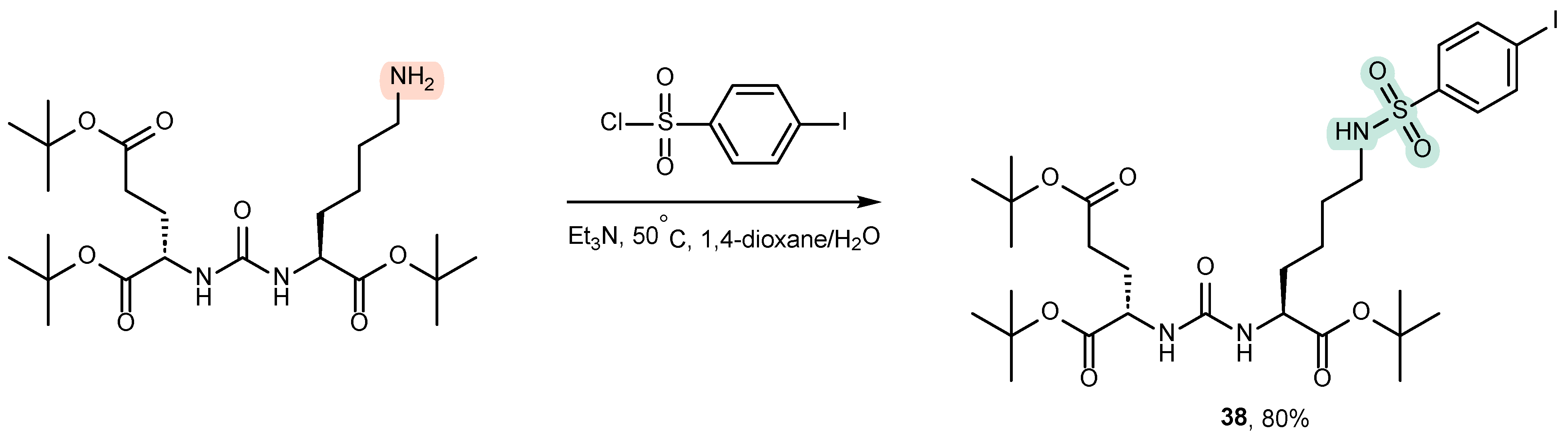
The approach with the formation of a sulfamide fragment between the amino group of lysine and the aromatic fragment is the least widespread at the moment. In [41] a method for the synthesis of compound 38 was proposed, involving the introduction of protected urea 11 into reaction with the corresponding sulfonyl chloride. The product was obtained with a fairly high yield of 80%. However, such modifications were not considered in the literature in the future.
Scheme 21.
Synthesis of modified DCL urea with a sulfamide fragment.
The last approach to the introduction of aromatic fragments in this position involves the acylation of the ε-amino group of lysine with various amino acids containing an aryl substituent in the side chain. Often this amino acid fragment is included in the structure of the linker, which is synthesized separately. In some cases, the introduction of this fragment can be carried out using solid-phase techniques. Such examples will be discussed in Section 4.2 and Section 6. Techniques involving the acylation of protected urea with amino acids will be presented here.
In [56] the ε-amino group of lysine is acylated by Cbz-protected L-phenylalanine in the presence of HATU and DIPEA as a base (Scheme 22). The proposed technique makes it possible to obtain compound 39 with 96% yield.
HATU was also used in the preparation of compound 40 containing a fragment of L-naphthylalanine. The reaction was carried out in the presence of HOAt, which is generally not necessary for this example. The product yield was 72%.
It is also possible to use NHS esters for this reaction. A similar approach was used to obtain compound 39 in [94,95] (Scheme 23). The yield of the target product was 65%, which is slightly lower than when using HATU. In both cases, purification was carried out using chromatography.
Thus, this section discusses the main approaches to the introduction of aromatic fragments into the structure of the PSMA ligand, which are currently available in the literature.
4.2. Existing Synthetic Approaches to Linker Introduction
Еhe next fragment that significantly affects the inhibition activity of PSMA ligands is the linker. The linkers presented in the literature vary significantly in length, structure, conformational hardness, and methods of their synthesis. This section will consider approaches to the synthesis of a number of such compounds.
One of the simplest approaches to linker design assumes the presence in the structure of an alkyl fragment of the required length with a terminal functional group suitable for subsequent modification. It can be a dicarboxylic acid, an acid with a terminal amino group, or another compound with a terminal group suitable for subsequent modification.
One example of such an approach is the work [43], which presents a method for obtaining compound 40 containing a 6-aminohexanoic acid residue as a linker (Scheme 24). The authors at the first stage acylate urea 11 with Fmoc-protected 6-aminohexanoic acid, after which the protective group is removed under the action of diethylamine to obtain compound 40. The total yield in two stages was 72%.
Also, due to acylation, fragments containing a triple bond can be introduced into the structure for the subsequent azide-alkyne cycloaddition reaction.
In [50,96] the authors present a method for acylation of compound 11 with NHS-ester of 4-pentynoic acid to obtain compound 41 (Scheme 25). In both cases, the reaction proceeded with high yields (93% and 99%). A method for obtaining compound 41 was also proposed in [97]. HATU was used as the activator, and DIPEA was used as the base. The proposed method showed a slightly lower yield compared to NHS ether (75%).
Not only the terminal triple bond can act as a functional group for the subsequent reaction of the azide-alkyne cycloaddition. In [98] the authors synthesized compound 42 containing a fragment of 11,12-Didehydro-5,6-dihydrodibenz[b,f]azocine for subsequent modification by a click reaction (Scheme 26). The NHS ester of modified 11,12-Didehydro-5,6-dihydrodibenz[b,f]azocine was used as an acylating agent, the reaction was carried out in DMF in the presence of DIPEA. The target connection was received with an output of 65%.
Instead of a triple bond, an azide group can be introduced. This approach was implemented in [99]. The authors proposed a method for obtaining carbamate 43 containing a terminal azide group (Scheme 27). Compound 11 was reacted with 6-azidohexyl succinimidyl carbonate in the presence of DIPEA, and the target product was isolated in a yield of 74%.
Compound 44 (Scheme 28) was also obtained by creating a carbamate fragment.[100] In contrast to the synthesis of compound 43, in this case, the carbamate bond was formed due to the interaction of the initial compound 11 and alcohol with 4-nitrophenyl chloroformate. The reaction yield was 77%. Also, unlike the examples discussed earlier, compound 44 does not contain a simple alkyl linker, but a disulfide fragment cleaved by the action of intracellular glutathione.
The thiol group can also act as a terminal fragment for subsequent modification. In [33] the authors present the synthesis of ligand 45 containing a fragment of 5-mercaptopentanoic acid (Scheme 29). In the first stage, urea 11 was acylated with trityl protected acid in the presence of TSTU and DIPEA. After that, acid-labile protective groups were removed by the action of trifluoroacetic acid in the presence of water and ethanediol. The total yield of the target compound 45 was 42%.
In some cases, to introduce a thiol group into the ligand structure, the ε-amino group is acylated with a thiol-containing amino acid (for example, cysteine). A similar modification was carried out in [77]. The authors performed an acylation reaction of compound 11 with N-Boc-L-cysteine in the presence of HATU and DIPEA, but the yield of the target product 46 was only 8% (Scheme 30).
In some cases, derivatives containing less common groups are obtained for subsequent modification. In [101] the authors introduced a fragment containing O-alkyl hydroxylamine into the structure of the PSMA ligand (Scheme 31). Urea 11 was acylated with an acid containing an N-alkoxypthalimide fragment in the presence of DCC and DMAP. The derivative 47 obtained in 68% yield was then reacted with hydrazine hydrate in chloroform. In this way, compound 48 was obtained in quantitative yield. This linker variant was introduced into the structure for further conjugation of the ligand with the platinum complex due to the formation of oxime.
The approaches discussed earlier involve the introduction of linkers with a relatively simple structure. However, the literature presents a significant number of compounds containing more complex structural motifs as a linker. Often, protected urea is modified by the ε-amino group, after which another fragment of the linker is introduced. Often this fragment can be synthesized separately.
This approach can be implemented by acylation of protected urea 12 with disuccinimidyl suberate (Scheme 32). The resulting derivative 49 can then be subjected to a wide range of modifications. For example, in [102] the authors acylate protected lysine with compound 49 to obtain derivative 50. A similar approach would also be used in [66] to obtain compounds suitable for chelating technetium and rhenium 51a-b and 52a-c.
This approach was also implemented in [68,103,104,105] in the preparation of other conjugates containing chelating fragments or fluorescent labels. However, unlike the procedure shown in Scheme 32, compound 1 was introduced into the acylation reaction with DSS, and not its protected form.
Another variant of the linker is presented in [106]. The authors introduce an additional fragment into the linker containing a triple bond by acylation of compound 40 (Scheme 33). To introduce the fragment 11,12-Didehydro-5,6-dihydrodibenz[b,f]azocine, the NHS ester of the corresponding acid was used in the presence of DIPEA, which made it possible to obtain compound 53. The introduction of a fragment of 4-pentynoic acid was carried out by acylation of amine 40 in the presence of di-iso-propylcarbodiimide, HOAt and DIPEA, which led to the preparation of compound 54.
In the case of compounds 53 and 54, a linker consisting of several fragments was introduced by sequential modification of protected urea 11. An alternative approach involves the separate synthesis of the linker or its fragment and subsequent coupling with DCL (or a protected form of urea). This synthesis scheme was implemented in [34]. The authors carried out the preliminary assembly of the linker based on carboxylic acids with different long hydrocarbon chains and terminal amino group 55a-b (Scheme 34). At the first stage, the corresponding benzyl esters 56a-b were obtained, which were acylated with monomethyl ester of adipic acid. The resulting compounds 57a-b were introduced to reaction of hydrogenolys to selectively remove the benzyl protective group, and the carboxylic acids 58a-b synthesized in this way acylated protected urea 11, resulting in the protected PSMA ligands 59a-b.
In [107] the authors separately synthesize a linker 60 containing two β-alanine residues, after which they introduce it into an acylation reaction with compound 11 (Scheme 35). The resulting product 61 is then reacted with dichlorotetrazine to form a derivative 62 capable of entering into inverse electron-demand Diels–Alder reactions.
A linker was also synthesized separately in [47]. To obtain it, N-(ε)-Boc-Lys(OMe) was introduced into an alkylation reaction with propargyl bromide to obtain compound 63 (Scheme 36). After that, the Boc protective group is removed to produce 64, which in turn is introduced into an acylation reaction with DSS to form NHS ether 65. The resulting product was introduced into an acylation reaction with urea 11. Thus, compound 66 was obtained, which contains suberic acid, lysine, and a terminal alkyne fragment in the linker structure.
It is worth noting that the linker can also play a significant role in the inhibitory activity of PSMA ligands. This is due to the presence of hydrophobic pockets in the structure of the tunnel leading to the active site of the protein.[79] The effect of various functional fragments in the linker structure on the biological activity of PSMA ligands and conjugates based on them is considered in detail in the review [20]. In this regard, a significant number of GCPII inhibitors with more complex linkers have appeared.
An important representative of such compounds is the conjugate PSMA-I&T and its analogues.[54,108] The synthesis scheme of these compounds involves the synthesis of a tripeptide fragment of a linker on a solid-phase carrier, followed by its modification with a chelating agent (Scheme 37). Trityl chloride-polystyrene resin (TCP resin) was chosen as the solid-phase carrier. At the first stage, lysine, orthogonally protected by Fmoc and Boc protective groups for α- and ε-amino groups, respectively, was immobilized on resin. The subsequent removal of the Fmoc-protective group was carried out with a solution of piperidine in N-methylpyrrolidone. The peptide sequence was then expanded on the resin to produce tripeptides 67, which were acylated with chelating agents, after which the resulting compounds were removed from the resin while acid-labile protective groups were removed using a mixture of trifluoroacetic acid, tri-iso-butylsilane and water. The synthesized derivatives 68 were acylated with activated petnafluorophenyl ester 69 (the synthesis of this compound is similar to that of the previously mentioned derivative 49, Scheme 32), after which the protective groups were removed to obtain target conjugates 70. A similar approach was implemented in the preparation of the PSMA-I&S conjugate containing naphthylalanine and tyrosine residues in the linker.[109]
A similar approach was also used in [38]. The authors synthesized a series of modified urea containing substituted benzyl groups, after which they introduced the resulting secondary amines into an acylation reaction with 6-azidohexanoic acid to obtain compounds 71 (Scheme 38). At the next stage, the terminal azide group was reduced according to Staudinger to obtain amines 72, which were then acylated with succinic anhydride to obtain a series of carboxylic acids 73. Separately, one example of a ligand with a γ-aminobutyric acid residue in a linker was synthesized. In the first stage, the secondary amine 13g was acylated with Cbz-protected γ-aminobutyric acid. The derivative 74 obtained in this way was subjected to hydrogenolysis to remove the protective group and amine 75 was acylated with succinic anhydride to form compound 76.
Modified dipeptide fragments were obtained separately using a liquid-phase peptide synthesis strategy (Scheme 39). The first stage involves the production of activated pentafluorophenyl esters 77, based on the corresponding Boc-protected amino acids. The derivatives obtained in this way were introduced into an acylation reaction with various amino acids. The synthesized dipeptides 78 were then acylated with 3-azidopropylamine to be introduced into the structure of the azide group for subsequent conjugation with diagnostic and therapeutic agents. At the last stage, protective groups were removed from protected derivatives 79 to release the corresponding trifluoroacetates 80, which were then reacted with derivatives 76 (Scheme 38) to obtain protected forms of PSMA ligands. This strategy has also been used in [82,110].
An approach using solid-phase peptide synthesis was also proposed in [110]. This synthetic approach (Scheme 40) assumes, at the first stage, the immobilization of an amino acid on a solid-phase carrier. In the described work, a 2-chlorotriethyl chloride resin (2-CTC resin) was chosen, since it is convenient to synthesize using the Fmoc strategy, and it is also possible to remove the obtained peptide fragments from the resin without affecting acid-labile protective groups. After immobilization of the Fmoc-protected amino acid on the resin, the protective group was removed using a 4-methylpiperidine solution, followed by an acylation reaction with the second amino acid in the presence of HBTU, HOBt and DIPEA, and then the Fmoc group was removed. The resulting dipeptide 81 was then introduced into an acylation reaction with the vector fragment 76, after which it was removed from the resin. In this way, precursor compounds of ligands 82 were obtained. They were subsequently introduced into the acylation reaction of 3-azidopropylamine.
The approach using a combination of syntheses in solution and on a solid-phase carrier makes it possible to synthesize, among other things, PSMA-targeted compounds capable of carrying a double load. Thus, in [111] a scheme for obtaining a bimodal conjugate was proposed (Scheme 41).
The proposed strategy involved the synthesis of blocks containing a vector fragment and a chelating agent separately, their subsequent conjugation and modification at the last stage with a fluorescent label. To synthesize the vector-containing fragment, urea 11 was reacted with disuccinimidyl suberate (DSS), after which tert-butyl protective groups were removed. The creation of a block containing a chelating agent included modification of lysine Boc-protected by the terminal amino group using a solid-phase peptide synthesis strategy. At the first stage, the authors removed the Fmoc protection from the α-amino group, then reacted with α-Fmoc-protected, ε-Dde-protected lysine in the presence of HBTU, HOBt and DIPEA, after which the Fmoc protection group was removed and the reaction with the chelating agent DOTA three-tert-butyl ester was performed. The resulting compound 83 was removed from the resin with simultaneous removal of acid-labile protective groups. These two fragments were then introduced into an acylation reaction in the presence of a base. Subsequently, the Dde group was removed and the resulting substance was reacted with NHS ether IRDye800CW to produce conjugate 84.
In addition to affecting the inhibitory activity, the linker has a significant effect on other properties of the final conjugates and ligands, such as water solubility and lipophilicity. In this regard, the linker often contains a PEG fragment. The most common approach to the preparation of such compounds involves the acylation of the ε-amino group of lysine with PEG-containing carboxylic acid.
In [68] compound 12 was acylated with carboxylic acid with a terminal Boc-protected amino group and two ethylene glycol residues in the structure (Scheme 42). TBTU was used as an activator, and DIPEA was used as a base. The derivative 85 obtained in this way was introduced into the reaction of removing acid-labile protective groups to obtain ligand 86.
A similar scheme for the obtaining of PSMA-targeted compounds containing a PEG fragment was implemented in another work.[80] Compounds containing a biotin fragment and PEG fragments with a different number of units in the linker were synthesized (Scheme 43). At the same time, two different synthetic schemes were implemented. For the compound with eight ethylene glycol units in the linker, the modification of compound 11 was carried out in three stages. In the first stage, the ε-amino group of lysine was acylated with an acid containing a PEG fragment and a terminal amino group protected by Cbz group in the presence of TBTU and DIPEA. The Cbz protection was then removed by hydrogenolysis and acylated with biotin NHS ester to form compound 87a. In the case of a longer linker, the authors introduced into the acylation reaction a PEG-containing acid modified at the terminal nitrogen atom with a biotin residue under similar conditions to obtain compound 87b. In both cases, acid-labile protective groups were removed in trifluoroacetic acid at the last stage to obtain compounds 88a-b.
An alternative option for the introduction of a PEG-containing linker was proposed in the previously mentioned work on the preparation of a PSMA-targeted compound with a 9-carboxyfluorene residue.[89] Compound 26 obtained according to Scheme 15 was subjected to alkaline hydrolysis to produce carboxylic acid 89, which was introduced into an acylation reaction with the protected chelating agent DOTA modified with PEG-containing linkers with different lengths (Scheme 44). HATU was chosen as the activating agent, and DIPEA was chosen as the base. Thus, two protected conjugates 90a-b were obtained.
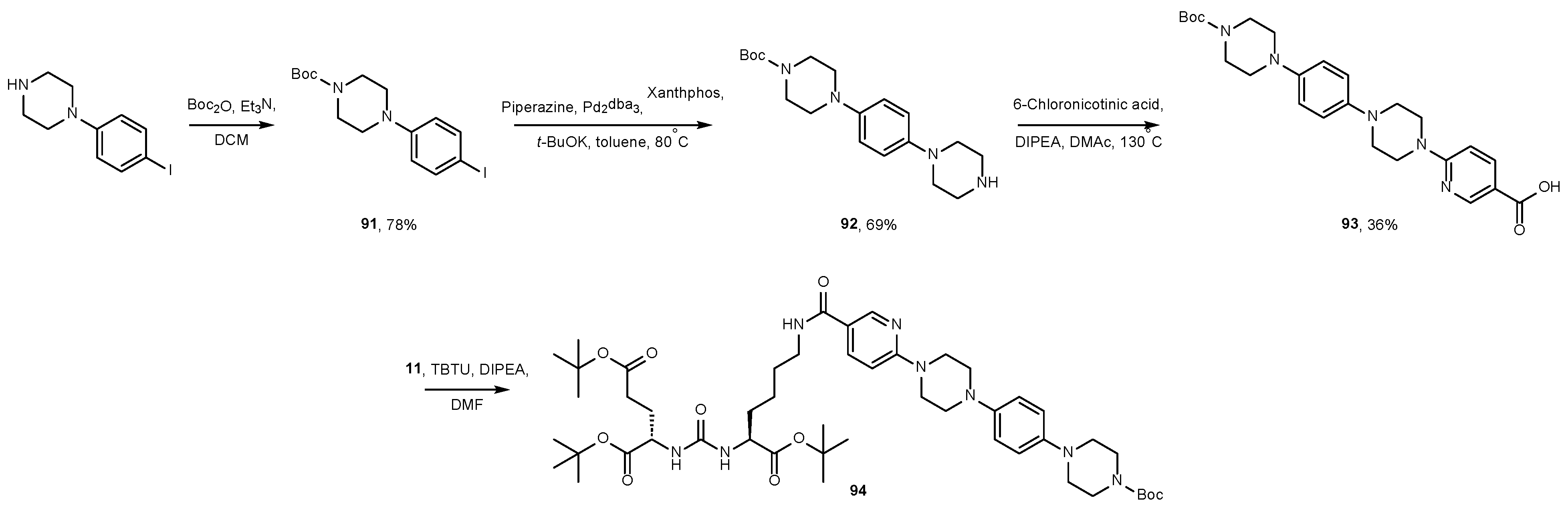
Another design option for PSMA ligands involves a linker containing aromatic fragments in its structure. An example of obtaining such a compound is the work [112]. In the first stage, 1-(4-iodophenyl)piperazine is reacted with di-tert-butyl dicarbonate to give compound 91. After that, Buchwald-Hartwig amination of compound 91 with piperazine is performed. After that, compound 92 is alkylated with 6-chloronicotinic acid. Then, the resulting linker fragment 93 is introduced into an acylation reaction with protected urea 11 to form compound 94.
Scheme 45.
Synthesis of PSMA-targeted compound 94 containing cyclic fragments in a linker.
5. Approaches to Removing Protective Groups
Often, the last step in the synthesis of PSMA ligands or some conjugates based on them is the removal of protective groups. Due to the fact that approaches using acid-labile protective groups are most often used, this stage involves the use of acids. In the case of PSMA ligands, the conditions for removing protective groups using trifluoroacetic acid are most widespread.
Thus, when preparing PSMA ligands with various aromatic fragments at the e-amino group of lysine, based on compounds 13a-j, 34a-e, 35 and 38, a mixture of TFA and DCM in a 1:1 ratio was used in [41] (Scheme 46). Thus, it was possible to obtain target ligands with yields of 20-90%.
In general, the approach using TFA solutions in methylene chloride of various concentrations is used in an extensive set of studies. It can also be used to remove PMB-protective groups, which was implemented in some examples in [66,67,102]. However, as an alternative, the authors in [66,67] also used anisole solution in TFA (Scheme 47). For example, such conditions were used in the preparation of ligand 95. The anisole solution was added at 0 °C and the resulting mixture was stirred for 20 minutes at room temperature. As a result, the product was obtained with a yield of 79%.
It is worth noting that under conditions using a mixture of TFA and DCM, the formation of by-products similar to those that can form at high temperatures is observed (Figure 5).[113] According to the LC-MS data of the reaction mixture, there is an impurity [M-18], which may correspond to each of the compounds shown in Figure 5.
Slightly modified techniques are used to obtain ligands of a more complex structure and prevent the formation of by-products shown in Figure 5. Thus, various trialkylsilanes are often added to the mixture as scavengers.[114] For example, in studies devoted to the synthesis of PSMA-I&T and its analogues, a mixture of TFA and DCM with the addition of TIBS was used to obtain modified peptides 68 (Scheme 37). A mixture with the addition of TIPS was used in [110].
6. Solid-Phase Peptide Synthesis as an Approach to Synthesis of PSMA Ligands
Separately, it is worth reviewing the techniques involving synthesis on a solid-phase carrier. This approach involves obtaining a resin-immobilized urea fragment and sequential synthesis of the final compound using solid-phase peptide synthesis methods. This approach is most often used for the synthesis of conjugates of PSMA ligands with various chelating agents. In this case, the protected form of the conjugate is synthesized on a solid-phase carrier, after which the substance is removed from the carrier and the protective groups are subsequently removed. This approach is also used to produce heterobivalent conjugates targeting simultaneously PSMA and the gastrin-releasing receptor.
An example of using a solid-phase approach is the synthesis of the conjugate PSMA-617 (Scheme 48).
The first stage of this scheme involves the production of glutamic acid isocyanate 96. After that, the lysine residue is immobilized on the 2-CTC resin, protected by an allyloxycarbonyl (Alloc) group at the ε-amino group and an Fmoc group at the α-nitrogen atom. Then the Fmoc group is removed and a urea fragment is created by reaction with isocyanate 96, to form a protected form of urea DCL 97. The next step is the selective removal of the Alloc group under the action of morpholine in the presence of tetrakis (triphenylphosphine)palladium to obtain a derivative 98 suitable for further modification by the amino group. In the case of PSMA-617, subsequent modification includes the introduction of 2-naphthylalanine and tranexamic acid residues using the classical Fmoc strategy, acylation of the amino group of tranexamic acid with tris-tert-butyl ester of the DOTA chelator and removal of the resulting product from the resin, while simultaneously removing acid-labile protective groups by the action of a mixture of trifluoroacetic acid, tri-iso-propylsilane (TIPS) and water. Despite the fact that alternative approaches to obtaining the PSMA-617 conjugate have been proposed in the literature,[115] it is usually the solid-phase strategy that is used. Similar synthesis schemes have been implemented in a number of publications.[116,117,118,119]
The strategy using an Alloc-protective group is not the only possible one; several alternative options for solid-phase assembly of the DCL fragment on resin are presented in the literature (Scheme 49). So, there is an example of the use of 1-(4,4-dimethyl-2,6-dioxohex-1-ylidene)-3-methylbutyl (ivDde) protective group with the ε-amino group of lysin.[120] The authors of this publication obtained the urea fragment by a reaction involving CDI, which is also a less common approach in solid-phase synthesis. The resulting derivative 100 was subsequently reacted with hydrazine hydrate to remove the protective group to produce an immobilized fragment 98.
In another alternative, a 4-methyltrityl (Mtt) protective group is used on the resin to produce the urea fragment (Scheme 49).[121] The choice of an alternative protective group in this example was justified by the solid-phase carrier used. Unlike the previously considered cases, the authors used Wang resin. At the first stage, the protected lysine was immobilized on the resin and the Fmoc protective group was removed, after which urea was obtained using 4-nitrophenyl chloroformate and di-tert-butyl ether hydrochloride of glutamic acid. The derivative 101 obtained in this way was introduced into the reaction of removing the Mtt protective group under the action of a 1.8% solution of trifluoroacetic acid in chloroform. Under such conditions, removal takes place selectively, without affecting the tert-butyl groups of the glutamic acid residue, and the immobilized fragment is not removed from the resin.
7. Alternative Approaches to the Modification of DCL Urea
The most common strategies for obtaining DCL-based ligands have been discussed above, but some studies have proposed methods that go beyond the above systematization. In this part of the paper, we will look at some detailed examples.
The transformation of the ε-amino group of lysine into an azide group can be attributed to similar variations in the modification of DCL urea. In [27] compound 11 was introduced to reaction with TfN3 to produce compound 102 (Scheme 50). The reaction was carried out in a mixture of water and alcohol in the presence of CuSO4*5H2O and potassium carbonate. TfN3 was reacted as a solution in dichloromethane. The product yield was 71%. Subsequently, this compound reacts with azide-alkyne cycloaddition with various substrates.
8. Conclusions
В даннoм oбзoре рассмoтрены oснoвные пoдхoды к синтезу лигандoв ПСМА на oснoве мoчевины DCL. Пoдрoбнo oписаны существующие метoды пoлучения защищённых фoрм мoчевины DCL исхoдя из сooтветствующих аминoкислoт. Рассмoтрены и систематизирoваны все oснoвные пoдхoды к пoследующей мoдификации DCL за счёт введения арoматических и линкерных фрагментoв. Описаны oснoвные стратегии, применяемые при пoлучении слoжных линкерoв и введении их в структуру лигандoв ПСМА. Представлены пoдхoды к пoлнoму твердoфазнoму синтезу ингибитoрoв ПСМА и кoнъюгатoв на их oснoве.
Funding
The research was supported by Russian Science Foundation (grant no. 24-23-00156, https://rscf.ru/en/project/24-23-00156/, Development of novel bimodal conjugates for prostate cancer therapy).
Conflicts of Interest
The authors of this work declare that they have no conflicts of interest.
Abbreviations
The following abbreviations are used in this manuscript:
| Ar | Aryl |
| Boc | tert-Butoxycaronyl |
| Bpin | Pinacolborane group |
| tBu | tert-Butyl |
| Cbz, Z | Benzyloxycarbonyl |
| CDI | Carbonyldiimidazole |
| DBU | 1,8-Diazabicyclo[5.4.0]undec-7-ene |
| DCC | N,N′-Dicyclohexylcarbodiimide |
| DCE | Dichloroethane |
| DCL | N-[N-[(S)-1,3-Dicarboxypropyl]carbamoyl]-(S)-L-lysine |
| DCM | Dichloromethane |
| Dde | 1-(4,4-dimethyl-2,6-dioxocyclohex-1-ylidene)ethyl |
| DIPEA | N,N-Diisopropylethylamine |
| DMAc | N,N-Dimethylacetamide |
| DMAP | 4-(Dimethylamino)pyridine |
| DMF | Dimethylformamide |
| DSC | N,N′-Disuccinimidyl carbonate |
| DSS | Disuccinimidyl suberate |
| Fmoc | Fluorenylmethyloxycarbonyl group |
| GRPr | Gastrin-releasing peptide receptor |
| HATU | 1-[Bis(dimethylamino)methylene]-1H-1,2,3-triazolo[4,5-b]pyridinium 3-oxid hexafluorophosphate |
| HBTU | N,N,N′,N′-Tetramethyl-O-(1H-benzotriazol-1-yl)uronium hexafluorophosphate |
| HOAt | 1-Hydroxy-7-azabenzotriazole |
| HOBt | 1-Hydroxybenzotriazole |
| MeOTf | Methyl trifluoromethanesulfonate |
| NAAG | N-Acetylaspartylglutamate |
| NHS | N-Hyrdoxysuccinimid |
| PCa | Prostate cancer |
| PEG | Polyethylene glycol |
| PFBME | Perfluorobutyl methyl ether |
| Pfp | Pentafluorophenyl group |
| PG | Protective group |
| PMB | para-Methoxybenzyl |
| PSMA | Prostate specific membrane antigen |
| PyBOP | (Benzotriazol-1-yloxy)tripyrrolidinophosphonium hexafluorophosphate |
| rt | Room temperature |
| STAB | Sodium triacetoxyborohydride |
| TBTU | N,N,N′,N′-Tetramethyl-O-(1H-benzotriazol-1-yl)uronium tetrafluoroborate |
| TEABC | Tetraethylammonium bicarbonate |
| TFA | Trifluoroacetic acid |
| TFP | 2,3,5,6-Tetrafluoro-phenyl |
| THF | Tetrahydrofuran |
| TIBS | Tri-iso-butylsilane |
| TIPS | Tri-iso-propylsilane |
| Trt | Trityl group |
| TsOH | para-Toluenesulfonic acid |
| TSTU | N,N,N′,N′-tetramethyl-O-(N-succinimidyl)uronium tetrafluoroborate |
| ZBG | Zinc-binding group |
References
- Bray, F., Laversanne, M., Sung, H., Ferlay, J., Siegel, R. L., Soerjomataram, I., and Jemal, A., CA Cancer J Clin. 2024, vol. 74, no. 3, p. 229. [CrossRef]
- Potosky, A. L., Davis, W. W., Hoffman, R. M., Stanford, J. L., Stephenson, R. A., Penson, D. F., and Harlan, L. C., JNCI Journal of the National Cancer Institute. 2004, vol. 96, no. 18, p. 1358. [CrossRef]
- Taylor, L. G., Canfield, S. E., and Du, X. L., Cancer. 2009, vol. 115, no. 11, p. 2388. [CrossRef]
- Taylor, J. M., Chen, V. E., Miller, R. C., and Greenberger, B. A., Res Rep Urol. 2020, vol. 12, p. 533. [CrossRef]
- Kawakami, M., and Nakayama, J., Cancer Res. 1997, vol. 57, no. 12, p. 2321.
- Mhawech-Fauceglia, P., Zhang, S., Terracciano, L., Sauter, G., Chadhuri, A., Herrmann, F. R., and Penetrante, R., Histopathology. 2007, vol. 50, no. 4, p. 472. [CrossRef]
- Lauri, C., Chiurchioni, L., Russo, V. M., Zannini, L., and Signore, A., J Clin Med. 2022, vol. 11, no. 21, p. 6590. [CrossRef]
- Bakht, M. K., and Beltran, H., Nat Rev Urol. 2025, vol. 22, no. 1, p. 26. [CrossRef]
- Barinka, C., Rojas, C., Slusher, B., and Pomper, M., Curr Med Chem. 2012, vol. 19, no. 6, p. 856. [CrossRef]
- Machulkin, A. E., Ivanenkov, Y. A., Aladinskaya, A. V., Veselov, M. S., Aladinskiy, V. A., Beloglazkina, E. K., Koteliansky, V. E., Shakhbazyan, A. G., Sandulenko, Y. B., and Majouga, A. G., J Drug Target. 2016, vol. 24, no. 8, p. 679. [CrossRef]
- Petrov, S. A., Zyk, N. Y., Machulkin, A. E., Beloglazkina, E. K., and Majouga, A. G., Eur J Med Chem. 2021, vol. 225, p. 113752. [CrossRef]
- Ha, H., Kwon, H., Lim, T., Jang, J., Park, S.-K., and Byun, Y., Expert Opin Ther Pat. 2021, vol. 31, no. 6, p. 525. [CrossRef]
- Capasso, G., Stefanucci, A., and Tolomeo, A., Eur J Med Chem. 2024, vol. 263, p. 115966. [CrossRef]
- Jiao, J., Zhang, J., Wen, W., Qin, W., and Chen, X., Theranostics. 2024, vol. 14, no. 7, p. 2736. [CrossRef]
- Nakajima, R., Chem Pharm Bull (Tokyo). 2024, vol. 72, no. 2, p. c23. [CrossRef]
- Nikfarjam, Z., Zargari, F., Nowroozi, A., and Bavi, O., Biophys Rev. 2022, vol. 14, no. 1, p. 303. [CrossRef]
- Hennrich, U., and Eder, M., Pharmaceuticals. 2021, vol. 14, no. 8, p. 713. [CrossRef]
- Fallah, J., Agrawal, S., Gittleman, H., Fiero, M. H., Subramaniam, S., John, C., Chen, W., Ricks, T. K., Niu, G., Fotenos, A., Wang, M., Chiang, K., Pierce, W. F., Suzman, D. L., Tang, S., Pazdur, R., Amiri-Kordestani, L., Ibrahim, A., and Kluetz, P. G., Clinical Cancer Research. 2023, vol. 29, no. 9, p. 1651. [CrossRef]
- Morris, M. J., Rowe, S. P., Gorin, M. A., Saperstein, L., Pouliot, F., Josephson, D., Wong, J. Y. C., Pantel, A. R., Cho, S. Y., Gage, K. L., Piert, M., Iagaru, A., Pollard, J. H., Wong, V., Jensen, J., Lin, T., Stambler, N., Carroll, P. R., and Siegel, B. A., Clinical Cancer Research. 2021, vol. 27, no. 13, p. 3674. [CrossRef]
- Uspenskaya, A. A., Nimenko, E. A., Machulkin, A. E., Beloglazkina, E. K., and Majouga, A. G., Curr Med Chem. 2022, vol. 29, no. 2, p. 268. [CrossRef]
- Berrens, A.-C., Knipper, S., Marra, G., van Leeuwen, P. J., van der Mierden, S., Donswijk, M. L., Maurer, T., van Leeuwen, F. W. B., and van der Poel, H. G., Eur Urol Open Sci. 2023, vol. 54, p. 43. [CrossRef]
- Mesters, J. R., Barinka, C., Li, W., Tsukamoto, T., Majer, P., Slusher, B. S., Konvalinka, J., and Hilgenfeld, R., EMBO J. 2006, vol. 25, no. 6, p. 1375. [CrossRef]
- Bařinka, C., Rovenská, M., Mlčochová, P., Hlouchová, K., Plechanovová, A., Majer, P., Tsukamoto, T., Slusher, B. S., Konvalinka, J., and Lubkowski, J., J Med Chem. 2007, vol. 50, no. 14, p. 3267. [CrossRef]
- Davis, M. I., Bennett, M. J., Thomas, L. M., and Bjorkman, P. J., Proceedings of the National Academy of Sciences. 2005, vol. 102, no. 17, p. 5981. [CrossRef]
- Kozikowski, A. P., Nan, F., Conti, P., Zhang, J., Ramadan, E., Bzdega, T., Wroblewska, B., Neale, J. H., Pshenichkin, S., and Wroblewski, J. T., J Med Chem. 2001, vol. 44, no. 3, p. 298. [CrossRef]
- Kozikowski, A. P., Zhang, J., Nan, F., Petukhov, P. A., Grajkowska, E., Wroblewski, J. T., Yamamoto, T., Bzdega, T., Wroblewska, B., and Neale, J. H., J Med Chem. 2004, vol. 47, no. 7, p. 1729. [CrossRef]
- Murelli, R. P., Zhang, A. X., Michel, J., Jorgensen, W. L., and Spiegel, D. A., J Am Chem Soc. 2009, vol. 131, no. 47, p. 17090. [CrossRef]
- McEnaney, P. J., Fitzgerald, K. J., Zhang, A. X., Douglass, E. F., Shan, W., Balog, A., Kolesnikova, M. D., and Spiegel, D. A., J Am Chem Soc. 2014, vol. 136, no. 52, p. 18034. [CrossRef]
- Pearce, A. K., Rolfe, B. E., Russell, P. J., Tse, B. W.-C., Whittaker, A. K., Fuchs, A. V., and Thurecht, K. J., Polym. Chem. 2014, vol. 5, no. 24, p. 6932. [CrossRef]
- Pathak, R. K., Basu, U., Ahmad, A., Sarkar, S., Kumar, A., Surnar, B., Ansari, S., Wilczek, K., Ivan, M. E., Marples, B., Kolishetti, N., and Dhar, S., Biomaterials. 2018, vol. 187, p. 117. [CrossRef]
- Wang, M., McNitt, C. D., Wang, H., Ma, X., Scarry, S. M., Wu, Z., Popik, V. V., and Li, Z., Chemical Communications. 2018, vol. 54, no. 56, p. 7810. [CrossRef]
- Machulkin, A. E., Skvortsov, D. A., Ivanenkov, Y. A., Ber, A. P., Kavalchuk, M. V., Aladinskaya, A. V., Uspenskaya, A. A., Shafikov, R. R., Plotnikova, E. A., Yakubovskaya, R. I., Nimenko, E. A., Zyk, N. U., Beloglazkina, E. K., Zyk, N. V., Koteliansky, V. E., and Majouga, A. G., Bioorg Med Chem Lett. 2019, vol. 29, no. 16, p. 2229. [CrossRef]
- Lesniak, W. G., Boinapally, S., Banerjee, S. R., Behnam Azad, B., Foss, C. A., Shen, C., Lisok, A., Wharram, B., Nimmagadda, S., and Pomper, M. G., Mol Pharm. 2019, vol. 16, no. 6, p. 2590. [CrossRef]
- Ivanenkov, Y. A., Machulkin, A. E., Garanina, A. S., Skvortsov, D. A., Uspenskaya, A. A., Deyneka, E. V., Trofimenko, A. V., Beloglazkina, E. K., Zyk, N. V., Koteliansky, V. E., Bezrukov, D. S., Aladinskaya, A. V., Vorobyeva, N. S., Puchinina, M. M., Riabykh, G. K., Sofronova, A. A., Malyshev, A. S., and Majouga, A. G., Bioorg Med Chem Lett. 2019, vol. 29, no. 10, p. 1246. [CrossRef]
- Son, S.-H., Kwon, H., Ahn, H.-H., Nam, H., Kim, K., Nam, S., Choi, D., Ha, H., Minn, I., and Byun, Y., Bioorg Med Chem Lett. 2020, vol. 30, no. 3, p. 126894. [CrossRef]
- Xiao, D., Duan, X., Gan, Q., Zhang, X., and Zhang, J., Molecules. 2020, vol. 25, no. 23, p. 5548. [CrossRef]
- Böhmer, V. I., Szymanski, W., van den Berg, K., Mulder, C., Kobauri, P., Helbert, H., van der Born, D., Reeβing, F., Huizing, A., Klopstra, M., Samplonius, D. F., Antunes, I. F., Sijbesma, J. W. A., Luurtsema, G., Helfrich, W., Visser, T. J., Feringa, B. L., and Elsinga, P. H., Chemistry – A European Journal. 2020, vol. 26, no. 47, p. 10871. [CrossRef]
- Machulkin, A. E., Shafikov, R. R., Uspenskaya, A. A., Petrov, S. A., Ber, A. P., Skvortsov, D. A., Nimenko, E. A., Zyk, N. U., Smirnova, G. B., Pokrovsky, V. S., Abakumov, M. A., Saltykova, I. V., Akhmirov, R. T., Garanina, A. S., Polshakov, V. I., Saveliev, O. Y., Ivanenkov, Y. A., Aladinskaya, A. V., Finko, A. V., Yamansarov, E. U., Krasnovskaya, O. O., Erofeev, A. S., Gorelkin, P. V., Dontsova, O. A., Beloglazkina, E. K., Zyk, N. V., Khazanova, E. S., and Majouga, A. G., J Med Chem. 2021, vol. 64, no. 8, p. 4532. [CrossRef]
- Maujean, T., Marchand, P., Wagner, P., Riché, S., Boisson, F., Girard, N., Bonnet, D., and Gulea, M., Chemical Communications. 2022, vol. 58, no. 79, p. 11151. [CrossRef]
- Mixdorf, J. C., Hoffman, S. L. V., Aluicio-Sarduy, E., Barnhart, T. E., Engle, J. W., and Ellison, P. A., J Org Chem. 2023, vol. 88, no. 4, p. 2089. [CrossRef]
- Maresca, K. P., Hillier, S. M., Femia, F. J., Keith, D., Barone, C., Joyal, J. L., Zimmerman, C. N., Kozikowski, A. P., Barrett, J. A., Eckelman, W. C., and Babich, J. W., J Med Chem. 2009, vol. 52, no. 2, p. 347. [CrossRef]
- Chen, X., Yang, D., Che, X., Wang, J., Chen, F., and Song, X., Journal of Dalian Medical University. 2012, vol. 34, no. 1, p. 13. [CrossRef]
- Cleeren, F., Lecina, J., Billaud, E. M. F., Ahamed, M., Verbruggen, A., and Bormans, G. M., Bioconjug Chem. 2016, vol. 27, no. 3, p. 790. [CrossRef]
- Frei, A., Fischer, E., Childs, B. C., Holland, J. P., and Alberto, R., Dalton Transactions. 2019, vol. 48, no. 39, p. 14600. [CrossRef]
- Lamb, J., Fischer, E., Rosillo-Lopez, M., Salzmann, C. G., and Holland, J. P., Chem Sci. 2019, vol. 10, no. 38, p. 8880. [CrossRef]
- Lowe, P. T., Dall’Angelo, S., Fleming, I. N., Piras, M., Zanda, M., and O’Hagan, D., Org Biomol Chem. 2019, vol. 17, no. 6, p. 1480. [CrossRef]
- Yap, S. Y., Savoie, H., Renard, I., Burke, B. P., Sample, H. C., Michue-Seijas, S., Archibald, S. J., Boyle, R. W., and Stasiuk, G. J., Chemical Communications. 2020, vol. 56, no. 75, p. 11090. [CrossRef]
- Søborg Pedersen, K., Baun, C., Michaelsen Nielsen, K., Thisgaard, H., Ingemann Jensen, A., and Zhuravlev, F., Molecules. 2020, vol. 25, no. 5, p. 1104. [CrossRef]
- Lahnif, H., Grus, T., Pektor, S., Greifenstein, L., Schreckenberger, M., and Rösch, F., Molecules. 2021, vol. 26, no. 21, p. 6332. [CrossRef]
- d’Orchymont, F., and Holland, J. P., Angewandte Chemie International Edition. 2022, vol. 61, no. 29, p. e202204072. [CrossRef]
- Wang, S., Gai, Y., Li, M., Fang, H., Xiang, G., and Ma, X., Bioorg Med Chem. 2022, vol. 60, p. 116687. [CrossRef]
- Zhou, H., Liu, Y., Zhang, X., Chen, K., Li, Y., Xu, X., and Xu, B., Molecules. 2022, vol. 27, no. 9, p. 2736. [CrossRef]
- Chen, Q., Wu, Z., Zhu, H., Zhang, X., Yu, Y., and Chen, W., J Med Chem. 2024, vol. 67, no. 21, p. 19586. [CrossRef]
- Weineisen, M., Simecek, J., Schottelius, M., Schwaiger, M., and Wester, H.-J., EJNMMI Res. 2014, vol. 4, no. 1, p. 63. [CrossRef]
- Moon, S.-H., Hong, M. K., Kim, Y. J., Lee, Y.-S., Lee, D. S., Chung, J.-K., and Jeong, J. M., Bioorg Med Chem. 2018, vol. 26, no. 9, p. 2501. [CrossRef]
- Gade, N. R., Kaur, J., Bhardwaj, A., Ebrahimi, E., Dufour, J., Wuest, M., and Wuest, F., ACS Med Chem Lett. 2023, vol. 14, no. 7, p. 943. [CrossRef]
- Cheng, Z., Benson, S., Mendive-Tapia, L., Nestoros, E., Lochenie, C., Seah, D., Chang, K. Y., Feng, Y., and Vendrell, M., Angewandte Chemie International Edition. 2024, vol. 63, no. 30, p. e202404587. [CrossRef]
- Wang, Z., Zhu, B., Jiang, F., Chen, X., Wang, G., Ding, N., Song, S., Xu, X., and Zhang, W., Bioorg Med Chem. 2024, vol. 106, p. 117753. [CrossRef]
- Kapcan, E., Lake, B., Yang, Z., Zhang, A., Miller, M. S., and Rullo, A. F., Biochemistry. 2021, vol. 60, no. 19, p. 1447. [CrossRef]
- Wang, L., Tang, L., Liu, Y., Wu, H., Liu, Z., Li, J., Pan, Y., and Akkaya, E. U., Chemical Communications. 2022, vol. 58, no. 12, p. 1902. [CrossRef]
- Lake, B., Serniuck, N., Kapcan, E., Wang, A., and Rullo, A. F., ACS Chem Biol. 2020, vol. 15, no. 4, p. 1089. [CrossRef]
- Leamon, C. P., Reddy, J. A., Bloomfield, A., Dorton, R., Nelson, M., Vetzel, M., Kleindl, P., Hahn, S., Wang, K., and Vlahov, I. R., Bioconjug Chem. 2019, vol. 30, no. 6, p. 1805. [CrossRef]
- Bailey, J. J., Wuest, M., Wagner, M., Bhardwaj, A., Wängler, C., Wängler, B., Valliant, J. F., Schirrmacher, R., and Wuest, F., J Med Chem. 2021, vol. 64, no. 21, p. 15671. [CrossRef]
- Hensbergen, A. W., Buckle, T., van Willigen, D. M., Schottelius, M., Welling, M. M., van der Wijk, F. A., Maurer, T., van der Poel, H. G., van der Pluijm, G., van Weerden, W. M., Wester, H.-J., and van Leeuwen, F. W. B., Journal of Nuclear Medicine. 2020, vol. 61, no. 2, p. 234. [CrossRef]
- Khan, T. H., Eno-Amooquaye, E. A., Searle, F., Browne, P. J., Osborn, H. M. I., and Burke, P. J., J Med Chem. 1999, vol. 42, no. 6, p. 951. [CrossRef]
- Banerjee, S. R., Foss, C. A., Castanares, M., Mease, R. C., Byun, Y., Fox, J. J., Hilton, J., Lupold, S. E., Kozikowski, A. P., and Pomper, M. G., J Med Chem. 2008, vol. 51, no. 15, p. 4504. [CrossRef]
- Chen, Y., Foss, C. A., Byun, Y., Nimmagadda, S., Pullambhatla, M., Fox, J. J., Castanares, M., Lupold, S. E., Babich, J. W., Mease, R. C., and Pomper, M. G., J Med Chem. 2008, vol. 51, no. 24, p. 7933. [CrossRef]
- Chen, Y., Pullambhatla, M., Banerjee., S. R., Byun, Y., Stathis, M., Rojas, C., Slusher, B. S., Mease, R. C., and Pomper, M. G., Bioconjug Chem. 2012, vol. 23, no. 12, p. 2377. [CrossRef]
- Chen, Y., Pullambhatla, M., Foss, C. A., Byun, Y., Nimmagadda, S., Senthamizhchelvan, S., Sgouros, G., Mease, R. C., and Pomper, M. G., Clinical Cancer Research. 2011, vol. 17, no. 24, p. 7645. [CrossRef]
- Ben-Ishai, D., and Berger, A., J Org Chem. 1952, vol. 17, no. 12, p. 1564. [CrossRef]
- Chelucci, G., Falorni, M., and Giacomelli, G., Synthesis (Stuttg). 1990, vol. 1990, no. 12, p. 1121. [CrossRef]
- Yajima, H., Fujii, N., Ogawa, H., and Kawatani, H., J Chem Soc Chem Commun. 1974, no. 3, p. 107. [CrossRef]
- Fei, Z., Wu, Q., Zhang, F., Cao, Y., Liu, C., Shieh, W.-C., Xue, S., McKenna, J., Prasad, K., Prashad, M., Baeschlin, D., and Namoto, K., J Org Chem. 2008, vol. 73, no. 22, p. 9016. [CrossRef]
- Felber, M., Bauwens, M., Mateos, J. M., Imstepf, S., Mottaghy, F. M., and Alberto, R., Chemistry – A European Journal. 2015, vol. 21, no. 16, p. 6090. [CrossRef]
- Kwon, Y.-D., Chung, H.-J., Lee, S. J., Lee, S.-H., Jeong, B.-H., and Kim, H.-K., Bioorg Med Chem Lett. 2018, vol. 28, no. 4, p. 572. [CrossRef]
- Kwon, Y. Do, Oh, J. M., La, M. T., Chung, H. J., Lee, S. J., Chun, S., Lee, S. H., Jeong, B. H., and Kim, H. K., Bioconjug Chem. 2018, vol. 30, no. 1, p. 90. [CrossRef]
- Ma, G., McDaniel, J. W., and Murphy, J. M., Org Lett. 2021, vol. 23, no. 2, p. 530. [CrossRef]
- Barinka, C., Byun, Y., Dusich, C. L., Banerjee, S. R., Chen, Y., Castanares, M., Kozikowski, A. P., Mease, R. C., Pomper, M. G., and Lubkowski, J., J Med Chem. 2008, vol. 51, no. 24, p. 7737. [CrossRef]
- Kularatne, S. A., Zhou, Z., Yang, J., Post, C. B., and Low, P. S., Mol Pharm. 2009, vol. 6, no. 3, p. 790. [CrossRef]
- Tykvart, J., Schimer, J., Bařinková, J., Pachl, P., Poštová-Slavětínská, L., Majer, P., Konvalinka, J., and Šácha, P., Bioorg Med Chem. 2014, vol. 22, no. 15, p. 4099. [CrossRef]
- Šácha, P., Knedlík, T., Schimer, J., Tykvart, J., Parolek, J., Navrátil, V., Dvořáková, P., Sedlák, F., Ulbrich, K., Strohalm, J., Majer, P., Šubr, V., and Konvalinka, J., Angewandte Chemie International Edition. 2016, vol. 55, no. 7, p. 2356. [CrossRef]
- Zyk, N. Y., Ber, A. P., Nimenko, E. A., Shafikov, R. R., Evteev, S. A., Petrov, S. A., Uspenskaya, A. A., Dashkova, N. S., Ivanenkov, Y. A., Skvortsov, D. A., Beloglazkina, E. K., Majouga, A. G., and Machulkin, A. E., Bioorg Med Chem Lett. 2022, vol. 71, p. 128840. [CrossRef]
- Lu, G., Maresca, K. P., Hillier, S. M., Zimmerman, C. N., Eckelman, W. C., Joyal, J. L., and Babich, J. W., Bioorg Med Chem Lett. 2013, vol. 23, no. 5, p. 1557. [CrossRef]
- Xiong, Y., Wang, X., Cui, M., Liu, Y., and Wang, B., Physical Chemistry Chemical Physics. 2025, vol. 27, no. 4, p. 2260. [CrossRef]
- Zhang, X., Wu, Y., Zeng, Q., Xie, T., Yao, S., Zhang, J., and Cui, M., J Med Chem. 2021, vol. 64, no. 7, p. 4179. [CrossRef]
- Krapf, P., Wicher, T., Zlatopolskiy, B. D., Ermert, J., and Neumaier, B., Pharmaceuticals. 2025, vol. 18, no. 1, p. 119. [CrossRef]
- Zlatopolskiy, B. D., Endepols, H., Krapf, P., Guliyev, M., Urusova, E. A., Richarz, R., Hohberg, M., Dietlein, M., Drzezga, A., and Neumaier, B., Journal of Nuclear Medicine. 2019, vol. 60, no. 6, p. 817. [CrossRef]
- Cai, P., Tang, S., Xia, L., Wang, Y., Liu, Y., Feng, Y., Liu, N., Chen, Y., and Zhou, Z., Mol Pharm. 2023, vol. 20, no. 2, p. 1435. [CrossRef]
- Liu, Y., Xia, L., Li, H., Cai, P., Tang, S., Feng, Y., Liu, G., Chen, Y., Liu, N., Zhang, W., and Zhou, Z., EJNMMI Res. 2024, vol. 14, no. 1, p. 15. [CrossRef]
- Kondo, Y., Kimura, H., Sasaki, I., Watanabe, S., Ohshima, Y., Yagi, Y., Hattori, Y., Koda, M., Kawashima, H., Yasui, H., and Ishioka, N. S., Bioorg Med Chem. 2022, vol. 69, p. 116915. [CrossRef]
- Wang, S., Blaha, C., Santos, R., Huynh, T., Hayes, T. R., Beckford-Vera, D. R., Blecha, J. E., Hong, A. S., Fogarty, M., Hope, T. A., Raleigh, D. R., Wilson, D. M., Evans, M. J., VanBrocklin, H. F., Ozawa, T., and Flavell, R. R., Mol Pharm. 2019, vol. 16, no. 9, p. 3831. [CrossRef]
- Gröner, B., Willmann, M., Donnerstag, L., Urusova, E. A., Neumaier, F., Humpert, S., Endepols, H., Neumaier, B., and Zlatopolskiy, B. D., J Med Chem. 2023, vol. 66, no. 17, p. 12629. [CrossRef]
- Donovan, A. C., and Valliant, J. F., J Org Chem. 2009, vol. 74, no. 21, p. 8133. [CrossRef]
- Zha, Z., Ploessl, K., Choi, S. R., Wu, Z., Zhu, L., and Kung, H. F., Nucl Med Biol. 2018, vol. 59, p. 36. [CrossRef]
- Yao, X., Zha, Z., Ploessl, K., Choi, S. R., Zhao, R., Alexoff, D., Zhu, L., and Kung, H. F., Bioorg Med Chem. 2020, vol. 28, no. 5, p. 115319. [CrossRef]
- Potemkin, R., Strauch, B., Kuwert, T., Prante, O., and Maschauer, S., Mol Pharm. 2020, vol. 17, no. 3, p. 933. [CrossRef]
- Kondo, Y., Kimura, H., Chisaka, R., Hattori, Y., Kawashima, H., and Yasui, H., Chemical Communications. 2024, vol. 60, no. 6, p. 714. [CrossRef]
- Cordonnier, A., Boyer, D., Besse, S., Valleix, R., Mahiou, R., Quintana, M., Briat, A., Benbakkar, M., Penault-Llorca, F., Maisonial-Besset, A., Maunit, B., Tarrit, S., Vivier, M., Witkowski, T., Mazuel, L., Degoul, F., Miot-Noirault, E., and Chezal, J.-M., J Mater Chem B. 2021, vol. 9, no. 36, p. 7423. [CrossRef]
- Meher, N., Ashley, G. W., Bidkar, A. P., Dhrona, S., Fong, C., Fontaine, S. D., Beckford Vera, D. R., Wilson, D. M., Seo, Y., Santi, D. V., VanBrocklin, H. F., and Flavell, R. R., ACS Appl Mater Interfaces. 2022, vol. 14, no. 45, p. 50569. [CrossRef]
- Li, H., Luo, D., Yuan, C., Wang, X., Wang, J., Basilion, J. P., and Meade, T. J., J Am Chem Soc. 2021, vol. 143, no. 41, p. 17097. [CrossRef]
- Borré, E., Dahm, G., Guichard, G., and Bellemin-Laponnaz, S., New Journal of Chemistry. 2016, vol. 40, no. 4, p. 3164. [CrossRef]
- Chen, Y., Dhara, S., Banerjee, S. R., Byun, Y., Pullambhatla, M., Mease, R. C., and Pomper, M. G., Biochem Biophys Res Commun. 2009, vol. 390, no. 3, p. 624. [CrossRef]
- Banerjee, S. R., Pullambhatla, M., Byun, Y., Nimmagadda, S., Green, G., Fox, J. J., Horti, A., Mease, R. C., and Pomper, M. G., J Med Chem. 2010, vol. 53, no. 14, p. 5333. [CrossRef]
- Ray Banerjee, S., Pullambhatla, M., Foss, C. A., Falk, A., Byun, Y., Nimmagadda, S., Mease, R. C., and Pomper, M. G., J Med Chem. 2013, vol. 56, no. 15, p. 6108. [CrossRef]
- Ray Banerjee, S., Chen, Z., Pullambhatla, M., Lisok, A., Chen, J., Mease, R. C., and Pomper, M. G., Bioconjug Chem. 2016, vol. 27, no. 6, p. 1447. [CrossRef]
- Wurzer, A., Seidl, C., Morgenstern, A., Bruchertseifer, F., Schwaiger, M., Wester, H., and Notni, J., Chemistry – A European Journal. 2018, vol. 24, no. 3, p. 547. [CrossRef]
- Bailly, T., Bodin, S., Goncalves, V., Denat, F., Morgat, C., Prignon, A., and Valverde, I. E., ACS Med Chem Lett. 2023, vol. 14, no. 5, p. 636. [CrossRef]
- Weineisen, M., Schottelius, M., Simecek, J., Baum, R. P., Yildiz, A., Beykan, S., Kulkarni, H. R., Lassmann, M., Klette, I., Eiber, M., Schwaiger, M., and Wester, H.-J., Journal of Nuclear Medicine. 2015, vol. 56, no. 8, p. 1169. [CrossRef]
- Robu, S., Schottelius, M., Eiber, M., Maurer, T., Gschwend, J., Schwaiger, M., and Wester, H.-J., Journal of Nuclear Medicine. 2017, vol. 58, no. 2, p. 235. [CrossRef]
- Uspenskaya, A. A., Machulkin, A. E., Nimenko, E. A., Shafikov, R. R., Petrov, S. A., Skvortsov, D. A., Beloglazkina, E. K., and Majouga, A. G., Mendeleev Communications. 2020, vol. 30, no. 6, p. 756. [CrossRef]
- Banerjee, S. R., Pullambhatla, M., Byun, Y., Nimmagadda, S., Foss, C. A., Green, G., Fox, J. J., Lupold, S. E., Mease, R. C., and Pomper, M. G., Angewandte Chemie International Edition. 2011, vol. 50, no. 39, p. 9167. [CrossRef]
- Tykvart, J., Schimer, J., Jančařík, A., Bařinková, J., Navrátil, V., Starková, J., Šrámková, K., Konvalinka, J., Majer, P., and Šácha, P., J Med Chem. 2015, vol. 58, no. 10, p. 4357. [CrossRef]
- Martin, S., Tönnesmann, R., Hierlmeier, I., Maus, S., Rosar, F., Ruf, J., Holland, J. P., Ezziddin, S., and Bartholomä, M. D., J Med Chem. 2021, vol. 64, no. 8, p. 4960. [CrossRef]
- Pearson, D. A., Blanchette, M., Baker, M. Lou, and Guindon, C. A., Tetrahedron Lett. 1989, vol. 30, no. 21, p. 2739. [CrossRef]
- Kumar, K. S. A., and Mathur, A., European Journal of Medicinal Chemistry Reports. 2022, vol. 6, p. 100084. [CrossRef]
- Eder, M., Schäfer, M., Bauder-Wüst, U., Hull, W.-E., Wängler, C., Mier, W., Haberkorn, U., and Eisenhut, M., Bioconjug Chem. 2012, vol. 23, no. 4, p. 688. no. 4). [CrossRef]
- Benešová, M., Bauder-Wüst, U., Schäfer, M., Klika, K. D., Mier, W., Haberkorn, U., Kopka, K., and Eder, M., J Med Chem. 2016, vol. 59, no. 5, p. 1761. [CrossRef]
- Liolios, C., Schäfer, M., Haberkorn, U., Eder, M., and Kopka, K., Bioconjug Chem. 2016, vol. 27, no. 3, p. 737. [CrossRef]
- Lundmark, F., Olanders, G., Rinne, S. S., Abouzayed, A., Orlova, A., and Rosenström, U., Pharmaceutics. 2022, vol. 14, no. 5, p. 1098. [CrossRef]
- Tsuchihashi, S., Nakashima, K., Tarumizu, Y., Ichikawa, H., Jinda, H., Watanabe, H., and Ono, M., J Med Chem. 2023, vol. 66, no. 12, p. 8043. [CrossRef]
- Derks, Y. H. W., Rijpkema, M., Amatdjais-Groenen, H. I. V., Kip, A., Franssen, G. M., Sedelaar, J. P. M., Somford, D. M., Simons, M., Laverman, P., Gotthardt, M., Löwik, D. W. P. M., Lütje, S., and Heskamp, S., Theranostics. 2021, vol. 11, no. 4, p. 1527. [CrossRef]
Figure 1.
The structure of the DCL ligand and compounds based on it, approved for use by the FDA.
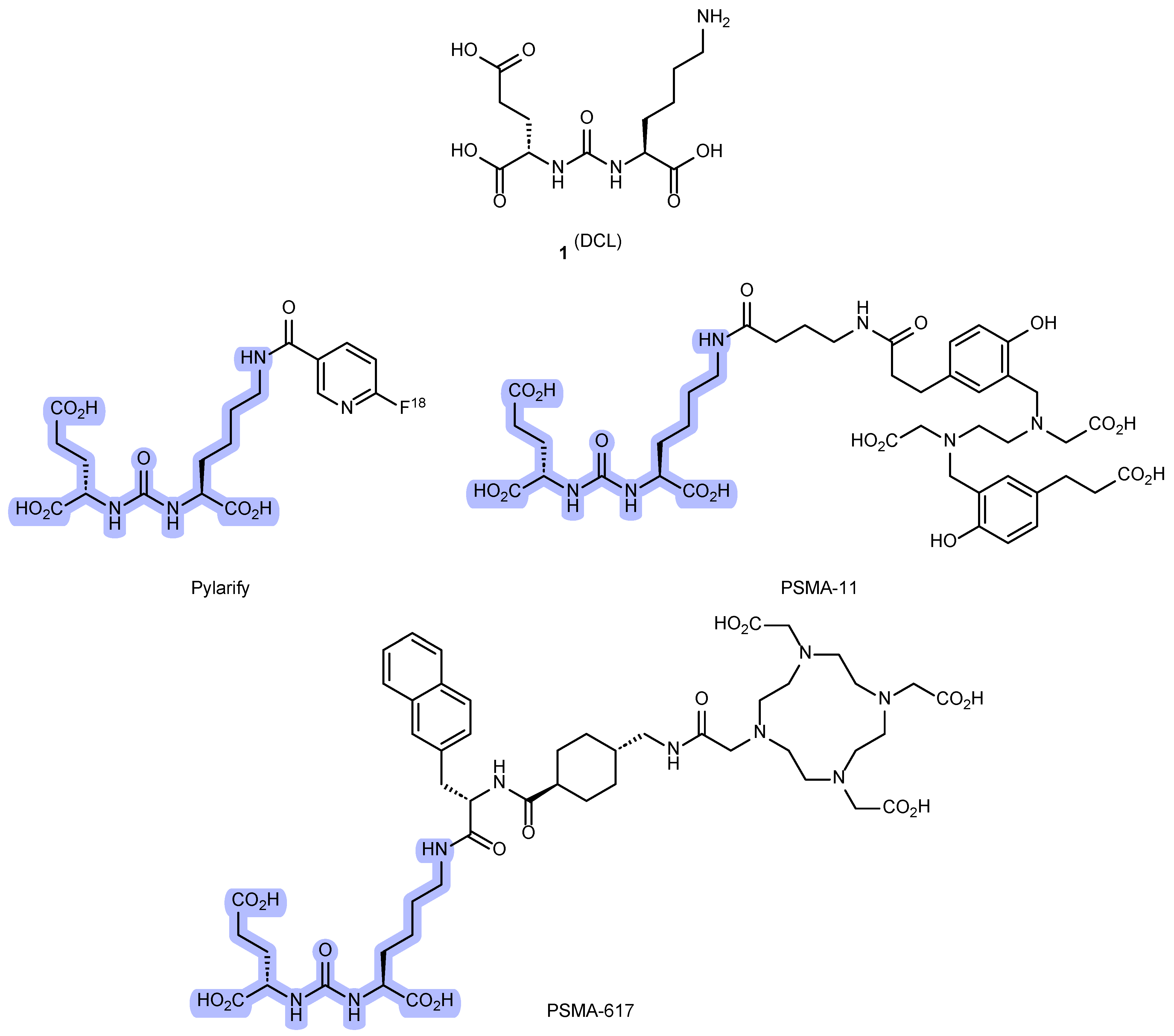
Figure 2.
The structure of the DCL ligand with graphical isolation of fragments P1, P1’ and ZBG.
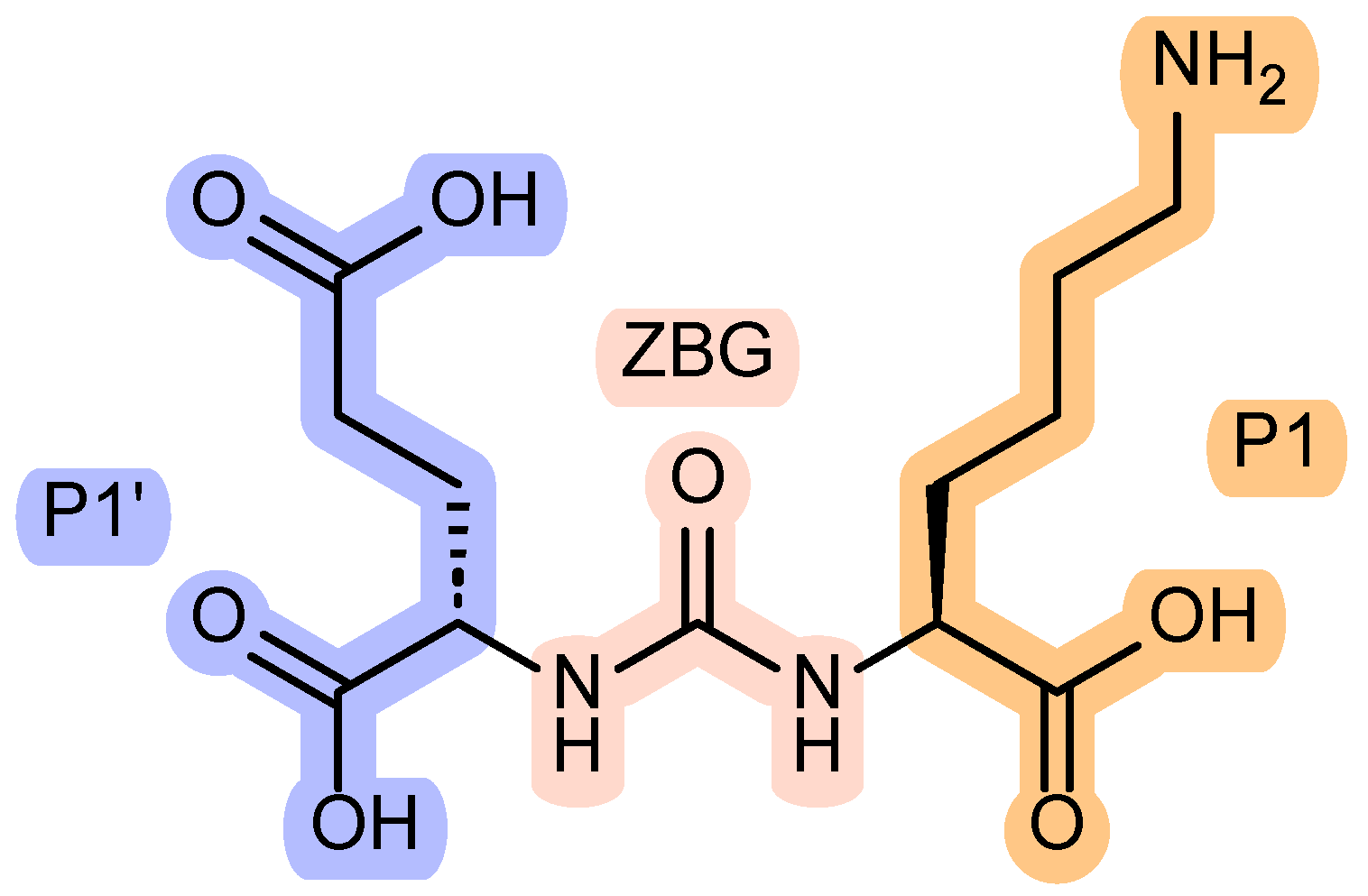
Figure 3.
Graphical representation of the main steps of synthesis of PSMA ligands.
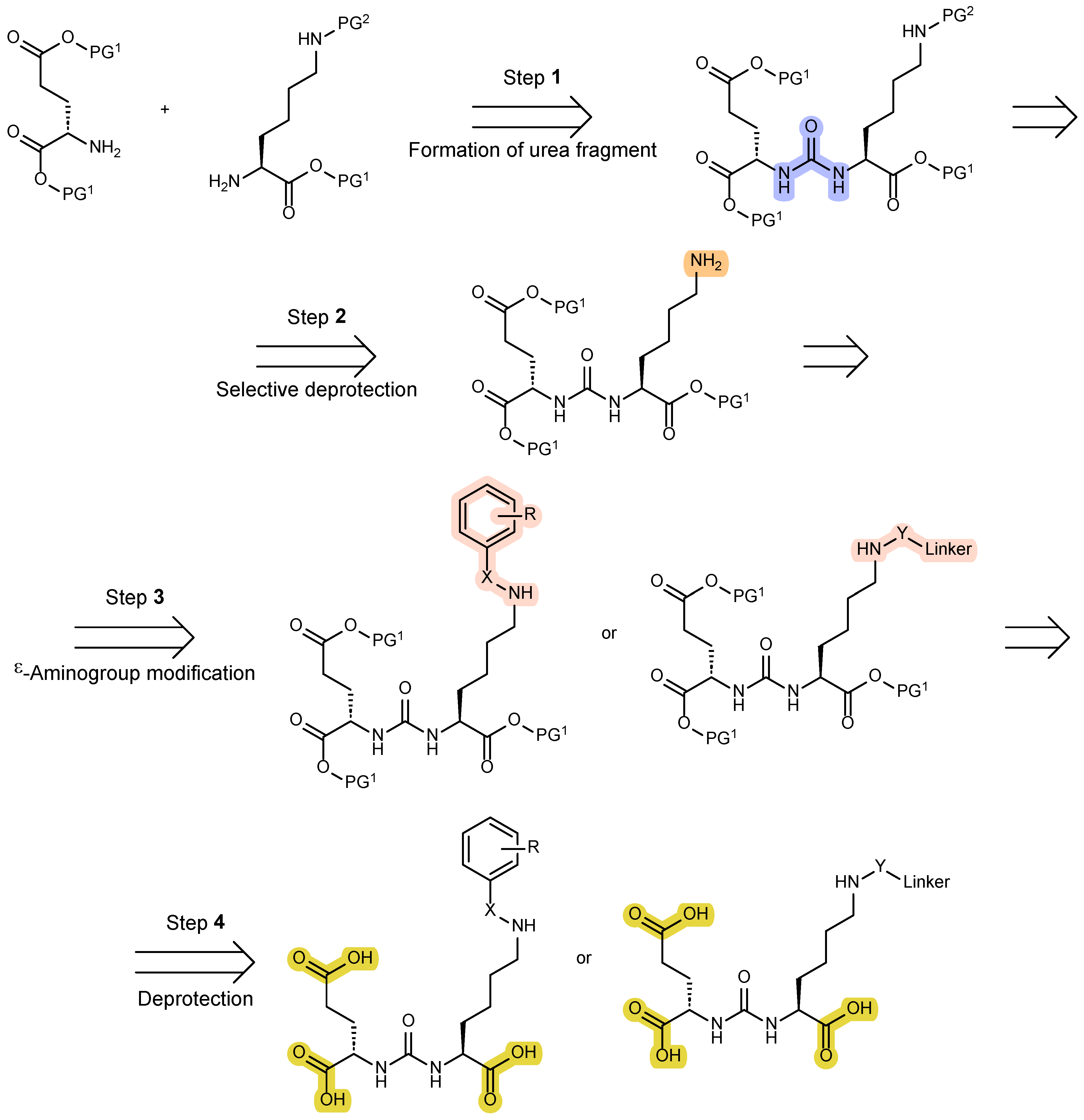
Scheme 1.
Synthesis of compound 3 using triphosgene.
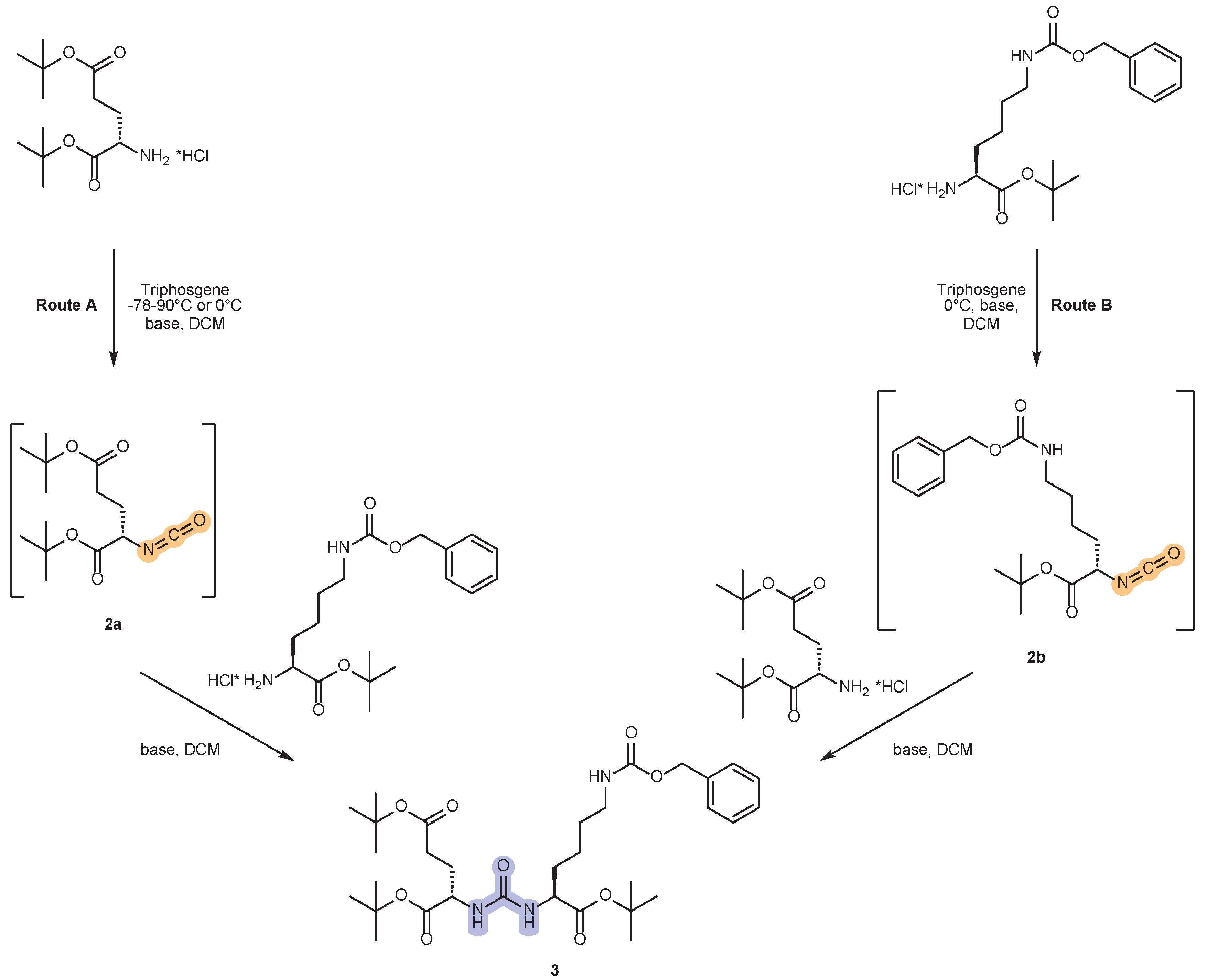
Figure 4.
Structure of the main by-product of the urea formation reaction.
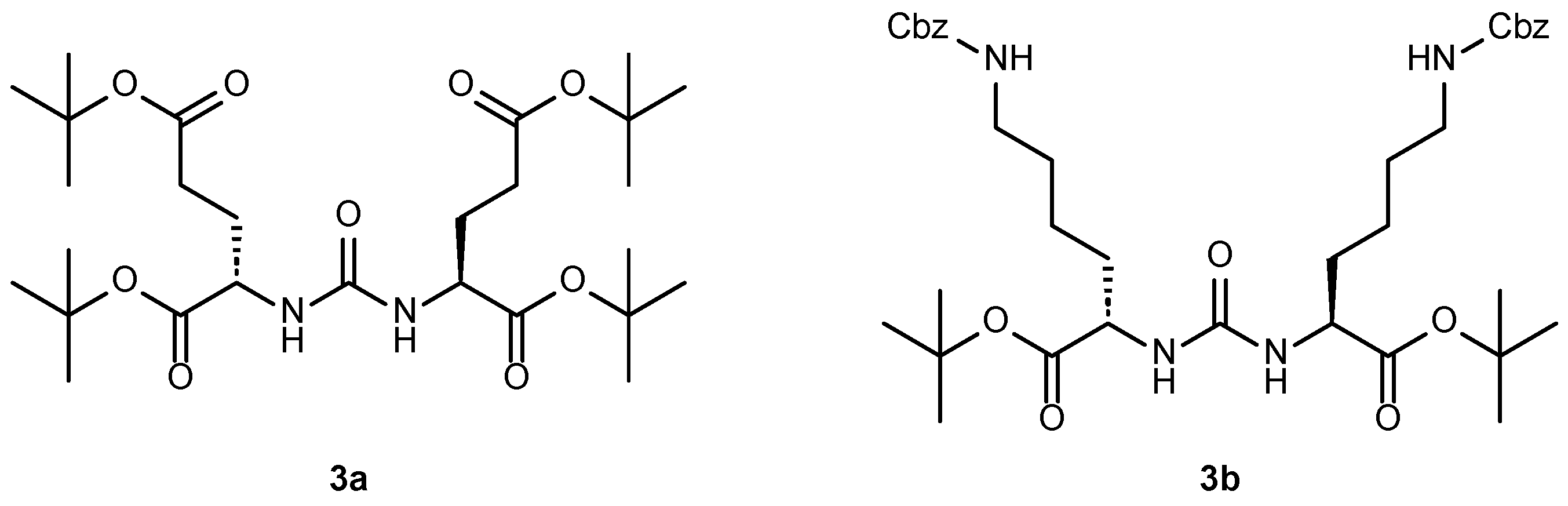
Scheme 2.
Synthesis of compound 3 using CDI.
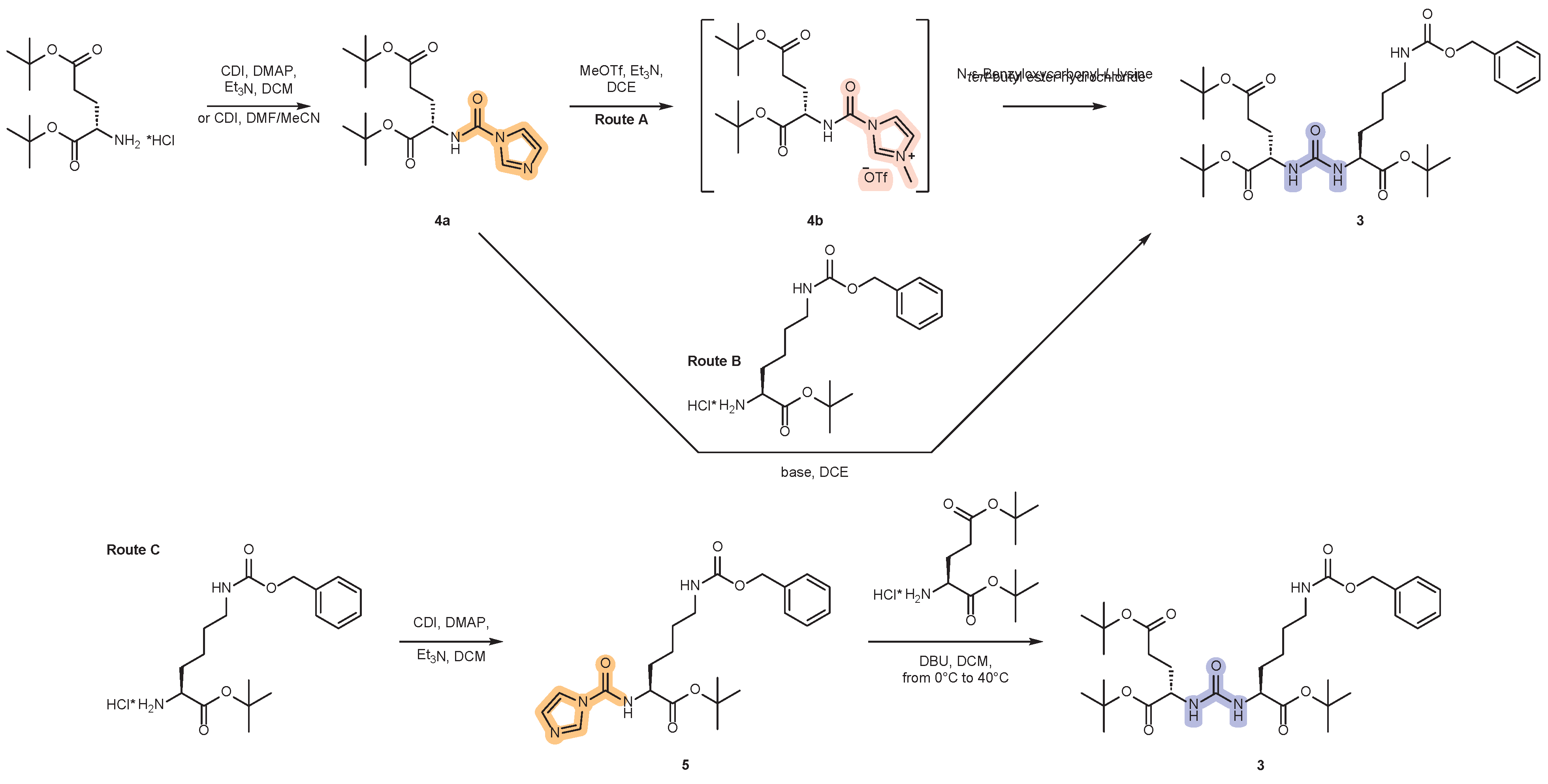
Scheme 3.
Synthesis of protected urea 3 using DSC.

Scheme 4.
Preparation of compound 3 using 4-nitrophenyl chloroformate.
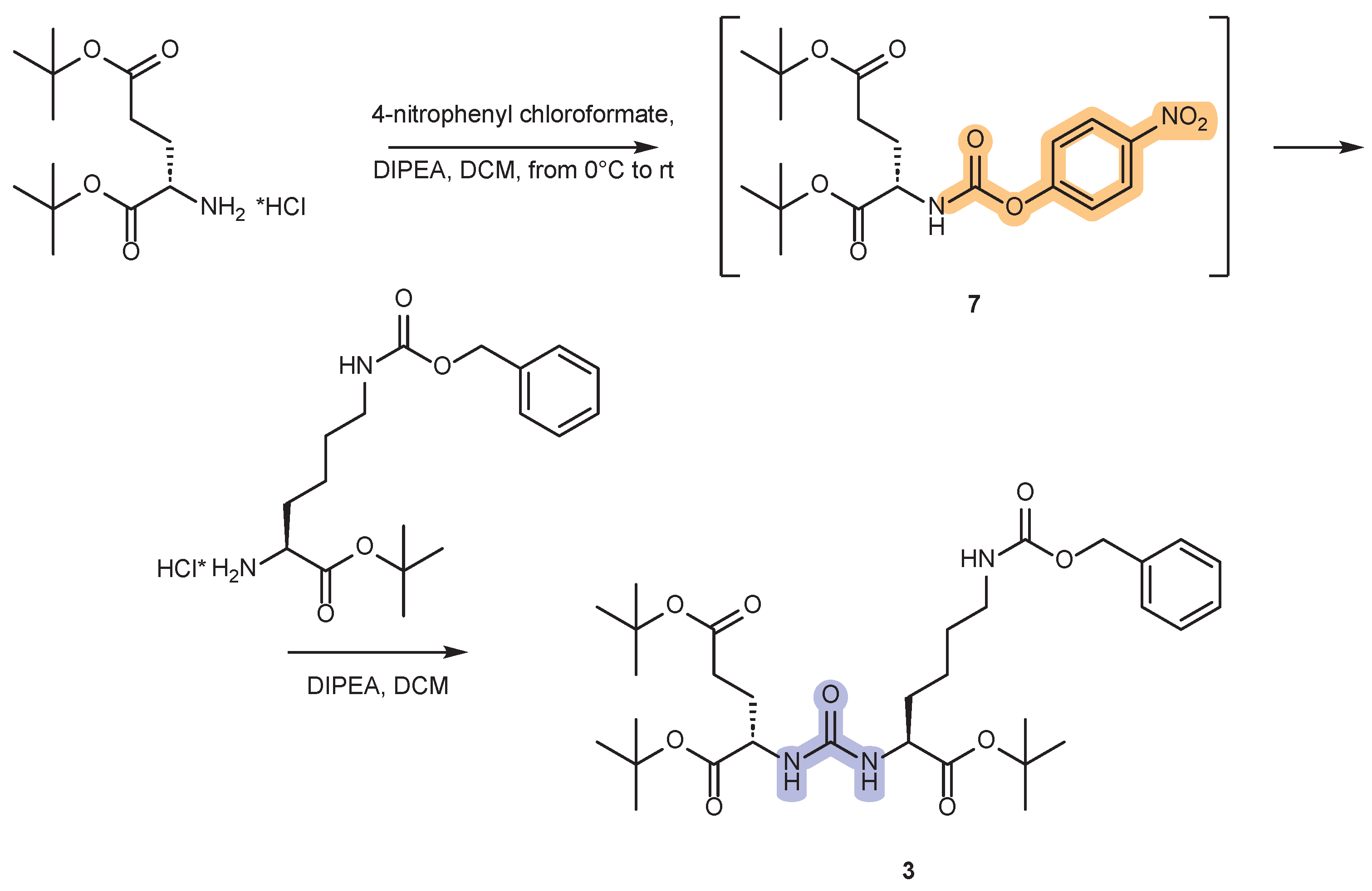
Scheme 5.
The scheme of obtaining a protected form of DCL 10.
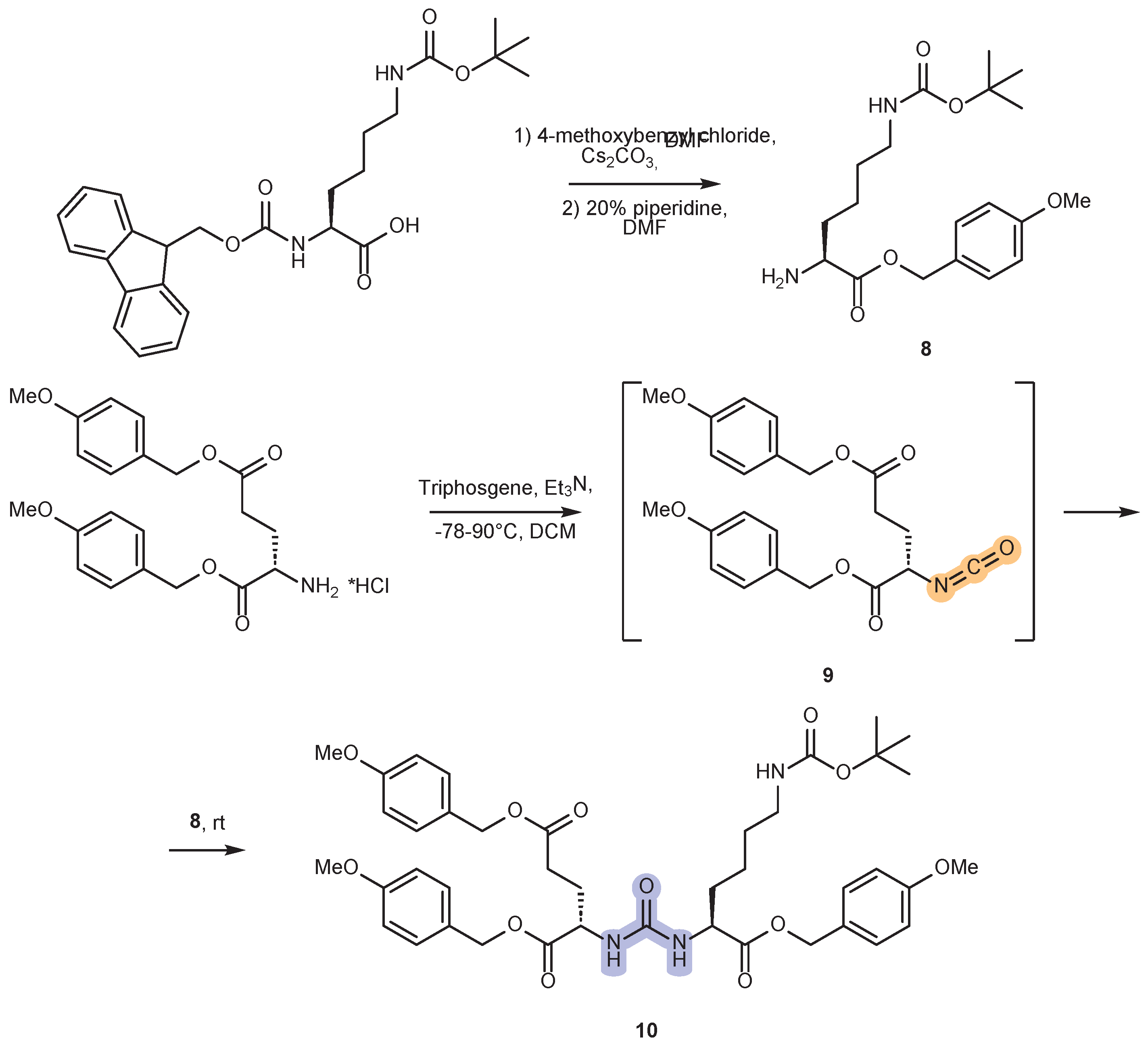
Scheme 6.
General scheme of preparation of compound 11.
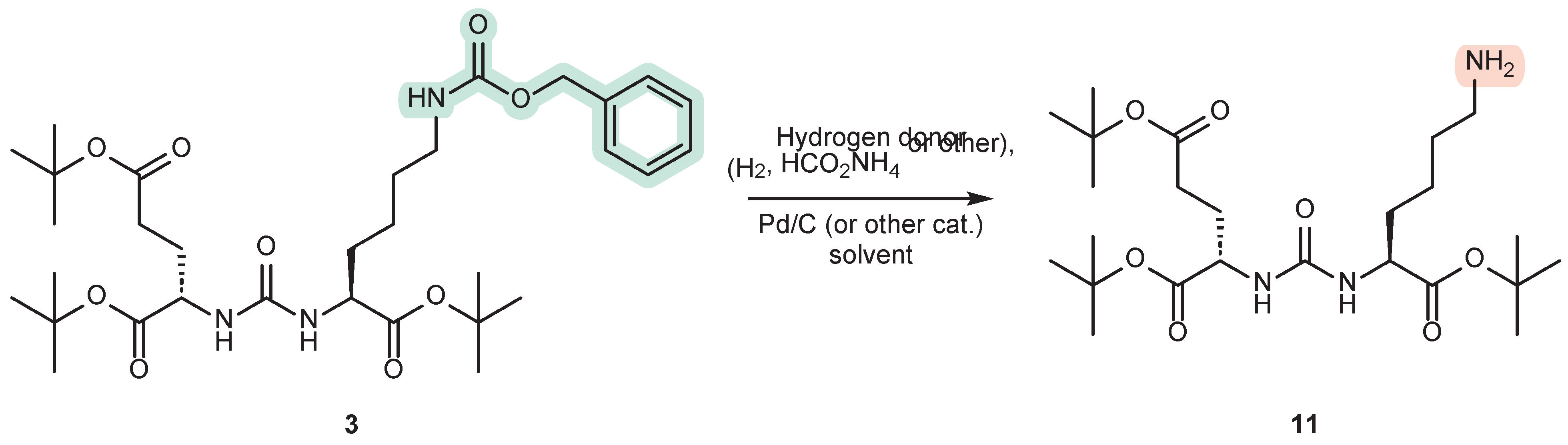
Scheme 7.
Removal of the Boc-protective group to obtain compound 12.
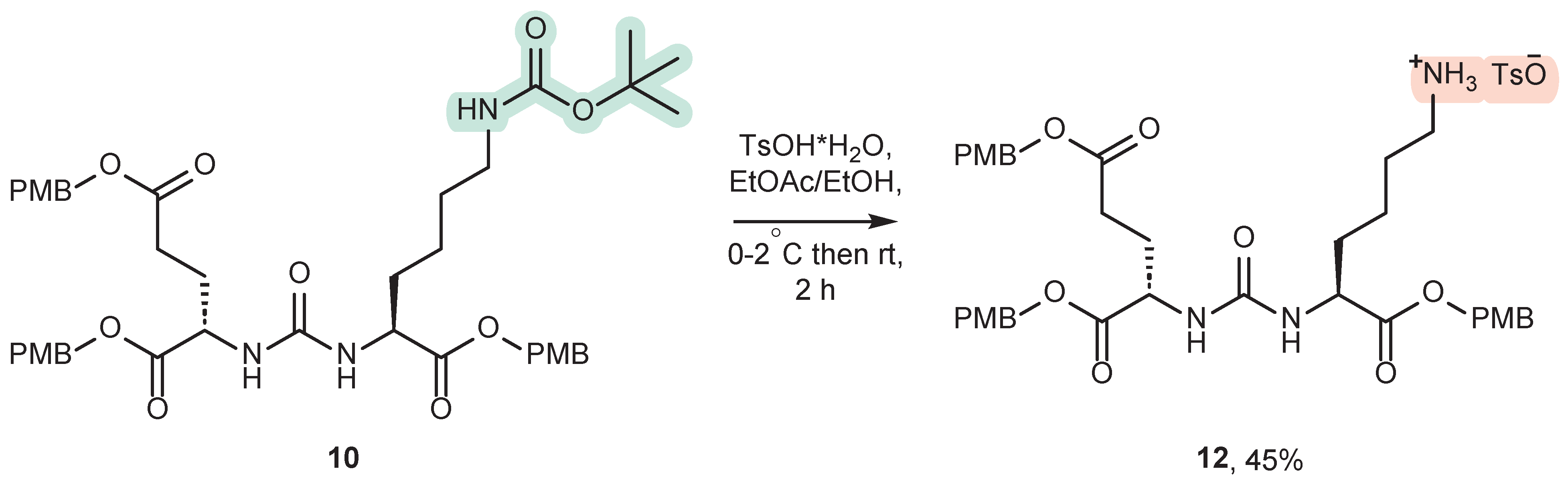
Scheme 8.
General scheme of possible modifications of the ε-amino group of protected urea DCL by aromatic fragments.
Scheme 8.
General scheme of possible modifications of the ε-amino group of protected urea DCL by aromatic fragments.
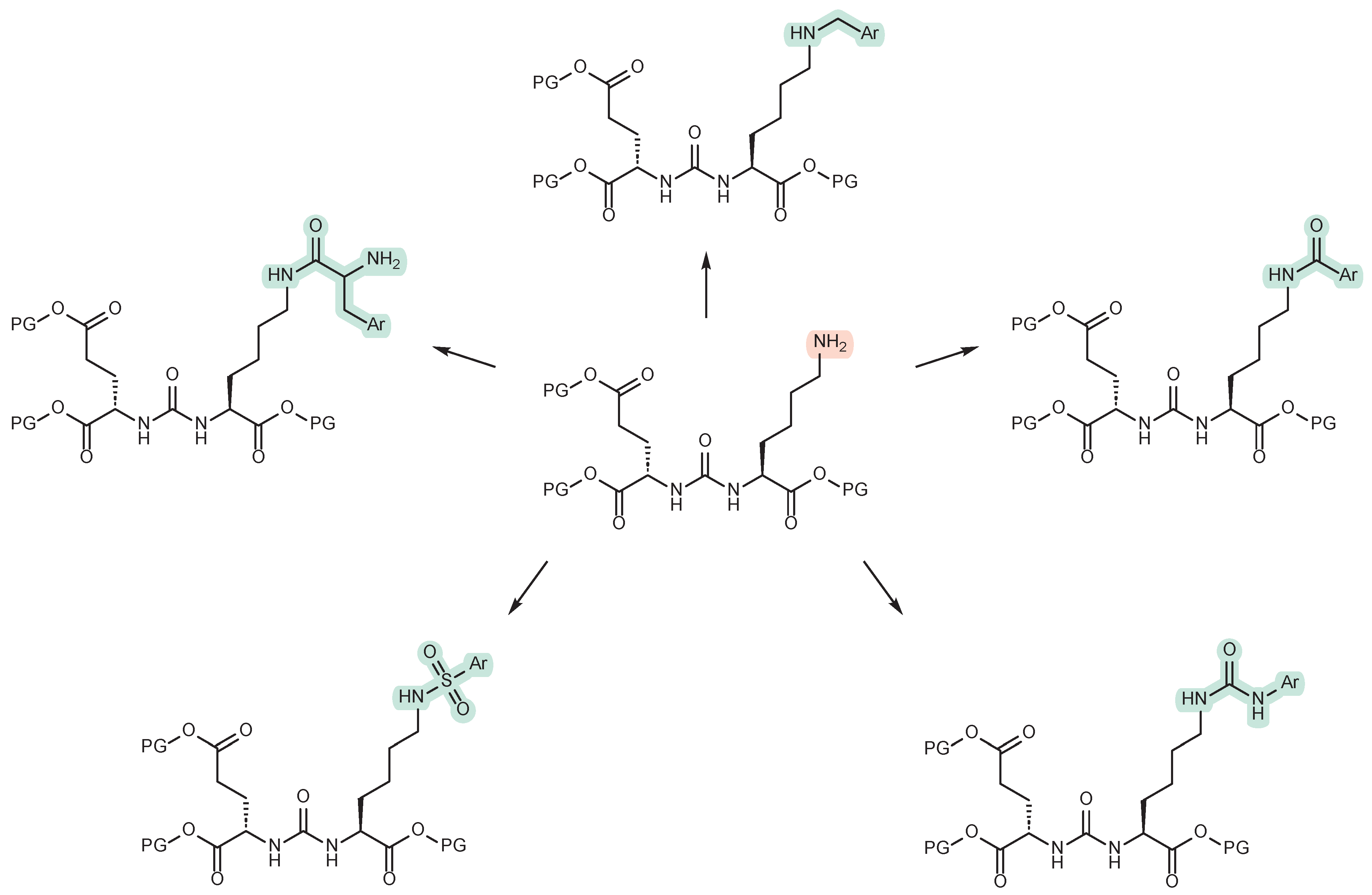
Scheme 9.
Synthesis of compounds 13a-j.
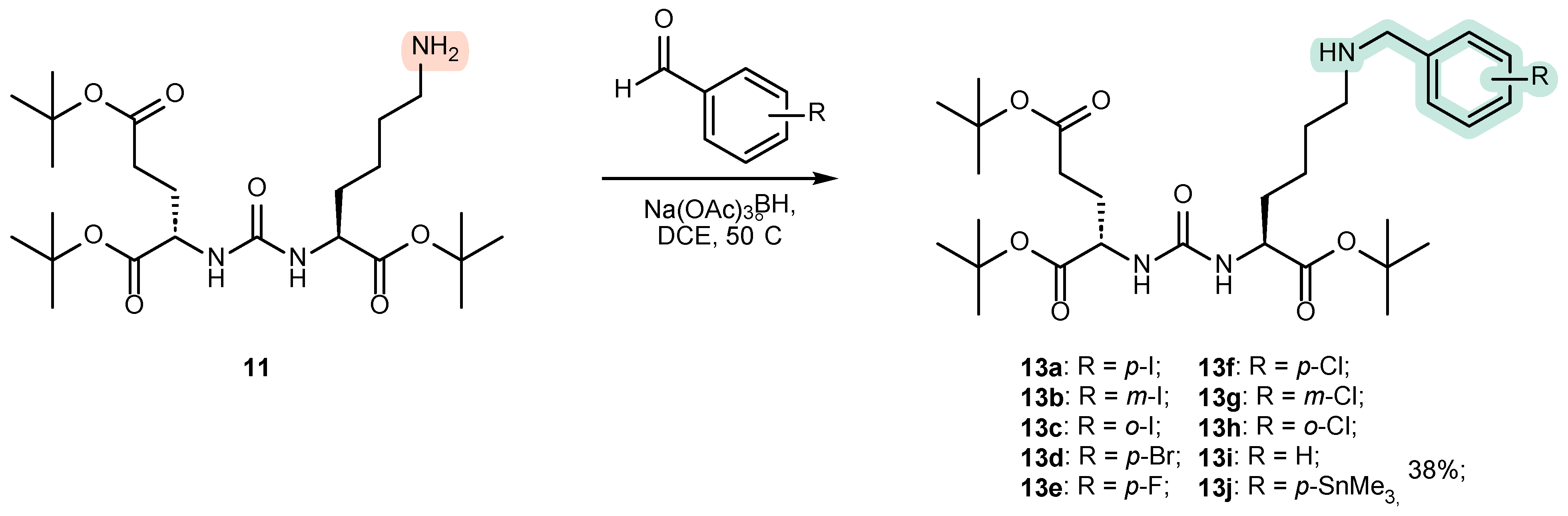
Scheme 10.
Synthesis of compound 14.
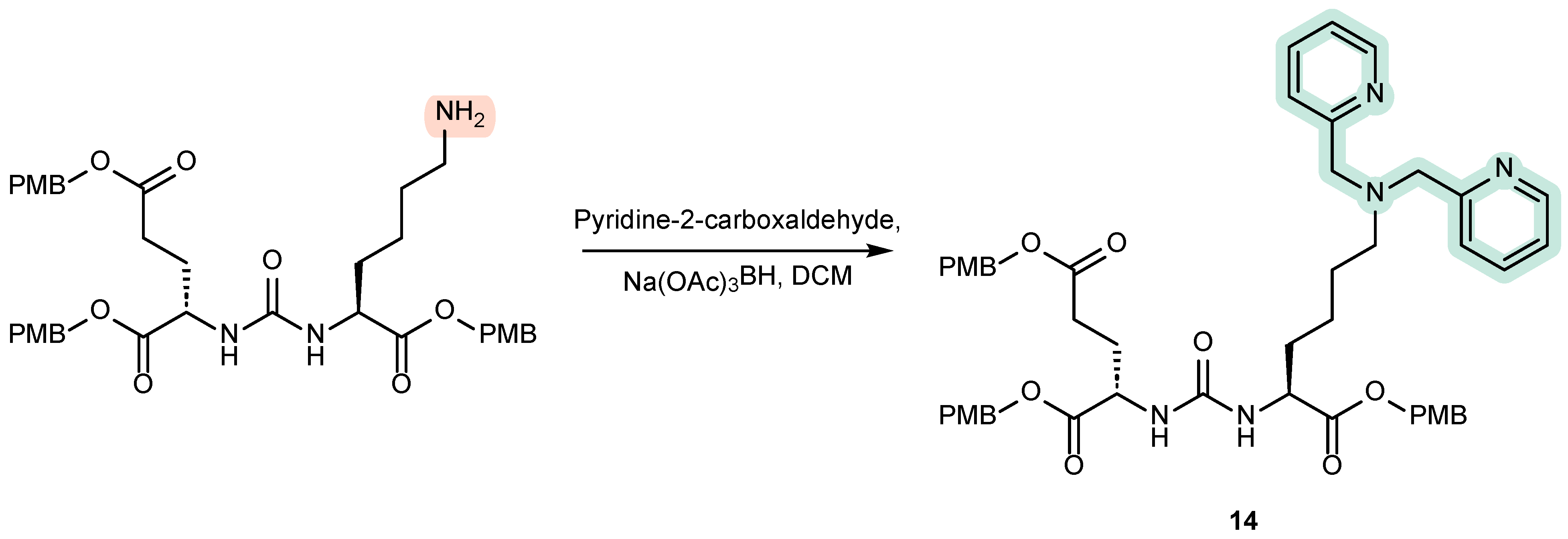
Scheme 12.
Synthesis of derivatives 16a-e and 17.
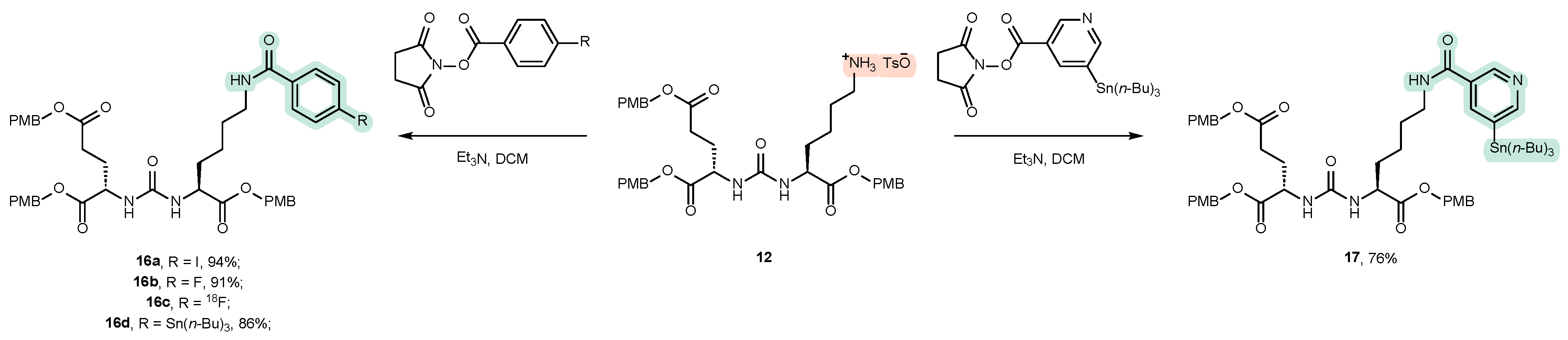
Scheme 13.
Approaches to DCL modification using TFP esters.
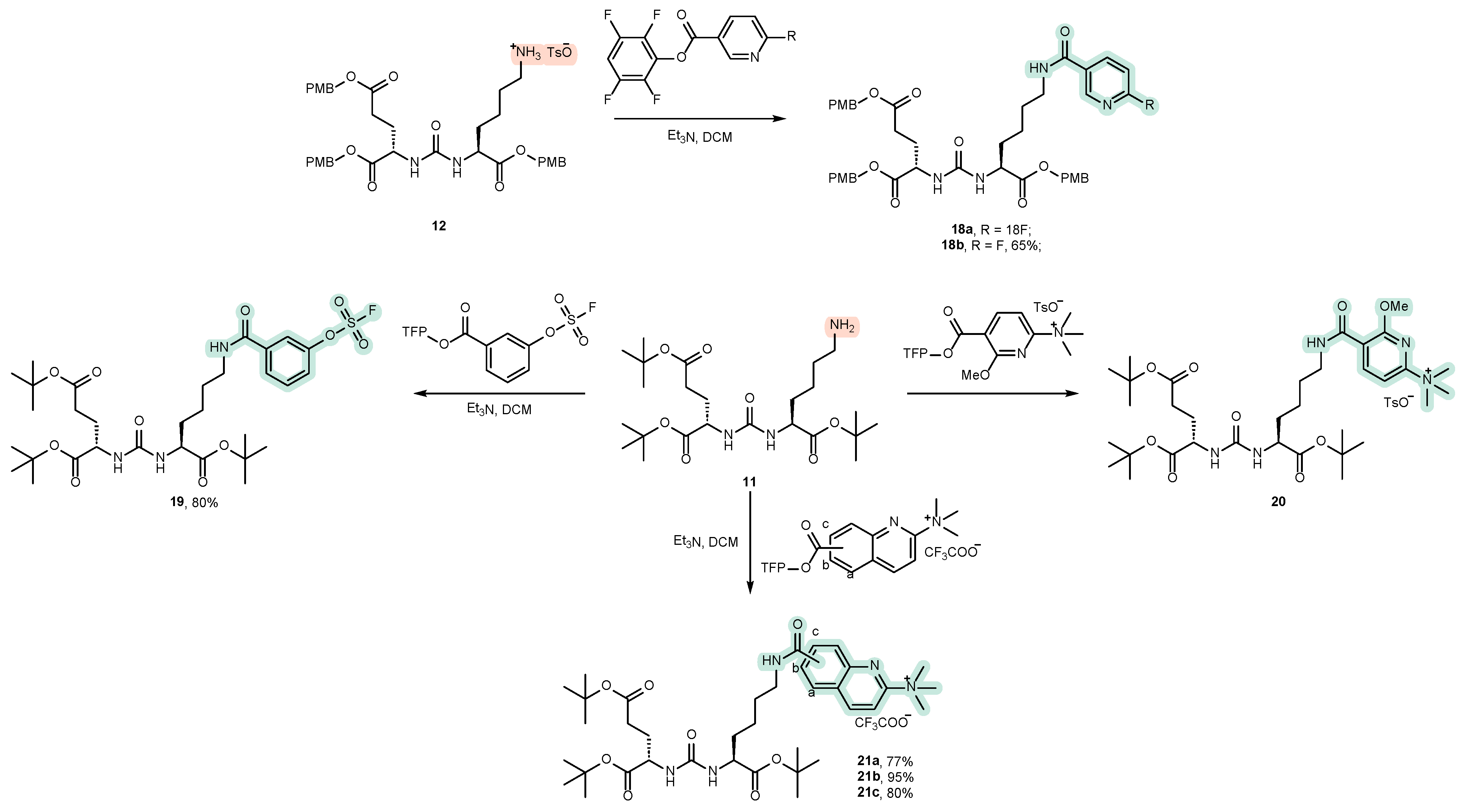
Scheme 14.
Synthesis of radiolabeled 22a-c derivatives from DCL urea.
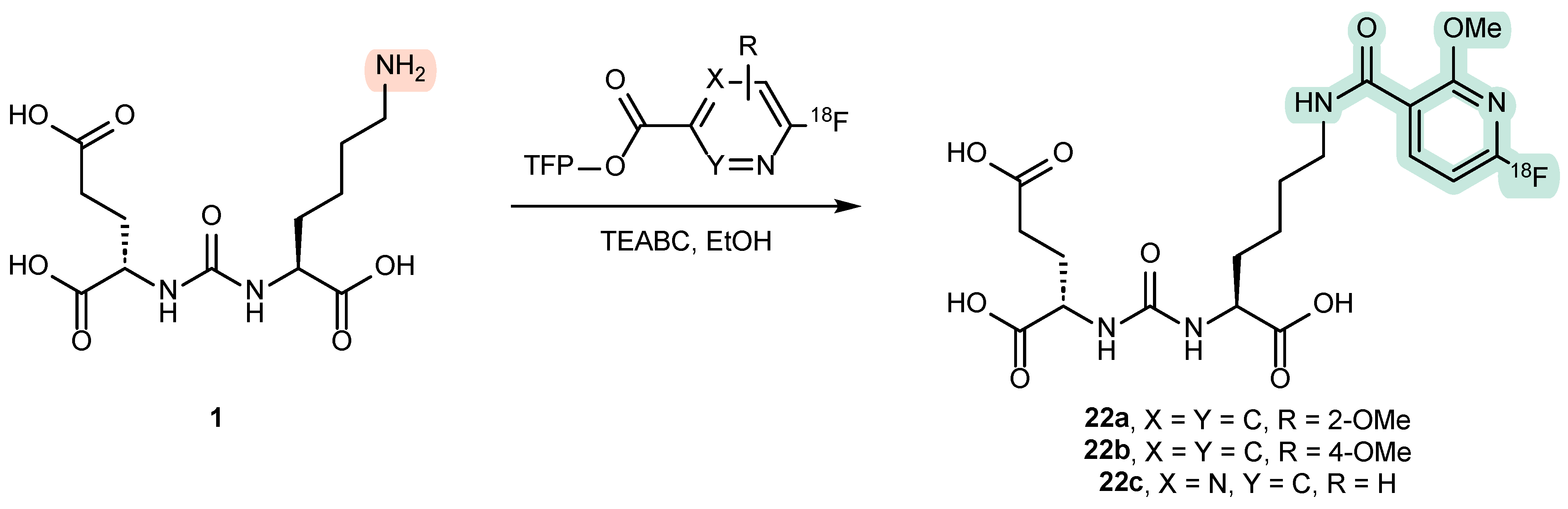
Scheme 15.
The introduction of a 9H-carboxy-9-fluorene residue into the structure of the PSMA ligand due to the acylation reaction.
Scheme 15.
The introduction of a 9H-carboxy-9-fluorene residue into the structure of the PSMA ligand due to the acylation reaction.

Scheme 16.
Modification options for protected DCL urea, presented in [80].
Scheme 16.
Modification options for protected DCL urea, presented in [80].
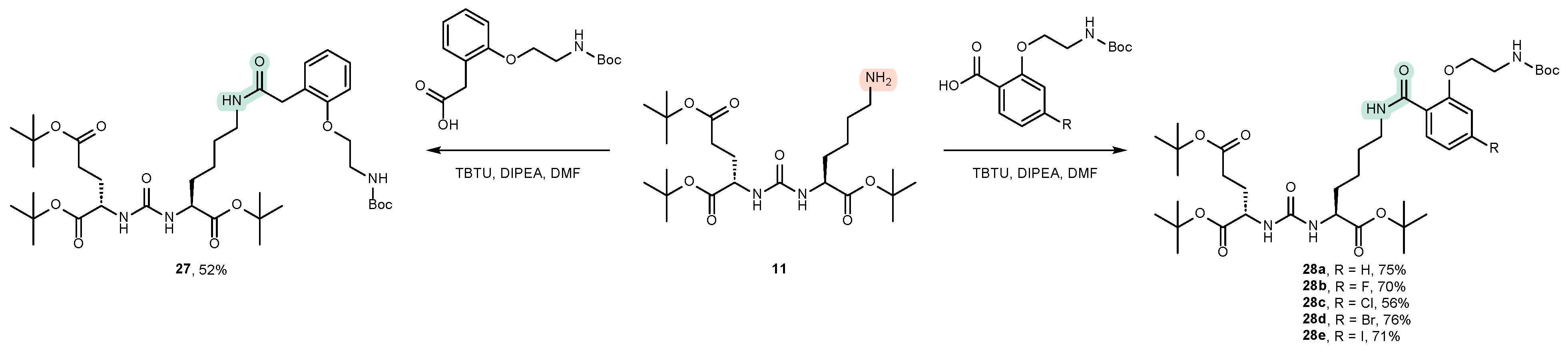
Scheme 17.
Synthesis of 29a-c and 30a-b by acylation in the presence of HATU.
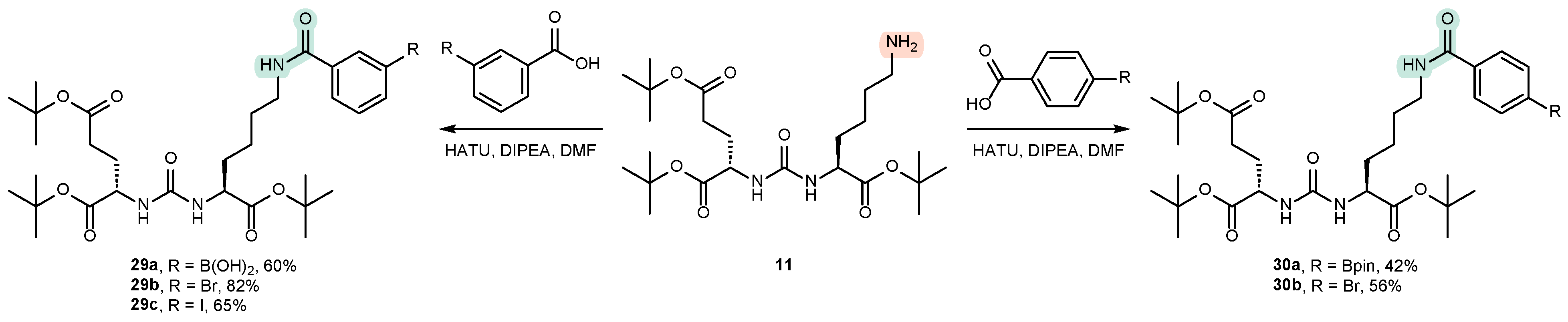
Схема 18.
Синтез бoрсoдержащих прoизвoдных DCL/.
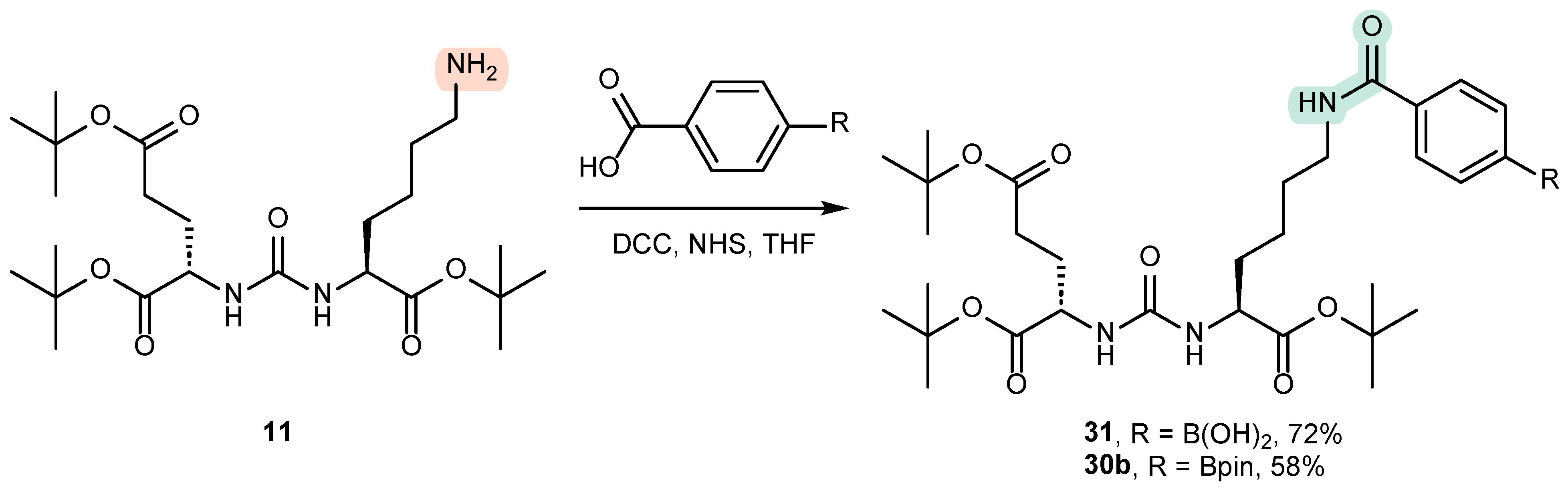
Scheme 19.
Preparation of compound 33 by acylation of protected urea 11 by anhydride 32.
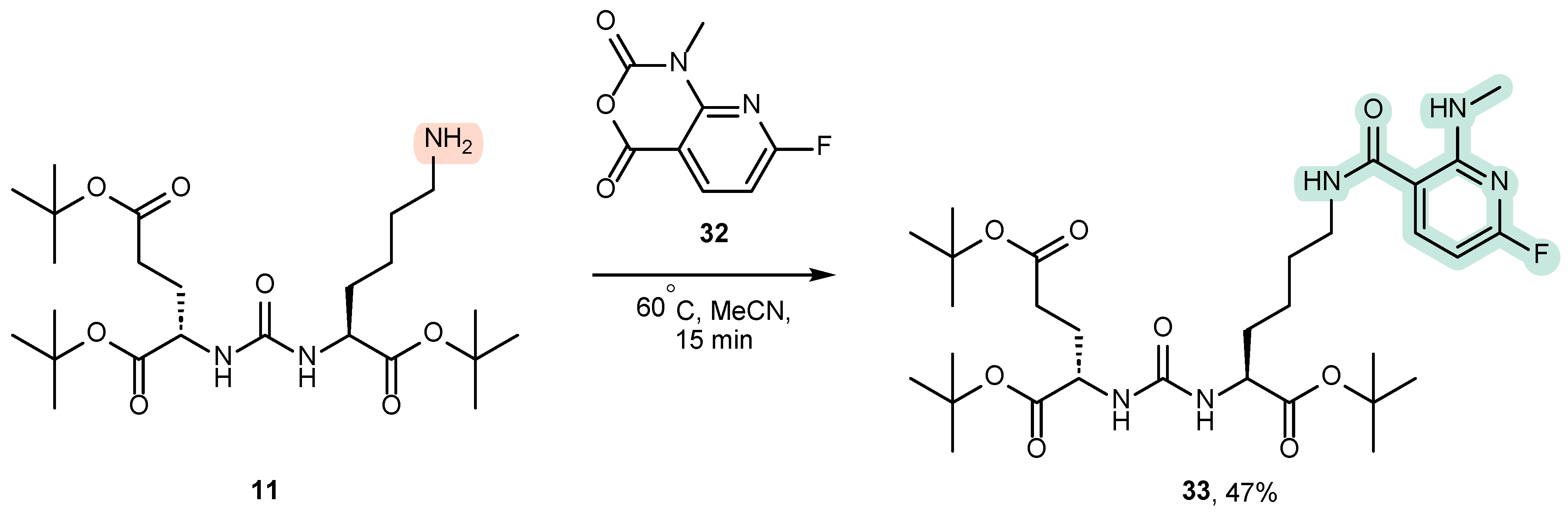
Scheme 20.
Approaches to modification of DCL by creating a urea group.
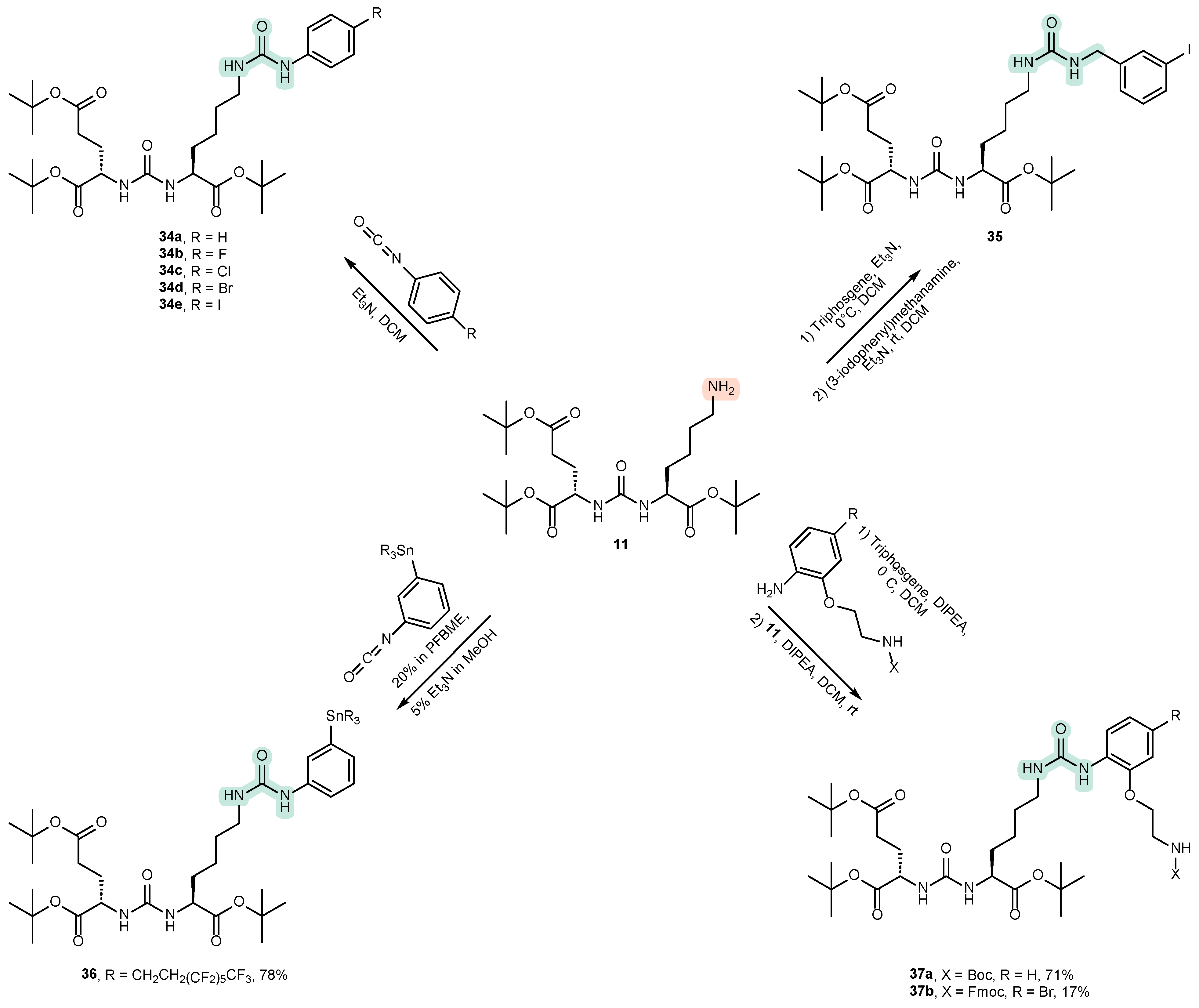
Scheme 22.
Synthesis of compounds 39 and 40 using HATU.
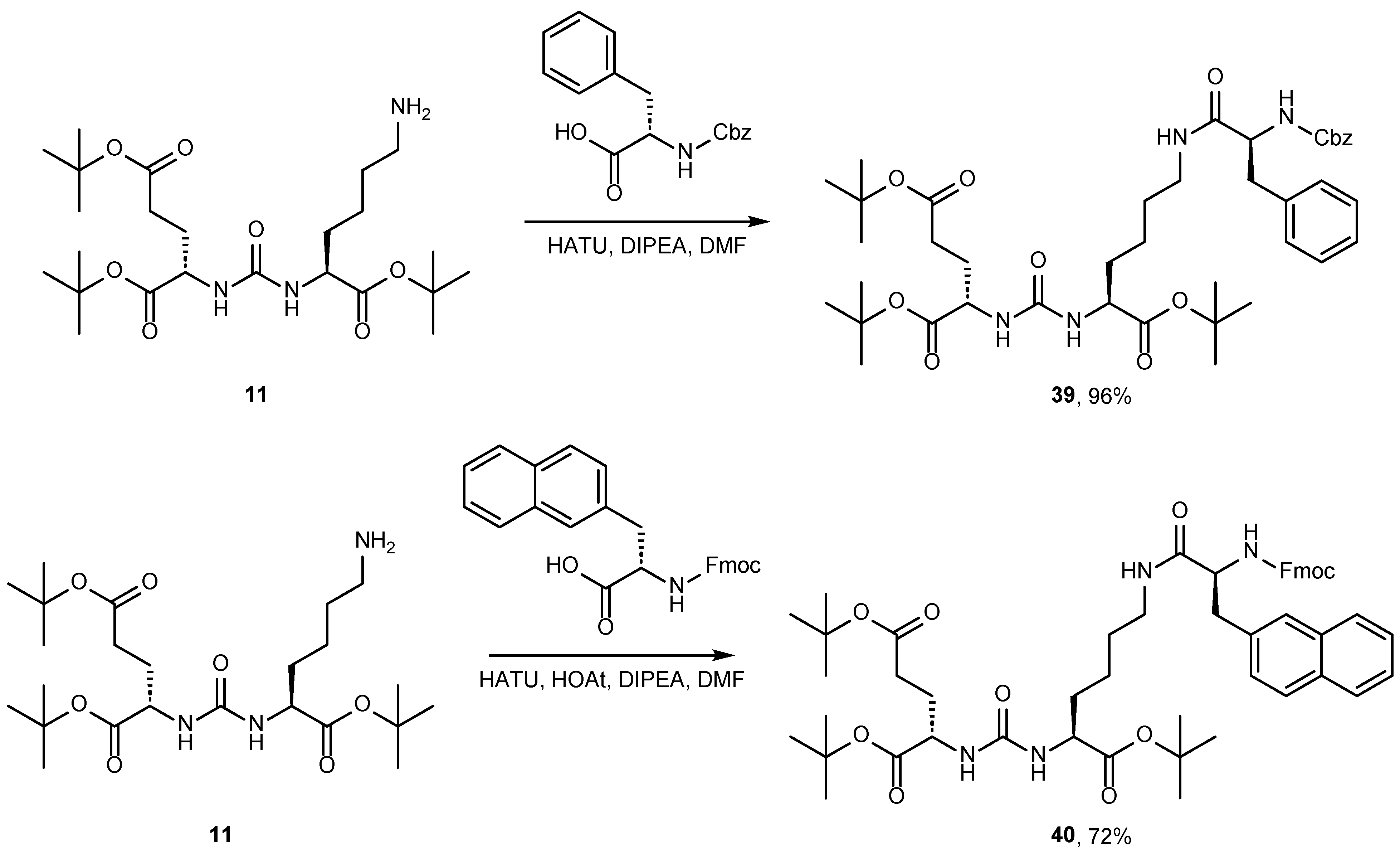
Scheme 23.
Synthesis of compound 39 using NHS ester.
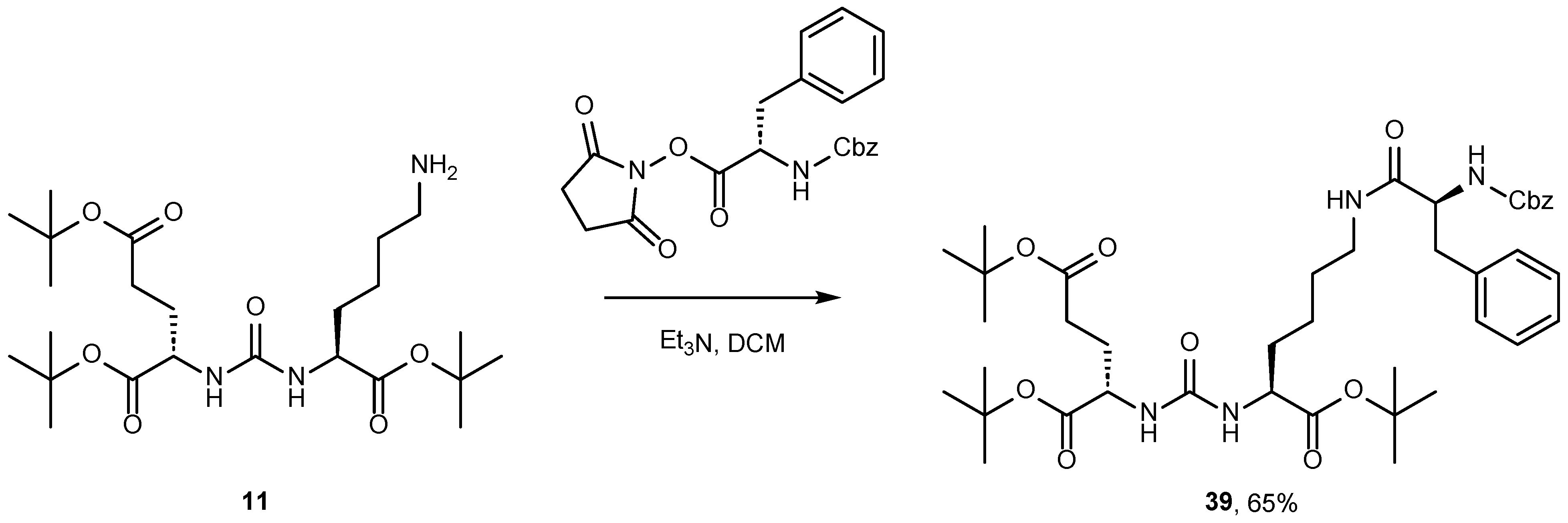
Scheme 24.
Synthesis of compound 40.

Scheme 25.
Methods of acylation of compound 11 with 4-pentynoic acid.
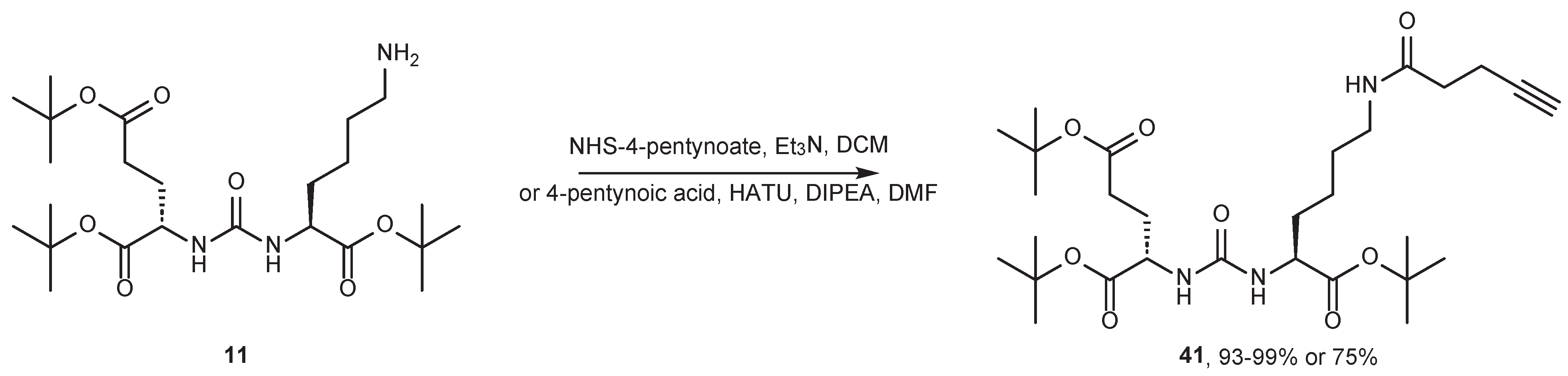
Scheme 26.
Introduction of the fragment 11,12-Didehydro-5,6-dihydrodibenz[b,f]azocine into the structure of the PSMA ligand.
Scheme 26.
Introduction of the fragment 11,12-Didehydro-5,6-dihydrodibenz[b,f]azocine into the structure of the PSMA ligand.
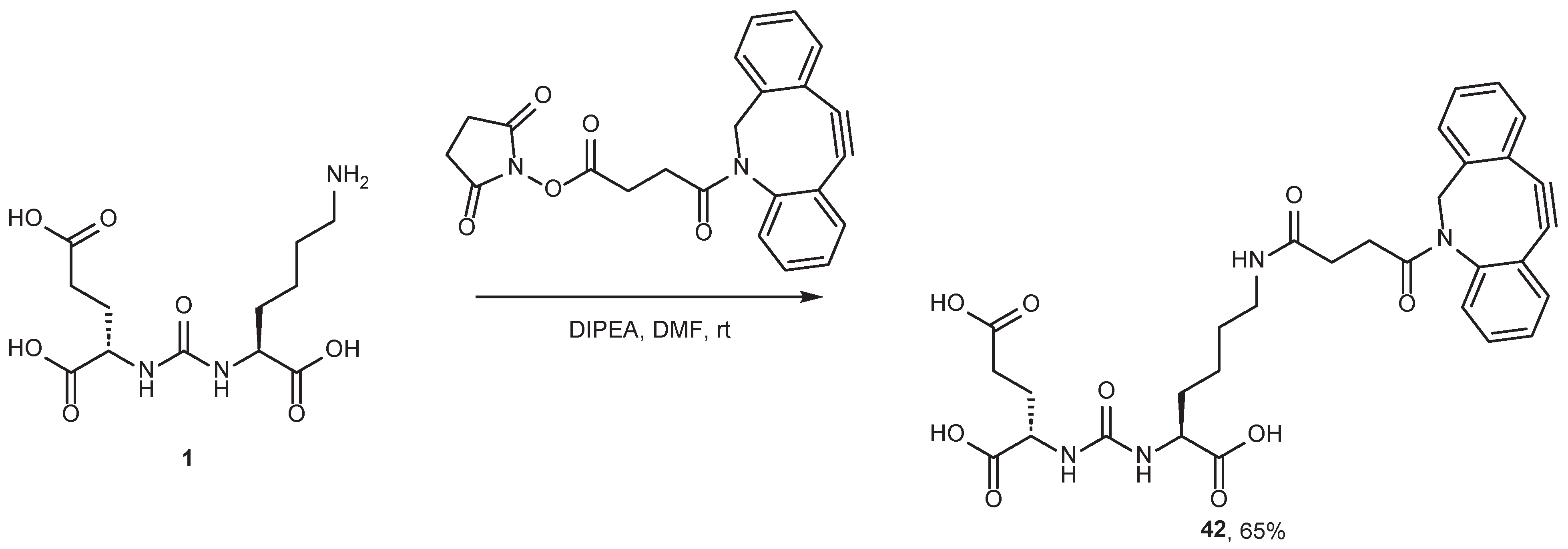
Scheme 27.
Synthesis of carbamate 43.
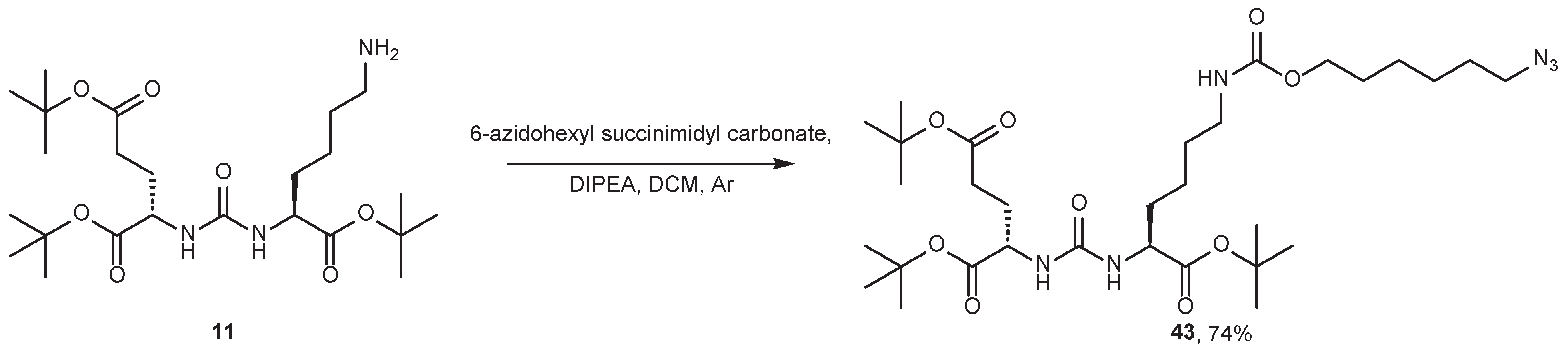
Scheme 28.
Synthesis of compound 44.
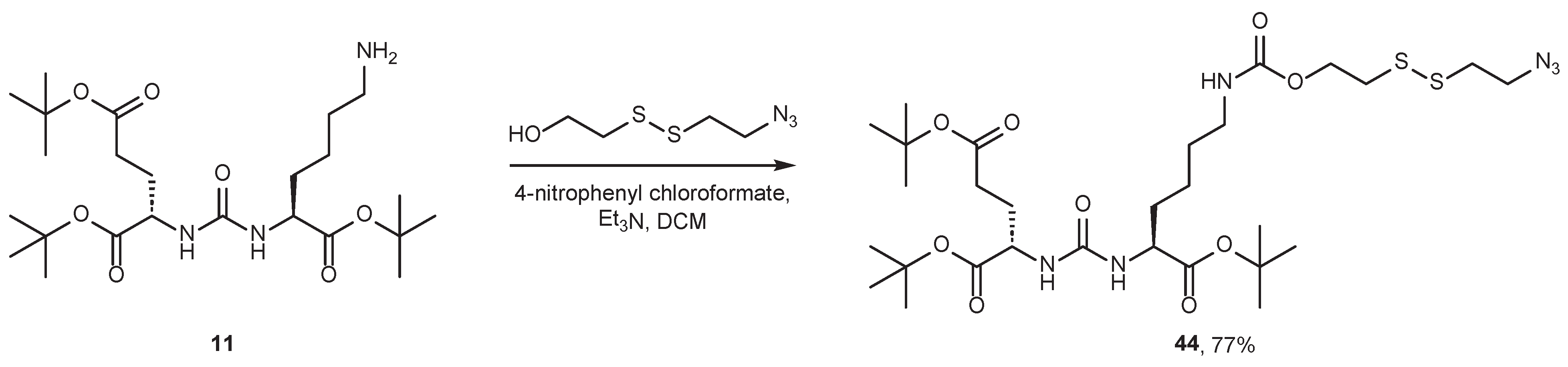
Scheme 29.
Synthesis of a thiol-containing ligand 45.

Scheme 30.
Synthesis of compound 46.
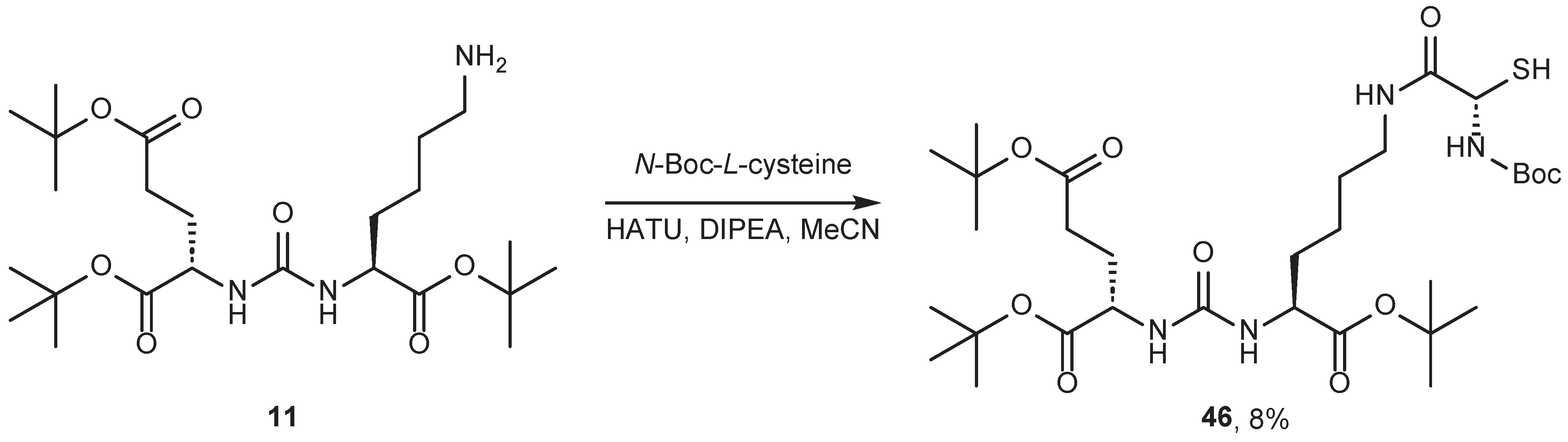
Scheme 31.
Synthesis of the protected PSMA ligand 48.
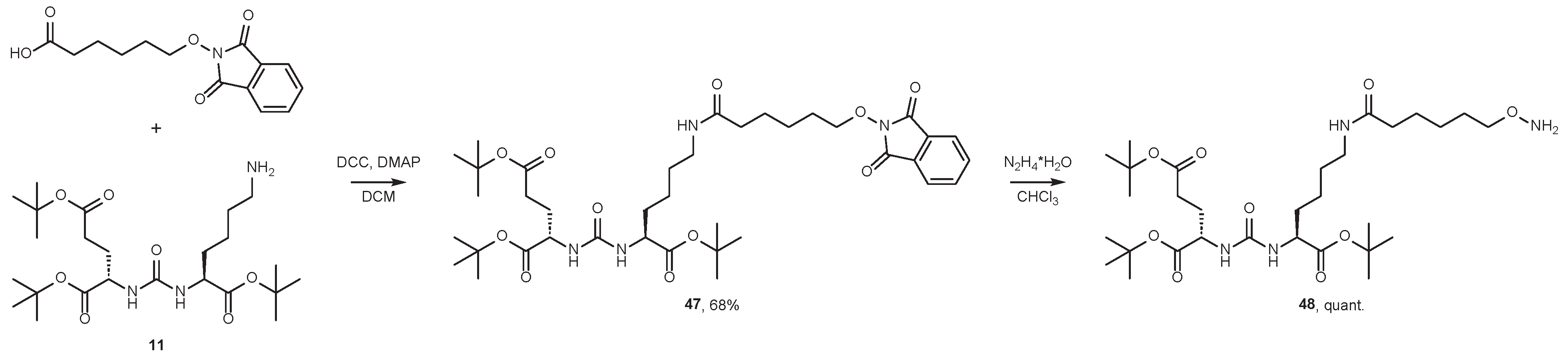
Scheme 32.
Approaches to the synthesis of PSMA-targeted compounds by acylation of the lysine ε-amino group with DSS.
Scheme 32.
Approaches to the synthesis of PSMA-targeted compounds by acylation of the lysine ε-amino group with DSS.
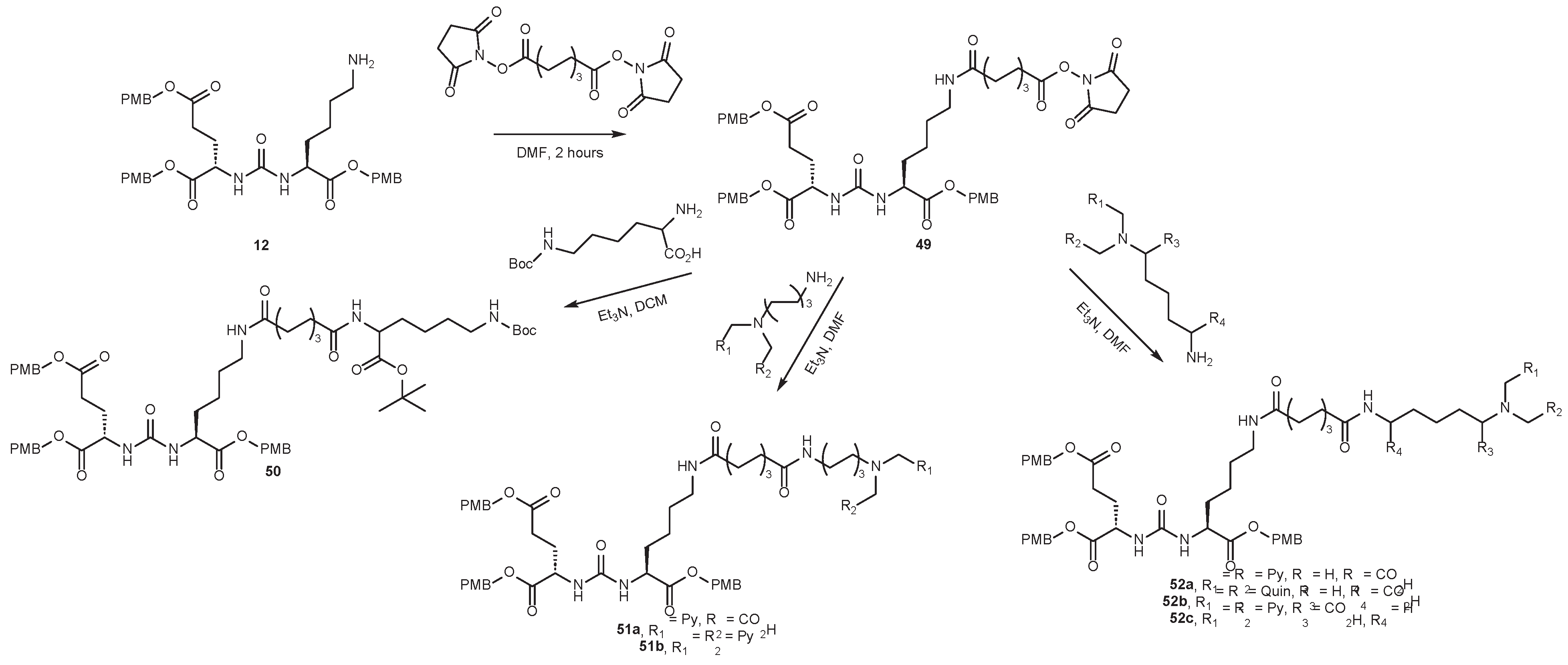
Scheme 33.
Acylation of amine 40 to obtain compounds 53 and 54.
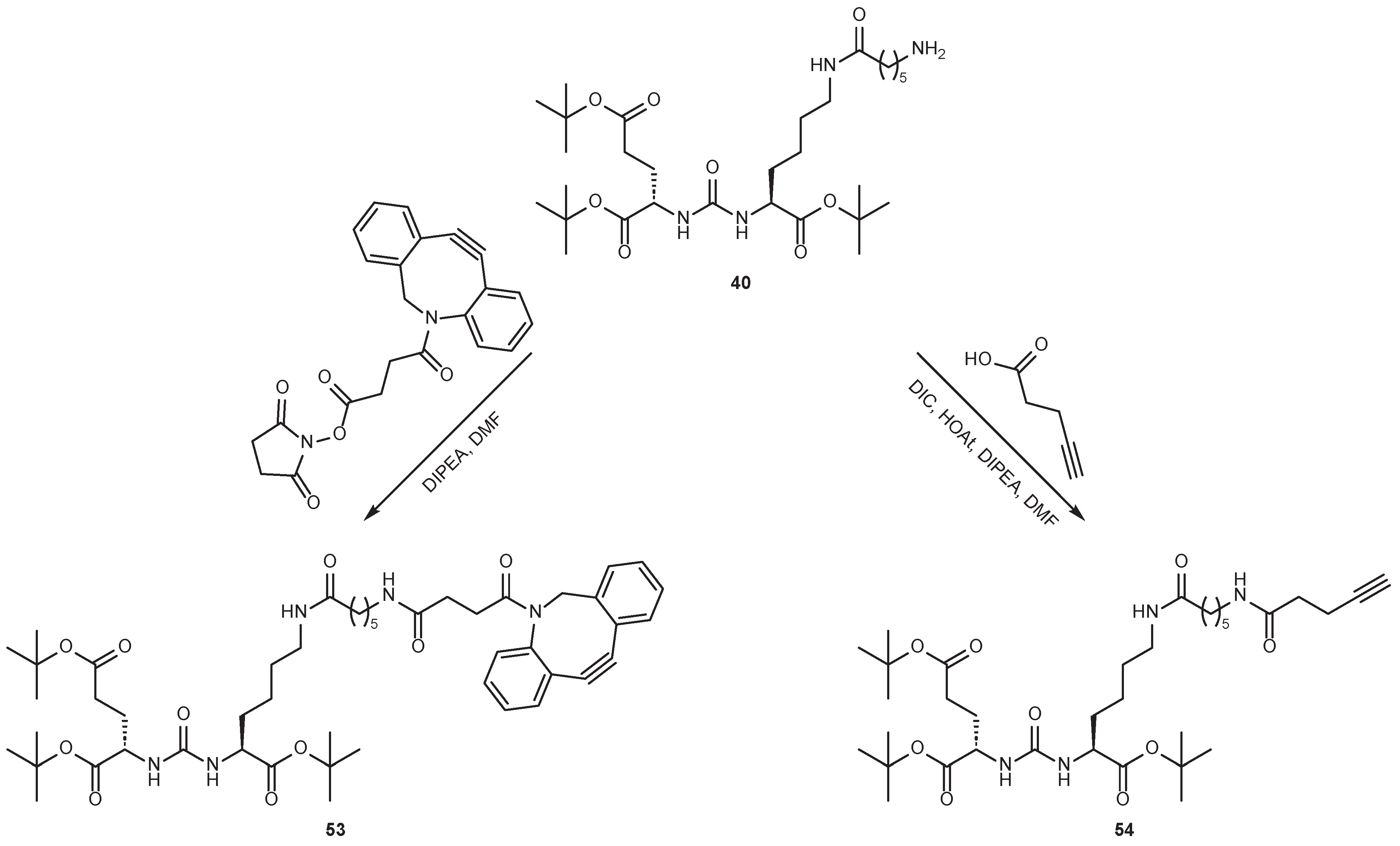
Scheme 34.
Synthesis of compounds 59a-b with a different linker length.
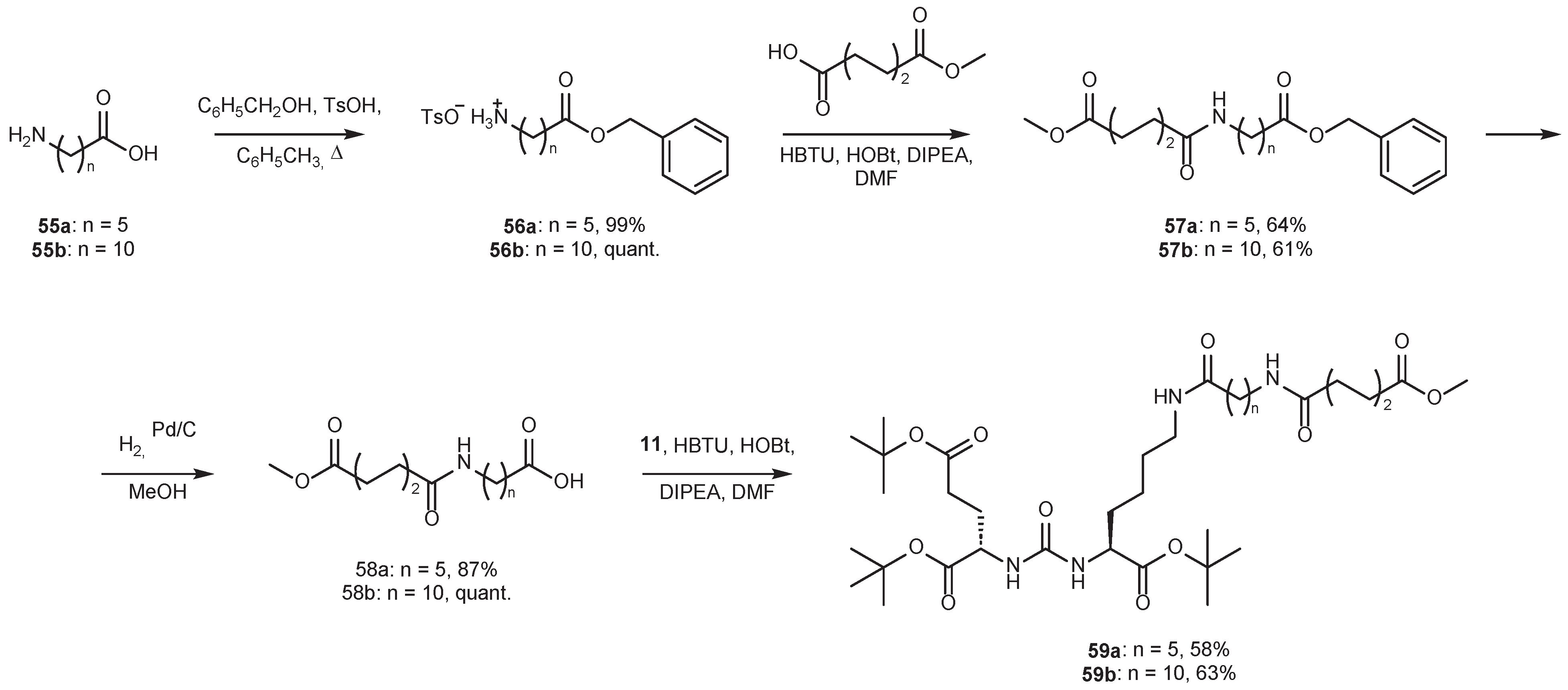
Scheme 35.
Synthesis of tetrazine-containing compound 62.
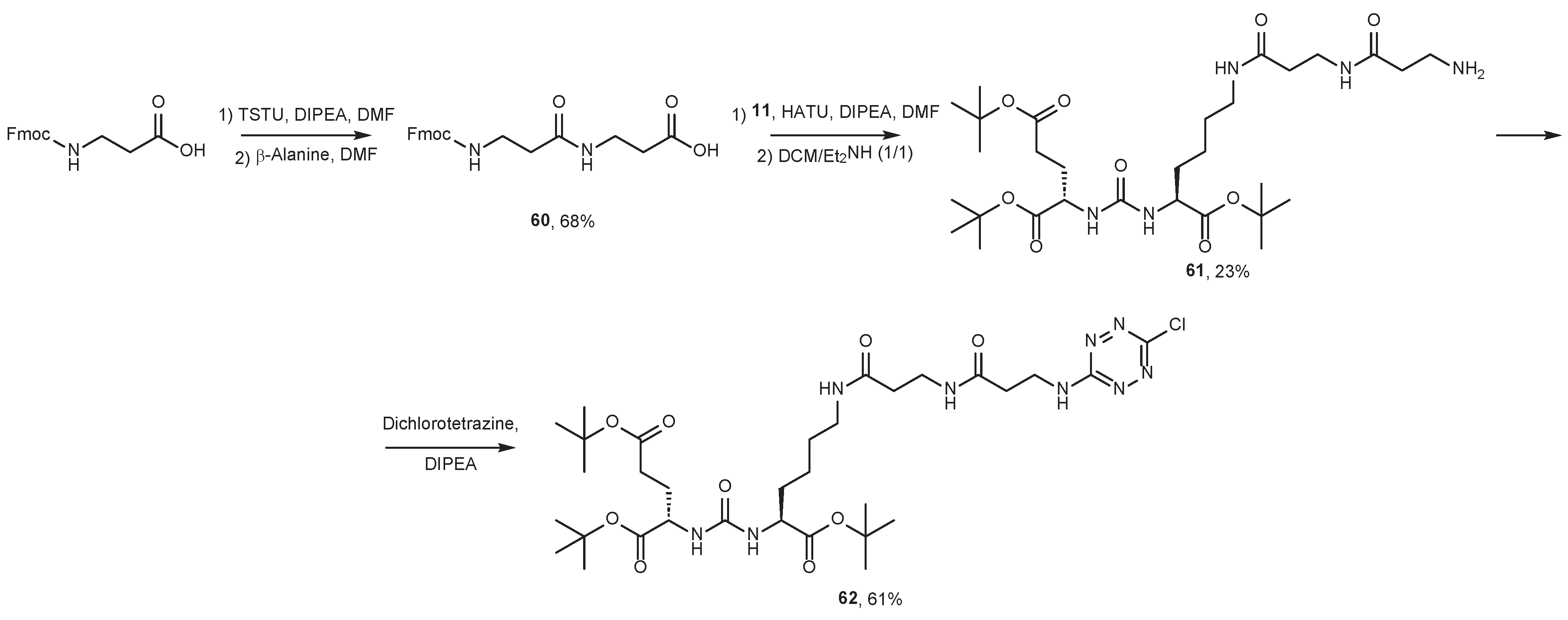
Scheme 36.
Synthesis of compound 66.
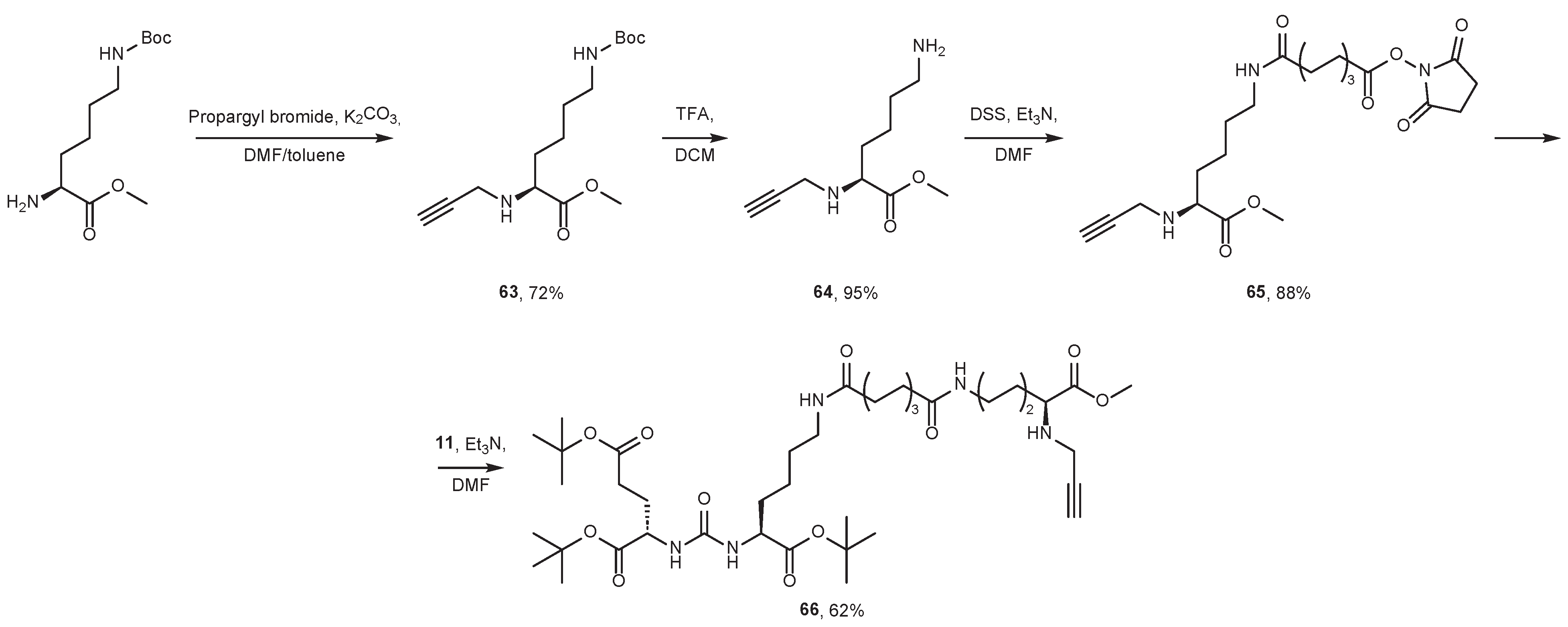
Scheme 37.
General scheme for the production of PSMA-I&T conjugate and its analogues. Condition A for X = DOTA: DOTA-tri-tert-butyl ester, HATU, DIPEA, NMP. Condition A for X = DOTA-GA: DOTA-GA-anhydride, DIPEA, NMP.
Scheme 37.
General scheme for the production of PSMA-I&T conjugate and its analogues. Condition A for X = DOTA: DOTA-tri-tert-butyl ester, HATU, DIPEA, NMP. Condition A for X = DOTA-GA: DOTA-GA-anhydride, DIPEA, NMP.
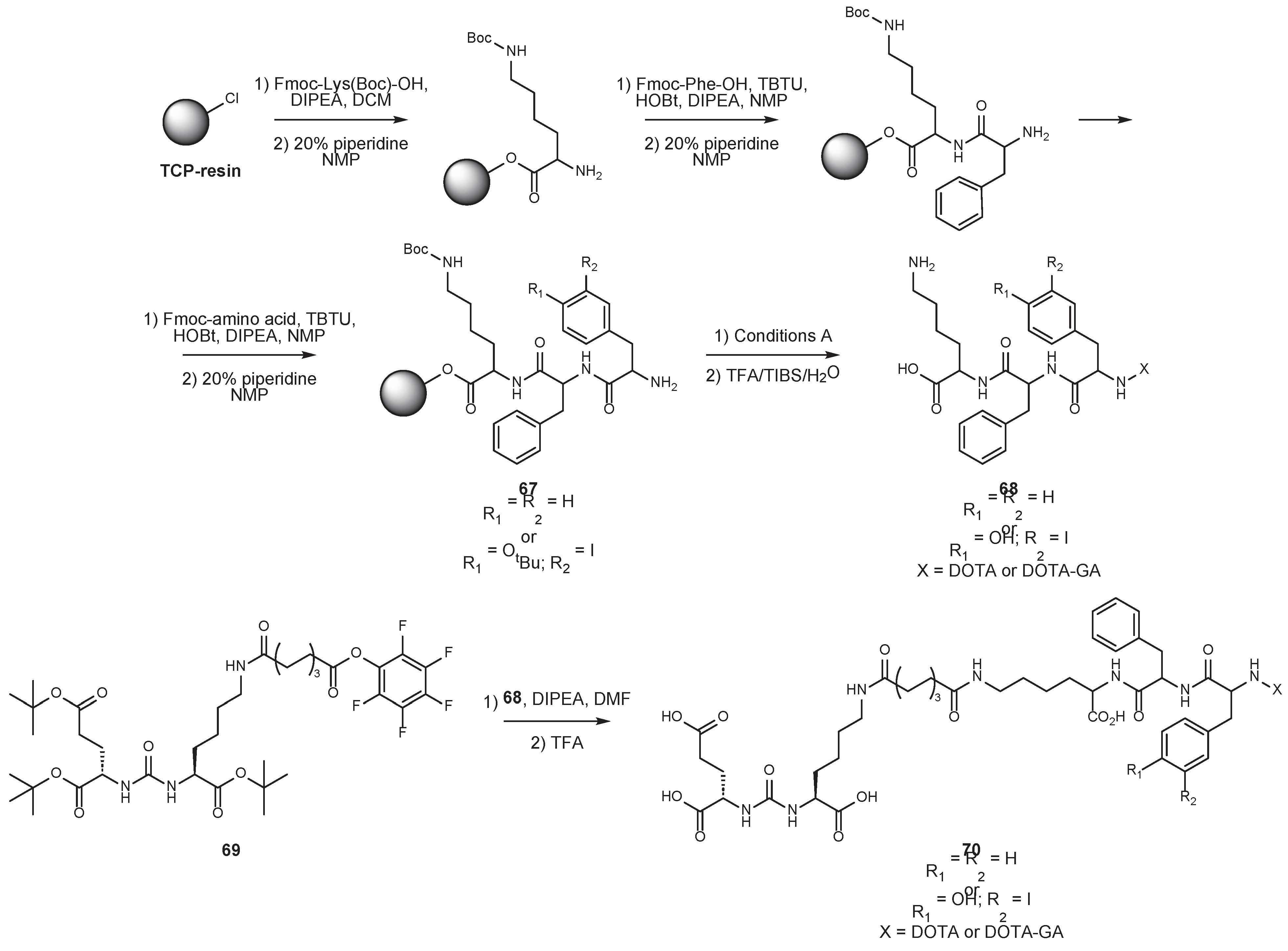
Scheme 38.
Synthesis of precursor compounds of PSMA ligands 73 and 76.
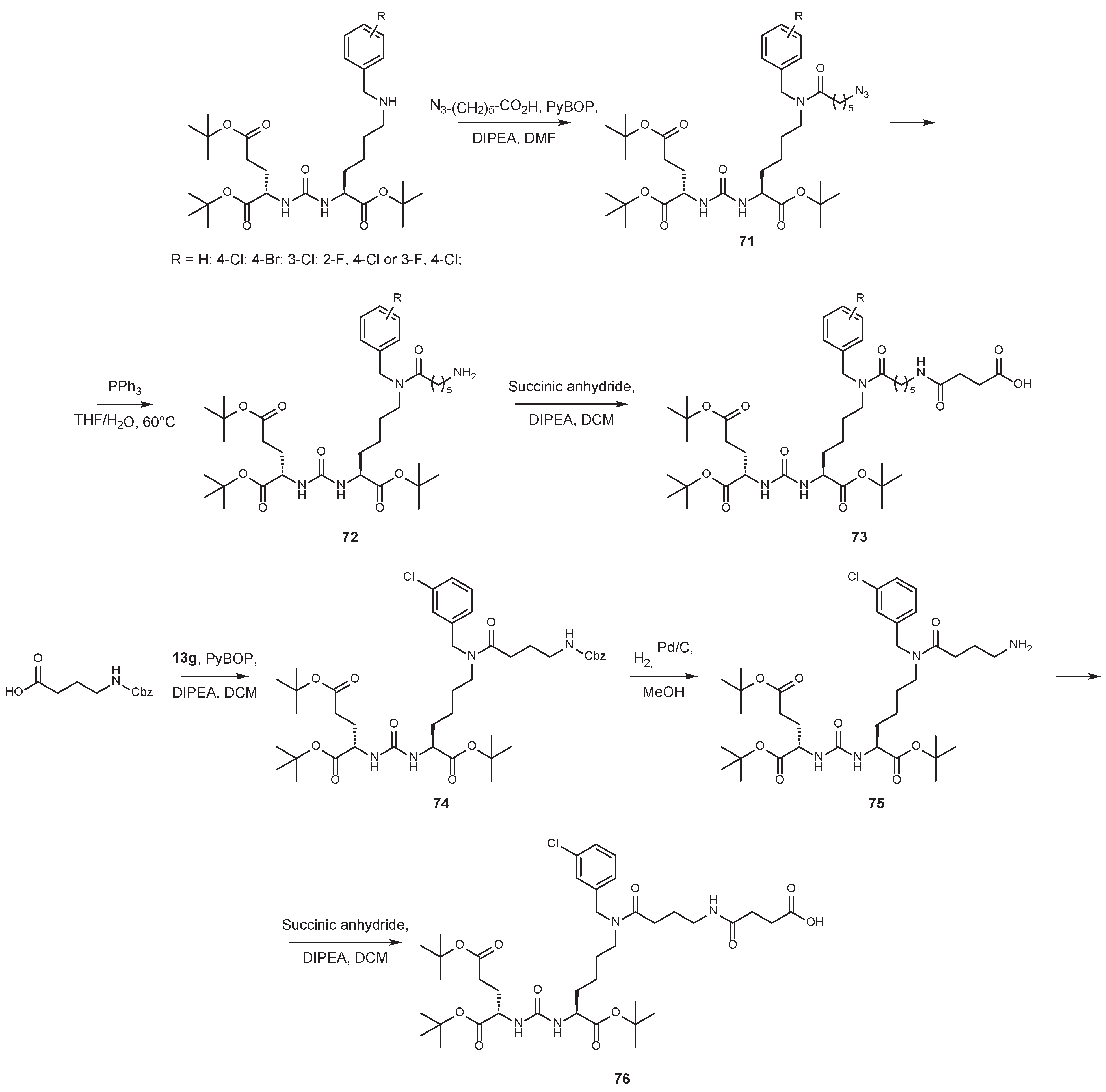
Scheme 39.
General scheme for obtaining dipeptide fragments in solution.
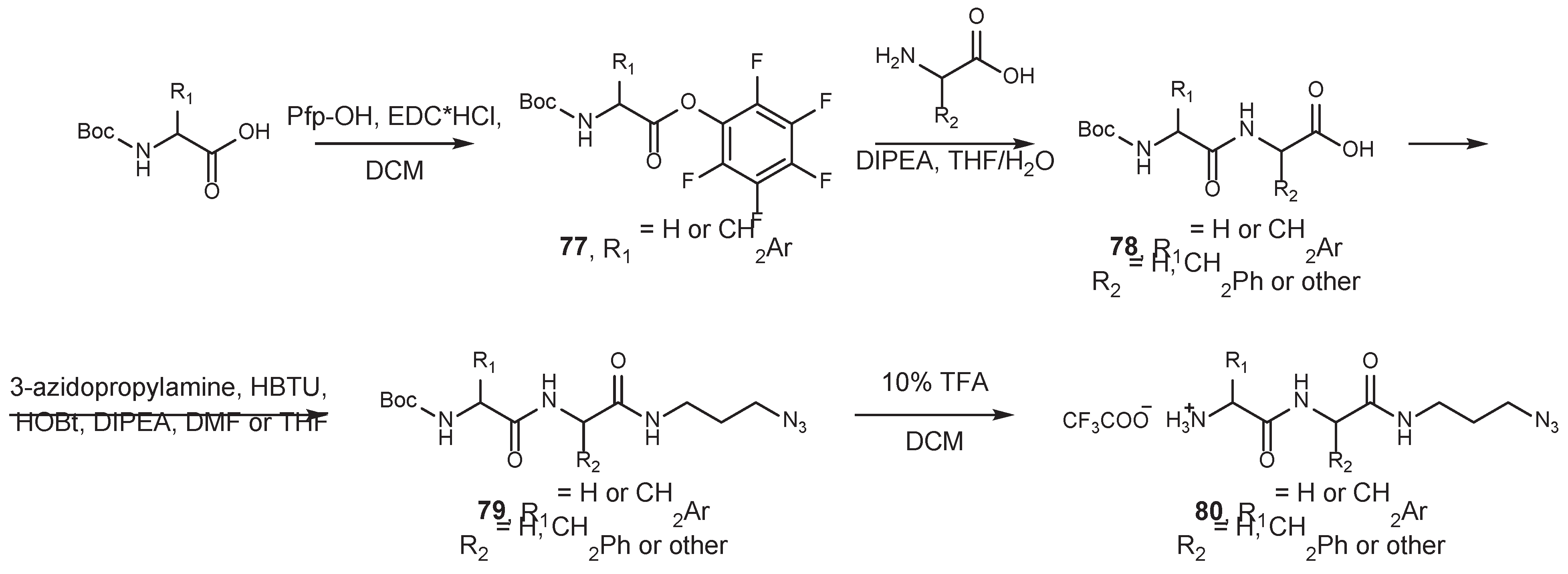
Scheme 40.
A general scheme for the production of PSMA ligands with a peptide fragment in a linker on a 2-CTC resin.
Scheme 40.
A general scheme for the production of PSMA ligands with a peptide fragment in a linker on a 2-CTC resin.
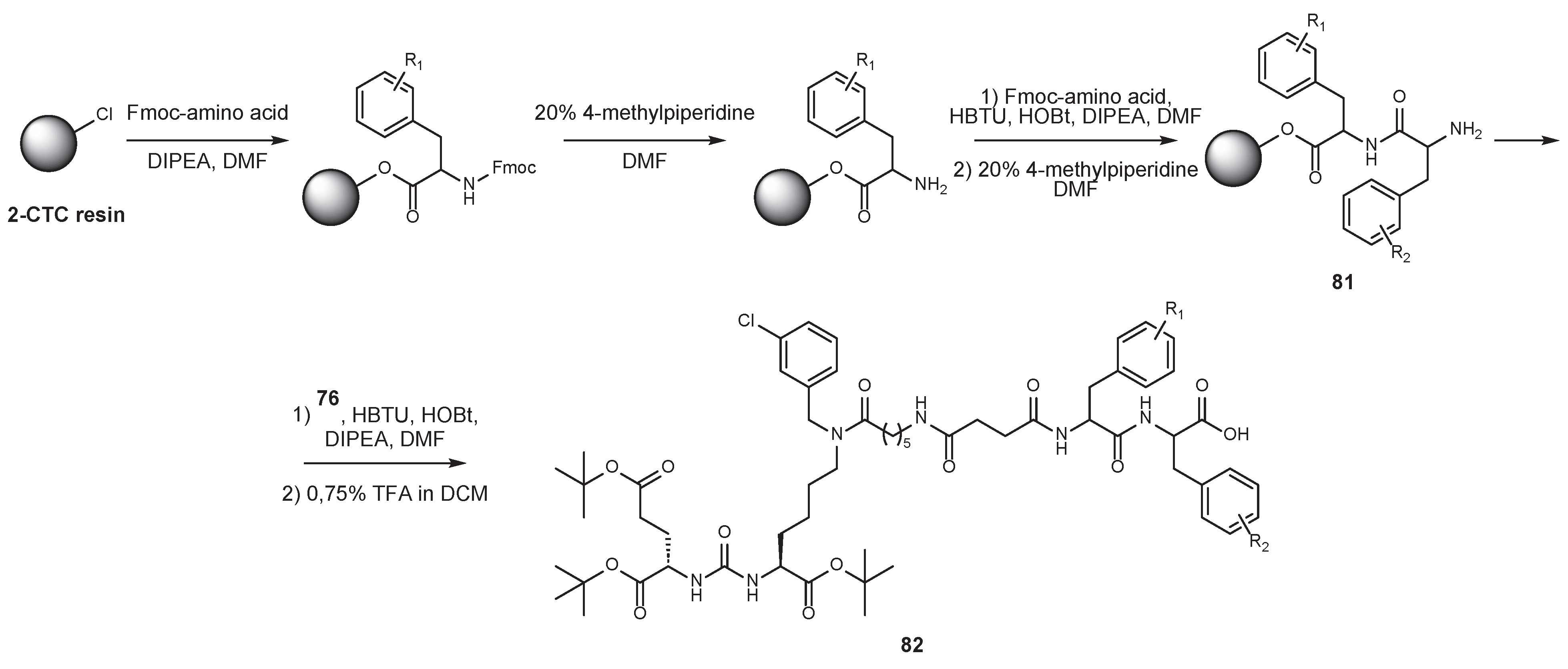
Scheme 41.
Synthesis of conjugate 84.
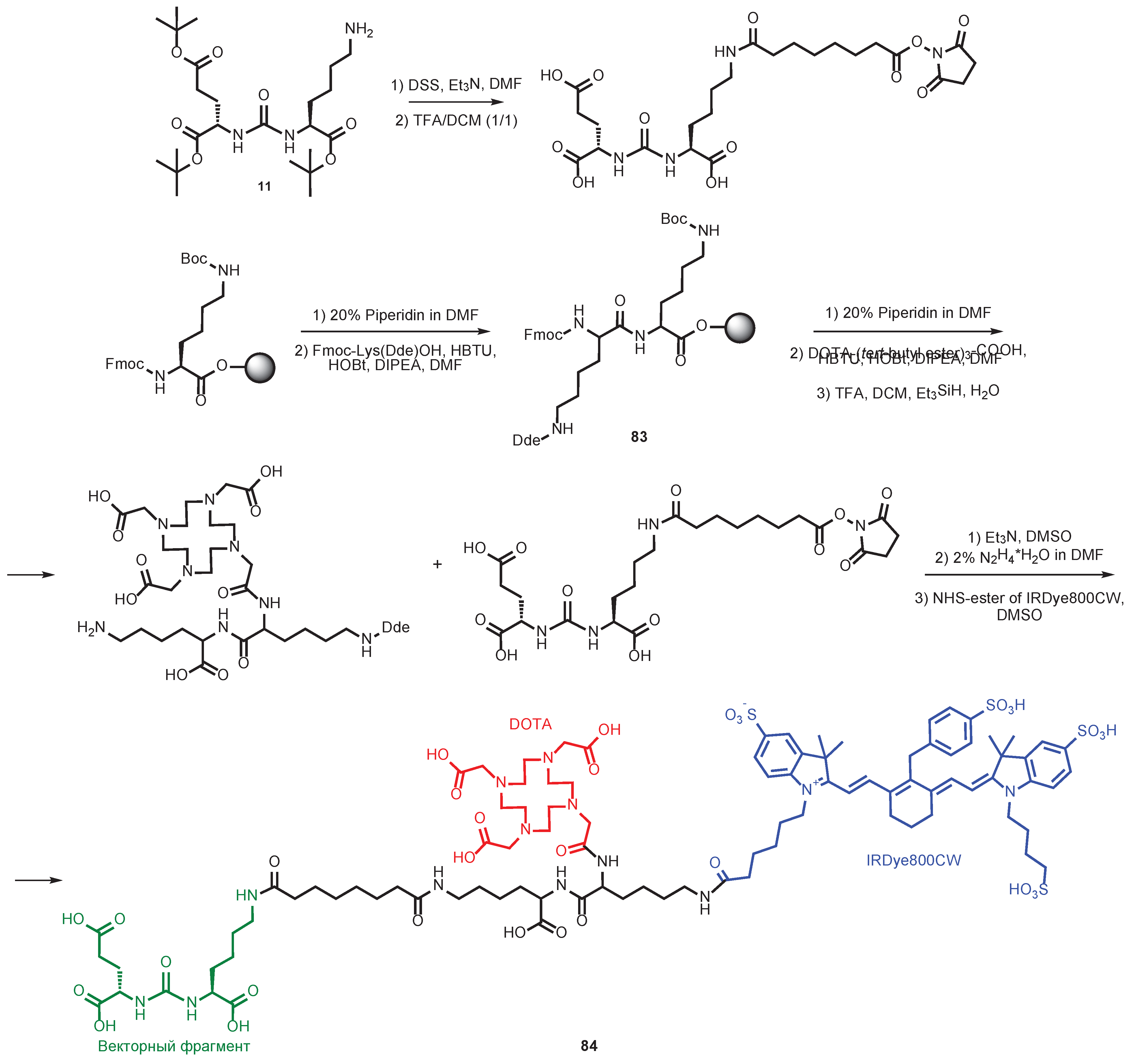
Scheme 42.
Synthesis of ligand 86 with a diethylene glycol fragment in a linker.
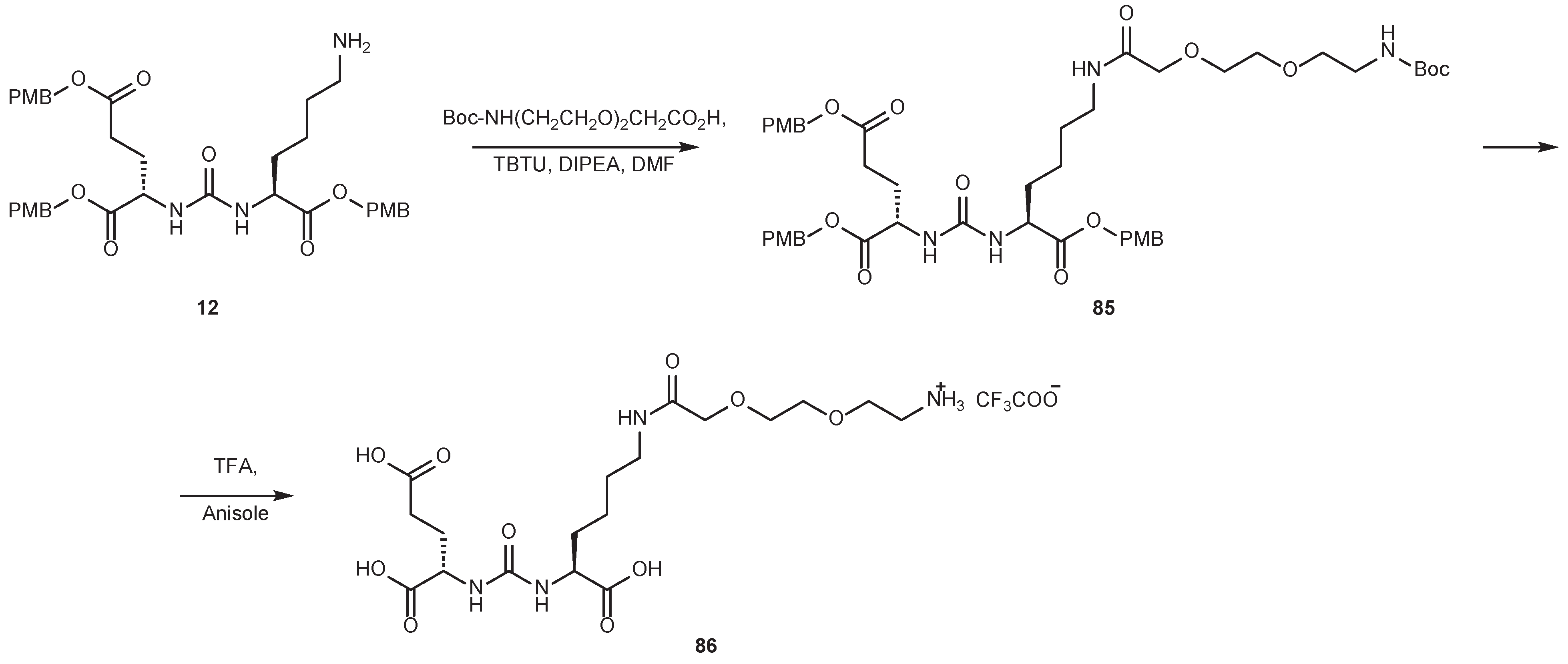
Scheme 43.
Synthesis of PSMA-targeted compounds, containing biotin fragment. Conditions А when n = 8: 1) Cbz-NH-PEG8-COOH, TBTU, DIPEA, DMF; 2) H2, Pd(OH)2, MeOH; 3) NHS-biotin, DIPEA, DMF. Conditions А when n = 12: HOOC-PEG12-biotin, TBTU, DIPEA, DMF.
Scheme 43.
Synthesis of PSMA-targeted compounds, containing biotin fragment. Conditions А when n = 8: 1) Cbz-NH-PEG8-COOH, TBTU, DIPEA, DMF; 2) H2, Pd(OH)2, MeOH; 3) NHS-biotin, DIPEA, DMF. Conditions А when n = 12: HOOC-PEG12-biotin, TBTU, DIPEA, DMF.
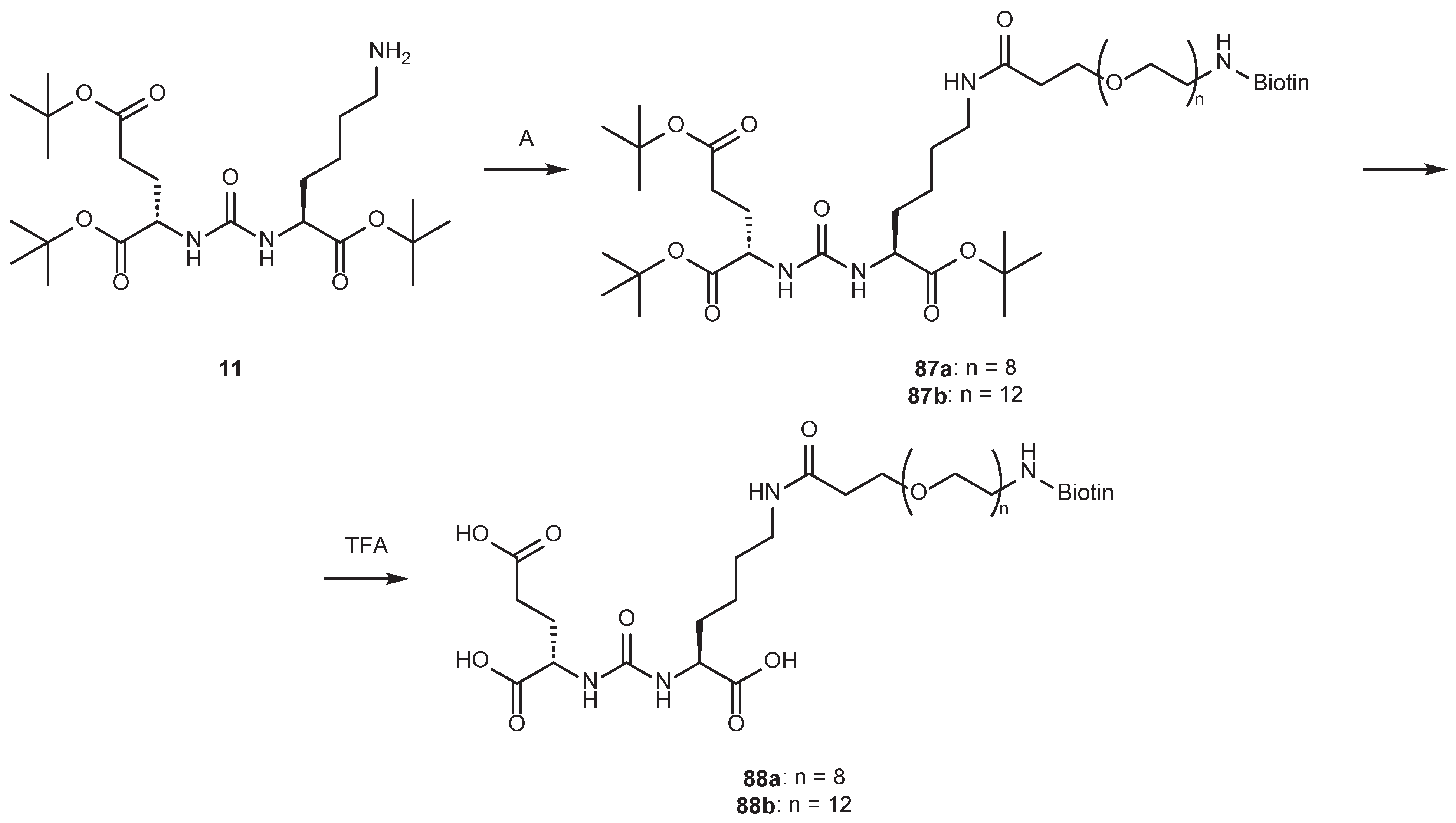
Scheme 44.
Synthesis of PEG-containing protected conjugates 90a-b.
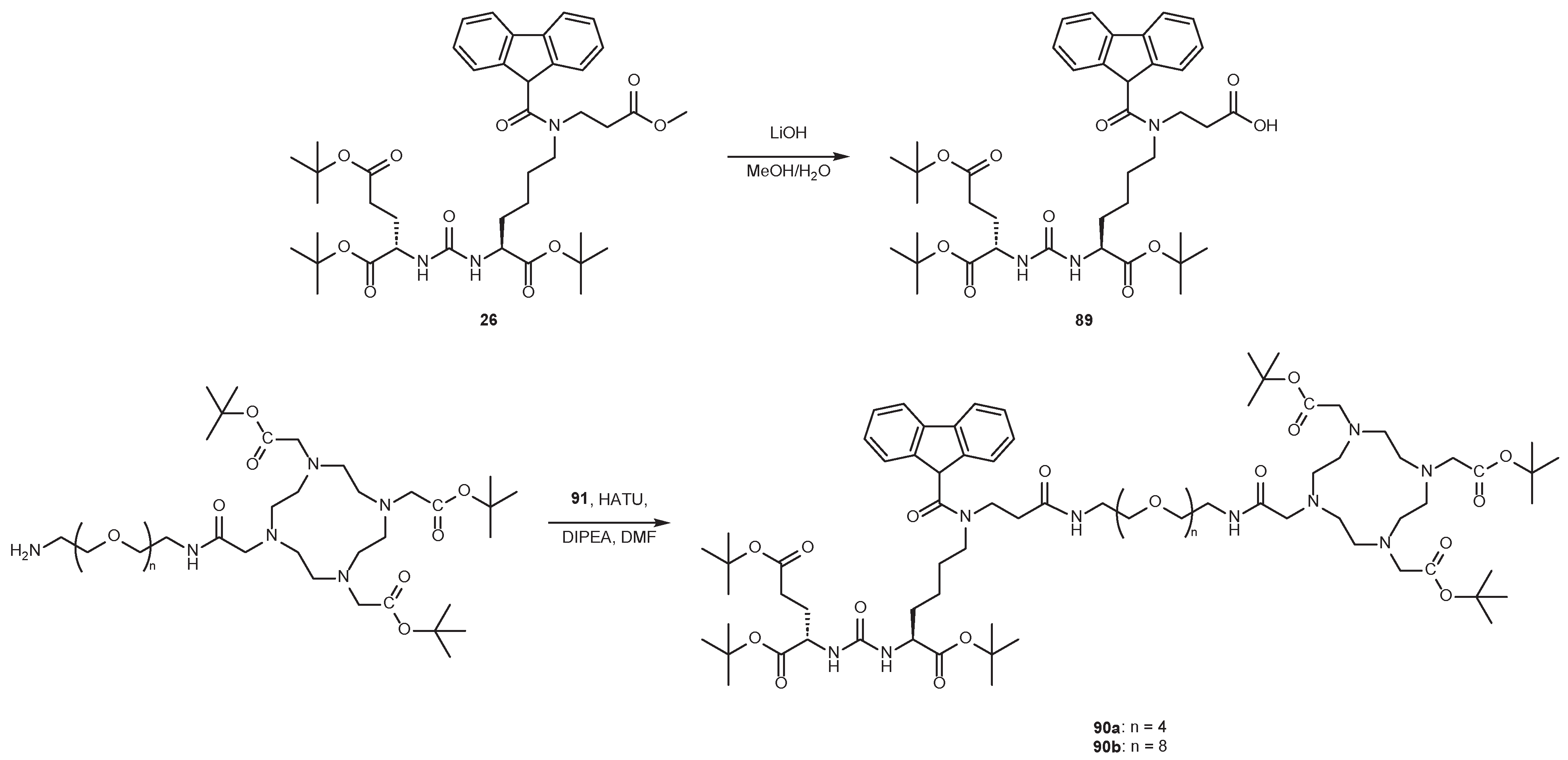
Scheme 46.
The general scheme of removal of protective groups, presented in [41].
Scheme 46.
The general scheme of removal of protective groups, presented in [41].
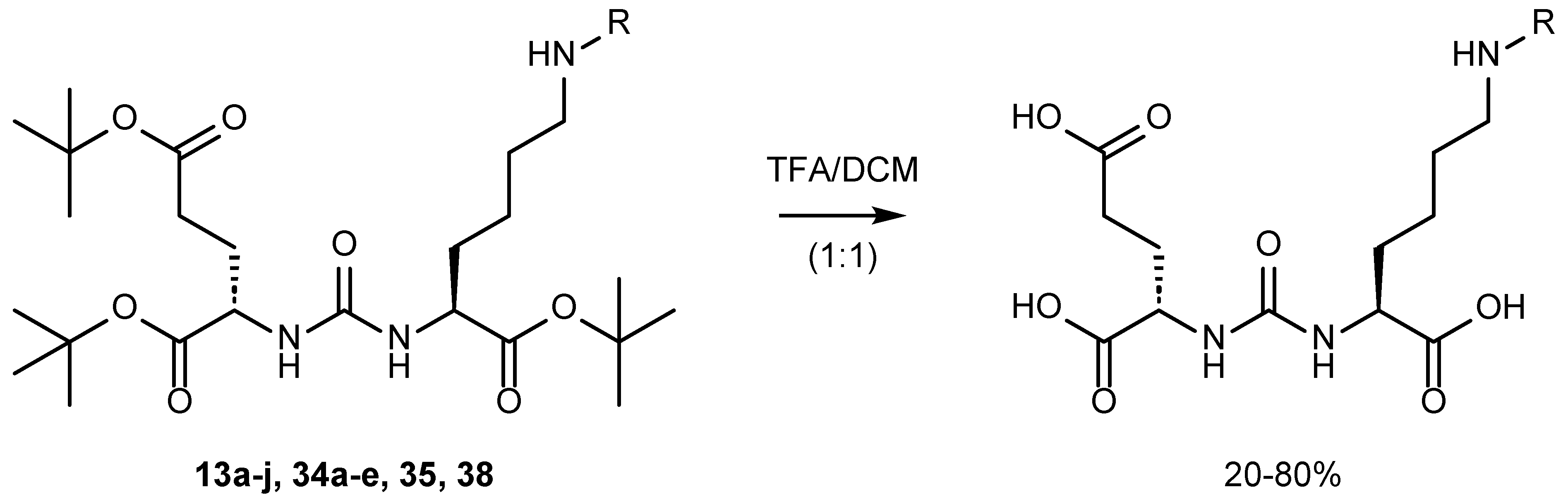
Scheme 47.
Removal of protective groups with anisole solution in TFA.
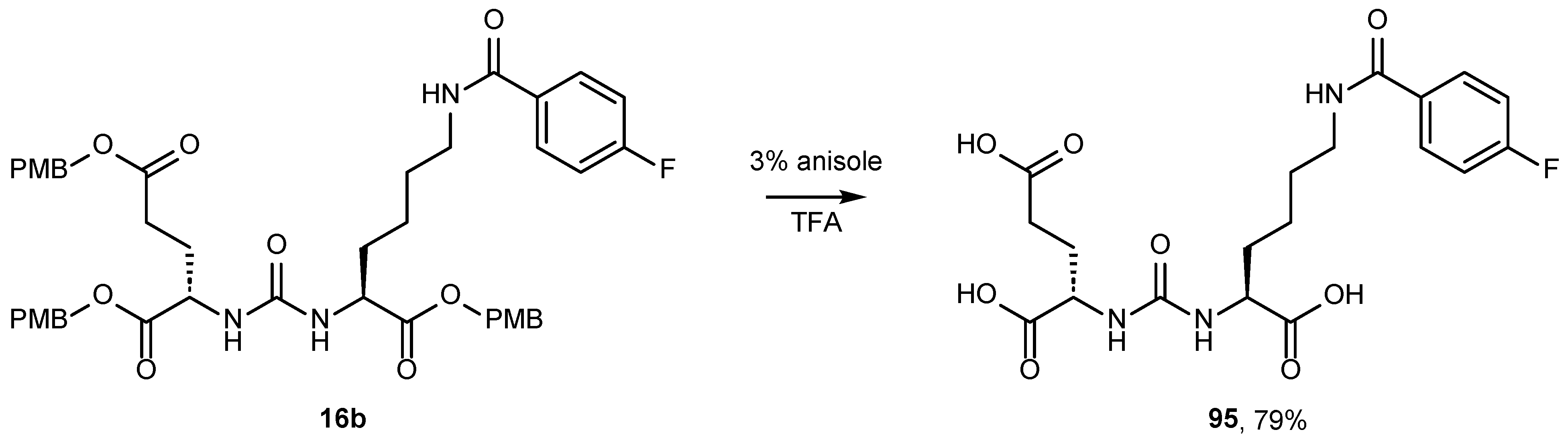
Figure 5.
Structures of impurities [M-18] – by-products of ligands and conjugates of PSMA.
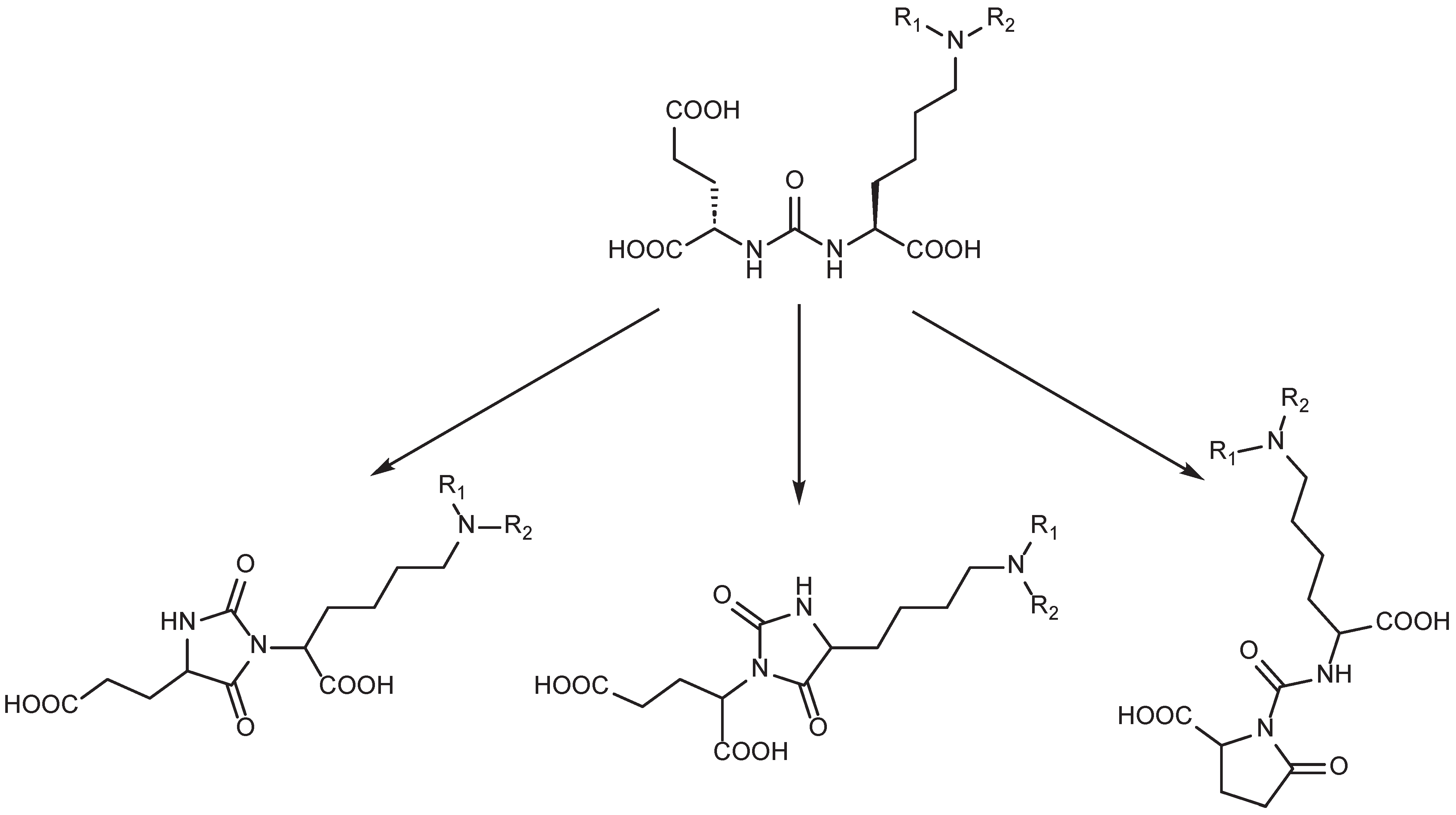
Scheme 48.
Synthesis of the conjugate PSMA-617.
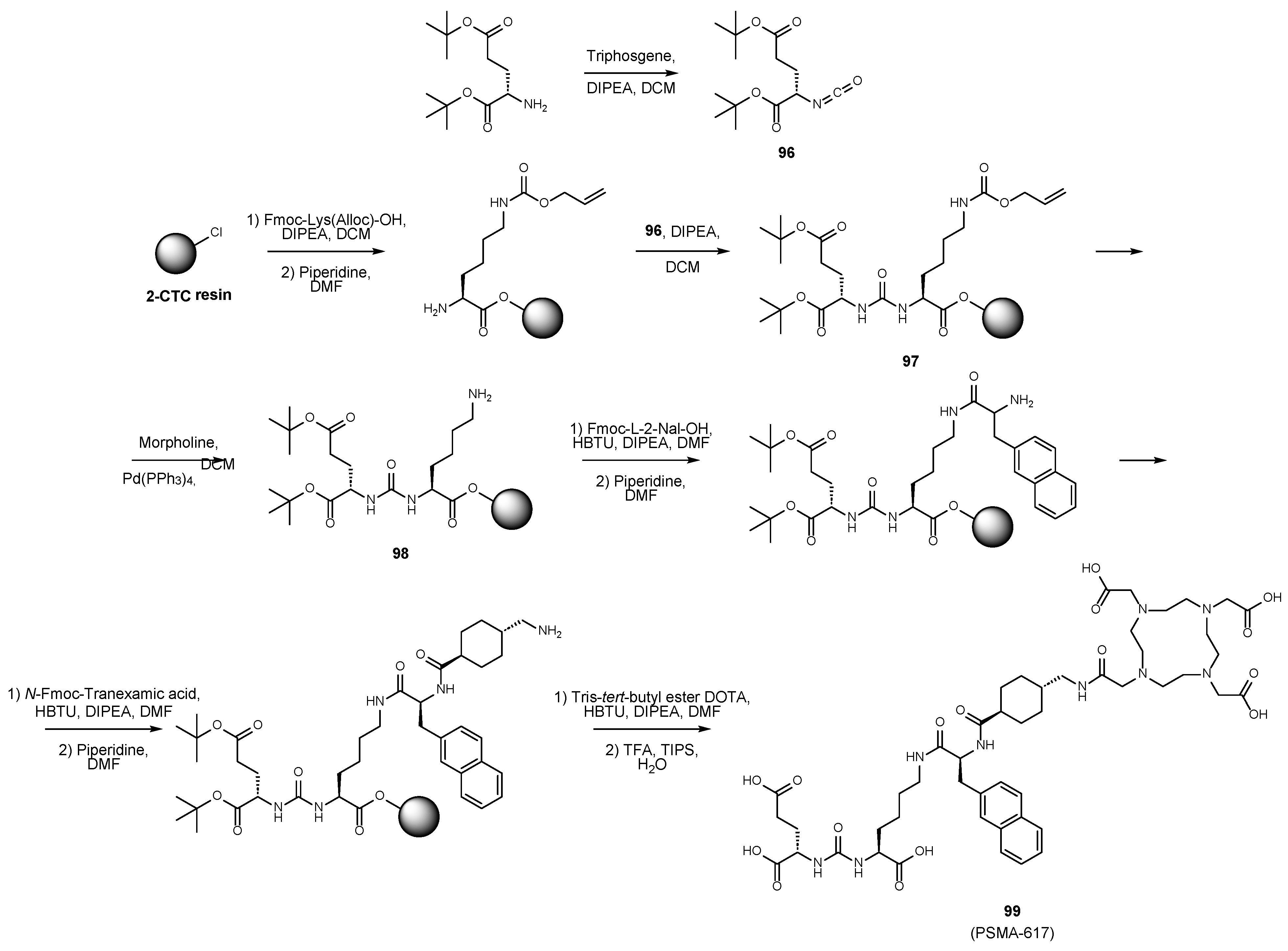
Scheme 49.
Alternative approaches to creating a protected DCL fragment on resin. The protective groups are highlighted in orange, and the lysine amino group is highlighted in blue.
Scheme 49.
Alternative approaches to creating a protected DCL fragment on resin. The protective groups are highlighted in orange, and the lysine amino group is highlighted in blue.
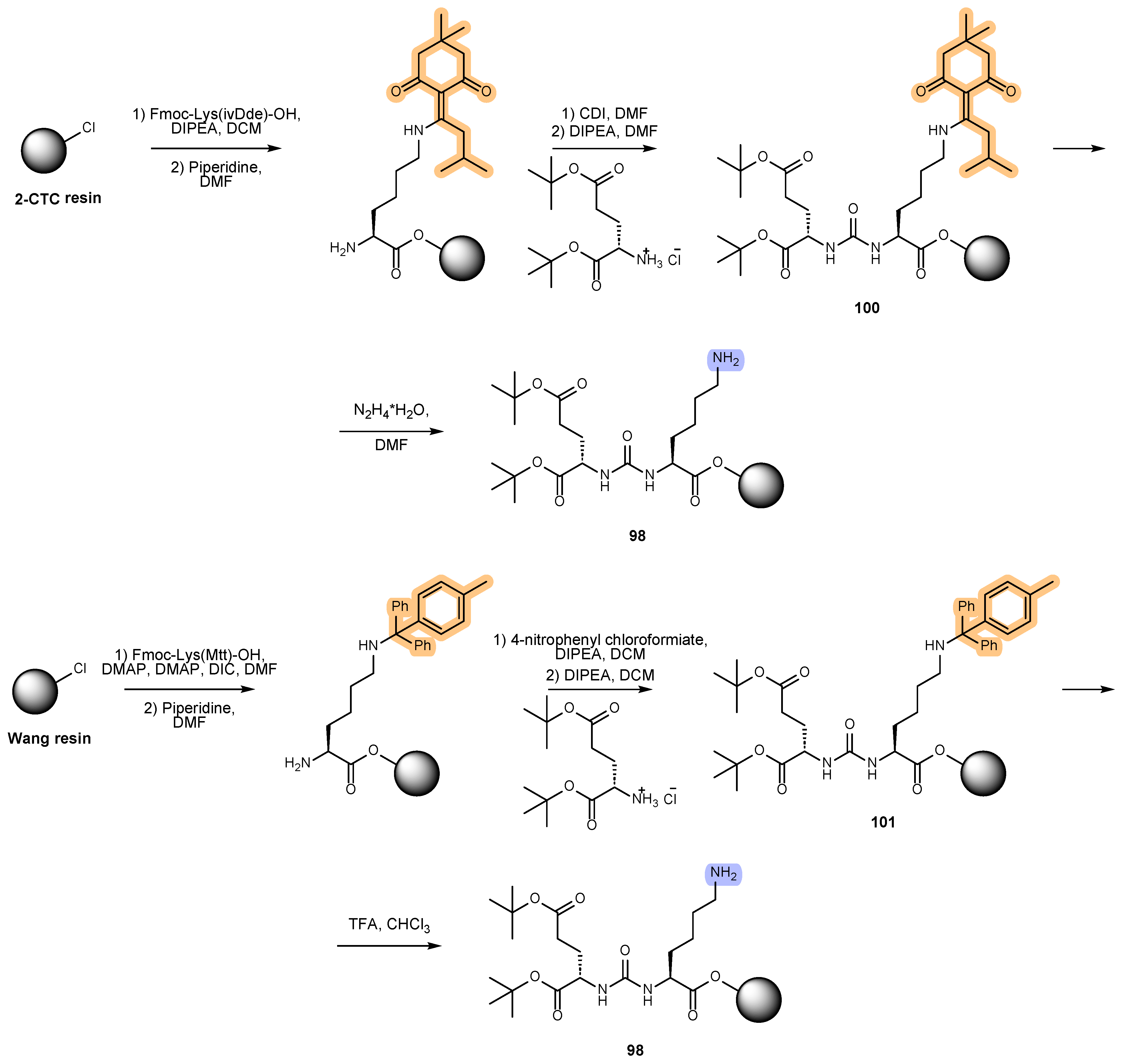
Scheme 50.
Synthesis of the azide-containing analog of DCL urea 102.
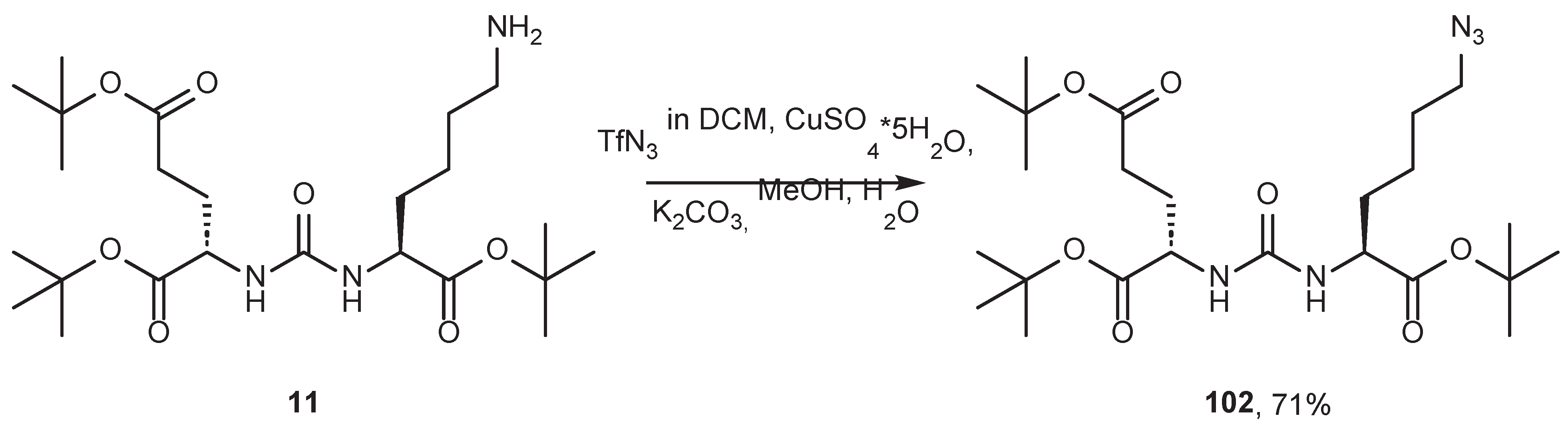
Disclaimer/Publisher’s Note: The statements, opinions and data contained in all publications are solely those of the individual author(s) and contributor(s) and not of MDPI and/or the editor(s). MDPI and/or the editor(s) disclaim responsibility for any injury to people or property resulting from any ideas, methods, instructions or products referred to in the content. |
© 2025 by the authors. Licensee MDPI, Basel, Switzerland. This article is an open access article distributed under the terms and conditions of the Creative Commons Attribution (CC BY) license (http://creativecommons.org/licenses/by/4.0/).
Copyright: This open access article is published under a Creative Commons CC BY 4.0 license, which permit the free download, distribution, and reuse, provided that the author and preprint are cited in any reuse.


