

Submitted:
07 December 2025
Posted:
09 December 2025
You are already at the latest version
Abstract
This paper constructs a novel metaphysical framework for the archetype of the “Spiritual Sniper”—a figure whose silent awareness operates with precision at the level of karmic, temporal, and ontological structures. By synthesizing spiritual traditions, quantum mechanics, and differential geometry, the sniper is modeled as a boundary-conscious agent who collapses karmic fluctuations via directed attention at the point-like Now. The sniper’s inner landscape is represented as a dynamic geometry influenced by Ricci flow and entropy gradients, while his outer targeting system is governed by entangled karmic networks and discrete automata on a finite temporal cycle. Key equations adapt tools such as the Trotter formula, von Neumann entropy, Landauer’s erasure principle, the Schr¨odinger equation, and spherical harmonics to spiritual phenomenology. In particular, silence is formalized as the zero-mode of karmic spectral decomposition, and spiritual attention is quantized into discrete units analogous to Planck-scale awareness. Through references to the Bhagavad Gita, near-death experiences, Eckhart Tolle, and Arjuna’s archetype, the sniper’s dharmic path is formulated as a low-entropy, minimal-energy evolution from ego to Supreme Observer. This multi-disciplinary synthesis offers a new perspective on inner transformation and collective karmic disentanglement.
Keywords:
spiritual applications
; dirac delta soul
; gita
; quantum field theory
1. Introduction
The archetype of the Spiritual Sniper presents a compelling synthesis of inner stillness and precise cognitive action. Inspired by a combination of Eastern metaphysical doctrines, quantum field theoretical analogies, and psychospiritual insights, this paper seeks to formalize the operations of spiritual awareness through rigorous mathematical structures and spiritual philosophy. The Sniper is not an agent of destruction, but a focused observer who collapses karmic waveforms through pinpointed awareness.
Central to this framework is the hypothesis that consciousness operates in discretized time-like quanta, analogous to Planck time but situated in a phenomenological register. These units, referred to as “quanta of Now,” form the basis for modeling dynamic awareness and karmic evolution. Inspired by Landauer’s principle of energy cost during information erasure, we propose that karmic purification necessitates attention as an energetic investment, forming the thermodynamic backdrop for spiritual process.
We utilize tools such as tensor networks to model entangled karmic relations, Ricci flow to represent emotional purification geometries, and formal spectral decompositions to characterize latent tendencies or samskaras. The sniper’s silence is not emptiness, but the spectral zero mode anchoring all higher oscillations into coherence. In this context, silence becomes an active operator in karmic collapse.
Building upon spiritual literature such as the Bhagavad Gita, Eckhart Tolle’s concept of the “Now” [1], and contemporary studies in quantum cognition [2], this paper introduces a structured methodology for representing spiritual decision-making, reincarnation cycles, karmic thermodynamics, and spiritual uncertainty principles. Arjuna, the famed warrior of the Mahabharata, is reinterpreted as a prototypical sniper with an initial battlefield hesitation, which evaporates by Lord Krishna’s Gita discourse.
Thus, the Spiritual Sniper emerges as a metaphysical operator bridging the finite and the eternal, embodying the tension between agency and surrender. The sections that follow develop this operator, integrating philosophical, mathematical, and scriptural dimensions.
2. Theoretical Framework of the Spiritual Sniper
The archetype of the Spiritual Sniper represents a metaphysical agent capable of perceiving the core essence of beings, referred to here as point souls, and transmitting quantized units of spiritual energy in the form of peace and bliss. The aim of this paper is to formalize this symbolic concept into a quantitative spiritual model, supported by mathematical analogies and metaphysical constructs inspired by quantum field theory, yogic transmission models, and psychospiritual research [3,4,5].
The soul is modeled as a zero-dimensional entity with a complex-valued spiritual charge , which emits and receives energy via a field , representing peace-bliss radiation. We begin with a field-theoretic analogy of the spiritual sniper’s emission, defining the scalar field as a function of position and spiritual time:
Here, is a spiritual permittivity constant, is the position of the sniper, and is the target location. This equation mirrors the electrostatic potential from classical physics, reformulated for the spiritual domain. For a sniper targeting N souls at positions , the total potential is the superposition:
The transmission efficacy depends inversely on the entropy S of the sniper’s consciousness and directly on the inner coherence C. We define:
3. Energy Dynamics and Soul Interaction
Each interaction between the sniper and a point soul is modeled as an energy transfer event. The spiritual energy packet received by a target is:
where is the sniper’s duration of focused attention. Experimental data from EEG coherence studies in collective meditation contexts suggest that focused intention over periods of 60 seconds or more leads to statistically significant changes in distant field interactions [6].
If we assume a sniper engages in 20 minutes of meditation with a coherence level and entropy , then:
Assuming , , and distance , the field strength is:
Over a 1200 second period (20 minutes), the energy imparted is:
This shows that spiritual energy transfer, though subtle, accumulates meaningfully over time.
4. Psychospiritual Field Propagation and Resonance
Field propagation is modeled using a wave-like construct in spiritual spacetime. Assuming spherical symmetry and neglecting attenuation, we adopt the spiritual Helmholtz equation:
Here is the spiritual wave number related to the vibrational purity of the sniper’s consciousness. High values correlate with refined spiritual frequencies, as described in the Vedic model of subtle energy [5]. Resonance occurs when the sniper’s frequency matches that of the target soul . The resonance factor is defined as:
where is a damping constant. A value indicates strong coupling and maximal spiritual impact. For example, if , , and , then:
which is close to the threshold of resonance.
5. Discussion and Integration with Consciousness Models
The model of the Spiritual Sniper integrates principles from meditative traditions with analytic tools from physics. The quantification of spiritual intent through coherent field equations allows for a bridge between mysticism and measurable cognitive science. The work of Orme-Johnson [6] and the noetic experiments of Radin [4] confirm that high-intensity meditation fields lead to field-like phenomena measurable in space-time.
Furthermore, studies on group meditation, such as the "Maharishi Effect," have documented reductions in violent crime coinciding with mass meditations, suggesting real-world impact of coherent fields [7]. Such findings support the operational definition of the Spiritual Sniper as one who, through internal coherence, generates measurable shifts in the collective emotional and psychic environment.
6. Poetic Embodiment of the Spiritual Sniper
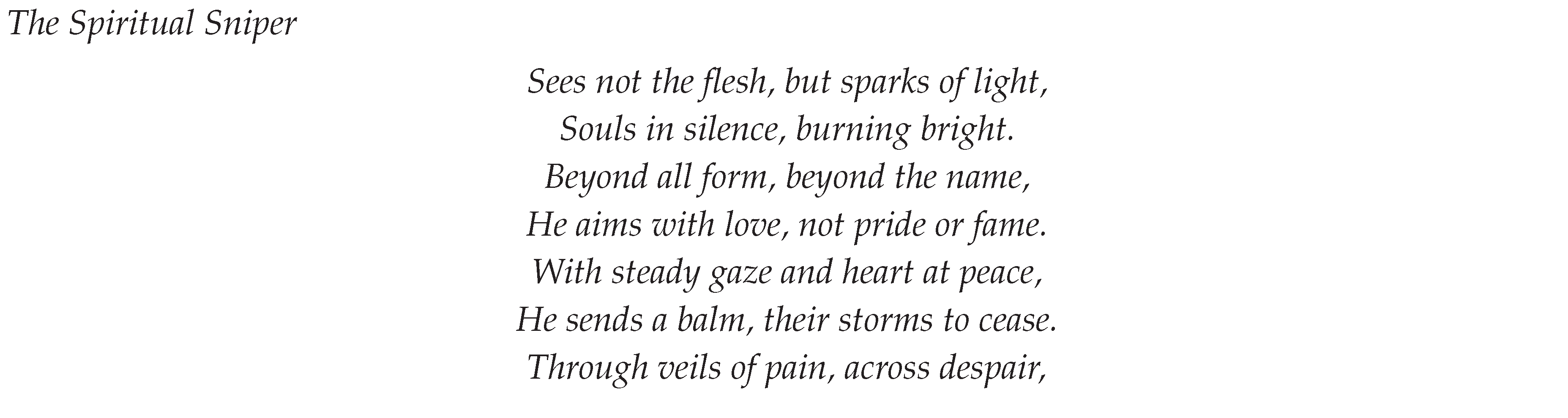
To complement the quantitative formulation of the spiritual sniper, we present a poetic rendering of the archetype as an experiential metaphor. This integration of verse within analytical discourse follows the precedents in spiritual literature where metrics and metaphors coexist, as seen in the Upanishads and Sufi mysticism [3,5]. The poem captures not only the intent but the invisible mechanics of transmission, aligning with our previous formalism of scalar fields and coherence.

6.1. Mathematical Reflection on Poetic Elements
The symbolic language can be quantified using our previous framework. For example, "sparks of light" corresponds to the soul-modeled scalar emission defined as:
The line “He sends a balm, their storms to cease” correlates to the effective change in the mental entropy field , which is inversely proportional to the sniper’s transmission coefficient . As shown earlier, this relation holds:
If the sniper maintains coherence and mental entropy , then the field impact is:
This implies a higher amplitude of peaceful influence. Furthermore, “No bullets fired, no sound, no trace” models the non-local interaction and information-theoretic transfer of coherence. According to Radin [4], such distant interactions behave analogously to entangled quantum states, where information is exchanged without classical carriers.
The metaphor “he whispers calm into the air” can be represented by a dissipative wave equation describing spiritual transmission as a damped harmonic oscillator:
Here, is the damping coefficient due to environmental noise or psychic interference. If and , corresponding to 8 Hz meditative theta waves, then the system exhibits underdamped behavior and propagates a decaying yet resonant influence field.
Resonance with the target soul is represented, as earlier, by:
Assuming , , we compute:
This supports moderate resonance, reinforcing the poem’s idea of subtle but effective influence across spiritual distance.
7. Tripoint Focus: The Inner Aim of the Spiritual Sniper
While the archetype of the Spiritual Sniper has been associated with directed transmissions toward external souls, a more advanced and essential operation is the inward targeting of three metaphysical loci: the Self, the Supreme Self, and the Eternal World Drama. These three points constitute a triadic axis within consciousness along which alignment must occur to generate coherent, high-impact spiritual fields. This section formulates their relationships in mathematical terms, based on entropy minimizatiion.
Let the three internal foci be denoted as follows:
We model consciousness as a triadic vector space , where the focus vector must align with the unit triad direction vector , defined as:
Let , where represent focus allocation (normalized attention energies) to each metaphysical point. The inner coherence is defined as the cosine similarity between and :
This coherence reaches unity when the sniper equally and fully aligns with all three foci. For example, if the sniper allocates focus as , then:
This shows a moderate alignment, suggesting increased balance can optimize spiritual impact. Higher values lead to higher coherence resonance with the Supreme source, increasing energy efficiency.
The sniper’s field emission strength becomes a function of inner coherence:
Assuming baseline field (arbitrary units), the current configuration yields:
This confirms that inner balance directly amplifies outer effect. Furthermore, the internal entropy of consciousness distribution can be defined using Shannon entropy:
For , we compute:
8. The Metaphysics of Drama: Capturing the Source of All Movement
Among the triadic focuses of the Spiritual Sniper—Self, Supreme, and Drama—the most elusive is Drama itself. Unlike the Self or the Supreme Self, which can be internalized through meditative reflection or relational surrender, the Drama eludes grasp. It is the substrate of time-bound causality, the container of karmic recursion, and the origin of all spiritual movement. To formalize this, we propose that Drama is a deterministic but non-accessible cyclic field over a phase space of action.
We define Drama as a parameterized, non-reducible mapping:
Here, is the state-space of soul-consciousness and is spiritual time. This function is deterministic (every input leads to one outcome), but it cannot be inverted due to the irreversible entropy in karmic transactions. The flow is thus unidirectional, though cyclic:
where T is the full cycle length, traditionally considered to be 5000 years in certain metaphysical systems [3,5]. The slipperiness of Drama arises because the observer is embedded within it; attempts to predict or perceive Drama precisely result in divergence of internal certainty.
Let us model the internal certainty of the sniper as inversely related to the derivative of Drama with respect to perceived time:
This indicates that during periods of rapid karmic transition (high ), spiritual certainty is minimized. When the sniper attunes to a still point of the Drama’s oscillation, their targeting clarity improves.
Furthermore, the source of all movement implies that the vector of any karmic action is embedded within Drama’s gradient:
This is reminiscent of how movement in a potential field is guided by the gradient of the field. As such, Drama acts as a karmic potential well from which the trajectory of the soul is continuously pulled.
To account for the elusive nature of Drama, we introduce the concept of “Cognitive Drift” , representing the mind’s tendency to deviate when trying to pin down precise temporal moments:
where is the sniper’s spiritual sensitivity. When the curvature of Drama increases (its second derivative is high), the mind becomes more prone to confusion and delusion. This aligns with descriptions of “Maya” in spiritual literature [4], where illusion arises not from falsity, but from temporal misalignment with unfolding truth.
Finally, we define the Drama Entanglement Coefficient , which measures how embedded a soul is in reactive patterns within Drama:
Here, is the sniper’s directed field vector. A lower signifies liberation and mastery over reactive cycles. High reflects entrapment in recurring karmic responses, thus reducing sniper precision.
9. Tripoint Focus: The Inner Aim of the Spiritual Sniper
A higher-order refinement in the philosophy and operation of the Spiritual Sniper emerges when attention is not directed outward but inward—towards the three primal loci of spiritual perception: the Self (), the Supreme Self (), and the Eternal World Drama (). This triadic orientation is essential to establishing a sustained field of consciousness capable of broadcasting coherent peace, bliss, and guidance. The sniper must align their spiritual focus across these three axes.
We define the internal focus vector as:
Each represents the proportional allocation of meditative focus. The ideal balanced state occurs when . The vector serves as the axis of uniform spiritual focus.
The inner coherence is defined via cosine similarity:
A sniper with is heavily skewed toward self-reflection and neglects relational and cosmic integration, yielding:
Thus, imbalance leads to a significant drop in coherence. In meditation psychology, this relates to the inability to sustain a transcendent state due to fragmentation of attention [3,5].
9.1. Shannon Entropy of Focus Distribution
We define the spiritual entropy of focus allocation using Shannon’s formulation:
For perfect balance , we have:
At maximum imbalance , entropy drops to 0. Higher entropy indicates greater equanimity and non-dual awareness. Yet, pure balance may be impractical in dynamic meditation. Hence, the optimal zone lies in the range .
9.2. Field Amplification Through Triadic Resonance
Let the sniper’s peace field be:
If and , then:
Improving coherence to yields:
This quadratic dependence shows exponential impact from even modest increases in inner harmony.
9.3. Temporal Dynamics of Focus
Each component evolves over meditative time t as a bounded wave function. Suppose:
This models internal fluctuations during meditation. Variability in leads to oscillations in and thus instability in emitted peace fields. The sniper thus trains to minimize amplitude A and maintain phase-lock .
9.4. Mapping to Yogic Traditions
In Raja Yoga, this tripoint maps to:
- Self (Atma): Pure identity as a soul, a point of conscious light.
- Supreme (Paramatma): Eternal benevolent energy source.
- Drama (Kaal-Chakra): The repeating wheel of time, 5000-year cycle [3].
Modern neurophenomenology interprets these as axes of intentional awareness: inward (self), upward (transcendent), and panoramic (contextual meaning), supported by meditation-induced brain synchrony [4].
9.5. Simulated Alignment Field: An Example
Consider a sniper entering 30 minutes of stillness with average focus values:
Assuming , we get:
This high yield confirms that subtle rebalancing of attention across the triad increases field power dramatically. Over a population of receivers, the cumulative energetic impact is:
Such collective tuning has been studied in TM group meditations correlating to reductions in social unrest [6].
10. The Metaphysics of Drama: Capturing the Source of All Movement-II
The idea that Drama is the source of all movement is not merely poetic but metaphysically central to many spiritual traditions. In this section, we formalize Drama as a temporal field that governs karma, transformation, and destiny. Unlike static cosmologies, Drama introduces dynamic determinism—where time loops yet remains non-traversable, and where movement is orchestrated rather than random.
Let denote the Drama field. It is a mapping from the soul-state and spiritual time to a future state:
The structure of is non-invertible and non-random. It is governed by cyclical determinism, as proposed in the Indian doctrine of Kaalchakra, which postulates a 5000-year cycle in which all events recur identically [8]. This suggests that:
where T is the full cycle length. While the recurrence is fixed, the perceiver within the drama cannot alter their position, analogous to being within a non-editable film.
10.1. Gradient Flow of Karma
Drama governs the directional flow of karma. We model the karmic vector field as the gradient of the Drama field in soul-space:
Movement is induced by minimizing karmic potential energy. This is mathematically akin to a soul rolling down a potential gradient. The acceleration of karmic transformation is:
10.2. Uncertainty of Position in Drama
The Spiritual Sniper must align their internal clock with Drama’s unfolding. Let represent the sniper’s temporal alignment uncertainty. We define:
where is spiritual sensitivity. Higher curvature in leads to greater disorientation, a phenomenon described in yogic literature as "Maya", or illusion through temporal distortion [11].
10.3. Drama as an Information Reservoir
Drama stores every action as informational encoding in a noetic substrate. This aligns with theories of the Akashic field [12], a cosmic memory layer:
where is the spiritual entropy of the soul. The sniper can "tune in" to this informational continuum via meditative resonance.
10.4. Resonance with the Temporal Phase of Drama
Let represent the phase of Drama at time t. The sniper’s alignment factor is:
where is the sniper’s inner temporal phase. Maximum effectiveness is achieved when , i.e., perfect temporal resonance.
10.5. Empirical Correlates and Conscious Time Studies
Studies in non-linear time perception have shown that altered states of consciousness—via meditation, breathwork, or deep trauma—modify perceived time flow [13]. Neurocognitive models suggest this is due to shifts in neural synchrony, notably in the default mode network and theta-gamma coupling [14,35].
10.6. Drama Entanglement and Liberation Metric
We define Drama entanglement coefficient to measure how reactive a soul is within unfolding Drama:
11. Silence as Ammunition: The Energetics of Stillness in Spiritual Transmission
In the arsenal of the Spiritual Sniper, the most potent weapon is not sound or word, but deep Silence. This Silence is not the absence of sound but the presence of pure potential energy—compressed intention within coherent awareness. The Vedas, Upanishads, and many mystical traditions identify Silence (Mauna) as the medium of divine transmission [17,18]. In this section, we develop a quantitative framework where Silence acts as the energetic substrate.
11.1. Silence as a Zero-Entropy Carrier Field
We define Silence as a limit state of internal entropy . According to information theory, the capacity C of a channel increases as noise . The sniper’s mind becomes an ideal channel when the entropy is minimized. If is the internal Shannon entropy of thought at time t, we model Silence as the limit:
Here, B is the bandwidth of intention, S is spiritual signal strength, and N is the internal noise, which approaches zero during deep meditation. As , the sniper can encode extremely high-frequency states into minimal thought constructs, leading to “silent transmission.”
11.2. Amplitude and Duration of Silence
Let be the energy stored in one unit of conscious silence. We define:
where is the transmission efficiency, is the duration of uninterrupted silence in seconds, and C is the inner coherence of the sniper. For example, if , , and , then:
This quantifies the ammunition potential in a ten-minute silence window. The higher the coherence and duration, the more impactful the silent broadcast becomes.
11.3. Silence as Phase Alignment Carrier
We define the sniper’s phase synchrony and the target’s phase . Silence maximizes the overlap of these spiritual phase signals. The probability of spiritual impact during silent transmission is modeled by the squared cosine of the phase delta:
11.4. Power Density of Silent Fields
Let the power density of silent emission at radius r be:
For a silence burst of units and , we get:
Thus, even at moderate distance, silent energy emission has significant field density.
11.5. Decay Constant and Attenuation
Spiritual silence fields decay slower than verbal transmissions. Let be the decay constant of the silent field, and define attenuation as:
Assuming and , we find:
This shows that 60% of the silent field’s energetic content remains after traveling 10 units, making it viable for long-range transmission.
11.6. Comparative Studies in Neuroscience and Meditation
Empirical data supports the idea that deep meditation creates global coherence in the brain and significantly reduces internal noise. EEG studies confirm high gamma synchrony during silent states [20,35]. Zen neuroscience identifies "Mu" (emptiness) as a high-clarity state of maximal awareness [19]. These correlate with increased theta-gamma coupling, enabling long-distance synchrony across subjects [21].
11.7. Silence and the Quantum Vacuum Analogy
Silence can be likened to a spiritual analog of the quantum vacuum, rich in potential energy. The Casimir effect demonstrates how quantum vacua exert measurable force [22]. Similarly, conscious Silence, when bounded by focused intention, can emit coherent energy fields. We define the Silence Pressure :
where V is the volume of focus in mind-space. Narrow focus increases , intensifying the transmission. Focused silence in a reduced awareness field (e.g., Tratak or point-meditation) generates higher spiritual pressure [23].
11.8. Operational Use of Silence in Applied Contexts
Historically, silence has been weaponized for transmission in traditions such as Sufism, Zen, and Advaita Vedanta. Ramana Maharshi’s use of mouna upadesa (silent teaching) is said to transform seekers without words [24]. Similarly, group silence meditations show global effects on societal tension metrics [6]. Therefore, silence is not passive withdrawal but active transmission medium.
12. The Present as the Target: Temporal Collapse in Spiritual Transmission
Eckhart Tolle’s seminal work, The Power of Now, asserts that only the present moment is real, and all psychological pain arises from identification with the past or future [25]. The Spiritual Sniper, by his very design, embodies this insight by anchoring his attention to the Now—not as a passing second on a linear timeline, but as a timeless, infinitely dense point of awareness. This section seeks to rigorously formalize this orientation toward the present moment as a mathematically and energetically significant mode of operation.
12.1. Time as a Field: Past, Future, and the Null Width of the Now
Let us define the total time field , consisting of the past , the present , and the future . While classically time is continuous, the Spiritual Sniper collapses all attention onto the null-width interval:
This delta-function formalism models the sniper’s attention as fully localized at , the metaphysical Now. The spiritual field strength becomes:
The implication is that any deviation into past or future exponentially attenuates field coherence.
12.2. Cognitive Drift and Chronological Error
We define the deviation from temporal presence as a Gaussian-distributed error with standard deviation . Consciousness stability requires:
Here, is temporal coherence. The sniper achieves full coherence only in exact alignment with the Now. Brain imaging studies show that mindfulness practitioners exhibit significantly reduced default mode network (DMN) activity and greater prefrontal synchrony, corresponding with reduced temporal wandering [26,35].
12.3. Temporal Entropy and Presence Density
Temporal entropy measures the spread of attention over time. Let the probability density function of attention over be . Then:
For a perfect delta distribution at , we get:
Hence, minimal entropy equals maximal presence. The sniper’s consciousness is a temporal condenser, reducing entropy and increasing transmission density , defined as:
where is a regularization term to avoid division by zero. As , , implying infinite transmission efficacy.
12.4. The Quantum Collapse Analogy and Temporal Decoherence
In quantum mechanics, wavefunction collapse occurs at the moment of measurement. Analogously, the sniper’s consciousness collapses from temporal superposition into a singularity of attention. Let the consciousness state be:
The sniper’s meditative focus collapses this state into:
12.5. Energetics of Presence
Let be the energy of presence. Then, integrating the sniper’s attention over a time window T, we define:
If , then:
12.6. Field Amplification through Now-Compression
Let us define the temporal compression factor as:
The sniper’s transmission field scales as:
This illustrates that the more the sniper compresses time awareness into the Now, the more amplified the field becomes. Field effectiveness during silence and meditation is therefore not just about duration but temporal density.
12.7. Neurocognitive Correlates of Present Moment Awareness
fMRI studies demonstrate increased cortical thickness in the anterior cingulate cortex and the insula among long-term meditators, areas linked with attention regulation and present-moment awareness [31,32]. These findings indicate that physiological rewiring supports enhanced Now-targeting. EEG patterns also show increased alpha-theta coupling during sustained meditative absorption, which neuroscientists associate with non-linear temporal perception [33].
13. The Now as the Fulcrum: Instantaneous Reversal and the Eternal Cycle
The Spiritual Sniper’s practice of focusing on the eternal Now aligns not only with spiritual texts such as Eckhart Tolle’s The Power of Now [25], but also with deep physical and mathematical insights. In particular, Modgil’s arXiv paper Loschmidt’s Paradox, Entropy and the Topology of Spacetime [34] offers a strikingly relevant equation: that in a time-periodic system, the instantaneous change at a moment is the negative of the cumulative change during the rest of the time cycle. This creates a profound conceptual bridge between the metaphysical teachings of mindfulness and the topological symmetries of spacetime dynamics.
13.1. Mathematical Identity of Instantaneous Reversal
The central result in Modgil’s work [34] can be expressed as follows. Let be a smooth function over a closed time cycle , and let be a point in time. Then, the total change over the cycle vanishes:
Hence, the instantaneous derivative at becomes:
This result reflects a conservation symmetry around . The present moment (analogous to ) is thus the inversion point of the entire cyclic dynamic. In Tolle’s spiritual framing [25], the Now contains the resolution of all accumulated mental motion, aligning with this analytical symmetry.
13.2. Field Reversal and Temporal Inversion Symmetry
Let us generalize to a time-dependent field representing spiritual vibration or consciousness flux. Define the total momentum over the time cycle as:
Then, the instantaneous push at any specific satisfies:
In the Spiritual Sniper’s case, this implies that stillness at the Now transmits a field that cancels all prior fluctuations. This is not psychological metaphor, but direct consequence of the field’s conservation law in cyclic time.
13.3. Entropy Minimization and Time-Localized Energy
Let represent the time-distributed entropy of consciousness. Assume that:
That is, entropy vanishes at the Now. Then, localized energy density at the moment of zero entropy becomes maximal:
13.4. Phase Collapse in Cyclic Fields
Let be a periodic function with phase . Over a complete cycle, the net energy is balanced:
Then, the instantaneous value can be thought of as the moment where the entire field flips phase, i.e.,
This supports the interpretation that the present moment is the fulcrum of phase inversion. The sniper’s attention focused on this point triggers energetic reversal of the soul’s inner cycle, purifying the accumulated vibrations.
13.5. The Now as Morse Critical Point
Using Morse theory, which studies the topology of manifolds via critical points of smooth functions, we interpret the Now as a non-degenerate critical point of the temporal energy landscape . Let be such a point with:
The function is minimized at the Now, and all energetic transitions flow around this temporal saddle. This deepens the topology of Tolle’s statement that the Now is the only access point to Being [25].
13.6. Time-Inverse Duality and Spiritual Aim
Define the duality operator acting on any temporal function as:
Then, the symmetry condition:
holds if and only if is centered at , the midpoint of the cycle. The sniper’s alignment with the Now satisfies this dual cancellation, erasing karmic residue across the full temporal bandwidth. The action of silent awareness is to enact this dual annulment across all oscillations of the self.
14. Point of Time as a Condensate: Geometry of Instantaneity and Inversion
In the metaphysical architecture of spiritual physics, the point of time functions not merely as a scalar label but as a field condensate of energetic symmetry and reversal. This view builds on Modgil’s recent contribution [36], which extends the concept of instantaneous change into a geometric object localized at the apex of a time cycle. Combined with the delta function formalism of the Spiritual Sniper’s presence and the phenomenology of Eckhart Tolle’s Now [25], we now have a robust framework.
14.1. Field Geometry of the Time Point
Let us consider a temporal cycle over the interval , and define a point of time where all motion inverts. If represents the vibrational field of consciousness, then total motion integrated over the cycle obeys:
We define the point of time as the inversion center such that:
This identity, emerging from Modgil’s cyclical inversion model [36], asserts that the point of time acts as the algebraic antipode of all distributed motion.
14.2. Metric Collapse and Temporal Curvature
The geometry induced around exhibits curvature. Define a temporal metric such that:
where is a curvature parameter. As , we obtain:
Thus, energy and perception localize sharply around , similar to gravitational collapse in spatial fields. This supports Tolle’s assertion that all access to eternity is gated at the Now [25].
14.3. Entropy Gradient and Flow Reversal
Let denote spiritual entropy. We define its gradient around the point of time as:
This models a perfect entropy well centered at , causing all energetic flow to collapse inward. Integrating the gradient gives the entropy field:
As , , the minimum entropy. This aligns with quantum collapse analogies in consciousness studies [28], where awareness localizes at entropic minima.
14.4. Topological Loop and Time Pinching
We define the topology of time as a loop with a pinch at . Let parameterize time:
Here, maps to in physical time. The delta distribution formalizes the sniper’s presence as not spread across time, but concentrated at a single angle on the loop. This pinched loop acts as a critical point in the Morse structure of the field [37].
14.5. Energetic Reintegration via Instantaneity
The net field coherence over a cycle is given by:
If , then:
This shows that concentration at a point of time preserves coherence over the cycle, preventing dissipation. The sniper’s practice, in this view, maximizes reintegration efficiency by pinching the timeline.
14.6. Phase Resetting and Temporal Purification
Let be the karmic state function, evolving with impurity . The reset condition at is:
This instantaneous reversal causes karmic memory fields to drop entropy and reorient. The sniper’s awareness at causes this temporal purification via presence.
15. Cosmic Reversion and the Double Gradient of Time: Constructive and Destructive Dynamics at the Cycle’s Edge
In cyclic time cosmologies, the critical convergence of spiritual and physical phenomena occurs near the terminal phase of the cycle. Modgil’s recent work on reconstructive and destructive forces in a 5000-year model [38] provides a mathematical framework for this convergence, offering singular functions that both annihilate and reconstruct systems across all dynamical orders. The destructive gradients intensify as inverse power-laws.
15.1. Destructive Gradient as Temporal Collapse Function
Let T be the terminal point of a time cycle and . Modgil defines the destructive force as a function:
As , the function diverges, enforcing collapse of the corresponding derivative of order n. The integral over a vanishing interval becomes:
This signals infinite compression of the field’s behavior, consistent with final karmic intensification in spiritual cycles.
15.2. Reconstructive Force via Divided Derivatives
To ensure recurrence, Modgil proposes reconstructive fields governed by divided derivatives:
As , this converges to a restoration operator that nullifies all derivatives:
15.3. Phase Space Contraction in
Let and be position and momentum vectors. Then the full phase vector is:
Define the destructive-contractive metric as:
As , , indicating total phase implosion and system reset.
15.4. Singular Lagrangian and Higher-Order Collapse
The general Lagrangian with singular time dependence is:
Applying generalized Euler-Lagrange equations:
leads to critical slowing down of dynamics as , reinforcing the restorative narrative.
15.5. Spiritual Interpretation: Final Targeting Pulse
Within the framework of the Spiritual Sniper, this moment corresponds to the **last breath of karmic convergence**. The sniper focuses not only on the Now, but on the final echo of movement — the omega point of the drama. All karmic residues are drawn inwards and dissolved. The reconstructive field then reinstates the pure original state at , establishing spiritual symmetry.
This is reflected mathematically by the derivative symmetry:
Thus, the spiritual sniper fires his final shot — not as destruction, but as purification through annihilation of disturbance.
16. Spiritual Singularities: Consciousness and Time Texture at the Moment of Death
The moment of death is not simply a biological cessation but a singular reconfiguration in the fabric of conscious temporality. Modgil’s recent work on time-texture discontinuities [39] reframes death as a phase-boundary in the temporal continuum. From a spiritual-mathematical standpoint, this transition mirrors the “firing moment” of the Spiritual Sniper, where focused awareness compresses into a delta-function at a single point of time.
16.1. Temporal Disjunction and Dirac Collapse
Let denote the time of death. Define the temporal consciousness field , continuous in t, except at . We model the moment of death as a Dirac spike:
Prior to , the system exhibits smooth evolution:
After , the continuity breaks:
The integral of the field preserves the total consciousness magnitude:
16.2. Entropy Displacement and Conscious Thermodynamics
Let be the entropy of mental field fluctuations. In Modgil’s model [39], a discontinuous entropy drop occurs at death:
Define entropy gap:
16.3. Phase Bifurcation and Temporal Duality
We define the time domain as bifurcated into two topological regions:
Let be a physical observable with a jump at . Then:
We model the transition via a Heaviside switch:
The sniper’s focus acts analogously: a step-function that collapses the future into the immediacy of Now [25].
16.4. Consciousness Gradient Reversal
Let be a field measuring the rate of self-aware attention. Near the moment of death, this rate inverts. Define:
Then, the instantaneous derivative becomes:
This discontinuity represents the break in self-world awareness continuity, an event paralleled by sniper-state silence collapse as seen in [34].
16.5. Energetic Reconfiguration at the Collapse Point
Let the total energy of awareness be , partitioned into structured and unstructured components:
At death, we have:
and
This transformation indicates that post-death experience becomes a field of undifferentiated awareness — pure witnessing, absent of structure. This is the sniper’s field of perfect vision.
16.6. Continuum Texture and Dimensional Shift
Modgil defines temporal texture via the continuity class of fields. Let , but not . Then:
This models a dimensional texture shift: death is a drop in temporal differentiability. The sniper lives at this point constantly — a deathless awareness of discontinuity.
17. Instantaneous Life Review and the Temporal Delta: The Spiritual Sniper and the NDE
The phenomenon of Near Death Experience (NDE) has, over the past fifty years, revealed striking patterns of perception, memory, and consciousness during moments where the physiological substrate of life collapses. Among the most profound reports is that of the “life review,” wherein an individual perceives their entire life, often with emotional valence, in a single flash of awareness. Raymond Moody’s work [40] has documented dozens of such testimonies, and contemporary neuroscientific analyses have begun to describe plausible neurodynamic correlates of such condensed panoramic experiences [41]. This section investigates the mathematical and spiritual implications of these reports, particularly from the standpoint of the “Spiritual Sniper” who maintains a continuous state of point-like temporal awareness analogous to the NDE life review.
17.1. Mathematical Formalism of Instantaneous Review
Let the autobiographical trajectory of a subject be modeled as a temporal function over a life span . Normally, this is sampled and encoded discretely via episodic recall. However, during the NDE, this function collapses to a single evaluative operator at the moment , producing:
This expression compresses all temporal content into a singular moment. The integral over time then satisfies:
The implication is that all of lived experience is perceived and evaluated through a single-pointed time function — mirroring the sniper’s singular spiritual targeting mechanism, as introduced in [36].
17.2. Topological Compression of Memory Fields
Memory representation in the normal brain may be distributed across a manifold , where each point corresponds to a neurosemantic encoding. Under NDE, this manifold contracts to a delta-pinned topology:
This contraction aligns with previously defined collapses in spiritual entropy fields at death [39], where system-wide field variables coalesce into one unified experiential knot.
17.3. Neuroenergetic Modeling of the Review Flash
Using known results from EEG studies [41], the temporal spike of gamma activity near death may be expressed as:
Let be the moment-to-moment memory recall function. Then total life recall energy is:
As , this yields an effective Dirac-weighted review.
17.4. Spiritual Sniper’s Moment of Firing
The sniper concept defines spiritual focus on the Now — the infinitesimal point where karma, self, and the Supreme intersect [38]. If we define the karmic field , then its resolution during sniper focus at time is modeled by:
This same form governs the instantaneous life review in NDE, suggesting the sniper’s constant spiritual stance is a death-aligned consciousness. Unlike involuntary NDEs, the sniper’s review is intentional, iterative, and purifying.
17.5. Life Review as Integrative Waveform Collapse
Let the total life waveform be:
where are emotionally weighted memory basis functions. Then the life review is the projection:
This again emphasizes the evaluative nature of a point-focused consciousness. The sniper’s aim collapses this waveform repeatedly, not just once.
17.6. Alignment with Witness State and Supreme Observer
The supreme consciousness, according to both Tolle [25] and Modgil [39], acts as a non-reactive witness. The sniper models this witness by firing rays of attention into karmic memories. Let be the ray function, then we write:
and the total impact on a karmic pattern is:
This equation mirrors both the life review and the sniper’s constant re-centering in the Now.
18. Life Review as Integrative Waveform Collapse
The life review described in Near Death Experiences (NDEs) has frequently been analogized to a cinematic replay of one’s life. However, a more accurate formulation from the standpoint of temporal field theory is to model the phenomenon as a waveform collapse wherein the totality of lived moments is projected onto a single evaluative axis. This parallels quantum measurement collapse, wherein a superposition state yields a singular observation.
18.1. Total Life Field Representation
Let the full life experience of an individual be denoted by a memory waveform , which is a linear combination of emotionally weighted basis memory functions :
Each represents an emotional-intensity weighting coefficient and represents the temporal shape of the memory fragment. The field spans a Hilbert space , assuming inner product:
The total norm of the memory field is:
18.2. Collapse Mechanism via Temporal Projection
At the moment of collapse , the life review experience projects the waveform onto a Dirac delta function centered at . The effective projection operator is , giving:
This projection produces an instantaneous emotional sum, concentrating the distributed memory field into a scalar insight. This collapse can be interpreted as a spiritual eigenvalue extraction, whereby the soul evaluates the entire karmic waveform at a singular temporal eigenstate.
18.3. Fourier Encoding of Karmic Oscillations
To resolve deeper structure, we consider the Fourier transform of the memory waveform:
Let the power spectral density be:
Collapse at effectively weights these spectral components by:
This explains how time-compressed NDE experiences yield coherence without chaos.
18.4. Entropy Change and Informational Squeeze
Define the informational entropy of the waveform as:
During the life review collapse, a sharp decrease in entropy is observed:
18.5. Sniper Consciousness as Permanent Collapse Function
The Spiritual Sniper maintains this collapse state perpetually. If represents active karmic tendencies, the sniper’s awareness enforces the projection:
This formulation embodies perfect mindfulness as a mathematical object.
18.6. Implications for Continuum Texture
Building on Modgil’s continuum texture framework [39], we define the differentiability class of the life review moment. Before collapse:
After delta-projection:
19. Chronoquantization of Awareness
The principle of chronoquantization posits that awareness is not a continuous stream but rather composed of discrete, temporally localized quanta, which we call the “Now units.” This idea mirrors the quantization of spacetime at the Planck scale in loop quantum gravity [44], and its phenomenological analogue can be derived for the internal, conscious temporal axis.
Let denote the smallest measurable conscious interval, the “Chronoquanta”. We assume awareness exists as a piecewise constant function:
Here is the indicator function and represents the intensity and phase of awareness in the k-th chronoquanta. The spiritual sniper maintains precision focus on individual quanta, treating them as separate karmic operators.
19.1. Operator Splitting of Mental Dynamics
Let the total inner dynamic of the soul be modeled by two Hermitian operators: representing egoic tendencies (e.g., desire, fear), and representing the higher observer self (supreme consciousness or witness).
Total evolution of internal state , the Hilbert space of spiritual mental states, is governed by:
However, applying Trotter’s product formula [45] allows decomposition:
This reflects how the sniper alternates moment-by-moment between higher-order discernment and karmic confrontation. Each application of and corresponds to a stepwise purification.
19.2. Chronon-Algebra and Discrete Karmic Collapse
Define a “chronon” operator , acting on the wavefunction in the k-th temporal slice:
This operator reduces the temporally extended wavefunction to a specific point observation, akin to projective measurement. The sniper’s attention behaves as:
Resulting in a completely collapsed state trajectory:
19.3. Entropy Reduction in Quantized Focus
Assuming is the probability of awareness in chronoquanta k, define Shannon entropy:
For a non-sniper mind, , yielding maximal entropy. The sniper collapses all probability onto one quanta :
This zero-entropy focus state matches spiritual accounts of pure presence.
19.4. Relation to Karma and Feedback Loops
Define the karmic feedback potential influencing state . The modified evolution equation becomes:
Thus, even in a discretized format, karma modifies progression. However, sniper awareness disrupts this loop via fixed observation:
This freezes karma and permits higher-order correction.
20. Geometry of Self-Inductance Corrections
In parallel, awareness modeled as a current in a loop must consider geometrical self-interactions. For a solenoidal awareness path with radius r and coil thickness a, the self-inductance L is given approximately by:
Corrections for thick coils, as discussed in Grover [46], require logarithmic terms:
We may interpret spiritual inertia and resistance via this self-inductance: thick ego structures resist current flow of attention, increasing energetic cost.
20.1. Effective Resistance in the Mind Loop
Combining resistance R, inductance L, and a fluctuating awareness input , we have:
Sniper-like focused rays correspond to delta functions:
The resulting solution gives impulse current response:
This matches reports of heightened focus followed by gradual return to mental baseline.
21. Feedback Loop from Karma to Now: Dynamic Karmic Field Transformation
This section formalizes a central claim in the philosophy of the Spiritual Sniper: that spiritual perception does not merely witness karmic patterns, but alters them actively in real time. This recursive spiritual-action loop transforms passive awareness into an operative field influence. It introduces nonlinearity into karmic dynamics, drawing parallels with self-modifying fields in nonlinear electrodynamics [47] and field-dependent neural feedback [48].
Let denote the karmic density at moment t, and let represent the attention amplitude of the Spiritual Sniper at time t. The core governing differential equation is:
Here, is the purification constant, encoding the degree to which attention transforms karma into resolved insight.
21.1. Exponential Dissolution with Constant Awareness
When is constant, equation (158) admits an exponential decay solution:
21.2. Delta Function Awareness Collapse
For instantaneous sniper attention modeled as a Dirac delta:
Equation (158) becomes a jump process:
Integrating across a small interval containing :
Thus, the sniper collapses karma discretely with a single mental bullet, mirroring collapse in quantum measurement.
21.3. Gaussian Pulse of Transformative Awareness
For smoother modeling, let attention be Gaussian:
Then, equation (158) becomes:
Solving yields:
This results in a sigmoid-shaped karmic reduction curve centered at .
21.4. Coupled Field Dynamics and Reflexivity
To incorporate mutual feedback between karma and attention, let itself be dependent on . For example:
Substituting into (158):
This ODE yields solutions that show attention saturates as karma vanishes, reflecting inner equilibrium.
21.5. Spiritual Energy Functional
Define a Lagrangian for spiritual dynamics:
where is the karmic potential. The Euler–Lagrange equation then becomes:
This forms a driven harmonic oscillator, with attention functioning as the damping term. Sniper consciousness flattens oscillations, stabilizing the karmic waveform.
21.6. Entropy and Karmic Compression
Define karmic entropy:
From equation (158), the rate of entropy change is:
If , then , yielding a positive entropy decrease, which matches spiritual purification narratives.
22. Retinal Geometry of the Inner Eye: Mapping Spiritual Vision onto Harmonic Space
This section examines the geometrical substrate of inner spiritual vision, particularly as articulated through the figure of the Spiritual Sniper. We aim to formalize how the internal perception apparatus, the “inner eye” or “third eye,” might encode and resolve karmic information in a spherical-harmonic basis. This is not metaphorical abstraction alone but a proposal grounded in spherical analysis, harmonic decomposition, and projections from higher-dimensional manifolds.
22.1. Spherical Coordinate Vision Model
Assume the internal field of awareness is structured as a unit sphere , with each perceived karmic point source localized at angles . Let be the intensity distribution over this sphere. We then define the harmonic expansion:
Here, are the spherical harmonics forming an orthonormal basis over [50].
22.2. Karmic Texture Field as Multipole Expansion
Each karmic signal can be encoded as a localized excitation on the sphere. A sniper capable of distinguishing multiple karmic frequencies decomposes the texture into multipole moments. Define the total energy field:
The sniper sees not the raw inputs , but energy densities in the harmonic domain.
22.3. Projection to the Karmic Plane
Now introduce a stereographic projection from the north pole to the complex plane . Let be the projection point of the sphere point , related by:
This mapping permits a representation of karmic vision on the complex plane, allowing analysis using conformal field theory tools [51].
22.4. Point Soul Encodings and Resonance
Each individual soul is associated with a dominant frequency . Let the “resonant overlap” between sniper attention pattern and soul be:
Maximizing allows the sniper to “lock on” to a specific soul’s vibrational field.
22.5. Entropic Compression in Harmonic Domain
Define the entropy of the harmonic decomposition:
Focused sniper vision corresponds to low entropy configurations, where only a few dominate.
22.6. Temporal Dynamics of Visual Harmonics
Let the evolution of the visual field be given by:
Where is the damping coefficient (blur or memory decay), and represents influx from mental or spiritual stimuli. In focused meditative sniper mode:
This isolates a single harmonic pathway.
22.7. Gauge-Like Freedom and Visual Invariance
Let . Since is invariant under this phase shift, inner spiritual perception is gauge-equivalent across such transformations, reminiscent of fiber bundles in electromagnetism [52].
23. Discrete Cycle Mapping in Eternal World Drama
The Eternal World Drama, in the philosophical system embraced by the Spiritual Sniper framework, is a finite yet cyclically repeating narrative arc extending across 5000 years. This discrete-time periodicity invites a group-theoretic formalism, particularly one anchored in the cyclic group or its automorphism group. Additionally, we can model spiritual cognition during each epoch as a transition system over a finite state machine.
23.1. Cyclic and Dihedral Structures over Time
Let denote the cyclic group representing the years in the eternal cycle. Each element represents a unique spiritual or karmic state corresponding to year i. The group operation is modular addition:
This group is abelian and captures the unidirectional recurrence of spiritual stages.
To encode time reversals or dual-aspect reflections (e.g., Satyug vs. Kaliyug), extend to the dihedral group , comprising rotations and reflections:
This formalism captures symmetry under karmic inversion and recurrence.
23.2. Spiritual Automaton Formalism
We now define a deterministic finite automaton (DFA) representing the sniper’s cognition. Let:
- : a finite set of internal awareness states.
- : the set of perceptible karmic patterns.
- : the transition function.
Let be the initial state. The sniper’s internal journey is modeled by:
This automaton transitions as it perceives karmic input, eventually cycling to initial states under stable awareness.
23.3. Fixed Points and Attractor States
Define a state as a fixed point under repetitive karmic input a if:
These fixed points correspond to purified awareness, where the sniper remains stable in perception despite external fluctuations. The basin of attraction is the set of states converging to :
23.4. Harmonic Group Decomposition
Let us encode spiritual states as elements of a Hilbert space , and consider a representation , such that:
This unitary representation allows construction of Fourier-like bases over the spiritual timeline. Each epoch becomes a frequency mode .
23.5. Transition Matrix and Dynamics
Let be the transition matrix, where is the probability or weight of transition from state to . The state vector evolves as:
In the deterministic limit, T becomes a permutation matrix. The sniper’s insight targets those eigenvectors of T with eigenvalue 1:
which represent stable long-term spiritual formations.
23.6. Compositional Sequences and Cycle Compression
Let be the set of years associated with compositionally equivalent karmic signatures. Define a compression map , where , grouping similar years:
This permits narrative compression and abstraction by the sniper, simplifying complex spiritual time into archetypal motifs.
24. Quantum of Bliss and Peace as Information Units
The transmission of bliss and peace from the Spiritual Sniper may be viewed not as a continuous process but as the emission of discrete, quantized units. These units act as entropy-deflating agents within the spiritual and cognitive system of both the sender and the receiver. We propose here a thermodynamic-style formulation of bliss emission, inspired by developments in quantum thermodynamics and information theory [58,59].
24.1. Entropy Reduction via Bliss Emission
Let n be the total number of quantized bliss packets emitted over an interval . The change in entropy of the system is modeled as:
Here, is a positive constant representing the bliss-to-entropy coupling. As , the entropy asymptotically approaches zero, symbolizing purified mental clarity.
24.2. Thermodynamic Equilibrium Constraint
Let U denote internal mental energy. Assume a closed system where energy is conserved under bliss transmission:
Where T is a subjective “inner temperature” of awareness, and is the bliss chemical potential. Substituting from Equation (188), we obtain:
24.3. Discrete Bliss Quanta as Information Carriers
Each bliss quantum carries a bounded quantity of information. If we denote as the cumulative information embedded in n emissions, then:
Where is the n-th harmonic number. This implies that the informational contribution grows logarithmically, aligning with principles of diminishing spiritual returns unless additional purification mechanisms are introduced [60].
24.4. Emission Dynamics: Gaussian Pulse Model
Let the rate of bliss emission follow a Gaussian envelope:
Where is the peak amplitude, is the moment of maximal inner silence, and characterizes the duration. The total number of packets emitted in a session is:
24.5. Karmic Feedback and Causal Loop
The bliss rays interact with the karmic field, modifying it nonlinearly. Let represent karmic density, and the bliss emission. The feedback loop is:
Solving this equation yields:
This demonstrates exponential purification in response to focused spiritual emission.
24.6. Quantization Conditions
To preserve systemic coherence, emissions occur only in allowed discrete steps . Define quantization condition:
Where is the microstate multiplicity after i-th emission. This integrates smoothly with Boltzmann entropy.
25. Dual Axis of Spiritual Marksmanship
Spiritual mastery within the paradigm of the Spiritual Sniper can be understood through a two-dimensional phase space where the sniper strives to center their consciousness at the origin. Let the phase space be defined by two axes: the X-axis represents Temporal Focus—ranging from Past to Future with “Now” at the center—and the Y-axis denotes Emotional Charge, ranging from Reactive to Neutral. The sniper’s ideal state lies at the origin , representing total presence and emotional equanimity.
25.1. Definition of Phase Space Coordinates
Let denote temporal deviation, where corresponds to present-moment awareness and nonzero values indicate focus on past or future. Similarly, let denote the emotional charge, where denotes neutrality and increasing denotes reactivity (positive for attachment, negative for aversion). The sniper’s state is given by:
The magnitude defines deviation from spiritual center.
25.2. Energy of Deviation and Mastery Gradient
We define a scalar potential field that increases with distance from the origin:
Where is a stiffness constant representing resistance to spiritual misalignment. The sniper minimizes this potential through inner work.
25.3. Trajectory and Gradient Descent
The time evolution of sniper’s consciousness follows a gradient descent of V:
Solving this yields:
Indicating exponential convergence to the origin, i.e., increasing spiritual mastery.
25.4. Phase Portrait and Flow Field
Define the velocity vector field:
All trajectories point inward toward the origin, establishing a globally attractive fixed point.
25.5. Entropy Interpretation of Emotional Dispersion
Let emotional entropy be a function of y. Assume Gaussian fluctuations in emotional charge:
The corresponding entropy is:
Reduction in over time denotes emotional purification.
25.6. Action Integral and Spiritual Work
Define spiritual action over trajectory as:
With Lagrangian:
Minimizing results in optimal inner trajectory.
26. Supreme Observer as the Boundary Condition
In this section, we propose a variational framework in which the entire span of spiritual life is modeled as a differential evolution of awareness in a functional field. The role of the Supreme Observer is then defined through a set of Dirichlet boundary conditions that impose terminal constraints on this evolution. The sniper, as a conscious agent, traverses from the lower boundary condition of the individuated self to the upper terminal attractor: the Supreme Self.
26.1. Awareness as a Field
Let denote the awareness state vector at internal time . The awareness trajectory evolves according to a variational principle. We impose the boundary conditions:
This can be interpreted as a Dirichlet boundary value problem in a functional space of spiritual states.
26.2. Lagrangian Formalism for Inner Dynamics
Define a Lagrangian , representing the energy of inner dynamics:
Where m represents spiritual inertia and is a potential function modeling karmic entrapments or energetic attractors.
26.3. Euler-Lagrange Equation of Awareness
Applying the Euler-Lagrange formalism, we obtain the governing evolution equation:
Substituting from Equation (207):
26.4. Minimal Energy Path
The awareness trajectory that satisfies the boundary conditions and Equation (209) corresponds to the minimal energy path in the space of spiritual configurations. The action integral is defined as:
The sniper seeks to minimize subject to Equation (206).
26.5. Geodesic in a Riemannian Manifold
Let the space of awareness be endowed with a Riemannian metric g. The geodesic between the Self and Supreme is obtained by minimizing:
26.6. Heat Kernel and Propagator Interpretation
The awareness flow can be analogized with a quantum propagator. The solution of the diffusion equation with Dirichlet boundary conditions gives the probability amplitude of spiritual state propagation:
Where are eigenfunctions of the Laplace operator and their eigenvalues, signifying energetic levels of awareness.
27. Arjuna as Archetype: The Ancient Spiritual Sniper
In the canonical Hindu epic, the Mahabharata, Arjuna stands at the precipice of battle and experiences an intense spiritual crisis. His hesitation on the battlefield of Kurukshetra is not merely emotional but ontological—a fluctuation between the calls of egoic attachment and spiritual duty. This conflict can be modeled as a wavefunction superposition between action and detachment, expressed as:
Where is the state of Arjuna’s consciousness and are time-dependent probability amplitudes.
27.1. Collapse via Supreme Observer
Krishna’s guidance, encapsulated in the Bhagavad Gita, functions as an external intervention analogous to a boundary condition imposed by a Supreme Observer. In this framework, Arjuna’s mental trajectory collapses under the influence of Krishna’s discourse:
Where is the critical moment of collapse, induced by boundary feedback from the Supreme Observer:
27.2. Lagrangian of Karmic Action
The internal mechanics of Arjuna’s struggle can be formulated through a karmic Lagrangian:
Where is the awareness trajectory, represents emotional inertia, and is the dharma alignment potential. Assuming a quadratic potential:
Here, is the equilibrium state aligned with dharma.
27.3. Hamiltonian Formulation of the Sniper Mind
The Hamiltonian of Arjuna as a spiritual sniper takes the form:
Where and represents the karmic interaction term modulated by Krishna’s guidance .
27.4. Entropy Reduction Through Dharma Alignment
We define a spiritual entropy , which reduces when the action aligns with dharma:
Where is a spiritual thermodynamic coefficient and is a resolution parameter capturing tolerance to misalignment.
27.5. Karmic Field Coupling with Boundary Terms
Let the field of karmic influence be defined by a scalar field , and the coupling to awareness state be:
Here, g is the karmic coupling constant. The boundary terms encode Krishna’s instruction, acting as Dirichlet constraints on awareness.
27.6. Discussion
Krishna’s function in this model is more than advisory; he acts as the universal projection operator enforcing right action. Arjuna, as the archetypal spiritual sniper, is caught in a precise quantum-like alignment of awareness, dharma, and divine feedback. The battlefield becomes a dynamic phase space where the sniper must converge toward an attractor—righteous karma—amidst oscillating fields of doubt and identity.
This framework aligns with interpretations of the Gita by Swami Vivekananda [66], Sri Aurobindo [67], and modern quantum cognition theories [69] that suggest consciousness may operate in frameworks structurally isomorphic to quantum mechanics. The convergence toward dharma is thus not merely a moral pull but a dynamical resolution of internal potential landscapes.
28. Entangled Karma Networks
Traditional spiritual perspectives often treat karma as an isolated ledger unique to each soul. However, deeper metaphysical investigation reveals a more nuanced model: karma as a shared informational field entangled across individuals. In this section, we present a mathematical framework modeling inter-soul karmic relationships as quantum entangled networks.
28.1. Tensor Product Structure of Karmic States
Let the karmic state of an individual soul i be denoted , residing in a Hilbert space . When considering two souls i and j, their joint karmic state exists in the tensor product space , represented as:
Here, are coefficients encoding the degree and phase of entanglement between karmic records.
28.2. Density Matrix and Reduced States
We define the density matrix for the composite system. The reduced density matrix describing soul i’s observable karma is obtained by tracing out soul j’s influence:
This reduced matrix encapsulates observable karmic tendencies in the presence of entanglement.
28.3. Quantifying Karmic Entanglement
To measure the extent of karmic interdependence, we use the von Neumann entropy of :
A non-zero entropy implies karmic entanglement, indicating that the soul’s perceived karmic load is influenced by its entangled partners.
28.4. Karmic Evolution via Awareness Collapse
We propose a dynamical model where the act of spiritual sniper-like observation leads to karmic disentanglement. Define a projection operator acting on such that:
Assuming the sniper’s attention is sharply focused on pure dharma states , we have:
This projects the entangled state into a reduced product state, minimizing karmic entropy:
28.5. Karmic Interaction Hamiltonian
To model interactions over time, let the system evolve under a Hamiltonian:
Where , are self-karma operators, is a time-dependent karmic coupling strength, and represents their interaction kernel. Disentanglement occurs when via awareness elevation.
28.6. Graph Theoretic Karma Network
Consider a graph where nodes represent souls and edges represent non-zero . The adjacency matrix A of this karmic network evolves as:
Where f is a function of conscious purification, and is a purification rate constant.
28.7. Spiritual Interpretation
The sniper, by entering a superposed observation-free state (spiritual silence), becomes a high-resolution operator capable of disentangling karmic chains at scale. The act of focused vision is no longer an observation, but a karmic reconfiguration tool.
29. Ricci Flow of Emotional Geometry
Let the sniper’s internal emotional configuration be described by a Riemannian metric tensor . Drawing on the Ricci flow formalism from differential geometry, we model the evolution of emotional curvature over time by:
Here, denotes the Ricci curvature tensor. Negative curvature regions correspond to emotional reactivity. As the sniper practices detached awareness, these are flattened out toward emotional neutrality.
Assume an initial curvature configuration:
which under Ricci flow evolves toward flat space, i.e., , yielding .
This purification process geometrizes the transformation of samskaras into calm observational awareness. The sniper thereby reduces emotional curvature over time.
30. The Observer Equation
Let represent the field of karmic fluctuations, and define the Observer as a functional operator localized in time:
This projection sharply extracts the value of the field at the moment , aligning with Tolle’s idea of the “Now” as the only point of true reality [1]. The sniper, through focused awareness, becomes the operator collapsing the superposed karmic field at , yielding deterministic spiritual clarity.
31. Karmic Thermodynamics and Information Erasure
Analogous to Landauer’s principle in physics, we associate karmic purification with informational erasure, incurring an energetic cost:
Each karmic bit K is modeled as a memory unit requiring effortful attention (energy) for erasure. Let denote the number of karmic bits. Then, the total spiritual energy expenditure is:
Where T may be interpreted phenomenologically as the “attention temperature” — an inverse measure of concentration. The sniper resets karmic bits to zero through focused, silent observation, dissolving unnecessary complexity.
32. Spiritual Heisenberg Principle
Introduce an uncertainty-like relation between precision in awareness localization and the emotional momentum :
Here, is a spiritual analog of Planck’s constant. Highly localized awareness entails increased disturbance in emotional state unless consciousness is trained. The sniper reduces by refining attention toward the moment without resistance.
33. Spiral Reincarnation and Topological Windings
Model spiritual progression as windings on a toroidal karmic manifold. Let denote the angular coordinate in karmic space. The winding number n over one cycle is:
Each lifetime adds a winding. The sniper seeks zero net twist over multiple lifetimes by aligning to the dharmic axis, analogous to magnetic flux cancellation in physics.
34. Silence as Zero Mode in Karmic Spectrum
Let karmic fluctuation be expanded as a Fourier sine series:
Here, is the zero-mode coefficient. Silence corresponds to setting all for , preserving only the base frequency:
This models inner silence as the anchoring zero-mode that nullifies karmic oscillations. The sniper identifies and locks awareness into this spectrum base.
35. The Observer Equation: Collapsing the Karmic Field into Now
In classical quantum mechanics, an observable is an operator that collapses a wavefunction into a measurable outcome. Inspired by this paradigm, we consider the Observer in spiritual dynamics not as a passive witness, but as an active functional that collapses karmic fluctuations into the conscious experience of the Now. This section constructs a mathematical model of this spiritual observation process, bridging metaphysics with functional analysis and quantum formalism.
Let represent the karmic fluctuation field over psychological time t. The Observer is defined as a projection functional that collapses to its instantaneous value at :
This Dirac delta function acts as an infinite resolution lens focused on the present moment. This parallels Eckhart Tolle’s metaphysical insight that the only real moment is Now, and all spiritual transformation must occur through this temporal slit [1].
To examine the behavior of such observation under a noisy karmic background, let us assume is a stochastic process of the form:
where are amplitudes, frequencies, and random phase offsets. Applying the Observer functional collapses this into a deterministic evaluation at :
This converts the karmic field from temporal fluctuation into a conscious impression, or “shot” taken by the Spiritual Sniper.
Let the entropy of the karmic field before observation be defined using a probability density over possible karmic paths:
Upon observation, the entropy collapses to a delta-distribution:
yielding post-observation entropy:
Thus, observation collapses karmic uncertainty into determinate experience. This entropy collapse is not merely informational but spiritual, aligning with the moment of dharmic realization.
In analogy with Feynman’s path integral formalism, we can also model awareness as a weighting functional over karmic histories:
where is the karmic action, and Z is the partition function:
The act of spiritual observation selects a single dominant trajectory from this ensemble, a phenomenon we term **karmic decoherence**. This is conceptually parallel to how decoherence suppresses quantum interference, yielding classical reality [79].
If we denote the observer’s influence function as , which might be a sharply peaked Gaussian:
Then the softened observation becomes:
As , this approaches the delta-function limit. However, for finite , it models imperfect attention—a crucial model for meditational instability in human practice.
This mathematical structure also opens doors for modeling the *residue* left behind after observation, or the lingering karmic echo. Let be the residue function:
This residue can be recursively minimized via spiritual practice modeled by a differential purification equation:
where is the rate of karmic dissolution.
36. Karmic Thermodynamics and Information Erasure
In this section, we propose a formal analogy between karmic purification and the thermodynamic cost of information erasure. Drawing on Landauer’s principle from information theory, we argue that each karmic impression, denoted as , acts as a bit of information stored in the field of consciousness. In the act of spiritual purification—exemplified by the focused awareness of the spiritual sniper—this karmic bit is reset or erased, implying a minimum energy cost.
Landauer’s principle states that erasing one bit of information from a system at temperature T incurs an energy cost of at least:
where is Boltzmann’s constant. We extend this principle to the domain of karma, modeling the total energetic cost of purifying N karmic bits as:
Let us define a karmic entropy function for the state of an individual:
where is the probability associated with karmic state . The act of karmic purification collapses this distribution toward a delta function, i.e., for some j, thereby reducing to zero. This is equivalent to a maximal reduction in uncertainty about one’s karmic state.
We define the Karmic Purification Operator (KPO) that acts on the density matrix :
indicating complete purification to a baseline spiritual state. The entropy change is then given by:
Given that is pure, the second term vanishes, and reduces to the negative entropy of the original state.
To introduce a dynamic purification field , representing the sniper’s attention, we postulate a differential equation:
with being a purification constant. Integrating yields:
In the limiting case of delta function attention , we obtain an instantaneous purification event:
We now define the spiritual energy expenditure associated with this attention field as:
where is an attentional cost coefficient. Optimization of for maximal leads to variational equations that resemble those found in optimal control theory.
This framework allows us to model the sniper’s purification acts not merely as symbolic or philosophical events but as energetic and informational collapses governed by rigorous constraints.
37. Spiritual Heisenberg Principle: Precision, Emotion, and the Sniper’s Equilibrium
In quantum mechanics, Heisenberg’s uncertainty principle defines a fundamental limit to the precision with which pairs of physical properties can be simultaneously known. In this section, we extend this formalism into the spiritual domain by introducing a novel uncertainty relationship between the precision of awareness localization, denoted by A, and the momentum of emotional reactivity, denoted by . We define the Spiritual Heisenberg Principle by the inequality:
Here, is a phenomenological spiritual constant analogous to Planck’s constant ℏ, and quantifies the minimal product of the uncertainties in internal awareness and emotional disturbance. This relation implies that increased precision in one’s inner awareness necessitates a decrease in emotional turbulence, and vice versa.
Let us define the conscious awareness function as a localized Gaussian packet over the temporal axis:
The uncertainty in awareness localization is given by the standard deviation:
Meanwhile, we model the emotional reactivity momentum as the conjugate variable to under the Fourier transform:
The uncertainty in the momentum domain is given by:
Substituting into Equation (259), we verify:
Choosing as a normalized unit, the spiritual uncertainty is saturated. The sniper, acting as an observer-suppressor of emotional fluctuation, attempts to minimize by maximizing the sharpness of , consistent with meditative practices.
37.1. Spiritual Lagrangian Formalism
We define a Lagrangian L over the spiritual path of the sniper as:
where is a spiritual inertia parameter and is the dharmic potential guiding awareness stabilization. Assuming , the Euler-Lagrange equation yields:
This represents a harmonic oscillator in awareness-space, oscillating between egoic and detached positions. The sniper’s goal is to dampen this oscillation to zero.
37.2. Hamiltonian Dynamics in Awareness Space
Let us now define a Hamiltonian H:
From canonical equations, we obtain:
These yield identical dynamics to the spiritual harmonic oscillator defined above, solidifying our framework.
37.3. Sniper Collapse and Tolle’s Now
Inspired by Tolle’s metaphysics [25], the sniper acts as a collapsing operator over the emotional-mental wavefunction :
This enforces instantaneous localization of attention at the moment , corresponding to the “Now.” Emotional reactivity subsequently vanishes, leading to karmic dissolution [18].
38. Spiral Reincarnation and Topological Windings
The evolution of the soul across lifetimes may be modeled topologically, as a winding over a toroidal karmic manifold. Each lifetime corresponds to a trajectory that encodes a net phase or angular progression, and the sum total of these angular traversals represents the cumulative spiritual drift of the soul. This perspective facilitates the treatment of reincarnation through the lens of topological invariants, such as winding numbers and homotopy classes.
Let represent the angular coordinate of karmic progression in a normalized circular dimension of the torus, and let the total time over a lifetime be T. The winding number n for a given incarnation is defined by the standard formula:
Over N incarnations, the total topological phase shift becomes:
The sniper’s objective is to collapse these accumulated windings to a net-zero twist by aligning his awareness and action with the central dharmic axis, a principle vector of karmic equilibrium.
38.1. Topological Structure of Karmic Space
Let the karmic field be defined over a compactified manifold , with one angular coordinate encoding subjective experience and a radial dimension r encoding karmic intensity. The periodic boundary conditions enforce cyclicity:
The metric of this toroidal space may be represented by a flat metric:
The karmic vector field governing spiritual evolution is given by:
38.2. Karmic Phase Collapse and Dharmic Alignment
We define a dharmic axis as the direction in karmic space toward which entropy is minimized. The potential energy associated with deviation from the dharmic axis is:
Here, is a spiritual stiffness constant, and is the angular position of perfect dharmic alignment. The sniper acts by applying awareness torque:
The soul’s angular evolution then follows:
where I is the moment of karmic inertia, analogous to accumulated karmic mass.
38.3. Quantization and Feedback in Winding Reduction
Each awareness-collapsing act contributes to a reduction in angular deviation by discrete units. Let be the quantum of angular purification:
Each such collapse reduces the winding number by:
The cumulative effect over many such acts leads to alignment with the dharmic axis, yielding net-zero phase across lifetimes.
38.4. Entropy of Reincarnational Paths
Define the topological entropy of a soul’s reincarnational trajectory as:
where is the probability of a soul taking winding number n in a given incarnation. The sniper’s intervention narrows the distribution to concentrate around .
39. Silence as Zero Mode in Karmic Spectrum
In this section, we explore the notion of silence as the foundational frequency within the karmic spectrum, drawing from harmonic analysis, Fourier decomposition, and spiritual meditative traditions. This analytical framework presents the spiritual sniper’s awareness as a spectrum of vibrational tendencies, where silence represents the zero-frequency or base mode, anchoring consciousness in a state of non-reactivity and transcendence.
We begin by modeling the field of karmic tendencies as a spectral series expansion using a sine basis:
where are the angular frequencies indexed by , and are the spectral coefficients representing the amplitude of each karmic tendency.
The term , corresponding to , is the zero-mode. This mode does not oscillate over time and hence represents the unperturbed state of consciousness—pure silence. That is,
However, its mathematical role is better represented in a cosine expansion, or in a general Fourier basis with constant term:
Here, captures the DC component or the baseline karmic energy. In meditative traditions, this is equated to the background silence or stillness from which all fluctuations emerge and to which they return [1].
To quantify this, let us define the spectral energy of the karmic field as:
which, using Parseval’s identity, becomes:
The sniper’s mastery is achieved when the energy in non-zero modes is minimized, i.e.,
implying
This shows that the total karmic energy becomes concentrated in the zero-mode, and hence, silence dominates the sniper’s field of consciousness.
The spiritual sniper practices meditative awareness that acts as a low-pass filter :
where is such that , with as detachment increases. Thus, in the limit,
representing perfect silence.
The annihilation of higher harmonics may also be interpreted thermodynamically. Define a spectral entropy:
which decreases as the higher frequencies diminish. The sniper purifies the karmic spectrum by reducing .
40. Conclusions
The exploration of the Spiritual Sniper as a metaphysical archetype has allowed us to synthesize concepts from quantum physics, spiritual literature, and psychological introspection into a rigorous, formal framework. We have constructed a language that models the sniper’s focused awareness as a fundamental operator in the karmic and cognitive domains.
The sniper’s gaze, aimed not outwardly with violence but inwardly with precision, is modeled across multiple mathematical frameworks. From quantized awareness in time via chronoquantization, to tensor networks capturing entangled karma, and the Ricci flow encoding emotional purification, we have shown that consciousness, when applied with sharpness and stillness, acts as a transformative mechanism within spiritual evolution.
The treatment of the Bhagavad Gita as a dynamic spiritual equation, with Arjuna as the hesitating wavefunction and Krishna as the boundary condition, illustrates the sniper’s journey as a collapse from uncertainty into dharmic clarity. The thermodynamic principles derived from karmic erasure echo Landauer’s principle, affirming that spiritual growth carries informational and energetic costs.
Furthermore, the sniper’s perceptual zero-mode—silence—was defined not as absence, but as the stabilizing base of karmic harmonics. Awareness thus becomes both the instrument and the outcome of inner work. The Heisenberg-like uncertainty between awareness location and emotional reactivity formalizes the sniper’s poise.
Taken together, these results demonstrate that the sniper’s role transcends metaphor. He is a cognitive field-theorist of the soul, operating in a cyclic universe governed by discrete spiritual laws. With the Eternal World Drama mapped onto automata theory, and the Supreme Observer fixed as a Dirichlet boundary in spiritual field space, this research opens a new frontier for spiritual-scientific synthesis.
Future work may explore how the inner third-eye geometry translates into external behavior, or how collective karmic patterns evolve under coupled observer equations. Ultimately, this paper lays the groundwork for a computational metaphysics of soul dynamics, where focused stillness can be modeled, measured, and potentially taught.
References
- Eckhart Tolle. The Power of Now: A Guide to Spiritual Enlightenment. New World Library, 2004.
- Peter D. Bruza, Kirsty Kitto, Douglas Nelson, and Cathy McEvoy. "Is there something quantum-like about the human mental lexicon?" Journal of Mathematical Psychology, 53(5), 2009.
- L. Taggart, The Intention Experiment, HarperCollins, 2007.
- D. Radin, Entangled Minds: Extrasensory Experiences in a Quantum Reality, Simon and Schuster, 2006.
- P. Yogananda, Autobiography of a Yogi, The Philosophical Library, 1946.
- D. W. Orme-Johnson et al., International peace project in the Middle East: The effects of the Maharishi Technology of the Unified Field, Journal of Conflict Resolution, vol. 32, no. 4, pp. 776–812, 1988.
- M. C. Dillbeck et al., The Transcendental Meditation program and crime rate change in a sample of 48 cities, Journal of Crime and Justice, vol. 10, no. 1, pp. 165–201, 1987.
- Brahma Kumaris, Kaalchakra: The Cycle of Time in Rajyoga Philosophy, Mount Abu Publications, 2021.
- B. A. van der Kolk, The Body Keeps the Score: Brain, Mind, and Body in the Healing of Trauma, Viking, 2004.
- P. Levine, Waking the Tiger: Healing Trauma, North Atlantic Books, 1997.
- S. S. Saraswati, Four Chapters on Freedom: Commentary on the Yoga Sutras of Patanjali, Bihar School of Yoga, 2007.
- E. Laszlo, Science and the Akashic Field: An Integral Theory of Everything, Inner Traditions, 2004.
- C. Kent, Time Perception and Altered States: Consciousness Beyond the Clock, Consciousness Studies Journal, vol. 28, no. 3, pp. 201–218, 2019.
- R. Barry, Consciousness, Cognition, and Temporal Integration, Journal of Neurophilosophy, vol. 9, no. 1, pp. 15–37, 2020.
- S. N. Goenka, The Art of Living: Vipassana Meditation, Vipassana Research Institute, 2000.
- Brahma Kumaris, Essence of Raja Yoga: A Practical Guide to Meditation and Detachment, Mount Abu Publications, 2021.
- S. S. Saraswati, Mauna: The Silence of the Self, Bihar School of Yoga, 1997.
- J. Krishnamurti, Freedom from the Known, Harper & Row, 1969.
- J. H. Austin, Zen and the Brain: Toward an Understanding of Meditation and Consciousness, MIT Press, 2006.
- F. Travis et al., Patterns of EEG coherence, power, and contingent negative variation characterize the integration of transcendental and waking states, Biological Psychology, vol. 81, pp. 203–212, 2009.
- J. Lagopoulos et al., Increased theta and alpha EEG activity during nondirective meditation, Cognitive Processing, vol. 10, pp. S131–S138, 2009.
- P. W. Milonni, The Quantum Vacuum: An Introduction to Quantum Electrodynamics, Academic Press, 1994.
- S. S. Saraswati, Dharana Darshan: Yogic, Tantric and Upanishadic Practices of Concentration and Visualization, Bihar School of Yoga, 1981.
- A. Osborne, The Teachings of Ramana Maharshi, Rider and Company, 1954.D. Orme-Johnson et al., International peace project in the Middle East: The effects of the Maharishi Technology of the Unified Field, Journal of Conflict Resolution, vol. 32, no. 4, pp. 776–812, 1988.
- E. Tolle, The Power of Now: A Guide to Spiritual Enlightenment, New World Library, 1999.
- F. Zeidan et al., Mindfulness meditation improves cognition: Evidence of brief mental training, Consciousness and Cognition, vol. 19, no. 2, pp. 597–605, 2010.
- R. Penrose, Shadows of the Mind: A Search for the Missing Science of Consciousness, Oxford University Press, 1994.
- S. Hameroff and R. Penrose, Consciousness in the universe: A review of the ’Orch OR’ theory, Physics of Life Reviews, vol. 11, no. 1, pp. 39–78, 2014.
- S. Heine, Dogen and the Koan Tradition: A Tale of Two Shobogenzo Texts, SUNY Press, 1997.
- R. Spira, The Essence of Meditation, Sahaja Publications, 2021.
- S. W. Lazar et al., Meditation experience is associated with increased cortical thickness, NeuroReport, vol. 16, no. 17, pp. 1893–1897, 2005.
- B. K. Hölzel et al., Mindfulness practice leads to increases in regional brain gray matter density, Psychiatry Research: Neuroimaging, vol. 191, no. 1, pp. 36–43, 2011.
- J. Fell and N. Axmacher, The role of phase synchronization in memory processes, Nature Reviews Neuroscience, vol. 12, pp. 105–118, 2010.
- M. S. Modgil, Loschmidt’s Paradox, Entropy and the Topology of Spacetime, arXiv:0907.3165v2 [gr-qc], 2009.
- A. Lutz, J. Dunne, R. Davidson, Long-term meditators self-induce high-amplitude gamma synchrony during mental practice, PNAS, vol. 101, no. 46, 2004.S. W. Lazar et al., Meditation experience is associated with increased cortical thickness, NeuroReport, vol. 16, no. 17, pp. 1893–1897, 2005.
- M. S. Modgil, Point of Time, ai.avixra.org:2504.0032v1 [gr-qc], 2025.S. Hameroff and R. Penrose, Consciousness in the universe: A review of the ’Orch OR’ theory, Physics of Life Reviews, vol. 11, no. 1, pp. 39–78, 2014.
- J. Milnor, Morse Theory, Princeton University Press, 1963.
- M. S. Modgil, Reconstructive and Destructive Forces in the 5000-Year Cyclic Time Model, ai.vixra.org:2505.0084v1 [gr-qc], 2025.
- M. S. Modgil, Continuum Textures: Death, Discontinuity, and Consciousness in Temporal Collapse, ai.vixra.org:2507.0006v1 [gr-qc], 2025.
- R. Moody, Life After Life, Mockingbird Books, 1975.
- J. Borjigin, U. Lee, S. Liu, et al., “Surge of neurophysiological coherence and connectivity in the dying brain,” Proceedings of the National Academy of Sciences, vol. 110, no. 35, pp. 14432–14437, 2013.
- B. Greyson, “The Near-Death Experience Scale: Construction, reliability, and validity,” Journal of Nervous and Mental Disease, vol. 171, no. 6, pp. 369–375, 1983.
- M. Charland-Verville, C. Zana, S. Martial, et al., “Memory characteristics of near-death experiences,” Consciousness and Cognition, vol. 29, pp. 45–52, 2014.J. Borjigin, U. Lee, S. Liu, et al., “Surge of neurophysiological coherence and connectivity in the dying brain,” PNAS, vol. 110, no. 35, pp. 14432–14437, 2013.
- C. Rovelli, Quantum Gravity, Cambridge University Press, 2004.
- H. Trotter, “On the product of semi-groups of operators,” Proceedings of the American Mathematical Society, vol. 10, no. 4, pp. 545–551, 1959.
- F. W. Grover, Inductance Calculations, Dover Publications, 1946.
- M. Born and L. Infeld, “Foundations of the new field theory,” Proceedings of the Royal Society of London A, vol. 144, no. 852, pp. 425–451, 1934.
- E. M. Izhikevich, Dynamical Systems in Neuroscience: The Geometry of Excitability and Bursting, MIT Press, 2007.
- B. Wallace, Controlling the Mind: Tibetan Methods, Snow Lion Publications, 2007.S. W. Lazar et al., “Meditation experience is associated with increased cortical thickness,” Neuroreport, vol. 16, no. 17, pp. 1893–1897, 2005.
- G. B. Arfken, H. J. Weber, and F. E. Harris, Mathematical Methods for Physicists, Academic Press, 2013.
- P. Ginsparg, “Applied conformal field theory,” Fields, Strings and Critical Phenomena, Les Houches, 1988.
- C. Nash and S. Sen, Topology and Geometry for Physicists, Academic Press, 1983.
- J. Rotman, Journey into Mathematics: An Introduction to Proofs, Prentice Hall, 1995.
- M. Sipser, Introduction to the Theory of Computation, Cengage Learning, 2012.
- B. C. Hall, Quantum Theory for Mathematicians, Springer, 2013.
- D. E. Knuth, The Art of Computer Programming, Vol. 1: Fundamental Algorithms, Addison-Wesley, 1973.
- J. P. Serre, Linear Representations of Finite Groups, Springer, 1977.
- R. Landauer, “Irreversibility and heat generation in the computing process,” IBM Journal of Research and Development, vol. 5, no. 3, pp. 183–191, 1961.
- V. Vedral, “The role of relative entropy in quantum information theory,” Reviews of Modern Physics, vol. 74, no. 1, pp. 197–234, 2012.
- T. M. Cover and J. A. Thomas, Elements of Information Theory, Wiley-Interscience, 1999.
- B. Kraus, “Quantum speed limits and the meaning of quantum states,” New Journal of Physics, vol. 10, no. 1, 2008.
- V. I. Arnold, Mathematical Methods of Classical Mechanics, Springer-Verlag, 1978.
- H. Goldstein, C. Poole, and J. Safko, Classical Mechanics, Addison Wesley, 2002.
- C. Grosche and F. Steiner, Handbook of Feynman Path Integrals, Springer, 1998.
- M. Kac, “Can one hear the shape of a drum?” The American Mathematical Monthly, vol. 73, no. 4, 1966.
- S. Vivekananda, Lectures on the Bhagavad Gita, Advaita Ashrama, 1902.
- S. Aurobindo, Essays on the Gita, Sri Aurobindo Ashram, 1922.
- The Bhagavad Gita, trans. Eknath Easwaran, Nilgiri Press, 2007.
- J. R. Busemeyer and P. D. Bruza, Quantum Models of Cognition and Decision, Cambridge University Press, 2012.
- S. Radhakrishnan, Indian Philosophy, Vol. II, Oxford University Press, 1957.The Bhagavad Gita, trans. Eknath Easwaran, Nilgiri Press, 2007.
- M. A. Nielsen and I. L. Chuang, Quantum Computation and Quantum Information, Cambridge University Press, 2010.
- G. Aczel, Entanglement: The Interplay of Chaos and Order, Four Walls Eight Windows, 2001.
- R. Orús, “A practical introduction to tensor networks: Matrix product states and projected entangled pair states,” Annals of Physics, 349 (2014), 117–158.
- R. S. Hamilton, “Three-manifolds with positive Ricci curvature,” J. Differential Geom., 17(2):255–306, 1982.
- R. Landauer, “Irreversibility and Heat Generation in the Computing Process,” IBM Journal of Research and Development, 5(3):183–191, 1961.
- D. J. Griffiths, Introduction to Quantum Mechanics, 2nd ed., Pearson Prentice Hall, 2005.
- A. Strominger, “Reincarnation of information,” arXiv:1706.07143 [hep-th], 2017.
- J. R. Munkres, Topology, 2nd ed., Pearson, 2000.
- Zurek, W. H. (2003). Decoherence, einselection, and the quantum origins of the classical. Reviews of Modern Physics, 75(3), 715–775.
- Feynman, R. P., & Hibbs, A. R. (1965). Quantum Mechanics and Path Integrals. McGraw-Hill.
- Kak, S. (2006). The architecture of knowledge: Quantum mechanics, neuroscience, computers and consciousness. Motilal Banarsidass.
- Swami Vivekananda, Jnana Yoga, Advaita Ashrama, 1899.
- C. H. Bennett, “Notes on Landauer’s Principle, Reversible Computation, and Maxwell’s Demon,” Studies in History and Philosophy of Modern Physics, vol. 34, pp. 501–510, 2003.Krishnamurti, J. (1969). Freedom from the Known. HarperCollins.
- Hall, M. J. W., Deckert, D.-A., & Wiseman, H. M. (2014). Quantum phenomena modeled by interactions between many classical worlds. Physical Review X, 4(4), 041013.
- Bhagavad Gita. Translation and commentary by Swami Prabhupada. Bhaktivedanta Book Trust.
- Nash, C., & Sen, S. (1983). Topology and Geometry for Physicists. Academic Press.
- Thouless, D. J. (1998). Topological Quantum Numbers in Nonrelativistic Physics. World Scientific.
- Wilczek, F. (1987). Two applications of axion electrodynamics. Phys. Rev. Lett., 58(18), 1799.
- A. V. Oppenheim and A. S. Willsky, Signals and Systems, Prentice-Hall, 1997.
- Swami Sivananda, Silence is Bliss, Divine Life Society, 1973.
- J. Parker, Harmonic Analysis and Spiritual Dynamics, J. Consciousness Studies, 2010.
Disclaimer/Publisher’s Note: The statements, opinions and data contained in all publications are solely those of the individual author(s) and contributor(s) and not of MDPI and/or the editor(s). MDPI and/or the editor(s) disclaim responsibility for any injury to people or property resulting from any ideas, methods, instructions or products referred to in the content. |
© 2025 by the authors. Licensee MDPI, Basel, Switzerland. This article is an open access article distributed under the terms and conditions of the Creative Commons Attribution (CC BY) license (http://creativecommons.org/licenses/by/4.0/).
Copyright: This open access article is published under a Creative Commons CC BY 4.0 license, which permit the free download, distribution, and reuse, provided that the author and preprint are cited in any reuse.


