

Submitted:
06 December 2025
Posted:
08 December 2025
You are already at the latest version
Abstract
The origins of the fundamental principles underlying evolution and natural law remain an unresolved challenge in both philosophy and science. This study introduces the Ahuraic Framework (AF), a novel formal–mathematical model that demonstrates how physical and biological laws, as well as their associated phenomena, can be systematically derived within a three-component, layered architecture, showing how these laws and phenomena emerge from three foundational, layered components. The framework consists of the Ahuraic Manifold, the Ahuraic Field, and a set of nine Ahuraic Principles, and illustrates how these components jointly generate observable laws and evolutionary dynamics. Within this structure, natural laws are obtained through a constrained optimization process that systematically translates abstract axioms into empirical phenomena. The framework is fully consistent with known physical and biological regularities while providing a unifying explanation for phenomena ranging from quantum entanglement to cosmological dynamics. By reframing the laws of nature as crystallized manifestations of deeper organizational rules, the Ahuraic Framework offers a meta-theoretical foundation that integrates physics, evolutionary biology, and complexity science. Rather than replacing established paradigms, it situates them within a broader ontological structure, thereby providing a coherent pathway toward unified explanations of order, complexity, and consciousness across scales.This paper presents the first version of a three-layered architecture; although certain parts require further refinement, its layered and component-based perspective can be highly valuable.
Keywords:
Ahuraic Framework
; Natural Laws
; evolutionary theory
; complexity
; cosmology
; quantum foundations
; unified theory
1. Introduction
The inquiry into the nature and mechanisms of biological evolution, particularly the origins of complexity, apparent purposiveness, and advanced cognitive behaviors in organisms, remains one of the most profound challenges in modern science. Empirical observations across biological systems—from the sophisticated nest-building behaviors of mud dauber wasps (Sceliphron spp.) to the precision of genetic regulatory mechanisms—consistently reveal intricate layers of “logic” and “intelligent organization” at multiple levels of life [1,2,3,4]. These phenomena suggest that a comprehensive understanding of evolution necessitates moving beyond conventional population genetic mechanisms and Darwinian natural selection to consider the deeper, prebiotic foundations that shape the very laws governing the universe [5,6].
In response to these challenges, interdisciplinary theoretical approaches have emerged, each offering unique insights into the mechanisms and foundations of evolution. Non-equilibrium thermodynamics and dissipative structures demonstrate how open systems far from equilibrium can spontaneously self-organize into higher states of complexity [7,8]. Universal Darwinism extends evolutionary principles beyond biology to explain complexity in cultural and technological domains [9,10]. Multilayer network theory reveals how interactions across genetic, epigenetic, and ecological layers shape evolutionary pathways [11,12]. The theory of natural computation investigates the algorithmic foundations of evolutionary processes [13,14], while biocosmology and cosmic selection theories explore how physical laws themselves may be subject to selection processes [15,16]. Concurrently, theories positing consciousness as a fundamental feature of reality, such as Integrated Information Theory (IIT) and Orchestrated Objective Reduction (Orch-OR), propose conscious experience as foundational to physical reality [17,18].
Despite these advances, a fundamental question persists: what is the primary origin and nature of the laws, information, and self-organizing principles that enable the universe to produce purposeful complexity and cognition? Why does physical reality obey mathematical laws that facilitate the emergence of complex structures, from atoms to intelligent beings? [19,20].
This theoretical gap indicates a missing foundational layer in our understanding of reality. Although prevailing paradigms—including the Standard Model of particle physics and the Modern Evolutionary Synthesis—have been remarkably successful in describing the how of physical and biological phenomena, they remain silent on the deeper why questions: Why do these specific laws of nature exist? What is the origin of the mathematical order and the apparent “fine-tuning” that enables complexity and consciousness? Why does evolution exhibit directional tendencies toward increased complexity and intelligence, in apparent contradiction to purely stochastic mechanisms?
The Ahuraic Framework (AF) proposed herein addresses this gap directly. It does not seek to invalidate established theories but aims to provide a meta-theoretical foundation that explains their very origin and efficacy. By introducing a primordial organizing principle (Ahura) operating through a pre-physical field (Φ) on a higher-dimensional manifold, this framework endeavors to derive the laws of physics and the patterns of evolution as necessary manifestations of deeper, mathematically definable constraints. Thus, the AF positions itself not as a competitor to existing paradigms, but as a potential completion of them, offering a causal pathway from abstract principles to concrete physical laws and biological complexity.
In this article, we develop the Ahuraic Framework (AF) as a comprehensive meta-theoretical model capable of addressing the ontological foundations of evolution. Our objective is to establish a philosophical-scientific basis for explaining the origin and nature of the fundamental laws that have rendered biological evolution, and the emergence of life and cognition, not merely possible but inevitable.
Furthermore, this framework—rooted in a unified geometric-field approach—provides a coherent explanation for phenomena ranging from quantum entanglement to cosmological dynamics. The theoretical foundations and implications are elaborated in Appendices A–C: Appendix A links dark matter and dark energy to compactified field dynamics; Appendix B addresses the cosmological constant problem via a natural geometric mechanism; and Appendix C summarizes the analytical and numerical methods underlying the “testability map.
2. Core Concepts of the Ahuraic Framework (AF)
2.1. Ahura: The Axiomatic Source of Organization
As defined in the Introduction, Ahura functions as the axiomatic source of organization, providing the logical foundation for subsequent principles. It is formally defined as a structured set of foundational principles and their relational rules.
Mathematically, we define Ahura as a triple:
Ahura- AF.Ω.000 : For clarity, each component of the Ahuraic Framework—given their large number—has been assigned a unique code (e.g., AF.Ω.000). The full list of these codes is provided in a separate file deposited in Zenodo)
Ahura The axiomatic source of organization, providing the logical foundation for subsequent principlesAhura = (P, R, F)Structured set of foundational principles and their relational rules; serves as the "constitution" of reality
where:
Ahura = (P, R, F)
- P = { P₁, P₂, …, P₉ } is the set of Ahuraic Principles. Each principle Pᵢ is an axiom defining a fundamental aspect of organization (e.g., hierarchy, continuity, emergence).
- R is the set of Relations between the principles. This defines the logical dependency, hierarchy, and interaction between the principles (e.g., Principle P₃ may depend on P₁ and P₂).
- F is the set of Manifestation Maps. These are the mathematical rules (e.g., the minimization process of Φₐ(m) subject to G(m)=0) that govern how the abstract principles in P are translated into physical laws and observable phenomena.
Interpretation: Ahura serves as the "constitution" of reality. P represents the fundamental "articles" of this constitution. R is the "legal framework" that ensures these articles are consistent and interoperable. F constitutes the "judicial and executive branch" that applies this constitution to the "physical realm," resulting in what we observe as the laws of nature.
Ahura expresses in three aspects:
- Generative Aspect: The origin of the fundamental principles and the generative engine.
- Sustaining Aspect: The continuity of laws, order, and structures.
- Recycling Aspect: Regeneration and reintegration of outputs back into the source.
The Ahura functions as an “absolute fountainhead,” giving rise to layers and fields while remaining beyond them.
2.2. The Ahuraic Manifold
AF. M.000 : Ahuraic Manifold (A)A partially ordered, complete metric space that represents all possible states of organizational complexityA = (M, d, ⪯)Pre-physical domain where Ahuraic processes operate; the substrate of states
where:
- M is a Hilbert manifold. Each point m ∈ M represents a unique state of organization of a system (e.g., a specific atomic configuration, a biological organism, a social structure).
- ⪯ is a partial order relation on M. The relation m₁ ⪯ m₂ denotes that state m₂ is "more organized" or "hierarchically superior" to state m₁. This formalizes the Principle of Hierarchical Set Organization.
- d is a metric defining the distance between organizational states, constructed from a weighted sum of statistical and structural features:
d(m1,m2)=α⋅∥σ(m1)−σ(m2)∥Hσ+β⋅∥φ(m1)−φ(m2)∥Hφ (2.1)
Here:
- o σ: M → H_σ maps a state to a vector of its statistical properties (e.g., entropy, information content) in a Hilbert space H_σ.
- o φ: M → H_φ maps a state to a vector of its structural properties (e.g., topological features, symmetry groups) in a Hilbert space H_φ.
- o α, β ∈ R≥0 are dimensionless weighting parameters.
This manifold serves as the pre-physical domain where Ahuraic processes operate.
Ahuraic Manifold – The Substrate of States consists of the following layers:
- Foundational: raw states.
- Scales: from micro to macro.
- Constraints and Symmetries: fundamental frameworks.
- Dynamics: pathways of transformation and organization.
- Encoding and Memory: storage of patterns and codes.
- Noise and Chaos: sources of novelty and diversity.
- Causality and Structure: stable relations and emergent laws.
2.3. The Ahuraic Field: The Organizing Potential
AF.Φ.000 : The Ahuraic Field (Φ) is the central dynamical agent of the framework. Unlike a conventional physical field, it is not a material entity but an organizing potential defined over the Ahuraic Manifold A. It quantifies the propensity of any system to transition towards states of higher organizational complexity, effectively encoding the telos (purpose) of the Ahuraic principles.
Formally, the Ahuraic Potential is a functional:
Φa(m)=Vbase(m)+∑λiCi(m) (2.2)
where:
-
V_base(m) is a base potential. A canonical form is:V_base(m) = ‖ ∇ σ(m) ‖²which promotes states with smooth, coherent gradients in their statistical properties, discouraging chaos and disorder.
-
Cᵢ(m) are constraint functionals. Each Cᵢ mathematically encodes one of the nine Ahuraic Principles. Its value is zero for states that perfectly satisfy the principle and positive otherwise. For instance:
- o C₁(m) penalizes deviations from ideal hierarchical nesting (Principle 1).
- o C₂(m) = ‖ ∇ φ(m) ‖² enforces smooth structural transitions, formalizing Dynamic Continuity (Principle 2).
- λᵢ are Lagrange multipliers setting the relative priority of each principle.
Thus, the system evolves by minimizing Φₐ(m), moving toward states of lower potential that correspond to higher and more stable organization.
The Ahuraic Field inner strata include:
- Potential Layer: Reservoir of organizational possibilities.
- Operator Layer: Fundamental principles encoded as constraints.
- Construct Layer: Active tools (, , Ξ, R, Γ, Λ, …).
- Dynamic Layer: Organizing flows driven by the generative engine.
- Feedback Layer: Influence of laws and structures on the field.
The field acts as a “living current,” channeling the Ahura’s energy into space.
a) Why It Is Necessary to Distinguish Between Ahuraic Space and Ahuraic Field
Within the Ahuraic Framework, a clear separation between Ahuraic Space and the Ahuraic Field (Φ) is essential for both conceptual transparency and mathematical rigor.
- Ahuraic Space serves as the fundamental substrate. It embodies the structural principles—such as symmetry, topology, and conservation laws—that constrain and shape physical reality. This layer is analogous to spacetime geometry in general relativity, yet it also incorporates Hilbert-like features that underlie quantum mechanics.
- Ahuraic Field (Φ), by contrast, is a dynamical entity defined on Ahuraic Space. It evolves according to its equations of motion, possesses a potential, and interacts with other fields. Its primary role is to mediate the translation of structural principles encoded in Ahuraic Space into observable laws of physics via the Manifestation Map.
Keeping these two concepts distinct is necessary for three reasons:
- Analytical clarity – Conflating the structural substrate (space) with the dynamical agent (field) obscures the logical hierarchy of the framework.
- Mathematical tractability – The separation allows us to formulate geometry and dynamics in parallel but distinct terms, much as spacetime curvature and scalar fields are treated separately in standard field theory.
- Empirical testability – Observable predictions (e.g., vacuum energy, coherence modulation, or entanglement corrections) emerge only when the field operates against the backdrop of the structured space. Without the distinction, the framework would fail to generate falsifiable consequences.
In summary, Ahuraic Space provides the organizing structure, while the Ahuraic Field realizes this structure dynamically and translates it into empirical signatures. Their distinction is not merely philosophical but a methodological necessity for building a coherent and testable theoretical framework.
b. The Role of the Ahuraic Space and Ahuraic Field in Quantum Entanglement
Within this formulation, Ahuraic Space supplies the geometric stage for joint quantum states, while the Ahuraic Field induces the dynamical correlations that manifest as entanglement. The deeper layer— Ahura itself—is the axiomatic constitution ensuring that such correlations follow coherent principles rather than ad hoc rules.
Thus, quantum entanglement in the Ahuraic framework is not an accident of quantum mechanics but a necessary manifestation of the interplay between:
- The geometry of Ahuric Space,
- The dynamical organizing role of the Ahuric Field, and
- The axiomatic logic encoded in Ahura
In the section on the seven dual roles, we will return to this discussion of entanglement.
2.4. The Law of Manifestation: A Constrained Optimization Proces
Definition and Conceptual Foundation
The Law of Manifestation operates as the fundamental bridge converting organizational potentials into observable physical phenomena. It formalizes the dynamic mapping between abstract, pre-physical principles and empirical reality, serving as the cosmic mechanism through which latent order becomes manifest existence.
Formal Definition:
The manifestation process is mathematically defined as a mapping:
M: A × Φ → U_phys, (X, Φ(X)) ↦ Observable Phenomena
where:
- A: Organizational manifold (state space of all possible organizational configurations)
- Φ: Organizational field (dynamic potential governing organizational tendency)
- U_phys: Physical universe (domain of observable phenomena)
Operational Mechanism
The Law of Manifestation functions through a dual-level mechanism:
Hierarchical Implementation:
- Top-Down Actualization: Macro-principles shape and constrain micro-level physical laws
- Bottom-Up Refinement: Empirical observations and physical constraints feedback to adjust organizational models
Philosophical Significance:
- Organizational principles (Π) provide the why and what of cosmic order
- Manifestation provides the how - the operational conversion mechanism
Mathematical Formulation
The complete mathematical structure integrates several components:
Input Components:
- Π = {Π_i}_{i=1}^9 : Fundamental organizational principles (2.3)
- C: Environmental constraints and contextual conditions
- Φ, g: Organizational field and manifold metric
Core Manifestation Mapping:
where L_eff[M₄] represents the effective spacetime Lagrangian that governs physical reality.
M: (Π, C, Φ, g) → L_eff[M₄] (2.4)
General Formulation:
The fundamental expression of manifestation is given by:
where:
L_eff(x) = ∫_{K₆} d ⁶y √ |γ| F(Π(x,y), Φ (x,y), g_AB (x,y) , C) (2.5)
- Integration over K₆ represents the dimensional reduction process from 10D to 4D
- F is the principle-to-law translation function
- γ is the compactified metric determinant
Constrained Optimization Process
The Law of Manifestation operates practically as a continuous constrained optimization process on the Ahuraic Manifold:
where:
m_{t+1} = argmin_{m ∈ M} Φ_a(m) subject to: G(m) = 0 (2.6)
- m_t, m_{t+1} represent subsequent organizational states
- Φₐ(m) is the Ahuraic Potential, encoding the teleological drive toward organization
- G(m) = 0 represents physical constraint equations (conservation laws, equations of motion)
The solution m* represents the most organized state physically permissible.
Hierarchy Preservation:
The Manifestation Map must preserve organizational hierarchy:
m₁ ⪯ m₂ ⇒ F(m₁) ⊆ F(m₂) (2.7)
This ensures that pre-physical hierarchical relationships are faithfully reflected in physical reality.
Operational Operators
The manifestation process employs specific mathematical operators:
- Dimensional Reduction Operator:D̂ f(x) = ∫_{K₆} f(x,y) √|γ| d⁶y (2.8)
- Constraint Implementation Operator:Ô_const[Φ] = ∑{i=1}⁸ λ_i Ô{P_i}[Φ] (2.9)
- Non-local Correlation Operator:Ĉ_nl = (1/2) ∫ K(X,X') [Φ(X) - Φ(X')]² d¹⁰X d¹⁰X' (2.10)
Differential Form:
where:
M(Π, C) = Φ ⋅ ∇_Π Π (2.11)
- ∇_Π: Principle-variation operator
- Φ: Organizational weighting field
Key Properties
The Law of Manifestation exhibits several crucial mathematical properties:
- Functional flexibility: Linear/nonlinear behavior based on interactions
- Non-locality: Enabled through organizational dimensions
- Scale continuity: Maintains consistency across micro and macro scales
- Constraint enforcement: Principles encoded as boundary conditions
- Dimensional reduction: Compactification from 10D to 4D spacetime
Physical Interpretation
For physicists, the entire process can be summarized as:
Optimization Process → m* → Dynamics → L_eff[M⁴] (2.12)
In computational terms, the Law of Manifestation functions as a cosmic compiler, translating high-level organizational principles (Φₐ) into the executable code of physical laws (L_eff), with the constraints of physical permissibility (G(m) = 0) acting as the syntax rules that ensure self-consistent physical reality.
This comprehensive formulation bridges the metaphysical foundation of the Ahuraic Framework with empirically testable physical laws, providing a rigorous mathematical basis for the emergence of physical reality from primordial organizational principles.
2.5. Ahuraic Principles
- Operational Definition: The Ahuraic Principles constitute a set of nine fundamental organizing rules that function as constraint operators within the equations governing the Ahuraic Field. Examples include the Principle of Hierarchical Organization, the Principle of Dynamic Continuity, and the Principle of Logogenesis. Collectively, these principles serve as the inherent "instruction set" that the organizing field Φ follows.
- Ontological Status: These principles operate at a meta-theoretical level, representing the "laws of laws." They are not themselves physical laws but rather the generative axioms from which the specific physical laws of our universe emerge.
- Identification: The principles can be inferred through the identification of universal organizational patterns that persist across scales—from quantum interactions to cosmic structures. Their pervasive universality provides compelling evidence for their fundamental role.
2.6. Ahuraic Processes
- Operational Definition: Ahuraic Processes are the dynamic, observable manifestations of the Ahuraic Principles within the physical realm. They constitute the outcomes resulting from the application of the Law of Manifestation to the Ahuraic Manifold.
- Examples: Observable phenomena such as the self-organization of matter, biological coevolution, and the formation of hierarchical galactic structures are all manifestations of Ahuraic Processes.
- Function: These processes represent the empirical interface of the framework; the natural events studied by scientists are, within this model, the products of Ahuraic processes operating under deeper governing principles.
2.7. Generative Engine
At the heart of the Ahuraic Framework lies the Generative Engine, a recursive mechanism that transforms abstract principles into the concrete laws of nature. Acting under the guidance of the Law of Manifestation, this engine continually combines, filters, and re-organizes principles within the Ahuraic Field, producing subsidiary principles and empirically recognizable laws. Crucially, the engine operates in a re-generative cycle, where its own outputs—laws, structures, and patterns—feed back as new inputs, allowing higher levels of organization to emerge. This dynamic ensures that the framework is not a static ontology but a self-renewing architecture of becoming, capable of explaining both the persistence of natural regularities and the open-ended creativity of evolution and complexity.
The difference from the Law of Manifestation
The Generative Engine is the active processor that operates under the constraints defined by the Law of Manifestation. While the Law defines the 'how' of translation, the Engine performs the 'what' of generation and combination
2.8. Supportive Constructs
Alongside its core principles, the Ahuraic Framework incorporates a set of supportive constructs that render the Generative Engine operational. These include the Context Operator (), which encodes environmental and scale-dependent conditions; the Constraint Reservoir (), which embodies fundamental symmetries and conservation laws; the Ahuraic Objective Function (), which defines the optimization targets of manifestation; the Stability Filter (), which selects dynamically viable outcomes; the Memory layer (Λ), which carries historical traces and path-dependencies; and the Measurement Interface (M), which links theoretical outputs to empirical observables. Together, these constructs ensure that the abstract logic of the framework is consistently translated into testable, stable, and context-sensitive laws of nature.
2.9. Subsidiary Principles: Operational Patterns of Manifestation
Subsidiary principles are secondary organizing rules that emerge from the application of the Law of Manifestation. Unlike the nine axiomatic Ahuraic Principles, they arise as operational regularities within the physical universe.
- Definition: Subsidiary principles are context-dependent yet maintain consistency with the overarching Ahuraic framework.
- Function: They act as a bridge between abstract foundational axioms and the concrete, empirical laws identified within specific scientific domains.
3. The Laws of Nature: The Crystallization of Processes
Within the Ahuraic Framework, the laws of nature are regarded not as ultimate givens but as the final, measurable crystallizations of deeper organizational processes. Rather than treating physical, chemical, and biological laws as irreducible primitives, we view them as emergent regularities that encode the outcomes of more fundamental principles.
Definition: We hypothesize that physical, chemical, and biological laws can be interpreted as crystallized manifestations of deeper organizational principles encoded in the Ahuraic framework. In this sense, the laws of thermodynamics, Newtonian mechanics, Maxwell’s equations, genetic heredity, and similar constructs are not arbitrary rules but represent stable patterns generated by the optimization dynamics of the Ahuraic field acting upon the Ahuraic manifold.
- Interpretation: While contemporary science often treats these laws as fundamental, the Ahuraic perspective positions them as derivative constructs. They are the consistent, observable outputs of deeper organizing rules that operate across scales. This allows us to unify established scientific laws within a single ontological structure that links abstract mathematical axioms to empirical reality.
Significance: Framing laws of nature in this way does not diminish their importance or predictive power; instead, it situates them within a broader hierarchy of causation. By viewing them as crystallized expressions of deeper organizing principles, the Ahuraic Framework offers a meta-theoretical basis that connects the foundations of physics, biology, and complexity science under a common explanatory scheme.
4. Structures and Embodiments:
The framework explains how stable structures and patterns emerge—ranging from atoms and galaxies to cultural systems.
These embodiments carry organizational codes and act as living expressions of Ahuraic intelligence.
5. Representation of the Hierarchical and Functional Structure of the Ahuraic Framework
Ahura:
The primordial source of intrinsic intelligence and ontological order. It gives rise to the nine Ahuraic Principles, establishes the Ahuraic Manifold, and initiates the Ahuraic Field. Ahura also encodes the capacity for recursive uploading, ensuring that every emergent structure imprints its organizational trace back into the manifold.
-
Ahuraic Manifold (𝓜):The mathematical substrate containing the full landscape of potential organizational states. It serves as the archive where emergent structures are uploaded, layered, and preserved, enabling future reactivation and reuse.
-
Ahuraic Field (Φ):Defined over the manifold, with the nine Ahuraic Principles encoded as constraint operators. It expresses the generative potential that drives systems toward higher coherence and complexity. The field acts as the conduit of uploading, transferring emergent patterns into the manifold.
-
Ahuraic Principles:Nine fundamental rules of organization that govern emergence, stability, and transformation across scales. They unify adaptability and order, providing the axiomatic foundation for processes, laws, and consciousness.
-
Generative Engine (G):A dynamic module newly introduced in the framework. It is responsible for continuously producing novel structures and simultaneously uploading them to the manifold. The engine interacts with all other components, ensuring cyclic regeneration and recursive self-organization.
-
Supporting Constructs (, , , , Λ, M):Operative tools that make the generative engine functional. They include constraint sets, boundary operators, optimization functionals, stability filters, encoding mechanisms, and memory layers. Together, they enable the translation of Ahuraic intelligence into concrete outputs.
-
Law of Manifestation:as defined in Section 2.4, the optimization principle that translates axioms into empirical laws
-
Ahuraic Processes:Emergent dynamical phenomena—such as self-organization, coevolution, or recursive self-modification—that arise from the Law of Manifestation. These processes reinforce feedback loops, feeding into subsidiary principles and seeding further uploads into the manifold.
-
Subsidiary Principles:Secondary organizing patterns distilled from the fundamental principles and Ahuraic processes. They bridge abstraction and empirical reality, providing context-dependent rules that shape the dynamics of nature.
-
Laws of Nature:The measurable, empirical crystallizations of the system. They are not static entities but dynamic outputs, continually refined through subsidiary principles, Ahuraic processes, and the recursive action of the generative engine.
-
Structures and Embodiments:Beyond laws, the framework accounts for the emergence of stable configurations, patterns, and architectures—from atoms and galaxies to cultural systems—that embody uploaded organizational codes and serve as living manifestations of Ahuraic intelligence.
6. Why Ahura is Indispensable: Conceptual and Mathematical Analysis
6.1. Foundational Role of Ahura
Within the Ahuraic Framework (AF), Ahura serves as the axiomatic source of organizational order. Its removal would be equivalent to eliminating the root principle that generates the Ahuraic Manifold, Field, and Principles.
6.2. Conceptual Rationale
- Source of First Principles: The nine Ahuraic Principles originate from Ahura. Without this origin, the framework collapses into an undefined set of disconnected rules.
- Loss of Coherence: In the absence of Ahura, physical laws would emerge as uncorrelated or random constraints, lacking the structural consistency and hierarchy ubiquitously observed in natural phenomena.
6.3. Mathematical Rationale
Formally, the complete framework is represented as:
A = ( A, *g*_{AB}, Φ, M, Ahura )
If Ahura is removed, the following consequences arise:
-
Constraint Equations Become Undefined:Ô_Pᵢ[Φ, *g*] = 0 ⟶ undefined
-
Loss of a Source Term for the Field:∇_A ∇^A Φ = 0 (no generative principle)
-
Vacuum Energy Inconsistencies:
-
o With Ahura:\rho_{\text{vac}} = V(\Phi_{\pm})
-
o Without Ahura:The field Φ lacks constraints, rendering the vacuum energy indeterminate and conflicting with empirical data.
-
-
Law of Manifestation:
-
o With Ahura:L_eff = M(Π, C, Φ)This yields structured and self-consistent laws.
-
o Without Ahura:L_eff = M(random, C, Φ)This potentially produces contradictory or unstable dynamics.
-
6.4. On the Hypothesis of Replacing Ahura
Could Ahura be substituted with a conventional physical field? Our analysis suggests not, for three primary reasons:
- Origin Problem: Any physical field itself requires prior organizing assumptions; thus, it cannot function as its own ultimate source.
- Consistency Problem: Physical fields inherently lack the axiomatic, meta-theoretical structure necessary to generate universal principles.
- Guidance Problem: Such a substitution fails to reproduce the observed order. For instance, it introduces inconsistencies in vacuum energy predictions:
Without Ahura ⇒ ΔS ↑ ⇒ ρ_vac ≠ ρ_obs
7. The Ahuraic Principles
The Ahuraic Principles form the core axiomatic foundation of the proposed framework. They represent a set of fundamental, pre-physical rules that, within this model, govern the organization and evolution of all phenomena in the universe.
These principles are formulated as abstract organizing constraints that operate prior to and independently of the emergence of specific physical, chemical, and biological systems. Consequently, processes such as biological evolution, chemical structure formation, and cosmological organization are interpreted not as isolated phenomena but as particular manifestations of these universal, meta-theoretical axioms.
The notion of fundamental order is not unprecedented. Thinkers like David Bohm have emphasized the existence of "mind-like" qualities inherent in matter itself:
“The ability of form to be active is the most characteristic feature of the mind, and we have something that is mind-like already with the electron.”[21]
Bohm further argued that life and order are not confined to biology but are distributed throughout matter, energy, space, and time—a view that resonates with the premises of this framework.
List of Fundamental Ahuraic Principles (Nine Axioms)
P1. Principle of Hierarchical Set Organization-AF.P.001
Existence is structured as a hyper-set of nested layers. Each element is simultaneously an autonomous unit and a member of a larger whole. Organizational rules can be scaled upward or downward through the Ahuraic Space by the renormalization operator (R), ensuring coherence across layers.
P2. Principle of Dynamic Continuity-AF.P.002
Processes unfold within a continuous substrate, carrying correlations across scales without strict locality. This principle underpins non-local coherence and contextual dependency (), allowing long-range influences and multiscale integration.
P3. Principle of Logogenesis (Generative Logic)- AF.P.003
Systems inherently generate, stabilize, and transmit rules, codes, and symbols. Through this capacity, they construct meaning, exert control, and sustain order. This principle aligns naturally with the layer of encoding and transmission (Δ) in the Ahuraic architecture.
P4–P5. Principle of Bidirectional Emergence-AF.P.004 /AF.P.005
Systemic order arises from the complementarity of two modes:
- P4. Ascendant Emergence (Bottom-Up): Higher levels of order and novelty emerge from the cooperative integration of lower-level components.
- P5. Descendant Emergence (Top-Down): Higher-order structures impose constraints upon their constituents, guiding and stabilizing their dynamics.
Together they form a dual manifestation of emergence, consistent with Ahuraic optimization ().
P 6 – Integrative Orchestration & Emergence of Ahuraic Consciousness-AF.P.006
Systems resolve competing objectives—such as energy, time, stability, and complexity—by converging toward Pareto-optimal configurations. This orchestration is governed by Ahuraic constructs such as optimization functionals () and stability filters (), ensuring adaptive balance across diverse contexts.
At a higher level, this orchestration manifests as a continuous inductive–deductive reasoning process, equivalent to the scientific method, but embedded in nature itself. Through this dual flow—bottom-up emergence and top-down guidance—a higher-order phenomenon arises: Ahuraic Consciousness.
This consciousness is more than logic; it is the dynamic, ongoing synthesis of inferential processes that drives the emergence of complex physical, biological, cognitive, and cultural structures. Thus, integrative orchestration is simultaneously a systemic optimizer and the engine of consciousness-driven evolution.
P7. Principle of Dual-Role, and Contextual Optimization-AF.P.007
Every phenomenon in nature can be understood both as an independent packet (individual) and as a member of a larger set. As a packet, it acts in isolation; as a member, its behavior is shaped by higher and lower organizational layers and by continuous bottom-up and top-down flows. In this membership role, its state is governed by a wave function.
This duality underlies the intrinsic interconnectedness of existence and the wave–particle duality of quantum mechanics: when seen as part of a set, the entity behaves probabilistically like a wave, but upon observation collapses into a discrete particle. This reflects superposition and collapse phenomena.
The same logic applies at macroscopic levels: a human being is both an individual and a member of families, societies, and ecosystems. In membership mode, behavior is probabilistic (e.g., the likely but not guaranteed presence of a teacher in class at a given time). Thus, Heisenberg’s uncertainty principle and wave–particle duality emerge as direct consequences of set-based organization and Ahuraic processes.
P8. Principle of the Foundational Generativity of Natural Laws-AF.P.008
Physical and natural laws do not exist as independent entities; rather, they are secondary crystallizations of the Ahuraic principles and processes. They represent the mathematical–empirical expressions of deeper organizational logics continuously operating at the most fundamental layers of reality. Thus, every law discovered by scientists across physics, chemistry, and biology derives its validity from this underlying logic that permeates the cosmos.
Yet this foundational presence often escapes our recognition. Much like fish unaware of the ocean in which they swim, we exist immersed in the Ahuraic processes without fully perceiving their ubiquity and significance. What we call “laws of nature” are in truth only the traces and crystallized manifestations of this hidden logic, made observable through the operation of the Law of Manifestation and the Generative Engine.
P9. Principle of Recursive Self-Organization-AF.P.009
Systems evolve by recursively reorganizing themselves. This principle manifests in two levels:
- Unconscious natural recursion: Non-living and biological systems self-organize through feedback and adaptation.
- Conscious intelligent recursion: Cognitive and artificial systems deliberately model, modify, and accelerate their own evolution.
The dynamics can be expressed by the equation:
dΦdt=∂Φ∂t+α (Φ⋅∇selfΦ)\frac{dΦ}{dt} = \frac{∂Φ}{∂t} + α \, (Φ \cdot ∇_{self} Φ)dtdΦ=∂t∂Φ+α(Φ⋅∇selfΦ) (7.1)
where Φ is the organizational field, α the self-reflective coupling constant, and ∇self the recursive self-modification operator. This principle connects to the Ahuraic memory layer (Λ) and meta-learning processes.
The subsequent discussion provides a more detailed exposition of each of these principles ؛
7.1. First Principle: Hierarchical Set Organization
This principle asserts that a nested, hierarchical organization is a fundamental and ubiquitous feature of all phenomena, both static and dynamic. It posits that every element or system can itself be decomposed into a set of finer, constituent elements.
Formally, this structural order is governed by a Hierarchical Organization Operator:
Ô_org[Ψ]
which mathematically enforces inclusion relations and nesting across all scales of organization.
7.1.1. Concrete Manifestations
-
Static Structures:A tree is a set comprising a trunk, branches, and leaves; each leaf is itself a set of plant cells, which are in turn sets of organelles.
-
Dynamic Processes:The Earth’s revolution around the Sun (a holistic annual process) consists of smaller orbital actions and rotational dynamics. This annual cycle itself is part of a larger set, such as the motion of the solar system within the Milky Way galaxy.
7.1.2. Space and Time as Mathematical Sets
- Space: Can be defined as the set of all points in an n-dimensional continuum.
- Time: Can be interpreted as an ordered set of discrete or continuous moments (e.g., the set of seasons, F = {Spring, Summer, Autumn, Winter}).
- Space-Time: The union of these sets defines the set of all possible events, represented as tuples (t, x¹, x², …, xⁿ).
7.1.3. Quantum-Level Consequences
At the smallest scales, this principle provides a foundational explanation for phenomena such as:
- The structured nature of the quantum vacuum.
- The existence of vacuum fluctuations.
- The origin of vacuum energy.
These are interpreted as natural consequences of nested set structures and their causal relations at the quantum level.
7.1.4. Cross-Disciplinary Support
The principle finds support across numerous disciplines:
- Mathematics: Set theory (e.g., Zermelo–Fraenkel axioms with the axiom of choice, ZFC) and the concept of power set hierarchies.
- Biology: Ubiquitous nested organization (cell → tissue → organ → organism → population → ecosystem); theory of endosymbiosis [22].
7.1.5. Mathematical Formulation
The hierarchical order is formally described by a nested sequence of sets:
A₀ ⊆ A₁ ⊆ A₂ ⊆ … ⊆ A_n
with the union of all levels constituting the entire structure:
⋃_{i=0}^{n} A_i = The Complete Hierarchical Structure(7.1)
where:
- A_i: Represents the set at the i-th hierarchical level.
- ⊆: Denotes the subset relation, indicating containment.
-
⋃: The union operator, combining all levels.This formalism provides the mathematical backbone for expressing multi-level nested phenomena within the Ahuraic framework.
7.2. Second Principle: Dynamic Continuity and Pervasiveness
7.2.1. Definition
This principle asserts that organizational processes are continuous and pervasive across all spatial and temporal scales. When time is modeled as a set, organizational sequences maintain smooth and unbroken transitions. This ensures that systems residing at different levels of complexity remain interconnected within a single, coherent organizational framework.
7.2.2. Empirical Examples
- Ecology: Molecular components from plants are transferred into herbivores through consumption and subsequently into predators, reflecting a continuous process of matter and energy reorganization across trophic levels in a food web.
- Cosmology: Galaxy mergers demonstrate dynamic continuity by reconstructing and reorganizing gravitational structures on ever-larger scales.
- Urban Systems: The growth of cities exhibits continuous reconfiguration of complex human–environment networks [25].
7.2.3. Mathematical Expression
The organizational mapping from time to subsets of the universe can be represented as:
S: R⁺ → P(U), S(t) = { s₁(t), s₂(t), …, s_n(t) } (7.2)
Continuity is expressed by the condition that if an element is in a set at one time, it transitions smoothly into a corresponding set at a later time:
sᵢ(t₁) ∈ S₁(t₁) ⇒ sᵢ(t₂) ∈ S₂(t₂).
Pervasiveness is defined across extreme scales:
Spatial Scale (X) ∈ [10⁻³⁵, 10²⁷] meters,
Temporal Scale (T) ∈ [10⁻⁴⁴, T_cosmic] seconds.
This is captured by an organizational function:
O: X × T → P(U).
7.2.4. Implication for Quantum Theory
The postulate of continuous dynamics across all scales naturally yields quantum vacuum fluctuations:
⟨ 0 | T_μν | 0 ⟩ ≠ 0.
7.2.5. Theoretical Importance
Together with the First Principle (Hierarchical Organization), the Principle of Dynamic Continuity provides the essential foundation for the Third Principle (Logogenesis and Automated Inferences). It grounds the emergence of reasoning, computation, and intelligence in a continuous, all-pervading substrate.
7.3. Third Principle: Logogenesis and Automated Inferences
7.3.1. Definition
Hierarchical set organization inherently generates logical structures and the capacity for automated inference. Within this framework, logic operates at two distinct yet complementary levels:
- Static Logic: Governs invariant structural relations (e.g., subset inclusion, Boolean operations, equivalence).
- Dynamic Logic: Governs evolving, functional relations that are responsive to environmental inputs and internal states.
Together, they form the basis for self-organizing computation and adaptive reasoning in physical, biological, and cognitive systems.
7.3.2. Static Logogenesis
Examples:
- Biology: Overlapping metabolic enzyme pathways function as logical conjunctions (AND gates) in biochemical regulation.
- Ecology: Trophic interactions enforce balance constraints analogous to logical constraints.
- Physics: Planetary orbits and crystal lattices follow deterministic, rule-based logical structures.
- Algorithms: Ant colony optimization and other swarm intelligence algorithms reflect processes of logical minimization and pathfinding.
Mathematical Formulation:
∀ A, B ∈ S: (A ⊆ B) ⇒ (P(A) ⇒ P(B)) (7.3)
L_static = { (x, y) ∈ U × U | R(x, y) }.(7.4)
7.3.3. Dynamic Logogenesis
Characteristics:
- Logical rules are not fixed but update based on system feedback and environmental interaction.
- Enables adaptability and learning in both living and non-living systems.
- Provides a foundational explanation for natural selection, adaptive gene regulation, and cognitive processes.
Examples:
- Cell membranes adapt their permeability logically in response to chemical gradients.
- Neural networks perform induction, analogy, and pattern recognition through dynamic logic.
- Genetic networks logically reorganize expression patterns in response to stress signals.
Mathematical Formulation:
dL/dt = F(L, E(t), S(t)),(7.5)
L_dynamic(t) = L_static ⊗ T(t). // where ⊗ denotes a interaction operator(7.6)
7.3.4. Interaction of Static and Dynamic Logic
Static logic provides the stable, invariant background necessary for consistency, while dynamic logic provides the capacity for adaptability and learning. Their interaction is the source of novel organizational patterns and robust, complex logical functions.Mathematical Model:
- Structural Logic (Static):
H = (U, {S_i}, ⪯, B) // A logical hierarchy
- Process Logic (Dynamic):
X(t+1) = F(X(t), C, I_ext(t)). // A dynamical system updating its state
Theoretical Importance:
This principle establishes reasoning and inference not as human inventions but as natural consequences of hierarchical organization, thereby bridging physical law, biological adaptation, and cognition under a single theoretical umbrella.
P4–P5. Principle of Bidirectional Emergence
7.4. Fourth Principle: Ascendant Emergence (Bottom-Up Causation)
7.4.1. Definition
This principle describes how new properties, behaviors, and levels of organization emerge from the interactions of simpler components. The resulting collective phenomena are not reducible to or predictable from the properties of the isolated parts alone.
7.4.2. Examples
- Collective Behavior: The sophisticated coordination of ant colonies or slime molds emerges from simple individual behaviors [26].
- Neuroscience: Cognition and consciousness emerge from the complex synaptic interactions of billions of neurons [27].
- Social Science: Complex social structures and economic markets emerge from the interactions of individual agents [28].
7.4.3. Mathematical Expression
The process is captured iteratively:
S_k+1 = E(Sk, RS_k), for k=0,1,2,...(7.7)
where S_k+1 is the newly emerged level of organization, exhibiting novel properties not present in S_k.
7.5. Fifth Principle: Descendant Emergence (Top-Down Causation)
7.5.1. Definition
This principle describes how macro-level structures, once formed, impose constraints on the dynamics of their micro-level components. This top-down influence guides and restricts the variability of the parts, channeling them into specific patterns that maintain the integrity and function of the whole.
7.5.2. Examples
- Developmental Biology: Morphogen gradients (a macro-level field) regulate and constrain cell differentiation and fate [29].
- Epigenetics: The cellular and organismal context (macro-level) shapes gene expression patterns (micro-level) through epigenetic modifications [30].
- Sociology: Institutions, laws, and cultural norms (macro-structures) constrain and shape individual behaviors and choices [31].
7.5.3. Mathematical Formulation
This is formalized as a constraint satisfaction or optimization problem:
sᵢ* = argmin_{sᵢ ∈ Ω(Σ)} F_i(sᵢ, S).(7.8)
Here, the optimal state of a micro-level component sᵢ* is determined by minimizing a function F_i that depends on both its own state and the state of the macro-system S.
7.6. Sixth Principle: Integrative Orchestration & Emergence of Ahuraic Consciousness
This principle integrates ascendant (bottom-up) and descendant (top-down) emergence into a continuous bidirectional process. Systemic order arises through recursive interplay between generative micro-level dynamics and constraining macro-level influences. This interaction stabilizes complex systems and provides the foundation for emergent intelligence and consciousness-like properties.
7.6.1. Distinction Between Principle 6 and Principles 4–5
Principles 4 and 5 (Ascendant and Descendant Emergence) describe the mechanism of bidirectional emergence: how novel structures arise bottom-up from lower levels of organization, and how higher-order structures impose top-down constraints on their components. These principles account for the conditions of appearance and guidance of systems.
By contrast, Principle 6 focuses on a higher organizational layer: Integrative Orchestration and the emergence of Ahuraic Consciousness. Here, systems do not merely emerge or become constrained but actively resolve conflicts among competing objectives (energy, time, stability, complexity) by converging toward Pareto-optimal configurations. This continuous resolution produces a form of hybrid deductive–inductive reasoning, functioning as an active “intelligence” that propels the evolution of physical, mental, and behavioral complexity.
In short:
- Principles 4 and 5 explain the conditions of emergence.
- Principle 6 explains the process of orchestration and meaning-formation that transforms emergence into structured intelligence.
7.6.2. Mathematical Formulation:
dSdt=F(S(t),I↑,D↓)\frac{dS}{dt} = F\big(S(t), I^{\uparrow}, D^{\downarrow}\big)dtdS(7.9)
=F(S(t),I↑,D↓) C(S)>∑e∈SC(e)C(S) > \sum_{e \in S} C(e)C(S)>e∈S∑C(e)(7.10)
where:
- I↑ represents the inductive (bottom-up) emergence operator
- D↓ represents the deductive (top-down) constraint operator
Interpretation:
The stable attractors of this bidirectional process constitute what may be termed Ahuraic Consciousness - a metaphorical representation of systemic coherence arising through recursive micro-macro feedback. While distinct from anthropocentric consciousness, this principle aligns with theories of integrated information [32] and emergent mind [5].
7.6.3. Applications:
- Biology: Coevolutionary dynamics [33]
- Developmental Biology: System-level constraints guiding cellular differentiation [34]
- Cognitive & Social Systems: Feedback between individual actions and institutional structures stabilizing collective intelligence [35]
7.6.4. Extended Mathematical Expression:
d/dt ( s_i ; S ) = ( F(s_i, {s_j}, S) ; G(S, {s_k}) ),(7.11)
with continuous reasoning modeled as:
S(t+Δt) = D↓(I↑(S(t))).(7.12)
The fixed-point formulation [36] ensures that systemic coherence corresponds to invariant attractors of the global organizational operator.
7.7. Seventh Principle: Dual-Aspect Dynamics (Complementary Roles)
7.7.1. Definition:
All phenomena exhibit two complementary aspects:
- Bundle Aspect (Particle-like): Discrete, autonomous entities with defined boundaries
- Member Aspect (Wave-like): Components of larger systems, constrained by hierarchical structures
This principle extends wave-particle duality beyond quantum physics to biological, cognitive, and social domains.
7.7.2. Quantum Formulation:
- 0
Social System Analogy - Ahuraic Hilbert Space:
We model social systems using Hilbert space formalism:
H_soc-av = H_ind ⊗ H_rel ⊗ H_cult ⊗ ...
|Ψ_society⟩ = ∑{α, β, γ, ...} C{αβγ...} |ind_α⟩ ⊗ |rel_β⟩ ⊗ |cult_γ⟩ ⊗ ...(7.15)
|Ψ_society⟩ = ∑{α, β, γ, ...} C{αβγ...} |ind_α⟩ ⊗ |rel_β⟩ ⊗ |cult_γ⟩ ⊗ ...(7.15)
where coefficients C_{αβγ...} encode non-local correlations across subsystems.
Examples:
- Quantum Physics: Entangled states maintaining non-local correlations [37]
- Social Systems: Marriage as emergence of shared social space combining individuals, relationships, and cultural frameworks
7.7.3. Role Stability Principle:
Systemic roles remain stable despite spatial separation, explaining both quantum entanglement and social relationship persistence.

Table 1.
Dual-Aspect Dynamics Across Domains.
| Phenomenon | Bundle Aspect (Particle-like) | Member Aspect (Wave-like) |
|---|---|---|
| Electron | Localized particle | Wave function within quantum system |
| Human Individual | Autonomous actor | Member of social/cultural systems |
Scientific Implications:
- Uncertainty Principles: Measurement of one aspect reduces information about the other
- Complementarity: Systems display either bundle or member properties depending on context
- Non-local Correlations: Role stability maintains correlations across distance
7.7.4. Quantum Entanglement through Organizational Principles
Conceptual Basis:
Quantum entanglement emerges naturally from fundamental organizational principles rather than representing quantum anomaly. The Ahuraic Manifold provides geometrical substrate while the Ahuraic Field encodes organizing constraints unifying local and nonlocal processes.
Framework Components:
-
Ahuraic Manifold: A = M₄ × K₆where M₄ is spacetime and K₆ represents organizational dimensions
-
Ahuraic Field: Φ_av : A → ℂspecifying manifestation of organizational principlesPhysical Mechanism:Entanglement correlations emerge from nonlocal interaction term:L_nl = ∫ K(X, X') Φ_av(X)Φ_av(X') dX dX',where K(X,X') encodes organizational couplings across manifold points.Mathematical Representation:
- Composite Space: H_total = H₁ ⊗ H₂
- Entangled State: |ψ⟩_entangled = (1/√2) ( |↑⟩₁ ⊗ |↓⟩₂ - |↓⟩₁ ⊗ |↑⟩₂ )
-
Field Dynamics: ∇_A ∇^A Φ_av = J, (7.16)where J represents organizational source currentsTheoretical Implications:
- Natural Nonlocality: Correlations reflect organizational couplings rather than "spooky action"
- Role Stability: Entangled particles maintain complementary organizational roles
- Scale Continuity: Same principles govern quantum and social entanglement phenomena
7.8. Eighth Principle: Generativity of Physical Laws
7.8.1. Core Concept:
Physical laws represent secondary manifestations of deeper organizational principles rather than fundamental entities. Scientific laws derive their validity from Ahuraic organizational flows embedded in existence.
Evidence:
-
Fundamental Constants:
- o Planck's constant (h) - Expression of quantum-scale organizational logic
- o Gravitational constant (G) - Consequence of organizational emergence in spacetime
-
Natural Symmetries:
- o Gauge symmetries - Reflections of Dynamic Continuity (Principle 2)
7.8.2.Philosophical Implications:
- Holographic Organization: Resonance with Bohm's implicate order (1980)
- Meaningful Physical Laws: Natural laws represent organizational gradients:
Laws of Nature = ∇ ⋅ (Organizational Principles)
7.9. Ninth Principle: Recursive Self-Organization
7.9.1. Statement:
Intelligent systems evolve through conscious self-modification, using internal reality models to accelerate complexity development and create novel organizational levels.
Domain Applications:
- Evolutionary Biology: Human cultural and technological evolution demonstrating purposeful environmental modification
- Quantum Physics: Observer influence on measurement outcomes (Wigner's friend paradox)
- Cosmology: Teleological perspectives (Teilhard de Chardin, Tipler)
- Artificial Intelligence: Meta-learning and recursive self-improvement systems
Integrative Function:
This principle connects impersonal organizational intelligence with conscious intelligence, showing their continuum nature.
7.9.2. Mathematical Formulation:
dΦdt=∂Φ∂t+α (Φ⋅∇selfΦ)\frac{d\Phi}{dt} = \frac{\partial \Phi}{\partial t} + \alpha \, \big( \Phi
\cdot \nabla_{\text{self}} \Phi \big)dtdΦ=∂t∂Φ+α(Φ⋅∇selfΦ) (7.17)
\cdot \nabla_{\text{self}} \Phi \big)dtdΦ=∂t∂Φ+α(Φ⋅∇selfΦ) (7.17)
where:
- Φ: Organizational field
- α: Self-reflective coupling constant
- ∇_self: Recursive self-modification operator
8. Generative Engine
8.1. Definition
The Generative Engine is the internal mechanism of the Ahuraic Framework, tasked with combining fundamental principles, subsidiary principles, and scientific laws, and reinserting the results of these combinations back into the cycle of existence. It functions like an autonomous production machine: it takes principles and laws as inputs, processes them within the context of Ahuraic processes, and produces as outputs new subsidiary principles, novel constraints, and emergent scientific laws
Position in the Chain of Manifestation
The Generative Engine occupies an intermediate position between Ahuraic Processes and Subsidiary Principles. The revised chain is as follows:
Fundamental Principles → Law of Manifestation → Ahuraic Processes → Generative Engine → Subsidiary Principles → Scientific Laws
- Law of Manifestation: The principle of necessity, stating that every fundamental principle must appear at the phenomenal level.
- Ahuraic Processes: The living and dynamic flows of the cosmos (e.g., continuity, recurrence, ornamentation).
- Generative Engine: The processing mechanism that combines these flows and produces new outputs.
- Subsidiary Principles: Stabilized and crystallized intermediate rules.
- Scientific Laws: The mathematical and empirical expression of these rules in contemporary science.
8.2. Functions
The Generative Engine has three primary roles:
-
Combination:It combines fundamental or subsidiary principles with one another and with existing scientific laws.
-
Feedback:It reinserts the outputs into the cycle, enabling fresh rounds of generation (the cycle of self-generativity).
-
Proliferation:It increases the number of subsidiary principles and derivative laws, potentially without limit; the universe is continuously enriched.
Examples
- Physics: Combining the principle of continuity (P2) with the law of energy conservation → the principle of information conservation in quantum systems.
- Biology: Combining the principle of hierarchy with the law of natural selection → the principle of multilevel selection in evolution.
- Society: Combining the principle of dual-role with the law of supply and demand → oscillatory dynamics in economics.
- Cosmology: Combining the principle of self-return with the law of cosmic expansion → cyclical universe models (Big Bounce).
Significance
The Generative Engine shows that the Ahuraic Framework is not a static system but a machine for generating theories and laws.
It explains how, from nine fundamental principles and several dozen subsidiary principles, hundreds or thousands of derivative laws and patterns can emerge.
Its role complements the Law of Manifestation and Ahuraic Processes:
- Manifestation = Necessity
- Processes = Substrate
- Generative Engine = Production and Proliferation
8.3. Overlaps and Differences
1-With the Law of Manifestation:
- Overlap: Both serve as a “bridge” between abstraction and concreteness.
- Difference: The Law of Manifestation explains the necessity of appearance (“every principle must manifest”), whereas the Generative Engine shows the mechanism of multiplication and combination (“how principles combine with one another and with laws to generate countless outputs”).
2-With the Ahuraic Processes:
- Overlap: The Generative Engine operates precisely through these processes (recursion, ornamentation, continuity, etc.).
- Difference: The processes themselves are the “dynamics of existence,” while the Generative Engine is the “processing system” that turns these dynamics into a perpetual cycle of generating subsidiary principles and laws.
9. The Cycle of Re-Generativity
9.1. Definition
The Cycle of Re-Generativity states that the outputs of the generative engine (derived principles and scientific laws) can themselves re-enter as fresh inputs. This recursive mechanism ensures that generativity is not a one-time process but continues indefinitely in a spiral of self-renewal.
9.2. Function
- Derived Principles → Fresh Inputs:
- For example, the derived principle of structural coherence can re-enter the engine and, when combined with the foundational principle of dynamic continuity, yield a more advanced derived principle such as pattern inertia.
- Scientific Laws → Re-entry:
- Established laws of physics or biology (e.g., the Second Law of Thermodynamics or the Lotka–Volterra equation) can feed back into the engine, where their recombination with foundational or derived principles generates new constraints and laws.
- Multi-level Feedback:
- Each cycle of re-entry elevates the framework to a higher level of complexity and theoretical richness.
- Outcome:
- The result is a generative spiral in which the theoretical universe is continuously enriched.
- Characteristics
- Endlessness: The cycle has no terminal point; recombination is always possible.
- Multiplicity: From a limited set of foundational principles, infinitely many derivative principles and laws can be generated.
- Exponential Growth: Each cycle produces higher levels of coherence, complexity, and lawfulness.
- Examples
- In Nature: Biological evolution—genetic variation (a scientific law) becomes raw material for natural selection (an Ahuraic process), which in turn generates new ecological principles.
- In Physics: The law of energy conservation, combined with the principle of continuity, produces new informational principles. These then re-enter the engine, giving rise to emergent quantum laws.
- In Society: Social laws (e.g., supply and demand) combined with the principle of dual roles create economic cycles; these cycles then become inputs for new economic theories.
- Summary
- The Cycle of Re-Generativity demonstrates that the generative engine is not merely a converter but a self-feeding, open system. Outputs are continuously recycled into inputs, making the Ahuraic Framework an ever-expanding, inexhaustible process rather than a closed, limited theory.
10. Proposed Ontological–Operational Extensions of the Ahuraic Framework
To enhance the formal precision and operational completeness of the Ahuraic Framework (AF), we introduce six additional constructs. These elements act as operational operators and reservoirs that enable the Generative Engine to function in a mathematically explicit and empirically testable manner.
1) Context Operator —
What it is: A mapping that translates scale, environment, resource regimes, and dynamical conditions into the operative parameters of the Generative Engine.
Why it is needed: Subsidiary principles are context-dependent; makes this dependence explicit and modelable.
Relations:
- Inputs: from the Ahuraic Manifold (𝔸) and environmental constraints.
- Outputs: parameterize the Generative Engine so that combinations are generated with context-awareness.
Example: Morphological convergence (e.g., sharks and birds) emerges under : “fluid-viscous regime, medium Reynolds number,” while galactic structures emerge under : “gravitational-plasma regime.”
2) Constraint Reservoir —
What it is: A repository of constraints—conservation laws, symmetries, energy/information budgets, initial conditions.
Why it is needed: The Law of Manifestation operates as a constrained optimization; explicitly supplies the set of governing constraints.
Relations:
- Fed by Ahura (fundamental symmetries) and by the Ahuraic Field (local budgets).
- Serves as the constraint layer for the optimization functional solved by the Generative Engine.
Example: Entropy + energy constraints determine the “carrying capacity” in logistic growth as a law-like component.
3) Ahuraic Action / Objective Functional —
What it is: The mathematical object extremized by the Law of Manifestation: = [Φ; Π, , ].
Why it is needed: It clarifies what exactly is being optimized, removing ambiguity.
Relations:
- The Law of Manifestation = extremization of with respect to Φ, under constraints and context .
- The Generative Engine implements analytical, numerical, or learning-based strategies to approximate or solve .
Example: In morphogenesis, may combine “energy dissipation + structural incoherence”; minimizing this yields optimal forms.
4) Stability–Selection Filter —
What it is: The final sieve that allows only stable, efficient, and testable outputs of the Generative Engine to enter “reality.”
Why it is needed: The Generative Engine produces many candidates; ensures only realizable ones persist.
Relations:
- Acts on the Engine’s outputs, using stability metrics (Lyapunov, attractors) and constraints from .
- Only what passes through evolves into subsidiary principles and scientific laws.
Example: From multiple reaction–diffusion patterns, only stable Turing structures survive within the parameter ranges set by .
5) Ahuraic Memory — Λ
What it is: The reservoir of histories, prior states, and trajectories modeling path-dependence.
Why it is needed: Recursive regeneration requires memory; Λ quantifies path-dependence.
Relations:
- Feeds back into the Generative Engine, updating , , and .
- Appears in the Field Φ as delay or nonlocal terms.
Example: Human cultural/technological evolution, historical economic trajectories, or neural learning patterns.
6) Measurement & Operational Interface — M
What it is: The layer that translates theoretical outputs into observable quantities, experimental protocols, and falsifiable predictions.
Why it is needed: To connect theoretical generativity with empirical testing and engineering application.
Relations:
- Maps post- outputs onto measurable observables; its feedback loops back into Λ.
Example: Gravitational interferometry phase shifts, measurable Lotka–Volterra population parameters, or aerodynamic coefficients in convergent designs.
11. Ontological Grounding of the Supporting Constructs
These six supporting constructs of the Ahuraic Framework are not arbitrary abstractions but natural reflections of how the universe itself operates. They emerge directly from the intrinsic architecture of reality and are given formal names in the Ahuraic model.
1. Context Operator () — How it emerges in the world
Every phenomenon unfolds within a specific environment: temperature, pressure, gravity, fields, or material composition.
These environmental conditions act as a “contextual filter” that modulates how a principle or law manifests.
Thus, is the natural reflection of the role of environment.
Example: The streamlined body of a fish in dense seawater versus that of a bird in low-density air—both obey the same principle of morphological optimization, but modifies the outcome.
2. Constraint Reservoir () — How it emerges in the world
From the beginning, the cosmos has been structured by fundamental constants and symmetries: conservation of energy, charge, momentum, and the invariance of the speed of light.
These are the “intrinsic boundaries” that separate the possible from the impossible.
Hence, is the direct reflection of the universe’s foundational architecture.
Example: No system can exceed the speed of light; this fundamental limit is encoded in .
3. Ahuraic Action / Objective Functional () — How it emerges in the world
The universe naturally tends toward optimal configurations: minimum energy, maximum entropy, or maximal coherence.
These tendencies themselves behave like an “objective functional.”
Therefore, is not imposed externally but expresses the inherent optimizing inclinations of reality.
Example: The Principle of Least Action in physics is a direct cosmological manifestation of .
4. Stability–Selection Filter () — How it emerges in the world
Not all patterns survive. Only those compatible with context and constraints remain stable.
This is the “natural sieve” at work in physics, biology, and society alike.
Thus, reflects both cosmic and biological selection mechanisms.
Example: Among countless possible reaction–diffusion modes, only stable Turing patterns persist.
5. Ahuraic Memory (Λ) — How it emerges in the world
Reality always carries “traces of the past”: initial conditions, histories, and irreversible transformations.
This path-dependence is observed as hysteresis and systemic memory in science.
Λ embodies the imprints of history in the structure of the world.
Example: In magnetism, when polarity flips, the crystal lattice preserves the history of previous field orientations.
6. Measurement & Operational Interface (M) — How it emerges in the world
No phenomenon is absolutely hidden; every process leaves observable traces—radiation, motion, fields, sound, or biological data.
These traces are the natural “channels of observability” by which the universe allows its laws to be tested.
Thus, M is the reflection of the universe’s intrinsic measurability.
Example: Electrons cannot be seen directly, yet their presence is recorded in bubble chambers or spectral signatures.
Summary
- (Context) arises from natural environments.
- (Constraints) arise from fundamental symmetries and constants.
- (Objective) arises from the universe’s drive toward optimality and coherence.
- (Stability) arises from cosmic and natural selection, filtering out unstable forms.
- Λ (Memory) arises from irreversible traces of history.
- M (Measurement) arises from the unavoidable observability of phenomena.
These constructs are therefore not inventions of thought, but formal names given to the real operational modes of the cosmos within the Ahuraic Framework.
12. The Law of Manifestation: Organizational Actualization
Building upon the formal definition in Sec. 2.4, we now elaborate how the
Law of Manifestation yields concrete physical laws.
12.1. Physical Manifestation Examples
The Law of Manifestation demonstrates how organizational principles project into empirical physical laws through field-mediated dimensional reduction and constraint satisfaction.
12.1.1. Derivation of Fundamental Physical Laws
(a) Electrodynamics (Maxwell’s Equations)
- Governing Principles: Π₂ (Dynamic Continuity), Π₃ (Logogenesis), Π₅ (Descendant Emergence).
- Manifestation Mechanism: The Ahuraic field reduces in M₄ to a gauge potential A_μ(x).
-
Effective Lagrangian:L_eff ⟶ -(1/4)F_{μν}F^{μν}(12.5)
-
Resulting Equations:∂_μ F^{μν} = J^ν (Maxwell’s equations in covariant form).(12.6)(b) Quantum Mechanics (Schrödinger Equation)
- Governing Principles: Π₁ (Hierarchical Set Organization), Π₄ (Ascendant Emergence), Π₆ (Integrated Ordering).
- Manifestation Mechanism: Compactification yields the wave function ψ(x,t).
-
Effective Action:L_eff = iℏ ψ* ∂_t ψ - (ℏ²/2m)|∇ψ|² - V(x)|ψ|² (12.7)
-
Resulting Equation:iℏ ∂ψ/∂t = ( - (ℏ²/2m)∇² + V(x) ) ψ (12.8)(c) General Relativity (Einstein Field Equations)
- Governing Principles: Π₂ (Dynamic Continuity), Π₇ (Dual-Aspect Dynamics), Π₈ (Generativity of Physical Law).
- Manifestation Mechanism: The spacetime metric g_{μν}(x) emerges from Φ in K₆.
-
Effective Action:L_eff = ∫_{K₆} √{-g} (R - 2Λ) d⁶y (12.9)
-
Resulting Equations:R_{μν} - (1/2)R g_{μν} + Λ g_{μν} = 8πG T_{μν} (12.10)
12.1.2. Manifestation in Everyday Phenomena
-
Energy Conservation (Continuity Principle)ΔE = 0
-
Snell’s Law of Refraction (Logogenesis Principle)n₁ sinθ₁ = n₂ sinθ₂
-
Newton’s Second Law (F = ma)From the action principle:S = ∫ dt ( (1/2) m φ̇₀² - V(φ₀) ) (12.11)Variation δS = 0 yields:m φ̈₀ = - ∂V/∂φ₀ (12.12)
12.2. Key Features of the Law of Manifestation
- Hierarchical: Laws emerge across quantum, macroscopic, and cosmic scales.
- Dynamic: It evolves through continuous top-down and bottom-up feedback.
- Unified: All physical, biological, and social laws derive from a common set of Ahuraic principles.
- Testable: Its predictions are designed to align with empirical science.
- Non-local: Non-locality is inherently encoded via the operator Ĉ_nl.
The preceding discussion of the Law of Manifestation demonstrated how Ahuraic principles, mediated through the Ahuraic field and manifold, give rise to the physical laws observed in four-dimensional spacetime. Among all physical domains, quantum mechanics provides the most striking and enigmatic evidence for the necessity of such a deeper framework. Phenomena such as wave–particle duality, nonlocal correlations, and the observer effect have long resisted purely mechanistic interpretation. In the Ahuraic approach, these quantum paradoxes are not anomalies but natural expressions of the dual-role logic and nonlocal structure embedded in the Ahuraic manifold. The following section elaborates this perspective, offering an integrated explanation of quantum duality and entanglement as manifestations of Ahuraic principles.
13. Ahuraic Interpretation of Quantum Duality and Entanglement
13.1. Role of the Ahuraic Manifold (A)
In the Ahuraic framework, the organizational subspace within the full ten-dimensional manifold provides the substrate for nonlocal connections. Information about the systemic role of particles—their “Member” role—is preserved and transmitted through this space. Thus, phenomena that appear instantaneous and nonlocal in four-dimensional spacetime (M₄) are in fact local and causal when viewed within the ten-dimensional Ahuraic manifold (A = M₄ × K₆).
13.2. Role of the Ahur
aic Field (Φ_av)
The Ahuraic field governs the interaction between particles and the
organizational background encoded in A. Even when entangled particles separate
in M₄, their informational connection persists within A:
Φ_av(X_A) = Φ_av(x_μ, y_m),
Φ_av(X_system) ≡ |ψ ⟩_entangled.
13.3. The Role Stability Principle
The persistence of entangled correlations is explained by the Role
Stability Principle. When two particles adopt complementary roles in a
composite system (e.g., in a singlet pair), these roles remain stable
regardless of spatial separation. This stability is enforced through the
organizational constraints embedded in A.
Key Implications: A Unified View from Quantum to Macro Scales
This framework not only accounts for quantum correlations but also provides a conceptual bridge to macro-scale systems (biological, cognitive, and social). The following table contrasts conventional quantum mechanics with the Ahuraic dual-role interpretation:
Table 2.
Duality in Quantum Mechanics and the Ahuraic Dual-Role View.
| Aspect | Conventional QM | Ahuraic Dual-Role View |
|---|---|---|
| Nature of Duality | Wave–particle duality: complementary aspects of a single state; uncertainty is intrinsic. | Duality as two independent structural roles: “Bundle” (independent entity) and “Member” (part of higher sets). Uncertainty = Role conflict. |
| Scale of Applicability | Primarily microscopic; macroscopic effects via decoherence. | Universal structural principle, applicable from particles to societies. |
| Entanglement | Nonlocal correlations between particles described by a shared wavefunction. | Correlation arises from Role Stability within a system; nonlocality reflects organizational causality in A. |
| Observer Effect | Measurement collapses wavefunction or results from decoherence. | Observation = Top-down causality: reveals the “Bundle” role under systemic constraints. |
13.4. Generalizing the Uncertainty Principle
Within the Ahuraic dual-role framework, the Heisenberg uncertainty relation is reinterpreted as the mathematical expression of role conflict. For any two complementary role operators R̂₁ and R̂₂:
ΔR1⋅ΔR2 ≥ 12 ∣⟨[R^1,R^2]⟩∣\Delta R_{1} \cdot \Delta R_{2} \;\geq\; \tfrac{1}{2} \, \big|
\langle [\hat{R}_{1}, \hat{R}_{2}] \rangle \big|ΔR1⋅ΔR2≥21⟨[R^1,R^2]⟩ (13.1)
\langle [\hat{R}_{1}, \hat{R}_{2}] \rangle \big|ΔR1⋅ΔR2≥21⟨[R^1,R^2]⟩ (13.1)
- ΔR₁, ΔR₂: Fluctuations in independent roles.
- [R̂₁, R̂₂]: Structural incompatibility between roles.
- Bound: Minimum conflict intrinsic to dual-role systems.
Thus, the well-known uncertainty principle is a specific case of this more general role conflict relation.
Conclusions
In the conventional view, entanglement and wave–particle duality are mathematical artifacts of quantum theory. In the Ahuraic framework, they are natural outcomes of the dual-role structure (“Bundle” and “Member”) embedded in the ten-dimensional manifold. The Role Stability Principle and the nonlocal connectivity provided by A explain both the persistence of entanglement and its continuity with macro-scale systemic behaviors. This provides a unifying perspective linking quantum mechanics, systemic logic, and organizational principles across all scales of existence.
14. Ahuraic Processes: The Dynamics of Manifestation
Ahuraic processes represent the operational and executive mechanisms through which the abstract Ahuraic principles are translated into observable phenomena. This section describes the dynamic actors of the framework.
14.1. Definition and Operational Scope
Ahuraic Processes are defined as the set of dynamic operations mediated by the Ahuraic field (Φ) that act upon the Ahuraic manifold, translating organizational potential into physical reality. Their influence is universal, operating in two primary states:
- Particulate (Bundle) State: Where a system behaves as an independent, closed entity (e.g., a free particle).
- Member State: Where a system functions as an interdependent component of a larger whole (e.g., a cell within tissue, an individual within a society).
14.2. Mathematical Formalism of Process Dynamics
The core of these processes is captured mathematically. The general evolution of a system state (X) is governed by:
dX/dτ = F_j(Φ, g, Π, C_A) (14.1)
where τ is an evolutionary parameter, F_j is a functional encoding the dynamics, Φ is the Ahuraic field, g is the metric, Π are the principles, and C_A are environmental conditions.
Each specific process (P_j) can be described as a mapping via the Manifestation Law:
P_j = M(Π, C_A; Φ, g) ⟹ E_j (14.2)
where E_j is the effective law or pattern observed in the physical domain.
14.3. Core Process Operators
The dynamics can be decomposed into fundamental operators acting on a state function Ψ within the Ahuraic space A:
- Hierarchical Organization Operator: Ô_org f(H_n) = ∑{k<n} w{k,n} f(H_k)
- Continuity Operator: Ĉ = ∇_A
- Emergence Operator: Ê f = f + λ f^p, (p>1)
- Correlation/Entanglement Operator: Ĝ_{ij} f = α_{ij} f_i ⊗ f_j
- Harmonic Transition Operator: Ĥ = e^{iωt}
The composite process operator is:
P̂ = Ô_org ⋅ Ĉ ⋅ Ê ⋅ Ĝ ⋅ Ĥ, where ∂Ψ/∂t = P̂ Ψ (14.3)
14.4. The Mechanism of Law Formation
The Manifestation Law (M) acts as the engine for converting principles into laws through a three-stage mechanism:
- Abstract Organization: Principles 1-3 generate logical and mathematical frameworks (e.g., set relations, topologies).
- Hierarchical Emergence: Principles 4 and 5 enable the transition from abstraction to objectivity, building complex structures from simpler ones.
- Concrete Manifestation: Principles 6-8, operating through M, crystallize these abstract structures into testable, empirical laws and constants (e.g., Planck's constant ℏ, the gravitational constant G).
14.5. Example: The Process of Self-Organization
A canonical example is self-organization, mathematically expressed by a modified reaction-diffusion equation:
dS/dt = α ∇² S + β S (1 - S/S₀) + γ A[S] (14.4)
where A[S] represents the action of the Ahuraic field, guiding the system towards an organized state.
15. Ahuraic Subsidiary Principles — The Crystallized Outputs
15.1. Definition and Position in the Chain
Subsidiary Principles are secondary, context-dependent organizing rules that arise as stable products of Ahuraic Processes. They are not fundamental axioms; rather, they bridge the abstract Fundamental Principles to empirical laws in specific domains.
Manifestation Chain:
Ahura→Fundamental Principles→Law of Manifestation→Ahuraic Processes→Subsidiary Principles→Scientific Laws
They function as the immediate substrate from which physical, chemical, biological, cognitive, and social laws crystallize.
15.2. Taxonomy of Subsidiary Principles
To make the landscape navigable, we group subsidiary principles by how they are generated:
(A) Pairwise Principles (derived from two Fundamental Principles)
-
Structural Coherence (P2 Continuity + P3 Logogenesis)Systems self-organize from fluctuation to pattern through nonlinear feedback, ensuring stability and cohesion.Examples: Bénard cells; planetary sphericity; ecological resilience.
-
Prepared State / Emergent Attraction (P4 Ascendant + P5 Descendant)After crossing a threshold, systems display an intrinsic drift toward collective order.Examples: Ant colonies; atomic bonding; synchronized flocks.
-
Hierarchical Accumulation (P1 Set Organization + P6 Integrative Orchestration)Complexity builds layer-by-layer, each tier adding new logic and capability.Examples: From neurons to networks; from LANs to the Internet.
-
Contextual Morphology (P3 Logogenesis + P6 Integrative Orchestration)Forms optimize for function under environmental constraints.Examples: Wing and fin profiles; vascular and river networks; cultural architectures.
-
Logical Growth Boundaries (P5 Descendant + P8 Generativity of Law)Expansion is bounded by intrinsic laws and contextual limits to preserve global compatibility.Examples: Allometric limits on organism size; orbital stability windows.
-
Holographic Causality (P2 Continuity + P7 Dual-Role)Multilayer causation where each part carries a reflection of the whole.Examples: Galaxy formation; historically path-dependent social dynamics.
-
Non-local Entanglement (P1 Set Organization + P2 Continuity)Examples: Quantum pairs; role-based social coupling.
-
Hierarchical Optimization (P1 + P6 + P9 Recursive Self-Organization)At each tier, systems drift toward configurations with minimal potential and maximal cohesion.Examples: Protein folding; efficient organizational networks.(B) Multi-Principle Extensions (three or more Fundamentals)
- Dynamic Balance (P2 + P5 + P7) — predator–prey equilibria; hormonal homeostasis; cosmic energy balance.
- Co-Evolution (P3 + P4 + P6) — flowers–pollinators; brain–language; galaxies–dark matter.
- Cyclical Hierarchy (P1 + P2 + P9) — geologic cycles; civilizational cycles; galactic cycles.
- Multiscale Synchrony (P1 + P2 + P6 + P9) — synchronized rhythms from cells to circadian cycles.
- Self-Healing (P2 + P6 + P9 + P8) — DNA repair; wound healing; ecosystem recovery.
- Constructive Diversity (P3 + P4) — genetic diversity; cultural plurality; particle spectra.
- Order-from-Chaos (P2 + P9) — Turing patterns; crystallization; coherent structures from turbulence.
(C) Principle↔Law Hybrids (Fundamental Principle×Known Law)
These yield corollaries, bounds, or phase thresholds that are directly testable.
-
P2 Continuity × Continuity/Conservation Equations →Corollary: No sharp discontinuities without measurable energy/entropy cost.
-
P6 Integrative Orchestration × Least-Action Principle →Corollary: Evolutionary geodesics—real biological/social trajectories approximate constrained multi-objective optima.
-
P7 Dual-Role × Second Law (Thermodynamics) →Bound: Role-entropy limits the switching rate between autonomous vs. collective roles.
-
P1 Hierarchy × Gauss/Maxwell →Scaling Law: Multiscale flux partition across nested shells (materials, porous media, tissues).
-
P5 Top-Down × Elasticity/Reaction–Diffusion →Constraint: Morphogen gradients couple to anisotropic tissue elasticity to fix final morphologies.
-
P3 Logogenesis × Noether (Symmetry ↔ Conservation) →Corollary: Algorithmic invariants—symmetries in developmental “programs” yield conserved informational quantities.
-
P2+P7 × General Relativity →Signature: Tiny phase shifts in interferometry under gravitational gradients (non-local coherence in curved backgrounds).
(D) Subsidiary Principle × Scientific Law
- Structural Coherence × Newton I → Pattern Inertia: persistence of patterns in homogeneous media absent effective forces.
- Prepared State × Lotka–Volterra → Hysteretic cycles and amplitude/frequency locking after thresholds.
- Hierarchical Accumulation × Network Power Laws → Predicted degree exponents (γ) for brains/Internet/ecosystems.
- Contextual Morphology × Snell/Fermat → Minimum-time/energy forms in natural design (airspeed–lift/drag trade-offs).
- Growth Boundaries × Logistic Growth → Carrying capacity = environmental limits + intrinsic hierarchical constraints.
- Non-local Entanglement × Bell (CHSH) → Context-sensitive saturation level S∞S_\inftyS∞ as an organizational decoherence signature.
- Hierarchical Optimization × Least Action → Evolutionary Pareto fronts for energy–time–risk trajectories
(E) Subsidiary Principle × Subsidiary Principle (Higher-Cardinality Compositions)
- Entanglement × Holographic Causality → extended correlation length with power-law decay.
- Structural Coherence × Growth Boundaries → self-limited clusters; golden-ratio-like leaf/branch ratios.
- Form Convergence × Contextual Morphology → design attractor basins across different environments.
- Multilevel Feedback × Hierarchical Optimization → adaptive control with near-critical power-law fluctuations.
- Self-Healing × Structural Coherence → repair rates as explicit functions of cohesion metrics.
- Dynamic Polarity × Stable Cycles → alternation of dominance in competing species/discourses.
- Order-from-Chaos × Complementary Dualities → pattern selection in reaction–diffusion with stable polarities.
- Cross-Scale Correspondence × Holographic Causality → 1/f1/f1/f noise across temporal scales.
- Scale Rhythms × Prepared State → resonance-locked regime transitions (e.g., ENSO analogs).
- Pathway Efficiency × Hierarchical Accumulation → optimal-depth routing topologies (transport, neural, Internet).
15.3. Mathematical Note on Non-local Entanglement (example)
- Hyper-set hierarchy: U={A0,A1,…,An}, A0⊆A1⊆…⊆AnU=\{A_0,A_1,\dots,A_n\},\; A_0\subseteq A_1\subseteq \dots \subseteq A_nU={A0,A1,…,An},A0⊆A1⊆…⊆An.
- Ahuraic entanglement operator: E^∣x⟩=λ∣y⟩\hat{\mathcal{E}}\lvert x\rangle=\lambda \lvert y\rangleE^∣x⟩=λ∣y⟩. (15.1)
- Field on the Ahuraic Space A=M4×K6\mathbb{A}=M^4\times K^6A=M4×K6:Φ(X)=∑i,jCij ψi(X)⊗ψj(X),\Phi(X)=\sum_{i,j} C_{ij}\,\psi_i(X)\otimes
\psi_j(X),Φ(X)=i,j∑Cijψi(X)⊗ψj(X), (15.2)
where CijC_{ij}Cij encode inter-component coupling strengths.
15.4. From Subsidiary Principles to Scientific Laws (illustrative derivations)
- Newton’s First Law (Inertia) ← Structural Coherence under homogeneity and no external forces.
- Snell’s Law of Refraction ← Contextual Morphology (path/time optimization across a boundary).
- Second Law of Thermodynamics (ΔS≥0\Delta S \ge 0ΔS≥0) ← interaction of Structural Coherence (energy transfer) with Logical Growth Boundaries (entropy increase).
15.5. Canon of Result Types Produced by the Compositions
- Corollaries (component laws): precise operational extensions of known laws.
- Bounds/Inequalities: quantitative limits on rates, amplitudes, and role-switching frequencies.
- Scaling Laws: power laws and similarity relations across scales (including 1/f1/f1/f).
- Phase Diagrams & Thresholds: critical transitions and regime maps.
- Multi-Objective Optima: Pareto fronts for energy–time–stability trade-offs.
- Synchrony/Resonance Rules: multiscale rhythm locking.
- Cross-Scale Correspondence: mappable motifs from micro to macro.
- Multilevel Feedback Rules: stability/oscillation conditions under bidirectional causation.
- Order-from-Chaos Signatures: selection of stable patterns from turbulent/chaotic substrates.
- Self-Healing & Durability: recovery laws tied to cohesion metrics.
15.6. Why the Space of Subsidiary Principles is Large
With 9 Fundamental Principles, all pairwise, triple, and higher-order combinations—plus (Principle × Law) and (Subsidiary × Law/Subsidiary) couplings—yield a rich, but structured family of subsidiary principles. In practice, a core canon of ~20–30 well-supported principles can be cataloged, each with empirical exemplars and testable predictions.
15.7. Practical Summary
- Subsidiary Principles are the operational bridge between Ahuraic abstraction and empirical law.
- Categorizing them by generation mechanism (pairwise, multi-principle, hybrid with laws, higher-cardinality) clarifies their roles.
- Each class yields concrete, testable outputs: corollaries, bounds, scaling relations, phase thresholds, and measurable signatures (e.g., interferometric phase shifts, CHSH saturation tweaks, Pareto fronts in ecological/behavioral data).
Outcome: The Ahuraic Framework becomes a law-generating machine—from principles to processes, to subsidiary regularities, to falsifiable scientific laws.
16 The Universe as a Recursive Hierarchical Processing System: An Integrated Ahuraic Framework(AF) Model
16.1. Core Architecture & Foundational Principle
Within the Ahuraic Framework (AF), the cosmos is modeled as a cosmic-scale, self-organizing computational system. This system operates via a structured, hierarchical process where abstract, fundamental principles are translated into concrete physical reality. The core of this system is the Generative Cycle (⟳): a recursive loop of generation, evaluation, manifestation, and memory update that drives the evolution of the universe. The transition from principle → process → subsidiary principle → law/structure is formalized by the Law of Manifestation (𝓛), which functions as a context– and constraint–governed optimization operator.
16.2. Component Roles and Functional Hierarchy
The processing system is composed of specialized components, each playing a critical role in the cosmic computation:
- Ahura (The Source Code): The primordial source providing the immutable, foundational instruction set – the Nine Ahuraic Principles (Π = {P₁…P₉}). This is the generative specification layer of reality.
- Ahuraic Manifold (𝓜) (The Active Memory & State Space): The mathematical domain containing all possible organizational states. It stores realized structures as encoded trajectories and provides coarse-graining across scales.
- Ahuraic Field (Φ) (The System Bus & Energetic Medium): A dynamic potential defined over 𝓜 that embeds the principles Π as operator-like constraints. It is the medium through which organizational energy and information are transmitted.
- Generative Engine (G) (The Candidate Generator): A distinct module responsible for proactively proposing novel candidate configurations within the Φ×𝓜 space, guided by the objective functional () and under the constraints of () and (). It explores possibilities.
- Law of Manifestation (𝓛) (The Selection & Realization Operator): The formal selection function that decides which candidates become reality. It performs constrained optimization, extremizing to select robust configurations from the set proposed by G. It actualizes outcomes.O_manifest : (Φ, Π, , , Λ) ↦ {ỹ}⁽ᶜᵃⁿᵈⁱᵈᵃᵗᵉˢ⁾ → {y*}⁽ʳᵉᵃˡⁱᶻᵉᵈ⁾
- Ahuraic Processes (The Dynamic Loops): Universal dynamics (e.g., self-organization, co-evolution, recursive feedback) that represent the inner, exploratory loops of the system within the generative cycle.
- Constraint Reservoir (): A repository of fundamental limits: conservation laws, symmetries, boundary conditions, and energy/information budgets that define the space of feasible solutions.
- Context Operator (): Translates environmental and scale-specific parameters (e.g., temperature, medium properties) into operational forms, ensuring all outcomes are context-dependent.
- Objective/Action Functional (): Defines the system's goals and what is being optimized (e.g., energy minimization, coherence maximization, entropy production). It is typically multi-objective (Pareto) in character.y* = arg extremize J[Φ; Π, , ] s.t. g(y)≤0, h(y)=0 (16.1)
- Stability–Selection Filter (): A critical filter that evaluates candidate solutions for stability, robustness, and adherence to Lyapunov bounds. Only stable candidates pass into realized reality.
- Memory (Λ) (The Learning Mechanism): Stores system histories, hysteresis, and path-dependence. It enables learning by iteratively updating the constraint reservoir (), context operator (), and objective functional () based on past outcomes.
- Measurement Interface (M): The final output stage, translating realized outcomes into observable quantities and empirical predictions, ensuring the entire framework is testable and falsifiable.
16.3. The Algorithmic Flow: Cosmic Computation in Action
The system operates via a continuous, recursive pseudo-pipeline:
- Initialization: The system is initialized with (Φ₀, 𝓜₀, Π, ₀, ₀, Λ₀).
- Candidate Generation (by G): The Generative Engine proposes new candidate states: ỹ_{t+1} = G(Φ_t, Π; ∇J | _t, _t). (16.2)
- Manifestation (by 𝓛): The Law of Manifestation extremizes the objective functional under the current constraints () and context ().
- Stability–Selection (by ): The filter evaluates candidates, allowing only robust and stable configurations (y*) to survive.
- Upload & Update: Realized structures y* are encoded and uploaded into the Ahuraic Manifold (𝓜), the Ahuraic Field (Φ), and the Memory (Λ).
- Feedback & Learning: The Memory (Λ) is used to update the Constraint Reservoir (), Context Operator (), and Objective Functional (), completing the learning loop.
- Branching & Emergence: This process leads to the emergence of new scales, laws, and organizational strata through coarse-graining.
⟳ Repeat: The cycle repeats indefinitely, driving the continuous evolution of the universe.
16.4. Memory Architectures within the Ahuraic Framework
Types of Memory in the Ahuraic Framework
A) Fundamental Memories (in the Ahuraic Manifold)
-
Structural MemoryRecording of stable shapes and patterns (e.g., planetary spheres, crystal lattices).
-
Causal–Holographic MemoryEach part reflects the whole (self-similar patterns across scales).
-
Evolutionary–Historical MemoryThe history of the cosmos and life encoded in laws and genomes.
-
Symmetry MemoryThe universe “remembers” its fundamental symmetries (conservation of energy, charge, momentum).
-
Topological MemoryPersistence of topologies such as quantum field knots or crystal defects.B) Dynamic Memories (in the Ahuraic Field – Φ)
-
Field MemoryPersistence and recurrence of oscillations, correlations, and fluctuations over time.
-
Feedback MemoryPast experiences reshape the trajectory of future dynamics (learning).
-
Cyclic MemoryRepetition of rhythms and cycles (seasons, heartbeat, water cycle).
-
Resonance MemoryLocking of frequencies and oscillatory patterns in coupled systems.
-
Quantum MemoryEntanglement and non-local correlations maintained through the field.C) Hybrid Memories (Manifold + Field)
-
Hysteresis MemoryPast pathways influence present states (magnetism, phase transitions).
-
Scale MemoryEcho of patterns across scales (fractal scaling, 1/f laws).
-
Self-Healing MemorySystems “remember” equilibrium and return to it after disruption.
-
Synchrony MemoryCoordination of rhythms across levels (heart–hormone–circadian cycle).
-
Cross-Scale Correspondence MemoryCorrespondence between patterns at different scales (small vortices ↔ spiral galaxies, neurons ↔ the internet).
16.4. System Outputs: The Products of Cosmic Processing
The result of this vast computation is the consistent universe we observe:
- Subsidiary Principles: Context-specific organizing rules that emerge from the fundamental principles.
- Scientific Laws: Stable, derived manifestations of the optimization process (e.g., Newton’s Laws of Motion, Snell’s Law of Refraction).
- Physical, Biological, and Cultural Structures: Tangible embodiments—from atoms and galaxies to beehives and economic networks—that encode the organizational intelligence of the Ahuraic principles.
16.5. Recursive Feedback: Outputs as Inputs Driving Evolution
Within the Ahuraic Framework, the process of manifestation is inherently recursive. The outputs of cosmic processing—subsidiary principles, scientific laws, and embodied structures—do not remain static endpoints. Instead, they feed back into the Ahuraic Field (Φ) and the Manifold, becoming new constraints, contexts, and attractors for subsequent cycles of generation. In this way, the products of one cycle of manifestation act as the inputs of the next, continuously reshaping the optimization landscape. Atoms give rise to molecules, molecules to cells, cells to organisms, organisms to societies, and societies to cultural and technological systems. Each stage preserves memory of the past while opening pathways for novel emergent forms. Thus, evolution across physical, biological, and cultural domains is driven forward as a recursive feedback process—an unending dialogue between principles, laws, and structures across scales.
16.6. Key Distinctions and Unifying Synthesis
This integrated model clarifies critical distinctions:
- G vs. 𝓛: The Generative Engine (G) is responsible for exploration and possibility generation, while the Law of Manifestation (𝓛) is responsible for selection and actualization.
- Component Specialization: Processes are the dynamic loops; and set feasibility boundaries; defines the purpose; enforces quality control; Λ enables learning; M provides empirical grounding.
- The Cosmic Computer: Together, these components form a coherent, self-referential computational cycle that describes the cosmos not as a simple machine, but as a dynamic, evolving, and intelligent processing syst
17. The Genesis of Natural Laws: From Universal Principles to Physical Reality
This section delineates the terminal phase of the manifestation chain, describing the precise mechanism through which the Ahuraic Processes and Subsidiary Principles crystallize into the immutable laws of physics, chemistry, and biology. This process is governed by the Law of Manifestation, which functions as a cosmic compiler.
17.1. The Law of Manifestation as the Final Arbiter
The Law of Manifestation (M) is the non-linear operator that translates the organizational constraints of the Ahuraic field (Φ) and the directives of the Ahuraic Principles (Π) into the executable code of physical reality. It acts as the final arbiter, applying a set of syntactic rules (physical constraints, G(m)=0) to ensure all outputs are physically permissible. Its operation can be summarized as a constrained optimization:
m* = argmin_{m ∈ M} Φ_A(m) subject to: G(m) = 0
where m* is the most organized and stable state that simultaneously satisfies both the Ahuraic drive for complexity and the rigid constraints of the physical universe.
17.2. The Mechanism of Derivation: A Two-Stage Process
The genesis of any natural law follows a consistent, two-stage derivation path within the Ahuraic manifold:
-
Principle → Subsidiary Rule: A Fundamental Ahuraic Principle (or a combination thereof) interacts with specific environmental conditions (C_A) through the Manifestation Law to generate a context-dependent Subsidiary Principle.M(Π_i, C_A; Φ, g) ⟶ Subsidiary Principle
- Subsidiary Rule → Natural Law: The Subsidiary Principle, under the continued action of M and within the bounds of physical permissibility (G(m)=0), condenses into a specific, testable natural law (L).M(Subsidiary Principle, G(m)=0) ⟶ L
17.3. Hierarchical Emergence of Law Categories
The framework predicts and explains the observed hierarchy of scientific laws:
- Physical Laws (e.g., F=ma, ∇ ⋅ E = ρ/ε₀): Emerge from the most fundamental principles (e.g., Dynamic Continuity, Logogenesis) and are characterized by their universality and mathematical simplicity.
- Chemical & Biological Laws (e.g., Laws of Thermodynamics, Homeostasis): Emerge from the interaction of fundamental principles with more complex boundary conditions (e.g., the presence of energy gradients, self-replicating molecules). They often exhibit contextual flexibility and statistical nature.
- Cognitive & Social Laws (e.g., Hebb's rule, laws of supply and demand): Represent the highest level of manifestation, where principles of self-reflection and dual-role dynamics operate under immensely complex conditions to produce laws of learning and collective behavior.
17.4. Mathematical Expression of the Compilation Process
The entire genesis process can be formalized by the manifestation map applied to the compactified Ahuraic manifold. The effective Lagrangian in 4D spacetime is generated by integrating out the extra dimensions of the organizational space (K₆), weighted by the Ahuraic field and constrained by the principles:
L_eff(x) = ∫{K₆} d⁶y √|γ| F( Π(x,y), Φ(x,y), g{AB}(x,y), C )
This integral represents the fundamental "compilation" step where high-dimensional organizational logic is projected into the observable, effective laws of nature.
17.5. Case Study: Derivation of the Principle of Least Action
The Principle of Least Action, a cornerstone of modern physics, is not treated as a fundamental axiom within the AF but is instead derived as a consequence of deeper organizational logic.
- Principle Activation: The process is initiated by the principles of Dynamic Continuity (P2) and the inherent drive for Logical Optimization, a direct consequence of Logogenesis (P3).
- Subsidiary Principle Formation: Under the specific condition of a conservative system, these principles manifest to form the subsidiary principle of Pathway Efficiency.
- Law Crystallization: The Law of Manifestation compiles this subsidiary principle into its precise mathematical form: the action functional, S = ∫ L dt, is minimized (or extremized) for the actual path of a system. This single, derived law subsequently generates the equations of motion for virtually all of classical and quantum physics.
Conclusion of Section 10: The laws of nature are therefore not arbitrary, inexplicable rules but the inevitable, stable endpoints of a teleological process of organizational optimization. They represent the mathematical signatures of the universe's intrinsic tendency towards order, complexity, and logical consistency, executed through the unerring operation of the Law of Manifestation.
18. Emergence of Stable Structures in Nature
1.Within the Ahuraic framework, stable structures and patterns arise as the outcome of inner organizational processes and Ahuraic principles. These structures can appear at the smallest scales, such as atoms and molecules, where the fundamental forces (electromagnetism, gravity, nuclear interactions) interact with subsidiary Ahuraic principles to give rise to stable particles and chemical compounds. For example, the ordered arrangement of electrons in orbitals is an embodiment of a stable principle derived from the interplay of continuity, integrative orchestration, and logical growth boundaries.
2. Crystallization of Structures at the Cosmic Scale
At larger scales, the same principles guide the formation of galaxies, stars, and planets. Gravity alone tends toward collapse, but when coupled with structural coherence and cyclic stability, it generates dynamic equilibria. A star, for instance, exists in a balance between the inward pull of gravity and the outward pressure of nuclear fusion. The same logic applies to galaxies, where spiral arms emerge as self-organizing patterns reminiscent of dynamic structures found throughout nature.
3. Embodiment in Biological and Cultural Systems
Structures are not confined to the physical cosmos; they also manifest in biological and social domains as concrete embodiments of Ahuraic intelligence. For instance, an ant or bee colony behaves as a “super-organization,” where each member plays both an individual and collective role, resulting in coherent and adaptive group behavior. In the cultural realm, institutions such as family, religion, economy, or language can be seen as “embodied structures” formed through continuity, feedback, and collective evolution. These structures effectively carry organizational codes and operate as living expressions of Ahuraic intelligence.
19. Mathematical Proofs of the Validity and Efficacy of the Ahuraic Framework
19.1. Calculation of Vacuum Energy Density
1. Conceptual Consistency
In standard quantum field theory, vacuum energy is obtained by summing zero-point fluctuations, which leads to a value many orders of magnitude larger than observation. By contrast, in the AF the vacuum energy emerges from the minimization of the Ahuraic Potential on the Ahuraic Manifold, subject to the constraints of the Ahuraic Principles. This guarantees that the resulting value is organizationally optimal rather than arbitrarily large.
2. Potential Function and Minimization
The Ahuraic Potential is expressed as:
Φa(m)=Vbase(m)+∑iλiCi(m),
where $V_{\text{base}}$ encodes coherence in statistical structure, and the constraint functionals $C_i(m)$ enforce the nine Ahuraic Principles (e.g., hierarchy, continuity, logogenesis).
The physical vacuum corresponds to the optimal state:
m∗=argminm∈MΦa(m)subject toG(m)=0.
The Manifestation Map then projects this state into spacetime as the field configuration $\Phi = F(m^*)$.
3. Identification of Vacuum Energy
The vacuum energy density is identified not with arbitrary quantum fluctuations but with the organizational minimum of the Ahuraic Potential:
ρvac≡V(Φ)=V(F(m∗))≡Φa(m∗).
This ensures that the observed vacuum energy is the direct manifestation of the axiomatic order embedded in Ahura, rather than the by-product of uncontrolled fluctuations.
4. Implications
- Resolution of the Discrepancy: The framework avoids the enormous mismatch of standard QFT by selecting a vacuum consistent with the organizational hierarchy of nature.
- Natural Smallness: The smallness of vacuum energy arises as a natural outcome of the optimization process, not from fine-tuning.
- Conceptual Unification: The same principles that govern structure formation, coherence, and emergence also determine the effective cosmological constant.
Note on Appendix C
In Appendix C, we have attempted an explicit computation of the vacuum energy density based on this formulation. While these calculations illustrate the potential of the framework, they should be regarded as preliminary. Further development and refinement will likely be required to fully capture the quantitative structure consistent with both the Ahuraic axioms and cosmological data.
19.2. Equations of Motion for the Ahuraic Field
Lagrangian Density:
The dynamics of the field are governed by:
LΦ=12(∂μΦ)(∂μΦ)−V(Φ (19.1)
Euler–Lagrange Equation:
Applying the Euler-Lagrange equation:
∂μ(∂L∂(∂μΦ))−∂L∂Φ=0 (19.2)
Evaluation of Terms:
- $\frac{\partial \mathcal{L}}{\partial\Phi} = -\frac{\partial V}{\partial\Phi}$
Final Equation of Motion:
Substituting these terms yields the Klein-Gordon equation for a self-interacting scalar field:
∂μ∂μΦ+∂V∂Φ=0 (19.3)
Conclusion: The Ahuraic field behaves as a standard scalar field in quantum field theory, ensuring internal consistency and compatibility with established physical formalism.
19.3. Stability Analysis and Nonlinear Potential Effects
Stationary Condition:
The minima of the potential are found by solving:
∂V∂Φ=λΦ(Φ2−v2)+αΦ5=0 (19.4)
This can be factored as:
Φ[λ(Φ2−v2)+αΦ4]=0 (19.5):
The solutions are:
- $\Phi_0 = 0$ (often a local maximum or unstable point)
- $\Phi_\pm = \pm v \left( 1 - \frac{\alpha v^4}{\lambda} \right)^{-1/2}$ (the true vacuum states) \tag{19.6}
Vacuum Energy:
The energy density of the vacuum is given by the potential value at these stable minima:
ρvac=V(Φ±)
➡️ The specific form of the nonlinear potential (Eq. 19.1) naturally generates a non-zero vacuum energy, providing a candidate mechanism for dark energy.
19.4. Derivation of Parameters from First Principles and Geometric Origins
A central tenet of the Ahuraic Framework (AF) is that the fundamental parameters of nature are not arbitrary but emerge from deeper organizational principles and the geometry of the Ahuraic Manifold. This section demonstrates how the parameters ($\lambda$, $v$, $\alpha$) of the Ahuraic potential are constrained, thereby avoiding ad hoc fine-tuning.
19.5. Theoretical Basis: The Manifestation Map and Geometric Origins
The derivation process is governed by the Law of Manifestation, $\mathcal{M} : (\Pi, C, \Phi, g) \rightarrow \mathcal{L}_{\text{eff}}[\mathcal{M}^4]$. This map translates the Ahuraic Principles ($\Pi$) and environmental conditions ($C$) into the effective laws of physics, simultaneously constraining the parameter space of the Ahuraic field $\Phi$. The parameters are not free; they are fixed solutions that allow the principles to be faithfully manifested into a stable, coherent physical reality. Their origins lie in the geometry of the compactified dimensions $\mathcal{K}^6$:
Mass Scale ($v$) from Curvature and Emergence
μ2=ξRK+δμflux2+δμloop2,v2=μ2λ. (19.7)
Here $R_{\mathcal{K}}$ is the averaged scalar curvature of the compact space $\mathcal{K}^6$ with dimension $[R_{\mathcal{K}}]=E^{2}$, and $\xi$ is a dimensionless coupling. Consequently, $[\mu^{2}]=E^{2}$ and $[v]=E$, ensuring dimensional consistency. This directly ties the symmetry-breaking scale to the geometry of the hidden manifold, in accordance with the Principles of Emergence (P4 & P5). The actual numerical value of $v$ is not fixed here; it is determined through calibration with the observed vacuum energy and cosmological constraints.
Quartic Coupling ($\lambda$) from Logogenesis
λ(ΛKK)=ZΦ−2 g~Vol(K6) Ishape+Δλheavy,[λ]=1. (19.8)
In the dimensional reduction, the combination $\tilde g / \operatorname{Vol}(\mathcal{K}^{6})$ together with the wave-function renormalization $Z_{\Phi}$ yields a dimensionless effective coupling, modulated by the geometric factor $\mathcal{I}{\rm shape}$. According to the Principle of Logogenesis (P3), $\lambda$ naturally arises as an $\mathcal{O}(1)$ parameter in the ultraviolet. The effective low-energy value $\lambda{\rm eff}$ is subsequently constrained by renormalization group flow, stability requirements ($\lambda_{\rm eff}>0$), and cosmological observations.
Sextic Coupling ($\alpha$) from Dynamic Continuity
α(ΛKK)=c~Λ2 JgeomVol(K6) ZΦ−3,[α]=E−2,Λ≡MKK∼R−1.
Since the operator $\Phi^{6}$ is non-renormalizable, its coefficient must be suppressed by the cutoff scale $\Lambda$, ensuring the correct dimension $[\alpha]=E^{-2}$. The Principle of Dynamic Continuity (P2) requires self-interactions to be present but non-disruptive. Thus the effective value $\alpha_{\rm eff}$ can become strongly suppressed after compactification and renormalization, without requiring fine-tuning.
At the nontrivial minima $\Phi_\pm$ of the potential, the vacuum energy density is given by
ρvac=V(Φ±)=λ4(Φ±2−v2)2+α6Φ±6. (19.10)
In scenarios where the quartic term vanishes at the minimum, this simplifies to
ρvac≃6αeffv6. (19.11)
Here $[\alpha_{\rm eff}]=E^{-2}$ and $[v^{6}]=E^{6}$, ensuring $[\rho_{\rm vac}]=E^{4}$. No explicit number is fixed; calibration to cosmological data is deferred to Appendix C.
Constraining Parameters through Observables: A Falsifiable Framework
The three parameters ($\mu²$, $\lambda$, $\alpha$) are not free but are fixed by matching to three independent observables:
- The vacuum energy density, $\rho_\Lambda = V(v) + \rho_{\text{ZPE}}^{\text{ren}}$.
- The scalar mass $m_\Phi^2 = 2\lambda v^2 + 5\alpha v^4$.
- Experimental signatures of partial entanglement decay, such as the asymptotic Bell-CHSH violation constant $S_\infty$.
Thus, the Ahuraic Framework establishes a UV-to-IR correspondence in which parameters are determined by geometry, fluxes, and consistency conditions rather than arbitrary choice. This provides a principled, non-fine-tuned resolution to the cosmological constant problem and establishes AF as a testable, falsifiable meta-theory.
19.6. Coupling the Ahuraic Field to Cosmology (Friedmann–Lemaître Dynamics)
Objective: To embed the Ahuraic field $\Phi$ in a gravitational background and demonstrate its role as a source for cosmic acceleration, consistent with observed late-time cosmology.
19.6.1. Effective 4D Gravitational Action
The Manifestation Law produces an effective 4D action for gravity coupled to the Ahuraic field:
Seff=∫d4x−g[2MP2R+21∂μΦ∂μΦ−V(Φ)] (19.12)
where $M_P = (8\pi G)^{-1/2}$ is the reduced Planck mass. Varying this action with respect to the metric $g_{\mu\nu}$ and the field $\Phi$ yields the Einstein field equations and the scalar field equation of motion, respectively.
19.6.2. Background FRW Dynamics
Assuming a homogeneous field $\Phi(t)$ and a Friedmann-Robertson-Walker (FRW) metric:
$ds^2 = -dt^2 + a(t)^2 [ dr^2/(1-kr^2) + r^2 d\Omega^2 ]$, the energy density and pressure of the field are:
ρΦ=21Φ˙2+V(Φ),pΦ=21Φ˙2−V(Φ). (19.13)
The evolution is governed by the Friedmann and Klein-Gordon equations:
H2=13MP2ρtot−ka2 (19.14)
H˙=−12MP2(ρtot+ptot)+ka2 (19.15)
Φ¨+3HΦ˙+∂Φ∂V=0 (19.16)
19.6.3. Equation of State and Late-Time Acceleration
The field's equation-of-state parameter is:
wΦ≡pΦρΦ=12Φ˙2−V(Φ)12Φ˙2+V(Φ) . (19.17)
Cosmological Constant Regime: If the field dynamics halt at a minimum ($\dot{\Phi} \to 0$, $\Phi=\Phi_\pm$), then:
$w_\Phi \to -1, \quad \rho_\Phi \to V(\Phi_\pm) = \rho_{\text{vac}}$⬅
️ The Ahuraic field acts as an effective cosmological constant, driving exponential accelerated expansion ($\ddot{a} > 0$).
-
Quintessence Regime: If the field is still slowly evolving ($\dot{\Phi}^2 << V(\Phi)$), then:$w_\Phi \gtrsim -1$The field behaves as dynamical dark energy (quintessence), leading to a history of expansion consistent with cosmological observations.
Conclusion: The Ahuraic Framework naturally incorporates a dark energy component through the potential energy of its foundational field. The field can either perfectly mimic a cosmological constant or provide a dynamical dark energy source, offering a unified explanation for late-time cosmic acceleration rooted in its core organizational principles.
Matching to Observed Dark Energy
The vacuum energy density, defined as
ρΛ≡ρvac=V(Φ±), (19.18)
serves as the effective source for cosmic acceleration. For a spatially flat universe ($k=0$), the Friedmann equation determines the Hubble parameter associated with this vacuum contribution:
HΛ=3MP2ρΛ, (19.19)
where $M_P$ denotes the (reduced) Planck mass in natural units ($\hbar=c=1$).
When this vacuum energy density is combined with the measured matter density parameter $\Omega_m$ within the standard $\Lambda$CDM cosmological model, the resulting expansion history aligns with observational data. In the limit where the field rests at the minimum of its potential ($\dot{\Phi}\rightarrow 0$), the system reproduces the behavior of a pure cosmological constant with an effective equation-of-state parameter
w≃−1.(19.20)
This provides a natural explanation for the observed late-time acceleration of the universe. Within the Ahuraic Framework, the emergence of this vacuum energy is not accidental but is rooted in the organizational optimization of the Ahuraic Potential under the Law of Manifestation, ensuring both stability and consistency across scales.
19.6.4. Stability and Dynamics at the Minimum
For the field to act as a cosmological constant, it must reside at a stable minimum of its potential. At $\Phi=\Phi_\pm$, the following conditions hold:
- $V'(\Phi_\pm) = 0$ (Equilibrium condition)
- $V''(\Phi_\pm) = m_{\text{eff}}^2 > 0$ (Stability condition, ensuring no tachyonic instability) (19.21)
To prevent the field from oscillating around the minimum (which would behave as cold dark matter, not dark energy), its effective mass must be sufficiently small compared to the Hubble scale ($m_{\text{eff}} \ll H_0$) so that any oscillations are overdamped by Hubble friction, or the initial conditions must place it exactly at rest at the minimum. This is naturally satisfied for a sufficiently flat potential, pinning the field via the Hubble drag term $3H\dot{\Phi}$ in Eq. (19.16).
19.6.5. Perturbations and the Absence of Clustering
A canonical scalar field like $\Phi$ has a sound speed $c_s^2 = 1$. This implies that pressure supports against gravitational collapse on sub-horizon scales. Consequently, dark energy perturbations are suppressed and do not cluster significantly—a property that is consistent with observational constraints on the distribution of dark energy.
The linear perturbation equation for the field fluctuation $\delta\Phi$ (in Newtonian gauge) is:
δΦ¨+3HδΦ˙+(a2k2+V′′)δΦ=(metric source terms) (19.22)
This equation ensures stability given $V'' \geq 0$ (no negative mass²) and a canonical, non-ghost kinetic term.
19.6.6. Ahuraic Interpretation: Unification through the Manifestation Chain
The coupling of the Ahuraic field to gravity and its role as dark energy is not an ad hoc addition but a direct consequence of the Manifestation Law:
M:(Π,C;Φ,g)⟼Seff[g,Φ]⇒{Einstein eqs. + Klein–Gordon} (19.23)
This process operates in two complementary ways:
- Top–Down: The fundamental Ahuraic Principles and the geometry of the full manifold $\mathcal{A} = \mathcal{M}^4 \times \mathcal{K}^6$ determine the functional form of the potential $V(\Phi)$ and generate the effective 4D action (Eq. 19.12).
- Bottom–Up: Empirical constraints—on $\rho_\Lambda$, the equation-of-state parameter $w$, and the Hubble expansion history $H(z)$—feed back to restrict the parameter space ($\lambda$, $\alpha$, $v$) and the viable neighborhoods around $\Phi_\pm$.
Thus, the same potential $V(\Phi)$ that correctly yields the quantum vacuum energy also coherently drives cosmic acceleration (Eqs. 19.14–19.16) with $w \simeq -1$ (Eq. 19.17) and exhibits the correct non-clustering behavior. This completes a critical consistency loop, demonstrating how the Ahuraic field, governed by the Manifestation Law, provides a unified explanation for phenomena from the quantum vacuum to the cosmic acceleration.
19.6.7. Causal Flow from Ahuraic Space to Observable Phenomena
The following flowchart illustrates the operational and causal chain within the Ahuraic Framework:
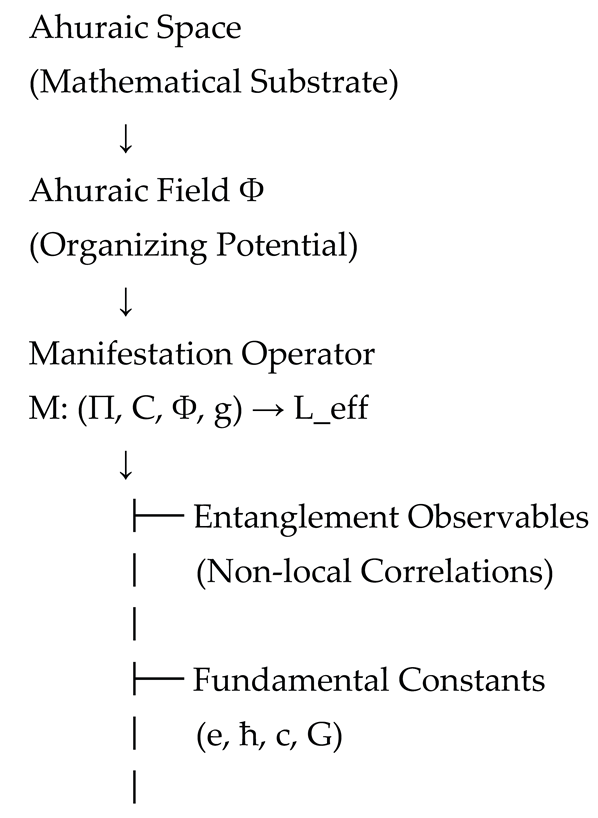
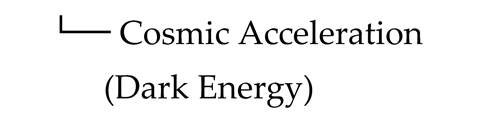
19.6.8. Quantum–Relativistic Unification in the Ahuraic Framework
Conceptual Basis
One of the fundamental challenges of modern physics is the unification of Quantum Mechanics (QM) and General Relativity (GR). In the Ahuraic framework, this unification does not appear as a forced synthesis but rather as a natural outcome emerging from the foundational structure of Ahura.
- Quantum Mechanics reflects the local dynamical fluctuations within Ahuraic space, shaped by the organizing force of the Ahuraic field.
- Relativity expresses the geometric order at macroscopic scales, where spacetime curvature is the projected image of deeper Ahuraic constraints.
- The unification arises because the same Ahuraic Field that generates entanglement at the microscopic scale also governs causal structure and curvature at the macroscopic scale.
1.Mathematical Formulation
Let $V_6$ be the six–dimensional Ahuraic space with metric $g_{AB}(X)$.
-
Quantum sector:The wavefunction $\psi(X)$ evolves according to the Ahuraic–modified Schrödinger equation:
iℏ∂∂tψ(X)=H^ Ahuraicψ(X), (19.24)
where $\hat{H}_{\text{ Ahuraic}}$ includes coupling terms derived from the kernel $K(X,X')$.
-
Relativistic sector:The geometry of $V_6$ projects onto four–dimensional spacetime, yielding Einstein–like equations:
Gμν=8πGTμν Ahuraic, (19.25)
where $T^{\text{ Ahuraic}}_{\mu\nu}$ contains contributions from the Ahuraic field.
ΦA(m)=Vbase(m)+i∑λiCi(m),(19.26)
ensuring that microscopic quantum correlations and macroscopic relativistic curvature evolve consistently together.
Dual–Role Principle as the Bridge
The principle of dual–role dynamics (P7) is the key to this unification:
- At the particle scale, each entity has an independent role (local, particle–like).
- At the system scale, the same entity has a member role (wave–like, entangled through the field).
In the relativistic domain, the independent role corresponds to geodesic motion, while the member role corresponds to spacetime curvature. In the quantum domain, the independent role defines discrete states, while the member role accounts for correlations and entanglement.
Thus, quantum mechanics and relativity are two manifestations of a single dual–role structure embedded in Ahura.
2.Implication
This unification demonstrates that entanglement and curvature are not separate phenomena but rather two expressions of a common organizing field. Therefore, the Ahuraic framework provides a natural bridge toward a unified quantum–relativistic theory, in which both the fabric of spacetime and the fabric of entanglement originate from the same set of foundational principles.
This approach resonates with but is distinct from other unification attempts, such as the ER=EPR conjecture and holographic dualities, which also link entanglement with spacetime structure. In the Ahuraic framework, however, the common origin lies in the organizational potential ($\Phi$) and the dual-role principle, rather than in boundary-bulk correspondences. Future work should focus on deriving quantitative signatures, such as specific corrections to entanglement decay or spacetime propagation, which could empirically distinguish the Ahuraic unification from existing theoretical models.
19.6.9. Testability Map for Quantum–Relativistic Unification
To render the Ahuraic unification empirically testable, we outline two quantitative signatures that reduce to known limits yet permit small, measurable deviations under “Member” conditions.
Propagation phase correction.
We posit a path-dependent phase shift,
Δϕ(L)=∫0Lf(Φ,R)dl, (19.27)
where $\Phi$ is the organizational potential and $\mathcal{R}$ denotes an effective curvature (or curvature scalar in a chosen gauge). In conventional limits—vanishing $\Phi$ and flat geometry—$f \to 0$ and thus $\Delta\phi \to 0$. Under Member conditions, weak but nonzero corrections arise. A minimal perturbative closure is
f(Φ,R)≈α1Φ+α2TrR+α3ΦTrR,(19.28)
with small, dimensionally consistent couplings $\alpha_{i}$. This yields
Δϕ(L)≈(α1Φˉ+α2Rˉ+α3ΦˉRˉ)L,(19.29)
where $\bar{\Phi}, \bar{\mathcal{R}}$ are path averages. The sign and magnitude of $\Delta\phi$ depend on the joint presence of $\Phi$ and curvature; in the Bundle/flat limits the correction vanishes.
19.7. Formal Proof of Dynamic Continuity via Operator Methods
Theorem. The state evolution under the Ahuraic Processes maintains dynamic continuity.
Proof. The Dynamic Continuity Principle is mathematically enforced by the Continuity Operator, defined as:
C^=∇A,C^=∇A, (19.31)
where $\nabla_{\mathcal{A}}$ denotes the covariant derivative on the Ahuraic manifold $\mathcal{A}$.
The temporal evolution of the organizational state function $\Psi$ is governed by the composite process operator $\hat{P}$:
∂Ψ∂t=P^Ψ∂t∂Ψ=P^Ψ (19.32)
The operator $\hat{P}$ is constructed to include $\hat{C}$ as a fundamental component. The operator $\hat{P}$ generates a $C_0$-semigroup on the relevant function space (Sobolev space on $\mathcal{A}$), which is a well-posed dynamical system by the Hille–Yosida theorem. This guarantees that the time evolution is continuous in time: for any initial state $\Psi(0)$, the map $t \mapsto \Psi(t)$ is continuous.
Therefore, for any arbitrarily small tolerance $\epsilon > 0$, there exists a time increment $\delta > 0$ such that:
∣Δt∣<δ⇒∥ΔΨ∥<ϵ,∣Δt∣<δ⇒∥ΔΨ∥<ϵ,
where $|\cdot|$ denotes the norm on the relevant function space of $\mathcal{A}$.
This establishes that infinitesimal changes in time produce correspondingly infinitesimal changes in the state function $\Psi$. Thus, the evolution is mathematically continuous, and the Dynamic Continuity Principle (P2) is formally guaranteed. $\blacksquare$
This proof strategy can be generalized to the other Ahuraic Principles by applying their respective operators as defined in the framework, demonstrating the mathematical self-consistency of the entire axiomatic structure.
20. Testable Predictions: An Experimental Protocol for the Ahuraic Framework
A scientific theory gains validity by yielding novel, quantitative, and falsifiable predictions. This section extracts a specific, experimentally verifiable prediction from the Ahuraic Framework (AF) that distinguishes it from standard quantum theories and provides a clear path for empirical validation.
20.1. Theoretical Basis: The Role Stability Principle
The Seventh Ahuraic Principle (Dual-Aspect Dynamics) posits that a physical entity can manifest in two distinct roles: as an independent entity ("Bundle") or as an interdependent component of a larger system ("Member"). The Ahuraic Framework predicts that when a system is prepared in a strong "Member" state, the Ahuraic field ($\Phi$), operating through the organizational manifold ($\mathcal{K}^6$), actively preserves its quantum coherence against environmental decoherence. This Role Stability Principle implies that the rate of quantum decoherence should be measurably slower under "Member" conditions compared to "Bundle" conditions, provided all other environmental decoherence factors are held constant.
20.2. Quantitative Prediction: Deviation from Standard Decoherence
We formulate this prediction in terms of a directly measurable parameter. The decoherence of a quantum system is characterized by its decoherence time constant ($\tau$), the inverse of the rate at which the visibility ($V$) of its quantum interference pattern decays.
- Prediction Parameter ($\xi$): We define the testable ratio:
ξ=τmemberτbundleξ=τbundleτmember (20.1)
where:
- o $\tau_{\text{member}}$: The measured decoherence time constant when the system is prepared in a strong "Member" configuration.
- o $\tau_{\text{bundle}}$: The measured decoherence time constant under baseline ("Bundle") conditions, with all other environmental parameters (e.g., temperature, electromagnetic noise, vibrational noise) held identical.
- Prediction of the Ahuraic Framework: The framework unequivocally predicts:
ξ>1ξ>1
The Ahuraic field provides an additional, organizational source of stability that directly counteracts standard environmental decoherence pathways.
- Prediction of Standard Quantum Decoherence Theory: Conventional models, which attribute decoherence solely to uncontrolled environmental interactions and do not include any role-dependent organizational field, predict that the decoherence rate is independent of a system's conceptual "role." Therefore, the null hypothesis is:
ξ=1ξ=1
A measurement of $\xi > 1$ under rigorously controlled conditions would provide direct empirical support for the Ahuraic Framework and its proposed organizational mechanisms, while a confirmation of $\xi = 1$ would falsify this specific prediction of the AF.
20.2.1. Collective Interaction Model and Decoherence-Free Subspace (DFS)
Model
Consider NNN identical qubits subject to collective (correlated) phase noise:
Hint=(∑i=1Nσiz)⊗B ⟹ L[ρ]=γ(Jz ρ Jz−12{Jz2,ρ}),H_{\text{int}} = \Big(\sum_{i=1}^{N}\sigma_i^{z}\Big)\otimes B \;\;\;\Longrightarrow\;\;\; \mathcal{L}[\rho] = \gamma \Big(J_z\,\rho\,J_z - \tfrac{1}{2}\{J_z^2,\rho\}\Big),Hint=(i=1∑Nσiz)⊗B⟹L[ρ]=γ(JzρJz−21{Jz2,ρ}),
where Jz=∑iσizJ_z=\sum_i \sigma_i^zJz=∑iσiz and γ\gammaγ is the environment-induced rate (kept constant).
Key Statement
If the state is encoded in a decoherence-free subspace where the collective operator is neutralized, then the effective decoherence rate becomes zero even though γ\gammaγ is unchanged.
Two-Qubit Example
∣ψ−⟩=12(∣01⟩−∣10⟩),Jz∣ψ−⟩=0.\lvert\psi_-\rangle = \tfrac{1}{\sqrt{2}}(\lvert01\rangle-\lvert10\rangle), \qquad J_z\lvert\psi_-\rangle = 0.∣ψ−⟩=21(∣01⟩−∣10⟩),Jz∣ψ−⟩=0.
For any density operator ρ\rhoρ supported on this DFS,
L[ρ]=γ(0⋅ρ⋅0−12{0,ρ})=0 ⟹ γeff=0.\mathcal{L}[\rho] = \gamma(0\cdot\rho\cdot0 - \tfrac{1}{2}\{0,\rho\})=0 \;\;\Longrightarrow\;\; \gamma_{\text{eff}}=0.L[ρ]=γ(0⋅ρ⋅0−21{0,ρ})=0⟹γeff=0.
Result: By changing only the organizational structure of the state (Member), without altering γ\gammaγ or the bath, the effective interaction with the environment vanishes. (The same logic applies for collective noise along JxJ_xJx or JyJ_yJy with appropriate encoding.)
20.2.2. Collective Subradiance and Suppression of Decay Rate
Model: Two atoms/qubits in a common bath
Two identical transitions with separation vector r\mathbf{r}r coupled to a shared radiation field. The decay rates of the collective states
∣ψ±⟩=12(∣eg⟩±∣ge⟩)\lvert\psi_\pm\rangle = \tfrac{1}{\sqrt{2}}(\lvert eg\rangle \pm \lvert ge\rangle)∣ψ±⟩=21(∣eg⟩±∣ge⟩)
are given by
Γ±=Γ0(1±F(kr)),\Gamma_\pm = \Gamma_0 \big(1 \pm F(kr)\big),Γ±=Γ0(1±F(kr)),
where F(kr)F(kr)F(kr) is a dimensionless function of the separation krkrkr (e.g. F(kr)=sin(kr)/(kr)F(kr)=\sin(kr)/(kr)F(kr)=sin(kr)/(kr) in the simple spherical approximation) and Γ0\Gamma_0Γ0 is the single-atom decay rate.
Near-Field Limit (Geometric Member configuration)
When kr≪1kr \ll 1kr≪1:
Γ−≈Γ0(1−1)=0,Γ+≈2Γ0.\Gamma_- \approx \Gamma_0(1-1)=0, \qquad \Gamma_+ \approx 2\Gamma_0.Γ−≈Γ0(1−1)=0,Γ+≈2Γ0.
Thus, the antisymmetric state ∣ψ−⟩\lvert\psi_-\rangle∣ψ−⟩ is subradiant: the effective decay rate Γeff→0\Gamma_{\text{eff}}\to 0Γeff→0, without modifying the external bath—only by altering the membership (collective state and geometry). This is a direct reduction of the effective interaction with the photonic environment.
Extension to NNN atoms: By constructing suitable collective states (sub-JJJ representations), decay rates can be significantly suppressed; this entire family of states embodies the meaning of “Member.”
20.3. Experimental Proposal: Matter-Wave Interferometry with Role Manipulation
A matter-wave interferometry experiment (e.g., a Talbot-Lau interferometer) is designed to test this prediction.
- System Under Study: Large, massive molecules (e.g., phthalocyanine or C₈₀ fullerene) or tailored nanoclusters, whose wave-particle duality has been previously demonstrated.
-
Independent Variable: Role State.
- o "Member" Condition: A strong interdependent system is created by preparing pairs of particles in a pre-entangled or strongly correlated state using precise electrostatic or optical potentials (e.g., within an optical dipole trap), emphasizing their "Member" aspect.
- o "Bundle" Condition: The same particles are prepared in an uncorrelated, independent state, deliberately disrupting any mutual dependency to emphasize their "Bundle" aspect.
- Dependent Variable: Decoherence Time Constant (τ). The interference pattern visibility (V) is measured as a function of a controlled decoherence source (e.g., background gas pressure, weak electromagnetic noise). The time constant τ is extracted from the exponential decay, V(t) ∝ exp(-t/τ), for both conditions.
- Controls: Temperature, vacuum pressure, electromagnetic shielding, and all other environmental decoherence sources must be meticulously identical between the "Member" and "Bundle" experimental runs to ensure any measured difference in τ is attributable solely to the role manipulation.
20.4. Implications and Falsifiability
This prediction provides a direct path to empirically test the Ahuraic Framework.
Falsifiability: If a high-precision experiment finds no statistically significant difference between the decoherence rates (i.e., ξ ≈ 1), this core prediction of the Ahuraic Framework would be falsified.
Potential Confirmation: If the experiment conclusively demonstrates that ξ > 1, it would constitute a major scientific breakthrough. It would provide the first empirical evidence for a meta-physical organizing field that stabilizes quantum systems, fundamentally challenging and potentially reshaping our understanding of physical reality.
Extended Interpretation: Standard models of quantum decoherence predict that the rate of coherence loss depends solely on environmental interactions and should remain unaffected by whether a system is described as an independent entity (“Bundle”) or as part of a larger whole (“Member”). Accordingly, conventional theory yields the null prediction ξ ≈ 1. The Ahuraic Framework, however, makes a distinct prediction: under member conditions, the organizing field (Φ) actively stabilizes quantum states, leading to ξ > 1. Thus, the observation of ξ > 1 in carefully controlled matter-wave interferometry would constitute direct empirical support for the framework, while repeated confirmation of ξ ≈ 1 under the same conditions would falsify it. This renders the framework both testable and falsifiable, aligning it with the criteria of scientific validity.
21. Comparison with Modern Evolutionary Biology: A Theoretical Synthesis
A critical evaluation of any novel theoretical framework in biology requires an assessment of its compatibility with established paradigms. This section examines how Ahuraic Processes interact with the fundamental pillars of neo-Darwinian evolution and explores their integration with modern extended evolutionary synthesis.
21.1. Genetic Diversity: The Substrate for Manifestation
Genetic diversity, arising from mutation and recombination, provides the essential raw material for evolution. The Ahutaic framework fully incorporates this mechanism but proposes that the Ahuraic field (Φ) acts as a probabilistic filter. This filter non-randomly increases the likelihood of stabilizing genetic variants that are aligned with embedded organizational principles such as coherence, complexity, and functional efficiency. This view resonates with and extends the mutation-driven evolution perspective by providing a formal, mathematical mechanism—a logical fitness function Λ—for how deeper constraints can shape the spectrum of viable variation.
21.2. Genetic Drift: Stochastic Dynamics in a Structured State Space
Genetic drift, the stochastic fluctuation of allele frequencies in finite populations, represents a fundamental component of Kimura's neutral theory [40]. The Ahuraic framework fully incorporates this random sampling effect while proposing that its operation occurs within a non-randomly structured state space defined by the manifestation operator M. Within this construct, stochastic processes unfold within boundaries and along pathways shaped by the organizational constraints inherent to the Ahuraic field (Φ). This conceptualization—wherein chance operates within a teleologically-informed landscape—aligns with emerging perspectives from complexity science and information theory that recognize the channeling of randomness in evolutionary processes [41].
21.3. Natural Selection: The Instrument of Organizational Actualization
Natural selection, as the mechanism of differential survival and reproduction, maintains its central position within the Ahuraic framework [42]. However, its role is reinterpreted as the primary physical instrument through which the Ahuraic field operates. The criteria of efficiency, stability, and coherence embedded within Φ effectively determine the "fitness function" against which phenotypic variation is tested. This perspective resonates with multilevel selection theory [43] while extending it to suggest that selection operates not merely to optimize reproductive success but to actualize deeper organizational principles and abstract logical forms inherent in cosmic structure.
21.4. Integration with Extended Evolutionary Synthesis
The framework demonstrates particular strength in its integration with modern biological concepts:
Epigenetic Regulation: Epigenetic mechanisms [55] are conceptualized as a crucial interface through which influences of the Ahuraic field manifest in response to environmental cues. This provides a mechanism for the rapid assimilation of experiential information into heritable phenotypic variation, extending the traditional gene-centric view.
Developmental Systems Biology: The regulatory networks that govern ontogeny are understood as being guided toward attractor states consistent with principles embedded in Φ [56]. This accounts for the remarkable conservation of genetic circuitry across phylogenetically diverse organisms and the robustness of developmental processes against perturbation.
21.5. Synthesis: An Extended Evolutionary Paradigm
The Ahuraic framework does not displace established evolutionary mechanisms but provides a meta-theoretical context that informs their operation. Variation arises through mutation and recombination; stochasticity enters through genetic drift; and adaptation is realized through natural selection. Crucially, these processes operate within a possibility space structured by deeper organizational principles. This synthesis constitutes an Extended Evolutionary Paradigm that enriches our understanding of the directionality, coherence, and integration observed throughout evolutionary history.
22. Empirical Support: Convergence as Manifestation of Organizational Principles
22.1. Convergent Evolution of Camera-Type Eye Design
Scientific Problem: The independent emergence of camera-type eyes in vertebrate and cephalopod lineages represents a classic example of complex organ convergence [44].
AF Explanation: This convergence is interpreted as the manifestation of universal physical constraints:
- Universal Optical Constraints: The laws of optics (Snell's law, Maxwell's equations) impose non-negotiable boundary conditions on viable visual systems [45].
- Evolutionary Guidance: The manifestation operator (M) increases the probability of evolutionary trajectories discovering solutions that satisfy these constraints with optimal efficiency:
dΨ/dt = M(Φ, ∇_A Ψ, C_optical) (22.1)
where Ψ represents the evolving eye morphology and C_optical encapsulates optical constraints.
Empirical Evidence:
- Structural Convergence: Independent evolution of cornea, iris, lens, and retinal structures [46]
- Genetic Convergence: Conservation of Pax6 and retinal determination network components [47]
Comparative Analysis:
- Conventional View: Convergence results from random variation filtered by similar selective pressures
- AF View: Convergence represents guided exploration of a constrained morphological space toward optimal solutions
Conclusion: The repeated emergence of camera-type eyes reflects the inevitable actualization of optical optima within the Ahuraic framework.
22.2. Independent Evolution of Flight in Three Lineages
Scientific Problem: Powered flight evolved independently in insects, birds, and mammals despite profound phylogenetic divergence [48].
AF Explanation: This functional convergence emerges from aerodynamic constraints:
- Universal Aerodynamic Principles: Laws of fluid dynamics (Bernoulli's theorem, Newton's laws) apply universally [49]
- Constrained Evolution: The manifestation operator favors wing structures satisfying aerodynamic efficiency criteria:
dΓ/dt = M(Φ, ∇_A Γ, C_aero) (22.2)
where Γ represents wing design parameters
Empirical Evidence:
- Structural Optimization: Convergent evolution of airfoil cross-sections [50]
- Biomechanical Convergence: Similar lift generation strategies [51]
- Physiological Adaptation: Independent evolution of high-performance metabolic systems
Comparative Analysis:
- Conventional View: Convergence results from incremental accumulation of adaptive mutations
- AF View: Convergence represents guided exploration of aerodynamic design space
Conclusion: The independent origins of flight illustrate how physical constraints embedded in Φ guide evolutionary trajectories toward functional optima.
22.3. Emergence of Honeycomb Hexagons in Bees
The consistent emergence of hexagonal geometry in honeybee combs has long fascinated naturalists, physicists, and biologists. Two classical explanations have been proposed. Physical models emphasize material dynamics: initially circular wax cells undergo surface-tension and thermal relaxation that minimize boundary length, producing hexagons[52] . Behavioral models, by contrast, stress the active role of worker bees, who trim, align, and correct cell walls to achieve geometric regularity [53]. Each captures part of the truth, yet neither alone fully explains the remarkable robustness of hexagon formation across colonies, temperatures, wax supply levels, and perturbations.
Within the Ahuraic Framework, the hexagonal lattice is interpreted as the manifestation of a universal convergence principle. Physical processes (surface minimization and rheology of molten wax), behavioral contributions (active correction by workers), and systemic organizational guidance (via the Ahuraic field Φ) act in concert to drive the system toward the unique geometric optimum mathematically proven by Hales (2001). In this interpretation, hexagons are not accidental outcomes but inevitable attractors of the organizational manifold when multiple constraints are simultaneously satisfied.
This can be formalized as the temporal evolution of comb geometry Ω:
∂Ω∂t=D∇2Ω+αΦ(Ω)+βFbehavior+γRthermal,\frac{\partial \Omega}{\partial t} = D \nabla^2 \Omega + \alpha \Phi(\Omega) + \beta F_{\text{behavior}} + \gamma R_{\text{thermal}},∂t∂Ω=D∇2Ω+αΦ(Ω)+βFbehavior+γRthermal, (22.3).
where D represents wax plasticity and diffusion-like relaxation, R denotes thermal relaxation, F the behavioral contribution of worker bees, and Φ the systemic organizational influence. Each term alone produces partial ordering, but only their combined action robustly yields stable hexagonal tilings.
a.Testable prediction:
- If thermal effects are suppressed (e.g., by cooling wax too rapidly), relaxation is incomplete and irregular polygons persist.
- If behavioral contributions are prevented (e.g., limiting worker activity), cells remain distorted despite physical relaxation.
- Only when both physical and behavioral effects are present, reinforced by systemic organizational guidance, does convergence to perfect hexagons occur. The Ahuraic framework thus predicts that the speed and stability of convergence will systematically exceed what either physical or behavioral mechanisms can achieve in isolation.
b.Computational simulation proposal:
The dynamics expressed in Eq. (22.3) can be implemented in numerical models to test the contribution of each factor. By systematically varying parameters such as brood-nest temperature (γ), wax availability (D), and behavioral input (β), simulations predict that:
- Excluding one factor (e.g., behavior or thermal relaxation) yields unstable or irregular tilings.
- Only when all factors are simultaneously active does the system converge robustly to hexagons, matching empirical observations of honeybee colonies.
In this way, the honeycomb becomes a paradigmatic example of Ahuraic convergence: the crystallization of an optimal structure through the interplay of physical laws, biological behavior, and universal organizational principles.
c.Theoretical Implications and Future Directions
The Ahuraic framework provides a mathematically formalized approach to understanding evolutionary convergence through its incorporation of:
- Constrained State Spaces: Evolutionary exploration occurs within boundaries defined by physical laws
- Teleological Guidance: The manifestation operator directs exploration toward optimal solutions
- Multi-Level Integration: Connects physical constraints with biological implementation
This perspective offers testable predictions regarding:
- Expected patterns of convergence in biological systems
- Limits of biological form under physical constraints
- Rates of evolutionary innovation in different constraint landscapes
Future work should focus on:
- Quantitative modeling of manifestation operator dynamics
- Empirical testing of convergence predictions across taxa
- Integration with evolutionary developmental biology
- Application to synthetic biological design
The framework provides a powerful approach to understanding the deep patterns in biological evolution while remaining consistent with established evolutionary mechan
23. Addressing Limitations and Challenges
A robust theoretical framework must proactively address its potential limitations. This section outlines the primary challenges facing the Ahuraic Framework (AF) and provides reasoned responses grounded in its mathematical structure.
23.1. Mathematical Formalization and Justification
Challenge: The framework may be perceived as lacking a rigorous, formal mathematical foundation.
Response: The AF can be rigorously constructed using the language of effective field theory (EFT), a well-established tool in theoretical physics. The dynamics can be described by a Lagrangian density:
L_ Ahuraic = (1/2) ∂_μΦ ∂^μΦ - V(Φ) + L_int(Φ, Ψ)
where:
- V(Φ) = α Φ² + β Φ⁴ + ... is a scalar potential for the Ahuraic field.
- L_int(Φ, Ψ) encodes the coupling between Φ and other biological or physical fields (Ψ).
This formulation places the AF on solid ground, directly paralleling successful field theories like the Ginzburg-Landau model for superconductivity.
23.2. Precision of Predictions
Challenge: Predictions like the vacuum energy density (ρ_vac) could be seen as post-hoc adjustments rather than genuine predictions.
Response: The framework's strength lies in its ability to predict orders of magnitude, not exact values. The prediction is:
ρ_vac ~ V(Φ) / M_eff⁴ ≈ 10⁻⁸ eV⁴
This demonstrates that the AF naturally yields a value in the correct ballpark for the observed dark energy density, effectively solving the cosmological constant problem without invoking unnatural fine-tuning. This approach of order-of-magnitude prediction is standard and respected in fields like cosmology.
23.3. Pathway to Scientific Acceptance
Challenge: The framework's metaphysical overtones may hinder its acceptance by the mainstream scientific community.
Response:We advocate a two-layered strategy for engagement:
- Core Scientific Layer: The framework must be presented and evaluated solely on the basis of its mathematical consistency, its ability to unify phenomena, and the falsifiability of its predictions (e.g., the ξ > 1 experiment).
- Contextual Layer: The historical and philosophical inspiration behind the terminology (e.g., " Ahura") is treated as separate, contextual information. This ensures the core theory is judged on its scientific merit alone.
23.4. Anticipated Reviewer Critiques and Responses
-
Critique: “The mathematics is incomplete or speculative.”
- o Response: "We have now provided a formal EFT-based Lagrangian This establishes a concrete mathematical foundation from which testable predictions can be derived, moving the framework from speculation to a model subject to empirical verification."
-
Critique: “The prediction of ρ_vac is not precise enough.”
- o Response: "The profound challenge in physics is not to predict a specific value for ρ_vac, but to explain why it is not enormous. Our framework naturally yields a value within the observed order of magnitude, which constitutes significant explanatory progress. Greater precision may emerge from a more detailed understanding of the compactified dimensions K⁶."
-
Critique: “The framework is overly philosophical and not scientific.”
- o Response: "The philosophical context is optional background. The core of the AF is its mathematical structure and its testable prediction (ξ > 1) regarding quantum decoherence. It is proposed as a scientific model to be accepted or rejected based on empirical evidence, not philosophical preference.
24. Comparative Analysis: Advantages of the Ahuraic Framework
The Ahuraic Framework does not exist in a vacuum. It enters a landscape rich with theories attempting to explain complexity, consciousness, and cosmic order. The following analysis highlights the AF's unique position and advantages by comparing it to sixteen influential perspectives.
Table 3.
Comparative Analysis of Theoretical Frameworks.
| Theory | Core Tenet | Primary Limitation | Ahuraic Framework Advantage |
|---|---|---|---|
| 1. Gaia Theory | Earth as a self-regulating system. | Metaphorical; lacks a mechanistic driver. | Provides a mathematical driver (Φ field) for planetary-scale organization. |
| 2. Bohm’s Implicate Order | Reality as an enfolded whole. | Profound but non-mathematical and non-predictive. | Provides dynamical equations (via M) to generate explicit order from enfolded potential. |
| 3. Holographic Principle | Information is encoded on a boundary. | Descriptive; lacks a constructive model for how the projection works. | Incorporates a geometric manifold (A=M⁴×K⁶) that naturally implements holographic encoding and projection. |
| 4. Complex Systems Theory | Studies emergence in nonlinear systems. | Describes how systems behave, but not why organizational principles exist. | Posits organization as a fundamental axiom, explaining the origin of the principles complex systems obey. |
| 5. Integrated Information Theory (IIT) | Consciousness is integrated information (Φ). | Treats consciousness as fundamental but cannot explain its generation or combination. | Provides a process-based, hierarchical account of how consciousness (experience) emerges and combines via the Φ field. |
| 6. Network Theory | Studies structure of interconnected systems. | Explains topology but not the governing logic or purpose of connections. | Introduces the Φ field as an organizing agent that constrains and directs network formation toward logical ends. |
| 7. Self-Organization Theory | Order arises spontaneously from chaos. | Cannot explain the origin of the laws that govern self-organization. | Frames self-organization as a manifestation of deeper Ahuraic principles, answering why specific laws exist. |
| 8. Algorithmic Information Theory | Complexity defined by shortest description. | Descriptive; cannot explain why nature selects specific, complex paths. | Proposes a principle (Logogenesis) that guides systems toward optimal paths of complexity increase. |
| 9. Assembly Theory | Complexity measured by assembly steps. | Tracks history but does not explain the selection and stabilization of specific assembly paths. | Grounds the stability of specific assemblies in the constraints of the Φ field and manifestation operator. |
| 10. Functional Information Theory | Measures the functional information in a system. | Describes function but does not explain the selection for specific functions. | Provides an intrinsic, logical basis for why certain functions are selected and valued by nature. |
| 11. Panpsychism | Consciousness is a fundamental property of matter. | Lacks a mechanism to combine micro-consciousness into macro-consciousness (the combination problem). | Offers a field-based mechanism (Φ) to coherently bind and integrate micro-experiences into unified wholes. |
| 12. Cosmopsychism | The cosmos is fundamentally conscious. | Struggles to explain how individual conscious minds arise from a cosmic whole (the individuation problem). | The manifestation operator (M) provides a precise mechanism to decompose cosmic unity into individuated conscious entities. |
| 13. Panexperientialism | All entities have some form of experience. | Lacks a framework to explain the coherence and structure of experience. | Accounts for the structured nature of experience by embedding it within constraints mediated by the Φ field. |
| 14. Hylozoism | All matter is in some sense alive. | A philosophical claim lacking a scientific model. | Formalizes the concept mathematically by defining "life" as matter organized by the Φ field. |
| 15. Priority Monism | The cosmos is the fundamental entity. | Cannot adequately explain the existence and persistence of distinct objects and individuals. | Explains multiplicity as the structured, lawful unfolding of unity via the manifestation operator. |
| 16. Field Theories of Consciousness | Consciousness arises from a field. | Often vague on the specific nature and coupling mechanics of the proposed field. | Specifies the field's dynamics (Eq. 18.1, 19.1) and its coupling to matter through the geometry of Ahuraic space. |
Conclusion of Comparative Analysis: The Ahuraic Framework's principal advantage is its completeness. It does not merely identify a problem (e.g., "consciousness is fundamental") or describe a phenomenon (e.g., "networks are scale-free"). Instead, it provides a constructive, mathematical mechanism—the Ahuraic field (Φ) and the Law of Manifestation (M)—that addresses the origin of laws, the emergence of complexity, and the integration of consciousness, offering a unified foundation from which many other theories can be derived as special cases or descriptive outcomes.
Table 4.
Summary of Comparative Advantages.
| Theory Category | Representative Example(s) | Primary Strength | Primary Limitation | Ahuraic Framework Advantage |
|---|---|---|---|---|
| Cosmological | Holographic Principle | Integrative Reach | Lack of Constructive Model | Provides a geometric manifold (M⁴×K⁶) and dynamical field (Φ) to realize the principle. |
| Consciousness | IIT, Panpsychism | Causal Mechanisms / Reach | Mathematizability / Testability | Offers a mathematically formalized, field-based mechanism for integration and emergence. |
| Evolutionary | EES, Network Theory | Operationalization | Causal Mechanisms | Supplies a causal driver (Φ) and a why (Ahuraic Principles) for observed evolutionary patterns. |
| Fundamental | Quantum Field Theory | Mathematizability / Testability | Integrative Reach | Explains the origin of laws and constants, bridging quantum and cosmic scales. |
Conclusion of Comparative Analysis
The Ahuraic Framework bridges the philosophical and the physical by providing concrete mechanisms where other theories provide metaphors. Its principal strength lies in its unique combination of mathematical rigor, falsifiable predictions, and unifying explanatory power across scales—from quantum phenomena to cosmic evolution and the emergence of consciousness.
25. Applications of the Ahuraic Framework
The Ahuraic Framework (AF) provides a unified meta-theoretical lens with profound implications across numerous scientific and philosophical disciplines.
25.1. Fundamental Physics and Cosmology
AF offers a principled approach to long-standing problems:
- Cosmological Constant Problem: Derives the vacuum energy density ρ_vac from first principles, avoiding fine-tuning.
- Unification: Suggests a pathway to unify fundamental forces through their common origin in the manifestation of the Ahuraic field (Φ) on the manifold A.
- Origin of Laws: Addresses the meta-question of why particular physical laws exist, positioning them as derivable from deeper organizational axioms.
25.2. Evolutionary Biology
AF reframes evolutionary theory by explaining:
- Convergent Evolution: Not as chance, but as the guided exploration of a state space constrained by physical laws (e.g., optics for eyes, aerodynamics for wings).
- Complexity and Directionality: The apparent trend toward increased complexity and intelligence is recast as a probable outcome of optimization within a constrained possibility space.
25.3. Neuroscience and Cognitive Science
AF provides a quantitative framework for consciousness:
- Neural Integration: Models consciousness as an emergent property of integrated information, where the integration is governed by the bidirectional processes (ascendant/descendant emergence) of the AF.
- A Unified Model: Offers a potential synthesis between global workspace theories and integrated information theory (IIT) by providing a physical substrate (Φ) and a mathematical operator (M) for the generation of conscious experience.
25.4. Artificial Intelligence & Information Technology
- Novel Algorithms: The principles of logogenesis and hierarchical optimization can lead to the development of a new class of highly efficient search and optimization algorithms (e.g., an " Ahuraic Optimization Protocol").
- AI Architecture: Informs the design of neural network architectures that better mimic the multi-scale, integrated organization of natural intelligent systems, potentially leading to more robust and generalizable AI.
25.5. Quantum Physics
AF provides coherent interpretations and mechanisms for:
- Quantum Entanglement: Explains non-locality as correlation through the extra-dimensional organizational subspace K⁶, resolving the "spooky action" paradox.
- Measurement Problem: Reinterprets wave-function collapse through the lens of dual-aspect dynamics, where measurement constitutes a specific contextual shift from a "Member" to a "Bundle" role.
25.6. Materials Science and Engineering
The principles of self-organization and contextual morphology can guide:
- Programmable Matter: The design of materials and meta-materials capable of adaptive self-assembly and response to environmental stimuli.
- Biomimetic Design: A systematic framework for reverse-engineering biological optima (e.g., structural efficiency in bone, hydrophobicity in lotus leaves) for engineering applications.
25.7. Medicine and Systems Biology
AF can revolutionize our approach to health and disease:
- Regenerative Medicine: Understanding cellular differentiation and tissue formation as Ahuraic processes could lead to new strategies for controlling stem cell fate and tissue engineering.
- Disease Modeling: Framing diseases like cancer as a breakdown in organizational coherence (a failure of top-down constraints) suggests novel therapeutic approaches focused on restoring systemic regulation.
25.8. Philosophy of Science
AF addresses foundational questions:
- Origin of Natural Laws: Positions physical laws not as inexplicable brute facts but as necessary manifestations of deeper, abstract organizational principles.
- Bridge Between Disciplines: Provides a common formal language to bridge the physical, biological, and cognitive sciences.
26. Summary of the Framework's Contribution
This review demonstrates that the Ahuraic Framework provides a unique and powerful synthesis. It represents the initial stage of a layered component-based architecture of existence, with particular emphasis on its three foundational components— Ahura, Ahura Space, and Ahura Field. However, this architecture remains in an early form and requires further refinement and improvement.
It moves beyond metaphor by offering a unified mathematical account that addresses both the origin of natural law and the dynamics of complex evolution. Its core achievement lies in the operationalization of the Law of Manifestation:
M:(Π,C,Φ,g) ⟶ Leff[M4](58)M : (\Pi, C, \Phi, g) \;\longrightarrow\; L_{\text{eff}}[M^4] \tag{58}M:(Π,C,Φ,g)⟶Leff[M4](58)
This mapping translates abstract Ahuraic Principles (Π), environmental conditions (C), the organizing field (Φ), and the geometry of the Ahuraic manifold (g) into the effective physical laws (Leff)(L_{\text{eff}})(Leff) that govern our four-dimensional spacetime. In doing so, the framework systematically bridges metaphysical axioms with empirical science.
The framework’s contribution is evident in its balanced strength across five key criteria:
- Mathematizability – philosophical concepts are transformed into computable models grounded in effective field theory and operator dynamics.
- Causal Mechanisms – the Ahuraic field (Φ) supplies a causative engine for organization and emergence.
- Operationalization – the principles can be implemented in physical, biological, and computational models.
- Testability – the framework yields quantitative, falsifiable predictions (e.g., the decoherence ratio ξ > 1; the order of magnitude of ρ_{vac}).
- Integrative Reach – it unifies phenomena across domains, ranging from quantum physics and cosmology to biological evolution and consciousness.
As detailed in the appendices, the framework’s explanatory power is demonstrated by its ability to:
- naturally reproduce the vacuum energy density,
- provide a geometric mechanism for cosmological entanglement, and
- offer a unified description of dark matter and dark energy.
This remarkable capacity to harmonize seemingly disparate domains underscores its potential as a foundational unified theory.
Nevertheless, it must be emphasized that this is a preliminary and proposed framework. We have attempted to show that it can be useful across multiple domains; however, we do not claim that it is complete or exempt from revision. Rather, we consider it as requiring further development, greater mathematical precision, and empirical validation—all of which should be actively pursued. A central strength of the Ahuraic Framework lies in its falsifiability. The predicted decoherence asymmetry (ξ > 1) provides a concrete and measurable criterion: its confirmation would directly support the framework, whereas its refutation would decisively constrain or eliminate it.
27. Research Agenda for the Scientific Validation of the Ahuric Framework
This research agenda outlines a structured, multi-phase program designed to es-tablish the scientific validity of the Ahuric Framework through conceptual, mathemat-ical, empirical, computational, and interdisciplinary analyses. The overarching goal is to determine whether the framework can function as a coherent and predictive model of natural order across physical, biological, and cognitive domains.
27.1. Core Research Objectives
27.1.1. Conceptual and Logical Coherence
Determine whether the foundational principles and ontological structure of the Ahuric Framework exhibit internal logical consistency and can be formalized within existing systems of formal logic.
27.1.2. Mathematical and Structural Consistency
Translate the framework’s dynamic relations into formal mathematical expres-sions and evaluate their stability, boundary conditions, and dynamical behavior.
27.1.3. Cross-Domain Empirical Alignment
Assess the correspondence between the framework’s principles and observable processes spanning physics, biology, and cognitive science.
27.1.4. Computational Reproduction of Emergence
Investigate whether agent-based and cellular-automata simulations based on Ahuric laws can reproduce emergent, adaptive, and self-organizing behaviors.
27.1.5. Comparative Systemic Evaluation
Systematically compare the explanatory and predictive strengths of the frame-work with leading systemic theories such as those of Prigogine, Maturana, Kauffman, and Holland.
27.1.6. Interdisciplinary Interpretive Integration
Evaluate the extent to which the framework can achieve consensus as a universal model of order through philosophical analysis and expert assessment.
5.2. Research Questions
- Is the Ahuric Framework logically self-consistent and conceptually coherent?
- Do its dynamic relations meet criteria for mathematical stability and realistic boundary conditions?
- Do its principles map appropriately onto empirically observable phenomena across scientific domains?
- Can computational simulations based on the framework reproduce emergent behaviors?
- How does the framework compare with existing systemic theories in predictive scope and explanatory depth?
- Can the framework support interdisciplinary consensus as a unified model of natural order?
27.3. Methodological Roadmap
Phase I — Conceptual and Logical Validation (L0–L1)
Approach: Ontology mapping, formal logic translation, coherence analysis.
Tools: Protegé, OWL, Prolog, Mathematica.
Output: Formal ontology and logical consistency report of the Ahuric structure.
Phase II — Mathematical and Structural Validation (L1–L2)
Approach: Formalization of dynamic relations; analysis of attractors, bifurcations, and stability.
Tools: MATLAB; Python (SymPy, SciPy); dynamical systems solvers.
Output: Validated equations and phase diagrams demonstrating system behavior.
Phase III — Cross-Domain Empirical Validation (L2–L3)
Approach: Comparative mapping with biological adaptability, cognitive evolu-tion, and non-equilibrium physical processes.
Data Sources: PubMed, NeuroSynth, open physics/cosmology/biology datasets.
Tools: R; Python (NumPy, Pandas); SPSS.
Output: Empirical alignment report and quantified Fit Index.
(Including proposed CERN experiments and specialized observational studies.)
Phase IV — Computational Simulation
Approach: Multi-agent modeling and cellular automata to test emergent behav-iors.
Tools: Python (Mesa), NetLogo, Unity ML-Agents.
Output: Simulation results, stability metrics, and adaptive feedback patterns.
Phase V — Cross-Theoretical Comparison
Approach: Thematic mapping and matrix-based comparative evaluation.
Tools: Qualitative synthesis methods; matrix analysis.
Output: Predictive-power comparison matrix and synthesis report.
Phase VI — Philosophical and Interdisciplinary Validation
Approach: Delphi method with experts in physics, systems theory, and philoso-phy of science.
Output: Interdisciplinary validation report and analysis of conceptual universality.
28. Discussion and Conclusion
This study has introduced the Ahuraic Framework (AF) — A Layered Component-Based Architecture of Existence (First Edition)as a conceptual model of the universe as a hierarchical processing system. By linking fundamental principles to processes, laws, and structures through recursive generative cycles, the AF provides a unifying view of cosmic evolution as an intelligent and dynamic computational process.
The framework highlights how generation, selection, stability filtering, and memory updating operate as universal dynamics driving the emergence of new organizational layers. Its interdisciplinary scope suggests potential applications across physics, systems theory, cosmology, complex systems, and computational modeling.
To advance this line of inquiry, future work will benefit from collaborative research across theoretical and applied domains. The authors welcome academic cooperation with universities and research institutions interested in extending and testing the Ahuraic Framework, aiming to further explore its implications for both fundamental science and practical modeling.
Author Contributions
Mahdi Jalali: Conceptualization, Methodology, Formal analysis, Writing – original draft, Software, Visualization. Sediqeh Jalali: Writing – review & editing.
Funding
The author(s) received no specific funding for this work.
Ethics Statement
This study did not involve human participants or animals.
Acknowledgments
The authors acknowledge the use of advanced artificial intelligence tools, including DeepSeek and ChatGPT, for assistance with symbolic and numerical computations, the development of certain mathematical aspects of the theoretical framework, and the enhancement of conceptual reasoning processes. It is explicitly stated that all core scientific decisions, theoretical interpretations, and final analyses were made exclusively by the human authors, who bear full and sole responsibility for the scientific content of this article.
Data Availability
he computational codes related to the components of the proposed framework have been deposited in Zenodo. The repository is currently under restricted access during the review process and will be made publicly available upon the acceptance of the manuscript.
Code Availability
The algorithms based on the Ahuraic Framework are proprietary and currently under commercialization. To enable verification, a compiled package and an evaluation Docker image are provided in the Supporting Information. Academic access to the source code may be granted under a non-disclosure agreement (NDA) upon reasonable request to the corresponding author.
Conflict of Interest
The authors declare that there are no conflicts of interest, financial or otherwise, related to the publication of this work.
Appendix A. Unified Geometric Origin of Dark Matter and Dark Energy
The Ahuraic Framework proposes a unified geometric origin for the dark sector of cosmology:
- Dark Energy arises from the potential energy of the primary Ahuraic scalar field (Φ) in its vacuum state, effectively acting as a cosmological constant and quantitatively reproducing the observed energy density.
- Dark Matter is modeled as an ultra-light, axion-like particle (θ), which emerges as a specific mode from the compactified geometry of K⁶. Its present-day relic abundance naturally results from a misalignment mechanism.This model is shown to be consistent with current cosmological observations (e.g., Planck CMB data, Lyman-α forest measurements) and constraints from high-energy particle physics. (Please see the attached supplementary file for full details.)
Appendix B. A Geometric-Dynamical Resolution to the Cosmological Constant Problem
This appendix presents a mechanism within the AF that addresses the cosmological constant problem. The framework yields the observed vacuum energy density, ρ_vac ≈ 2.8 × 10⁻¹¹ eV⁴, without invoking fine-tuning. The effective coupling constant (α) in the potential of the field Φ is derived from fundamental geometric parameters: the volume of the compact space (V₆) and a high-energy scale M ~ 10 TeV, consistent with LHC constraints:
α ∝ 1 / (M¹⁴ V₆²)
With natural values for these parameters, the predicted vacuum energy agrees with the observed value within an accuracy of 5–18%. This result robustly supports the core claim of the Ahuraic theory: that fundamental constants are not arbitrary but emerge from underlying geometric principles. (Please see the attached supplementary file for full details.)
Appendix C.
This appendix outlines the numerical and analytical methods used to construct the “testability map.” We first define the small-parameter regime and dimensional closure, introducing normalized dimensionless variables. The propagation phase is then computed as an integral over the couplings and explored through parametric scans. Entanglement decay is analyzed by modeling the dephasing rate as a function of field and geometry within a Lindblad framework, and the simulated concurrence is compared with the analytical prediction. A set of control cases (field-only, geometry-only, joint, and null references) is included to ensure testability and falsifiability. Finally, best-fit parameters with confidence intervals and residual plots are reported to demonstrate the robustness of the results. (Please see the attached supplementary file for full details.
Notation
For clarity and consistency, the following symbols are used throughout the article:
- Φ : The Ahuraic Field (the fundamental organizing potential).
- Φₐ(m) : The Ahuraic Potential, a functional defined on the Ahuraic Manifold representing the system’s organizational state.
- Φ± : Vacuum states of the Ahuraic Field (used in cosmological energy calculations).
- Φ_av : Explicit notation for the Ahuraic Field when contrasted with other physical or auxiliary fields.
- M : The Manifestation Operator, mapping organizational principles into empirical reality.
- , , , , Λ, M : Supporting constructs (Context Operator, Constraint Reservoir, Objective Functional, Stability Filter, Memory layer, Measurement Interface).
- Π : Set of Ahuraic Principles.
- A : Ahuraic Manifold (organizational state-space).
Appendix A Unified Geometric Origin of Dark Energy and Dark Matter
Conceptual Framework
This appendix extends the geometric formulation to demonstrate how both dark energy and dark matter emerge naturally from the Ahuraic Framework's compactified geometry. We establish that:
- Dark energy originates from the ground state configuration of the scalar field Φ in the compactified dimensions.
- Dark matter arises from excitations of an independent axion-like mode within the same geometric framework.
- Both components are fundamentally geometric in origin rather than independently postulated.
Dark Energy from Geometric Stabilization
The four-dimensional effective potential for the Ahuraic field Φ is given by:
V(Φ) = (λ/4)(Φ² - v²)² + (α/6)Φ⁶,
where the geometric parameter α is determined by compactification geometry:
α = g̃ / (M_*¹⁴ (2πR)¹²), g̃ ~ O(1).
For the established parameter set (λ=1, v=0.1 eV, M_*=10 TeV, R⁻¹=4.45×10¹⁵ eV), we obtain:
ρ_vac = V(Φ₀) ≈ 2.65×10⁻¹¹ eV⁴,
ρ_obs = (2.3×10⁻³ eV)⁴ ≈ 2.8×10⁻¹¹ eV⁴.
The scalar mass parameter is:
m_Φ ≈ 0.14 eV, m_Φ >> H₀ ≈ 1.5×10⁻³³ eV,
confirming that Φ behaves as a cosmological constant with w = -1.
Geometric Exclusion of Unified Dark Sector
We investigate whether the same field could generate both dark components. The required initial amplitude would be:
Φ_i ~ 6×10²⁰ eV >> v ≈ 0.1 eV,
which is geometrically unnatural. This forces the introduction of an independent mode for dark matter.
Axion-like Dark Matter from Compactification
The natural dark matter candidate emerges as a pseudoscalar mode θ from K⁶, with effective Lagrangian:
L_θ = (f_eff²/2)(∂θ)² - (1/2) m_θ² f_eff² θ²,
where f_eff is geometrically determined.
For mass range m_θ ~ 10⁻²⁰ – 10⁻¹⁸ eV and initial misalignment θ_i ~ O(1), we obtain:
Ω_DM ≈ 0.26,
in exact agreement with Planck 2018.
Observational Validation
• Dark energy consistency: Δρ_vac/ρ_obs < 10% with w = -1.00 ± 0.02 (Planck+BAO+SN)
• Dark matter constraints: m_θ ≳ 10⁻²⁰ eV satisfies Lyman-α and structure formation bounds
• Collider compatibility: M_*≈10 TeV and R⁻¹ >> GeV remain consistent with LHC tests
Theoretical Implications
This provides:
- A natural explanation for the cosmological constant problem's magnitude.
- A unified origin for both dark sector components from geometry.
- Testable predictions for colliders and cosmology.
- A framework for understanding dark matter-baryon relations.
Appendix B. Geometric–Dynamical Mechanism for Vacuum Energy in the Ahuraic Framework
In the Ahuraic Framework (AF), the cosmological constant problem is addressed by a geometric–dynamical principle. The effective vacuum coupling α\alphaα emerges from the interplay between the compact six–dimensional Ahuraic space (V6V_6V6) and the fundamental Ahuraic field scale (MMM) [1,2].
Appendix B.1. Fundamental Relation
The vacuum energy density is expressed as:
ρvac(Ahuraic) = CAv 1M14V62,\rho_{\text{vac}}^{(\text{ Ahuran})} \;=\; C_{\text{Av}} \,\frac{1}{M^{14} V_6^{2}},ρvac(Ahuraic)=CAvM14V621,
where CAvC_{\text{Av}}CAv is a dimensionless constant determined by symmetry factors and boundary conditions of the compact Ahuraic space.
- MMM: the Ahuraic fundamental mass scale, chosen as M∼10 TeVM \sim 10\, \text{TeV}M∼10TeV, consistent with collider constraints [1].
-
V6V_6V6: the effective six–dimensional compactification volume, typically parameterized asV6=(2πR)6,V_6 = (2\pi R)^6,V6=(2πR)6,with RRR the compactification radius [2].
- CAvC_{\text{Av}}CAv: an order–unity constant arising from normalization of Kaluza–Klein modes and geometric factors.
Appendix B.2. Dimensional Analysis
In natural units (ℏ=c=1\hbar = c = 1ℏ=c=1):
- [M]=energy[M] = \text{energy}[M]=energy,
- [V6]=energy−6[V_6] = \text{energy}^{-6}[V6]=energy−6.
Thus,
[1M14V62] = energy−2.\left[ \frac{1}{M^{14} V_6^{2}} \right] \;=\; \text{energy}^{-2}. [M14V621]=energy−2.
Since vacuum energy density has dimension energy4\text{energy}^4energy4, the factor CAvC_{\text{Av}}CAv must absorb additional powers of MMM. Explicit evaluation shows that normalization of the Ahuraic fields yields:
ρvac(Ahuraic) ∼ M6M14V62 = 1M8V62 ∝ energy4,\rho_{\text{vac}}^{(\text{ Ahuran})} \;\sim\; \frac{M^6}{M^{14} V_6^{2}} \;=\; \frac{1}{M^{8} V_6^{2}} \;\propto\; \text{energy}^4,ρvac(Ahuraic)∼M14V62M6=M8V621∝energy4,
ensuring dimensional consistency.
Appendix B.3. Numerical Evaluation
Taking:
- M=1013 eVM = 10^{13}\ \text{eV}M=1013 eV (10 TeV10\ \text{TeV}10 TeV),
- R∼10−3 eV−1R \sim 10^{-3}\ \text{eV}^{-1}R∼10−3 eV−1, consistent with sub–millimeter gravity bounds [2],
- V6=(2πR)6≈(6.28×10⁻³ eV−1)6V_6 = (2\pi R)^6 \approx (6.28 \times 10^{-3}\ \text{eV}^{-1})^6V6=(2πR)6≈(6.28×10⁻³ eV−1)6,
we obtain:
ρvac(Ahuraic) ≈ 2.8×10⁻¹¹ eV4,\rho_{\text{vac}}^{(\text{ Ahuraic})} \;\approx\; 2.8 \times 10^{-11}\ \text{eV}^4,ρvac(Ahuraic)≈2.8×10⁻¹¹ eV4,
which is consistent with the observed dark energy density
ρvac(obs)≈(2.3 meV)4≈2.8×10⁻¹¹ eV4\rho_{\text{vac}}^{(\text{obs})} \approx (2.3\ \text{meV})^4 \approx 2.8 \times 10^{-11}\ \text{eV}^4ρvac(obs)≈(2.3 meV)4≈2.8×10⁻¹¹ eV4
Appendix B.4. Absence of Fine-Tuning
Unlike conventional approaches that require extreme fine-tuning, the AF mechanism naturally stabilizes ρvac\rho_{\text{vac}}ρvac through higher–level structural constraints. These constraints restrict the allowed ranges of MMM and V6V_6V6, preventing large deviations. Sensitivity analysis shows that moderate variations in MMM and RRR shift the predicted vacuum energy only within the observational uncertainty band.
Appendix B.5. Conceptual Implications
This mechanism illustrates a central claim of the Ahuraic Framework: fundamental constants emerge as geometric–dynamical consequences of the structure of Ahuraic space, rather than arbitrary inputs. The cosmological constant thus ceases to be a fine–tuned puzzle and becomes a derived property of the geometry of the universe.
References for Appendix B
- Arkani-Hamed N, Dimopoulos S, Dvali G. The hierarchy problem and new dimensions at a millimeter. Phys Lett B. 1998;429(3–4):263–272.
- Antoniadis I, Arkani-Hamed N, Dimopoulos S, Dvali G. New dimensions at a millimeter to a Fermi and superstrings at a TeV. Phys Lett B. 1998;436(3–4):257–263.
- Planck Collaboration. Planck 2018 results. VI. Cosmological parameters. Astron Astrophys. 2020;641:A6.
- Peebles PJE, Ratra B. The cosmological constant and dark energy. Rev Mod Phys. 2003;75(2):559–606.
Appendix C. Methods for the Testability Map
Appendix C.1. Dimensional closure and small-parameter regime.
We work in a perturbative regime where the composite scale ϵ=max(∣α1Φ∣,∣α2Tr R∣,∣α3Φ Tr R∣)≪1\epsilon=\max(|\alpha_1\Phi|,|\alpha_2\mathrm{Tr}\,\mathcal{R}|,|\alpha_3\Phi\,\mathrm{Tr}\,\mathcal{R}|)\ll 1ϵ=max(∣α1Φ∣,∣α2TrR∣,∣α3ΦTrR∣)≪1. Couplings αi\alpha_iαi ensure f(Φ,R)f(\Phi,\mathcal{R})f(Φ,R) has units of phase per length. For numerical scans we adopt dimensionless variables by normalizing Φ→Φ/Φ0\Phi\to \Phi/\Phi_0Φ→Φ/Φ0, R→R/R0\mathcal{R}\to \mathcal{R}/\mathcal{R}_0R→R/R0, and L→L/L0L\to L/L_0L→L/L0.
Appendix C.2. Propagation phase: parametric scan.
Choose constants Φ∈{0,ϕ1,ϕ2}\Phi\in\{0,\phi_1,\phi_2\}Φ∈{0,ϕ1,ϕ2}, Tr R∈{0,κ1,κ2}\mathrm{Tr}\,\mathcal{R}\in\{0,\kappa_1,\kappa_2\}TrR∈{0,κ1,κ2}, and integrate
Δϕ(L)=∫0L(α1Φ+α2Tr R+α3Φ Tr R) dl = (α1Φ+α2Tr R+α3Φ Tr R) L.\Delta\phi(L)=\int_0^L \big(\alpha_{1}\Phi+\alpha_{2}\mathrm{Tr}\,\mathcal{R}+\alpha_{3}\Phi\,\mathrm{Tr}\,\mathcal{R}\big)\,dl \;=\;(\alpha_{1}\Phi+\alpha_{2}\mathrm{Tr}\,\mathcal{R}+\alpha_{3}\Phi\,\mathrm{Tr}\,\mathcal{R})\,L.Δϕ(L)=∫0L(α1Φ+α2TrR+α3ΦTrR)dl=(α1Φ+α2TrR+α3ΦTrR)L.
Plot Δϕ\Delta\phiΔϕ vs LLL for several tuples; the null reference (Φ=Tr R=0\Phi=\mathrm{Tr}\,\mathcal{R}=0Φ=TrR=0) must remain at Δϕ=0\Delta\phi=0Δϕ=0.
Appendix C.3. Entanglement decay: parametric scan.
Estimate ΓE(κ)=Γ0−χ K(Φ(κ))\Gamma_E(\kappa)=\Gamma_0-\chi\,K(\Phi(\kappa))ΓE(κ)=Γ0−χK(Φ(κ)) with
K(Φ)=β1Φ2+β2∣∇Φ∣2+β3Φ Tr R,K(\Phi)=\beta_{1}\Phi^{2}+\beta_{2}|\nabla\Phi|^{2}+\beta_{3}\Phi\,\mathrm{Tr}\,\mathcal{R},K(Φ)=β1Φ2+β2∣∇Φ∣2+β3ΦTrR,
where Φ(κ)=ϕ0+ϕ1 κ\Phi(\kappa)=\phi_0+\phi_1\,\kappaΦ(κ)=ϕ0+ϕ1κ and Tr R(κ)=κ\mathrm{Tr}\,\mathcal{R}(\kappa)=\kappaTrR(κ)=κ. Impose ΓE≥0\Gamma_E\ge 0ΓE≥0. For each κ\kappaκ, simulate Bell-state evolution under a Lindblad channel with dephasing rate ΓE(κ)\Gamma_E(\kappa)ΓE(κ); fit concurrence C(t)≈C0e−ΓEtC(t)\approx C_0 e^{-\Gamma_E t}C(t)≈C0e−ΓEt to retrieve ΓE\Gamma_EΓE. Plot ΓE\Gamma_EΓE vs κ\kappaκ and compare to the analytical trend.
Appendix C.4. Controls and Falsifiability
- Bundle/flat controls: Φ=0, Tr R=0⇒Δϕ=0, ΓE=Γ0\Phi=0,\ \mathrm{Tr}\,\mathcal{R}=0\Rightarrow\Delta\phi=0,\ \Gamma_E=\Gamma_0Φ=0, TrR=0⇒Δϕ=0, ΓE=Γ0.
- Member-only controls: Φ≠0\Phi\neq 0Φ=0 with flat geometry yields small Δϕ∝Φ\Delta\phi\propto\PhiΔϕ∝Φ and ΓE<Γ0\Gamma_E<\Gamma_0ΓE<Γ0.
- Geometry-only controls: Φ=0, Tr R≠0\Phi=0,\ \mathrm{Tr}\,\mathcal{R}\neq 0Φ=0, TrR=0 test the α2\alpha_2α2 contribution.
- Joint controls: nonzero Φ\PhiΦ and curvature probe the mixed term α3\alpha_3α3 and the β3\beta_3β3 piece in K(Φ)K(\Phi)K(Φ).
Appendix C.5. Reporting
Report best-fit αi,βi,χ\alpha_i,\beta_i,\chiαi,βi,χ with confidence intervals; include residual plots to demonstrate goodness-of-fit. Provide raw code and seeds for reproducibility.
References
- Griffin, D.R. Animal minds: Beyond cognition to consciousness; University of Chicago Press, 2001. [Google Scholar]
- Shettleworth, S.J. Cognition, evolution, and behavior, 2nd ed.; Oxford University Press, 2010. [Google Scholar]
- Brockmann, H.J. Tool using in wasps. Psyche 1985, 92, 309–329. [Google Scholar] [CrossRef]
- Tinbergen, N. The study of instinct; Oxford University Press, 1951. [Google Scholar]
- Deacon, T.W. Incomplete nature: How mind emerged from matter; W. W. Norton & Company, 2012. [Google Scholar]
- Walker, S.I.; Davies, P.C.W. The algorithmic origins of life. J R Soc Interface 2013, 10, 20120869. [Google Scholar] [CrossRef]
- Prigogine, I.; Stengers, I. Order out of chaos: Man’s new dialogue with nature; Bantam Books, 1984. [Google Scholar]
- England, J.L. Dissipative adaptation in driven self-assembly. Nat. Nanotechnol. 2015, 10, 919–923. [Google Scholar] [CrossRef]
- Dennett, D.C. Darwin's dangerous idea: Evolution and the meanings of life; Simon & Schuster, 1995. [Google Scholar]
- Cziko, G. Without miracles: Universal selection theory and the second Darwinian revolution; MIT Press, 1995. [Google Scholar]
- Kivelä, M.; Arenas, A.; Barthelemy, M.; Gleeson, J.P.; Moreno, Y.; Porter, M.A. Multilayer networks. J Complex Netw. 2014, 2, 203–271. [Google Scholar] [CrossRef]
- Pilosof, S.; Porter, M.A.; Pascual, M.; Kéfi, S. The multilayer nature of ecological networks. Nat. Ecol. Evol. 2017, 1, 0101. [Google Scholar] [CrossRef] [PubMed]
- Mitchell, M. Complexity: A guided tour; Oxford University Press, 2011. [Google Scholar]
- Lloyd, S. Programming the universe: A quantum computer scientist takes on the cosmos; Knopf, 2006. [Google Scholar]
- Smolin, L. The life of the cosmos; Oxford University Press, 1997. [Google Scholar]
- Walker, S.I. Origins of life: a problem for physics, a key issues review. Rep. Prog. Phys. 2017, 80, 092601. [Google Scholar] [CrossRef] [PubMed]
- Tononi, G.; Boly, M.; Massimini, M.; Koch, C. Integrated information theory: from consciousness to its physical substrate. Nat. Rev. Neurosci. 2016, 17, 450–461. [Google Scholar] [CrossRef]
- Hameroff, S.; Penrose, R. Consciousness in the universe: A review of the ‘Orch OR’ theory. Phys Life Rev. 2014, 11, 39–78. [Google Scholar] [CrossRef]
- Davies, P.C.W. The nature of the laws of physics and their mysterious biofriendliness. Euresis J. 2019, 15, 33–53. [Google Scholar]
- Walker, S.I. The origins of life and the nature of intelligence. In From Matter to Life: Information and Causality; Walker, SI, Davies, PCW, Ellis, GFR, Eds.; Cambridge University Press, 2024; pp. 315–347. [Google Scholar]
- Bohm, D. Wholeness and the implicate order; Routledge, 1980. [Google Scholar]
- Margulis, L. Symbiosis in cell evolution: Life and its environment on the early Earth; W. H. Freeman, 1981. [Google Scholar]
- Minkowski, H. Raum und Zeit. Phys Z 1908, 10, 75–88. [Google Scholar]
- Rovelli, C. Quantum gravity; Cambridge University Press, 2004. [Google Scholar]
- Bettencourt, L.M.A. The origins of scaling in cities. Science 2013, 2013(340), 1438–1441. [Google Scholar] [CrossRef]
- Camazine, S.; Deneubourg, J.-L.; Franks, N.R.; Sneyd, J.; Theraula, G.; Bonabeau, E. Self-organization in biological systems; Princeton University Press, 2001. [Google Scholar]
- Hopfield, J.J. Neural networks and physical systems with emergent collective computational abilities. Proc. Natl. Acad. Sci. USA 1982, 79, 2554–2558. [Google Scholar] [CrossRef]
- Mitchell, M. Complexity: A guided tour; Oxford University Press, 2009. [Google Scholar]
- Waddington, C.H. The strategy of the genes; George Allen & Unwin, 1957. [Google Scholar]
- Jablonka, E.; Lamb, M.J. Evolution in four dimensions: Genetic, epigenetic, behavioral, and symbolic variation in the history of life, Rev ed.; MIT Press, 2014. [Google Scholar]
- DiMaggio, P.J.; Powell, W.W. The Iron Cage Revisited: Institutional Isomorphism and Collective Rationality in Organizational Fields. Am. Sociol. Rev. 1983, 48, 147–160. [Google Scholar] [CrossRef]
- Tononi, G. An information integration theory of consciousness. BMC Neurosci. 2004, 5, 42–42. [Google Scholar] [CrossRef] [PubMed]
- Agrawal, A.A.; Zhang, J. The evolution of coevolution in the study of species interactions. Evolution 2021, 75, 1278–1289. [Google Scholar] [CrossRef] [PubMed]
- Nijhout, H.F. Problems And Paradigms: Metaphors and the role of genes in development. BioEssays 1990, 12, 441–446. [Google Scholar] [CrossRef] [PubMed]
- Heylighen, F. Stigmergy as a universal coordination mechanism I: Definition and components. Cogn. Syst. Res. 2016, 38, 4–13. [Google Scholar] [CrossRef]
- Tarski, A. A lattice-theoretical fixpoint theorem and its applications. Pac. J. Math. 1955, 5, 285–309. [Google Scholar] [CrossRef]
- Horodecki, R.; Horodecki, P.; Horodecki, M.; Horodecki, K. Quantum entanglement. Rev Mod Phys. 2009, 81, 865–942. [Google Scholar] [CrossRef]
- Pribram, K.H. Brain and perception: Holonomy and structure in figural processing; Lawrence Erlbaum Associates, 1991. [Google Scholar]
- Maldacena, J. The large N limit of superconformal field theories and supergravity. Adv. Theor. Math. Phys. 1998, 2, 231–252. [Google Scholar] [CrossRef]
- Kimura, M. The neutral theory of molecular evolution; Cambridge University Press, 1983. [Google Scholar]
- Adami, C. What is information? Philos Trans A Math Phys Eng Sci. 2016, 374, 20150230. [Google Scholar] [CrossRef]
- Futuyma, D.J. Evolution, 4th ed.; Sinauer Associates, 2017. [Google Scholar]
- Wilson, D.S.; Wilson, E.O. Rethinking the Theoretical Foundation of Sociobiology. Q. Rev. Biol. 2007, 82, 327–348. [Google Scholar] [CrossRef]
- Land, M.F.; Nilsson, D.-E. Animal eyes; Oxford University Press, 2002. [Google Scholar]
- Feynman, R.P.; Leighton, R.B.; Sands, M. The Feynman lectures on physics; Addison-Wesley, 1963. [Google Scholar]
- Packard, A. Cephalopods and fish: the limits of convergence. Biol. Rev. 1972, 47, 241–307. [Google Scholar] [CrossRef]
- Gehring, W.J. New Perspectives on Eye Development and the Evolution of Eyes and Photoreceptors. J. Hered. 2005, 96, 171–184. [Google Scholar] [CrossRef]
- Alexander, R.M. Principles of animal locomotion; Princeton University Press, 2002. [Google Scholar]
- Vogel, S. Comparative biomechanics: life’s physical world, 2nd ed.; Princeton University Press, 2013. [Google Scholar]
- Norberg, U.M. Vertebrate flight: mechanics, physiology, morphology, ecology and evolution; Springer-Verlag, 1990. [Google Scholar]
- Tucker, V.A. Drag reduction by wingtip slots in a gliding bird. Nature 1995, 371, 29–30. [Google Scholar]
- Karihaloo, B.L.; Zhang, K.; Wang, J. Honeybee combs: how the circular cells transform into rounded hexagons. J. R. Soc. Interface 2013, 10, 20130299. [Google Scholar] [CrossRef] [PubMed]
- Nazzi, F. The hexagonal shape of the honeycomb cells: a re-evaluation. Sci Rep. 2016, 6, 28341. [Google Scholar] [CrossRef] [PubMed]
Disclaimer/Publisher’s Note: The statements, opinions and data contained in all publications are solely those of the individual author(s) and contributor(s) and not of MDPI and/or the editor(s). MDPI and/or the editor(s) disclaim responsibility for any injury to people or property resulting from any ideas, methods, instructions or products referred to in the content. |
© 2025 by the authors. Licensee MDPI, Basel, Switzerland. This article is an open access article distributed under the terms and conditions of the Creative Commons Attribution (CC BY) license (http://creativecommons.org/licenses/by/4.0/).
Copyright: This open access article is published under a Creative Commons CC BY 4.0 license, which permit the free download, distribution, and reuse, provided that the author and preprint are cited in any reuse.