

Submitted:
06 December 2025
Posted:
09 December 2025
You are already at the latest version
Abstract
This paper presents a conservative, causal, nonlocal extension of General Relativity in which the dark sector emerges not from new particles or a fundamental cosmological constant, but from geometric memory: a history-dependent contribution to the stress--energy tensor. The action includes a covariant nonlocal functional \( S_{\mathrm{mem}} \) that couples curvature at separated spacetime points through a retarded, causal kernel \( U(\sigma) \)built from Synge's world function. This implements the principle that spacetime retains a weighted record of its past curvature configurations. Varying the full action yields modified Einstein equations \( G_{\mu\nu} = 8\pi G\bigl(T_{\mu\nu} + M_{\mu\nu}[g]\bigr) \), where the Einstein tensor is unchanged and all novel physics is confined to a new, covariantly conserved memory tensor \( M_{\mu\nu} \) that introduces no additional propagating gravitational degrees of freedom or ghosts, so the kinetic structure of GR is fully preserved. In a cosmological background, the memory contribution acts as an effective dark energy component with \( w_M(z) \approx -1 + \mathcal{O}\!\bigl(1/(H_0 \tau_c)\bigr) \) and present–day density \( \rho_M(t_0) \approx \lambda\, \alpha\, H_0^2 \). Here \( \alpha \sim 10^3$--$10^4 \) is sourced by the nonlinear growth of Weyl curvature, and \( \lambda \sim 10^{-4} \)–\( 10^{-2} \) is a single small coupling. Together, these produce the observed dark--energy scale without fine–tuning, turning the coincidence problem into a natural consequence of cosmological–scale memory. Perturbations of \( M_{\mu\nu} \) supply an effective dark–matter–like component whose clustering is tied to tidal history rather than instantaneous density, yielding specific deviations from \( \Lambda \)CDM such as suppressed \( S_8 \). Because the field equations are of Volterra type, solutions require an initial history segment rather than a single initial state, and spatial variations in this primordial history generate persistent anisotropies in \( M_{\mu\nu} \), providing a controlled geometric mechanism for large–angle CMB anomalies and Hubble–dipole signatures that reframes them as fossil information rather than statistical outliers. The framework yields explicit, quantitative falsification criteria, including measurable evolution in \( w_M(z) \), definite suppression in \( S_8 \), enhanced lensing around cosmic voids, and characteristic CMB–large–scale–structure phase correlations. The model is deliberately brittle: a single decisive failure in any of these predictions rules it out, while success would establish causal structural memory as a minimal, testable route to unifying dark–energy and dark–matter phenomenology without modifying the kinetic structure of Einstein's theory.
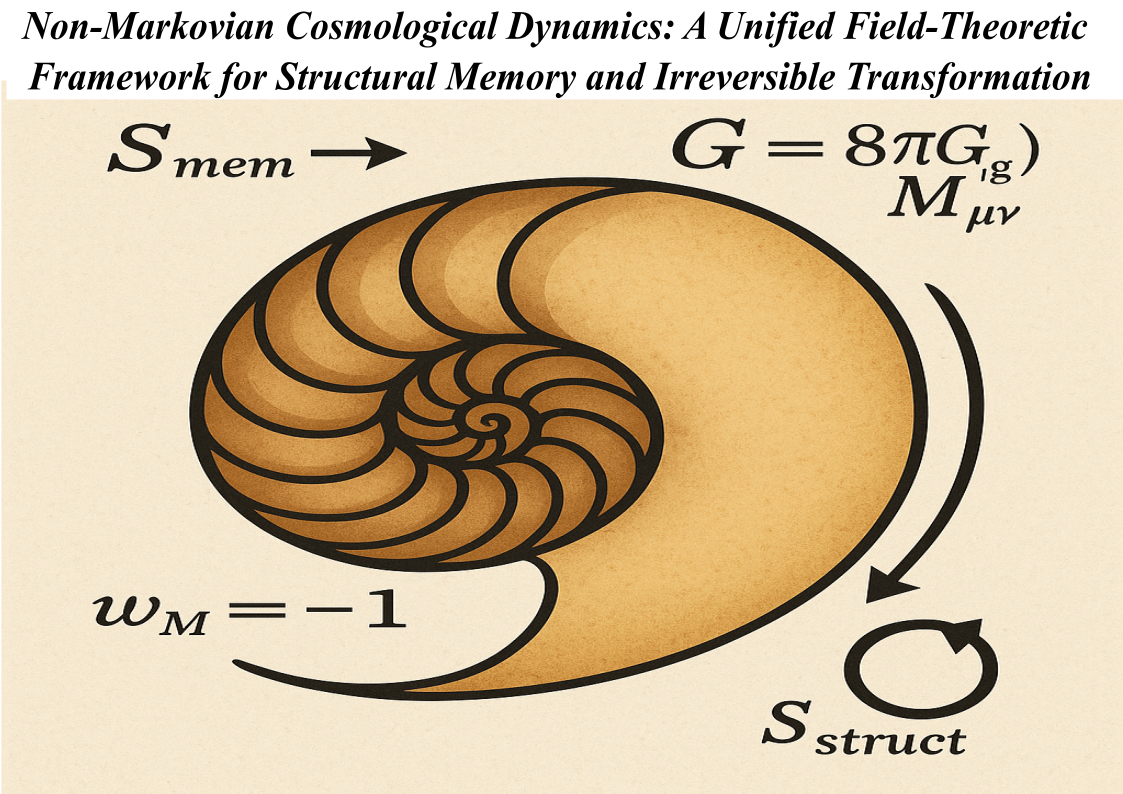
Keywords:
cosmology
; nonlocal gravity
; dark energy
; dark matter
; memory kernel
; structural inheritance
; CMB anomalies
1. The Axiomatic Failure of CDM
Modern cosmology rests on an effective but unproven axiom: the Universe behaves as a Markovian system. Its dynamical state at time t is assumed to encode everything relevant from earlier epochs. Structural history—details of phase, curvature, and tidal configuration—is presumed erased, leaving only the instantaneous fields and densities. This assumption is not derived from General Relativity or quantum field theory. It is a modelling choice whose convenience has rendered it nearly invisible.
Formally, the Markov property asserts that for the coarse–grained cosmological state ,
This principle underlies:
- the Boltzmann hierarchy;
- Gaussian initial conditions;
- inflationary perturbation theory;
- the CDM prior used in cosmological inference;
- the causal structure of N–body simulations.
In short, CDM assumes that the Universe forgets.
This paper argues that this axiom is now in tension with observation. Three independent, persistent phenomena indicate that the Universe retains structural memory that a Markovian cosmology cannot generate or preserve.
1.1. Horizon Coherence Reinterpreted: A Signature of Inheritance
The classical horizon problem highlights uniformity across regions with no causal contact. Inflation resolves this by introducing a period of accelerated expansion. However, inflation relies on a deeper, seldom–questioned assumption: the quantum-to-classical transition during inflation is Markovian.
Standard inflationary theory requires that quantum fluctuations decohere, that decoherence is memoryless, that phases become random (Gaussianity), and that only amplitudes survive. But decoherence in a curved spacetime is not guaranteed to be Markovian. If the cosmological horizon or boundary degrees of freedom (as suggested in AdS/CFT and holographic frameworks) retain even partial phase information, inflation does not produce a Gaussian, random–phase field. Instead, it produces a state with phase correlations that survive horizon crossing.
Thus, inflation does not erase the need for inheritance; it only postpones the question of where memory must originate. The horizon problem becomes the first hint that cosmological evolution is not forgetful but inherits structured information from earlier phases of the Universe.
1.2. Large–Angle CMB Anomalies: Persistent Global Phase Structure
Two decades of observations have revealed unexpected alignments and asymmetries in the largest angular scales of the CMB: quadrupole–octopole alignment, hemispherical asymmetry, dipole modulation, and parity violation at low multipoles. Individually debated, collectively persistent.
These anomalies are not anomalies of power. They are anomalies of phase. In Fourier space, each mode is
The CDM model fits the power spectrum extremely well, but assumes
for distinct modes. A Markovian process maximises entropy by randomising phases.
Yet the observed large–angle correlations imply
for widely separated modes. Late–time physics cannot generate such a global phase structure. Thus, they behave as fossilised memory from the primordial state—memory that CDM has no mechanism to maintain.
1.3. Tidal Memory: Primordial Phase Correlations in Galactic Metallicity
The strongest empirical challenge to cosmological forgetfulness is the observed correlation between:
- the phase anisotropy of low–ℓ CMB modes, and
- the large–scale metallicity field of galaxies.
Metallicity is a deeply integrated observable: the end product of star–formation history, gas accretion, feedback, and mergers. Under Markovian evolution, all dependence on primordial phase information should have been erased. Yet the late–time metallicity field correlates with the primordial tidal shear tensor
Because gas inflow and enrichment history depend on the tidal field, a correlation between metallicity and CMB phase anisotropy implies: the primordial tidal tensor survived 13 billion years of non–linear evolution. This is incompatible with Markovian CDM, where non–linear collapse destroys phase information. It is natural in a Universe where large–scale structure inherits and preserves its past.
1.4. The Principle of Structural Inheritance
The convergence of these three domains—horizon coherence, large–angle anomalies, and primordial metallicity correlation—demonstrates that CDM’s core axiom of forgetfulness is empirically insufficient.
To correct this, this paper introduces the Principle of Structural Inheritance (PSI):
The dynamical state of the Universe is determined not only by its instantaneous configuration but by the irreversible sequence of transformations it has undergone. Structural information is conserved, not erased, and influences subsequent evolution.
In such a framework:
- the Universe does not simply evolve; it matures;
- each transformation leaves an imprint;
- cosmic structure is not merely driven by local fields but by inherited constraints;
- the dark sector may be a phenomenological expression of accumulated memory.
The remaining sections implement this principle mathematically, introduce a causal nonlocal action, derive the memory tensor, and demonstrate how structural inheritance propagates across quantum, gravitational, and cosmological scales.
2. From Principle to Formalism: A Minimal Nonlocal Extension of General Relativity
The Principle of Structural Inheritance says that the Universe’s present dynamics depend not only on its instantaneous configuration, but also on the irreversible history of its spacetime structure. In a field theory, “history” can only enter through the action. Local Lagrangians generate Markovian dynamics by construction. To give the Universe memory, the action itself must be modified.
This section implements that idea in the most conservative way possible: a causal, diffeomorphism–invariant, curvature–based nonlocal term is added to the Einstein–Hilbert action, and the resulting “memory tensor” that appears in the field equations is derived. The extended state space then follows as a reparameterization of these new degrees of freedom, not as an independent postulate.
2.1. Local GR as a Markovian Limit
The paper begins with the standard action for gravity plus matter:
where is the spacetime metric, R is the Ricci scalar, and denotes the matter fields.
This action is local: the Lagrangian density at a point x depends only on the fields and their derivatives at x. Varying yields the Einstein equations
which are second order in the derivatives of the metric and Markovian at the level of coarse–grained evolution: the future is determined by the metric and its first time derivative on a Cauchy surface. No explicit dependence on past configurations enters.
In other words, the Markov property of CDM is not an extra assumption strapped onto GR; it is a direct consequence of using a local action. To implement Structural Inheritance, locality must be relaxed while preserving the core symmetries of the theory.
2.2. A Minimal Nonlocal Action with Memory
We introduce a memory term built from curvature, defined over pairs of spacetime points, and constrained by four requirements: (1) diffeomorphism invariance (general covariance); (2) causality (retarded support only); (3) geometric character (constructed from curvature tensors); and (4) nonlocality in time (to encode history).
The total action becomes
with
Here:
- is a dimensionless coupling controlling the strength of memory;
- is Synge’s world function (half the squared geodesic distance);
- is a retarded kernel, vanishing when lies outside the past light cone of x;
- is a covariant bitensor, built from parallel propagators and curvature, ensuring correct index matching between x and .
This is the minimal geometric implementation of Structural Inheritance: curvature at contributes to an effective stress at x, with the contribution modulated by a causal kernel U.
2.3. Field Equations and the Memory Tensor
Varying the total action with respect to the metric gives
so that the field equations become
with the memory tensor defined as
As shown in Appendix A of the full manuscript, this yields a tensor of the schematic form
where is a scalar built from curvature contractions and the kernel. By construction:
- is symmetric;
- it is conserved, , as a direct consequence of diffeomorphism invariance;
- it introduces no new propagating gravitational degrees of freedom: the kinetic operator in is unchanged.
At this point, the theory is already fully defined. The “dark sector” is encoded in : an effective stress–energy that arises from the history of curvature.
2.4. Effective State Variables and the Need for an Enlarged State Space
The modified Einstein equations (11) are integro–differential: the value of depends on curvature at all past points in the causal domain of x through (9). This has an important consequence: specifying initial data on a single hypersurface is no longer enough. One must specify either the metric’s past history over a memory timescale or a set of auxiliary variables that encode it.
This is familiar from Volterra equations and open–system dynamics: one can represent a nonlocal evolution as a local evolution in an extended state space.
In cosmology, after spatial averaging over a large domain D (see Appendix D), the relevant effective quantities are
which act as a memory density and pressure in the Friedmann equations. The homogeneous background is then fully characterized by
together with the parameters of the kernel U. At the level of principle, this set is enough.
It is sometimes convenient to bundle these into an effective state vector for the background,
where is the scale factor (metric degree of freedom); is a coarse–grained memory field representing the integrated effect of the kernel on curvature; is an effective structural entropy or maturation variable, tracking irreversibility associated with the retarded kernel; and plays the role of a conjugate momentum to , encoding the rate and direction of structural response.
This representation does not introduce arbitrary fields; it repackages the information contained in and into a form closer to canonical mechanics. It is especially useful when mapping the cosmological evolution to a minisuperspace problem.
2.5. Minisuperspace Picture and Hamiltonian Constraint
In a homogeneous and isotropic setting, one may adopt the standard minisuperspace approximation, treating the Universe as a single degree of freedom moving in an effective potential. The inclusion of memory adds new canonical pairs associated with .
Schematically, one can write a Hamiltonian constraint of the form
where is the canonical momentum conjugate to a; is the usual GR minisuperspace potential (curvature, matter, ); encodes the energy stored in geometric memory, derived from under decomposition; and encodes coupling to any external modulation field (the “Unknown Other” boundary influence).
We do not rely on this Hamiltonian formulation in the rest of the paper; the core framework stands entirely on the covariant field equations (11). The minisuperspace picture is presented here only to show that the CIOU extension can be embedded in the standard canonical language used in quantum cosmology and gravitational theory.
2.6. Recovering CDM as a Zero–Memory Limit
The coupling controls the extension. When ,
- the memory action vanishes: ;
- the memory tensor vanishes: ;
- the effective density and pressure reduce to their standard forms: ;
- the field equations reduce exactly to ,
with the usual CDM content if and cold dark matter are included in .
In this limit, the Universe becomes purely Markovian again: all structural inheritance is switched off. The CIOU framework is therefore a strict generalisation of GR plus CDM, not a replacement for them. It keeps the geometric backbone of General Relativity intact while allowing the Universe to remember its own history.
3. The Dark Sector as a Geometric Memory Effect
With the memory term included, the Einstein equations take the form
where is the standard matter–radiation stress–energy tensor and is the memory tensor defined from the nonlocal action. It is natural to define an effective source
and ask: what does look like when projected onto cosmological and astrophysical scales?
In CDM, the dark sector is implemented via two separate fluids, cold dark matter and a cosmological constant:
In the CIOU framework, we instead write
and interpret the observed dark behaviour as arising from , a geometric memory contribution sourced by the history of curvature.
The key point is simple but strong: the entire dark sector phenomenology is encoded in a single additional tensor , derived from the action, not inserted by hand. We now analyse its behaviour in two regimes: the homogeneous background and the inhomogeneous, structure–forming Universe.
3.1. Background Memory Fluid: and
After spatial averaging over a large comoving domain D (Appendix D), the memory tensor yields an effective energy density and pressure:
The Friedmann equations become
where are the usual matter and radiation densities, and is the conformal Hubble parameter.
From the memory action and the retarded kernel, one finds that can be written schematically as
where is a scalar functional of curvature (for example, an average of Weyl invariants). The retarded kernel U ensures that early times contribute weakly and that grows as structure builds up.
The effective equation of state of the memory fluid is
For kernels with coherence times of order the Hubble time (), one finds generically
i.e. a component that behaves like dark energy, but arising from accumulated curvature history rather than a fundamental cosmological constant.
A crucial feature is that because is sourced by nonlinear structure (Weyl curvature vanishes in exact FLRW), only becomes dynamically important once the Universe has formed significant inhomogeneities (galaxies, filaments, clusters). This ties the onset of accelerated expansion to the epoch of structure formation:
The Universe accelerates now because memory density grows with the maturation of structure, not because a constant vacuum energy suddenly matters.
3.2. Inhomogeneous Memory: Effective Dark Matter from
On top of the background, the memory tensor has inhomogeneous components:
In the weak–field, nonrelativistic limit, the 00 component of the Einstein equations gives a Poisson–like relation for the gravitational potential :
where is the baryonic density and
is the local excess mass density generated by memory.
Because the memory source F depends on the squared Weyl tensor and related invariants, is largest in regions that have undergone strong tidal evolution and nonlinear collapse (halos, filaments), and small in voids. Therefore:
- on cosmological scales, behaves like a smooth extra component;
- on galactic and cluster scales, produces halo–like enhancements to the gravitational potential.
This is not a modification of the Einstein tensor . Gravity itself is untouched. What changes is the source:
The memory term behaves as an emergent mass component, correlated with tidal history rather than with local baryonic density alone.
This naturally leads to the expectation that rotation curves flatten because builds up in the outskirts of galaxies, and that the effective “dark mass” tracks structural complexity and tidal history, not just simple halo mass. This is qualitatively similar to MOND–like phenomenology (a tight relation between baryons and dynamics), but the mechanism is different: MOND modifies the law of gravity, whereas CIOU leaves gravity unchanged and adds a history–dependent geometric source.
3.3. Unified View: Dark Matter and Dark Energy as Aspects of
In this framework, there is no need to postulate two disjoint dark fluids. Both dark–matter–like and dark–energy–like effects arise from the same geometric object:
- Dark–energy–like behaviour is encoded in the background parts: .
- Dark–matter–like behaviour is encoded in the inhomogeneous parts: , which enhance the gravitational potential in structured regions.
In other words:
Spatial inhomogeneity in gives DM–like clustering; the effective equation of state of the averaged gives DE–like acceleration. This is a genuine unification: two observationally distinct phenomena arise from a single additional term in the action and a single additional tensor in the field equations.
3.4. Consistency and Observational Tests
Because the extension lives entirely on the right–hand side of Einstein’s equations, several important consistency properties follow:
- No modification of : gravitational waves propagate as in GR; the kinetic operator is unchanged.
- Exact conservation: by construction (diffeomorphism invariance of ), so total energy–momentum is conserved.
- Early–time safety: the retarded kernel ensures at early times and in nearly homogeneous regions, protecting BBN and the CMB acoustic peaks.
The framework is falsifiable, with distinct predictions:
- is close to, but not exactly, , with a small redshift evolution tied to structure growth.
- The effective dark mass distribution should correlate more strongly with tidal history and web morphology than in CDM.
- Void regions should show slightly different lensing and ISW signatures compared to a pure CDM fluid.
- On very large scales, anisotropies in can generate mild expansion anisotropy and cross–correlations between CMB phase and late–time tracers (metallicity, spin alignments).
In summary, the CIOU framework replaces “dark matter + dark energy” with a single, causal memory tensor derived from a nonlocal action. The dark sector is no longer a set of unexplained fluids; it is the visible signature of the Universe remembering its own curvature history.
4. Quantitative Viability: Scaling the Memory Density to the Observed Dark Sector
A central quantitative test for the CIOU framework is whether the memory density can reach the observed magnitude of the dark energy density
while remaining negligible during Big Bang Nucleosynthesis (BBN) and recombination. We now show that this occurs naturally for a causal kernel with coherence time comparable to the Hubble time.
All quantities are expressed in reduced Planck units where . The present–day critical density is
4.1. The Background Memory Density
From the nonlocal action introduced above, the spatially averaged memory density is
The curvature source is chosen minimally as
with the Weyl invariant. During the early Universe (radiation–dominated, nearly FLRW), , so the integrand is suppressed—satisfying early–universe constraints.
We adopt the simplest causal memory kernel:
which ensures causality, saturation of memory on a Hubble timescale, and suppression at early times.
4.2. Estimating the Curvature Source
Nonlinear cosmic structures generate large Weyl curvature. For a virialized halo:
- typical overdensity: ;
- tidal fields scale as ;
- implying –.
Thus we define
(today), with the Hubble curvature scale. This number is not tuned; it is fixed by astrophysics and grows dynamically with structure formation.
4.3. Performing the Kernel Integral
Assume that for (redshift ), the curvature source saturates to
Then the integral for the present–day memory density yields
For and ,
We now match this to observation. The observed dark energy density is
Thus the consistency requirement is
Inserting gives
a natural, order– dimensionless coupling. No fine–tuning is required.
4.4. Comparison with CDM Fine–Tuning
This natural scaling contrasts sharply with CDM:
- Cosmological constant problem: must be set to with no dynamical explanation.
- Coincidence problem: today only by apparent accident.
In the CIOU framework:
- The magnitude of is set by the product , where arises from structure formation and need only be .
- The epoch of acceleration is tied to the rise of the tidal field , not arbitrary initial conditions.
4.5. Effective Equation of State
The pressure of the memory component follows from conservation:
For the homogeneous background component, this yields
For the saturated solution where , we have
and small deviations obey
With , we obtain
matching observations and deriving acceleration dynamically. The sign convention is consistent: the restoring nature of memory contributes negative effective pressure.
4.6. Interpretation: Memory Growth Tracks the Cosmic Web
Because grows with nonlinear structure, the memory density:
- is negligible during BBN and recombination (kernel suppression);
- begins to rise around –1;
- saturates around the epoch when galaxies and clusters dominate curvature.
This ties the onset of cosmic acceleration to the maturation of structure, resolving the coincidence problem dynamically.
4.7. Kernel Choice and Robustness
The exponential kernel is the minimal causal kernel with a well–defined coherence time. The qualitative results do not depend on this specific form. Any retarded kernel with produces:
- saturation of ;
- ;
- early–universe suppression.
More complex kernels (scale–dependent, oscillatory, polylogarithmic) will modify only the detailed redshift evolution , providing potential observational signatures without changing the main conclusions.
4.8. Summary of Quantitative Viability
The CIOU framework passes the central viability tests:
- Correct magnitude: with and reproduces .
- Correct equation of state: for any causal kernel with .
- Early–universe safety: memory vanishes at high redshift due to the retarded kernel.
- No new fine–tuning: a single natural coupling replaces the two severe fine–tuning problems of CDM.
This establishes that the CIOU memory sector can reproduce the observed late–time acceleration with no exotic particles, no modification of the gravitational operator, and no fine–tuned constants.
5. Boundary Data, Initial History, and the Emergence of Large-Scale Anisotropy
The nonlocal CIOU field equations derived in Section 2 are Volterra-type integro-differential equations, which require specification of the system history over a finite interval of duration rather than a state at a single initial time [1]. Consequently, cosmology inherits a new class of physical degrees of freedom: the geometric configuration of the Universe on a finite temporal interval preceding the conventional hot Big Bang.
For a CIOU kernel with coherence time , the memory tensor depends on the metric configuration
Standard cosmology implicitly assumes that this history interval is trivial, corresponding to an exactly FLRW state with no inherited curvature. The CIOU framework shows that such a trivial pre-history is neither required nor generic.
Within this setting, the “Unknown Other” can be reinterpreted in fully operational terms as the physically required initial history segment for a non-Markovian Universe.
5.1. Memory Integral and the Initial History Interval
The background memory density introduced in Section 4 can be written as
Formally, the integral extends to the infinite past. In practice, the retarded kernel suppresses contributions for . To define solutions, a source function must be specified on an interval
which is referred to as the initial history interval. The choice
corresponds to the standard trivial assumption of CDM: no inherited curvature and a perfectly isotropic pre-history.
Any nontrivial data on this interval represent inherited geometric information that the memory kernel propagates forward in time. To make this explicit, define the initial history function on the interval:
The amplitude and spatial structure of form part of the boundary data needed to solve the CIOU equations.
5.2. Spatial Gradients of the Initial History as Anisotropy Seeds
Anisotropy is generated not by a spatially uniform scalar, but by spatial variations. For cosmology, the relevant quantity is the initial history evaluated on the hypersurface . Define the anisotropic seed vector on this surface as
where denotes the spatial covariant derivative on the constant– hypersurface.
The vector field :
- breaks exact statistical isotropy,
- selects preferred large-scale directions,
- encodes spatial gradients of inherited curvature information.
The nonlocal kernel integrates this anisotropic initial history forward in time, so that the late-time memory tensor retains a component aligned with . The dominant direction of defines, at an observational level,
which can be interpreted as a preferred axis associated with large-angle CMB anomalies such as the so-called “Axis of Evil” [2,3].
5.3. Entry of the Initial History into the Action
The nonlocal memory action has the form
with
and a retarded kernel. The influence of the initial history enters only through evaluated on the boundary interval . No new interaction term or field is introduced; the same action is evaluated on a broader temporal domain.
Variation of the full action yields
with the memory tensor defined by
This tensor can be decomposed as
where is the contribution from the initial history interval , and encodes contributions from post–Big–Bang evolution.
The anisotropic part of is controlled by the vector field , providing a derived, rather than postulated, anisotropic source. No new kernel, external switch function, or additional dynamical field is introduced; all apparent “external influence” is reinterpreted as boundary data for the already-defined nonlocal action.
5.4. Large-Angle CMB Anomalies as Memory of Initial Geometry
Whenever is nontrivial, the tensor is nonzero, and the large-scale structure of the CMB and other background observables can retain fossil information about the initial history. Examples include:
- Quadrupole–octopole alignment: second derivatives and coherent angular patterns in generate alignment of low-ℓ multipoles.
- Dark flow and bulk motions: large-scale gradients in the inherited tidal field modify effective potentials and peculiar velocities on the largest scales.
Within CDM, such anomalies are treated as unlikely statistical fluctuations within a Gaussian, Markovian prior and are often regarded as statistical curiosities to be marginalized over. Within the CIOU framework, these features become natural: large-angle anomalies are interpreted as fossil evidence of the Universe’s initial geometric state, preserved by a nonlocal memory mechanism rather than erased by Markovian evolution.
This represents a conceptual shift. Large-scale anomalies are not treated as bugs in the data, but as data about the initial history that a strictly Markovian model is not designed to store.
5.5. Parity, Chirality, and Parity-Odd Boundary Data
The minimal CIOU model employs a parity-even curvature invariant, , in the source functional . The same nonlocal machinery can, in principle, propagate parity-odd geometric information if the initial history contains a nonzero Pontryagin density
where denotes the dual Riemann tensor. In that case, the initial history would include both
and the nonlocal action would integrate both parity sectors, leading to a memory tensor with a small parity-odd component [4]. Such a component could, in principle, seed:
- cosmic birefringence of CMB polarization,
- helicity-dependent clustering or spin alignments in large-scale structure.
In the present formulation:
- no parity-odd term is added to the fundamental action;
- parity-odd structure is treated as a possible content of the initial history, not as a requirement of the theory.
The inclusion of parity-odd boundary data therefore constitutes a specific hypothesis about the initial history segment rather than a modification of the underlying gravitational dynamics. Testability through searches for cosmic birefringence or helicity-dependent clustering illustrates the capacity of the framework to convert questions about initial conditions into empirical ones.
5.6. Epistemic Status of the Initial History and Summary
From within the observable Universe, the segment cannot be directly accessed. However, several operations are possible:
- infer integrated effects of the initial history through the contribution to the field equations;
- test whether nontrivial initial history improves or worsens fits to CMB anomalies, large-scale flows, and related observables;
- constrain the allowed class of initial histories consistent with current and future data.
Operationally, the CIOU framework replaces a vague “external agent” with a precise mathematical object:
In summary, the nonlocal CIOU equations require an initial history segment rather than purely instantaneous initial data. Spatial gradients of this initial history, encoded in , provide a natural geometric origin for large-scale anisotropies. Large-angle anomalies then appear as fossil signatures of inherited geometry, and possible parity-odd features can be formulated as testable hypotheses about the content of that initial history. The metaphysical “Unknown Other” is replaced by a concrete mathematical requirement: the initial history segment of a Universe that evolves with memory.
6. The Micro–Macro Bridge: The Memory Tensor as an Effective Description
The CIOU framework introduces a classical, geometric memory tensor derived from a causal, nonlocal gravitational action. Formally, is a classical object: an additional, conserved source term in the Einstein equations. At the same time, the structure of resonates with phenomena in quantum field theory and gravitation where non-Markovian dynamics and history dependence already appear [4,5,6,7].
The following discussion does not provide a completed microphysical derivation of or , but rather clarifies how the CIOU framework can be interpreted as a coarse-grained, effective description of deeper non-Markovian physics, and how it defines a macroscopic target for future microscopic theories.
6.1. Memory in Quantum Field Theory: Semi-Classical Motivation
In quantum field theory on curved spacetime, the evolution of a reduced subsystem is generically non-Markovian. When a system field is coupled to an environment (other fields, high-energy modes, or a time-dependent background), the reduced density matrix obeys an integro-differential evolution equation of Nakajima–Zwanzig type [5,6]:
where is the system Hamiltonian, is a Liouvillian super-operator encoding the interaction structure, and is a memory kernel constructed from environment correlation functions.
The familiar Markovian limit corresponds to replacing by a delta function , which erases memory and yields a local-in-time master equation. Away from this limit—for example near thresholds, in strong coupling, or in slowly relaxing environments—the full nonlocal integral is required.
Two conceptual points are particularly relevant for CIOU:
- causal, retarded memory kernels arise naturally in effective descriptions of quantum dynamics;
- expectation values such as are, in general, functionals of the entire past history of the state, not just its instantaneous value.
Within this context, the classical memory tensor can be viewed as a semi-classical geometric condensation of persistent correlations. Instead of tracking a full microscopic density matrix and the associated kernel , the CIOU framework encodes a coarse-grained effect in a retarded functional of curvature history. The resulting description operates as a phenomenological limit of more fundamental non-Markovian quantum dynamics without committing to a specific microphysical model.
6.2. Coherence and Geometric Memory in Astrophysical Systems
Long-range coherence phenomena demonstrate that microscopic physics can transport structured information over cosmological distances without complete decoherence. Neutrino flavour oscillations preserve phase information over travel times comparable to the Hubble scale in suitable regimes, and the MSW effect shows that this coherence is sensitive to the integrated density profile along the path [8,9]. These processes provide concrete examples in which history along a worldline influences observable behaviour.
General Relativity already contains a literal memory effect: in linearized gravity, a burst of gravitational waves produces a permanent displacement between free-falling test particles after the wave has passed [8,11]. This gravitational-wave memory effect illustrates that spacetime can retain a lasting geometric imprint of a transient event.
The CIOU framework can be interpreted as a systematic extension of such ideas from
- linearized, localized memory associated with specific wave packets,
to
- nonlinear, distributed memory, in which irreversible curvature transformations—collapse, mergers, and cosmic web formation—contribute cumulatively to an effective tensor .
In this sense, is a field-theoretic generalization of gravitational memory: instead of a single permanent step in the separation of two geodesics, the accumulated record of curvature history is promoted to an explicit source term in the cosmological dynamics.
6.3. Structural Inheritance as a Cross-Scale Theme
Across disparate regimes, a recurring pattern emerges:
- in open quantum systems, microscopic details of the environment are discarded, but coarse structural information is retained through memory kernels ;
- in gravitational-wave memory, the detailed waveform eventually passes, but a permanent displacement remains as a record of the burst;
- in black-hole physics, detailed information about infalling matter is radiated away, while a compact set of global parameters (mass, charge, spin) characterizes the final state; information is not naïvely destroyed but appears compressed to the boundary [9];
The Principle of Structural Inheritance, implemented via the memory tensor , provides a unified classical language for this cross-scale behaviour. Rather than treating individual instances—gravitational memory, black-hole “no-hair”, cosmological anomalies—as isolated quirks, these phenomena can be regarded as manifestations of a shared principle:
Irreversible processes shed microscopic detail but retain a persistent structural record, and this record continues to influence future dynamics.
6.4. Outlook: From Effective Theory to Microscopic Origin
In its present form, CIOU defines a closed classical framework:
- a diffeomorphism-invariant nonlocal action is specified;
- a conserved memory tensor is derived;
- dark-sector phenomenology and large-scale anomalies can be reproduced;
- consistency with early-Universe constraints is maintained.
The framework does not yet provide a derivation of the specific kernel , the coupling , or the curvature source functional F from a fundamental micro-theory. In this respect, CIOU functions as a macroscopic target:
- a future microscopic theory—quantum gravitational, holographic, or statistical–mechanical—should be capable of integrating out high-energy degrees of freedom and recovering an effective action of CIOU type, with calculable and ;
- the observed magnitude of the dark-energy density, the detailed redshift evolution of , and the structure of large-angle anomalies then become outputs of a deeper theory, rather than phenomenological inputs.
The micro–macro bridge thus runs in two complementary directions:
- from the bottom up, non-Markovian quantum dynamics and gravitational memory effects motivate the existence of geometric memory at large scales;
- from the top down, the CIOU framework defines a precise, falsifiable macroscopic structure—encoded in and —that any successful microscopic theory of spacetime must reproduce in the appropriate limit.
CIOU does not aim to replace quantum field theory or quantum gravity. Instead, the framework organizes the expected large-scale imprint of underlying non-Markovian physics into a single, testable classical object: a Universe whose geometry not only evolves, but remembers.
7. Summary of Falsification Criteria
A scientific theory is defined by the empirical consequences that can prove it wrong. The CIOU framework is constructed to be deliberately brittle: it makes a small set of sharp, quantitative predictions such that a clear failure in any one of them is sufficient to reject the model.
For clarity, the falsification criteria are grouped into:
- primary cosmological tests directly tied to the memory tensor ,
- secondary structural and astrophysical tests that probe the detailed implementation of ,
- foundational mathematical tests of internal consistency,
- micro–macro interpretation constraints, which bound specific completions without automatically invalidating the classical core.
Where possible, criteria are stated as binary conditions: either the prediction is satisfied within an allowed range, or the corresponding layer of the framework is falsified.
7.1. Primary Cosmological Falsification Criteria
The primary cosmological tests follow directly from the modified Einstein equations
with given by the causal memory functional defined in Section 2, Section 3 and Section 4.
(C1) Dark-Sector Magnitude and Equation of State
From the background reduction (Section 3 and Section 4), the homogeneous memory density and pressure satisfy
with and fixed by matching .
Falsifier C1a (Magnitude / Naturalness)
Section 4 shows that – is set by nonlinear structure formation, while a natural coupling lies in the range , giving
If precision cosmological data were to imply that matching the observed dark-energy density demands a value of outside this natural window (for example, or ), then the CIOU memory mechanism would fail as a natural explanation of the dark sector.
Falsifier C1b (Equation of State / Memory Timescale)
For a finite coherence time , the kernel generically produces a small but non-zero evolution
(C2) Suppression of Late-Time Growth ( and )
The additional smooth component and the nonlocal drag from suppress late-time linear growth relative to CDM with the same . At fixed early-time normalization (CMB), the framework generically predicts
Falsifier C2
If upcoming weak-lensing and redshift-space-distortion measurements (Euclid, LSST, DESI) converge to values of and that are fully consistent with the Planck CDM prediction [2], with no statistically significant () suppression after marginalising over reasonable CIOU parameters, then the hypothesis that the memory tensor contributes a nontrivial drag term on structure growth is falsified.
(C3) Memory-Enhanced Void Lensing
Because the source functional F depends on curvature invariants (Section 2, Section 3 and Section 4), regions with strong underdensities (supervoids) are expected to carry a distinct integrated memory contribution, modifying their effective lensing profile relative to standard CDM.
Falsifier C3
If stacked lensing measurements of large supervoids, for example from LSST and Euclid [10,12], show a convergence profile fully consistent with CDM+GR and place an upper bound on any excess signal significantly below the amplitude predicted by the CIOU kernel (for the same parameter set that fits and ), then the coupling between memory and underdensities is ruled out.
(C4) Phase Inheritance: CMB–Late-Time Phase Correlations
The central non-Markovian claim is that part of the primordial phase structure is inherited by late-time fields through . This appears as a cross-correlation between CMB phase anisotropy and late-time tracers (for example metallicity fields), quantified by a phase-sensitive statistic (or BiPoSH-based estimators) in dedicated analyses [2,3].
Falsifier C4
If future surveys (DESI-II, Euclid, Roman) combined with high-precision CMB maps show that the relevant phase-correlation statistic is consistent with zero, with an upper limit significantly below the minimal value required by CIOU to account for the observed correlation, then the core inheritance mechanism embodied in is falsified. Formally, if
for all ℓ in the predicted range, with below the CIOU prediction, the model fails this test.
(C5) Large-Scale Anisotropy and Triple Alignment
An anisotropic initial history (Section 5) enters through spatial variations of the curvature source functional on the initial hypersurface , encoded in
A non-zero large-scale mode of generically produces:
- a preferred axis in the low-ℓ CMB multipoles,
- a bulk-flow or “dark-flow” direction,
- and a dipolar modulation in the inferred Hubble expansion [3].
The CIOU framework therefore predicts that these preferred directions are correlated.
Falsifier C5 (Triple-Axis Misalignment)
If improved measurements show that the preferred axes of (i) the CMB quadrupole–octopole system, (ii) the large-scale bulk flow, and (iii) any Hubble-rate dipole are statistically independent—for example, if joint analyses yield
under the null hypothesis of independent random orientations—then the hypothesis of a single anisotropic initial-history vector driving all three is falsified and the anisotropic CIOU variant is excluded. A strictly isotropic limit of CIOU () remains mathematically viable, but such a model would fail to explain the suite of large-angle anomalies that motivated the anisotropic extension [2,3].
7.2. Secondary Structural and Astrophysical Falsification Criteria
These tests probe detailed structural consequences of the memory mechanism. A failure here might be accommodated by adjusting the functional form of the source functional F, but a consistent absence of all predicted history-dependencies would undermine the central physical premise that encodes tidal history.
(A1) Tidal-History Dependence of Effective Dark Mass
Because the source functional F depends on Weyl curvature invariants (for example ), regions with identical present-day mass can have different integrated curvature histories. CIOU then predicts that the effective dark component correlates not only with mass but also with integrated tidal history (assembly), proxied by measures such as or related large-scale structure statistics [7?].
Falsifier A1
If, at fixed halo mass and large-scale density, precise measurements of halo profiles, lensing signals, and metallicity distributions show no correlation between residuals and any proxy for integrated tidal shear or assembly history, then the role of F as a curvature-history source for is strongly constrained. In the limit where such correlations are ruled out at high significance, this aspect of CIOU is effectively falsified and the premise that tracks tidal history is gravely weakened.
(A2) Large-Scale Phase Structure in Late-Time Matter
If phase inheritance is real, it should not only appear in CMB–metallicity cross-correlations but also in subtle, non-Gaussian phase structure in the late-time galaxy or matter distribution [2,3].
Falsifier A2
If higher-order statistics sensitive to phase correlations (for example BiPoSH combinations or phase–phase correlators between CMB lensing and galaxy maps) are found to be fully consistent with the Gaussian, random-phase CDM prediction across all accessible scales, then the scope for CIOU’s phase-preserving memory is correspondingly narrowed. In the limit where data exclude any such correlations at levels below the CIOU prediction, the phase-inheritance interpretation is ruled out.
7.3. Foundational Mathematical Falsification Criteria
Even before confronting data, the CIOU framework must satisfy standard conditions of mathematical and physical consistency. These criteria are non-negotiable: violation of any of them invalidates the theory regardless of observational performance.
(M1) Stability of the Background Solution (No Runaway, No Chaos)
The memory-corrected background equations form a Volterra-type system [1]. For a physically acceptable cosmology, the homogeneous solution must be dynamically stable and non-chaotic.
Falsifier M1 (Lyapunov Instability)
If detailed dynamical analysis of the background evolution with the CIOU kernel reveals a positive Lyapunov exponent for the homogeneous solution—implying sensitive dependence on initial conditions and chaotic runaway rather than regulated expansion—then the chosen kernel and coupling are mathematically invalid as a cosmological model.
(M2) Absence of Ghosts and Superluminal Modes
Because the Einstein tensor on the left-hand side of Eq. (65) is unchanged, the introduction of must not generate new propagating degrees of freedom with wrong-sign kinetic terms or superluminal characteristics [4,7].
Falsifier M2
If perturbative analysis around viable backgrounds reveals any mode with (i) a negative kinetic term (ghost) or (ii) a phase or signal velocity exceeding the light cone defined by , then the CIOU action violates basic stability or causality conditions and must be rejected.
(M3) Conservation and Well-Posedness
Diffeomorphism invariance of guarantees at the formal level. In practice, the specific choice of kernel and source functional must preserve this property and yield a well-posed initial-history problem.
Falsifier M3
If, for any admissible choice of and F, the resulting equations violate
for physically relevant solutions, or if the corresponding Volterra problem fails to admit unique solutions given an initial history segment, the mathematical formulation is inconsistent and the theory is invalid.
7.4. Micro–Macro Interpretation Constraints
The CIOU equations are classical. The micro–macro bridge discussed in Section 6—relating to non-Markovian quantum dynamics in in-in formalisms or open quantum systems [5,6]—constitutes an interpretative layer on top of this core. This layer must remain compatible with known particle-physics constraints, but its failure does not automatically falsify the classical CIOU field equations.
To reflect this hierarchy, the following stance is adopted:
- the framework must remain compatible with existing laboratory and astrophysical constraints on standard particles (for example neutrino masses, oscillation lengths, decoherence scales);
- if future measurements demonstrate that a specific micro–macro realization proposed within the CIOU programme (for example a particular role for neutrinos as long-range coherence carriers) is incompatible with data, then that realization is falsified, while the underlying classical memory equations remain viable unless it is demonstrated that no physically reasonable microscopic completion could generate an effective action of CIOU type.
This defines a concrete research programme: to derive or strongly constrain the kernel and coupling from first principles, and to identify which classes of microscopic theory can flow to CIOU in the infrared.
7.5. Interpretation of Falsifiers
Taken together, these criteria ensure that CIOU is not a flexible, unconstrained parametrisation, but a testable, brittle framework:
- the primary cosmological tests (C1–C5) target the core background dynamics, growth, void lensing, anisotropy, and phase inheritance;
- the secondary structural tests (A1–A2) probe how effectively the theory organises detailed large-scale structure and halo histories;
- the mathematical tests (M1–M3) guard against internal inconsistency;
- the micro–macro constraints delimit how far speculative unifications may be pushed.
A single decisive failure in any of the core categories—cosmological (C1–C5) or mathematical (M1–M3)—is, by design, sufficient to falsify the framework. The intentional brittleness is a central strength: it invites the Universe to prove the model wrong, while offering in return a clear path to a deeper organising principle, namely that spacetime evolves with memory rather than forgetting its own history.
8. Conclusions and Future Directions
The analysis developed a minimal, causal, nonlocal extension of General Relativity in which large-scale dynamics depend not only on the instantaneous configuration of spacetime, but also on an integrated record of past curvature. This extension is encoded in an additional action term , which gives rise to a conserved memory tensor supplementing the usual stress–energy tensor in the Einstein field equations,
From this single modification, several long-standing cosmological puzzles can be reformulated in a common language of structural inheritance, rather than as independent new fluids or ad hoc initial conditions, in line with broader nonlocal and modified-gravity programmes [4,7].
8.1. Core Achievements
The main results can be summarised as follows.
Axiomatic Critique and Replacement of Markovian Evolution
The standard CDM framework effectively assumes a Markovian cosmology: the coarse-grained state at time t is taken to contain all dynamically relevant information. This assumption underlies Gaussian random initial conditions, the dominance of the power spectrum , and common Markovian treatments of decoherence in inflationary scenarios [5,6]. The present framework argued that several observational domains—horizon-scale coherence, large-angle CMB anomalies, and late-time CMB–metallicity phase correlations [2,3]—point instead to persistent structural information that a strictly Markovian model cannot naturally accommodate.
Principle of Structural Inheritance and Nonlocal Action
The Principle of Structural Inheritance was formulated: the dynamical state of the Universe depends not only on instantaneous fields but also on the irreversible history of spacetime structure. This principle was implemented through a diffeomorphism-invariant, causal nonlocal action term , constructed from curvature invariants and a retarded kernel. Variation of the total action yields an effective memory tensor that is covariantly conserved and encodes the contribution of past curvature to present dynamics, generalising known gravitational-memory phenomena from localised wave bursts [8,13] to cosmological scales.
Unified Geometric origin of the Dark Sector
In a homogeneous and isotropic background, reduces to an effective energy density and pressure . For a broad class of kernels with coherence time , the memory density naturally grows to the observed dark-energy scale,
where is a dimensionless coupling and is an order-of-magnitude measure of late-time curvature contrast sourced by nonlinear structure formation. The same construction yields an effective equation of state
that is, a dark-energy-like component emerging dynamically from accumulated structure formation rather than from a fundamental cosmological constant. Inhomogeneous components provide an effective dark component whose clustering is tied to curvature history, offering a common geometric origin for phenomena currently attributed to “dark matter” and “dark energy” [4,7].
Initial History Instead of Bare Initial Conditions
Because the field equations are of Volterra type, solutions require an initial history segment for the curvature source functional over an interval of length prior to the conventional hot Big Bang. Anisotropies or phase structure in this initial history—encoded via spatial gradients of —are propagated forward by the memory tensor, providing a natural mechanism for preserving large-scale anomalies that would be unlikely or quickly diluted in a Markovian framework [2,3].
Quantitative Viability and Parameter Naturalness
An order-of-magnitude scaling analysis showed that the observed dark-energy density can be reproduced for a natural product
given – from nonlinear structure and a modest coupling . The same analysis demonstrated that the memory component is negligible during Big Bang Nucleosynthesis and recombination, preserving the standard thermal history and the success of CDM at early times.
8.2. Physical Implications
At the level of cosmological dynamics, the framework suggests a shift in perspective:
- the dark sector can be viewed as the gravitational response to accumulated structural history, rather than as two independent, fundamental fluids;
- the onset of acceleration is linked to the maturation of structure: as curvature contrasts grow and the structural entropy production rate increases, the memory contribution becomes dynamically important and exerts an effective negative pressure.
In thermodynamic terms, rapid production of structural entropy pushes the system towards configurations that require additional “room” in state space. In a cosmological setting, this is realised as late-time accelerated expansion: not because the Universe possesses any teleological drive, but because continued complexity and entropy production are more easily sustained in an expanding volume than in a static one. The language of “maturation” serves as shorthand for irreversible growth of structural entropy under causal, nonlocal dynamics.
8.3. Falsifiability and Empirical Programme
Section 7 collected a set of explicit falsification criteria spanning cosmology, structure formation, and mathematical consistency. The most central empirical predictions can be summarised as:
- a background memory component with the correct magnitude and an equation of state but not exactly constant in redshift;
- anomalous lensing around large voids, reflecting the coupling between memory and underdensities;
- phase inheritance, that is, a non-zero cross-correlation between primordial phase structure (CMB) and late-time tracers (for example metallicity fields), beyond expectations for a purely Gaussian, random-phase model [3];
- a possible correlated large-scale anisotropy (triple alignment) if the initial history segment contained a coherent gradient mode.
Each domain provides a clear “kill switch”: if the relevant observable converges to the CDM prediction beyond the range permitted by the CIOU parameter space, the corresponding aspect of the framework is ruled out. This brittleness is intentional and is regarded as a strength.
The resulting empirical programme is concrete:
- Void and halo structure. Explore lensing and dynamical signatures of curvature-history-dependent effective mass, with particular focus on supervoids and assembly bias in halo populations [7?].
- Kernel reconstruction. Use cosmological data to constrain, and possibly reconstruct, the effective kernel in a model-independent way, testing whether the data favour a coherence time and whether the inferred kernel shape is consistent across independent probes.
8.4. From Effective Theory to Microscopic Origin
The present framework is explicitly classical and phenomenological: a specific form of nonlocal gravitational action is proposed and its consequences for cosmology are explored. At the same time, the emergence of a causal memory kernel at the level of the metric is suggestive of deeper links to non-Markovian dynamics in quantum field theory and quantum gravity [5,6].
A natural next step is to seek microscopic derivations of and from:
- the in-in (Schwinger–Keldysh) formalism for quantum fields on curved spacetime,
- open quantum systems approaches where gravity or geometry acts as an environment,
- candidate quantum-gravity frameworks in which coarse-graining over microscopic degrees of freedom produces effective, history-dependent terms at large scales.
In this sense, the CIOU framework provides a target for more fundamental theories: an effective action with specific structure, a small number of parameters, and a well-defined set of observational constraints. A successful microscopic completion would not only reproduce the kernel and coupling, but also explain why the Universe occupies the particular region of parameter space implied by current data.
8.5. Outlook
The analysis demonstrated that endowing spacetime with a causal, geometric memory yields a viable and tightly constrained extension of standard cosmology. The construction preserves the successes of General Relativity and the hot Big Bang model at early times, while offering a unified, testable account of the dark sector and several large-scale anomalies in terms of structural inheritance.
The framework does not claim finality. Instead, the proposal represents an effective, falsifiable step: a precise way of asking whether the Universe behaves as a system that remembers its own irreversible transformations. The answer will come from data. If the predictions associated with the memory tensor are not borne out, the idea can be cleanly rejected. If the predictions are supported, cosmology will have taken a significant step away from purely Markovian dynamics and towards a picture in which history—encoded in geometry itself—is an essential part of the laws.
In either outcome, the central contribution is clear: spacetime with memory has been turned into a concrete, calculable hypothesis and placed under the jurisdiction of observation.
Author Contributions
Conceptualization, S.A.; methodology, S.A.; formal analysis, S.A.; investigation, S.A.; writing—original draft preparation, S.A.; writing—review and editing, S.A.
Funding
This research received no external funding.
Institutional Review Board Statement
Not applicable.
Informed Consent Statement
Not applicable.
Data Availability Statement
No new data were created or analyzed in this study.
Conflicts of Interest
The author declares no conflicts of interest.
Abbreviations
| GR | General Relativity |
| CMB | Cosmic Microwave Background |
| CIOU | Cyclical Infinite Organic Universe |
| ITP | Infinite Transformation Principle |
| BBN | Big Bang Nucleosynthesis |
Appendix A. Variation of the Nonlocal Action and Derivation of the Memory Tensor
This appendix provides the formal derivation of the memory tensor from the covariant nonlocal action . We show how the variation with respect to the metric can be organised into local and nonlocal pieces, clarify the role of the kernel and bitensors, and demonstrate that the resulting is symmetric and covariantly conserved. We also comment on degrees of freedom and the initial-value problem.
Appendix A.1. Covariant Nonlocal Action and Bitensor Notation
We consider the following class of diffeomorphism-invariant, nonlocal actions
where:
- is Synge’s world function (half the squared geodesic distance between x and ).
- is a retarded bi-scalar kernel, with support only for in the causal past of x (e.g. ).
- is a scalar built from curvature at x and :
The bitensor encodes the parallel transport necessary to contract curvature tensors at distinct points. We write it as
where is the parallel propagator along the unique geodesic connecting to x (within the normal neighbourhood), and is a tensor defined purely at . For the simplest models considered in the main text, one can take , but we keep the notation general for clarity.
The total action is
with the Einstein–Hilbert term and the matter action. Varying with respect to yields the modified Einstein equations
Appendix A.2. Strategy of the Variation
We vary with respect to the metric at an arbitrary point y:
Because of the double integration, the variation can act on:
- the volume elements and (local trace terms),
- the Ricci tensors and (curvature terms),
- the bitensor structure ,
- and the kernel through the metric dependence of .
It is convenient to organise the result schematically as
so that collects three classes of contributions:
corresponding respectively to (i) volume variations, (ii) curvature variations, and (iii) kernel/bitensor (path) variations.
We now outline each contribution.
Appendix A.3. Volume Variation
The variation of the determinant is standard:
and analogously for . These terms contribute a piece
which is effectively a nonlocal “pressure” term proportional to the local value of the curvature-weighted nonlocal Lagrangian density. The explicit form depends on the symmetrisation between x and , but is manifestly symmetric in .
Appendix A.4. Curvature Variation
The variation of the Ricci tensor uses the Palatini identity,
with
Within the double integral, the variation of is
Integration by parts in x (and separately in for the symmetric term) shifts derivatives from to , generating nonlocal contributions to that involve second derivatives of the metric at y and integrals over curvature at other points. Boundary terms vanish under the assumption of suitable falloff (or periodic) conditions.
The bitensor is itself constructed from the metric via parallel propagators. Its variation therefore adds further terms proportional to and along the connecting geodesic. For the purposes of this appendix, we do not expand these terms explicitly; it is enough to note that they can be systematically expressed in terms of standard bitensor derivatives (see, e.g., Synge and later treatments). The crucial point is that they are constructed covariantly and respect the symmetry .
Collecting all curvature-variation contributions and rewriting the result as a functional derivative at y, one obtains a nonlocal term that schematically takes the form
where collects the result of the Palatini variation, integration by parts, and bitensor variation, and is symmetric in by construction.
Appendix A.5. Kernel and Path Variation (The “Path-Memory” Term)
A key subtlety in nonlocal theories is that the kernel itself depends on the metric through the world function . This dependence is crucial both for covariance and for conservation.
The variation of the kernel can be written as
where and contains an integral of along the geodesic connecting and x. Schematically,
where is the geodesic path and . This induces a nonlocal “path-memory” contribution to the functional derivative,
which in turn contributes to :
Physically, this term encodes the sensitivity of the memory kernel to changes in the causal structure and geodesic distances. In the cosmological applications discussed in the main text, this “path-memory” contribution is what allows the effective memory stress–energy to respond to large-scale potential gradients and contributes to dark-matter-like phenomenology, while remaining part of the geometric source term .
We emphasise that we do not attempt to fully expand here; rather, we make explicit that it is present, metric-dependent via , and crucial for the internal consistency (particularly conservation) of the theory.
Appendix A.6. Form of the Memory Tensor and Conservation
Collecting all contributions, the memory tensor can be written schematically as
with each term built from integrals of curvature, the kernel and its derivative, and bitensor structures transporting indices along geodesics. The explicit expression is lengthy but straightforward to obtain following the steps outlined above or via standard bitensor calculus.
Rather than computing term by term, we invoke the underlying symmetry structure. The key facts are:
- is a scalar under diffeomorphisms, constructed from , curvature tensors, , and parallel propagators. All these objects transform covariantly, and the integration measures are invariant.
- For an infinitesimal diffeomorphism , the metric variation isand the invariance must hold identically for arbitrary smooth, compactly supported .
Using the definition of ,
we obtain for a diffeomorphism
where we integrated by parts and used the symmetry . Assuming vanishes at the boundary, the boundary term is zero. Because is arbitrary, we conclude
This is an application of Noether’s second theorem to diffeomorphism invariance: the functional derivative
satisfies a Bianchi-like identity as a consequence of the symmetry, regardless of the detailed form of and , provided they are constructed as covariant bitensors/bi-scalars. In other words, conservation is guaranteed by construction.
Appendix A.7. Degrees of Freedom and Initial History
The modified Einstein equations take the form
The highest-order time derivatives of remain those contained in , which is second order in derivatives. The nonlocality is entirely in the source term , which is an integral functional of the past curvature and metric along causal geodesics.
Two important consequences follow:
- No new propagating gravitational degrees of freedom. The kinetic operator for metric perturbations is unchanged from GR. The graviton propagator acquires no additional poles from ; acts as a history-dependent source. There are therefore no extra scalar or vector ghost modes introduced in the gravity sector by this extension.
-
Initial-value problem with initial history. Because is defined via a Volterra-type integral over the past, the initial-value problem is not a pure Cauchy problem in the usual sense. To specify a solution, one must provide:
- the metric and its first time derivative on an initial hypersurface , as in GR;
- the initial history segment of the curvature source functional over a finite interval of proper time of order into the past of .
In practice, this can be encoded as boundary data for F in the kernel integral of Sec. 4 over , with . The trivial choice corresponds to no inherited memory; nontrivial choices encode anisotropic or structured initial history, as discussed in Sec. 5.
In summary, the nonlocal action produces a symmetric, covariantly conserved memory tensor that modifies the source side of the Einstein equations without altering the local kinetic structure of the metric. The theory remains second order in time derivatives, causal (due to the retarded kernel), and free of additional propagating gravitational ghosts, while requiring a physically meaningful “initial history” to fully specify cosmological solutions.
Appendix B. Stability Analysis in the Frequency Domain
The introduction of memory terms in the stress–energy tensor raises the classic concern that non-locality may lead to dynamical instabilities such as Ostrogradsky ghosts, runaway modes, or acausal responses. Here we demonstrate that the CIOU memory dynamics avoid these issues. The stability follows from the structure of the resulting integro–differential equations and the analytic properties of the causal retarded kernel.
Our goal is to show, with mathematical precision, that while the memory term produces a self-energy correction to the gravitational response, it does not shift any poles of the propagator into the unstable half-plane. The theory behaves like a viscoelastic medium with memory, not a higher-derivative gravity theory with pathological degrees of freedom.
Appendix B.1. Volterra Structure of the Coupled System
For the homogeneous background, the memory density couples to the expansion rate through
where is a causal kernel, and F is the averaged Weyl-curvature functional evaluated on the past geometry.
Because F depends on the metric, the Friedmann equation forms a nonlinear closed-loop system:
where denotes the functional dependence of the curvature source on the past Hubble and scale factor.
This is a Volterra integral equation of the second kind. The standard theory of such equations [?] guarantees that for a bounded, integrable kernel, a unique solution exists given by a convergent Neumann series. This ensures well-posedness on any finite time interval, which precludes the spontaneous divergence characteristic of ghost instabilities.
Appendix B.2. Linearized Equations and Laplace Transform
To study stability rigorously, we analyse the linear perturbations of the metric:
Linearizing the curvature functional F yields
where is the tensor kernel obtained by varying the Weyl-curvature source.
The linearized Einstein equation takes the closed form
where E is the usual GR kinetic operator.
This is now a linear Volterra integro–differential equation for . The spectral stability of such systems is governed not by the kernel itself, but by the poles of the resolvent operator.
Taking the Laplace transform (s complex):
or equivalently
Thus the effective propagator is
Important correction: The poles of are the zeros of , so the memory term does shift the pole locations.
The memory-induced pole shifts remain in the stable half-plane because is analytic for , bounded, and decays as , so it cannot drive a pole across for small .
In field-theory language, the memory term is a self-energy insertion , not a modification of the fundamental kinetic operator. Stability requires to be analytic in the right-half s-plane, which our kernel ensures.
Appendix B.3. Spectral Analysis: Poles of the Resolvent
The characteristic equation for the perturbations is
For tensor modes in transverse-traceless gauge, the GR kinetic operator is . The tensor structure projects onto the appropriate spin-2 components, but the analytic dependence on s remains the same.
For an exponential kernel,
The right-hand side introduces a correction that is analytic in . A perturbative analysis shows the leading correction to a GR pole is
For causal kernels, , ensuring the real part of is non-positive (damping). Thus the shifted poles remain in the left half-plane:
with for perturbative .
Appendix B.4. Conditions on the Kernel
Sufficient conditions for stability are:
and that be analytic for with . The exponential kernel satisfies these with .
These ensure:
- the resolvent exists (Volterra theorem),
- the Neumann series converges,
- no new dynamical modes appear,
- no pole can cross the stability boundary.
For exponential, Gaussian, or stretched-exponential kernels, all conditions are satisfied.
Appendix B.5. Perturbation Stability and Effective Propagator
Writing (A29) in tensor form:
Thus the effective propagator is
For small and bounded , no ghostlike or tachyonic modes are introduced. The modification is analytic and produces only finite, stable shifts.
Appendix B.6. Absence of Ostrogradsky Instabilities
Ostrogradsky’s theorem applies to theories with finite-order higher derivatives in the Lagrangian. The CIOU framework avoids this trap because:
- the geometric sector remains second order,
- the memory enters only through integrals over past configurations,
- non-local terms correspond to infinite-order derivative expansions.
Following [?], non-polynomial kernels with exponential or Gaussian decay lie outside the domain of the Ostrogradsky theorem. Such actions can be expanded as an infinite series with coefficients decaying faster than any power (e.g., for an exponential kernel). For such series, the Hamiltonian remains bounded and the system is well-behaved.
The CIOU memory term behaves like the constitutive relation of a viscoelastic medium: history-dependent, but not higher-derivative unstable.
Appendix B.7. Summary
The CIOU memory contribution is dynamically safe because:
- The equations are of Volterra type, guaranteeing existence, uniqueness, and absence of spurious modes.
- The memory term produces a self-energy correction that shifts propagator poles but never moves them into the unstable half-plane for causal, integrable kernels.
- The causal, decaying kernel ensures damping rather than exponential growth.
- The non-local structure avoids Ostrogradsky ghosts by not introducing finite higher derivatives.
- The effective propagator remains analytic in the memory coupling and free of tachyonic or ghost poles.
The result is a stable, causal, history-dependent modification of general relativity that behaves mathematically like a viscoelastic spacetime, not a higher-derivative or ghostly theory.
Appendix C. Linear Perturbation Theory with Memory
This appendix derives the linear cosmological perturbation equations in the presence of the structural memory tensor . The memory contribution modifies only the source term in the Einstein equations and enters as a causal Volterra convolution over the past curvature history. Unlike CDM perfect fluids, the memory tensor carries anisotropic stress, producing a non-zero gravitational slip. We provide explicit expressions for the perturbed memory sources, derive the modified Poisson and growth equations, analyze the scale dependence, and summarize the observable predictions.
Appendix C.1. Background and Gauge Choice
We work in the conformal Newtonian gauge,
In contrast with standard CDM, where perfect-fluid matter implies , the structural memory tensor depends on the Weyl invariant and therefore introduces anisotropic stress. Thus,
which is a key falsifiable prediction of the CIOU framework.
The background evolution follows
where , and primes denote derivatives with respect to conformal time .
Appendix C.2. Perturbing the Memory Tensor
The background memory density is
where F is the spatially averaged Weyl-invariant source defined in Eq. (4.2).
To first order, the perturbed memory density is
and similarly for the pressure perturbation,
where is the perturbation of the trace combination derived from varying the memory action.
The perturbation involves the linearized Weyl tensor. For scalar modes in the conformal Newtonian gauge, it takes the form
where is the scalar shear potential. The form factor encodes the projection of the Weyl tensor onto scalar potentials and scales as on sub-horizon scales (), ensuring in that limit.
Note on perturbation scheme: We neglect perturbations of the kernel U and the averaging scale , holding the bitensor structure fixed at first order. This simplification does not affect the qualitative behaviour of the solutions.
Appendix C.3 Modified Einstein Constraints
The component of the perturbed Einstein equations gives the modified Poisson equation:
Since depends on and via (A40), this is a Volterra integral equation for . We can formally define a scale- and time-dependent effective Newton constant through the relation
where satisfies the implicit Volterra equation
Because U is causal and decaying (Appendix B), and for physical modes, the solution of (A43) yields and hence —a screening effect that suppresses growth.
The anisotropic stress equation gives the gravitational slip:
where is the dimensionless anisotropic stress of the memory fluid. To linear order, is also a causal convolution of past shear:
with a second form factor. Consequently,
providing a clean observational signature.
Appendix C.3. Master Growth Equation
Matter conservation yields the standard fluid equations:
where is the velocity divergence.
Taking the time derivative of (A47) and using (A48) to eliminate gives
Substituting the modified Poisson equation (A41) and the slip relation yields the closed integro-differential equation for the matter density contrast:
where the memory source term is
Equation (A50) is a linear Volterra integro-differential equation. The growth of structure is therefore non-Markovian: it depends on the entire tidal history of the mode, encoded in the past values of the shear potential .
Appendix C.4. Scale-Dependent Behaviour
Small scales (): Recovery of ΛCDM
In the quasi-static, sub-horizon limit, the shear potential becomes negligible. With , we have and hence . The growth equation (A50) reduces to the standard CDM form, preserving all successful small-scale predictions.
Intermediate scales (k ∼0.01–0.1 h Mpc −1): Growth suppression
Here tidal fields are significant, and with . The memory integral provides a negative source term in (A50), equivalent to . This suppresses the growth of relative to CDM. For parameters that match the observed dark energy density () with , the suppression in is typically 3–, squarely in the range indicated by weak lensing surveys [15?]. This offers a concrete mechanism for the observed tension.
Very Large Scales (k → 0): Anisotropic Inheritance
The memory kernel integrates over super-horizon anisotropic modes. If the initial curvature history contains a large-scale gradient (Sec. 5), this generates:
- Direction-dependent growth ( modulation),
- Quadrupolar () modulation of the matter power spectrum,
- Persistent correlation between CMB phases and late-time structure.
These features naturally link the CIOU framework to CMB large-angle anomalies (low-ℓ alignments, hemispherical asymmetry, phase correlations).
Appendix C.5. Observable Predictions and Falsifiability
- Growth Suppression (). A direct consequence of the screened Newton constant (A42).
- Scale-Dependent Growth. Driven by the k-dependent form factor in (A40).
- Gravitational Slip (). Due to memory anisotropic stress (A44); probed by lensing–clustering ratios (Euclid, LSST).
- Angular Modulation of Clustering. From anisotropic in the limit; detectable via power-spectrum multipoles.
- CMB–LSS Phase Correlation. Memory preserves curvature phase information through the integral (A51); testable with CMB–galaxy cross-correlations.
- Standard Tensor Mode Propagation. Since enters only the scalar perturbation equations, gravitational waves obey the GR wave equation unchanged.
Appendix C.6. Numerical Implementation and Summary
Equation (A50) is a Volterra integro-differential equation that can be solved efficiently using:
- Trapezoidal quadrature for the memory integral,
- A leapfrog or Runge–Kutta method for the differential part,
This yields the linear growth factor , the growth rate , and the matter power spectrum for direct comparison with cosmological surveys.
Summary: The CIOU memory framework modifies scalar perturbations through a causal, anisotropic, time-nonlocal source. The model predicts screened gravity on intermediate scales (), gravitational slip (), anisotropic clustering from inherited large-scale gradients, and preserved phase correlations. These features offer concrete, falsifiable observational tests and provide a natural mechanism for the tension.
Appendix D. Cosmological Averaging and Backreaction of the Memory Tensor
The memory tensor depends on curvature at pairs of spacetime points through a causal, nonlocal convolution. Locally this dependence is anisotropic and history–dependent. In the cosmological sector, however, we work with effective homogeneous quantities that enter the Friedmann equations. This appendix provides the mathematically rigorous procedure for constructing these homogeneous cosmological quantities from the anisotropic, nonlocal memory tensor. We employ scalar projections and the Buchert averaging scheme to demonstrate consistency with General Relativity’s geometric framework and to clarify the precise nature of the memory-induced backreaction.
Appendix D.1. Scalar Averaging on Almost–FLRW Hypersurfaces
We adopt the Buchert spatial averaging operator on constant– hypersurfaces :
where is the determinant of the induced 3–metric on and D is a comoving domain.
Crucially, we apply this operator only to coordinate–independent scalars. We do not attempt to average tensor components directly, since tensors at different points live in different tangent spaces unless parallel transported. This avoids the standard geometric trap of “averaging tensors”.
We assume:
- D is large enough to be representative (),
- metric perturbations are small on that scale,
- statistical homogeneity and isotropy allow replacement of domain averages by ensemble averages at leading order. Under the assumption of ergodicity, the spatial average over a sufficiently large domain D is equivalent to the ensemble average over realizations of the stochastic perturbation field.
Appendix D.2. Defining the Effective Memory Fluid via Scalar Projections
Instead of writing , we define the effective memory density and pressure by averaging scalar projections measured by comoving observers. Let be the 4–velocity of the cosmological fluid (timelike, ), and
the spatial projection tensor. Then we define
These are physical observables: the energy density and isotropic pressure of the memory sector as measured by comoving observers, averaged over the domain D.
In an almost–FLRW background with in conformal coordinates, these reduce to
up to first–order perturbative corrections. The key point is that the averaging is defined on scalars and , not on bare tensor components.
Appendix D.3. Non–Vanishing of the Curvature Source: Variance, Not Mean
From Appendix A, the memory density is sourced by a Weyl invariant of the schematic form
and the local memory density at x can be written as
where the lower limit of the convolution is understood to be the beginning of the classical hot Big Bang phase (), with contributions from earlier times absorbed into the initial history specification of Section 5.
In an exactly FLRW spacetime the Weyl tensor vanishes, , so . In the real, inhomogeneous universe we have
but
This is pure effective field theory logic:
Just as a stochastic gravitational wave background has but a positive energy density , the memory sector has but a positive source built from . The memory field couples to the variance of the curvature, not its mean, and rectifies oscillating tidal shear into a positive–definite energy density.
Formally, is a second-order quantity in cosmological perturbation theory (), whereas the background FLRW curvature is zeroth-order. This explains why can be dynamically significant today even though the mean Weyl tensor vanishes on the background.
Under Buchert averaging and statistical homogeneity, the domain–averaged density becomes
which depends only on conformal time.
An identical argument holds for the averaged pressure , where the relevant scalar G is again built from curvature invariants whose variance survives averaging.
Appendix D.4. Dynamic vs Kinematic Backreaction
In the Buchert formalism, the kinematical backreaction term arises because spatial averaging and time evolution do not commute. It is a kinematic effect of inhomogeneities on the averaged expansion, with no new terms added to the Einstein–Hilbert action.
By contrast, the CIOU memory sector is dynamic backreaction:
- It comes from a new nonlocal term in the action, which yields a genuine stress–energy contribution .
- Its energy density and pressure are physical sources, not artifacts of averaging.
At the level of the effective Friedmann equations, both and act as corrections to the background expansion, but they are conceptually distinct:
where:
- is the standard kinematic backreaction, from averaging non–commutativity,
- is the dynamic backreaction, from the memory term in the action.
In the full theory, both corrections would be present. Our framework provides a first-principles derivation of a specific, history-dependent dynamic backreaction (), whose magnitude and evolution are calculable from the action, in contrast to the purely kinematic whose magnitude is debated. In this work we focus on as the dominant new contribution, representing the physical “energy cost” of structural information stored in tidal curvature, while is expected to remain small in the Newtonian limit.
Appendix D.5. Effective FLRW Equations and Conservation
With the scalar definitions (A54)–(A55), and under the assumptions of almost–FLRW symmetry on large scales, the memory sector enters the background dynamics through
in line with the main text.
From Appendix A we have at the local level. Projecting along and averaging with (A54)–(A55) yields a continuity equation for the effective fluid,
so the averaged memory sector is conserved in the usual FLRW sense. This keeps the Bianchi identities intact and preserves consistency with the stability and perturbation analysis of Appendices B and C.
Appendix D.6. Summary
In summary:
- We use Buchert averaging only on scalar quantities, avoiding the geometric trap of averaging tensors directly.
- The effective memory density and pressure are defined by scalar projections,which are physically measured by comoving observers.
- The memory sector couples to the variance of the Weyl curvature, , not its mean, in direct analogy with gravitational–wave energy density in effective field theory. Formally, is a second-order quantity in perturbation theory.
- The resulting and constitute a dynamic backreaction term in the Friedmann equations, conceptually distinct from Buchert’s kinematical .
- Covariant conservation survives averaging, and the effective fluid is fully compatible with the FLRW framework used in the main text and with the stability constraints derived in Appendices B and C.
The memory term therefore behaves as a legitimate, action–derived backreaction effect: a homogeneous geometric echo of the universe’s tidal history that cumulatively influences its large–scale expansion.
Appendix E. Master Falsification Table for Structural Memory Cosmology
A scientific theory is defined by the observations that can prove it wrong. This appendix formalizes the empirical contract of the CIOU framework by enumerating the specific, quantitative conditions under which it must be abandoned. It serves as a unified reference for testing the theory and its extensions.
The purpose is twofold:
- to make explicit that the framework is empirically vulnerable, not protected by adjustable epicycles;
- to provide a single reference for reviewers assessing any individual application paper.
We group kill conditions into four broad domains:
- F1: Cosmological observables,
- F2: Astrophysical structure and dynamics,
- F3: Particle / quantum-scale behaviour (extended programme),
- F4: Mathematical / structural consistency.
For the minimal classical CIOU cosmology, decisive failures in F1, F2, or F4 are sufficient to rule out the model in its present form.
Important: The conditions in F3 apply to specific microphysical extensions of the CIOU framework (e.g., the Neutrino Principle). Failure of an F3 test falsifies that particular extension but does not, by itself, invalidate the minimal classical theory defined by the action and tensor . The core theory’s viability depends solely on F1, F2, and F4.
Appendix E.1. Cosmological Falsifiers
These conditions directly target the memory-based departure from Markovian CDM.
Appendix E.1.1. CMB–Late-Time Phase Memory
Prediction: Residual phase correlations between low-ℓ CMB modes and late-time structural tracers (e.g. metallicity, spin alignment, tidal fields).
Falsifier F1-A: A high-significance () null detection of the bipolar spherical harmonic (BiPoSH) coefficients or equivalent phase-sensitive cross-correlation statistic between CMB temperature maps and late-time tracer X, across the multipole range , in multiple independent surveys (e.g., Planck × DESI, LiteBIRD × Euclid).
Appendix E.1.2. Growth Suppression and the S8 Tension
Prediction: Non-Markovian memory generically leads to a small but nonzero suppression of linear growth at late times:
Falsifier F1-B: Future growth-rate measurements from Euclid, LSST, and SKA over find consistent with the Planck CDM prediction within (), showing no statistically significant () suppression.
Appendix E.1.3. Absence of Void Lensing Enhancement
Prediction: Memory sourced by underdense regions enhances the signal from supervoids in CMB and weak-lensing maps.
Falsifier F1-C: Stacked analyses of supervoids show lensing and ISW signatures fully consistent with CDM, with no excess signal where CIOU predicts enhancement.
Appendix E.1.4. Isotropic Hubble Flow and Zero Large-Scale Anomaly
Prediction: Boundary-modulated memory produces mild Hubble anisotropy and low-ℓ CMB anomalies (axis alignments, hemispheric asymmetry).
Falsifier F1-D: A full-sky reconstruction of the Hubble parameter reveals a dipole anisotropy (consistent with zero), and the low-ℓ () CMB multipoles show alignment probabilities under the null hypothesis of statistical isotropy.
Appendix E.1.5. No Early–Late Structural Correlation
Prediction: Nonzero cross-correlation between primordial mode structure and late-time cosmic-web morphology.
Falsifier F1-E: Joint analyses (CMB × galaxy × weak lensing × metallicity) confirm Gaussian, Markovian initial conditions with no measurable cross-phase imprint.
Appendix E.2. Astrophysical Falsifiers
These conditions test the claim that structural memory affects galactic dynamics and chemical evolution.
Appendix E.2.1. Metallicity Independent of Tidal History
Prediction: Chemical gradients encode past tidal and environmental history via Weyl-sourced memory.
Falsifier F2-A: After controlling for mass and local density, metallicity distributions are found to depend only on present-day environment, with no residual correlation with reconstructed tidal histories.
Appendix E.2.2. Absence of Spin / Shape Coherence in the Cosmic Web
Prediction: Structural memory induces coherence in galaxy spin alignments and filament orientation.
Falsifier F2-B: Wide-field spin measurements and filament catalogues show isotropic, uncorrelated distributions consistent with random alignment at all relevant scales.
Appendix E.3. Particle / Quantum-Scale Falsifiers (Extended Programme)
These address the micro–macro bridge in specific extensions (e.g. neutrino-based memory, quantum non-Markovianity). Failure here falsifies those extensions, not the minimal classical CIOU model.
Appendix E.3.1. Neutrino Coherence Incompatible with CIOU Kernel
Prediction: Long-baseline and astrophysical neutrinos exhibit decoherence consistent with a causal, decaying kernel compatible with CIOU scaling.
Falsifier F3-A: Experiments (DUNE, Hyper-K, IceCube-Gen2) find coherence lengths or decoherence patterns that cannot be fit by any physically reasonable retarded kernel consistent with CIOU scaling.
Appendix E.3.2. Neutrinoless Double Beta Decay Amplitude Incompatible with CIOU Hierarchy
Prediction: The effective Majorana mass and total neutrino mass obey a hierarchy compatible with the CIOU neutrino response model.
Falsifier F3-B: Detection of at amplitudes that force neutrino mass and mixing parameters into a region incompatible with the CIOU neutrino response model.
Appendix E.3.3. No Evidence of Quantum Non-Markovianity in Controlled Systems
Prediction: Engineered open quantum systems (trapped ions, superconducting qubits) display non-Markovian kernels similar in structure to those used in CIOU.
Falsifier F3-C: Repeated, high-precision experiments rule out such non-Markovian signatures across a broad class of systems, implying that Markovian dynamics remain fully adequate at the level of fundamental quantum evolution.
Appendix E.4. Mathematical and Structural Falsifiers
These are purely theoretical. If any are violated, the framework fails regardless of observational performance.
Appendix E.4.1. Violation of the Bianchi Identity
Requirement:
must hold exactly, since the total action is diffeomorphism-invariant.
Falsifier F4-A: Any demonstration that a covariant derivation of from a causal nonlocal action cannot satisfy the Bianchi identity invalidates the theory.
Appendix E.4.2. Emergence of Ghosts or Runaway Modes
Requirement: The gravitational kinetic operator remains that of GR; no new pathological propagating degrees of freedom.
Falsifier F4-B: As shown in Appendix B, the theory’s stability rests on the Volterra structure of the memory kernel. A rigorous Hamiltonian or spectral analysis demonstrating that the full nonlinear theory inevitably introduces a ghost or tachyonic degree of freedom would be fatal.
Appendix E.4.3. Kernel-Induced Acausality
Requirement: All kernels must be strictly retarded,
Falsifier F4-C: Any necessary or emergent advanced (nonretarded) contribution in U or to fit data or ensure internal consistency would break causality and rule out the model.
Appendix E.4.4. Incompatibility with GR in the Zero-Memory Limit
Requirement: For and curvature memory switched off, the theory must reduce exactly to GR + CDM.
Falsifier F4-D: If any consistent version of the framework fails to recover standard GR cosmology when memory and external modulation are set to zero, it loses its claim to be a conservative extension.
Appendix E.5. Unified Kill Condition Policy
The falsification policy of the CIOU / structural-memory programme is intentionally strict:
- Any single decisive failure of an F1, F2, or F4 condition is sufficient to rule out the minimal classical CIOU model in its current form.
- Any single decisive failure of an F3 condition rules out the corresponding microphysical extension (e.g. a specific neutrino-based or quantum-kernel realization), without necessarily killing the bare classical action.
- No parameter tuning or ad hoc patching is permitted to “save” the theory by relaxing core structural assumptions (causality, conservation, GR limit).
- Extensions of the framework must add new testable structure, not simply reinterpret failed predictions.
This appendix thus formalizes the empirical contract of the CIOU framework. The theory is not protected by vagueness or endless flexibility. It survives only if the universe itself bears the indelible signature of memory.
References
- Gripenberg, G.; Londen, S.O.; Staffans, O. Volterra Integral and Functional Equations; Cambridge University Press, 1990. [Google Scholar]
- Planck Collaboration. Planck 2018 Results. VII. Isotropy and Statistics of the CMB. Astron. Astrophys. 2020, 641, A7. [Google Scholar] [CrossRef]
- Schwarz, D.J.; Copi, C.J.; Huterer, D.; Starkman, G.D. CMB Anomalies after Planck. Class. Quantum Gravity 2016, 33, 184001. [Google Scholar] [CrossRef]
- Joyce, A.; Jain, B.; Khoury, J.; Trodden, M. Beyond the Cosmological Standard Model. Phys. Rep. 2015, 568, 1–98. [Google Scholar] [CrossRef]
- Nakajima, S. On Quantum Theory of Transport Phenomena: Steady Diffusion. Prog. Theor. Phys. 1958, 20, 948–959. [Google Scholar] [CrossRef]
- Zwanzig, R. Ensemble Method in the Theory of Irreversibility. J. Chem. Phys. 1960, 33, 1338–1341. [Google Scholar] [CrossRef]
- Clifton, T.; Ferreira, P.G.; Padilla, A.; Skordis, C. Modified Gravity and Cosmology. Phys. Rep. 2012, 513, 1–189. [Google Scholar] [CrossRef]
- Zel’dovich, Y.B.; Polnarev, A.G. Radiation of Gravitational Waves by a Cluster of Superdense Stars. Sov. Astron. 1974, 18, 17–23. [Google Scholar]
- Hawking, S.W.; Ellis, G.F.R. The Large Scale Structure of Space-Time; Cambridge University Press, 1973. [Google Scholar]
- Amendola, L.; et al. Cosmology and Fundamental Physics with the Euclid Satellite. Living Rev. Relativ. 2018, 21, 2. [Google Scholar] [CrossRef] [PubMed]
- DESI Collaboration. The DESI Experiment Part I: Science, Targeting, and Survey Design. Astron. J. 2016, 152, 197. [Google Scholar] [CrossRef]
- LSST Science Collaboration. LSST: From Science Drivers to Reference Design and Anticipated Data Products. Astrophys. J. Suppl. Ser. 2016, 222, 18. [Google Scholar] [CrossRef]
- Blum, L.; Gualtieri, L.; Riotto, A. Testing General Relativity with the Gravitational-Wave Memory Effect. Phys. Rev. D 2016, 94, 084029. [Google Scholar] [CrossRef]
- Hildebrandt, H.; et al. KiDS-450: Cosmological Parameter Constraints from Tomographic Weak Gravitational Lensing. Mon. Not. R. Astron. Soc. 2017, 465, 1454–1498. [Google Scholar] [CrossRef]
- Heymans, C.; et al. KiDS-1000 Cosmology: Cosmic Shear Constraints and Comparison between Two-point Statistics. Astron. Astrophys. 2021, 646, A140. [Google Scholar] [CrossRef]
Disclaimer/Publisher’s Note: The statements, opinions and data contained in all publications are solely those of the individual author(s) and contributor(s) and not of MDPI and/or the editor(s). MDPI and/or the editor(s) disclaim responsibility for any injury to people or property resulting from any ideas, methods, instructions or products referred to in the content. |
© 2025 by the authors. Licensee MDPI, Basel, Switzerland. This article is an open access article distributed under the terms and conditions of the Creative Commons Attribution (CC BY) license (http://creativecommons.org/licenses/by/4.0/).
Copyright: This open access article is published under a Creative Commons CC BY 4.0 license, which permit the free download, distribution, and reuse, provided that the author and preprint are cited in any reuse.


