
Submitted:
03 December 2025
Posted:
07 December 2025
You are already at the latest version
Abstract
This paper introduces Primary Breadth-First Development (PBFD) and Primary Depth-First Development (PDFD)—formally and empirically verified methodologies for scalable, industrial-grade full-stack software engineering. Both approaches enforce structural and behavioral correctness through graph-theoretic modeling, bridging formal methods and real-world practice.PBFD and PDFD model software development as layered directed graphs with unified state machines, verified using Communicating Sequential Processes (CSP) and Linear Temporal Logic (LTL). This guarantees bounded-refinement termination, deadlock freedom, and structural completeness.To manage hierarchical data at scale, we present the Three-Level Encapsulation (TLE)—a novel bitmask-based encoding scheme. TLE operations are verified via CSP failures-divergences refinement, ensuring constant-time updates and compact storage that underpin PBFD's robust performance.PBFD demonstrates exceptional industrial viability through eight years of enterprise deployment with zero critical failures, achieving approximately 20× faster development than Salesforce OmniScript, 7–8× faster query performance, and 11.7× storage reduction compared to conventional relational models. These results are established through longitudinal observational studies, quasi-experimental runtime comparisons, and controlled schema-level experiments.Open-source Minimum Viable Product implementations validate key behavioral properties, including bounded refinement and constant-time bitmask operations, under reproducible conditions. All implementations, formal specifications, and non-proprietary datasets are publicly available.
Keywords:
formal verification
; full-stack development
; graph-based software engineering
; hierarchical data systems
; bitmask encoding
; communicating sequential processes
; linear temporal logic
; empirical software engineering
; industrial validation
1. Introduction
1.1. Background
Modern Full-Stack Software Development (FSSD) integrates frontend interfaces, backend services, data models, and deployment tooling into cohesive, multi-tier applications. Popular stacks—such as MEAN, MERN, LAMP, and Spring Boot— provide standardized frameworks to support this integration across layers. The demand for full-stack developers has surged due to their ability to manage end-to-end development, a trend consistently reflected in workforce projections and training curricula [1,2,3,4,5].
Professional programs like IBM’s Full Stack Developer Certificate now emphasize cloud-native architecture, AI integration, and DevOps practices [3], trends aligned with the broader shift toward scalable, AI-augmented full-stack workflows [1,2].
In practice, FSSD projects typically adopt a backend-first sequence, beginning with data modeling, API design, and business logic before frontend integration. This ordering aligns with Agile principles, which emphasize incremental delivery, stakeholder feedback, and adaptability [6]. Yet despite their flexibility, Agile approaches lack formal mechanisms for dependency modeling or correctness enforcement across layers [7,8]. Stojanovic et al. [9] and Mognon and Stadzisz [10] observe that the de-emphasis on architectural specification in Agile environments introduces coordination overhead and increases integration risk in complex systems.
Existing literature on FSSD focuses largely on imperative workflows and technology stacks [11,12], with limited use of formal abstractions such as graph traversal, finite automata, or process algebra. The absence of mathematically grounded models hinders scalability, maintainability, and correctness in deeply interdependent systems. Without a unifying theoretical foundation, developers lack principled tools to reason about dependencies, enforce consistency, or optimize control flow across layers [13,14].
This need for rigor is echoed in recent work on orchestration and agent-based coordination, which has reinforced the importance of verifiable models in enterprise-scale environments [15]. These findings highlight the limitations of ad hoc sequencing and motivate the integration of formal semantics into full-stack workflows.
To address this gap, this paper introduces two methodologies—Primary Breadth-First Development (PBFD) and Primary Depth-First Development (PDFD)—that reframe FSSD as a formally verifiable workflow problem, expanding on a framework initially proposed in [16,17]. Grounded in graph theory, state machines, process algebra, and Linear Temporal Logic (LTL), PBFD and PDFD integrate with Agile practices while adding precision, scalability, and correctness guarantees. Although developed for FSSD, the models generalize to broader classes of hierarchical and dependency-aware systems (see Section 3).
1.2. Motivation
Enterprise-scale full-stack systems face escalating complexity, particularly in coordinating frontend, backend, and data layers. In the absence of formally specified workflows, development teams often rely on informal, tool-driven processes that suffice for small applications but break down under scale. This leads to fragmented dependencies, inconsistent state propagation, and growing technical debt—a well-documented challenge that affects both organizational outcomes and developer satisfaction [18,19].
- Fragmented Dependency and Coordination Bottlenecks
Disconnected workflows across layers result in duplicated validation logic and unpredictable system behavior. Kretschmer et al. [20] show that inconsistent state propagation arises when changes in one part of a system fail to trigger coordinated updates elsewhere, leading to architectural drift and regression. Tkalich et al. [21] attribute frequent integration breakdowns in large-scale continuous engineering environments to the absence of formal dependency modeling. This problem is exemplified by one of our large claims processing platforms, where weak coordination between front-end states and backend APIs triggered cascading failures, requiring weeks of remediation.
- Technical Debt and Productivity Loss
Ad hoc implementation choices accumulate as technical debt in the absence of formal validation. Besker et al. [18] report that developers spend over 20% of their time addressing debt-related inefficiencies. Perera et al. [19] provide a systematic mapping of technical debt quantification approaches, revealing gaps in remediation strategies and highlighting the organizational cost of unmanaged debt. Behutiye et al. [22] further show that reduced productivity, system degradation, and increased maintenance cost are among the most significant consequences of technical debt in Agile environments. The same system we developed accumulated over 2,000 unresolved tickets due to ad hoc coordination, delaying milestones and increasing cost.
- Performance and Scalability Constraints
Legacy schema designs often prioritize readability or normalization over computational efficiency, leading to significant performance bottlenecks and storage overhead in enterprise-scale full-stack systems. Arulraj et al. [23] demonstrate that hybrid transactional and analytical workloads—common in full-stack architectures—suffer from high latency and poor throughput in traditional row-store schemas, highlighting a fundamental limitation of schema-first design without formal orchestration. In one of our enterprise-scale systems, relational schemas consumed 11.7× more storage and exhibited O(n) query latency—causing responsiveness issues during peak operations (see Appendix 22 for a detailed case study).
- Cognitive Overhead and Developer Friction
Repeated transitions between backend schema updates and frontend logic introduce cognitive load and procedural friction. Meyer et al. [24] show that frequent context switching reduces developer productivity and erodes motivation, especially in systems lacking structural coherence. Etikyala and Etikyala [25] demonstrate how orchestrators such as Apache Airflow and Temporal reduce developer burden by managing dependencies and improving fault tolerance. Nevertheless, in the absence of such formalisms at the development workflow level, one of our mission-critical deliveries suffered from repeated context shifts that hindered team velocity and introduced regression defects, despite an experienced team.
To address these systemic limitations in dependency management, technical debt, performance, and cognitive overhead, we developed Primary Breadth-First Development (PBFD) and Primary Depth-First Development (PDFD). Building on prior exploratory work [16,17], the models presented in this paper aim to replace ad hoc sequencing and dependency management with principled, automation-ready solutions.
1.3. Contributions
This paper introduces a unified formal and practical framework that advances the rigor, scalability, and verifiability of full-stack software development through four primary contributions:
- 1.
- Graph-Theoretic Formal Verified Development Framework
We formalize software development as graph traversal over layered directed acyclic graphs, represented with unified state machines and verified using Communicating Sequential Processes (CSP) and Linear Temporal Logic (LTL). Four foundational models (Directed Acyclic Development, Depth-First Development, Breadth-First Development, Cyclic Directed Development) are synthesized into two hybrid methodologies—Primary Breadth-First Development (PBFD) and Primary Depth-First Development (PDFD)—with provable properties including termination, deadlock freedom, dependency preservation, and finalization invariance.
- 2.
- Three-Level Encapsulation for Hierarchical Data
We introduce Three-Level Encapsulation (TLE), a bitmask-based encoding pattern achieving O(1) hierarchical operations with 11.7x storage reduction and 85.7x smaller indexes compared to normalized relational schemas. TLE's correctness is established through CSP trace refinement and formal complexity proofs (Theorems A.10.1–A.10.4), enabling predictable, high-performance hierarchical data handling.
- 3.
- Machine-Checked Formal Verification
All workflow semantics (DAD, DFD, BFD, CDD, PBFD, PDFD) and data operations (TLE: LOAD, READ, WRITE, COMMIT) are machine-checked using FDR4 refinement checker [26,27], establishing deadlock freedom, liveness, bounded refinement, and failures-divergences correctness.
- 4.
- Rigorous Industrial Validation
Eight-year enterprise deployment with zero critical failures demonstrates 20x faster development cycles, 7–8x faster queries, and 11.7x storage reduction. Results are established through longitudinal observational studies (Appendix A.20), quasi-experimental runtime comparisons (Appendix A.21), and controlled schema experiments (Appendix A.22). Open-source MVPs [28,29,30] ensure reproducibility.
Scholarly Impact: Existing approaches—including agile feature delivery, low-code platforms, and normalized database schemas—lack formal guarantees for hierarchical systems. PDFD and PBFD establish the first graph-theoretic, formally verified foundation for full-stack development, uniting mathematical rigor with demonstrated industrial scalability.
2. Related Work
This section situates our work within the broader landscape of software engineering research, focusing on four interrelated research streams: (1) domain-driven and collaborative design, (2) formal development methods such as CSP and LTL, (3) state-based traversal and process-oriented methodologies, and (4) hierarchical data structures with encoded representations. We analyze the limitations of existing paradigms and highlight how Primary Breadth-First Development (PBFD), augmented by Three-Level Encapsulation (TLE), and Primary Depth-First Development (PDFD) integrate and extend these foundations to address a persistent gap in scalable, verifiable full-stack software engineering.
2.1. Domain-Driven Design, Collaborative Modeling, and Low-Code Platforms
Domain-Driven Design (DDD) has significantly influenced software engineering by emphasizing alignment between software architecture and business domains through constructs like bounded contexts and ubiquitous language [31]. Collaborative practices such as EventStorming [32] extend this further by facilitating stakeholder workshops to build shared understanding. However, these approaches remain fundamentally heuristic: they lack executable semantics, formal operational guidance, and mechanisms to ensure consistency or correctness in the resulting models [33]. This often leads to ambiguity and significant challenges in scaling collaborative models to complex, hierarchical enterprise systems.
These limitations have contributed to the growing appeal of Low-Code Development Platforms (LCDPs) (e.g., Mendix, OutSystems, Microsoft Power Apps), which promise to accelerate development through visual modeling and automation [34]. While LCDPs operationalize domain concepts, they often do so with opaque orchestration logic, limited extensibility, and no formal guarantees of correctness [35]. They prioritize speed over verifiability, making them unsuitable for high-assurance systems.
PBFD and PDFD address these limitations by transforming collaborative modeling into a disciplined, verifiable process. Unlike DDD’s reliance on emergent consensus or LCDPs’ black-box automation, our methodologies provide algorithmically defined traversal strategies that enforce a rigorous sequence of development. For instance, PBFD’s level-wise progression ensures domain patterns are finalized in an order that aligns with both stakeholder accessibility and architectural dependencies, while PDFD’s depth-first refinement guarantees detailed feature completion before horizontal expansion. By embedding formal guarantees of termination, consistency, and correctness directly into the modeling lifecycle, PBFD and PDFD bridge the critical gap between collaborative design and a transparent, executable implementation.
2.2. Formal Methods, LTL, and Model-Driven Engineering
Formal methods, including algebraic specification [36], Z [37], and Alloy [38], provide rigorous frameworks for specifying and verifying software systems. These approaches offer strong guarantees of soundness and precision but are often criticized for their steep learning curves and limited integration into practical, iterative development workflows [39]. Recent editorial perspectives emphasize that formal methods must be grounded in concrete modeling challenges to achieve broader impact in software and systems engineering [40].
Model-Driven Engineering (MDE) emerged to bridge this gap by elevating models to primary artifacts and automating implementation through model transformations [41]. However, MDE frequently struggles with aligning high-level models to evolving requirements, maintaining practicality in large-scale applications, and overcoming the "modeling bottleneck" [42,43]. Many MDE initiatives have failed to transition from academic research to widespread industrial adoption due to this complexity [44].
PBFD and PDFD integrate formal rigor directly into the development process without requiring practitioners to adopt entirely new specification languages or complex transformation frameworks. Our methodologies incorporate well-founded relations, inductive invariants, and process-algebraic semantics (e.g., CSP [45]) into the traversal logic itself. Additionally, Linear Temporal Logic (LTL) is a cornerstone of model checking [46], providing a formal language to specify and verify temporal properties such as liveness, safety, and eventual completion. While traditional approaches apply CSP and LTL for system analysis, PBFD and PDFD elevate them to primary methods for governing the development process itself, enabling correctness verification as an inherent property of development workflows.
This integration lowers the adoption barrier by embedding verification into the operational semantics of development, rather than as a separate post-hoc phase. Consequently, PBFD and PDFD extend the MDE vision by offering formal correctness guarantees through pragmatic traversal strategies accessible to developers familiar with modern agile practices.
2.3. State-Based and Traversal-Oriented Approaches
State machines [47], Petri nets [48], and process algebras like CSP [45] provide foundational models for reasoning about concurrency, sequencing, and state transitions. These frameworks have profoundly influenced areas like verification, scheduling, and dependency analysis. More recently, traversal-based algorithms (e.g., BFS, DFS) have been incorporated into model checking [46] and dependency-aware development tools [49,50]. However, in existing work, these techniques are typically applied as auxiliary mechanisms for analysis rather than as primary, governing principles for structuring the entire development process. A key limitation is the general absence of built-in support for safe rollback and state recovery, which is crucial for managing iterative refinement in complex projects.
PBFD and PDFD advance this field by elevating traversal strategies to first-class citizens in software development methodology. Unlike traditional uses of BFS/DFS as support functions, our methodologies encode traversal logic directly into the state machine and process algebra that govern development progression. This allows properties like correctness, termination, and rollback safety to be derived directly from the traversal semantics. Beyond correctness, our approach supports rollback safety and iterative refinement—features often missing in traditional state-based models. By doing so, PBFD and PDFD establish a formal and practical bridge between classical state-based reasoning and the complexities of modern full-stack development, enabling a new paradigm of verifiable and scalable software construction.
2.4. Encoded Data Structures and Hierarchical Storage
Efficiently managing hierarchical data in relational systems has long been a challenge, typically relying on recursive mechanisms (e.g., Recursive CTEs on adjacency lists) that yield complexity proportional to the depth or size of the hierarchy, incurring substantial O(log n) lookup costs and high query overhead [51,52]. This complexity directly contributes to the performance and scalability issues discussed in Section 1.2.
Our work is related to research in high-performance encoded data systems. Database designs like column-stores prioritize encoding and compression techniques to achieve faster query processing and reduced I/O [53,54,55]. The use of bitwise operations for fast filtering and lookup is a well-established principle in this domain. However, this work focuses on internal query optimization within the DBMS, whereas our Three-Level Encapsulation (TLE) model introduces a declarative bitmask-based schema pattern, a technique that uses bitwise operations to store and manipulate multiple Boolean states within a single integer field, externalizing optimization to the application layer.
In contrast, the TLE model enables O(1) lookup, update, and traversal while remaining fully compatible with standard relational platforms. By formalizing hierarchical semantics through bitmask encoding rather than traditional approaches like adjacency lists or nested sets, TLE bridges the gap between encoded data representations and application-level correctness—offering a formally verifiable alternative to materialized path or encoded columnar models not addressed in prior hierarchical storage research.
2.5. Synthesis and Positioning of PBFD/PDFD
As summarized in Table 1, existing research strands exhibit complementary strengths and limitations. DDD and collaborative modeling excel at fostering shared understanding but lack formal execution. Formal methods offer rigor but suffer from practicality issues. Traversal and state-based approaches provide analytical power but are rarely central to development methodologies. Encoded hierarchical storage approaches optimize performance but do not address formal correctness or integrated workflow management.
PBFD and PDFD synthesize these domains into a unified framework. Our methodologies leverage graph-based traversal as the core organizing principle for development, ensuring structured progression, formal verifiability, and practical adaptability. This integration addresses a persistent gap in the literature: the lack of a scalable, verifiable methodology that spans from collaborative design to full-stack implementation, while maintaining the rigor demanded by high-assurance systems (see Table 1).
Together, PBFD and PDFD provide a coherent foundation for automating, verifying, and scaling hierarchical full-stack systems, directly addressing the tensions between flexibility, rigor, and practicality that have long challenged the software engineering community.
3. Formal Framework and Methodologies
3.1. Introduction and Motivation
While Section 1 establishes the practical challenges of full-stack development, this section introduces a unified formal framework for reasoning about and comparing the software development methodologies that address them. Prior research has employed distinct formalisms—Petri nets for state modeling [56], process calculi for communication semantics [57], and temporal logic for property specification [46]—yet these techniques often operate in isolation, lacking systematic integration for cross-paradigm comparative analysis. This fragmentation persists despite calls for formal methods to engage with concrete modeling challenges to achieve lasting impact in software and systems engineering [40].
Our framework addresses this gap by formalizing development workflows as directed dependency graphs with traversal-driven development semantics. A software system under development is represented as a directed graph G = (V, E), where vertices V denote Structural Entities—the units of development, refinement, or verification (e.g., modules, components, features, data schemas, or architectural layers)—and edges E ⊆ V × V capture precedence constraints, semantic dependencies, or compositional relationships. Development follows systematic traversal of this graph, implementing either Primary Breadth-First Development (PBFD) where nodes typically represent pattern instances, or Primary Depth-First Development (PDFD, where nodes may correspond to business data elements—such as countries, states, or schemas—depending on project constraints.
Methodologies are defined as systematic traversal strategies over this graph, governed by state machines that specify control flow, vertex selection rules, and refinement logic. This abstraction enables rigorous reasoning about critical correctness properties, including:
- Termination — The development process completes in finite time, visiting all reachable vertices.
- Deadlock freedom — No circular dependency chains prevent progress (i.e., the graph is acyclic or cycles are explicitly managed).
- Dependency satisfaction— All prerequisite vertices are processed before their dependents, respecting the partial order imposed by E.
- Completeness—All vertices representing required system components are eventually processed and verified.
To ensure rigor and verifiability [58,59], the framework integrates multiple complementary representational layers:
- Structural diagrams visualize workflow architecture and traversal paths.
- State machines define precise operational semantics and control logic.
- Unified transition tables specify deterministic rules linking states, conditions, and actions.
- Pseudocode encodes algorithmic logic for traversal, validation, and refinement.
- Communicating Sequential Processes (CSP) [45] model concurrent execution and inter-process communication, with execution traces serving as the semantic basis for temporal verification.
- Linear Temporal Logic (LTL) [60] specifies global temporal properties—such as liveness, termination, and rollback safety—to be proven over all possible CSP traces.
This hybrid approach supports both local reasoning (via state machines) and global verification (via CSP and LTL). Verification combines automated, instance-based model checking with generalizable correctness proofs derived from transition rules and graph-theoretic invariants. By embedding verification directly into workflow semantics, the framework transforms the design of methodologies such as PBFD and PDFD from a largely heuristic practice into a formally grounded, reproducible engineering discipline [61].
3.2. Formal Notation and Communication Conventions
To support reproducibility and cross-methodology comparison, we standardize notation and communication across all representational layers. Formal definitions for logic symbols, state identifiers, and transition semantics are provided in Appendix A.1.
Each methodology is expressed through the following integrated representations:
- Pseudocode: Defined as Procedure [Name](...) with explicit inputs, outputs, and traversal logic.
- CSP Specifications: All formal models use synchronous channels to represent communication and control flow. Each specification is validated in FDR 4.2.7, with complete source code and verification scripts available in the corresponding appendices A.2–A.7 and linked GitHub repositories.
- Unified Transition Tables: Specify formal transition rules between states, including conditions, actions, and branching logic.
- Structural Diagrams: Mermaid-based diagrams visualize workflow structure and state transitions. Source code is provided in the respective appendices.
- Cross-Representational Mappings: Appendices A.2–A.7 include full mappings between pseudocode, CSP specifications, and transition tables, ensuring consistency and enable reproducibility across diverse implementation contexts.
The LTL properties defined for each methodology (e.g., termination, liveness, and dependency completeness) are evaluated over the observable traces of their verified CSP processes. For basic methodologies, representative properties are verified; for hybrid methodologies (PBFD and PDFD), all key temporal properties are formally proven in Appendix A.8. These properties are derived from each methodology’s transition rules and foundational graph algorithms [62,63].
This layered formalism ensures that each methodology is both executable and verifiable across structural, operational, and temporal dimensions, providing a rigorous foundation for comparative reasoning and scalable adoption.
3.3. Basic Methodologies
The basic methodologies are rigorous graph-theoretic abstractions, each derived from a fundamental traversal or dependency structure. Rather than prescriptive software engineering practices, they serve as composable formal models that capture distinct workflow strategies:
- Directed Acyclic Development (DAD): Enforces strict, non-cyclic dependencies to ensure monotonic progress and traceability. Its full formal specification is provided in Appendix A.2.
- Depth-First Development (DFD): Derived from depth-first search (DFS). Prioritizes vertical exploration by completing deep dependency chains before addressing sibling units. Its full formal specification is provided in Appendix A.3.
- Breadth-First Development (BFD): Derived from breadth-first search (BFS). Promotes horizontal, level-wise traversal to maintain cross-component consistency at each stage. Its full formal specification is provided in Appendix A.4.
- Cyclic Directed Development (CDD): Based on cyclic directed graphs. Incorporates bounded feedback loops within otherwise acyclic workflows, supporting structured reprocessing for iterative refinement. Its full formal specification is provided in Appendix A.5.
Together, these methodologies establish the foundational traversal patterns and dependency constraints upon which hybrid approaches, such as PDFD and PBFD, are later defined.
3.3.1. Directed Acyclic Development (DAD)
Directed Acyclic Development (DAD) is a hierarchical, dependency-driven methodology that organizes software construction around a strict-dependency chain. It ensures that a given node can only be processed once all of its direct dependencies (D(v)) have been completed and validated. This approach guarantees logical correctness by enforcing that all foundational components are finalized before any dependent features are developed. The core of this methodology is derived from graph-based dependency analysis and a topological sort algorithm, ensuring a valid and predictable order of execution.
- Definition and Formalization
Definition: Directed Acyclic Development (DAD) structures development as a DAG G = (V, E), where:
- Nodes represent components (e.g., modules, tasks).
- Edges represent irreversible dependencies ((u, v) means u must complete before v).
- Acyclicity ensures no cycles exist, preventing deadlocks or circular dependencies.
Formal Parameters: The structural elements of DAD are defined in Table 2.
- 2.
- Key Characteristics
The essential features of DAD are summarized in Table 3.
- 3.
- Workflow Representation
Figure 1 illustrates a five-node, four-level DAG model with modular parent–child dependencies and scalable extension at the leaf level. The corresponding MermaidJS source code is provided in Appendix A.2.1.
- 4.
- State Descriptions
The states of the DAD process model are defined in Table 4.
- 5.
- Unified State Transition Table
The formal transition rules, with conditions expressed in first-order logic, are defined in Table 5.
- 6.
- State Machine Diagram
The state machine model for DAD, reflecting transitions DA1–DA6 from Table 5, is shown in Figure 2. The corresponding MermaidJS source code is available in Appendix A.2.2, and the function definitions are in Table A.2.1.
- 7.
- CSP Formal Verification Results and Guarantees for DAD
This section confirms that the CSPM model (See Appendix 2.4) of the Directed Acyclic Development (DAD) pipeline satisfies the formal properties verified using the FDR model checker. The verification demonstrates that the concrete DAD implementation adheres to behavioral constraints, dependency-first processing, and liveness requirements expressed in the DAD specification.
The results below show that DAD’s dependency-first mechanism—specifically its topological node handling, dependency validation, and ordered graph extension—is formally correct (see Table 6).
- Interpretation & Contributions
Dependency-first execution guarantees
Assertions DequeueThenProcess, ProcessThenValidate, DepsProcessedThenGenerate, and GenerateThenEnqueue collectively verify DAD’s dependency-first processing:
- Nodes are processed immediately after being dequeued (DA2).
- Dependency validation occurs immediately after processing (DA2 → DA3/DA4).
- Children are generated only once all dependencies are completed (DA3).
- Generated children are properly enqueued for subsequent processing (DA3).
These behaviors confirm correctness of the S1 (Node Processing) and S2 (Dependency Check) states and DA2–DA3 rules.
Graph integrity and termination guarantees
Assertions MissingDepThenExtend, AllProcessedThenValidate, and TerminationAllowed verify:
- Missing dependencies properly trigger DAG extension while preserving acyclicity (DA4 & DA5).
- Final validation occurs only after complete processing (DA6).
- System can always reach a successful or error termination state.
These ensure proper state flow through S2/S3 and eventual workflow completion.
Practical significance
Collectively, the results show that DAD:
- Supports correct dependency-first construction of hierarchical software components
- Ensures topological order execution and integrity of the DAG
- Allows incremental graph extension while maintaining acyclic structure
- Avoids deadlocks, livelocks, and nondeterministic processing
- 8.
- LTL Properties
The global properties of DAD, expressed in LTL [60] and proven manually from the transition rules, are given in Table 7.
- 9.
- Advantages
The benefits of applying DAD are summarized in Table 8.
- 10.
- Example Use Case
A geospatial logging system can be modeled using DAD:
- Root: Continent (e.g., “Africa”)
- Hierarchy: Country → Province → Commune
- Termination: Process completes at leaf nodes (communes)
- Dependencies: Unidirectional (e.g., Africa → Algeria → Adrar Province)
Figure 3 illustrates this DAD-based structure, with ellipses indicating unexpanded branches.
The full formal specification for DAD is provided in Appendix A.2.
3.3.2. Depth-First Development (DFD)
Depth-First Development (DFD) organizes software construction around a single, vertical progression. The methodology ensures that a complete feature or branch of the system is fully processed and validated down to its deepest nodes before backtracking to explore new or alternative branches. This approach facilitates early end-to-end integration and provides a holistic view of a single system slice. The operational model of DFD is
based on the Depth-First Search (DFS) graph traversal algorithm, which systematically explores, completes, and validates one path before moving on to the next.
- Definition and Formalization
Definition: Depth-First Development (DFD) is a software development methodology that traverses a semantic dependency tree Tr (e.g., representing domain hierarchies or functional prerequisites) in a depth-first order. Derived from the depth-first search (DFS) algorithm [63], it prioritizes the completion of vertical dependency chains before horizontally exploring sibling branches, using backtracking to ensure exhaustive coverage.
Formal Parameters: The structural elements of DFD are defined in Table 9.
- 2.
- Key Characteristics
These structural limitations are manifested in Table 10.
- 3.
- Workflow Representation
Figure 4 illustrates the conceptual flow of an eight-node, three-level DFD model, emphasizing depth-first exploration and controlled backtracking. The corresponding MermaidJS source code is provided in Appendix A.3.1.
- 4.
- State Descriptions
The states of the DFD process model are defined in Table 11.
- 5.
- Unified State Transition Table
The formal transition rules are defined in Table 12.
- 6.
- State Machine Diagram
The state machine model for DFD, reflecting transitions DF1–DF7 from Table 12, is shown in Figure 5. The corresponding MermaidJS source code is available in Appendix A.3.2.
- 7.
- CSP Formal Verification Results and Guarantees for DFD
This section confirms that the CSPM model (See Appendix 3.4) of the DFD pipeline satisfies the formal properties verified using the FDR model checker. The verification demonstrates that the concrete DFD implementation adheres to behavioral constraints, stack-based traversal, and liveness requirements expressed in the DFD specification.
The results below show that DFD’s depth-first traversal mechanism—specifically its pre-order node handling, child stack management, and ordered completion—is formally correct (see Table 13).
- Interpretation & Contributions
Depth-first execution guarantees
Assertions DequeueThenProcess, NonLeafPushesChildren, and LeafToBacktrack formally verify DFD’s pre-order, stack-based traversal:
- Nodes are processed as soon as they are dequeued (DF2–DF3).
- Non-leaf nodes correctly push their children before descent.
- Leaf processing reliably initiates the backtracking sequence.
These behaviors confirm correctness of the S1 (Vertical Processing) state and DF2/DF3 rules.
Subtree completion and termination guarantees
Assertions ValidationSequence and TerminationAllowed verify:
- The system cannot stall in backtracking or validation cycles (DF5–DF7).
- All hierarchical paths are completed before termination.
- Final termination is guaranteed once traversal is exhausted.
Together, these ensure proper state flow through S2/S3 and eventual termination.
Practical significance
Collectively, the results show that DFD:
- Supports correct recursive descent through hierarchical structures using deterministic stack operations
- Ensures subtree completion before parent-level progression
- Avoids deadlocks, livelocks, and nondeterministic backtracking
- 8.
- LTL Properties
To ensure correctness and termination of the DFD workflow, we define its global properties using Linear Temporal Logic (LTL), as shown in Table 14.
- 9.
- Advantages
The benefits of applying DFD are summarized in Table 15.
The full formal specification for DFD is provided in Appendix A.3.
3.3.3. Breadth-First Development (BFD)
Breadth-First Development (BFD) organizes software construction around horizontal progression across architectural levels. The methodology ensures that all nodes at a given depth are processed and validated before advancing to subsequent levels, thereby enforcing layered correctness and predictable advancement. This approach is conceptually derived from the Breadth-First Search (BFS) graph traversal algorithm [63,64].
- Definition and Formalization
Definition: Breadth-First Development (BFD) is a hierarchical methodology that processes all nodes at level k before descending to level k+1. This guarantees uniform development across parallel branches of the system and enforces synchronization within each architectural layer, a strategy that aligns with architectural design principles [65].
Node Semantics: Each Nₖ represents a set of semantic units (e.g., modules, tasks, or components) located at architectural depth k in the dependency graph.
Formal Parameters: The structural elements of BFD are summarized in Table 16. In this model, edges are directional, with v→u indicating that node v must be completed before node u can begin. Here, D(v) refers to the set of direct successors (children) of v.
- 2.
- Key Characteristics
The structural and operational characteristics of BFD are listed in Table 17.
- 3.
- Workflow Representation
Figure 6 shows the conceptual flow of an eight-node, three-level BFD model, emphasizing horizontal traversal at each level. The MermaidJS source code is provided in Appendix A.4.1.
- 4.
- State Descriptions
The states of the BFD process model are defined in Table 18.
- 5.
- Unified State Transition Table
The formal transition rules governing the BFD workflow are defined in Table 19.
- 6.
- State Machine Diagram
Figure 7 depicts the BFD state machine model, corresponding to the transitions in Table 19. The corresponding MermaidJS source code is available in Appendix A.4.2.
- 7.
- CSP Formal Verification Results and Guarantees for BFD
This section confirms that the CSPM model (see Appendix A.4.4) of the BFD pipeline satisfies the formal properties verified using the FDR model checker. The verification demonstrates that the concrete BFD implementation adheres to behavioral constraints, liveness requirements, and robustness goals expressed in the BFD specification.
The results below demonstrate that BFD’s breadth-first traversal mechanism—particularly its safe handling of level queues, node processing, and level validation—is formally correct (see Table 20).
- Interpretation & Contributions
Breadth-first execution guarantees
Assertions DequeueImpliesProcess and ValidateBeforeAdvance formally verify BFD’s breadth-first execution semantics:
- Each node in the current level queue is dequeued and processed before moving to the next node.
- Level advancement occurs only after all nodes in the current level are validated.
Together, these ensure that breadth-first traversal respects hierarchical dependencies (BF1–BF4) and prevents premature progression to higher levels.
Termination guarantees
Assertions CanReachTerminate and TerminationAtEnd confirm that:
- BFD can always successfully reach the termination state terminate_successfully_actual.
- All nodes and levels are fully processed, ensuring liveness and preventing livelock (BF5).
Practical significance
Collectively, the results show that BFD:
- Supports safe, level-by-level processing of hierarchical structures
- Guarantees full completion and validation of each level before moving to the next
- Prevents deadlocks or livelocks while ensuring predictable, deterministic behavior
- Ensures internal consistency and milestone integrity through explicit assertions on processing order, validation, and termination
- 8.
- LTL Properties
To ensure layered correctness and termination, we define the global properties of BFD using Linear Temporal Logic (LTL), as shown in Table 21. Note that processed (Nₖ) is a shorthand for ∀c∈Nₖ:processed(c).
- 9.
- Advantages
The benefits of applying BFD are summarized in Table 22.
The full formal specification for BFD is provided in Appendix A.4.
3.3.4. Cyclic Directed Development (CDD)
Cyclic Directed Development (CDD) is a software development methodology that incorporates controlled feedback loops into the development process. Unlike linear or strictly acyclic models, CDD enables revisiting previously developed nodes based on validation or stakeholder feedback. This capability ensures adaptability while imposing formal constraints to avoid infinite regress. CDD formalizes patterns seen in Agile workflows [66], acting as a foundational model for hybrid and iterative development methods. Its behavior is formally specified via a state machine and CSP process algebra (see Appendix A.5).
- Definition and Formalization
Definition: Cyclic Directed Development (CDD) permits iterative refinement of a development graph by enabling controlled feedback loops, subject to formal convergence guarantees.
Node Semantics: Each node represents a semantic unit (e.g., module, component, or feature) within a directed graph that may contain cycles, representing iterative refinement points.
Formal Parameters: The key parameters of CDD are summarized in Table 23.
- 2.
- Key Characteristics
The fundamental characteristics of CDD are outlined in Table 24.
- 3.
- Workflow Representation
Figure 8 illustrates the CDD workflow pattern, highlighting the integration of feedback loops within the development cycle to facilitate iterative refinement. The corresponding MermaidJS source code is provided in Appendix A.5.1.
- 4.
- State Descriptions
The states of the CDD process model are defined in Table 25.
- 5.
- Unified State Transition Table
The transitions between different states in the CDD process are captured in Table 26. Function definitions and descriptions can be found in Tables A.1.5 and A.5.1.
- 6.
- State Machine Diagram
The state machine for CDD, illustrating the cyclic transitions for refinement and validation, is depicted in Figure 9. The corresponding MermaidJS source code is available in Appendix A.5.2.
- 7.
- CSP Formal Verification Results and Refinement Guarantees for CDD
This section confirms that the CSPM model (see Appendix A.5.4) of the CDD pipeline satisfies the formal properties verified using the FDR model checker. The verification demonstrates that the concrete implementation adheres to the behavioral constraints, liveness requirements, and robustness goals expressed in the CDD specification.
The results below demonstrate that CDD’s enhanced architecture—particularly its safe handling of concurrent component dependencies and its guarantee of bounded, terminating refinement cycles—is formally correct (see Table 27).
- Interpretation & Contributions
Dependency-aware safety
Assertions DependencySpec_N4 [T= CDD] and DependencySpec_N5 [T= CDD] formally verify CDD’s concurrency and scheduling guarantees:
- N4 dependency: N4 cannot start until both N2 and N3 are complete.
- N5 dependency: N5 cannot start until N4 is complete.
Together, these ensure that parallel processing flexibility does not violate critical sequential dependencies.
Bounding guarantee under adversary
The hostile-environment check (CDD_Hostile :[...]) composes CDD with HostileEnv_Refinement, an environment that persistently supplies validation_failed_actual and refinement_failed_actual. Passing the deadlock and divergence checks confirms the model enforces the refinement bound:
- After Rₘₐₓ= 3 failed refinements, the process issues the error termination event terminate_with_error_actual and does not deadlock or livelock.
Practical significance
Collectively, the results show that CDD:
- Supports safe, concurrent processing under explicit dependencies
- Provides a provable defense against infinite refinement cycles by bounding retries and enforcing termination in worst-case conditions
- Ensures internal consistency and milestone completion integrity through both guards and dependency assertions
- 8.
- LTL Properties
The global properties of CDD, defined below using Linear Temporal Logic (LTL), ensure bounded iterative refinement and guarantee termination (see Table 28). Note that validated(Iₖ) implies that all components in Iₖ are validated, and refine(Cⱼ) denotes the act of reprocessing and revalidating the node Cⱼ.
- 9.
- Advantages
The benefits of adopting the CDD methodology are summarized in Table 29.
The full formal specification for CDD is provided in Appendix A.5.
3.4. Hybrid Methodologies
Traditional methodologies struggle to reconcile the dual imperatives of modern software development—adaptability and architectural rigor. While Waterfall provides the latter but lacks the former [67], pure Agile emphasizes the former but often lacks the latter at scale [68]. In systems with deep hierarchical dependencies, this dichotomy often leads to coordination bottlenecks and technical debt [69].
These limitations are mirrored in our basic graph-based models. While Depth-First Development (DFD), Breadth-First Development (BFD), and Cyclic Directed Development (CDD) each offer unique structural strengths, they exhibit critical weaknesses in isolation:
- DFD and BFD lack mechanisms for iterative adaptability.
- CDD accommodates iteration but sacrifices hierarchical scaffolding.
To resolve these structural and operational trade-offs, we introduce hybrid methodologies that unify vertical depth, horizontal coordination, and structured refinement. This approach parallels hybrid models in implementation science, which blend clinical effectiveness testing with implementation strategies to accelerate real-world adoption [70]. Similarly, the methodologies proposed here instantiate a dual optimization pattern: simultaneously addressing functional correctness and process efficiency.
We define two primary hybrid strategies:
- Primary Depth-First Development (PDFD): An adaptive, vertical progression model optimized for recursive, dependency-heavy systems requiring early risk resolution. It integrates depth-first traversal with bounded parallelism (Kᵢ) and cyclic refinement (Rₘₐₓ) to manage local complexity while securing critical paths.
- Primary Breadth-First Development (PBFD): A scalable, horizontal progression model optimized for large-scale systems where architectural stability is paramount. It utilizes pattern-driven modularity (e.g., Three-Level Encapsulation) to establish architectural scaffolds before engaging in selective depth-oriented refinement.
By embedding verification directly into workflow semantics, these hybrids elevate methodology design into a reproducible engineering discipline that balances vertical recursion with horizontal scalability.
3.4.1. Primary Depth-First Development (PDFD)
This section introduces the Primary Depth-First Development (PDFD) methodology, which serves as the foundational control model for hierarchical system development. PDFD formalizes depth-first progression, bounded parallelism, and iterative refinement. It aligns with established software architecture paradigms [65] and supports formal verification through state-space exploration [71].
- Foundational Concepts and Definitions
Definition
PDFD operates over a hierarchical structure of L levels (L ≥ 1), where nodes at each level i are collectively denoted as level(i). Each node n maintains a processing state P(n) ∈ {0, 1, 2}, with P(n) = 2 indicating finalized status.
In the reference implementation, nodes represent discrete business data entities (e.g., continent, country, state), with directed edges capturing hierarchical relationships.
Core Paradigms
The methodology synthesizes three core paradigms:
- Depth-First Development (DFD): Enables vertical progression through the hierarchy, adapted from graph traversal theory [62] for systematic elaboration of dependencies
- Cyclic Directed Development (CDD): Enables iterative, validation-driven refinement with bounded limit Rₘₐₓ, providing corrective feedback without infinite loops [74]
Progression Control
Progression from level i to level i+1 is permitted only after at least Kᵢ nodes at level i reach finalized state (P(n) = 2). This completion-driven constraint acts as a synchronization threshold. Unlike traditional Work-In-Progress (WIP) upper bounds, Kᵢ ensures that a meaningful batch of work is validated before the system permits vertical descent. This prevents premature context switching and maintains flow efficiency.
Refinement Mechanism
When validation fails at level i, the function trace_origin(i) identifies the earliest affected level Jᵢ, triggering refinement across the range [Jᵢ, i]. This mechanism allows previously finalized nodes to be revisited and reprocessed if validation errors trace to earlier stages.
To ensure termination and architectural consistency, the number of refinements per level is strictly bounded by Rₘₐₓ. While node status may be temporarily reset during active refinement, the process is designed to restore finalized status upon successful re-validation.
Finalization Process
Upon reaching terminal or blocked paths, PDFD invokes a structured finalization mechanism. This combines bottom-up subtree verification with top-down passes to complete all unprocessed nodes, ensuring global integrity.
Implementation Note
To operationalize bounded parallelism, the PDFD MVP utilizes the Breadth-First-by-Two (BF-by-Two) strategy. This policy sets Kᵢ = 2, processing sibling nodes in pairs (e.g., one checked feature with one unchecked feature). This balances cognitive load while ensuring systematic feature coverage during hierarchical traversal.
Theoretical Grounding
PDFD’s state machine formalization follows established workflow verification patterns [75], while its refinement semantics extend formal refinement theory for state-based systems [76]. The approach parallels constraint-graph traversal [72] and incorporates quality control practices from iterative development [74].
Formal Parameters
Table 30 lists the minimal and expressive set of control variables.
- 2.
- Key Characteristics
Table 31 outlines the key conceptual characteristics that guide PDFD's hybrid execution model.
- 3.
- Workflow Representation
Figure 10 illustrates the conceptual flow of a six-node, four-level PDFD model. The diagram visually separates three phases:
- Depth-oriented progression through successive levels
- Iterative refinement cycles via backward jumps
- Completion sweep through bottom-up and top-down finalization
The corresponding source code is available in Appendix A.6.1. Figure A.11.1. of Appendix A.11 is an instance of the PDFD structural workflow in a PDFD MVP.
- 4.
- State Descriptions
Table 32 details the various states involved in the PDFD process. Note that in PDFD, validation is an integral part of the Bottom-Up Completion and Top-Down Completion states, reflecting a continuous verification approach rather than a discrete, separate validation phase as in its foundational methodologies. Table A.11.1. of Appendix A.11 is an instance of the PDFD state description in a PDFD MVP.
- 5.
- Unified State Transition Table
Table 33 captures the transitions between different states in the PDFD process. Definitions for predicates and functions used in the table are provided in Tables A.1.5 and A.6.1. Table A.11.2 of Appendix A.11 is an instance of the PDFD state transition table in a PDFD MVP.
- 6.
- State Machine Diagram
The transitions between different states in the PDFD process, emphasizing the integration of depth-first progression, controlled concurrency, and iterative refinement, are depicted in Figure 11. This state machine diagram illustrates the transitions between different states in the PDFD process. The corresponding source code is available in Appendix A.6.2. Figure A.11.3 of Appendix A.11 is an instance of the PDFD state machine diagram in a PDFD MVP.
Note: The state machine diagram uses S1_i notation for technical rendering reasons, where S1_i corresponds to S₁(i) in the formal specification. This notation mapping applies to all parameterized states (S1_i ≡ S₁(i), S2_i ≡ S₂(i), etc.).
- 7.
- CSP Formal Verification Results and Refinement Guarantees
This section confirms that the CSPM model of the PDFD methodology (see Appendix A.6.4) satisfies all targeted formal properties verified using the FDR 4.2.7 model checker. The verification demonstrates that the implementation adheres to the structural integrity constraints, safety conditions, and bounding guarantees defined in the PDFD specification.
The results confirm that PDFD’s architecture—especially its deterministic processing logic, structured conditional handling, and bounded refinement cycles—meets all correctness objectives (see Table 34).
- Interpretation & Contributions
Deterministic Flow
The assertion System :[deterministic [F]] confirms that the next state is strictly determined by the current state and environmental inputs (e.g., threshold conditions, refinement availability). This rules out ambiguous execution paths and ensures predictable refinement behavior.
Bounding Guarantee via Liveness
The combination of divergence checks and the Rₘₐₓ constraint proves the process cannot enter unbounded refinement:
- No infinite refinement loops occur.
- On exceeding Rₘₐₓ, the system transitions to terminate_error, enforcing bounded failure handling.
Practical significance
These results collectively show that PDFD:
- Ensures termination by always reaching either T (success) or safely halting at S5 (error)
- Provides consistency through six validated conditional soundness checks
- Guarantees predictability via globally deterministic control flow
- 8.
- LTL Properties
The LTL properties underpinning PDFD are presented in Table 35.
Measure Argument: The termination and liveness proofs rely on a lexicographic measure M = (k₁, k₂, k₃, k₄) where:
- k₁: Count of unfinalized nodes
- k₂: Remaining refinement attempts across levels
- k₃: Phase ordinal (S₀ = 4, S₁ = 3, S₂ = 2, S₃ = 1, S₄ = 0)
- k₄: Intra-phase progress measure
Every non-terminal transition decreases M in lexicographic order.
- 9.
- Advantages
The benefits of adopting the PDFD methodology are summarized in Table 36.
The full formal specification for PDFD is provided in Appendix A.6.
3.4.2. Primary Breadth-First Development (PBFD)
This section presents Primary Breadth-First Development (PBFD), a hybrid methodology for complex hierarchical system development. PBFD combines pattern-driven breadth-first progression with selective depth-first traversal and robust cyclic refinement mechanics. It incorporates certain foundational concepts established in PDFD (Section 3.4.1) while introducing pattern-based modularity for managing architectural complexity.
- Definition and Pattern Encapsulation
PBFD operates over a hierarchical structure of L levels (L ≥ 1), where nodes at each level i are collectively denoted as level(i) [58]. Each node n maintains a processing state P(n) ∈ {0, 1, 2}, with P(n) = 2 indicating finalized status.
To operationalize pattern-based modularity, PBFD employs hierarchical encapsulation mechanisms, realized in this study as Three-Level Encapsulation (TLE). TLE is a structural schema that encapsulates exactly three hierarchical levels into a single processing unit.
Each node is a constituent component of a TLE pattern instance, and can serve as the anchor for a subsequent instance. This anchoring creates a continuous chain of dependency, allowing the methodology to enforce local consistency while traversing the global hierarchy.
Example: Consider a geographic hierarchy (Continent → Country → State → County → City):
- Instance 1 (Continent-anchored): Continent → Country → State
- Instance 2 (Country-anchored): Country → State → County
- Instance 3 (State-anchored): State → County → City
Core Paradigms
The methodology synthesizes three core paradigms:
- Breadth-First Development (BFD): PBFD's primary progression is breadth-first, facilitating sequential, level-by-level processing of the layered directed acyclic graph. Nodes within the same level share structural characteristics defined by discrete structural signatures (e.g., bitmask encoding), enabling efficient pattern-driven initial development and horizontal batch processing. Because BFD processes nodes level-by-level, a single pattern implementation is reused across all nodes sharing the same signature (e.g., bitmask-defined level sets, shared data schemas, or common processing logic).
- Depth-First Development (DFD): DFD complements the breadth-first structure by enabling selective vertical traversal. Within TLE structure, DFD is operationalized through selective promotion of parent nodes to grandparent positions. This allows the system to refine specific hierarchical paths (critical subtrees) without processing all branches uniformly.
- Cyclic Directed Development (CDD): CDD governs validation-driven refinement by introducing bounded iterative cycles. This permits systematic re-entry into development based on feedback, continuing until predefined resolution criteria or refinement limits are met [78].
Pattern-Driven Progression
- Selection and Advancement: At level i, specific patterns (denoted Patternᵢ, a subset of nodes at level i; see Table A.1.4) are selected and processed based on dependency structure or criticality [65,79]. Advancement to level i+1 is permitted only when all nodes within Patternᵢ reach finalized status (P(n) = 2), enabling the derivation of Patternᵢ₊₁ from the children of those finalized nodes.
- Selective Refinement: Pattern progression to Patternᵢ₊₁ is governed by selective advancement via function select_critical_children(Patternᵢ) (Table A.1.5). This mechanism concentrates refinement along critical paths while preserving completeness guarantees through the S₄ completion phase (Table 39). This modularity follows principles of minimizing coupling and maximizing cohesion [80].
Refinement Mechanism
- Validation-driven refinement: Upon validation fails at level i, the function trace_origin(i) identifies the earliest affected level Jᵢ. This triggers reprocessing across the range [Jᵢ, i]. This backtracking capability allows previously finalized nodes to be revisited when validation errors originate from earlier levels, ensuring systemic coherence and architectural integrity across the hierarchy [82].
- Bounded refinement: CDD enforces the per-level limit Rₘₐₓ and iteration tracking indices—adhere to the formal model introduced in PDFD (Section 3.4.1), enforcing termination consistent with lifecycle principles [83]. The PBFD MVP implementation demonstrates this with Rₘₐₓ = 50 (Appendix A.14).
Completion Phase
- Top-down finalization: Upon reaching the leaf level, PBFD initiates a top-down completion phase [81]. Remaining unprocessed patterns are finalized sequentially from level 1 through level L. This ensures comprehensive system completion while preserving the architectural consistency established during pattern-driven progression.
Theoretical Grounding
PBFD's pattern-driven approach aligns with established software architecture paradigms [65] and extends the formal control mechanisms of PDFD to support modular, incremental development of complex hierarchical systems. The selective depth-first elaboration balances breadth-first architectural visibility with targeted vertical refinement, optimizing for both cognitive manageability and architectural coherence.
Formal Parameters
The key parameters of PBFD are summarized in Table 37.
- 2.
- Key Characteristics
PBFD’s structural and functional behavior is summarized in Table 38.
Patterns such as “security” or “logging” may be compactly represented as bitmasks, enabling parallel resolution or traversal via techniques like Three-Level Encapsulation (TLE) [53,55] (see Section 4).
- 3.
- Workflow Representation
Figure 12 illustrates the full PBFD workflow, including horizontal pattern processing, depth-based transitions, validation-triggered refinement loops, and the finalization phase. Figure A.14.1. in Appendix 14 is an example of data driven PBFD workflow where the development node is the row data. The corresponding source code is available in Appendix A.7.1.
Description: The diagram presents a tree-like hierarchy of nodes partitioned into level-wise patterns. Each Patternᵢ is processed horizontally before deriving the next level’s pattern from the children. Nodes failing validation generate feedback that rewinds execution to a prior Patternⱼ, triggering refinement. After reaching the leaf level, unprocessed nodes across all levels are finalized via top-down traversal.
- 4.
- State Descriptions
PBFD’s behavior is formally captured via a set of states, described in Table 39. Table A.14.1 of Appendix A.14 is an instance of the PBFD state description in a PBFD MVP.

Table 39.
State definitions for PBFD: Operational phases during pattern processing, validation, refinement, and completion.
Table 39.
State definitions for PBFD: Operational phases during pattern processing, validation, refinement, and completion.
| State ID | Phase | Description |
|---|---|---|
| S₀ | Initialization | Load tree and initialize patterns |
| S₁(i) | Current Pattern | Processes nodes in Patternᵢ |
| S₁(i+1) | Next Pattern (Children) | Represents the state of actively processing Patternᵢ₊₁, which is derived from children of Patternᵢ |
| S₁(j) | Refinement Level | Reprocess Patternⱼ due to failure propagated from a later level |
| S₂(i) | Pattern Validation | Validate processed nodes in Patternᵢ |
| S₂(j) | Refinement Validation | Validate reprocessed nodes in Patternⱼ during refinement |
| S₃(i) | Depth-Oriented Resolution | Depth-Oriented Resolution (Normal Context) - Load required data and resolve node implementation before descending |
| S₃(j) | Refinement Depth-Oriented Resolution | Refinement Depth Resolution - Load required data and resolve node implementation for Patternⱼ during refinement before descending or returning to the original context |
| S₄(i) | Completion Level | Finalize unprocessed nodes in Patternᵢ during the top-down pass |
| S₅ | Error | Terminates due to unresolved validation failures after exhausting Rₘₐₓ |
| T | Termination | All patterns processed and finalized |
- 5.
- Unified State Transition Table
Table 40 defines the unified transition logic for PBFD, mapping each workflow rule to a formal condition and state transition. Note that while the state machine diagrams use simplified labels for readability, the transition conditions in this table remain the formal, detailed specifications. Definitions for predicates and functions used in the table are provided in Tables A.1.5 and A.7.1. Table A.14.2 of Appendix A.14 is an instance of the PBFD state transition table in a PBFD MVP.
- 6.
- State Machine Diagram
Figure 13 presents the PBFD state machine, representing the operational semantics of the methodology, including pattern transitions, validation and refinement feedback,
depth resolution, and top-down completion. This diagram provides a visual representation of the workflow described in Table 40. The corresponding source code is available in Appendix A.7.2. Figure A.14.2 of Appendix A.14 is an instance of the PBFD state machine diagram in a PBFD MVP.
Description: The diagram shows transitions from initialization (S₀) into pattern processing states S₁(i), where patterns are validated (S₂) and resolved (S₃) before producing the next pattern. Validation errors may initiate a return to prior pattern levels for refinement (S₁(j)). Upon reaching the final level, the workflow transitions to S₄(i) for top-down finalization, terminating at T when all nodes are processed. Validation failures that exceed Rₘₐₓ refinement cycles transition to an error state (S₅), halting automated execution.
- 7.
- CSP Formal Verification Results and Refinement Guarantees
This section confirms that the CSPM model (see Appendix A.7.4) of PBFD satisfies all formal refinement properties when verified using the FDR model checker. The verification (see Table 41) ensures the concrete implementation adheres strictly to the behavioral constraints, liveness properties, and robustness required by the PBFD specification, especially against an adversarial environment.
- Interpretation & Contributions
Exhaustive State Coverage
The 26 state-level assertions span every defined state in Table 39, including:
- Initialization (S0, S1 at each level L1, L2, L3)
- Validation (S2_ValidationInitial and S2_ValidationRefinement for all valid (j,i) combinations)
- Depth progression (S3_DepthProgression and S3_RefinementDepthResolution for all valid (j,i) combinations)
- Completion (S4 at all levels L1, L2, L3)
- Terminal states (S5 for error, T for success)
Each state was proven both deadlock-free and divergence-free for all legal trace origins and conditional environments.
Termination via Rₘₐₓ
The liveness checks confirm that no refinement loop can continue indefinitely. Transition rules PB3a3, PB7b, and PB9 from Table 40 enforce the bound on refinement attempts, ensuring the process always terminates at either T (success) or S5 (error).
Robustness Against Adversarial Conditions
Both hostile-environment assertions passed, confirming that PBFD's logic remains safe even when environmental conditions resolve in the least favorable (but legal) way.
This validates that the state machine correctly handles all possible condition combinations.
Implementation Fidelity
All nine transition rules (PB1–PB9) from Table 40 execute as specified, with correct handling of per-level refinement, condition evaluation, and propagation through child nodes.
Practical significance
The verification results confirm that PBFD delivers production-grade reliability through the following guarantees:
- Guaranteed Termination: The process always reaches either T (success) or S5 (controlled failure), eliminating the risk of system hangs.
- Bounded Recovery: Infinite refinement cycles are prevented via enforcement of the Rₘₐₓ threshold, ensuring resource-bounded execution.
- Fault Tolerance: The model maintains correctness under adversarial inputs, supporting deployment in mission-critical environments.
Together, these guarantees ensure that a PBFD implementation cannot hang, enter an inconsistent conditional state, or exceed its refinement budget—regardless of input environment or traversal depth.
- 8.
- LTL Properties
PBFD’s correctness is grounded in the properties defined in Table 42.
Measure Argument: The termination and liveness proofs rely on a lexicographic measure M = (k₁, k₂, k₃, k₄) where:
- k₁: Count of unfinalized nodes (k₁ = |{n ∈ G | P(n) ≠ 2}|)
- k₂: Remaining refinement attempts across levels (decreases during refinement attempts)
- k₃: Phase ordinal (Initialization S₀=4, Progression S₁=3, Validation S₂=2, Resolution S₃=1, Completion S₄=0) (decreases during forward phase transition)
- k₄: Intra-phase progress measure (e.g., progress within S₁, S₃, or S₄ steps)
Every non-terminal transition ensures a strict lexicographic decrease in M, as proven in Lemma A.8.7.
- 9.
- Advantages
PBFD offers several advantages, as summarized in Table 43.
- Cross-Paradigm References:
- PDFD refinement mechanics (Section 3.4.1) apply to PBFD’s Jᵢ, Rᵢ, and Rₘₐₓ parameters.
- trace_origin(i) follows the PDFD specification (Appendix A.1, Table A.1.5). For details on trace_origin, see PDFD’s dependency-tracing logic in Section 3.4.1.
The full formal specification for PBFD is provided in Appendix A.7.
3.5. Methodological Synergy and Graph Theory in Practice
The methodologies detailed in this section (DAD, DFD, BFD, CDD, PDFD, and PBFD) each address specific development challenges by applying structured traversal and refinement principles:
- Directional Rigor: Methodologies like DAD enforce strict hierarchies to prevent cycles, while DFD/BFD prioritize vertical/horizontal progression for early validation.
- Iterative Resilience: CDD enables controlled iterative refinement through structured feedback loops, essential for managing complexity and evolving requirements.
- Hybrid Efficiency: PDFD and PBFD apply hybrid traversal strategies, balancing depth-first and breadth-first techniques, and integrating CDD's iterative refinement to meet different scalability and modularity requirements.
By formally mapping these workflows to graph theory, developers can systematically optimize systems for modularity, scalability, and resilience.
These methodologies are not mutually exclusive; rather, they are often strategically blended to balance rigor with adaptability [58,86,90]. This hybridization (e.g., PDFD and PBFD) allows teams to combine structured workflows with iterative refinement and parallel development. In practice, teams may adapt methods (e.g., using strict DAD for core logic and CDD for UI refinement) to fit specific project needs.
4. Bitmask Encoding and Three-Level Encapsulation
- Overview
Traditional relational models struggle with hierarchical data complexity, often requiring deep joins that inflate storage requirements and degrade performance—a fundamental limitation documented in database literature [54,91] and evidenced by empirical audits in fields like biodiversity informatics [92].
This section introduces a hierarchical encoding framework that addresses these limitations through two integrated techniques:
Section 4.1 - Bitmask-Based Encoding (Foundation)
- Compact representation of child node selections
- Each child corresponds to a single bit in an integer
- Enables O(1) set operations (union, intersection, membership testing)
- Analogous to bitmap-index encoding in relational systems [91]
Section 4.2 - Three-Level Encapsulation (Framework)
- Hierarchical pattern organizing data into Grandparent-Parent-Children levels
- Applies bitmask encoding at the Children level
- Enables O(1) relationship queries without joins
- Combines relational structure with bitmask efficiency
Relationship: TLE builds upon bitmask encoding—while Section 4.1 establishes how bitmasks efficiently encode child selections within a parent, Section 4.2 extends this into a complete hierarchical architecture where:
- Grandparent = Table (root context)
- Parent = Columns (intermediate entities)
- Children = Bitmask-encoded values (using Section 4.1 technique)
Both techniques leverage bitwise operations on fixed-width machine words, which execute in O(1) time for bounded hierarchies [62]. This integrated approach underpinned the 11.7× storage reduction and 7–8× faster query performance observed in our large-scale deployment (Section 5). While demonstrated here within PBFD, these techniques offer general utility for hierarchical data systems across domains.
The architecture described in this section was implemented in the PBFD Minimum Viable Product (MVP), with detailed empirical evaluation in Appendix A.14.
4.1. Bitmask-Based Pattern Encoding
4.1.1. Motivation and Encoding Mechanism
- The Problem
In pattern-driven development, particularly PBFD, each node in a hierarchy may be associated with functional patterns (e.g., "high-density areas," "priority regions," specific geographic selections) that guide traversal, transformation, or validation. Traditional flag-based approaches using per-node Boolean properties incur O(N·D) predicate evaluation costs across deep hierarchies [91,93].
- The Solution
Bitmask encoding provides a compact representation where each specific child node corresponds to a single bit in an integer—a technique directly analogous to bitmap-index encoding in relational systems [91]. A set bit indicates the corresponding child node is active for processing in the current traversal context.
- Key characteristics:
- O(1) operations for n ≤ w (where w is machine word size, typically 64 bits)
- O(⌈n/w⌉) operations for n > w (multi-word bitmasks with minimal constant factor)
- Other lifecycle states (e.g., 'processed,' 'validated,' 'finalized') tracked using separate auxiliary bitmask fields
The composition of a pattern—defining a functional classification or unit of business logic—is represented as a bitmask indicating the presence or absence of constituent child nodes. This enables constant-time operations to check, update, or combine selections across parent nodes, providing an efficient mechanism for tracking selected or processed nodes at each hierarchical level.
4.1.2. Structure and Operations
- Bit Assignment
Each child node under a common parent is assigned a specific bit position within a bitmask, enabling rapid bitwise operations for querying, updating, or merging selections [94]. Table 44 illustrates this encoding for geographic nodes.
- Core Operations
Table 45 summarizes key bitwise operations for managing node selections within a parent's bitmask.
This representation allows node selection status to be queried and modified in single-cycle operation, enabling efficient pattern-driven control flow.
4.1.3. Application in PBFD
- Node Selection and Tracking
In PBFD, children nodes are assigned fixed bit positions as defined by their hierarchy. Bitmasks serve multiple purposes:
Node Selection: A parent's bitmask indicates which of its children nodes are selected or active for processing.
Selection tracking:
- Check if a child node is selected: parent_bitmask & child_node_mask != 0
- Mark a child node as processed/selected: parent_bitmask |= child_node_mask
Bitmasks are attached to each relevant parent node during traversal and updated dynamically. For example:
- A child node is “active” (selected) if its corresponding bit is set in the node's bitmask.
- Once processing for a child node is finalized, additional bits can be toggled to record completion status.
- Integration into the PBFD Lifecycle
Bitmask fields support PBFD traversal logic at each stage:
- Pattern matching: Select relevant groups of nodes at each level based on their bitmask representation
- Validation and refinement: Encoded selection status to avoid redundant node checks
- Finalization: Ensures complete coverage for all required node selections before progressing downward or exiting
- State machine control: Enables conditional transitions (e.g., transition from S₃ to S₄ only if all required children within a pattern are selected in the relevant parent's bitmask)
4.1.4. Performance Characteristics
- Storage and Computational Efficiency
Table 46 compares bitmask encoding against traditional row-based approaches.
- Key Advantages:
- Compact representation: Up to w distinct children nodes can be encoded in a single w-bit word (e.g., w = 64), assigning each node a unique bit position— enabling simultaneous updates and queries via single-cycle bitwise operations [95].
- Atomic updates: Selection flags within a parent's bitmask can be updated using atomic bitwise operations if concurrency is involved.
- Pattern combination: Bitwise OR or AND across multiple parent nodes supports group operations (e.g., finding all parent nodes that share a common set of selected children).
- Composable filtering: Parent nodes can be filtered based on complex combinations of child node selections via simple bitwise comparisons.
4.2. Three-Level Encapsulation (TLE)
Three-Level Encapsulation (TLE) builds upon the bitmask encoding technique introduced in Section 4.1, applying it to a three-level hierarchical structure.
While Section 4.1 demonstrated how bitmasks efficiently encode child node selections within a single parent, TLE extends this concept into a complete hierarchical pattern where:
- Grandparent level: Table (root context)
- Parent level: Columns (intermediate entities)
- Children level: Bitmask-encoded cell values (using the technique from Section 4.1)
This architectural pattern enables constant-time hierarchical queries by combining
relational structure (tables and columns) with bitmask-based child encoding.
4.2.1. Pattern Definition and Core Concepts
- Pattern Definition
Three-Level Encapsulation (TLE) is a hierarchical encoding pattern designed to overcome the deep join and storage bottlenecks of traditional relational models [54,91]. TLE achieves constant-time (O(1)) access to hierarchical relationships by structuring data into three levels of containment and encoding relationships as bitmasks rather than foreign keys.
- Relational Mapping
Table 47 maps TLE's logical structure to its relational implementation. Figure 14 illustrates an abstract TLE unit, with corresponding source code provided in Appendix A.9.1.
- Recursive Extension
TLE supports arbitrary hierarchy depth through recursive application:
Entities that serve as "parents" at level N become "grandparents" at level N+1. For example:
- Level 1: [North American] (table) → [United State] (column) → States (bitmask)
- Level 2: [United States] (table) → Maryland (column) → Counties (bitmask)
- Level 3: Maryland (table) → [Allegany County] (column) → Cities (bitmask)
Each level maintains the same three-tier structure (table → columns → bitmasks), enabling scalable traversal without query complexity growth. This recursive pattern is detailed in Table A.14.4.
- Implementation Variants
While storage-paradigm-agnostic (Potentially adaptable to key-value, document, or graph databases), TLE admits flexible relational implementations:
- Canonical pattern (MVP): One table per grandparent entity, maximizing modularity and independent evolution
- Consolidated pattern (Enterprise): Multiple grandparent entities combined into wide tables, optimizing for query performance and reduced I/O overhead
Both preserve TLE's core semantics while adapting to different operational requirements.
- Bitmask Semantics
The bitmask stored for a parent node uses the encoding technique detailed in Section 4.1. As established there, each bit represents the state of a specific child node, enabling O(1) operations. In the TLE context, the bitmask stored for a parent node is a compact integer where each bit represents the state of a specific child node. For example, if the column Maryland has a bitmask with decimal value 5 (binary 0b101) representing its counties, the bits decode as follows:
- Bit 0 (LSB) = 1 → Allegany County is active
- Bit 1 = 0 → Anne Arundel County is inactive
- Bit 2 = 1 → Baltimore County is active
Because each county corresponds to a fixed bit position, determining whether a county is active requires only a constant-time bitwise operation:
(Maryland & (1 << county_bit_position)) != 0
A non-zero result indicates that the corresponding county is active for that record in the current traversal context.
4.2.2. Hybrid Architecture and Implementation
- Architecture Components
The enterprise deployment implements TLE using a hybrid data model that maintains both normalized source data and performance-optimized TLE tables. This architecture balances data integrity with query efficiency—a strategy aligned with evolving best practices for complex data workloads [54].
- Source hierarchy table: Maintains normalized parent-child relationships using traditional foreign keys. This serves as the authoritative data source and ensures referential integrity.
- Derived TLE table: A denormalized, bitmask-encoded representation materialized from the source table. Structured according to Table 47's mapping, this provides O(1) hierarchical access without joins.
A detailed implementation of this hybrid architecture is provided in the PBFD MVP (Appendix A.14), including schema definitions and materialization logic.
- Operational Workflow
The TLE pattern efficiently manages hierarchical data processing through its core operations: LOAD, READ, WRITE, and COMMIT. The compact bitmask representation enables atomic updates and consistent traversal of hierarchical relationships.
For example, in an interactive web application with a relational backend, this general workflow can be instantiated as follows: User selections on a previous page act as the input, prompting the system to LOAD the grandparent table and READ the bitmask cell values from its columns to retrieve a batch of corresponding parent and children nodes for processing and display on the current page. For each parent node, a bitmask encodes the selections of its children. As illustrated in Figure A.17.2 (Appendix A.17), the parent node of “North America” initially has “Canada” and “United States” selected. Upon user submission, the WRITE operation updates this bitmask to reflect the latest selections (“Canada” and “Mexico”), and the COMMIT operation persists the changes back to the grandparent table.
- Core Operations
The fundamental operations on a TLE structure are:
- LOAD(Grandparent): Load the TLE-encoded data for a given grandparent context
- READ(Parent, Child): Check the state (selected/active) of a specific Child within a Parent's bitmask
- WRITE(Parent, Child, State): Set or clear the state of a specific Child within a Parent's bitmask
- COMMIT(Grandparent): Persist the updated TLE-encoded data for the grandparent context
These operations can be composed into workflows suitable for various contexts (interactive web apps, batch data pipelines, streaming services, etc.).
While this denormalized, bitmask-based representation resembles NoSQL’s document-oriented storage, the Three-Level Encapsulation (TLE) model is implemented entirely within a relational backend, preserving full ACID guarantees. This hybrid architecture is central to the PBFD MVP and the enterprise deployment: it achieves the scalability and traversal efficiency characteristic of NoSQL systems while maintaining the integrity and transactional reliability of relational databases.
- Performance Characteristics
The TLE table's single-row, fixed-width representation of three-level subtrees eliminates multi-table joins and enables constant-time relationship queries. This structural compression—where an entire subtree maps to one table row with bitmask columns—directly produces the empirical performance gains reported in Section 5, where TLE-based queries consistently outperformed normalized designs.
- Key advantages:
- Eliminated joins: Parent-child relationships accessed via bitmask operations
within a single row
- Predictable I/O: Fixed-width rows enable efficient memory layout and caching
- Constant-time operations: Bitwise operations replace recursive traversals
The hybrid architecture allows updates to flow through the normalized source table
(preserving ACID properties) while reads leverage the optimized TLE representation
(maximizing throughput). Synchronization between source and derived tables can be
implemented via triggers, scheduled jobs, or event-driven updates based on
consistency requirements.
4.2.3. Formal Specification and Verification
- Abstract State Descriptions
The lifecycle for processing a hierarchical TLE data unit can be formally described by the abstract states outlined in Table 48.
- Unified State Transitions
Transitions between these abstract states are governed by TLE operations and business-logic conditions, detailed in Table 49. Definitions of all functions and variables referenced in this section are provided in Table A.9.1.
Conditions such as update_required represent atomic composite operations within the state machine. In the CSP specification (Appendix A.9), the S₆ → S₀ recursion (Rule TLE10) formally captures the readiness of the TLE engine for continuous, multi-unit processing.
Figure 15 illustrates the state transitions from Table 49. Its source code is in Appendix A.9.2. This model represents the generalized lifecycle. Domain-specific implementations will provide the logic for the transition conditions.
- Formal Verification and Refinement Guarantees for TLE
This section reports verification results using FDR 4.2.7. The analysis confirms conformance to the abstract model, correctness of parameterized state transitions, and safety of the event-driven execution workflow. The verification demonstrates that the TLE model preserves structural soundness, maintains isolation of per-unit processing, and supports continuous execution without deadlock or divergence (see Table 50).
- Interpretation and Technical Contributions
State-Space Coverage
The verification covers all 49 assertions across the parameterized TLE state space. The 38 state-level checks reflect:
38 = 2 × [(1 non-parameterized state S₀) + (6 parameterized states × 3 units)]
Broken down:
- Implementation specification: S₀ (1) + S₁–S₆ across u₁, u₂, u₃ (18) = 19 assertions
- Abstract specification: Abstract_S₀ (1) + Abstract_S₁–S₆ across u₁, u₂, u₃ (18) = 19 assertions
- Total: 19 + 19 = 38
Unit-Specific Determinism
Execution for S₁(u) through S₆(u) is verified separately for u₁, u₂, and u₃. Parameterized channels ensure events advance only the corresponding state instance, preventing interference across concurrent units.
Recurrence Guarantee
State S₆(u) transitions to S₀ via finalize_process.u, ensuring continued operation over unbounded streams of TLE units.
Failures–Divergences Refinement
Passing the FD refinement confirms alignment between TLE_Process and TLE_Abstract_Process, ensuring that all observable behaviors and refusal sets match their formal specification.
Hostile-Environment Robustness
Deadlock-freedom under adversarial or out-of-order event injection demonstrates that external disturbances cannot force the system into unschedulable states.
Practical Significance
The verification establishes the following guarantees:
- Isolation: Parameterized state and channel definitions maintain separation between concurrent units.
- Robustness: The system remains safe under adversarial scheduling or unexpected event ordering.
- Event-Driven Correctness: Synchronization via parameterized channels mirrors the intended event-driven semantics.
- Continuous Operation: The S₆ → S₀ recurrence supports unbounded execution without termination or deadlock.
The TLE model has been formally verified for correctness, consistency, and termination, with grounded proofs establishing liveness and the absence of deadlocks and livelocks (full details in Appendix A.9.6).
4.2.4. Performance Characteristics and Complexity Analysis
- Computational Complexity
The computational characteristics of TLE are derived from its bitmask-based representation and direct-memory semantics. These characteristics determine the operational complexity of core actions such as storage, lookup, update, and batch traversal.
Table 51 summarizes the complexity guarantees formally proven in Appendix A.10 (Theorems A.10.1–A.10.4). These results quantify the performance behavior of TLE under varying hierarchical distributions. The core notation appears in Table A.1.8. of Appendix A.1.
TLE compresses hierarchical relationships into word-sized (or compactly encoded) bitmasks and performs direct bitwise computation without joins or secondary index scans. This yields constant-time operations when the hierarchy fits within a machine word and logarithmic scaling otherwise. These performance characteristics explain the empirical gains demonstrated in Section 5.
- Formal Properties
The TLE model also exhibits properties beyond performance—specifically, properties related to semantics, correctness, and behavioral guarantees. These are summarized in Table 52 and supported by formal proofs in Appendix 10 and FDR model checking in Appendix 9.
4.3. Summary of Advantages
The key techniques and their advantages are consolidated in Table 53.
These encoding strategies underpin the scalability and maintainability demonstrated in PBFD’s empirical deployments. The compactness of bitmask encoding and the join elimination of TLE were direct contributors to the substantial reductions in development effort, execution latency, and storage requirements detailed in Section 5.
Source code and the full formal specification for the described TLE operations are provided in Appendix A.9, ensuring reproducibility and facilitating integration into other hierarchical data systems.
5. Evaluation of PBFD and PDFD: From Controlled MVPs to Production Deployment
We evaluated the Primary Breadth-First Development (PBFD) and Primary Depth-First Development (PDFD) methodologies through a multi-method empirical strategy. This approach encompassed both the implementation of open-source Minimum Viable Products (MVPs) to validate the core architectural principles and a longitudinal case study of a production PBFD deployment to measure large-scale performance [97].
This evaluation advances Evidence-Based Software Engineering (EBSE) [98] by providing reproducible artifacts and empirical data. The MVP implementations ground the formal state transitions and methodological workflows in practical systems, extending the vision of improvement-oriented software environments [99].
- Evidence from MVP Implementations
The PDFD MVP (Appendix A.11) was essential for validating Hybrid Depth-First Progression (BF-by-Two) and demonstrated early conflict detection across sibling nodes—such as UI state inconsistencies between “Asia” and “North America”—that cannot be detected as early in pure depth-first strategy. It further operationalized bounded refinement (Rₘₐₓ = 60, chosen empirically) and iterative schema adaptation in response to mid-development changes. This was conducted as a controlled experiment, designed to test bounded refinement and sibling-node conflict detection under reproducible conditions.
The PBFD MVP (Appendix A.14) served as a concrete instantiation of the Three-Level Encapsulation (TLE) architecture and bitmask encoding, providing a reproducible artifact that validated the core mechanisms enabling high performance. It demonstrated the replacement of four to five join traversals with direct one-hop access and confirmed the feasibility of constant-time (O(1)) bitmask updates under controlled conditions (See Table A.14.7). This was conducted as a controlled experiment, validating constant-time bitmask updates and one-hop access in a reproducible test harness.
All MVP components—including schema generators, migration scripts, test harnesses, and sample datasets—are publicly available in the artifact repository [28,29], enabling third-party validation and replication under real-world conditions.
- From Architectural Validation to Production Performance
The architectural patterns validated in the PBFD MVP—specifically TLE and bitmask-based subtree encoding—were directly deployed in the enterprise system. The production implementation subsequently recorded dramatic performance results, achieving 7–8× faster query execution and an 11.7× reduction in storage requirements compared to normalized relational designs. Development timelines were reduced by 20×, and zero post-release defects were recorded over eight years of continuous operation—outcomes attributable to the structured, constraint-driven application of PBFD.
- Focus of This Section
While both methodologies were rigorously evaluated through their MVP implementations, this section emphasizes the longitudinal PBFD enterprise deployment. This case was selected for its scale, ecological validity, and availability of long-term operational data, enabling a comprehensive assessment of methodology impact on development effort, runtime performance, and storage efficiency in a real-world setting. All findings presented are derived from anonymized operational metrics and reproducible performance benchmarks collected over multiple release cycles over a span of eight years.
5.1. Problem Context
A client required a claim form application to capture detailed incident reports, a domain characterized by high structural complexity [100]. The project faced three core challenges under an aggressive three-week delivery constraint:
- Complex data requirements: The system was designed to support the structured capture of incident locations, timelines, multi-tiered classification codes, and detailed employment data, including union affiliations, employment status, and employer information.
- Deep hierarchical dependencies: The form structure includes up to eight levels of conditionally dependent elements, which are formally modeled as an n-ary tree. This depth leads to a combinatorial explosion of possible states, making traditional row-based storage and retrieval inefficient [91].
- Performance and Delivery Demands: The system required real-time validation and responsive user interaction under production load, with complete feature delivery within three weeks—a timeline incompatible with conventional iterative development approaches.
Traditional relational approaches, reliant on normalized schemas and volumetric join operations, exhibited high latency and fragile scalability when maintaining consistency across these hierarchical layers [54], making them unsuitable for both the technical complexity and the compressed delivery schedule.
5.2. Solution: Adoption of PBFD Methodology
To address these challenges, we adopted the PBFD methodology, leveraging its level-wise processing strategy and bitmask-based hierarchical encoding to achieve constant-time (O(1)) operations on hierarchical relationships [101]. The development process followed the structural workflow illustrated in Figure 12 and was guided by four key design principles:
- Hierarchical modeling
The business logic was formally structured as an 8-level n-ary tree (Figure 16; Mermaid source code in Appendix A.19), providing a graph-based representation that enabled systematic decomposition of the domain’s hierarchical structure. This n-ary model allows PBFD’s bitmask encoding to capture complex parent–child relationships while maintaining (O(1)) query performance through ancestral path encoding.
- Bitmask-based representation
Each user selection was stored as a compressed bitmask encoding aligned to its hierarchical level, applying the mechanism detailed in Section 4.1. This enabled efficient storage, traversal, and bitwise set operations (union, intersection, difference) on hierarchical selections [102].
- Database Optimization via Consolidated TLE Schema
The production deployment adapted the Three-Level Encapsulation (TLE) principles from Section 4.2 into a consolidated, high-performance schema. While the canonical TLE pattern uses one table per grandparent node to maximize theoretical extensibility, the production implementation collapses all nodes into two shared tables, trading structural flexibility for query performance and development simplicity.
- Consolidation Approach
-
Hierarchy flattening: The 8-level hierarchy (Figure 16) was flattened by representing grandparent entities as columns within a single table, rather than as separate tables in the canonical TLE design. This creates a recursive column promotion pattern:
- ○
- Parent columns at level N contain bitmask values encoding their children
- ○
- These parent columns are promoted to grandparent columns at level N+1
- ○
- Each column–bitmask pair preserves the parent→child relationship within a unified table structure
For example, a “United States” column (grandparent) is associated with state-level parent columns, which in turn store county-level bitmasks as children. At the next level, state columns are promoted to grandparent roles for their respective county hierarchies. This recursive promotion continues through level L-3 (where L is the total hierarchy depth), stopping two levels before the bottom to ensure sufficient depth for TLE encoding.
- Preserved semantics: The core TLE logic remains unchanged—for any parent value, a bitmask column encodes its selected children. Parent–child relationship semantics and bitwise operations are identical to canonical TLE; only the physical storage model differs.
- Performance outcome: This consolidation reduced the transactional schema to two tables, minimizing I/O overhead and join complexity while guaranteeing production-scale performance [54].
This adaptation demonstrates TLE’s flexibility: its core bitmask-based encoding supports both canonical multi-table schemas and consolidated wide-table designs, enabling performance-tuned deployments without sacrificing semantic integrity.
- UI integration
Dynamic user interfaces directly interpreted bitmask-encoded data to render hierarchical form structures, ensuring consistency between the data model and presentation layer.
5.3. Implementation Outcomes
The adoption of PBFD yielded significant improvements across key engineering metrics. Table 54 summarizes the results while detailed methods and evidence are in the appendices. To support methodological transparency and traceability, Table 55 expands on the study types listed in Table 54 by detailing their design dimensions and evaluation structure.
The findings from Table 54 confirm that PBFD reduces development effort, improves runtime responsiveness, and optimizes storage for hierarchical workloads—translating its theoretical advantages into sustained production impact.
To clarify the methodological basis for each evaluation, Table 55 summarizes the experimental design dimensions and study types applied in the PBFD assessments.
5.4. Technical Observations
Analysis of the production deployment yielded the following observations:
- Rapid Development and Onboarding: PBFD enabled one developer to deliver a production system in a single month. Compared to traditional methods (≥9× faster) and low-code tools (≥20× faster), this is supported by Appendix A.20’s analysis. The graph-driven structure also fostered rapid onboarding, aligning with evidence on the role of coherent mental models in comprehension [108].
- Compact Storage and Schema Simplification: Encoding relationships into fixed-width bitmask fields reduced schema complexity from 13 tables (6 factor and 7 junction tables) to 2, while achieving 11.7× overall storage reduction and 85.7× index reduction (Appendix A.22).
- Optimized Write and Query Performance: Bitwise O(1) updates replaced traditional O(n) multi-row operations. This explains the 7–8× page-load improvement and lower tail latency (Appendix A.21), mitigating known bottlenecks in hierarchical queries [91].
- Production-Stable Hybrid Semantics: PBFD illustrates a hybrid relational–NoSQL design through TLE: SQL Server is used to achieve document-like modeling within a relational system. Eight years of production stability demonstrate that PBFD balances hierarchical flexibility with ACID integrity [109].
5.5. Limitations and Threats to Validity
While promising, the results must be qualified by the following threats [97]:
- Single-case Generalizability: Findings from one enterprise case, offering strong ecological validity but limited statistical generalization
- Construct Validity – Developer Expertise: While all implementations were led by expert developers, expertise levels and domain familiarity vary across individuals. The PBFD vs. relational comparison involves the same expert (PBFD's inventor) leading both, introducing additional confounds from learning effects and problem familiarity. Detailed analysis in Appendix A.20.5
- Construct Validity – Baseline Heterogeneity: Heterogeneous systems for baseline comparisons, providing ecological realism and potentially underestimating PBFD’s performance advantage (see Appendices A.21.6, A.22.4)
- Temporal and Maturation Threats: Data spanning 2016–2024, introducing potential history and maturation effects mitigated by the longitudinal design
These threats are explicitly addressed in the appendices. Broader replication studies are discussed as future work in Section 7.
6. PDFD and PBFD Comparative Analysis
This section evaluates the proposed Primary Depth-First Development (PDFD) and Primary Breadth-First Development (PBFD) methodologies in comparison to traditional Full-Stack Software Development (FSSD) approaches and modern database paradigms, with additional focus on hierarchical encoding techniques specific to PBFD. The comparative analysis is grounded empirically in Section 5 and Appendices A.11–A.22, including the detailed MVP comparisons in Appendix A.18, ensuring rigor and reproducibility.
6.1. Traditional FSSD: Situational Advantages and Trade-Offs
While PBFD and PDFD excel in complex hierarchical systems, traditional Full-Software Systems Development (FSSD) approaches may still be preferred in specific, less intricate scenarios. These traditional approaches align with established agile practices that emphasize iterative development and responsiveness to change [110]. Table 56 summarizes these situations and their associated trade-offs, providing a contextual comparison against established practices.
6.2. Methodological Comparison: FSSD vs PDFD vs PBFD
This section provides a side-by-side comparison of the three methodologies across core software engineering dimensions, including their alignment with contemporary practices like Agile and DevOps. The comparison framework follows established software engineering analysis methods that evaluate methodologies across multiple architectural and process dimensions [65]. Table 57 summarizes this methodological comparison of traditional FSSD, PDFD, and PBFD.
6.3. PBFD vs. Conventional Relational Models (Including PDFD)
This section analyzes the architectural behavior of PBFD, which introduces Three-Level Encapsulation (TLE) and bitmask-based hierarchy encoding within a relational database.
While both PBFD and conventional approaches (including PDFD's graph-oriented model and traditional normalized schemas) employ relational databases as their backend storage layer, they differ fundamentally in schema design and query execution patterns.
PDFD employs directed-graph feature isolation using conventional foreign-key relationships, whereas PBFD encodes hierarchical ancestry through TLE, enabling constant-time hierarchy resolution.
The performance advantages of specialized encoding techniques over traditional relational joins are well-documented in software architecture and database literature [53,111].
Table 58 summarizes the key architectural distinctions, and Section 5.3 presents the corresponding empirical performance results.
6.4. Comparison with Modern Database Paradigms
Table 59 presents a comparative analysis of PBFD and PDFD relative to modern database paradigms, emphasizing how these methodologies address specific limitations through structured workflow and encoding techniques. These comparisons are grounded in both theoretical insights and empirical observations drawn from Section 5.
6.5. Comparison to Traditional Bitmap Indexing
While PBFD leverages bitmask encoding, its application differs significantly from traditional bitmap indexing techniques, as outlined in Table 60. Traditional bitmap indexing is primarily optimized for low-cardinality columns in data warehouse environments [115], whereas PBFD's approach is designed specifically for hierarchical data relationships.
6.6. Comparison to Multi-Column or Multi-Row
PBFD's bitmask encoding per parent offers advantages over traditional multi-column or multi-row approaches for representing hierarchical selections, as detailed in Table 61. The storage efficiency benefits align with principles from column-oriented database systems that optimize for specific query patterns [53].
6.7. Key Takeaways: Advancing FSSD with Directed Graph-Based Methodologies
PDFD and PBFD apply directed graph structuring to Full-Stack Software Development (FSSD), providing clear management of complex, non-linear dependencies and hierarchies. This represents a shift from traditional emergent architecture toward more intentional, structured approaches to software design [65]. While PDFD focuses on depth-first, feature-oriented development, PBFD applies pattern-based, level-wise progression to support modularity and scalability in layered systems.
The following key takeaways summarize the comparative benefits and positioning of PDFD and PBFD:
- Methodological Fit: PBFD excels in layered or dependency-driven domains (e.g., claims processing, product taxonomies), while PDFD suits feature-centric, quick end-to-end testing needs consistent with the iterative, feature-focused delivery principles of Extreme Programming [110].
- Complexity Management: Both reduce maintenance burdens by decoupling dependencies and enforcing structure, addressing common software evolution challenges [111].
- Adoption Potential: Their conceptual clarity facilitates onboarding and modular scaling, supporting integration into low-code and DSL-based workflows.
- Scalability: Empirical results confirm stability at large user scales, affirming their suitability for evolving, long-lived systems.
Together, PBFD and PDFD advance FSSD by combining rigor, modularity, and performance in managing deeply structured data.
6.8. Limitations of PDFD and PBFD
Despite their advantages, both methods introduce specific challenges that align with known adoption barriers for structured methodologies [112]:
- Learning Curve: Understanding bitmasks (PBFD) or state transitions and directed graph slicing (PDFD) can be nontrivial for teams used to traditional relational models.
- Tooling and Middleware: PBFD may require custom middleware to support cross-shard aggregation of TLE-encoded bitmasks. Both PBFD and PDFD rely on dependency- or hierarchy-aware tooling to manage their underlying traversal graphs (e.g., DAG slicing in PDFD and TLE-based parent–child graph navigation in PBFD).
- Model Rigidity: PDFD assumes well-isolated features; PBFD assumes a relatively stable hierarchy—both may be challenged in dynamic, unstructured domains (e.g., social graphs).
- Initial Overhead: Upfront modeling and pattern definition require more investment than ad hoc FSSD approaches, consistent with the trade-offs of plan-driven methodologies [111].
In summary, PBFD and PDFD effectively bridge critical gaps in the management of complex hierarchical data by offering a unique combination of performance, scalability, and storage efficiency as demonstrated in our empirical evaluation. Table 62 encapsulates the key benefits of these two approaches.
7. Discussion
This section interprets the study’s findings, contextualizes their implications, outlines limitations, and proposes directions for future research.
7.1. Significance of the Study
This work addresses a critical gap in formalizing and rigorously engineering data-driven Full-Stack Software Development (FSSD) workflows. Its significance lies in providing a unified formal and practical framework that introduces novel capabilities for complex, scalable, and reliable FSSD systems.
Theoretically, we advance FSSD by applying graph-theoretic constructs (e.g., directed graph-based workflows in PDFD) and state machine models (e.g., Three-Level Encapsulation in PBFD). This formalization offers a rigorous, provably correct foundation for FSSD, enabling deterministic control over traversal, validation, and refinement—a capability largely absent in traditional approaches. Formal verification using CSP and LTL [45,46,116,117] further establishes guarantees on correctness, termination, and safety properties.
Methodologically, PBFD and PDFD define novel graph-based methodologies operationalizing this framework. They offer systematic, predictable strategies that mitigate risks of emergent development. The bitmask-based TLE fundamentally transforms hierarchical data management, achieving O(1) ancestor-descendant lookups and substantial storage and index reductions compared to multi-join traversals, while maintaining full architectural compatibility with relational systems. This approach aligns with established database design principles that emphasize efficient data organization and access as a cornerstone of system performance [54,118].
Empirically, the study provides compelling validation through open-source MVPs and an eight-year enterprise deployment. We demonstrate a substantial reduction in development effort (≥20× faster than commercial alternatives) and significant performance improvements (7–8× faster queries, 11.7× storage reduction).
Practically, these outcomes substantiate our theoretical underpinnings and establish new benchmarks for highly scalable, reliable, and maintainable full-stack systems. The exceptional long-term system stability (zero critical defects supporting 100K+ users) and its efficacy in legacy modernization underscore its real-world impact.
In summary, this study unifies theoretical, methodological, and practical contributions to FSSD, linking formal models, engineering procedures, and empirical validation in a single coherent framework.
7.2. Mechanisms Underpinning PBFD and PDFD Efficiency
Our case study analysis (Section 5; Appendices A.11 and A.14) identifies three principal design factors that influence the development and operational performance of PDFD and PBFD:
- Graph-Based Abstraction for Business Logic: Modeling business processes as directed graphs (Figure 3 and Figure 16) profoundly reduced cognitive load and streamlined development, leading to over 20× speedup compared to conventional tools (Table 54, Appendix A.20) [119].
- Context Consistency in Sequential Development: Disciplined sequential development across refinement layers minimized context switching and cross-module regressions (Appendices A.11 & A.14), improving modular testability and reducing verification cycles [120].
- Encoded Data Optimization: The combination of Three-Level Encapsulation (TLE) and bitmask techniques (Section 4) yielded substantial space savings (11.7× compression; Appendix A.22) and dramatically improved lookup speed (O(1) complexity, Table 61). The efficiency gains from such encoding are a well-understood principle in database systems, where optimized data structures are critical for high-performance query execution [53,55]. The use of bitmask techniques in PBFD aligns with established indexing strategies such as bitmap indexes, which are widely used in data warehouses to accelerate query processing over low-cardinality columns [54].
7.3. Early Adoption Challenges for PBFD
Initial PBFD adoption faced resistance from database teams due to its unconventional structure (e.g., absence of junction tables) and limited early documentation. These barriers were gradually overcome through targeted onboarding and live demonstrations. This experience underscores that integrating formal methodologies into enterprise workflows is not solely a technical challenge—it is also an educational one, requiring accessible reference guides, intuitive tooling, and sustained developer engagement [41,121].
7.4. Adapting TLE to Non-Relational Database Systems
While TLE and bitmask-based hierarchical encoding are implemented and validated on relational platforms in our MVP and enterprise deployment, the underlying conceptual principles may be adaptable to other storage paradigms. However, the specific performance guarantees (O(1) operations, 11.7× storage reduction) demonstrated in Section 5 are tied to the relational implementation and require empirical validation in other contexts.
Graph databases (e.g., Neo4j, Amazon Neptune) natively support hierarchical traversal [113], potentially making TLE's encoding layer unnecessary. Document stores (e.g., MongoDB) offer flexible schemas [90] but lack columnar structure. Key-value stores may enable optimizations beyond relational word-size constraints. This direction aligns with trends toward polyglot persistence and application-specific data modeling [118].
Table 63 outlines preliminary conceptual mappings for cross-paradigm investigation. These mappings are speculative and require prototyping and benchmarking to determine whether TLE's benefits transfer to these paradigms.
Formalizing these mappings and conducting comparative benchmarking across paradigms represent essential future research directions. Such studies would establish the generality of TLE's design principles, identify paradigm-specific performance trade-offs, and provide evidence-based guidance for practitioners selecting optimal platforms for hierarchical data processing at scale [90,113]. Until such empirical work is completed, TLE's benefits remain proven only in relational systems.
7.5. Relational Constraints and Design Trade-Offs in PBFD Deployments
PBFD’s relational implementation favors structural determinism over schema flexibility. Its Three-Level Encapsulation (TLE) replaces conventional junction tables with bitmask-encoded relationship fields, enabling constant-time hierarchy resolution within a compact, fixed schema. By removing multi-table joins and recursive queries, PBFD transforms relational traversal from O(n) joins to O(1) bitwise evaluations, yielding predictable and efficient execution paths.
This optimization introduces deliberate constraints. Because hierarchical relationships are encoded rather than dynamically modeled, schema evolution requires controlled restructuring, limiting runtime flexibility. Likewise, PBFD delegates integrity management and relationship validation to application-level logic, minimizing reliance on stored procedures or foreign-key constraints.
Despite these restrictions, PBFD remains fully compatible with native SQL query planners and indexing mechanisms. Its deterministic schema structure supports cost-based optimization and stable execution plans, aligning with the principle that physical design must directly support the logical data model and workload characteristics to achieve efficiency [54,118].
7.6. Study Limitations
This study is constrained by a limited number of in-depth case implementations. Comprehensive quantitative comparisons between PBFD/PDFD and traditional FSSD (e.g., latency, throughput) remain underexplored. Future work must prioritize systematic, controlled benchmarking under varied operating conditions—including workload diversity, concurrency levels, and schema complexity—for broader generalization [122,123].
7.7. Unexpected Benefits
Beyond primary objectives, post-deployment feedback revealed unanticipated benefits. PBFD’s clear separation of OLTP and OLAP workflows significantly improved operational clarity, streamlined data pipeline management, and enhanced reporting flexibility. This successful separation of concerns resonates with established database design practices for managing complex, high-throughput systems [54,118]. These advantages were particularly pronounced in large-scale claims processing, enabling cleaner architectural segregation and improved system resilience.
7.8. Additional Future Research Directions
Additional future research can further extend PBFD and PDFD's impact and applicability:
- Domain Generalization: Extend methodologies to other contexts (e.g., ETL, BI, rules engines) by mapping abstract nodes to domain primitives and refining traversal semantics
- Distributed and Modular Systems: Investigate utility in microservice and edge computing, focusing on runtime synchronization, orchestration, and modular validation
- Tooling and Developer Ecosystem: Develop companion tooling (e.g., IDE plugins, visualizers) to translate abstract process models into accessible engineering workflows
- Rigorous Empirical Validation: Conduct controlled comparative studies against conventional methods across performance, scalability, maintainability, and defect density. Future empirical work could build upon the comprehensive frameworks for evaluating database system performance as laid out in standard texts [54,118]
This study positions PBFD and PDFD as formally grounded, empirically validated alternatives for FSSD. Despite initial adoption barriers and relational trade-offs, they demonstrate robust performance, maintainability, and efficiency in production. By generalizing these algorithms, enhancing developer tooling, and expanding empirical validation, future research can establish PBFD and PDFD as foundational paradigms for scalable, formally grounded software engineering.
8. Conclusion
This paper introduces Primary Breadth-First Development (PBFD) and Primary Depth-First Development (PDFD)—formally grounded methodologies that address Full-Stack Software Development's persistent challenges in dependency management, hierarchical data efficiency, and cross-layer coordination. Built upon four foundational models (Directed Acyclic Development, Depth-First Development, Breadth-First Development, and Cyclic Directed Development), these approaches integrate graph traversal strategies, state machine workflow models, and bitmask-encoded data structures to provide rigorous foundations for hierarchical system development.
Theoretical Contributions. PBFD and PDFD extend classical graph traversal with hybrid strategies offering provable termination under bounded refinement (Rₘₐₓ) and formal guarantees including deadlock freedom, dependency preservation, and finalization invariance. These properties are validated through Communicating Sequential Processes (CSP) and Linear Temporal Logic (LTL) specifications, with verification via FDR4 model checking. The Three-Level Encapsulation (TLE) pattern enables O(1) hierarchical operations through bitmask encoding, with complexity bounds proven in Theorems A.10.1–A.10.4. and operational correctness verified through CSP failures-divergences refinement.
Empirical Validation. An eight-year production deployment of PBFD demonstrates exceptional reliability (zero critical failures) with substantial performance gains: over 20× faster development cycles, 7–8× faster query execution, and 11.7× storage reduction. These results, established through longitudinal observational studies, quasi-experimental runtime comparisons, and controlled schema-level experiments, confirm that formally verified, graph-based development can deliver measurable improvements in enterprise systems. Publicly available Minimum Viable Products ensure reproducibility and practical accessibility.
Broader Impact. This work demonstrates that formal methods can enhance rather than hinder industrial software practice. PBFD and PDFD provide a practical pathway for modernizing hierarchical enterprise systems with provable correctness while achieving significant performance improvements. The successful eight-year deployment establishes that verification-driven development and industrial pragmatism are not opposing forces but complementary approaches to building reliable, scalable systems.
Future Directions. Key research avenues include cross-paradigm generalization (NoSQL, graph databases), automated tooling for pattern-driven development, and expanded empirical evaluation across diverse enterprise contexts. By advancing the rigor, efficiency, and scalability of complex system development, PBFD and PDFD lay groundwork for broader adoption of formally grounded methodologies in industrial software engineering.
Author Contributions
Conceptualization, D.L.; methodology, D.L.; software, D.L.; validation, D.L.; investigation, D.L.; writing—original draft preparation, D.L.; writing—review and editing, D.L.; visualization, D.L. All authors have read and agreed to the published version of the manuscript.
Funding
This research received no external funding.
Institutional Review Board Statement
Not applicable.
Informed Consent Statement
Not applicable.
Conflicts: of Interest
The author is an employee of IBM Consulting and declares inventorship of PBFD and PDFD.
Data Availability Statement
All non-proprietary data supporting the findings of this study are openly available. MVP implementations, formal specifications (CSP/CSPM models), validation datasets, and supplementary materials are available at https://github.com/IBM-Consulting-Formal-Methods. Additional detailed results, transition tables, and validation outcomes are provided in the manuscript appendices. The raw enterprise deployment data from the eight-year IBM case study is proprietary and cannot be publicly released due to client confidentiality agreements; the experimental environment, aggregated performance metrics, and a representative high-level technical architecture are included in the manuscript.
Acknowledgments
The author gratefully acknowledges the support of IBM managers Jen Kostenko, Ricardo Zavaleta Cruz, and Anton Cwu for facilitating the publication process and for reviewing and authorizing the inclusion of the enterprise deployment case study materials used in this work. Portions of this manuscript benefited from AI-assisted editing tools used solely to improve clarity, consistency, formatting, and code debugging. All conceptual contributions—including research design, ideas, interpretations, analyses, and conclusions—are entirely the author's own.
Appendix A
Appendix A.1. Formal Notation and Semantic Symbols
This appendix defines the logical and algebraic notations used throughout the formal models of Directed Acyclic Development (DAD), Breadth-First Development (BFD), Depth-First Development (DFD), Cyclic Directed Development (CDD), Primary Depth-First Development (PDFD), and Primary Breadth-First Development (PBFD).
Table A.1.1.
Logical and Temporal Operators
| Symbol | Meaning |
|---|---|
| □φ | Always φ (globally true) — “Globally” in LTL |
| ◯φ | Next state φ — φ will be true in the very next state |
| ◊φ | Eventually φ — φ will be true at some future time |
| φ ⇒ ψ | Implication — if φ holds, then ψ must also hold |
| ¬φ | Negation — φ does not hold |
| φ ∧ ψ | Conjunction — both φ and ψ hold |
| φ ∨ ψ | Disjunction — at least one of φ or ψ holds |
| <_{lex} | Lexicographical comparison. The operator evaluates if the tuple on the left is strictly less than the tuple on the right. Comparison proceeds from left to right, element by element. |
Table A.1.2.
Quantifiers and Set-Based Expressions
| Expression | Meaning |
|---|---|
| ∀x ∈ X | Universal quantifier: for all x in set X |
| ∃x ∈ X | Existential quantifier: there exists x in set X |
| ∄ | There does not exist (e.g., no cycles, no path) |
| X ⊆ Y | Set inclusion: X is a subset of Y |
| X ∖ Y | Set difference: elements in X but not in Y |
Table A.1.3.
Process State Notation
| Notation | Meaning |
|---|---|
| P(n) = 0 | Node n is unprocessed |
| P(n) = 1 | Node n is in progress |
| P(n) = 2 | Node n is fully processed and validated |
| processed(n) | P(n)=1 or P(n)=2 |
| validated(n) | P(n) = 2 |
| finalized(n) | P(n) = 2. Used interchangeably with validated(n) |
This table defines fundamental concepts from graph theory and universal mathematical properties used throughout the methodologies.
Table A.1.4.
General / Mathematical Definitions
| Term | Definition / Description |
|---|---|
| G=(V,E) | A Directed Acyclic Graph (DAG) with vertex set V and edge set E |
| children(v) | The set of direct successor nodes to node v in the graph or tree |
| D(v) | Direct dependencies of node v: the set of nodes u such that there is a directed edge from u to v (i.e., {u | (u,v) ∈ E}) |
| Tr | Rooted, finite, acyclic tree structure with nodes V and edges E |
| Cᵢ | The current node being processed in the traversal |
| Bⱼ | A backtrack point (a node on the current path with unvisited siblings) |
| Q | Global queue tracking nodes to process |
| Nₖ | Set of nodes at level k |
| Iₖ | Incremental delivery milestone k, representing a validated subset of the system |
| Fₖ | Feedback trigger mechanism (e.g., validation failure, stakeholder input) associated with milestone k |
| depth(v) | The length of the longest path from a root node to node v |
| ancestors(v) | The set of all nodes from which node v is reachable in the graph (i.e., {u ∈ V | there exists a path from u to v}) |
| descendants(v) | The set of all nodes reachable from node v in the graph (i.e., {u ∈ V | there exists a path from v to u}) |
| level(k) | The set of all nodes at a specific depth k in a tree or layered graph (i.e., {v ∈ V | depth(v)=k}) |
| Path(v) | A directed path from a root node to node v |
| state(Bⱼ) | A function mapping node Bⱼ to its processing state |
| Subtree(Bⱼ) | All descendants of node Bⱼ |
| invalid(s) | True if state s violates the state machine constraints or invariant conditions |
| ReachableStates | The set of all states reachable from the initial state through legal transitions |
| follows_rules(t) | True if the transition t complies with the transition rules |
| consistent(n, a, d) | True if node n is consistent with its ancestor a and descendant d in terms of structure/data |
| valid_state(s) | A state is considered valid if and only if it is not invalid(s) |
| succ(L) | Returns the successor level to L |
| pred(L) | Returns the predecessor level to L |
| Next(level) | Returns the logically next level from the current level (e.g., level + 1), capped at the maximum depth L. Used for sequential level progression |
| Patternᵢ | A formal model: a cohesive, feature/function-grouped subset of nodes (comprising data, logic, and UI artifacts) at hierarchical level i, encapsulating a distinct unit of business logic or system functionality (See Section 3.4.2 for detailed discussion) |
| roots(G) | The set of root nodes in graph G: {v ∈ V | ¬∃u: (u,v) ∈ E} |
| leaves(G) | The set of leaf nodes in graph G: {v ∈ V | ¬∃u: (v,u) ∈ E} |
| L | The maximum depth of the graph/tree hierarchy: max{depth(v) | v ∈ V} |
| [P] | Iverson bracket: [P] = 1 if predicate P is true, 0 otherwise |
| bitmask | Binary representation of child relationships under a parent, supporting constant-time access |
This table serves as a central reference, defining the fundamental predicates, functions, and constants utilized in the formal specifications and particularly in the transition conditions across all methodologies.
Table A.1.5.
Core Definitions for Formal Methodologies: Predicates, Functions, and Constants
| Term | Type | Description | Methodologies |
|---|---|---|---|
| processed(n) | Predicate | Evaluates to True if node n has undergone its core processing or development action | DAD, DFD, BFD, CDD |
| Rₘₐₓ | Constant | The maximum number of refinement attempts allowed for any specific level or pattern before an error state is triggered | PDFD, PBFD |
| Jᵢ | Constant | Start of refinement: Earliest level impacted by failures at i, where Jᵢ = trace_origin(i) | PDFD, PBFD |
| Rᵢ | Constant | Refinement range: The number of levels to reprocess, calculated as Rᵢ = i - Jᵢ + 1 (bounded by L) | PDFD, PBFD |
| Kᵢ | Constant | Progression Threshold: Minimum finalized nodes (P(n)=2) at level i required before advancing to i+1. Acts as a configurable WIP limit enforcing structured synchronization points | PDFD, PBFD |
| rⱼ | Constant | Current refinement attempt index for Patternⱼ | PDFD |
| Reset(n) | Predicate | Evaluates to True if node n's processing status or validation state is reverted, requiring re-evaluation or re-processing. | PDFD, PBFD |
| refinement_attempts(j) | Counter | Tracks the number of refinement attempts for a specific level/pattern j. Resets when a new refinement cycle begins | PDFD, PBFD |
| trace_origin(i) | Function | Determines the root cause level Jᵢ (or pattern Jᵢ) based on a validation failure detected at level i | PDFD, PBFD |
| trace(i) | Function | The path or sequence of levels leading to level i, used to constrain progression and ensure bounded advancement | PDFD |
| selected_subtree | Set | The subset of nodes selected for processing within a level or pattern, constrained by trace and eligibility criteria | PDFD |
| max_batch_size | Constant | The maximum number of nodes that can be processed in a single batch within a level | PDFD |
| validated(n) | Predicate | Evaluates to True if node n has successfully passed all its associated validation criteria | DFD, BFD, CDD, PDFD, PBFD |
| critical(n) | Predicate | True if node n requires vertical processing (children must be processed) | PBFD |
| start(i) | Pseudocode | Initial state transition (idle → active) | DAD, DFD, BFD, CDD |
| terminate(i) | Pseudocode | Terminal state (all nodes processed) | DAD, DFD, BFD |
| refine(c) | Function | A node that needs iterative improvement. | CDD |
| finalize(i) | Function | Finalizes a single node | CDD |
| processing_complete(i) | Predicate | Evaluates to True when processing at level i is complete | PDFD |
| refining(j) | Predicate | True when the system is executing a refinement cycle targeting level j (state = S₁(j) ∧ refinement_attempts(j) > 0) | PDFD, PBFD |
| affected_nodes(j) | Function | Returns the set of nodes {n ∈ G | ∃k ∈ [j, L]: n ∈ level(k)} that may be reset during refinement at level j | PDFD, PBFD |
| consistent(n) | Predicate | True if node n satisfies all internal consistency constraints and validation criteria specific to its domain | PDFD, PBFD |
| dependencies_satisfied(n) | Predicate | True if node n satisfies all architectural dependencies and interface contracts with related nodes | PDFD, PBFD |
| all_descendants_validated(n) | Predicate | True if all descendant nodes of n have been validated | PDFD, PBFD |
| processed_subtree(n) | Function | Returns the set of nodes selected for processing in the subtree of n | PDFD, PBFD |
| dequeue(v) | Predicate | True when node v is dequeued for processing | DAD |
| process(v) | Function | Initiates core processing for node v | DAD |
| select_critical_children(Patternᵢ) | Function | Returns a subset of ∪_{n∈Patternᵢ} children(n) selected based on critical path analysis, dependency ordering, and resource constraints. Ensures architectural coherence while allowing efficient progression, with remaining nodes handled in S₄ completion phase | PBFD |
| k₁ (unfinalized_nodes) | Function | Returns the count of nodes with P(n) ≠ 2 | PDFD, PBFD |
| k₂ (remaining_attempts) | Function | Returns ∑_{j∈ActiveLevels} (Rₘₐₓ − refinement_attempts(j)) | PDFD, PBFD |
| k₃ (phase_ordinal) | Function | Maps state phases to ordinals: S₀ = 4, S₁=3, S₂=2, S₃=1, S₄=0 | PDFD, PBFD |
| k₄ (intra_phase_progress) | Function | Tracks progress within the current phase | PDFD, PBFD |
| M | Function | Lexicographic measure M = (k₁, k₂, k₃, k₄) | PDFD, PBFD |
| enabled_transition(s) |
Predicate |
True if at least one transition is enabled in state s |
PDFD |
| eligible(n) | Predicate | True if node n meets all local validation and architectural criteria, allowing it to be part of the set considered for the Kᵢ threshold in S₂ progression. (Implies validated(n) and consistent(n)) | PDFD |
| Structural Invariants | Set/Term | The set of all fundamental structural properties required for correct termination, including: Global Consistency, Descendant Finalization Invariant, and dependencies_satisfied for all nodes | PDFD, PBFD |
| test_failed(Cᵢ) | Predicate | True if testing of node Cᵢ fails | CDD |
| feedback_triggered(Cᵢ) | Predicate | True if feedback is triggered for node Cᵢ | CDD |
| refinement_complete(Cᵢ) | Predicate | True if refinement of node Cᵢ is complete | CDD |
| refinement_failed(Cᵢ) | Predicate | True if refinement of node Cᵢ fails | CDD |
| refinement_count(Cᵢ) | Counter | Tracks the number of refinements for node Cᵢ | CDD |
| all_components_written(Iₖ) | Predicate | True if all components in milestone Iₖ are written | CDD |
| feedback_received(Iₖ) | Predicate | True if feedback is received for milestone Iₖ | CDD |
| validation_failed(Iₖ) | Predicate | True if validation of milestone Iₖ fails | CDD |
| all_increments_validated | Predicate | True if all increments are validated | CDD |
| validation_successful(Iₖ) | Predicate | True if validation of milestone Iₖ is successful | CDD |
| initiate_workflow(Grandparent) | Function / Operation | Starts the TLE workflow for a given grandparent unit (loads context, registers processing unit) | TLE |
| LOAD(Grandparent) | Operation | Atomic load of grandparent data and metadata into TLE context | TLE |
| resolve_hierarchy() | Function / Operation | Internal resolution that computes parent/child relationships and prepares traversal order | TLE |
| evaluate_children(Parent) | Predicate / Operation | Iteratively evaluates each child of Parent for processing eligibility (reads child state, bitmask tests) | TLE |
| READ(Parent, Child) | Operation | Read access to Parent and Child data (used during evaluate_children) | TLE |
| update_required(Parent, Child) | Predicate | True iff a child/parent pair requires an update (e.g., bitmask change or state change) | TLE |
| apply_update(Parent, Child, State) | Operation | Apply the computed update to Parent/Child in-memory state (pre-commit) | TLE |
| persist_changes() | Operation | Flush pending updates to durable storage (pre-commit stage) | TLE |
| WRITE(Parent, Child, State) | Operation | Durable write of Parent/Child state (used when persisting updates) | TLE |
| COMMIT(Grandparent) | Operation | Commit the grandparent-level changes (atomic commit of bitmask / selection) | TLE |
| has_next_unit() | Predicate | True if there is another TLE processing unit (grandparent) to process in the workload | TLE |
| has_unprocessed_unit() | Predicate | True if there exists at least one grandparent unit not yet processed | TLE |
| finalize_process() | Operation | Finalize the overall TLE workflow (cleanup, release resources, produce summary) | TLE |
Table A.1.6.
State Machine Identifiers (Used in Tables and Diagrams)
| State ID | Global Label | Description | Methodologies Using This State |
|---|---|---|---|
| S₀ | Initialization | The initial state, involving loading foundational structures (e.g., DAGs, trees, or graphs) and initializing necessary parameters, queues, or dependency structures | All (DAD, DFD, BFD, CDD, PDFD, PBFD, TLE) |
| S₁ | Active Processing | Represents the core development or processing phase where active work is performed on nodes, levels, or components (e.g., enqueuing, pushing, resolving patterns) | DAD, DFD, BFD, CDD |
| S₁(i) | Current Pattern/Level | Indicates active processing of nodes within Patternᵢ or level i | PDFD, PBFD |
| S₁(i+1) | Next Level/Pattern Progression | Processing of Patternᵢ₊₁ or level i+1, typically derived from children of Patternᵢ or level i | PDFD, PBFD |
| S₁(j) | Refinement Level | Reprocessing Patternⱼ or level j due to a validation failure detected in a later stage | PDFD, PBFD |
| S₁ (TLE) | Parent Batch Loaded | Indicates the parent node batch has been loaded and is ready for context-aware evaluation | TLE |
| S₂ | General Validation / Dependency Check/Refinement | A non-parameterized validation phase. Examples include verifying dependency completeness (DAD), backtracking to a parent node (DFD), validating an entire level (BFD), or refining nodes and levels (CDD) | DAD, DFD, BFD, CDD |
| S₂(i) | Pattern/Level Validation | Validates the processed nodes within Patternᵢ or level i | PDFD, PBFD |
| S₂(j) | Refinement Validation | Validates the reprocessed nodes in Patternⱼ or level j during an active refinement cycle | PDFD, PBFD |
| S₂ (TLE) | Context Established | Resolves grandparent-level context to support child node resolution and bitmask evaluation | TLE |
| S₃ | Graph Extension / Validation | General adaptation including node/edge addition and iterative design validation | DAD, DFD, CDD |
| S₃(i) | Depth-Oriented Process / Resolution | Bottom-up subtree validation and subtree resolution before descent | PDFD, PBFD |
| S₃(j) | Refinement Depth-Oriented Resolution | Refinement Depth Resolution - Load required data and resolve node implementation for Patternⱼ during refinement before descending or returning to the original context | PBFD |
| S₃ (TLE) | Ancestor Data Prepared | Loads ancestor-level metadata to support bitmask-based child node resolution | TLE |
| S₄ | Completion Phase | A top-down traversal phase used to finalize unprocessed nodes or patterns, ensuring full coverage and correctness prior to termination | PDFD, PBFD |
| S₄(i) | Level / Pattern Completion Phase | Completes all unprocessed nodes within Patternᵢ or level i during top-down finalization | PDFD, PBFD |
| S₄ (TLE) | Children Evaluated | Child Node Evaluation via Bitmask Logic – Determines structural inclusion or filtering | TLE |
| S₅ | Error / Failure Termination | Triggered when validation or refinement fails irrecoverably, or Rₘₐₓ (maximum refinement attempts) is exceeded | PDFD, PBFD |
| S₅ (TLE) | Bitmask Committed | Ancestor-Level Bitmask Update – Writes finalized selection to ancestor or top-level structure | TLE |
| S₆ (TLE) | Traversal Finalized | Indicates that the traversal is complete and no further node evaluation remains for the current resolution pass. | TLE |
| T | Termination | The successful conclusion of all phases: all nodes, patterns, and components are validated and finalized. Applies to both flat and hierarchical methods, including hybrid workflows (PBFD, PDFD). | All (DAD, DFD, BFD, CDD, PDFD, PBFD, TLE) |
This notation glossary corresponds to the CSPM models verified under FDR 4.2.7 (full specifications hosted in the project’s GitHub repository).
Table A.1.7.
Core CSP Operators Used in DAD, DFD, BFD, CDD, PBFD, PDFD, and TLE Formal Specifications.
Table A.1.7.
Core CSP Operators Used in DAD, DFD, BFD, CDD, PBFD, PDFD, and TLE Formal Specifications.
| Symbol | Meaning |
|---|---|
| -> | Action Prefix / Event Sequencing: Defines sequential event occurrences where event a occurs then process P executes (Example: a -> P) |
| [] | External Choice: Allows environment selection between processes where either A or B can occur based on external input (Example: (event1 -> P1) [] (event2 -> P2)) |
| ; | Process Sequencing: Ensures process P completes (reaches SKIP) before process Q begins (Example: P ; Q) |
| SKIP | Successful Termination: Represents successful completion of an event or process |
| ? | Input Parameter: Receives input from the environment for parameterized events (Example: ?node) |
| ! | Output Parameter: Sends output to the environment for parameterized events (Example: !result) |
| [] x:S @ P | Indexed External Choice: Enables non-deterministic selection where the environment chooses any element from set S to initiate process P (Example: [] c:NodeID @ process_c) |
| STOP | Deadlock / Halt: Represents a blocked state where no events are possible |
| ?x / !x | Channel Input / Output: Receives values via ?x or sends values via !x |
| if ... then ... else ... | Conditional Branching: Enables guard-based process selection |
| let ... within ... | Local Variable Assignment: Defines local variables for intermediate computation |
| RUN(A) | Infinite Acceptance: Accepts any event from alphabet A indefinitely |
| [T= P] | Trace Refinement: Verifies that process behavior conforms to specification P |
| \ | Hiding: Makes specified events internal and unobservable |
| [| X |] | Synchronized Parallel Composition: Executes two processes in parallel with required synchronization on events in set X while allowing independent execution of events outside X |
| |~| | Internal Non-deterministic Choice: Enables system-internal selection among multiple options without environment influence |
| ||| | Interleaving / Independent Parallel: Executes processes independently without event synchronization |
This table defines the core notation for the bitmask-based hierarchical data model.
Table A.1.8.
Three-Level Encapsulation (TLE) Notation
| Symbol | Meaning |
|---|---|
| n | Number of root entities (grandparent units) |
| Maximum number of children for any parent entity | |
| c_id | Identifier of a specific child within a parent bitmask; used for bitwise indexing |
| Variable number of parent entities for grandparent unit i | |
| Total number of parent entities across all grandparents | |
| Time complexity of a single lookup query (Theorem A.10.2) | |
| Time complexity of a single update operation (Theorem A.10.3) | |
| Total time complexity of processing all relationships (Theorem A.10.4) | |
| Variable bitmask size in bits for a parent entity j (e.g., 8, 16, 32, 64, or varchar(n)) | |
| k | Bit length of a traditional foreign key used in the baseline relational representation |
| m | Total number of child relationships in the hierarchy |
| ĉ | The average number of children per parent across all parent entities |
| Ć | The average bitmask size (in bits) across all parent entities |
| w | Machine word size used for bitmask storage (e.g., 64 for BIGINT) |
| Total storage size (in bits) required by the TLE model | |
| Total storage size (in bits) required by the traditional foreign key representation | |
| Grandparent |
Root-level entity that encapsulates multiple parent entities and their hierarchical context |
| Parent | Intermediate entity that manages child relationships through bitmask-based selection |
| Child | Leaf-level entity evaluated for inclusion/exclusion via parent's bitmask logic |
Appendix A.2. DAD Mermaid Code, Algorithm, and Process Algebra
Appendix A.2 provides the formal specification for the Directed Acyclic Development (DAD) methodology, covering its Mermaid diagrams, pseudocode, and CSP model.
Appendix A.2.1. Structural Workflow Mermaid Code
graph TD
N1[Node1 Root]-->|Dependency|N2[Node2]; N1-->|Dependency|N3[Node3]
N2-->|Dependency|N4[Node4]; N3-->|Dependency|N4
N4-->|Dependency|N5[Node5]
legend["DAD Principles:<br>- Acyclicity<br>- Hierarchy<br>- Scalability"]; legendCore[Core]:::core; legendExtended[Extended]:::extended
classDef core fill:#E1F5FE,stroke:#039BE5;
classDef extended fill:#F0F4C3,stroke:#AFB42B;
classDef legend fill:#FFFFFF,stroke:#BDBDBD
class N1,N2,N3,N4 core; class N5 extended; class legend legend
Appendix A.2.2. State Machine Mermaid Code
stateDiagram-v2
direction TB
[*] --> S₀: DA1 - Load DAG
S₀ --> S₁: DAG Validated
S₁ --> S₂: DA2 - Validate Dependencies
S₂ --> S₁: DA3 - Dependencies Satisfied
S₂ --> S₃: DA4 - Missing Dependencies
S₃ --> S₁: DA5 - Extension Complete
S₁ --> T: DA6 - All Nodes Processed
T --> [*]
Appendix A.2.3. Algorithm (Pseudo Code)
Algorithm DAD
Procedure DAD(G: DAG, v₁: Node)
Input: G, a Directed Acyclic Graph; v₁, its root node
Output: Fully processed DAG with validated dependencies
// State S₀: Initialization (Table 4)
// Transition DA1: S₀ → S₁ (Table 5)
1. LoadDAG(G)
2. queue Q ← [v₁]
// State S₁: Node Processing (Table 4) - Main DAD loop
3. While Q is not empty:
3a. v ← Dequeue(Q)
3b. Process(v)
// Transition DA2: S₁ → S₂ (Table 5) - Initiate dependency check
3c. ValidateDependencies(D(v))
// State S₂: Dependency Check (Table 4) - Logic for transitions from S₂
// Transition DA3: S₂ → S₁ (Table 5) - All dependencies resolved
3d. If all_u_in_Dv_are_processed(v): // Check if all direct dependencies of v are processed
3e. Enqueue(children(v)) // Process children of v for next iteration
// Transition DA4: S₂ → S₃ (Table 5) - Missing dependencies detected
3f. Else: // If there are missing dependencies
// State S₃: Graph Extension (Table 4) - Extend DAG with missing node
3g. ExtendGraph(v_new) // Add new node v_new to resolve dependency
// Transition DA5: S₃ → S₁ (Table 5) - Extension complete
3h. Enqueue(v_new) // Enqueue new node v_new for future processing
// Transition DA6: S₁ → T (Table 5) - Final validation and termination
4. FinalValidation() // Perform final validation and conclude workflow
// State T: Termination (Table 4)
// Algorithm ends here.
// --- Helper Functions (Detailed implementation omitted for conciseness)
// These functions operate on the graph G and implicitly manage a 'processed' set.
function all_u_in_Dv_are_processed(v):
// Checks if all direct dependencies of node v are marked as processed.
function ExtendGraph(v_new):
// Adds a new node v_new and its necessary edges to the DAG,
// ensuring acyclicity is preserved.
function FinalValidation():
// Performs any final checks before termination, e.g.,
// ensuring all necessary nodes have been processed.
End Procedure
Appendix A.2.4. CSP Implementation and Formal Verification
The complete CSP model (CSPM syntax, FDR 4.2.7 compatible) implementing all operations from Algorithm A.2.3 and state transitions from Table 4 and Table 5 is available in our supplementary repository.
Verification Status: All 10 formal properties verified (deadlock-free, divergence-free, deterministic, correct sequencing for DA2-DA6).
Repository Access:
- GitHub: https://github.com/IBM-Consulting-Formal-Methods/CDD_CSP (commit: 03b972d)
The model includes all processes (S0-S3) and events documented in Tables A.2.1-A.2.2. See repository README for verification instructions.
Appendix A.2.5. DAD (Directed Acyclic Development) Methodology Tables
The DAD methodology's formal specification is detailed through unified tables linking pseudocode and CSP models. Table A.2.1 defines terms and operations, while Table A.2.2 maps core CSP states and transitions directly to pseudocode lines and events.
Table A.2.1.
DAD Methodology - Unified Definitions (Pseudocode + CSP)
| Pseudocode Term | Type | Description | Pseudocode Lines | CSP Mapping |
|---|---|---|---|---|
| Initialization | ||||
| LoadDAG(G) | Function | Initializes the DAD process by loading the Directed Acyclic Graph structure G | 1 | load_dag_actual!g_initial |
| queue Q ← [v₁] | Function | Initializes the processing queue Q with the root node v₁ | 2 | initialize_queue_actual!v1_root |
| Node Processing Loop | ||||
| Q is not empty | Condition | True if the processing queue Q has no nodes (loop termination condition) | 3 | queue_not_empty |
| v ← Dequeue(Q) | Function | Removes and returns a node v from the front of the processing queue Q | 3a | dequeue_actual!node |
| Process(v) | Function | Perform core processing action for node v | 3b | process_actual!node |
| Dependency Validation | ||||
| ValidateDependencies(D(v)) | Function | Verify completeness of v's dependencies | 3c | validate_dependencies_actual!node |
| all_u_in_Dv_are_processed(v) | Condition | True if all direct dependencies of v are processed | 3d | all_dependencies_processed!node |
| Enqueue(children(v)) | Function | Add children of v to the queue for next iteration | 3e | generate_children_actual!node / enqueue_nodes_actual!children(node) |
| Graph Extension (Missing Dependencies) | ||||
| Else (missing dependency) | Control | Handles unresolved dependencies | 3f | missing_dependency!node |
| ExtendGraph(v_new) | Function | Add new node v_new and its necessary edges to the DAG to resolve dependency | 3g | extend_graph_actual!node!v_new_param |
| Enqueue(v_new) | Function | Enqueue new node v_new for future processing | 3h | enqueue_nodes_actual!{v_new} |
| Termination | ||||
| FinalValidation() | Function | Perform final validation and conclude workflow | 4 | perform_final_validation_actual |
Table A.2.2.
DAD Methodology - CSP Process Algebra Core (States + Transitions)
| CSP Process | Key Transitions | Pseudocode Lines | CSP Events |
|---|---|---|---|
| S0 (Initialization) | DA1: →S1 (Load DAG & Init Queue) | 1-2 | load_dag_actual!g_initial, initialize_queue_actual!v1_root |
| S1 (Node Processing) | DA2: →S2ValidateOutcome(v) (Dequeue & Process) | 3a-3c | queue_not_empty, dequeue_actual!node, process_actual!node, validate_dependencies_actual!node |
| DA6: →T_SUCCESS (All Nodes Processed) | 3, 4 | all_nodes_processed, perform_final_validation_actual | |
| S2ValidateOutcome(v) | DA3: →S1 (Dependencies Processed) | 3d-3e | all_dependencies_processed!node, generate_children_actual!node, enqueue_nodes_actual!(children(node)) |
| DA4: →S3ExtendCompletion(v_new) (Missing Dependency) | 3f-3g | missing_dependency!node, extend_graph_actual!node!v_new_param | |
| S3ExtendCompletion(v_new) | DA5: →S1 (Enqueue New Node) | 3h | enqueue_nodes_actual!{v_new} |
| T_SUCCESS (Successful Termination) | N/A | N/A | terminate_successfully_actual |
| T_ERROR (Error Termination) | N/A | N/A | terminate_with_error_actual |
Appendix A.2.6. Formal Verification Details for DAD Model and Guarantees
All verification checks were performed using FDR 4.2.7 with standard configuration:
- Compression: default behavioral reduction (e.g., diamond elimination, sbisim).
- Search order: Breadth-first exploration (default, ensures shortest counterexample discovery).
- The model state space was fully explored. Verification confirms tractability and correctness for all ten critical assertions.
Assertions 1–10
- Core safety and liveness (Assertions 1–3): Confirm predictable, non-blocking dependency-first traversal.
- Local processing and dependency control (Assertions 4–8): Enforce strict adherence to DA2–DA3 sequencing.
- Validation and termination (Assertions 9–10): Guarantee that traversal, final validation, and termination complete correctly.
Appendix A.3. DFD Mermaid Code, Algorithm, and Process Algebra
Appendix A.3 provides the formal specification for the Depth-First Development (DFD) methodology, covering its Mermaid diagrams, pseudocode, and CSP model.
Appendix A.3.1. Structural Workflow Mermaid Code
graph TD
%% Tree Structure
C1((C₁)) --> C2_1((C₂¹))
C1 --> C2_2((C₂²))
C1 --> C2_3((C₂³))
C2_1 --> C3_1((C₃¹))
C2_2 --> C3_2((C₃²))
C2_3 --> C3_3((C₃³))
%% C3_3 and C3_4 are siblings of C2_3
C2_3 --> C3_4((C₃⁴))
%% Traversal Path with Backtracking and Sibling Processing
C1 -.->|"1: Process C₁"| C2_1
C2_1 -.->|"2: Process C₂¹"| C3_1
C3_1 -.->|"3: Backtrack to C₂¹"| C2_1
%% All children of C2_1 processed, backtrack
C2_1 -.->|"4: Backtrack to C₁"| C1
%% Go to next sibling of C2_1
C1 -.->|"5: Process C₂²"| C2_2
C2_2 -.->|"6: Process C₃²"| C3_2
C3_2 -.->|"7: Backtrack to C₂²"| C2_2
C2_2 -.->|"8: Backtrack to C₁"| C1
C1 -.->|"9: Process C₂³"| C2_3
C2_3 -.->|"10: Process C₃³"| C3_3
C3_3 -.->|"11: Backtrack to C₂³"| C2_3
%% Go to next sibling of C3_3 (under C2_3)
C2_3 -.->|"12: Process C₃⁴"| C3_4
C3_4 -.->|"13: Backtrack to C₂³"| C2_3
C2_3 -.->|"14: Backtrack to C₁"| C1
%% explicit termination node
C1 -.->|"15: All nodes processed"| T((Terminate))
%% Legend with more distinct colors
subgraph Legend
note[Superscripts like ¹, ², ³ indicate ordering of sibling nodes]
L2[" "]:::legendNode
L2_text[Processed]
L3[" "]:::currentNode
L3_text[Current]
L4[" "]:::pendingNode
L4_text[Pending]
end
%% Connect legend elements
L2 --- L2_text
L3 --- L3_text
L4 --- L4_text
%% Styling with more distinct colors
classDef legendNode fill:#6495ED,stroke:#000,stroke-width:2px
classDef currentNode fill:#32CD32,stroke:#000,stroke-width:2px
classDef pendingNode fill:#FFF,stroke:#000,stroke-width:2px
classDef legendBox fill:#f9f9f9,stroke:#ccc,stroke-dasharray: 5 5
%% Color classes for tree nodes (adjust as needed for the visual representation of current state)
class C1 legendNode
class C2_1,C3_1 currentNode
class C2_2,C2_3,C3_2,C3_3,C3_4 pendingNode
class Legend legendBox
%% Style text nodes to be transparent
classDef textNode fill:transparent,stroke:transparent
class L2_text,L3_text,L4_text,note textNode
Appendix A.3.2. State Machine Mermaid Code
stateDiagram-v2
direction TB
[*] --> S₀: Initialize
S₀ --> S₁: DF1 - Load Tree & Init Stack
S₁ --> S₁: DF2 - Process Child
S₁ --> S₂: DF3 - Set Backtrack Point
S₂ --> S₁: DF4 - Unprocessed Sibling
S₂ --> S₃: DF5 - Validate Subtree
S₃ --> S₂: DF6 - Backtrack
S₃ --> T: DF7 - Terminate
T --> [*]
Appendix A.3.3. Algorithm (Pseudo Code)
Algorithm DFD
Procedure DFD(T: Tree)
Input: T, a hierarchical tree with root node C₁
Output: Validated and completed node set
// State S₀: Initialization (Table 11)
// Transition DF1: S₀ → S₁ (Table 12)
1. LoadProject(T) // Initialize project and tree structure
2. stack ← [C₁] // LIFO stack for Depth-First Search, initialized with root
3. Processed ← ∅ // Set to track processed nodes for validation and preventing re-processing
// State S₁: Vertical Processing (Table 11) - Main DFD loop
4. while stack is not empty:
4a. C ← pop(stack) // Dequeue the current node Cᵢ for processing
4b. Process(C) // Perform core processing action for node Cᵢ
4c. Add C to Processed // Mark node as processed
// Transition DF2: S₁ → S₁ (Table 12) - Move to child if non-leaf
// Transition DF3: S₁ → S₂ (Table 12) - Set backtrack point if leaf
4d. if C is a non-leaf:
// Push children for deeper traversal; next iteration processes a child
4e. push(reverse(children(C)), stack)
4f. else: // C is a leaf node
// State S₂: Backtracking (Table 11) - Initiate backtracking from leaf
4g. Bⱼ ← parent(C) // Set backtrack point to the parent of the processed leaf
// Loop represents returning to ancestor nodes for alternatives within S₂
4h. while Bⱼ is not null:
// Transition DF4: S₂ → S₁ (Table 12) - Process next sibling if it exists
4i. if has_unprocessed_sibling(Bⱼ):
4j. push(get_unprocessed_sibling(Bⱼ), stack) // Enqueue sibling
4k. break // Stop backtracking, return to S₁ to process sibling
// Transition DF5: S₂ → S₃ (Table 12) - No alternatives, validate subtree
4l. else: // No alternative siblings at Bⱼ
// Transition S₂ → S₃: DF5 - ValidateSubtree()
4m. ValidateSubtree(Bⱼ) // Perform validation for the subtree rooted at Bⱼ
// State S₃: Validation (Table 11) - Decide next step after validation
// Transition DF7: S₃ → T (Table 12) - Terminate if all nodes processed
4n. if stack is empty and no_more_backtrack_points_above(Bⱼ): // Check if overall traversal is complete
4o. Terminate() // Final termination
4p. return // Exit algorithm
// Transition DF6: S₃ → S₂ (Table 12) - More backtracking needed
4q. else: // Subtree validated, continue backtracking to next ancestor
4r. Bⱼ ← parent(Bⱼ) // Move to the next higher backtrack level
// Final termination if the main loop completes (all nodes processed)
5. Terminate()
// --- Helper Functions (Detailed implementation omitted for conciseness)
function has_unprocessed_sibling(node):
// Checks if 'node' has unprocessed siblings under its parent
// Requires access to 'Processed' set.
function get_unprocessed_sibling(node):
// Retrieves an unprocessed sibling of 'node'
function ValidateSubtree(node):
// Validates the subtree rooted at 'node'.
// Requires checking status of all nodes in subtree against validation criteria.
function no_more_backtrack_points_above(node):
// Returns true if there are no remaining ancestors or nodes on stack to process,
// indicating the overall traversal is not yet complete.
End Procedure
Appendix A.3.4. CSP Implementation and Formal Verification
The complete CSP model (CSPM syntax, FDR 4.2.7 compatible) implementing all operations from Algorithm A.3.3 and state transitions from Table 11 and Table 12 is available in our supplementary repository.
Verification Status: All 8 formal properties verified (deadlock-free, divergence-free, deterministic, correct sequencing for DF2-DF7)
Repository Access:
- GitHub: https://github.com/IBM-Consulting-Formal-Methods/DFD_CSP (commit: b421b32)
The model includes all processes (S0-S3, PushChildren) and events documented in Tables A.3.1-A.3.2. See repository README for verification instructions.
Appendix A.3.5. DFD (Depth-First Development) Methodology Tables
The DFD methodology's formal specification is further detailed through Table A.3.1, which provides a unified set of definitions for both the pseudocode and CSP models. Table A.3.2 then outlines the core CSP process algebra, detailing the state transitions and key events that correspond to the pseudocode.
Table A.3.1.
DFD Methodology - Unified Definitions (Pseudocode + CSP)
| Pseudocode Term | Type | Description | Pseudocode Lines | CSP Mapping |
|---|---|---|---|---|
| Initialization | ||||
| LoadProject(T) | Function | Initializes tree structure | 1 | load_tree_actual!t_initial |
| stack ← [C₁] | Function | Initializes DFS stack | 2 | initialize_stack_actual!c_root |
| Node Processing Loop | ||||
| stack is not empty | Condition | Loop continuation | 4 | stack_not_empty!c |
| stack is empty | Condition | Termination check | 4 | stack_is_empty |
| C ← pop(stack) | Function | Pops node from stack | 4a | dequeue_actual!c |
| Process(C) | Function | Core processing | 4b | dequeue_actual!c |
| Add C to Processed | Operation | Mark node as processed | 4c | Tracked in processed set parameter |
| Non-Leaf Processing | ||||
| C is a non-leaf | Condition | Node has children | 4d | is_non_leaf!c |
| push(reverse(children(C)), stack) | Function | Push children for DFS traversal | 4e | process_child_actual!c → push_children_actual!c → PushChildren process |
| Leaf Processing & Backtracking | ||||
| C is a leaf | Condition | Node is leaf | 4f | is_leaf!c |
| Bⱼ ← parent(C) | Function | Set backtrack point to parent | 4g | set_backtrack_point_actual!parent(c) |
| Bⱼ is not null | Condition | Backtracking loop continuation | 4h | Implicit in S2/S3 recursion |
| has_unprocessed_sibling(Bⱼ) | Condition | Check for unprocessed siblings | 4i | has_unprocessed_sibling!b_j |
| push(get_unprocessed_sibling(Bⱼ), stack) | Function | Push sibling to stack | 4j | get_unprocessed_sibling_actual!b_j → push_sibling_actual!sibling |
| no alternative siblings at Bⱼ | Condition | No unprocessed siblings remain | 4l | no_unprocessed_sibling!b_j |
| ValidateSubtree(Bⱼ) | Function | Subtree validation | 4m | validate_subtree_actual.Bⱼ |
| Termination Checks | ||||
| stack is empty and no_more_backtrack_points_above(Bⱼ) | Condition | Final termination check | 4n | no_more_backtrack_points_above!b_j |
| Terminate() | Function | Final termination | 4o, 5 | terminate_successfully_actual |
| Bⱼ ← parent(Bⱼ) | Function | Backtrack upward to parent | 4r | backtrack_to_actual!b_j!parent(b_j) |
Table A.3.2.
DFD Methodology - CSP Process Algebra Core (States + Transitions)
| CSP Process | Key Transitions | Pseudocode Lines | CSP Events |
|---|---|---|---|
| S0 (Initialization) | DF1: →S1 (Load tree & initialize stack) | 1-2 | load_tree_actual!t_initial, initialize_stack_actual!c_root |
| S1 (Vertical Processing) | DF7: →T (Stack empty termination) | 4,5 | stack_is_empty, terminate_successfully_actual |
| DF2: →S1 (Non-leaf processing) | 4a-4e | stack_not_empty!c, dequeue_actual!c, process_actual!c, is_non_leaf!c, process_child_actual!c, push_children_actual!c, PushChildren process (iterates over children) | |
| DF3: →S2 (Leaf processing) | 4a-4g | stack_not_empty!c, dequeue_actual!c, process_actual!c, is_leaf!c, set_backtrack_point_actual!parent(c) | |
| S2(Bⱼ) (Backtracking) | DF4: →S1 (Process unprocessed sibling) | 4h-4j | has_unprocessed_sibling!b_j, get_unprocessed_sibling_actual!b_j, push_sibling_actual!sibling |
| DF5: →S3 (No siblings, validate subtree) | 4h, 4l-4m | no_unprocessed_sibling!b_j, validate_subtree_actual!b_j | |
| S3(Bⱼ) (Validation) | DF7: →T (Terminate at root) | 4n-4o | no_more_backtrack_points_above.Bⱼ, terminate_successfully_actual |
| DF6: →S2 (Continue backtracking upward) | 4q-4r | subtree_validated.Bⱼ, backtrack_to_actual.parent(Bⱼ) | |
| T (Termination) | Final state | 5 | terminate_successfully_actual |
Appendix A.3.6. Formal Verification Details for DFD Model and Guarantees
All verification checks were performed using FDR 4.2.7 with standard configuration:
- Compression: default behavioral reduction (e.g., diamond elimination, sbisim)
- Search order: Breadth-first exploration (default, ensures shortest counterexample discovery)
The model state space was fully explored. Verification confirms tractability and correctness for all eight critical assertions.
Assertions 1–8
- Core safety and liveness (Assertions 1–3): Confirm predictable, non-blocking traversal
- Local processing and control flow (Assertions 4–6, 8): Enforce strict adherence to stack-based sequencing (DF2→DF3)
- Validation and termination (Assertion 7): Guarantee that traversal and validation complete before halting
Appendix A.4. BFD Mermaid Code, Algorithm, and Process Algebra
Appendix A.4 provides the formal specification for the Breadth-First Development (BFD) methodology, covering its Mermaid diagrams, pseudocode, and CSP model.
Appendix A.4.1. Structural Workflow Mermaid Code
graph TD
A[Level 1: Root] --> B[Level 2: Node 1]
A --> C[Level 2: Node 2]
A --> D[Level 2: Node 3]
B --> E[Level 3: Node 1.1]
B --> F[Level 3: Node 1.2]
C --> G[Level 3: Node 2.1]
D --> H[Level 3: Node 3.1]
%% Legend components
legendProcessed[Processed]:::processed
legendCurrent[Current]:::current
legendPending[Pending]:::pending
%% Traversal Order
classDef processed fill:#99f,stroke:#333
classDef current fill:#9f9,stroke:#333
classDef pending fill:#fff,stroke:#333
%% Apply styling to nodes
class A processed
class B,C,D current
class E,F,G,H pending
%% Style edges
linkStyle 0,1,2 stroke:#9f9,stroke-width:2px
Appendix A.4.2. State Machine Mermaid Code
stateDiagram-v2
[*] --> S₀ : Initialization
S₀ --> S₁ : BF1<br>Graph loaded<br>Initialize level queues with root
S₁ --> S₁ : BF2<br>Qₖ ≠ ∅<br>Process node & enqueue children
S₁ --> S₂ : BF3<br>∀c ∈ Nₖ - processed(c)<br>Validate level k
S₂ --> S₁ : BF4<br>k < L<br>Advance to level k+1
S₂ --> [*] : BF5<br>k = L<br>Terminate
Appendix A.4.3. Algorithm (Pseudo Code)
Algorithm BFD
Procedure BFD(T: Tree)
Input: T, a hierarchical tree with root node C₁
Output: Level-synchronized implementation
// State S₀: Initialization (Table 18)
// Transition BF1: S₀ → S₁ (Table 19)
1. LoadProject(T) // Initialize project and tree structure
2. level_queues ← [[C₁]] // Initialize list of level queues
3. k ← 0 // Initialize current level index
4. Processed ← ∅ // Set to track processed nodes
// State S₁: Level Processing (Table 18) - Main BFD loop
5. while k < len(level_queues):
6. Qₖ ← level_queues[k] // Get queue for current level k
7. while Qₖ is not empty:
// Transition BF2: S₁ → S₁ (Table 19) - Process nodes at level k
7a. C ← Dequeue(Qₖ)
7b. Process(C) // Core processing action
7c. Add C to Processed
// Enqueue children for next level
7d. for each child in children(C):
7e. if len(level_queues) ≤ k+1:
7f. level_queues.append(new_queue())
7g. enqueue(child, level_queues[k+1])
// Transition BF3: S₁ → S₂ (Table 19) - Current level fully processed
8. ValidateLevel(k) // Validate all nodes at level k
// State S₂: Validation (Table 18) - Decide next step after validation
9. if k+1 < len(level_queues):
// Transition BF4: S₂ → S₁ (Table 19) - Advance to next level
9a. k ← k + 1
10. else:
// Transition BF5: S₂ → T (Table 19) - All levels processed
10a. Terminate()
10b. return
// --- Helper Functions ---
function ValidateLevel(k):
// Validates all nodes at level k
End Procedure
Appendix A.4.4. CSP Implementation and Formal Verification
The complete CSP model (CSPM syntax, FDR 4.2.7 compatible) implementing all operations from Algorithm A.4.3 and state transitions from Table 18 and Table 19 is available in our supplementary repository.
Verification Status: All formal properties verified (deadlock-free, divergence-free, deterministic, correct sequencing for BF1-BF5 transitions, and behavioral specifications including DequeueImpliesProcess, ValidateBeforeAdvance, and TerminationAtEnd)
Repository Access:
- GitHub: https://github.com/IBM-Consulting-Formal-Methods/BFD_CSP (commit: 2dd71de)
The model includes all processes (S0, S1, S2, T, EnqueueChildSeq) and events documented in Tables A.4.1-A.4.2. See repository README for verification instructions and complete FDR 4.2.7 assertion results.
Appendix A.4.5. BFD (Breadth-First Development) Methodology Tables
The BFD methodology's formal specification is further detailed through Table A.4.1, which provides a unified set of definitions for both the pseudocode and CSP models. Table A.4.2 then outlines the core CSP process algebra, detailing the state transitions and key events that correspond to the pseudocode.
Table A.4.1.
BFD Methodology - Unified Definitions (Pseudocode + CSP)
| Pseudocode Term | Type | Description | Pseudocode Lines | CSP Mapping |
|---|---|---|---|---|
| Initialization | ||||
| LoadProject(T) | Function | Initializes tree structure | 1 | load_tree_actual!t_initial |
| level_queues ← [[C₁]] | Function | Initializes level queue structure | 2 | initialize_level_queues_actual!c_root |
| k ← 0 | Variable | Current level index | 3 | (tracked implicitly in S1 parameter lv) |
| Level Processing | ||||
| k < len(level_queues) | Condition | Check whether more levels remain | 5 | get_level_queue_actual!k |
| Qₖ is not empty | Condition | Nodes available at current level k | 7 | level_queue_not_empty!k |
| Qₖ is empty | Condition | Current level finished — trigger validation | 7 | level_queue_empty!k |
| Node Operations | ||||
| C ← Dequeue(Qₖ) | Function | Dequeues node from level k | 7a | dequeue_actual!k!C |
| Process(C) | Function | Perform core processing action for node C | 7b | process_actual!C |
| Add C to Processed | Operation | Mark node C as processed for validation/ordering | 7c | tracked in processed parameter of S1/S2 |
| for each child in children(C) → enqueue(child, level_queues[k+1]) | Function | Add C's children to next level queue (create next queue if needed) | 7d–7g | append_new_queue_actual!(k+1) (if needed) then enqueue_child_actual!(k+1)!child for each child |
| Validation & Level Transition | ||||
| ValidateLevel(k) | Function | Validate all nodes at level k; enter S2 (Validation) | 8 | validate_level_actual!k → (S2 entry) → level_validated!k |
| k ← k + 1 | Operation | Advance to next level after successful validation | 9a | level_validated!k → advance_level_actual!k |
| Termination | ||||
| k + 1 < len(level_queues) | Condition | Check for next level existence (Advance case) | 9 | level_validated!k → advance_level_actual!k |
| k + 1 ≥ len(level_queues) / no_more_levels | Condition | No further levels — final termination case | 10 | level_validated!k → no_more_levels!k |
| Terminate() | Function | Final termination of the algorithm | 10a, 10b | terminate_successfully_actual |
Table A.4.2.
BFD Methodology - CSP Process Algebra Core (States + Transitions)
| CSP Pro-cess | Key Transitions | Pseudo-code Lines | CSP Events |
|---|---|---|---|
| S0 | BF1: →S1 | 1-4 | load_tree_actual!t_initial, initial-ize_level_queues_actual!c_root |
| S1(k) |
BF2: →S1 (process node) | 7a-7g | get_level_queue_actual!k, level_queue_not_empty!k, dequeue_actual!k!C, process_actual!C, [ap-pend_new_queue_actual!(k+1)]?, enqueue_child_actual!(k+1)!child* — * means repeated per child; ? means conditional append if next level not present |
| BF3: →S2 (Enter valida-tion) | 7, 8 | get_level_queue_actual!k, level_queue_empty!k, vali-date_level_actual!k (enters S2; validation result is emitted from S2 as level_validated!k) | |
| S2(k) |
BF4: →S1 (advance level) | 9, 9a | level_validated!k, advance_level_actual!k — then continue at S1(k+1) |
| BF5: →T (terminate) | 10, 10a | level_validated!k, no_more_levels!k, termi-nate_successfully_actual | |
| T | — | final | terminate_successfully_actual |
Appendix A.4.6. Formal Verification Details for BFD Model and Guarantees
All verification checks were performed using FDR 4.2.7 with standard configuration:
- Compression: Default behavioral reduction (e.g., diamond elimination, sbisim)
- Search order: Breadth-first state exploration
The model state space—tracking six nodes across four levels—was exhaustively explored. Verification confirms tractability and correctness for all eight critical assertions.
Assertions 1–8
- Core safety and liveness (Assertions 1–2) guarantee no deadlocks or livelocks.
- Determinism (Assertion 3) ensures unique execution paths for any given state.
- Dequeue implies process and level validation (Assertions 4–5) ensure correct breadth-first hierarchical processing.
- Post-validation behavior and termination correctness (Assertions 6–8) guarantee that BFD completes all levels and nodes.
Notes on methodology
The breadth-first model assumes no external adversarial interference. Correctness under this model implies correctness under any operational scenario.
Passing all FDR assertions demonstrates that BFD’s traversal and level-handling logic is sound, bounded, and deterministic.
Appendix A.5. CDD Mermaid Code, Algorithm, and Process Algebra
Appendix A.5 provides the formal specification for the Cyclic Directed Development (CDD) methodology, covering its Mermaid diagrams, pseudocode, and CSP model.
Appendix A.5.1. Structural Workflow Mermaid Code
graph TD
A[Initialization] --> B[Develop/Refine Components]
B --> C[Validate Increment]
C -->|Feedback/Re-work| B
C --> D[Final Delivery]
style B fill:#f9f,stroke:#333,stroke-width:2px,stroke-dasharray:5 5
style C fill:#9cf,stroke:#333,stroke-width:2px
Appendix A.5.2. State Machine Mermaid Code
stateDiagram-v2
[*] --> S₀
S₀--> S₁: CD1<br>Graph loaded
S₁--> S₁: CD2<br>Node processed
S₁--> S₂: CD3a<br>test_failed(Cᵢ)
S₁--> S₂: CD3b<br>feedback_triggered(Cᵢ)
S₂--> S₁: CD4a<br>refinement_complete(Cᵢ)
S₁--> S₃: CD5<br>all_components_written(Iₖ)
S₃--> S₂: CD6<br>feedback_received ∨<br>validation_failed
S₃--> [*]: CD7<br>all_increments_validated
S₂--> [*]: CD4b<br>refinement_failed ∨<br>refinement_count ≥ M
S₃--> S₁: CD8<br>validation_successful ∧<br>more_increments
Appendix A.5.3. Algorithm (Pseudo Code)
Algorithm CDD
Procedure CDD(G: Graph, Rₘₐₓ: Integer, L: Integer)
Input: G — A directed project graph
Input: Rₘₐₓ— Maximum allowed refinements per component
Input: L — Total number of milestones
Output: Successfully deployed system, or error
// State S₀: Initialization
1. LoadGraph(G)
2. InitializeDependencies(G)
3. current_milestone ← 1
4. refinement_counts ← empty_map()
5. SystemState ← S₁
// Main Loop
6. while SystemState ≠ T:
// State S₁: Node Processing
6a. if SystemState = S₁:
6b. if all_components_written(current_milestone) then
// Transition CD5: S₁ → S₃
6c. SystemState ← S₃
6d. else:
// Transition CD2: S₁ → S₁
6e. C ← SelectAndProcessNode(current_milestone)
6f. Process(C)
6g. Mark C as processed
// Transition CD3a, CD3b: S₁ → S₂
6h. if test_failed(C) or feedback_triggered(C) then
6i. ComponentToRefine ← C
6j. SystemState ← S₂
// State S₂: Refinement
6k. else if SystemState = S₂:
6l. if refinement_counts[ComponentToRefine] ≥ Rₘₐₓ then
// Transition CD4b: S₂ → T
6m. TerminateWithError(ComponentToRefine)
6n. else:
6o. refinement_counts[ComponentToRefine] += 1
6p. RefineComponent(ComponentToRefine)
6q. if refinement_successful(ComponentToRefine) then
// Transition CD4a: S₂ → S₁
6r. SystemState ← S₁
6s. else:
// Transition CD4b: S₂ → T
6t. TerminateWithError(ComponentToRefine)
// State S₃: Validation
6u. else if SystemState = S₃:
6v. ValidateIncrement(current_milestone)
6w. if validation_failed or feedback_received then
// Transition CD6: S₃ → S₂
6x. ComponentToRefine ← IdentifyFlaw()
6y. SystemState ← S₂
6z. else:
6aa. if current_milestone < L then
// Transition CD8: S₃ → S₁
6ab. current_milestone += 1
6ac. SystemState ← S₁
6ad. else:
// Transition CD7: S₃ → T
6ae. TerminateSuccess()
Procedure TerminateSuccess()
7. SystemState ← T
End Procedure
Procedure TerminateWithError(C: NodeID)
8. SystemState ← T
End Procedure
End Procedure
Appendix A.5.4. CSP Implementation and Formal Verification
The complete CSP model (CSPM syntax, FDR 4.2.7 compatible) implementing all operations from Algorithm A.5.3 and state transitions from Table 25 and Table 26 is available in our supplementary repository.
Verification Status: All formal properties verified (deadlock-free, divergence-free, deterministic, correct sequencing for CD1-CD8 transitions, dependency respect verification for N4 and N5, bounded refinement with Rmax enforcement, and hostile environment verification for worst-case refinement scenarios)
Repository Access:
- GitHub: https://github.com/IBM-Consulting-Formal-Methods/CDD_CSP (commit: 03b972d)
The model includes all processes (S0, S1, S2, S3) and events documented in Tables A.5.1-A.5.2, featuring actual dependency graph modeling with parallel processing capabilities and bounded refinement loops. See repository README for verification instructions and complete FDR 4.2.7 assertion results including dependency compliance proofs and refinement bound verification.
Appendix A.5.5. CDD (Cyclic Directed Development) Methodology Tables
The CDD methodology's formal specification is further detailed through Table A.5.1, which provides a unified set of definitions for both the pseudocode and CSP models. Table A.5.2 then outlines the core CSP process algebra, detailing the state transitions and key events that correspond to the pseudocode.
Table A.5.1.
CDD Methodology - Unified Definitions (Pseudocode + CSP)
| Pseudocode Term | Type | Description | Pseu-docode Lines | CSP Mapping |
|---|---|---|---|---|
| Initialization | ||||
| LoadGraph(G) | Function | Loads project graph | 1 | load_graph_actual!Graph |
| InitializeDependen-cies() | Function | Initializes dependencies | 2 | initialize_dependencies_actual |
| current_milestone ← 1 | Variable | Set initial milestone | 3 | (Implied in S1(M1) parameter) |
| Internal State | ||||
| refinement_counts | Variable | Tracks refinement attempts (parameter attempts in S2) | 4, 6o | (Abstracted as attempts parameter in S2) |
| Component Processing | ||||
| SelectAndProcess-Node() | Function | Node processing action | 6e-6f | process_node_actual!NodeID |
| test_failed(C) | Condition | Test failure → S2 (CD3a) | 6h | test_failed_actual!NodeID |
| feedback_triggered(C) | Condition | Feedback detected → S2 (CD3b) | 6h | feed-back_triggered_actual!NodeID |
| all_components_written(k) | Condition | Milestone complete check | 6b | all_components_written_actual!MilestoneID |
| Refinement | ||||
| RefineComponent(C) | Function | Initiates refinement at-tempt | 6p | refine_component_actual!NodeID → refine-ment_confirmed_actual!NodeID |
| refine-ment_successful(C) | Condition | Refinement successful | 6q | refine-ment_complete_actual!NodeID |
| refinement_failed(C) | Condition | Refinement failed → check Rmax | 6s | refinement_failed_actual!NodeID |
| Validation | ||||
| ValidateIncrement(k) | Function | Validates milestone incre-ment k | 6v | vali-date_increment_actual!MilestoneID |
| validation_failed | Condition | Validation failed → S2 (CD6) | 6w | valida-tion_failed_actual!MilestoneID |
| feedback_received | Condition | Feedback received after validation → S2 (CD6) | 6w | feed-back_received_actual!MilestoneID |
| IdentifyFlaw() | Function | Identifies flawed compo-nent | 6x | identify_flaw_actual?NodeID |
| Termination | ||||
| current_milestone < L | Condition | Advance to next milestone check | 6aa | milestone_lt(k, L_max) (Implied in S3 logic) |
| current_milestone += 1 | Variable Assign-ment | Increments milestone counter | 6ab | ad-vance_milestone_actual!Next_Milestone(k) |
| FinalDeployment() | Function | Final deployment | 6ae | final_deployment_actual |
| TerminateSuccess() | Function | Successful termination | 7, 6ae | final_development_actual → ter-minate_successfully_actual |
| TerminateWithError() | Function | Error termination (Rmax exceeded) | 8, 6m, 6t | termi-nate_with_error_actual!NodeID |
Table A.5.2.
CDD Methodology - CSP Process Algebra Core (States + Transitions)
| CSP Process | Key Transitions | Pseudocode Lines | CSP Events |
|---|---|---|---|
| S0 | CD1: →S1 (Load & init) | 1-5 | load_graph_actual!Graph, initialize_dependencies_actual |
| S1(k, n1..n5) | CD2: →S1 (Process success) | 6e-6g | process_node_actual!C → mark_completed → S1 self-loop |
| CD3a: →S2 (Test failure) | 6h-6j | process_node_actual!C → test_failed_actual!C → S2(C, k, n1..n5, 0) | |
| CD3b: →S2 (Feedback) | 6h-6j | process_node_actual!C → feedback_triggered_actual!C → S2(C, k, n1..n5, 0) | |
| CD5: →S3 (Milestone complete) | 6b-6c | all_components_written_actual!k → validate_increment_actual!k → S3(k, n1..n5) | |
| S2(c, k, n1..n5, attempts) | CD4a: →S1 (Refinement success) | 6p-6r | refine_component_actual!c → refinement_confirmed_actual!c → refinement_complete_actual!c → S1(k, n1..n5) |
| CD4b: → S0 (Error termination with S0 instead of T for FDR liveness verification) | 6m, 6t | refine_component_actual!c → refinement_confirmed_actual!c → refinement_failed_actual!c → [Rmax check] → terminate_with_error_actual!c → S0 | |
| S3(k, n1..n5) | CD6: →S2 (Validation failure) | 6w-6y | (validation_failed_actual!k → identify_flaw_actual?c → mark_not_completed) □ (feedback_received_actual!k → identify_flaw_actual?c → mark_not_completed) → S2(c, k, n1..n5, 0) |
| CD8: →S1 (Advance milestone) | 6z-6ac | milestone_lt(k, L_max) → advance_milestone_actual!Next_Milestone(k) → S1(Next_Milestone(k), NotCompleted, ...) | |
| CD7: → 0 (Final success) | 6ad-6ae | ¬ milestone_lt(k, L_max) → final_development_actual → terminate_successfully_actual → S0 | |
| T | Termination | final | Not explicitly used as a final state; replaced by → S0 for liveness verification. |
Appendix A.5.6. Formal Verification Details for CDD Model and Guarantees
All verification checks were performed using FDR 4.2.7 with standard configuration:
- Compression: Default behavioral reduction (e.g., diamond elimination, sbisim)
- Search order: Breadth-first state exploration
The model state space—tracking five nodes across three milestones plus the refinement counter—was exhaustively explored. The cumulative verification demonstrates tractability for all 10 assertions.
Dependency respect verification (Assertions 6 & 7)
- N4 (Assertion 6): Verified that N4 cannot execute until both N2 and N3 complete. Trace refinement confirms all observable behaviors respect this dependency.
- N5 (Assertion 7): Verified that N5 cannot execute until N4 completes. Trace refinement confirms strict sequential enforcement.
Refinement bound verification (Assertions 8 & 9)
-
Using the Hostile Environment technique, the system is exposed to persistent refinement failures:
- ○
- Always triggers validation_failed_actual
- ○
- Always triggers refinement_failed_actual
-
Passing deadlock and divergence checks confirms:
- ○
- Maximum Rₘₐₓ attempts are enforced.
- ○
- System terminates with terminate_with_error_actual.
- ○
- Infinite refinement loops are prevented.
Other assertions (1–5, 10)
- Core safety and liveness (Assertions 1–2) guarantee no deadlocks or livelocks.
- Protocol compliance (Assertions 3–4) ensures deployment sequences conform to the expected events.
- Initial guard (Assertion 5) prevents premature shutdown before initialization.
- Internal consistency (Assertion 10) ensures mutually exclusive event sequences cannot occur.
Notes on methodology
The hostile environment represents a conservative worst-case adversary. Correctness under this scenario implies correctness under any weaker, more benign conditions. This approach avoids the need for complex failures-refinement encodings while still providing strong, provable guarantees for bounded retries and safe dependency-respecting execution.
Appendix A.6. PDFD Mermaid Code, Algorithm, and Process Algebra
Appendix A.6 provides the formal specification for the Primary Depth-First Development (PDFD) methodology, covering its Mermaid diagrams, pseudocode, and CSP model.
Appendix A.6.1. Structural Workflow Mermaid Code
graph TD
%% Vertical Progression (Depth-First)
L1[Level 1: Root Node] --> L2a[Level 2: Node A]
L1 --> L2b[Level 2: Node B]
L2a --> L3a[Level 3: Node A.1]
L2b --> L3b[Level 3: Node B.1]
L3b --> L4a[Level 4: Node B.1.1]
%% Refinement Phase (Bounded by Rₘₐₓ)
L3b -->|Validation Failed → Refinement| RF[Refinement: Levels J₂ to J₃]
RF -->|Resume Progression| L2b
RF -->|Resume Progression| L3b
RF -->|Exhaust Rₘₐₓ| E[Error: Manual Intervention]
%% Bottom-Up Finalization (Levels L to 1)
L4a -->|Finalize Subtree| C3[Completion Level 3]
C3 --> C2[Completion Level 2]
C2 --> C1[Completion Level 1]
%% Top-Down Finalization (Levels 1 to L)
C1 -->|Start Top-Down| T1[Top-Down Level 1]
T1 --> T2[Top-Down Level 2]
T2 --> T3[Top-Down Level 3]
T3 --> T4[Top-Down Level 4]
%% Styling
classDef level fill:#F0F8FF,stroke:#999
classDef refine fill:#FFEBEE,stroke:#D32F2F
classDef complete fill:#E8F5E9,stroke:#2E7D32,stroke-width:2px
classDef error fill:#FFCDD2,stroke:#B71C1C
class L1 level
class L2a level
class L2b level
class L3a level
class L3b level
class L4a level
class RF refine
class C1 complete
class C2 complete
class C3 complete
class T1 complete
class T2 complete
class T3 complete
class T4 complete
class E error
Appendix A.6.2. State Machine Mermaid Code
stateDiagram-v2
[*] --> S0
S0 --> S1_i : PD1<br>Begin root-level<br>processing
S1_i --> S2_i : PD2<br>Validate current<br>level's nodes
S1_j --> S5 : PD8<br>Refinement exhausted
S2_i --> S1_j : PD2a<br>Backtrack to<br>level j<br>for refinement
S2_i --> S1_iplus1 : PD2b<br>Advance to next level
S2_i --> S3_i : PD4<br>Transition to<br>bottom-up process
S1_j --> S2_j : PD3<br>Validate level j again
S2_j --> S1_jplus1 : PD3a<br>Resume processing<br>at next level
S2_j --> S2_i : PD3b<br>Return to original level
S2_j --> S1_j : PD3c<br>Retry refinement<br>at level j
S3_i --> S3_iminus1 : PD4a<br>Move to<br>level i-1
S3_i --> S1_j : PD4b<br>Backtrack from<br>bottom-up<br>to refinement
S3_2 --> S4_1 : PD5<br>Transition to<br>top-down finalization
S4_i --> S4_iplus1 : PD6<br>All nodes<br>validated move to i+1
S4_i --> S1_j : PD6a<br>Backtrack<br>from completion to refinement
S4_i --> S5 : PD6b<br>Terminate due to<br>unvalidated nodes
S4_L --> T : PD7<br>Success
S5 --> [*]
T --> [*]
Appendix A.6.3. Algorithm (Pseudo Code)
Algorithm PDFD
procedure PDFD_Validation(T, L, R_MAX):
1. // S0: Initialization (PD1)
2. Load Tree T, set L (levels), set R_MAX.
3. Initialize refinement_attempts[1..L] = 0.
4.
5. // PD1: Transition S0 -> S1(1)
6. call S1_InitialProcess(L1)
7.
8. // S1_InitialProcess(i): Current Level Processing (PD2 entry)
9. procedure S1_InitialProcess(i):
10. // PD8: Check for immediate R_MAX exhaustion
11. if refinement_attempts[i] >= R_MAX then call S5 // Error
12.
13. // PD2: Process nodes
14. Process_Level(i)
15.
16. // PD2: Transition S1(i) -> S2(i) Validation (Implicit)
17. call S2_LevelValidation(i)
18.
19. // S1_RefinementProcess(j, i_orig): Refinement Level Processing (PD3 entry)
20. procedure S1_RefinementProcess(j, i_orig):
21. // PD8: Check for immediate R_MAX exhaustion
22. if refinement_attempts[j] >= R_MAX then call S5 // Error
23.
24. // PD3: Process nodes
25. Process_Level(j)
26.
27. // PD3: Transition S1(j) -> S2(j) Validation (Implicit)
28. call S2_RefinementValidation(j, i_orig)
29.
30. // S2_LevelValidation(i): Validation Decision Point (PD2, PD4)
31. procedure S2_LevelValidation(i):
32. is_threshold_met = Validate_Level(i)
33.
34. if is_threshold_met:
35. // PD2b: Threshold met -> Advance to next level
36. if (i = L) OR (level(i+1) = empty) OR (has_no_children(i)):
37. // PD4: Go Bottom-Up Completion
38. call S3_BottomUpCompletion(i)
39. else:
40. call S1_InitialProcess(Next(i))
41. else:
42. // PD2a / PD4: Threshold NOT met
43. // PD2a: Attempt Refinement at some j
44. j = Find_Refinement_Origin(i, L)
45. if j is not null and refinement_attempts[j] < R_MAX:
46. refinement_attempts[j] += 1
47. call S1_RefinementProcess(j, i)
48. else:
49. // PD8: Refinement exhausted globally (fallback error)
50. call S5 // Error
51.
52. // S2_RefinementValidation(j, i_orig): Refinement Validation (PD3)
53. procedure S2_RefinementValidation(j, i_orig):
54. is_threshold_met = Validate_Level(j)
55.
56. if is_threshold_met:
57. // PD3a/PD3b: Refinement successful at j
58.
59. if j < i_orig:
60. // PD3a: Continue refinement deeper
61. call S1_RefinementProcess(Next(j), i_orig)
62. else:
63. // PD3b: Resume original validation context
64. call S2_LevelValidation(i_orig)
65. else:
66. // PD3c: Refinement at j failed
67. j_new = Find_New_Refinement_Origin(j, i_orig)
68. if j_new is not null and refinement_attempts[j_new] < R_MAX:
69. refinement_attempts[j_new] += 1
70. call S1_RefinementProcess(j_new, i_orig)
71. else:
72. // PD8: Refinement exhausted
73. call S5 // Error
74.
75. // S3_BottomUpCompletion(i): Bottom-Up Pass (PD4, PD5)
76. procedure S3_BottomUpCompletion(i):
77. Finalize_Subtrees(i)
78. is_validated = Check_All_Descendants_Validated(i)
79.
80. if is_validated:
81. if i != L1:
82. // PD4a: Move up to parent level
83. call S3_BottomUpCompletion(Prev(i))
84. else:
85. // PD5: Reached root -> Start Top-Down Pass
86. call S4_TopDownCompletion(L1)
87. else:
88. // PD4b: Some descendants failed validation -> Refinement needed
89. j = Find_Refinement_Origin(i, L)
90. if j is not null and refinement_attempts[j] < R_MAX:
91. refinement_attempts[j] += 1
92. call S1_RefinementProcess(j, i)
93. else:
94. // PD8: Refinement exhausted
95. call S5 // Error
96.
97. // S4_TopDownCompletion(i): Top-Down Pass (PD6, PD7)
98. procedure S4_TopDownCompletion(i):
99. Finalize_Unprocessed_Nodes(i)
100. is_validated = Check_All_Descendants_Validated(i)
101.
102. if is_validated:
103. if i != L5:
104. // PD6: Move to next level down
105. call S4_TopDownCompletion(Next(i))
106. else:
107. // PD7: Reached end of levels -> Success
108. call T // Success
109. else:
110. // PD6a / PD6b: Validation failed
111. if Trace_Origin_Exists(i):
112. // PD6a: Refinement trace exists -> Refinement needed
113. j = Find_Refinement_Origin(i, L)
114. if j is not null and refinement_attempts[j] < R_MAX:
115. refinement_attempts[j] += 1
116. call S1_RefinementProcess(j, i)
117. else:
118. // PD8: Refinement exhausted
119. call S5 // Error
120. else:
121. // PD6b: No trace origin exists -> Error
122. call S5 // Error
123.
124. // T: Success Termination
125. procedure T:
126. // Implementation to signal SUCCESS
127.
128. // S5: Error Termination
129. procedure S5:
130. // Implementation to signal ERROR
Appendix A.6.4. CSP Implementation and Formal Verification
The complete CSP model (CSPM syntax, FDR 4.2.7 compatible) implementing all operations of the Primary Depth First Development (PDFD) methodology from Algorithm A.6.3. and state transitions from Table 32 and Table 33 —including its recursive structure, state transitions, conditional decision logic, and Rmax bounding mechanism—is available in our supplementary repository.
Verification Status: All 11 core formal properties verified successfully: deadlock-free, livelock-free, divergence-free, deterministic (System :[deterministic [F]]), protocol safety (SystemProtocolView :[divergence free]), and six consistency checks guaranteeing mutually exclusive conditional handling (see Appendix A.6.6)
Repository Access:
- GitHub: https://github.com/IBM-Consulting-Formal-Methods/PDFD_CSP (commit: b5107ac)
The model includes the main system process (System), the conditional environment (CondEnv), and all necessary supporting processes for state and counter management. It features a fully deterministic flow that is guaranteed to be bounded by the Rmax refinement limit, ensuring safe termination in all worst-case scenarios.
See the repository README for verification instructions and complete FDR 4.2.7 assertion results, including the proofs of Determinism and Conditional Soundness.
Appendix A.6.5. PDFD (Primary Depth-First Development) Methodology Tables
The PDFD methodology's formal specification is further detailed through Table A.6.1, which provides a unified set of definitions for both the pseudocode and CSP models. Table A.6.2 then outlines the core CSP process algebra, detailing the state transitions and key events that correspond to the pseudocode.
Table A.6.1.
PDFD Methodology - Unified Definitions (Pseudocode + CSP)
| Pseudocode Term | Type | Description | Pseudocode Lines | CSP Mapping |
|---|---|---|---|---|
| Initialization | ||||
| Load T, initialize | Procedure | Initializes tree T and refinement attempt counters to zero. | 1-3 | (Implicit) |
| call S1_InitialProcess(L1) | Call | Starts the process at the initial level L1. | 6 | PD1: process_level!L1 → S1_InitialProcess(L1) |
| S₁: Level Processing | ||||
| Process_Level(i) | Procedure | Performs the core processing for the given level i or j. | 14, 25 | process_level!i |
| if refinement_attempts[i] ≥ R_MAX | Condition | Checks if refinement attempts for the current level are exhausted. | 11, 22 | PD8: cond_refinement_exhausted?i → S5 |
| S₂: Validation | ||||
| is_threshold_met = Validate_Level(i) | Function | Performs the level validation check. | 32, 54 | validate_level!i |
| if is_threshold_met | Condition | Threshold met (PD2b) or refinement success (PD3a/3b). | 34, 56 | cond_threshold_met?i |
| call S1_InitialProcess(Next(i)) | State Transition | Advances to process the next level. | 40 | PD2b: S1_InitialProcess(Next(i)) |
| if j < i_orig | Condition | Successful refinement continues deeper. | 59 | PD3a: cond_j_lt_i.j.i_orig |
| else: call S2_LevelValidation(i_orig) | State Transition | Successful refinement resumes validation context. | 63-64 | PD3b: cond_j_eq_i.j.i_orig → S2_LevelValidation(i_orig) (CSP uses S2_LevelValidation which includes S3 call) |
| Refinement / Bottom-Up Logic | ||||
| if (i=L) OR ... (has_no_children(i)) | Condition | Checks if Bottom-Up is mandatory or an option (PD4). | 36 | cond_has_no_children?i |
| j = Find_Refinement_Origin(i, L) | Function | Identifies the root cause level j for refinement backtracking. | 44, 67, 89, 113 | cond_refinement_available?j (Non-deterministic choice) |
| refinement_attempts[j] += 1 | Action | Increments refinement attempt counter for level j. | 46, 69, 91, 115 | increment_attempts!j |
| call S1_RefinementProcess(j, i_orig) | State Transition | Transitions to the Level Processing state for refinement. | 47, 70, 92, 116 | S1_RefinementProcess(j, i_orig) |
| S₃: Bottom-Up Completion | ||||
| Finalize_Subtrees(i) | Procedure | Processes and validates subtrees at the current level. | 77 | finalize_subtrees!i |
| if is_validated | Condition | Checks if all nodes in a subtree are successfully validated. | 80 | cond_all_descendants_validated?i |
| if i != L1: call S3_BottomUpCompletion(Prev(i)) | State Transition | Continues bottom-up to the previous level (PD4a). | 81-83 | S3_BottomUpCompletion(Prev(i)) |
| else: call S4_TopDownCompletion(L1) | State Transition | Transitions to the Top-Down Completion state (PD5). | 84-86 | S4_TopDownCompletion(L1) |
| S₄: Top-Down Completion | ||||
| Finalize_Unprocessed_Nodes(i) | Procedure | Finalizes and validates any remaining unprocessed nodes. | 99 | finalize_unprocessed!i |
| if i != L5: call S4_TopDownCompletion(Next(i)) | State Transition | Continues top-down to the next level (PD6). | 103-105 | S4_TopDownCompletion(Next(i)) |
| else: call T | State Transition | Transitions to the successful termination state (PD7). | 106-108 | T |
| if Trace_Origin_Exists(i) | Condition | Checks if refinement is possible after failure (PD6a). | 111 | cond_trace_origin_exists?i |
| else: call S5 | State Transition | Transitions to the terminal error state (PD6b). | 121-122 | cond_trace_origin_not_exists?i → S5 |
| Final Outcome | ||||
| call T | Termination | The system terminates successfully. | 125-126 | terminate_success → T |
| call S5 | Termination | The system terminates with an error. | 129-130 | terminate_error → S5 |
Table A.6.2.
PDFD Methodology - CSP Process Algebra Core (States + Transitions)
| CSP Process | Key Transitions | Pseudocode Lines | CSP Events (Simplified) |
|---|---|---|---|
| S₀ | PD1: Initial start | 1–6 | process_level!L1 → S1_InitialProcess(L1) |
| S₁_InitialProcess(i) | PD2: Core sequence start | 9–14 | process_level!i → S2_LevelValidation(i) |
| PD8: Exhaustion check | 11 | cond_refinement_exhausted?i → S5 | |
| S₁_RefinementProcess(j, i_orig) | PD3: Core sequence start | 20–25 | process_level!j → S2_RefinementValidation(j, i_orig) |
| PD8: Exhaustion check | 22 | cond_refinement_exhausted?j → S5 | |
| S₂_RefinementValidation(j, i_orig) | PD3 (Entry) | 53–54 | validate_level!j → ... |
| PD3a/PD3b: Refinement success | 56–64 | cond_threshold_met?j → S3_RefinementResolution(...) | |
| PD3c: Refinement failure | 66–73 | cond_threshold_not_met?j → (refinement choice) | |
| S₃_RefinementResolution(j, i_orig) | PD3a: Continue deep refinement | 58–61 | cond_j_lt_i.j.i_orig -> S1_RefinementProcess |
| PD3b: Resume validation context | 62–64 | cond_j_lt_i.j.i_orig → S1_RefinementProcess(Next(j), i_orig) | |
| S₂_LevelValidation(i) | PD2b: Advance level | 39–40 | cond_threshold_met?i → S1_InitialProcess(Next(i)) |
| PD4: Go bottom-up (mandatory) | 48–50 | cond_has_no_children?i → S3_BottomUpCompletion(i) | |
| PD2a: Refine (failure path) | 44–47 | cond_refinement_available?j → increment_attempts!j → S1_RefinementProcess(j, i) | |
| S₃_BottomUpCompletion(i) | PD4a: Move up | 80–83 | finalize_subtrees!i → cond_all_descendants_validated?i → S3_BottomUpCompletion(Prev(i)) |
| PD5: Start top-down | 84–86 | finalize_subtrees!i → cond_all_descendants_validated?i → S4_TopDownCompletion(L1) | |
| PD4b: Refine (failure) | 88–95 | cond_not_all_descendants_validated?i → SimpleRefinementHandler(i) | |
| S₄_TopDownCompletion(i) | PD6: Move down | 102–105 | finalize_unprocessed!i → cond_all_descendants_validated?i → S4_TopDownCompletion(Next(i)) |
| PD7: Success | 106–108 | finalize_unprocessed!i → cond_all_descendants_validated?i → T | |
| PD6a: Refine (failure) | 110–119 | cond_not_all_descendants_validated?i → cond_trace_origin_exists?i → SimpleRefinementHandler(i) | |
| PD6b: Error | 120–122 | cond_not_all_descendants_validated?i → cond_trace_origin_not_exists?i → S5 | |
| S₅ / T | Termination | 125–130 | terminate_error → S5 / terminate_success → T |
Appendix A.6.6. Formal Verification Details for PDFD Model and Guarantees
All verifications were performed in FDR 4.2.7 using default behavioral reduction (e.g., sbisim, diamond elimination) and breadth-first exploration.
Scope
The model tracks:
- Five core levels (L1–L5)
- Core and refinement transitions
- The refinement attempt counter
All 11 assertions completed exhaustively within this state space.
- Structural Integrity (1 Assertion)
Determinism
System :[deterministic [F]] confirms the system’s progression is fully driven by conditional events offered by CondEnv, with no implicit nondeterminism.
- 2.
- Consistency and Soundness (6 Assertions)
Mutual Exclusivity All conditional decision pairs (cond_X) were proven disjoint.
Example: ConditionConsistency_ThresholdMet [T= STOP] guarantees cond_threshold_met and cond_threshold_not_met cannot both be enabled.
This validates the soundness of the transition rules at every decision point.
- 3.
- Liveness and Bounded Termination (4 Assertions)
Deadlock-, Livelock-, and Divergence-Free
These checks confirm that termination is always reached safely and that bounded refinement is enforced without hidden cycles.
Protocol View Confirmation
SystemProtocolView :[divergence free] confirms that correctness is preserved even when conditional events are abstracted.
Appendix A.7. PBFD Mermaid Code, Algorithm, and Process Algebra
Appendix A.7 provides the formal specification for the Primary Breadth-First Development (PBFD) methodology, covering its Mermaid diagrams, pseudocode, and CSP model.
Appendix A.7.1. Structural Workflow Mermaid Code
flowchart TD
A0([Start]) --> A1[Initialize Pattern₁]
A1 --> A2[Process Patternᵢ]
%% Proceed if all nodes are validated
A2 -->|All nodes validated| A3[Proceed to next level Patternᵢ₊₁]
A2 -->|Validation failed| A4[Backtrack to Patternⱼ]
%% j is determined by trace_origin(i)
A4 -->|refinement_attemptsⱼ < Rₘₐₓ| A2
A4 -->|refinement_attemptsⱼ >= Rₘₐₓ| A5[Error: Exhausted Rₘₐₓ]
A3 -->|i < L ∧ Patternᵢ₊₁ != ∅| A2
A3 -->|i < L ∧ Patternᵢ₊₁ = ∅| A6[Start Top-Down Finalization]
A3 -->|i = L| A6
A6 --> A7[Finalize Patternᵢ]
A7 -->|All nodes processed| A8[Advance to Patternᵢ₊₁]
A8 -->|i < L| A7
A8 -->|i = L| A9([Done])
Appendix A.7.2. State Machine Mermaid Code
stateDiagram-v2
%% ──────────────── Initialization Phase ────────────────
state "S0: Entry Point" as S0_init
%% ──────────────── Progression Phase ────────────────
state "S1(i): Current Pattern Processing" as S1_i
state "S1(i+1): Next Pattern (Children)" as S1_i_plus_1
state "S2(i): Pattern Validation" as S2_i
state "S3(i): Depth Resolution" as S3_i
%% ──────────────── Refinement Phase ────────────────
state "S1(j): Refinement Level Processing" as S1_j
state "S1(j+1): Refinement Progression" as S1_j_plus_1
state "S2(j): Refinement Validation" as S2_j
state "S3(j): Refinement Depth Resolution" as S3_j
%% ──────────────── Completion Phase ────────────────
state "S4(1): Completion Phase Entry" as S4_1_entry
state "S4(i): Completion Level" as S4_i
state "S4(L): Last Completion Level" as S4_L
%% ──────────────── Terminal States ────────────────
state "S5: Error - Terminate" as S5_error
state "T: Terminate" as T_success
%% ──────────────── Choice Pseudostates ────────────────
state PB1_ch <<choice>>
state PB2_ch <<choice>>
state PB3_ch <<choice>>
state PB3a_ch <<choice>>
state PB3a_post_ch <<choice>>
state PB4a_ch <<choice>>
state PB4b_ch <<choice>>
state PB5_ch <<choice>>
state PB6_ch <<choice>>
state PB7_ch <<choice>>
%% ──────────────── Initial Flow ────────────────
[*] --> S0_init
S0_init --> PB1_ch
PB1_ch --> S1_i : PB1 - i = 1
%% ──────────────── Pattern Progression ────────────────
S1_i --> PB2_ch
PB2_ch --> S2_i : PB2 - Node unvalidated
PB2_ch --> S3_i : PB2a - All validated
%% ──────────────── Pattern Validation (S2_i) ────────────────
S2_i --> PB3_ch
PB3_ch --> S1_j : PB3 - Backtrack possible
PB3_ch --> S3_i : PB4 - All validated
PB3_ch --> S5_error : PB3c - No backtrack possible
%% ──────────────── Refinement Handling (S1_j to S3_j) ────────────────
S1_j --> PB3a_ch
PB3a_ch --> S2_j : PB3a - Node unvalidated
PB3a_ch --> S3_j : PB3b - All validated
S1_j --> S5_error : PB9 - Attempts exhausted
S2_j --> PB3a_post_ch
PB3a_post_ch --> S3_j : PB3a1 - All validated
PB3a_post_ch --> S1_j : PB3a2 - Retry refinement
PB3a_post_ch --> S5_error : PB3a3 - Attempts exhausted
%% ──────────────── Post-Refinement Actions (S3_j) ────────────────
S3_j --> PB5_ch
PB5_ch --> S1_j_plus_1 : PB5 - Resume next level (j < i)
S3_j --> PB6_ch
PB6_ch --> S3_i : PB6 - Refinement complete (j = i)
%% ──────────────── Descent or Completion Decision (S3_i) ────────────────
S3_i --> PB4a_ch
PB4a_ch --> S1_i_plus_1 : PB4a - Recurse to critical children
S3_i --> PB4b_ch
PB4b_ch --> S4_1_entry : PB4b - Start Completion
%% ──────────────── Completion Phase ────────────────
S4_1_entry --> S4_i
S4_i --> PB7_ch
PB7_ch --> S4_i : PB7 - Advance (i+1 < L)
PB7_ch --> S4_L : PB7 - Advance to Last (i+1 = L)
PB7_ch --> S1_j : PB7a - Unfinalized → backtrack
PB7_ch --> S5_error : PB7b - Unfinalized → no backtrack
S4_L --> T_success : PB8 - All levels completed
%% ──────────────── Final Transitions ────────────────
S5_error --> [*]
T_success --> [*]
Appendix A.7.3. Algorithm (Pseudo Code)
Algorithm PBFD
// ========================
// Structural Helper Functions
// ========================
// Table 40, Rule PB3/PB7a: Determines the lowest-level pattern that caused the failure.
Function trace_origin(i: Integer, check_predicate: Function) Returns Integer
// Find j = min{k | k < i ∧ check_predicate(Patternₖ, Patternᵢ)}
// The check_predicate is either 'affected_by' (for PB3) or 'affected_by_unprocessed' (for PB7a).
j_list ← {k | k < i ∧ check_predicate(Patternₖ, Patternᵢ)}
if j_list is empty then
return UNDEFINED // Handles PB3c condition: trace_origin undefined
else
return min(j_list)
End Function
// Table 40, Rule PB5: Finds the next level to process within the original refinement scope (j to i_orig).
Function determine_next_refinement_level(j: Integer, i_orig: Integer) Returns Integer
// In PBFD, refinement is horizontal advancement after a success at j.
// The next level is simply j+1, provided j+1 is still within the original scope.
if j + 1 <= i_orig then
return j + 1
else
// This case should be caught by the PB6 condition (j = i_orig) but included for safety.
return UNDEFINED
End Function
// ========================
// Critical Children Selection Procedure
// ========================
Function select_critical_children(available_children: Set[Node], level: Integer)
// Selection criteria based on architectural criticality
critical_children ← ∅
for each child in available_children do
if is_on_critical_path(child) ∨
has_high_fanout(child) ∨
is_foundational_component(child, level) then
critical_children ← critical_children ∪ {child}
end if
end for
return critical_children
End Function
// ========================
// Consolidated Refinement Handler
// Covers Table 40: Rules PB3/PB3c and PB7a/PB7b
// ========================
Function HandlePBFDFailureRefinement(
current_failed_level: Integer,
R_MAX: Integer,
find_j_predicate: Function
) Returns State
// Table 40, Rule PB3/PB7a: Find root cause level (using trace_origin)
1: j ← trace_origin(current_failed_level, find_j_predicate)
// Table 40, Rule PB3/PB7a: Check refinement possibility (j defined AND attempts < R_MAX)
2: if j is defined and refinement_attempts[j] < R_MAX then
3: refinement_attempts[j]++
4: Return S1_RefinementProcess(j, current_failed_level) // → S1(j) via PB3/PB7a
// Table 40, Rule PB3c/PB7b: Termination (j undefined OR attempts exhausted)
5: else
6: Return S5 // → S5 via PB3c/PB7b
End Function
// ========================
// Main PBFD Algorithm
// ========================
Procedure PBFD(T: Tree, L: Integer, R_MAX: Integer)
Input: Tree T (L levels), Rₘₐₓ
Output: Processed tree or error
// Table 39: S0 Initialization
1: Load T, initialize refinement_attempts[1..L] = 0
2: i ← 1, currentState ← S1_InitialProcess(i) // Table 40, Rule PB1: → S1(1)
3: while currentState ∉ {T, S5} do
4: case currentState of
// Table 39: S1(i) Main Pattern Processing
5: S1_InitialProcess(i):
6: Process Patternᵢ
7: if ∃n ∈ Patternᵢ: ¬validated(n) then // Rule PB2: → S2(i)
8: currentState ← S2_ValidationInitial(i)
9: else if ∀n ∈ Patternᵢ: validated(n) then // Rule PB2a: → S3(i)
10: currentState ← S3_DepthProgression(i)
// Table 39: S2(i) Initial Pattern Validation
11: S2_ValidationInitial(i):
12: Validate Patternᵢ // Rule PB4 Action
13: if ∀n ∈ Patternᵢ: validated(n) then // Rule PB4: → S3(i)
14: currentState ← S3_DepthProgression(i)
15: else if ∃n ∈ Patternᵢ: ¬validated(n) then // Rule PB3/PB3c: Refinement or Termination
16: currentState ← HandlePBFDFailureRefinement(i, R_MAX, affected_by)
// Table 39: S1(j) Refinement Processing
17: S1_RefinementProcess(j, i_orig):
18: if refinement_attempts[j] ≥ Rₘₐₓ then // Rule PB9: → S5
19: currentState ← S5
20: else
21: Process Patternⱼ
22: if ∃n ∈ Patternⱼ: ¬validated(n) then // Rule PB3a: → S2(j)
23: currentState ← S2_ValidationRefinement(j, i_orig)
24: else if ∀n ∈ Patternⱼ: validated(n) then // Rule PB3b: → S3(j)
25: currentState ← S3_RefinementDepthResolution(j, i_orig)
// Table 39: S2(j) Refinement Validation
26: S2_ValidationRefinement(j, i_orig):
27: if ∀n ∈ Patternⱼ: validated(n) then // Rule PB3a1: → S3(j)
28: currentState ← S3_RefinementDepthResolution(j, i_orig)
29: else if ∃n ∈ Patternⱼ: ¬validated(n) and refinement_attempts[j] < Rₘₐₓ then // PB3a2
30: refinement_attempts[j]++
31: currentState ← S1_RefinementProcess(j, i_orig) // → S1(j)
32: else if ∃n ∈ Patternⱼ: ¬validated(n) and refinement_attempts[j] ≥ Rₘₐₓ then // PB3a3
33: currentState ← S5 // → S5
// Table 39: S3(i) Depth-Oriented Resolution
34: S3_DepthProgression(i):
35: //Implement Pattern Derivation (Table 40, Rule PB4a action); Select critical children for next pattern (not all children)
36: Patternᵢ₊₁ ← ∅
37: available_children ← {c ∈ V | ∃n ∈ Patternᵢ: (n,c) ∈ E}
38: Patternᵢ₊₁← select_critical_children(available_children, i)
39: if i < L and Patternᵢ₊₁ ≠ ∅ then // Rule PB4a: → S1(i+1)
40: i ← i+1, currentState ← S1_InitialProcess(i)
41: else if i = L or Patternᵢ₊₁ = ∅ then // Rule PB4b: → S4(1)
42: i ← 1, currentState ← S4(i)
// Table 39: S3(j) Refinement Depth Resolution
43: S3_RefinementDepthResolution(j, i_orig):
44: if j < i_orig then // Rule PB5: → S1(j+1)
45: next_level ← determine_next_refinement_level(j, i_orig) //Get next level
46: currentState ← S1_RefinementProcess(next_level, i_orig)
47: else if j = i_orig then // Rule PB6: → S3(i_orig)
48: currentState ← S3_DepthProgression(i_orig)
// Table 39: S4(i) Completion Phase
49: S4(i):
50: Finalize Patternᵢ
51: if ∀n ∈ Patternᵢ: processed(n) then
52: if i < L then // Rule PB7: → S4(i+1)
53: i ← i+1, currentState ← S4(i)
54: else if i = L then // Rule PB8: → T
55: currentState ← T
56: else if ∃n ∈ Patternᵢ: ¬ processed(n) then
57: currentState ← HandlePBFDFailureRefinement(i, R_MAX, affected_by_unprocessed) // PB7a/PB7b
58: end case
59: end while
// Final Termination (Table 40)
60: if currentState = S5 then Terminate with error
61: else if currentState = T then Terminate successfully
End Procedure
Appendix A.7.4. CSP Implementation and Formal Verification
The complete CSP model (CSPM syntax, FDR 4.2.7 compatible) implementing all operations of the Primary Breadth-First Development (PBFD) methodology from Algorithm A.7.3. and state transitions from Table 39 and Table 40 —including its breadth-first with S3_DepthProgression logic, state transitions, conditional decision predicates, and R_max bounding mechanism—is available in our supplementary repository.
Verification Status:
All 33 core formal properties verified successfully:
Core Safety & Liveness: Deadlock-free and divergence-free under both normal and hostile conditions
State-Level Safety: Successful verification of 26 state-level assertions, covering every operational and terminal state (S0–S5, T) across all level combinations (L1, L2, L3) in both normal and refinement contexts
Conditional Soundness: Verified mutual exclusivity of validation conditions, ensuring no contradictory conditional states
Hostile Environment Robustness: Deadlock-free operation under adversarial conditional environments
Bounding Guarantee: Verified R_max enforcement, ensuring termination even in failure scenarios.
The model includes the main system process (PBFD → System), the conditional environment (LegalCondEnv), the hostile conditional environment (HostileEnv), and all necessary supporting processes for state management. The flow is guaranteed to be bounded by the R_max refinement limit, ensuring safe termination in all worst-case scenarios.
Repository Access:
- GitHub: https://github.com/IBM-Consulting-Formal-Methods/PBFD_CSP (commit: ea1a3bc)
See the repository README for verification instructions and complete FDR 4.2.7 assertion results detailing all 33 passing assertions.
Appendix A.7.5. PBFD (Primary Breadth-First Development) Methodology Tables
The PBFD methodology's formal specification is further detailed through Table A.7.1, which provides a unified set of definitions for both the pseudocode and CSP models. Table A.7.2 then outlines the core CSP process algebra, detailing the state transitions and key events that correspond to the pseudocode.
Table A.7.1.
PBFD Methodology - Unified Definitions (Pseudocode + CSP)
| Pseudocode Term | Type | Description | Pseudocode Lines | CSP Mapping |
|---|---|---|---|---|
| Initialization | ||||
| Load T | System Function | Initializes tree structure and pattern hierarchy | PBFD: 1 | load_tree_actual |
| initialize refinement_attempts | System Function | Sets all level refinement counters to 0 | PBFD: 1 | initialize_refinement_attempts_actual |
| currentState ← S1_InitialProcess | State Transition | Begins main pattern processing (PB1) | PBFD: 2 | S1_InitialProcess(L1) |
| Pattern Processing | ||||
| Process Patternᵢ | Pattern Function | Executes core pattern processing (PB2) | PBFD: 6 | process_pattern_actual.i |
| Validate Patternᵢ | Validation Action | Performs pattern validation (PB4 Action) | PBFD: 12, 27 | validate_pattern_actual.i |
| ∃n ∈ Patternᵢ: ¬validated(n) | Validation Condition | Pattern validation failed (PB2) | PBFD: 7, 22, 29, 32 | cond_not_all_validated?i |
| ∀n ∈ Patternᵢ: validated(n) | Validation Condition | Pattern validation succeeded (PB2a, PB4) | PBFD: 9, 13, 24, 27 | cond_all_validated?i |
| Refinement Control | ||||
| Find j | Trace Function | Identifies minimal root cause level j (PB3/PB7a) | HandlePBFDFailureRefinement: 1 | (Implicit in TryTraceOrigin using cond_trace_origin) |
| affected_by_unprocessed | Trace Function | Finds patterns affecting unprocessed nodes | PBFD: 57 | (Implicit in TryTraceOrigin_Completion) |
| refinement_attempts[j]++ | Counter Operation | Increments refinement attempts for level j (PB3/PB3a2/PB7a) | HandlePBFDFailureRefinement: 3, PBFD: 30 | increment_refinement_attempts_actual.j |
| refinement_attempts[j] ≥ Rₘₐₓ | Limit Check | True when refinement attempts for level j ≥Rmax (PB3c/PB3a3/PB7b/PB9) | HandlePBFDFailureRefinement: 5 (else branch), PBFD: 18, 32 | cond_ref_attempts_ge_Rmax?j |
| refinement_attempts[j] < Rₘₐₓ | Limit Check | True when refinement attempts for level j <Rmax (PB3/PB3a2/PB7a) | HandlePBFDFailureRefinement: 2, PBFD: 29 | cond_ref_attempts_lt_Rmax?j |
| HandlePBFDFailureRefinement | Procedure | Handles PB3/PB3c/PB7a/PB7b logic | PBFD: 16, 57 | TryTraceOrigin_Initial/Completion |
| Critical Children Selection | ||||
| available_children(Patternᵢ) | Function | Returns set of direct child nodes: {c ∈ V | ∃n ∈ Patternᵢ: (n,c) ∈ E} | PBFD: 37 | (Implied by resolve_depth_actual) |
| is_on_critical_path(c) | Predicate | True if node c lies on critical path from roots to leaves | select_critical_children | (Not directly mapped, external logic) |
| has_high_fanout(c) | Predicate | True if node c has ≥3 dependents | select_critical_children | (Not directly mapped, external logic) |
| is_foundational_component(c, level) | Predicate | True if node c provides foundational services for its level | select_critical_children | (Not directly mapped, external logic) |
| select_critical_children(available_children, level) | Procedure | Selects architecturally critical nodes for Patternᵢ₊₁ | PBFD: 38 | select_critical_children_actual.i |
| Depth Processing | ||||
| Patternᵢ₊₁ ≠ ∅ | Existence Check | True when next level has no pattern entries (PB4b) | PBFD: 39 | cond_pattern_next_nonempty.i |
| i < L | Boundary Check | True when not at max level (PB4a/PB7) | PBFD: 39, 52 | cond_i_lt_L?i |
| i = L | Boundary Check | True at max level (PB4b/PB8) | PBFD: 41, 54 | cond_i_eq_L?i |
| Patternᵢ₊₁ = ∅ | Existence Check | True when next level has patterns (PB4b) | PBFD: 41 | cond_pattern_next_empty?i |
| Completion Phase | ||||
| Finalize Patternᵢ | Completion Function | Processes remaining nodes (PB7/PB8) | PBFD: 50 | finalize_pattern_actual.i |
| processed(n) | State Predicate | True when node n is fully processed (P(n)=1 ∨ P(n)=2) | Implied by PBFD: 51, 56 | (Implied by cond_all_processed) |
| ∃n∈Patternᵢ:¬processed(n) | Validation Condition | Pattern has unprocessed nodes (PB7a/PB7b) | PBFD: 56 | cond_not_all_processed?i |
| ∀n∈Patternᵢ:processed(n) | Validation Condition | All nodes processed (PB7/PB8) | PBFD: 51 | cond_all_processed?i |
| Termination | ||||
| S5 | Error State | Terminal state for all error conditions (PB3c/PB3a3/PB7b/PB9) | PBFD: 60 | terminate_failure_actual → S5 |
| T | Success State | Terminal state for successful completion (PB8) | PBFD: 61 | terminate_success_actual → T |
Table A.7.2.
PBFD Methodology - CSP Process Algebra Core (States + Transitions)
| CSP Process | Key Transitions (PB Ref.) | Pseudocode Lines | CSP Events (Simplified) |
|---|---|---|---|
| S0 | PB1: → S1_InitialProcess(L1) | PBFD: 1-2 | load_tree_actual → initialize_refinement_attempts_actual → S1_InitialProcess(L1) |
| S1_InitialProcess(i) | PB2: False → S2; PB2a: True → S3 | PBFD: 6-10 | process_pattern_actual.i → (cond_not_all_validated?i → S2_ValidationInitial(i) [] cond_all_validated?i → S3_DepthProgression(i)) |
| S2_ValidationInitial(i) | PB4: True → S3; PB3/PB3c: False → TryTraceOrigin | PBFD: 12-16 | validate_pattern_actual.i → (cond_all_validated?i → S3_DepthProgression(i) [] cond_not_all_validated?i → TryTraceOrigin_Initial(i) |
| S1_RefinementProcess(j,i_orig) | PB9: attempts ≥ Rmax → S5; PB3a: attempts < Rmax → S2 | PBFD: 18-25 | (cond_ref_attempts_ge_Rmax?j → S5) [] cond_ref_attempts_lt_Rmax?j → process_refinement_pattern_actual.j → … |
| S2_ValidationRefinement(j,i_orig) | PB4a: i < L, Patternᵢ₊₁ ≠ ∅ → S1(i+1); PB4b: i = L ∨ Patternᵢ₊₁ = ∅ → S4(1) | PBFD: 27-33 | validate_refinement_pattern_actual.j → (cond_all_validated?j → S3_RefinementDepthResolution(j, i_orig) [] cond_not_all_validated?j → …) |
| S3_DepthProgression(i) | PB5: j < i_orig → S1(Next(j)); PB6: j = i_orig → S3(i_orig) | PBFD: 37-42 | resolve_depth_actual.i → select_critical_children_actual.i → (cond_pattern_next_nonempty?i ∧ cond_i_lt_L?i → S1_InitialProcess(i+1) [] … → S4(L1)) |
| S3_RefinementDepthResolution(j,i_orig) | PB5: j < i_orig → S1(Next(j)); PB6: j = i_orig → S3(i_orig) | PBFD: 44-48 | resolve_refinement_depth_actual.j → (if LessThan(j, i_orig) then S1_RefinementProcess(Next(j), i_orig) else S3_DepthProgression(i_orig)) |
| S4(i) | PB7: i < L, processed → S4(i+1); PB8: i = L, processed → T; PB7a/PB7b: ¬processed → TryTraceOrigin | PBFD: 50-57 | finalize_pattern_actual.i → (cond_all_processed?i → (cond_i_lt_L?i → S4(i+1) [] cond_i_eq_L?i → T) [] cond_not_all_processed?i → TryTraceOrigin_Completion(i)) |
| S5 | N/A (Terminal Failure State) | PBFD: 60 | terminate_failure_actual → S5 |
| T | N/A (Terminal Success State) | PBFD: 61 | terminate_success_actual → T |
Appendix A.7.6. Formal Verification Details for PBFD model and Refinement Guarantees
All results were obtained in FDR 4.2.7 using breadth-first state exploration and default behavioral reductions (e.g., sbisim, diamond elimination).
Scope and Configuration
- Three depth levels: L1, L2, L3. The verification guarantees correctness up to this depth.
- State set: S0 through S5 and T
- Full transition set: PB1–PB9 from Table 40
- Bounded refinement: R_max = 5
- Complete conditional environment: Both legal and hostile variants
Assertion Breakdown
See Table A.7.3. for the details.
Table A.7.3.
Assertion Breakdown (Total: 33)
| Category | Count | Coverage |
|---|---|---|
| Core Safety/Liveness | 5 | System deadlock/divergence freedom plus initialization safety |
| State-Level Safety | 26 | All operational and terminal states across all level combinations |
| Conditional Soundness | 1 | Mutual exclusivity of conditional predicates |
| Hostile Environment | 2 | Adversarial robustness under non-cooperative inputs |
| Total | 33 | Complete verification |
State-Space Characteristics
The bounded refinement (R_max = 5) and limited levels (L1–L3) ensure a finite, tractable model. All checks completed successfully, confirming:
- Bounded progression through at most 3 levels
- Bounded refinement with at most R_max = 5 attempts per level
- Guaranteed termination at either T (success) or S5 (error)
Performance
Most checks complete in under one second. Hostile-environment checks may take 5–30 seconds due to nondeterministic conditional choices and larger state space exploration, but always pass consistently.
Reproducibility
To reproduce results:
- Load pbfd_model.csp in FDR 4.2.7
- Run all 33 assertions
- Expected outcome: all checks pass with no warnings or counterexamples
Appendix A.8. Formal Proofs
This section provides detailed proofs for PBFD/PDFD’s core properties (termination and correctness). The proofs are built on the state transition rules defined in Subsection A.8.1 and the lexicographic measure M. The logical dependencies between the lemmas are shown in Figure A.8.1. The mermaid code for Figure A.8.1. is in A.8.9.
Figure A.8.1.
(Dependency Graph): Lemmas A.8.2 and A.8.3 depend directly on the state rules; Lemmas A.8.4–A.8.7 build on those; Theorem A.8.8 depends on A.8.4–A.8.7.
Figure A.8.1.
(Dependency Graph): Lemmas A.8.2 and A.8.3 depend directly on the state rules; Lemmas A.8.4–A.8.7 build on those; Theorem A.8.8 depends on A.8.4–A.8.7.
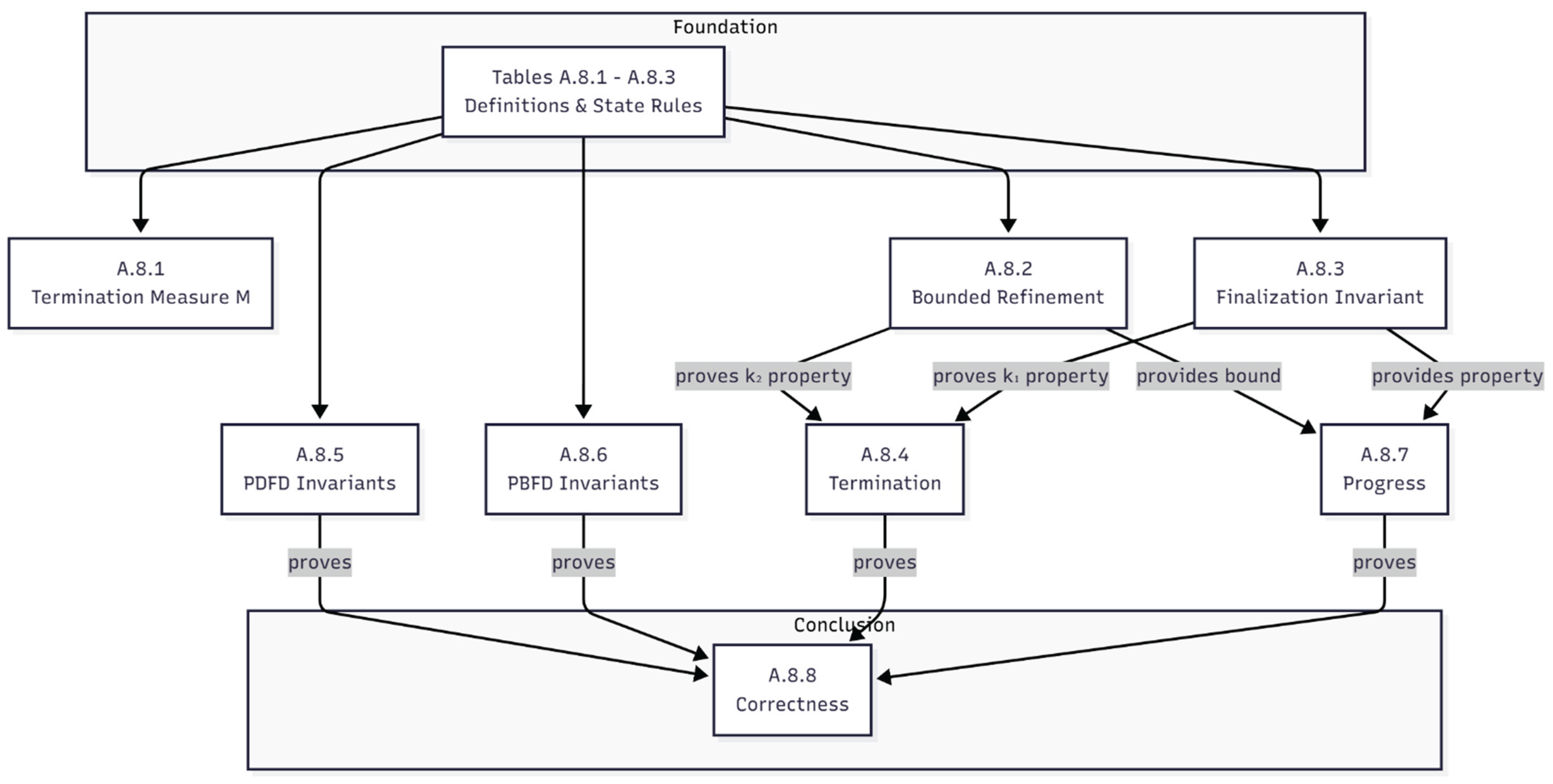
Appendix A.8.1. Termination Measure and State Transition Analysis
This subsection defines the lexicographic measure and state transition rules that form the basis of the termination argument. The subsequent lemmas prove the critical properties that ensure this measure is well-founded.
Definitions for Termination Proofsk
Table A.8.1.
Definitions and Invariants for Termination Proofs
| Term / Invariant Name | Type | Formal Definition / Condition |
|---|---|---|
| processing_complete(i) | Predicate | All nodes n in level(i) have been processed by the current phase's validation logic. |
| descendants_validated(n) | Predicate | All nodes in the processed subtree rooted at n have been permanently finalized (P(n) = 2). |
| nrl(j) | Function | The Next Refinement Level function, returning the lowest level k < j that still requires validation. |
| Kᵢ | Constant | A fixed batch size threshold for level i, used to trigger a batch commit in transition PD2b. |
| Descendant Finalization Invariant | Invariant | A node n is finalized only if all its processed descendants are finalized. |
| Refinement Locality Invariant | Invariant | Any backtrack targets j = trace_origin(i) and the refinement scope is contiguous. |
| Level-wise Ordering Invariant | Invariant | New patterns at level i+1 are produced only after Patternᵢ is validated. (Ensured by PB4a guard.) |
| Top-down Finalization Invariant | Invariant | The S₄ completion phase proceeds sequentially from level 1 up to L, ensuring no level is skipped. (PB7) |
| Refinement Locality Invariant (PBFD) | Invariant | Any backtrack targets j = trace_origin(i) and the refinement scope is limited to levels k ∈ [j, i]. (PB3) |
Lexicographic Measure
Define the tuple
M = (k₁, k₂, k₃, k₄)
With components:
- k₁: Count of unfinalized nodes — k₁ = |{n ∈ G | P(n) ≠ 2}|. (Highest priority.)
- k₂: Remaining refinement attempts across all levels — k₂ = ∑_{j ∈ ActiveLevels} (Rₘₐₓ − refinement_attempts(j)). (Finite, >0 in non-terminal states while attempts remain.)
- k₃ ∈ {4, 3, 2, 1, 0} → Phase ordinal (map phases to ordinals: S₀ = 4, S₁ = 3, S₂ = 2, S₃ = 1, S₄ = 0. A transition to a later phase reduces the numerical value of k₃)
- k₄ ∈ ℕ → Intra-phase progress measure (e.g., remaining nodes in a batch or pattern)
We use the lexicographic order on tuples (k₁, k₂, k₃, k₄). The termination proof requires that every non-terminal transition causes a strict lexicographic decrease of M. For each non-terminal transition, we identify the first non-zero component of ΔM (from left). The transition guarantees progress if and only if that component is negative. Termination proofs for software systems via lexicographic ranking functions [124,125,126,127,128,129] support this methodology.
Notation. We adopt: validated(n) ⟺ P(n)=2. trace_origin(i) and refinement_attempts(j) are as defined in Sections 3.4.1 and 3.4.2. Rₘₐₓ ∈ N⁺ is fixed.
Relationship of Measure Components to the Rules (Intuitive)
- k₁ decreases only on commit/finalization transitions (when nodes are permanently set P(n)=2).
- k₂ strictly decreases on refinement-entry transitions (each such transition consumes one refinement attempt for a level).
- k₃, k₄ measure local progress within phases and provide the necessary descent when k₁, k₂ remain unchanged for short steps. Multiple-component (lexicographic or multi-ranking) proofs remain a mainstream tool in termination analysis [125].
The remainder of this subsection lists the state transitions and their ΔM effects, which are used exhaustively in the proofs. The PDFD and PBFD state transition tables remain unchanged, but ΔM annotations are now supported by references [124,125,126,127,128,129] for lexicographic reasoning and [116,130] for CSP/concurrency reasoning.
Table A.8.2.
PDFD State Transition Impacts on M
| Rule | Transition | ΔM (Δk₁,Δk₂,Δk₃,Δk₄) | Key Condition | Type | Progress Justification (first non-zero component) |
|---|---|---|---|---|---|
| PD1 | S₀ → S₁(1) | — | i = 1 (initial) | Initial | Initialization (not used in lexicographic descent) |
| PD2 | S₁(i) → S₂(i) | (0,0,↓,↓) | processing_complete(i) ∧ ∃ n ∈ level(i): ¬validated(n) | Non-terminal | k₃ decreases (S₁→S₂) → progress |
| PD2a | S₂(i) → S₁(j) | (0,↓,↑,0) | j = trace_origin(i) ∧ refinement_attempts(j) < Rₘₐₓ (backtrack/refinement entry) | Non-terminal | k₂ decreases (attempt consumed) → progress |
| PD2b | S₂(i) → S₁(i+1) | (↓,0,↑,0) | ∑_{n ∈ level(i)} [P(n)=2] ≥ Kᵢ (commit/finalize batch) | Non-terminal | k₁ decreases (batch commit) → progress |
| PD3 | S₁(j) → S₂(j) | (0,0,↓,↓) | processing_complete(j) ∧ ∃ n ∈ level(j): ¬validated(n) | Non-terminal | k₃ decreases (S₁→S₂) → progress |
| PD3a | S₂(j) → S₁(nrl(j), i_orig) | (0,0,0,↓) | ∀ n ∈ level(j): validated(n) ∧ j < i (advance to next refinement level nrl(j)) | Non-terminal | k₄ decreases (intra-phase progress) → progress — PD3a treated intra-phase for M |
| PD3b | S₂(j) → S₂(i) | (0,0,0,↓) | ∀ n ∈ level(j): validated(n) ∧ j = i (resume original validation at level i) | Non-terminal | k₄ decreases (intra-phase progress) → progress |
| PD3c | S₂(j) → S₁(j) | (0,↓,↑,0) | processing_complete(j) ∧ ∃ n ∈ level(j): ¬validated(n) ∧ refinement_attempts(j) < Rₘₐₓ (retry refinement — consumes attempt) | Non-terminal | k₂ decreases (attempt consumed) → progress |
| PD4 | S₂(i) → S₃(i) | (0,0,↓,0) | processing_complete(i) ∧ (i = L ∨ level(i+1) = ∅) | Non-terminal | k₃ decreases (S₂→S₃) → progress |
| PD4a | S₃(i) → S₃(i−1) | (0,0,0,↓) | ∀ n ∈ level(i): validated(n) ∧ descendants_validated(n) | Non-terminal | k₄ decreases (intra-phase progress) → progress |
| PD4b | S₃(i) → S₁(j) | (0,↓,↑,0) | ∃ n ∈ level(i): ¬validated(n) ∧ j = trace_origin(i) ∧ refinement_attempts(j) < Rₘₐₓ (backtrack from bottom-up) | Non-terminal | k₂ decreases (attempt consumed) → progress |
| PD5 | S₃(2) → S₄(1) | (0,0,↓,↓) | i = 2 (bottom-up progress boundary) | Non-terminal | k₃ decreases (S₃→S₄) → progress |
| PD6 | S₄(i) → S₄(i+1) | (↓,0,0,0) | ∀ n ∈ level(i): validated(n) | Non-terminal | k₁ decreases (commit/finalize of level i). |
| PD6a | S₄(i) → S₁(j) | (0,↓,↑,0) | ∃ n ∈ level(i): ¬validated(n) ∧ j = trace_origin(i) ∧ refinement_attempts(j) < Rₘₐₓ (backtrack from completion) | Non-terminal | k₂ decreases (attempt consumed) → progress |
| PD6b | S₄(i) → S₅ | — | ∃ n ∈ level(i): ¬validated(n) ∧ (no refinement path remains for trace_origin(i)) (equivalently refinement_attempts(trace_origin(i)) ≥ Rₘₐₓ) | Terminal | Terminal (error) |
| PD7 | S₄(L) → T | — | ∀ i ∈ [1,L], ∀ n ∈ level(i): validated(n) | Terminal | Terminal (complete) |
| PD8 (generalized) | From ∈ {S₁(j), S₂(j), S₃(j)} → S₅ | — | refinement_attempts(j) ≥ Rₘₐₓ (no further attempts remain for level j) | Terminal | Terminal (exhaustion) |
Note: For the lexicographic measure M, PD3a (S₂ → S₁(nrl(j), i_orig)) is treated as intra-phase progress (k₃ unchanged) and the progress for this transition is recorded in k₄.
For every non-terminal rule in Table A.8.2, the lexicographic measure M = (k₁, k₂, k₃, k₄) undergoes a strict decrease. This is guaranteed by the following:
- k₁ Strict Decrease: The finalization transition PD2b and PD6 strictly reduces k₁ (unfinalized nodes), overriding any changes in lower-priority components.
- k₂ Strict Decrease: The refinement-entry transitions PD2a, PD3c, PD4b, and PD6a strictly reduce k₂ (remaining refinement attempts), ensuring lexicographic progress even when backtracking causes k₃ to increase temporarily.
- k₃ Decrease Role: Phase-progression transitions (PD2, PD3, PD4, PD5) strictly reduce k₃, ensuring forward progress. Although k₃ may temporarily increase during backtracking (PD2a, PD2b, PD3c, PD4b, PD6a), the overall lexicographic decrease is maintained by strict reduction of higher-priority components k₁ or k₂.
- k₄ Strict Decrease: The intra-phase traversals PD3a, PD3b, and PD4a strictly reduce k₄ (intra-phase progress), providing the necessary descent when all higher-priority components remain unchanged.
Terminal rules PD6b, PD7, and PD8 end the computation, yielding no further measure. Since every non-terminal transition guarantees a strict lexicographic decrease in M, the measure is well-founded, and the algorithm is guaranteed to terminate.
Table A.8.3.
PBFD State Transition Impacts on M
| Rule | Transition | ΔM (Δk₁,Δk₂,Δk₃,Δk₄) | Key Condition | Type | Progress Justification |
|---|---|---|---|---|---|
| PB1 | S₀ → S₁(1) | — | i = 1 | Initial | — |
| PB2 | S₁(i) → S₂(i) | (0,0,↓,↓) | ∃n ∈ Patternᵢ: ¬validated(n) | Non-terminal | k₃ decreases (3→2). |
| PB2a | S₁(i) → S₃(i) | (0,0,↓,0) | ∀n ∈ Patternᵢ: validated(n) | Non-terminal | k₃ decreases (3→1). |
| PB3 | S₂(i) → S₁(j) | (0,↓,↑,0) | (∃n ∈ Patternᵢ: ¬validated(n)) ∧ j = trace_origin(i) ∧ refinement_attempts(j) < Rₘₐₓ (refinement entry) | Non-terminal | k₂ decreases (attempt consumed). |
| PB3a | S₁(j) → S₂(j) | (0,0,↓,↓) | ∃n ∈ Patternⱼ: ¬validated(n) | Non-terminal | k₃ decreases (3→2). |
| PB3a1 | S₂(j) → S₃(j) | (0,0,↓,0) | ∀n ∈ Patternⱼ: validated(n) | Non-terminal | k₃ decreases (2→1). |
| PB3a2 | S₂(j) → S₁(j) | (0,↓,↑,0) | ∃n ∈ Patternⱼ: ¬validated(n) ∧ refinement_attempts(j) < Rₘₐₓ (retry refinement) | Non-terminal | k₂ decreases (attempt consumed). |
| PB3a3 | S₂(j) → S₅ | — | ∃n ∈ Patternⱼ: ¬validated(n) ∧ refinement_attempts(j) ≥ Rₘₐₓ (refinement exhausted) | Terminal | — |
| PB3b | S₁(j) → S₃(j) | (0,0,↓,0) | ∀n ∈ Patternⱼ: validated(n) | Non-terminal | k₃ decreases (3→1). |
| PB3c | S₂(i) → S₅ | — | (∃n ∈ Patternᵢ: ¬validated(n)) ∧ (trace_origin(i) undefined ∨ refinement_attempts(trace_origin(i)) ≥ Rₘₐₓ) (no valid trace_origin or attempts exhausted) | Terminal | — |
| PB4 | S₂(i) → S₃(i) | (0,0,↓,0) | ∀n ∈ Patternᵢ: validated(n) (refinement validated) | Non-terminal | k₃ decreases (2→1). |
| PB4a | S₃(i) → S₁(i+1) | (↓,0,↑,0) | i < L ∧ Pattern_{i+1} ≠ ∅ ((commit/finalize)) | Non-terminal | k₁ decreases (commit/finalize of Patternᵢ). |
| PB4b | S₃(i) → S₄(1) | (0,0,↓,0) | i = L ∨ Pattern_{i+1} = ∅ (enter completion) | Non-terminal | k₃ decreases (1→0). |
| PB5 | S₃(j) → S₁(j+1) | (0,0,0,↓) | j < i (refinement-range progress) | Non-terminal | k₄ decreases (refinement-range progress). |
| PB6 | S₃(j) → S₃(i) | (0,0,0,↓) | j = i (return from refinement) | Non-terminal | k₄ decreases (intra-phase progress/return). |
| PB7 | S₄(i) → S₄(i+1) | (↓,0,0,0) | ∀n ∈ Patternᵢ: processed(n) | Non-terminal | k₁ decreases (commit/finalize of Patternᵢ). |
| PB7a | S₄(i) → S₁(j) | (0,↓,↑,0) | ∃n∈Patternᵢ:¬ processed(n)∧j=trace_origin(i)∧refinement_attempts(j)< Rₘₐₓ (backtrack from completion) | Non-terminal | k₂ decreases (attempt consumed). |
| PB7b | S₄(i) → S₅ | — | ∃n∈Patternᵢ:¬ processed(n)∧¬(j=trace_origin(i)∧refinement_attempts(j)< Rₘₐₓ) (unvalidated nodes and no refinement option) | Terminal | — |
| PB8 | S₄(L) → T | — | ∀i ∈ [1,L], ∀n ∈ Patternᵢ: validated(n) (all validated) | Terminal | — |
| PB9 | S₁(j) → S₅ | — | refinement_attempts(j) ≥ Rₘₐₓ (attempts exhausted) | Terminal | — |
Notes:
- Transitions that decrement k₂ (remaining refinement attempts) are PB3, PB3a2, and PB7a. Each consumes exactly one attempt.
- k₁ (unfinalized nodes) is strictly reduced only by the commit/finalization transitions PB4a (forward pass) and PB7 (completion phase). These dominate all lower-priority changes.
- PB4a is the forward commit step finalizing Patternᵢ before moving to Patternᵢ₊₁.
- PB5 and PB6 represent intra-refinement navigation and strictly reduce k₄, not k₁.
For every non-terminal rule in Table A.8.3, the lexicographic measure
M = (k₁, k₂, k₃, k₄) strictly decreases. This is ensured by:
- k₁ Strict Decrease: PB4a and PB7 finalize nodes, reducing the highest-priority component.
- k₂ Strict Decrease: PB3, PB3a2, and PB7a consume refinement attempts and strictly reduce k₂, ensuring lexicographic progress even when backtracking causes k₃ to increase temporarily.
- k₃ Decrease Role: The phase-progression transitions PB2, PB2a, PB3a, PB3a1, PB3b, PB4, and PB4b strictly reduce k₃ (phase ordinal), ensuring forward progress through the main execution path. Although k₃ may temporarily increase in commit transition PB4a and refinement/backtracking transitions (PB3, PB3a2, PB7a), the overall lexicographic decrease is guaranteed by the strict reduction of higher-priority components k₁ or k₂.
- k₄ Strict Decrease: PB5 and PB6 reduce intra-phase progress when higher-priority components remain unchanged.
Terminal rules PB3a3, PB3c, PB7b, PB8, and PB9 end the computation and do not require measure reduction.
Since every non-terminal transition strictly decreases M lexicographically, the measure is well-founded and termination is guaranteed.
∎
Appendix A.8.2. Lemma (Bounded Refinement)
Statement. For all levels k∈ [1, L]: □(refinement_attempts(k) ≤ Rₘₐₓ). In any non-terminal state, any active refinement target j satisfies refinement_attempts(j) < Rₘₐₓ. Terminal states S₅ are reached only when an attempt bound is exhausted.
Proof.
- Base Case. At initial state S₀: ∀k: refinement_attempts(k)=0 ≤ Rₘₐₓ. The statement holds vacuously.
- Inductive Step. Assume in state S the invariant holds. Consider a transition S → S′. Only refinement-entry rules increment refinement_attempts(j). From Tables A.8.2. - A.8.3. these are explicitly guarded by refinement_attempts(j) < Rₘₐₓ (PD2a, PD3c, PD4b, PD6a for PDFD; PB3, PB3a2, PB7a for PBFD). Hence any increment preserves refinement_attempts(j) ≤ Rₘₐₓ. All other rules leave all refinement counters unchanged. Terminal rules (e.g., PD6b, PD8, PB3a3, PB9, PB7b, PB3c) fire only when refinement_attempts(j) ≥ Rₘₐₓ for some j. Terminal transitions (which fire only when refinement_attempts(j) ≥ Rₘₐₓ) do not increment counters, preserving the invariant.
- Conclusion. By induction on transitions, the counter is bounded by Rₘₐₓ at all times. Since at most L levels can each suffer at most Rₘₐₓ increments, the total number of refinement attempts is bounded by L ⋅ Rₘₐₓ. Thus k₂ is finite and strictly decreases on each refinement entry until exhaustion.
∎
Appendix A.8.3. Lemma (Finalization Monotonicity)
Statement.Once a node n has been permanently finalized (P(n)=2), it remains finalized unless a refinement backtrack explicitly resets it. Resets occur only on refinement-entry rules and are strictly controlled by attempt bounds. Moreover, across execution, k₁ (the count of unfinalized nodes) is monotone non-increasing except when a controlled reset (paired with a decrease in k₂) occurs.
Proof.
- Base Case. Initially no node is finalized (P(n) ≠ 2 for all n). The statement holds vacuously in the initial state.
- Finalization Step: Per Tables A.8.2-A.8.3, the rules that set nodes to finalized (i.e., produce committed P(n)=2) are the commit/finalize transitions PDFD: PD2b and PD6; PBFD: PB4a and PB7). In both algorithms, these transitions strictly reduce k₁. No other transition creates P(n)=2.
- Reset rules. The only rules that may reset previously finalized nodes to non-finalized ones (i.e., potentially Δk₁ > 0) are refinement-entry/backtrack rules (PD2a, PD3c, PD4b, PD6a; PB3, PB3a2, PB7a). Each such rule has the guard refinement_attempts(j) < Rₘₐₓ and the operational semantics of attempting correction. On taking such a rule, k₂ strictly decreases (since refinement_attempts(j) is incremented). No non-refinement rule resets finalized nodes.
- Lexicographic compensation. Therefore, any transition that reverses finalization (i.e., a reset that potentially increases k₁) is guaranteed to be a refinement-entry transition that strictly decreases k₂. Hence the pair (k₁, k₂) is lexicographically non-increasing across transitions: a rise in k₁ is strictly compensated by a fall in k₂.
- Conclusion. k₁ is monotone non-increasing unless a bounded, recorded refinement reset occurs; such resets are bounded by Lemma A.8.2. Thus the finalization invariant holds.
∎
Appendix A.8.4. Lemma (Termination Guarantee)
Statement.For any finite tree G = (V, E) and finite parameters L, Rₘₐₓ∈ N⁺, any execution of PDFD or PBFD terminates in either:
- Success T: all nodes finalized (∀n ∈ V: P(n) = 2), or
- Bounded failure S₅: refinement exhausted for some level (∃j: refinement_attempts(j) = Rₘₐₓ).
Proof.
-
Well-foundedness. Each component of M = (k₁, k₂, k₃, k₄) ranges over a well-founded (finite or well-ordered) set:
- ○
- 0 ≤ k₁ ≤ |V|.
- ○
- 0 ≤ k₂ ≤ L ⋅ Rₘₐₓ.
- ○
- k₃ ∈ {0, 1, 2, 3, 4}.
- ○
- k₄ bounded by finite batch sizes (≤|V|).
Thus no infinite strictly decreasing sequence in M exists.
-
Measure descent on transitions. From the exhaustive ΔM annotations in Tables A.8.2- A.8.3, every non-terminal transition strictly decreases M in lexicographic order:
- ○
- If a non-terminal transition finalizes nodes, it decreases k₁.
- ○
- If it is a refinement-entry, it decreases k₂.
- ○
- Otherwise the phase/intra-phase components (k₃, k₄) strictly decrease.
- No infinite execution sequences. Since M decreases on every non-terminal step and M is well-founded, the system cannot execute infinitely many non-terminal moves. Therefore, every execution sequence reaches a terminal state.
- Terminal classification. Terminal rules in Tables A.8.2-A.8.3 correspond exactly to either all nodes validated (PD7, PB8) or to a bounded failure from exhausted refinements (PD6b, PD8, PB3a3, PB3c, PB7b, PB9). These cases partition all terminal states. Hence termination leads to either T or S₅.
∎
Appendix A.8.5. Lemma (Invariant Preservation for PDFD)
Statement.Across all reachable states of PDFD, the following invariants hold:
- Descendant finalization invariant. A node at level i is not considered finally complete unless all nodes in its processed subtree are finalized (guards enforced by PD4a/PD6/PD7).
- Refinement locality. Backtracks always target j = trace_origin(i) with j ≤ i; refinement scope is contiguous and anchored.
Proof.
- Base Case. The initial state S₀ satisfies both invariants vacuously: no nodes are finalized yet, and no refinement operations have been initiated. Therefore, both the descendant finalization invariant and refinement locality invariant hold trivially.
-
Inductive Step. Assume both invariants hold in state S. Consider any transition S → S′ according to Table A.8.2. We show that S′ preserves both invariants:
- ○
- Descendant finalization invariant. Transitions that finalize nodes or advance levels (PD4a, PD6, PD7) are strictly guarded by conditions requiring validated(n) or descendants_validated(n) to be true. These guards explicitly enforce that a node is finalized only when its processed descendants are already finalized. All other transitions either do not affect finalization status or are refinement backtracks that temporarily reset nodes (addressed by refinement locality).
- ○
- Refinement locality invariant. Backtrack transitions (PD2a, PD3c, PD4b, PD6a) compute the target level j using the trace_origin function, which by definition satisfies j ≤ i. The guard conditions ensure that refinement scope remains contiguous within the range [j, i]. Non-backtrack transitions do not modify refinement relationships.
- Conclusion. By induction on the transition sequence, both invariants are preserved across all reachable states. The exhaustive nature of the state transitions in Table A.8.2 guarantees that no invariant-violating state is reachable.
∎
Appendix A.8.6. Lemma (Invariant Preservation for PBFD)
Statement.Across all reachable states of PBFD:
- Level-wise ordering. Children/pattern at level i+1 are produced only after Patternᵢ is validated (PB4a).
- Top-down finalization in completion. PB7/PB8 iterate from level 1 upward without skipping.
- Refinement locality. Backtracks always target j = trace_origin(i) with j ≤ i; refinement scope is contiguous and anchored (PB3).
Proof.
- Base Case. The initial state S₀ satisfies all three invariants vacuously: no patterns have been processed, no finalization has begun, and no refinement operations have been initiated. Therefore, all invariants hold trivially in the initial state.
-
Inductive Step. Assume all three invariants hold in state S. Consider any transition S → S′ according to Table A.8.3. We show that S′ preserves all invariants:
- ○
- Level-wise Ordering Invariant. The transition PB4a, which advances from Patternᵢ to Patternᵢ₊₁, is strictly guarded by the condition that Patternᵢ is fully validated. This guard ensures that no pattern at level i+1 is produced unless the preceding pattern has been successfully validated. All other transitions either operate within a single level or do not produce new patterns.
- ○
- Top-down Finalization Invariant. The completion phase transitions (PB7, PB8) progress sequentially through S₄(i) → S₄(i+1), with each step guarded by ∀n ∈ Patternᵢ: processed(n). This ensures that levels are finalized in strict ascending order from 1 to L without skipping. Backtrack transitions from S₄ (PB7a) do not violate this invariant as they temporarily exit completion mode.
- ○
- Refinement Locality Invariant. Refinement backtrack transitions (PB3, PB3a2, PB7a) compute the target level j using the trace_origin function, which by definition satisfies j ≤ i. The guard conditions and operational semantics ensure that refinement scope remains contiguous within [j, i]. Non-refinement transitions do not modify these relationships.
- Conclusion. By induction on the transition sequence, all three invariants are preserved across all reachable states. The exhaustive nature of the state transitions in Table A.8.3. guarantees that no invariant-violating state is reachable.
∎
Appendix A.8.7. Lemma (Unified Progress)
Statement.From any non-terminal state, there exists an enabled transition whose execution causes a strict lexicographic decrease in M.
Proof.
This is guaranteed by the design of the state machines and measure: By the exhaustive annotation of Tables A.8.2 and A.8.3, for every non-terminal state, at least one transition rule is enabled by its guard condition, and the ΔM for that rule shows a strict lexicographic decrease. This is by construction of the state machines. Lemmas A.8.2 and A.8.3 guarantee that decreases in k₂ and k₁ are well-founded and therefore prevent indefinite stuttering in k₃, k₄.
∎
Appendix A.8.8. Theorem (Total Correctness)
Statement.PDFD and PBFD always terminate and upon termination satisfy their postconditions:
- Terminate in T (all nodes validated) or S₅ (refinement exhausted).
- Structural invariants (descendant finalization, refinement locality, level ordering) hold at all reachable states.
Proof.
Follows directly from Lemmas A.8.2–A.8.7 and the invariant guarantees in A.8.5 and A.8.6:
- Termination by Lemma A.8.4.
- Partial correctness by Lemmas A.8.5–A.8.6 (invariants). Upon termination in state T, the postcondition ∀n ∈ V, P(n)=2 is met directly by the guard of the terminal rule (PD7/PB8). The structural invariants ensure this final state is internally consistent.
- Progress/no stalling by Lemma A.8.7.
Therefore both algorithms satisfy total correctness: termination and preservation of required invariants; terminal states meet the declared postconditions.
∎
Corollaries
- A.8.2.1 (Boundedness). Total number of refinement attempts ≤ L ⋅ Rₘₐₓ.
- A.8.3.1 (Finalization Permanence). Once P(n)=2 outside an active refinement rollback, it remains 2; any temporary reset is only through guarded refinement-entry transitions, is bounded by Lemma A.8.2, and is always accompanied by a strict decrease in the k₂ component of the measure M.
- A.8.4.1 (Temporal completeness). From start, eventually the run reaches either success T or bounded failure S₅: □(start ⇒ ◊(T ∨ S₅)).
Appendix A.8.9. Proof Mermaid Code
flowchart TD
subgraph Foundation [Foundation]
A[Tables A.8.1-A.8.3<br>Definitions & State Rules]
end
A --> B[A.8.1<br>Termination Measure M]
A --> C[A.8.2<br>Bounded Refinement]
A --> D[A.8.3<br>Finalization Invariant]
A --> E[A.8.5<br>PDFD Invariants]
A --> F[A.8.6<br>PBFD Invariants]
C -- proves k₂ property --> G[A.8.4<br>Termination]
D -- proves k₁ property --> G
C -- provides bound --> H[A.8.7<br>Progress]
D -- provides property --> H
subgraph Conclusion [Conclusion]
I[A.8.8<br>Correctness]
end
E -- proves --> I
F -- proves --> I
G -- proves --> I
H -- proves --> I
Appendix A.9. TLE Mermaid Code, Algorithm, and Process Algebra
Appendix A.9 provides the formal specification for the Three-Level Encapsulation (TLE) technique, covering its Mermaid diagrams, pseudocode, and CSP model.
Appendix A.9.1. Structural Workflow Mermaid Code
graph TD
%% Compact Layout for Single Column
subgraph Legend
LG1[Level N]
LG2[Level N+1]
LG3[Level N+2]
%% Vertical layout within legend
LG1 --- LG2
LG2 --- LG3
end
%% Main structure with condensed labels
G[Grandparent] --> P1[Parent A]
G --> P2[Parent B]
G --> P3[Parent C]
P1 --> B1[Bitmask A1]
P2 --> B2[Bitmask B1]
P3 --> B3[Bitmask C1]
%% Colors
classDef level1 fill:#E1F5FE,stroke:#039BE5
classDef level2 fill:#FFF8E1,stroke:#FBC02D
classDef level3 fill:#E8F5E9,stroke:#388E3C
class G level1
class P1,P2,P3 level2
class B1,B2,B3 level3
class LG1 level1
class LG2 level2
class LG3 level3
Appendix A.9.2. State Machine Mermaid Code
stateDiagram-v2
state "S₀: Idle" as S0
state "S₁: Data Loaded" as S1
state "S₂: Hierarchy Resolved" as S2
state "S₃: Children Evaluated" as S3
state "S₄: Children Updated" as S4
state "S₅: Changes Committed" as S5
state "S₆: Workflow Finalized" as S6
[*] --> S0 : TLE1 - System Start
S0 --> S1 : TLE2 - initiate_workflow(Grandparent)
S0 --> S6 : TLE11 - ¬has_unprocessed_unit()
S1 --> S2 : TLE3 - resolve_hierarchy()
S2 --> S3 : TLE4 - evaluate_children()
S3 --> S4 : TLE5 - update_required ∧ apply_update()
S3 --> S5 : TLE6 - ¬update_required
S4 --> S5 : TLE7 - persist_changes()
S5 --> S0 : TLE8 - has_next_unit()
S5 --> S6 : TLE9 - ¬has_next_unit()
S6 --> S0 : TLE10 - Workflow Complete
Appendix A.9.3. Algorithm (Pseudo Code)
Algorithm TLE(Pages)
Procedure TLE_EventDriven(Units)
Input: Units – list of TLE data units (e.g., grandparent entities) to process
Output: Tree with bitmask-encoded children selections finalized
1: currentState ← S₀ // TLE1: [*] → S₀. System Start
2: currentUnit ← NULL
// TLE process runs continuously, reacting to external events
3: while System_Running do
4: switch currentState
5: case S₀: // Idle (TLE_S0). Awaiting load or finalization signal.
6: // TLE2: load(u) → S₁ | TLE11: no_next_unit(u) → S₆
7: event ← WaitForEvent({load, no_next_unit}) // Wait for next unit or end-of-batch
8: if event.type == load then
9: currentUnit ← event.Unit // Store the unit parameter (u)
10: currentState ← S₁(currentUnit)
11: else if event.type == no_next_unit then
12: currentUnit ← event.Unit // Unit being finalized (passed from environment)
13: currentState ← S₆(currentUnit)
14: // Note: Unit parameter is always received from the environment here (load/no_next_unit)
15:
16: case S₁(u): // Data Loaded (TLE_S1(u)). Awaiting hierarchy resolution.
17: // TLE3: hierarchy_resolved(u) → S₂
18: event ← WaitForEvent({hierarchy_resolved})
19: if event.Unit == u then // Check for unit-specific synchronization
20: resolve_hierarchy() // TLE3 Action (Internal resolution)
21: currentState ← S₂(u)
22:
23: case S₂(u): // Hierarchy Resolved (TLE_S2(u)). Awaiting children evaluation.
24: // TLE4: children_evaluated(u) → S₃
25: event ← WaitForEvent({children_evaluated})
26: if event.Unit == u then
27: child_nodes ← evaluate_children() // TLE4 Action: Iterative READ
28: currentState ← S₃(u)
29:
30: case S₃(u): // Children Evaluated (TLE_S3(u)). Conditional path: update or skip.
31: // TLE5: children_updated(u) → S₄ | TLE6: skip_update(u) → S₅
32: event ← WaitForEvent({children_updated, skip_update})
33: if event.Unit == u then
34: if event.type == children_updated then // TLE5 (WRITE required)
35: apply_update(child_nodes) // TLE5 Action
36: currentState ← S₄(u)
37: else // event.type == skip_update (TLE6)
38: currentState ← S₅(u)
39:
40: case S₄(u): // Children Updated (TLE_S4(u)). Awaiting changes commit.
41: // TLE7: changes_committed(u) → S₅
42: event ← WaitForEvent({changes_committed})
43: if event.Unit == u then
44: persist_changes() // TLE7 Action: COMMIT
45: currentState ← S₅(u)
46:
47: case S₅(u): // Changes Committed (TLE_S5(u)). Signalling readiness or finalization.
48: // TLE8: has_next_unit → S₀ | TLE9: no_next_unit(u) → S₆
49: // The process emits the readiness/finalization signal and transitions immediately.
50: if HasNextUnitAvailable() then
51: EmitEvent(has_next_unit) // TLE8 Action (Unparameterized signal)
52: currentState ← S₀ // Loop back to S₀ to await new work
53: else
54: EmitEvent(no_next_unit.u) // TLE9 Action (Parameterized signal)
55: currentState ← S₆(u)
56:
57: case S₆(u): // Workflow Finalized (TLE_S6(u)). Final action and system reset.
58: // TLE10: finalize_process(u) → S₀
59: EmitEvent(finalize_process.u) // TLE10 Action
60: currentState ← S₀ // TLE10: Transition back to S₀ to await new unit
61:
62: end switch
63: end while
64: return
End Procedure
Appendix A.9.4. CSP Implementation and Formal Verification
The complete CSPM model (FDR 4.2.7 compatible) implementing all operations from Algorithm A.9.3 and state transitions from Table 48 and Table 49 is available in our supplementary repository.
Verification Status: All 49 formal properties were successfully verified, including deadlock freedom, divergence freedom, deterministic behavior, correct sequencing of TLE1–TLE11 transitions, and behavioral conformance to the abstract specification (TLE_Abstract_Process). Unit-specific guarantees such as WaitForEvent(u) synchronization, EmitEvent(u) propagation, and recurrence S₆ → S₀ were validated.
Repository Access:
GitHub: https://github.com/IBM-Consulting-Formal-Methods/TLE_CSP (commit: 7e5b6c3)
The model includes all TLE processes (S0, S1(u), S2(u), S3(u), S4(u), S5(u), S6(u)), event channels, and unit parameterization (u1, u2, u3) as documented in Tables A.9.1. - A.9.2. The repository README provides detailed verification instructions and complete FDR 4.2.7 assertion results.
Appendix A.9.5. TLE (Three-Level Encapsulation) Technique Tables
The TLE technique's formal specification is further detailed through Table A.9.1, which provides a unified set of definitions for both the pseudocode and CSP models. Table A.9.2. then outlines the core CSP process algebra, detailing the state transitions and key events that correspond to the pseudocode.
Table A.9.1.
TLE Technique - Unified Definitions (Pseudocode + CSP)
| Pseudocode Term | Type | Description | Pseudocode Lines | CSP Mapping |
|---|---|---|---|---|
| Algorithm & States | ||||
| Algorithm TLE(Units) | Meta-Process | Coordinates the tree-leaf encoding pipeline. | Header | TLE_Process(start→ TLE_S0) |
| currentState | State Variable | Tracks the current stage of the TLE process. | 1, 4, 10, 13, 21, 28, 36, 38, 45, 52, 55, 60 | (Implicit in CSP State Processes TLE_Sₓ(u)) |
| S₀ | State | Idle. Waiting for input. | 5, 52, 60 | TLE_S0 |
| S₁ | State | Data Loaded. A TLE unit is loaded. | 10, 16 | TLE_S1(u) |
| S₂ | State | Hierarchy Resolved. Parent levels identified. | 21, 23 | TLE_S2(u) |
| S₃ | State | Children Evaluated. Child states processed. | 28, 30 | TLE_S3(u) |
| S₄ | State | Children Updated. Child states modified. | 36, 40 | TLE_S4(u) |
| S₅ | State | Changes Committed. Modifications persisted. | 38, 45, 47 | TLE_S5(u) |
| S₆ | System End State | Workflow Finalized. Process complete. | 13, 55, 57 | TLE_S6(u) |
| Functions & Actions | ||||
| LOAD(Grandparent) | Core TLE Op | Loads a TLE data unit. | 9 | load?u:UNIT (Input) |
| resolve_hierarchy() | Processing Function | Resolves and validates hierarchy. | 20 | hierarchy_resolved.u (Output) |
| evaluate_children() | Processing Function | Reads and logically processes children. | 27 | children_evaluated.u (Output) |
| apply_update(...) | Core TLE Op | WRITE. Modifies child states. | 35 | children_updated.u (Output) |
| persist_changes() | Core TLE Op | COMMIT. Persists changes. | 44 | changes_committed.u (Output) |
| finalize_process() | System Function | Completes the TLE algorithm. | 59 | finalize_process.u (Output) |
| Conditions | ||||
| update_required | Condition | Trigger for WRITE operation. | 34 | (Implied by children_updated.u choice in TLE_S3) |
| has_next_unit() | Condition / Signal | Checks if more units exist. | 50 | has_next_unit (Output, Valueless) |
| ∃ unprocessed unit... | Condition | Checks if more units exist. | 7 | (Implicit in load?u:UNIT choice in TLE_S0) |
| CSP-Specific Events | ||||
| load | CSP Input | Signals a unit is ready for processing. | 7 | load?u:UNIT |
| no_next_unit | CSP I/O | Signals no more units. | 7, 11, 48, 54 | S0: Input (?u); S5: Output (.u) |
| skip_update | CSP Output | Signals no update was required, skipping to commit. | 32, 37 | skip_update.u |
Table A.9.2.
TLE Technique - CSP Process Algebra Core (States + Transitions)
| CSP Process | Key Transitions (TLE Ref.) | Pseudocode Lines | CSP Events (Simplified) |
|---|---|---|---|
| S₀ (TLE_S0) |
TLE1: Start → S₀ | 1 | (start→TLE_S0)→TLE_S0 (via TLE_Process) |
| TLE2: load(u) → S₁ | 7–10 | load?u:UNIT → TLE_S1(u) | |
| TLE11: no_next_unit(u) → S₆ | 7, 11–13 | no_next_unit?u:UNIT → TLE_S6(u) | |
| S₁(u) (TLE_S1(u)) | TLE3: hierarchy_resolved(u) → S₂ | 18–21 | hierarchy_resolved.u → TLE_S2(u) |
| S₂(u) (TLE_S2(u)) | TLE4: children_evaluated(u) → S₃ | 25–28 | children_evaluated.u → TLE_S3(u) |
| S₃(u) (TLE_S3(u)) | TLE5: children_updated(u) → S₄ | 32, 34–36 | children_updated.u → TLE_S4(u) |
| TLE6: skip_update(u) → S₅ | 32, 37–38 | skip_update.u → TLE_S5(u) | |
| S₄(u) (TLE_S4(u)) | TLE7: changes_committed(u) → S₅ | 42–45 | changes_committed.u → TLE_S5(u) |
| S₅(u) (TLE_S5(u)) | TLE8: has_next_unit → S₀ | 50–52 | has_next_unit → TLE_S0 |
| TLE9: no_next_unit(u) → S₆ | 53–55 | no_next_unit.u → TLE_S6(u) | |
| S₆(u) (TLE_S6(u)) | TLE10: finalize_process(u) → S₀ | 58–60 | finalize_process.u → TLE_S0 |
| Top-Level (TLE_Process) | System Start → S₀ | 1 | start → TLE_S0 |
Appendix A.9.6. Formal Verification Methodology and Scope
Verification Framework
All analyses were conducted using FDR 4.2.7 with standard behavioral reduction (sbisim, diamond elimination) and breadth-first state exploration.
Table A.9.3.
Coverage of the 49 Verification Assertions
| Category | Count | Coverage |
|---|---|---|
| Core System Safety | 4 | Deadlock freedom; behavioral refinement (T, F, FD) |
| State-Level Reliability | 38 | Two specifications: S₀ (non-param) + S₁–S₆ (3 units each) |
| Liveness Guarantees | 2 | Divergence checks for TLE_Process and TLE_Abstract_Process |
| Composition & Robustness | 5 | Concurrency checks (2), hostile-environment checks (2), determinism (1) |
| Total | 49 | Complete verification of safety, liveness, and concurrency |
Assertion Breakdown
Core System Safety (4):
- TLE_Process :[deadlock free]
- TLE_Process [T= TLE_Abstract_Process]
- TLE_Process [F= TLE_Abstract_Process]
- TLE_Process [FD= TLE_Abstract_Process]
State-Level Reliability (38):
- Implementation states: S₀ (1) + S₁–S₆ × (u₁, u₂, u₃) (18) = 19
- Abstract states: Abstract_S₀ (1) + Abstract_S₁–S₆ × (u₁, u₂, u₃) (18) = 19
Liveness Guarantees (2):
- TLE_Process :[divergence free]
- TLE_Abstract_Process :[divergence free]
Composition & Robustness (5):
- TLE_TwoUnits :[deadlock free] (parallel composition test)
- TLE_Abstract_TwoUnits :[deadlock free] (abstract parallel test)
- TLE_Hostile_System :[deadlock free] (hostile environment robustness)
- TLE_HostileEnv :[deadlock free] (hostile environment itself)
- TLE_Process :[deterministic [F]] (internal determinism)
Reproducibility
All 49 checks can be reproduced by loading the CSP model (tle_model.csp) in FDR 4.2.7 and executing the assertions. The parameterized unit design (u₁, u₂, u₃) enables tractable exploration of both sequential and concurrent scenarios, with all assertions passing consistently.
Appendix A.10. Proofs of TLE Theorems
Notation: See Table A.1.8 for formal definitions of symbols used in this section.
Theorem A.10.1. (Storage Complexity).The TLE storage ratio compared to traditional foreign key representation is
where:
- Ć is the average bitmask size (in bits) across all parent entities,
- ĉ is the average number of children per parent,
- k is the storage size (in bits) required per stored relationship in the traditional representation.
For sparse hierarchies where Ć≪ ĉk, TLE yields substantial storage reduction.
Proof.
In the traditional foreign-key relational schema, each parent→child relationship requires storing a foreign key.
Let:
be the total number of parent→child relationships across the hierarchy.
Each relationship requires k bits of storage, so:
In TLE, each parent stores a bitmask of size bits. Total TLE storage is the sum of all bitmask sizes:
Define:
Interpretation.
If the bitmask size is approximately equal to the average number of children:
Ć ≈ ĉ
Then
→ TLE yields a k-fold storage reduction.
For sparse hierarchies where bitmasks are much smaller:
TLE achieves even greater savings (ratio <1/k).
In practice, TLE minimizes storage when children are sparse and bitmasks remain compact, as confirmed by empirical evaluation in Section 5.
∎
Theorem A.10.2. (Query Complexity).For hierarchies where the number of children per parent n ≤ w (machine word size, typically 64 bits), TLE enables constant-time O(1) lookups for child selection status. For n > w requiring multi-word bitmasks, lookup complexity is O(⌈n/w⌉).
Proof.
For n ≤ w, the lookup operation for a specific child c under parent p and root (grandparent) entity g consists of:
- Root Access: O(1) via direct or indexed lookup on g.
- Bitmask Retrieval: O(1) access to the fixed-width integer column for p.
- Bitwise Check: O(1) operation: (bitmask >> c_id) & 1.
Each step is a constant-time operation. The total time complexity is therefore:
For n > w, the bitmask requires ⌈n/w⌉ words (or equivalent variable-width encoding). The bitwise check requires identifying the correct word segment and bit position, yielding O(⌈n/w⌉) complexity.
In practice, for hierarchies with bounded branching factors (n ≤ 64), which is typical in enterprise systems, the operation is constant-time.
∎
Theorem A.10.3. (Update Complexity).For hierarchies where the number of children per parent n ≤ w (machine word size, typically 64 bits), TLE supports constant-time O(1) updates to child states. For n > w requiring multi-word bitmasks, update complexity is O(⌈n/w⌉).
Proof.
For n ≤ w, the update operation for a specific child c under parent p and root (grandparent) entity g consists of:
- Root Access: O(1) via direct or indexed lookup on g.
- Bitmask Update: A single, constant-time bitwise operation:
Set: bitmask |= (1 << c_id)
Clear: bitmask &= ~(1 << c_id)
Toggle: bitmask ^= (1 << c_id)
- 3.
- Write-back: O(1) operation to persist the updated fixed-width field.
Each step is a constant-time operation. The total time complexity is therefore:
For n > w, the bitmask update requires identifying and modifying the appropriate word segment, yielding O(⌈n/w⌉) complexity for both the bitwise operation and write-back.
In practice, for hierarchies with bounded branching factors (n ≤ 64), which is typical in enterprise systems, the operation is constant-time.
∎
Theorem A.10.4. (Batch Processing Complexity).For hierarchies with bounded branching factor ( ≤ w), processing all relationships in a TLE structure requires O(time, where is the total number of parent entities.
Proof.
An operation that must process every relationship (e.g., a full data export) must:
- 1.
- Iterate over each grandparent entity.
For each grandparent, iterate over each of its
- 2.
- parent entities.
- 3.
- For each parent entity, process its bitmask.
The bitmask processing cost depends on the number of children n relative to word size w:
- ○
- O(1) for fixed-width integer fields when n ≤ w
- ○
- O(⌈n/w⌉) for variable-width encodings when n > w
Thus, each parent's bitmask can be processed in O(⌈/w⌉) time, where is the maximum children per parent across the hierarchy, the total time complexity is :
For bounded branching factors ( ≤ w, typical in enterprise hierarchies with 64-bit integers), this simplifies to:
Comparison to Alternative Approaches
Alternative hierarchy traversal methods incur higher computational cost (see Table A.10.1).
Table A.10.1.
Complexity comparison of hierarchical traversal approaches
| Approach | Complexity | Practical Characteristics |
|---|---|---|
| ≤ w) | Linear scan, cache-friendly, predictable | |
| B-tree indexed adjacency | Logarithmic overhead per parent lookup | |
| ContinentViewModel | Depth-dependent; degrades for deep hierarchies |
B-tree indexed adjacency lists: Each parent lookup requires O(log n) time in an n-node hierarchy. Processing all parents to locate their children requires for index traversals. For a single parent with k children, the total cost is O(logn + k): O(log n) index search plus O(k) retrieval time.
Recursive CTEs: Evaluating hierarchy materialization requires iterative processing proportional to hierarchy depth d, yielding . While theoretical complexity bounds exist [131], practical performance degrades significantly for deep hierarchies where d≫ log n, compared to TLE's flat traversal.
Conclusion
TLE traversal achieves asymptotic optimality for bounded hierarchies: matches the theoretical lower bound Ω() for reading entities. This efficiency, combined with cache-friendly sequential access patterns, enables scalable PBFD pattern evaluation over TLE-encoded tables, supporting efficient pattern-driven development workflows.
∎
Discussion
Beyond the complexity advantages established in Theorems A.10.1–A.10.4, the Three-Level Encapsulation (TLE) model offers structural benefits not available in conventional hierarchical encodings. Unlike nested sets [132], which require O(n) relabeling when modifying tree structure, or standard adjacency lists [133], which depend on recursive traversal or materialized transitive closure to reconstruct hierarchy, TLE enables constant-time bitmask operations while preserving a fully normalized relational schema.
These theoretical bounds are further supported by empirical results (Section 5 and Appendix A.14), confirming that TLE’s asymptotic advantages yield measurable performance improvements in PBFD batch evaluation and pattern-driven development workflows.
Appendix A.11. The PDFD MVP
Appendix A.11.1. Overview of the PDFD MVP
Purpose: This section details a working implementation of the Primary Depth-First Development (PDFD) methodology within a real-world application: the "Logging Visited Places" use case (Section 3.3.1, item 10), developed mainly between 12/11/2024 and 12/25/2024 using Microsoft ASP.NET MVC. This MVP serves as a concrete instantiation of the formal PDFD framework, grounded on the PDFD formal model detailed in Section 3.4.1.
Caveat: For brevity, this PDFD demonstration is an MVP focusing on core traversal and pattern derivation. While reflecting PDFD's progression criteria (Section 3.4.1, item 5, Table 33), it omits exhaustive processing phases/features of the full methodology. Our formal guarantees (Appendix A.8) apply solely to this complete specification.
Reproducibility & Research Context: The repository includes generation/migration scripts, sample datasets, and deployment instructions [28]. These artifacts enable reproducible experiments and controlled comparisons against normalized or graph-based alternatives, supporting the formal empirical evaluation presented in Section 5.
Appendix A.11.2. Objective
The primary objective of developing this Minimum Viable Product (MVP) was to validate the practical applicability of the PDFD methodology (as defined in Section 3.4.1) to real-world hierarchical workflows, as exemplified by the "Logging Visited Places" use case and its alignment with the business model in Figure 3.
Appendix A.11.3. Strategy in Practice
The MVP operationalizes the PDFD model (defined in Section 3.4.1) with a real-world dataset. Rather than restating the methodology, we highlight the instantiation of PDFD’s key components within this application. Each node corresponds to a business data element (e.g., continent, country, state, or county), with directed edges capturing hierarchical relationships. PDFD MVP directly uses raw business data to drive the development process, enabling traversal, refinement, and validation without intermediate pattern abstraction.
- 1.
- Hybrid Depth-First Progression with Controlled Breadth
- Vertical Execution (DFD-style): Hierarchical levels (e.g., State → Country → Province) were traversed sequentially, focusing on in-depth development along a primary path.
- Controlled Breadth (Breadth-First by Two, or BF-by-Two): At each hierarchical level, two peer nodes (e.g., “Asia” and “North America”) are processed in parallel to validate both their combinatorial selection states and the resulting feature-driven workflows. The BF-by-Two approach corresponds to a controlled parallel expansion strategy, conceptually aligned with branch-and-bound techniques used to manage combinatorial state spaces [72].
- 2.
- Iterative Refinement via Feedback
- CDD Cycles: The cycles were triggered upon the detection of inconsistencies or schema limitations (e.g., missing intermediate tables or key definitions). This prompted a return to previous hierarchical levels for necessary corrections.
- 3.
- Application Scalability and Portability
- The solution was designed to be stack-agnostic and modular. Though built in ASP.NET MVC, PDFD's structure maps naturally to other frameworks (e.g., React/Node.js), making the pattern portable and extensible.
Appendix A.11.4. Workflow and Database Structure
This subsection details the application workflow implementing the PDFD methodology and the underlying relational database schema used in the MVP.
Application Workflow
The hierarchical traversal across levels—such as Continent → Country → Province—is illustrated in Figure A.11.1. This workflow exemplifies the BF-by-Two strategy, which selectively deepens the hierarchy by expanding only key nodes at each level. When inconsistencies are detected, the process initiates refinement through a feedback mechanism that incorporates dependency-directed backtracking [77].
Figure A.11.1.
PDFD MVP structural workflow implementing hybrid depth-first progression, BF-by-Two node selection, and feedback-based refinement in a multi-level geographic hierarchy
Figure A.11.1.
PDFD MVP structural workflow implementing hybrid depth-first progression, BF-by-Two node selection, and feedback-based refinement in a multi-level geographic hierarchy
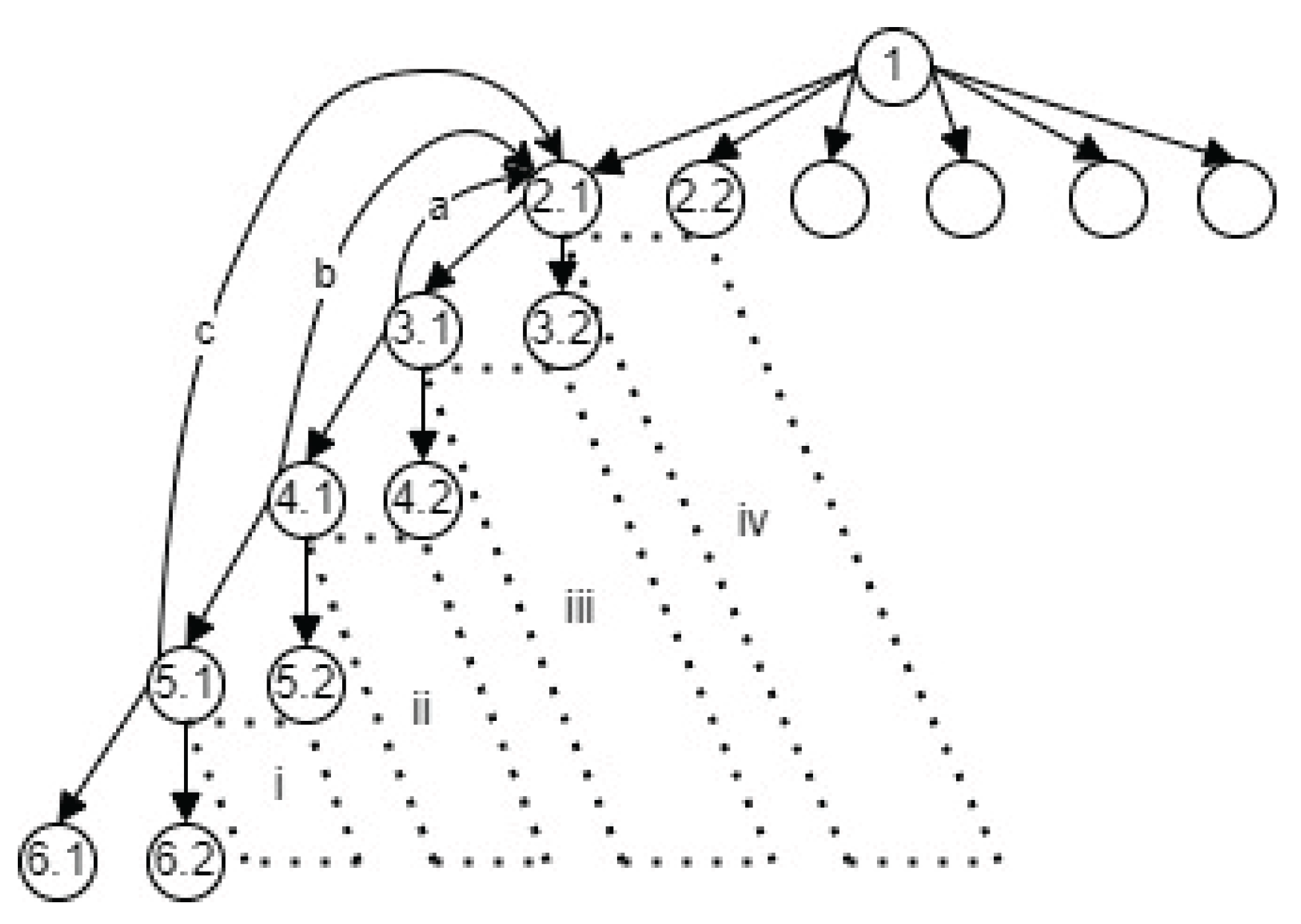
In the figure:
- Arrows represent dependencies between nodes.
- Dotted areas highlight subsets of the hierarchy that are deferred for population until after initial validation.
- Curved arrows indicate feedback loops that activate the CDD process for iterative refinement.
- Nodes are labeled according to their hierarchical position—e.g., 1 denotes the root node, 2.1 refers to the first node at Level 2, and so on—providing a structured view of the progressive traversal and refinement workflow.
Relational Schema
The normalized relational schema underpinning the MVP, designed to represent the multi-level hierarchical relationships (e.g., Continent → Country → Province), is depicted in Figure A.11.2. This schema represents a simplified hierarchical relationship for the MVP. In some real-world scenarios, certain relationships might be more complex (e.g., many-to-many) and would require additional linking tables.
Appendix A.11.5. State Machine Representation
- 1.
- Parameters
The behavior of the PDFD application workflow can be formally modeled using a state machine. This state machine is a specific instantiation of the generic mapping in Section 3.4.1. The following steps tailor the generic model for this specific application:
Step 1: Configure Parameters for Fixed Levels
The MVP fixes parameters from the general model to emulate real-world constraints:
- L = 6 (max level)
- Rₘₐₓ= 60 (Predefined refinement iterative limit, allowing refinement up to 60 times per level in the MVP while ensuring termination guarantees.)
- For i=3,4,5, Jᵢ = trace_origin(i) = 2, indicating that each level traces back to Level 2. This enforces refinement to Level 2 in the MVP, emphasizing critical dependency fixes.
Figure A.11.2.
Normalized relational database schema used in the PDFD MVP to support progressive development and validation of multi-level geographic data (Continent → Country → State)
Figure A.11.2.
Normalized relational database schema used in the PDFD MVP to support progressive development and validation of multi-level geographic data (Continent → Country → State)
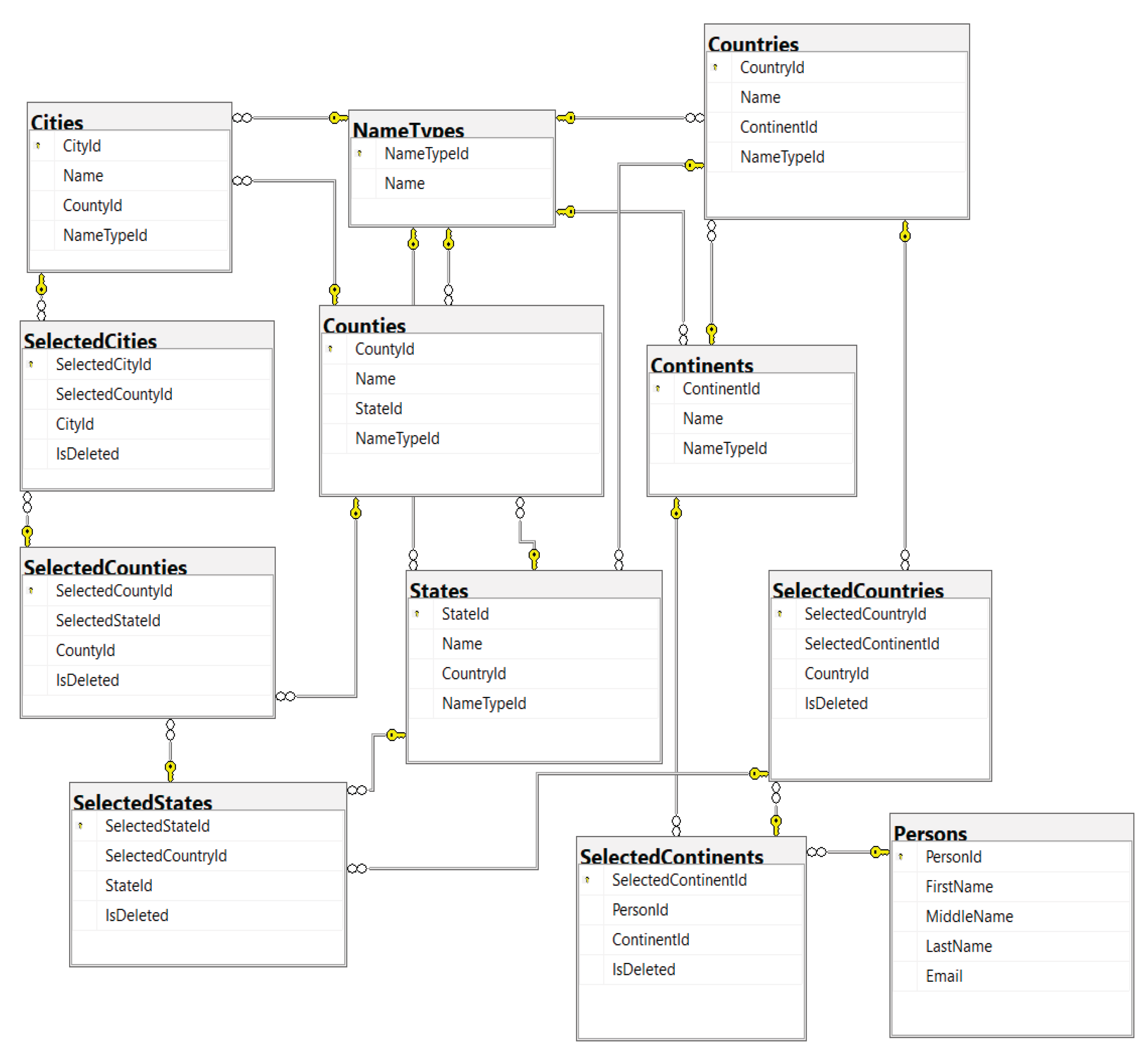
- For i=3,4,5, Rᵢ = min(i−Jᵢ +1, i) ensures that dependent levels are revisited while respecting hierarchy boundaries. This mirrors the state-space exploration strategy in model checkers like SPIN, which also rely on efficient traversal and pruning to verify correctness [71]. However, PDFD introduces hierarchy-aware semantics absent from SPIN, enabling structured backtracking aligned with layered dependencies.
Step 2: Customize State Logic to Emulate MVP
Refinement Scope. Modify the refinement phase to begin at Level 2 and span Rᵢ levels:
S₃ = refine([2, 2 + Rᵢ - 1]) → S₁(i)
Here, refine([2, 2 + Rᵢ − 1]) denotes a bounded refinement over levels 2 through 2 + Rᵢ − 1, producing the updated state S₁(i) for node i.
- 2.
- States and Transitions
Tables A.11.1-A.11.2 present the states and transitions of the PDFD MVP model. The state machine formalization follows established patterns for workflow verification and conformance checking, as explored in the field of process mining [75]. The PDFD-specific refinement semantics extend concepts from formal refinement theory—particularly those applied to state-based systems and process algebras [76], demonstrating how iterative development can maintain formal correctness guarantees.
Table A.11.1.
PDFD MVP application state descriptions and their mappings to generic PDFD state categories and parameter configurations
Table A.11.1.
PDFD MVP application state descriptions and their mappings to generic PDFD state categories and parameter configurations
| State ID | Phase | Description | Generic Mapping (State + Parameters) |
|---|---|---|---|
| S1 | Process & Validate Level 1 | Root node (Node 1) | S₁(1) → S₂(1) |
| S2 | Process & Validate Level 2 | Nodes 2.1 and 2.2 | S₁(2) → S₂(2) |
| S3 | Process & Validate Level 3 | Nodes 3.1 and 3.2 | S₁(3) → S₂(3) |
| S4 | Process & Validate Level 4 | Nodes 4.1 and 4.2 | S₁(4) → S₂(4) |
| S5 | Process & Validate Level 5 | Nodes 5.1 and 5.2 | S₁(5) → S₂(5) |
| S6 | Process & Validate Level 6 | Nodes 6.1 and 6.2 | S₁(6) → S₂(6) |
| S2_R1 | Refine Levels 2-3 | Reprocess Levels 2-3 due to failure at Level 3 | S₁(j=2) → S₂(j=2) |
| S2_R2 | Refine Levels 2-4 | Reprocess Levels 2-4 due to failure at Level 4 | S₁(j=2) → S₂(j=2) |
| S2_R3 | Refine Levels 2-5 | Reprocess Levels 2-5 due to failure at Level 5 | S₁(j=2) → S₂(j=2) |
| S7 | Finalize Level 5 Subtree | Finalize subtree under 5.1 and 5.2 | S₃(5) |
| S8 | Finalize Level 4 Subtree | Finalize subtree under 4.1 and 4.2 | S₃(4) |
| S9 | Finalize Level 3 Subtree | Finalize subtree under 3.1 and 3.2 | S₃(3) |
| S10 | Finalize Level 2 Subtree | Finalize subtree under 2.1 and 2.2 | S₃(2) |
| S11 | Finalize Root Subtree | Finalize root node and ensure completeness | S₄(1) |
| S_ERROR | Terminate on Failure | Refinement limit exceeded or validation failed | S₅ |
Table A.11.2.
PDFD MVP state transition rules, triggers, and their corresponding formal definitions in the generic PDFD model
Table A.11.2.
PDFD MVP state transition rules, triggers, and their corresponding formal definitions in the generic PDFD model
| Rule ID | From State -> To State | Formal Condition / Trigger | Workflow Step | Generic Rule (PD# + Parameters ) |
|---|---|---|---|---|
| PDFD1 | [*] → S1 | System initialized | Begin root-level processing | PD1 |
| PDFD2 | S1 → S2 | Root validated | Advance to Level 2 | PD2b (i=1) |
| PDFD3 | S2 → S3 | Level 2 validated | Advance to Level 3 | PD2b (i=2) |
| PDFD4 | S3 → S2_R1 | Level 3 validation failed | Backtrack to refine Levels 2-3 | PD2a (i=3, j=2) |
| PDFD5 | S2_R1 → S3 | Levels 2-3 refinement validated | Revalidate Level 3 | PD3b (j=2→i=3) |
| PDFD6 | S3 → S4 | Level 3 validated | Advance to Level 4 | PD2b (i=3) |
| PDFD7 | S4 → S2_R2 | Level 4 validation failed | Backtrack to refine Levels 2-4 | PD2a (i=4, j=2) |
| PDFD8 | S2_R2 → S4 | Levels 2-4 refinement validated | Revalidate Level 4 | PD3b (j=2→i=4) |
| PDFD9 | S4 → S5 | Level 4 validated | Advance to Level 5 | PD2b (i=4) |
| PDFD10 | S5 → S2_R3 | Level 5 validation failed | Backtrack to refine Levels 2-5 | PD2a (i=5, j=2) |
| PDFD11 | S2_R3 → S5 | Levels 2-5 refinement validated | Revalidate Level 5 | PD3b (j=2→i=5) |
| PDFD12 | S5 → S6 | Level 5 validated | Advance to Level 6 | PD2b (i=5) |
| PDFD13 | S6 → S7 | Level 6 validated | Finalize Level 5 subtrees | PD4 (i=6) |
| PDFD14 | S7 → S8 | Subtree at Level 5 validated | Finalize Level 4 subtrees | PD4a |
| PDFD15 | S8 → S9 | Subtree at Level 4 validated | Finalize Level 3 subtrees | PD4a |
| PDFD16 | S9 → S10 | Subtree at Level 3 validated | Finalize Level 2 subtrees | PD4a |
| PDFD17 | S10 → S11 | Subtree at Level 2 validated | Finalize root node | PD5 |
| PDFD18 | S11 → [*] | Root finalized | Terminate | PD6 → PD7 |
| PDFD19 | S2_R1/S2_R2/S2_R3 → S_ERROR | Refinement validation failed AND refinement_attempts[2] ≥ 60 | Terminate | PD3c → PD8 |
| PDFD20 | S3/S4/S5 → S_ERROR | refinement_attempts[2] ≥ 60 | Terminate | PD8 |
For simplicity, the level-by-level top-down process in the generic model is compacted and replaced by S11’s subtree top-down state, governed by the PDFD18 rules. While the formal state categories (S₁, S₂, S₃, S₄, and S₅) follow the definitions in Section 3.4.1, this particular state machine reflects the actual control flow of the MVP implementation and does not enumerate all possible scenarios defined by the generic PDFD methodology. The table captures the practical subset of transitions that occurred during execution and validation of the MVP system.
In this MVP, bottom-up subtree finalization (S₃(i)) culminates in a top-down global finalization pass (S₄(1)), recognizing the root-driven pass as a streamlined final step.
The state machine diagram (see Figures A.11.3) visually depicts the flow, with transitions corresponding to the rules in Table A.11.2. Please refer to Appendix A.12 for the State Machine Mermaid code.
Appendix A.11.6. Development Process
For detailed step-by-step implementation traces of the MVP, including screenshots, transaction sequences, and database evolution, refer to Appendix A.13.
Appendix A.11.7. Key Technical Highlights
This MVP implementation illustrates the practical strengths of the Primary Depth-First Development (PDFD) methodology through several key technical highlights:
-
Controlled Depth Parallelism (BF-by-Two Adaptation):
- ○
- Benefit: By processing two sibling nodes in parallel at each hierarchical level during the depth-first traversal, the system can expose cross-branch inconsistencies and UI state conflicts early in development, rather than deferring them to integration.
- ○
- Contrast: A pure DFD approach may postpone the detection of lateral interactions until deeper refinement phases, whereas a pure BFD approach—by prioritizing horizontal breadth—may introduce significant coordination overhead and delay cross-level dependency validation.
- ○
- Example: Simultaneously testing the nodes “Asia” and “North America” at the continent level revealed UI inconsistencies in regional naming conventions (e.g., “state” in the US vs. “province” in China). Early resolution of these discrepancies prevented cascading structural conflicts at deeper country-specific levels of the hierarchy.
-
Iterative Schema Refinement
- ○
- Benefit: The integration of CDD allows for flexible schema evolution during the development process, accommodating necessary mid-development changes such as the introduction of surrogate keys.
- ○
- Contrast: Traditional, more rigid development methodologies like Waterfall, with their upfront and inflexible schema design, often hinder the incorporation of necessary updates identified later in the cycle.
- ○
- Example: Initially, composite keys (e.g., combining PersonId and ContinentId) were used. However, during backtracking at the continent level, these were refactored to simpler surrogate keys (e.g., SelectedContinentId), significantly simplifying downstream data relationships and query logic.
Figure A.11.3.
State machine diagram for the PDFD MVP showing progression, refinement, and termination paths mapped to formal rule identifiers
Figure A.11.3.
State machine diagram for the PDFD MVP showing progression, refinement, and termination paths mapped to formal rule identifiers
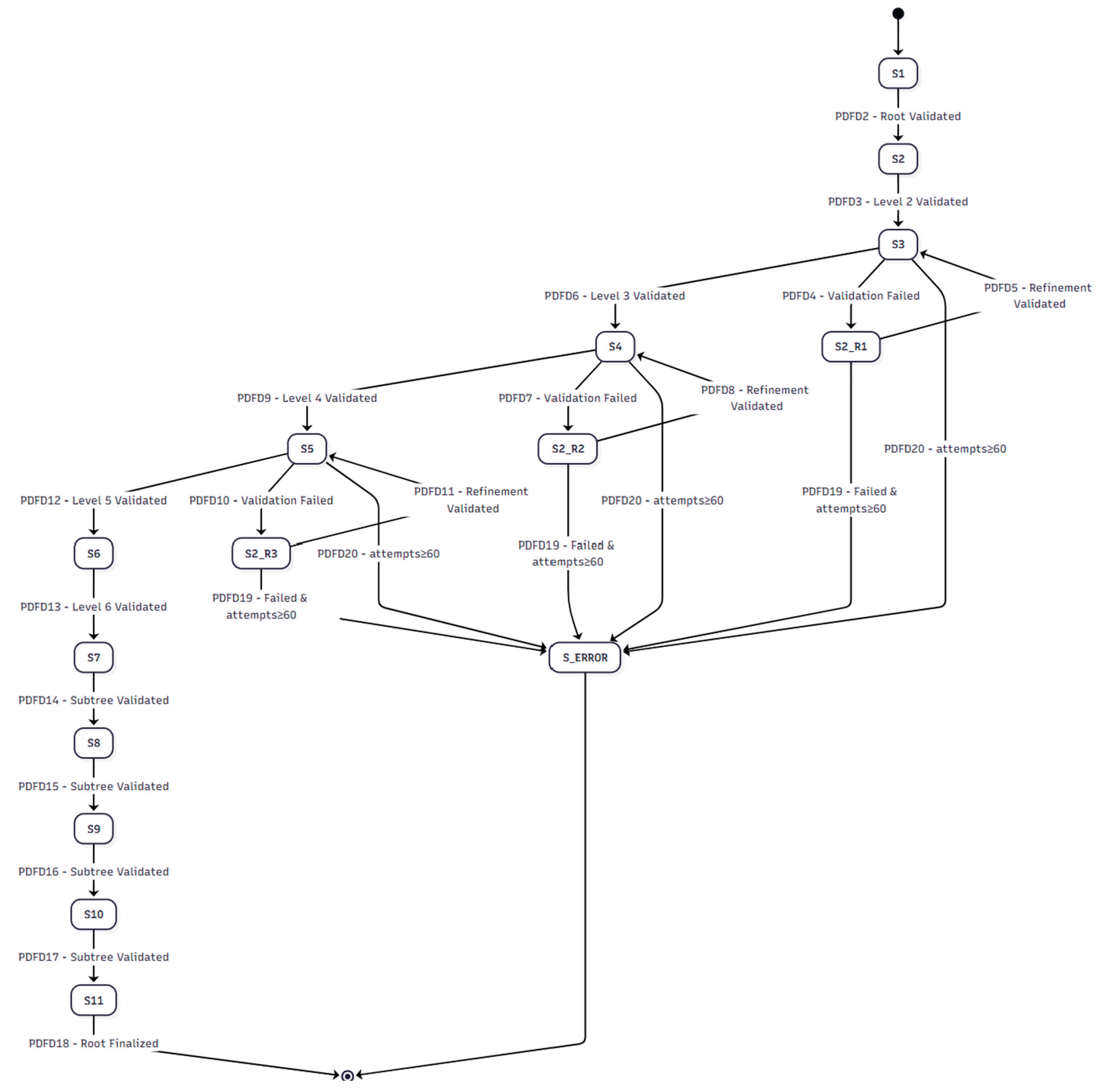
-
Hierarchical Backtracking
- ○
- Benefit: Backtracking to previously validated hierarchical levels to incorporate new branches enhances the stability and reusability of the developed components by ensuring core paths are solid before extensive horizontal expansion.
- ○
- Contrast: Monolithic development methods often require significant rework or even rollback when errors are discovered late in the process, especially after substantial horizontal expansion.
- ○
- Example: After thoroughly validating the path USA → Maryland → Howard, PDFD facilitated backtracking to the state level to add branches for Virginia. This allowed for the reuse of existing controllers and views, minimizing redundant development effort.
-
Methodological Cohesion
- ○
- The PDFD methodology effectively integrates DFD, BFD through the BF-by-Two strategy, and CDD.
- ○
- This MVP serves as a practical instantiation of the hybrid approach, demonstrating its ability to maintain the formal properties of the underlying methodologies (as discussed in Section 3.4.1) while offering a pragmatic and adaptable development process for hierarchical systems.
Appendix A.12. PDFD MVP State Machine Workflow Mermaid Code
Appendix A.12.1. Mermaid Code for Figure A.11.3
stateDiagram-v2
direction TB
[*] --> S1
state S1: Process & Validate Level 1
S1 --> S2: PDFD2 - Root Validated
state S2: Process & Validate Level 2
S2 --> S3: PDFD3 - Level 2 Validated
state S3: Process & Validate Level 3
S3 --> S4: PDFD6 - Level 3 Validated
S3 --> S2_R1: PDFD4 - Validation Failed
S3 --> S_ERROR: PDFD20 - attempts≥60
state S2_R1: Refine Levels 2-3
S2_R1 --> S3: PDFD5 - Refinement Validated
S2_R1 --> S_ERROR: PDFD19 - Failed & attempts≥60
state S4: Process & Validate Level 4
S4 --> S5: PDFD9 - Level 4 Validated
S4 --> S2_R2: PDFD7 - Validation Failed
S4 --> S_ERROR: PDFD20 - attempts≥60
state S2_R2: Refine Levels 2-4
S2_R2 --> S4: PDFD8 - Refinement Validated
S2_R2 --> S_ERROR: PDFD19 - Failed & attempts≥60
state S5: Process & Validate Level 5
S5 --> S6: PDFD12 - Level 5 Validated
S5 --> S2_R3: PDFD10 - Validation Failed
S5 --> S_ERROR: PDFD20 - attempts≥60
state S2_R3: Refine Levels 2-5
S2_R3 --> S5: PDFD11 - Refinement Validated
S2_R3 --> S_ERROR: PDFD19 - Failed & attempts≥60
state S6: Process & Validate Level 6
S6 --> S7: PDFD13 - Level 6 Validated
state S7: Finalize Level 5
S7 --> S8: PDFD14 - Subtree Validated
state S8: Finalize Level 4
S8 --> S9: PDFD15 - Subtree Validated
state S9: Finalize Level 3
S9 --> S10: PDFD16 - Subtree Validated
state S10: Finalize Level 2
S10 --> S11: PDFD17 - Subtree Validated
state S11: Finalize Root
S11 --> [*]: PDFD18 - Root Finalized
state S_ERROR: Terminate on Failure
S_ERROR --> [*]
Appendix A.13. PDFD MVP Development Process
This section details the step-by-step progression of the PDFD MVP’s development process; the corresponding source code is provided in [28].
Appendix A.13.1. Root Node Level – Visitor
The root node (Node 1 in Figure A.13.1) represents visitor information, serving as the entry point for the application’s hierarchical workflow.
Figure A.13.1.
PDFD MVP Root Node (Visitor Entry) User Interface

Implementation Details
- Model: The Person class maps to the Persons database table (Table A.13.1), with PersonId as the primary key.
- Controller: The PersonsController processes HTTP requests, binds the Person model to the view, and handles form submissions.
- View: ASP.NET Razor syntax is used to render the visitor entry interface (Figure A.13.1).
- Workflow: Users input visitor details, which are persisted in SQL Server (Table A.13.1) upon submission. This process, representing Level 1 (S1 in Figure A.11.3), then redirects users to the Continent Level (Level 2) via PDFD2 (Table A.11.2).
Table A.13.1.
Sample Data for Person (Root Level) in PDFD MVP Hierarchy
| PersonId | First Name | Middle Name | Last Name | |
|---|---|---|---|---|
| 1 | Test | T | Tester | tester@test.com |
Appendix A.13.2. Continent Level – Asia and North America
This level handles continent selection and integrates with downstream geographical hierarchies.
- 1.
- Implementation Overview
Table A.13.2 outlines the key components, including models, database tables, and core data fields.
Table A.13.2.
Model, Database Table, and Data Field Summary for PDFD MVP Continent Level
| Model | SQL Table | Function | Key Data Fields |
|---|---|---|---|
| Continent | Continents | Reference Data | ContinentId, Name, NameTypeId |
| SelectedContinent | SelectedContinents | Selection Tracking | SelectedContinentId, PersonId, ContinentId, IsDeleted |
| ContinentViewModel | N/A | View Model | ContinentId, ContinentName, PersonId, IsSelected |
- 2.
- Source Tables
The PDFD MVP uses the following tables as source data, with some shared across all hierarchy levels:
- Persons (Table A.13.1) – Shared across all levels
- Continents (Table A.13.3)
- NameTypes (Table A.13.4) – Shared across all levels
- SelectedContinents (Table A.13.5)
Table A.13.3.
Reference Data for Continents in PDFD MVP
| ContinentId | Name | NameTypeId |
|---|---|---|
| 1 | Asia | 1 |
| 2 | North America | 1 |
Table A.13.4.
Reference Data for NameTypes (Hierarchy Levels) in PDFD MVP
| NameTypeId | Name |
|---|---|
| 1 | Continent |
| 2 | Country |
| 3 | State |
| 4 | County |
| 5 | City |
| 6 | District |
| 7 | Province |
| 11 | Region |
Table A.13.5.
Sample Transaction Data for SelectedContinents in PDFD MVP
| SelectedContinentId | PersonId | ContinentId | IsDeleted |
|---|---|---|---|
| 1 | 1 | 1 | 1 |
| 2 | 1 | 2 | 0 |
- 3.
- Workflow Logic
User Interaction
-
Users interact with the continent selection interface (Figure A.13.2), which triggers updates to the SelectedContinents table (Table A.13.5). Upon submission, the system updates Table A.13.5. according to the following rules—also applicable at subsequent hierarchy levels:
- ○
- New selections are added with IsDeleted = 0.
- ○
- Deselections are marked with IsDeleted = 1 (soft delete).
- ○
- Restored selections have IsDeleted reset to 0.
- User selections at the continent level trigger cascaded updates to downstream levels (e.g., countries).
Figure A.13.2.
PDFD MVP Continent Selection User Interface

State Machine (Figure A.11.3)
- Level 2 (S2) processed.
- Transitions to Level 3 (S3) follow PDFD3 (∑P(n) ≥ K₂).
Structural Workflow (Figure A.11.1)
-
Level 2 with K₂ = 2:
- ○
- Node 2.1: North America (ContinentId = 2)
- ○
- Node 2.2: Asia (ContinentId = 1)
- 4.
- Hierarchical Context
Refinement Logic (Figure A.11.3)
- Errors detected at Level 3 (S3) trigger refinement starting at Jᵢ=2 (PDFD4).
Appendix A.13.3. Country Level – United States and Canada
This level manages country selection within the continent hierarchy.
- 1.
- Implementation Overview
CDD Intervention (Figure A.11.3)
- Missing IsSelected field triggered refinement (PDFD4) for Levels 2–3.
- Post-refinement, processing resumed at Level 3 (PDFD5).
Models
- Country, SelectedCountry, CountryViewModel (see Table A.13.6)
Tables
- Countries Lookup (Table A.13.7), SelectedCountries Transaction Data (Table A.13.8)
Table A.13.6. summarizes the models, corresponding tables, functions, and their roles at the country level.
Table A.13.6.
Model, Database Table, and Data Field Summary for PDFD MVP Country Level
| Model | SQL Table | Function | Key Data Fields |
|---|---|---|---|
| Country | Countries | Reference Data | CountryId, Name, ContinentId, NameTypeId |
| SelectedCountry | SelectedCountries | Selection Tracking | SelectedCountryId, SelectedContinentId, CountryId, IsDeleted |
| CountryViewModel | N/A | View Model | CountryId, CountryName, SelectedContinentId, IsSelected |
Table A.13.7.
Reference Data for Countries in PDFD MVP
| CountryId | Name | ContinentId | NameTypeId |
|---|---|---|---|
| 1 | USA | 2 | 2 |
| 2 | Canada | 2 | 2 |
Table A.13.8.
Sample Transaction Data for SelectedCountries in PDFD MVP
| SelectedCountryId | SelectedContinentId | CountryId | IsDeleted |
|---|---|---|---|
| 1 | 2 | 1 | 0 |
| 2 | 2 | 2 | 1 |
- 2.
- Workflow Logic
User Interaction
The CountryController uses the CountryViewModel to populate the interface (Figure A.13.3), where users toggle country selections (e.g., USA, Canada). Changes are persisted to the SelectedCountries table (Table A.13.8) using soft deletion (IsDeleted flag).
Figure A.13.3.
PDFD MVP Country Selection User Interface

Pre-Checked Entries
Previously selected countries (e.g., USA in Table A.13.8) are pre-checked in the interface, reflecting historical data stored in SelectedCountries.
-
State Machine (Figure A.11.3)
- ○
- S3 processing step failed
- ○
- Transitions to S2_R1
- Structural Workflow (Figure A.11.1)
Level 3 with (indicating two nodes processed at this level):
- ○
- Node 3.1: USA (CountryId = 1)
- ○
- Node 3.2: Canada (CountryId = 2)
Appendix A.13.4. State Level – Maryland and Virginia
This level handles state/province selection within countries, adhering to the hierarchical structure defined in PDFD. It is state S4 in Figure A.11.3. Here, a surrogate key was found to be a better choice for database design, prompting the use of the CDD strategy to refine levels 2-4. Refer to 'Transition from Composite to Surrogate Keys' in item 1 of section A.13.7, curve b in Figure A.11.1, and state S2_R2 in Figure A.11.3 for more details.
- 1.
- Implementation Overview
CDD Intervention (Figure A.11.3)
- Surrogate key introduction triggered refinement (PDFD7) for Levels 2–4.
- Processing resumed at Level 4 (PDFD8).
Models
- State, SelectedState, StateViewModel. (Table A.13.9)
Tables
- States Lookup (Table A.13.10), SelectedStates (Table A.13.11)
Table A.13.9. summarizes the models, corresponding tables, functions, and their roles at the state level.
Table A.13.9.
Model, Database Table, and Data Field Summary for PDFD MVP State Level
| Model | SQL Table | Functions | Key Data Fields |
|---|---|---|---|
| State | States | Reference Data | StateId, Name, CountryId, NameTypeId |
| SelectedState | SelectedStates | Selection Tracking | SelectedStateId, SelectedCountryId, StateId, IsDeleted |
| StateViewModel | N/A | View Model | StateId, StateName, SelectedCountryId, IsSelected |
Table A.13.10.
Reference Data for States in PDFD MVP
| StateId | Name | CountryId | NameTypeId |
|---|---|---|---|
| 1 | Maryland | 1 | 3 |
| 2 | Virginia | 1 | 3 |
Table A.13.11.
Sample Transaction Data for SelectedStates in PDFD MVP
| SelectedStateId | SelectedCountryId | StateId | IsDeleted |
|---|---|---|---|
| 1 | 1 | 1 | 0 |
| 2 | 1 | 2 | 1 |
- 2.
- Workflow Logic
User Interaction
- The StateController uses the StateViewModel to populate the interface (Figure A.13.4), where users toggle state selections (e.g., Maryland, Virginia). Changes are saved to the SelectedStates table (Table A.13.11) using soft deletion (IsDeleted flag).
Figure A.13.4.
PDFD MVP State Selection User Interface

- Users modify state selections, with pre-checked entries reflecting prior choices stored in SelectedStates.
State Machine (Figure A.11.3)
- Level 4 processing
- Transitions to S2_R2 (PDFD7)
Structural Workflow (Figure A.11.1)
Level 4 with (indicating two nodes processed at this level):
- Node 4.1: Maryland (StateId = 1)
- Node 4.2: Virginia (StateId = 2)
Appendix A.13.5. County Level – Howard and Baltimore
This level manages county/district selection within states, corresponding to S5 in Figure A.11.3's 'Processing & Refinement' state. A missing IsDeleted field at this stage triggered the CDD methodology to refine levels 2-5. For details, refer to 'Introduction of the IsDeleted Flag' in A.11.7.1, curve c in Figure A.11.1, and S2_R3 in Figure A.11.3.
- 1.
- Implementation Overview
CDD Intervention (Figure A.11.3)
- Missing IsDeleted flag triggered refinement (PDFD10) for Levels 2–5.
- Processing resumed at Level 5 (PDFD11).
Models
- County, SelectedCounty, CountyViewModel (Table A.13.12)
Tables
- Counties Lookup (Table A.13.13), SelectedCounties Transaction Data (Table A.13.14)
Table A.13.12.
Model, Database Table, and Data Field Summary for PDFD MVP County Level
| Model | SQL Table | Function | Key Data Fields |
|---|---|---|---|
| County | Counties | Reference Data | CountyId, Name, StateId, NameTypeId |
| SelectedCounty | SelectedCounties | Selection Tracking | SelectedCountyId, SelectedStateId, CountyId, IsDeleted |
| CountyViewModel | N/A | View Model | CountyId, CountyName, SelectedStateId, IsSelected |
Table A.13.13.
Reference Data for Counties in PDFD MVP
| CountyId | Name | StateId | NameTypeId |
|---|---|---|---|
| 1 | Howard | 1 | 4 |
| 2 | Boltimore | 1 | 4 |
Table A.13.14.
Sample Transaction Data for SelectedCounties in PDFD MVP
| SelectedCountyId | SelectedStateId | CountyId | IsDeleted |
|---|---|---|---|
| 1 | 1 | 1 | 0 |
- 2.
- Workflow Logic
User Interaction
- Users toggle county selections (e.g., Howard, Baltimore) within Maryland via the interface (Figure A.13.5), with updates persisted to SelectedCounties (Table A.13.14).
Figure A.13.5.
PDFD MVP County Selection User Interface

State Machine (Figure A.11.3)
- Level 5 processing
- Transitions to S2_R3 (PDFD10)
Structural Workflow (Figure A.11.1)
Level 5 with (indicating two nodes processed at this level):
- Node 5.1: Howard County (CountyId = 1)
- Node 5.2: Baltimore County (CountyId = 2)
Appendix A.13.6. City Level – Ellicott City and Columbia
This level handles city selection within counties.
- 1.
- Implementation Overview
Models
- City, SelectedCity, CityViewModel (Table A.13.15)
Tables
- Cities Lookup (Table A.13.16), SelectedCities Transaction Data (Table A.13.17)
Table A.13.15.
Model, Database Table, and Data Field Summary for PDFD MVP City Level
| Model | SQL Table | Function | Key Data Fields |
|---|---|---|---|
| City | Cities | Reference Data | CityId, Name, CountyId, NameTypeId |
| SelectedCity | SelectedCities | Selection Tracking | SelectedCityId, SelectedCountyId, CityId, IsDeleted |
| CityViewModel | N/A | View Model | CityId, CityName, SelectedCountyId, IsSelected |
Table A.13.16.
Reference Data for Cities in PDFD MVP
| CityId | Name | CountyId | NameTypeId |
|---|---|---|---|
| 1 | Ellicott City | 1 | 5 |
| 2 | Columbia | 1 | 5 |
Table A.13.17.
Sample Transaction Data for SelectedCities in PDFD MVP
| SelectedCityId | SelectedCountyId | CityId | IsDeleted |
|---|---|---|---|
| 1 | 1 | 1 | 0 |
| 2 | 1 | 2 | 0 |
- 2.
- Workflow Logic
User Interaction
- Users finalize city selections (e.g., Ellicott City, Columbia) within Howard County via the interface (Figure A.13.6), with data stored in SelectedCities (Table A.13.17).
Figure A.13.6.
PDFD MVP City Selection User Interface

State Machine (Figure A.11.3)
- Level 6 processing.
- Transition to completion phase follows PDFD13.
Structural Workflow (Figure A.11.1)
Level 6 with (indicating two nodes processed at this level):
- Node 6.1: Ellicott City (CityId = 1).
- Node 6.2: Columbia (CityId = 2).
Appendix A.13.7. Intermediate Development with CDD
CDD played a crucial role in refining the PDFD application’s architecture, addressing evolving requirements, and resolving unanticipated gaps during implementation. While the final workflow comprises six hierarchical levels (Figure A.11.1), iterative cycles were essential in ensuring structural integrity and scalability throughout the development process.
Key Iterations and CDD Interventions
- 1.
- Addition of the IsSelected Field
- Challenge: The IsSelected flag—essential for tracking user selections—was omitted during initial continent-level development and identified only at the country level.
- CDD Intervention: A feedback loop (curve a in Figure A.11.1) redirected development back to the continent level to add the IsSelected field, ensuring consistent state management and user selection tracking across all levels.
- 2.
- Transition from Composite to Surrogate Keys
- Initial Design: Composite keys (e.g., PersonId + ContinentId for SelectedContinents) were initially used to enforce uniqueness across tables.
- Challenge: As development progressed to deeper levels of the hierarchy (e.g., states, counties), composite keys became cumbersome, complicating foreign key relationships and reducing scalability.
- CDD Intervention: A surrogate key (SelectedContinentId) was introduced at the continent level (curve b in Figure A.11.1), simplifying downstream dependencies and improving scalability.
- 3.
- Introduction of the IsDeleted Flag
- Challenge: Soft-deletion functionality, essential for marking deselected entries without losing data, was overlooked initially, risking permanent data loss when users deselected entries.
- CDD Intervention: The IsDeleted field was retrofitted into transaction tables (e.g., SelectedContinents) via a feedback loop (represented by curve c in Figure A.11.1), allowing for dynamic updates to selections without data loss.
Table A.13.18. summarizes the key information of these interventions. Refers to Table A.11.1. and Table A.11.2. for the rule id and state transition.
Table A.13.18.
Summary of CDD Interventions and Their Mapping to PDFD MVP State Transitions
| Intervention | Scope Levels | i | Rᵢ | Depth | Rule ID | State Transition | Figure Reference |
|---|---|---|---|---|---|---|---|
| Addition of IsSelected | 2–3 | 3 | 2 | 2 | PDFD4 → PDFD5 | S3 → S2_R1 → S3 | Curve a (Figure A.11.1) |
| Transition to Surrogate Keys | 2–4 | 4 | 3 | 3 | PDFD7 → PDFD8 | S4 → S2_R2 → S4 | Curve b (Figure A.11.1) |
| Introduction of IsDeleted | 2–5 | 5 | 4 | 4 | PDFD10 → PDFD11 | S5 → S2_R3 → S5 | Curve c (Figure A.11.1) |
Note: Depth = Rᵢ = i - j + 1 (j=2 for all refinements).
Outcomes of CDD Iterations
- Data Integrity: Retroactive fixes ensured consistent tracking of user selections and deletions across all levels, preventing data inconsistencies.
- Scalability: The introduction of surrogate keys reduced relational complexity, supporting seamless expansion to accommodate deeper hierarchical levels as the system grew.
- Workflow Cohesion: Iterative refinements aligned the system with real-world user behavior (e.g., revisiting selections), resulting in a more intuitive user experience.
Key Takeaways
CDD’s cyclical workflow enabled the team to incrementally address gaps, refine dependencies, and adapt to emerging requirements. This iterative approach highlights the methodology’s strength in balancing structured development with Agile flexibility, ensuring robust outcomes in complex hierarchical systems.
Formal validation prioritizes CDD because its refinement cycles introduce NP-hard cyclomatic dependencies - the methodology's highest-risk domain requiring termination proofs (Rₘₐₓ=60). Sequentially processed components are verifiable through conventional techniques, inheriting correctness from CDD's state conformance guarantees.
Termination Assurance
- Per-level refinement limit: refinement_attempts[j] ≤ Rₘₐₓ = 60 (Section A.11.5)
-
S_ERROR enforcement:
- ○
- PDFD19: Refinement failure after 60 attempts
- ○
- PDFD20: Forward-pass failure after 60 attempts
State Machine Conformance
- Development phases map 1:1 to PDFD states (Table A.11.1)
- CDD interventions trigger exact refinement rules (Table A.13.18)
Parameter Invariance
- Jᵢ=2 maintained for all refinements (root-cause level)
-
Refinement Scope Consistency:
- ○
- Rᵢ=2: Levels 2-3 (S2_R1)
- ○
- Rᵢ=3: Levels 2-4 (S2_R2)
- ○
- Rᵢ=4: Levels 2-5 (S2_R3)
Formal Bounds
-
Tree Parameters:
- ○
- Depth: L=6 (Levels 1-6)
- ○
- State Complexity: |Q|=15 states
-
Refinement Attempts:
- ○
- Level 2: 3 attempts << Rₘₐₓ=60
- ○
- Level 3: 3 attempts << 60
- ○
- Level 4: 2 attempts << 60
- ○
- Level 5: 1 attempts << 60
-
Transition Complexity:
- ○
- |δ|=20 rules (Table A.11.2)
- ○
- Max depth: O(L)=6
Appendix A.13.8. The Report Page
The Report Page consolidates and displays hierarchical selections made across all levels (Figure A.11.1), offering a comprehensive view of visited locations.
- 1.
- Implementation Overview
Table A.13.19. outlines the components and data flow for generating the report.
Table A.13.19.
Components and Data Flow for Generating the PDFD MVP Report Page
| Type | Name | Role | Key Data Fields |
|---|---|---|---|
| Database View | vw_Report | Data Aggregation | Persons, SelectedContinents, Continents, SelectedCountries, Countries, SelectedStates, States, SelectedCounties, Counties, SelectedCities, Cities, NameTypes |
| Model | Report | UI Presentation | PersonName, ContinentName, CountryName, StateName, CountyName, CityName |
- 2.
- Workflow Logic
Data Aggregation
The SQL View vw_Report aggregates data by joining transactional tables (e.g., SelectedContinents, SelectedCountries) with reference tables (e.g., Continents, Countries). It uses the NameTypes table to standardize naming conventions (e.g., "State" vs. "Province").
View Model Mapping
The Report ViewModel extracts user-friendly fields (e.g., PersonName, ContinentName) from vw_Report to render the data for the UI.
Figure A.13.7 presents a visitor’s selections in a hierarchical format (e.g., Test Tester → North America → USA → Maryland → Howard → Ellicott City.
Appendix A.13.9. Backtracking to complete the entire application
This section is not part of the source code referenced in [28], as the PDFD MVP does not fully implement the complete PDFD specification. It is included here to provide a comprehensive explanation of the full specification.
The backtracking process is composed of bottom-up and top-down parts.
Figure A.13.7.
PDFD MVP Report Page Displaying Hierarchical Visitor Selections

Bottom-Up Completion with Local Top-Down Verification
States S7-S10 implement bottom-up completion with integrated local top-down verification:
-
Bottom-Up Processing:
- ○
- Finalizes subtrees level-by-level from leaves toward root
- ○
- Handles localized subtree completion
-
Local Top-Down Verification:
- ○
- Validates parent-child relationships within the current subtree
- ○
- Ensures hierarchical integrity from subtree root to leaves
- ○
- Example: S7 verifies Maryland→Howard County→Ellicott City
Global Top-Down Finalization (S11 Only)
-
State S11 performs global top-down finalization:
- ○
- Verifies completeness from root perspective (Person→Continent→Country→...)
- ○
- Ensures cross-subtree consistency
- ○
- Executes final validation pass before termination (PDFD18)
Following the core implementation detailed in Sections A.13.1–A.13.8, PDFD employs iterative backtracking in this section to systematically expand data coverage and validate business scenarios. This approach ensures manageable system updates by progressively populating hierarchical subsets (indicated by dotted areas in Figure A.11.1) and refining the code as needed. This process commences after PDFD13 (transition to State S7, see Figure A.11.3).
-
Phase 1: County-Level Completion (Subset i in Figure A.11.1 and state S7 in Figure A.11.3)
- ○
- Objective: Expand Howard County by adding remaining cities (e.g., Columbia) and populate all cities in Baltimore County
- ○
- Actions: Update the Cities table with missing entries (Table A.13.16)
- ○
- State Machine: Maps to S7 → S8 (PDFD14) (Table A.11.2)
-
Phase 2: State-Level Expansion (Subset ii in Figure A.11.1 and state S8 in Figure A.11.3)
- ○
- Objective: Implement remaining counties/cities in Maryland and Virginia
- ○
- Actions: Populate Counties and Cities tables for Virginia (e.g., Fairfax County, Arlington)
- ○
- State Machine: Maps to S8 → S9 (PDFD15) (Table A.11.2)
-
Phase 3: National Scalability (Subset iii in Figure A.11.1 and state S9 in Figure A.11.3)
- ○
- Objective: Scale to all U.S. states and Canadian provinces
- ○
- Actions: Populate States, Counties, and Cities tables for the U.S. (e.g., Texas, California) and Canada (e.g., Ontario, Quebec)
- ○
- State Machine: Maps to S9 → S10 (PDFD16) (Table A.11.2)
-
Phase 4: Continental Integration (Subset iv in Figure A.11.1 and state S10 in Figure A.11.3)
- ○
- Objective: Integrate North American and Asian datasets
- ○
- Actions: Populate Asian countries (e.g., China, Japan) with region-specific hierarchies (e.g., provinces, prefectures)
- ○
- State Machine: Maps to S10 → S11 (PDFD17, Transitions to global top-down finalization)
-
Phase 5: Global Coverage (Unpopulated Nodes in Figure A.11.1 and S11 in Figure A.11.3)
- ○
- Objective: Achieve global completeness by adding remaining continents (e.g., Europe, Africa)
- ○
- Actions: Populate Countries, States, Counties, and Cities for all regions
- ○
- State Machine: Executes during S11 (global top-down finalization) and terminates via PDFD18
Appendix A.14. PBFD MVP WITH PATTERN-BASED TRAVERSAL AND TLE
Appendix A.14.1. Overview of the PBFD MVP
Purpose: This section presents a Minimum Viable Product (MVP) of Primary Breadth-First Development (PBFD) developed mainly between 12/26/2024 and 01/15/2025. The MVP demonstrates pattern-driven, level-wise traversal combined with Three-Level Encapsulation (TLE) and bitmask encoding for relational optimization. The implementation follows the PBFD formal model (Section 3.4.2) and the bitmask-based TLE optimizations outlined in Section 4. [53,55]
Caveat: For brevity the MVP applies a pragmatic progression rule (advancing after processing a subset of Patternᵢ nodes). Consequently, the full formal guarantees in Appendix A.8 apply to the complete PBFD methodology (Section 3.4.2, Table 40), not the simplified MVP.
Reproducibility & Research Context: The repository includes generation/migration scripts, sample datasets, and deployment instructions [29]. These artifacts enable reproducible experiments and controlled comparisons against normalized or graph-based alternatives, supporting empirical evaluation in Section 5.
Appendix A.14.2. Technology Stack and Key Design Decisions
Built from the "Logging Visited Places" use case (Section 3.3.1, item 10), the PBFD MVP is implemented using Microsoft ASP.NET MVC with SQL Server for backend persistence. Each node is a business-level data item (consistent with the PDFD MVP), but nodes above the final two hierarchical levels (county and city) also serve as Level 1 anchors of TLE instances (see A.14.7).
For example, the raw data “United States” functions both as a business entity and as the grandparent element of a TLE structure that encodes:
- Level 1: the country (“United States”), implemented in the MVP as the table name representing the grandparent pattern
- Level 2: its constituent states (e.g., Maryland, California), represented as columns within the Level 1 table
- Level 3: the counties within each state, encoded as bitmask values stored in the corresponding Level 2 column cells
This dual role enables each upper-level node to embed a fixed three-level hierarchical pattern (Level 1 → Level 2 → Level 3) while remaining a normal record in the application domain. TLE’s bitmask-based encoding preserves hierarchical semantics across levels and ensures predictable, constant-time operations for lookup, traversal, and update.
Key design decisions reflect established trade-offs between encoded, columnar-style access patterns and conventional relational semantics:
- Selective Depth Exploration: After resolving a Level 1 or Level 2 pattern, the MVP performs controlled descent into the corresponding TLE instance to validate cross-level constraints while maintaining early UI feedback.
- Iterative Refinements (CDD): Bounded refinement cycles allow schema or pattern adjustments when validations fail. This preserves termination guarantees while supporting correction and incremental evolution of the hierarchy.
Appendix A.14.3. Strategy in Practice
PBFD MVP combines horizontal pattern-based development with depth-first extensions and iterative refinement. The approach maintains flexibility without compromising structure.
Breadth-First Core: Level-Wise Consolidation
- Example: continents such as "North America" and "Asia" are presented as checkboxes in a shared view, enabling batch-processing logic.
- Efficiency: server-side Razor views with shared models reduce UI duplication.
Selective Depth-First Exploration
- Depth After Pattern: after a pattern (e.g., continent selection) is validated, the system descends into the children of selected parents only (e.g., countries inside selected continents), enabling earlier detection of cross-level invariants [62].
Iterative Refinement via CDD
- Feedback Loops: mid-development changes (shared components, schema adjustments) were integrated via bounded CDD cycles; failures at deeper levels trigger controlled backtracking and refinement of parent-level patterns. This mirrors dependency-directed backtracking techniques used in knowledge refinement and constraint search [77].
MVP Parameters (following Table 37)
- Rₘₐₓ = 50 (empirical maximum refinement attempts per level before bounded failure)
- Jᵢ = trace_origin(i) (refinement origin tracing)
- Rᵢ = i - Jᵢ + 1 (refinement span)
Appendix A.14.4. Structural Workflow
Figure A.14.1 illustrates the PBFD MVP hybrid flow: breadth-first pattern consolidation, selective depth validation, and iterative refinement backtracks (CDD). The figure annotations emphasize TLE units and where bitmask operations provide single-row, constant-time checks for child selection. [53,55,118].
Figure A.14.1.
Structural workflow of PBFD MVP illustrating breadth-first progression, selective depth-first traversal, and iterative refinements
Figure A.14.1.
Structural workflow of PBFD MVP illustrating breadth-first progression, selective depth-first traversal, and iterative refinements
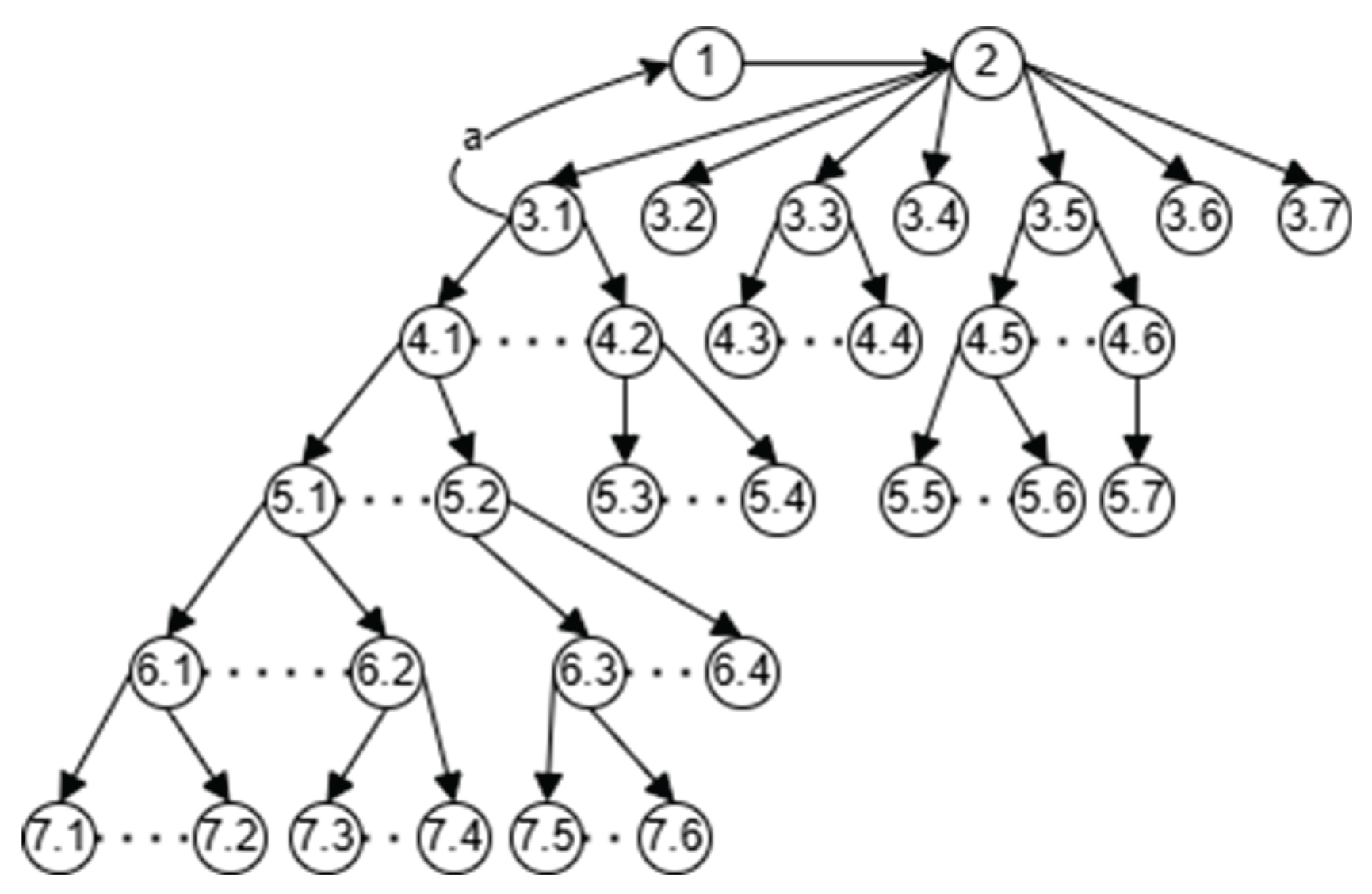
The visual conventions used in Figure A.14.1 are defined as follows:
Node Conventions
- Root Node: Level 1 (ContinentGrandparent)
- Numbering: First digit = level, second digit = position (e.g., Node 3.1 = North America)
Annotations
- Arrows: Progression through hierarchical levels
- Dotted Lines: Unselected nodes
- Curve a: CDD-driven refinements (Levels 1–3) triggered by Level 3 failures
Appendix A.14.5. State Machine Representation
The PBFD MVP is captured by a specialized state machine (see Tables A.14.1 & A.14.2). Several PBFD states integrate level processing plus TLE-based resolution for subsequent levels (e.g., Level_3_Processing_Validating_Resolving handles levels 3–5 as a single TLE scope). This coalescing reduces protocol overhead and mirrors the encapsulated access patterns characteristic of columnar and encoded storage architectures [53,55].
Key note: While the MVP’s state transitions preserve the generic PBFD semantics—progression, refinement, and finalization—they are implemented in a simplified and consolidated form. The MVP employs coarser TLE-scoped states to optimize data transfer volume and improve query efficiency.
Table A.14.1.
PBFD MVP-specific state definitions with corresponding TLE scopes (functioning as dynamic traversal windows) and generic rule mappings
Table A.14.1.
PBFD MVP-specific state definitions with corresponding TLE scopes (functioning as dynamic traversal windows) and generic rule mappings
| State Id | Label | Phase | Generic Mapping | TLE Scope |
|---|---|---|---|---|
| S0 | Level_1_Processing_Validating_Resolving | Process & Validate Level 1 & resolve Level 2 (TLE Root: ContinentGrandparent) | S₁(1) → S₂(1) → S₃(1) | Levels 1–3 |
| S1 | Level_2_Processing_Validating_Resolving | Process & Validate Level 2 & resolve Level 3 (TLE Root: ContinentParent) | S₁(2) → S₂(2) → S₃(2) | Levels 2–4 |
| S2 | Level_3_Processing_Validating_Resolving | Process & Validate Level 3 & resolve Level 4 (TLE Root: a continent) | S₁(3) → S₂(3) → S₃(3) | Levels 3–5 |
| S3 | Level_4_Processing_Validating_Resolving | Process & Validate Level 4 & resolve Level 5 (TLE Root: a country) | S₁(4) → S₂(4) → S₃(4) | Levels 4–6 |
| S4 | Level_5_Processing_Validating | Process & Validate Level 5 (TLE Root: a state) | S₁(5) → S₂(5) | Levels 5–7 |
| S5 | Refine_Level1-3 | Refine Levels 1–3 (Level 3 failure) | S₁(j) → S₂(j) → S₃(j) (j=1) | Levels 1–3 |
| S6 | Finalize_All | Finalize all nodes top-down | S₄(1) → ... → S₄(7) | Levels 1–7 |
| S7 | Complete | Termination state | T | – |
| S8 | Validation_Failure | Terminate due to Rₘₐₓ = 50 exhaustion | S₅ | – |
Table A.14.2.
Unified state transitions for PBFD MVP, integrating generic rule references and workflow logic
Table A.14.2.
Unified state transitions for PBFD MVP, integrating generic rule references and workflow logic
| Rule ID | From State | To State | Condition | Generic Rule | Workflow Step |
|---|---|---|---|---|---|
| PBFD1 | [*] | S0 | Start | PB1 | Initialize Level 1 (TLE 1–3) |
| PBFD2 | S0 | S1 | Level 1 validated & resolved | PB4a | Proceed to Level 2 (TLE 2–4) |
| PBFD3 | S1 | S2 | Level 2 validated & resolved | PB4a | Proceed to Level 3 (TLE 3–5) |
| PBFD4 | S2 | S3 | Level 3 validated & resolved | PB4a | Proceed to Level 4 (TLE 4–6) |
| PBFD5 | S3 | S4 | Level 4 validated & resolved | PB4a | Proceed to Level 5 (TLE 5–7) |
| PBFD6 | S2 | S5 | Level 3 validation failed | PB3 | Refine Levels 1-3 |
| PBFD7 | S5 | S0 | Levels 1-3 reprocessed | PB3a | Resume Level 1 (TLE 1–3) |
| PBFD8 | S5 | S8 | refinement_attempts ≥ Rₘₐₓ | PB9 | Terminate with error |
| PBFD9 | S4 | S6 | Level 5 validated | PB4b | Finalize all levels |
| PBFD10 | S6 | S7 | All nodes finalized. Finalization (S6) combines PB7 and PB8, resolving all levels top-down in a single step for efficiency. | PB8 | Complete |
The state machine representation visually depicts the flow of the PBFD application, as shown in Figure A.14.2. The transitions between states correspond to the progression and refinement steps of the methodology, with each transition labeled according to the rules defined in Table A.14.2. State S5 (Refine_Level1-3, PBFD6) reprocesses Levels 1–3 to resolve inconsistencies before resuming at Level 1. Mermaid code for Figure A.14.2 is provided in Appendix A.15.
Figure A.14.2.
State machine diagram for PBFD MVP, showing pattern transitions and completion rules across hierarchical levels
Figure A.14.2.
State machine diagram for PBFD MVP, showing pattern transitions and completion rules across hierarchical levels
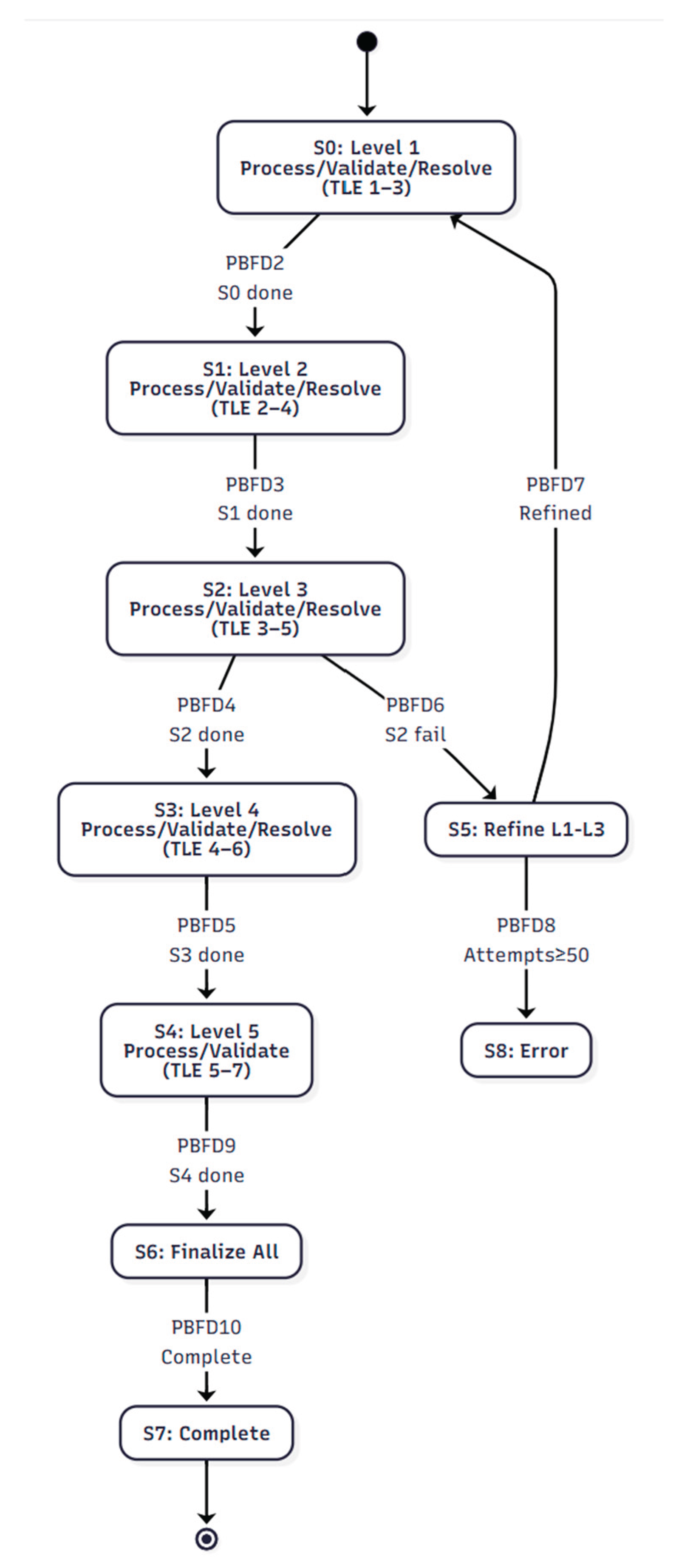
Appendix A.14.6. Data Structure and Relationships
The PBFD MVP relies on a hierarchical, pattern-driven relational schema to represent and traverse location-based data. This structure underpins both the backend logic and the dynamic frontend traversal behavior governed by the TLE Rule (see Section 4.2).
- 1.
- Sample Locations Dataset
At the heart of the PBFD MVP system lies the Locations table (Table A.14.3) — a static reference structure containing all nodes and their hierarchical relationships. This metadata table serves as the input for dynamically generating the grandparent-level tables that form the three-level traversal model.
Table A.14.3.
Static Locations dataset schema supporting PBFD pattern traversal and bitmask encoding
Table A.14.3.
Static Locations dataset schema supporting PBFD pattern traversal and bitmask encoding
| Id | Name | Name Type Id | Type | Parent Id | Child Id | Level |
|---|---|---|---|---|---|---|
| 0 | ContinentGrandparent | null | INT | null | 0 | 1 |
| 1 | ContinentParent | null | INT | 0 | 0 | 2 |
| 2 | North America | 1 | INT | 1 | 0 | 3 |
| 3 | South America | 1 | INT | 1 | 1 | 3 |
| 9 | United States | 2 | BIGINT | 2 | 0 | 4 |
| 10 | Canada | 2 | INT | 2 | 1 | 4 |
| 14 | Brazil | 2 | INT | 3 | 0 | 4 |
| 38 | Virginia | 3 | VARCHAR(120) | 9 | 11 | 5 |
| 45 | Maryland | 3 | INT | 9 | 18 | 5 |
| 102 | Howard County | 4 | INT | 45 | 12 | 6 |
| 148 | Ellicott City | 5 | INT | 102 | 1 | 7 |
Explanation of Key Fields
- Id: Unique identifier for the node
- Name: Entity name (e.g., "North America", "Maryland")
- Name Type Id: Categorize the entity type (e.g., continent = 1, country = 2). ContinentGrandparent and ContinentParent are structural placeholders for TLE
-
Type: The SQL data type for the node's bitmask, determined by the maximum number of children:
- ○
- INT: Supports up to 32 child selections
- ○
- BIGINT: Supports up to 64 child selections
- ○
- VARCHAR(X): For >64 children, storing a character-based bitmask representation
- Parent Id: References the parent node's Id
- Child Id: The node's zero-based position within its parent's bitmask encoding
- Level: The node's depth in the hierarchy
The ChildId enables constant-time bitwise operations for setting, clearing, and testing selection flags, minimizing computational overhead once the target row is accessed [53,55].
- 2.
- Design Rationale
This static table design supports:
- Hierarchical Querying: ParentId define the tree structure.
- Pattern Encoding: ChildId enables bitmask-based grouping within TLE tables.
- Dynamic Generation: Serves as input to recursively generate TLE tables at runtime, adapting bitmask data types as needed for flexibility.
- Consistency: Levels 1–5 follow a consistent schema; Levels 6–7 are embedded as bitmasks within parent levels.
- 3.
- Integration with TLE
Every TLE-compliant grandparent table derives its structure from the Locations table:
- ParentId defines column-to-row relationships.
- ChildId defines the bit position in the bitmask.
Example:
- "United States" (ChildId = 0) → 0b0001 = bitmask 1
- "Canada" (ChildId = 1) → 0b0010 = bitmask 2
This approach of replacing deep recursive joins with precomputed, encoded tables reduces I/O and aligns with design rationales in columnar storage systems [53,55], though it introduces the operational complexity of dynamic schema generation— a trade-off that aligns with foundational database architecture principles, where encoded storage and performance optimizations often necessitate increased system complexity [134].
Appendix A.14.7. Three-Level Encapsulation (TLE) Rule
PBFD applies the TLE (Three-Level Encapsulation) rule to model each three-level span in the hierarchy using a single table. This design maps a contiguous span (grandparent→parent columns→child bitmask) into one table, enabling one-hop reads from a root record to its grandchild selections and avoiding multi-join traversal for pattern queries. This approach is analogous to materialized or denormalized encodings used in high-performance DBMS designs (columnar and encoded stores) [53,55,118].
For optimization purposes, the handling of the final three-level span, encompassing the lowest two hierarchical levels, deviates from the standard dynamic table generation.
Example of a TLE Unit
In a regional structure (see Figure A.14.3):
Figure A.14.3.
Example of a Three-Level Encapsulation (TLE) unit mapping levels 2–4 in the PBFD hierarchy
Figure A.14.3.
Example of a Three-Level Encapsulation (TLE) unit mapping levels 2–4 in the PBFD hierarchy
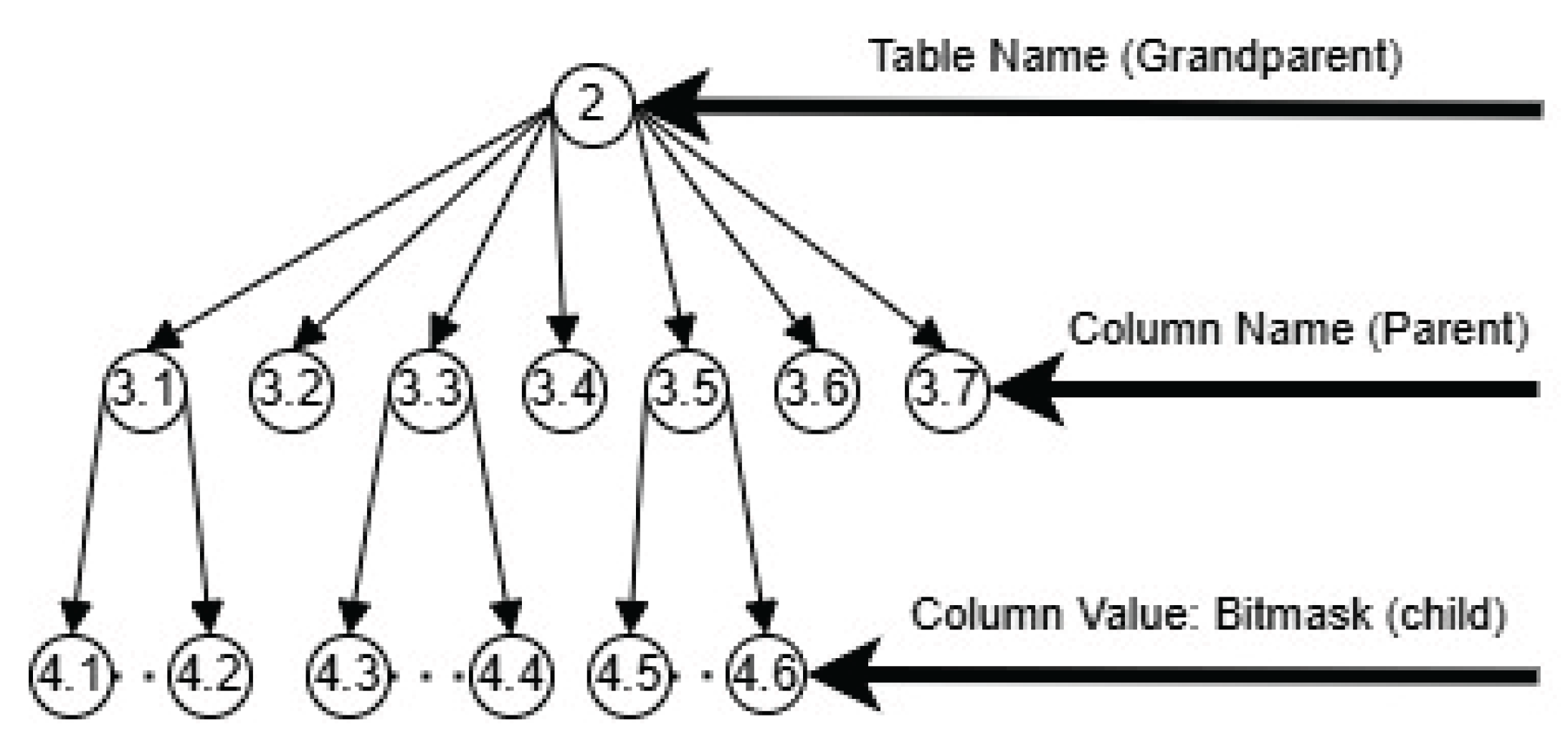
- Grandparent (Level 2): ContinentParent (Grandparent, Node 2)
- Parent (Level 3): [North America], [South America], etc. (Parent columns, Nodes 3.1 – 3.7)
- Child (Level 4): Bitmask for selected countries within each continent (Child state, Nodes 4.1 – 4.6)
Grandparent Table Hierarchy
The hierarchy begins at the conceptual ContinentGrandparent (Level 1) and extends downward. The fictitious top-level nodes (ContinentGrandparent, ContinentParent) act as structural sentinels [135]—providing a stable anchor for the TLE encapsulation boundaries. They prevent root-level special cases and allow the TLE pattern to be applied uniformly across all hierarchical segments. Table A.14.4. summarizes the TLE scope for the three-level segments.
Table A.14.4.
Mapping of hierarchical levels to TLE units in PBFD MVP, including node roles and bitmasks
Table A.14.4.
Mapping of hierarchical levels to TLE units in PBFD MVP, including node roles and bitmasks
| Level | Grandparent Node (Table) | Parent Nodes (Columns) | Child Nodes (Bitmask) | Three-Level Scope |
|---|---|---|---|---|
| 1 | ContinentGrandparent | Continentparent | Continent selections (e.g. North America (1)) | Levels 1–3 |
| 2 | Continentparent | e.g. Asia, North America | Country selections (e.g. United States (1)) | Levels 2–4 |
| 3 | Continent | e.g. United States, Canada | State selections (e.g., Maryland (262,144)) | Levels 3–5 |
| 4 | Country | e.g. Virginia, Maryland | County selections (e.g., Howard County (4096)) | Levels 4–6 |
| 5 | State | e.g. Howard County, Baltimore County | City selections (e.g., (Columbia MD + Ellicott City) (3)) | Levels 5–7 |
Note: Parenthesized values represent decimal bitmasks.
Handling the Lowest Two Hierarchical Levels
As the asymptotic analysis in Appendix A.16 demonstrates, the lowest hierarchical levels in a perfect ternary tree contain approximately 89% of all nodes. To mitigate the potential explosion of dynamic tables, the PBFD methodology leverages TLE’s hierarchical encapsulation by embedding Levels 6 (County) and 7 (City) into their grandparent table (State, Level 5):
- County Level (Level 6): Represented as dedicated columns within the State table (Level 5)
- City Level (Level 7): Stored as bitmasks within the corresponding County columns
This embedding minimizes the number of dynamic tables and preserves compact storage.
Table A.14.5. (Dynamic Table Maryland (Level 5)) illustrates this structure, where counties are represented as columns, and city selections are stored as bitmasks within those columns for a specific state.
Table A.14.5.
Bitmask-encoded dynamic table for Maryland (Level 5), illustrating embedded county/city selections
Table A.14.5.
Bitmask-encoded dynamic table for Maryland (Level 5), illustrating embedded county/city selections
| PersonId | Howard County (bitmask) | …… |
|---|---|---|
| 1 | 3 | …… |
Justification
This TLE-based relational design provides several key benefits:
- It encapsulates the grandparent-parent-child hierarchy within a single unit, using bitmasks for O(1) updates and enabling parallel resolution of nodes within a pattern.
- Leveraging the analytical findings from Appendix A.16, it avoids creating hundreds of tables for leaf-level data by embedding their states, thus maintaining modularity and performance despite the exponential node growth in deeper levels.
- Scalability Alignment: By minimizing dynamic table proliferation and maintaining compact storage, this approach supports the horizontal scaling and operational efficiency required in cloud-native environments.
Appendix A.14.8. Database Implementation (SQL Server)
The PBFD MVP backend uses SQL Server and combines static tables with dynamically generated Three-Level Encapsulation (TLE) tables. This design replaces deep recursive joins with compact, schema-on-demand structures optimized via bitmask encoding [90].
Dynamic TLE Table Generation
Dynamic tables are derived from the static Locations lookup table through an automated transformation pipeline. Rather than storing each hierarchical level in a fully normalized chain of joins, PBFD generates three-level encapsulated tables that encode grandparent–parent–child relationships. Bitmask columns encode child selections as binary flags, enabling constant-time set, clear, and test operations within SQL Server.
Algorithm: Dynamic TLE Table Generator
Let
- N denote the current hierarchical level
- L denote the maximum depth of the hierarchy (in PBFD MVP, L=7)
- The algorithm iterates from level 1 to L - 2, generating one dynamic table per grandparent node
Input:
- Locations metadata (table or JSON)
- Maximum dynamic depth = 5 (up to the State level)
Output:
- SQL table per grandparent that follows the TLE rule (level N)
- One column per parent (level N+1)
- One bitmask field encoding child selections (level N+2)
Steps:
- Load the Locations data
- Group nodes by hierarchical level
- For each level N from 1 to L-2:
For each node at level N, generate a dynamic table corresponding to that grandparent node, with:
- ○
- One column for each parent node at level N+1
- ○
- One bitmask field encoding child selections at level N+2
- 4.
-
Skip dynamic table creation for the lowest two levels (L−1 and L):
- ○
- These levels are embedded into their grandparent’s table as described in Appendix A.14.7, using dedicated columns and bitmask fields
This approach scales to arbitrary depth while maintaining constant-time lookup and update via bitwise operations. It reflects principles seen in schema-on-read and evolution-oriented persistence models [90].
Example root-level table:
- ContinentGrandparent (Level 1, Id = 0)
- Serves as the hierarchical entry point and contains bitmask columns for descendant states or subregions
Operational Safeguards and Deployment
To prevent schema drift or runtime faults:
- Deterministic CREATE TABLE generation occurs as part of controlled deployment scripts.
- All DDL changes are executed inside transactions to ensure rollback safety.
- Preflight checks validate bitmask width, column compatibility, and backward consistency before applying any schema upgrades.
- Type escalation (e.g., INT → BIGINT → VARCHAR) is handled automatically when child-node cardinality outgrows the existing bitmask type.
These safeguards align with established practices in schema evolution and controlled denormalization within polyglot persistence systems [90].
Integrated Schema Structure
The resulting database consists of:
Static Tables:
- Persons (core entity table)
- Locations (full hierarchy metadata)
- NameTypes (categorization of nodes: continent, country, etc.)
Dynamic TLE Tables (auto-generated):
- Level 1: ContinentGrandparent
- Level 2: ContinentParent
- Level 3: one table per continent (e.g., NorthAmerica, Asia, etc.)
- Level 4: one table per country (e.g., [United State], Canada, etc.)
- Level 5: one table per state (e.g., Alabama, California, etc.)
- Lower levels embedded via bitmask columns rather than additional tables
Figure A.14.4. illustrates:
- The Persons table as the static entry point
- Dynamically generated TLE structures for the first three hierarchical levels
- One-hop access paths from Persons
- Clear delineation of bitmask fields and level boundaries within each dynamic table
Clear delineation of hierarchical roles—table name as grandparent, columns as parents, and bitmask fields as children—within each dynamic TLE table.
Figure A.14.4.
PBFD MVP database schema integrating static and dynamic TLE-compliant tables with bitmask encoding
Figure A.14.4.
PBFD MVP database schema integrating static and dynamic TLE-compliant tables with bitmask encoding
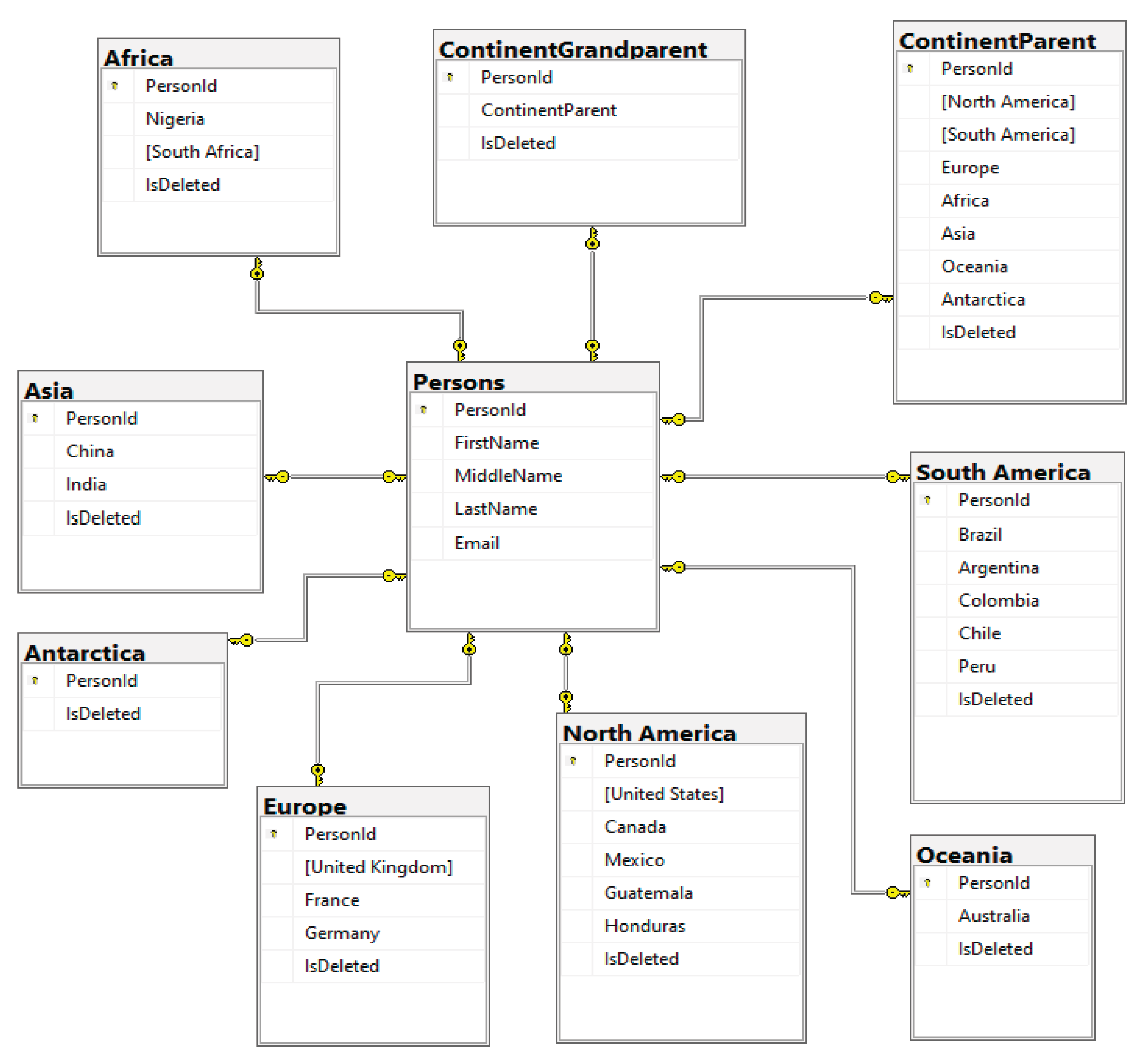
Appendix A.14.9. PBFD Loosely Coupled Table Design Benefits
PBFD's dynamic Three-Level Encapsulation (TLE) design replaces rigid, deeply joined schemas with a scalable, loosely coupled architecture. This approach preserves the core advantages of relational databases while systematically addressing common performance and operational bottlenecks. The benefits are summarized in the tables below.
Table A.14.6.
Key relational database benefits preserved in PBFD MVP’s TLE-based design
| Feature | Benefit |
|---|---|
| Normalization [136] | Static tables are highly normalized. |
| Security [137] | Table-level permissions enforce granular access control (e.g., permitting team-specific access to regional data), a foundational relational security model. |
| Optimization [55,138] | Each grandparent table can utilize separate indexes and be independently partitioned or sharded, allowing for targeted performance tuning. |
Table A.14.7.
Relational challenges and PBFD MVP’s architectural solutions
| Challenge | PBFD Solution |
|---|---|
| Multi-Table Joins [139] | Replaces 4–5 join traversals with direct, one-hop access to precomputed grandparent tables, dramatically reducing query complexity. |
| ORM/Workflow Complexity [140] | Employs a single controller and view model across all hierarchical levels, simplifying the application layer and minimizing code duplication. |
| Backup/Restore Bottlenecks [141] | Enables modular, table-level operations (e.g., backing up only the "Europe" dataset), which aligns with modern, cloud-native operational practices [90]. |
The empirical benefits observed in the MVP stem from three key design outcomes: (a) a significant reduction in joins per pattern query, (b) a compact bitmask representation that lowers I/O for read-heavy paths, and (c) a table-level granularity that facilitates independent management. This architectural strategy embodies a practical form of denormalization, trading initial schema complexity for sustained query and operational efficiency, a trade-off well-documented in literature on schema evolution and polyglot persistence.
Appendix A.14.10. Development Process
The PBFD MVP follows a top-down hierarchical construction guided by the central Locations metadata table and TLE-compliant data models. The process is engineered for reproducibility and for validating the methodology’s core claims. The complete, step-by-step implementation details are available for inspection and verification in Appendix A.17.
Process Flow (high level)
- Frontend — Visitor entry & pattern selection: The frontend collects visitor data, including each party’s initial pattern choices.
- Backend — Dynamic generation: The Locations table is consulted to deterministically generate TLE tables (CREATE TABLE statements).
- UI — Shared rendering: A single Razor view and ViewModel are reused across levels to render pattern options, reducing duplication.
- Data update — Bitmask write: User actions are persisted by updating the bitmask column in the grandparent table (typically a single-row O(1) operation).
Key Methodology Claims (Instantiated in the MVP)
- Hierarchy-Aware Design: Logical table boundaries are enforced for each three-level scope via TLE, aligning with structured decomposition principles in hierarchical relational schemas [118].
- Reusable Workflow: A single MVC controller and ViewModel operate across all hierarchical levels, minimizing ORM complexity and duplication in line with multi-view reuse patterns in enterprise MVC frameworks [142].
- Exceeding Rₘₐₓ transitions the workflow to state S8, as specified in Table A.14.2, enforcing bounded iteration and controlled bailout paths consistent with ISO/IEC 12207 lifecycle termination principles [87].
Appendix A.14.11. Key Claims Supported and Academic Grounding
This MVP provides empirical evidence supporting the following claims, grounded in established computer science and database literature (See Table A.14.8).
Table A.14.8.
Key Claims Supported and Academic Grounding
| Claim | Academic Grounding |
|---|---|
| Bitwise/encoded access provides substantial read efficiency for pattern queries. | Grounded in columnar/encoding database literature [23,53,55] |
| Recursive-CTE/adjacency-list traversal has depth-dependent costs (worse for broad/deep hierarchies). | Grounded in classical database texts on hierarchical representations and relational trade-offs [118] |
| TLE’s dynamic table approach is a practical denormalization strategy that trades schema complexity for query and operational efficiency. | Consistent with schema evolution and polyglot persistence research [90] |
| Bounded iterative refinement and backtracking map to classical search/backtracking techniques. | Supported by DFS/BFS algorithmic foundations and process-refinement literature [62,77,83] |
| Formal verification of workflow/state-machine behavior aligns with CSP paradigms, and the MVP inherits its structural and behavioral guarantees from the verified Generic model. | Grounded in process algebra and model checking guidance (CSP) [45,71,87], as applied to the Generic model from which the MVP is derived |
By integrating these elements, the PBFD MVP operationalizes concepts typically treated in isolation—encoded storage, bounded search, hierarchical partitioning, and verification—into a unified and reproducible development methodology.
Appendix A.15. PBFD MVP State Machine Workflow Mermaid Code
Mermaid Code for Figure A.14.2:
stateDiagram-v2
direction TB
[*] --> S0
state "S0: Level 1<br>Process/Validate/Resolve<br>(TLE 1–3)" as S0
state "S1: Level 2<br>Process/Validate/Resolve<br>(TLE 2–4)" as S1
state "S2: Level 3<br>Process/Validate/Resolve<br>(TLE 3–5)" as S2
state "S3: Level 4<br>Process/Validate/Resolve<br>(TLE 4–6)" as S3
state "S4: Level 5<br>Process/Validate<br>(TLE 5–7)" as S4
state "S5: Refine L1-L3" as S5
state "S6: Finalize All" as S6
state "S7: Complete" as S7
state "S8: Error" as S8
S0 --> S1 : PBFD2<br>S0 done
S1 --> S2 : PBFD3<br>S1 done
S2 --> S3 : PBFD4<br>S2 done
S3 --> S4 : PBFD5<br>S3 done
S2 --> S5 : PBFD6<br>S2 fail
S5 --> S0 : PBFD7<br>Refined
S5 --> S8 : PBFD8<br>Attempts≥50
S4 --> S6 : PBFD9<br>S4 done
S6 --> S7 : PBFD10<br>Complete
S7 --> [*]
Appendix A.16. Quantifying Node Reduction in Perfect N-ary Trees
This section quantifies the number of nodes remaining in a perfect n-ary tree after removing all leaves (nodes at the deepest level) and their immediate parent nodes. We assume a perfect n-ary tree of height h, where all levels are fully filled.
Key Formula
- Total Nodes (before removal):
-
Nodes removed:
- ○
- Leaves (level h): nodes
- ○
- Parent level (level h−1): nodes
- Remaining nodes (after removing leaves and their parents):
Remaining Nodes (after removing leaves and their parents):
Example: Ternary Tree (n = 3) of Height h = 6
Step 1: Compute the Total Nodes
Step 2: Compute the Nodes to Remove
- Leaves (Level 6): nodes
- Parent Level (Level 5): nodes
- Total Nodes Removed: nodes
Step 3: Compute the Remaining Nodes
Step 4: Compute the Remaining Nodes’ Percentage
Step 5: Percentage of Last Two Levels
- ○
- Nodes in last two levels: 729 + 243 = 972 nodes
- ○
- Percentage of last two levels: (972 / 1093) × 100% ≈ 88.93%
Thus, after removing the leaves and their parent level, only 121 nodes or approximately 11% remain in the tree. The last two levels (5 and 6) constitute approximately 89% of the total tree (see Table A.16.1).
Table A.16.1.
Summary for Ternary Tree (n = 3, h = 6)
| Metric | Value | Percentage |
|---|---|---|
| Total nodes | 1,093 | 100.00% |
| Level 6 (leaves) | 729 | 66.70% |
| Level 5 (parents) | 243 | 22.23% |
| Last two levels combined | 972 | 88.93% |
| Remaining nodes (Levels 0–4) | 121 | 11.07% |
This analysis informs the PBFD MVP design (Appendix A.14), in which the bottom two hierarchical levels— representing approximately 89% of nodes in a ternary tree— are fully encapsulated within their grandparent table. This prevents excessive table proliferation while representing TLE's performance characteristics.
Appendix A.17. PBFD MVP Development Process
This section details the step-by-step progression of the PBFD MVP’s development process. The corresponding source code is provided in [29].
Appendix A.17.1. The Visitor Page
- Purpose: Captures initial visitor information (e.g., name, contact details) and persists it to the static Persons table (Table A.13.1)
-
Design:
- ○
- Model: Person (maps to Persons table)
- ○
- UI: Person node excluded from PBFD MVP hierarchy (Figure A.15.1) but serving as root node in PDFD MVP design (Figure A.11.1)
- Workflow: On submission, redirects to the Continent Page to begin hierarchical selections
-
State Machine Context:
- ○
- Pre-Processing: This step occurs before the state machine initializes.
- ○
- Transition: Submission triggers PBFD1 (Table A.14.2), transitioning to S0 (Level_1_Processing_Validating_Resolving) (Table A.14.1).
Appendix A.17.2. Continent Level (Child Level 3, Grandparent Level 1)
- Hierarchical Structure
TLE Rule Implementation (see Table A.17.1): The continent bitmask is stored as a column value under its parent node—ContinentParent, which resides within the grandparent node—Table ContinentGrandparent (Table A.17.2, Figure A.17.1). This follows the TLE rule for hierarchical data structuring.
Table A.17.1.
Sample mapping of grandparent, parent, and child nodes at the continent level based on TLE encoding
Table A.17.1.
Sample mapping of grandparent, parent, and child nodes at the continent level based on TLE encoding
| Child LocationId | ChildId | Child Node | Parent Node (Columns) | Grandparent Node (Table) |
|---|---|---|---|---|
| 2 | 0 | North America | ContinentParent | ContinentGrandparent |
| 4 | 2 | Europe | ContinentParent | ContinentGrandparent |
| 6 | 4 | Asia | ContinentParent | ContinentGrandparent |
Table A.17.2.
Bitmask encoding (Decimal) of selected continent nodes stored in the ContinentGrandparent table
Table A.17.2.
Bitmask encoding (Decimal) of selected continent nodes stored in the ContinentGrandparent table
| PersonId | ContinentParent |
| 1 | 21 |
The ContinentGrandparent and ContinentParent tables are structural artifacts (analogous to sentinel nodes in linked lists) introduced to enable root-level TLE encapsulation. While physically persisted, they represent conceptual hierarchy levels not present in raw geographical data.
Figure A.17.1.
Continent level interface showing checkbox-based selection of continent nodes using bitmask encoding
Figure A.17.1.
Continent level interface showing checkbox-based selection of continent nodes using bitmask encoding

- 2.
- Key Workflow
- Data Retrieval: The LocationViewModel fetches continent nodes from the Locations table (Table A.14.3) where ParentId = 1.
- UI Binding: Continent names (e.g., "North America") are bound to checkboxes in the interface (Figure A.17.1).
- Bitmask Encoding: Selected continents are encoded as bitmasks (e.g., 21 for North America + Europe + Asia).
- Persistence: Bitmasks are saved in the ContinentGrandparent table (Table A.17.2).
- 3.
- Continent Level Interface
- Node Mapping (Figure A.14.1): Nodes 3.1–3.7 represent continents (e.g., 3.1 = North America).
- Example: Selecting Asia (3.5), Europe (3.3), and North America (3.1) generates the bitmask 0000000000010101 (decimal 21).
- 4.
- Interpretation
Node: ContinentParent
- Decimal Value: 21
-
Binary Value: 00010101 (8-bit format)Bit Positions Set:
- ○
- Bit 0: North America (Node 3.1 in Figure A.14.1)
- ○
- Bit 2: Europe (Node 3.3 in Figure A.14.1)
- ○
- Bit 4: Asia (Node 3.5 in Figure A.14.1)
- UI: North America, Europe, and Asia appear as checked checkboxes in Figure A.17.1.
- Storage: Selected continents are stored as bitmasks in the ContinentGrandparent table (Table A.17.2), with each bit representing a continent.
- 5.
- Workflow Impact
- Selection: Selections are saved as bitmasks in ContinentGrandparent.
- Deselection: Unchecking North America updates the bitmask to 20 (0000000000010100), while the LocationResetService recursively clears all associated child data within North America (including Country, State, etc.).
- UI/Backend Split: Only child nodes (Continents) are displayed, with grandparent and parent nodes managed by middleware.
- 6.
- State Machine Context
- Current State: S0 (Level_1_Processing_Validating_Resolving) (Table A.14.1)
- TLE Structure: Processes Child Level 3 under Grandparent Level 1 (ContinentGrandparent table)
- Transition: On submission, advances to S1 (Level_2_Processing_Validating_Resolving) via PBFD2 (Table A.14.2)
Appendix A.17.3. Country Level (Child Level 4, Grandparent Level 2)
- 1.
- Hierarchical Structure
TLE Rule Implementation: In the Country Level, Columns in ContinentParent (e.g., 'North America') are dynamically generated only for continents selected at Level 3 (see Table A.17.3). These columns represent parent nodes (continents), while country selections are stored as bitmasks within their respective continent columns (see Table A.17.4 and Figure A.17.2).
Table A.17.3.
Sample mapping of grandparent, parent, and child nodes at the country level following TLE rules
Table A.17.3.
Sample mapping of grandparent, parent, and child nodes at the country level following TLE rules
| Child LocationId | ChildId | Child Node | Parent Node (Columns) | Grandparent Node (Table) |
|---|---|---|---|---|
| 9 | 0 | United States | North America | ContinentParent |
| 10 | 1 | Canada | North America | ContinentParent |
| 19 | 0 | United Kingdom | Europe | ContinentParent |
| 20 | 1 | France | Europe | ContinentParent |
| 24 | 0 | China | Asia | ContinentParent |
| 25 | 1 | India | Asia | ContinentParent |
Table A.17.4.
Bitmask decimal values representing selected countries persisted in the ContinentParent table
Table A.17.4.
Bitmask decimal values representing selected countries persisted in the ContinentParent table
| PersonId | North America | Europe | Asia |
|---|---|---|---|
| 1 | 3 | 3 | 0 |
- 2.
- Key Workflow
- Parent Nodes: Columns in the ContinentParent table (e.g., "North America") correspond to selected continents from the previous level (Table A.17.2).
- Child Bitmasks: Each column value encodes selected countries using a bitmask (e.g., 00000011 for United States and Canada, as shown under the [North America] column in Table A.17.4).
- UI Rendering: The LocationViewModel populates checkboxes for countries under selected continents (Figure A.17.2). Only child nodes (countries) and parent nodes (Continents) are displayed, with grandparent nodes managed by middleware. This hierarchical approach continues consistently down to the city level.
Figure A.17.2.
Country level interface with dynamically rendered checkboxes based on selected continents and encoded as bitmasks
Figure A.17.2.
Country level interface with dynamically rendered checkboxes based on selected continents and encoded as bitmasks

- 3.
- Interpretation
Node: North America
- Bitmask Value: 3 (binary 00000011 (8-bit format))
-
Set Bits:
- ○
- Bit 0: United States (Node 4.1 in Figure A.14.1)
- ○
- Bit 1: Canada (Node 4.2 in Figure A.14.1)
- Storage: Saved in the North America column of the Continent table (Table A.17.4)
Node: Europe
- Bitmask Value: 3 (binary 00000011(8-bit format))
-
Set Bits:
- ○
- Bit 0: United Kingdom (Node 4.5 in Figure A.14.1)
- ○
- Bit 1: France (Node 4.6 in Figure A.14.1)
- Storage: Persisted in the Europe column of the Continent table (Table A.17.4)
Node: Asia
- Bitmask Value: 0 (binary 00000000(8-bit format))
- Set Bits: None (all bits unset)
- Storage: Persisted in the Asia column of the Continent table (Table A.17.4)
- 4.
- Workflow Impact
- Selection: Selecting a country (e.g., United States) causes the corresponding state-level tables to be displayed.
- Deselection: Unchecking a country (e.g., Canada) invokes the LocationResetService, recursively nullifying child data (states, counties, etc.).
- 5.
- State Machine Context
- Current State: S1 (Level_2_Processing_Validating_Resolving) (Table A.14.1)
- TLE Structure: Processes Child Level 4 under Grandparent Level 2 (ContinentParent table)
- Transition: Advances to S2 (Level_3_Processing_Validating_Resolving) via PBFD3 after validation
Appendix A.17.4. State Level (Child Level 5, Grandparent Level 3)
- 1.
- Hierarchical Structure
TLE Rule Implementation: In the State Level, columns are dynamically generated in grandparent tables (e.g., North America, Europe, or Asia tables) based on the selected continent-country hierarchy (see Table A.17.5). These columns represent parent nodes (countries), and state selections are stored as bitmasks within the corresponding country columns (see Table A.17.6 and Figure A.17.3).
Table A.17.5.
Sample mapping of grandparent, parent, and child nodes at the state level using dynamic column generation
Table A.17.5.
Sample mapping of grandparent, parent, and child nodes at the state level using dynamic column generation
| Child LocationId | ChildId | Child Node | Parent Node (Columns) | Grandparent Node (Table) |
|---|---|---|---|---|
| 38 | 11 | Virginia | United States | North America |
| 45 | 18 | Maryland | United States | North America |
| 77 | 0 | Ontario | Canada | North America |
| 89 | 12 | Nunavut | Canada | North America |
Table A.17.6.
Bitmask encoding (Decimal) of selected states stored in dynamically generated continent-level (North America) table
Table A.17.6.
Bitmask encoding (Decimal) of selected states stored in dynamically generated continent-level (North America) table
| PersonId | United States | Canada |
|---|---|---|
| 1 | 264192 | 4097 |
- 2.
- Key Workflow
- Grandparent Tables: Each grandparent table (e.g., North America in this sample) corresponds to a continent selected at the Country Level (Table A.17.4).
- Parent Columns: Columns in the grandparent table (e.g., "United States" in North America) represent selected countries.
- Child Bitmasks: Bitmasks in parent columns encode selected states (e.g., 264,192 for Virginia + Maryland in the United States in Table A.17.6)
- 3.
- Interpretation (Derived from Table A.17.6 and Figure A.17.3)
Figure A.17.3.
State level interface illustrating checkboxes for states rendered from selected countries using bitmask storage
Figure A.17.3.
State level interface illustrating checkboxes for states rendered from selected countries using bitmask storage

North America (Grandparent Table)
-
Parent Column (United States):
- ○
- Bitmask Value: 264,192 (binary 1000000100000000000 (20-bit format))
- ○
-
Set Bits:
- ▪
- Bit 11: Virginia (Node 5.2 in Figure A.14.1)
- ▪
- Bit 18: Maryland (Node 5.1 in Figure A.14.1)
-
Parent Column (Canada):
- ○
- Bitmask Value: 4,097 (binary 0001000000000001(16-bit format))
- ○
- Set Bits:
- ▪
- Bit 0: Ontario (Node 5.4 in Figure A.14.1)
- ▪
- Bit 12: Nunavut (Node 5.3 in Figure A.14.1)
UI Consistency
- The same LocationViewModel renders checked states (e.g., Maryland, Nunavut) across all grandparent tables (e.g., North America, Europe), as shown in Figure A.17.3.
Storage
- Selected states are stored as bitmasks in the North America table (Table A.17.6), with columns representing parent countries.
- 4.
- Technical Note
The bigint data type (64-bit) is used for the United States due to its 50 states, ensuring sufficient bitwise capacity (see Table A.14.3).
- 5.
- Workflow Impact
- Selection: Choosing a state (e.g., Maryland) causes the corresponding county-level tables and user interfaces to be displayed.
- Deselection: Unchecking a state (e.g., Virginia) invokes the LocationResetService, recursively nullifying child data (counties, cities).
- 6.
- State Machine Context
- Current State: S2 (Level_3_Processing_Validating_Resolving) (Table A.14.1)
- TLE Structure: Processes Child Level 5 under Grandparent Level 3 (e.g. [North America] table)
-
Transition:
- ○
- On success: Advances to S3 (Level_4_Processing_Validating_Resolving) via PBFD4
- ○
- On failure: Transitions to S5 (Refine_Level1-3) (Table A.14.1) via PBFD6
Appendix A.17.5. County Level (Child Level 6, Grandparent Level 4)
- 1.
- Hierarchical Structure
TLE Rule Implementation: In the County Level, columns are dynamically generated within Country Level tables (e.g., United States), following the TLE Rule (see Table A.17.7). These columns represent parent nodes (states), while county selections are stored as bitmasks within their respective state columns (see Table A.17.8 and Figure A.17.4).
Table A.17.7.
Sample mapping of grandparent, parent, and child nodes at the county level using country-specific tables
Table A.17.7.
Sample mapping of grandparent, parent, and child nodes at the county level using country-specific tables
| Child LocationId | ChildId | Child Node | Parent Node (Columns) | Grandparent Node (Table) |
|---|---|---|---|---|
| 92 | 2 | Baltimore County | Maryland | United States |
| 102 | 12 | Howard County | Maryland | United States |
| 120 | 6 | Arlington County | Virginia | United States |
| 186 | 28 | Fairfax County | Virginia | United States |
Table A.17.8.
Bitmask decimal values for selected counties stored in the United States table
| PersonId | Virginia | Maryland |
|---|---|---|
| 1 | 268435520 | 4100 |
Figure A.17.4.
County level interface showing hierarchical county selections for selected states encoded via bitmask flags.
Figure A.17.4.
County level interface showing hierarchical county selections for selected states encoded via bitmask flags.
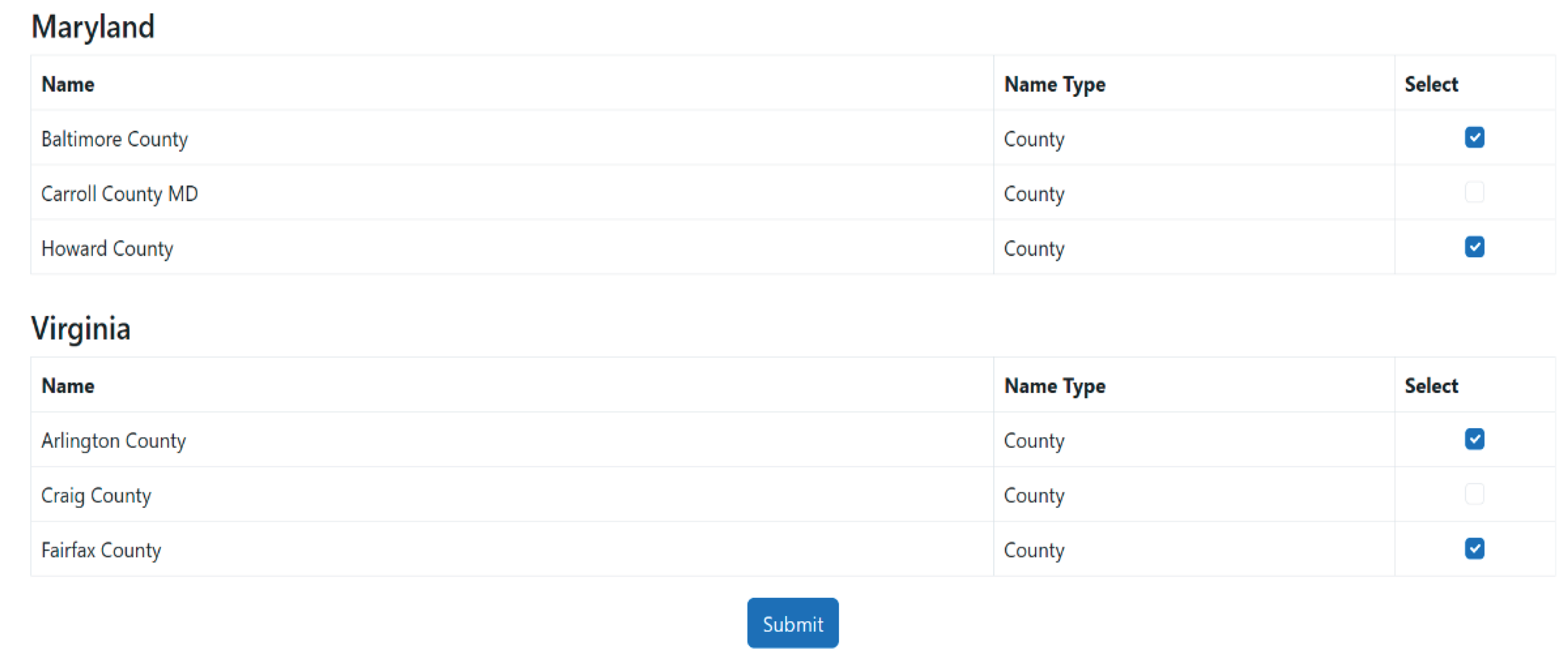
- 2.
- Key Workflow
Grandparent Tables: Country Level tables (e.g., United States in Table A.17.8) serve as the root for the County Level hierarchy.
Parent Columns: Columns in Country Level tables (e.g., Maryland, Virginia) represent selected states from the State Level (Table A.17.8).
Child Bitmasks: Parent columns store bitmasks that encode selected counties using binary flags (e.g., 0b1000000000100 for Baltimore and Howard Counties in Maryland, with each bit representing a county).
UI Rendering: The shared LocationViewModel populates checkboxes for counties under selected states (Figure A.17.4).
Interpretation
Node: Virginia
-
Decimal Value: 268,435,520
- ○
- Binary Value: 00010000000000000000000001000000 (32-bit format)
- ○
-
Bit Positions Set:
- ▪
- Bit 6: Arlington County (Node 6.3 in Figure A.14.1)
- ▪
- Bit 28: Fairfax County (Node 6.4 in Figure A.14.1)
- UI: Both counties (Arlington and Fairfax) appear as checked checkboxes in Figure A.17.4.
Node: Maryland
-
Decimal Value: 4,100
- ○
- Binary Value: 0001000000000100 (16-bit format)
- ○
-
Bit Positions Set:
- ▪
- Bit 2: Baltimore County (ChildId = 2, Node 6.1 in Figure A.14.1)
- ▪
- Bit 12: Howard County (ChildId = 12, Node 6.2 in Figure A.14.1)
- UI: Both Baltimore County and Howard County appear as checked checkboxes in Figure A.17.4.
Storage
Selected counties are stored as bitmasks in the United States table (Table A.17.8), with columns representing parent states.
- 4.
- Technical Note
Large Bitmasks: To accommodate bitmasks exceeding 64 bits (e.g., states with numerous counties like Virginia, see Table A.14.3), the system employs VARCHAR for database persistence. In the C# application, System.Numerics.BigInteger seamlessly converts these VARCHAR values into arbitrary-precision integers, enabling efficient in-memory bitwise operations. While this introduces a minor string-to-BigInteger conversion overhead, it provides crucial flexibility and scalability for variable-length bitmasks, simplifying schema management and application logic compared to fixed-size integer alternatives.
- 5.
- Workflow Impact
Selection: Selected counties trigger the collection of City Level data (e.g., cities under Howard County like Columbia MD), which are stored as bitmasks within the parent county columns of the Country Level tables (e.g., United States).
Deselection: Unchecking a county (e.g., Fairfax County) invokes the LocationResetService, recursively nullifying its child city bitmasks.
State Machine Context
- Current State: S3 (Level_4_Processing_Validating_Resolving) (Table A.14.1)
- TLE Structure: Processes Child Level 6 embedded in Grandparent Level 4 (e.g. [United States] table)
- Transition: Advances to S4 (Level_5_Processing_Validating) via PBFD5
Appendix A.17.6. City Level (Child Level 7, Grandparent Level 5)
- 1.
- Hierarchical Structure
TLE Rule Implementation (see Table A.17.9): In the City Level, columns are dynamically generated within State Level tables (e.g., Maryland, Virginia) to represent parent nodes (counties), and city selections are stored as bitmasks within these dynamically created county columns (see Tables A.17.10, A.17.11, and Figure A.17.5).
Table A.17.9.
Sample mapping of grandparent, parent, and child nodes at the city level using dynamically generated state tables
Table A.17.9.
Sample mapping of grandparent, parent, and child nodes at the city level using dynamically generated state tables
| Child LocationId | ChildId | Child Node | Parent Node (Columns) | Grandparent Node (Table) |
|---|---|---|---|---|
| 138 | 0 | Arbutus | Baltimore County | Maryland |
| 139 | 1 | Catonsville | Baltimore County | Maryland |
| 146 | 0 | Columbia MD | Howard County | Maryland |
| 147 | 1 | Ellicott City | Howard County | Maryland |
| 149 | 3 | Laurel | Howard County | Maryland |
| 156 | 0 | Arlington | Arlington County | Virginia |
| 164 | 8 | Virginia Square | Arlington County | Virginia |
Table A.17.10.
Bitmask decimal values representing city selections stored in the Maryland table
| PersonId | Baltimore County | Howard County |
|---|---|---|
| 1 | 3 | 3 |
Table A.17.11.
Bitmask decimal values representing city selections stored in the Virginia table
| PersonId | Arlington County | FairFax County |
|---|---|---|
| 1 | 257 | 0 |
Figure A.17.5.
City level interface showing checkbox-based city selections for selected counties using TLE-encoded bitmasks
Figure A.17.5.
City level interface showing checkbox-based city selections for selected counties using TLE-encoded bitmasks
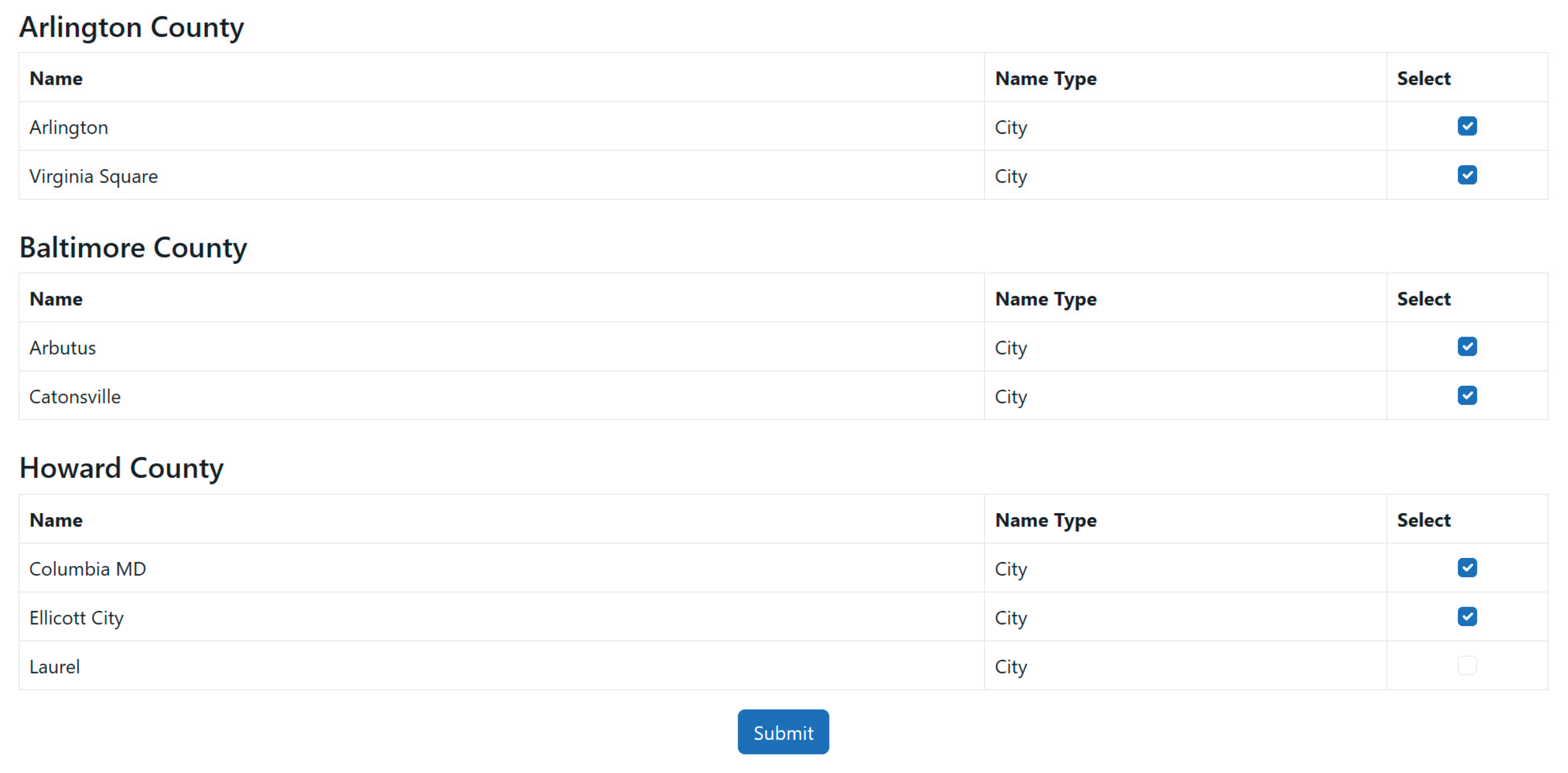
- 2.
- Key Workflow
Data Retrieval: The LocationViewModel fetches counties (e.g., Howard County) selected at the County Level (Table A.14.3).
UI Binding: Cities under selected counties (e.g., Columbia MD, Arlington) are bound to checkboxes (Figure A.17.5).
Bitmask Encoding: Selections are stored as bitmasks in county columns (e.g., Howard County = 3).
Persistence: Bitmasks are saved in State Level tables (e.g., Maryland).
Interpretation
Node: Howard County
- Binary: 00000011 (8-bit format)
-
Set Bits:
- ○
- Bit 0: Columbia MD (Node 7.3 in Figure A.14.1)
- ○
- Bit 1: Ellicott City (Node 7.4 in Figure A.14.1)
- UI: Both cities are checked in Figure A.17.5.
Node: Baltimore County
- Binary: 00000011 (8-bit format)
-
Set Bits:
- ○
- Bit 0: Arbutus (Node 7.1 in Figure A.14.1)
- ○
- Bit 1: Catonsville (Node 7.2 in Figure A.14.1)
- UI: Both cities are checked in Figure A.17.5.
Node: Arlington County
- Binary: 100000001 (9-bit format)
-
Set Bits:
- ○
- Bit 0: Arlington (Node 7.5 in Figure A.14.1)
- ○
- Bit 8: Virginia Square (Node 7.6 in Figure A.14.1)
- UI: Both cities are checked in Figure A.17.5.
Node: Fairfax County
- Binary: 00000000 (8-bit format)
- Interpretation: No cities selected
- UI: All cities under Fairfax County are unselected and not shown in Figure A.17.5.
Storage
- Selected cities are stored as bitmasks in State Level tables (e.g., Maryland, Virginia) under county columns (Tables A.17.10. and Tables A.17.11).
- 4.
- Workflow Impact
- Selection: Selected cities are encoded as bitmasks within their respective parent county columns (e.g., Columbia MD, stored in the Howard County column).
- Deselection: Unchecking a city (e.g., Virginia Square) updates the bitmask and nullifies its data.
- 5.
- State Machine Context
- Current State: S4 (Level_5_Processing_Validating) (Table A.14.1)
- TLE Structure: Processes Child Level 7 embedded in Grandparent Level 5 (e.g., Maryland table)
- Transition: Advances to S6 (Finalize_All) via PBFD9
Appendix A.17.7. The Report Page
The LocationReportService generates hierarchical location reports by leveraging the TLE Rule (defined in Section 4.2) to traverse checked nodes in the workflow (Figure A.14.1).
Key Components
The LocationReportService leverages the following components to generate hierarchical reports:
-
Caching Mechanism:
- ○
- Metadata Cache: Preloads table/column names (e.g., ContinentGrandparent, North America)
- ○
- Data Cache: Stores hierarchical data (e.g., continent-country mappings)
- Recursive CTE Engine: Constructs hierarchical paths using SQL Common Table Expressions
- Bitwise Decoder: Resolves selected nodes from stored bitmasks (e.g., Continent = 21 → North America + Europe + Asia)
Workflow
-
Queue Initialization:
- ○
- Starts from the root node (ContinentGrandparent, Node 1 in Figure A.14.1) and processes checked nodes breadth-first
-
TLE Rule Traversal:
- ○
- Grandparent: Active table (e.g., ContinentGrandparent)
- ○
- Parent: Columns representing child nodes of grandparents (e.g., North America)
- ○
- Child: Bitmasks encoding grandchild node selections (e.g., United States and Canada under North America)
-
Path Generation:
- ○
- Uses recursive CTEs to build paths (e.g., Continent → North America → United States)
- Aggregation: Combines visited paths into a unified report (Figure A.17.6)
Figure A.17.6.
PBFD Report Page interface displaying hierarchical output generated from recursive bitmask decoding and TLE traversal
Figure A.17.6.
PBFD Report Page interface displaying hierarchical output generated from recursive bitmask decoding and TLE traversal
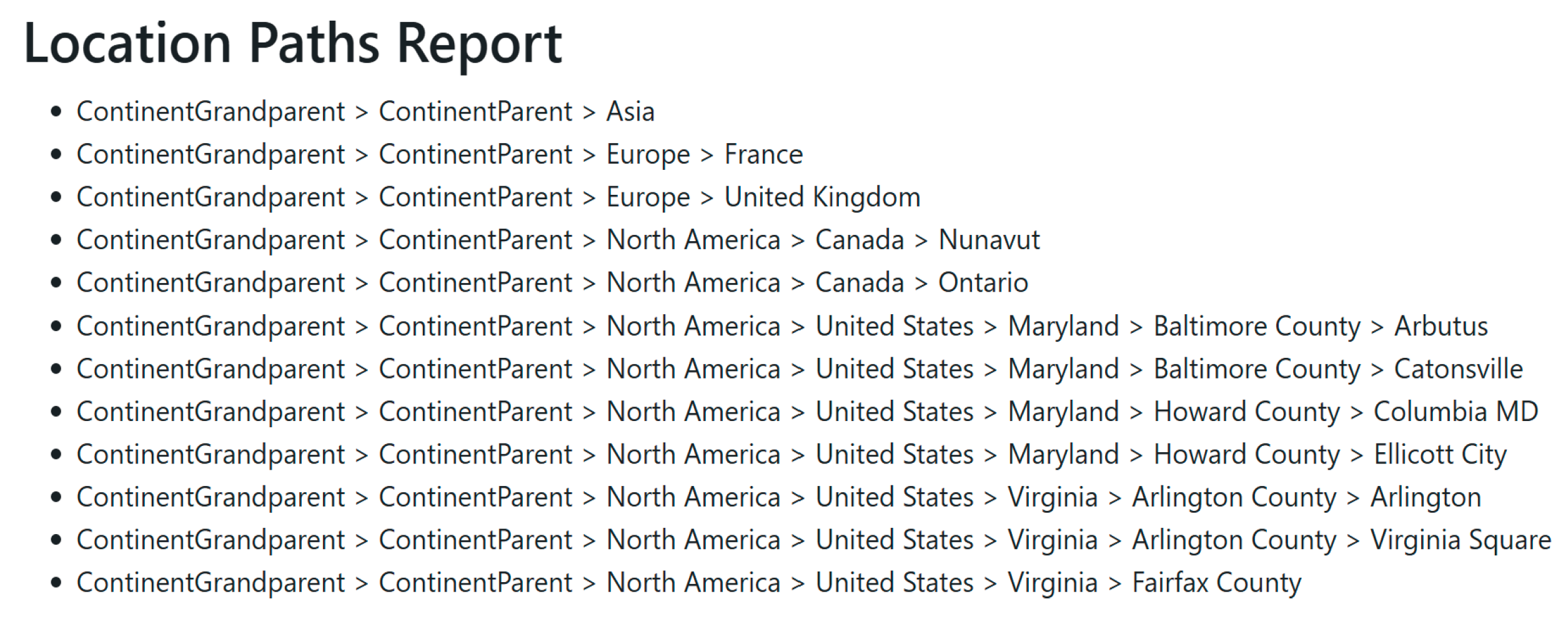
Appendix A.17.8. Development with CDD
- 1.
- Refactoring Journey
-
Initial Approach:
- ○
- Redundant Components: Each level (ContinentGrandparent, ContinentParent, and Continent) had dedicated models, views, and controllers.
- ○
- Bottleneck: Code duplication increased maintenance costs at the Continent Level (grandparent Level 3 in Figure A.14.1).
-
Realization of Shared Logic:
- ○
- Hierarchical Symmetry: Identified recurring patterns (TLE Rule) across levels
- ○
-
Refactoring:
- ▪
- Shared Models: LocationViewModel, LocationSaveService
- ▪
- Unified View: Dynamic UI rendering based on JSON configuration
- ▪
- Centralized Controller: LocationController handling all levels
-
Impact:
- ○
- Workflow Alignment: Aligns UI-centric child-level workflows with the database's grandparent table hierarchy. Curve a (See Figure A.14.1) depicts this mapping: As UI focus shifts from child data at Level 5 (e.g., States) up to Level 3 (e.g., Continents), the corresponding database operations target grandparent tables from Level 3 (e.g., the Continent table) up to Level 1 (e.g., the ContinentGrandparent table).
This refactoring journey epitomizes effective CDD. By identifying the 'hierarchical symmetry' and consistent 'TLE Rule' patterns across geographical levels, we abstracted level-specific logic into reusable shared components (e.g., LocationViewModel, LocationSaveService, LocationController). This dramatically reduced code duplication, simplified maintenance, and significantly enhanced the system's extensibility. Future hierarchy expansions or rule modifications now primarily involve metadata updates and leverage existing, verified components, substantially lowering long-term total cost of ownership and adapting to evolving data requirements.
- 2.
- State Machine Context
Current State: S5 (Refine_Level1-3) (See Table A.14.1)
TLE Structure: Processes Child Levels 3-7 embedded in Grandparent Levels 1-5
Transition: Refactoring prompted a restart from Level 3 (S2) to Level 1 (S0) via S5, reprocessing Levels 1–3 to resolve shared component dependencies
Formal Validation Takeaways
Validation prioritizes CDD where refinement iterations create unique cyclomatic risks requiring bounded termination (Rₘₐₓ=50). Sequential elements inherit correctness from CDD's invariance properties and use conventional verification. The PBFD state machine's sequential progression (S0 to S4, via Table A.14.2 transitions) benefits from CDD's invariant component design. Core shared components (e.g., LocationViewModel, LocationSaveService, LocationController) are rigorously verified once for their consistent adherence to TLE Rule principles. Consequently, each subsequent level's processing inherits this foundational correctness. Verification then shifts from re-validating component logic to focusing on conventional aspects: data integrity from the Locations dataset (See Table A.14.3) and precise state transition adherence, streamlining validation efforts.
The CDD refinement process adheres to FBFD methodology through these PBFD-specific invariants:
-
Termination Assurance
- ○
- Per-level refinement limit: refinement_attempts[j] ≤ Rₘₐₓ = 50 (See Appendix A.14.3)
- ○
-
Error enforcement:
- ▪
- PBFD6: Level 1-3 failure after 50 attempts
- ▪
- PBFD9: Finalization failure
-
State Machine Conformance
- ○
-
TLE state mappings:
- ▪
- Continent: S0 → Grandparent Level 1
- ▪
- City: S4 → Grandparent Level 5
- ○
-
Refinement triggers:
- ▪
- Shared component refactoring: PBFD6 → S5 (See Table A.14.2)
-
Parameter Invariance
- ○
- Root-cause level: Jᵢ=1 (Grandparent Level)
- ○
-
Refinement scope:
- ▪
- Rᵢ = i - Jᵢ + 1 (Appendix A.14.3)
- ▪
- Example: Level 3 failure → Rᵢ=3 (Levels 1-3)
- Complexity Bounds (See Table A.17.12)
Table A.17.12.
Complexity bounds of the PBFD MVP system across state machine parameters and refinement limits
Table A.17.12.
Complexity bounds of the PBFD MVP system across state machine parameters and refinement limits
| Metric | PBFD Value | Reference |
|---|---|---|
| Hierarchy Depth (L) | 5 | Table A.14.4 |
| States (⎥Q⎥) | 9 | Table A.14.1 |
| Transitions (⎥δ⎥) | 10 | Table A.14.2 |
| Max Attempts Recorded | 1 (<< Rₘₐₓ=50) | Appendix A.17.8 |
- 4.
- Key Advantage
Level-Wise Efficiency: Shared components significantly reduce development effort, scaling exponentially or polynomially with hierarchy depth due to reuse across multiple tiers.
Appendix A.17.9. Backtracking to complete the application
This section is not part of the source code referenced in [29], as the PBFD MVP does not fully implement the complete PBFD specification. It is included here to provide a comprehensive explanation of the full specification.
Sequential Development Process
With the Continent Level fully implemented (Nodes 3.1–3.7 in Figure A.14.1), the PBFD application uses backtracking to incrementally add missing child nodes under existing parents across subsequent levels to locations.json:
-
Country Level Completion
- ○
- Existing Parents: Added missing countries under continents (e.g., Japan under Asia)
- ○
- Validation: Verified bitmask updates in the ContinentParent table (e.g., Asia’s bitmask expanded to include Japan)
-
State Level Expansion
- ○
- Existing Parents: Added missing states under countries (e.g., Kanto under Japan)
- ○
- Testing: Confirmed state bitmasks in the Asia table (e.g., Japan’s Kanto = 1)
-
County/City Integration
- ○
- Existing Parents: Added counties under states (e.g., Tokyo Metropolis under Kanto) and cities under counties (e.g., Tokyo City)
- ○
- Regression Testing: Ensured no conflicts with existing data (e.g., Maryland’s counties unaffected)
State Machine Context
- Current State: S6 (Finalize_All) (Table A.14.1)
- TLE Structure: Processes Child Levels 3-7 embedded in Grandparent Levels 1-5
- Transition: Finalizes processing, entering completion phase (S7) via PBFD10
- Failure Handling: Exceeding Rₘₐₓ = 50 refinement attempts in S5 transitions to S8 (Validation_Failure), terminating the workflow
Technical Notes
- Hierarchical Integrity: Maintains the TLE Rule (e.g., Asia → Japan → Kanto)
-
Testing:
- ○
- Bitwise Validation: Ensures new additions (e.g., Japan) do not corrupt existing selections (e.g., China)
- ○
- UI Consistency: Confirms new nodes appear in workflows (Figure A.14.1)
Key Advantages
- Hierarchical Flexibility: The TLE Rule allows seamless addition of nodes at any level.
- Efficiency: Leveraging similarities between neighboring nodes (e.g., Maryland/Virginia counties) reduces redundant coding.
Appendix A.18. Comparative Analysis of PDFD and PBFD MVP Implementations
This section presents a structured comparison between the MVP implementations of Primary Depth-First Development (PDFD) and Primary Breadth-First Development (PBFD) methodologies. While both approaches share foundational principles—such as hierarchical data modeling, component-driven architecture, and hybrid methodological influences—they diverge significantly in execution strategy, database architecture, and scalability.
Appendix A.18.1. Foundational Similarities
- Hierarchical Data Modeling: Both approaches structure information using explicit parent–child relationships (e.g., Continent → Country → State). At a finer granularity, nodes are modeled as individual units in a directed graph, supporting localized validation and dependency tracking.
- Component-Driven Architecture: Modular MVC components (views, models, and controllers) promote reusability and maintenance across hierarchical levels.
- User Interaction Workflows: Dynamic forms and multi-level selection UIs are driven by back-end traversal logic.
- Hybrid Methodology Integration: Both leverage elements of DFD, BFD, and CDD to enable top-down progression, subtree resolution, and refinement cycles.
Appendix A.18.2. Key Differences in Methodological Strategy
Table A.18.1 contrasts the core methodological strategies of PDFD and PBFD, highlighting their differences in traversal logic, structural optimizations, and enabling technologies.
Table A.18.1.
Methodological distinctions between PDFD and PBFD
| Aspect | PDFD | PBFD |
|---|---|---|
| Core Approach | Hybrid Depth-First: Vertical slice traversal with concurrent processing of same-level nodes | Hybrid Breadth-First: Pattern-grouped traversal with selective vertical descent |
| Key Strategy | Sequential subtrees with bounded vertical depth | Pattern compaction and horizontal aggregation using TLE and bitmasks |
| Key Technology | Feature-based selective traversal (e.g., BF-by-Two) | Bitmask encoding and Three-Level Encapsulation (TLE) |
Appendix A.18.3. Graph Traversal Workflow
Table A.18.2 compares the traversal patterns of PDFD and PBFD, focusing on how nodes are selected, validated, and refined in each methodology.
Table A.18.2.
Graph traversal strategies in PDFD and PBFD
| Aspect | PDFD | PBFD |
|---|---|---|
| Node Selection | Feature-selected nodes per level | Pattern-based node groups |
| Progression | Vertical-first traversal | Horizontal-first compaction followed by vertical descent |
| Refinement Scope | Narrow, vertical chains | Broad pattern groups spanning multiple levels via TLE |
Appendix A.18.4. Pilot Tunnelling Strategies
Drawing an analogy to pilot tunneling in engineering [143,144], Table A.18.3 illustrates how each method performs risk-aware preliminary development to detect and resolve structural issues.
Table A.18.3.
Pilot tunneling strategies in PDFD and PBFD
| Aspect | PDFD | PBFD |
|---|---|---|
| Tunneling Analogy | Small pilot tunnel → feature-driven scaling | Large pilot tunnel → pattern-driven scaling |
| Focus | Vertical validation with minimal breadth | Horizontal breadth with controlled depth |
| Efficiency Driver | Early risk detection | Early structural optimization via TLE patterns |
| Scale | Suitable for small to mid-sized systems | Designed for enterprise-grade and distributed systems |
Appendix A.18.5. Development Workflow
Table A.18.4 details the contrasting development workflows of the two MVPs, including traversal strategies, refinement cycles, and structural encapsulation.
Table A.18.4.
Development workflow characteristics in PDFD and PBFD
| Aspect | PDFD | PBFD |
|---|---|---|
| Core Workflow Pattern | Depth-first exploration with subtree completion | Breadth-first pattern grouping followed by selective descent |
| Branching Strategy | Narrow branching (few nodes per level) | Wide branching across three-level spans (grandparent–child) |
| CDD Iterations | Higher (3 iterations during refinement) | Lower (pre-optimized structure reduces iteration count to 1) |
Appendix A.18.6. Database Architecture
Table A.18.5 outlines the structural and architectural distinctions in the database schemas of PDFD and PBFD, focusing on lookup tables, query complexity, and relational encoding.
Table A.18.5.
Comparison of database schema design between PDFD and PBFD
| Aspect | PDFD | PBFD |
|---|---|---|
| Lookup Table | Multiple normalized tables with foreign key relationships | Single adjacency-list table (e.g., Locations table in Table A.14.3) |
| Base Table | Per-level normalized relational tables | Per-grandparent dynamic tables using TLE |
| Query Complexity | JOIN-heavy SQL queries | Bitwise queries within denormalized bitmask tables |
Appendix A.18.7. Data Storage Models
Table A.18.6 compares the storage efficiency and scalability mechanisms used in each methodology’s data representation.
Table A.18.6.
Data storage model comparison for PDFD and PBFD
| Aspect | PDFD | PBFD |
|---|---|---|
| Data Model | Row-based (1 record per selected node) | Bitmask-based (1 row encodes multiple selections) |
| Storage Efficiency | Higher overhead due to repeated foreign keys | Compact, bit-level efficiency |
| Scalability | Limited by relational constraints and locking | Optimized for horizontal scaling and parallel operations |
Appendix A.18.8. Relational Table Structures
Table A.18.7 contrasts how hierarchical tables are organized, indexed, and accessed in PDFD versus PBFD, emphasizing schema scalability and join complexity.
Table A.18.7.
Structural comparison of database tables in PDFD and PBFD
| Aspect | PDFD | PBFD |
|---|---|---|
| Schema Design | Dedicated table per hierarchical level | Per-grandparent table generated dynamically via TLE |
| Scalability | Constrained by row growth and indexing | Scales through distributed grandparent tables |
| Join Complexity | Multi-table joins for full traversal | Joins only between grandparent tables and the global Person table |
Appendix A.18.9. MVC Architecture
Table A.18.8 presents the differences in software architecture, focusing on how MVC components are structured and reused across levels.
Table A.18.8.
MVC architectural comparison of PDFD and PBFD
| Aspect | PDFD | PBFD |
|---|---|---|
| Model | Static models per level (e.g., CountryModel, StateModel) | Unified dynamic view model (LocationViewModel) derived from metadata |
| View | Level-specific Razor views | Shared Razor view for all hierarchical levels |
| Controller | Multiple specialized controllers | Single reusable controller (e.g., LocationController) |
Appendix A.18.10. Performance & Scalability
Table A.18.9 summarizes the runtime characteristics of each approach, including query efficiency, storage cost, and readiness for distributed environments.
Table A.18.9.
Performance and scalability characteristics of PDFD and PBFD
| Aspect | PDFD | PBFD |
|---|---|---|
| Query Speed | Slower due to multi-join queries (O(n)) | Faster using in-place bitwise operations (O(1)) |
| Write Efficiency | Multiple-row inserts/updates (O(n)) | Single-row bitmask updates (O(1)) |
| Storage Footprint | Higher due to normalized rows | Lower due to compact binary encoding |
| Distributed Support | Challenging due to ACID across tables | Optimized for horizontal sharding via table-level separation |
Appendix A.18.11. Comparative Strengths and Tradeoffs
Table A.18.10 presents a summary-level tradeoff analysis of PDFD and PBFD, encapsulating key strengths and limitations.
Table A.18.10.
Summary of benefits and limitations of PDFD and PBFD methodologies
| Approach | Strengths | Limitations |
|---|---|---|
| PDFD | Intuitive for traditional developers Simpler debugging workflows |
Inefficient for large-scale graphs High storage/query costs |
| PBFD | High performance and scalability Optimized for modern cloud systems |
Higher implementation complexity Limited mainstream tooling support |
Appendix A.18.12. Example Workflows
PDFD (Feature-Driven Traversal)
- Level 1: Continents → North America, Asia
- Level 2: Countries → USA, Canada
- Level 3: States → Maryland, Virginia
Strategy: Controlled selection and deselection of hierarchical feature nodes across levels for depth management, ensuring comprehensive combinatorial coverage and uninterrupted user progression.
PBFD (Pattern-Driven Compaction)
- Level 3: Compact all continents into bitmasks (e.g., `00010101` for North America, Asia, Europe)
- Level 4: Compact countries under selected continents (e.g., North America = `00000011` for USA + Canada)
- Level 5: Compact states under selected countries (e.g., USA = `264,192` for Maryland + Virginia)
Strategy: Full bitmask compaction within a TLE table spanning three levels
Appendix A.18.13. Methodology Suitability Guidelines
Choose PDFD or PBFD based on project scale, performance goals, and team capabilities.
- Use PDFD for small-to-medium systems with limited depth, or where team familiarity and debugging clarity are essential
- Use PBFD for complex, deeply nested systems requiring performance, compact storage, and horizontal scalability
Appendix A.19. Real-World Structural Workflow Mermaid Code
graph TD
%% Layer 1 (Single Root)
N1_1[N1_1]
%% Layer 2
N1_1 --> N2_1[N2_1]; N1_1 --> N2_2[N2_2]; N1_1 --> N2_3[N2_3]
%% Layer 3
N2_1 --> N3_1[N3_1]; N2_1 --> N3_2[N3_2]; N2_2 --> N3_1; N2_2 --> N3_3[N3_3]; N2_3 --> N3_2; N2_3 --> N3_4[N3_4]
%% Layer 4
N3_1 --> N4_1[N4_1]; N3_1 --> N4_2[N4_2]; N3_2 --> N4_1; N3_2 --> N4_3[N4_3]; N3_3 --> N4_2; N3_4 --> N4_4[N4_4]
%% Layer 5
N4_1 --> N5_1[N5_1]; N4_1 --> N5_2[N5_2]; N4_2 --> N5_1; N4_2 --> N5_3[N5_3]; N4_3 --> N5_2; N4_4 --> N5_4[N5_4]
%% Layer 6
N5_1 --> N6_1[N6_1]; N5_1 --> N6_2[N6_2]; N5_2 --> N6_1; N5_3 --> N6_2; N5_3 --> N6_3[N6_3]; N5_4 --> N6_3
%% Layer 7
N6_1 --> N7_1[N7_1]; N6_1 --> N7_2[N7_2]; N6_2 --> N7_1; N6_2 --> N7_3[N7_3]; N6_3 --> N7_2; N6_3 --> N7_4[N7_4]
%% Layer 8 (Added to meet 8-level requirement)
N7_1 --> N8_1[N8_1]; N7_2 --> N8_2[N8_2]; N7_3 --> N8_3[N8_3]; N7_4 --> N8_4[N8_4]
%% Add data labels as annotations
N1_1 -.-> D1[Claimant]; N2_1 -.-> D2[Incident Location]; N3_1 -.-> D3[Reasons at the Location]; N4_1 -.-> D4[Claimant Organization]; N5_1 -.-> D5[Claimant Role in the Organization]; N6_1 -.-> D6[Claimant Employment Type]; N7_1 -.-> D7[Claimant Employment Period]; N8_1 -.-> D8[Specific Period Metric]
%% Style the nodes
classDef mainPath fill:#ffcdd2,stroke:#d32f2f,stroke-width:2px,color:#000
classDef dummyNodes fill:#e8f5e8,stroke:#4caf50,stroke-width:1px,color:#666
classDef dataLabels fill:#e3f2fd,stroke:#1976d2,stroke-width:1px,color:#000
class N1_1,N2_1,N3_1,N4_1,N5_1,N6_1,N7_1,N8_1 mainPath
classN2_2,N2_3,N3_2,N3_3,N3_4,N4_2,N4_3,N4_4,N5_2,N5_3, N5_4,N6_2,N6_3,N7_2,N7_3,N7_4,N8_2,N8_3,N8_4 dummyNodes
class D1,D2,D3,D4,D5,D6,D7,D8 dataLabels
Appendix A.20. Observational Case Study on Development Effort
Reviewer Takeaway: In a longitudinal case study, the PBFD methodology demonstrated 9–20× reductions in development effort for a complex hierarchical system. Both ratios represent conservative estimates: the 20× comparison involves incomplete OmniScript implementation, while the 9× comparison involved a developer with 25+ years of relational expertise versus concurrent PBFD invention experience.
Appendix A.20.1. Methodological Context and Related Work
Evaluating development efficiency in real-world industrial settings presents significant methodological challenges. Rather than relying on randomized controlled trials—which are rarely feasible for complex software projects due to organizational, ethical, and logistical constraints—empirical software engineering frequently adopts observational, case-based, and design-science methods [97,105,145] to achieve ecological validity. While controlled experiments play a role in validating specific methodological components, they are not the primary vehicle for assessing development practices in production environments.
This appendix presents a longitudinal observational case study (aligned with Table 55) comparing development effort across three implementation strategies—PBFD, traditional relational schema, and Salesforce OmniScript. Our pragmatic methodology draws from project management artifacts (e.g., Jira, time-tracking systems) and delivered functionality to estimate effort and scope. While less controlled than laboratory experiments, this approach provides high ecological validity and reflects the practical constraints of industrial software development [146].
Experimental Design Framework
- Unit of Comparison: Development methodology (PBFD vs. relational vs. OmniScript)
- Evaluation Focus: Person-month effort, calendar duration, scope completeness
- Controlled Variables: Shared enterprise context, comparable functional requirements, consistent audit logging
- Independent Variable: Implementation methodology and platform
- Study Type: Longitudinal observational case study with embedded effort estimation
This design emphasizes ecological validity and methodological transparency. Our analysis explicitly acknowledges inherent challenges—such as normalizing effort metrics, accounting for developer expertise [147,148], and comparing projects with differing completion states—and employs conservative estimations to mitigate bias. We therefore interpret the large magnitude of observed differences as a robust indicator of methodological efficiency worthy of further investigation.
Appendix A.20.2. Project Characteristics Overview
Table A.20.1 summarizes the scope, methodology, and timeframes of each development effort. The projects were conducted at different times with different primary objectives, which must be considered when interpreting the observational data. Effort A and B involved direct contributions from the author as primary developer, while managerial oversight for Effort B and C was provided by two individuals acknowledged in the Acknowledgements section. All efforts were led by experts.
Table A.20.1.
Project characteristics for three implementation strategies
| Implementation | Methodology/Platform | Team Size | Time Required (Calendar Months) | Year | Scope Delivered |
|---|---|---|---|---|---|
| Effort A (PBFD Enterprise) | PBFD, bitmask, TLE | 1 primary developer | 1 (Jun–Jul) | 2016 | Full System (Production) |
| Effort B (Relational Port) | Traditional relational schema (SQL Server) | 2 part-time developers (0.35 & 0.15 FTE) | 9 | 2021–2022 | DB schema and data migration (No UI/Middleware) |
| Effort C (Salesforce) | Salesforce OmniScript | 7 developers | 24 | 2022–2024 | UI + logic (undeployed) |
All "Time Required" figures exclude separate testing and deployment phases. Effort A's integrated development, however, inherently minimized distinct testing and deployment, allowing rapid production transition.
- For Effort A: The "1 primary developer" refers to the PBFD inventor. Two auxiliary developers contributed non-overlapping, sequential efforts (including code development, validation, and training) spanning approximately one to two weeks. The primary developer estimated that replicating this auxiliary work would have required only 1-2 additional days. Because this effort was minimal, non-overlapping, and not part of the core PBFD development activity, it is excluded from the primary metrics. It is a critical threat to validity that the principal developer was also the methodology inventor, a known confound in productivity studies [147,148]. We acknowledge this limits the ability to draw definitive causal inference solely on the methodology.
- For Effort B: The same individual who was the primary developer for Effort A contributed 0.35 FTE to Effort B.
- For Effort C: Involved a team of 7 developers with varying engagement: 2 core developers (each at ~0.3 FTE) and 5 nominal developers (contributors with assigned roles but limited, sustained effort at ~0.05 FTE each), totaling an estimated 20.4 FTE-months over 24 calendar months. Effort C is included to illustrate platform-specific development challenges and provide context for comparative effort estimation, despite its incomplete status. This effort remained incomplete and undeployed, making direct quantitative comparison challenging.
Observation on Calendar Time and Person-Month Alignment: The alignment between calendar time and calculated FTE-months is a key indicator of sustained, continuous development effort. For Effort A, 1 calendar month equated to 1 FTE-month for the primary developer. For Effort C, the 24 calendar months closely approximate the 20.4 FTE-months, accounting for the distributed team structure. This correlation, especially for critical-path foundational work, supports the accuracy of the effort estimation from a project management perspective. The significant discrepancy for Effort B (9 calendar months vs. 4.5 FTE-months) is consistent with its part-time, lower-priority nature.
Appendix A.20.3. Scope of Delivered Functionality
This section outlines the core functional modules and their delivery status. The varying degrees of completion are a fundamental aspect of this observational comparison.
Core Functional Modules:
- Hierarchical question flow (up to 8 hierarchical levels)
- Conditional branching logic with enable/disable rules
- Diverse input types: checkboxes, multi-select dropdowns, text fields
- Real-time validation and navigation
- Secure submission pipeline with persistence and audit logging.
- Storage Optimization
Table A.20.2.
Key Aspects of Functional Module Delivery across three implementation strategies, showing production readiness and architecture-level support
Table A.20.2.
Key Aspects of Functional Module Delivery across three implementation strategies, showing production readiness and architecture-level support
| Key Aspect | Effort A (PBFD) | Effort B (Relational Port) | Effort C (Salesforce OmniScript) |
|---|---|---|---|
| End-to-End Claim Form | ✅ Production | ❌ (DB schema only, no UI/middleware) | ⚠️ Incomplete |
| Full UI/UX Integration | ✅ Production | ❌ (UI layer not implemented) | ⚠️ Incomplete |
| Question Hierarchy Support (8 levels) | ✅ (Native PBFD bitmasking) | ✅ (via complex SQL JOINs) | ⚠️ Incomplete |
| Dynamic Flow + Conditionals | ✅ Production | ✅ (Logic in DB) | ⚠️ Incomplete |
| Storage Optimization | ✅ (bitmask encoding) | ❌ (normalized schema, higher redundancy) | ❌ (Platform-managed) |
| Deployment Readiness | ✅ (in production since 2016) | ❌ (no front-end, not deployable) | ⚠️ In progress (not deployed) |
Appendix A.20.4. Observed Efficiency Comparison
This analysis provides calculated ratios based on project data. These figures represent observed differences rather than results from a controlled experiment and must be interpreted with caution due to the limitations outlined in A.20.5. Our estimation approach is intentionally conservative to mitigate threats to validity.
Table A.20.3.
Calculated development ratios
| Comparison | Observed Ratio (Calculation) | Context and Justification |
|---|---|---|
| PBFD vs. Relational Port (A vs B) | ~9x ( (4.5 FTE-months * 2) / 1 FTE-month ) | Full-stack system (A: 1 FTE-month) vs. backend-only implementation (B: 4.5 FTE-months). A multiplier of 2x was applied to Effort B's DB effort to estimate the missing UI/middleware effort. This multiplier is derived from organizational historical data for projects of similar logic complexity and aligns with conservative expert judgment in software project estimation [149]. This estimates a total ~9 FTE-month effort for a full relational stack. |
| PBFD vs. OmniScript (A vs C) | ~20x (20.4 FTE-months / 1 FTE-month) | Full-stack system (A: 1 FTE-month) vs. incomplete UI+logic (C: ≥20.4 estimated FTE-months). The credibility of this FTE-month estimate is supported by its close alignment with the 24-month calendar timeline (see Section A.20.2). Effort C's incomplete status suggests the actual ratio upon completion would be higher. This comparison is primarily illustrative of the platform-specific challenges encountered. |
Appendix A.20.5. Summary of Threats to Validity
This section details threats to validity specific to the comparisons made in this appendix. Section 5 of the main text addresses high-level, study-wide threats (e.g., generalizability, observational design), while the appendices contain the specific, methodological threats related to each case study and data source.
Construct Validity
Effort measurement is inconsistent across projects (e.g., auxiliary effort excluded in A, all developer time included in C). The "person-month" metric may not reflect effort intensity [146]. The multiplier used for Effort B's UI, while based on historical data, remains an estimation [149].
Internal Validity (Mixed Threats)
- Developer Expertise Variation: While all implementations were led by expert developers, skill levels and methodology familiarity vary across individuals. Development of both PBFD and the relational baseline was led by the methodology’s inventor, while OmniScript implementations were carried out by other expert developers, some of whom possessed decades of development experience.
- OmniScript Incomplete Implementation: The OmniScript comparison measures effort at an incomplete state, while PBFD reached full production deployment. This introduces scope normalization challenges.
- Same-Developer Learning Asymmetry (PBFD vs. Relational): The same developer led both implementations, possessing 25+ years of relational database expertise, in contrast to concurrent learning while inventing PBFD, which created an expertise asymmetry favoring relational approaches.
- Temporal Span: Implementations span 2016–2024, introducing potential confounds from evolving tools and practices.
- Method Inventorship: The inventor of PBFD/PDFD led the PBFD implementation, which may introduce bias toward more efficient realization of the methodology. This threat is mitigated by the conservative biases described above.
External Validity
Findings are from a single case study. Generalizability is limited and requires further replication [97].
Conclusion Validity
The large magnitude of the observed ratios (~9×, ~20×) persists despite threats to internal validity that bias against PBFD. The 20× comparison involves incomplete OmniScript effort (conservative), while the 9× comparison involves a developer with substantially more relational expertise than PBFD expertise (conservative).
While these threats prevent definitive causal attribution to methodology alone, the consistency of large efficiency advantages across multiple independent comparisons—each biased conservatively—provides strong evidence that PBFD offers substantial methodological benefits when applied by competent practitioners. The results establish a credible lower bound for PBFD's efficiency potential rather than precise point estimates [147,148].
Appendix A.21. A Longitudinal Performance Evaluation of PBFD Versus Traditional Relational Approaches
Reviewer Takeaway: Operating on identical infrastructure, the PBFD-based component processed requests 7.6–8.5× faster than traditional relational modules. Tail latency was dramatically reduced, confirming PBFD’s efficiency for hierarchical workloads under realistic enterprise conditions and sustained production traffic.
Appendix A.21.1. Methodology
This analysis employs a longitudinal quasi-experimental study embedded within a production case study [97] to compare the runtime performance of the Primary Breadth-First Development (PBFD) methodology against an aggregate baseline of traditional relational patterns. The study spans nearly eight years of continuous production operation (2016 - 2024).
Although embedded in a production case study, the system architecture provided quasi-experimental control over key confounding variables. PBFD and traditional modules were implemented within the same ASP.NET MVC solution (Framework v3.5–4.8), compiled into a single assembly, and deployed on the same IIS and SQL Server instances. Both operated concurrently as part of the same running application process, thereby ensuring identical infrastructure, runtime environment, and production traffic.
Controlled variables
- Hardware & OS: Identical CPU, memory, storage, and Windows Server instance.
- Database Server: Shared SQL Server instance with identical configuration, buffer pools, and query execution resources.
- Network: No inter-module latency; all communication occurred over the same internal path.
- Load & Time: Both modules operated concurrently under the same production traffic and infrastructure conditions, though workload characteristics varied by controller and logic path.
Workload definition
- PBFD operations: A scoped, read-optimized workload, identified in the audit log as ControllerName = 'MainController' AND ActionName NOT IN ('UpdateX','DeleteX','SaveX'). These operations typically involve multi-level hierarchical navigation and complex pattern matching.
- Traditional operations: Traditional operations represent a heterogeneous mix of CRUD operations, reporting queries, and business logic processing across approximately 11 controllers. While not functionally identical to PBFD’s read-optimized scope, this aggregate baseline reflects the realistic complexity of enterprise systems against which PBFD must perform.
Data collection and filtering
Execution logs were retrieved from the production audit log (AuditEventLog). Events with Duration ≤ 10 ms were excluded to minimize noise from lightweight health checks and infrastructure-level overhead. No application-level caching was employed for either module during the observation period, ensuring that measured latencies reflect raw query and processing performance.
Analysis metrics
Following established performance guidelines [150,151], latency distributions were computed using continuous percentiles (PERCENTILE_CONT in SQL Server):
- P5 (5th percentile): Infrastructure/middleware floor
- P50 (median): Typical user experience
- P95 (95th percentile): Tail latency, critical for scalability
- Average (mean): Reported for completeness but interpreted with caution due to skew
This methodology integrates the ecological validity of a longitudinal observational study [97] with the internal validity of quasi-experimental comparison, enabled by infrastructure co-location, concurrent execution, and shared production traffic. This evaluation corresponds to the “longitudinal quasi-experimental comparison” design dimension in Table 55, with component architecture and query logic as the independent variable.
Appendix A.21.2. Experimental Environment
The platform underwent scheduled upgrades during the study, migrating from Windows Server 2008/SQL Server 2008 R2 to newer environments. For a significant portion of the observation period, including its final configuration, the system operated on infrastructure comparable to the following.
Table A.21.1.
Example Experimental Environment Specification (Final State)
| Component | Specification |
|---|---|
| Application Framework | ASP.NET MVC on .NET Framework 4.8 |
| Web Server | IIS 10.0 on Windows Server 2016 Std. |
| Database Server | Microsoft SQL Server 2016 |
| Web Server CPU | Quad-Core, 2.6 GHz (Model 55) |
| Database Server CPU | 8-Core, 2.6 GHz (Model 55) |
| Web Server RAM | 16 GB |
| Database Server RAM | 99 GB |
| Network | vmxnet3 Ethernet Adapter (~4 Gb/s) |
| Storage | SSD-backed (RAID configuration) |
PBFD and traditional components were always migrated together during upgrades, ensuring identical hardware/software configurations at every stage. This co-location across layers preserved the validity of the relative performance comparison.
Appendix A.21.3. SQL Query
-- PBFD (System A)
WITH PBFD_Metrics AS (
SELECT
PERCENTILE_CONT(0.05) WITHIN GROUP (ORDER BY Duration) OVER () AS P5_A,
PERCENTILE_CONT(0.50) WITHIN GROUP (ORDER BY Duration) OVER () AS P50_A,
PERCENTILE_CONT(0.95) WITHIN GROUP (ORDER BY Duration) OVER () AS P95_A,
AVG(Duration) OVER () AS Avg_A
FROM AuditEventLog
WHERE ControllerName = 'MainController'
AND ActionName NOT IN ('UpdateX', 'DeleteX', 'SaveX')
AND Duration > 10
),
-- Traditional Method (System B)
Traditional_Metrics AS (
SELECT
PERCENTILE_CONT(0.05) WITHIN GROUP (ORDER BY Duration) OVER () AS P5_B,
PERCENTILE_CONT(0.50) WITHIN GROUP (ORDER BY Duration) OVER () AS P50_B,
PERCENTILE_CONT(0.95) WITHIN GROUP (ORDER BY Duration) OVER () AS P95_B,
AVG(Duration) OVER () AS Avg_B
FROM AuditEventLog
WHERE NOT (
ControllerName = 'MainController'
AND ActionName NOT IN ('UpdateX', 'DeleteX', 'SaveX')
)
AND Duration > 10
)
-- Comparison
SELECT DISTINCT
P5_A, P50_A, P95_A, Avg_A,
P5_B, P50_B, P95_B, Avg_B,
P5_B / P5_A AS P5_Ratio,
P50_B / P50_A AS Median_Ratio,
P95_B / P95_A AS P95_Ratio,
Avg_B / Avg_A AS Avg_Ratio
FROM PBFD_Metrics, Traditional_Metrics;
Appendix A.21.4. Results
The dataset includes 46,739,051 logged events. PBFD operations comprised 1,100,375 events (2.4% of total), while traditional operations comprised 45,638,676 events (97.6%).
Table A.21.2.
Runtime latency comparison (ms) between PBFD and traditional aggregates
| Metric (ms) | P5 | P50 | P95 | Average |
|---|---|---|---|---|
| PBFD | 16 | 47 | 406 | 118.46 |
| Traditional | 16 | 359 | 3469 | 881.49 |
| (Trad/PBFD) | 1 | 7.64 | 8.54 | 7.44 |
Notes:
- A ratio of 1.0 at P5 indicates both methodologies hit the same infrastructural latency floor, confirming that performance differences are due to application- and database-level processing.
- The consistency of performance ratios across all percentiles (P50, P95, average) and the large sample size (46+ million events) provide strong evidence for the observed performance differences, though formal statistical testing was not performed given the complete population data.
Appendix A.21.5. Key Findings
- Median Performance (P50): PBFD processed requests 7.64× faster than the traditional aggregate, improving efficiency for typical operations.
- Tail Latency (P95): PBFD reduced slow-response outliers by 8.54×, showing superior scalability under load. In deeply-nested architectures, high tail latencies can cascade and become the dominant factor in overall user-perceived performance, making their mitigation a critical engineering goal [152].
- Average Latency: PBFD achieved a 7.44× improvement, confirming consistent performance gains.
- Performance Floor (P5): Both shared a 16 ms lower bound, reflecting a common infrastructure/middleware baseline.
- Effect Size: The 7–8× performance improvement represents a large effect size by conventional standards in software performance evaluation, particularly notable given that both systems operated under identical environmental constraints.
Appendix A.21.6. Threats to Validity
- Construct Validity (Workload heterogeneity): The traditional baseline encompassed ~11 controllers with diverse workloads, not all directly comparable to PBFD’s read-optimized scope. This heterogeneity—which includes simpler operations alongside complex ones—may understate PBFD’s efficiency but provides a realistic enterprise baseline. Reported ratios should be interpreted as conservative lower-bound estimates.
- Internal Validity (Implementation factors): While infrastructure was controlled, minor differences in query patterns or transient load conditions may exist. The long (8-year) observation window helps mitigate transient effects. Furthermore, the use of percentiles over means reduces the impact of outlier events on the overall results [150,151].
- External Validity (Generalizability): Results stem from a single large-scale enterprise deployment. While ecologically valid [97], replication in other environments is necessary to establish generalizability.
Appendix A.21.7. Conclusion
This longitudinal case study, conducted under tightly controlled production conditions, shows that PBFD consistently achieved 7–8× latency reductions across median, tail, and average measures compared to traditional relational approaches. By co-locating both systems on identical infrastructure, these improvements can be attributed directly to the underlying methodology rather than environmental factors.
PBFD’s demonstrated efficiency for read-heavy hierarchical workloads positions it as a scalable, latency-reducing alternative for enterprise systems.
Appendix A.22. A Comparative Analysis of Storage Efficiency: PBFD vs. Traditional Relational Deployment
Reviewer Takeaway: PBFD achieves 11.7× storage reduction and operational performance gains through TLE-based bitmask encoding, validated via a controlled schema-level experiment.
Appendix A.22.1. Methodology
This appendix presents a controlled schema-level experiment embedded within a production case study [145], comparing the storage efficiency of the Primary Breadth-First Development (PBFD) methodology against a traditional Third Normal Form (3NF) relational schema. The analysis uses production data from a long-term deployment, following the same longitudinal case study approach outlined in Appendix A.21.
PBFD leverages Three-Level Encapsulation (TLE) for hierarchical data management; its formal model is described in Section 4.2. This experiment isolates schema structure as the independent variable, evaluating how TLE’s bitmask encoding and PBFD’s schema design contribute to operational and storage efficiency compared to conventional relational approaches.
Experimental Design Context (aligned with Table 55)
-
Unit of Comparison: Two alternative schema architectures instantiated over the same dataset:
- ○
- Traditional 3NF (multi-table, join-based)
- ○
- PBFD/TLE (wide-form, bitmask-encoded, minimal table count)
-
Evaluation Focus:
- ○
- Structural reduction (tables, rows, junctions, indexing strategy)
- ○
- Physical storage usage (reserved space, index size, unused space, row volume)
-
Controlled Variables:
- ○
- Same DBMS
- ○
- Same hardware and configuration
- ○
- Same source dataset used for schema population
- ○
- Same total record volume mapped according to each schema’s structure
- Independent Variable: Schema design paradigm (join-centric 3NF vs. compact PBFD/TLE
- Data Source Handling: The dataset is identical in origin, but table counts and row distributions differ due to schema architecture (e.g., 4.7M rows normalized vs. 170K rows in PBFD per Table A.22.2)
- Study Type: Controlled schema-level experiment focused on structural and storage efficiency
Experimental Environment
The storage analysis was conducted on the system's final, stable configuration: a Microsoft SQL Server 2016 instance running on Windows Server 2016 Standard. Both schemas operated on the same shared database instance, ensuring that observed differences are attributable solely to schema design—not to hardware, storage subsystem, or platform configuration (see A.21).
Schema Design Comparison
The fundamental architectural differences between the two approaches are summarized in Table A.22.1. PBFD’s use of bitmask encoding for hierarchical relationships, as formalized in Section 4.2, is the primary differentiator.
Table A.22.1.
Fundamental Schema Architecture Comparison
| Feature | Traditional 3NF | PBFD |
|---|---|---|
| Core Transactional Tables | 6 | 2 (Wide-form, bitmask-encoded) |
| Explicit Junction Tables | 7 | 0 |
| Indexing Strategy | Per-entity and per-relationship (join-focused) | Minimal (payload- and query-focused) |
Note: PBFD’s bitmask encoding mechanism and table layout are formalized in Section 4, linking storage design to the formal methodology.
Functional Equivalence
Both implementations were rigorously designed to support identical production requirements:
- Complex hierarchical structures (8-level nested claims).
- Dynamic validation and conditional branching logic.
- Comprehensive, timestamped audit logging and versioning.
Data Collection Protocol
Storage metrics were collected following a reproducible protocol to ensure accuracy and minimize measurement bias:
- Tool: sp_spaceused executed via sp_msforeachtable across all user-defined tables [153]
- Timing: Immediately after scheduled index maintenance to standardize fragmentation
- Scope: User-defined tables and indexes only; system metadata excluded
- Dataset: 8 years of production data (Traditional: 4.7M rows across all tables; PBFD: 170K rows in core tables).
Reproducible T-SQL
-- Reproducible T-SQL
CREATE TABLE #StorageMetrics (
TableName NVARCHAR(128),
Rows BIGINT,
ReservedKB NVARCHAR(50),
DataKB NVARCHAR(50),
IndexKB NVARCHAR(50),
UnusedKB NVARCHAR(50)
);
INSERT INTO #StorageMetrics EXEC sp_msforeachtable 'EXEC sp_spaceused ''?''';
SELECT * FROM #StorageMetrics ORDER BY ReservedKB DESC;
Appendix A.22.2. Results
Aggregated storage usage metrics, presented in Table A.22.2, demonstrate significant efficiency gains from the PBFD architecture.
Table A.22.2.
Aggregated Storage Usage Metrics
| Metric | Traditional | PBFD | Ratio (Trad/PBFD) |
|---|---|---|---|
| Core Tables | 6 | 2 | 3.0× |
| Total Rows | 4.7M | 170K | 27.6× |
| Reserved Space (KB) | 658,768 | 56,168 | 11.7× |
| Index Size (KB) | 37,040 | 432 | 85.7× |
| Unused Space (KB) | 5,448 | 48 | 113.5× |
Note: Ratios reflect core transactional tables only; auxiliary lookup tables excluded.
Appendix A.22.3. Key Findings
- Structural Simplification: PBFD’s schema required 3× fewer core tables and eliminated all 7 junction tables, drastically simplifying the data model and query execution paths.
- Storage Efficiency: PBFD achieved 11.7× reduction in reserved space, 85.7× reduction in index overhead, and 113.5× improvement in page utilization.
- Operational Performance Linkage: The drastic reduction in row count and index size directly lowers I/O pressure and improves buffer pool cache locality. This optimized data footprint complements bitmask encoding as a key contributor to the 7–8× faster query performance documented in Appendix A.21, as query processing involves scanning fewer data pages.
- Methodological Traceability: This experiment isolates schema structure as the independent variable, aligning with the controlled design dimensions in Table 55.
- Formal Integration: PBFD’s schema design is consistent with the TLE model in Section 4.2, linking empirical outcomes to theoretical guarantees.
Appendix A.22.4. Threats to Validity
- Construct Validity: Metrics focus exclusively on user data storage. System metadata is excluded. Lookup tables are omitted from comparison ratios due to their optional role in downstream functionality and inconsistent presence across implementations.
- Internal Validity: Traditional schema may include legacy optimizations. Post-maintenance measurements minimize index fragmentation bias.
- External Validity: The results are most directly applicable to systems managing complex hierarchical data. The efficiency gains for flat, transactional data may differ. Furthermore, the absolute savings are influenced by SQL Server’s storage engine (e.g., 8KB page size), though the relative gains are expected to hold across relational platforms.
Appendix A.22.5. Conclusion
This controlled schema-level experiment provides strong empirical evidence that the PBFD methodology—via its TLE-based bitmask encoding—achieves order-of-magnitude storage efficiency improvements for hierarchical workloads.
By achieving an 11.7× storage reduction (a 91.5% decrease), the experiment grounds the theoretical model in production-scale data. The elimination of all junction tables and the 85.7× reduction in index overhead directly reduce I/O pressure and improve cache locality, contributing to the query performance gains reported in Appendix A.21.
Overall, this experiment effectively links the formal PBFD methodology to its industrial implementation, demonstrating that PBFD’s architectural choices provide predictable and substantial advantages for managing complex hierarchical data in enterprise relational systems.
References
- Skillcrush. 8 Full-Stack Development Trends to Look Out for in 2025. Skillcrush 2025. Available online: https://skillcrush.com/blog/full-stack-developer-trends/ (accessed on 15 May 2025).
- GeeksforGeeks. Top 10 Full Stack Development Trends in 2025. GeeksforGeeks 2025. Available online: https://www.geeksforgeeks.org/blogs/full-stack-development-trends/ (accessed on 15 May 2025).
- IBM. IBM Full Stack Software Developer Professional Certificate. Coursera 2024. Available online: https://www.coursera.org/professional-certificates/ibm-full-stack-cloud-developer (accessed on 15 May 2025).
- Talent500. Full Stack Developer Roadmap 2025: Skills & Guide. Talent500 2025. Available online: https://talent500.com/blog/full-stack-developer-roadmap-2025 (accessed on 15 May 2025).
- Stack Overflow. Developer Survey 2025. Stack Overflow 2025. Available online: https://survey.stackoverflow.co/2025 (accessed on 15 May 2025).
- Beck, K.; Beedle, M.; van Bennekum, A.; Cockburn, A.; Cunningham, W.; Fowler, M.; et al. Manifesto for Agile Software Development. Agile Alliance 2001. Available online: https://agilemanifesto.org (accessed on 15 May 2025).
- Tsilionis, K.; Ishchenko, V.; Wautelet, Y.; Simonofski, A. Scaling Agility in Large Software Development Projects: A Systematic Literature Review. In Research and Innovation Forum 2023; Springer Proceedings in Complexity; Visvizi, A., Troisi, O., Corvello, V., Eds.; Springer: Cham, 2024; pp. 1–15. [Google Scholar]
- Santos, P.d.; de Carvalho, M.M. Exploring the challenges and benefits for scaling agile project management to large projects: a review. Require. Eng. 2022, 27, 117–134. [Google Scholar] [CrossRef]
- Stojanovic, Z.; Dahanayake, A.; Sol, H.G. Modeling and Architectural Design in Agile Development Methodologies. In Proceedings of the 8th CAISE/IFIP8.1 International Workshop on Evaluation Methods in System Analysis and Design; Velden, M., Ed.; 2003; pp. 180–189. [Google Scholar]
- Mognon, F.; C. Stadzisz, P. Modeling in Agile Software Development: A Systematic Literature Review. In Agile Methods; Silva da Silva, T., Estácio, B., Kroll, J., Mantovani Fontana, R., Eds.; Communications in Computer and Information Science, Vol. 680; Springer: Cham, 2017; pp. 1-15.
- Northwood, C. The Full Stack Developer: Your Essential Guide to the Everyday Skills Expected of a Modern Full Stack Web Developer; Apress: New York, 2018. [Google Scholar]
- Zammetti, F. Modern Full-Stack Development: Using TypeScript, React, Node.js, Webpack, Python, Django, and Docker; Apress: New York, 2022. [Google Scholar]
- Mkaouer, W.; Kessentini, M.; Sahraoui, H.; Bechikh, S.; Deb, K. Many-objective software remodularization using NSGA-III. ACM Trans. Softw. Eng. Method. 2015, 24, 1–45. [Google Scholar] [CrossRef]
- Recker, J. Opportunities and constraints: the current struggle with BPMN. Bus. Process Manag. J. 2010, 16, 181–201. [Google Scholar] [CrossRef]
- Kandogan, E.; Kraska, T.; Li, F.; Wu, E. Orchestrating Agents and Data for Enterprise: A Blueprint Architecture for Compound AI. In Proceedings of the 2025 IEEE 41st International Conference on Data Engineering Workshops; IEEE: New York, 2025; pp. 18–27. [Google Scholar]
- Liu, D. Primary Breadth-First Development (PBFD): An Approach to Full Stack Software Development. arXiv 2025, arXiv:2501.10624. [Google Scholar] [CrossRef]
- Liu, D. PBFD and PDFD: Formally Defined and Verified Methodologies and Empirical Evaluation for Scalable Full-Stack Software Engineering; Zenodo, 2025. [Google Scholar] [CrossRef]
- Besker, T.; Martini, A.; Bosch, J. Software developer productivity loss due to technical debt. J. Syst. Softw. 2019, 156, 41–61. [Google Scholar] [CrossRef]
- Perera, J.; Tempero, E.; Tu, Y.-C.; Blincoe, K. A systematic mapping study exploring quantification approaches to code, design, and architecture technical debt. ACM Trans. Softw. Eng. Method. 2024, 1, 1–35. [Google Scholar] [CrossRef]
- Kretschmer, R.; Khelladi, D.E.; Lopez-Herrejon, R.E.; Egyed, A. Consistent change propagation within models. Softw. Syst. Model. 2021, 20, 539–555. [Google Scholar] [CrossRef]
- Tkalich, A.; Klotins, E.; Moe, N.B. Identifying critical dependencies in large-scale continuous software engineering. In Proceedings of the 29th International Conference on Evaluation and Assessment in Software Engineering; ACM: New York, 2025; pp. 157–168. [Google Scholar]
- Behutiye, W.N.; Rodriguez, P.; Oivo, M.; Tosun, A. Analyzing the concept of technical debt in the context of agile software development: A systematic literature review. Inf. Softw. Technol. 2017, 82, 139–158. [Google Scholar] [CrossRef]
- Arulraj, A.; Pavlo, A.; Menon, V. Bridging the Archipelago between Row-Stores and Column-Stores for Hybrid Workloads. In Proceedings of the 2016 ACM SIGMOD International Conference on Management of Data; ACM: New York, 2016; pp. 583–598. [Google Scholar]
- Meyer, A.N.; Fritz, T.; Murphy, G.C.; Zimmermann, T. Software developers' perceptions of productivity. In Proceedings of the 22nd ACM SIGSOFT International Symposium on Foundations of Software Engineering; ACM: New York, 2014; pp. 19–29. [Google Scholar]
- Etikyala, S.P.; Etikyala, V. Efficiency in Cloud-Enabled Asynchronous Services: Analysis of Workflow Orchestrators. In Proceedings of the World Congress on Computer and Information Technology; WCCIT; 2023. [Google Scholar]
- University of Oxford. FDR Documentation. University of Oxford 2025. Available online: https://cocotec.io/fdr/manual/ (accessed on 15 May 2025).
- Gibson-Robinson, T.; Armstrong, P.; Boulgakov, A.; Roscoe, A.W. FDR3 — A Modern Refinement Checker for CSP. In Tools and Algorithms for the Construction and Analysis of Systems; Ábrahám, E., Havelund, K., Eds.; Lecture Notes in Computer Science, Vol. 8413; Springer: Berlin, 2014; pp. 1-15.
- Liu, D. PDFD-MVP. GitHub 2025. Available online: https://github.com/IBM-Consulting-Formal-Methods/PDFD-MVP (accessed on 15 May 2025).
- Liu, D. PBFD-MVP. GitHub 2025. Available online: https://github.com/IBM-Consulting-Formal-Methods/PBFD-MVP (accessed on 15 May 2025).
- Lenarduzzi, V.; Taibi, D. MVP Explained: A Systematic Mapping Study on the Definitions of Minimal Viable Product. In Proceedings of the 2016 42th Euromicro Conference on Software Engineering and Advanced Applications; IEEE: New York, 2016; pp. 112–119. [Google Scholar]
- Evans, E. Domain-Driven Design: Tackling Complexity in the Heart of Software; Addison-Wesley: Boston, 2003. [Google Scholar]
- Brandolini, A. Introducing EventStorming: An Act of Deliberate Collective Learning; Leanpub: Victoria, BC, Canada, 2025. [Google Scholar]
- Vernon, V. Domain-Driven Design Distilled; Addison-Wesley: Boston, 2016. [Google Scholar]
- Ihirwe, F.; Di Ruscio, D.; Mazzini, S.; Pierini, P.; Pierantonio, A. Low-code engineering for Internet of Things: A state of research. In Proceedings of the 23rd ACM/IEEE International Conference on Model Driven Engineering Languages and Systems: Companion Proceedings; ACM: New York, 2020; pp. 1–8. [Google Scholar]
- Sahay, A.; Indamutsa, A.; Di Ruscio, D.; Pierantonio, A. Supporting the understanding and comparison of low-code development platforms. In Proceedings of the 2020 46th Euromicro Conference on Software Engineering and Advanced Applications; IEEE: New York, 2020; pp. 171–178. [Google Scholar]
- Goguen, J.A.; Burstall, R.M. Introducing institutions. In Proceedings of the Carnegie Mellon Workshop on Logic of Programs; Springer: New York, 1984; pp. 221–256. [Google Scholar]
- Spivey, J.M. The Z Notation: A Reference Manual; Prentice Hall: New York, 1992. [Google Scholar]
- Jackson, D. Software Abstractions: Logic, Language, and Analysis; MIT Press: Cambridge, 2016. [Google Scholar]
- Woodcock, J.; Larsen, P.G.; Bicarregui, J.; Fitzgerald, J. Formal methods: Practice and experience. ACM Comput. Surv. 2009, 41, 1–36. [Google Scholar] [CrossRef]
- Chechik, M.; Combemale, B.; Gray, J.; et al. Formal methods in the scope of the Software and Systems Modeling journal. Softw. Syst. Model. 2025, 24, 271–272. [Google Scholar] [CrossRef]
- Schmidt, D.C. Model-driven engineering. Computer 2006, 39, 25–31. [Google Scholar] [CrossRef]
- France, R.; Rumpe, B. Model-driven development of complex software: A research roadmap. In 2007 Future of Software Engineering; IEEE: New York, 2007; pp. 37–54. [Google Scholar]
- Brambilla, M.; Cabot, J.; Wimmer, M. Model-Driven Software Engineering in Practice, Second Edition; Morgan & Claypool: San Rafael, 2017. [Google Scholar]
- Hutchinson, J.; Rouncefield, M.; Whittle, J. Model-driven engineering practices in industry. In Proceedings of the 2011 33rd International Conference on Software Engineering; ACM: New York, 2011; pp. 633–642. [Google Scholar]
- Hoare, C.A.R. Communicating Sequential Processes; Prentice Hall: New York, 1985. [Google Scholar]
- Clarke, E.M.; Grumberg, O.; Peled, D.A. Model Checking; MIT Press: Cambridge, 1999. [Google Scholar]
- Hopcroft, J.E.; Ullman, J.D. Introduction to Automata Theory, Languages, and Computation; Addison-Wesley: Boston, 1979. [Google Scholar]
- Peterson, J.L. Petri Net Theory and the Modeling of Systems; Prentice Hall: New York, 1981. [Google Scholar]
- Zimmermann, T.; Weissgerber, P.; Diehl, S.; Zeller, A. Mining version histories to guide software changes. IEEE Trans. Softw. Eng. 2005, 31, 429–445. [Google Scholar] [CrossRef]
- McIntosh, S.; Kamei, Y.; Adams, B.; Hassan, A.E. An empirical study of the impact of modern code review practices on software quality. Empir. Softw. Eng. 2016, 21, 2146–2189. [Google Scholar] [CrossRef]
- Abadi, D.J.; Madden, S.R.; Ferreira, M. Integrating compression and execution in column-oriented database systems. In Proceedings of the 2006 ACM SIGMOD International Conference on Management of Data, New York; ACM, 2006; pp. 671–682. [Google Scholar]
- Elmasri, R.; Navathe, S. Fundamentals of Database Systems, 7th Edition; Pearson: New York, 2016. [Google Scholar]
- Stonebraker, M.; et al. C-Store: A column-oriented DBMS. In Proceedings of the 31st International Conference on Very Large Data Bases; VLDB, 2005; pp. 553–564. [Google Scholar]
- Garcia-Molina, H.; Ullman, J.D.; Widom, J. Database Systems: The Complete Book, 2nd Edition; Pearson: New York, 2008. [Google Scholar]
- Abadi, D.J.; Boncz, P.A.; et al. Column-Stores vs. Row-Stores: How Different Are They Really? In Proceedings of the 2008 ACM SIGMOD International Conference on Management of Data; ACM: New York, 2008; pp. 967–980. [Google Scholar]
- van der Aalst, W.M.P. The application of Petri nets to workflow management. J. Circuits Syst. Comput. 1998, 8, 21–66. [Google Scholar] [CrossRef]
- Milner, R. Communicating and Mobile Systems: The π-Calculus; Cambridge University Press: Cambridge, 1999. [Google Scholar]
- Liskov, B.; Zilles, S. Specification techniques for data abstractions. ACM SIGPLAN Notices 1975, 10, 72–87. [Google Scholar] [CrossRef]
- Harel, D. Statecharts: a visual formalism for complex systems. Sci. Comput. Program. 1987, 8, 231–274. [Google Scholar] [CrossRef]
- Pnueli, A. The temporal logic of programs. In Proceedings of the 18th Annual Symposium on Foundations of Computer Science; IEEE: New York, 1977; pp. 46–57. [Google Scholar]
- Dijkstra, E.W. A Discipline of Programming; Prentice-Hall: New York, 1976. [Google Scholar]
- Cormen, T.H.; Leiserson, C.E.; Rivest, R.L.; Stein, C. Introduction to Algorithms, 4th Edition; MIT Press: Cambridge, 2022. [Google Scholar]
- Knuth, D.E. The Art of Computer Programming, Volume 1: Fundamental Algorithms, 3rd Edition; Addison-Wesley: Boston, 1997.
- Moore, E.F. The shortest path through a maze. In Proceedings of an International Symposium on the Theory of Switching; Harvard University Press: Cambridge, 1959; pp. 285–292. [Google Scholar]
- Bass, L.; Clements, P.; Kazman, R. Software Architecture in Practice, 3rd Edition; Addison-Wesley: Boston, 2012. [Google Scholar]
- Poppendieck, M.; Poppendieck, T. Lean Software Development: An Agile Toolkit; Addison-Wesley: Boston, 2003. [Google Scholar]
- Jones, C. Software Methodologies: A Quantitative Guide; Auerbach Publications: New York, 2018. [Google Scholar]
- Edison, H.; Wang, X.; Conboy, K. Comparing Methods for Large-Scale Agile Software Development: A Systematic Literature Review. IEEE Trans. Softw. Eng. 2022, 48, 2709–2731. [Google Scholar] [CrossRef]
- Verdecchia, R.; Kruchten, P.; Lago, P. Architectural Technical Debt: A Grounded Theory. In Software Architecture; Springer: Cham, 2020; pp. 202–219. [Google Scholar]
- Curran, G.M.; Bauer, M.; Mittman, B.; Pyne, J.M.; Stetler, C. Effectiveness-Implementation Hybrid Designs: Combining Elements of Clinical Effectiveness and Implementation Research to Enhance Public Health Impact. Med. Care 2022, 50, 217–226. [Google Scholar] [CrossRef]
- Holzmann, G. The SPIN Model Checker: Primer and Reference Manual; Addison-Wesley: Boston, 2004. [Google Scholar]
- McCreesh, C.; Prosser, P. The shape of the search tree for the maximum clique problem and the implications for parallel branch and bound. ACM Trans. Parallel Comput. 2015, 2, 1–27. [Google Scholar] [CrossRef]
- Womack, J.P.; Jones, D.T. Lean Thinking: Banish Waste and Create Wealth in Your Corporation; Free Press: New York, 2003. [Google Scholar]
- Larman, C.; Basili, V.R. Iterative and Incremental Development: A Brief History. Computer 2003, 36, 47–56. [Google Scholar] [CrossRef]
- van der Aalst, W. Process Mining: Data Science in Action; Springer: Berlin, 2016. [Google Scholar]
- Derrick, J.; Boiten, E. Refinement: Semantics, Languages and Applications; Springer: Cham, 2018. [Google Scholar]
- Wiratunga, N.; Craw, S. Incorporating Backtracking in Knowledge Refinement. In Validation and Verification of Knowledge Based Systems; Springer: Boston, 1999; pp. 1–15. [Google Scholar]
- Boehm, B.W. A spiral model of software development and enhancement. Computer 1988, 21, 61–72. [Google Scholar] [CrossRef]
- Gamma, E.; Helm, R.; Johnson, R.; Vlissides, J. Design patterns: Elements of reusable object-oriented software; Addison-Wesley: Boston, 1994. [Google Scholar]
- Parnas, D.L. On the Criteria To Be Used in Decomposing Systems into Modules. Commun. ACM 1972, 15, 1053–1058. [Google Scholar] [CrossRef]
- Yourdon, E.; Constantine, L.L. Structured Design: Fundamentals of a Discipline of Computer Program and System Design; Prentice Hall: New York, 1979. [Google Scholar]
- Ruijters, E.; Stoelinga, M. Fault tree analysis: A survey of the state-of-the-art in modeling, analysis and tools. Comput. Sci. Rev. 2015, 15, 29–62. [Google Scholar] [CrossRef]
- Boehm, B.; Turner, R. Using risk to balance agile and plan-driven methods. Computer 2003, 36, 57–66. [Google Scholar]
- Clements, P.; Bachmann, F.; Bass, L.; Garlan, D.; Ivers, J.; Little, R.; Merson, P.; Nord, R.; Wood, B. Documenting Software Architectures: Views and Beyond, 2nd Edition; Addison-Wesley: Boston, 2010. [Google Scholar]
- Martin, R.C. Clean Architecture: A Craftsman's Guide to Software Structure and Design; Prentice Hall: New York, 2017. [Google Scholar]
- Lehman, M.M. Programs, life cycles, and laws of software evolution. Proc. IEEE 1980, 68, 1060–1076. [Google Scholar] [CrossRef]
- ISO/IEC/IEEE 12207:2017; Systems and software engineering — Software life cycle processes. International Organization for Standardization 2017. (accessed on 15 May 2025).
- Lamport, L. The Temporal Logic of Actions (TLA). ACM Trans. Program. Lang. Syst. 1994, 16, 872–923. [Google Scholar] [CrossRef]
- Feathers, M.C. Working Effectively with Legacy Code; Prentice Hall: New York, 2004. [Google Scholar]
- Sadalage, P.J.; Fowler, M. NoSQL Distilled: A Brief Guide to the Emerging World of Polyglot Persistence; Addison-Wesley: Boston, 2012. [Google Scholar]
- Silberschatz, A.; Korth, H.F.; Sudarshan, S. Database System Concepts, 7th Edition; McGraw-Hill: New York, 2019. [Google Scholar]
- Novotný, P.; Wild, J. Relational modeling of hierarchical data in biodiversity databases. Database 2024, 2024, baae107. [Google Scholar] [CrossRef]
- Selinger, P.G.; Astrahan, M.M.; Chamberlin, D.D.; Lorie, R.A.; Price, T.G. Access Path Selection in a Relational Database Management System. In Proceedings of the 1979 ACM SIGMOD International Conference on Management of Data; ACM: New York, 1979; pp. 23–34. [Google Scholar]
- Knuth, D.E. Bitwise Tricks & Techniques. In The Art of Computer Programming, Volume 4A: Combinatorial Algorithms, Part 1; Addison-Wesley: Boston, 2011; pp. 1-62.
- Warren, H.S., Jr. Hacker's Delight, 2nd Edition; Addison-Wesley: Boston, 2013. [Google Scholar]
- Angles, R.; Gutierrez, C. Survey of graph database models. ACM Comput. Surv. 2008, 40, 1:1–1:39. [Google Scholar] [CrossRef]
- Runeson, P.; Höst, M. Guidelines for conducting and reporting case study research in software engineering. Empir. Softw. Eng. 2009, 14, 131–164. [Google Scholar] [CrossRef]
- Kitchenham, B.A.; Charters, S. Guidelines for performing systematic literature reviews in software engineering. Keele University Technical Report; 2007; p. EBSE-2007-01. [Google Scholar]
- Basili, V.R.; Rombach, H.D. The TAME project: towards improvement-oriented software environments. IEEE Trans. Softw. Eng. 1988, 14, 758–773. [Google Scholar] [CrossRef]
- Sittig, D.F.; Singh, H. Design and Evaluation of a Structured Incident Reporting System for Healthcare. Int. J. Med. Inform. 2013, 82, 1188–1195. [Google Scholar]
- Knuth, D.E. The Art of Computer Programming, Vol. 1: Fundamental Algorithms, 3rd Edition; Addison-Wesley: Boston, 1997.
- Cover, T.M.; Thomas, J.A. Elements of Information Theory, 2nd Edition; Wiley: New York, 2006. [Google Scholar]
- Solingen, R.; Basili, V.; Caldiera, G.; Rombach, H.D. The Goal Question Metric Approach. In Encyclopedia of Software Engineering; John Wiley & Sons: New York, 2002. [Google Scholar]
- Easterbrook, S.; Singer, J.; Storey, M.A.; Damian, D. Selecting Empirical Methods for Software Engineering Research. In Guide to Advanced Empirical Software Engineering; Shull, F., Singer, J., Sjøberg, D.I.K., Eds.; Springer: London, 2008; pp. 1–25. [Google Scholar]
- Kitchenham, B.; Pfleeger, S.L.; Pickard, L.M.; Jones, P.W.; Hoaglin, D.C.; El Emam, K.; Rosenberg, J. Preliminary guidelines for empirical research in software engineering. IEEE Trans. Softw. Eng. 2002, 28, 721–734. [Google Scholar] [CrossRef]
- Shadish, W.R.; Cook, T.D.; Campbell, D.T. Experimental and Quasi-Experimental Designs for Generalized Causal Inference; Cengage Learning: Boston, 2002. [Google Scholar]
- Wohlin, C.; Runeson, P.; Höst, M.; Ohlsson, M.C.; Regnell, B.; Wesslén, A. Experimentation in Software Engineering; Springer: Berlin, 2012. [Google Scholar]
- LaToza, T.D.; Myers, B.A. Hard-to-answer questions about code. In Evaluation and Usability of Programming Languages and Tools; ACM: New York, 2010; pp. 1–8. [Google Scholar]
- Stonebraker, M. SQL databases v. NoSQL databases. Commun. ACM 2010, 53, 10–11. [Google Scholar] [CrossRef]
- Beck, K. Extreme Programming Explained: Embrace Change, 2nd Edition; Addison-Wesley: Boston, 2004. [Google Scholar]
- Sommerville, I. Software Engineering, 10th Edition; Pearson: New York, 2015. [Google Scholar]
- Pressman, R.S.; Maxim, B.R. Software Engineering: A Practitioner's Approach, 9th Edition; McGraw-Hill: New York, 2019. [Google Scholar]
- Robinson, I.; Webber, J. Graph Databases, 2nd Edition; O'Reilly: Sebastopol, 2015. [Google Scholar]
- Florescu, D.; Kossmann, D. Storing and Querying XML Data Using an RDMBS. IEEE Data Eng. Bull. 1999, 22, 27–34. [Google Scholar]
- Wu, K.; Otoo, E.J.; Shoshani, A. Using Bitmap Indexing Technology for Combined Numerical and Text Queries. LBNL-59254; LBNL Technical Report. 2006. [Google Scholar]
- Roscoe, A.W. Understanding Concurrent Systems; Springer: London, 2010. [Google Scholar]
- Emerson, E.A. Temporal and modal logic. In Handbook of Theoretical Computer Science;Formal Models and Semantics; Elsevier: Amsterdam, 1990; Vol. B, pp. 995–1072. [Google Scholar]
- Elmasri, R.; Navathe, S.B. Fundamentals of Database Systems, 7th Edition; Pearson: New York, 2015. [Google Scholar]
- Jackson, M. Problem Frames: Analysing and Structuring Software Development Problems; Addison-Wesley: Boston, 2001. [Google Scholar]
- Rumpe, B. Modeling with UML: Language, Concepts, Methods; Springer: Berlin, 2016. [Google Scholar]
- Stahl, T.; Voelter, M. Model-Driven Software Development: Technology, Engineering, Management; Wiley: New York, 2006. [Google Scholar]
- Fitzgerald, B.; Stol, K.-J. Continuous software engineering: A roadmap and agenda. J. Syst. Softw. 2017, 123, 176–189. [Google Scholar] [CrossRef]
- Leite, L.; Rocha, C.; Kon, F.; Milojicic, D.; Meirelles, P. A survey of DevOps concepts and challenges. ACM Comput. Surv. 2020, 52, 1–35. [Google Scholar] [CrossRef]
- Podelski, A.; Rybalchenko, A. A Complete Method for the Synthesis of Linear Ranking Functions. In Verification, Model Checking, and Abstract Interpretation;Lecture Notes in Computer Science; Steffen, B., Levi, G., Eds.; Springer: Berlin, 2004; Vol. 2937, pp. 239–251. [Google Scholar]
- Bradley, C.; Manna, Z.; Sipma, H. Linear Ranking with Reachability. In Computer Aided Verification;Lecture Notes in Computer Science; Etessami, K., Rajamani, S.K., Eds.; Springer: Berlin, 2005; Vol. 3576, pp. 491–504. [Google Scholar]
- Colón, M.A.; Sipma, H.B. Synthesis of Linear Ranking Functions. In Tools and Algorithms for the Construction and Analysis of Systems;Lecture Notes in Computer Science; Margaria, T., Yi, W., Eds.; Springer: Berlin, 2001; Vol. 2031, pp. 1–15. [Google Scholar]
- Cook, B.; Podelski, A.; Rybalchenko, A. Termination Proofs for Systems Code. ACM SIGPLAN Notices 2006, 41, 415–426. [Google Scholar] [CrossRef]
- Larraz, D.; Oliveras, A.; Rodríguez-Carbonell, E.; Rubio, A. Proving termination of imperative programs using Max-SMT. In Proceedings of the 2013 Formal Methods in Computer-Aided Design; IEEE: New York, 2013; pp. 218–225. [Google Scholar]
- Chatterjee, K.; Goharshady, E.K.; Novotný, P.; Zárevúcky, J.; Žikelić, Đ. On Lexicographic Proof Rules for Probabilistic Termination. In Formal Methods;Lecture Notes in Computer Science; Huisman, M., Păsăreanu, C., Zhan, N., Eds.; Springer: Cham, 2021; Vol. 13047, pp. 1–20. [Google Scholar]
- Roscoe, A.W. The Theory and Practice of Concurrency; Prentice-Hall: New York, 2005. [Google Scholar]
- Vardi, M.Y. The Complexity of Relational Query Languages. In Proceedings of the 14th ACM SIGACT Symposium on Theory of Computing; ACM: New York, 1982; pp. 137–146. [Google Scholar]
- Celko, J. Joe Celko's Trees and Hierarchies in SQL for Smarties, 2nd Edition; Morgan Kaufmann: Burlington, 2012. [Google Scholar]
- Tropashko, V. Nested Intervals Tree Encoding in SQL. ACM SIGMOD Rec. 2006, 35, 47–52. [Google Scholar] [CrossRef]
- Hellerstein, J.M.; Stonebraker, M.; Hamilton, J. Architecture of a Database System. Found. Trends Databases 2007, 1, 141–259. [Google Scholar] [CrossRef]
- Knebl, H. Algorithms and Data Structures: Foundations and Probabilistic Methods for Design and Analysis; Springer: Cham, 2020. [Google Scholar]
- Date, C.J. Database Design and Relational Theory: Normal Forms and All That Jazz, 2nd Edition; Apress: New York, 2019. [Google Scholar]
- Griffiths, P.P.; Wade, B.W. An Authorization Mechanism for a Relational Database System. Commun. ACM 1976, 19, 429–437. [Google Scholar] [CrossRef]
- Abadi, D.J. Query execution in column-oriented database systems. PhD Dissertation, Massachusetts Institute of Technology, Cambridge, MA, 2006. [Google Scholar]
- Neumann, T. Efficiently compiling efficient query plans for modern hardware. Proc. VLDB Endow. 2011, 4, 539–550. [Google Scholar] [CrossRef]
- Bauer, C.; King, G. Java Persistence with Hibernate; Manning Publications: New York, 2006. [Google Scholar]
- Verbitski, A.; Gupta, A.; Saha, D.; Brahmadesam, M.; Gupta, K.; Mittal, R.; et al. Amazon Aurora: Design considerations for high throughput cloud-native relational databases. In Proceedings of the ACM SIGMOD International Conference on Management of Data, New York; ACM, 2017; pp. 1041–1052. [Google Scholar]
- Fowler, M. Patterns of Enterprise Application Architecture; Addison-Wesley: Boston, 2002. [Google Scholar]
- Kuesel, T.R.; King, E.H.; Bickel, J.O. Tunnel Engineering Handbook, 2nd Edition; Springer: New York, 1996. [Google Scholar]
- Li, S.; Zhang, Y.; Cao, M.; Wang, Z. Study on excavation sequence of pilot tunnels for a rectangular tunnel using numerical simulation and field monitoring method. Rock Mech. Rock Eng. 2022, 55, 3507–3523. [Google Scholar] [CrossRef]
- Basili, V.R. The Role of Controlled Experiments in Software Engineering Research. In Empirical Software Engineering Issues;Lecture Notes in Computer Science; Basili, V.R., Rombach, D., Schneider, K., Kitchenham, B., Pfahl, D., Selby, R.W., Eds.; Springer: Berlin, 2007; Vol. 4336, pp. 1–12. [Google Scholar]
- Sjoberg, D.I.; Hannay, J.E.; Hansen, O.; Kampenes, V.B.; Karahasanovic, A.; Liborg, N.K.; et al. A survey of controlled experiments in software engineering. IEEE Trans. Softw. Eng. 2005, 31, 733–753. [Google Scholar] [CrossRef]
- Sackman, H.; Erikson, W.J.; Grant, E.E. Exploratory experimental studies comparing online and offline programming performance. Commun. ACM 1968, 11, 3–11. [Google Scholar] [CrossRef]
- Forsgren, N.; Storey, M.A.; Maddila, C.; Zimmermann, T.; Houck, B.; Butler, J. The SPACE of developer productivity. Commun. ACM 2021, 64, 46–53. [Google Scholar] [CrossRef]
- Jørgensen, M.; Shepperd, M. A systematic review of software development cost estimation studies. IEEE Trans. Softw. Eng. 2007, 33, 33–53. [Google Scholar] [CrossRef]
- Jain, R. The Art of Computer Systems Performance Analysis: Techniques for Experimental Design, Measurement, Simulation, and Modeling; Wiley: New York, 1991. [Google Scholar]
- Georges, A.; Buytaert, D.; Eeckhout, L. Statistically Rigorous Java Performance Evaluation. In Proceedings of the 22nd annual ACM SIGPLAN conference on Object-oriented programming systems and applications; ACM: New York, 2007; pp. 57–76. [Google Scholar]
- Dean, J.; Barroso, L.A. The Tail at Scale. Commun. ACM 2013, 56, 74–80. [Google Scholar] [CrossRef]
- Microsoft Docs. sp_spaceused (Transact-SQL). Microsoft 2024. Available online: https://learn.microsoft.com/en-us/sql/relational-databases/system-stored-procedures/sp-spaceused-transact-sql (accessed on 15 May 2025).
Figure 1.
Structural workflow of the DAD model, highlighting acyclic dependencies, modular component relationships, and scalable node extension
Figure 1.
Structural workflow of the DAD model, highlighting acyclic dependencies, modular component relationships, and scalable node extension
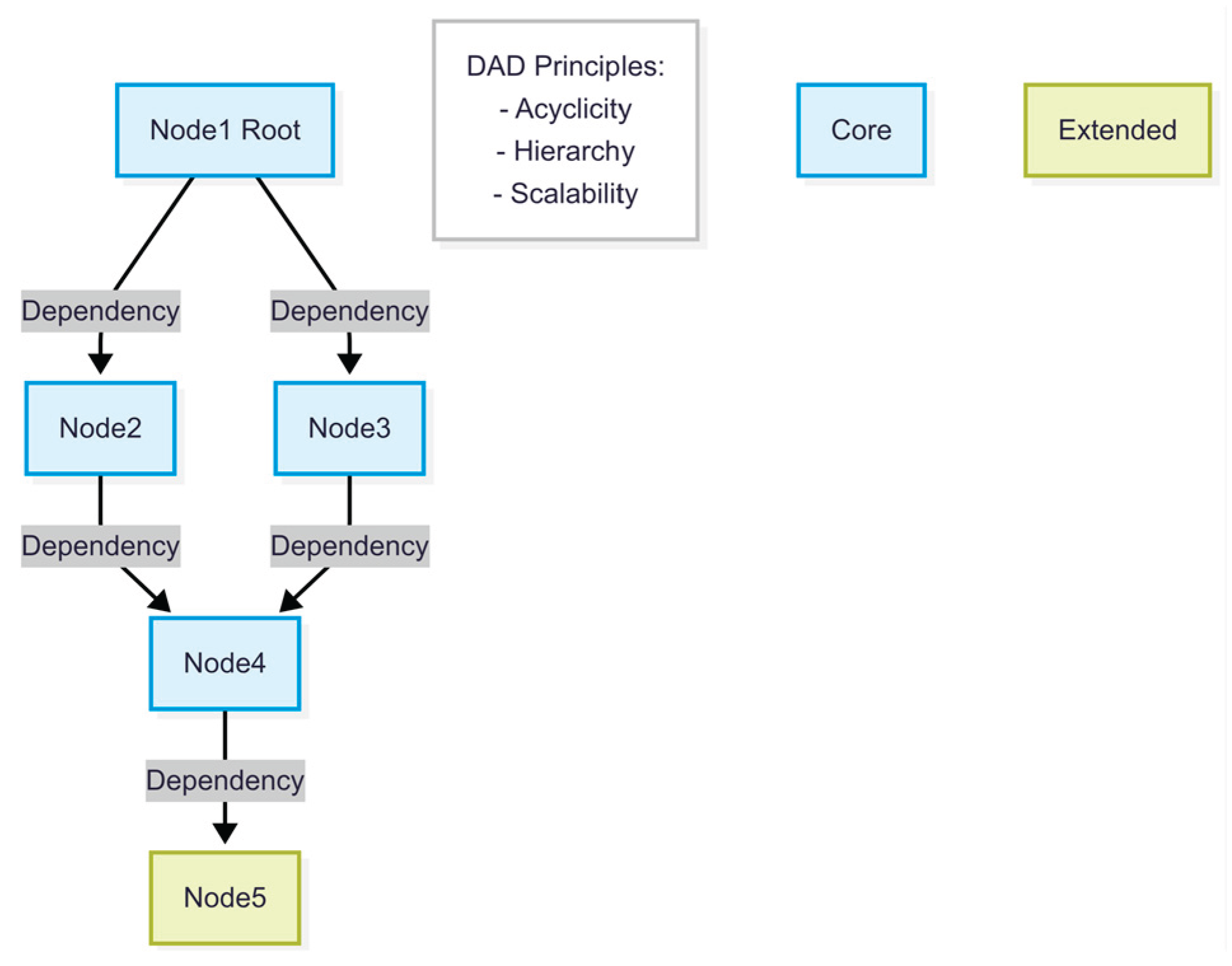
Figure 2.
State machine model of DAD showing transitions DA1–DA6, corresponding to the development and extension process.
Figure 2.
State machine model of DAD showing transitions DA1–DA6, corresponding to the development and extension process.
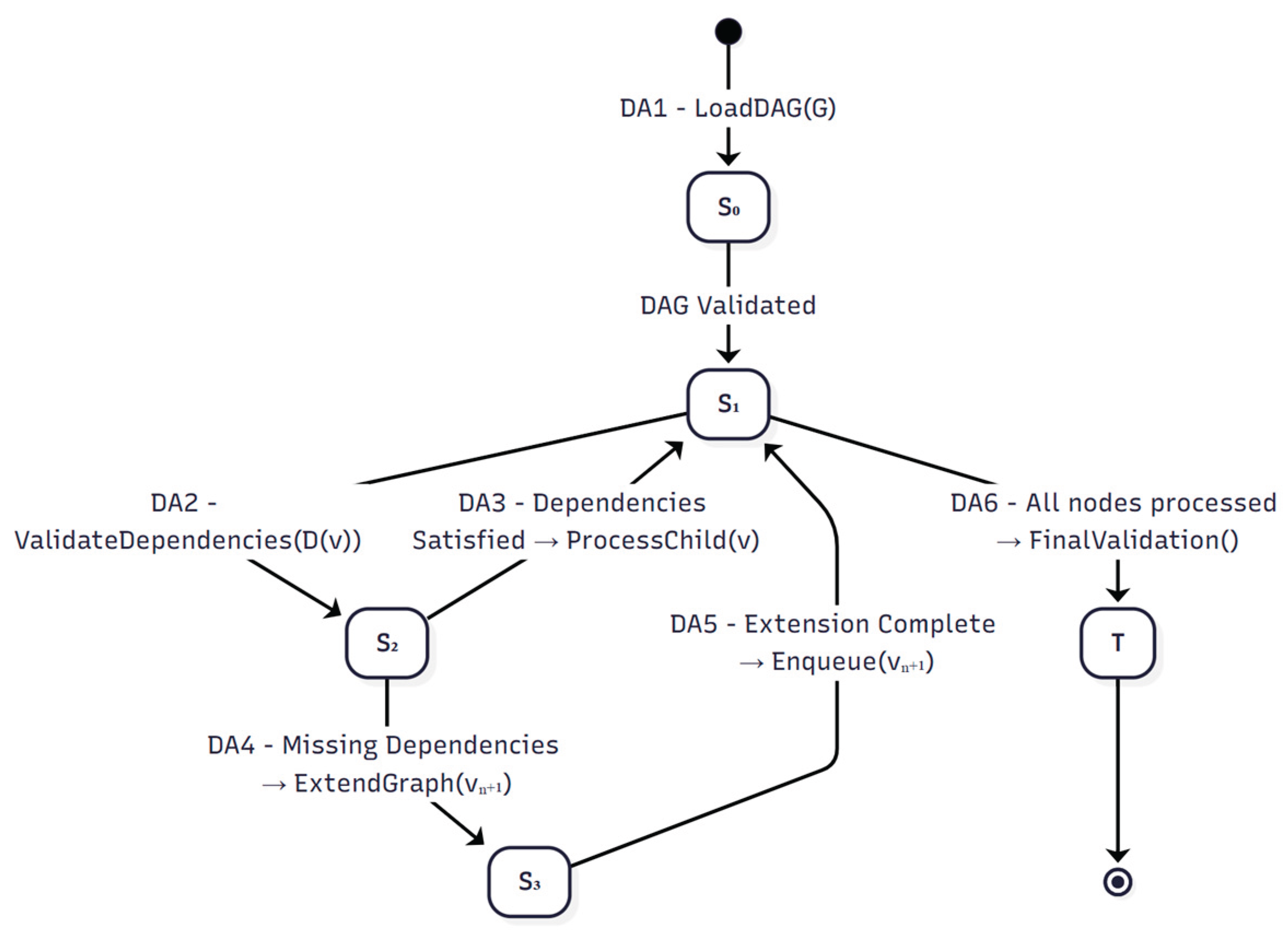
Figure 3.
Geospatial DAD-based model for logging visited places, where each level (continent, country, province, commune) represents a hierarchical dependency enforced by Directed Acyclic Development.
Figure 3.
Geospatial DAD-based model for logging visited places, where each level (continent, country, province, commune) represents a hierarchical dependency enforced by Directed Acyclic Development.
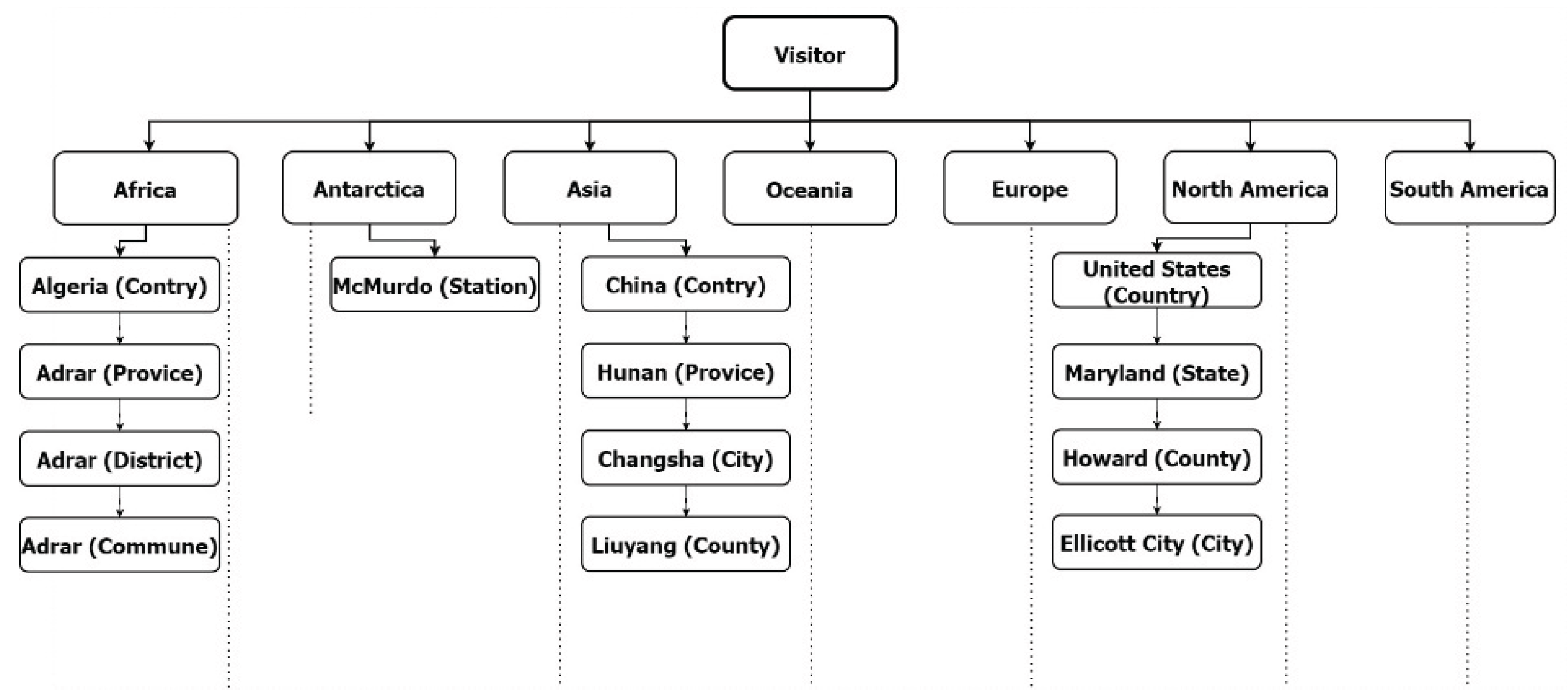
Figure 4.
Structural workflow of DFD traversal highlighting depth-first exploration and backtracking
Figure 4.
Structural workflow of DFD traversal highlighting depth-first exploration and backtracking
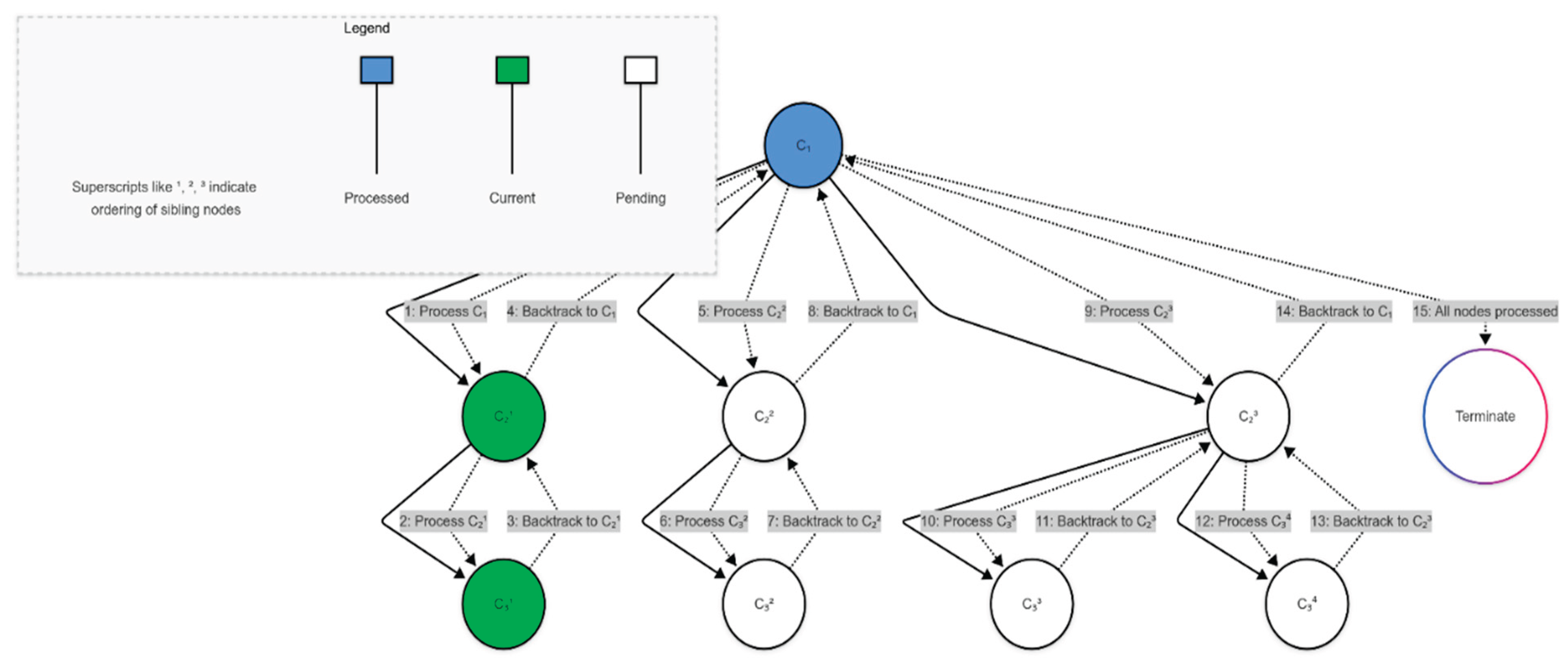
Figure 5.
State machine model of DFD illustrating transitions DF1–DF7.
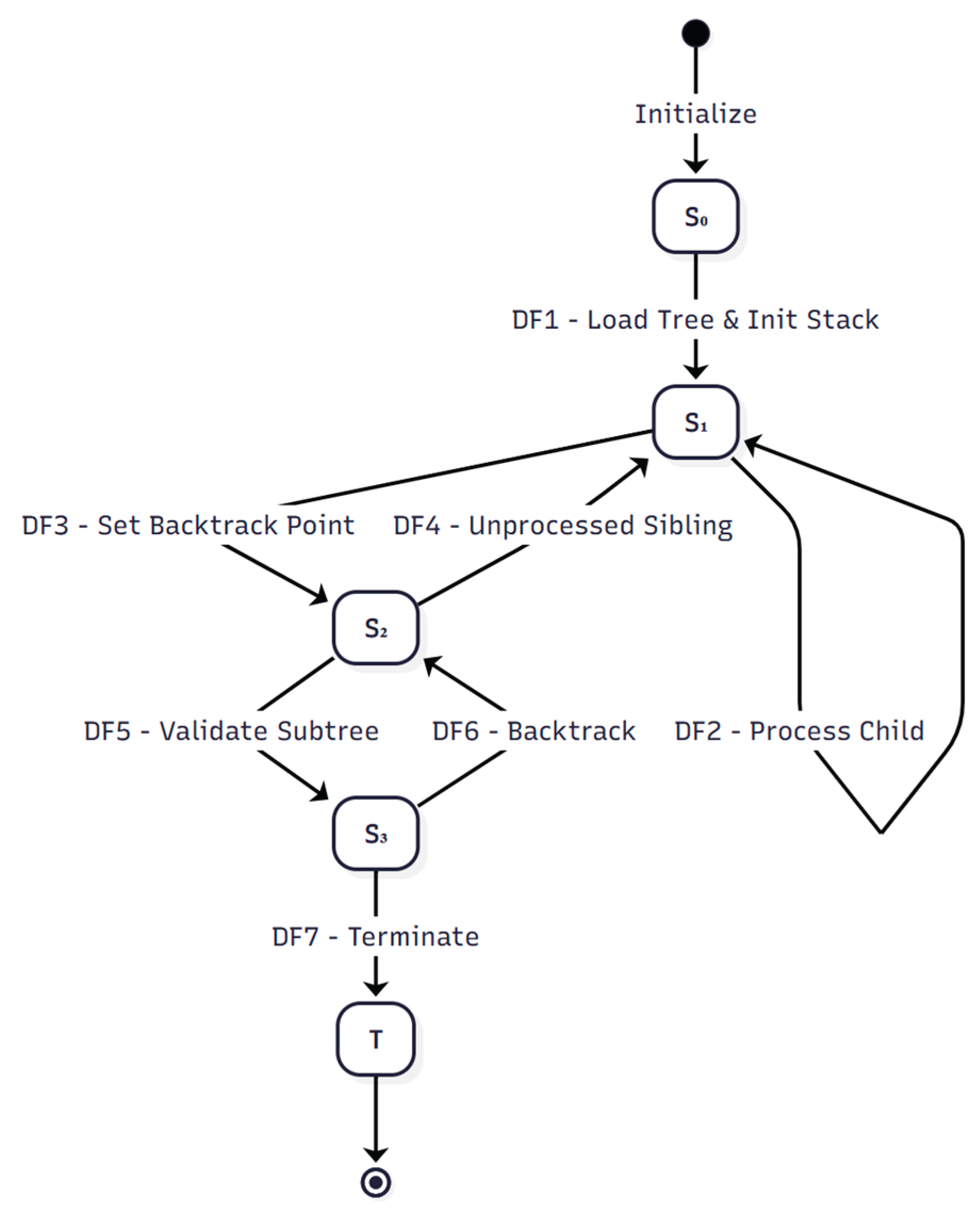
Figure 6.
Structural workflow of BFD illustrating horizontal processing across each level
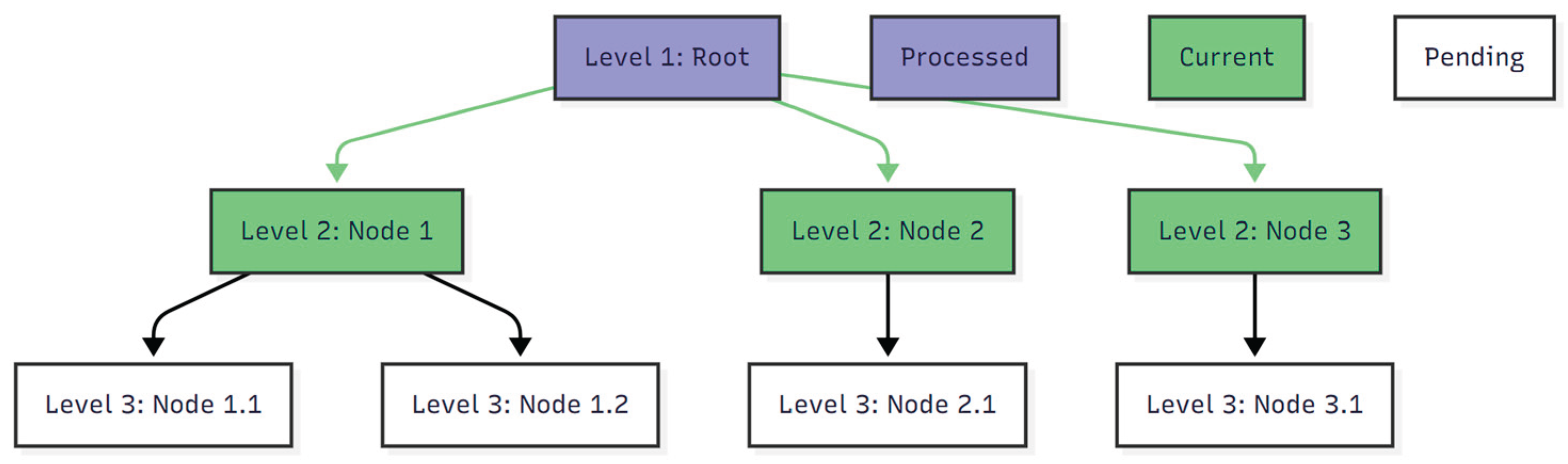
Figure 7.
State machine model of BFD showing transitions BF1–BF5.
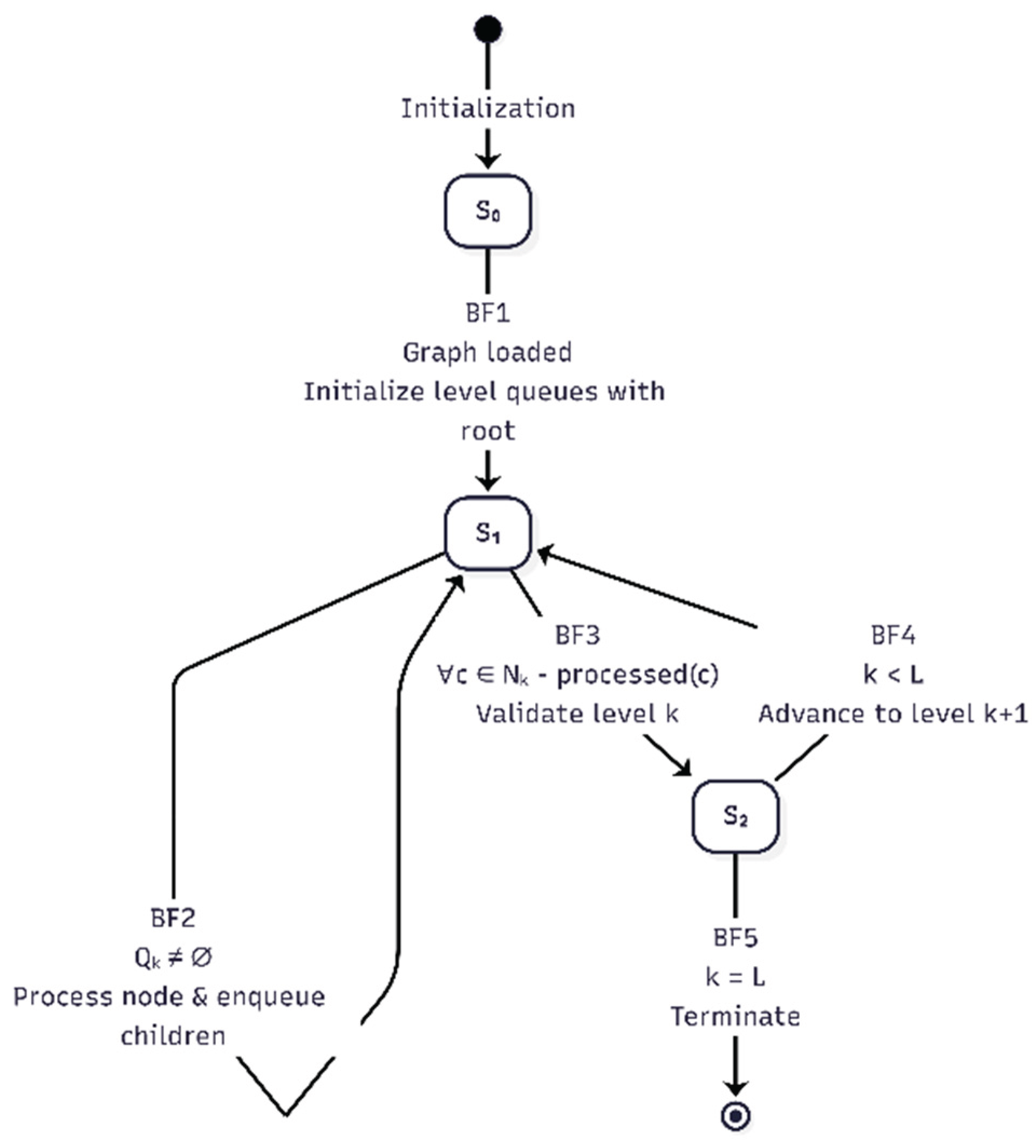
Figure 8.
CDD workflow model integrating feedback cycles and bounded iteration
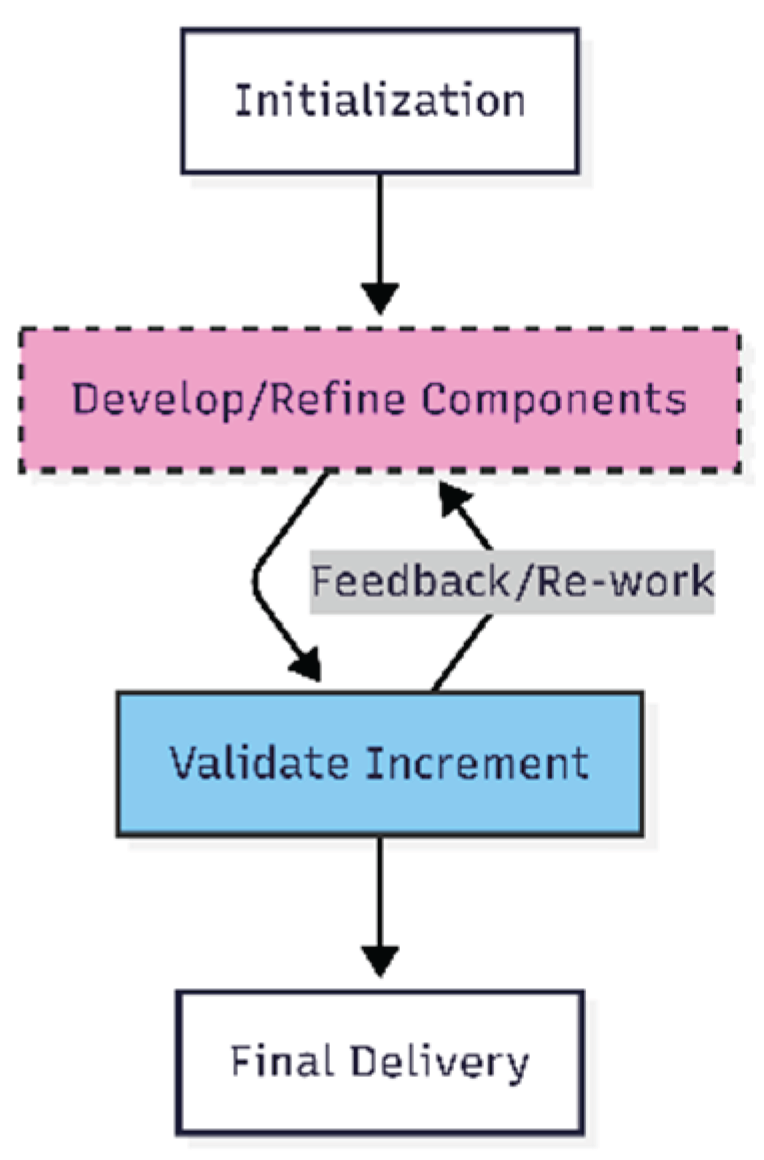
Figure 9.
State machine diagram of CDD showing cyclic transitions and bounded iteration.
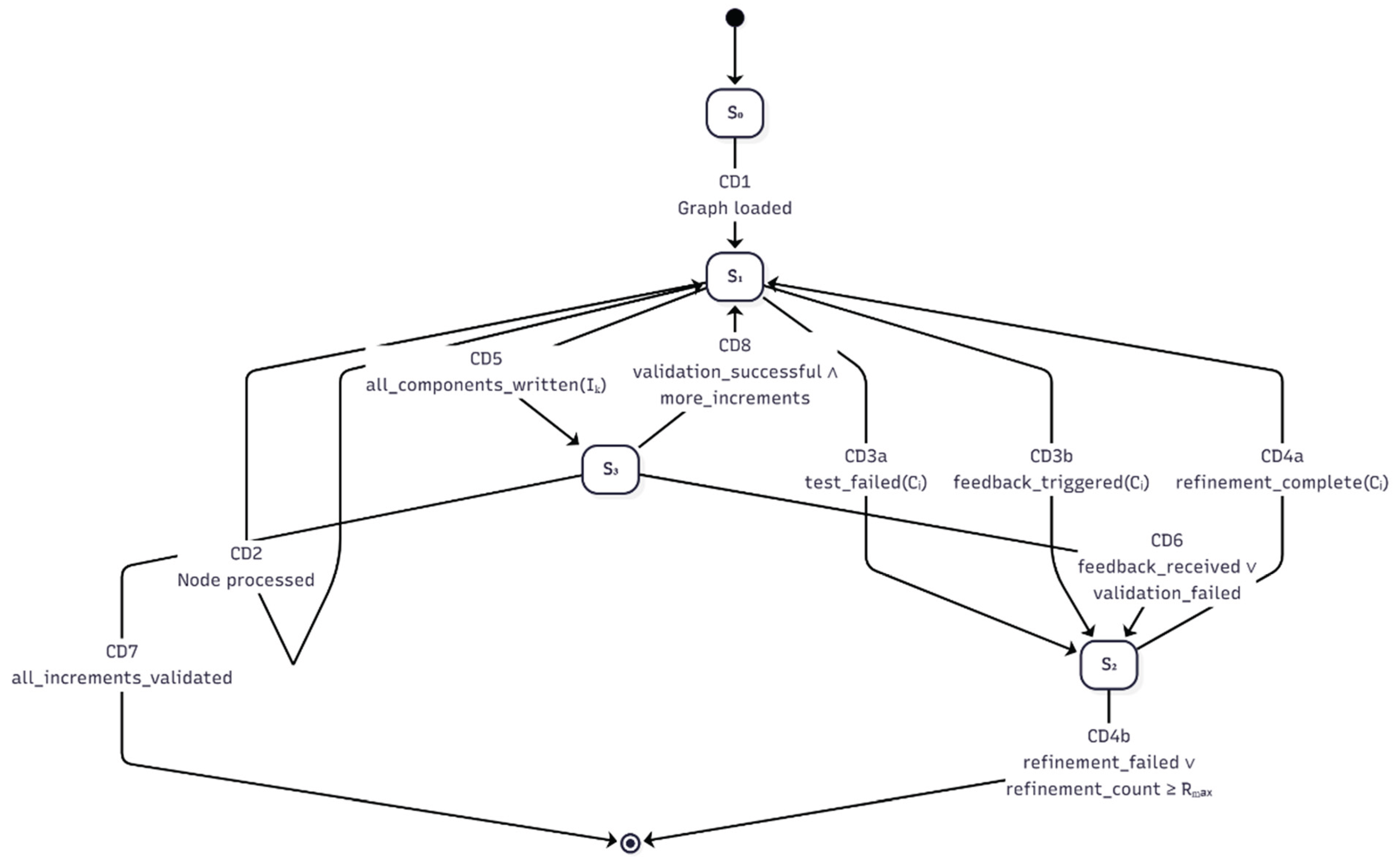
Figure 10.
Conceptual workflow diagram of PDFD illustrating depth-first progression, iterative refinement, and structured completion phases.
Figure 10.
Conceptual workflow diagram of PDFD illustrating depth-first progression, iterative refinement, and structured completion phases.
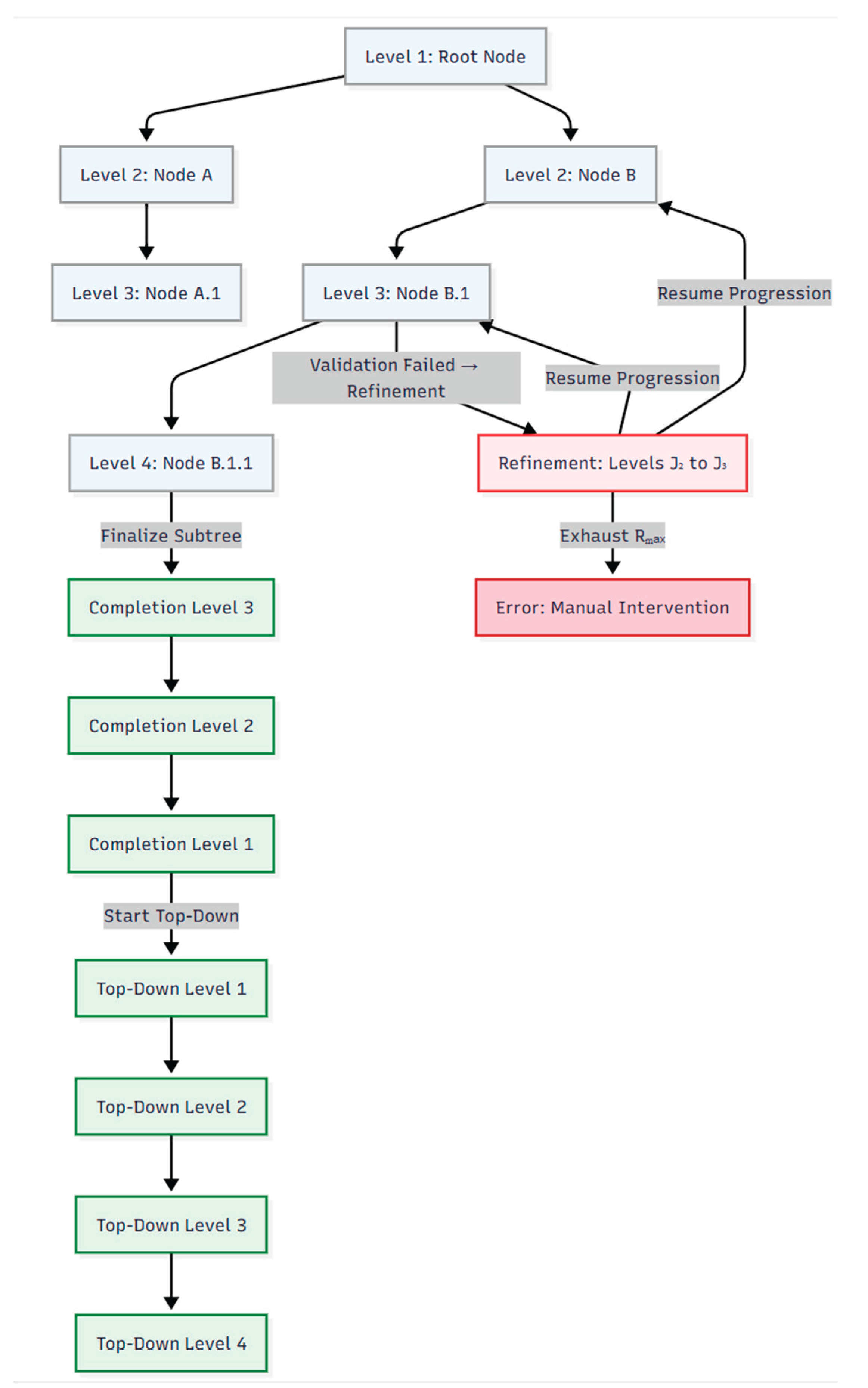
Figure 11.
State machine of PDFD detailing formal transitions across progression, refinement, and finalization states.
Figure 11.
State machine of PDFD detailing formal transitions across progression, refinement, and finalization states.
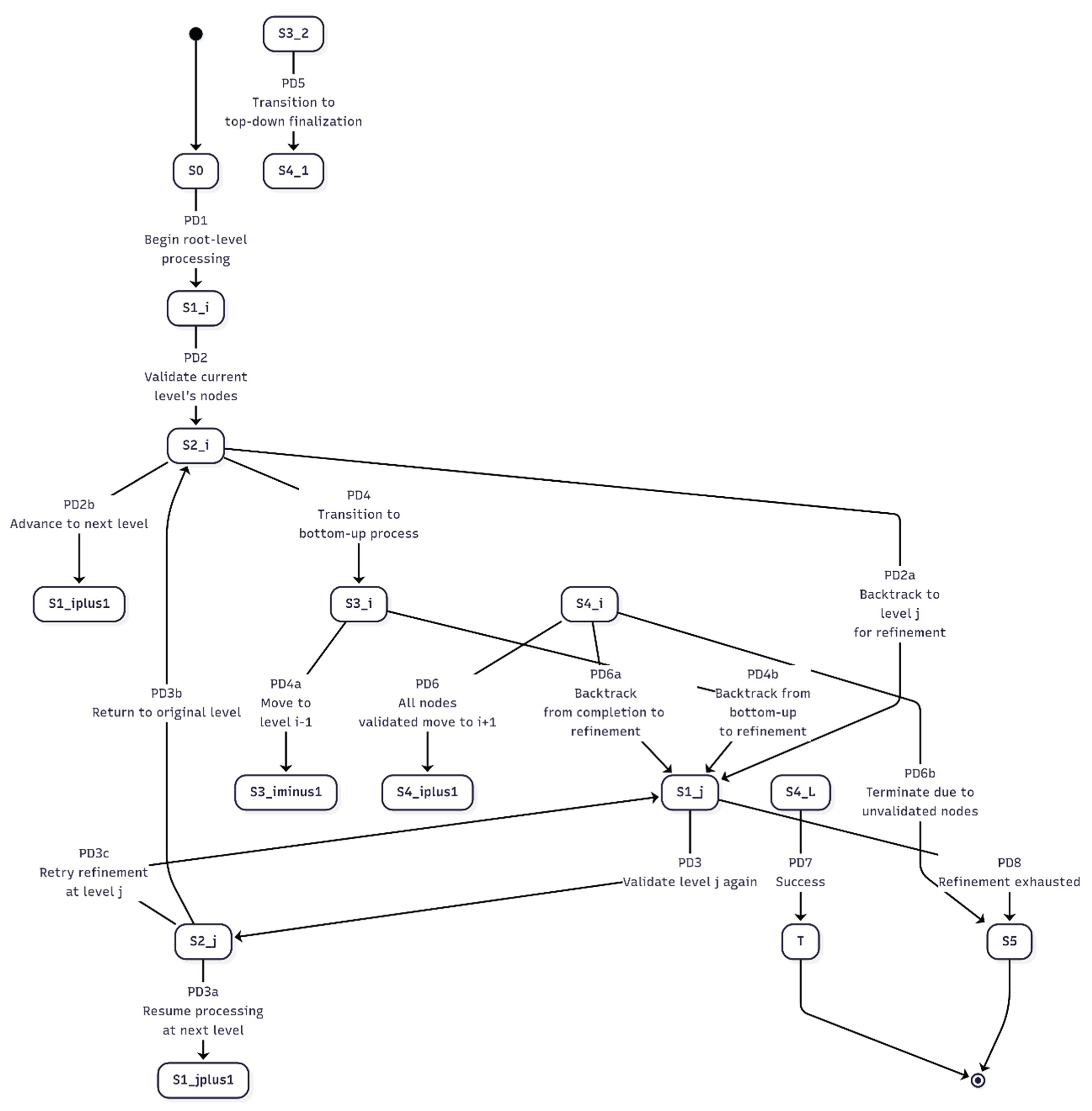
Figure 12.
PBFD Structural Workflow: Hierarchical traversal, refinement feedback loops, and finalization path.
Figure 12.
PBFD Structural Workflow: Hierarchical traversal, refinement feedback loops, and finalization path.
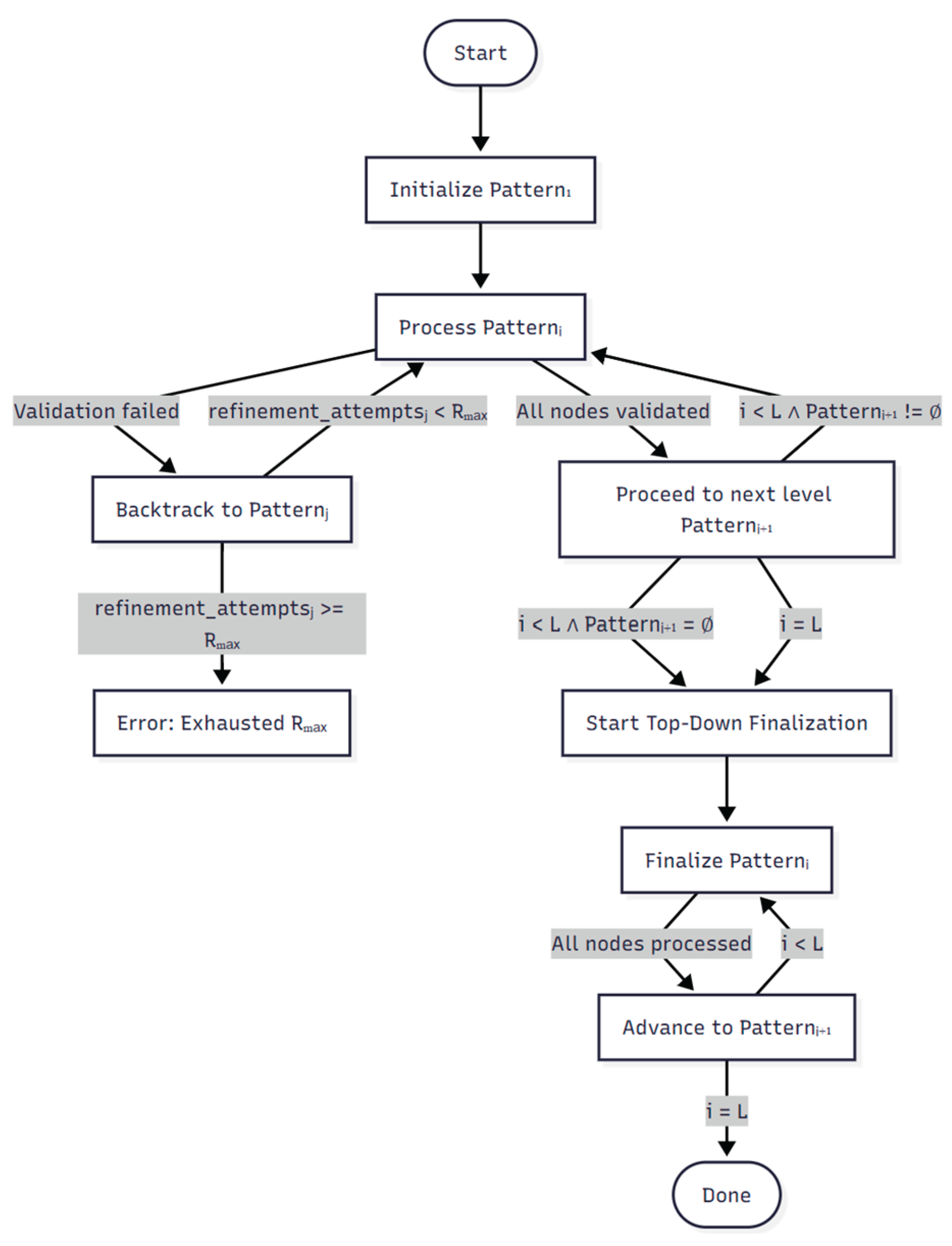
Figure 13.
PBFD state machine: Formal transition diagram covering initialization, pattern processing, refinement, and top-down finalization.
Figure 13.
PBFD state machine: Formal transition diagram covering initialization, pattern processing, refinement, and top-down finalization.
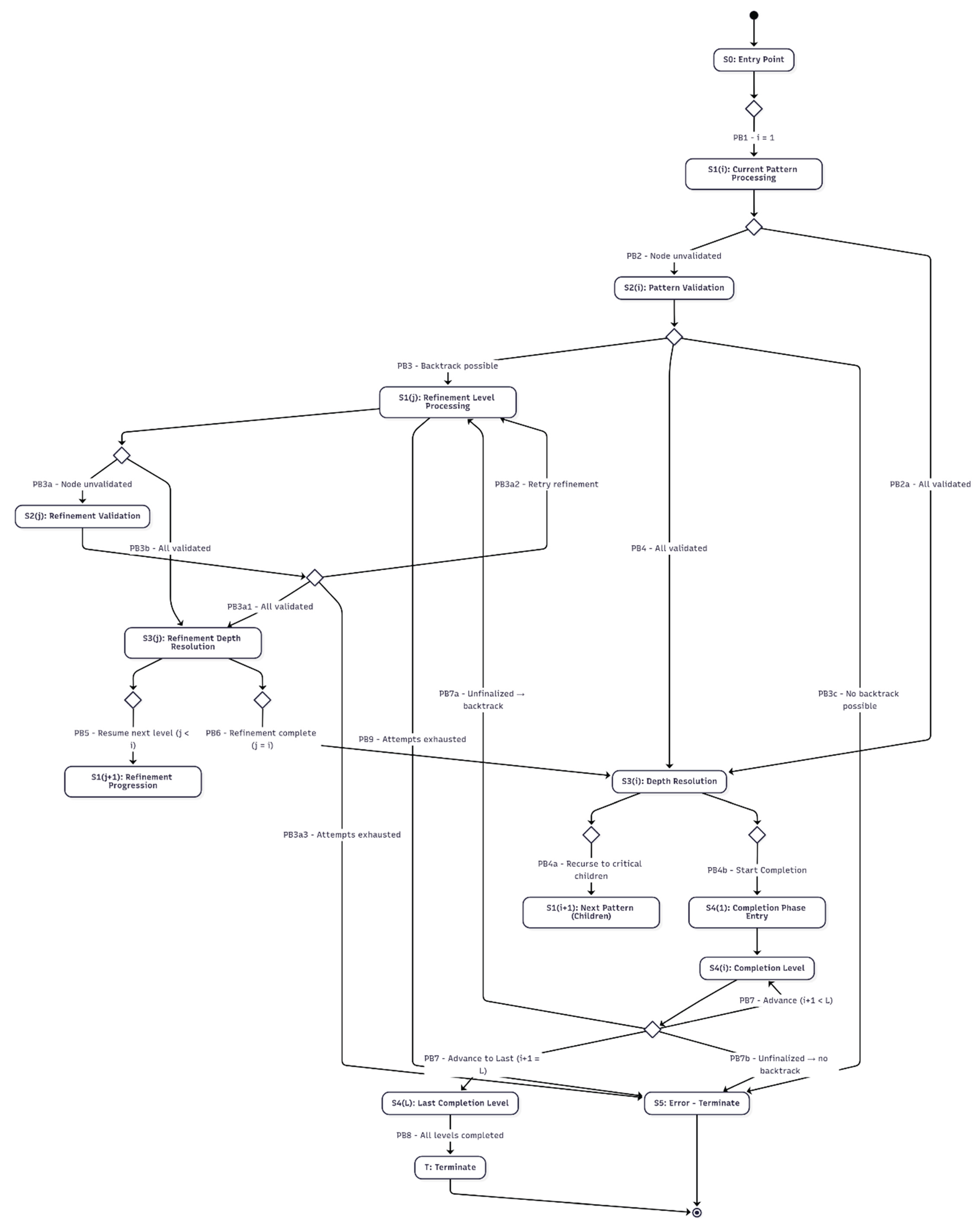
Figure 14.
Structural diagram of the Three-Level Encapsulation (TLE) model, showing the grandparent-parent-children mapping.
Figure 14.
Structural diagram of the Three-Level Encapsulation (TLE) model, showing the grandparent-parent-children mapping.
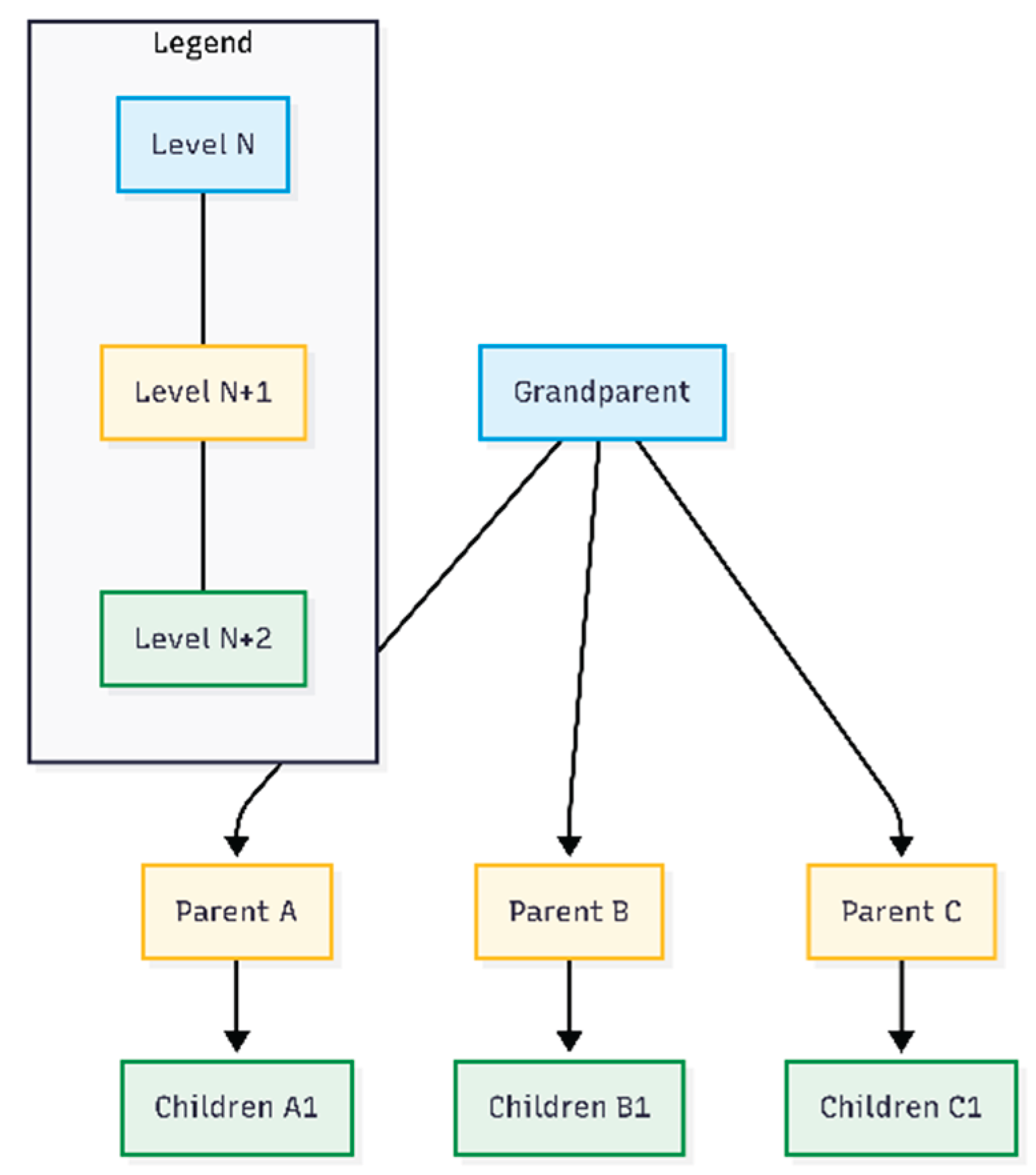
Figure 15.
Abstract state machine diagram for TLE processing, showing transitions between phases of hierarchical data operations.
Figure 15.
Abstract state machine diagram for TLE processing, showing transitions between phases of hierarchical data operations.
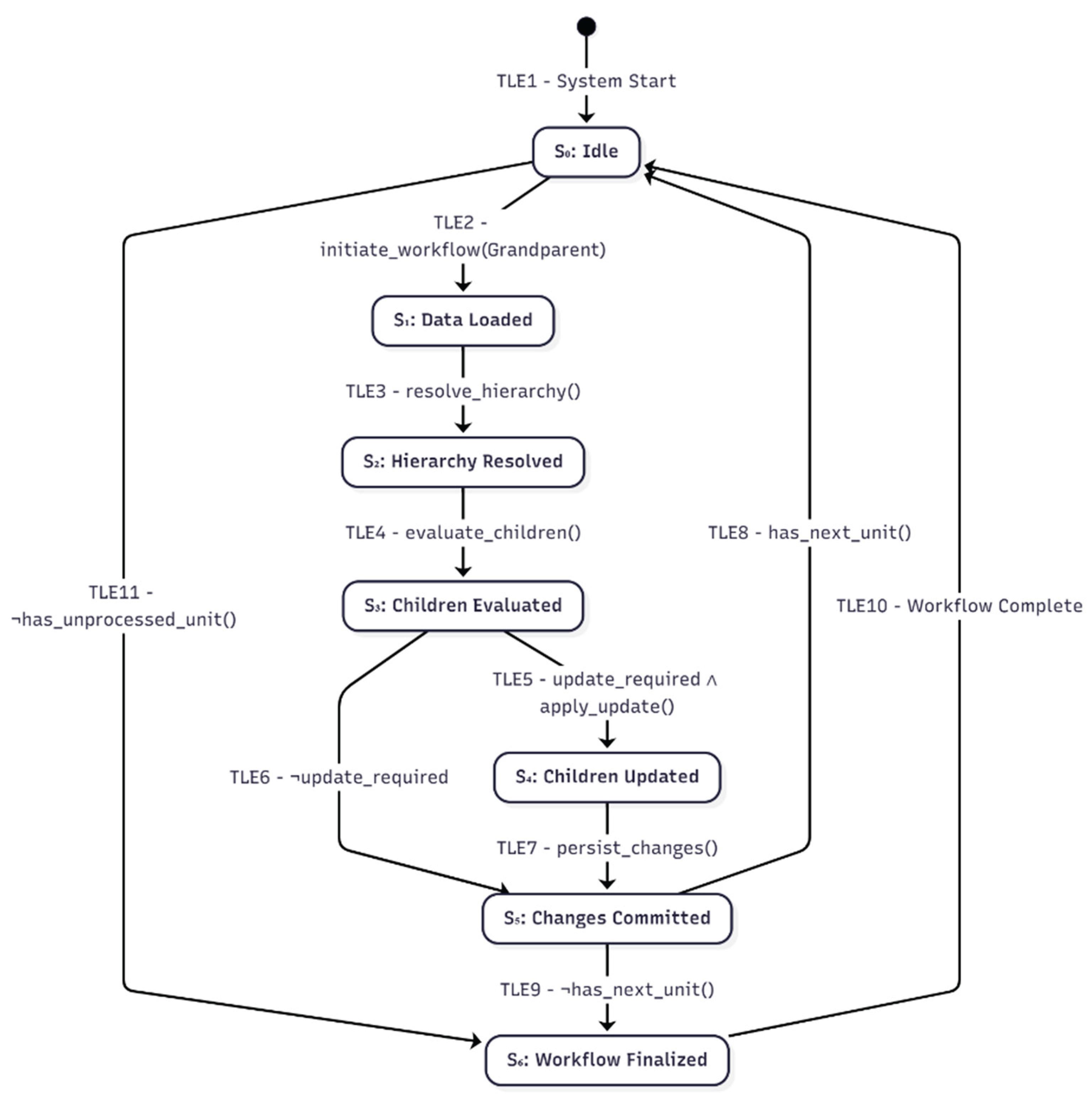
Figure 16.
Eight-level n-ary business hierarchy for claimant management. The highlighted path (red nodes) traces the primary analytical chain from Claimant to Specific Metric. Green nodes represent alternative branches—for example, multiple incident locations at Level 2 (N2_1, N2_2, N2_3) enable different analytical pathways.
Figure 16.
Eight-level n-ary business hierarchy for claimant management. The highlighted path (red nodes) traces the primary analytical chain from Claimant to Specific Metric. Green nodes represent alternative branches—for example, multiple incident locations at Level 2 (N2_1, N2_2, N2_3) enable different analytical pathways.
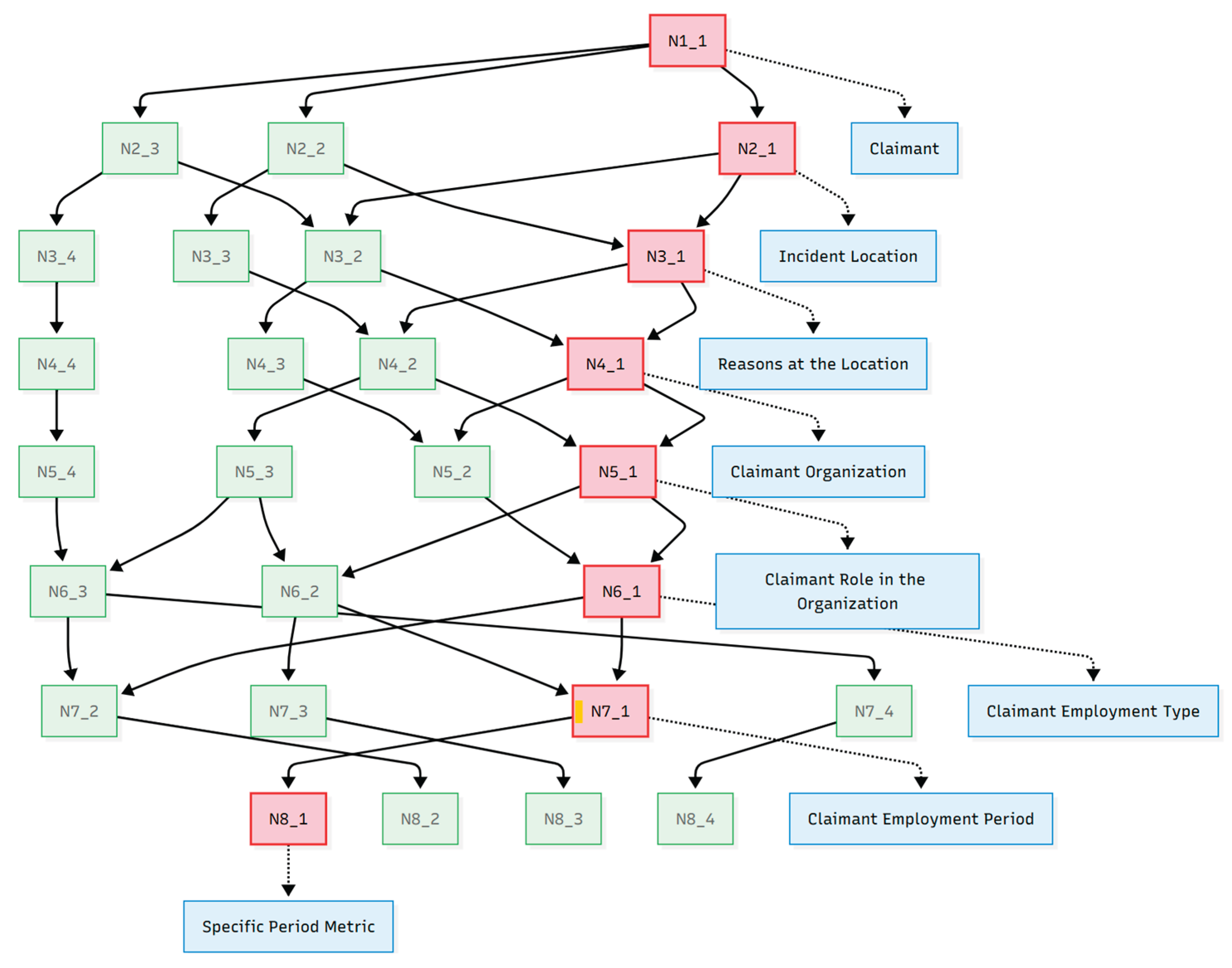
Table 1.
Positioning of PBFD and PDFD Against Existing Research Paradigms.
| Research Area | Typical Limitations in Prior Work | PBFD/PDFD Contributions |
|---|---|---|
| Domain-Driven Design & Collaborative Modeling [31,32] | Heuristic, non-executable, lacks formal consistency guarantees | Formal semantics with executable workflow rules; ensures verifiable consistency |
| Formal Methods & LTL [39,40,44,48] | High abstraction, steep learning curve, limited integration with practice | Embedded rigor within accessible workflows; verification of temporal properties (liveness, safety, eventual completion) |
| State Machines & Traversal Algorithms [47,48] | Used as auxiliary tools, not primary development drivers | Traversal as a first-class development primitive; enables derivation of correctness properties, rollback safety |
| Model-Driven Engineering [41,42,43,44] | Struggles with evolving requirements, scalability, and industrial adoption | Pragmatic adaptability combined with formal foundation; scales to enterprise systems |
| Low-Code Development Platforms [34,35] | Opaque orchestration, limited extensibility, correctness not guaranteed | Transparent, graph-based orchestration; ensures structural correctness and extensibility |
| Encoded Data Structures, Columnar Encoding, Bitmap Indexes [52,54,55] | Encoding used internally by DBMS for query acceleration; hierarchical relations still require recursive/nested traversal (O(log n)); no formal semantics for hierarchy or correctness | Declarative bitmask-based hierarchical schema (TLE); O(1) lookup/update/traversal; externalizes encoding at schema design level; preserves explicit hierarchical semantics and enables formal verification (CSP/LTL) |
Table 2.
Formal parameters for the DAD model.
| Symbol | Description |
|---|---|
| G | Directed Acyclic Graph with vertices V and edges E |
| D(v) | Direct dependencies of node v: {u|(u, v) ∈ E} |
Table 3.
Key characteristics of DAD.
| Characteristic | Description |
|---|---|
| Acyclic Enforcement | Ensures that the development dependency graph remains acyclic, preventing circular dependencies and infinite traversal loops |
| Scalability | Supports incremental addition of nodes and edges, provided that the overall graph preserves its acyclic structure |
Table 4.
State definitions in the DAD process model.
| State ID | Phase | Description |
| S₀ | Initialization | Load DAG G and validate acyclicity |
| S₁ | Node Processing | Process node v ∈ V (e.g., develop component) and enqueue its children |
| S₂ | Dependency Check | Verify the completeness of v's dependencies, D(v) |
| S₃ | Graph Extension | Add new nodes or edges to resolve unmet dependencies while preserving acyclicity |
| T | Termination | Final validation and workflow conclusion |
Table 5.
Formal state transitions and workflow operations in DAD.
| Rule ID | Source State | Target State | Condition | Operational Step |
|---|---|---|---|---|
| DA1 | S₀ | S₁ | DAG G is loaded and validated as acyclic. | Initialize processing queue with the root node |
| DA2 | S₁ | S₂ | A node v is dequeued for processing. | Initiate a check for all dependencies D(v) |
| DA3 | S₂ | S₁ | ∀u ∈ D(v): processed(u) (All dependencies are resolved). | Enqueue the dependencies of v for processing |
| DA4 | S₂ | S₃ | ∃u ∈ D(v): ¬processed(u) (An unresolved dependency exists). | Extend the DAG by adding a new node vₙ₊₁ or edge |
| DA5 | S₃ | S₁ | DAG extension is complete and acyclicity is preserved. | Enqueue the new node vₙ₊₁ for processing |
| DA6 | S₁ | T | ∀v ∈ V: processed(v) (All nodes are processed). | Perform final validation and terminate the workflow |
Table 6.
Summary of verification results.
| Property | CSP Assertion | FDR Result | Engineering Significance |
|---|---|---|---|
| Core Safety | DAD :[deadlock free [F]] | ✓ Passed | Ensures no circular dependencies or blocking states during processing |
| Core Liveness | DAD :[divergence free] | ✓ Passed | Confirms absence of infinite loops or τ-cycles in dependency checking |
| Determinism | DAD :[deterministic [F]] | ✓ Passed | Guarantees predictable topological execution order |
| Dequeue-Process Sequencing | DequeueThenProcess [T= DAD_Core] | ✓ Passed | Ensures dequeued nodes are immediately processed (local atomicity, DA2) |
| Process-Validate Sequencing | ProcessThenValidate [T= DAD_Core] | ✓ Passed | Verifies that processing a node triggers dependency validation (DA2 → DA3/DA4) |
| Dependency Completion Logic | DepsProcessedThenGenerate [T= DAD_Core] | ✓ Passed | Enforces children generation only after all dependencies completed (DA3) |
| Child Enqueueing Logic | GenerateThenEnqueue [T= DAD_Core] | ✓ Passed | Ensures generated children are properly scheduled for processing (DA3) |
| Graph Extension Control | MissingDepThenExtend [T= DAD_Core] | ✓ Passed | Triggers DAG extension for missing dependencies while maintaining acyclicity (DA4 & DA5) |
| Final Validation Timing | AllProcessedThenValidate [T= DAD_Core] | ✓ Passed | Confirms final validation occurs after all nodes are processed (DA6) |
| Termination Guarantee | TerminationAllowed [T= DAD_Core] | ✓ Passed | Ensures system can always reach a successful or error termination state |
Table 7.
LTL properties of DAD ensuring correctness and termination.
| Property | Formal Specification | Description |
|---|---|---|
| Acyclicity Invariant | □(∀v ∈ V, ∄ cycle(v₀, ..., vₖ)) | No cycles are introduced during operation. Rule DA4 triggers graph extension, which is implemented by the ExtendGraph function (Appendix A.2.3) to guarantee acyclicity is preserved. |
| Dependency Completeness | □(processed(v) ⇒ ∀u ∈ D(v), processed(u)) | A node is processed only after all its dependencies are processed (Rules DA2, DA3). |
| Liveness of Processing | □(dequeue(v) ⇒ ◊process(v)) | Every dequeued node is eventually processed (Enabled by DA2-DA5 and the acyclicity invariant). |
| Fairness (No Starvation) | □∀v ∈ V, ◊processed(v) | Every node in the graph is eventually processed (Guaranteed by DA6 and the exhaustive traversal semantics). |
| Termination Guarantee | □(start(DAD) ⇒ ◊terminate(DAD)) | The process eventually terminates for any finite DAG (Rule DA6). |
Table 8.
Advantages of DAD in dependency-aware systems.
| Property | Advantage |
|---|---|
| Cycle Prevention | Eliminates circular dependencies and development deadlocks |
| Dependency Isolation | Isolation of branch changes |
| Incremental Scaling | Supports evolutionary system growth |
| Impact Analysis | Traceable dependency chains aid debugging and planning |
Table 9.
Formal parameters for the DFD model
| Symbol | Description |
|---|---|
| Tr | Rooted, finite, acyclic tree structure with nodes V and edges E |
| D(v) | Direct dependencies of node v: { u ∣ (u, v) ∈ E } |
| Cᵢ | The current node being processed in the traversal |
| Bⱼ | A backtrack point (a node on the current path with unvisited siblings) |
Table 10.
Key characteristics of DFD.
| Characteristic | Description |
|---|---|
| Vertical Progression | Prioritizes traversing a single dependency path to its deepest point before exploring other branches |
| Exhaustive Traversal | Ensures all nodes and their subtrees are eventually visited and processed by combining vertical progression and backtracking |
| Backtracking Enablement | Allows returning to a parent node to explore unvisited sibling branches after a path is completed |
Table 11.
State definitions in the DFD process model.
| State ID | Phase | Description |
| S₀ | Initialization | Load tree Tr and initialize stack with root node |
| S₁ | Vertical Processing | Process current node Cᵢ and push its direct dependencies onto the stack |
| S₂ | Backtracking | Return to a parent node (Bⱼ) after processing a leaf or a completed branch |
| S₃ | Validation | Validate the fully explored subtree rooted at the current backtrack point |
| T | Termination | Final state after all nodes are processed and validated |
Table 12.
Formal state transitions and workflow operations in DFD.
| Rule ID | Source State | Target State | Condition | Operational Step |
|---|---|---|---|---|
| DF1 | S₀ | S₁ | Tree Tr is loaded and valid. | Initialize stack with root node C₁ |
| DF2 | S₁ | S₁ | Cᵢ is a non-leaf node. | Process Cᵢ, then push its direct dependencies D(Cᵢ) onto the stack |
| DF3 | S₁ | S₂ | Cᵢ is a leaf node. | Process Cᵢ, then set backtrack point Bⱼ to parent(Cᵢ) |
| DF4 | S₂ | S₁ | Bⱼ has an unprocessed sibling. | Process the next sibling of Bⱼ, push it onto the stack |
| DF5 | S₂ | S₃ | Bⱼ has no unprocessed siblings. | Initiate validation for the subtree rooted at Bⱼ |
| DF6 | S₃ | S₂ | Stack is not empty. | Continue backtracking to the parent of Bⱼ |
| DF7 | S₃ | T | Stack is empty. | Perform final validation and terminate |
Table 13.
Summary of verification results.
| Property | CSP Assertion | FDR Result | Engineering Significance |
|---|---|---|---|
| Core Safety | DFD :[deadlock free [F]] | ✓ Passed | Ensures no blocking states occur during subtree processing or backtracking |
| Core Liveness | DFD :[divergence free] | ✓ Passed | Confirms absence of τ-cycles or infinite descent during traversal |
| Determinism | DFD :[deterministic [F]] | ✓ Passed | Guarantees predictable recursion and unambiguous subtree completion |
| Local Processing Safety | DequeueThenProcess [T= DFD_Core] | ✓ Passed | Ensures each dequeued node is immediately processed (DF2 & DF3) |
| Non-Leaf Descent Logic | NonLeafPushesChildren [T= DFD_Core] | ✓ Passed | Enforces DF2: non-leaf nodes must push their children before continuing descent |
| Leaf/Backtrack Initiation | LeafToBacktrack [T= DFD_Core] | ✓ Passed | Enforces DF3: processing a leaf correctly triggers parent-level backtracking |
| Validation Control Flow | ValidationSequence [T= DFD_Core] | ✓ Passed | Ensures validation transitions lead only to backtracking or termination (DF5–DF7) |
| Termination Reachability | TerminationAllowed [T= DFD_Core] | ✓ Passed | Confirms the system can always reach the final successful state |
Table 14.
LTL properties of DFD ensuring correctness and termination.
| Property | Formal Specification | Description |
|---|---|---|
| Single Path Completion | □∀P = (C₀, ..., Cᴸ) ∈ G: (processed(Cᴸ) ⇒ ∀Cⱼ ∈ P, processed(Cⱼ)) | A path is processed completely before moving to siblings (Rules DF2, DF3). |
| Subtree Validation Completeness | □(validated(Bⱼ) ⇒ ∀Cₖ ∈ Subtree(Bⱼ), validated(Cₖ)) | A subtree is only validated after all nodes within it are processed (Rules DF5, DF6). |
| Liveness (No Starvation) | ∀ v ∈ V, ♢processed(v) | Every node is eventually processed (Rules DF4, DF6). |
| Termination Guarantee | □(start(DFD) ⇒ ◊terminate(DFD)) | The process eventually terminates for any finite tree (Rule DF7). |
Table 15.
Advantages of DFD in dependency-aware systems.
| Property | Advantage |
|---|---|
| Early Validation | Foundational logic (e.g., country → state → city) is validated early. |
| Modular Testing | Bugs are isolated within narrow vertical paths. |
| Incremental Scaling | New nodes or branches can be integrated without restructuring validated paths. |
Table 16.
Formal parameters for the BFD model
| Symbol | Description |
|---|---|
| Q | Global queue tracking nodes to process |
| Nₖ | Set of nodes at level k |
| L | Maximum depth level of the tree |
| D(v) | Set of direct successors to node v, i.e., {u∣(v,u)∈E} |
Table 17.
Key characteristics of BFD.
| Characteristic | Description |
|---|---|
| Horizontal Progression | All nodes at a given level must be processed before the algorithm proceeds to the next level. |
| Layered Advancement | Advancement from level k to k+1 occurs only after all nodes at level k are processed and validated. |
| Level Synchronization | Maintains level integrity, ensuring consistency across parallel node implementations within the same level. |
Table 18.
State definitions in the BFD process model.
| State ID | Phase | Description |
| S₀ | Initialization | Load graph and initialize level queues |
| S₁ | Level Processing | Process nodes at level k |
| S₂ | Validation | Validate all nodes at level k |
| T | Termination | Final state after all levels are completed |
Table 19.
Formal state transitions and workflow operations in BFD.
| Rule ID | Source State | Target State | Condition | Operational Step |
|---|---|---|---|---|
| BF1 | S₀ | S₁ | Graph loaded. | Initialize queue Q with root |
| BF2 | S₁ | S₁ | Q≠∅∧(∃c∈Nₖ:¬processed(c)) | Process next node in current level |
| BF3 | S₁ | S₂ | ∀c∈ Nₖ:processed(c) | Validate level k |
| BF4 | S₂ | S₁ | k<L | Advance to level k+1 |
| BF5 | S₂ | T | k=L | Terminate |
Table 20.
Summary of verification results.
| Property | CSP Assertion | FDR Result | Engineering Significance |
|---|---|---|---|
| Core Safety | BFD :[deadlock free [F]] | ✓ Passed | Guarantees liveness across node and level processing (no terminal blocking states) |
| Core Liveness | BFD :[divergence free] | ✓ Passed | Confirms absence of livelock and infinite internal loops (τ-cycles) |
| Determinism | BFD :[deterministic [F]] | ✓ Passed | Ensures that queue and node processing decisions are uniquely defined for predictable execution |
| Safety: Dequeue Implies Process | DequeueImpliesProcess [T= BFD_Core] | ✓ Passed | Confirms that each dequeued node is immediately processed, preserving workflow correctness (BF2) |
| Level Validation Before Advancement | ValidateBeforeAdvance [T= BFD_Core] | ✓ Passed | Ensures that all nodes at level k are validated before moving to level k+1 (BF3 & BF4) |
| Post-Validation Behavior | AfterValidation [T= BFD_Core] | ✓ Passed | Guarantees that after level validation, the process either advances or terminates (BF4 & BF5), ensuring progress. |
| Successful Termination | terminate_successfully_actual -> SKIP [T= CanReachTerminate] | ✓ Passed | Demonstrates that BFD completes all levels and nodes successfully (BF5) |
| Termination at End | TerminationAtEnd [T= BFD_Core] | ✓ Passed | Confirms that termination occurs only after all processing and validation steps are complete |
Table 21.
LTL properties of BFD ensuring layered correctness and termination.
| Property | Formal Specification | Description |
|---|---|---|
| Layer Completion | □∀k≤L: (processed(Nₖ) ⇒ ¬∃Cⱼ∈Nₖ: ¬processed(Cⱼ)) | All nodes in a level are processed before proceeding (Rules BF2, BF3). |
| Order Preservation | □∀k<L: (validated(Nₖ) ⇒ ◊processed(Nₖ₊₁)) | Level k+1 is entered only after all nodes at level k are validated (Rules BF3, BF4). |
| Termination Guarantee | □(start(BFD) ⇒ ◊terminate(BFD)) | Process reaches completion (Rules BF4, BF5). |
| Liveness (No Starvation) | □∀v∈V, ◊processed(v) | Every node in the graph is eventually processed. |
Table 22.
Advantages of BFD in dependency-aware systems.
| Property | Advantage |
|---|---|
| Consistency | Uniform implementation across layers (e.g., all Level 1 nodes completed before Level 2) |
| Parallelization | Nodes at the same level can be processed concurrently |
| Predictability | Clear level-based rules simplify debugging (errors are localized to a single level) |
Table 23.
Formal parameters for the CDD model
| Symbol | Description |
|---|---|
| G = (V, E) | Directed graph (possibly cyclic) with nodes V and edges E, representing development flow and dependencies |
| Iₖ | Incremental delivery milestone k, representing a validated subset of the system |
| Fₖ | Feedback trigger mechanism (e.g., validation failure, stakeholder input) associated with milestone k |
| Rₘₐₓ | Maximum allowed refinements per node to ensure convergence |
Table 24.
Key characteristics of CDD supporting iterative and incremental development
| Characteristic | Description |
|---|---|
| Controlled Feedback Loops | Feedback is allowed only when externally triggered and is bounded to prevent infinite iteration. |
| Incremental Delivery | Components are delivered in validated increments to support continuous integration and testing. |
Table 25.
State definitions in the CDD process model.
| State ID | Phase | Description |
| S₀ | Initialization | Load graph and initialize dependencies |
| S₁ | Node Processing | Develop components under the current milestone |
| S₂ | Refinement | Iterate based on validation failure or stakeholder feedback |
| S₃ | Validation | Evaluate milestone Iₖ for completeness and correctness |
| T | Termination | Final increment successfully validated and delivered |
Table 26.
Formal state transitions and workflow operations in CDD.
| Rule ID | Source State | Target State | Condition | Operational Step |
|---|---|---|---|---|
| CD1 | S₀ | S₁ | Graph loaded | Initialize development graph |
| CD2 | S₁ | S₁ | Node processed | Continue node development |
| CD3a | S₁ | S₂ | test_failed(Cᵢ) | Rework after failure |
| CD3b | S₁ | S₂ | feedback_triggered(Cᵢ) | Apply bounded feedback loop |
| CD4a | S₂ | S₁ | refinement_complete(Cᵢ) | Resume development on node |
| CD4b | S₂ | T | refinement_failed(Cᵢ) ∨ refinement_count(Cᵢ) ≥ Rₘₐₓ | Terminate with error |
| CD5 | S₁ | S₃ | all_components_written(Iₖ) | Validate increment |
| CD6 | S₃ | S₂ | feedback_received(Iₖ) ∨ validation_failed(Iₖ) | Revision required |
| CD7 | S₃ | T | all_increments_validated | Finalize delivery |
| CD8 | S₃ | S₁ | validation_successful(Iₖ) ∧ (k < L) | Advance to milestone Iₖ₊₁ |
Table 27.
Summary of verification results.
| Property | CSP Assertion | FDR Result | Engineering Significance |
|---|---|---|---|
| Core Safety | CDD :[deadlock free] | ✓ Passed | Guarantees liveness throughout the deployment lifecycle (no terminal blocking states) |
| Core Liveness | CDD :[divergence free] | ✓ Passed | Confirms absence of livelock and infinite internal loops. |
| Protocol Compliance (Trace) | ProtocolChecker [T= CDDProtocolView] | ✓ Passed | Observable deployment traces conform to the defined protocol |
| Protocol Compliance (Liveness) | CDDProtocolView :[divergence free] | ✓ Passed | Livelock-free protocol abstraction |
| Safety: Initial Guard | NoEarlyTermination [T= CDD] | ✓ Passed | Prevents termination before mandatory initialization (load_graph, initialize_dependencies) |
| Dependency Respect (Contribution N4) | DependencySpec_N4 [T= CDD] | ✓ Passed | Proves N4 cannot execute before both N2 and N3 complete |
| Dependency Respect (Contribution N5) | DependencySpec_N5 [T= CDD] | ✓ Passed | Proves N5 cannot execute before N4 completes |
| Robustness: Bounded Refinement (Deadlock) | CDD_Hostile :[deadlock free] | ✓ Passed | Liveness retention and error-termination reachability under adversarial failure |
| Robustness: Bounded Refinement (Divergence) | CDD_Hostile :[divergence free] | ✓ Passed | Shows the system does not livelock under persistent failures; termination is guaranteed |
| Internal Consistency | ConditionalConsistency [T= STOP] | ✓ Passed | Ensures mutually exclusive conditional events do not conflict |
Table 28.
LTL properties of CDD enabling bounded iterative refinement.
| Property | Formal Specification | Description |
|---|---|---|
| Cycle Integrity | □(processed(Cⱼ) ⇒ ◊refine(Cⱼ)) ∧ □(refinement_count(Cⱼ) ≤ Rₘₐₓ) | Bounded feedback loops are permitted (CD3a/CD3b). |
| Incremental Soundness | □(◊finalize(Iₖ) ⇒ ∀C ∈ Iₖ, validated(C)) | All components in a milestone must be validated before release (CD5, CD7). |
| Bounded Refinement | □∀v ∈ V: (refinement_count(v) ≤ Rₘₐₓ) | The number of refinements for any node is strictly bounded by Rₘₐₓ. |
| Termination Guarantee | □(start(CDD) ⇒ ◊T) | The process eventually reaches successful termination. |
Table 29.
Advantages of CDD in dependency-aware systems.
| Property | Advantage |
|---|---|
| Adaptability | Supports bounded iteration in response to validation results or stakeholder feedback |
| Risk Reduction | Enables early defect detection through milestone-based validation |
| Agile Compliance | Aligns with sprint-style incremental delivery while maintaining formal convergence guarantees |
Table 30.
Control parameters used in PDFD for regulating progression, refinement, and termination.
| Symbol | Description |
|---|---|
| Kᵢ | Progression Threshold: The minimum number of nodes (representing features or components) at level i that must reach a finalized state (P(n)=2) before development can progress to level i+1. This threshold acts as a configurable Work-In-Progress (WIP) limit, which can be set statically based on team capacity or adjusted dynamically in real-time based on evolving system constraints and priorities [66]. It enforces structured synchronization points, preventing uncontrolled parallelism and managing complexity |
| Jᵢ | Start of refinement: Earliest level impacted by failures at i, where Jᵢ = trace_origin(i)). |
| L | Maximum depth (leaf level) of the hierarchical tree. |
| Rᵢ | Refinement range: The number of levels to reprocess, calculated as Rᵢ = i - Jᵢ + 1 (bounded by L). |
| Rₘₐₓ | Iteration limit: Maximum refinement attempts per level. Predefined to ensure termination. |
Note: Parameters Jᵢ and Rᵢ define the refinement scope [Jᵢ, i] of length Rᵢ = i - Jᵢ + 1, which determines the levels reprocessed during refinement cycles. Rᵢ = min(i - Jᵢ + 1, i) rule ensures dependent levels are revisited while respecting hierarchy boundaries. This is conceptually similar to the state-space exploration in model checkers like SPIN, which must also employ efficient traversal and pruning to verify correctness [71], though PDFD introduces hierarchy-aware rollback semantics not present in SPIN. The PDFD-specific refinement logic itself extends concepts from formal refinement theory applied to state-based systems and process algebras [76].
Table 31.
Conceptual characteristics of PDFD governing its hybrid traversal, concurrency control, and iterative validation.
Table 31.
Conceptual characteristics of PDFD governing its hybrid traversal, concurrency control, and iterative validation.
| Characteristic | Description | Theoretical Basis / Inspiration |
|---|---|---|
| Vertical Progression | Processing descends level-by-level in a depth-first manner, leveraging DFD principles for focused development paths. | Depth-First Search (Graph Theory), DFD |
| Controlled Concurrency | Progression to deeper levels depends on meeting a per-level feature threshold Kᵢ of finalized nodes, integrating a controlled breadth-first-like synchronization derived from BFD. | Bounded Parallelism, WIP Limits (Lean/Agile), BFD |
| Iterative Refinement | The methodology reprocesses and validates levels [Jᵢ, i] to resolve failures, then resumes progression from Jᵢ, directly incorporating CDD's feedback mechanisms. | Iterative Development, Feedback Loops (Spiral Model, Agile) [74], dependency-directed backtracking [77], CDD |
| Targeted Refinement | Limits rework to Rₘₐₓ attempts per level, balancing precision and scope in iterative cycles. | Bounded Iteration (CDD) |
| Bottom-Up Finalization | Subtree completion of validated nodes is performed in a bottom-up manner, ensuring localized integrity. It allows backtracking to refinement if unprocessed nodes fail validation and earlier levels have attempts remaining. | Bottom-Up Validation |
| Top-Down Completion | Finalizes and inherently validates any remaining unprocessed nodes from root to leaves after bottom-up closure, ensuring comprehensive system-wide consistency. Like Bottom-Up Finalization, backtracking to bounded refinement is allowed. | Top-Down Validation |
| Termination Guarantee | Guarantees process termination once all required conditions are satisfied, considering bounded refinements and finite tree structures. | Formal Methods |
Table 32.
State definitions in PDFD capturing progression, refinement, and validation phases.
| State ID | Phase | Description |
| S₀ | Initialization | Load tree and initialize features |
| S₁(i) | Current Level | Processes selected nodes in level i |
| S₁(i+1) | Next Level (Children) | Represents the state of actively processing level i+1, which is derived from children of nodes in level i |
| S₁(j) | Refinement Level | Reprocess level j (where j ≤ i) due to failure propagated from a later level i |
| S₂(i) | Level Validation | Validate processed nodes in level i |
| S₂(j) | Refinement Validation | Validates reprocessed nodes in level j during refinement |
| S₃(i) | Bottom-Up Process | Initiate bottom-up subtree completion for the subtrees rooted at finalized nodes (P(n)=2) in level i |
| S₄(i) | Completion Level | Finalize unprocessed nodes in level i during the top-down pass |
| S₅ | Error | Terminates due to unresolved validation failures after exhausting Rₘₐₓ |
| T | Termination | All nodes processed and finalized |
Table 33.
State transition table for PDFD showing rules, triggering conditions, and operational steps.
Table 33.
State transition table for PDFD showing rules, triggering conditions, and operational steps.
| Rule ID | Source State | Target State | Condition | Operational Step |
|---|---|---|---|---|
| PD1 | S₀ | S₁(i) | i = 1 | Begin root-level processing |
| PD2 | S₁(i) | S₂(i) | processing_complete(i) ∧pd∃n ∈level(i): ¬validated(n) | Validate current level’s nodes |
| PD2a | S₂(i) | S₁(j) | j = trace_origin(i) ∧ refinement_attempts(j) < | Backtrack to level j and begin refinement if validation fails at level i |
| PD2b | S₂(i) | S₁(i+1) | ∑_{n ∈ level(i)} [P(n)=2]≥ Kᵢ | Advance to next level after processing batch |
| PD3 | S₁(j) | S₂(j) | processing_complete(j) ∧ ∃n ∈level(j): ¬validated(n) | Validate level j again after refinement |
| PD3a | S₂(j) | S₁(j+1) | ∀n ∈ level(j): validated(n) and j<i | Resume processing at next level within refinement scope after successful validation |
| PD3b | S₂(j) | S₂(i) | ∀n ∈ level(j): validated(n) and j=i | Refinement validation complete; return to original current level for forward pass continuation |
| PD3c | S₂(j) | S₁(j) | ∃n ∈ level(j): ¬validated(n) ∧ refinement_attempts(j) < Rₘₐₓ | Retry refinement processing at level j |
| PD4 | S₂(i) | S₃(i) | i=L ∨ | Transition to bottom-up process (prematurely or at leaf) |
| PD4a | S₃(i) | S₃(i-1) | ∀n ∈level(i): validated(n) ∧ all_descendants_validated(n) | All unprocessed nodes in the subtree of the processed nodes at level i have been processed and validated; move to level i-1 |
| PD4b | S₃(i) | S₁(j) | processing_complete(j) ∧ ∃n∈level(i):¬validated(n)∧j=trace_origin(i)∧refinement_attempts(j)< Rₘₐₓ | Backtrack from bottom-up phase to refinement processing |
| PD5 | S₃(2) | S₄(1) | i=2 in bottom up | Transition to top-down finalization |
| PD6 | S₄(i) | S₄(i+1) | ∀n ∈ level(i): validated(n) | All nodes at level i validated; move to level i+1 |
| PD6a | S₄(i) | S₁(j) | ∃n∈level(i):¬validated(n)∧j=trace_origin(i)∧refinement_attempts(j)< Rₘₐₓ | Backtrack from completion phase to refinement processing |
| PD6b | S₄(i) | S₅ | ∃n∈level(i):¬validated(n) ∧ refinement_attempts(trace_origin(i)) ≥ Rₘₐₓ | Terminate due to unvalidated nodes with no refinement options |
| PD7 | S₄(L) | T | ∀i ∈ [1, L], ∀n ∈ level(i): validated(n) | All nodes validated |
| PD8 | S₁(j) | S₅ | Terminate due to refinement cycle exhaustion |
Notes: (1). refinement_attempts(j) tracks attempts for level j. j = Jᵢ = trace_origin(i),Rᵢ = i - j + 1. Refinement parameters (Rₘₐₓ, Jᵢ , Rᵢ) follow PDFD’s level-based logic. (2). Explicit validation again ensures corrections in parallel-processed level are synchronized before progression. Revalidation may include correcting incomplete descendants if needed. descendants(n) are implicitly revalidated only if P(n)=2 or analogous. (3). Exceptional finalization if level i is empty prematurely (i < L). Example: If level(i) = {n₁, n₂} and children(n₁) = children(n₂) = ∅, then level(i+1) = ∅, triggering PD4. This also handles the natural transition to bottom-up when i=L as level(i+1) will be empty. (4). This rule (PD8) triggers termination when a specific level j (selected for refinement) exhausts its Rₘₐₓ refinement attempts, specifically after its refinement_attempts counter has been incremented.
Table 34.
Summary of verification results.
| Property | CSP Assertion | FDR Result | Engineering Significance |
|---|---|---|---|
| Core Safety | System :[deadlock free], System :[livelock free] | ✓ Passed | Ensures progress by eliminating blocking and non-productive cyclic states |
| Core Liveness | System :[divergence free] | ✓ Passed | Confirms absence of infinite internal loops, supporting guaranteed termination |
| Structural Integrity | System :[deterministic [F]] | ✓ Passed | Establishes that behavior is fully determined by environment conditions |
| Protocol Robustness | SystemProtocolView :[divergence free] | ✓ Passed | Confirms that abstracted conditional events do not introduce livelock |
| General Consistency | ConditionConsistency [T= STOP] | ✓ Passed | Validates that the composite conditional environment is non-contradictory |
| Mutual Exclusivity (5 checks) | ConditionConsistency_ThresholdMet [T= STOP], etc. | ✓ Passed | Confirms that all five core PD decision pairs are logically disjoint and sound |
Table 35.
LTL properties of PDFD ensuring soundness, termination, completeness, and structural consistency.
Table 35.
LTL properties of PDFD ensuring soundness, termination, completeness, and structural consistency.
| Property | Formal Specification | Description & Justification |
|---|---|---|
| Total Correctness | □(start ⇒ ((T ∧ Structural Invariants) ∨ S₅)) | Theorem A.8.8: The methodology always terminates (T or S₅) and, upon successful termination (T), guarantees that all nodes are validated and all structural invariants are satisfied. |
| Termination | □(start ⇒ ◊(T ∨ S₅)) | Lemma A.8.4: The algorithm always terminates, either in success (all nodes finalized, T) or bounded failure (refinement exhausted, S₅). |
| Bounded Refinement | ∀k ∈ [1, L], □(refinement_attempts(k) ≤ Rₘₐₓ) | Lemma A.8.2: The number of refinement attempts for any level k is strictly bounded by the constant Rₘₐₓ. |
| Refinement Convergence | □∀j: (refining(j) ⇒ ◊(¬refining(j) ∨ refinement_attempts(j) = Rₘₐₓ)) | Lemmas A.8.2. & A.8.3: Each refinement cycle either resolves the issue and exits refinement, or exhausts its attempt bound, ensuring refinement doesn't stall indefinitely within the bounded attempts. |
| Finalization Monotonicity | □((◯k₁ ≤ k₁) ∨ (◯k₁ > k₁ ∧◯k₂ < k₂)) | Lemma A.8.3: The global count of unfinalized nodes (k₁) is non-increasing. A strict increase in k₁ (reset) is strictly compensated by a decrease in k₂ (remaining refinement attempts), ensuring lexicographic progress. |
| Finalization Permanence | ∀n∈G: □((P(n)=2 ∧ ¬∃j:(refining(j) ∧ n∈affected_nodes(j))) ⇒ ◯(P(n)=2)) | Corollary A.8.3.1: A finalized node's status is permanent except when an active, guarded refinement backtrack resets it; such resets are bounded and compensated by a strict decrease in k₂ (remaining refinement attempts). |
| Descendant Finalization Invariant | ∀n: □(P(n)=2 ⇒ ∀d ∈ descendants(n) ∩ processed_subtree(n), P(d)=2) | Lemma A.8.5: A node is not finalized unless all nodes in its processed subtree are also finalized. Enforced by guards in PD4a, PD6, PD7. |
| Refinement Locality | □∀i,j: ((state = S₂(i) ∧ ◯state = S₁(j)) ∨ (state = S₃(i) ∧ ◯state = S₁(j)) ∨ (state = S₄(i) ∧ ◯state = S₁(j))) ⇒ (j ≤ i ∧ j = trace_origin(i)) | Lemma A.8.5: All backtracking transitions target a valid anchor level j within the current progression frontier, and j is the origin of the current trace. |
| Progression Condition | □∀i: ((S₂(i) ∧ (∑_{n ∈ level(i)} [P(n)=2] ≥ Kᵢ)) ⇒ ◯(S₁(i+1))) | Rule PD2b (Table A.8.2): The system advances to the next level's Initialization phase (S₁) when enough nodes (Kᵢ) at the current level are finalized. |
| Guarded Progression Invariant | □((state = S₂(i) ∧ ∑_{n∈level(i)}[eligible(n)] ≥ Kᵢ) ⇒ ◯(S₁(i+1) ∧ selected_subtree ⊆ trace(i))) |
Rule PD2b (Table A.8.2): Progression to the next level is guarded by eligibility criteria and trace constraints, ensuring bounded advancement. |
| Bottom-Up Finalization | □∀i: ((S₂(i) ∧ (i = L ∨ level(i+1)=∅)) ⇒ ◯(S₃(i))) | Rule PD4 (Table A.8.2): Finalization initiation is triggered upon reaching a leaf node or an empty level, ensuring the transition from progression to completion. |
| Top-Down Finalization | □∀i: ((S₄(i) ∧ (∀n ∈ level(i): P(n)=2)) ⇒ ◯S₄(i+1) ∨ ◯T ∨ ◯S₅) | Rule PD6 (Table A.8.2): The top-down completion phase progresses to the next level once the current level is fully finalized (or the process terminates). |
| Global Consistency | □(T ⇒ (∀n ∈ G, P(n)=2)) | Rule PD7 (Table A.8.2): Successful termination implies all nodes in the graph are finalized. |
| Vertical Closure (Forward Guarantee) |
□((P(n)=2 ∧ children(n) ≠ ∅) ⇒ ◊∀d ∈ children(n): P(d) ∈ {1,2} ∨ T ∨ S₅) | Implied by PD4/PD6 (Table A.8.2): If a parent is finalized, its children are guaranteed to be addressed in the process flow (either by forward progression or completion), barring system termination. |
| Soundness | T ⇒ (∀n∈G: consistent(n) ∧ dependencies_satisfied(n)) | Theorem A.8.8: Successful termination implies all nodes are internally consistent and satisfy their architectural dependencies, ensuring the final system is semantically correct. |
| Unified Progress | □((¬T ∧ ¬S₅) ⇒ ∃enabled_transition) | Lemma A.8.7: From any non-terminal state, at least one transition rule is enabled, ensuring the system never deadlocks. |
| Liveness (Progress) | □((¬T ∧ ¬S₅) ⇒ ◯(M <_{lex} M)) | Lemma A.8.7: From any non-terminal state, an enabled transition exists, which decreases the lexicographic measure M, guaranteeing forward movement and preventing deadlock. |
| Well-Foundedness | M = (k₁, k₂, k₃, k₄) where k₁ ∈ [0, |V|], k₂ ∈ [0, L·Rₘₐₓ], k₃ ∈ {0,1,2,3,4}, k₄ ∈ [0, max_batch_size] | Lemma A.8.4: Each component of the lexicographic measure M is bounded and ranges over a well-ordered set, ensuring no infinite decreasing sequences exist. |
Table 36.
Summary of design advantages offered by PDFD across validation, scalability, and completeness dimensions.
Table 36.
Summary of design advantages offered by PDFD across validation, scalability, and completeness dimensions.
| Property | Advantage |
|---|---|
| Early Validation | Depth-first traversal enables early detection of structural and behavioral issues in the hierarchy. |
| Controlled Concurrency | Parameter Kᵢ regulates concurrent workload distribution in real time. |
| Targeted Refinement | Parameter Rₘₐₓ bounds rework iterations per level, balancing precision and efficiency. |
| Completeness Guarantee | Combined bottom-up and top-down closure ensures that all components are fully processed. |
| Scalable Design | Dynamic parameters adapt traversal behavior to diverse tree structures. |
| Hierarchical Closure | Systematic traversal guarantees complete coverage from root to leaves. |
Table 37.
Control parameters used in PBFD: Key parameters guiding progression, validation, and refinement across hierarchical levels.
Table 37.
Control parameters used in PBFD: Key parameters guiding progression, validation, and refinement across hierarchical levels.
| Symbol | Description |
|---|---|
| L | Maximum depth (leaf level) of the hierarchical tree |
| Jᵢ | Start of refinement: Earliest level impacted by failures in Patternᵢ (at level i), computed via trace_origin(i) (see PDFD, Section 3.4.2) |
| Rᵢ | Refinement range: Number of levels (Rᵢ = i - Jᵢ + 1) to reprocess, spanning patterns from level Jᵢ to i, bounded by L |
| Rₘₐₓ | Iteration limit: Maximum refinement attempts per level (Patternⱼ), matching PDFD’s per-level refinement cap (Section 3.4.2) |
| Patternᵢ | A formal model: A cohesive, feature/function-grouped subset of nodes (data, logic, UI artifacts) at hierarchical level i, encapsulating a distinct unit of business logic [79,80,84]; Patternᵢ₊₁ is a selected subset of ∪_{n∈Patternᵢ} children(n), chosen based on critical path, dependencies, and development priorities |
| rⱼ | Current refinement attempt index for Patternⱼ |
Note: Rₘₐₓ specifies the maximum number of collective attempts allowed for all patterns within a given level, rather than for individual patterns.
Table 38.
Key Characteristics of PBFD: Summary of pattern-driven traversal, depth transition, and completion behavior.
Table 38.
Key Characteristics of PBFD: Summary of pattern-driven traversal, depth transition, and completion behavior.
| Characteristic | Description | Theoretical Basis / Inspiration |
|---|---|---|
| Pattern-Driven Traversal | Nodes are grouped into patterns and processed level-by-level, with selective advancement to critical child nodes at each step, and may be optimized for O(1) data-access efficiency using techniques like bitmask encoding. | Breadth-First Search (BFD), Architectural Patterns [79,84,85] |
| Depth Transition | Children of current pattern nodes are promoted as the next pattern (Patternᵢ₊₁) | Dependency Tracing [65], DFD Principles |
| Pattern-Based Refinement | On validation failure, PBFD rewinds to prior levels (Patternⱼ) to correct impacted nodes. Example: Reprocessing level 1’s “data access” pattern due to a failure in level 2’s “security” pattern. | Iterative Development, Feedback Loops (CDD) [78], Software Evolution [86] |
| Parallelism | Nodes within a pattern are processed concurrently. Advancement to the next state occurs only after all processed nodes within the pattern are successfully validated. | Scalable Parallelism, Horizontal Concurrency |
| Top-Down Finalization | Finalization iterates from the root (level 1) to the leaf level (L), ensuring all dependencies are resolved and complete processing from root to leaves is achieved. | Top-Down Validation, Structured Design [81] |
| Termination Guarantee | Process termination is guaranteed once all required conditions are satisfied, considering bounded refinements and finite tree structures. | Formal Methods, Well-Founded Measures [61], Model Checking (CSP/SPIN) [45,71,87] |
Table 40.
Unified PBFD state transition logic: Workflow rules mapped to conditions and operational state progressions.
Table 40.
Unified PBFD state transition logic: Workflow rules mapped to conditions and operational state progressions.
| Rule ID | Source State | Target State | Condition | Operational Step |
|---|---|---|---|---|
| PB1 | S₀ | S₁(i) | i = 1 | Begin pattern processing at root level |
| PB2 | S₁(i) | S₂(i) | ∃n ∈ Patternᵢ: ¬validated(n) | Validate current pattern nodes |
| PB2a | S₁(i) | S₃(i) | ∀n ∈ Patternᵢ: validated(n) | Current pattern processing successful; proceed to depth resolution |
| PB3 | S₂(i) | S₁(j) | (∃n ∈ Patternᵢ: ¬validated(n)) ∧ j = trace_origin(i) ∧ refinement_attempts(j) < Rₘₐₓ | Backtrack to level j and begin refinement |
| PB3a | S₁(j) | S₂(j) | ∃n ∈Patternⱼ: ¬validated(n) | Validate Patternⱼ again after refinement |
| PB3a1 | S₂(j) | S₃(j) | ∀n ∈ Patternⱼ: validated(n) | Resume depth resolution after refinement |
| PB3a2 | S₂(j) | S₁(j) | ∃n ∈ Patternⱼ: ¬validated(n) ∧ refinement_attempts(j) < Rₘₐₓ | Retry refinement processing at level j |
| PB3a3 | S₂(j) | S₅ | ∃n ∈ Patternⱼ: ¬validated(n) ∧ refinement_attempts(j) ≥ Rₘₐₓ | Terminate due to unresolved validation failures after exhausted refinement attempts |
| PB3b | S₁(j) | S₃(j) | ∀n ∈ Patternⱼ: validated(n) | Refinement validated; proceed to resolve depth of the finalized nodes (P(n)=2) in level j |
| PB3c | S₂(i) | S₅ | (∃n ∈ Patternᵢ: ¬validated(n)) ∧ (trace_origin(i) undefined ∨ refinement_attempts(trace_origin(i)) ≥ Rₘₐₓ) | Terminate due to Patternᵢ has unvalidated nodes but refinement is impossible |
| PB4 | S₂(i) | S₃(i) | ∀n ∈ Patternᵢ: validated(n) | Proceed to resolve depth and prepare next |
| PB4a | S₃(i) | S₁(i+1) | i < L ∧ Patternᵢ₊₁ ≠ ∅ | Patternᵢ₊₁:= select_critical_children(Patternᵢ); Recurse to level i+1 for processing |
| PB4b | S₃(i) | S₄(1) | i=L ∨ Patternᵢ₊₁ = ∅ | Transition to top-down finalization (prematurely or at leaf) |
| PB5 | S₃(j) | S₁(j+1) | j<i | Resume pattern processing at next level within refinement scope |
| PB6 | S₃(j) | S₃(i) | j=i | Refinement range complete; return to original current level for forward pass continuation |
| PB7 | S₄(i) | S₄(i+1) | ∀n ∈ Patternᵢ: processed(n) | All nodes at level i finalized; move to level i+1 |
| PB7a | S₄(i) | S₁(j) | ∃n∈Patternᵢ:¬processed(n)∧j=trace_origin(i)∧refinement_attempts(j)< Rₘₐₓ | Backtrack from completion phase to refinement processing |
| PB7b | S₄(i) | S₅ | ∃n∈Patternᵢ:¬processed(n)∧¬(j=trace_origin(i)∧refinement_attempts(j)< Rₘₐₓ) | Terminate due to unprocessed nodes with no refinement options |
| PB8 | S₄(L) | T | ∀i ∈ [1, L], ∀n ∈ Patternᵢ: validated(n) | All nodes completed |
| PB9 | S₁(j) | S₅ | refinement_attempts(j) ≥ Rₘₐₓ | Terminate due to refinement cycle exhaustion |
Note: (1). Explicit validation again (PB3a) ensures corrections in parallel-processed patterns are synchronized before progression. Applies to both initial refinement entry (PB3) and retries (PB3a2).
Table 41.
Formal Verification Results for PBFD Model.
| Property | CSP Assertion | FDR Result | Engineering Significance |
|---|---|---|---|
| Core Safety | System: [deadlock free] | ✓ Passed | Prevents premature halts |
| Core Liveness | System: [divergence free]; SystemSync: [divergence free] | ✓ Passed | Eliminates infinite internal cycles |
| Initialization Safety | S0: [deadlock free]; S1_InitialProcess(L1): [deadlock free] | ✓ Passed | Confirms PB1 startup behavior from Table 40 |
| Hostile Robustness | HostileSystem: [deadlock free]; HostileSystemSync: [deadlock free] | ✓ Passed | Ensures correctness under non-cooperative inputs |
| Conditional Consistency | LegalCondEnv [T = NoContradictions] | ✓ Passed | Verifies mutual exclusivity across all decision predicates |
| State-Level Safety | 26 assertions | ✓ Passed | All operational and terminal states (S0–S5, T) verified across all level combinations |
Table 42.
PBFD LTL Properties: Correctness guarantees, refinement bounds, and termination invariants.
Table 42.
PBFD LTL Properties: Correctness guarantees, refinement bounds, and termination invariants.
| Property | Formal Specification | Description & Justification |
|---|---|---|
| Total Correctness | □(start ⇒ ((T ∧ Structural Invariants ) ∨ S₅)) | Theorem A.8.8: The methodology always terminates (T or S₅), and, upon successful termination (T), guarantees that all nodes are validated and all structural invariants are satisfied. |
| Termination | □(start ⇒ ◊(T ∨ S₅)) | Lemma A.8.4: Always, if the system starts, it eventually reaches the successful Termination (T) or bounded Error (S₅) state [61]. |
| Well-Foundedness | M = (k₁, k₂, k₃, k₄) where k₁ ∈ [0, |V|], k₂ ∈ [0, L·Rₘₐₓ], k₃ ∈ {0,1,2,3,4}, k₄ ∈ [0, max_batch_size] | Lemma A.8.4: Each component of the lexicographic measure M is bounded and ranges over a well-ordered set, ensuring no infinite decreasing sequences exist. |
| Bounded Refinement | ∀k ∈ [1, L], □(refinement_attempts(k) ≤ Rₘₐₓ) | Lemma A.8.2: The number of refinement attempts for any level (k) is strictly bounded by the constant Rₘₐₓ (e.g. Rₘₐₓ =50) [65,78]. A practical limit, such as Rₘₐₓ = 50, is used in the PBFD MVP implementation (Appendix A.14). |
| Refinement Convergence | □∀j:(refining(j) ⇒ ◊(¬refining(j)∨refinement_attempts(j) = Rₘₐₓ)) | Lemmas A.8.2 & A.8.3: Each refinement cycle eventually resolves the issue or exhausts its attempt bound, ensuring refinement is not indefinitely stalled [78]. |
| Finalization Monotonicity | □((◯ k₁≤ k₁) ∨ (◯ k₁> k₁∧◯k₂ < k₂)) | Lemma A.8.3: The global count of unfinalized nodes (k₁) is non-increasing. It strictly decreases during commit transitions (PB4a, PB7) and can only increase during a guarded, bounded refinement reset that is compensated by a strict decrease in k₂. |
| Finalization Permanence | ∀n∈G:□((P(n)=2∧¬∃j:(refining(j)∧n∈affected_nodes(j))) ⇒ ◯(P(n)=2)) | Corollary A.8.3.1: A finalized node's status is permanent unless actively reset by a guarded, bounded refinement backtrack. |
| Pattern Processing Order | □∀i:((S₃(i)∧(i<L ∧ Patternᵢ₊₁ ≠ ∅)) ⇒ ◯(S₁(i+1))) | Lemma A.8.6 (Level-wise Ordering Invariant): Progression to the next level's pattern (Patternᵢ₊₁) only occurs after the current pattern (Patternᵢ) is fully resolved. |
| Top-Down Finalization Order | □∀i:((S₄(i) ∧ (∀n ∈ Patternᵢ: processed(n))) ⇒ ◯S₄(i+1) ∨ ◯T ∨ ◯S₅) | Lemma A.8.6 (Top-down Finalization Invariant): The completion phase strictly finalizes levels in sequence from root to leaf. [81]. |
| Refinement Scope | □∀i,j: (backtrack(i,j) ⇒ (j = trace_origin(i) ∧ j ≤ i)) | Lemma A.8.6 (Refinement Locality Invariant): Backtracking always targets the calculated trace origin within the current progression frontier i, j ≤ i. |
| Vertical Closure | □((P(n)=2 ∧ children(n) ≠ ∅) ⇒ ♢(∀c ∈ children(n): P(c) ∈ {1,2} ∨ T ∨ S₅)) | Implied by Lemma A.8.6 invariants: If a parent is finalized, its children are guaranteed to be addressed in the process flow, barring system termination. |
| Global Consistency | T ⇒ (∀n ∈ G, P(n)=2) | Rule PB8 (Table A.8.3): Successful termination (T) guarantees that every single node in the system is finalized [88]. |
| Soundness | T ⇒ (∀n∈G: consistent(n) ∧ dependencies_satisfied(n)) | Theorem A.8.8: Successful termination implies all nodes are internally consistent and satisfy their architectural dependencies. [88] |
| Liveness (Progress) | □((¬T ∧ ¬S₅) ⇒ ◯(M <_{lex} M)) | Lemma A.8.7: From any non-terminal state, an enabled transition exists that strictly decreases the lexicographic measure M, guaranteeing forward movement and preventing deadlock. [61] |
| Selective Progression Invariant | □((state = S₃(i) ∧ i < L ∧ Patternᵢ₊₁ ≠ ∅) ⇒ ◯(state = S₁(i+1) ∧ Patternᵢ₊₁=select_critical_children(Patternᵢ))) | Rule PB4a (Table A.8.3): Progression is guarded by the selection of the next pattern, ensuring only critical nodes are considered for the next processing cycle. |
| Completion Phase Invariant | □(state=S₄(i)⇒ (♢state=S₄(i+1) ∨ ♢T ∨ ♢S₅)) | Rule PB7 (Table A.8.3): The sequential progression S₄(1) → S₄(2) → ... → S₄(L) ensures that finalization is strictly top-down for global completeness. |
Table 43.
PBFD Advantages: Design benefits from hybrid traversal, modular patterning, and bounded refinement.
Table 43.
PBFD Advantages: Design benefits from hybrid traversal, modular patterning, and bounded refinement.
| Property | Advantage |
|---|---|
| Hybrid Flexibility | Combines the strengths of breadth-first (BFD), depth-first (DFD), and cyclic refinement (CDD) models |
| Pattern-Centric Traversal | Promotes modular grouping and processing of nodes by feature, layer, or function [89] |
| Scalable Parallelism | Enables concurrent processing within a pattern (horizontal parallelism) |
| Controlled Refinement | Supports bounded iteration (via Rₘₐₓ) to avoid infinite rework loops |
| Predictable Finalization | Ensures all nodes are finalized through structured top-down traversal |
| Fine-Grained Dependency Recovery | Allow precise backtracking to affected pattern levels through validation-triggered refinements. |
| Termination Guarantee | Strong guarantees of convergence and termination, even with partial failures |
Table 44.
Example bitmask assignments for geographic nodes, illustrating the encoding of node selections for PBFD traversal and pattern matching.
Table 44.
Example bitmask assignments for geographic nodes, illustrating the encoding of node selections for PBFD traversal and pattern matching.
| Node Name | Level | Bit Index | Binary Mask | Decimal Mask (Per Level) |
|---|---|---|---|---|
| North America | 3 | 0 | 0b00001 | 1 |
| Asia | 3 | 4 | 0b10000 | 16 |
| United States | 4 | 0 | 0b00001 | 1 |
| Canada | 4 | 1 | 0b00010 | 2 |
| Mexico | 4 | 2 | 0b00100 | 4 |
Example: If a parent node representing continents has "North America" and "Asia" selected, its combined bitmask is 0b10001 (decimal 17: 1 + 16).
Table 45.
Key bitwise operations for managing node selections and pattern states within parent node bitmasks.
Table 45.
Key bitwise operations for managing node selections and pattern states within parent node bitmasks.
| Operation | Symbol | Example | Description |
|---|---|---|---|
| OR | | | parent_bitmask |= US_mask | Set a child node's bit (ensures selection while preserving prior selections) |
| AND | & | parent_bitmask & Canada_mask != 0 | Check if a specific child node is selected in the parent's bitmask |
| XOR | ^ | parent_bitmask ^= Mexico_mask | Toggle the selection status of a child node |
| NOT | ~ | parent_bitmask &= ~Europe_mask | Clear a child node's bit (deselected the child) |
Table 46.
Comparative analysis of in-memory storage, query, and update efficiency between traditional row-based node selection methods and bitmask-based encoding.
Table 46.
Comparative analysis of in-memory storage, query, and update efficiency between traditional row-based node selection methods and bitmask-based encoding.
| Feature | Traditional (Row-based) | Bitmask-based |
|---|---|---|
| Storage | O(n rows) | O(1) for n≤64 children; O(⌈n/w⌉) with minimal factor for n>64 |
| Query | Recursive join (O(n)) | Bitwise check (O(1)) |
| Update | Row insert/delete (O(n)) | Bitwise OR/AND (O(1)) |
| Integration | SQL joins | Native bitwise ops in SQL & C-style languages, parallelizable |
Note: Performance metrics reflect in-memory computational complexity for node selection and bitmask manipulation. End-to-end query performance depends on additional factors including I/O latency, network overhead, and database buffer management. Empirical query performance comparisons accounting for these factors are presented in Table 54.
Table 47.
Three-Level Encapsulation (TLE) hierarchy mapping from logical concepts to relational implementation, showing how bitmask encoding (Section 4.1) is applied at the Children level.
Table 47.
Three-Level Encapsulation (TLE) hierarchy mapping from logical concepts to relational implementation, showing how bitmask encoding (Section 4.1) is applied at the Children level.
| Hierarchy Level | Logical TLE Component | Relational Implementation | Example Value |
|---|---|---|---|
| Level N | Grandparent | Table Name | dbo.[United States] |
| Level N+1 | Parent | Column Name | [Maryland], [California], [Virginia] |
| Level N+2 | Children | Cell Value (Bitmask) | 5 (Binary 0b101 for counties in [Maryland]: Allegany, Baltimore) |
Table 48.
Abstract state definitions for the TLE hierarchical data processing lifecycle.
| State | Phase | Abstract Description |
|---|---|---|
| S₀ | Idle | The TLE structure is at rest; no active unit of work. |
| S₁ | Data Loaded | A TLE data unit (e.g., a grandparent row) has been loaded into a processing context. |
| S₂ | Hierarchy Resolved | The grandparent and parent levels have been identified and validated. |
| S₃ | Children Evaluated | Child node states have been read and logically processed (e.g., filtered, validated). |
| S₄ | Children Updated | Child node states have been modified via bitmask writes. |
| S₅ | Changes Committed | All modifications to the TLE structure are persisted to the grandparent entity. |
| S₆ | Workflow Finalized | The unit of work is complete; the system is ready for the next task (via transition TLE10 to S₀ in the CSP model to ensure system liveness). |
Table 49.
Formal state transition rules for the abstract TLE processing model, defining the lifecycle of hierarchical data operations and ensuring reproducibility of PBFD's traversal logic.
Table 49.
Formal state transition rules for the abstract TLE processing model, defining the lifecycle of hierarchical data operations and ensuring reproducibility of PBFD's traversal logic.
| Rule ID | From State | To State | Transition Condition/Trigger | Core TLE Operation/Action |
|---|---|---|---|---|
| TLE1 | [*] | S₀ | System Start | - |
| TLE2 | S₀ | S₁ | initiate_workflow(Grandparent) | LOAD(Grandparent) |
| TLE3 | S₁ | S₂ | resolve_hierarchy() | (Internal resolution) |
| TLE4 | S₂ | S₃ | evaluate_children() | Iterative READ(Parent, Child) |
| TLE5 | S₃ | S₄ | update_required ∧ apply_update() | WRITE(Parent, Child, State) |
| TLE6 | S₃ | S₅ | ¬update_required | - |
| TLE7 | S₄ | S₅ | persist_changes() | COMMIT(Grandparent) |
| TLE8 | S₅ | S₀ | has_next_unit() | - |
| TLE9 | S₅ | S₆ | ¬has_next_unit() | - |
| TLE10 | S₆ | S₀ | Workflow Complete | finalize_process() |
| TLE11 | S₀ | S₆ | ¬has_unprocessed_unit() | - |
Table 50.
Formal Verification Summary for TLE.
| Property | CSP Assertion | FDR Result | Engineering Significance |
|---|---|---|---|
| Core System Safety | TLE_Process : [deadlock free], TLE_Process [T = TLE_Abstract_Process], TLE_Process [F = TLE_Abstract_Process], TLE_Process [FD = TLE_Abstract_Process] | ✓ Passed (4) | Confirms conformance to the abstract model and absence of halting executions; guarantees full behavioral refinement |
| State-Level Reliability | TLE_S0, TLE_S1.u1–u3, …, TLE_S6.u1–u3 (Implementation) TLE_Abstract_S0, TLE_Abstract_S1.u1–u3, …, TLE_Abstract_S6.u1–u3 (Abstract) |
✓ Passed (38) | Ensures deadlock freedom for all operational states across all unit parameters; validates unit-specific determinism |
| Liveness Guarantees | TLE_Process : [divergence free], TLE_Abstract_Process : [divergence free] | ✓ Passed (2) | Confirms absence of infinite internal activity; guarantees workflow continuity |
| Composition & Robustness | TLE_TwoUnits : [deadlock free], TLE_Abstract_TwoUnits : [deadlock free], TLE_Hostile_System : [deadlock free], TLE_HostileEnv : [deadlock free], TLE_Process : [deterministic [F]] | ✓ Passed (5) | Validates safe concurrent execution, robustness under adversarial inputs, and internal determinism of the TLE workflow |
Table 51.
Computational characteristics of the Three-Level Encapsulation (TLE) model, with complexity guarantees from Theorems A.10.1–A.10.4.
Table 51.
Computational characteristics of the Three-Level Encapsulation (TLE) model, with complexity guarantees from Theorems A.10.1–A.10.4.
| Characteristic | Operation /Complexity | Explanation |
|---|---|---|
| Storage Efficiency | = Ć / (ĉ · k) | Encodes child-relationship sets in bitmasks instead of foreign key rows. Ć = average bitmask size; ĉ = average children per parent; k = metadata overhead per relational child record. For sparse hierarchies where Ć ≪ ĉ · k, TLE yields substantial storage reduction. |
| Query Complexity | O(1) (n ≤ w), O(⌈n/w⌉) otherwise | Bitmask lookup enables constant-time child existence checks when the hierarchy fits within a standard word size. |
| Update Cost | O(1) (n ≤ w), O(⌈n/w⌉) otherwise | Updates (adding/removing child association) are performed via bitwise OR / AND / XOR instead of relational inserts/deletes. |
| Batch Parent Traversal | ) | A linear scan over all parent entities eliminates index lookups, since parent–child presence is determined from the mask. |
| Denormalization Cost | O(1) amortized | There are no join tables, as relationships are encoded directly in each parent row. |
Table 52.
Formal properties of Three-Level Encapsulation (TLE) model.
| Property | Description | Formal Basis |
|---|---|---|
| Storage Efficiency | Replaces O(m) foreign key storage with O(Σ Cᵢ) bitmask storage, yielding an asymptotic reduction of O(1/k). Sparse hierarchies amplify the reduction factor | Theorem A.10.1 |
| Query Complexity | O(1) lookup of child-membership status when n ≤ w (word size) using bitwise tests; O(⌈n/w⌉) for larger hierarchies | Theorem A.10.2 |
| Update Complexity | O(1) bitwise update on the mask; does not require relational mutations | Theorem A.10.3 |
| Batch Processing | Direct sequential scan through bitmasks enables parent-level batch traversal in O() | Theorem A.10.4 |
| Semantic Expressiveness | Maintains explicit root → parent → child semantics; masks encode relationship cardinality constraints | Section 4.2 (Figs. 14–15), [96] |
| Behavioral Correctness | Verified deadlock-free lifecycle based on TLE state machine | FDR4 Proof (Appendix A.9) |
| Empirical Evidence | Demonstrated significant storage savings and faster query execution at MVP and enterprise deployment scale | Section 5 |
Table 53.
Summary of hierarchical encoding techniques and their benefits, highlighting their role in enabling PBFD's scalability, maintainability, and empirical performance gains (Section 5).
Table 53.
Summary of hierarchical encoding techniques and their benefits, highlighting their role in enabling PBFD's scalability, maintainability, and empirical performance gains (Section 5).
| Technique | Purpose | Role in Architecture | Benefits |
|---|---|---|---|
| Bitmask Encoding (4.1) | Efficient node selection and state tracking | Foundation: Encodes set membership at O(1) complexity | Compact storage, constant-time operations, parallelizable |
| Three-Level Encapsulation (4.2) | Structured hierarchical data management | Framework: Applies bitmask encoding to Grandparent-Parent-Children structure | Eliminates joins, O(1) relationship queries, scalable design |
Note: TLE builds upon bitmask encoding, using it at the Children level to encode parent-child relationships within a three-tier relational structure. This layered architecture enables both the storage compactness of bitmasks and the structural efficiency of hierarchical organization.
Table 54.
Empirical results from a PBFD enterprise deployment, demonstrating improvements in development speed, runtime performance, and storage efficiency over traditional relational and OmniScript-based implementations.
Table 54.
Empirical results from a PBFD enterprise deployment, demonstrating improvements in development speed, runtime performance, and storage efficiency over traditional relational and OmniScript-based implementations.
| Aspect | PBFD Outcome | Reference & Notes |
|---|---|---|
| Development Speed | At least 9× faster than equivalent relational development and 20× faster than OmniScript; full-stack system delivered in 1 FTE-month | Appendix A.20 — longitudinal observational study [103,104] |
| Runtime Performance | 7.64× faster (P50), 8.54× faster (P95); P5 equal to baseline (identical latency floor); sustained across 8 years | Appendix A.21 — quasi-experimental runtime comparison under identical infrastructure [105,106] |
| Storage Efficiency | 11.7× less reserved space, 85.7× smaller index size, 113.5× better page utilization; eliminated junction tables | Appendix A.22 — controlled schema-level evaluation comparing PBFD vs. normalized designs [105,107] |
| System Stability | Zero critical defects, deadlocks, or regressions across 8 years | Internal monitoring; Longitudinal observational study [97] |
| Onboarding Efficiency | Junior developer delivered a production feature in one week | Internal engineering metrics — qualitative observational evidence [107] |
Table 55.
Experimental Designs Dimensions in PBFD Evaluation.
| Design Dimension | Development Speed | Runtime Performance | Storage Efficiency |
|---|---|---|---|
| Unit of Comparison | Implementation methodology (PBFD vs. relational vs. OmniScript) | Different UI endpoints within the same deployed application | Different schema designs (TLE vs. normalized) within the same database |
| Evaluation Focus | Effort and time required to implement equivalent functionality | Request latency and execution speed | Reserved space, index size, and page utilization |
| Controlled Variables | Shared enterprise context, functional requirements, audit logging | Same hardware and application context; workload varies by page logic | Same DBMS, hardware, and data volume |
| Independent Variable | Development methodology and platform | Page-level logic and rendering paths | Schema structure (TLE vs. normalized joins) |
| Study Type | Longitudinal observational case study | Quasi-experimental comparison | Controlled schema-level experiment |
Table 56.
Situational trade-offs: Traditional FSSD versus PDFD and PBFD across selected project scenarios
Table 56.
Situational trade-offs: Traditional FSSD versus PDFD and PBFD across selected project scenarios
| Scenario | Traditional FSSD Advantage | Trade-off with PDFD | Trade-off with PBFD |
|---|---|---|---|
| Small-Scale Projects | Minimal setup and tooling overhead consistent with lightweight processes [111] | Vertical slicing overhead unnecessary for trivial systems | Hierarchical encoding and TLE architecture add unnecessary complexity. |
| Rapid Prototyping | Drag-and-drop tools quick iteration enabled | Slower initial visibility due to vertical rigor | Architecture-first planning delays visible prototypes. |
| Non-Hierarchical Systems | Works well for simple CRUD apps and dashboards | Hierarchy modeling unnecessary | Hierarchical encoding (TLE, bitmasks) provides no benefit. |
| Legacy Integration | Compatible with existing monolithic, relational systems | Requires refactoring into vertical feature slices with explicit dependencies | Legacy schemas must be restructured into TLE's three-level hierarchical architecture. |
| Team Familiarity | Common practice with extensive tooling support [112] | Requires learning feature-first structuring and validation workflows | A solid understanding of TLE, bitmask encoding, and level-wise progression is required. |
Table 57.
Methodological comparison of traditional FSSD, PDFD, and PBFD
| Criterion | Traditional FSSD | PDFD | PBFD |
|---|---|---|---|
| Method Focus | Iterative feature development with flexible layering [110] | Complete vertical feature slices (UI→Logic→DB) with early integration | Systematic layer-by-layer development with pattern-driven refinement |
| Progression Model | Flexible layer transitions; sprint-based iteration | Depth-first traversal per feature slice with bounded refinement (Rₘₐₓ) | Breadth-first level traversal with selective depth-first pattern elaboration and bounded refinement (Rₘₐₓ) |
| Early Deliverable | Partial features across layers; integration deferred | Fully functional end-to-end feature slice | Complete architectural skeleton with interface definitions across all layers |
| Risk Visibility | Late-stage integration and architectural risks [65] | Feature-level integration risks identified and resolved early | Interface contracts and architectural inconsistencies identified early |
| Concurrency | Sprint-based parallelism with cross-functional teams | Controlled parallel feature development via Kᵢ threshold (WIP limit per level) | Parallel layer development after interface stabilization |
| Architectural Discipline | Emergent architecture evolving through iterative refinement | Explicit dependency structure via directed acyclic graph (DAG) with feature-level adaptation | Strong upfront hierarchical design with DAG-enforced dependencies and TLE-encoded structure |
| Predictability | Variable integration timelines; architecture emerges over time | High predictability for vertical slice completion and feature delivery | High predictability for architectural coverage and systematic layer completion |
| Ideal Use Cases | Simple consumer applications, low-risk web/mobile projects | Enterprise applications requiring early end-to-end validation; safety-critical systems | Platform systems, distributed architectures, and deeply nested hierarchical data models |
Note: All three approaches can incorporate Agile sprint cycles and DevOps practices. PDFD and PBFD add formal structure (DAG, state machines, bounded refinement) while maintaining iterative development principles.
Table 58.
Architectural characteristics of PBFD (TLE schema) versus conventional relational schema designs
Table 58.
Architectural characteristics of PBFD (TLE schema) versus conventional relational schema designs
| Aspect | Conventional Relational Schema | PBFD with TLE Schema |
|---|---|---|
| Hierarchy Representation | Foreign-key relationships; graph edges stored as references across tables | Bitmask encoding; child membership compressed into integer fields within parent columns |
| Hierarchy Resolution | Recursive queries or multi-hop joins (O(m log n) for m relationships with B-tree indexes) | Bitwise operations on encoded paths (O(1) per parent-child query) |
| Query Pattern | Multi-table joins traversing foreign keys | Single-table queries using bitwise predicates on bitmask columns |
| Scalability Approach | Functional or domain-based partitioning | Horizontal partitioning at grandparent level with independent TLE table instances |
| Relationship Storage Overhead | Foreign-key columns with supporting indexes (k bits per relationship) | Compact bitmask fields (1 bit per child node) |
| Update Operations | Multi-row INSERT/UPDATE/DELETE across related tables | Single-row bitwise updates within grandparent table cells |
Note: TLE consolidates three hierarchical levels (Grandparent-Parent-Children) into a single table structure, eliminating inter-table joins while preserving relational ACID guarantees. Complexity comparisons assume bounded hierarchies where n ≤ w (word size).
Table 59.
Comparative analysis of PBFD and PDFD relative to modern database paradigms.
| Approach | Strengths | Weaknesses | How PBFD/PDFD Address These |
|---|---|---|---|
| Relational | ACID compliance, mature tooling , strong consistency guarantees | Recursive joins required for hierarchies (O(n log n)); poor native hierarchy support | TLE architecture: Eliminates recursive joins via bitmask-encoded parent-child relationships, achieving O(1) hierarchy queries while preserving ACID guarantees |
| Graph (Neo4j) | Natural hierarchy traversal and relationship queries [113] | High storage overhead for edge metadata; lacks formal schema discipline | PDFD/PBFD structure: Enforces formal DAG-based schema with explicit dependency management; TLE encoding: Reduces edge storage via compact bitmask representation |
| Document Stores (MongoDB) | Schema flexibility; embedded document hierarchies | No formal hierarchy guarantees; inconsistent nested structure | PDFD/PBFD methodology: Provides formal hierarchical validation and state machine guarantees; TLE pattern: Enforces consistent three-level structure with verified state transitions |
| XML Databases | Native tree queries via XPath/XQuery [114] | Slow updates due to DOM manipulation; poor horizontal scalability | TLE implementation: Single-row atomic updates via bitwise operations; PBFD partitioning: Horizontal scaling through grandparent-level table distribution |
| Columnar Stores (Cassandra) | High-performance batch reads; excellent write throughput [52] | Weak transaction guarantees; limited join support | Hybrid TLE architecture: Combines relational ACID guarantees with columnar-style fixed-width encoding; achieves transactional safety with efficient batch processing |
Note: PBFD and PDFD are development methodologies that can leverage various database backends. TLE (Three-Level Encapsulation) is the specific encoding pattern that enables efficient hierarchical operations when implemented over relational systems, combining the structural benefits of specialized databases with relational ACID guarantees.
Table 60.
Comparison of PBFD’s bitmask encoding and traditional bitmap indexing for hierarchical data.
Table 60.
Comparison of PBFD’s bitmask encoding and traditional bitmap indexing for hierarchical data.
| Aspect | Traditional Bitmap Indexing | PBFD Bitmask Encoding |
|---|---|---|
| Primary Purpose | Query optimization for filtering low-cardinality columns [115] | Hierarchical relationship representation and traversal |
| Granularity | One bitmap per distinct attribute value across all rows | One bit per child node within each parent's bitmask |
| Hierarchy Awareness | None; operates on flat attribute values only | Native support for multi-level hierarchies via Three-Level Encapsulation (TLE) |
| Storage | Separate bitmap for each distinct value (external index structure) | Bitmasks embedded within parent rows (one bitmask column per parent type) |
| Query Pattern | Accelerates WHERE clauses on indexed columns via bitmap operations | Enables O(1) parent-child membership queries via bitwise tests |
| Use Case | Data warehouse filtering on low-cardinality dimensions | Hierarchical data compaction and constant-time relationship traversal |
Table 61.
Comparison of PBFD bitmask encoding with multi-column and multi-row relational approaches for hierarchical data representation.
Table 61.
Comparison of PBFD bitmask encoding with multi-column and multi-row relational approaches for hierarchical data representation.
| Aspect | Multiple Columns | Multiple Rows | PBFD Bitmask Encoding |
|---|---|---|---|
| Storage Footprint | High: separate column for each child node (e.g., n columns for n children) | High: one row per selected child, requiring foreign keys and indexes | Compact: single integer field per parent (1 bit per child; n ≤ 64 fits in 64-bit word) |
| Query Complexity | O(n) column scans to check all children | O(n) joins or subqueries to aggregate selections | O(1) bitwise tests for membership checks (for n ≤ w) |
| Update Operations | O(n) column updates for batch changes | O(n) INSERT/DELETE operations for relationship changes | O(1) bitwise operations (OR, AND, XOR) for atomic updates |
| Scalability | Schema changes required to add new children (DDL operations) | Join complexity increases with relationship count | Bounded by word size w (typically 64); extensible to O(⌈n/w⌉) for n > w via multi-word encoding |
| Schema Flexibility | Rigid: requires DDL for each new child | Flexible: new relationships via INSERT | Semi-flexible: bounded by bitmask capacity; requires column type upgrade for n > w |
Note: Complexity assumes bounded hierarchies where n ≤ w (word size, typically 64 bits). For n > w, PBFD bitmask operations scale to O(⌈n/w⌉) with minimal constant factor overhead.
Table 62.
Comparative synthesis of PDFD and PBFD benefits across development velocity, runtime scalability, rigor, and architectural clarity
Table 62.
Comparative synthesis of PDFD and PBFD benefits across development velocity, runtime scalability, rigor, and architectural clarity
| Benefit | PDFD | PBFD |
|---|---|---|
| Development Velocity | Enables early completion of fully functional vertical feature slices | Accelerates development via pattern-driven modularity and level-wise batch processing |
| Scalability | Supports independent scaling of modular feature slices | Supports horizontal partitioning at the TLE grandparent level, enabling distributed processing [53] |
| Rigor and Quality | Enforces formal state transitions with bounded refinement cycles (Rₘₐₓ) ensuring termination | Combines pattern-level validation with bounded refinement cycles (Rₘₐₓ), ensuring both horizontal coverage and vertical correctness |
| Architectural Clarity | Enforces explicit feature boundaries and dependency structures via directed acyclic graphs | Enforces layered hierarchical design via directed graphs and Three-Level Encapsulation (TLE), aligning with architectural modularity principles [65] |
Note: Both methodologies share core guarantees (bounded refinement, formal verification, DAG-based structure) but differ in traversal strategy: PDFD prioritizes depth-first feature completion while PBFD emphasizes breadth-first pattern coverage with selective depth-first elaboration.
Table 63.
Preliminary mappings of TLE concepts for cross-paradigm investigation (speculative; requires empirical validation)
Table 63.
Preliminary mappings of TLE concepts for cross-paradigm investigation (speculative; requires empirical validation)
| Data Model | Proposed TLE Mapping | Key Research Question |
| Document Database (MongoDB) | Collection → Document → Nested bitmask fields | Do MongoDB's bitwise operators ($bitsAllSet) provide query advantages over array-based flags, or do index scan costs outweigh storage benefits in row-oriented BSON? |
| Key-Value Store (Redis) | Key namespace prefix → Structured keys → Bitmask values | Why does user→bitmask fail for cohort queries, and how does permission→bitmap achieve O(1) filtering with BITOP operations? |
| Graph Database (Neo4j) | Node labels → Node instances → Properties with bitmasks | When do bitmask properties undermine index-free adjacency, and how do native edges preserve traversal performance? |
Disclaimer/Publisher’s Note: The statements, opinions and data contained in all publications are solely those of the individual author(s) and contributor(s) and not of MDPI and/or the editor(s). MDPI and/or the editor(s) disclaim responsibility for any injury to people or property resulting from any ideas, methods, instructions or products referred to in the content. |
© 2025 by the author. Licensee MDPI, Basel, Switzerland. This article is an open access article distributed under the terms and conditions of the Creative Commons Attribution (CC BY) license (https://creativecommons.org/licenses/by/4.0/).
Copyright: This open access article is published under a Creative Commons CC BY 4.0 license, which permit the free download, distribution, and reuse, provided that the author and preprint are cited in any reuse.


