

Submitted:
03 December 2025
Posted:
04 December 2025
You are already at the latest version
Abstract
The increasing demand for sustainable materials in electrical engineering has encouraged the substitution of conventional fillers in epoxy insulation with recycled industrial by-products. This study investigates the potential use of waste tire rubber particles and zinc oxide recovered from electric arc furnace dust as eco-friendly fillers for epoxy resins in high-voltage insulation applications. Four material variants were fabricated: pure epoxy, epoxy with 10 wt% ZnO, epoxy with 10 wt% tire rubber, and epoxy with 20 wt% tire rubber. The breakdown voltage of each composite was measured under AC voltage. Results indicate that the incorporation of recycled fillers influences the breakdown voltage depending on both the type and concentration of filler. The 10 wt% ZnO-filled epoxy exhibited a moderate enhancement in breakdown voltage compared to pure epoxy, attributable to interfacial polarization and charge trapping at the epoxy-ZnO interface. Conversely, tire rubber fillers introduced localized field distortion and interfacial voids, resulting in a gradual reduction of breakdown voltage with increasing filler content. The results show that ZnO from metallurgical waste can function as an effective additive to improve dielectric performance. This approach supports circular-economy principles and offers a sustainable option for future high-voltage insulation materials.
Keywords:
1. Introduction
2. Materials and Methods
2.1. Filler material characterization and preparation
2.1.1. ZnO filler preparation
2.1.2. Rubber filler preparation
2.2. Sample preparation
2.3. Methods
3. Results and Discussion
4. Conclusions
Author Contributions
Funding
Institutional Review Board Statement
Informed Consent Statement
Data Availability Statement
Acknowledgments
Conflicts of Interest
Abbreviations
| AC | alternating current |
| CSV | comma-separated values |
| CNC | computer numerical control |
| EAF | electric arc furnace |
| Elem. | element |
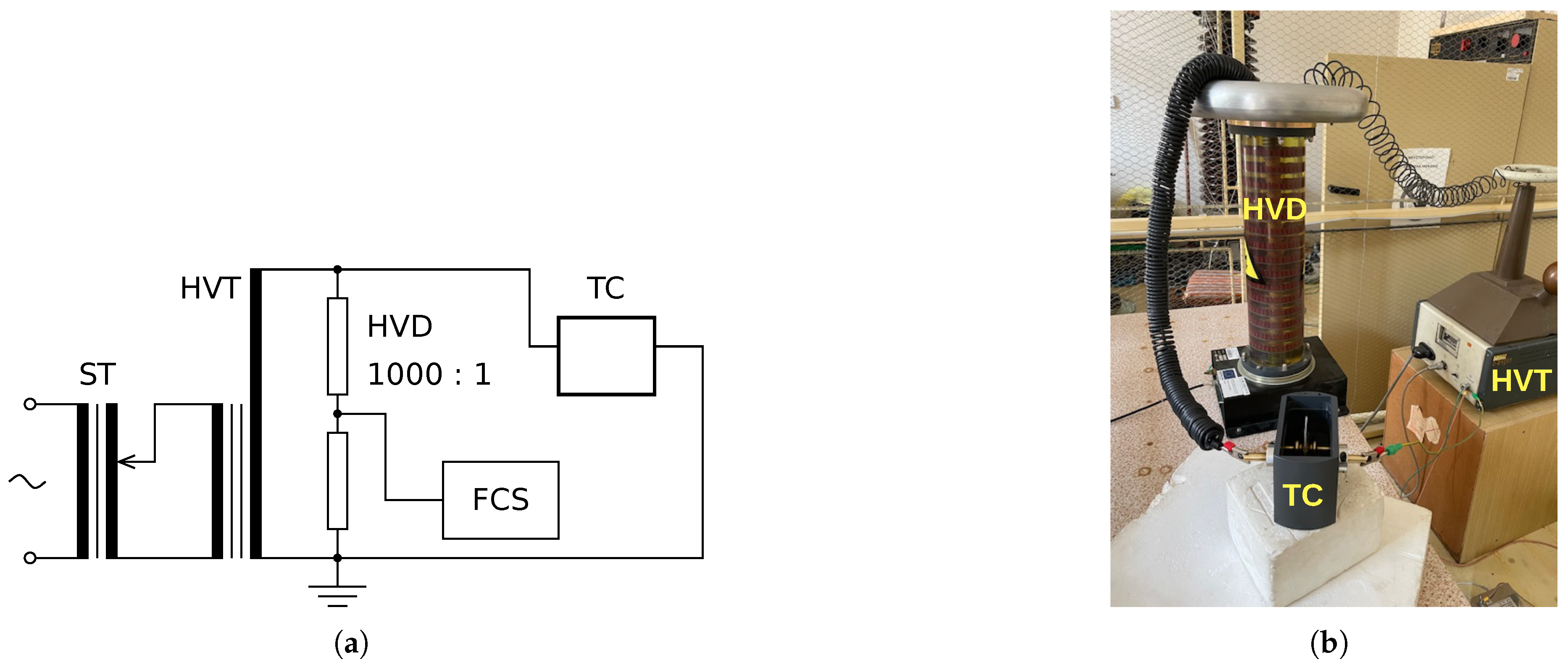
| FCS | four channels scope |
| GNU | GNU’s Not Unix! |
| HVD | high-voltage divider |
| HVT | high-voltage transformer |
| IEC | International Electrotechnical Commission |
| LCA | life-cycle assessment |
| LTS | long-term support |
| RMS | root-mean-square |
| ST | setting transformer |
| TC | test cell |
| ZnO | zinc oxide |
| XRF | X-ray fluorescence |
References
- Xiao, Y.; Goyal, G.K.; Su, J.; Abbasi, H.; Yan, H.; Yao, X.; Tantratian, K.; Yan, Z.; Alksninis, A.; Phipps, M.; et al. A comprehensive review of electric vehicle recycling: Processes in selective collection, element extraction, and component regeneration. Resources, Conservation and Recycling 2025, 219, 108309. [Google Scholar] [CrossRef]
- Laftah, W.A.; Rahman, W.A.W.A. A comprehensive review of tire recycling technologies and applications. Materials Advances 2025, 6, 4992–5010. [Google Scholar] [CrossRef]
- Domingues, J.; Marques, T.; Mateus, A.; Carreira, P.; Malça, C. An Additive Manufacturing Solution to Produce Big Green Parts from Tires and Recycled Plastics. Procedia Manufacturing 2017, 12, 242–248. [Google Scholar] [CrossRef]
- Lee, S.W.; Park, J.; Lee, D.; Chun, B.; Banthia, N.; Yoo, D.Y. Beneficial effect of recycled tire powder incorporation on the tensile performance of strain-hardening alkali-activated concrete. Construction and Building Materials 2025, 464, 140115. [Google Scholar] [CrossRef]
- Calignano, F.; Bove, A.; Mercurio, V.; Marchiandi, G. Effect of recycled powder and gear profile into the functionality of additive manufacturing polymer gears. Rapid Prototyping Journal 2023, 30, 16–31. [Google Scholar] [CrossRef]
- Soussi, N.; Ammar, M.; Mokni, A.; Mhiri, H. Efficiency of a recycled composite material for building insulation. Construction and Building Materials 2025, 467, 140358. [Google Scholar] [CrossRef]
- Liu, H.; Zou, Y.; Xu, J.; Zhou, S.; Wu, X.; Liu, Y. Efficient recycling of anhydride-cured epoxy resins for electrical insulation: Green economy and tunable performance. Polymer Testing 2025, 150, 108934. [Google Scholar] [CrossRef]
- Mourou, C.; Bonoli, A.; Zamorano, M.; Martín-Morales, M. Environmental impact of roof tiles using recycled waste glass coatings: A Life Cycle Assessment approach. Building and Environment 2025, 270, 112481. [Google Scholar] [CrossRef]
- Alcoceba-Pascual, S.; Ortego, A.; Villanueva-Martínez, N.I.; Schaik, A.v.; Reuter, M.A.; Iglesias-Émbil, M.; Valero, A. Evaluating the recyclability of electronic car parts through disassemblability, thermodynamic and metallurgical analyses. Journal of Cleaner Production 2025, 513, 145725. [Google Scholar] [CrossRef]
- Shi, X.; Liao, Q.; Chen, K.; Wang, Y.; Liu, L.; Wang, F.; Zhu, H.; Zhang, L.; Liu, C. Foaming process and thermal insulation properties of foamed glass-ceramics prepared by recycling muti-solid wastes. Construction and Building Materials 2025, 466, 140270. [Google Scholar] [CrossRef]
- Chagas, P.A.M.; Lima, F.A.; Medeiros, G.B.; Mata, G.C.; Tanabe, E.H.; Bertuol, D.A.; Oliveira, W.P.; Guerra, V.G.; Aguiar, M.L. From waste to innovation: Advancing the circular economy with nanofibers using recycled polymers and natural polymers from renewable or waste residues. Journal of Industrial and Engineering Chemistry 2025, 147, 56–84. [Google Scholar] [CrossRef]
- Ma, H.; Liu, X.; Wang, J.; Cai, Y.; Huang, J.; She, M.; Chen, L.; Zhang, H.; Wang, H.; Xiong, S. High-performance polyarylate nanofiber membranes with ultra-thin structure, multi-environmental tolerance, and recyclability for advanced electrical insulation. Chemical Engineering Journal 2025, 518, 164782. [Google Scholar] [CrossRef]
- Wu, Y.; Gan, Y.; Peng, C.; Gao, C.; Yu, J.; Zhang, X. Hot-press recycling of epoxy insulating materials: Mechanistic insights into network reconfiguration and performance evolution modulated by processing conditions. Polymer 2025, 337, 128965. [Google Scholar] [CrossRef]
- Isayev, A.I. Chapter 15 - Recycling of Rubbers. In The Science and Technology of Rubber (Fourth Edition), Fourth Edition ed.; Mark, J.E., Erman, B., Roland, C.M., Eds.; Academic Press: Boston, 2013; pp. 697–764. [Google Scholar] [CrossRef]
- Zhang, L.; Wang, R.; Dai, Z.; Zhang, C. Ion liquid selective depolymerization of epoxy resin insulation materials from electric power industry in a polar aprotic solvent system. Reactive and Functional Polymers 2025, 216, 106456. [Google Scholar] [CrossRef]
- Kuznetsov, G.V.; Syrodoy, S.V.; Purin, M.V.; Zenkov, A.V.; Gvozdyakov, D.V.; Larionov, K.B. Justification of the possibility of car tires recycling as part of coal-water composites. Journal of Environmental Chemical Engineering 2021, 9, 104741. [Google Scholar] [CrossRef]
- Li, D.; Sun, B.; Yang, L.; Wang, W. Mechanical and thermal properties of recycled coarse aggregate concrete incorporating microencapsulated phase change materials and recycled tire rubber granules and its freeze-thaw resistance. Journal of Building Engineering 2025, 101, 111821. [Google Scholar] [CrossRef]
- Duque-Villaverde, A.; Sóñora, S.; Dagnac, T.; Roca, E.; Llompart, M. Metal and metalloid content in real urban synthetic surfaces made of recycled tire crumb rubber including playgrounds and football fields. Science of The Total Environment 2025, 975, 179267. [Google Scholar] [CrossRef]
- Feng, Y.; Zhang, Z.; Yue, D.; Belko, V.O.; Maksimenko, S.A.; Deng, J.; Sun, Y.; Yang, Z.; Fu, Q.; Liu, B.; et al. Recent progress in degradation and recycling of epoxy resin. Journal of Materials Research and Technology 2024, 32, 2891–2912. [Google Scholar] [CrossRef]
- Zhao, X.; Zeng, S.; Chu, J.; Bi, J.; Li, Y.; Zhang, G. Recycling of epoxy polymer and enhancement of breakdown strength after reconstruction via alcoholysis. Polymer 2025, 334, 128712. [Google Scholar] [CrossRef]
- Anjana, E.I.; Aiswariya, K.; Prathish, K.P.; Sahoo, S.K.; Jayasankar, K. Recovery and recycling of silica fabric from waste printed circuit boards to develop epoxy composite for electrical and thermal insulation applications. Waste Management 2025, 198, 174–186. [Google Scholar] [CrossRef]
- Zhou, Y.; Dang, B.; Wang, H.; Liu, J.; Li, Q.; Hu, J.; He, J. Polypropylene-based ternary nanocomposites for recyclable high-voltage direct-current cable insulation. Composites Science and Technology 2018, 165, 168–174. [Google Scholar] [CrossRef]
- Reghunadhan, A.; Datta, J.; Jaroszewski, M.; Kalarikkal, N.; Thomas, S. Polyurethane glycolysate from industrial waste recycling to develop low dielectric constant, thermally stable materials suitable for the electronics. Arabian Journal of Chemistry 2020, 13, 2110–2120. [Google Scholar] [CrossRef]
- Qian, K.; Wang, L.; Teng, J.; Liu, G. Strategies and technologies for sustainable plastic waste treatment and recycling. Environmental Functional Materials 2025. [Google Scholar] [CrossRef]
- Magbool, H.M. Recycling electronic waste as fiber reinforcement in high-strength concrete: A sustainable approach. Developments in the Built Environment 2025, 24, 100755. [Google Scholar] [CrossRef]
- Wang, J.; Zhao, C.; Li, Q.; Song, G.; Hu, Y. The synergistic effect of recycled steel fibers and rubber aggregates from waste tires on the basic properties, drying shrinkage, and pore structures of cement concrete. Construction and Building Materials 2025, 470, 140574. [Google Scholar] [CrossRef]
- Yousaf, A.; Rashid, A.A.; Polat, R.; Koç, M. Potential and challenges of recycled polymer plastics and natural waste materials for additive manufacturing. Sustainable Materials and Technologies 2024, 41, e01103. [Google Scholar] [CrossRef]
- Li, S.; Tsang, H.H.; Cheng, Y. Shaking table tests on geotechnical seismic isolation of electrical transformers using recycled tire rubber-soil mixtures. Construction and Building Materials 2025, 497, 143886. [Google Scholar] [CrossRef]
- Ruiz, O.; Clemente, C.; Alonso, M.; Alguacil, F.J. Recycling of an electric arc furnace flue dust to obtain high grade ZnO. Journal of Hazardous Materials 2007, 141, 33–36. [Google Scholar] [CrossRef]
- Araújo, J.A.d.; Schalch, V. Recycling of electric arc furnace (EAF) dust for use in steel making process. Journal of Materials Research and Technology 2014, 3, 274–279. [Google Scholar] [CrossRef]
- Liptai, P.; Nagy, Š.; Dolník, B.; Matvija, M.; Pirošková, J. Optimization of technological processes in the manufacturability of varistors based on recycled ZnO product, with emphasis on environmental sustainability. Heliyon 2024, 10, e35898. [Google Scholar] [CrossRef]
- Müller, D.; Groves, D.I.; Zhang, L. Towards a circular economy: Modern recycling technologies for critical metals. Gondwana Research 2025. [Google Scholar] [CrossRef]
- IEC 62539(E):2007. Guide for the statistical analysis of electrical insulation breakdown data. Standard IEC 62539:2007, International Electrotechnical Commission, Geneva, CH, 2007.
- IEC 60243-1:2013. Electric strength of insulating materials – Test methods – Part 1: Tests at power frequencies. Standard IEC 60243-1:2013, International Electrotechnical Commission, Geneva, CH, 2013.
- ASTM D1816-12R19. Standard Test Method for Dielectric Breakdown Voltage of Insulating Oils of Petroleum Origin Using VDE Electrodes. Standard ASTM D1816-12R19, Institute of Electrical and Electronic Engineers, Piscataway, NJ 08855, USA, 2012.
- Cheon, C.; Seo, D.; Kim, M. Statistical Analysis of AC Breakdown Performance of Epoxy/Al2O3 Micro-Composites for High-Voltage Applications. Applied Sciences 2024, 14. [Google Scholar] [CrossRef]
- Dolník, B. Eco-Functional Epoxy Composites from Recycled ZnO and Tire Rubber: A Study on Breakdown Voltage Enhancement, 2025. [CrossRef]
- Zhu, M.X.; Luo, L.Y.; Li, M.T.; Xu, X.K.; Ren, J.R. Robust high-surface-insulating and superhydrophobic materials by constructing nanoparticles decorated porous structures. Composites Science and Technology 2025, 261, 111033. [Google Scholar] [CrossRef]
- Huan, X.; Hu, B.; Ji, Z.; Gao, C.; Zhou, F.; Yu, J.; Du, B.; Zhao, Y. Enhancing electrical insulation of epoxy composites by suppressing charge injection and subsequently electric field distortion. Composites Communications 2025, 56, 102391. [Google Scholar] [CrossRef]

| Elem.1 | Zn | S | Si | Ca | K | P | Fe | Cu | V | Cr | Mn |
|---|---|---|---|---|---|---|---|---|---|---|---|
| wt.% | 96.295 | 1.344 | 0.793 | 0.519 | 0.399 | 0.245 | 0.243 | 0.057 | 0.05 | 0.03 | 0.019 |
| Sample ID | Filler type and concentration | Thickness (mm) | (kV) | (–) | Relative change in vs. pure epoxy | Correlation coefficient (Pearson) | Dielectric strength (kV/mm) |
|---|---|---|---|---|---|---|---|
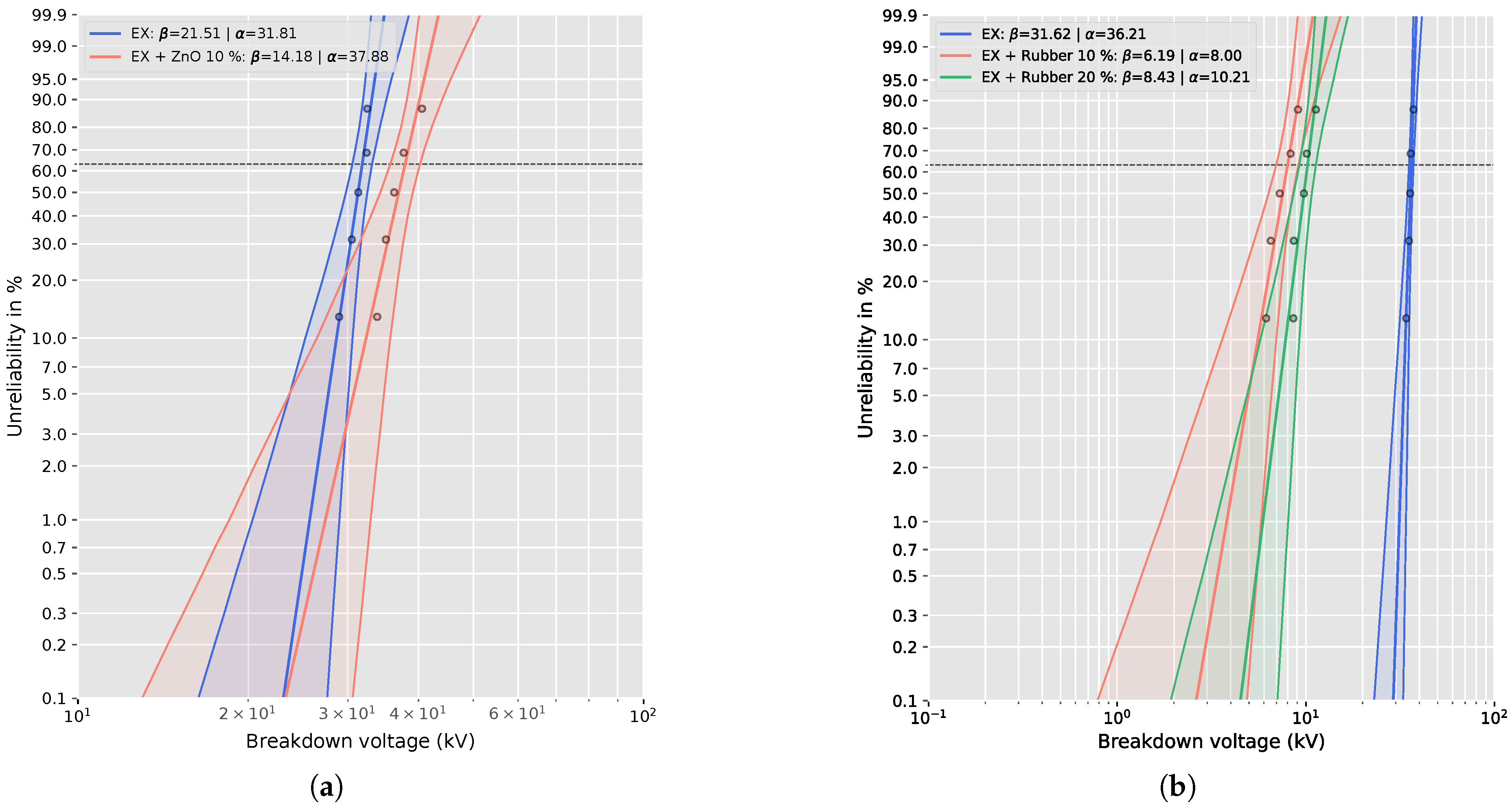
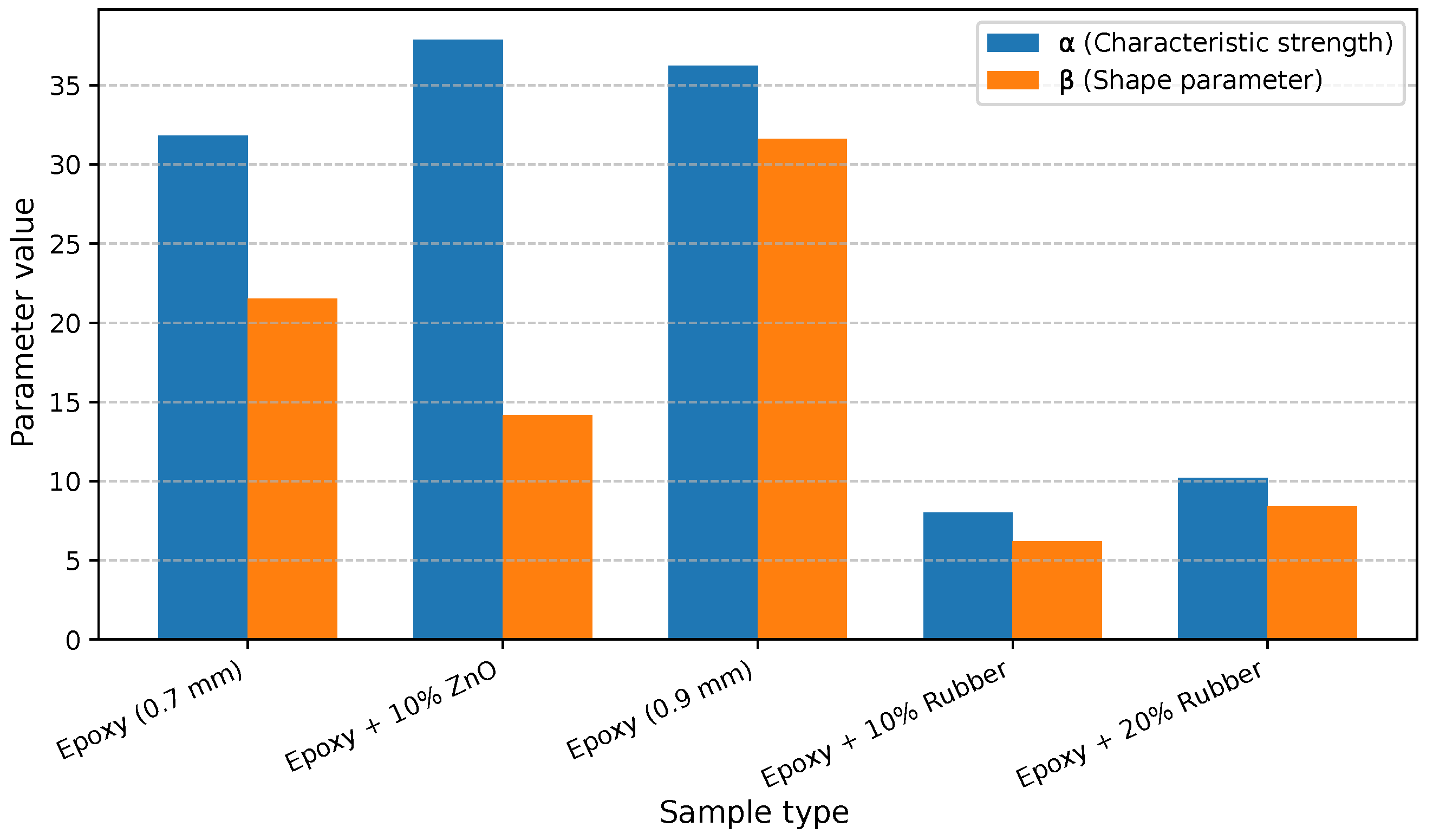
| E-0.7 | Pure epoxy (reference, 0.7 mm) | 0.7 | 31.81 | 21.51 | — | 0.98587 | 45.44 |
| E-ZnO10 | Epoxy + 10 wt% ZnO (EAF dust) | 0.7 | 37.88 | 14.18 | % | 0.95270 | 54.11 |
| E-0.9 | Pure epoxy (reference, 0.9 mm) | 0.9 | 36.21 | 31.62 | — | 0.98062 | 40.23 |
| E-R10 | Epoxy + 10 wt% tire rubber | 0.9 | 8.00 | 6.19 | % (4.53× lower) | 0.96073 | 8.89 |
| E-R20 | Epoxy + 20 wt% tire rubber | 0.9 | 10.21 | 8.43 | % (3.55× lower) | 0.92787 | 11.34 |
Disclaimer/Publisher’s Note: The statements, opinions and data contained in all publications are solely those of the individual author(s) and contributor(s) and not of MDPI and/or the editor(s). MDPI and/or the editor(s) disclaim responsibility for any injury to people or property resulting from any ideas, methods, instructions or products referred to in the content. |
© 2025 by the authors. Licensee MDPI, Basel, Switzerland. This article is an open access article distributed under the terms and conditions of the Creative Commons Attribution (CC BY) license (http://creativecommons.org/licenses/by/4.0/).