

Submitted:
02 December 2025
Posted:
03 December 2025
You are already at the latest version
Abstract
The physical nature of dark matter and dark energy remains one of the most pressing questions in modern cosmology. This work presents a phenomenological model where the entire dark sector is described by two minimally coupled scalar fields within General Rela-tivity. The first, an ultra-light scalar field Ψ with mass mΨ, constitutes Fuzzy Dark Matter (FDM), whose coherent oscillations dynamically replicate cold dark matter on large scales. The second, a quintessence field ϕ, evolves under an axion-like potential and serves as the dark energy component. We demonstrate that this framework can successfully reproduce the canonical cosmic history while offering a physical mechanism to address the S8 tension. By exploring the model’s parameter space, we show that the suppression of small-scale structure is a direct function of the FDM mass. For a benchmark mass of mΨ = 10−22 eV, chosen to illustrate the potential impact, we show that the model can produce a value of S8 σ8(Ωm/0.3)0.5 of approximately 0.79, significantly alleviating the tension between early and late-universe probes [1,9,10]. Concurrently, the model predicts a “thawing” behavior for dark energy, with a present-day equation of state, wϕ,0, that depends on the potential’s parameters, yielding wϕ,0 0.92 in our benchmark case—a value distinguishably different from the cosmological constant’s wΛ = 1. We acknowledge that the FDM mass required to affect the S8 tension creates a testable conflict with some Lyman-alpha forest constraints [16], a point we discuss as a key feature for the model’s falsifiability. By connecting cos-mic acceleration, dark matter, and the S8 tension, this self-consistent framework offers a compelling and highly testable alternative to the ΛCDM model, motivating a full statistical analysis.
Keywords:
1. Introduction
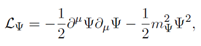
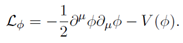
2. Theoretical Framework

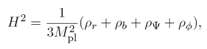
3. Cosmological Field Equations

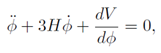
4. Background Cosmological Dynamics
4.1. Numerical Setup and Parameter Space
4.1.1. Quintessence Potential

4.1.2. Parameter Selection and Benchmark
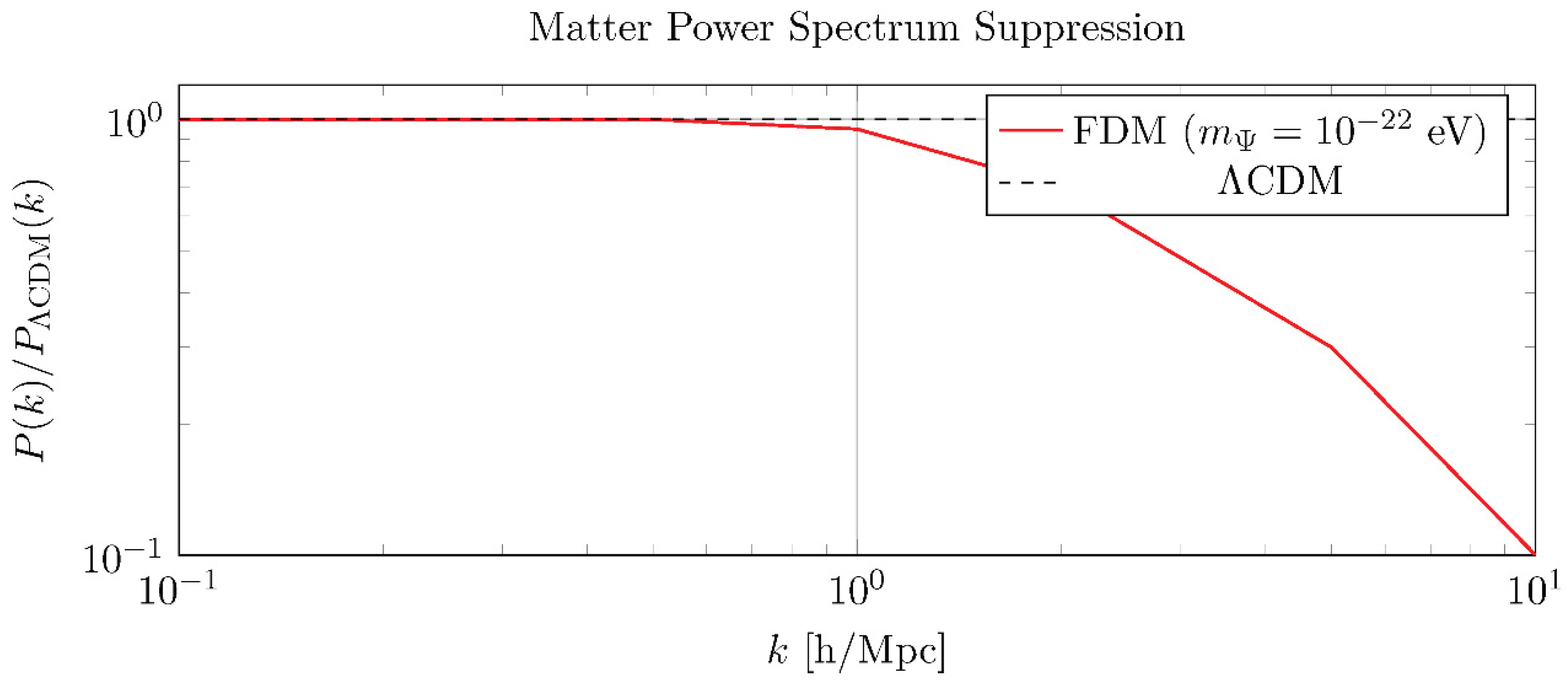
- FDM Mass (mΨ): We select mΨ = 10−22 eV for our benchmark. This value is specifically chosen because it lies in a range known to suppress small-scale structure [8].
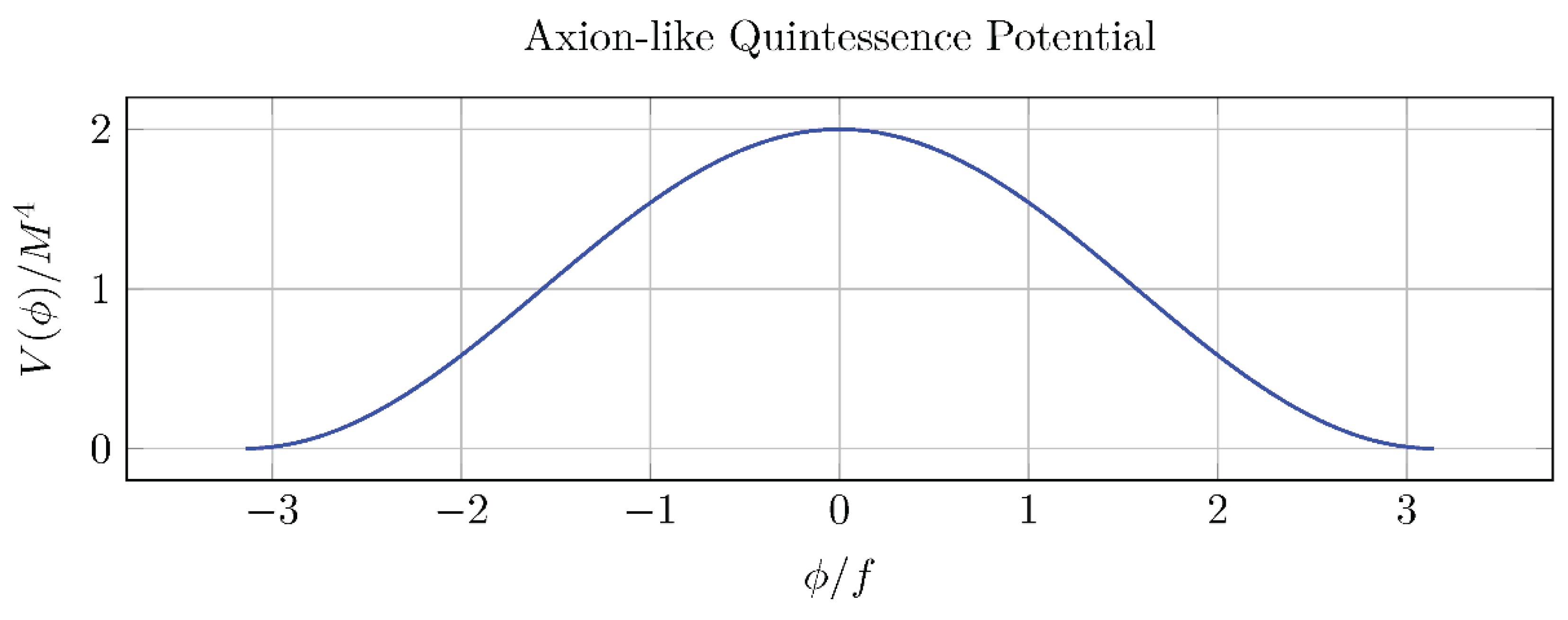
- Quintessence Scales (M , f): We set M = 2.5 × 10⁻³ eV and f = Mpl. The energy scale M is tuned to yield the correct dark energy density today, while f = Mpl is motivated by high-energy physics contexts.
4.1.3. Initial Conditions and Robustness
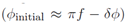 with negligible initial velocity. This requires a small initial displacement of δϕ ≈ 10−5f . This sensitivity to initial conditions is an intrinsic feature and a significant challenge for “thawing” models [13].
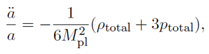
4.2. Results: Cosmic Expansion History
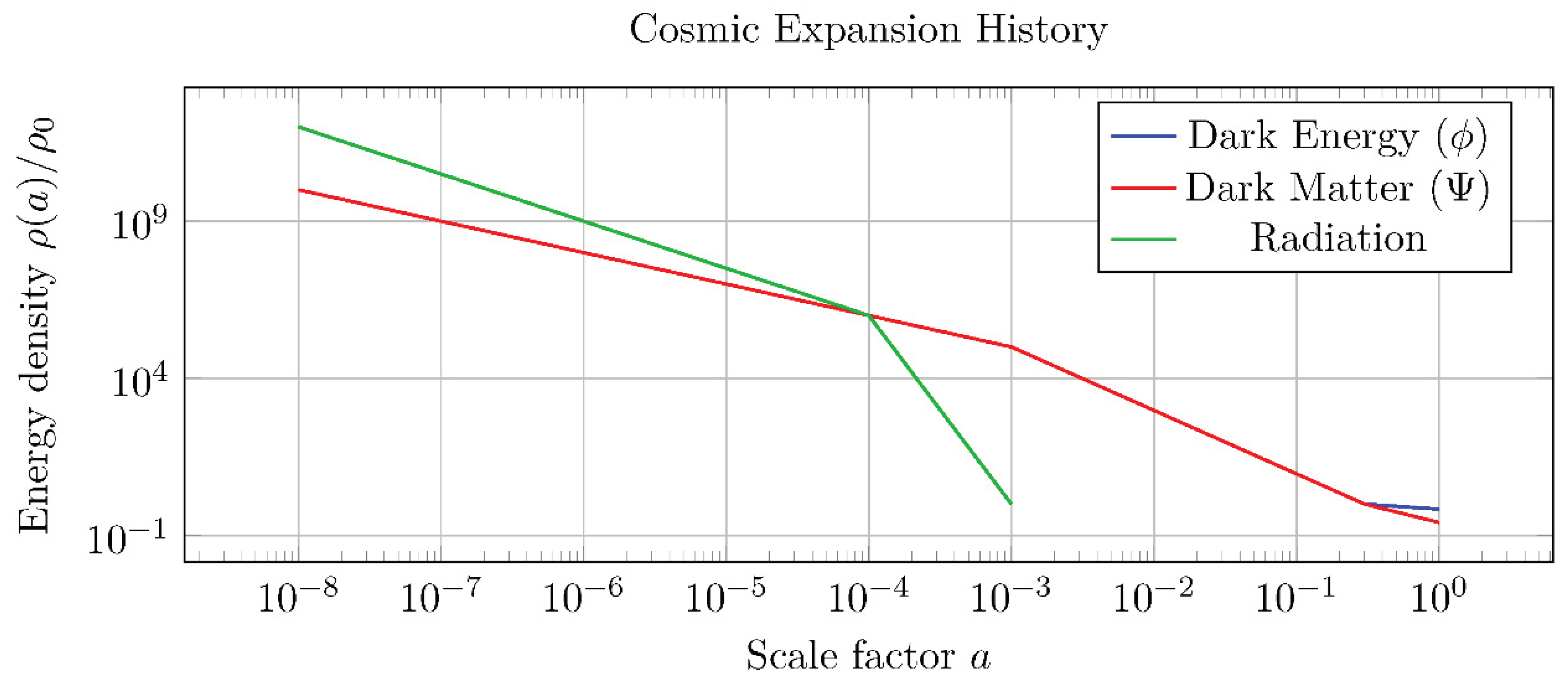
5. Observational Signatures and Discussion
5.1. A Dynamic Equation of State for Dark Energy
5.2. Suppression of Small-Scale Structure and the S8 Tension
5.3. Parameter Degeneracies and Model Robustness
6. Conclusion
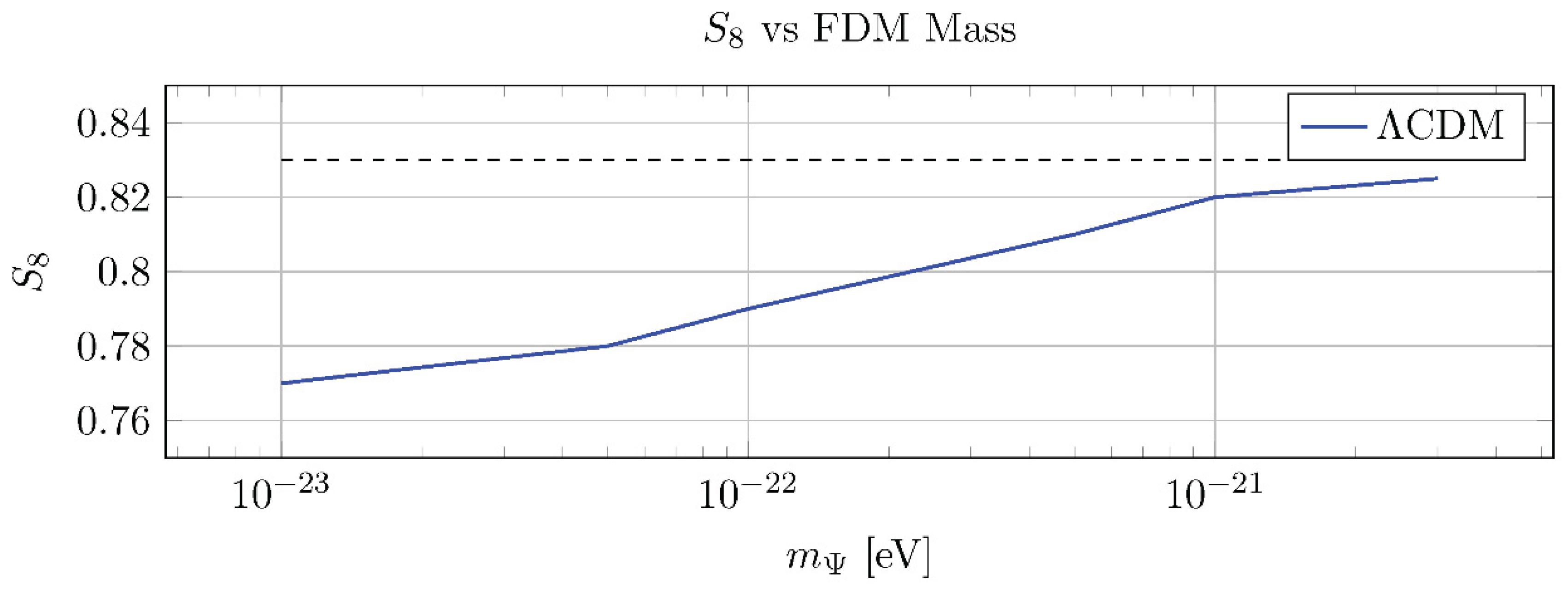
- A Mechanism for S8 Tension Relief: The FDM component can suppress the matter power spectrum on small scales. We showed that a benchmark mass of mΨ = 10−22 eV can yield S8 ≈ 0.79.
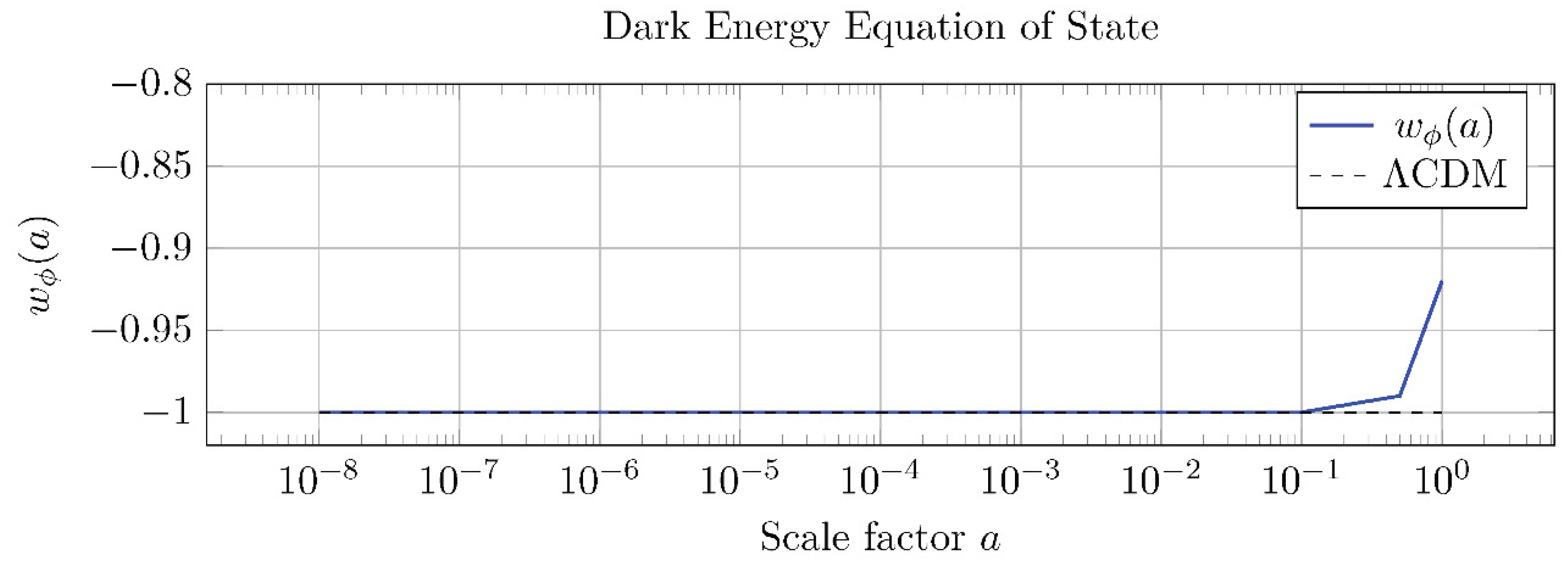
- Testable Dark Energy Dynamics: The quintessence component leads to a dynamic equation of state, with wϕ,0 ≈ −0.92.
- A Clear Observational Trade-Off: The model creates a testable tension between the FDM mass required to lower S8 and existing constraints from the Lyman-alpha forest.
Acknowledgments
A Implementation of Scalar Field Perturbations in CLASS

A.1 Fuzzy Dark Matter Perturbation (δΨ)

A.2 Quintessence Perturbation (δϕ)

A.3 Perturbed Energy-Momentum Tensor
A.4 Initial Conditions and Numerical Stability
References
- Aghanim, N., et al. (Planck Collaboration). 2020, A&A, 641, A6.
- Riess, A. G., et al. 1998, AJ, 116, 1009.
- Perlmutter, S., et al. 1999, ApJ, 517, 565. [CrossRef]
- Weinberg, S. 1989, Rev. Mod. Phys., 61, 1. [CrossRef]
- Copeland, E. J., Sami, M., & Tsujikawa, S. 2006, Int. J. Mod. Phys. D, 15, 1753. [CrossRef]
- Hu, W., Barkana, R., & Gruzinov, A. 2000, Phys. Rev. Lett., 85, 1158. [CrossRef]
- Bullock, J. S., & Boylan-Kolchin, M. 2017, ARA&A, 55, 343. [CrossRef]
- Marsh, D. J. C. 2016, Phys. Rep., 643, 1. [CrossRef]
- Heymans, C., et al. 2021, A&A, 646, A140.
- Abbott, T. M. C., et al. (DES Collaboration). 2022, Phys. Rev. D, 105, 023520. [CrossRef]
- Frieman, J. A., Hill, C. T., Stebbins, A., & Waga, I. 1995, Phys. Rev. Lett., 75, 2077. [CrossRef]
- Svrcek, P., & Witten, E. 2006, JHEP, 2006, 051. [CrossRef]
- Caldwell, R. R., & Linder, E. V. 2005, Phys. Rev. Lett., 95, 141301. [CrossRef]
- Laureijs, R., et al. 2011, arXiv:1110.3193. [CrossRef]
- Lesgourgues, J. 2011, arXiv:1104.2932. [CrossRef]
- Iri, V., et al. 2017, Phys. Rev. Lett., 119, 031302.
- Schutz, K. 2020, Phys. Rev. D, 102, 063022.
- Poulin, V., Smith, T. L., Karwal, T., & Kamionkowski, M. 2019, Phys. Rev. Lett., 122, 221301. [CrossRef]
Disclaimer/Publisher’s Note: The statements, opinions and data contained in all publications are solely those of the individual author(s) and contributor(s) and not of MDPI and/or the editor(s). MDPI and/or the editor(s) disclaim responsibility for any injury to people or property resulting from any ideas, methods, instructions or products referred to in the content. |
© 2025 by the authors. Licensee MDPI, Basel, Switzerland. This article is an open access article distributed under the terms and conditions of the Creative Commons Attribution (CC BY) license (http://creativecommons.org/licenses/by/4.0/).