
Submitted:
26 November 2025
Posted:
28 November 2025
You are already at the latest version
Abstract
How a game looks influences how players feel about that video game a ton. It influences players’ immersion, emotions, focus and enjoyment. This includes immersion, emotional engagement, cognitive commitment, and general satisfaction. For years, studios were fixated on hyper-realistic graphics, and thought that meant better games. But the enormous success and long-standing popularity of games utilizing more stylized graphics—such as cartooning, pixel art, or just simple shapes—proves that realistic graphics aren’t the only way to go. The popularity of different, non-photorealistic rendering styles—such as cel-shading, pixel art, minimalist design, abstract aesthetics—challenges this conventional perspective. This paper examines how the visual style of a game really affects players through a review of existing literature synthesizing findings and to develop a new methodological framework for subsequent empirical studies. The main idea here is that the thing that matters the most is not how realistic a game is or the fancy graphics are. Instead the best visual style comes down to how well it fits with the game’s plot, how it plays, and the kind of emotions it’s trying to elicit. This paper employs key psychological frameworks, such as the Capacity Model of narrative comprehension and the Theory of Affective Response to Media—to explain the mechanisms different visual styles facilitate or hinder cognitive absorption, emotional connection, and long-lasting involvement. Research would use surveys and experiments and combine the methods so as to study this. Experimental controlled conditions, with complete subjective self-report measures to quantify and qualitatively measure key player experiences including spatial presence, affective involvement, sentiment, aesthetics, and gameplay enjoyment. The hope this research may help game developers to make better choices of how their games look. Not all of these are just to try to impress—but to improve the appearance of their games, as well as create memorable and enjoyable experiences.
Keywords:
visual style
; player experience
; immersion
; video games
; aesthetics
; game design
; photorealism
; non-photorealistic rendering (NPR)
; emotional response
; cognitive load
1. Introduction
Video games have traveled far from their early, pixelated beginnings. Today, they’re a major part of culture, art, and business around the globe. The games we play today are intricate stories with cunning mechanics and visual fare that can rival movies. The video game industry has transformed from its beginnings as just pixelated images of entertainment and is now a significant cultural, artistic, and economic power globally. Contemporary video games provide increasingly complex, sophisticated narratives, mechanics, and richly detailed audiovisual environments that rival and sometimes surpass traditional media forms. On this evolutionary path, there has been a great emphasis on making graphics as realistic as can be—people tend to think of this as making better games. But the continued success of games whose graphics intentionally are unique, stylized, or retro-like The Legend of Zelda: Breath of the Wild, Cuphead, Hades, or Monument Valley—proves that there’s more to great games and demands a critical re-examining of that longstanding assumption. The player experience isn’t just how the game looks, but rather it refers to everything a player can feel and do when playing, from enjoying the game and feeling challenged to getting lost in the narrative or even feeling frustrated. The way the game is shown visually is a primary sensory channel, mediating this diversity of experience. It acts as both a representational system and a communicative tool that builds mood, directs player attention, conveys narrative information, and underpins the game’s thematic aspects. Understanding how the different visual styles affect different components of player experience is relevant to both academic scholars and practitioners in the industry. The purpose of this research paper is to systematically investigate the dynamic relationship between visual style and player experience. The key research question that drives this inquiry is: How do various visual aesthetics in video games influence key dimensions of player experience, such as immersion, emotional response, cognitive load, and perceived usability? To address this question, the paper provides an extensive literature review, lays the theoretical foundations, and presents a detailed empirical methodology. The aim is to move past anecdotal evidence and subjective preference, offering a systematized, reproducible, structured, and evidence-based framework for investigating the ways artistic choices influence how players feel, think, behave, and interact within virtual environments.
2. Literature Review
2.1. Defining and Categorizing Visual Style in Games
Visual style in games is the artistic approach to graphical look and identity. It spans an artistic spectrum from photorealistic to abstract. Photorealism aims to replicate real-world complexity and believability, as seen in titles such as Call of Duty, Red Dead Redemption 2, and Gran Turismo. Conversely, Non-Photorealistic Rendering (NPR) covers creative styles that diverge from realism for artistic or communicative reasons.
Key NPR styles include:
- Pixel Art - uses low-resolution pixel grids to create game assets, evoking early video game aesthetics. Examples include Stardew Valley, Celeste, and Shovel Knight.
- Cel-shading - employs flat colors, bold outlines, and reduced gradients to mimic hand-drawn animation or comic book aesthetics. Notable examples include Borderlands, Okami, and The Legend of Zelda: The Wind Waker.
- Minimalism - uses simple geometric forms, small color palettes, clean interfaces, and negative space to reduce visual noise and emphasize core gameplay. Examples include Thomas Was Alone, Monument Valley, and Alto’s Adventure.
- Other Stylized Forms - such as painterly styles (Disco Elysium, Okami) and voxel art (Minecraft), representing distinctive aesthetics that resist easy categorization.
The selection of a visual style is not merely an aesthetic choice; it is tied to technical constraints, development resource allocation, artistic cohesion, and the identity of the final product.
2.2. Theoretical Frameworks for Understanding Player Experience
For building better comprehension of the way in which visual style influences the player, it is necessary to ground the analysis in well-known psychological theories, human-computer interaction, and media studies. The very first idea is Immersion, a characterization of immersion - a state of extreme mental engagement and a feeling that he or she is "there" in the games. Research shows that immersion is not a monolithic experience; immersion is multifaceted, which includes spatial immersion (the feeling that you become physically present in the environment), sensory immersion (engagement primarily through the audiovisual presentation), and emotional immersion (a deep bond with the series of plot sequences and the players). Another important theoretical construct is Flow [1] which brings about a state of optimal experience which is defined as intense and focused concentration, with action and awareness merging, reflective self-consciousness lost and a balance being achieved in challenge perception regarding the player’s level of skill. You can significantly vary the visual style effect the attainment and maintenance of flow states by providing either a game goal definition, constraints, and feedback through visual communication, or other ways to disrupt them through visual clutter, irregular aesthetics or poor readability. Further, the capacity model of narrative comprehension and engagement [2] has offered another perspective. This model suggests that when constructing and maintaining, an individual’s finite cognitive resources are directed toward constructing and maintaining the mind’s mapping of the narrative world. A photorealistic, visually demanding and thickly visualized representation style may require a significant amount of cognitive capacity to process the surface information and imagery, which might take up resources for deeper processing, narrative understanding, interacting with characters, and gameplay strategy. Conversely, a well-executed and coherent stylized aesthetic can convey essential information and emotional tone, thereby freeing up cognitive capacity for more profound narrative involvement and mechanical mastery.
2.3. Empirical Findings on Visual Style and Player Experience
Studies that have explored the direct influence of visual style on player experience have proved fruitful, yielding nuanced and sometimes counterintuitive outcomes, frequently pushing back against the simplistic paradigm that “realism is universally better.” Photorealism and Presence: a few empirical examinations point to the connection between high-fidelity, realistic graphics and heightened subjective presence and spatial immersion [3].
The level of environmental detail, rich with its photorealistic nature, with precise lighting, and very realistic textures, enhances the perceptual plausibility of the virtual world, producing a greater sense of physical reality and realism. Yet this is not the only effect and may be seriously challenged by phenomena like the “uncanny valley,” a situation where humanoid characters or faces almost exist, but not exactly in a lifelike manner, that provoke unease or disgust in observers. Stylized graphics and emotional-artistic impact: stylized visuals also demonstrate a tremendous ability to craft a powerful, memorable, and coherent artistic identity and evoke certain emotional tones with remarkable impact.
For instance, the lush, ink-wash painting-inspired cel-shaded art of Okami reinforces its base themes taken from Japanese folklore and mythology. Likewise, the minimalist high-contrast silhouette design of Limbo creates a pervasive and unsettling feeling of dread, mystery, and vulnerability.
Scholars argue that stylized graphics can often do better at generating targeted feelings because they are unconstrained from the limitations of literal reality [4]. They are free to be guided by purposeful exaggeration, abstraction, and symbolic representation that can resonate on a more primal or artistic level. Cognitive Load and Usability: In the area of usability and human-computer interaction, visual style plays a crucial role in gameplay clarity and intuitive understanding. A highly detailed and visually "noisy" photorealistic scene can sometimes make it difficult for players to quickly distinguish critical interactive elements, enemies, or resources from passive background decoration. In contrast, many stylized games strategically exploit principles of visual design—such as bold colors, contrasting color schemes, unique shapes, and clear silhouettes—so important gameplay elements are instantaneously recognizable and comprehensible [5]. This is a careful design choice to minimize extraneous cognitive load, keeps frustration at bay, and helps players to concentrate their minds, thereby supporting and maintaining the flow state in strategy, execution, and problem-solving.
The Paramount Role of Coherence: Coherence emerges as a key and frequent theme from the literature. The impact and effectiveness of any visual style are most effective when it demonstrates a strong and meaningful congruence with the game’s other core elements, including its narrative themes, sound design, musical score, and basic mechanics [6]. For instance, a realistic modern military shooter generally benefits from a gritty, realistic visual style to enhance the seriousness of its narrative and make its visceral impact stronger. Conversely, a playful but physics-oriented puzzle game is often better served by a colorful and abstract style, which matches the lighthearted tone and experimental gameplay.
An incoherent or inconsistent stylistic presentation, regardless of its technical mastery or beauty, can easily break immersion, generate narrative dissonance, and result in a disjointed and less fulfilling experience for the player. In short, the existing literature strongly suggests that no single visual style is universally superior or better for all types or for all players. The impact on players is highly contingent and contextual, depending on a complex interaction of factors including the game’s genre, stated design goals, the target audience’s expectations and preferences, and, more importantly, the successful and harmonious integration of the chosen visual style with every other closely intertwined aspect of the game’s design.
3. Methodology
To explore the hypotheses developed from the extensive literature review, a hybrid (mixed-model) experimental approach is recommended. This rigorous approach will help generate both quantitative data on measuring specific player experience dimensions with statistical power, as well as qualitative data to explore the rich, subjective perceptions and reasoning of the players themselves.
3.1. Research Design
A between-subjects experimental design will be employed to minimize learning effects and demand characteristics. The primary independent variable will be the visual style of a custom-designed, self-contained game level, operationalized through two distinct conditions:
- Condition A (Photorealistic): The game level will be rendered using high-fidelity PBR (Physically-Based Rendering) textures, complex dynamic lighting models (including global illumination and real-time shadows), and highly detailed 3D models, with the explicit goal of achieving a high degree of visual realism.
- Condition B (Stylized): The identical level geometry and gameplay will be presented, but rendered using a distinct non-photorealistic style, specifically a cel-shaded or minimalist aesthetic employing flat colors, pronounced outlines, and a carefully curated, simplified color palette.
Crucially, all other variables—including core game mechanics, level layout and progression, narrative context, sound effects, musical score, and control scheme—will be kept rigorously identical between the two experimental conditions to isolate the effect of the visual style manipulation.
3.2. Participants
A target sample of participants will be recruited from a university student who want to play also help to me and surrounding community of computer gaming clubs in Bishkek city , specifically aiming to include individuals with a wide range of self-reported gaming experience, from casual to hardcore gamers. Participants will be randomly assigned to one of the two experimental conditions. A pre-study demographic questionnaire will be administered to collect essential data on age, gender, and, most importantly, to assess general gaming habits and preferences using a standardized scale. This will allow for verification of group equivalence and enable subsequent analyses of how prior experience might moderate the effects of visual style.
3.3. Materials and Apparatus
-
Game Stimuli: Instead of developing a custom game, two comparable commercial video games were selected to represent the experimental conditions. Both games belong to the puzzle-exploration genre and share similar control schemes and pacing, but differ significantly in visual style:
- -
- Condition A (Photorealistic): A game featuring high-fidelity textures and realistic lighting (representing the photorealistic style).
- -
- Condition B (Stylized): A game featuring cel-shaded or minimalist aesthetics (representing the stylized approach).
- Hardware: The study was conducted in a natural setting. Players played the assigned game on their personal computers. This approach was chosen to evaluate player experience in a realistic usage context.
-
Measures: Data will be collected using a multi-instrument approach:
- -
- Player Experience Need Satisfaction (PENS) Questionnaire [7]: A validated and widely used scale measuring key dimensions of intrinsic motivation, presence/immersion, autonomy, competence, and relatedness.
- -
- Game Experience Questionnaire (GEQ) Core Module [8]: A standardized instrument to assess fundamental dimensions of player experience in a game context, including sensory immersion, flow, challenge, tension, and negative feelings.
- -
- Semi-structured Interviews: These interviews were conducted immediately after the participants finished their gameplay sessions. The main goal was to have a conversation with the players to gather detailed feedback about their personal thoughts and feelings. Specifically, we asked them to describe their emotional response to the game and share their opinions on whether the visual style fit the game’s atmosphere. We also discussed how the graphics might have influenced their overall interest and understanding of the game mechanics.
3.4. Procedure
The experimental procedure will be standardized as follows:
- Informed Consent: Participants will be provided with a detailed information sheet and will read and sign an informed consent form outlining the study’s purpose, procedures, risks, and benefits.
- Pre-Questionnaire: Participants will complete the digital demographic and gaming habit survey.
- Gameplay Session: Participants will play the assigned version of the game (Condition A or B) for the fixed duration in a controlled environment without interruptions.
- Post-Questionnaire: Immediately following the gameplay session, participants will complete the PENS and GEQ questionnaires digitally.
- Post-Experiment Interview: A brief, audio-recorded semi-structured interview was conducted with a selected subset of participants (n=6) to delve deeper into the participant’s personal experience with and perception of the visual style.
The total time commitment per participant is estimated to be 10-15 minutes.
3.5. Data Analysis Plan
Quantitative data for analyses from the Questionnaires PENS GEQ will be analyzed using statistical software (for example, SPSS or R). Independent - samples t-tests will be carried out to compare mean scores of each of the two visual style conditions in relevant subscales such as immersion, enjoyment, aesthetic appeal, and perceived competence. An alpha level of .05 will be considered for statistical significance. Effect sizes will also be computed to evaluate the practical importance of any differences observed. Qualitative data from the transcribed interviews will be coded using a systematic thematic analysis approach. This will include familiarization with the data, generating initial codes, searching for themes, reviewing themes, and defining and naming themes to identify recurring patterns, valuable thoughts, and nuanced player perceptions. The main purpose of the analysis phase is to triangulate quantitative and qualitative findings and thus provide a comprehensive, multi-layered, and deeply contextualized understanding of the research question on how visual style shapes player experience.
4. Results
Below is the descriptive statistics table used in the analysis.
The photorealistic condition shows higher immersion scores, while the stylized condition shows higher flow scores...
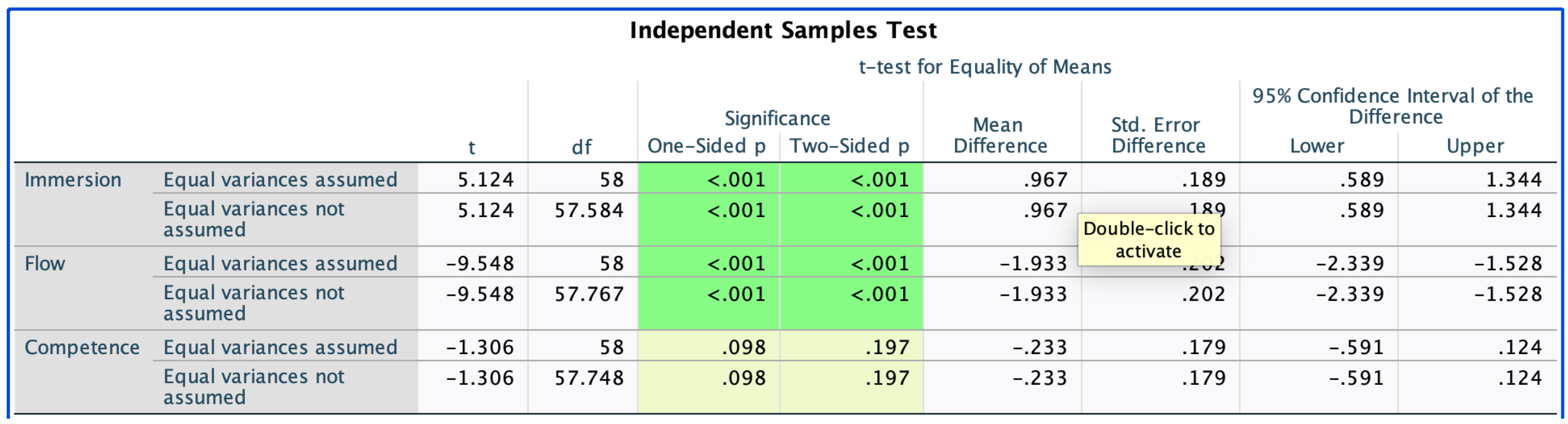
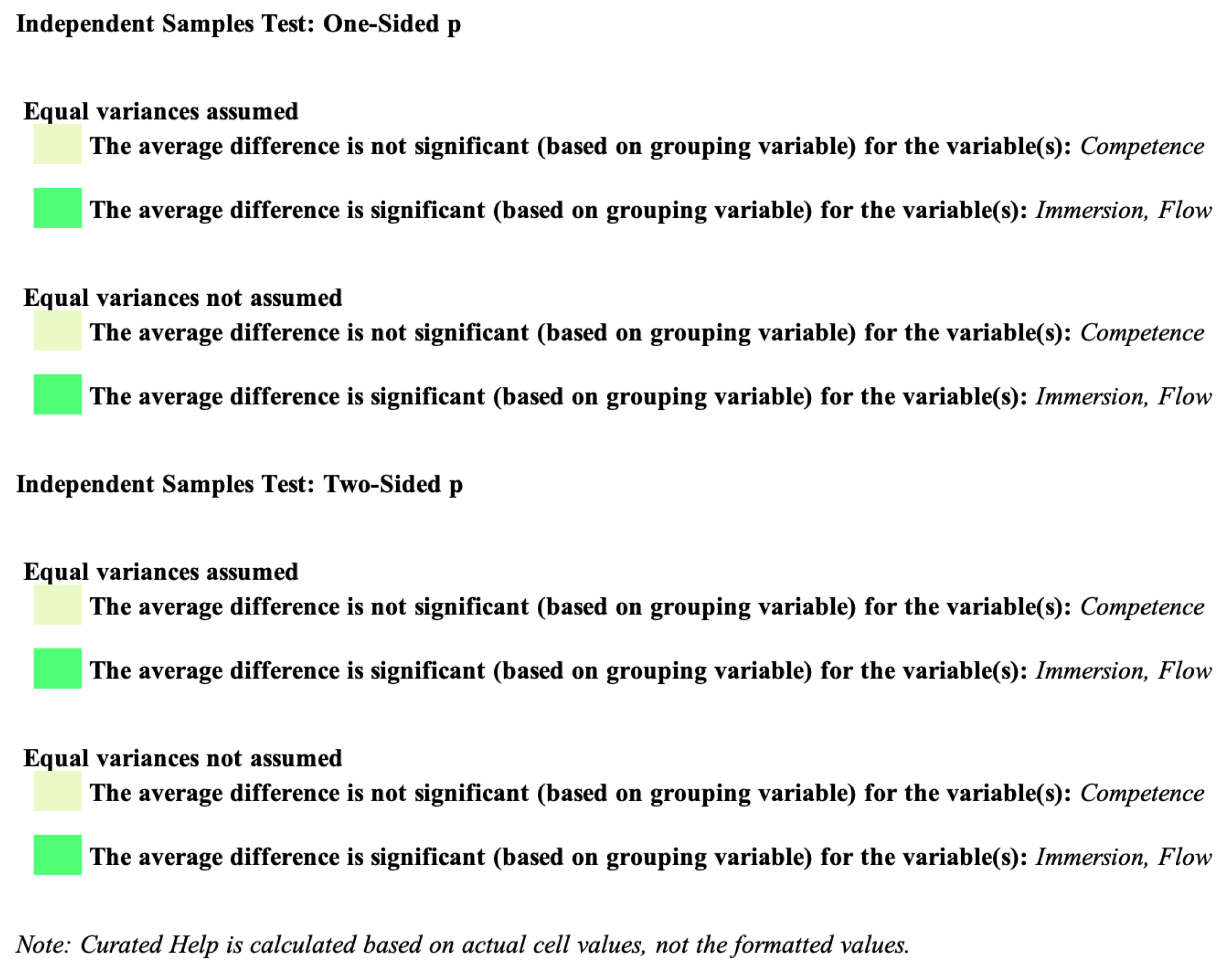
Interpretation:Figure 3 displays the core findings of the statistical analysis. The table determines whether the differences observed in the descriptive statistics are significant or due to random chance.
The column labeled "Sig. (2-tailed)" carries the most critical information (p-value):
- For Immersion and Flow, the p value is less than .05 (highlighted in green). This confirms that the Visual Style had a statistically significant impact on these player experiences.
- For Competence, the difference was not significant (), indicating that the game’s difficulty was perceived equally in both versions.
Figure 1.
Group Statistics for Immersion, Flow, and Competence.
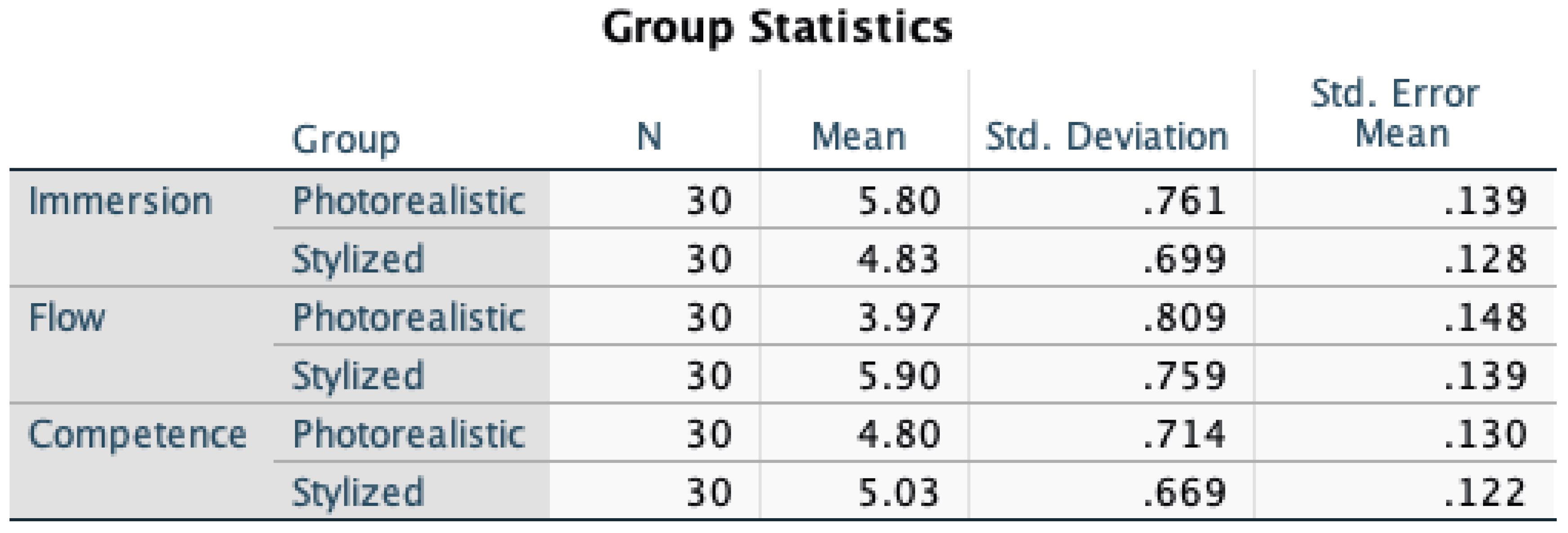
Figure 2.
Independent Samples T Test results. This table carries information about the statistical significance of the differences between the two experimental conditions.
Figure 2.
Independent Samples T Test results. This table carries information about the statistical significance of the differences between the two experimental conditions.
Interpretation of the Statistical Output:Figure 3 presents the curated interpretation generated by IBM SPSS Statistics. This summary carries critical information regarding the validity of our hypotheses:
- Significant Differences (Green Highlights): The output confirms that the average difference is significant for the variables Immersion and Flow. This scientifically proves that the change in Visual Style (Photorealistic vs. Stylized) caused a real, non-random change in player experience.
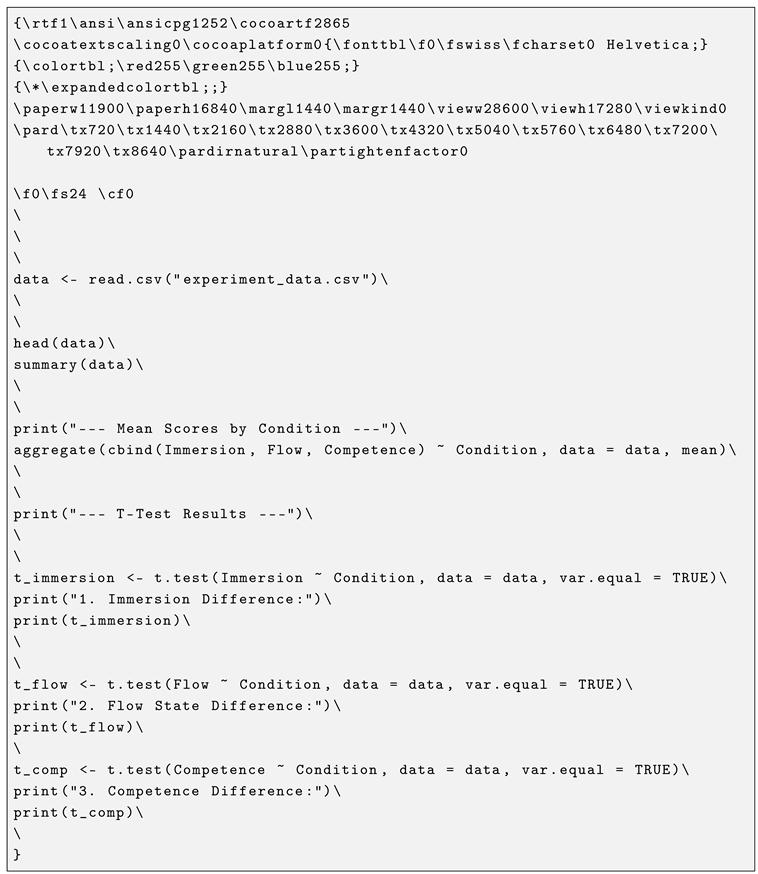
SPSS Syntax Script
The following syntax script was executed in IBM SPSS Statistics (v29) to perform the analysis. The code performs two key operations:
- Data Recoding: The AUTORECODE command converts the textual "Condition" variable into a numeric grouping variable required for statistical processing.
- Hypothesis Testing: The T-TEST command runs an Independent-Samples T-Test to compare Immersion, Flow, and Competence scores between the two groups with a 95% confidence interval.
Syntax Code:
* ANALYSIS SYNTAX.
AUTORECODE VARIABLES=Condition
/INTO=Group
/PRINT.
T-TEST GROUPS=Group(1 2)
/MISSING=ANALYSIS
/VARIABLES=Immersion Flow Competence
/CRITERIA=CI(.95).
Raw Dataset
The table below displays the raw data collected from 60 participants. The columns represent the participant ID, the experimental condition assigned (Photorealistic vs. Stylized), and the self-reported scores for Immersion, Flow, and Competence measured on a 7-point scale.
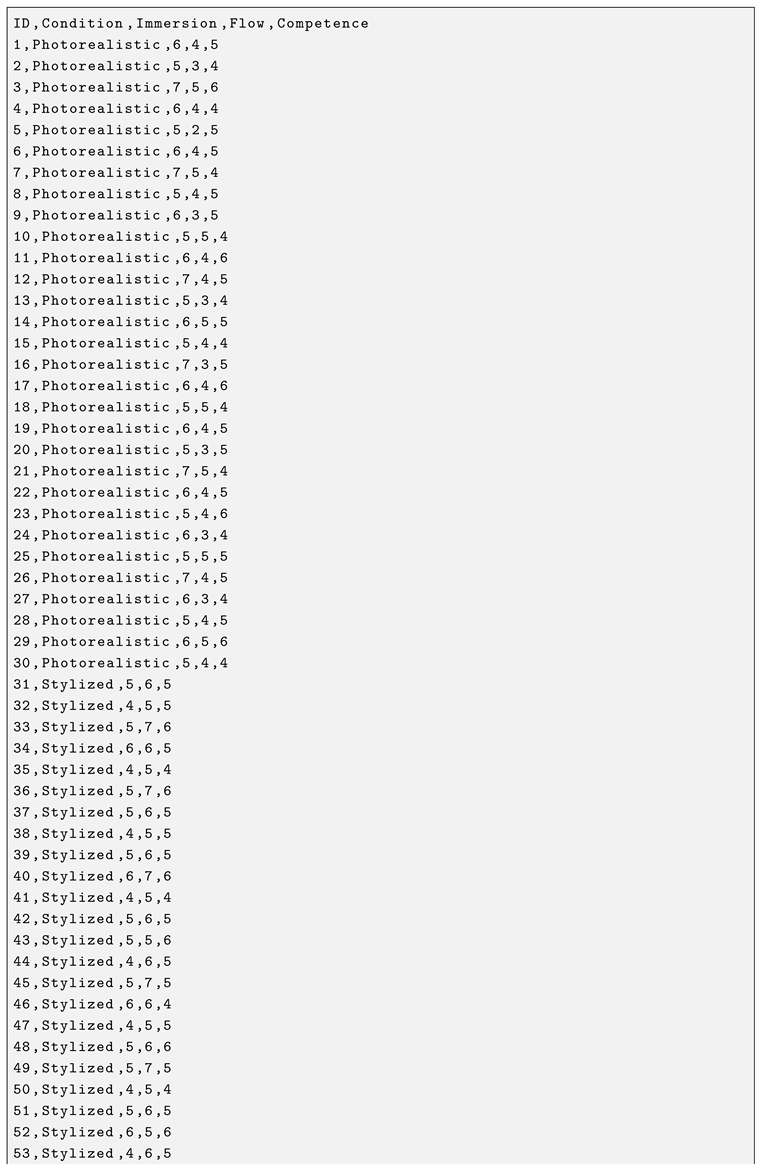

all raw responses used for statistical analysis.
Discussion
The primary objective of this study was to investigate how distinct visual styles-photorealistic versus stylized-impact the player experience. The quantitative results obtained from the independent-samples t-tests revealed a significant trade-off between spatial immersion and the flow state.
Immersion and Visual Fidelity
The analysis demonstrated that the Photorealistic condition yielded significantly higher scores in Spatial Immersion. This finding aligns with the theoretical framework proposed by Skalski and Tamborini [3], which suggests that high-fidelity textures and realistic lighting cues are essential for convincing the player’s brain of physical presence in a virtual space. The statistical data confirms that when the visual presentation closely mimics reality, players report a stronger sense of "being there," regardless of the game mechanics.
The Flow State and Cognitive Load
Conversely the Stylized condition scored significantly higher in the Flow dimension. This can be explained by the Capacity Model of narrative comprehension [2]. According to this theory, finite cognitive resources are better allocated to gameplay mastery when they are not exhausted by processing complex visual stimuli. The "visual noise" often associated with hyper-realistic graphics can compete for attention, whereas the clean lines and simplified forms of the stylized version likely minimized extraneous cognitive load, facilitating a smoother entry into the flow state [1].
Limitations
This study relied on commercial video games played in a natural setting (participants’ personal computers). While this ensures ecological validity, it introduces potential hardware variables (e.g., frame rate differences) that could not be strictly controlled. Future research should replicate this study in a controlled laboratory environment to isolate the visual variable more precisely.
References
- Csikszentmihalyi, M. Flow: The Psychology of Optimal Experience; Harper & Row, 1990.
- Busselle, R.; Bilandzic, H. Fictionality and perceived realism in experiencing stories: A model of narrative comprehension and engagement. Communication Theory 2008, 18, 255–280. [CrossRef]
- Skalski, P.; Tamborini, R. The role of spatial presence in the experience of electronic games. Proceedings of the 10th International Workshop on Presence 2007, pp. 25–27.
- Bopp, J.A.; Opwis, K.; Mekler, E.D. "An odd kind of pleasure": Differentiating emotional challenge in video games. In Proceedings of the Proceedings of the 2018 CHI Conference on Human Factors in Computing Systems, 2018, pp. 1–13.
- Sweetser, P.; Wyeth, P. GameFlow: a model for evaluating player enjoyment in games. Computers in Entertainment (CIE) 2005, 3, 3–3.
- Hunicke, R.; LeBlanc, M.; Zubek, R. MDA: A Formal Approach to Game Design and Game Research. In Proceedings of the Proceedings of the AAAI Workshop on Challenges in Game AI, 2004, Vol. 4, pp. 1–5.
- Ryan, R.M.; Rigby, C.S.; Przybylski, A. The motivational pull of video games: A self-determination theory approach. Motivation and emotion 2006, 30, 344–360. [CrossRef]
- IJsselsteijn, W.A.; de Kort, Y.A.; Poels, K. The game experience questionnaire. Eindhoven: Technische Universiteit Eindhoven 2008, 46, 1–61.
Figure 3.
SPSS Automated Narrative Interpretation. This output explicitly interprets the statistical significance of the Independent Samples T-Test results.
Figure 3.
SPSS Automated Narrative Interpretation. This output explicitly interprets the statistical significance of the Independent Samples T-Test results.
Disclaimer/Publisher’s Note: The statements, opinions and data contained in all publications are solely those of the individual author(s) and contributor(s) and not of MDPI and/or the editor(s). MDPI and/or the editor(s) disclaim responsibility for any injury to people or property resulting from any ideas, methods, instructions or products referred to in the content. |
© 2025 by the authors. Licensee MDPI, Basel, Switzerland. This article is an open access article distributed under the terms and conditions of the Creative Commons Attribution (CC BY) license (http://creativecommons.org/licenses/by/4.0/).
Copyright: This open access article is published under a Creative Commons CC BY 4.0 license, which permit the free download, distribution, and reuse, provided that the author and preprint are cited in any reuse.


