1. Introduction
We exist within the confines of an information system called human culture, which has evolved alongside humanity for tens of thousands of years. Human culture functions not unlike an operating system on a computer, providing basic definitions and life-essential tools such as language and regulating social processes and behavior.
The proposed theory accepts and builds upon many principles and ideas developed in the systems theory and cybernetics. It recognizes that social systems are autopoietic systems, as described by Maturana and Varela. Also, cybernetic systems differ from other systems in terms of the principle of self-regulation (Bertalanffy 1968, p. 17).
In addition, this theory has some of its roots in Structural-Functionalism but goes well beyond that. Whitney Pope defines a functionalist "as one who (1) views society as a whole composed of interrelated parts (i.e., as a system), (2) assumes a tendency toward system equilibrium, (3) considers how society or the social order is possible and, hence, (4) views structures in terms of their contributions to the perpetuation or evolutionary development of society, and (5) sees pervasive commonalities or consensus as the ultimate basis of social order" (Pope 1965, p. 1). However, this is only one side of the story because this theory also considers that social systems go through the process of formation as well as disappearance, both of which are accompanied by constant conflict.
However, the main difference between this theory and other social systems theories is that it aims to identify the basic building blocks, or "bits and bytes," of this information system and understand the principles of how these components fit together and function. This approach gives it some advantages, which are discussed in more detail in the Conclusions section.
2. Main Concepts and Terminology
Evolution is a dual process comprised of the evolution of the biological systems along with the evolution of the information systems, both of which affect and support one another. The ability to process information is the defining quality of all living organisms. A biologist or a chemist might find this description grossly incomplete. If we ever encounter extraterrestrial life, we might discover that it is not carbon-based and possibly has very different chemical and biological characteristics. However, we would still undoubtedly recognize it as "Life" because we would recognize its ability to process information. Information processing in any biological organism is performed on every level; even copying the DNA molecule processes information. Also, every biological or artificial system that processes information must use some form of energy; therefore, this characteristic is simply implied.
Language is not simply a communication tool but also the source of the value system, reward and punishment mechanisms, and many other social functions. So, to look for the basic building blocks within language is logical.
Functional Idea (FI) is an evolutionary product, a concept developed to perform a function in society, may be identified as the basic building block. The first words a baby learns, like "mama," "milk," and "bye-bye," are FIs that fit into other FIs, forming more complex FIs.
Soft Force (SF) is a psychological force, a vector with magnitude and "direction." Soft Forces are just a subset of all psychological forces. It is not practical within the framework of a social theory to look at and analyze all the psychological forces, so this term is needed to study the forces at play in various social situations. There is a direct correlation between FI and SF, with an SF vector being formed in the subconscious based on the FI. There are two kinds of SFs, connective and directional, which interact with each other on a level playing field, so this division could be superficial. This theory focuses on the connective SFs since they are instrumental in forming social structures. This concept of Soft Force did not just come from nowhere. We exist in the universe of systems formed by various types of forces, like gravity and nuclear forces, or “hard forces”, so this concept comes from the understanding that social systems of the biological species must also be formed by forces, in this case, psychological forces, or “soft forces”, with another meaning coming from the word “software”.
Idearchy is a collection of all the main FIs comprising human culture. This term facilitates discussion concerning the evolution and health of the Idearchy and how society develops means to maintain it, not unlike antivirus software, ranging from ridicule to execution of heretics and dissidents.
Why is the term Functional Idea needed? Why not just use plain “idea”? Well, our mind generates myriads of ideas, not all of them become FIs. It is only when an SF is formed in the subconscious based on a particular idea, then that idea becomes an FI. There are two ways an idea can become an FI. First, if it is part of the Idearchy – even basic words, mentioned above, like “mama” or “milk”, if mispronounced or used in the wrong context will have a negative emotional reaction from other people, indicating that there are SFs associated with that FI. This will be further discussed in paragraph 3. Another way is if the individual begins to believe in the idea, finds it correct, helpful, practical, etc., in other words, “functional”.
The SF vectors with the same "direction" are summed up into the resulting vectors, positive and negative. These vectors are dynamic and constantly being reevaluated. All decisions, including choosing whether to stay as part of a social structure, are made at the Soft Force level, not at a logical level. With insignificant decisions, the SF vectors are so weak that they are barely noticeable, creating the appearance that the determination was made at a logical level. Also, only the resulting vectors are at play in the final decision process.
Like all other organs, the brain communicates with our consciousness through a set of signals or symptoms. Emotions are only symptoms of SF vector interaction. When positive SFs prevail, we experience positive emotions, with negative SFs causing negative emotions.
There are two significant reasons why the system of Soft Forces has evolved. First, social motives must interact with and compete on a level playing field against basic instincts like hunger, fear, and the urge to procreate. Second, the multitude of SFs comprising one resulting vector force creates stability in the fabric of social structures. This stability is crucial in accomplishing resilience and viability in the real world, where biological systems must perform like all other physical systems; only biological systems operate with greater degrees of freedom.
Ideologically opposite segments of the population play an essential role in the evolution of FIs, assuring that the change process is paced correctly and that new FIs are vetted before they become part of human culture. Social groups compete not only for land, resources, and power but also to prove the viability and superiority of their Functional Ideas.
It needs to be clarified why information is discussed here more explicitly and communication— more implicitly. In the natural world, information can exist without being communicated, like light waves can carry information about composition and temperature of distant stars, for instance. However, it is different in the world of cybernetics. Even on the most basic level, in the binary system, for example, a bit cannot be turned on without something or someone giving it the instruction to do so, i.e., communicating this information. Furthermore, processing information always involves moving it from one area of memory to another, which is also communication in effect. The same must be said about the brain or any other biological system in general.
Let us suppose a person puts a message in a bottle and throws it in the creek to communicate with a friend who lives downstream and uses a net to catch these bottles. In this case, the creek, the bottle, and the net constitute a communication system, but not an information system per se. That shows that all information systems imply communication, but not all communication systems are information systems. It can also be concluded that, in cybernetic systems, communication is an integral part and a property of information.
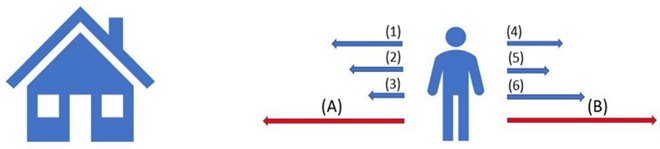
To illustrate key concepts of the Functional Theory of Social Systems, let us use a hypothetical situation (Diagram A). An individual buys a house but several weeks later discovers a chemical factory nearby, which occasionally produces an unpleasant and potentially harmful chemical odor. The intent here is to analyze the Soft Forces (SFs) involved in deciding whether to stay or sell the house. A social system is formed between the person and the house with multiple positive (attracting) and negative (repelling) SFs. This example demonstrates how SFs of different origins interact on a level playing field and shows that SF functions as a common denominator in the decision-making process.
Diagram A.
The positive SFs here are:
Architectural beauty of the house, origin – sensory perception (visual).
Low interest rate bank loan, origin – Functional Idea.
Low property taxes, origin – Functional Idea.
a. Resulting positive SF vector.
The negative SFs here are:
- 4.
Factory odor, origin – sensory perception (sense of smell).
- 5.
Fear that the odor is harmful to health, origin – the instinct of self-preservation.
- 6.
There are not enough bedrooms for all children, and the origin is a physical reality.
B. Resulting negative SF vector.
Dynamic psychological forces (SFs) are formed in the subconscious based on the above factors. They are constantly reevaluated, producing an "oscillating" effect, not unlike atoms in a molecule. Resulting positive and negative SF vectors are also formed, which are the sums of individual SFs. The ultimate decision is made based on the magnitude or "pull" of the resulting SF vectors.
It is worth noting that there is a phenomenon of SF "hardening" with time, which is to say that the longer an SF exists, the stronger its corresponding vector becomes. It is what we call, in cultural terms, "forming a habit" or "getting used to" something. Another crucial factor affecting the strength of the SF is how strongly the person believes that his or her idea is valid, correct, and essential - SF number 5 in the above diagram is a particularly good example of that dependency.
The need for a common denominator in the decision-making process is a compelling argument for the existence of Soft Forces in our subconscious. How else could we make decisions based on input from such diverse sources as basic instincts, sensory perception, physical reality, social considerations, etc.
We looked at a social system here formed between a person and a house, but the same basic principles apply to forming other social systems, like friendship, a club, a corporation, etc.
So, we can draw an analogy here to building materials like brick and mortar, with FI being the brick and SF the mortar. Like any structure can be built using brick and mortar, any social system can be formed by FIs and SFs.
This seemingly simple mechanism can explain the formation and disappearance of social systems and constitutes the basis for decision-making.
What are connective SFs and how are they different from directional SFs? First of all, it needs to be reiterated that the difference between the two types is superficial. Connective SFs attract individuals to form social structures. In our example they are the positive SFs. The negative SFs would be considered directional. But even the positive SFs in different situations would be considered directional. For instance, if the individual in our example goes on vacation or a business trip, he/she very well might experience longing for their home. He/she will have pictures in their mind of their house, their beautiful lawn and flowers, their comfortable bed, etc. That is the effect of positive connective SFs pulling the individual towards their home. When he/she is ready to return, these same SFs become directional and navigate them back home.
At this point we are ready to define a social system:
A social system is a type of system comprised of individuals or individuals and physical objects and entities that individuals form by means of Soft Forces.
At first glance, it is difficult to imagine that such entities as complex as social systems could be defined in such a relatively simple way. However, the complexity is hiding in the myriad of FIs that encompass this notion, such as shared values, norms of behavior, roles people play in various social, political and economic institutions, etc., in other words, all the FIs that comprise Idearchy. Therefore, this definition includes only the primary characteristics of a social system.

3. Soft Forces and Emotions
Let us examine another hypothetical situation (Diagram B) in which a person drives to work and encounters another car in front of him/her, moving significantly below the speed limit. Let us suppose that he or she cannot pass the car in this scenario and is forced to follow it slowly.
The "resulting" SF vector A pushes him/her forward, and SF vector 1 (origin – physical reality of the car ahead of him/her) presses vector A, resulting in feelings of anger and frustration. The "resulting" vector A is a complex structure consisting of many SF vectors, which, in turn, are comprised of interconnected FIs. The main driving force here is the necessity to be in the office by 9 am, since accumulating incidents of tardiness will result in growing negative SFs in his or her employment SF model. That, in turn, could result in employment termination, leading to financial hardship for him or her and their family. This potential chain of events creates a powerful fear SF component in vector A, increasing the emotional response.
Diagram B
The emotional response in this case is caused by the directional SFs, which is quite different from the one caused by the connective SFs in the first example (Diagram A). In that example, the resulting negative SF vector B pulling on the positive vector A creates a sense of sadness or depression because it threatens the very existence of that social system.
4. Decoding and Interpreting Some Cultural Notions
Functional ideas are precisely what they sound like - ideas that allow us to function in society. Also, some of them are not the ultimate truths, but the approximation of the physical reality that is close enough to the truth so that people can function by utilizing those notions.
However, they do unravel more and more as science progresses and teaches us that there is no "up" or "down" - only gravity, no "hot" or "cold" - only the level of the kinetic energy of the particles in matter, and so on. Still, culture is very pervasive, and in daily life, even physicists use simple words like "up" and "down" or "hot" and "cold."
Understanding FIs and SFs and their relationship makes it possible to decode and interpret many more cultural notions and social phenomena to understand their functions better.
It has already been mentioned that a society uses ridicule to maintain the integrity and stability of the Idearchy, or the status quo when some insignificant rules (FIs) are broken, like customary dress codes or table manners.
The next higher level of rule enforcement is an "insult." People sometimes use insults to berate someone when they cut in line or push someone on a sidewalk.
There is no need to immerse deeply into human psychology to understand how ridicule or an insult works subconsciously; this is a social theory.
All individuals have the main upward social driving force within them which is a complex "resulting" SF vector comprised of many SFs of different origins like libido, athletic ability, physical appearance, upbringing and the expectation of our parents, peer pressure, and competition from our friends, and many others, including personal ambitions. Not all of them are positive, of course. Many of the negative SFs originate from previous failures, creating insecurities in cultural terms.
So, ridicules and insults are actually FIs that instantaneously generate an SF in the individual's subconscious they are leveled at. This SF "hits" the above "resulting" SF vector, evoking feelings of anger and humiliation.
To prove that this is precisely the mechanism at play here, let us compare the reaction to an insult by an ordinary citizen to that of a homeless person living on the streets for some time. Aside from being extraordinarily complex, the above "resulting" vector is also a dynamic entity. The magnitudes of the component SFs, both positive and negative, constantly change throughout our lives based on past successes and failures, diminishing physical abilities, and changing appearance. That is especially true for homeless people.
So, an insult leveled at a homeless person is likely to generate one of two reactions. Either the person completely ignores it if his/her circumstance genuinely breaks that social driving force, or it produces an explosive, violent reaction if the person is angry at the whole world and blames it for his or her misfortune. In this case, the person's social driving force, the "resulting" SF vector, is hypertrophied.
5. Modeling Social Systems
Social systems can be modeled, and quantitative analysis can be performed utilizing the concepts of FIs and SFs. For example, it is possible to calculate the relative strength of an average friendship formed in high school vs. the one formed in college.
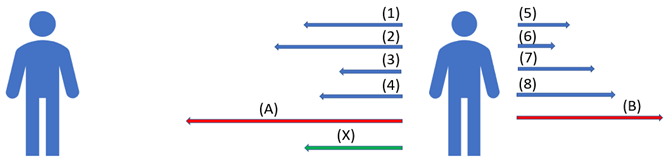
A random sample of students with one best friend must be selected from both institutions and given questionnaires. They would be asked to identify all their friend's primary positive and negative qualities and all the major positive and negative aspects of their relationship - these would be the FIs translating into positive and negative SFs (Diagram C). They would also need to rate each one from -10 to +10, thereby giving the sign and magnitude to these SF vectors.
Standardized questionnaires cannot be used here because human relationships are so personal, with everyone having different reasons for forming a friendship in this case.
Diagram C.
It must be clarified that this is a one-sided measurement, i.e., SFs of only one person involved in the friendship are identified and measured independently. This approach is chosen because reciprocity is not guaranteed in friendship, and the second individual may not share the good feelings of one friend for another; therefore, they would not indicate a strong overall relationship.
Since these are dynamic SFs, these measurements must be repeated several times over a sufficient period, say biweekly during a semester, to obtain the average values. Here are hypothetical answers to the questionnaire from one student with the corresponding average values in parentheses.
The positive SFs here are:
the individual is a good athlete (7.2)
popular with peers (8.4)
likes the same music (5.3)
can go to parties together (6.8)
A. Resulting positive SF vector, the sum of the values is 27.7 The negative SFs here are:
- 5.
selfish (-4.1)
- 6.
Impolite (-3.4)
- 7.
ill-informed (-5.8)
- 8.
distracts from the study (-7.2)
B. Resulting negative SF vector, the sum of the values is -20.5.
In this case, the difference between A and B is positive 7.2, which is the value of the final resulting SF vector X. Such measurements must be repeated for all the high school and college participants in the experiment, and the values of the X vectors are recorded for each institution.
The next step requires some additional assumptions. These two data sets are assumed to be statistically independent and normally distributed. Under these assumptions, the standard t- test (Boslaugh 2012) can be utilized to determine if the two data sets differ significantly (in statistical terms). In other words, the calculated t-statistics would show if there were any significant differences in the SFs between the two distinct populations.
6. General Definition of Art
Why Art? Why would the General Definition of Art be a part of this theory?
Well, this theory is not only about FIs and SFs and how they form social systems, but it is primarily a study of human culture as an information system, and Art plays a critical role in it. In any information system, it is necessary to define elements, which is Art's primary function, even though it is somewhat hidden behind many other secondary ones.
Art is the alternative form of communicating non-life-essential information that defines man and society (Belitsky 2019)
It must be stressed that the "non-life-essential" clause is not intended to diminish the importance of Art as a social phenomenon but only to distinguish it from other forms of communication that society uses for vital information.
Art defines man and society in many different ways. For example, F. Scott Fitzgerald's The Great Gatsby defines the "roaring twenties" in the United States as The Jazz Age. On the other hand, when a modern-day billionaire buys a painting by the Old Masters, previously owned by the 18th or 19th-century European aristocracy, he or she attempts to define themself as belonging to the elites of today. This quality of Art, along with design, architecture, and other forms of artistic expression, allows it to create powerful Soft Forces that play essential roles in various social systems like Goals and Rewards, for instance.
7. Role of FIs and SFs in Regulating Social Behavior
The concepts of FIs and SFs provide a theoretical basis for understanding the precise mechanism of how social behavior is regulated. Let us look at another hypothetical situation. A group of colleagues is working on a company project. One individual is aware of a potential design problem that could lead to serious technical, safety or legal ramifications after implementation. He shares his concerns with the group leader, but the group leader seems to underestimate the risks and is pushing hard for quick completion of the project, citing budgetary constraints and deadlines. The issue for the individual here is whether to bring this issue up to the department manager or to remain silent and be “a good team player” by siding with the group leader. Here are some examples of FIs in this situation that could result in positive (for the decision to speak up) and negative (against the decision to speak up) SFs being generated.
The positive SFs here are:
Desire to do “the right thing”, to avert a system failure
Desire to be rewarded with career advancement and salary increase
The negative SFs here are:
- 3.
Fear that the department manager could side with the group leader
- 4.
Fear of retaliation by the group leader
- 5.
Peer pressure to keep silent and hope that the critical situation leading to failure never occurs
Generating SF vectors and their corresponding strengths is a highly individual process, based on many factors, including one’s upbringing and personal qualities, so the final decision will be made based on all these factors. However, we can determine most of the FIs and SFs involved in the decision-making process. Some of these FIs are part of the Idearchy, like the desire to do “the right thing” and the desire for career advancement, but the other ones are mostly learned skills people acquire when they enter the corporate world, and for that matter, are part of the political maneuvering people face in any social system.
8. Conclusions
In any discipline, identifying and distinguishing primary and secondary characteristics of the subject matter is the most critical yet challenging task. The enormity of human culture makes it even harder.
Information systems, founded initially on a limited number of basic principles, evolve and tend to grow exponentially in complexity when they begin to function within the real-world environment, chess being a good example. This information system consisting of eight distinct pieces moving on a board of just two-color squares, as most know, becomes incredibly complex when the game is played.
For all the reasons above, this theory concentrates on studying the basic building blocks of culture because they provide the most in-depth understanding of it.
The most basic FIs that have undergone centuries or even thousands of years of evolution are the most stable and resistant to change. As we move up the FI pyramid, this stability lessens, and once we get to the very top, in the area of ideology and politics, it lessens even further.
Every social order eventually hits a dead end in its life span and evolution and needs to be reformed; the great past empires are an excellent illustration of that. People who have experienced different cultures can attest that many, if not the majority, of the building blocks, or FIs, of all ideologies are similar. So, when change is needed, most societies just reshuffle the building blocks of the old ideologies and tailor them to the needs of the newly emerging social order.
In many instances, philosophy assisted in that process. Historically, philosophy performed as a generator of Functional Ideas, like ethics, for example, and has not been a science in the true sense of the word, not because it was not capable of it but because the need for Functional Ideas was so great that it skewed philosophy in that direction. It is important to stress here that, obviously, not everything in human culture is a Functional Idea. Humanity possesses true scientific and technological knowledge, information about our surroundings, and many more. It is only when it comes to language, customs and traditions, norms of behavior, and especially ideology and politics, that Functional Ideas begin to prevail.
Even though it may be counterintuitive, as much as society cares about the main FIs forming the Idearchy, the SFs they generate are still its primary focus. Like software, the FIs can be replaced as long as they perform the same function. People have different customs and traditions in different cultures, but, in general, the overall ways of life are remarkably similar. By shifting the emphasis from the multitude of ideas to the SFs and their functions, this theory could play an important role in charting a pathway to a unified Social Theory.
People are often unaware of all the SFs at play in certain situations. They could come up with explanations for themselves and other people as to why they ended a relationship or left a job, for example, that could be quite different from the actual SFs involved in the final decision.
On the other hand, people could come up with an idea that is not entirely based on reality and start believing in it so firmly that it creates an SF strong enough to break up a working relationship.
These examples show that even though the system of Soft Forces is very efficient and generally works well, it is still imperfect because it functions in the real world and involves real people with all their strengths and weaknesses.
In today's world, this theory could provide an essential tool for AI development by demonstrating that the decision-making processes of humans and machines are different, which gives a theoretical basis for developing software to mimic human decision-making processes in AI. If AI applications are involved in critical decisions, this methodology could assure safety and provide moral guidance in those processes.
What are the practical uses of this theory? How can it help people in their lives? Some people have difficulty forming strong employment or personal relationships; one reason could be an inability to generate strong positive SFs. As was mentioned above, the way our subconscious generates SFs is a highly individual process resistant to external control. However, it is possible to generate additional SFs to complement the existing ones if the person understands how the decision-making process really works. If the person wants to save the relationship, it is possible to develop new FIs that will generate new positive SFs that will lessen the pressure of negative SFs. The person needs to believe in those new FIs to be able to generate strong SFs.
Functional Theory of Social Systems (FTSS) is not intended to be antagonistic towards most of the principles of classic systems theories, the difference is the perspective. For example, you can study ocean waves through field observations using instruments like wave buoys, radar systems, and satellites to measure wave height, frequency, and direction in real-time. On the other hand, it can be approached from the molecular level, studying how water molecules interact to create the surface tension that allows waves to form and propagate. The FTSS’s method is closer to the latter. All FIs needed to maintain social systems as self-sustaining and self-organizing autopoietic systems (Maturana, H. R. and Varela, F. J. 1980) are encoded in the Idearchy, including principles of adaptation, evolution, autonomous operation, etc. FTSS just reveals how these principles are applied: through FI evolution, competition and discourse.
FTSS offers several advantages over the leading systems theories. For instance, according to A. Javier Treviño, Talcott Parsons' theory assumes that everything in society is functionally indispensable, unified, and beneficial, without considering the possibility of functional alternatives, relative independence, or dysfunctions and does not account for the diversity, conflict, and change that exist in real societies (Treviño 2020). In that regard, FTSS reveals that the multitude of opposing SFs, both connective and directional, clearly shows that conflict and discourse are built into the fabric of culture as well as the human psyche in general and that cognitive dissonance (Festinger 1957) is an integral part of the way people function in society. Also, competition between different FIs in society is part of the evolution of Idearchy. It is worth reiterating here that the term Functional Idea does not imply that the concept is actually "functional"; it could very well be "dysfunctional" in a particular social situation. It only means that it plays a role in the functioning of society and the decision-making process.
Critics contend that the highly abstract nature of Niklas Luhmann's theory hinders its empirical applicability and verifiability. While the theory offers advanced insights into social complexity, its abstractness may limit its practical utility in empirical research (Francot 2023, p. 2215). FTSS, on the other hand, aims to identify the basic building blocks, or "bits and bytes" of social systems, making it more concrete and applicable. It also provides the theoretical base for social systems modeling and quantitative analysis.
Luhmann's theory also tends to view social systems as closed, self-referential systems, which can limit their ability to account for change and conflict (Francot 2008). In contrast, FTSS recognizes that social systems go through processes of formation and disappearance, accompanied by constant conflict.
Furthermore, Luhmann's theory has been critiqued for its deterministic view of individuals as mere elements within systems with little agency or free will (Kihlstrom 2011). Well, people absolutely do have free will, the ability to formulate new Functional Ideas, believe in them, and generate powerful Soft Forces to achieve their goals. Nevertheless, it takes a strong individual to break away from the cobweb of Soft Forces that tie people down to multiple social systems. Still, humanity's progress in modern times has given people tremendous freedoms in many societies compared to previous centuries and has given hope and optimism about the future.
References
- Belitsky, Mark (April 27, 2019). Attempting a General Definition of Art. American Thinker.
- Bertalanffy, Ludwig von (1968). General System Theory. Foundations, Development, Applications. New York: Braziller.
- Boslaugh, Sarah. (2012). Statistics in a Nutshell. O'Reilly Media.
- Festinger, L. (1957). A theory of cognitive dissonance. Evanstone, IL: Row, Peterson.
- Francot, L. (2008). Normativity’s Re-Entry. Niklas Luhmann’s Social Systems Theory: Society and Law. WLP, Nijmegen.
- Francot, L. (2023). Luhmann, Niklas. In: Sellers, M., Kirste, S. (eds) Encyclopedia of the Philosophy of Law and Social Philosophy. Springer, Dordrecht, pp. 2213 – 2217.
- Kihlstrom, Anita (2011). Luhmann’s system theory in social work: Criticism and reflections. Journal of Social Work, pp. 287–299.
- Maturana, H. R. and Varela, F. J. (1980), Autopoiesis and Cognition: The Realization of the Living, Boston Studies in the Philosophy of Science, Vol. 42, Reidel, Boston. First and revised commercial publication of the original Maturana-Varela monograph (1973 and 1975), including.
- S. Beer's preface.
- Pope, Witney (1975). Durkheim as a Functionalist. The Sociological Quarterly, Vol. 16, No. 3, (Summer, 1975). Published By: Taylor & Francis, Ltd.
- Javier Treviño (2020). 10 - Pounding on Parsons: How Criticism Undermined the Reputation of Sociology's Incurable Theorist. The Cambridge Handbook of Social Theory, pp. 179 – 204. Publisher: Cambridge University Press.
|
Disclaimer/Publisher’s Note: The statements, opinions and data contained in all publications are solely those of the individual author(s) and contributor(s) and not of MDPI and/or the editor(s). MDPI and/or the editor(s) disclaim responsibility for any injury to people or property resulting from any ideas, methods, instructions or products referred to in the content. |
© 2025 by the authors. Licensee MDPI, Basel, Switzerland. This article is an open access article distributed under the terms and conditions of the Creative Commons Attribution (CC BY) license (http://creativecommons.org/licenses/by/4.0/).