

Submitted:
25 November 2025
Posted:
26 November 2025
You are already at the latest version
Abstract
The Satellite Internet of Things (IoT) sector is undergoing rapid transformation, driven by breakthroughs in satellite communications and the pressing need for seamless global coverage—especially in remote and poorly connected regions. In locations where terrestrial infrastructure is limited or non- existent, Low Earth Orbit (LEO) satellites are proving to be a game-changing solution, delivering low- latency and high-throughput links well-suited for IoT deployments. While North America currently dominates the market in terms of revenue, the Asia-Pacific region is projected to lead in growth rate. Nevertheless, the development of satellite IoT networks still faces hurdles, including spectrum regulation and international policy alignment. In this evolving landscape, the LoRa and LoRaWAN protocols have been enhanced to support direct communication with LEO satellites, typically operating at altitudes between 500 km and 2,000 km. This paper offers a comprehensive review of current research on LoRa/LoRaWAN technologies integrated with LEO satellite systems, also providing a performance assessment of this combined architecture in terms of theoretical achievable bitrate, Bit Error rate (BER), and path loss.
Keywords:
lora
; low earth orbit satellite
; IoT
; direct-to-satellite
; performance analysis
; path loss
; bitrate
; bit error rate (BER)
1. Introduction
The Satellite Internet of Things (IoT) market is rapidly evolving, driven by advancements in satellite communication technologies and the increasing need for global connectivity, particularly in remote and underserved regions. As traditional terrestrial networks struggle to reach isolated areas, Low Earth Orbit (LEO) satellites are emerging as a transformative solution, offering low-latency, high-throughput communication capabilities that are ideal for IoT applications. According to [1], a significant growth of Satellite IoT Market is forecasted by 2027. The market projected to increase from $1.1 billion in 2022 to $2.9 billion by 2027, at a CAGR of 21.9%. This growth is primarily driven by the increasing demand for global, low-latency connectivity, facilitated by LEO satellites. These satellites offer faster, more reliable communication compared to traditional geostationary satellites, making them ideal for IoT applications in remote and underserved areas. Key trends identified in the report include the reduction in satellite launch costs, which makes satellite IoT solutions more affordable, and the integration of IoT and AI technologies, which enable real-time data analytics and monitoring. The report also highlights the growing adoption of satellite IoT in sectors like agriculture, automotive, and defense, where reliable communication networks are essential. North America is expected to hold the largest share of the market, while Asia-Pacific is predicted to experience the fastest growth. However, challenges such as regulatory complexities and spectrum allocation could impact the rapid expansion of satellite IoT networks. The potential of LEO satellites emerges to provide low-cost, reliable communication for IoT applications, offering a strong outlook for the satellite IoT market over the next few year. In this context, Lora/LoraWAN protocol has been updated for connections directly to LEO satellite (with an altitude ranging from 500 km to 2,000 km). The paper presents a review of the papers on LoRa/LoRaWAN and LEO Satellite Communication. It also provides a performance analysis of the LoRa/LoRaWAN and LEO Satellite combined system. The paper is structured as follows. Section II reviews the current advancements in satellite IoT technologies, highlighting the role of LEO satellites and the increasing integration of satellite networks with terrestrial IoT systems.Section III focuses on the design and technical aspects of LoRa transceivers that enable Direct-to-Satellite (D2S) communication. It covers the challenges of frequency management, link budget, and the technical requirements for establishing direct communication between ground devices and satellite gateways. In Section IV, the paper introduces Long Range Frequency Hopping Spread Spectrum (LR-FHSS) technique as an enhancement for LoRa communications. It explains how this modulation improves scalability, reduces interference, and enhances robustness, especially in satellite communication environments. In Section V the performance analysis of D2S communication system. The Analysis of Results is provided in Section VI presents the results of the performance analysis and compares LR-FHSS with traditional LoRa and other modulation schemes. Finally, the conclusions are drawn in Section VII.
2. Materials and Methods
Table 1 summarizes the key studies on the integration of LoRa/LoRaWAN with LEO satellite communications. The table provides a chronological overview of research contributions from 2019 to 2024, highlighting the evolution of network design, modulation techniques, multiple-access schemes, and performance optimization strategies. This compilation offers a structured reference framework for understanding trends, challenges, and emerging solutions in satellite-based IoT deployments, setting the stage for the detailed discussion of individual works presented in the following sections.
Ref. [2] explores the integration of LEO satellite constellations into 5G and beyond-5G communication systems. The authors employ mathematical modeling techniques, including network capacity models, signal propagation models, and orbital mechanics to simulate the behavior of LEO satellites in providing mobile broadband, massive machine-type communications (mMTC), and ultra-reliable low-latency communications (URLLC). The models account for satellite orbit parameters, satellite handovers, and coverage areas, while the formulae used include signal-to-noise ratio (SNR) calculations based on the Friis transmission equation and link budget analysis for satellite communication. Additionally, the paper uses models of interference from both satellite and terrestrial networks. The results of the mathematical simulations suggest that LEO satellites are crucial for expanding global network coverage, especially in underserved regions. Ref. [3] focuses on optimizing the key parameters of LoRa communication for satellite-based IoT applications in the LEO environment. This paper develops a mathematical model to simulate LoRa’s communication behavior under different environmental and system conditions, such as Doppler shifts, signal degradation, and channel noise. The optimization approach is based on the analysis of key performance indicators such as energy efficiency and communication reliability, with the authors employing a multi-objective optimization framework. The formulae used include the computation of the signal-to-noise ratio (SNR) for each parameter configuration, the Shannon capacity formula for determining channel capacity, and energy consumption models derived from the transmission power and duty cycle. Simulation results demonstrate that optimized LoRa parameters can enhance communication reliability and energy efficiency, making it a viable solution for satellite IoT applications. In [4], the authors introduce a novel mathematical model for ultra-dense LEO satellite constellations. The model is based on the queuing theory to represent satellite network traffic, the interference models to capture signal collisions, and the orbital mechanics models to simulate the deployment and movement of satellites in low Earth orbit. They apply models of Poisson processes to describe the traffic arrival rates and employ the Erlang-B formula to calculate the blocking probability for satellite channels. Additionally, interference management techniques are modeled using game theory, where the authors use Nash equilibrium solutions to model satellite resource sharing and interference mitigation. The results indicate that ultra-dense constellations significantly enhance system capacity, but advanced interference management is crucial to optimize network performance. Ref. [5] investigates the performance of LoRa (Long Range) technology for Internet of Things (IoT) networks using LEO satellites. The authors conduct an in-depth analysis of LoRa’s feasibility in satellite IoT applications, focusing on the challenges posed by the satellite environment, including high mobility, Doppler shifts, and propagation conditions. The study uses both analytical models and simulation results to assess key performance metrics, such as packet delivery success, energy efficiency, and link reliability, under various channel conditions typical of LEO satellite communications. The authors examine how LoRa’s physical-layer characteristics, such as Chirp Spread Spectrum (CSS) modulation and long-range communication capabilities, enable reliable data transmission in satellite IoT networks, especially in remote or underserved areas. The paper also explores the trade-offs between spreading factor, transmission power, and network coverage in the context of LEO satellite IoT deployments. Key findings reveal that while LoRa performs well in terms of range and power efficiency, it requires optimization in terms of synchronization and Doppler shift compensation to effectively support large-scale satellite IoT networks. Ref. [6] provides a comprehensive overview of the Long Range Frequency-Hopping Spread Spectrum (LR-FHSS) modulation scheme, specifically designed to enhance the scalability and robustness of LoRa-based networks. LR-FHSS introduces frequency hopping to the conventional LoRa modulation, allowing for more efficient spectrum usage and reducing interference in densely deployed environments. The authors offer a detailed performance analysis of LR-FHSS, comparing it to traditional LoRa in terms of capacity, energy efficiency, and interference resilience. Through both theoretical modeling and simulation, the paper demonstrates that LR-FHSS can significantly increase network capacity (up to 40 times) without compromising the low power consumption that is characteristic of LoRa technology. Additionally, the study highlights that LR-FHSS can maintain reliable communication in the presence of narrowband interference and congestion, which are common challenges in large-scale IoT deployments. Key results show that LR-FHSS’s frequency diversity allows for reduced packet collisions and enhanced link reliability, making it an attractive solution for large-scale IoT networks, particularly in applications such as smart cities and industrial IoT. Ref. [7] introduces a unified architecture that bridges terrestrial and space-based IoT infrastructures, aiming to enable global and ubiquitous connectivity. The authors classify IoT-satellite interactions into direct and indirect satellite access models and systematically assess their performance in terms of energy efficiency, coverage, and delay. Particular attention is given to Low Power Wide Area Network (LPWAN) technologies, specifically NB-IoT and LoRa/LoRaWAN, evaluating their physical and protocol-layer feasibility for Low Earth Orbit (LEO) satellite scenarios. Key challenges such as Doppler shift, timing synchronization, link intermittency, and contention in the access medium are analyzed in detail. The study highlights that although LoRa and NB-IoT offer strong potential for low-energy satellite IoT, protocol adaptations and cross-layer design improvements are critical to ensure robust operation in high-mobility satellite environments. This foundational work sets the stage for further development of hybrid terrestrial-satellite IoT systems. In [8], the authors explore the application of differential modulation techniques within LoRa communication frameworks targeted at LEO satellite-based IoT networks. The primary objective is to mitigate synchronization and frequency offset challenges, which are prominent in satellite channels characterized by high Doppler shifts and rapid mobility. Differential modulation, by allowing symbol decoding without requiring explicit phase recovery, enhances the robustness of LoRa links in dynamic propagation environments. The study provides both theoretical analysis and simulation-based validation, demonstrating that differential LoRa modulation can maintain reliable connectivity at low SNRs and under varying Doppler conditions. Additionally, it retains the core advantages of LoRa, such as long-range communication and low power consumption, making it a viable candidate for energy-efficient, space-based IoT deployments. This research contributes to improving the link reliability and physical-layer adaptability of LoRa in non-terrestrial environments. The paper [9] provides a review of dynamic communication techniques for LEO satellite networks. Although this paper focuses more on reviewing existing literature, it references several key mathematical models, including beamforming models that use array gain calculations to optimize the directional communication of satellites. The authors also discuss frequency reuse models, interference mitigation using power control algorithms, and dynamic scheduling methods, with mathematical formulations for optimal frequency allocation and channel assignment. Furthermore, they refer to dynamic beamforming models that employ antenna gain and signal attenuation equations, and discuss adaptive algorithms to handle satellite mobility, including Markov chain models to represent handover and routing protocols in dynamic LEO networks. Ref. [10] presents the design of a LoRa-like transceiver optimized for satellite IoT applications. The mathematical models used in this paper include link budget calculations, considering factors such as satellite altitude, path loss, and free-space propagation models. The paper also uses signal degradation models to predict the attenuation over long distances. The formulae applied include the path loss model derived from the Friis transmission equation, and power consumption models based on signal strength and modulation schemes. Additionally, the authors utilize the Shannon-Hartley theorem to assess the theoretical maximum data rates achievable under varying signal conditions. The optimization process focuses on minimizing energy consumption while maintaining acceptable communication reliability, and the results demonstrate that the LoRa-like transceiver provides an energy-efficient solution with good performance over long distances in satellite networks. Ref. [11] examines how LoRaWAN combined with LEO satellites can facilitate mMTC in remote regions. The paper uses mathematical models for network coverage and reliability, incorporating satellite link budget equations and path loss models specific to LEO satellites. The authors also apply models of interference and fading, including the Ricean fading model to simulate the impact of environmental conditions on signal strength. Additionally, the paper employs stochastic geometry models to evaluate the spatial distribution of devices and network performance in terms of coverage, throughput, and scalability. Simulations show that integrating LoRaWAN with LEO satellites offers a cost-effective and reliable solution for mMTC in rural and isolated areas. Ref. [12] explores the performance of the LoRaWAN protocol integrated with LR-FHSS modulation for direct communication to LEO satellites. The authors used a combination of analytical and simulation models to evaluate the feasibility and performance of this system in satellite communication scenarios. To assess packet delivery from ground nodes to LEO satellites, the authors developed mathematical models that consider various factors such as satellite mobility, channel characteristics, and potential signal collisions. These models focus on the integration of LR-FHSS within the LoRaWAN framework to improve network capacity and resilience, specifically addressing the challenges posed by the dynamic nature of satellite communication. The analytical model also takes into account the average inter-arrival times for different packet elements, including headers and payload fragments, and calculates the overall success probability for packet transmission. This success probability is influenced by the first (Ftx-1) payload fragments and the last fragment of a data packet. Additionally, the study incorporates the effects of Rician fading in the communication channel, considering the elevation angle of the satellite as a function of time, which reflects the rapid variations in the channel caused by the movement of the satellite. This dynamic modeling is crucial for accurately simulating the real-world conditions of satellite communication. The results indicate that the use of LR-FHSS significantly improves the potential for large-scale LoRaWAN networks in direct-to-satellite scenarios. The study also identifies important trade-offs between different LR-FHSS-based data rates, particularly for the European region, and highlights the causes of packet losses, such as insufficient header replicas or inadequate payload fragment reception. These findings emphasize the potential of LR-FHSS to enhance direct connectivity between IoT devices and LEO satellites, providing an effective solution for enabling IoT applications in remote and underserved areas. Ref. [13] investigates the performance of LoRaWAN with Long Range Frequency Hopping Spread Spectrum (LR-FHSS) in direct-to-satellite communication scenarios. The paper uses mathematical models to simulate the impact of Doppler shifts and interference on LoRaWAN’s performance. The authors use Doppler shift models based on satellite velocity and orbital parameters to analyze the variation in signal frequency, and interference models that consider multiple access interference and the impacts of frequency hopping. Additionally, the authors use SNR-based formulas to evaluate the system’s performance under varying link conditions, such as changes in the relative positions of satellites and ground stations. Simulation results indicate that LR-FHSS in LoRaWAN enhances the system’s robustness against Doppler shifts and interference, ensuring reliable communication in direct-to-satellite scenarios. Ref. [14] explores the scalability of LoRa for IoT satellite communication systems and evaluates its performance in multiple-access communication scenarios. The authors use analytical models to calculate the channel capacity and throughput of LoRa-based networks, applying queuing theory and slotted ALOHA for multiple-access schemes. The paper incorporates interference models based on the random arrival of packets and the effects of channel collisions. Additionally, the authors use the Shannon capacity formula to analyze the maximum achievable data rates in multiple-access satellite IoT networks. Their findings show that LoRa can be scaled for large IoT deployments, offering a low-power solution that ensures efficient multiple-access operation in satellite environments. In [15] the authors model the uplink channel for LoRa in satellite-based IoT systems. The paper uses models based on link budget analysis to calculate the effective SNR and the associated bit error rate (BER) for uplink transmissions. The authors apply the Shannon-Hartley theorem to evaluate the capacity of the uplink channel and use fading models, such as Rayleigh and Ricean fading, to simulate realistic satellite communication conditions. Additionally, the authors consider the impact of transmission power on energy consumption, employing optimization techniques to determine the optimal transmission power for minimizing energy consumption while maintaining sufficient communication reliability. The findings suggest that LoRa provides a viable solution for uplink transmission in satellite IoT networks, particularly when optimized for power and signal conditions.
Ref. [16] presents a novel scheduling algorithm, SALSA, designed to manage data transmission from IoT devices to LEO satellites. The paper introduces an optimization model for dynamic traffic scheduling, where the authors use queuing models to prioritize data packets based on urgency and delay tolerance. The scheduling algorithm minimizes communication delays and optimizes throughput by dynamically adjusting the transmission window, considering factors such as satellite position and network load. Mathematical formulations used in this paper include the calculation of optimal scheduling intervals using linear programming techniques, and the analysis of queueing delay based on Poisson processes. The paper concludes that SALSA significantly enhances the efficiency of LoRa-based satellite communications by reducing latency and increasing throughput, improving the overall performance of IoT networks. Ref. [17] provides an in-depth review of scalable LoRaWAN solutions for satellite IoT systems. The authors discuss scalability models that address network densification, including interference mitigation and synchronization techniques. They present mathematical models of LoRaWAN network traffic, using stochastic models and queuing theory to evaluate network scalability under different operational conditions. The paper also references interference models based on Gaussian noise and path loss equations specific to satellite communication. The authors apply models from game theory to address resource allocation and power control in large-scale IoT systems. The review concludes that LoRaWAN can effectively scale for massive IoT systems in satellite networks but suggests that further improvements in network management and interference mitigation are necessary to handle the increasing demands of such systems. Ref. [18] investigates the applicability of quasisynchronous LoRa communication in LEO nanosatellites. The primary objective is to address the Doppler shift challenges typically encountered in such environments and to enhance the reliability of long-range, low-power communication. The authors conduct a series of simulations to test the robustness and efficiency of quasisynchronous transmission techniques. These simulations are designed to reduce Doppler-induced signal degradation while preserving energy efficiency. Mathematical modeling focuses on the analysis of symbol error rate (SER) under additive white Gaussian noise (AWGN) conditions, considering various spreading factors and chip waveform structures. The outcomes of these simulations demonstrate that quasisynchronous LoRa can significantly improve communication reliability for nanosatellites engaged in IoT operations, particularly where energy constraints are paramount. Ref. [19] presents a system architecture for a cost-effective nanosatellite communication platform based on LoRa technology, targeting emerging IoT deployments. The study involves the design and prototyping of both hardware and software elements of the communication system. Performance evaluation includes link budget calculations and assessments of signal range and energy efficiency. The analysis employs received signal strength indicator (RSSI) metrics and estimates the maximum communication distance achievable, which exceeds 14 kilometers. The findings suggest that LoRa-based nanosatellites offer a viable solution for long-range, low-power communication systems that are both scalable and economically sustainable for large-scale IoT applications. Ref. [20] presents a novel transmission protocol that integrates Device-to-Device (D2D) communication with LoRaWAN LR-FHSS to enhance the performance of direct-to-satellite (DtS) IoT networks. The authors propose a D2D-assisted scheme in which IoT devices first exchange data using terrestrial LoRa links and subsequently transmit both the original and parity packets, generated through network coding, to a LEO satellite gateway using the LR-FHSS modulation. This approach is designed to mitigate the limitations of conventional LoRaWAN deployments in DtS scenarios, particularly those associated with limited capacity and high outage rates in dense environments. A comprehensive system model is developed, incorporating a realistic ground-to-satellite fading channel characterized by a shadowed-Rician distribution. The authors derive closed-form expressions for the outage probability of both the baseline and D2D-aided LR-FHSS systems, taking into account key system parameters including noise, channel fading, unslotted ALOHA scheduling, capture effect, IoT device spatial distribution, and the geometry of the satellite link. These analytical results are rigorously validated through computer-based simulations under various deployment scenarios. The study demonstrates that the proposed D2D-aided LR-FHSS scheme significantly enhances network capacity compared to the traditional LR-FHSS approach. Specifically, the network capacity improves by up to 249.9% for Data Rate 6 (DR6) and 150.1% for Data Rate 5 (DR5) while maintaining a typical outage probability of . This performance gain is achieved at the cost of one to two additional transmissions per device per time slot due to the D2D cooperation. The D2D approach also exhibits strong performance in dense IoT environments, where packet collisions and interference are prominent. In [21] the authors provide a comparative review of LPWAN technologies, with a particular emphasis on LoRaWAN, and evaluate their potential for direct-to-satellite IoT communication. The methodology involves the systematic comparison of LPWAN protocols based on their scalability, power consumption, and data throughput. The analytical framework includes interference modeling, latency evaluation, and throughput estimation under variable environmental and operational conditions. The survey concludes that LPWAN technologies, especially LoRaWAN, are well-positioned to support satellite IoT networks; however, persistent challenges such as high-latency communication and susceptibility to interference warrant further investigation. Ref. [22] surveys recent technological trends in the integration of LPWAN, specifically LoRaWAN, within LEO satellite constellations. The authors conduct a thorough review of advancements in synchronization protocols, interference mitigation strategies, and system scalability. Analytical modeling is used to characterize interference dynamics, while synchronization models assess the temporal alignment of satellite communications. Furthermore, scalability is evaluated through network topology simulations and capacity forecasting. The paper concludes that although LPWAN presents numerous advantages for LEO constellations, including low power usage and wide coverage, the technology requires enhanced coordination mechanisms and interference control techniques to achieve full operational efficacy. In [23] the focus is on quantifying and mitigating the impact of Doppler shifts in LoRa-based satellite communications. The authors develop a mathematical model to calculate Doppler shifts resulting from the relative velocity of LEO satellites and ground terminals. The study introduces frequency compensation algorithms aimed at counteracting the signal distortion caused by rapid satellite motion. Performance is assessed through simulations that incorporate SNR analyses and compare communication quality with and without Doppler compensation mechanisms. The results confirm that Doppler effects significantly impair LoRa signal integrity in direct-to-satellite communication, but also show that well-designed compensation techniques can restore acceptable levels of performance. Ref. [24] investigates strategies for minimizing energy consumption in LoRaWAN-based communication systems deployed via LEO satellites. The central focus of the paper is the development of adaptive transmission techniques that dynamically adjust power levels and duty cycles based on real-time communication requirements and environmental conditions. The authors utilize simulation-based methods to compare multiple transmission schemes in terms of their energy efficiency and network reliability. The mathematical framework incorporates models for energy consumption as a function of packet size, transmission frequency, and satellite-ground link distance. Additionally, Markov models are used to simulate duty cycle transitions and assess network availability. The findings demonstrate that optimizing these parameters can significantly prolong the operational lifetime of IoT devices in satellite networks and make LoRaWAN a highly viable protocol for energy-constrained space-based IoT deployments. Ref. [25] proposes a novel uplink scheduling strategy for LoRaWAN-based DtS IoT systems, termed Beacon-based Uplink LoRaWAN (BU-LoRaWAN). The method leverages the Class B synchronization framework of LoRaWAN, utilizing periodic beacons transmitted by satellites to synchronize ground devices. By aligning transmissions within beacon-defined time slots, the scheme significantly reduces packet collisions and improves spectral efficiency, particularly in contention-heavy, low-duty-cycle uplink scenarios. Simulation results demonstrate that BU-LoRaWAN outperforms standard ALOHA-based LoRaWAN protocols in terms of delivery probability and latency under typical LEO orbital conditions. The study also discusses practical implementation challenges such as beacon visibility duration, orbital scheduling, and ground terminal hardware constraints. The proposed protocol is shown to be especially advantageous for delay-tolerant IoT applications in remote and infrastructure-less regions, supporting scalability and efficient utilization of limited satellite resources.
3. Lora Transceiver for Direct-to-Satellite
The Semtech LR1121 is a state-of-the-art, ultra-low-power, multi-band RF transceiver engineered to support long-range, low-throughput communication over both terrestrial and satellite links [26]. It integrates multiple radio interfaces within a single chip architecture, offering support for the sub-GHz Industrial, Scientific, and Medical (ISM) bands, the globally available 2.4 GHz ISM band, and the S-Band frequencies spanning 1.9 to 2.1 GHz. These frequency bands, particularly the S-Band, are of particular interest for direct-to-satellite communication due to their favorable propagation characteristics and compatibility with current LEO satellite constellations. The LR1121 is particularly well-suited for satellite-based IoT applications. Its support for both LoRa and LR-FHSS modulation schemes provides significant flexibility in adapting to the varying link budgets and fading conditions associated with satellite communications. LoRa, known for its chirp spread spectrum modulation, offers high link robustness at the expense of data rate. In contrast, LR-FHSS is designed to enhance spectral efficiency and scalability, making it ideal for scenarios with dense terminal populations and long-range uplinks, such as those encountered in satellite IoT networks. From a radiofrequency performance standpoint, the LR1121 delivers up to +22 dBm of transmit power in the sub-GHz frequency range, ensuring that sufficient link margin can be maintained even in high path-loss scenarios such as direct satellite uplinks. The transceiver’s low noise figure in its receiver chain further enhances sensitivity, which is critical for maintaining communication reliability when signal power is severely attenuated over long distances and through atmospheric layers. Power efficiency is a key design criterion for satellite IoT endpoints, often deployed in remote or inaccessible regions with constrained energy budgets. The LR1121 addresses this through an integrated power amplifier regulator, enabling dynamic power scaling between +15 dBm and +22 dBm transmit levels. This allows developers to optimize for either extended range or reduced energy consumption depending on the application profile. Additionally, the chip includes an embedded AES-128 cryptographic engine, which provides secure data handling and ensures the integrity and confidentiality of communication, a non-negotiable requirement for commercial and industrial deployments in satellite IoT domains. In practical deployment scenarios, such as global asset tracking, environmental monitoring, or infrastructure telemetry in off-grid locations, the LR1121 enables real-time or near-real-time data transfer without the need for terrestrial backhaul. These use cases benefit from the global coverage and high availability of satellite systems, particularly when terrestrial LoRaWAN gateways are impractical due to cost or logistical constraints. Furthermore, smart metering in rural or maritime environments can be realized through satellite connectivity, ensuring regulatory compliance and data continuity. However, realizing the full potential of the LR1121 in a satellite communication context entails careful system-level design considerations. Antenna selection and design are paramount; due to the high free-space path loss in satellite links, highly efficient or directional antennas may be required to achieve acceptable link performance. Additionally, a detailed link budget analysis must be conducted to account for all gains and losses in the communication chain, including transmit power, antenna gain, atmospheric absorption, and satellite elevation angles. The trade-offs between data rate, modulation scheme, and duty cycle must be carefully balanced to meet application-specific requirements while adhering to regulatory constraints on spectrum usage and power levels. The LR1121 complies with global regulatory standards across multiple bands, including ETSI and FCC guidelines for sub-GHz ISM operation. This ensures broad geographical compatibility, which is critical for global IoT deployments leveraging both satellite and terrestrial infrastructure. Moreover, the ability to operate across a wide range of frequencies enhances the transceiver’s flexibility for hybrid terrestrial-satellite use cases, where seamless fallback or handover between the two modes is required. The Semtech LR1121 represents a highly integrated and power-efficient solution for next-generation direct-to-satellite IoT communications. Its multi-band operation, advanced modulation capabilities, and secure communication architecture make it a strong candidate for enabling ubiquitous low-power connectivity across the globe. Its adoption in satellite IoT systems is expected to expand as demand grows for resilient, infrastructure-independent wireless networks capable of supporting large-scale, global sensor deployments.
4. LR-FHSS Modulation in LoRa Communication Systems
The Long Range Frequency-Hopping Spread Spectrum (LR-FHSS) modulation scheme represents a significant evolution in LoRa-based communication, introduced to enhance scalability, robustness, and spectral efficiency in IoT networks. Unlike traditional LoRa modulation, which operates on fixed frequencies using CSS, LR-FHSS introduces a dynamic frequency-hopping approach over narrower bandwidths, enabling the system to reduce interference and allow for massive device connectivity within a constrained spectrum allocation [6]. A foundational study by Boquet et al. provided a comprehensive overview of LR-FHSS, identifying its primary advantages in large-scale LoRaWAN deployments. The modulation enhances network capacity by up to 40 times compared to legacy LoRa, while maintaining energy efficiency and robustness against narrowband interference. Through both theoretical modeling and simulation, the authors demonstrated how frequency diversity enables reduced packet collisions and improved link reliability [6]. Expanding on these theoretical insights, Jung et al. addressed the practical challenges of applying LR-FHSS in DtS IoT scenarios. In such environments, Doppler effects and synchronization issues are significant. The authors proposed a novel transceiver design capable of demodulating LR-FHSS signals under high Doppler and low SNR conditions. Their receiver architecture incorporated a robust framing and synchronization scheme that can effectively track the frequency-hopping sequence, making LR-FHSS viable for satellite-based communication [27]. Complementing these findings, another empirical investigation by Boquet et al. reinforced the network-level benefits of LR-FHSS. Through field trials and real-world scenarios, they confirmed that LR-FHSS reduces the probability of interference, especially in dense deployments. The modulation’s ability to decouple frequency usage across users allows for concurrent transmissions, thereby increasing the number of end devices that can coexist within a single gateway’s coverage area [6]. Sanchez-Vital et al. explored the energy performance of LR-FHSS by proposing a detailed power consumption model. Their work showed that while LR-FHSS leads to longer time-on-air due to lower bitrates, the modulation’s increased reliability results in fewer retransmissions. As a consequence, battery lifetimes of IoT devices could be extended by up to 25% in realistic deployment conditions, indicating its suitability for long-term, low-maintenance IoT solutions [28]. Finally, Bukhari and Zhang conducted a practical performance evaluation using real packet traces and a custom SDR-based receiver to decode LR-FHSS transmissions. Their findings revealed implementation challenges such as tight timing constraints and sensitivity to hardware impairments. However, they also confirmed the robustness of LR-FHSS under realistic channel conditions, including frequency offsets and multipath fading, supporting its applicability in diverse deployment contexts [29,30]. Together, these studies validate LR-FHSS as a transformative enhancement for LoRaWAN networks. By enabling greater scalability, resilience to interference, and energy efficiency, LR-FHSS paves the way for reliable IoT communication in terrestrial and non-terrestrial networks.
5. Performance Analysis
5.1. System Parameters
The analysis models a LoRa communication link from a ground terminal to a satellite using the Semtech LR1121 transceiver, focusing on the S-Band at 2.1 GHz. The parameters listed in Table 2 define the simulation setup for analyzing a LoRa-based direct-to-satellite communication link. These values are chosen to reflect realistic constraints and configurations used in current LEO satellite communication systems, particularly for IoT and LPWAN. A carrier frequency of 2.1 GHz is selected, which falls within the S-band spectrum—a frequency band often used in satellite-based IoT applications due to its favorable propagation characteristics, including lower atmospheric attenuation compared to higher frequencies [26,31]. The simulated distance range spans from 500 km to 2000 km. The LoRa bandwidth is fixed at 125 kHz, as this setting provides a good trade-off between coverage and energy efficiency and is supported by commercial LoRa transceivers, like the Semtech LR1121, [26]. Spreading Factors (SF) from 7 to 12 are considered to assess the trade-off between coverage and data rate. As the SF increases, the symbol duration becomes longer, which improves the link budget but reduces the bitrate [32]. The simulation uses a standard free-space path loss model to evaluate signal attenuation as a function of distance and frequency. Thermal noise power is calculated using the well-established formula , where T is the system noise temperature set at 290 K. The transmit power is assumed to be +22 dBm, which aligns with the maximum allowed power output of many commercial LoRa modules operating in satellite uplink scenarios [26,33].
5.2. Free-Space Path Loss
The free-space path loss (FSPL) formula, derived from the Friis transmission equation, models signal attenuation in ideal line-of-sight conditions due to geometric spreading and frequency-dependent loss.
where d is in meters and f in Hz.
It assumes a vacuum-like, unobstructed environment, making it appropriate for satellite communications. However, real-world scenarios often require additional corrections for atmospheric and system-level losses.
5.3. Noise Power
The total thermal noise power at the receiver is:
The formula represents the total thermal noise power at the receiver, calculated using the standard noise power spectral density at room temperature. The term dBm/Hz corresponds to the noise floor in dBm per hertz of bandwidth at a temperature of 290 K, which is the typical room temperature. The factor accounts for the noise power over a finite bandwidth B in hertz, where B is the bandwidth of the communication channel. This relationship reflects how thermal noise increases with bandwidth, as broader channels capture more noise energy. This expression is fundamental in link budget calculations, as it helps determine the SNR at the receiver, a key factor in evaluating communication reliability.
5.4. Received Signal Power
The received signal power is computed by subtracting the path loss from the transmit power:
5.5. Bitrate Calculation
The bitrate is determined by the spreading factor:
The formula above defines the bitrate for LoRa communication, which is inversely proportional to the spreading factor (SF). The spreading factor determines the duration of each symbol in LoRa modulation, with higher SF values leading to longer symbols and thus lower data rates. The bitrate is given by , where B is the bandwidth, and accounts for the spreading of each symbol in the time domain. The condition ensures that the receiver sensitivity threshold is met; if the received signal power is lower than the receiver’s sensitivity for a given spreading factor, the bitrate is set to zero, reflecting an inability to demodulate the signal. The mentioned formula is a simplified approximation, as it does not consider the coding rate or overhead introduced by LoRa’s forward error correction (FEC) mechanisms, which are critical in real-world scenarios to maintain robust communication. The coding rate and preamble length reduce the effective throughput, making this simplified expression less accurate for practical applications.
5.6. SNR and Bit Error Rate (BER)
The SNR is given by the difference between the received signal power, , and the noise power, , as expressed by the equation:
This equation is fundamental in assessing the quality of a communication link, as a higher SNR generally indicates a clearer and more reliable signal. The SNR in decibels (dB) reflects the ratio of signal strength to noise, which directly influences the performance of the communication system. The Bit Error Rate (BER) is then approximated using an exponential function of the SNR, where the BER decreases as the SNR increases. The approximation used is:
Here, the BER is inversely related to both the SNR and the SF. The exponential decay captures the intuitive behavior that higher SNRs result in fewer bit errors, and a higher SF improves the robustness of the signal, making the system more resilient to noise. This simplified model, however, assumes ideal conditions and does not account for practical effects such as interference, fading, or non-ideal channel characteristics, which would further affect the actual BER.
6. Analysis of Result
Figure 1 illustrates the relationship between Path Loss (PL) and satellite distance, based on the free-space path loss model.
Path loss increases logarithmically with distance, which is typical for radio wave propagation in free space. The model considers factors such as the transmission frequency (2.1 GHz in this case), the speed of light, and the distance between the transmitter and receiver. At 500 km, the path loss is approximately 150 dB, while at 2000 km, it reaches about 170 dB. This exponential increase in path loss emphasizes the strong sensitivity of the received signal to distance in satellite communication systems. As the path loss grows, the received signal strength diminishes, resulting in a weaker signal at the receiver. This in turn degrades the signal quality and can significantly affect the reliability of the communication link. This relationship highlights the inherent challenges in satellite communications, where longer distances lead to substantial increases in path loss. In such cases, compensatory measures such as higher transmission power or more advanced error correction techniques are needed to maintain a reliable link. It should also be noted that the model assumes ideal conditions, without accounting for environmental factors such as atmospheric absorption, multi-path fading, or interference, which can further exacerbate path loss in real-world scenarios.
Figure 2 demonstrates the theoretical achievable bitrate for different spreading factors (SFs) as a function of satellite distance.
The figure illustrates that the bitrate is inversely proportional to the spreading factor: as the SF increases, the bitrate decreases. This inverse relationship between bitrate and SF is a key characteristic of LoRa communication systems. At 500 km, the bitrate for SF7 is approximately 7.8 kbps, whereas for SF12, it decreases to around 1.9 kbps. This shows that while higher SFs improve the robustness of the signal, they come at the cost of reducing the available bandwidth. As the satellite distance increases, the bitrate remains constant for each spreading factor. However, this constant bitrate assumes ideal conditions and does not account for the effects of error correction or environmental factors, which would likely lower the actual achievable bitrate in practice. In real-world scenarios, as path loss increases with distance, a higher SF would be required, further reducing the effective bitrate. This trade-off between robustness and data rate is essential for designing LoRa-based satellite systems, where the demand for high bitrate must be balanced with the need for long-range, low-power communication. Thus, the figure emphasizes the critical decision of selecting the appropriate SF based on the operational distance, as the trade-off between data rate and signal robustness becomes more significant over long distances.
Figure 3 illustrates the BER as a function of satellite distance for various spreading factors (SFs).
BER is a critical performance metric in communication systems, representing the fraction of incorrectly received bits compared to the total transmitted bits. As the satellite distance increases, the quality of the received signal deteriorates, leading to a higher BER. For SF7, the BER at 500 km is approximately 10−2, but at 2000 km, it increases to around 10−1. In contrast, for SF12, the BER starts at about 10−6 at 500 km and increases to 10−4 at 2000 km. This demonstrates that higher SFs offer greater robustness, resulting in a lower BER, even at larger distances. The figure highlights the inverse relationship between SF and BER: increasing the SF improves the communication link’s robustness but reduces the available bitrate. This is evident in the comparison of BER values at 2000 km, where the BER for SF12 is significantly lower than for SF7, indicating that SF12 is a more suitable choice for long-range communication, despite the associated decrease in bitrate. As the distance grows, BER increases due to the decreased signal strength and increased noise levels at the receiver. These trends underscore the importance of choosing the appropriate SF based on the operational distance to ensure reliable communication. In satellite communication applications where data integrity is paramount, reducing BER through the selection of an appropriate SF at greater distances can provide more reliable communication, although this will come at the cost of reduced throughput.
Figure 4 presents the Cumulative Distribution Function (CDF) of the path loss as a function of satellite distance.
The CDF provides a detailed view of the distribution of path loss values, offering insight into how likely it is that a given path loss value will be exceeded at various distances. As the satellite distance increases, the path loss shifts to higher values, as reflected by the increasing slope of the CDF. At a distance of 2000 km, the path loss is typically greater than 160 dB, meaning that most communication links at such distances will experience high losses. The CDF further demonstrates that a significant portion of links at distances greater than 1500 km will suffer from high path loss, with more than 50% of the links experiencing a path loss greater than 160 dB. The CDF is an important tool for understanding the probability of encountering a given level of path loss in satellite communication systems, aiding in the estimation of link budgets and the design of systems to ensure reliable communication under adverse conditions. The plot also emphasizes the need for robust error correction and power management strategies, particularly at greater distances where path loss becomes more severe.
Figure 5 presents the CDF of the BER for various SFs at different satellite distances.
This plot illustrates how the error rates are distributed across different distances for each SF. For SF7, the BER is high, particularly at longer distances, reaching values as high as 10−1 at 2000 km. However, for SF12, the BER is significantly lower, decreasing to around 10−4 at the same distance, demonstrating the improved robustness of the signal at higher SFs. The CDF of BER further shows that as the satellite distance increases, the probability of achieving a lower BER is much higher for higher SFs. At 2000 km, the probability of achieving a BER below 10−5 is much higher for SF12 than for SF7. This plot reinforces the importance of selecting an appropriate SF to balance error rate and data throughput. In applications where high data integrity is required, such as satellite-based communications, higher SFs like SF12 may be preferred despite their associated decrease in bitrate. This balance between error rate and bitrate is crucial in designing satellite communication systems that can provide reliable service over long distances.
7. Conclusions
The Satellite IoT sector is experiencing rapid expansion, driven by the need for ubiquitous connectivity and recent advancements in satellite communications. As terrestrial networks continue to face limitations in reaching remote and underserved areas, LEO satellites have emerged as a viable alternative due to their low-latency and high-throughput capabilities. In this evolving landscape, the adaptation of the LoRa/LoRaWAN protocol for direct-to-LEO satellite links—spanning orbital altitudes between 500 and 2000 km—represents a significant technological step. The LoRa/LoRaWAN-based satellite communication is now a reality. The performance evaluation confirm that path loss increases significantly with distance, rising from approximately 150 dB at 500 km to around 170 dB at 2000 km. This sharp increase underscores the inherent challenges of maintaining reliable links in satellite communications, where signal degradation becomes a critical factor as distance grows. The analysis of bitrate performance demonstrates that while higher SFs improve signal robustness, they substantially reduce the effective bitrate. Although this trade-off limits data throughput, higher SFs offer improved reliability at longer distances, which is essential in scenarios with high path loss. Similarly, BER analysis indicates that lower SFs result in higher error rates as distance increases, while SF12 maintains significantly lower BER even at 2000 km, highlighting its suitability for long-range communication with strict reliability requirements. The CDFs of path loss and BER further validate that higher SFs offer a greater probability of maintaining acceptable link quality over extended ranges. While higher SFs compromise data rate, they are crucial to ensuring communication robustness in the high-loss environments typical of LEO satellite links. Future system designs should consider these trade-offs, implementing adaptive schemes and advanced error correction to balance throughput and reliability across varying orbital distances. Future work will focus on adaptive modulation techniques to optimize data rate and robustness in LoRa satellite links, along with advanced Doppler compensation strategies. Cross-layer design, energy-efficient protocols, and the use of AI for adaptive scheduling and error mitigation represent promising directions.
Funding
This research received no external funding.
Acknowledgments
This work was supported by the European Union under the Italian National Recovery and Resilience Plan of Next Generation (NRRP) EU, partnership on “Telecommunications of the Future” (PE00000001—program “RESTART”).
Conflicts of Interest
The authors declare no conflicts of interest.
Abbreviations
The following abbreviations are used in this manuscript:
| LEO | Low Earth Orbit |
| D2S | Direct-to-Satellite |
| mMTC | massive Machine-type Communications |
| URLLC | Ultra-reliable Low-Latency Communications |
| LR-FHSS | Long Range Frequency-Hopping Spread Spectrum |
| SNR | Signal-to-Noise ratio |
| IoT | Internet of Things |
| CSS | Chirp Spread Spectrum |
| LPWAN | Low Power Wide Area Network |
| NB-IoT | Narrowband IoT |
| BER | Bit Error Rate |
| SER | Symbol Error Rate |
| AWGN | Additive White Gaussian Noise |
| D2D | Device-to-Device |
| DtS | Direct-to-Satellite |
| DR | Data Rate 5 |
| ISM | sub-GHz Industrial, Scientific, and Medical |
| SF | Spreading Factors |
| FSPL | Free-Space Path Loss |
| FEC | Forward Error Correction |
| BER | Bit Error Rate |
| PL | Path Loss |
| CDF | Cumulative Distribution Function |
References
- MarketsandMarkets, "Satellite IoT Market by Application (Asset Tracking, Remote Monitoring, and Others), Component (Hardware, Software, and Services), End User (Transportation, Energy, Government, and Others), and Region - Global Forecast to 2027," MarketsandMarkets, 2023.
- 1. I. Leyva-Mayorga, B. Soret, M. Röper, D. Wübben, B. Matthiesen, A. Dekorsy e P. Popovski, "LEO Small-Satellite Constellations for 5G and Beyond-5G Communications," arXiv preprint arXiv:1912.08110, 2019.
- M. Jouhari, N. Saeed, M.-S. Alouini e E. Amhoud, "Real-Time Parameter Optimization of LoRa for LEO Satellite Communication," arXiv preprint arXiv:2202.11082, 2021.
- R. Wang, M. A. Kishk e M.-S. Alouini, "Ultra-Dense LEO Satellite Communication Systems: Modeling Technique," arXiv preprint arXiv:2110.12938, 2021.
- M. Jouhari, N. Saeed, M.-S. Alouini e E. Amhoud, "LoRa Performance Analysis for LEO Satellite IoT Networks," arXiv preprint arXiv:2202.11082, 2021.
- G. Boquet, P. Tuset-Peiro, F. Adelantado, T. Watteyne e X. Vilajosana, "LR-FHSS: Overview and Performance Analysis," arXiv preprint arXiv:2010.00491, 2020.
- J. A. Fraire, O. Iova, and F. Valois, "Space-Terrestrial Integrated Internet of Things: Challenges and Opportunities", arXiv preprint arXiv:2110.11518, Oct. 2021.
- C. Liu, T. Hong, X. Ding, and G. Zhang, "LoRa Differential Modulation for LEO Satellite IoT", in Proc. International Conference on Wireless Communication and Signal Processing (WCSP), Apr. 2021. [Online].
- K. Sagar, "A Literature Review on Dynamic LEO Satellite Communication Network," Journal of Science & Technology, vol. 7, n. 2, pp. 146–171, 2022. [CrossRef]
- A. De Maio, A. De La Oliva, A. Zanella e M. Zorzi, "A New LoRa-like Transceiver for LEO Satellite Communications," Sensors, vol. 22, n. 5, art. no. 1830, 2022. [CrossRef]
- M. Jouhari, N. Saeed, M.-S. Alouini e E. Amhoud, "Enabling mMTC in Remote Areas with LoRaWAN and LEO Satellites," arXiv preprint arXiv:2202.11082, 2022.
- Boquet, P. Tuset-Peiro, F. Adelantado, T. Watteyne e X. Vilajosana, "Analysis and Simulation of LoRaWAN LR-FHSS for Direct-to-Satellite Scenario," arXiv preprint arXiv:2010.00491, 2022.
- G. Boquet, P. Tuset-Peiro, F. Adelantado, T. Watteyne e X. Vilajosana, "LoRaWAN LR-FHSS for Direct-to-Satellite Scenario," arXiv preprint arXiv:2010.00491, 2022.
- G. Boquet, P. Tuset-Peiro, F. Adelantado, T. Watteyne e X. Vilajosana, "IoT via Satellite: LoRa Multiple-Access Performance Study," arXiv preprint arXiv:2010.00491, 2022.
- G. Boquet, P. Tuset-Peiro, F. Adelantado, T. Watteyne e X. Vilajosana, "Uplink Transmission for LoRa-Based Direct-to-Satellite IoT," arXiv preprint arXiv:2010.00491, 2022.
- G. Boquet, P. Tuset-Peiro, F. Adelantado, T. Watteyne e X. Vilajosana, "SALSA: A Scheduling Algorithm for LoRa to LEO Satellites," arXiv preprint arXiv:2010.00491, 2022.
- G. Boquet, P. Tuset-Peiro, F. Adelantado, T. Watteyne e X. Vilajosana, "A Survey on Scalable LoRaWAN for Massive IoT," IEEE Communications Surveys & Tutorials, vol. 25, n. 3.
- H. G. Uysal, F. Yilmaz, H. A. Cirpan, O. Kucur e H. Arslan, "Quasisynchronous LoRa for LEO Nanosatellite Communications," arXiv preprint arXiv:2308.00634, 2023.
- R. Parada, V. Monzon Baeza, D. N. Barraca-Ibort e C. Monzo, "LoRa-Based Low-Cost Nanosatellite for Emerging Communication Networks in Complex Scenarios," Aerospace, vol. 10, n. 9, art. no. 754, 2023. [CrossRef]
- A. Maleki, H. H. Nguyen, E. Bedeer e R. Barton, "D2D-aided LoRaWAN LR-FHSS in Direct-to-Satellite IoT Networks," arXiv preprint arXiv:2212.04331, 2022.
- H. E. Susilo e J. Suryana, "Research on LPWAN Direct to Satellite IoT: A Survey Technology and Performance on LEO Satellite," in Proc. 29th Int. Conf. Telecommunications (ICT), 2023, pp. 1–6.
- O. Ledesma, P. Lamo e J. A. Fraire, "Trends in LPWAN Technologies for LEO Satellite Constellations in the NewSpace Context," Electronics, vol. 13, n. 3, art. no. 579, 2024. [CrossRef]
- A. Ullah, M. A. Mikhaylov, H. Alves e K. M. S. Huq, "Limits of LoRa Direct-to-Satellite: Doppler Effects," IEEE Open Journal of the Communications Society, vol. 5, pp. 51–63, 2024. [CrossRef]
- A. G. Uysal, F. Yilmaz, H. A. Cirpan, O. Kucur e H. Arslan, "Energy Efficient LoRaWAN in LEO Satellites," arXiv preprint arXiv:2308.00634, 2023.
- M. Al Mojamed, "Beacon-Based Uplink Transmission for LoRaWAN Direct-to-Satellite IoT", arXiv preprint arXiv:2409.20408, Sep. 2024.
- Semtech Corporation, "LR1121 Datasheet," 2023. [Online]. Available: https://www.semtech.com/products/wireless-rf/lora-connect/lr1121 . [Accessed on 30 April 2025].
- S. Jung, S. Jeong, J. Kang, J. G. Ryu, and J. Kang, “Transceiver Design and Performance Analysis for LR-FHSS-Based Direct-to-Satellite IoT,” IEEE Communications Letters, vol. 27, no. 12, Dec. 2023.
- Sanchez-Vital, R.; Casals, L.; Heer-Salva, B.; Vidal, R.; Gomez, C.; Garcia-Villegas, E. Energy Performance of LR-FHSS: Analysis and Evaluation. Sensors 2024, 24, 5770. [CrossRef]
- M. A. Bukhari e Z. Zhang, "An LR-FHSS Receiver for Massive IoT Connectivity," in Proc. IEEE Int. Symp. Personal, Indoor and Mobile Radio Commun. (PIMRC), 2023, pp. 1–6.
- J. Bukhari and Z. Zhang, “Understanding Long Range-Frequency Hopping Spread Spectrum (LR-FHSS) with Real-World Packet Traces,” arXiv preprint, Dec. 2023. https://arxiv.org/abs/2312.13981.
- Semtech Corporation, "LoRa Technology Overview," 2023. [Online]. Available: https://www.semtech.com/lora . [Accessed on 30 April 2025].
- Semtech Corporation, "LoRaWAN Regional Parameters v1.0.3," 2020.
- Semtech Corporation, A. Krishnan, "LoRaWAN and Multi-RAN Architecture Connecting the Next Billion IoT Devices." 2020.
Figure 1.
Pathloss vs satellite distance.
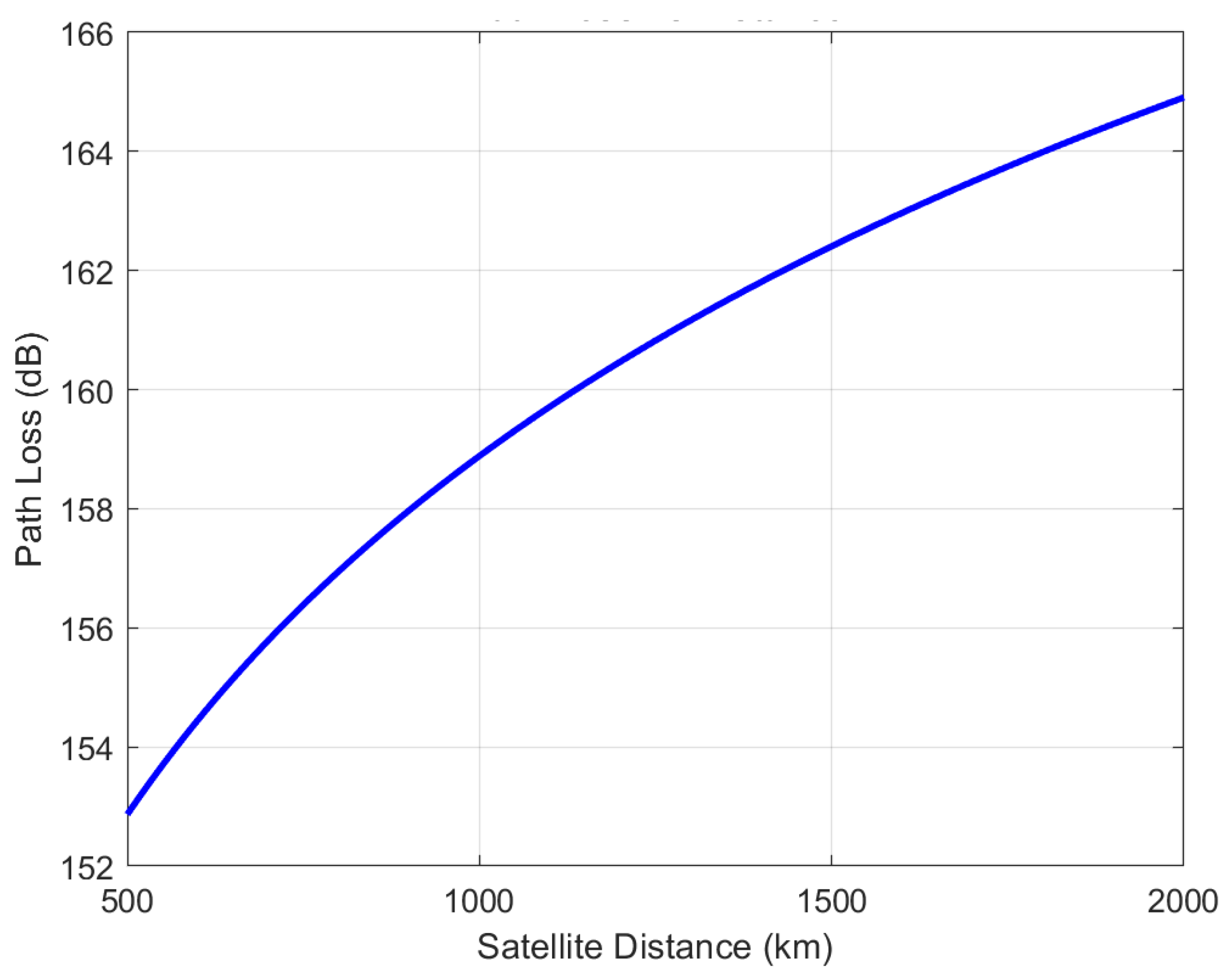
Figure 2.
Theoretical Achievable Bitrate vs satellite distance.
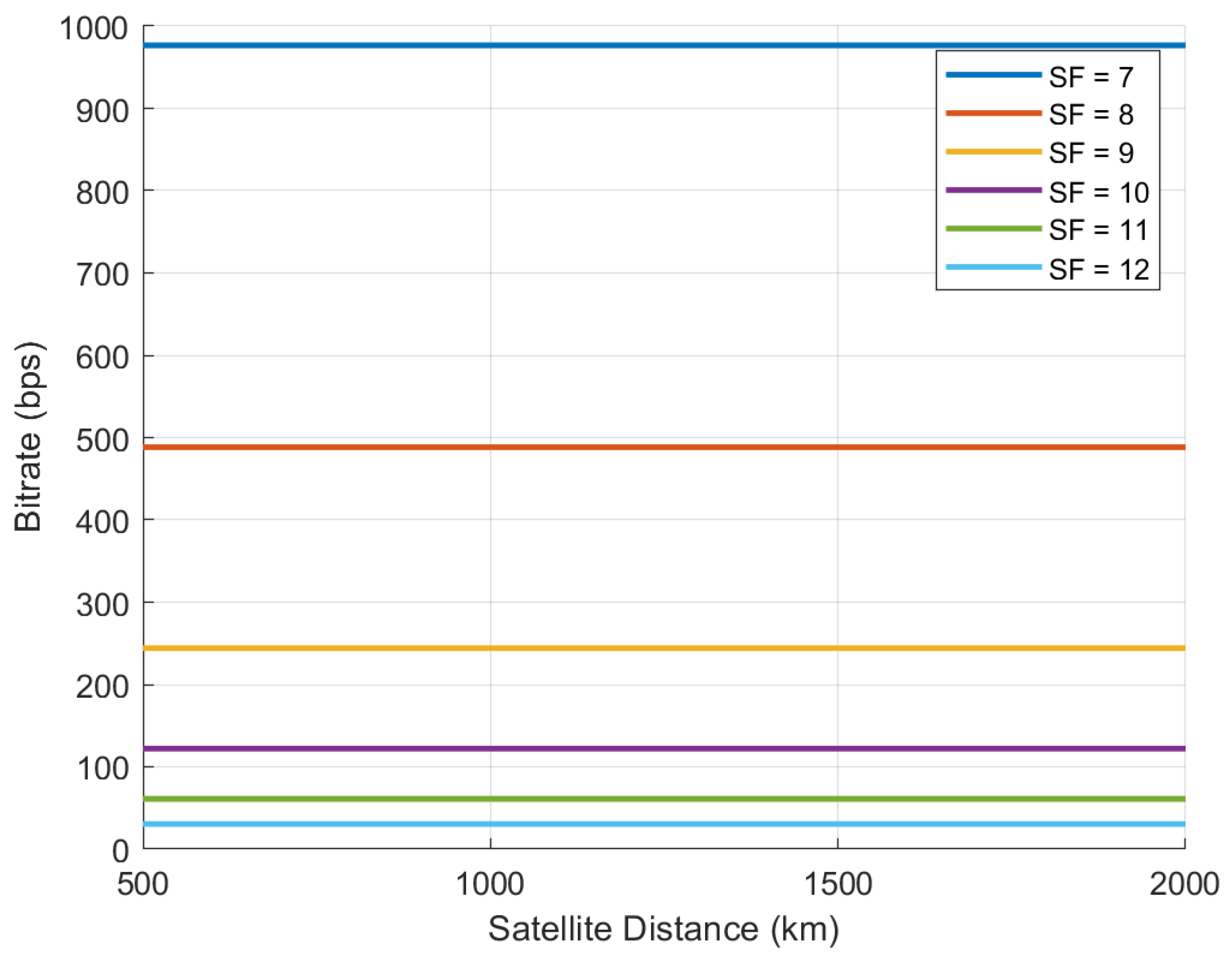
Figure 3.
Bit Error Rate (BER) vs satellite distance.
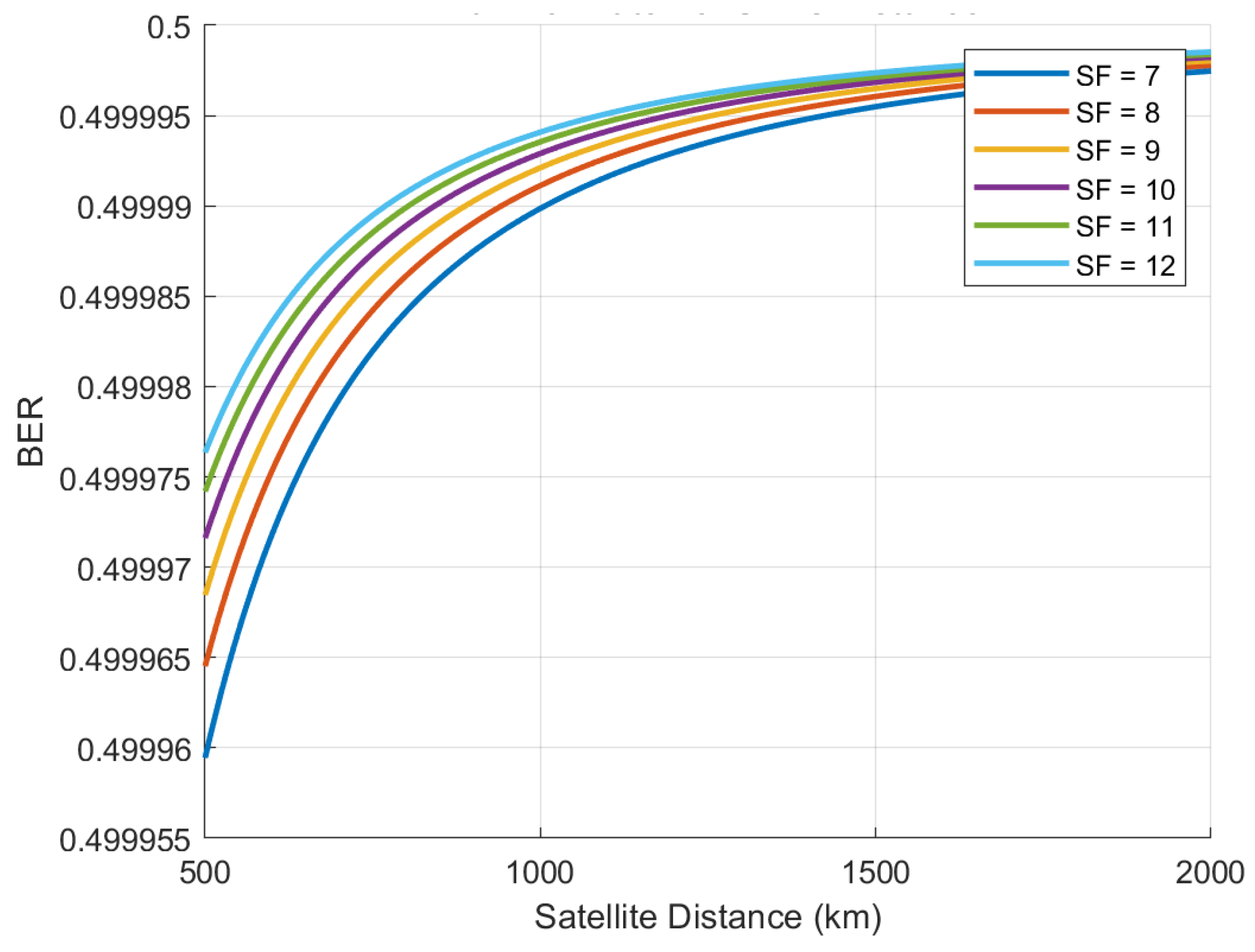
Figure 4.
Cumulative Distribution Function (CDF) of the Path Loss.
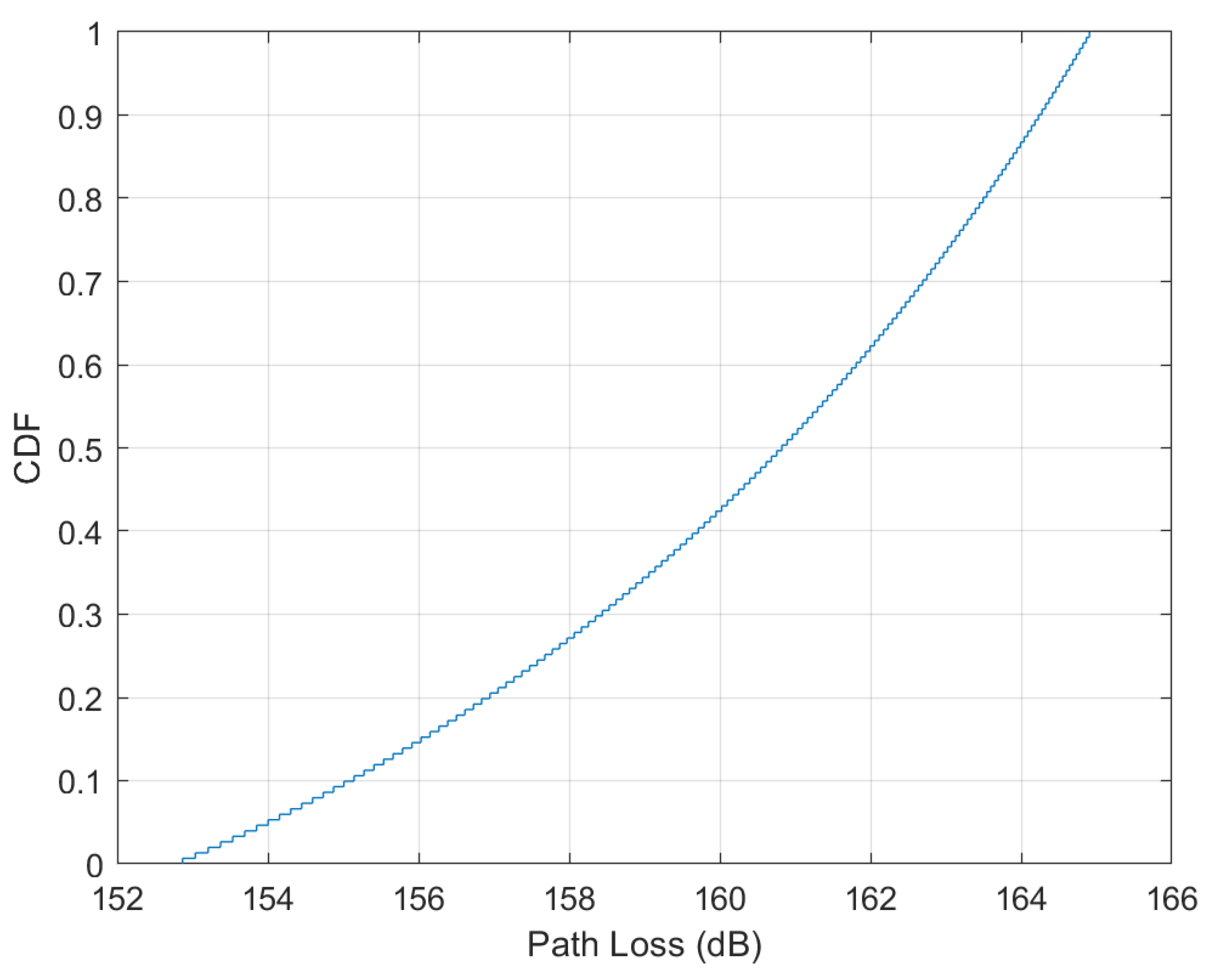
Figure 5.
Cumulative Distribution Function (CDF) of Bit Error Rate (BER).
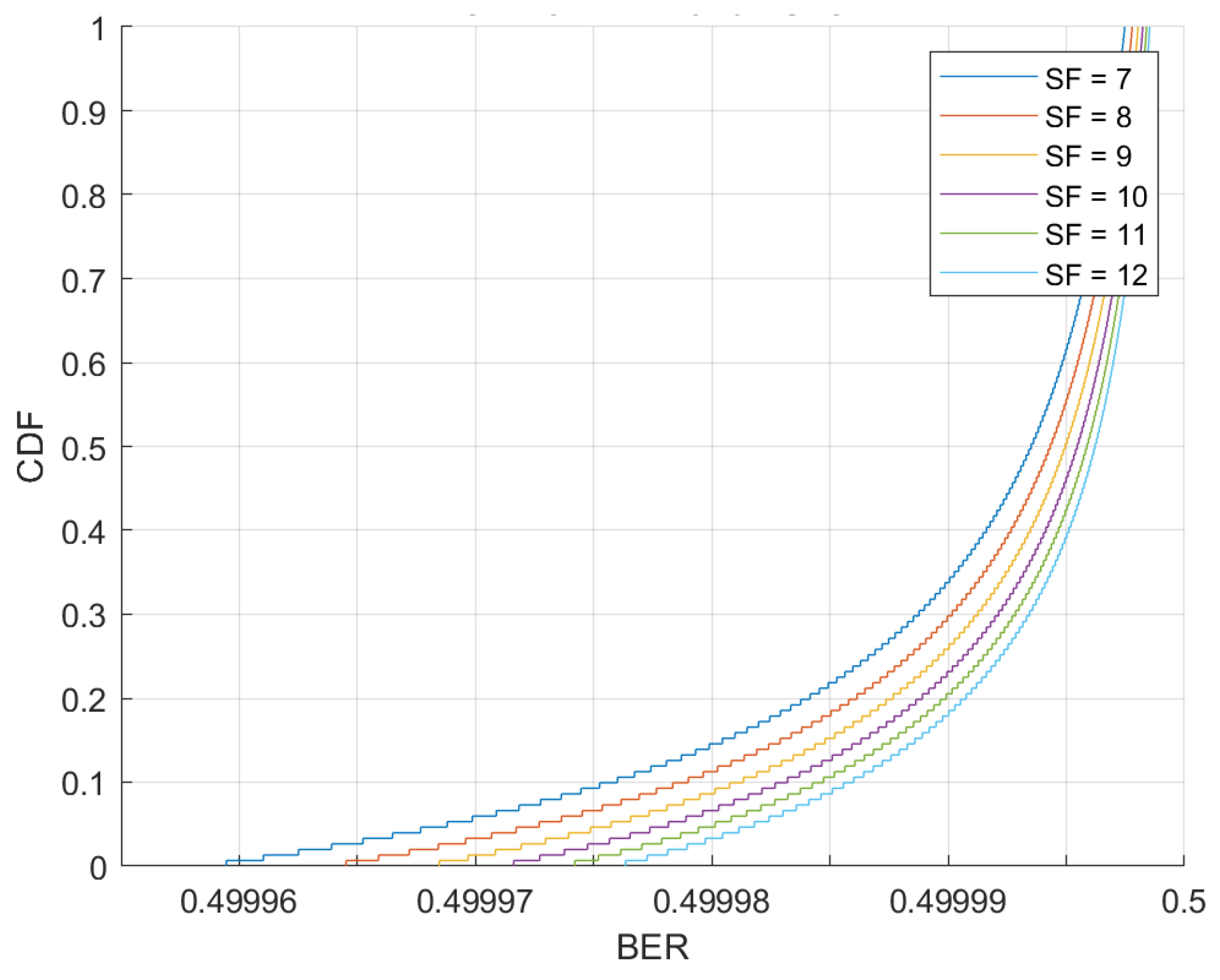

Table 1.
List of Analysed Papers on LoRa/LoRaWAN and LEO Satellite Communication.
| Year | Paper Title | Reference |
|---|---|---|
| 2019 | LEO Small-Satellite Constellations for 5G and Beyond-5G Communications | [2] |
| 2021 | Real-Time Parameter Optimization of LoRa for LEO Satellite Communication | [3] |
| 2021 | Ultra-Dense LEO Satellite Communication Systems: Modeling Technique | [4] |
| 2021 | LoRa Performance Analysis for LEO Satellite IoT Networks | [5] |
| 2021 | LR-FHSS: Overview and Performance Analysis | [6] |
| 2021 | Space-Terrestrial Integrated Internet of Things: Challenges and Opportunities | [7] |
| 2021 | LoRa Differential Modulation for LEO Satellite IoT | [8] |
| 2022 | Literature Review on Dynamic LEO Satellite Communication Network | [9] |
| 2022 | A New LoRa-like Transceiver for LEO Satellite Communications | [10] |
| 2022 | Enabling mMTC in Remote Areas with LoRaWAN and LEO Satellites | [11] |
| 2022 | Analysis and Simulation of LoRaWAN LR-FHSS for Direct-to-Satellite Scenario | [12] |
| 2022 | LoRaWAN LR-FHSS for Direct-to-Satellite Scenario | [13] |
| 2022 | IoT via Satellite: LoRa Multiple-Access Performance Study | [14] |
| 2022 | Uplink Transmission for LoRa-Based Direct-to-Satellite IoT | [15] |
| 2022 | SALSA: A Scheduling Algorithm for LoRa to LEO Satellites | [16] |
| 2023 | A Survey on Scalable LoRaWAN for Massive IoT | [17] |
| 2023 | Quasisynchronous LoRa for LEO Nanosatellite Communications | [18] |
| 2023 | LoRa-Based Low-Cost Nanosatellite for Emerging Networks | [19] |
| 2024 | D2D-aided LoRaWAN LR-FHSS in Direct-to-Satellite IoT Networks | [20] |
| 2023 | LPWAN Direct to Satellite IoT: A Survey | [21] |
| 2024 | Trends in LPWAN for LEO Satellite Constellations | [22] |
| 2024 | Limits of LoRa Direct-to-Satellite: Doppler Effects | [23] |
| 2024 | Energy Efficient LoRaWAN in LEO Satellites | [24] |
| 2024 | Beacon-Based Uplink Transmission for LoRaWAN Direct-to-Satellite IoT | [25] |
Table 2.
Input Parameters for LoRa Direct-to-Satellite Simulation.
| Parameter | Value | Unit | Description |
|---|---|---|---|
| Frequency (f) | Hz | Carrier frequency in S-Band (typical for LEO satellite) | |
| Distance range (d) | 500 to 2000 | km | Satellite altitude above Earth |
| Speed of light (c) | m/s | Speed of electromagnetic waves in vacuum | |
| Transmit Power () | dBm | Maximum transmit power (Semtech LR1121) | |
| Bandwidth (BW) | Hz | LoRa signal bandwidth | |
| Temperature (T) | 290 | K | System noise temperature |
| Boltzmann constant (k) | J/K | Physical constant used in thermal noise calculation | |
| Spreading Factors (SF) | 7 to 12 | – | LoRa spreading factors tested |
| Receiver Sensitivity | (SF=9, BW=125kHz) | dBm | Typical LoRa sensitivity from Semtech datasheet |
| Noise Floor () | dBm | Thermal noise power per bandwidth |
Disclaimer/Publisher’s Note: The statements, opinions and data contained in all publications are solely those of the individual author(s) and contributor(s) and not of MDPI and/or the editor(s). MDPI and/or the editor(s) disclaim responsibility for any injury to people or property resulting from any ideas, methods, instructions or products referred to in the content. |
© 2025 by the authors. Licensee MDPI, Basel, Switzerland. This article is an open access article distributed under the terms and conditions of the Creative Commons Attribution (CC BY) license (http://creativecommons.org/licenses/by/4.0/).
Copyright: This open access article is published under a Creative Commons CC BY 4.0 license, which permit the free download, distribution, and reuse, provided that the author and preprint are cited in any reuse.


