3. Results
Participant Characteristics and Group Dynamics: A total of 15 participants (12 women, 3 men) took part in three focus groups. Their ages ranged from 35 to 70 years. Participants represented a spectrum of roles related to caregiving. All focus groups were lively, with high engagement. Notably, the interaction analysis did not reveal any single individual dominating the discussions, nor obvious hierarchies based on professional status; for instance, in the first focus group of health professionals, both doctors and nurses/caregiver representatives took turns leading parts of the conversation. In the mixed groups, mutual respect was observed – professionals listened attentively to caregivers’ personal accounts, and caregivers in turn showed interest in professionals’ viewpoints. This dynamic suggests that the topic – support for post-caregivers – was approached by all as a shared concern rather than a contentious issue.
Across the groups, participants converged on a central idea: the community itself needs to be the main pillar of support for informal post-caregivers. One participant metaphorically described the current support system as “a net with holes” that post-caregivers fall through, and said the solution is “activating the living forces of the community to weave those holes shut.” The term “Community-For-Care” emerged organically in one discussion and became a unifying theme in the analysis. Community-For-Care is defined as a community-driven support network devoted to caring for those who have finished caregiving. Participants envisioned this as a holistic approach rallying local resources – people, knowledge, services, compassion – around the post-caregiver.
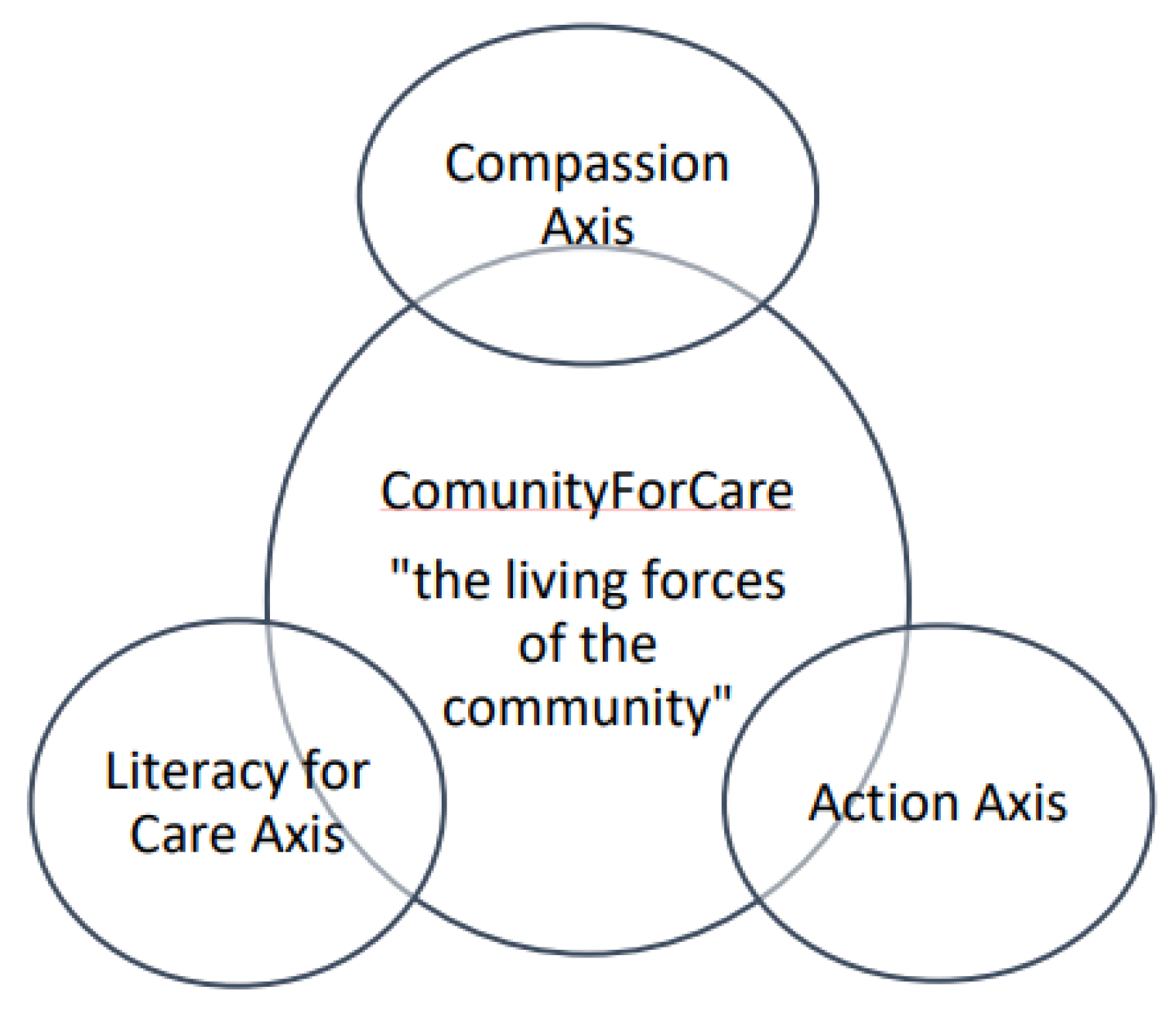
Through qualitative analysis, three major thematic axes were identified that constitute the foundation of the Community-For-Care network: Compassion Axis, Coordinated Action Axis, and Care Literacy Axis. These were consistently mentioned and strongly interlinked in participants’ narratives.
Figure 1 illustrates the thematic map of the proposed Informal Post-Caregiver Support Network, showing Community-For-Care at the center (the overarching framework) with the three axes surrounding it and feeding into one another.
Community-For-Care: An Overview
The community (“living forces of the community”) is at the core, symbolized by the central circle. Surrounding it are three interrelated axes essential for supporting informal post-caregivers: a Compassion Axis (fostering a culture of care and empathy), a Coordinated Action Axis (integrating efforts of healthcare, social services, and community actors), and a Care Literacy Axis (educating and empowering caregivers, post-caregivers, and professionals). The bidirectional arrows indicate that these axes influence and reinforce each other in a dynamic way.
Participants across all groups stressed that community involvement is both the context and the engine of any support system for post-caregivers. The community was described as the “village that cares,” invoking the proverb “it takes a village” – in this case, to care for the caregiver who has cared for someone else. The idea is that when the formal caregiving role ends, the community collectively should step forward to care for the post-caregiver. As one participant (P2 a community association member) put it, “We talk a lot about communities of care for patients, but we also need a community for the carers – a Community-For-Care that doesn’t abandon you after the funeral.”
This overarching theme of Community-For-Care implies re-centering support at the community level, rather than expecting individual post-caregivers to navigate siloed services or cope entirely on their own. It encompasses emotional support (neighbors checking in, peer support groups), practical help (community volunteers providing respite or assistance with errands), and inclusive social structures (ensuring post-caregivers are invited and welcomed in community events and dialogues, not left isolated). Participants noted that communities already have latent “living forces” – compassionate individuals, local leaders, faith groups, social clubs, etc. – that could be harnessed more effectively to create a safety net.
The three axes below detail the key dimensions participants identified within this community-centric model:
Compassion Axis
The Compassion Axis refers to cultivating a culture and value of compassion throughout the community, so that caring and empathy become normative “reflexes” in society’s response to post-caregivers. Participants diagnosed a lack of recognition and empathy fatigue in society regarding informal caregivers, which naturally extends to post-caregivers. Many felt that caregiving is undervalued – an invisible labor taken for granted – and that once a caregiver’s duties end, society assumes they are simply “free” to resume normal life. This axis, therefore, is about raising awareness and sensitivity so that communities appreciate the caregiver role and its aftermath.
Participants shared heartfelt accounts illustrating the current compassion gap. One post-caregiver (P8) described the feeling of being discarded after her care recipient died: “We [post-caregivers] are very little valued for the work we did and the needs we still have. The role of the caregiver is highly undervalued at all levels. It starts with being devalued by health professionals, who use us as a resource to fill gaps in services... Society in general only understands the caregiver’s role when they go through it themselves. When you stop being a caregiver, no one is interested in whether you’re physically or psychologically unwell. It’s like, the next day you’re expected to go back to work as if your problem is over.” (P8, post-caregiver)
This quote highlights a perceived dismissal of the post-caregiver’s experience: their years of labor and sacrifice aren’t formally acknowledged, and their subsequent struggles (health issues, grief) are ignored or trivialized. P8’s mention of health professionals viewing family caregivers as a “mere resource” also points to systemic issues – caregivers often fill in for inadequate home care services, yet their partnership is not reciprocated with support for them later on.
Another participant (P3, a palliative care psychologist) emphasized the emotional toll on caregivers and how that continues post-care: “Family caregivers are very lonely and need to talk. I see them [during caregiving] going through several bereavements, because they are losing the person in pieces – losing various abilities and identities sometimes – long before the final bereavement of death. The caregiver goes through so much grief before the endpoint.” (P3, psychologist)
This underscores that by the time caregiving ends, individuals may have already endured prolonged anticipatory grief and serial losses, leaving them emotionally depleted. Yet the community often does not acknowledge this cumulative grief. The Compassion Axis would involve validating these experiences and ensuring post-caregivers feel seen and heard.
One concrete strategy suggested to bolster compassion was the creation of a platform for sharing caregiving experiences. Participants imagined an online (and/or community center-hosted) platform where current and post-caregivers could narrate their stories – the challenges, the joys, the lessons learned. By doing so, these personal stories could resonate with others and “put a face” to the caregiving journey for the broader public. As P4 (caregiver association representative) described: “We need something like a digital wall of stories… These awareness actions can even be done digitally, at no great cost, to reach everyone. It starts small, like a snowball – you post one story here, one there, multiply the actions, load the platform with up-to-date testimonials. It gives meaning to those who share, and it educates those who read.” (P4, association rep)
The rationale for the platform is twofold: for the post-caregivers or caregivers who share, it is therapeutic and validating (making meaning of their experience through writing, as narrative medicine advocates); for the readers (community members, policymakers, health professionals), it builds empathy and could drive changes in attitudes or policies. Participants noted that positive caregiving experiences should be shared, not just negative ones, so that society can also see caregiving as valued work and not solely a burden. In essence, if caregiving is often described as rewarding yet challenging, those rewards – the love, personal growth, human connection – should also be highlighted to build a collective appreciation for care in the community ethos.
In discussing compassion, the idea of the “village of care” emerged. This envisions a community where caring is integrated into daily life, not something that only happens in crisis. In a compassionate community, neighbors might routinely check on each other’s well-being, people are attentive to who in their vicinity might be a caregiver or post-caregiver, and local culture prizes kindness. Some participants cited examples like community-organized visiting programs for widows or support circles in churches that rally around bereaved families. The consensus was that these organic acts of compassion need scaling and formal encouragement. A participant (P7, caregiver support institution member) noted:
“The value of caring, as a shared value, creates a reflexive, cascading movement. If we as a community truly value caring – like celebrate caregivers at events, talk about it in schools, whatever – it will open space for everyone to reflect on how we look after each other. Particularly how we treat our elders and those exhausted from caring for them… At what age do we stop deserving respect? At what level of dependency do we become disregarded?” (P7, support institution member)
This passionate statement calls out ageism and dependency stigma – implying that a compassionate community does not discard people who are old, dependent, or who have “fulfilled their duty” and are now themselves in need (like many post-caregivers). Thus, compassion here is linked to social inclusion and dignity.
In summary, the Compassion Axis involves raising community consciousness to truly see informal caregivers and post-caregivers, valorizing their roles, and fostering an environment where asking for and offering help is normalized. Strategies include storytelling platforms, awareness campaigns (e.g., local pamphlets or social media highlighting “Caregiver of the Month” stories), and community ceremonies or acknowledgments (some participants suggested an “Informal Caregivers Day” celebration). The expected outcome of strengthening this axis is a more empathetic society that organically provides emotional support and reduces the isolation of post-caregivers.
Coordinated Action Axis
The Coordinated Action Axis focuses on the need for different services, sectors, and actors to work in a concerted, continuous way to support caregivers through the entire caregiving trajectory – including after caregiving ends. Participants universally criticized the current support system as fragmented and reactive. They pointed out that while some resources exist (like caregiver allowances, respite care options, bereavement counseling), these are often disjointed, hard to navigate, or temporary. There was a call for a more integrated approach that would seamlessly accompany an individual from being a caregiver to becoming a post-caregiver.
One participant (P1, a palliative care physician) described the status quo bluntly: “The system is highly fragmented, it’s not integrated, and the responses are too scarce and one-off. They’re often based on an assistentialist model – like charity or short-term relief – instead of a sustainable plan. Caregivers need responses on the ground that are consistent, not just pilot projects or pamphlets. Right now, it’s like a patchwork with big holes.” (P1, physician)
This critique aligns with literature that advocates for continuous caregiver support programs rather than episodic interventions. P1 emphasizes that many current efforts are not sustained or scaled (e.g., a time-limited project in one locale that doesn’t continue or expand).
Participants suggested that coordination needs to occur on multiple levels:
Healthcare integration: Ensuring that when a patient under care dies or is institutionalized, the healthcare system does not simply close the case, but actively transitions the caregiver into follow-up support. One strong proposal was to establish a “Caregiver Consultation” or clinic within the healthcare system. For instance, P9 (a nurse) suggested a dedicated consultation for caregivers and post-caregivers: “Why do we have a well-baby check-up after birth, but nothing analogous after a death? There should be a consultation for the caregiver – integrated into hospital discharge planning or in primary care – that specifically looks after the caregiver’s health and plans the next steps for them. Many caregivers would need training during the care (like when their loved one is hospitalized) and then a follow-up appointment after care ends… to prepare this transition.” (P9, nurse)This idea implies a systematic change: including caregivers in care plans of patients and formally handing them over to a post-care program upon the patient’s death or placement in a facility. Such a program might involve health screening for the post-caregiver (many neglect their own health), mental health support, and linkage to community resources.
Cross-sector collaboration: Participants identified that multiple sectors have roles – healthcare, social services, local government, NGOs, religious organizations, employers (for working caregivers), etc. A coordinated network could involve appointing a case coordinator or a “community care navigator” who helps connect a post-caregiver to various supports (grief counselors, financial advice, social benefits, volunteer help). P5 (a general practitioner) mentioned the importance of social and mental health support alongside medical: “Healthcare must be designed to provide support over time according to the caregivers’ evolving needs – not just financial support (though that’s important), but real reintegration support. Right now in our legislation there’s basically nothing after the caregiving ends. We need good mental health services, social work follow-up, maybe job re-training for those who can still work. It has to be a package that is coordinated – primary care, mental health, social security, all talking to each other.” (P5, a general practitioner)This suggests setting up protocols where, for example, when a death is registered or a palliative care service discharges a patient due to death, an alert could go to a community care coordinator who then proactively contacts the family caregiver to offer support services.
Persistent timeline: A crucial element is longitudinality – participants felt support shouldn’t cut off shortly after bereavement, but continue as needed for months or years. Some suggested a tapering model: intensive support in the first weeks (e.g., daily check-ins by a community health worker or volunteer, help with funeral and paperwork), then regular check-ins for a year (monthly calls or support group meetings), and easy re-entry if help is sought later. P10 (a post-caregiver who is now an association volunteer) described the abrupt cutoff:
“It’s extremely violent how from one day to the next, the caregiver’s entire world disappears. The healthcare team is gone, the routine is gone. One day you’re giving 110%, the next day you’re not needed. That transition from full throttle to dead stop has to be prepared in advance. We need to discharge the caregiver as well – gradually, kindly – not just drop them.” (P10, post-caregiver)This quote illustrates the emotional whiplash of transition and underscores the need for a planned handover. In a coordinated system, as P10 notes, preparing the caregiver for the end should be part of end-of-life care practice: healthcare professionals can, while the care recipient is nearing the end, start discussing with the caregiver what will happen afterward (both practically and emotionally), perhaps referring them to resources preemptively.
In terms of who should coordinate, participants had various ideas. Some felt primary care (family doctors and community nurses) are best positioned because they have ongoing relationships with families and a mandate for continuous care. Others thought specialized palliative care teams or hospice programs might extend their care to the family for a period post-death (some palliative care services internationally provide bereavement follow-up for families for up to a year; participants wished this were more widespread in Portugal). There was also mention of municipal roles – local councils could create “Caregiver Support Offices” to centralize information and referrals, ensuring no one falls through the cracks.
Another component of coordination is building partnerships with community organizations and volunteers. This ties back to compassionate communities: for instance, a local volunteer network (through a church, Red Cross, or a Compassionate Community initiative) could be on call to provide home visits to a new widower to reduce loneliness, or drive a post-caregiver to social events to help reintroduce them to community life. Participants suggested that formal services should coordinate with such informal support: e.g., a doctor or social worker, with consent, could refer a post-caregiver to a community volunteer group for companionship.
One novel suggestion was establishing a post-caregivers peer support network where post-caregivers support newer post-caregivers (the idea that “only someone who’s been through it really gets it”). This could be coordinated by an NGO or community center. Given that participants like P10, who had become a volunteer, exist, harnessing their empathy and knowledge in a structured way could help newly bereaved caregivers. This peer network could operate like a mentoring or buddy system.
To illustrate the Coordinated Action Axis, consider a hypothetical but typical scenario raised in the focus group: A 60-year-old woman cared for her husband with cancer for 5 years. He passes away at home under palliative care. In a coordinated model, the palliative care nurse and social worker would meet with her shortly after, provide condolences and a “post-care info pack” (including contacts for grief counseling, legal/financial advice, support groups). Her family doctor is alerted to do a check-up within a month. A volunteer from a local compassionate community program might start visiting weekly or invite her to a “tea time” for widows. A few months later, a follow-up call is made by a caregiver support office to see how she’s coping and whether she needs help returning to work or engaging in community activities. All these moving parts require planning and communication across agencies – exactly what the Coordinated Action Axis encapsulates.
Participants acknowledged that implementing such coordination is challenging and requires political will and resources. They argued, however, that the payoff would be significant: healthier, more resilient post-caregivers who are less likely to suffer severe health decline or require institutional care themselves. In the long run, this could even be cost-saving for the healthcare system. It was evident that participants viewed the current lack of coordination as a major weakness that the Community-For-Care model must fix.
Care Literacy Axis
The Care Literacy Axis involves education, training, and knowledge-sharing for all parties involved in the caregiving and post-care process – including caregivers and post-caregivers themselves, health professionals, and the community at large. By improving “literacy” in care (both the practical skills and the understanding of the caregiving journey), individuals can be empowered and the support network made more effective.
Several needs were articulated under this theme:
Training and information for informal caregivers/post-caregivers: Participants argued that one reason caregivers struggle is lack of preparation and knowledge about both caregiving tasks and self-care. Thus, by extension, many post-caregivers might have coped better if they had better training during their caregiving period. A specific idea was a centralized training platform or repository of caregiver resources. P7 (a community health worker) said: “We need a platform that promotes literacy about the rights and resources for caregivers, and even basic know-how. There is such a lack of knowledge: caregivers often don’t know what support they’re entitled to, how to navigate the health system, or even how to manage the medical tasks they’re asked to do at home. If they were more empowered and taken care of during caregiving, they’d emerge as post-caregivers in better mental and physical health, not completely burned out.” (P7)This platform could aggregate tools and resources from different caregiver associations, covering topics like caregiving techniques (safe mobility, medication management), legal/financial guidance, respite options, self-care strategies, and what to expect when caregiving ends (mourning, returning to work, etc.). It should be user-friendly for a general audience. One benefit of an online platform is broad accessibility; however, participants also noted the importance of in-person literacy efforts: workshops, community meetings, etc., for those less tech-savvy or to build personal connections.
Psychological literacy and bereavement support: Many participants emphasized educating caregivers and families about the emotional aspects of caregiving, including anticipatory grief and bereavement. If caregivers had more knowledge about the grieving process, they might be better prepared for the waves of emotions post-care. Some suggested offering bereavement literacy sessions – possibly integrated into hospice or hospital bereavement programs – where caregivers approaching end-of-life situations could learn about common feelings after loss, coping mechanisms, and the fact that seeking help is okay. P11 (a psychologist) stressed that professionals themselves need this training: “The truth is health professionals don’t receive training in grief and bereavement during their studies. It’s entirely possible a nurse or doctor has no idea how to support a family after a patient dies, beyond saying ‘my condolences’. So we can’t expect them to guide post-caregivers if they’ve never been taught to. We need to incorporate this into training at all levels – primary care, hospital teams, even in medical/nursing school. How to care for the bereaved caregiver, how to identify complicated grief.” (P11, psychologist)This points to a gap in professional training. By increasing healthcare providers’ literacy in supporting caregivers and post-caregivers, the formal system can respond more appropriately (instead of leaving it all to chance or the community).
Empowering post-caregivers through knowledge: Some participants advocated for specific skill-building for post-caregivers to help them reintegrate into society. For instance, if a caregiver left the workforce and is at risk of long-term unemployment, providing them with adult education or job training is a form of literacy (economic/skills literacy) that could be transformative. While not traditionally framed as “care literacy,” it was mentioned that supporting post-caregivers might include helping them gain new competencies or certifications to re-enter jobs, or offering financial planning advice if their economic situation changed after caregiving. In other words, part of caring for post-caregivers is equipping them for their next chapter.
Streamlining information about rights and benefits: The relatively new caregiver law in Portugal and existing benefits (like respite care or caregiver allowance) are often not widely known or are confusing to navigate. Participants recommended that the support network include clear guidance on “what am I entitled to, and how do I get it?” as a key literacy component. This could be through informational brochures, a website, or trained personnel (nurses, social workers) who proactively educate caregivers.
Concrete proposals under this axis included:
Developing curricula for caregiver education (potentially delivered by healthcare providers or NGOs) that could be offered when someone registers as an informal caregiver under the new law. This would ensure a baseline knowledge, as one participant said, “like prenatal classes, but for caregiving.”
Organizing community literacy events (health fairs focused on caregivers, public lectures on aging and caregiving, etc.) to raise general awareness. This ties back to the Compassion Axis because as the public becomes more literate about what caregiving entails, compassion increases.
Encouraging peer knowledge exchange: e.g., experienced caregivers mentoring new caregivers, or post-caregivers sharing tips on how they coped with certain transitions. Participants noted that often practical tips (like how to get some sleep while caregiving, or how to deal with paperwork after someone dies) are not found in manuals but can be obtained from those who’ve been through it.
Notably, some participants (especially from caregiver associations) expressed feeling that they were doing a job that should be done by formal entities. For example, one association representative said they spend a lot of time informing caregivers about basic rights that hospitals or social security offices should have told them. This indicated a systemic gap in literacy dissemination by official channels, hence NGOs and communities stepping in. The Care Literacy axis in the Community-For-Care model would ensure that such information is centralized and consistently provided, ideally with institutional support rather than solely volunteer-run.
Finally, raising literacy among health professionals was strongly emphasized. Beyond bereavement training, participants said professionals need to recognize caregivers (and by extension post-caregivers) as part of the care unit. Simple acts like a doctor asking a caregiver “How are you holding up?” during a patient visit can make a difference, as can giving advice on self-care or referrals to caregiver support. If professionals are literate in caregiver issues, they can educate patients’ families early, refer them to resources, and follow up appropriately.
In summary, the Care Literacy Axis complements the Compassion and Coordination axes by ensuring everyone has the knowledge and skills to effectively participate in the support network. It empowers caregivers and post-caregivers through information, prepares professionals to engage with them empathetically and effectively, and informs the community so that caregiving is a visible, understood part of life.
Together, the Compassion, Coordinated Action, and Care Literacy axes create a synergistic framework: a compassionate community motivates coordination, coordination ensures that compassionate intentions translate into concrete help, and literacy provides the tools and understanding needed to sustain both compassion and coordination. Participants believed that by developing all three axes, Community-For-Care would be a robust support network that adapts to the needs of informal post-caregivers and values their well-being as an integral part of society’s fabric.