Preprint
Article

This version is not peer-reviewed.

Antidepressant-Induced Apathy in Adolescents with a Depressive Episode While Taking Sertraline: Results of 8-Week Observational Study with Pharmacogenetic Testing for CYP2C19

Submitted:

20 November 2025

Posted:

21 November 2025

You are already at the latest version

Abstract

Objectives. To investigate the risk of developing emotional blunting in adolescents with a depressive episode who are prescribed sertraline. To establish associations of carriage of CYP2C19 gene polymorphisms with the antidepressant-induced apathy. Methods. The study included 133 adolescents (89.5% female) aged 12-17 who were prescribed sertraline. The follow-up was carried out for 8 weeks. Emotional blunting was assessed using the Oxford Depression Questionnaire scale (ODQ-26) at the time of activation, after one, three and 8 weeks. We took into account the appointment of additional pharmacotherapy. The polymorphisms CYP2C19*2, *3, *17 were genotyped for all patients. Based on the results of genotyping, the phenotypes of the CYP2C19 isoenzyme were determined. Results. The ODQ score at the time of enrollment was higher (65 [50;79]) compared to after 8 weeks (38 [32;53]). The part 3 of the ODQ-26 questionnaire remained approximately the same for 8 weeks. Patients with higher ODQ-26 values at enrollment (73 [56;83] vs. 59 [44;71], p=0.0006) were more likely to be prescribed antipsychotics. Differences in ODQ scores remained significant up to 3 weeks after enrollment (50.5 [41.5;68], vs. 45.5 [36;54], p=0.015). The comparison of ODQ scores and their dynamics did not show significant differences depending on CYP2C19*2 or *17 polymorphisms, or the type of CYP2C19 metabolism. Conclusion. A negative outcome was observed: there was no improvement in emotional blunting among adolescents with depression who took sertraline for eight weeks. No significant correlations were found between the carriage of CYP2C19 gene variants and the development of apathy induced by antidepressants.

Keywords: 
;  ;  ;  ;  ;  ;  ;  ;  ;  ;  ;  

1. Introduction

Apathy is a lack of motivation that is not associated with impaired cognitive function, consciousness, or emotional stress [1]. Apathy is one of the manifestations of depressive syndrome. At the same time, "apathy" and "emotional dullness" are observed in patients taking selective serotonin reuptake inhibitors (SSRIs) [2]. This was first shown in a study by Opbroek et al. (2002): patients noted a significant narrowing of the range of emotions experienced when taking SSRIs [3]. According to patient surveys, the feeling of "apathy" when taking SSRIs differs from the manifestations of a depressive episode [2]. This undesirable reaction is observed when taking all monoaminergic antidepressants [4]. SSRI-induced apathy manifests itself as a loss of initiative, indifference to others, and is more pronounced with a greater severity of the depressive episode [4].
Today, antidepressant-induced emotional blunting has been well studied among adult patients [5]. This is a dose-dependent, reversible adverse reaction observed in 20-92% of patients who take SSRIs [5]. According to the conducted research, emotional dullness becomes one of the reasons for discontinuation of SSRIs [6,7].
A special scale, the Oxford Depression Questionnaire, has been developed to assess emotional blunting [6,8]. The scale contains 26 questions, of which the last 6 (part 3) need to be answered only if you are taking an antidepressant [8]. The use of ODQ in adult patients with a depressive episode makes it possible to successfully assess the degree of emotional blunting, as well as the dynamics of improvement in the patient’s condition [4,5,6,7]. To date, there are no studies of antidepressant-induced emotional dullness in adolescents. Only a description of a series of clinical cases has been published [9,10]. Emotional indifference in adolescents of different ages was observed when taking fluvoxamine, fluoxetine, and paroxetine [9,10]. Studies using the ODQ-26 questionnaire in patients under the age of 18 have not been found in the literature.
It is known that emotional blunting causes the withdrawal of antidepressants, and thus increases the risk of relapse of a mental disorder [5,7]. Apathy is reversible, and even dose-dependent, which allows us to talk about its correction and prevention [5].
Pharmacogenetic testing is an effective way to improve the effectiveness and safety of antidepressants [11,12]. To date, personalization algorithms have been developed for most SSRIs: sertraline, fluvoxamine, paroxetine, citalopram and escitalopram [11]. But these algorithms are based on studies conducted on adult patients [13,14]. Studies among adolescents often show paradoxical results [15,16]. This suggests the need for new associative pharmacogenetic studies to identify significant biomarkers.
In our study, we assessed emotional blunting using the ODQ-26 questionnaire in adolescents with a depressive episode and suicidal intentions who were prescribed sertraline. Firstly, this phenomenon has not been previously studied in detail in this population. Secondly, there are currently no pharmacogenetic studies on the risk of developing antidepressant-induced emotional dullness in either adults or children. Sertraline is primarily metabolized by the CYP2C19 isoenzyme [17]. Therefore, we chose pharmacogenetic testing of polymorphic variants of CYP2C19*2, *3, and *17. Their carriage leads to both a slowdown in the metabolic rate of the isoenzyme (CYP2C19*2, *3) and a significant acceleration (CYP2C19*17) [18]. Therefore, the pharmacogenetically determined sertraline metabolic rate may be related to the severity of emotional blunting in adolescents

2. Results

The study initially included 133 patients. The clinical and demographic characteristics of the patients are presented in Table 1.
Figure 1 shows the dynamics of the study.
At the time of inclusion, most patients filled out only the first 20 questions (ODQ-20), as they had not started taking an antidepressant. However, 21 patients completed ODQ-26 at the time of admission, as they were taking an antidepressant before hospitalization. On day 7, all 133 patients completed ODQ-26; after 3 weeks, 105 patients completed ODQ-26. At the end of the study (8 weeks), only 73 patients had completed the ODQ-26.
Table 2 shows the results of the ODQ analysis among patients. In the analysis, the total ODQ score of 26 was calculated, the ODQ score of 20 (parts 1-2) was shown separately, and the third part of the ODQ was associated with changes in the patient’s emotionality while taking an antidepressant. As follows from the Table 2, there is a significant decrease in the overall ODQ-26 score at week 3 of receiving therapy. During the first week, the value of the ODQ-26 scale score hardly changes. By the 8th week of follow-up, the total ODQ-26 score decreases almost twofold in all patients.
Quantitative changes in the ODQ-26 scale (Table 3) were calculated for 69 patients. This is due to the fact that only patients who completed a full follow-up period of 8 weeks were selected from the entire sample.
Then we compared the ODQ-26 score between carriers of different CYP2C19 polymorphisms, as well as between "normal" and "intermediate" CYP2C19 metabolizers (Table 2). Our study did not identify any carriers of the CYP2C19*3 polymorphism, so the comparison was carried out only for carriers of CYP2C19*2, *17. According to DPWG algorithm [19], 96 patients had "normal" CYP2C19 metabolism, 27 had "intermediate" metabolism, and 8 had "ultrarapid" metabolism. Only two patients had a "poor" metabolism. The "ultrarapid" and "slow" metabolizers were excluded from the comparative analysis.
It was found that at the time of activation, the "intermediate" metabolizers of CYP2C19 had a higher ODQ score of 20 compared to the "normal" ones (69 [59; 84] vs. 63 [44.5; 76]; p=0.028). However, this difference was eliminated after 1 week of follow-up. There were no statistically significant differences in the magnitude of the decrease in the ODQ score depending on the polymorphisms of the CYP2C19 gene, as well as the type of metabolism of the CYP2C19 isoenzyme (Table 3).
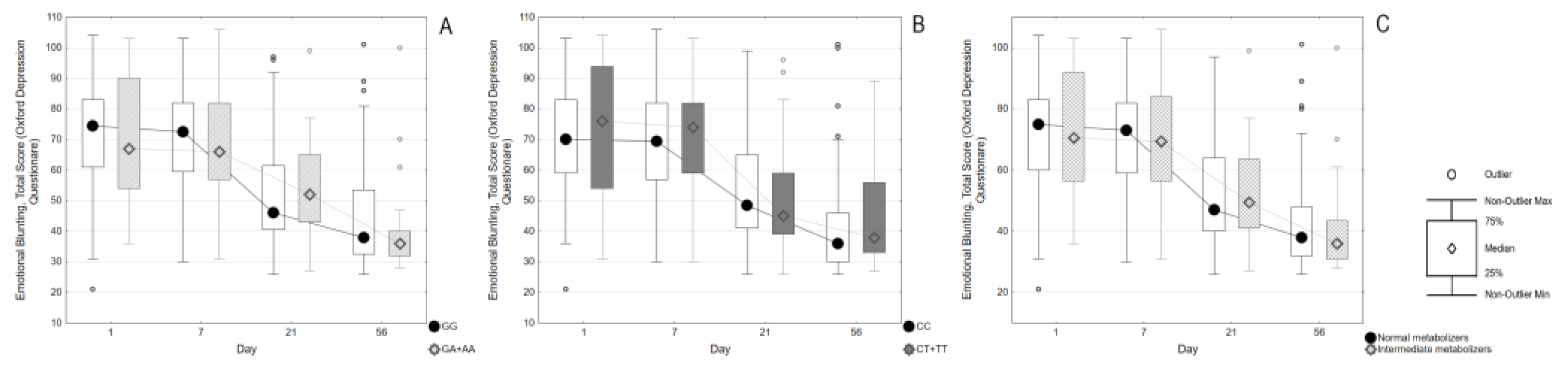
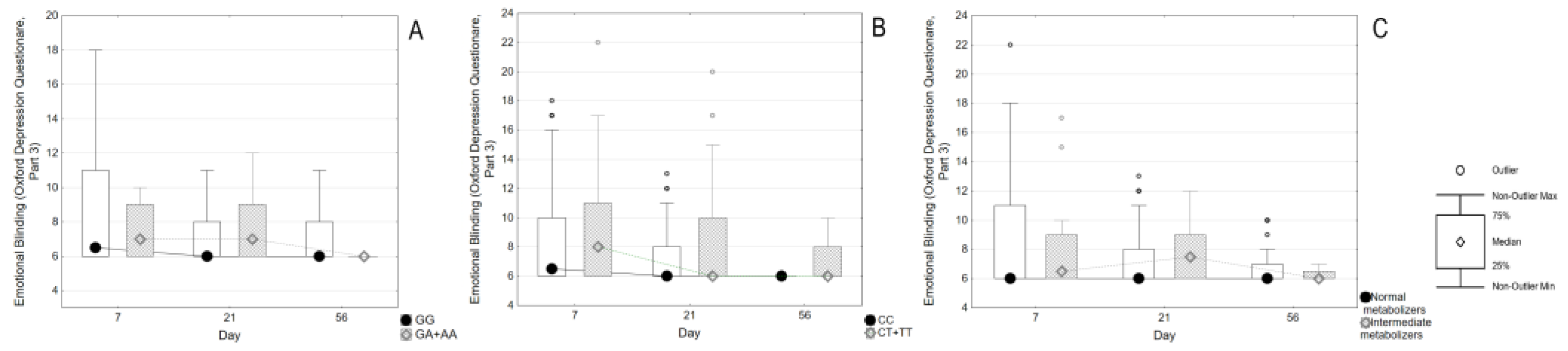
Figure 2 shows that within 8 weeks, there is a significant decrease in the ODQ score in all patients. There was no significant difference in the dynamics of decrease depending on the carriage of CYP2C19 polymorphisms (Figure 2, Parts A and B), as well as on the type of metabolism of CYP2C19 (Figure 2, Part C). Figure 3 shows the changes in the score of only part 3 of the ODQ scale. The score remained stable for almost the entire follow-up period, and did not differ between carriers of different genotypes of CYP2C19*2, *17 polymorphisms (Figure 3, Parts A and B). There is also no difference between "normal" and "intermediate" metabolizers of CYP2C19 (Figure 3, Part C).
Information about additional psychopharmacotherapy was received for all patients. The analysis of the ODQ score revealed a significant difference depending on the prescription of the antipsychotic (Table 4).
In particular, antipsychotic administration was associated with greater emotional blunting according to the ODQ at the time of inclusion in the study (73 [56; 83] vs. 59 [44; 71]; p=0.0006). The difference remained significant on day 7 (68 [54; 81] vs. 57 [43; 73]; p=0.0075) and on day 21 (50.5 [41.5; 68] vs. 45.5 [36;54]; p=0.015) of observation. At week 8 of the examination, there were no differences in the ODQ score depending on the antipsychotic administration (p=0.43). The administration of mood stabilizers, anxiolytics, and anticholinergic drugs was not associated with different ODQ scores.

3. Discussion

We conducted a study of emotional blunting in adolescents with a depressive episode and suicidal intentions who are prescribed sertraline. According to our data, this is the first study of a large sample of adolescents with a depressive episode in which antidepressant-induced apathy was assessed using ODQ-26. We were able to establish that emotional dullness in adolescents with a depressive episode significantly decreases within 8 weeks. The third part of the ODQ-26 scale in our study had no significant effect on the overall score of the questionnaire. Therefore, the ODQ scale allows you to measure the dynamics of improvement in the patient’s condition when taking an antidepressant. As follows from previously published studies, antidepressant-induced emotional blunting in adolescents is an infrequent phenomenon [9,10]. The advantage of our study compared to previously published ones is a large sample of adolescents with a depressive episode.
The only finding from the study was the association between the prescription of an antipsychotic medication and the ODQ score. The study was conducted under naturalistic conditions and the researcher was unable to influence the patients’ pharmacotherapy. This allowed for an accurate representation of the treatment process for adolescents with depression in a hospital setting.
Patients with greater levels of emotional blunting were more likely to receive an antipsychotic prescription at the time they were enrolled in the study. This difference persisted up to three weeks after enrollment, but was no longer significant at the eight-week follow-up.
In this case, the apathy of patients was present prior to the initiation of pharmacotherapy and was assessed using the ODQ-20 scale (without considering the effects of the antidepressant medication). It can therefore be concluded that patients with a higher level of apathy are more likely to be prescribed an antipsychotic by their attending physician. However, as the difference between the two groups was no longer significant after 8 weeks of follow-up, it is not possible to draw any conclusions regarding the effect of antipsychotic medication on maintaining apathy in patients. The use of antipsychotics, including those from generation 2, has been linked to a risk of apathy and emotional blunting [20]. Antipsychotics block dopamine receptors, and an intersection with the likely effect of antidepressants on emotional blunting can be assumed [21]. The development of SSRI-induced apathy is associated with the effect of antidepressants on the frontal cortex [22,23]. SSRIs increase serotonin levels, resulting in increased activity of The GABA-ergic interneurons. In turn, this reduces the levels of dopamine and norepinephrine, and thus emotional blunting develops [21,23]. Dopamine plays a key role in motivation and internal reward processes, so a decrease in the activity of dopaminergic neurons can lead to symptoms of emotional blunting [21]. In our study, it was not confirmed that the simultaneous use of sertraline and an antipsychotic leads to a greater degree of emotional blunting.
Patient complaints of apathy in the first weeks of taking an antidepressant, according to Peters et al. (2022), should be considered as a residual symptom of the underlying disease [24]. In fact, although emotional blunting reduces the patient’s quality of life, it is a rare symptom (<6%) [24]. The Peters et al. (2022) study did not use ODQ, emotional blunting was assessed on a single point of the Montgomery-Åsberg Depression Rating Scale, which does not allow for a full comparison with our results. But the results are consistent in that by the 8th week of therapy, the number of complaints of emotional blunting significantly decreases [24]. Thus, our results in adolescents who are prescribed sertraline are approximately the same as those in adult patients with a depressive episode. Emotional blunting in our sample steadily decreases in all patients by the 8th week of follow-up. It can be concluded that when taking sertraline, the severity of emotional dullness is not a common adverse reaction in adolescents with a depressive episode.
In our study, we also assessed the contribution of pharmacogenetic factors to the risk of emotional dullness when taking sertraline. Our study did not reveal significant associations of the ODQ-26 score with the carriage of genetic polymorphisms of CYP2C19, as well as with the type of metabolism of CYP2C19. At the time of inclusion in the study, the "intermediate" metabolizers of CYP2C19 had a significantly higher ODQ-20 score (Table 2), but this was not associated with taking sertraline. Subsequently, the difference was eliminated. We can talk about the negative result of our research.
The pharmacogenetics of SSRI safety in adolescents have not been sufficiently studied today compared to adults. But the results obtained so far indicate that it is impractical to extrapolate personalization algorithms to adolescents [16]. New associative research is required to develop algorithms for personalizing the administration of antidepressants to adolescents. In this study, we found that there are no significant associations between CYP2C19 polymorphisms and emotional dullness in adolescents with a depressive episode. We cannot compare our results with other studies, including those on adult patients, because no similar studies have been conducted before. However, the negative result of our study is consistent with the fact that the prognostic role of pharmacogenetic testing for the safety of antidepressants in adolescents is less significant than in adults, or paradoxical [15,16].

3.1. Limitations

In the present study, the follow-up period is limited to 8 weeks, which makes it impossible to assess the long-term effects of taking sertraline. We conducted pharmacogenetic testing of only polymorphisms of the CYP2C19 gene, and we plan to expand the genetic panel in the future. The naturalistic design of the study did not exclude the effect of additional pharmacotherapy.

4. Materials and Methods

The study was approved by the meeting of the local ethics committee of the "Scientific-Practical Children’s and Adolescents Mental Health Center n.a. G.E. Sukhareva" (Minute No. 2/23 dated 05/17/2023).
Study design: prospective observational. The study involved patients admitted to the "Scientific-Practical Children’s and Adolescents Mental Health Center n.a. G.E. Sukhareva" from May 20, 2023 to August 31, 2024.
The medical records of children admitted to inpatient treatment were examined for compliance with the inclusion and exclusion criteria.
Inclusion criteria:
  • Age from 12 to 17 years inclusive.
  • Depressive syndrome as the main reason for treatment.
  • Suicidal intentions in the patient (thoughts, preparations, or attempts).
  • Prescribing of sertraline.
  • Signed voluntary informed parental consent for the patient’s participation in the study.
  • Criteria for non-inclusion:
  • Diagnosis of bipolar affective disorder (F31.X).
  • Diagnosis of schizophrenic spectrum disorders (F2X).
  • Non-compliance with the inclusion criteria.
  • Refusal to participate in the study.
As a result of the screening of adolescents who are hospitalized with depressive syndrome, 133 patients were selected.
The inclusion of the patient into the study was carried out on the first day of their admission to the psychiatric hospital. Each time, the patient’s legally authorized representative signed an informed, voluntary consent to participate in the research. The personal information that can identify the patient was not entered into any electronic databases.

4.1. Sample Clinical and Demographic Characteristics

The individual registration chart for each patient included: gender, age, height, weight, body mass index, main diagnosis, total number of hospitalizations, age of onset of symptoms of mental disorder, history of suicide attempt, the fact of non-suicidal self-harm, age of occurrence of non-suicidal self-harm (if any), age of the first suicide attempt (if available), the total number of suicidal attempts (if available), the presence of suicidal thoughts at the time of examination, the fact of taking an antidepressant immediately before hospitalization.

4.2. Assessment of Emotional Blunting Using the ODQ Scale

During the dynamic follow-up, all patients underwent an assessment of the degree of emotional dullness on the Oxford Depression Questionnaire scale (ODQ-26). At the time of inclusion in the study, the patient filled out only the first two parts of the questionnaire (ODQ-20), but upon examination after 1 week, 3 weeks and 8 weeks, the patient filled out the full version of ODQ-26. As a result, a total ODQ score was obtained for each patient. The number of points received when completing the third part of the ODQ questionnaire (changes that occurred after the appointment of an antidepressant) was taken into account separately after one, three and eight weeks.

4.3. Pharmacotherapy

The researcher could not influence the appointment of psychopharmacotherapy by the attending physician. All psychotropic drugs with daily dosages received by the patient were entered into an individual registration card.
All patients received sertraline as their primary therapy. Some patients were additionally prescribed antipsychotics, mood stabilizers, anticholinergic drugs to correct extrapyramidal symptoms, and anxiolytics. Such cases were considered as polypharmacy and were necessarily taken into account in the analysis.

4.4. Genotyping

On the day of inclusion in the study, 5 ml of blood was collected from each patient in test tubes in disposable sterile vacuum tubes with EDTA, for the purpose of subsequent genotyping. The biomaterial was taken simultaneously with routine analyses and did not require additional venipunctures. The biomaterial was frozen at -20 ° C, transported to the laboratory and subsequently stored at -70 ° C.
The laboratory part of the study was conducted on the basis of the Research Institute of Molecular and Personalized Medicine of the Russian Medical Academy of Continuous Professional Education (Moscow). DNA isolation and genotyping of the samples took place as they were received between June 1, 2023 and August 31, 2024.
DNA was isolated from venous blood using the column method using the QIAamp DNA Blood Mini Kit (Qiagen, Germany). The concentrations and quality assessment of the obtained DNA preparations were carried out using a Qubit 4 fluorimeter (Thermo Fisher Scientific, USA) and a Nanodrop ND-1000 spectrophotometer (Thermo Fisher Scientific, USA).
Genetic polymorphisms CYP2C19*2 (rs4244285 G681A), CYP2C19*3 (rs4986893 G636A), CYP2C19*17 (rs12248560 C-806T) were determined by real-time polymerase chain reaction (PCR) using commercial reagent kits, equipment: CFX96 TouchTM Real-Time PCR Detection System (Bio-Rad, USA).

4.5. Statistical Analysis

Statistical analysis was carried out using the SPSS Statistics 26.0. Due to the abnormal distribution of data, nonparametric criteria were used to compare quantitative variables between groups. The results of calculations of quantitative variables were presented as median and quartiles - Me [Q1; Q3].
All patients were divided into subgroups according to the genotypes of the polymorphisms: carriers of the polymorphic allele (heterozygotes+homozygotes) and homozygotes for the "wild" allele. For example, carriers of the polymorphic variant CYP2C19*2 are divided into two subgroups GG and GA+AA, etc. Subsequently, the genetically determined subgroups were compared to find associations with the clinical parameters of the patients.
According to the results of pharmacogenetic testing, the type of CYP2C19 metabolism was determined for each patient according to the Dutch Pharmacogenetics Working Group algorithm: "ultrarapid", "normal", "intermediate", "poor" [19].
The Mann-Whitney criterion was used to compare the selected subgroups at the same time point according to quantitative variables. The frequencies of categorical variables were compared with each other using Pearson’s Chi-square, and Fisher’s exact criterion was used for 2x2 comparisons. The Bonferroni correction was introduced to correct multiple comparisons. The calculation of the correspondence of the genotype distribution to the Hardy-Weinberg law was performed using an online calculator [25].

5. Conclusions

In adolescents with a depressive episode and suicidal itentions, there was no significant effect of taking sertraline on the severity of emotional blunting. According to our data, this is the first study of adolescents with a depressive episode using the ODQ scale to assess antidepressant-induced apathy. The result of the study can be considered negative, which makes it possible to be less wary of the development of emotional dullness when taking sertraline in adolescents.
Our study found no significant associations of carriage of CYP2C19 polymorphisms for antidepressant-induced apathy. Thus, the pharmacogenetic part of our study also showed a negative result. This highlights the importance of conducting new associative studies to identify significant pharmacogenetic factors in the efficacy and safety of antidepressants in adolescents with a depressive episode.

Author Contributions

Conceptualization, D. Ivashchenko, Y. Shevchenko and D. Sychev; methodology, D. Ivashchenko, A. Basova, Y. Shevchenko and D. Sychev; software, I. Korsakov and S. Markov; formal analysis, I. Korsakov and S. Markov; investigation, V. Sobur, S. Grass, P. Shimanov, A. Shubin, R. Deitch, S. Tuchkova; resources, A. Basova; data curation, I. Korsakov and S. Markov; writing—original draft preparation, D. Ivashchenko, S. Grass; writing—editing, D. Ivashchenko, Y. Shevchenko and D. Sychev; visualization, I. Korsakov; supervision, D. Sychev; project administration, K. Mirzaev; funding acquisition, K. Mirzaev and D. Sychev. All authors have read and agreed to the published version of the manuscript.

Funding

This research was funded by the Ministry of Science and Higher Education of the Russian Federation (the Federal Scientific-technical programme for genetic technologies development for 2019–2030, agreement No. 075-15-2025-463 of 29 May 2025).

Institutional Review Board Statement

The study was conducted in accordance with the Declaration of Helsinki, and approved by the local ethics committee of the Scientific-Practical Children’s and Adolescents Mental Health Center n.a. G.E. Sukhareva (Minute No. 2/23 dated 05/17/2023).

Informed Consent Statement

Informed consent was obtained from all subjects involved in the study.

Data Availability Statement

The data presented in this study are available on request from the corresponding author.

Acknowledgments

None.

Conflicts of Interest

The authors declare no conflicts of interest.

Abbreviations

The following abbreviations are used in this manuscript:
BMI Body mass index
ODQ Oxford Depression Questionnaire

References

  1. Raffard, S.; Capdevielle, D.; Attal, J.; Novara, C.; Bortolon, C.; Fritz, N.E.; Boileau, N.R.; Stout, J.C.; Ready, R.; Perlmutter, J.S.; et al. Apathy: A neuropsychiatric syndrome. J. Neuropsychiatry 1991, 3, 243–254. [Google Scholar] [CrossRef] [PubMed]
  2. Barnhart, W.J.; Makela, E.H.; Latocha, M.J. SSRI-Induced Apathy Syndrome: A Clinical Review. J. Psychiatr. Pr. 2004, 10, 196–199. [Google Scholar] [CrossRef] [PubMed]
  3. Opbroek, A.; Delgado, P.L.; Laukes, C.; McGahuey, C.; Katsanis, J.; Moreno, F.A.; Manber, R. Emotional blunting associated with SSRI-induced sexual dysfunction. Do SSRIs inhibit emotional responses? Int. J. Neuropsychopharmacol. 2002, 5, 147–151. [Google Scholar] [CrossRef] [PubMed]
  4. Goodwin, G.; Price, J.; De Bodinat, C.; Laredo, J. Emotional blunting with antidepressant treatments: A survey among depressed patients. J. Affect. Disord. 2017, 221, 31–35. [Google Scholar] [CrossRef]
  5. Masdrakis, V.G.; Markianos, M.; Baldwin, D.S. Apathy associated with antidepressant drugs: A systematic review. Acta Neuropsychiatr. 2023, 35, 189–204. [Google Scholar] [CrossRef]
  6. Christensen, M.C.; Fagiolini, A.; Florea, I.; Loft, H.; Cuomo, A.; Goodwin, G.M. Validation of the Oxford Depression Questionnaire: Sensitivity to change, minimal clinically important difference, and response threshold for the assessment of emotional blunting. J. Affect. Disord. 2021, 294, 924–931. [Google Scholar] [CrossRef]
  7. Rosenblat, J.D.; Simon, G.E.; Sachs, G.S.; Deetz, I.; Doederlein, A.; DePeralta, D.; Dean, M.M.; McIntyre, R.S. Treatment effectiveness and tolerability outcomes that are most important to individuals with bipolar and unipolar depression. J. Affect. Disord. 2019, 243, 116–120. [Google Scholar] [CrossRef]
  8. Price, J.; Cole, V.; Doll, H.; Goodwin, G.M. The Oxford Questionnaire on the Emotional Side-effects of Antidepressants (OQuESA): Development, validity, reliability and sensitivity to change. J. Affect. Disord. 2012, 140, 66–74. [Google Scholar] [CrossRef]
  9. Garland, E.J.; Baerg, E.A. Amotivational Syndrome Associated with Selective Serotonin Reuptake Inhibitors in Children and Adolescents. J. Child Adolesc. Psychopharmacol. 2004, 11, 181–186. [Google Scholar] [CrossRef]
  10. Reinblatt, S.P.; Riddle, M.A. Selective Serotonin Reuptake Inhibitor-Induced Apathy: A Pediatric Case Series. J. Child Adolesc. Psychopharmacol. 2006, 16, 227–233. [Google Scholar] [CrossRef]
  11. Bousman, C.A.; Stevenson, J.M.; Ramsey, L.B.; Sangkuhl, K.; Hicks, J.K.; Strawn, J.R.; Singh, A.B.; Ruaño, G.; Mueller, D.J.; Tsermpini, E.E.; et al. Clinical Pharmacogenetics Implementation Consortium (CPIC) Guideline for CYP2D6, CYP2C19, CYP2B6, SLC6A4, and HTR2A Genotypes and Serotonin Reuptake Inhibitor Antidepressants. Clin. Pharmacol. Ther. 2023, 114, 51–68. [Google Scholar] [CrossRef] [PubMed]
  12. Milosavljević, F.; Molden, E.; Ingelman-Sundberg, M.; Jukić, M.M. Current level of evidence for improvement of antidepressant efficacy and tolerability by pharmacogenomic-guided treatment: A Systematic review and meta-analysis of randomized controlled clinical trials. Eur. Neuropsychopharmacol. 2024, 81, 43–52. [Google Scholar] [CrossRef] [PubMed]
  13. Fares-Otero, N.E.; Budde, M.; Laatsch, J.; Harrer, M.; Pelgrim, T.; Philipsen, A.; Heilbronner, U.; Vieta, E.; van Westrhenen, R. Efficacy of pharmacogenetic (PGx)-guided antidepressant treatment on functional outcomes and quality of life in adults with anxiety and affective disorders: A systematic review and meta-analysis. Eur. Neuropsychopharmacol. 2025, 100, 13–23. [Google Scholar] [CrossRef] [PubMed]
  14. Zhang, Y.; Gao, Y.; Zou, Y.; Ye, Y.; Jiang, F.; Wang, Z.; Qiu, J.; Zou, Z. Comparative effectiveness of pharmacogenomic-guided versus unguided antidepressant treatment in major depressive disorder: New insights from subgroup and cumulative meta-analyses. BMJ Ment. Heal. 2025, 28, e301726. [Google Scholar] [CrossRef]
  15. Rossow, K.M.; Aka, I.T.; Maxwell-Horn, A.C.; Roden, D.M.; Van Driest, S.L. Pharmacogenetics to Predict Adverse Events Associated With Antidepressants. Pediatrics 2020, 146. [Google Scholar] [CrossRef]
  16. Voort, J.L.V.; Orth, S.S.; Shekunov, J.; Romanowicz, M.; Geske, J.R.; Ward, J.A.; Leibman, N.I.; Frye, M.A.; Croarkin, P.E. A Randomized Controlled Trial of Combinatorial Pharmacogenetics Testing in Adolescent Depression. J. Am. Acad. Child Adolesc. Psychiatry 2021, 61, 46–55. [Google Scholar] [CrossRef]
  17. DeVane, C.L.; Liston, H.L.; Markowitz, J.S. Clinical Pharmacokinetics of Sertraline. Clin. Pharmacokinet. 2002, 41, 1247–1266. [Google Scholar] [CrossRef]
  18. Torso, N.d.G.; Rodrigues-Soares, F.; Altamirano, C.; Ramírez-Roa, R.; Sosa-Macías, M.; Galavíz-Hernández, C.; Terán, E.; Peñas-Lledó, E.; Dorado, P.; Llerena, A. CYP2C19 genotype-phenotype correlation: Current insights and unanswered questions. Drug Metab. Pers. Ther. 2024, 39, 201–206. [Google Scholar] [CrossRef]
  19. Brouwer, J.M.J.L.; Nijenhuis, M.; Soree, B.; Guchelaar, H.-J.; Swen, J.J.; van Schaik, R.H.N.; van der Weide, J.; Rongen, G.A.P.J.M.; Buunk, A.-M.; de Boer-Veger, N.J.; et al. Dutch Pharmacogenetics Working Group (DPWG) guideline for the gene-drug interaction between CYP2C19 and CYP2D6 and SSRIs. Eur. J. Hum. Genet. 2021, 30, 1114–1120. [Google Scholar] [CrossRef]
  20. Ueda, S.; Sakayori, T.; Omori, A.; Fukuta, H.; Kobayashi, T.; Ishizaka, K.; Saijo, T.; Okubo, Y. Neuroleptic-induced deficit syndrome in bipolar disorder with psychosis. Neuropsychiatr. Dis. Treat. 2016, 12, 265–268. [Google Scholar] [CrossRef]
  21. Belujon, P.; A Grace, A. Dopamine System Dysregulation in Major Depressive Disorders. Int. J. Neuropsychopharmacol. 2017, 20, 1036–1046. [Google Scholar] [CrossRef]
  22. Nutt, D.; Demyttenaere, K.; Janka, Z.; Aarre, T.; Bourin, M.; Canonico, P.L.; Carrasco, J.L.; Stahl, S. The other face of depression, reduced positive affect: The role of catecholamines in causation and cure. J. Psychopharmacol. 2007, 21, 461–471. [Google Scholar] [CrossRef]
  23. Sansone, R.A.; Sansone, L.A. SSRI-Induced Indifference. Psychiatry 2010, 7, 14–18. [Google Scholar]
  24. Peters, E.M.; Balbuena, L.; Lodhi, R.J. Emotional blunting with bupropion and serotonin reuptake inhibitors in three randomized controlled trials for acute major depressive disorder. J. Affect. Disord. 2022, 318, 29–32. [Google Scholar] [CrossRef]
  25. Hardy-Weinberg Calc. Hardy Weinberg Equilibrium Online Calculator n.d. Available online: https://www.had2know.org/academics/hardy-weinberg-equilibrium-calculator-2-alleles.html.
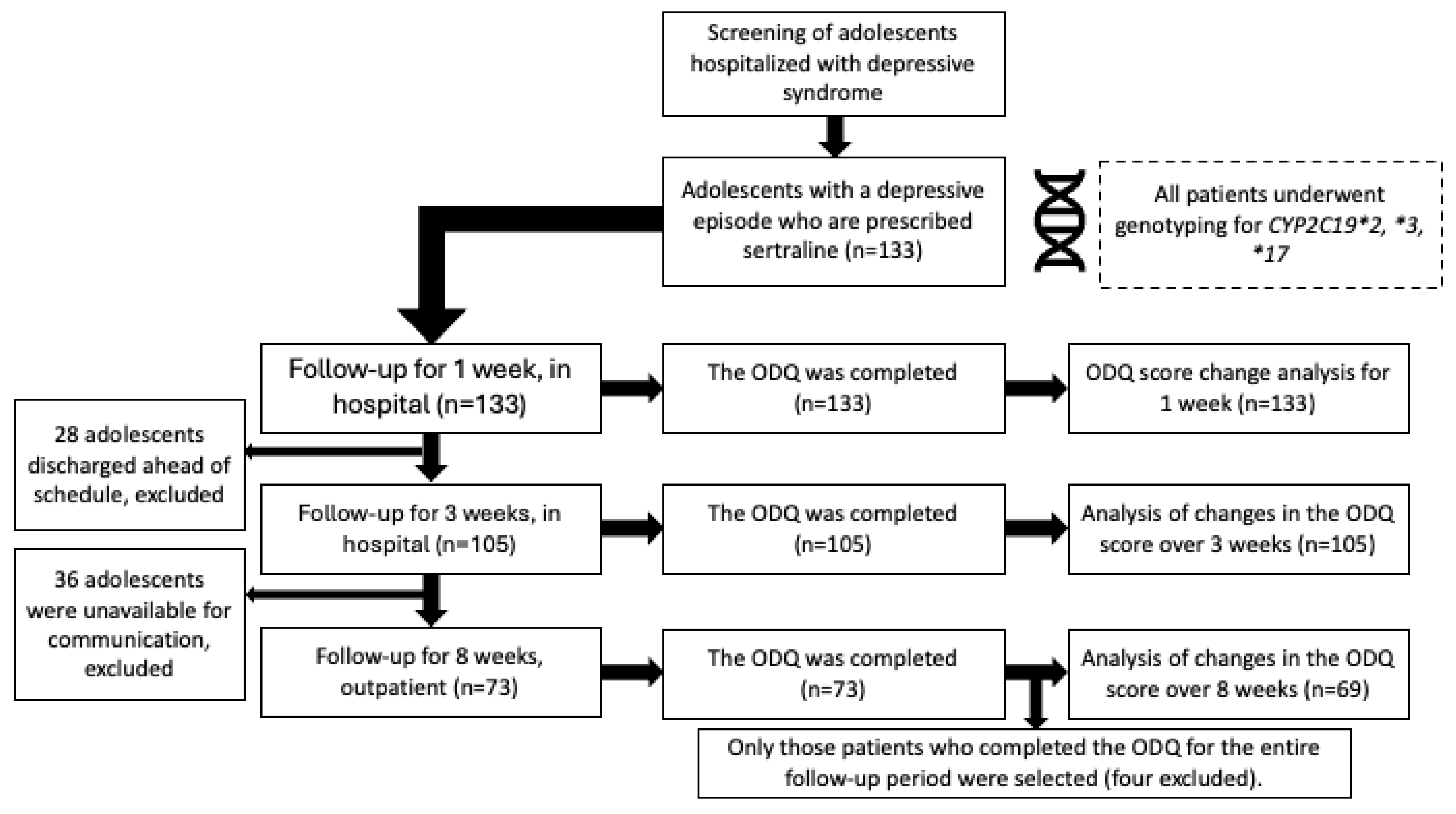
Figure 1. Study flow chart.
Preprints 185964 g001
Figure 2. Dynamics of Oxford scale score changes over 8 weeks depending on carriage of CYP2C19*2, CYP2C19*17, type of CYP2C19 metabolism. Notes: A represents the dynamics of the overall score value of the ODQ-26 depending on the CYP2C19*2 genotype (GG, GA+AA). B represents the dynamics of the total ODQ-26 scale score depending on the genotype of CYP2C17*17 (CC, CT+TT). C represents the dynamics of the ODQ-26 total score based on the type of CYP2C19 metabolism.
Preprints 185964 g002
Figure 3. Dynamics of the change in the score of part 3 of the Oxford scale over 8 weeks, depending on the carriage of CYP2C19*2, CYP2C19*17, type of metabolism of CYP2C19. Notes: A represents the dynamics of the score value for the part 3 of the ODQ scale, depending on the genotype of CYP2C19*2 (GG, GA + AA). B represents the dynamics of the score value for the same part, depending on the genotype of CYP2C19*17 (CC, CT + TT). C represents the dynamics of the part 3 ODQ score, depending on CYP2C19 metabolic type.
Preprints 185964 g003
Table 1. Clinical and demographic characteristics of the patients included in the study.
Variables All Participants (n=133)
Age, years (Me [Q1; Q3]) 15 [14; 16]
Height, m (Me [Q1; Q3]) 1,64 [1,58; 1,68]
Weight, kg (Me [Q1; Q3]) 54,05 [47,6; 62,4]
Body mass index (Me [Q1; Q3]) 19,97 [18,3; 22,4]
Female (n, %) 119, 89,5%
Total number of hospitalizations (including the current one) (Me [Q1; Q3]) 1 [1; 1]
Age of onset of symptoms of mental disorder, years (Me [Q1; Q3]) 13 [12; 14]
Suicidal thoughts (n, %) 124, 93,2%
A history of NSSI (n, %) 122, 91,8%
Age of occurrence of NSSI, years (Me [Q1; Q3]) 13 [12; 14]
History of suicide attempt (n, %) 53(40,2%)
Total number of suicide attempts (Me [Q1; Q3]) 0 [0; 1]
Age at the start of taking antidepressants, years (Me [Q1; Q3]) 14 [13; 16]
Duration of mental disorder before inclusion in the study, months (Me [Q1; Q3]) 18 [8,5; 27]
Table 2. ODQ-26 score values depending on the carriage of polymorphic variants of CYP2C19*2, CYP2C19*17, type of metabolism of CYP2C19.
Moment of Inclusion All Patients (n=133) CYP2C19*2 p CYP2C19*17 p CYP2C19 Metabolism p
GG (n=105) GA+AA (n=28) CC (n=83) CT+TT (n=50) "Normal" (n=96) "Intermediate" (n=27)
Overall ODQ score 65 [50; 79] 64 [48; 78] 67,5 [58; 84] 0,146 65 [49;79] 63,5 [50;80] 0,678 64 [49;78,5] 69 [59;84] 0,078
Parts 1-2 score 64 [49;77] 63 [44;76] 67,5 [58;84] 0,067 65 [49;77] 63 [52;78] 0,772 63 [44,5;76] 69 [59;84] 0,028
Part 3 score (n=21) 9 [6;14] 9 [6;16] 11,5 [9;14] 0,686 9 [6;14] 11 [7;15,5] 0,645 9,5 [6;16] 11,5 [9;14] 0,758
Examination after 1 week All patients (n=133) CYP2C19*2 p CYP2C19*17 p CYP2C19 metabolism p
GG (n=105) GA+AA (n=28) CC (n=83) CT+TT (n=50) "Normal" (n=96) "Intermediate" (n=27)
Overall ODQ score 65 [50; 79] 62 [50; 78] 66 [55,5;79,5] 0,332 63 [47;79] 65,5 [53;79] 0,726 63,5 [50;79] 66 [54;80] 0,275
Parts 1-2 score 54 [41;69] 53 [40;69] 56[47;67,5] 0,372 54 [40;68] n=83 54 [42;69] n=50 0,866 53,5 [40;69] 57 [46;69] 0,341
Part 3 score 8 [6;10] 7 [6;10] 8,5 [6;11] 0,280 7 [6;10] n=83 8 [6;12] n=50 0,615 8 [6;10] 9 [6;12] 0,379
Examination after 3 weeks All patients (n=105) CYP2C19*2 p CYP2C19*17 p CYP2C19 metabolism p
GG (n=80) GA+AA (n=25) CC (n=64) CT+TT (n=41) "Normal" (n=73) "Intemediate" (n=24)
Overall ODQ score 48 [39;62,5] 47 [39,63] 50 [43;58] 0,42 48 [39;63] 46 [39;59] 0,734 47,5 [39;64] 49 [43;56] 0,63
Parts 1-2 score 41 [32;53] 40,5[31;55] 42 [34;48] 0,522 41,5 [33;54] 39 [32;50] 0,702 41[32;55] 40,5 [33,5] 0,755
Part 3 score 6[6;10] 6[6;9,5] 7[6;10] 0,153 6[6;9] 6[6;11] 0,386 6[6;9] 7,5[6;9,5] 0,170
Examination after 8 weeks All patients (n=73) CYP2C19*2 p CYP2C19*17 p Метабoлизм CYP2C19 p
GG (n=55) GA+AA (n=18) CC (n=45) CT+TT (n=28) "Normal" (n=52) "Intermediate" (n=17)
Overall ODQ score 38 [32; 53] 38 [32,5; 56] 35,5 [32; 40] 0,419 36 [31; 47] 38,5 [33,5; 56,5] 0,326 38 [32; 53] 36 [32; 40] 0,515
Parts 1-2 score 32 [27; 45] 32 [27; 47] 29 [26; 34] 0,420 30 [26; 40] 32,5 [27,5; 46,5] 0,388 32 [26,5; 45,5] 29 [26; 34] 0,644
Part 3 score 6 [6; 8] 6 [6; 9] 6 [6; 6] 0,363 6 [6; 6] 6 [6; 8,5] 0,502 6 [6; 8,5] 6 [6; 6] 0,494
Table 3. Change in the ODQ score between patient examinations, with the results of comparing carriers of different genotypes of polymorphisms CYP2C19*2, CYP2C19*17, types of metabolism CYP2C19.
ODQ Score Difference All Patients (n=69) CYP2C19*2 p CYP2C19*17 p CYP2C19_Met p
GG (n=52) GA+AA (n=17) CC (n=42) CT+TT (n=27) "Normal" n=49 "Intermediate" n=16
ODQ-26, 1 week vs. Inclusion -1[-7;4] -0,5[-6,5;4,5] -3 [-8;3] 0,664 -2,5 [-8;7] -1 [-7;2] 0,850 0 [-6;5] -3,5 [-9,5; 2,5] 0,428
ODQ-26, 3 weeks vs. 1 week -19[-27;-8] -20 [-29,5;-8] -17 [-20;-8] 0,139 -16,5 [-23;-7] -21[-31;-13] 0,098 -19 [-30;-8] -18,5 [-20;-14] 0,541
ODQ-26, 8 weeks vs. Inclusion -29[-42;-16] -31 [-41,5;-15] -23 [-45;-16] 0,962 -31 [-42;-16] -23[-46;-16] 0,985 -31 [-42;-16] -28 [-47,5;17,5] 0,874
ODQ-26, 8 weeks vs. 3 weeks -8[-17;1] -7[-17;2] -14[-17;-3] 0,185 -11 [-17;-1] -4 [-20;3] 0,209 -7[-19;1] -11,5 [16,5;-1,5] 0,437
ODQ Part 3, 8 weeks vs. 1 weeks 0[-3;0] 0[-3,5;0] -1[-3;0] 0,929 0[-2;0] 0[-4;0] 0,595 0[-3;0] -0,5[-3;0] 0,970
ODQ Part 3, 8 weeks vs. 3 weeks 0[-2;0] 0[-1;0] -1[-3;0] 0,132 0[-1;0] 0[-2;0] 0,840 0[0;0] -0,5[-2,5;0] 0,201
Table 4. The value of the ODQ score depending on the appointment of additional pharmacotherapy.
Moment of Inclusion Antipsychotic p Mood Stabilizer p Anxiolytic p Anticholinergic Drug p
Yes (n=70) No (n=63) Yes (n=17) No (n=116) Yes (n=64) No (n=69) Yes (n=20) No (n=113)
Overall ODQ score 73 [56;83] 59 [44;71] 0,0006 61 [42;69] 65,5 [50,5;79,5] 0,389 62,5 [48,5;80,5] 67 [54;78] 0,433 65 [49,5;85,5] 65 [50;77] 0,538
Parts 1-2 score 70[53;79] 59[38;71] 0,0023 58[42;67] 65[49,5;78] 0,206 62,5[43,5;80,5] 65[50;76] 0,675 65[49;84] 64[50;76] 0,563
Part 3 score (n=21) 13[9;18] 7,5[6;10] 0,072 9[6;13] 9,5[6,5;15] 0,780 9[6;14] 10[6;17] 0,654 9[6;13] 9,5[6;16] 0,669
Examination after 1 week Antipsychotic p Mood stabilizer p Anxiolytic p Anticholinergic drug p
Yes (n=70) No (n=63) Yes (n=17) No (n=116) Yes (n=64) No (n=69) Yes (n=20) No (n=113)
Overall ODQ score 68 [54;81] 57 [43;73] 0,0075 65 [50;69] 65,5 [51;79] 0,864 59,5 [51;77] 66 [50;79] 0,748 67,5 [57,5; 80] 65 [47;78] 0,285
Parts 1-2 score 58[42;73] 48[7;65] 0,0114 52[42;61] 54,5[40,5;69] 0,818 55[41;69] 52[42;68] 0,895 57,5[50,5;70,5] 52[40;68] 0,161
Part 3 score 8[6;11] 7[6;10] 0,543 8[6;10] 7[6;10] 0,464 7[6;10] 8[6;10] 0,649 6,5[6;9] 8[6;10] 0,315
Examination after 3 weeks Antipsychotic p Mood stabilizer p Anxiolytic p Anticholinergic drug p
Yes (n=60) No (n=45) Yes (n=13) No (n=92) Yes (n=50) No (n=55) Yes (n=17) No (n=88)
Overall ODQ score 50,5 [41,5;68] 45,5 [36;54] 0,015 51[47;58] 47[39;63] 0,211 47 [39;66] 48,5 [39;58] 0,98 48,5 [42;66] 48 [39;59] 0,486
Parts 1-2 score 42[34;60] 39[29;44] 0,0181 42[39;50] 40,5[31;54] 0,399 40,5[32;59] 41[32;50] 0,876 42[36;60] 41[31;52,5] 0,409
Part 3 score 6[6;10,5] 6[6;8] 0,150 7[6;11] 6[6;9,5] 0,383 6[6;9] 6[6;10] 0,997 6[6;10] 6[6;9,5] 0,839
Examination after 8 weeks Antipsychotic p Mood stabilizer p Anxiolytic p Anticholinergic drug p
Yes (n=38) No (n=35) Yes (n=9) No (n=64) Yes (n=36) No (n=37) Yes (n=10) No (n=63)
Overall ODQ score 39 [33;56] 36 [32;49] 0,43 41 [29;51] 38 [33;53] 0,98 38 [33;56] 38 [32;46] 0,52 34 [33;46] 38 [32;56,5] 0,38
Parts 1-2 score 32,5[27;46] 30[26;40] 0,499 34[20;45] 31,5[27;44] 0,850 32,5[27,5;48] 32[26;40] 0,413 28[27;40] 32[36;47] 0,405
Part 3 score 6[6;8] 6[6;9] 0,617 6[6;9] 6[6;7,5] 0,472 6[6;9,5] 6[6;7] 0,550 6[6;6] 6[6;9] 0,079
Disclaimer/Publisher’s Note: The statements, opinions and data contained in all publications are solely those of the individual author(s) and contributor(s) and not of MDPI and/or the editor(s). MDPI and/or the editor(s) disclaim responsibility for any injury to people or property resulting from any ideas, methods, instructions or products referred to in the content.
Copyright: This open access article is published under a Creative Commons CC BY 4.0 license, which permit the free download, distribution, and reuse, provided that the author and preprint are cited in any reuse.
Prerpints.org logo

Preprints.org is a free preprint server supported by MDPI in Basel, Switzerland.

Subscribe

Disclaimer

Terms of Use

Privacy Policy

Privacy Settings

© 2025 MDPI (Basel, Switzerland) unless otherwise stated