

Submitted:
19 November 2025
Posted:
20 November 2025
You are already at the latest version
Abstract
Personality prediction is a remarkable field with applications in psychology, marketing, and human-computer interaction. This study used supervised machine learning techniques to predict a person's personality type. The goal of the research was to accurately predict personality types using machine learning algorithms. To achieve this, we applied Gradient Boosting, Decision Tree, Random Forest, and Naive Bayes classifiers. Among these machine learning models, the Random Forest algorithm demonstrated the highest accuracy in predicting personality types, achieving an impressive accuracy rate of 87.64%. This study highlights an effective machine learning approach for personality prediction and offers valuable insights for future research in this domain.
Keywords:
personality
; prediction
; machine learning
; random forest
; RapidMiner
1. Introduction
Personality prediction is a very important concept across various fields of life, especially in areas such as hiring, self-improvement, mental health evaluation, and marketing [1]. Traditionally, personality has been evaluated using interviews, questionnaires, or psychometric tests. While these methods are useful and impactful, they are often slow and subjective [2,3].
In recent years, the introduction of new technologies has significantly improved personality prediction processes. Machine learning has made it possible to predict a person’s personality using datasets collected from different social media platforms [28,29,30,31,32]].
This research focuses on personality type prediction using a machine learning approach with a measurable dataset obtained from Kaggle. This method is more efficient and reliable than traditional systems. The Kaggle dataset used in this study contains eight features: Age, Gender, Education, Introversion Score, Sensing, Thinking Score, Judging Score, and Interest [18,19]. These features serve as an input for predicting personality types using machine learning algorithms.
Previous studies have applied machine learning models [25,26,27] using datasets collected from platforms like Facebook, Twitter, and Instagram. Although those models performed efficiently, the Kaggle dataset used in this study achieved higher accuracy and provides a more comprehensive view of personality prediction.
In this study, we implemented several machine learning algorithms, including Gradient Boosting, Decision Tree, and Random Forest. Each model has its own strengths. The aim of this study is to fill the gap in existing systems [21,22,23,24] by evaluating the performance of these machine learning algorithms using metrics such as accuracy, precision, recall, and F1-score [20].
The structure of this research paper is as follows (Figure 1):
2. Literature Review
This paper reviews research on using social media data to predict users’ personality types. Several studies have investigated the relationship between users’ personalities and their interactions on platforms like Facebook and Twitter.
One study focused on Facebook users, examining how the amount of time spent on the platform, types of liked content, and news consumption patterns relate to personality traits. The XGBoost machine learning algorithm achieved the highest personality prediction accuracy of 74.2%. Among all traits, the highest prediction accuracy, 78.6%, was recorded for the Extraversion trait using individual SNA features [1].
Another study explored personality prediction using Twitter data, applying Linear Discriminant Analysis (LDA), Multinomial Naive Bayes, and AdaBoost to classify users based on the Big Five personality model: Openness, Conscientiousness, Extraversion, Agreeableness, and Neuroticism. The models analyzed user tweets. Naive Bayes achieved the highest accuracy of 73.43% for the Openness trait, while LDA and AdaBoost showed the highest recall of 0.72 for the same trait [2].
A third paper evaluated the performance of GPT-3.5 and GPT-4 models (ChatGPT) in classifying personality types using data from PersonalityCafe, a forum focused on personality discussions. GPT-3.5 achieved 73% accuracy, while GPT-4 reached 76%. The study acknowledged a limitation due to the domain-specific nature of the dataset [3].
Another research study combined K-Means Clustering and Gradient Boosting to predict personality traits from general online data [16,17,18,19]. The combined model achieved an average accuracy of 86.3%. Techniques such as TF-IDF, lemmatization, and hyperparameter tuning were used to improve performance [4].
Research has also explored personality prediction using smartphone usage data. A study collected data from 624 volunteers over 30 days, analyzing patterns in communication, music listening [13,14,15], app usage, mobility, and time-of-day activity. Two models Elastic Net and Random Forest were tested, with Random Forest outperforming Elastic Net. The average prediction accuracy was 40%, indicating the potential of mobile data but also its limitations compared to social media platforms [5].
Further studies categorize three generations of personality prediction research using machine learning:
- a)
- Early MLPA studies focused on digital footprints like social media activity.
- b)
- Optimizing predictive validity used large samples to improve model accuracy.
- c)
- Comparison to traditional assessments examined whether machine learning models could outperform self-reports and peer reports. This involved three key stages: data collection, data extraction, and personality prediction [6].
One paper built upon the “Big Five Experiment” by the Online Privacy Foundation, which used basic statistics to identify links between Facebook activity and personality traits. A more recent study improved on this with advanced data mining and machine learning techniques. Using a dataset of 537 Facebook users who completed a 45-question Big Five survey, researchers achieved 75% accuracy in predicting traits among the top 10% most Open individuals and 64% accuracy for the bottom 5% most Extraverted. However, the small sample size limited generalization [1].
Another study collected data from various platforms such as Twitter and Facebook, labeling it using IBM Personality Insights. Multiple machine learning and deep learning algorithms were tested, including kNN, J48, Random Forest, SVM, Naive Bayes, K-Means, Agglomerative Clustering, Decision Trees, and Simple Logistic Regression. These methods showed varying success in personality prediction [2].
SVM were particularly effective for predicting Conscientiousness, achieving 37.1% for Perceptual Curiosity, while Random Forests were used for broader classification tasks [8]. Some studies go beyond digital behavior. One paper focused on physiological responses, specifically eye movements, to predict personality traits. Using the Naive Bayes algorithm, it achieved 85.1% accuracy on a small dataset [10].
Another approach applied NLP techniques to improve personality prediction based on the Myers-Briggs Type Indicator (MBTI). The study used a Kaggle dataset with 8,675 entries containing MBTI types and social media posts to train models [11].
A broader study collected personality data from diverse sources, including government agencies, e-commerce websites, psychometric testing platforms, and marriage websites, integrating various machine learning models for improved prediction. NLP techniques were also applied [12].
3. Proposed Methodology
Personality prediction plays an important role across various domains such as recruitment, education, mental health, and marketing. Traditionally, personality has been assessed through interviews, questionnaires, and CV evaluations. However, advancements in technology have revolutionized this process. Today, personality can be predicted using data collected from social media platforms such as Facebook, Twitter, and Instagram.
Data Description
In this study, we used a publicly available dataset from Kaggle, chosen for its recency and completeness. The dataset contains 8 features: Age, Gender, Education, Introversion Score, Sensing, Thinking Score, Judging Score, and Interest. These features serve as predictors for identifying personality types, with the target variable being the personality type (e.g., ENTP, INTP, ESFP, ENFJ, ISFP, ESTJ, INFP, ISFJ, ESTP, and ENFP).
The dataset was imported into the RapidMiner tool, a widely used machine learning platform that supports data preprocessing, model training, and evaluation. For this study, we primarily used the SVM algorithm, which achieved an accuracy of 85%. However, it is worth noting that the dataset has limitations due to its size, which may not fully reflect the diversity of personality traits in the general population [7].
A related study [10] predicted personality traits using eye movement data collected in a controlled laboratory setting. That dataset consisted of 48 participants (42 females and 8 males). Using RapidMiner, the study achieved F1-scores of 40.3 for Neuroticism, 48.6 for Extraversion, 45.9 for Agreeableness, and 43.1 for other traits. Table 1 shows selected features.
4. Result
We evaluated the performance of four machine learning algorithms: Gradient Boosting, Decision Tree, Random Forest, and Naive Bayes. As described earlier, the dataset was split into 70% for training and 30% for testing. Each algorithm was applied individually. Among them, Random Forest achieved the highest prediction accuracy. This algorithm is particularly effective [33] for handling complex and noisy data. Decision Tree performed the worst, likely due to the dataset’s limitations. Table 2 and Figure 2 shows final results
The benchmark studies predicts the personality types of a person. This all model predicts the personality of a person. This data set has 8 features on the base of this feature the personality predict.

5. Conclusions
This research paper explores personality prediction using various machine learning algorithms. The dataset used for this purpose was obtained from Kaggle and contains eight impactful features that contribute significantly to predicting an individual’s personality. The paper analyzes which model is most suitable for this task. In the future, results could be improved by adjusting model parameters and focusing on personalized features within the dataset. Applying advanced feature engineering techniques may further enhance prediction accuracy.
References
- Kale, P. S. R.; Pawar, S. R.; Behare, T. M.; Hingwe, S. H.; Khuje, S. A. Issue 2. JETIR. 2024. Available online: http://www.jetir.org.
- Tadesse, M. M.; Lin, H.; Xu, B.; Yang, L. Personality predictions based on user behavior on the Facebook social media platform. IEEE Access 2018, 6, 61959–61969. [Google Scholar] [CrossRef]
- Kosan, M. A.; Karacan, H.; Urgen, B. A. Predicting personality traits with semantic structures and LSTM-based neural networks. Alexandria Engineering Journal 2022, 61(10), 8007–8025. [Google Scholar] [CrossRef]
- Murphy, M. Artificial intelligence and personality: Large language models’ ability to predict personality type; Emerging Media, 2024. [Google Scholar] [CrossRef]
- Mushtaq, Z.; Ashraf, S.; Sabahat, N. Predicting MBTI personality type with K-means clustering and gradient boosting. 2020 23rd IEEE International Multi-Topic Conference (INMIC); 2020. [Google Scholar] [CrossRef]
- Stachl, C.; et al. Personality research and assessment in the era of machine learning. European Journal of Personality 2020, 34(5), 613–631. [Google Scholar] [CrossRef]
- Bleidorn, W.; Hopwood, C. J. Using machine learning to advance personality assessment and theory. Personality and Social Psychology Review 2019, 23(2), 190–203. [Google Scholar] [CrossRef] [PubMed]
- Sai Abhishak, I.; Vashisht, S. A study was conducted to predict personality traits using machine learning techniques on a dataset obtained from social media. 2024. Available online: https://ssrn.com/abstract=4833913.
- Hoppe, S.; Loetscher, T.; Morey, S. A.; Bulling, A. Eye movements during everyday behavior predict personality traits. Frontiers in Human Neuroscience 2018, 12. [Google Scholar] [CrossRef] [PubMed]
- Mehta, Y.; Fatehi, S.; Kazameini, A.; Stachl, C.; Cambria, E.; Eetemadi, S. Bottom-up and top-down: Predicting personality with psycholinguistic and language model features. In Proceedings of the IEEE International Conference on Data Mining (ICDM); 2020; pp. 1184–1189. [Google Scholar] [CrossRef]
- Berkovsky, S.; et al. Detecting personality traits using eye-tracking data. In Proceedings of the ACM Conference on Human Factors in Computing Systems (CHI); 2019. [Google Scholar] [CrossRef]
- Agarwal, D.; Karthikeyan, M. M. Personality prediction using machine learning. 2023. Available online: http://www.irjmets.com.
- Chincholkar, A.; Bhosale, D.; Adsul, S.; Bodkhe, A.; Kadam, R. A comprehensive survey on personality prediction using machine learning techniques. International Journal of Advanced Research in Computer and Communication Engineering (IJARCCE) 2023, 12(11). [Google Scholar] [CrossRef]
- Rehman, A. U.; et al. A machine learning--based framework for accurate and early diagnosis of liver diseases: A comprehensive study on feature selection, data imbalance, and algorithmic performance. International Journal of Intelligent Systems 2024, 2024(1). [Google Scholar] [CrossRef]
- Mir, A.; et al. A novel approach for the effective prediction of cardiovascular disease using applied artificial intelligence techniques; ESC Heart Failure, 2024. [Google Scholar] [CrossRef]
- Azeem, M.; Ullah, A.; Ashraf, H.; Jhanjhi, N. Z.; Humayun, M.; Aljahdali, S.; Tabbakh, T. A. Fog-oriented secure and lightweight data aggregation in iomt. IEEE Access 2021, 9, 111072–111082. [Google Scholar] [CrossRef]
- Ahmed, Q. W.; Garg, S.; Rai, A.; Ramachandran, M.; Jhanjhi, N. Z.; Masud, M.; Baz, M. Ai-based resource allocation techniques in wireless sensor internet of things networks in energy efficiency with data optimization. Electronics 2022, 11(13), 2071. [Google Scholar] [CrossRef]
- Khan, N. A.; Jhanjhi, N. Z.; Brohi, S. N.; Almazroi, A. A.; Almazroi, A. A. A secure communication protocol for unmanned aerial vehicles. CMC-Computers Materials & Continua 2022, 70(1), 601–618. [Google Scholar]
- Muzafar, S.; Jhanjhi, N. Z. Success stories of ICT implementation in Saudi Arabia. In Employing Recent Technologies for Improved Digital Governance; IGI Global Scientific Publishing, 2020; pp. 151–163. [Google Scholar]
- Jabeen, T.; Jabeen, I.; Ashraf, H.; Jhanjhi, N. Z.; Yassine, A.; Hossain, M. S. An intelligent healthcare system using IoT in wireless sensor network. Sensors 2023, 23(11), 5055. [Google Scholar] [CrossRef] [PubMed]
- Shah, I. A.; Jhanjhi, N. Z.; Laraib, A. Cybersecurity and blockchain usage in contemporary business. In Handbook of Research on Cybersecurity Issues and Challenges for Business and FinTech Applications; IGI Global, 2023; pp. 49–64. [Google Scholar]
- Shahnazari, K.; Ayyoubzadeh, S. M. Who Are You Behind the Screen? Implicit MBTI and Gender Detection Using Artificial Intelligence. arXiv 2025, arXiv:2503.09853. [Google Scholar] [CrossRef]
- Hanif, M.; Ashraf, H.; Jalil, Z.; Jhanjhi, N. Z.; Humayun, M.; Saeed, S.; Almuhaideb, A. M. AI-based wormhole attack detection techniques in wireless sensor networks. Electronics 2022, 11(15), 2324. [Google Scholar] [CrossRef]
- Shah, I. A.; Jhanjhi, N. Z.; Amsaad, F.; Razaque, A. The role of cutting-edge technologies in industry 4.0. In Cyber Security Applications for Industry; Chapman and Hall/CRC, 2022; Volume 4.0, pp. 97–109. [Google Scholar]
- Naz, A.; Khan, H. U.; Bukhari, A.; Alshemaimri, B.; Daud, A.; Ramzan, M. Machine and deep learning for personality traits detection: a comprehensive survey and open research challenges. Artificial Intelligence Review 2025, 58(8), 239. [Google Scholar] [CrossRef]
- Stracqualursi, L.; Agati, P. Predicting MBTI personality of YouTube users. Scientific Reports 2025, 15(1), 7221. [Google Scholar] [CrossRef] [PubMed]
- Humayun, M.; Almufareh, M. F.; Jhanjhi, N. Z. Autonomous traffic system for emergency vehicles. Electronics 2022, 11(4), 510. [Google Scholar] [CrossRef]
- Muzammal, S. M.; Murugesan, R. K.; Jhanjhi, N. Z.; Jung, L. T. SMTrust: Proposing trust-based secure routing protocol for RPL attacks for IoT applications. In 2020 International Conference on Computational Intelligence (ICCI); IEEE, October 2020; pp. 305–310. [Google Scholar]
- Brohi, S. N.; Jhanjhi, N. Z.; Brohi, N. N.; Brohi, M. N. Key applications of state-of-the-art technologies to mitigate and eliminate COVID-19; Authorea Preprints, 2023. [Google Scholar]
- Kiel, L.; Lind, M.; Bo, S.; Jørgensen, C. R.; Bøye, R.; Frederiksen, C. K.; Spindler, H. Associations between pathological personality traits, functional impairment, and personality disorder: Controlling for basic personality traits and identity disturbance. In Personality Disorders: Theory, Research, and Treatment; 2025. [Google Scholar]
- Khalil, M. I.; Humayun, M.; Jhanjhi, N. Z.; Talib, M. N.; Tabbakh, T. A. Multi-class segmentation of organ at risk from abdominal ct images: A deep learning approach. In Intelligent Computing and Innovation on Data Science: Proceedings of ICTIDS 2021; Singapore; Springer Nature Singapore, 2021; pp. 425–434. [Google Scholar]
- Humayun, M.; Jhanjhi, N. Z.; Niazi, M.; Amsaad, F.; Masood, I. Securing drug distribution systems from tampering using blockchain. Electronics 2022, 11(8), 1195. [Google Scholar] [CrossRef]
- Imran, N.; Zhang, J.; Yang, Z.; Ali, J. mm-FERP: An effective method for human personality prediction via mm-wave radar using facial sensing. Information Processing & Management 2025, 62(1), 103919. [Google Scholar]
Figure 1.
Research Paper Overview.
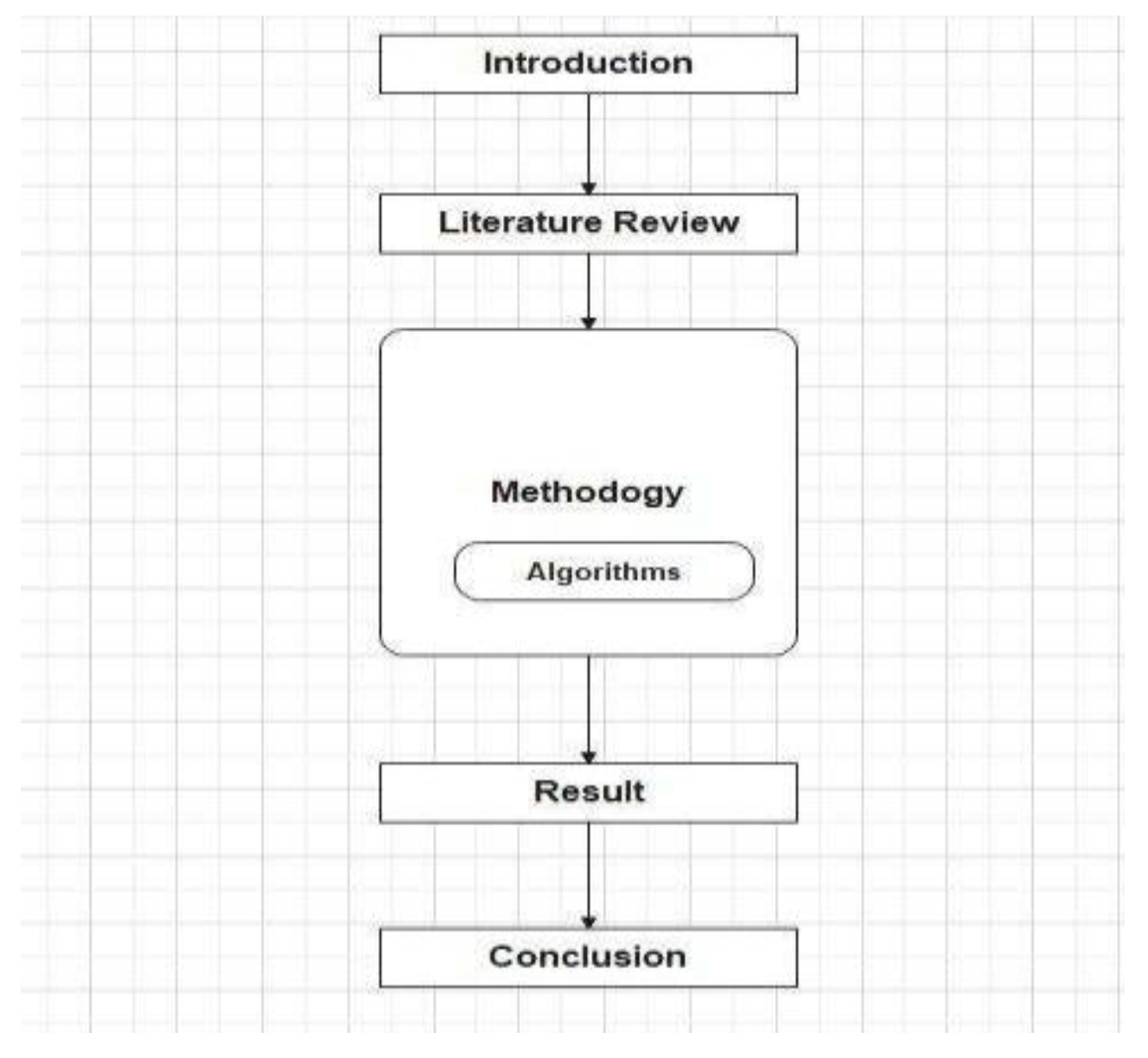
Figure 2.
Model Accuracy Comparison.
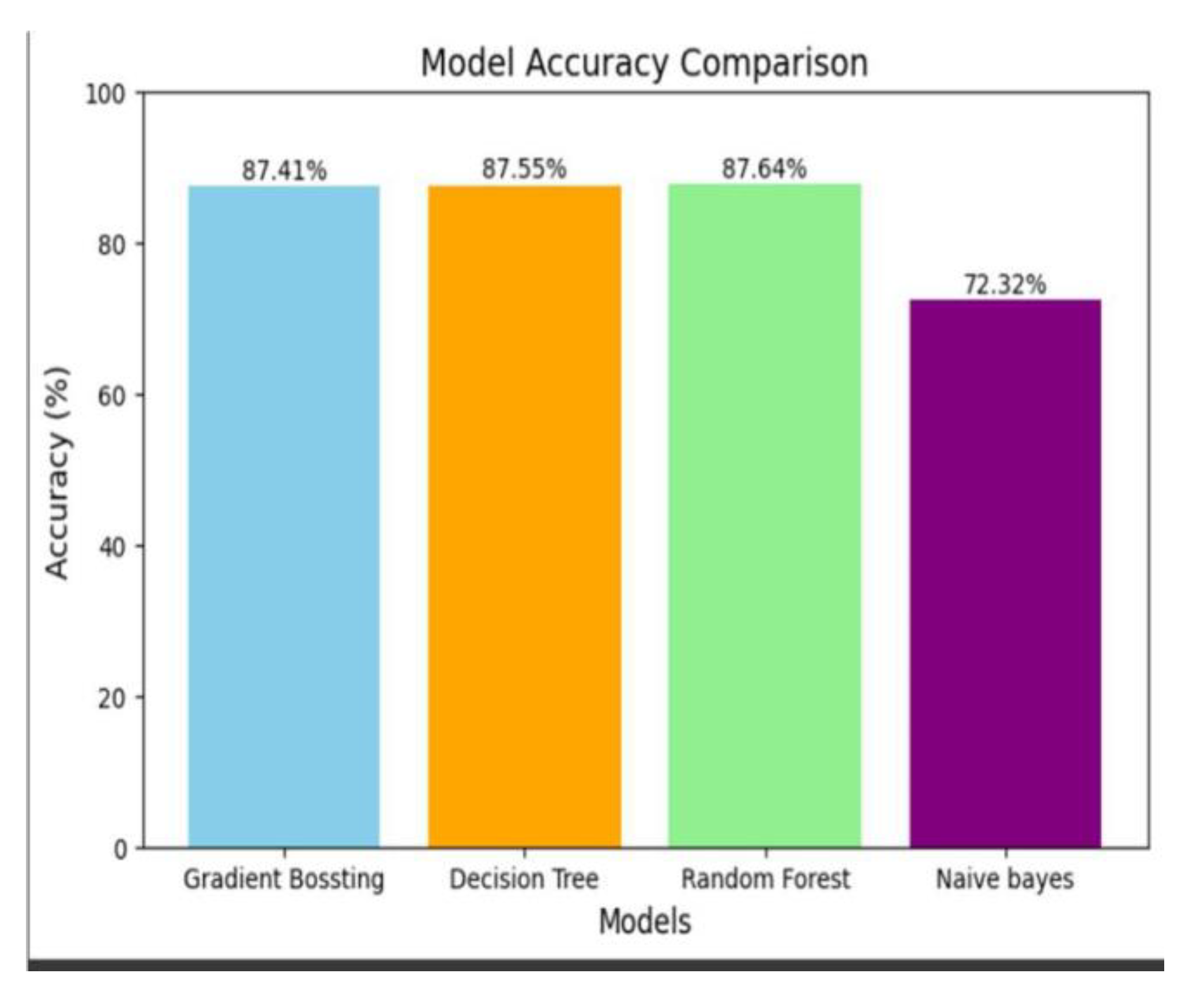
Table 1.
prediction of personality.
| Feature | Description |
| Age | Age of the person |
| Gender | Gender of the person (e.g., Male, Female) |
| Education | Indicates whether the person is educated or not |
| Introversion | Level of activity or engagement on social media |
| Sensing Score | Measures how practical or detail-oriented a person is |
| Thinking Score | Reflects the person’s logical reasoning ability |
| Judging Score | Indicates preference for planning and organization |
| Interest | Person’s areas of interest or hobbies |
Table 2.
Comparison of Accuracy.
| Algorithms | Accuracy |
|---|---|
| Gradient boosting | 87.41% |
| Decision Tree | 87.55% |
| Random Forest | 87.64% |
| Naive Bayes | 72.32% |
Disclaimer/Publisher’s Note: The statements, opinions and data contained in all publications are solely those of the individual author(s) and contributor(s) and not of MDPI and/or the editor(s). MDPI and/or the editor(s) disclaim responsibility for any injury to people or property resulting from any ideas, methods, instructions or products referred to in the content. |
© 2025 by the authors. Licensee MDPI, Basel, Switzerland. This article is an open access article distributed under the terms and conditions of the Creative Commons Attribution (CC BY) license (http://creativecommons.org/licenses/by/4.0/).
Copyright: This open access article is published under a Creative Commons CC BY 4.0 license, which permit the free download, distribution, and reuse, provided that the author and preprint are cited in any reuse.


