
Submitted:
19 November 2025
Posted:
20 November 2025
You are already at the latest version
Abstract
As the population arises everyday, road accidents also increase. More than half of all road traffic deaths and injuries involve vulnerable road users, such as pedestrians, cyclists and motorcyclists and their passengers. One of the many reasons is the lack of road lighting. Without sufficient road lighting, it is necessary to provide some means to guide the drivers along dark roads. Road studs are among the most important devices that help in preventing cars from running off the road or their lanes and making our roads safer. They reflect the light from a car's headlights to allow the driver to observe the curves and corners of the road from a distance. Even in the dark, the driver is easily able to see the road alignments, ends, and corners of the road and judge where to turn, what lane of the road to adopt and in turn, drive safely. This makes studs extremely useful on poorly lit roads. They provide effective night guidance even under adverse weather conditions. The aim of this study is to provide better understanding and to get an overview of the developments of road studs through time. The data collection has been carried out through the search engines Google Scholar and Google Search. Therefore limitations, selections and exclusions have been made by the authors. This study focuses only on the variables stated above, the effectiveness of road studs to road safety and visibility . The method for answering the research questions was conducted by systematic literature search and review.
Keywords:
road studs
; safety and visibility
1. Introduction
At night, car drivers could not see where the road ends and where the alignment of the road changes in direction. Without sufficient road lighting, it is necessary to provide some means to guide the drivers along dark roads. Road stud was based on the principle of cat’s eyes. When a ray of light enters the eyes of a cat, the light shall be reflected back towards the emitting source. As such, with the reflection of car’s headlights by road studs, it is possible to identify road conditions and alignment in darkness [17].
There are many cases in which traffic safety concerns may arise; these include riding bicycles with faint lights, walking in areas without street lamps, and insufficient nighttime illumination in rural mountain areas and on industrial roads [13]. Also, reflective road studs are used as a measure to assist drivers in low light by highlighting road features, such as lanes, carriageway edges, curvature, and junctions.
However, the problem with these conventional road studs, is that they only have a reflective portion and rely on car headlights for illumination. Reflective road studs do not allow the driver to have an effective reaction time [15]. Additionally, the power emitting from the vehicle headlights that reflects to the road stud can vary due to the effect of weather and the physical condition of the studs themselves. Intelligent road studs are a recent development which seeks to address such issues [6].
Therefore, it is important to take a closer look at the scientific literature on advancement and technologies on how to improve road safety under various conditions. The rapid development of science and technology is heavily reliant upon the exploitation of various energy sources [13] and gradually establishes an intelligent transportation system to facilitate traffic operation plans, mitigate traffic congestions, and improve traffic safety [4].
1.1. Purpose of the Study
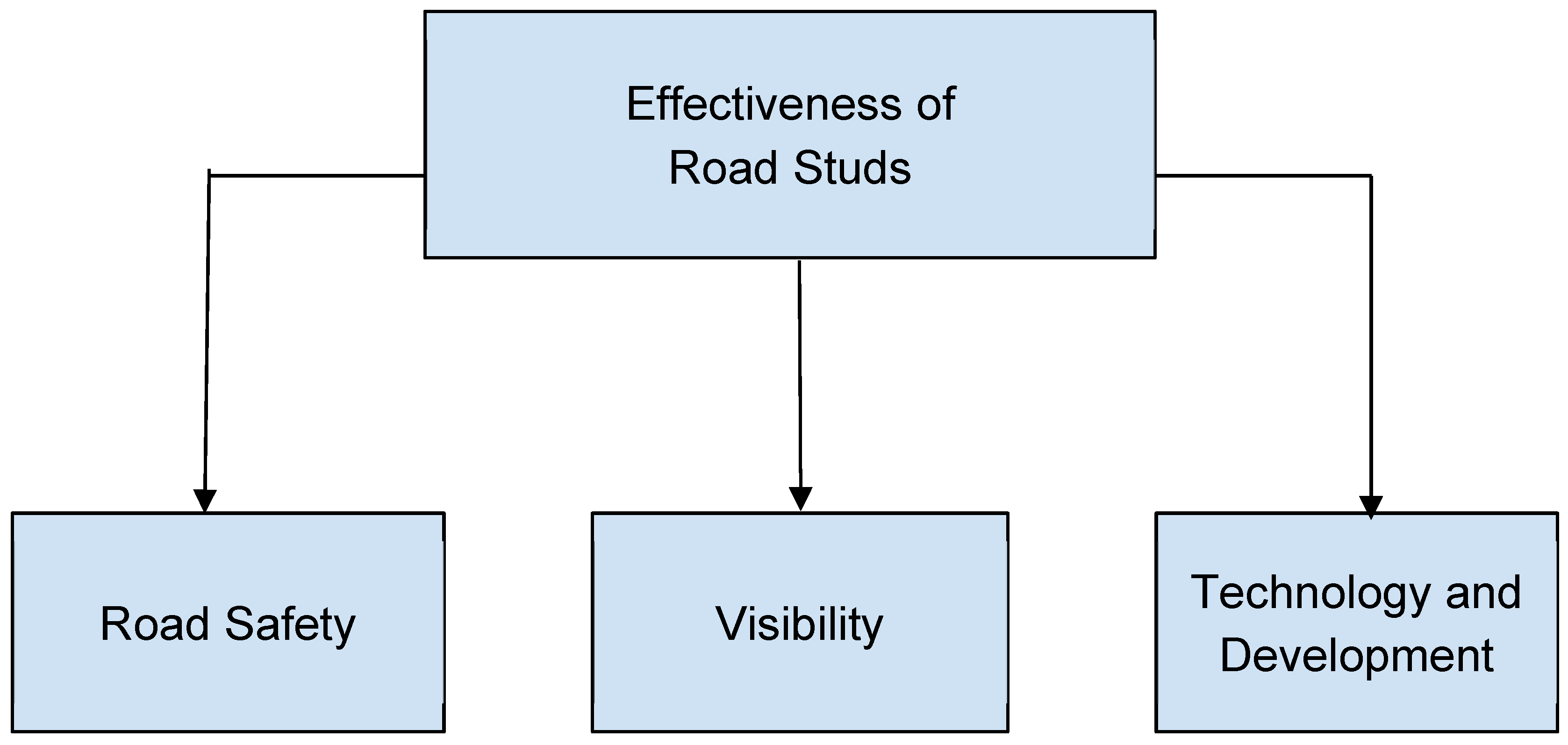
The aim of this study is to provide better understanding and to get an overview of the developments of road studs through time. This review is divided into 3 parts: (1) Road Safety - which focuses on road accidents; (2) Visibility - which can affect the driver’s reaction time and concentration; and (3) Technology - which addresses the developments such as energy storage and the use of stud as traffic monitoring device.
2. Methodology
The field of road safety precaution and measure today is quite large, and a wide range of research that deals with these matters led to a large number of scientific articles, reports and books. Therefore, the selections and limitations have been made by the authors. This research focuses only on road studs and through selections of keywords, limitations have been made.
The method for answering the research questions was conducted by systematic literature search and review. There are terms and combinations that have been used in order to collect correlated articles with regards to road studs like road studs, road light, road cat’s eye, solar stud, road stud technology, smart road stud, wireless road stud.
The data collection has been carried out through the search engine Google Scholar and Google Search. Overall, a minimum of 20 articles has been read through in order to develop an understanding of the development of the research on road stud safety applications. Therefore limitations, selections and exclusions have been made by the authors. This literature study focuses only on the 3 parts stated above.
Conceptual Framework
Figure 1.
Conceptual framework illustrating how the effectiveness of road studs contribute toimprovement in road safety, enhances roadway visibility, supports advancement in technology and development.
Figure 1.
Conceptual framework illustrating how the effectiveness of road studs contribute toimprovement in road safety, enhances roadway visibility, supports advancement in technology and development.
3. Road Safety
Road safety is a problem that all nations deal with on a daily basis. There are situations where there is little to no infrastructure to promote road safety in underdeveloped countries, particularly in rural areas. [8]. There are numerous ways to improve road safety, but each one has price and functional restrictions. Although having access to power is a basic requirement for many Intelligent Transportation System (ITS) developments in the industrialized world, its apparent lack in many developing places severely restricts many chances to increase road safety. A road safety solution that is adaptable and simple to deploy in terms of cost and complexity is required for emerging nations. Its reliance on regional infrastructure for things like electricity or other traffic safety features must also be kept to a minimum. [8]
Road studs are retroreflective compounds used on the road's surface to improve exposure in poor lighting and weather conditions. Before junctions, crossings, as well as the beginning of the flyover section, where the majority of accidents occur, road studs serve as a speed arrestor. [17]
According to Le Roux et. al. (2011), 34 km section of road had 7800 solar road studs installed as part of a two-year trial project in KwaZulu-Natal back in 2003, which resulted in a 70% reduction in nighttime accidents within a year of the studs' installation. Per the UK research, whilst using studs, motorists are less likely to breach solid center lines or swerve out of their lanes on a two-lane roadway and brake more consistently and early (Reed 2006). [8]
Thanks to their reflective surface, passive studs simply reflect light. This means that as the car speeds down the road, the headlights rebound off the studs to make it more visible for the driver. These are known as cat's eyes studs since its creator Percy Shaw was motivated to create them when he observed a cat's eyes reflecting in the dark. Active studs have LED lights that alert other drivers of impending dangers. They not only reflect light but also illuminate the road. A battery is installed in the studs, and it collects a daily solar charge. As dusk strikes, this kind of stud begins to illuminate. [18]
Shahar, Bre´mond & Villa (2016), simulated experiment compared driving at night on country roads in three different lighting scenarios: without lighting, with typical road luminaires shining on curves, and with an active lane delineation system that activates self-luminous road studs to outline the lane and road edges as the driver approaches and passes the curves. There was a collective total of 16 curved and 16 straight road stretches under each of these situations. Three road segments were taken into consideration around each bend, adding a second element called "road section" to the assessment. Eight left and eight right turns, each with a radius of 200 meters, and four longer turns, each with a radius of 400 meters, made up the 16 curves. This was done to decrease the anticipation of the route layout and boost flexibility in the driving simulation experience. The respondents reviewed and signed an informed consent form before the experimental sessions commenced, and they also completed a survey to disclose some background information and their driving history. They were informed that they'd be partaking in a driving experiment that would involve driving in a car simulator, responding to questions, and simulating realistic driving. Despite the exception of left curves, where the lateral position may be quite far from the carriageway center, up to 28 cm in the dimly lit condition, the analysis of lateral position disclosed that participants drove near the center of their lane in all illumination conditions — the mean distance is lower than 11 cm from the lane center. The assessments also indicate a benefit of the studs in contrast to the luminaires condition, with shorter crossovers in right turns in the stud’s condition as well as a smaller standard deviation of the lateral position in left curves. [1]
1. Visibility
In the article published by Llewellyn and Ladyman (2016), inattentional blindness is a phenomenon that happens when a person's thoughts are so concerned with a side task that they lose focus on the main task they were working on and miss something that would normally be obvious. Since the development of the automobile, this situation has impacted drivers, and it is growing more significant as the number of possible distractions inside and outside of contemporary vehicles rises. The research conducted indicated that almost all vehicle kinds and movements examined had a lowering in lane transgression behavior after the intelligent road stud was installed. Between 33% and 60% less vehicles were exposed to the possibility of accidents as a result of the reduction in transgressions. Following the installation of the studs, it was observed that driver behavior was more predictable and consistent. The likelihood of automobile collisions has decreased as a consequence of better lane discipline. The greater consistency of routes through the roundabout may potentially have advantages for traffic flow. [13]
C. Villa et al. (2014) conducted a test on a French closed track. The stud was installed at a 0-degree horizontal angle. According to preliminary tests, the road stud was still visible at 69 meters even with the lowest luminous intensity that was available. The horizontal illuminance actually changed during the visibility investigation when it was performed during the daylight hours depending on the time of day and the position of the sun. [4]
L. Holdridge (2020) revealed that reflective road studs have been utilized in South Africa for 40 years, and that the issue with these traditional road studs is that they only have a reflective part that relies on automotive headlights for illumination. However, at 100 km/h, solar road studs, which illuminate the road for up to 1000 m, lengthen the driver's response time to possible dangers by three to thirty seconds. This shows that solar would be favorable when glare is present because it would help the driver stay on the road by providing illuminated guidance in the event of glare from street lamps, headlights, and other sources as opposed to the traditional reflective road studs. [10]
Alexis Bacelar (2004) conducted a poll on how three bright studs were perceived by drivers in terms of visibility, comfort, and driving aid (car and scooter drivers). His case study was conducted on a 400-meter by 7-meter test track at the CETE Normandie-Centre in Roeun, France. One month before the test, an experiment was carried out with observers to determine the stud height and spacing. Seventeen observers and eight guests drove in one direction for fifteen minutes during the actual experiment. [2]
Llewellyn & Ladyman (2016) studies how intelligent transportation technologies, such as LED road studs, can increase road safety by reducing external driving distractions. It is shown that the installation of intelligent road studs significantly lowers the number of lane transgressions at the roundabout using before and after video surveys. Results were determined to be reliable for every kind of vehicle, both during the day and at night. Driver behavior was shown to be more consistent and predictable after the studs were installed. Improvements in lane discipline have decreased the likelihood of automobile collisions. The increased predictability of the roundabout's routes may help improve traffic flow. [13]
4. Development and Technology
Wang, Quan & Ochieng (2019) stated that vehicle detection and traffic control are two of the many ITS platforms that help the development, execution, and implementation of measures to mitigate congestion problems, enhance safety, and increase the effectiveness of road transport operations. It is recognized that information technology continues to transform the world's transportation systems. [7]
With the introduction of remotely programmable solar road stud networks, traffic control and road safety have both been enhanced. In particular, adopting GSM connectivity reduces the number of collisions and casualties, especially in poor nations as part of contemporary, energy-free road safety. [8]
Zhimin, Wei & Hua (2022) - to improve traffic sensing infrastructure, smart road studs (SRS) were developed as a sensor network. SRS are distinguished by their features in traffic monitoring, range wireless data transmission, self-sustained power source, and remote custom controlled lighting-based traffic guidance. SRS nodes are positioned on lane lines rather than lane centers, in contrast to conventional traffic detectors and road studs, to enable applications other than detection, such as traffic monitoring, congestion warning, routing guidance, and so forth. SRS uses three-axis magnetic sensors to identify cars. Accordingly, under various operational conditions, a vehicle detection algorithm is suggested to count automobiles in two neighboring lanes. The precision of its detection can be further increased by a sensor network made up of several SRSs working together. Results from field tests reveal that, even when drivers deviate from the norm by crossing lanes, the SRS network's vehicle recognition accuracy is still 98% per lane, the same level as the commercial detector positioned in the middle of the lane. The vast range of applications for SRS networks as a component of intelligent traffic detection infrastructure are made possible by their excellent performance, value-added service, and low cost. [21]
Le Roux, Barnard & Booysen (2013) proposed a system of wirelessly interconnected road spikes that can be remotely managed through a website. The proof-of-concept demonstrator described in this paper is made up of three functional components: the coordinator unit, which receives commands from the platform via a GSM modem and then transmits the pertinent data to the road studs via a based wireless network. The online SMART platform, which is used to transmit commands to the road studs in the field via a GSM connection. The technique significantly enhances traffic control and road safety. Given that it can be used on existing roadways and is not dependent on regional energy sources, it is especially geared toward developing nations. [8]
O’Connor, Casey & Faber, comparing the COMPANION system to Intelligent Road Stud allowed researchers to assess the system's influence on driver behavior, especially speed (IRS). Therefore, the review aimed to guarantee that the IRS were technically sound and had a comparable favorable effect on drivers as the COMPANION system. The evaluation's findings indicate that, while the system was unavailable for 3% of the trial time owing to maintenance, it was available for 96.4% of it. Additionally, the analysis demonstrates that all speed activations occurred when necessary and that fog activations have a strong association with independent meteorological data. The system has received mostly excellent feedback, with the one complaint being that the studs are too bright at night. A retrofit dimming facility was used to address this. Additionally, lane change movements, headway, and speed all decreased when the flashing studs were activated. [9]
5. Conclusions
The purpose of this research is to know the benefits of road studs in road safety and visibility. Road stud research uses a variety of approaches and objectives, but most of them lead to the same conclusions. It has been determined that road studs can be utilized to lessen traffic accidents, which will lower the number of injury and fatality cases. Studies have shown that road studs aid in increasing nighttime driver vision, particularly in rural areas where some roads are not illuminated. Furthermore, the presence of these studs improves or speeds up drivers' concentration and reaction times in various weather situations. As technology advances, standard road studs become more intelligent, both in terms of their mechanical and physical characteristics. According to studies, intelligent road studs can monitor the flow of traffic to increase road transport operations' effectiveness and safety.
Recommendation
Future researchers should make further evaluation measures of road studs. Without good evaluations, measures and methods, it can be very difficult to draw proper conclusions about what actually affects safety and visibility of road studs. Here before- and after studies could be very valuable in evaluating road studs.
References
- A Shahar PhD, R Bre´mond PhD and C Villa PhD: Can Light Emitting Diode-Based Road Studs Improve Vehicle Control in Curves at Night? A Driving Simulator Study. Lighting Res. Technol., 0, 2016, 1-19. [CrossRef]
- Alexis BACELAR: Definition of a Luminous Stud to Improve the Legibility of Expressway for Drivers. J. Light & Vis. Enc, 28, 2004, 148-151. [CrossRef]
- Amit Shahar, Roland Bremond: Toward Smart Active Road Studs for Lane Delineation. Transport Research Arena, 2014, 1-10.
- C. Villa PhD, R. Bremond PhD and E. Saint Jacques: Visibility and Discomfort Glare of LED Road Studs. Lighting Res. Technol., 0, 2014, 1-19. [CrossRef]
- Dragan Samardˇzija, Nikola Tesli´, Branislav M. Todorovi´c, Erne Kovaˇc, Dorde Isailovi´c, and Bojan Miladinovi´c: Road Nail: Experimental Solar Powered Intelligent Road Marking System. Journal of Electrical Engineering, 63, 2012, 65-74. [CrossRef]
- Hamdy Faheem, PhD: Effectiveness of Using Cat-Eye Reflectors as Warning And Traffic Calming Devices In Local Roads And Highways. International Conference on Road Safety and Simulation, 3, 2011, 1-15.
- Hua Wang, Wei Quan & Washington Yotto Ochieng: Smart Road Stud Based Two-Lane Traffic Surveillance. Journal of Intelligent Transportation Systems, 2019, 1-13. [CrossRef]
- J.H. Le Roux, A. Barnard and M.J. Booysen: Remotely Controllable Wireless Road Stud Network. [CrossRef]
- Linda O’Connor, Joanne Casey and Faber Maunsell: Trial And Evaluation Of Intelligent Road Studs For Hazard Warning. [CrossRef]
- Lucinda Holdridge: Solar Road Studs: An Innovative Solution to Increase Visibility and Safety on South Africa’s Roads. Western Cape, 2012, 66-68.
- Lung-Yin Lin and Yu-Shing Chang: Modular Design Using Sustainable Luminescent Materials in Energy-Saving Reflective Cat’s Eyes for Public Road Safety Planning. Journals of Renewable Materials, 10, 5, 2022, 1416-1437. [CrossRef]
- M F Hazim (2022), Effectiveness of and Public Perception about the Installation of Transverse Rumble Strips with Road Studs: IOP Conference Series: Earth and Environmental Science, 971, 2022, 1-17. [CrossRef]
- Mr Richard Llewellyn, Dr Stephen Ladyman: Inattentional Blindness and Road Safety: The Potential Role of Intelligent Road Studs in Reducing Accidents. ITS European Congress, Glasgow, 2016, 1-11.
- Richard Llewellyn ,Jonathan Cowie and Mike Maher: Active Road Studs as an Alternative to Lighting on Rural Roads: Driver Safety Perception. Sustainability, 12, 9648, 2020, 1-16. [CrossRef]
- Richard Llewellyn , Jonathan Cowie and Grigorios Fountas: Solar-Powered Active Road Studs and Highway Infrastructure: Effect on Vehicle Speeds. Energies, 14, 2021, 1-15. [CrossRef]
- Richard Llewellyn: Improving Lane Adherence at Signalized Roundabouts with Intelligent Road Studs – A Case Study. Transport Research Institute, 2017, 1-8.
- Road studs - types, requirement, and placement. The Constructor. (2020, March 28). Retrieved September 30, 2022, from https://theconstructor.org/transportation/road-studs-types-requirement -placement/38724/.
- Seo. (2021, July 23). Road studs: What are their advantages and what are they used for? Sportsmark. Retrieved September 30, 2022, from https://www.sportsmark.net/road-studs-what-are-their- advantages-and-what-are-they-used-for/?v=79cba1185463.
- Singh, K. (2017, May 4). What is the purpose of road studs in roads? Civil Engineering Portal - Biggest Civil Engineering Information Sharing Website. Retrieved September 30, 2022, from https://www.engineeringcivil.com/what-is-the-purpose-of-road-studs-in-roads.html?fbclid=IwAR3g947GKlCoFB3kRKhOD-RrCKjZOrMlNDUSBqkr03bBsScwtj9C5IQ8g3g.
- What are the advantages and disadvantages of LED solar studs? Henan Ruichen Traffic Equipment Co., LTD. (n.d.). Retrieved September 30, 2022, from https://www.rctraffic.com/exhibition-news /news /what-are-the-advantages-and-disadvantages-of-led-solar-studs.html.
- Zhimin Tao, Wei Quan, and Hua Wang: Innovative Smart Road Stud Sensor Network Development for Real-Time Traffic Monitoring. Journal of Advanced Transportation, 8830276, 2022, 1-9. [CrossRef]
Disclaimer/Publisher’s Note: The statements, opinions and data contained in all publications are solely those of the individual author(s) and contributor(s) and not of MDPI and/or the editor(s). MDPI and/or the editor(s) disclaim responsibility for any injury to people or property resulting from any ideas, methods, instructions or products referred to in the content. |
© 2025 by the authors. Licensee MDPI, Basel, Switzerland. This article is an open access article distributed under the terms and conditions of the Creative Commons Attribution (CC BY) license (http://creativecommons.org/licenses/by/4.0/).
Copyright: This open access article is published under a Creative Commons CC BY 4.0 license, which permit the free download, distribution, and reuse, provided that the author and preprint are cited in any reuse.