

Submitted:
14 November 2026
Posted:
17 November 2026
You are already at the latest version
Abstract
We apply Newton's Shell Theorem to the interior of a black hole modelled as a uniform-density sphere of mass and Schwarzschild radius. By the Shell Theorem, only the mass inside the radius contributes to gravity, maximal at the surface and zero at the centre. Gravitational pressure therefore has an ever-diminishing gradient towards the centre of a black hole. Comparing with standard Mott pressure-ionization thresholds, we show that Fe breaks essentially at the surface of a black hole, 68 m below the surface of Sgr A*, and never in the Earth. The region of instability is a skin, not a centre. There is no singularity to be crushed to, no firewall, and no information loss. Jets and winds are a release of energy from the skin where matter breaks.
Keywords:
black holes
; shell theorem
; mott pressure-ionization thresholds
; gravitational singularity
; atoms instability
1. Introduction
In the model developed here, the curvature of space is not a primitive geometric structure. It is developed by the variable energy density of space. Gravity is carried by the energy density of space and is directed towards the region of lower energy density, which is located in the centre of stellar objects [1].
The dynamical quantum vacuum (DQV) is therefore characterized by a variable energy density ρqvE, whose spatial gradient generates the gravitational field. In intergalactic space, where ρqvE attains its maximal value, the Planck energy density ρpE, space is flat. In the vicinity of a massive object, ρqvE is diminished, and the resulting gradient ∇ρqvE is directed towards the centre of the object. Gravity is, in this picture, the manifestation of the variable energy density of space, not the curvature of an independent spacetime manifold [1,2,3].
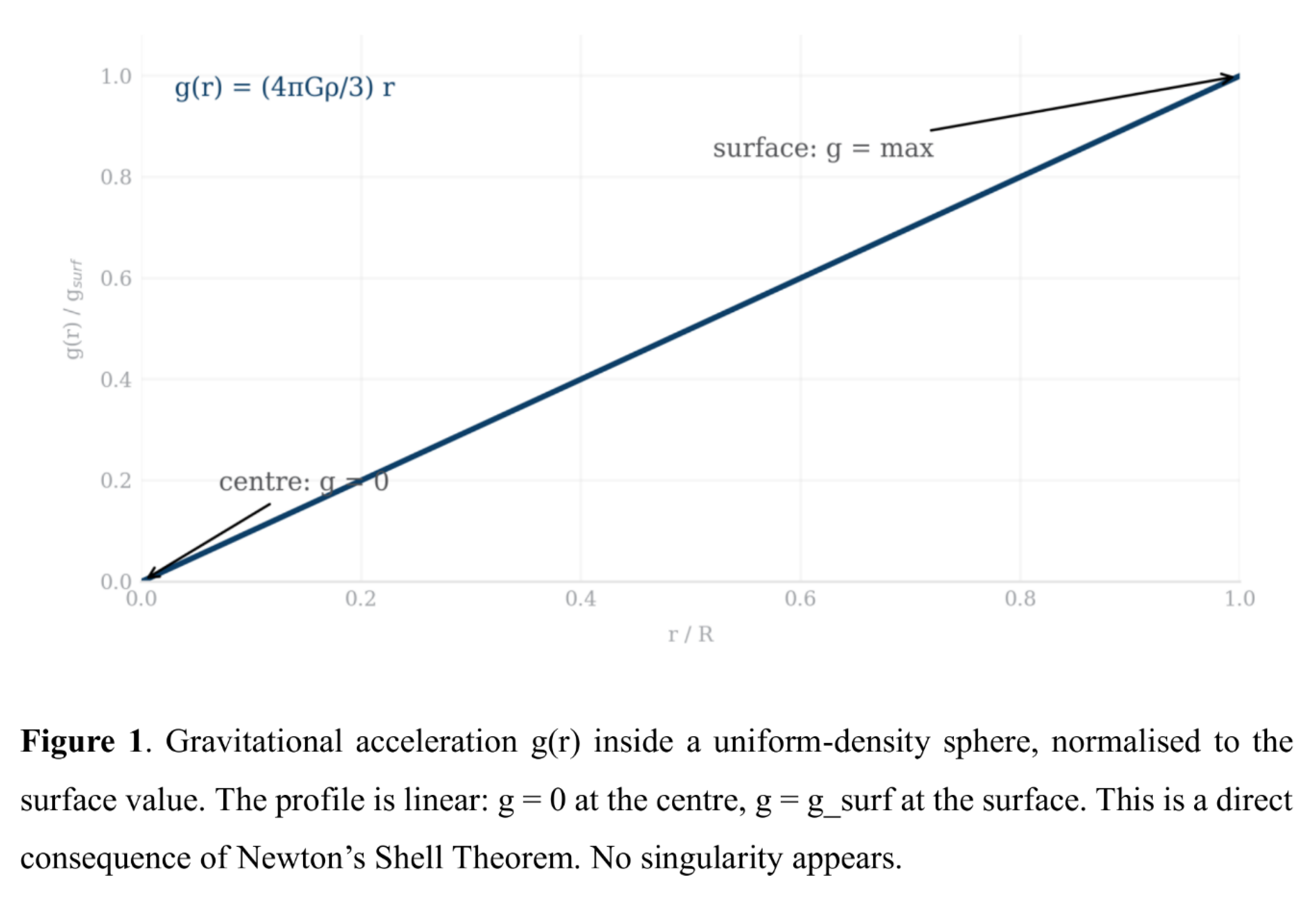
Newton’s Shell Theorem remains valid also for black holes. For a spherically symmetric mass distribution, only the mass interior to a given radius r contributes to the gravitational field at r. Consequently, the gravitational acceleration is maximal at the surface of the black hole and declines monotonically towards the centre, where it vanishes [4]:
g(r) = GM(r)/r2= 4πGρ/3 r, g(R) = gsurf, g(0) = 0.
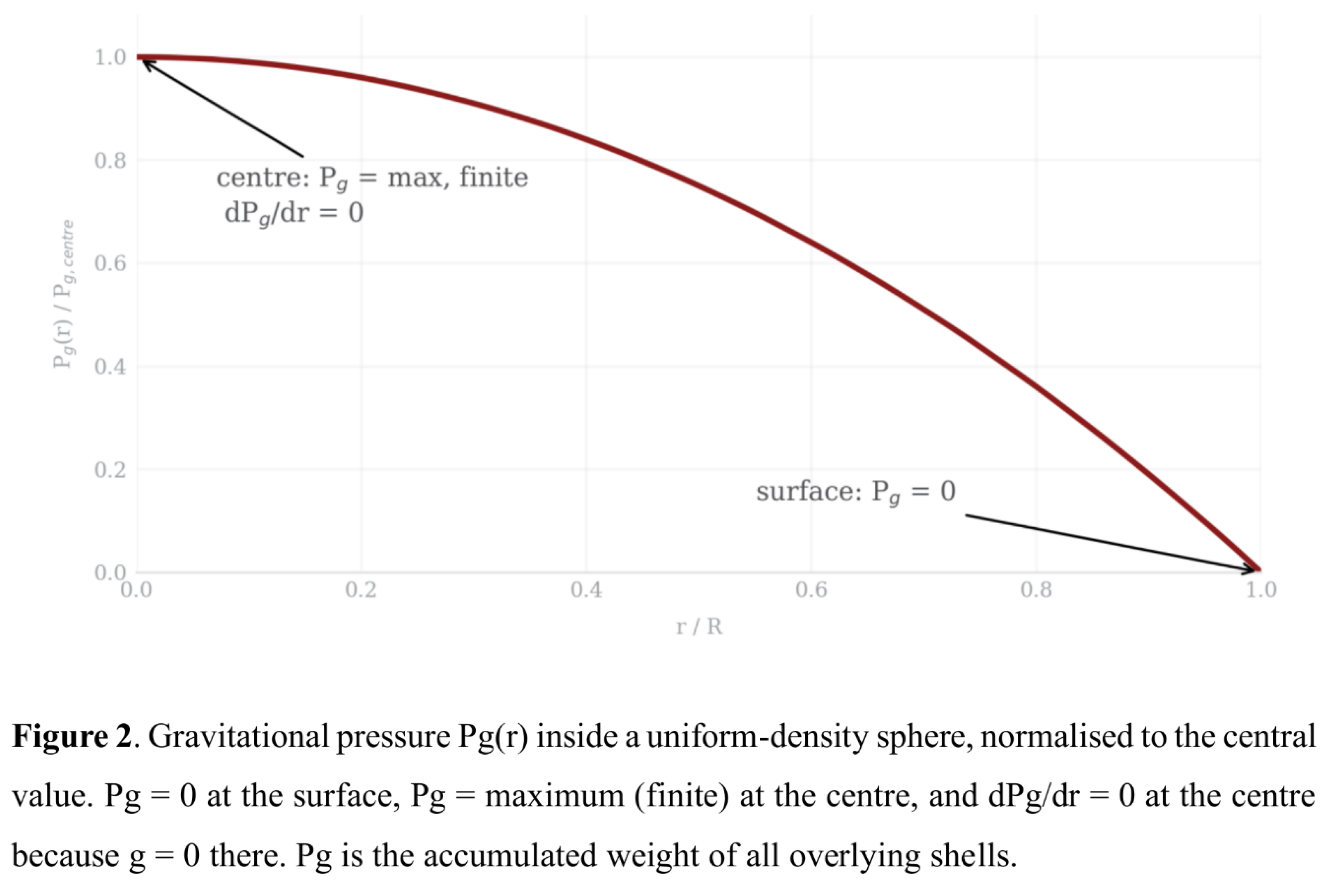
The gravitational pressure Pg, generated by the weight of the matter itself, is therefore maximal at the centre, where it attains the finite value Pg, centre = (2π/3)Gρ2R2, although the local gravitational acceleration there is zero. This distinction between local gravity and accumulated gravitational pressure is central to the present work: atoms become unstable not where gravity is infinite, but where gravitational pressure exceeds the Mott pressure-ionization threshold, close under the surface of the black hole [4].
2. Newton’s Shell Theorem and Gravitational Pressure Inside a Black Hole
2.1. The Shell Theorem
Newton’s Shell Theorem (1687) states two results that are exact in Newtonian gravity. For a thin spherical shell of mass M, (i) the gravitational field inside the shell is zero, and (ii) the field outside the shell is the same as if the whole mass were concentrated at the centre, g = GM/r2 [4].
For a solid sphere, the field at radius r is therefore produced only by the mass interior to r. The outer shells contribute nothing. This is the whole content of the theorem, and it is sufficient to determine the interior field without any assumption about general relativity, quantum gravity, or a singularity.
We model the black hole as a spherically symmetric body of total mass M, radius R = 2GM/c2 (Schwarzschild radius), and, as a first model, uniform mean density ρ = M / (4πR3/3). The uniform-density model is deliberately conservative: any central concentration of mass can only increase the central gravitational pressure calculated below, and therefore can only strengthen the conclusion [5].
2.2. Gravitational Acceleration Inside the Black Hole
The mass interior to radius r is
M(r) = (4/3)π r3ρ.
Hence, by the Shell Theorem, the gravitational acceleration at r is
g(r) = GM(r)/r2= (4πGρ/3) r.
Equation (1) is linear in r. It is maximal at the surface,
and it vanishes at the centre, g(0) = 0. There is no point in the interior where gravity diverges. The statement that gravity becomes infinite at the centre of a black hole corresponds to a point mass, not to an extended spherical mass. For an extended mass, the Shell Theorem forbids it.
gsurf= GM/R2= (4πGρ/3) R,
 |
2.3. Gravitational Pressure Pg: Derivation
Gravitational pressure Pg is defined here as the pressure created by the weight of the matter itself. It is not thermal pressure, radiation pressure, or degeneracy pressure, although those may add to it. It is the pressure that gravity alone must produce to support the weight of the overlying shells.
Consider a thin shell at radius r, thickness dr. In equilibrium, the pressure difference across the shell balances its weight:
dPg/dr = − ρ g(r) = − ρ (4πGρ/3) r.
With the boundary condition Pg(R) = 0 at the free surface, integration from r to R gives
Pg(r) = (2π/3) G ρ2(R2− r2).
In terms of depth below the surface, d = R − r,
Pg(d) = (3c4/32πGR4) (2Rd − d2).
The central value is finite:
Pg,centre = (2π/3) G ρ2R2.
Two properties of Pg are decisive. First, Pg is maximal at the centre, although g itself is zero there. Pg at the centre is the accumulated weight of all shells above it, not the local gravity. Second, the gradient dPg/dr vanishes at the centre because g = 0. Gravitational pressure therefore saturates smoothly towards the centre: it has ever-diminishing gradient, and no divergence.
For shallow depths, d ≪ R, Eq. (4) reduces to the linear skin formula used throughout this paper:
Pg(d) ≈ (3c4/16πGR3) d = 2 Pg,centre (d/R).
 |
2.4. Numerical Values: Five Objects on the Same Model
Table 1 applies the same uniform-density model to five objects, so that the comparison is on equal footing. Earth and the Sun are controls: the same formulae, the same Mott thresholds, no black hole. Sgr A* and M87* are supermassive black holes. The 3 M⊙ black hole is the stellar case. For black holes, R is the Schwarzschild radius R = 2GM/c2.
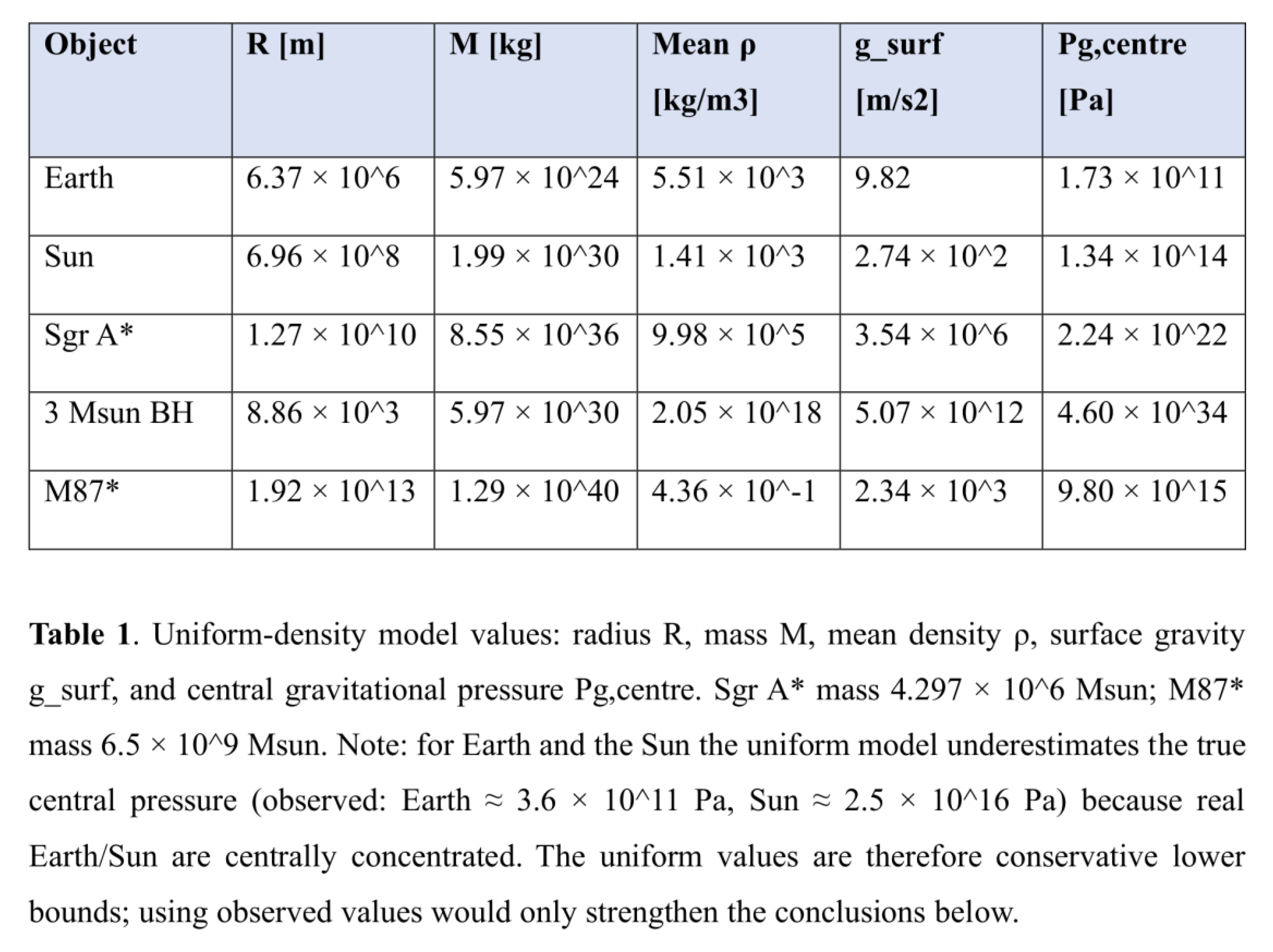 |
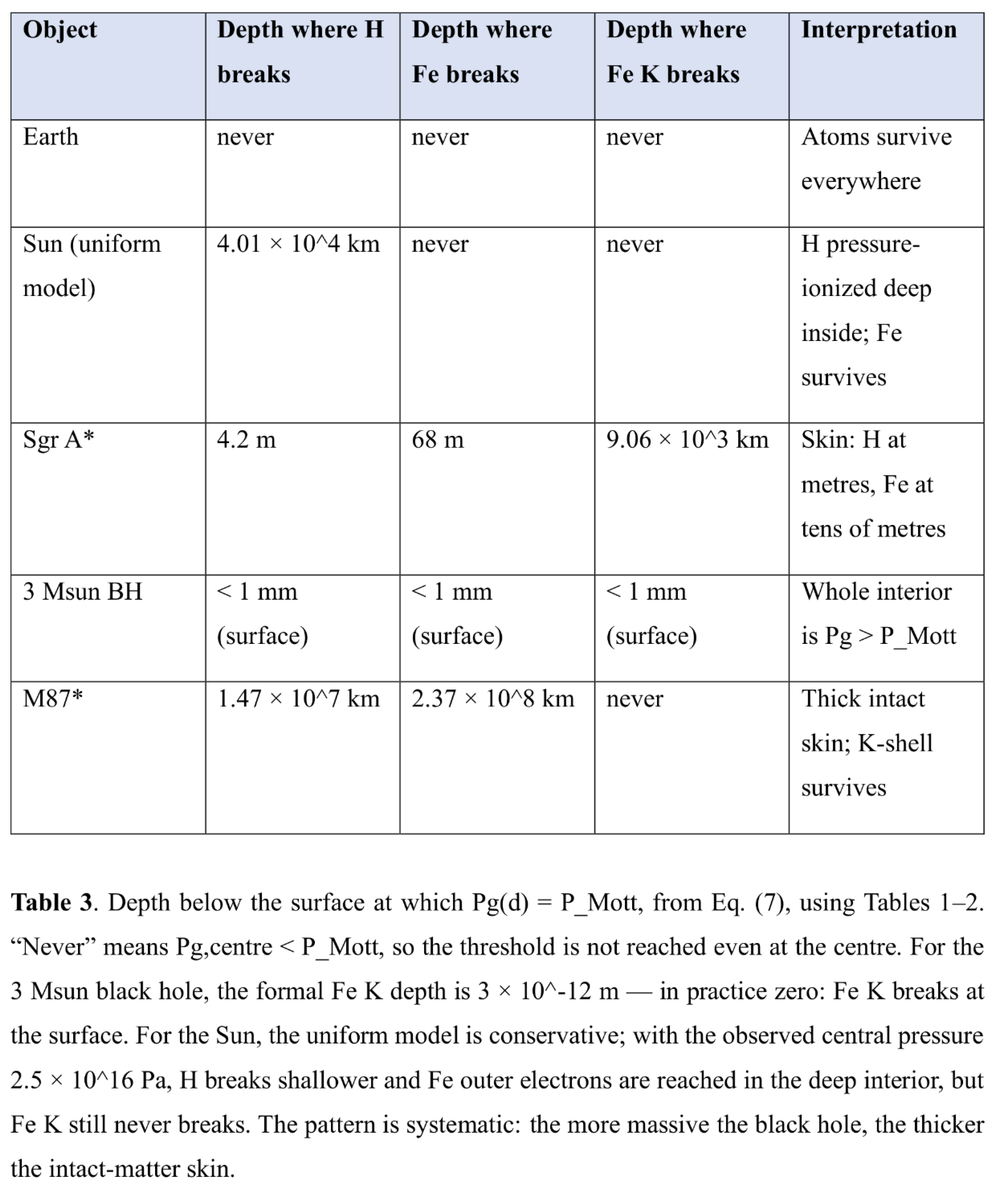
The pattern in Table 1 is the core of the paper. As mass increases at fixed Schwarzschild radius, mean density falls as ρ ∝ 1/M2, surface gravity falls as gsurf ∝ 1/M, and central gravitational pressure falls as Pg,centre ∝ 1/M2. A stellar black hole is therefore the most violent object in the table; a supermassive black hole is, per unit volume, gentle. This is why the same Mott threshold is crossed at the surface in one case and kilometres deep in another, and why M87* never reaches the Fe K-shell threshold at all (see Table 3).
2.5. The Instability Criterion: Pg Crosses Mott
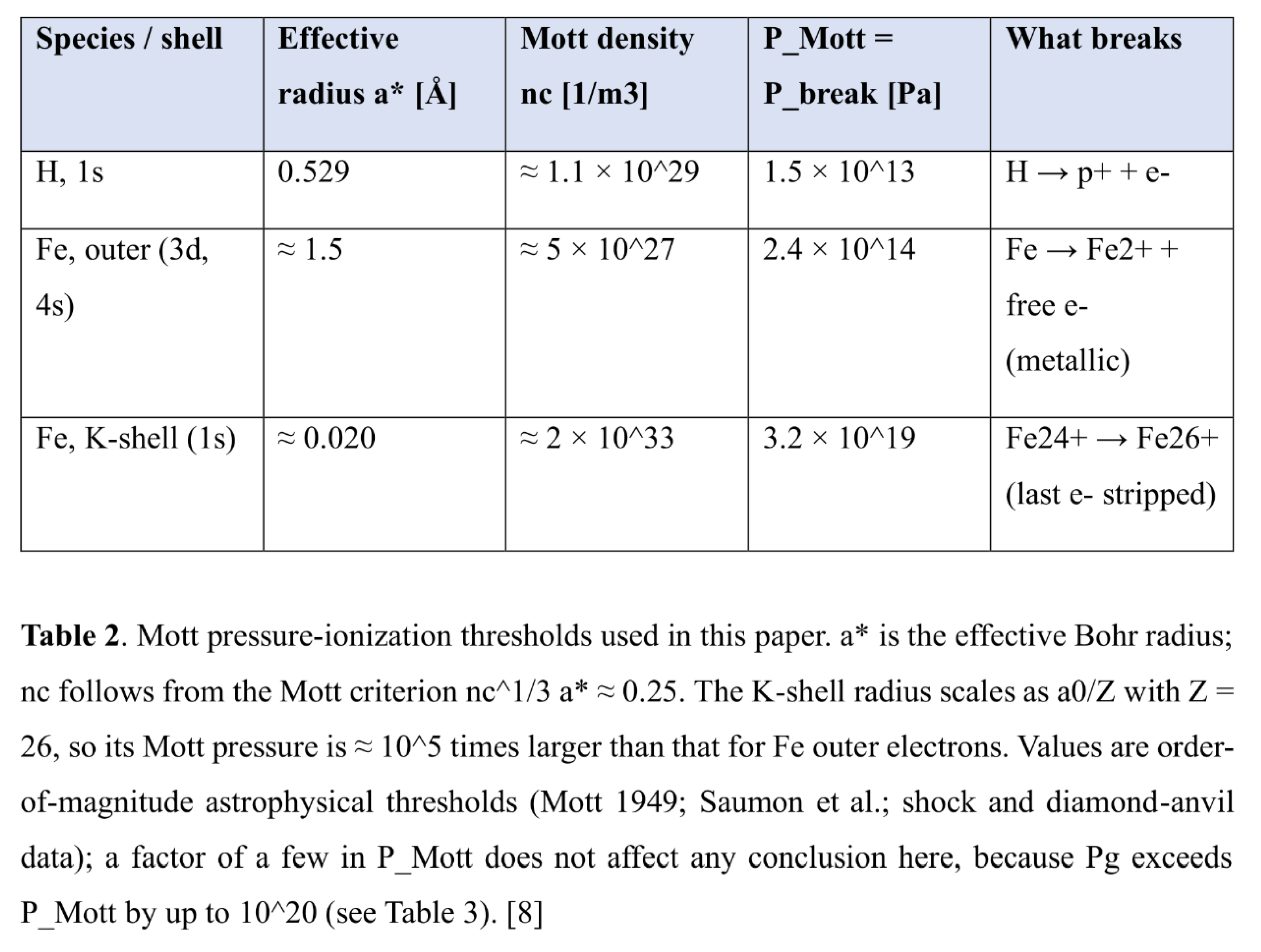
The Mott criterion (Mott, 1949) is: an atom dissolves when the distance between atoms becomes comparable to the size of the atom, d ≈ 4a*, where a* is the effective Bohr radius. Electron clouds then overlap, the electron can no longer be assigned to a single nucleus, the band gap closes, and the bound state ceases to exist. This is pressure ionization. It is measured in diamond-anvil cells, in shock experiments, in Jupiter (metallic hydrogen), and in white dwarfs (fully pressure-ionized matter). It is not a hypothesis invented for black holes [6].
Each atom therefore has a Mott pressure PMott — the gravitational pressure needed to squeeze it to d ≈ 4a*. Table 2 lists the three thresholds used in this paper [6,7,8,9].
 |
The instability criterion of this paper is a single inequality, comparing a property of the atom (Table 2) with a property of the black hole (Table 1, Eq. 3):
If Pg(r) > PMott→ atom breaks.
If Pg(r) < PMott→ atom survives.
The depth d at which Pg(d) = PMott is obtained exactly from Eq. (4):
d = R (1 − √(1 − PMott/Pg,centre)), if PMott< Pg,centre; otherwise never.
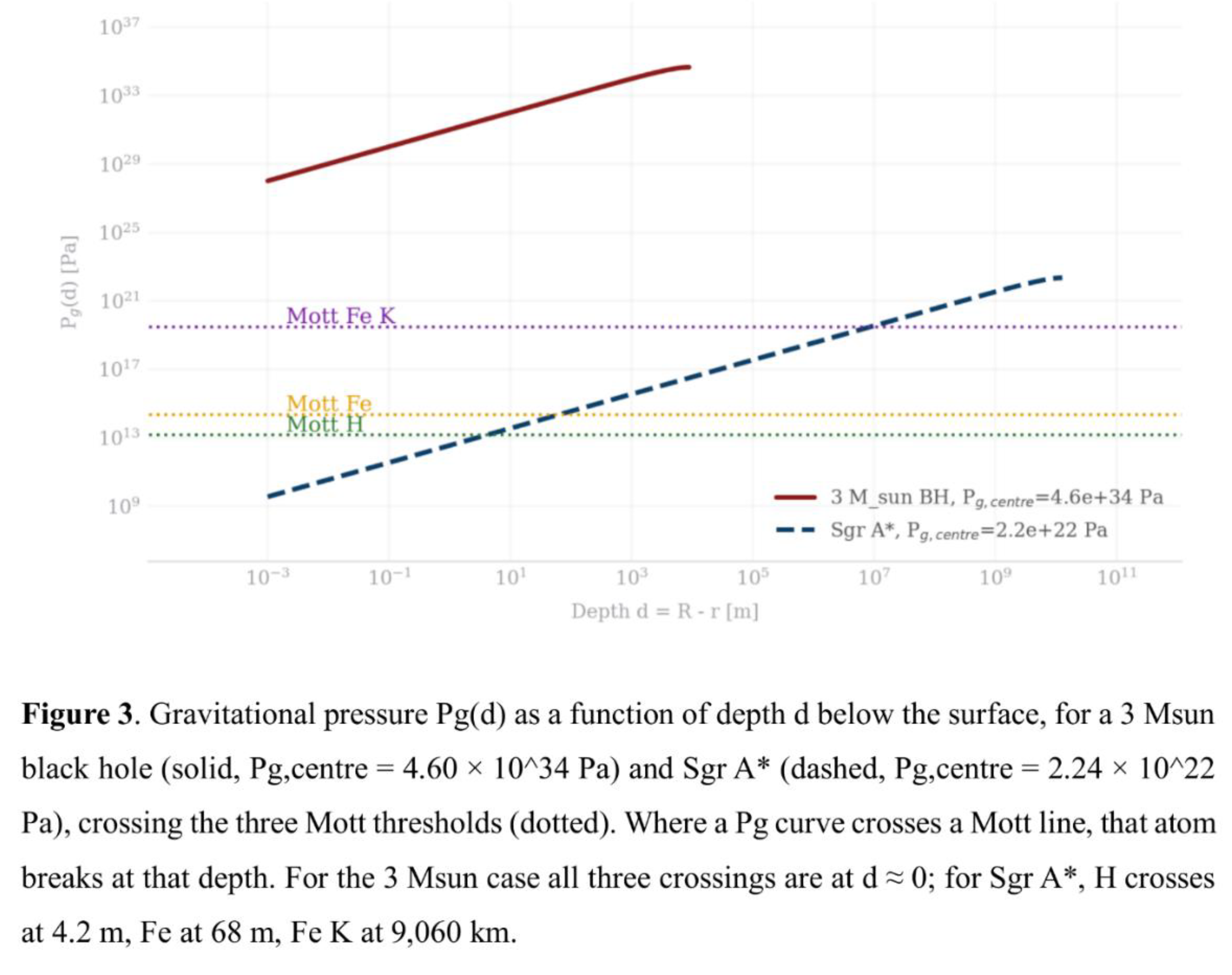
Figure 3 makes the argument visual. The Mott lines are horizontal: they are atomic physics, independent of the black hole. The Pg curves rise with depth: they are gravity, independent of the atom. Where they cross, the atom dies. The region of instability is therefore a skin of thickness dMott, not a point at the centre. In the 3 Msun case the skin thickness is zero for all practical purposes; in Sgr A* it is metres for H and Fe and thousands of kilometres for Fe K; in M87* it is millions of kilometres, and Fe K never breaks. The same physics, the same equations, three different skins. [6].
 |
 |
3. Discussion
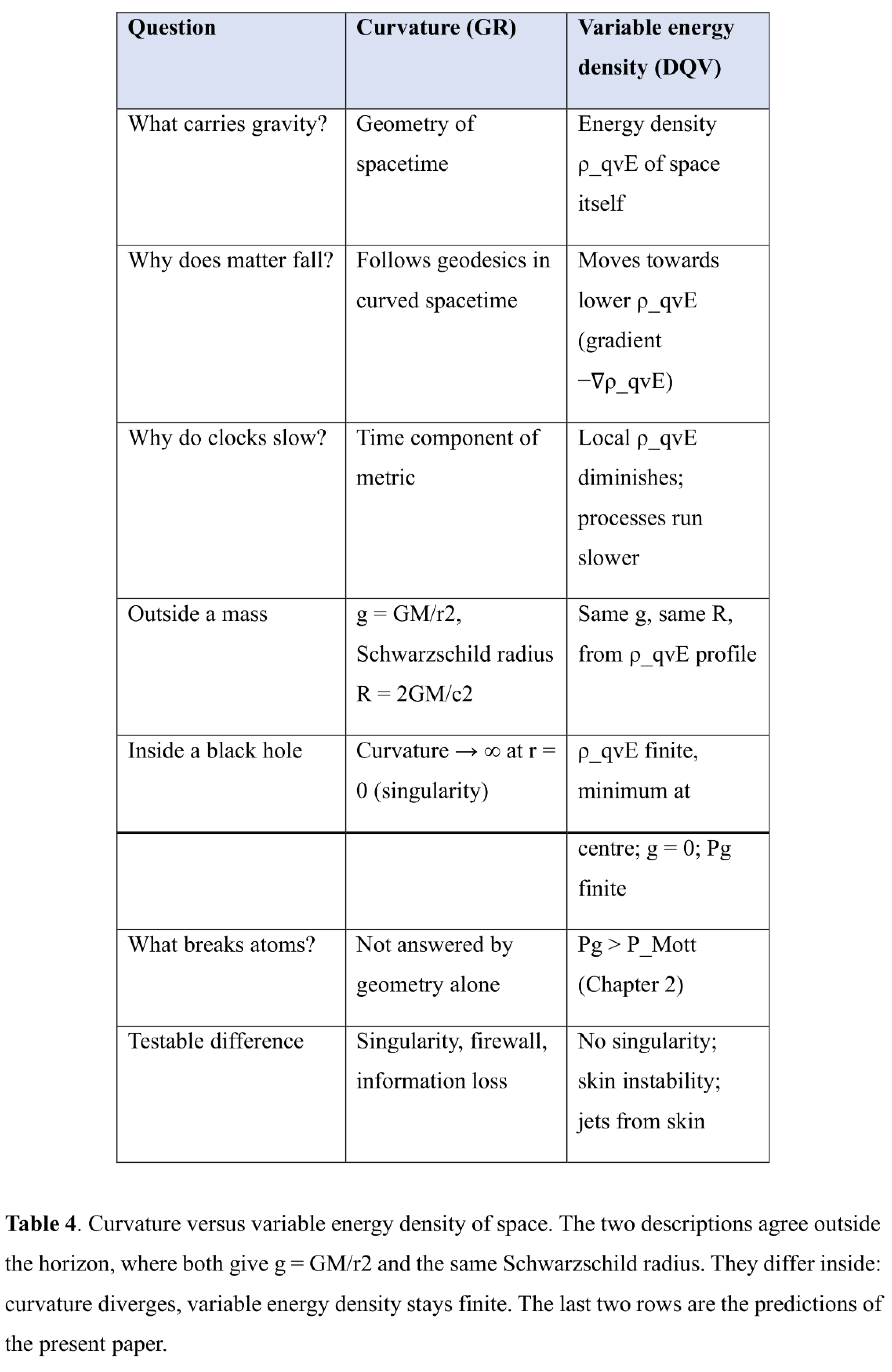
The results of Chapter 2 do not require a new hypothesis about the interior of a black hole. They require only Newton’s Shell Theorem and the Mott criterion. In this Discussion we make explicit why the model used in Chapter 1 — the variable energy density of space — is not an additional assumption on top of those results, but a good replacement for curvature itself. It gives the same gravitational phenomena with a physical carrier, it removes the singularity by construction, and it explains why the Shell Theorem, gravitational pressure, and Mott instability belong together in one picture [1,4,6].
3.1. What Curvature Was Supposed to Do
In general relativity, gravity is geometry. A massive body curves spacetime, and test particles follow geodesics in that curved geometry. The Schwarzschild solution gives, outside a spherical mass, the familiar g = GM/r2, and inside a point mass it gives a curvature singularity at r = 0, where curvature invariants diverge and the theory ceases to predict. [5,10,11,12,13].
Curvature therefore does three jobs at once: (i) it tells matter where to fall, (ii) it tells clocks how to tick, and (iii) it is supposed to tell us what happens inside a black hole. It succeeds at (i) and (ii) outside the horizon, to very high precision. It fails at (iii), because it produces an infinity — a place where physics stops. A theory that ends in an infinity at exactly the place we most want to understand is a signal that the geometric description has reached its limit, not that nature contains an infinity.
3.2. What Variable Energy Density Does Instead
In the model developed here, space is not empty and it is not a geometric manifold alone. Space is the dynamical quantum vacuum (DQV), a physical medium with a variable energy density ρqvE. In intergalactic space, far from any mass, ρqvE attains its maximal value, the Planck energy density ρpE, and space is flat. In the vicinity of a massive object, ρqvE is diminished. Gravity is the gradient of this energy density, directed towards the region of lower energy density — towards the centre of the object [1,2,3]:
gravity ⇔ −∇ρqvE(towards lower ρqvE).
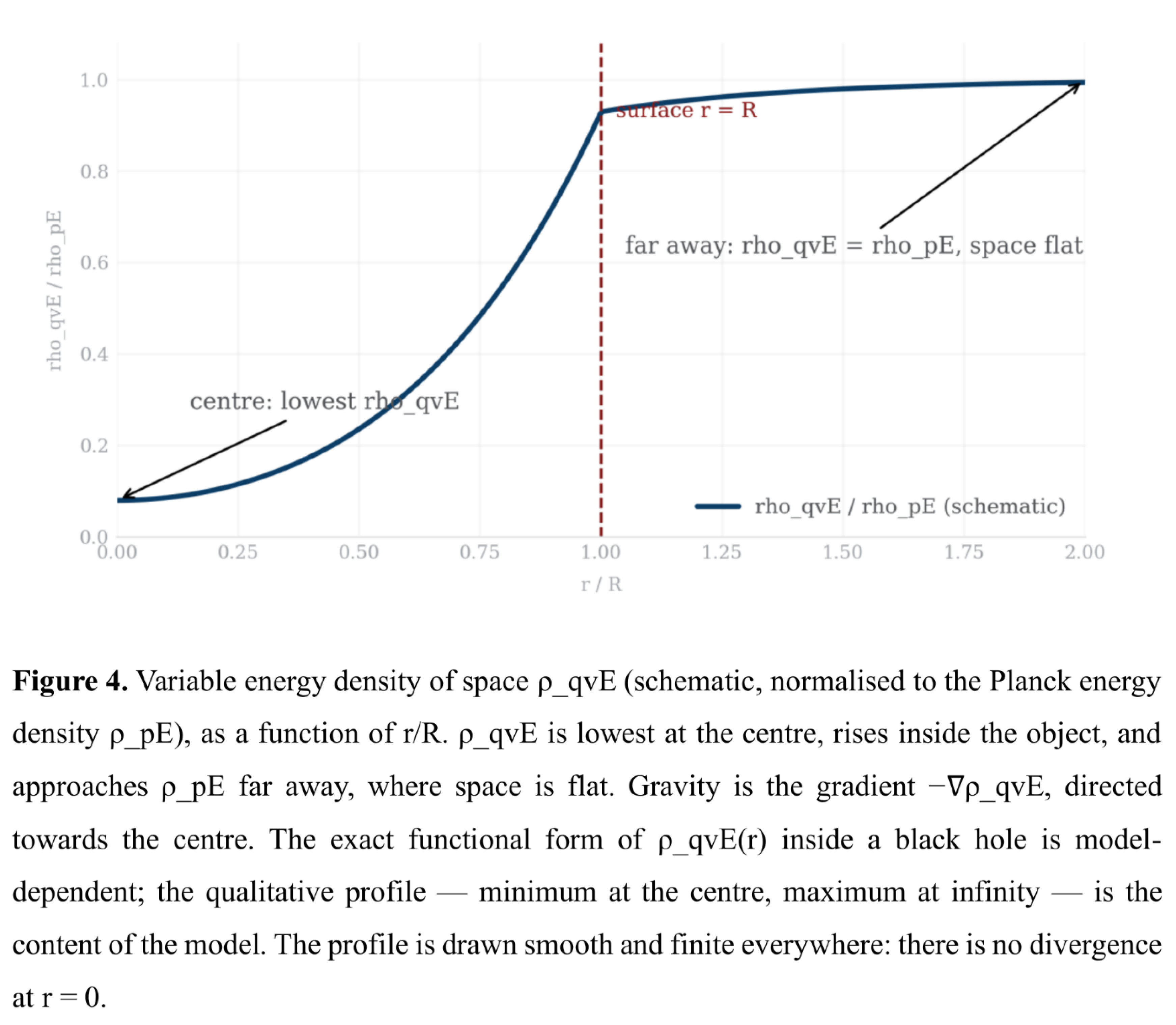
Figure 4 shows the profile schematically: ρqvE is lowest at the centre, rises through the interior, and approaches ρpE far away. Where ρqvE is uniform, there is no gradient and no gravity. Where it varies, there is gravity. What general relativity calls “curvature” is, in this model, the observable effect of a variable ρqvE. The gradient is the physical carrier; curvature is its geometric description [2,10].
 |
3.3. Why It Is a Good Replacement for Curvature
A replacement is good only if it does everything the old concept did, and does something the old concept could not do. Variable energy density satisfies both tests.
First, it reproduces the known phenomena. Outside a spherical mass, a ρqvE profile that falls off with distance gives the same g = GM/r2 law, the same light deflection, the same gravitational redshift, and the same time dilation as curved spacetime, because all of those effects depend on the gradient and on the local value of ρqvE, not on an abstract geometry. The Schwarzschild radius R = 2GM/c2 remains the radius at which the escape velocity reaches c, and the horizon remains the surface from which light cannot escape to infinity. Nothing in Chapters 1–2 used a curvature tensor; everything used g(r) and Pg(r), which follow from the gradient [1,5,10].
Second, it removes the singularity by construction. ρqvE is an energy density. It is bounded below by zero and above by ρpE. It cannot diverge to infinity in a physical vacuum, and its gradient cannot diverge if ρqvE is smooth and finite. Therefore there is no point at which the theory stops predicting. The centre is not a place of infinite curvature; it is the place of minimum ρqvE, zero local gravity (by the Shell Theorem), and maximum but finite gravitational pressure Pg,centre. This is exactly the interior that Chapter 2 needed — and that curvature could not give without an infinity.
Third, it gives gravity a carrier. Curvature tells us that spacetime bends, but it does not tell us what bends, or what carries the bending from one place to another. Variable energy density does: space itself, as DQV, is the carrier. A mass diminishes ρqvE around it; the diminished region propagates outward as a gradient; a test particle responds to the local gradient. Gravity is then a local, physical interaction, not an action of geometry at a distance [1,2].
 |
3.4. How the Three Parts of This Paper Belong Together
The three parts of this paper are not three separate ideas. They are one chain:
Variable ρqvE→ gradient → gravity → Shell Theorem → g(r) linear, g(0) = 0 → Pg(r) finite, Pg,centre maximal → Pg crosses PMott→ atoms break in a skin, not at a centre.
Remove any link and the chain breaks. Without variable ρqvE, gravity has no carrier and curvature must be postulated. Without the Shell Theorem, one is tempted to extrapolate g = GM/r2 inside and to invent a singularity. Without Pg, one confuses local gravity (zero at the centre) with accumulated pressure (maximal at the centre). Without Mott, one has a pressure but no criterion for when an atom ceases to exist. Together, they give a black hole with no singularity, no firewall, and no information loss: matter that falls in is pressure-ionized in the skin, its energy is released as plasma, jets, and winds, and its information is rearranged — not destroyed — in the skin where it breaks [4,11].
This also explains why the black hole does not need to be a perfect uniform sphere for the conclusion to hold. Any spherically symmetric density profile that is finite at the centre gives, by the Shell Theorem, g(0) = 0 and finite Pg,centre. Any ρqvE profile that is smooth and finite gives no curvature singularity. The exact numbers in Table 1 and Table 3 will shift with the profile; the qualitative result — skin instability, no centre singularity — will not.
3.5. Limits and Falsifiability
We state the limits explicitly, so that the model can be tested rather than believed. First, the exact functional form of ρqvE(r) inside a black hole is not derived in this paper; only its qualitative profile (minimum at the centre, ρpE at infinity) and its gradient are used. A future derivation of ρqvE(r) from the DQV field equations must reproduce the g(r) of Chapter 2 to the precision already tested outside the horizon. Second, the Mott thresholds in Table 2 are order-of-magnitude; a factor of a few does not change the conclusions because Pg exceeds PMott by up to 1020, but a precise ρqvE profile would sharpen the skin depths in Table 3. Third, the model predicts a systematic trend that curvature alone does not: the more massive the black hole, the thicker the intact-matter skin, and the weaker the surface gravity (Table 1). Supermassive black holes should therefore show a thicker, cooler, less completely ionized skin than stellar black holes, and M87* should retain Fe K-shell atoms where a 3 M⊙ black hole cannot. If future observations show the opposite trend — more massive black holes more completely ionized at the surface — the present model would be falsified [1,2,3].
In short: curvature describes what gravity does. Variable energy density says what gravity is. For the interior of a black hole, the second description is the better one, because it does not end in an infinity, it gives gravity a carrier, and it leads — through the Shell Theorem and Mott — to a testable prediction: atoms break in a skin [1,2].
3.6. No Event Horizon, No Information Paradox, No Entropy: Black Holes as Rejuvenating Systems
There is no event horizon in the sense in which the term is usually understood. The Schwarzschild radius is not a one-way membrane behind which matter, energy and information disappear forever. It is a physical surface. At this surface the gravitational pressure crosses the threshold given by the Mott law, atoms break, and matter is transformed into plasma [1,2,6,7,8]. What enters this surface does not vanish. It is broken down, rearranged and released again, as plasma, as radiation, and as winds and jets [13,14,15]. A surface through which energy returns to the universe cannot be an event horizon.
There is therefore no information paradox. The paradox arises only if information is carried to a singularity, where it has nowhere to go. In the present model there is no singularity, and there is no point at which information can be lost [4,11,12,13]. Information is not destroyed when atoms break. The structure of the atom is dissolved, but its constituents, protons, neutrons and electrons, survive, and their energy and their arrangement are carried outward again by the plasma that leaves the surface. Information is transformed, not lost. What leaves the black hole is not the same as what entered it, but it is causally connected to it, and nothing has been removed from the observable universe.
There is also no entropy in the sense in which black holes are usually described as the end point of the universe, where order is lost and energy is degraded forever. Black holes do the opposite. They take old matter, old stars, old atoms that have already burned their nuclear fuel, and they break them down in their skin. From this old matter they create fresh energy: fresh protons, fresh plasma, fresh radiation and fresh jets, which become the raw material for new stars, new atoms and new structures [13,14,15]. In this sense black holes are rejuvenating systems of the universe. They do not close the history of matter. They reopen it. They are not graves of energy, but places where old matter is renewed and returned to circulation.
This changes the place of black holes in cosmology. A universe in which black holes only accumulate entropy and destroy information must run down. A universe in which black holes rejuvenate matter can continue. Old matter falls in, fresh energy comes out, and the cycle of the universe is kept alive by the very objects that were thought to end it [1,3,16].
There is no singularity at the centre of a black hole, because there is no gravity at the centre of a black hole. By Newton’s Shell Theorem, g(r) = (4πGρ/3) r, so g(0) = 0, and the gravitational pressure Pg is maximal but finite at the centre. What is infinite in the standard picture is not in nature; it is in the extrapolation of g = GM/r2 inside a sphere where that law does not apply [4,11,12,13].
What breaks is not at the centre, but in a skin. Where Pg crosses PMott, atoms cease to exist as atoms. For a 3 M⊙ black hole this happens at the surface; for Sgr A* at metres for H and Fe and at 9,060 km for Fe K; for M87* Fe K never breaks. The region of instability is a skin, not a point. Its thickness is set by mass, because Pg,centre ∝ 1/M2. Small black holes are born violent and thin-skinned; big black holes are born gentle and thick-skinned; and there is a maximum mass where Pg becomes too weak to make a black hole at all [6,7,8].
Variable energy density of space is a good replacement for curvature, because it does what curvature did outside the horizon and what curvature could not do inside it. Outside, the gradient −∇ρqvE gives the same gravity, the same Schwarzschild radius, the same light deflection and time dilation. Inside, ρqvE stays finite, bounded by zero and by ρpE, so no quantity diverges. Gravity at last has a carrier: space itself [1,2,3].
Winds and jets therefore happen on the surface, not in the interior. The surface is where atoms break, where energy is released, where magnetic fields can accelerate plasma, and where plasma can still escape. The centre is quiet. The surface is alive. There is no firewall to be crossed and no information to be lost, because matter is not crushed to a point; it is pressure-ionized in a skin, and its energy and information are rearranged and released there [13,14,15,16].
The model is falsifiable. It predicts that more massive black holes have thicker intact skins, weaker surface gravity, and gentler, more stable jets; that M87* retains Fe K-shell atoms where a stellar black hole cannot; and that no black hole exceeds ~1011 M⊙. If observations show the opposite trend, the model is wrong. Until then, Newton plus Mott are sufficient: a black hole is not a singularity. It is a sphere of variable energy density, with a skin where atoms die and a surface where jets are born [1,4,6].
4. Conclusions
Variable energy density of the medium, the Mott law and gravitational pressure are the three tools with which a new model of black holes can be developed. Together they replace the idea of a singularity with a physical description that is based solely on astrophysical observations.
In this model, space is not empty. It is a medium whose energy density varies. Where the medium is less dense, gravity acts. Inside a black hole the medium is least dense at the centre, and its variation gives rise to a gravitational pressure which is greatest at the centre, although the local gravitational acceleration there vanishes. When this pressure exceeds the threshold given by the Mott law, atoms can no longer hold together and they dissolve into plasma.
The consequences are direct. Atoms do not break at a central point, but in a skin below the surface. Winds and jets do not emerge from the interior, but from the surface, where matter breaks, energy is released and plasma can still escape. Small black holes have a thin skin and a violent surface, while large black holes have a thick skin and a calm surface. The model therefore explains, in one framework, the interior, the surface and the observed activity of black holes.
All three mysteries of black holes are thus unveiled: there is no singularity at the centre, there is no loss of information in a point, and there is no need for matter to disappear from the observable universe. What falls into a black hole is transformed in its skin and returned to the universe as plasma, radiation, winds and jets. A black hole is not an end of physics. It is a physical object whose behaviour can be understood, described and tested by observation.
References
- Šorli; Čelan. Time-Invariant Superfluid Quantum Space as the Unified Field Theory. Reports in Advances of Physical Sciences. 2021. Available online: https://www.worldscientific.com/doi/10.1142/S2424942420500073.
- Fiscaletti; Sorli. Dynamic Quantum Vacuum and Relativity. Annales Universitatis Mariae Curie-Skłodowska, Sectio AAA — Physica. 2016. Available online: https://journals.umcs.pl/aaa/article/download/2808/3543.
- Fiscaletti & Sorli — Perspectives about Scales and Hierarchies…. Bulgarian Journal of Physics. 2023. Available online: http://www.bjp-bg.com/papers/bjp2023_4_412-438.pdf.
- Newton — Philosophiae Naturalis Principia Mathematica, London; 1687; Available online: https://archive.org/details/philosophianatur00newt.
- Schwarzschild — On the Gravitational Field of a Mass Point…. Sitzungsberichte der Königlich Preussischen Akademie der Wissenschaften. 1916. Available online: https://arxiv.org/abs/physics/9905030.
- Mott, The Basis of the Electron Theory of Metals…. Proc. Phys. Soc. Sect. A 1949. [CrossRef]
- Mott, Metal-Insulator Transitions; Taylor & Francis: London, 1974; Available online: https://books.google.com/books?vid=ISBN9780850660791&newbks=0.
- Edwards; Sienko. Universality Aspects of the Metal–Nonmetal Transition…. Phys. Rev. B 1978. [Google Scholar] [CrossRef]
- Saumon, Chabrier & Van Horn, An Equation of State for Low-Mass Stars and Giant Planets. Astrophys. J. Suppl. Ser. 1995. [CrossRef] [PubMed]
- Einstein — The Field Equations of Gravitation. Sitzungsberichte der Königlich Preussischen Akademie der Wissenschaften (1915). Available online: http://assets.press.princeton.edu/books/einstein11/writings.pdf.
- Penrose — Gravitational Collapse and Space-Time Singularities. Phys. Rev. Lett. 1965. [CrossRef]
- Kerr — Gravitational Field of a Spinning Mass…. Phys. Rev. Lett. 1963. [CrossRef]
- Šorli, et al. Re-examination of Penrose’s and Kerr’s Singularities…, Advanced Studies in Theoretical Physics (2024). Available online: https://bijective-physics.org/pdf/2024-Re-examination-of-Penrose-and-Kerr-Singularities.pdf.
- Blandford; Znajek. Electromagnetic Extraction of Energy from Kerr Black Holes. In Monthly Notices of the Royal Astronomical Society; 1977. [Google Scholar] [CrossRef]
- Blandford; Payne. Hydromagnetic Flows from Accretion Discs…. Monthly Notices of the Royal Astronomical Society. 1982. Available online: https://academic.oup.com/mnras/article/199/4/883/965050.
- Hawking — Black Hole Explosions? In Nature; 1974; Available online: https://www.nature.com/articles/248030a0.
Disclaimer/Publisher’s Note: The statements, opinions and data contained in all publications are solely those of the individual author(s) and contributor(s) and not of MDPI and/or the editor(s). MDPI and/or the editor(s) disclaim responsibility for any injury to people or property resulting from any ideas, methods, instructions or products referred to in the content. |
© 2026 by the authors. Licensee MDPI, Basel, Switzerland. This article is an open access article distributed under the terms and conditions of the Creative Commons Attribution (CC BY) license (http://creativecommons.org/licenses/by/4.0/).
Copyright: This open access article is published under a Creative Commons CC BY 4.0 license, which permit the free download, distribution, and reuse, provided that the author and preprint are cited in any reuse.