

Submitted:
19 November 2025
Posted:
20 November 2025
Read the latest preprint version here
Abstract
In 2014, NASA measured that the universe has a Euclidean shape. This discovery suggests that the curvature of space is merely a mathematical description of some more basic physical property of space. By extending the principle of equality of mass and energy to the space occupied by dark energy, a model of gravity was developed, where the gravitational force is due to the variable energy density of dark energy. The more curved the space, the lower the energy density of dark energy. A black hole, like any other stellar object, reduces the energy density of dark energy at its center in proportion to its mass and energy. In the centre of a black hole, the gravitational force is zero, as it is in all stellar objects. There are no wormholes in space, and there is no gravitational singularity at the center of a black hole. Gravity inside black holes follows Newton's physics.
Keywords:
matter
; dark energy
; black holes
; astrophysical jets
; gravity
1. Introduction
In the Introduction section, a novel view on gravity is presented, based on the variable energy of dark energy. In the second section, titled Critique of Gravitational Singularities and of Geometrization of Gravity, the weaknesses of the gravitational singularity model and the curvature of space model are highlighted. In the third section, named Mathematics of black holes in Newtonian physics, the mathematical model of gravity inside a black hole is presented. In the fourth section, named Historical overview of gravitational physics, the development of gravitational models from Newton to the present day is discussed.
A recent article published in Physical Review Letters suggests, based on astronomical observation, that in black holes, matter decays into dark energy [1]. This discovery requires the revision of black hole physics, which will give a physical explanation of the decay of matter into dark energy. In this article, the mass-energy equivalence principle will be extended to dark energy. This allows us to describe the energy relation of mass between black holes and diminished energy density of dark energy in the centre of black holes, which causes atoms to become unstable and decay into elementary particles and further into dark energy.
Dark energy represents 95% of the entire energy of the universe, 5% represents matter. The dark energy model has several similarities with the old model of ether and the novel model of superfluid space. These are different terms that describe the energy substrate of space [2,3].
Einstein’s idea that the stellar object curves space is questionable because it was never explained how matter interacts with universal space and changes its geometry. In this article, a model is developed where stellar objects diminish the energy density of dark energy, and this generates gravity. Curvature of space is replaced by the variable energy density of dark energy. More space is curved, and the energy density of dark energy.
Dark energy in intergalactic space can be expressed with Planck units. Planck density is a Planck mass in a Planck volume. Multiplying Planck energy by , we get Planck Energy Density , see Equation (1).
In intergalactic space, the energy density of dark energy is at its maximum ; in the centre of a black hole, the energy density of dark energy diminishes accordingly to the mass of a black hole , see Equation (2).
where m is the mass of the black hole and V is its volume. Mass of a given stellar object can be expressed by the diminished energy density of dark energy in its center, see Equation (3).
where is the mass of a black hole, is the volume of the black hole, and is the energy density of dark energy in the centre of a black hole, black hole [4].
Two stellar objects diminish the energy density of dark energy, and the gravitational force is a pushing force of the outer area of dark energy towards the area with lower energy density. French physicist Mayeul Arminjon also suggested in 2011 that gravity acts as a pressure force of the ether-dark energy-superfluid space [5], see Figure 1.
Black holes are stars with extremely huge masses and extremely dense mass. Diminished energy density of dark energy in the center of a black hole changes its electromagnetic properties to the extent that atoms become unstable; they fall apart into elementary particles, and elementary particles decay into dark energy. This is the explanation for the astronomical observations presented in the recent article published in Physical Review Letters [1]. Several astronomical data confirm that black holes are rejuvenating systems of the universe:
2. Critique of Gravitational Singularities and of Geometrization of Gravity
Roger Penrose predicted that the mass density in the centre of the black hole is infinite [7]. The mass density of the proton is . In the centre of a black hole, matter decays into protons. If we imagine that in a cubic meter of volume there are only protons, then in a cubic meter, there are of protons. Penrose’s proposal about infinite mass density at the center of a black hole contradicts the fact that a proton has a maximum mass density, and a higher mass density cannot exist. His idea of a black hole where the gravitational force towards the center increases because the density of matter there is infinite should be re-examined. It is shown in this article that when going towards the center of a black hole, the energy density of dark energy diminishes in the same way as in all other stellar objects. This means that, also, inside black holes, gravity obeys the Newtonian Shell Theorem. The gravitational force in the centre of a black hole is zero. There is no gravitational collapse of the black hole as Penrose predicted. The black hole is eating itself because atoms in its center become unstable [2].
Schwarzschild metrics suggest that a black hole has a singularity in the center where physical laws break down. These singularities have been debated for more than 100 years, and no final solution has been found [8]. This article proposes that the Schwarzschild singularity is only a mathematical model that has no physical existence; the energy density of the dark energy in the centre of a black hole is so low that atoms become unstable. A black hole eats itself not because of infinite gravity in the center but because of the extremely low energy density of the dark energy in its center.
Schwarzschild radius of a black hole marks the area in the black hole, where low energy density of dark energy causes matter to decay into elementary particles and dark energy, see Equation (4.)
Transformation of matter into elementary particles creates in the center of a black hole fresh energy and enormous pressure. A supernova is the explosion of a black hole. When a black hole is too big to explode, as is the case with SMBHs, the fresh energy pressure opens the hole in the direction of the black hole’s axis of rotation [4], see Figure 2.
Removing the singularity from black hole physics eliminates all the mysterious aspects of black holes, which are essentially high-density stars with extremely high mass. There are no holes in space, because there is no curvature of space, see section 5.
The introduction of the singularity into physics, where the laws of physics break down, is, according to the author, a reckless historical mistake that has led physics in the wrong direction. A physical model that shows matter decaying into dark energy in a black hole challenges the physical existence of the Schwarzschild singularity, which is just a mathematical concept that has led physics in the wrong direction for more than 100 years. Also, the initial singularities of the Big Bang cosmology are more a philosophical debate than real physics. Categorically eliminating the singularity from physics seems to be the best way to progress black hole physics and cosmology [9]. The idea that singularities belong more to philosophy and religion than to physics is entering mainstream physics: “Perhaps surprisingly, both event horizons and spacetime singularities are generally considered to be mathematical idealizations that, while useful approximations to reality, fall short of fully capturing the underlying physics. Specifically, the teleological nature of event horizons makes them inherently undetectable in any finite time experiment. Similarly, spacetime singularities are generally thought to reflect our incomplete understanding of the behavior of spacetime and matter under extreme conditions Fundamentally, both concepts hinge on the notion of infinity: event horizons involve infinite time, while spacetime singularities correspond to infinite curvature, or equivalently, infinite energy and matter density. It is generally anticipated that these idealizations will be replaced by more appropriate concepts as the infinities are resolved into finite quantities” [10].
The geometrization of gravity lacks the empiricism of how matter interacts with empty space, which has no physical properties, and bends it. It is more than 100 years since GR was born, and nobody has explained in physical terms how matter bends space. The idea of bending space leads to the gravitational singularities that we see today are problematic. It is time to turn the page and find other solutions for gravity. The core problem of the gravitational singularities is expressed in the so-called “Penrose’s Singularity Conundrum”, see Figure 3 below.
We have a black hole with a gravitational singularity. One light year from the centre of a black hole, gravity at the point T is finite. How does infinite gravity in the centre of a black hole diminish into finite gravity at the point T? Where does the continuous function of infinite gravity jump to the continuous function of gravity decreasing with the square of the distance? On the first side, conundrum seems unsolvable simply because gravity we know in physics is a function of mass that diminishes by the square of distance. Therefore, it would make sense to eliminate gravitational singularities from physics.
Light bends when passing near stellar objects because the variable energy density of the dark energy changes the refractive index of light. When light moves towards the stellar object, the energy density of dark energy decreases; when light moves away from the object, the energy density of dark energy increases, causing light to bend. The angle of light bending based on the variable energy density of dark energy, see Figure 4.
Mass m in the
classical equation for light bending can be replaced by the variable energy
density of dark energy, see Equation (5).
where is Planck energy density of dark energy in intergalactic space = ,
is the energy density of dark energy in the center of the Sun, 20 c: Speed of light, R is Sun’s radius.
= × 10−6 × 206264.86
1.75 arc seconds
According to Einstein’s General Relativity (1915), gravity causes light to bend near massive bodies like the Sun, with the bending angle given by where M is the Sun’s mass and R is the impact parameter (Sun’s radius). In his equation, we replaced mass with the variable energy density of dark energy. With the Equation (5) we show that it is not mass that bends the light, it is the diminished energy density of dark energy in the centre of the Sun that changes the refraction index of light which bends light. Gravitational constant G we can express with the energy density of dark energy, see Equation (6):
[3].
We combine Equation (5) and Equation (6) and we get:
Velocity of light we can change with Planck units
[11].
Equation (8) confirms that the bending of light depends on the volume of the Sun and on the energy density of dark energy in the centre of the Sun. If the Sun had a smaller volume and the same mass, the energy density of dark energy in the center would be lower, and the bending of light would be greater [11].
Geometrization of gravity needs rigorous re-examination by the international scientific community. Insisting on the validity of the idea that curved space carries gravity which was experimentally never-proven models is the main cause of today’s gravitational physics stagnation. NASA measured in 2014 that the universal space has a shape of Euclidean geometry: “Recent measurements (c. 2001) by a number of ground-based and balloon-based experiments, including MAT/TOCO, Boomerang, Maxima, and DASI, have shown that the brightest spots are about 1 degree across. Thus, the universe was known to be flat to within about 15% accuracy prior to the WMAP results. WMAP has confirmed this result with very high accuracy and precision. We now know (as of 2013) that the universe is flat with only a 0.4% margin of error. This suggests that the Universe is infinite in extent; however, since the Universe has a finite age, we can only observe a finite volume of the Universe” [12]. Einstein’s geometrization of gravity has a weak point, namely, we cannot calculate the gravitational force between two stellar objects. Even more than 100 years after its creation, it is still unclear what the units of Einstein’s gravitational tensor are [13]. With the variable energy density of dark energy, we elegantly describe gravitational force and all relativistic phenomena, including the Pioneer anomaly [3]. Keeping the geometrization of gravity as the leading model of gravity seems unfair and represents a major obstacle to the development of gravitational physics, which did not stop with Einstein; its development goes on. Einstein’s gravitational model, where gravity is the result of the geometry of space, led to the idea that gravity is not the primordial force of the universe and is related to entropy [14]. The idea that entropy created at the atomic level of a given stellar object could create a gravitational force is questionable because we know that gravity exists between atoms [15,16,17]. Atoms have a mass, and every mass diminishes the energy density of dark energy, which generates gravitational mass of an atom and consequently gravitational force between two atoms, see Figure 5.
Gravitational mass is a pushing force of dark energy toward the centre of a physical object. Also, the inertial mass is a pushing force of dark energy toward the centre of a physical object. Einstein discovered that gravitational and inertial mass are equal; this is because they have the same origin. Rest mass is not inertial mass . Rest mass interaction with dark energy generates inertial mass and gravitational mass [18], see Equation (9).
When a proton is accelerated in a cyclotron, it interacts with the dark energy and absorbs it. This increases its mass. Relativistic mass of proton is a real phenomenon and has nothing to do with the position of the observer; it is a pure technicality of proton interaction with dark energy [2], see Equation (10).
With the increase in velocity, Lorentz factor γ increases, and the proton’s relativistic mass also increases. Also, AGNs that rotate around their axis in the centre of galaxies interact with the dark energy. They absorb dark energy which increases their relativistic mass, and they rotate local dark energy inside the galaxy, which causes galaxies’ rotational curves [3]. The weak point of the geometrization of gravity is that no direct energy relation between mass of a given physical object and curvature of space is mathematically defined. The model of gravity, based on variable energy density of dark energy, has a mathematically well-defined relation between the mass of a given physical object with the variable energy density of the medium of dark energy in which this object exists. This model works from the scale of an atom to the scale of a supermassive black hole. We can calculate the energy density of dark energy in a given physical object center and at any point T at a distance d from the center, see Equation (11) [4].
where is the energy density of dark energy at point T, is the energy density of dark energy in intergalactic space, is the mass of the physical object, is the radius of the object, and is the distance of point from the centre of the physical object. When tends to the infinite, tends to , see Figure 6.
By extending the principle of mass-energy equivalence to dark energy, the curvature of space is replaced by the variable energy density of dark energy. More space is curved and the energy density of dark energy. The energy density of dark energy changes the electromagnetic properties of the local space at the center of the black hole, making the atoms unstable. In this model, the first law of thermodynamics at the center of a black hole is preserved, and the mysterious singular properties of black holes are eliminated.
3. Mathematics of Black Holes in Newtonian Physics
In Newtonian physics, a black hole is a particular type star with high mass density. Imagine we have two black holes with the same mass. The first one has radius r and the second has radius 2r, see Figure 7.
Gravitational acceleration g on the surface of a smaller black star is bigger than on the surface of the bigger black star, see Equation (12).
The energy density of dark energy in the center of a smaller star is lower than in the centre of the bigger star. That’s why gravitational acceleration g on the surface of a smaller star is bigger than on the surface of a bigger star. Gravitational acceleration g depends on the difference between the energy density of dark energy on the surface of the star and in the centre of the star. We calculate the energy density of dark energy on the surface and in the center of the star with Equation (11). Moving towards the centre of the black star, the energy density of dark energy is decreasing, the difference between energy density at the given point T and the centre is getting smaller and, consequently, gravitational acceleration is decreasing. In the centre, becomes equal to , and gravitational acceleration there is zero. This is the Newton’s shell theorem inside black stars, expressed by the energy density of dark energy, see Figure 8.
At the point T gravitational acceleration is calculated by Equation (13).
where is the mass of the star without outer shell, is the gravitational constant, is the radius of the mass , is the Planck energy density of dark energy in intergalactic space, is the energy density in the centre of the black star, and is the energy density of dark energy at the point T. Gravitational acceleration on the surface is bigger than at the point T because the difference in the energy density on the surface and in the center is bigger than the difference in the energy density between the point T and the center, see Equation (14).
Equation (13) and Equation (14) confirm that the difference of energy density of dark energy and distance from the centre are two parameters that define the magnitude of gravitational acceleration .
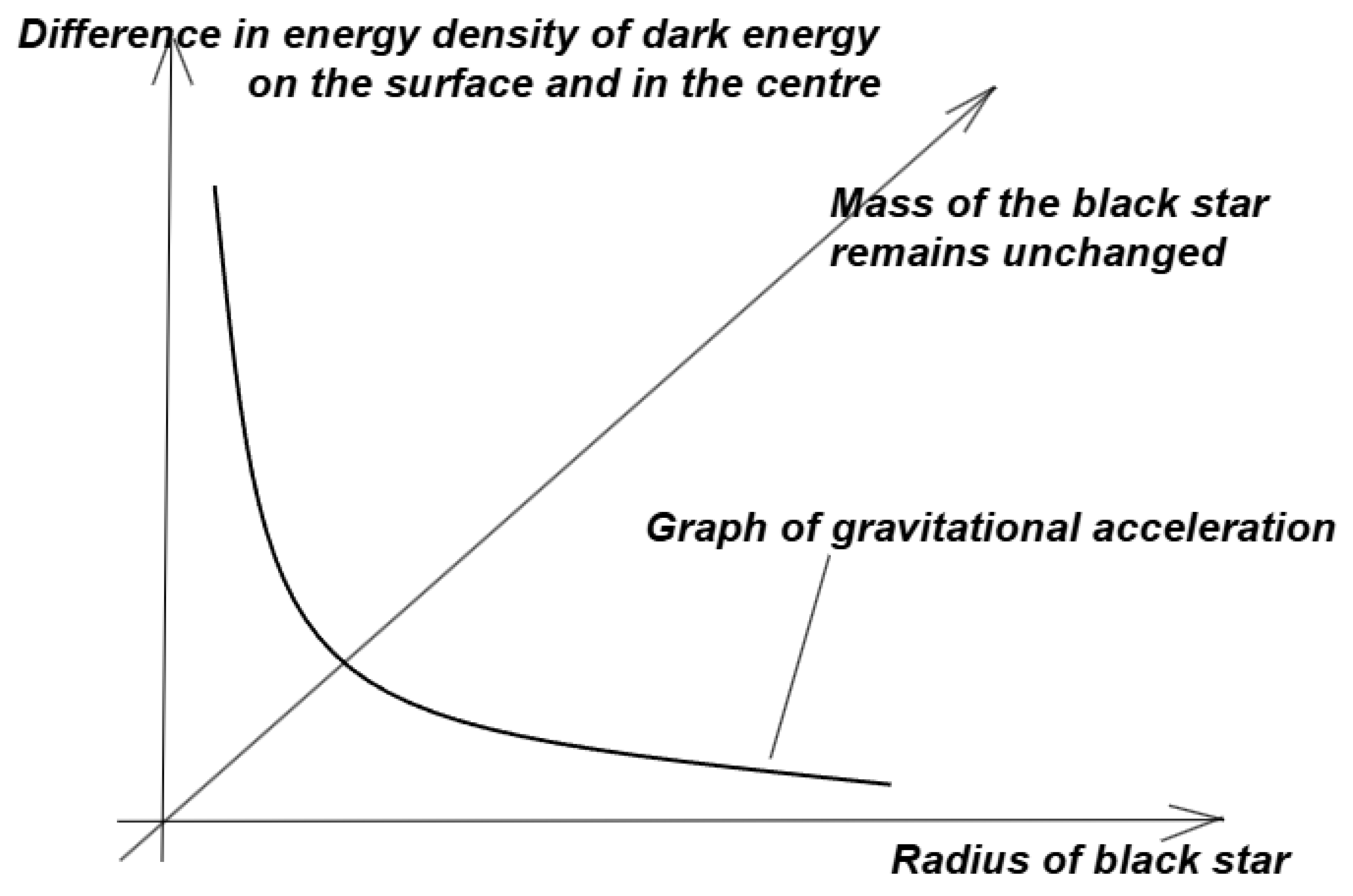
Imagine there is a black star with a constant mass. The star is extremely dense and has a small radius. The difference between the energy density in the centre and on the surface is extremely high. With the increase of the radius, the difference of energy density is decreasing, and gravitational acceleration on the surface is also decreasing, see Figure 9.
Figure 9 illustrates the basic dynamics between the gravitational acceleration of a black star, its radius, and the difference in energy density of dark energy in the center and on the surface of a black star.
4. Historical Overview of Gravitational Physics
Newton’s contribution to gravitational physics is the equation for the gravitational force between two physical objects. In his model, the action of the gravitational force remains unclear. Einstein attempted to explain how gravity operates between two physical objects by considering that the curvature of space generates gravitational force. His model is of a mathematical nature and does not explain the physical origin of the gravitational force. There have been several attempts to unify general relativity and quantum physics. In a recent article, authors explored the relationships between photon, electron, and graviton, which is believed to carry the gravitational force [19]. The idea that gravitational force is similar to electromagnetic force has persisted in physics for the past 100 years. However, it has never been theoretically explained how atoms that comprise stellar objects emit gravitons and how they receive them. Also, it is not imaginable how a graviton that is halfway from the Sun to the Earth could keep them together.
Einstein’s geometrization of gravity is a step ahead of Newton’s because it is clear that two physical objects can generate a gravitational force only via the medium in which they exist. A model of curved space cannot explain how the gravitational force works. Replacement of the curvature of space with the variable energy density of dark energy provides the physical model of gravity where gravitational force is a pushing force of space, see Figure 1 and Figure 5. The given mass deforms the space; It reduces the energy density of dark energy, which creates gravity. The basic idea is the same as in Einstein’s model; its advantage is that it can explain the physical origin of the gravitational force. Newtonian gravity, which is based on the ether [18], which is the old name for dark energy, is superior to Einsteinian gravity because it keeps gravity as a force. Gravity is the fundamental force of the dynamics of the universe that governs the motion of entire galaxy clusters, including the local supercluster Laniakea, towards the Great Attractor [20,21]. In 2014, NASA confirmed that universal space has Euclidean shape [12]. It is time, and fair, that the curvature of space as a carrier of gravity is recognized as a model that belongs to the history of physics.
In 2023, Allain Haraux presented his research on black hole physics from the perspective of Newtonian physics [22]. The study of black holes in the context of Newtonian physics without hypothetical singularities has a future because it clarifies the currently problematic picture of black holes, where in singularities the laws of physics no longer apply. John Wheeler was criticizing the singularity of a black hole and suggested it should be replaced by the “fiery marriage” of general relativity and quantum physics: “General relativity must fail at the central singularity and be replaced by a “fiery marriage”, as he called it, of general relativity and quantum physics, by the new laws of quantum gravity that he, Misner, DeWitt, and others were beginning to seek” [23]. It is shown in this article that when we replace the curvature of space with the variable energy density of dark energy, the newborn of this “fiery marriage” is the extension of the mass-energy equivalence principle of a black hole on dark energy, and understanding that Newton’s Shell Theorem works well inside black holes, which are stars with extremely high mass density.
5. Conclusions
The fundamental law of physics is the conservation of energy, which cannot be created or destroyed, but it can transform into another type of energy. With the extension of the mass-energy equivalence to dark energy, we integrated dark energy into the energy conservation law and got a new model of black hole as a rejuvenating system of the universe. In the center of a black hole, old matter with high entropy decays into elementary particles and dark energy, which have a low entropy. Black holes keep the universe young; they reverse the process of entropy increase of matter, where atoms with low atomic number are transformed into atoms with high atomic number. The energy of astrophysical jets that AGNs throw into intergalactic space is the fresh energy for the formation of new stars.
References
- S.P. Ahlen et al., Positive Neutrino Masses with DESI DR2 via Matter Conversion to Dark Energy, Phys. Rev. Lett. 135, 081003 - Published 21 August, 2025. [CrossRef]
- Amrit Sorli, Niko Gorjup, Rado Gorjup, Dark energy, superfluid space, ether, and missing dark matter, Advanced Studies in Theoretical Physics, Vol. 17, 2023, no. 1, 31-42 (2024) https://www.m-hikari.com/astp/astp2023/astp1-4-2023/91995.html.
- Amrit S. Sorli, Einstein Legacy: Ether Relativity and Cosmology, International Journal of Quantum Foundations, Volume 11, Issue 4, pages 527-559 (2025) https://ijqf.org/archives/7583.
- Amrit Sorli et al. Re-examination of Penrose’s and Kerr’s singularities and the origin of protons in astrophysical jets. Advanced Studies in Theoretical Physics, 18(2), 61-82. Retrieved from https://www.m-hikari.com/astp/astp2024/astp1-4-2024/92117.html.
- Mayeul Arminjon, Gravitation as a pressure force: a scalar ether theory (2011). [CrossRef]
- Nizamov, B.A., Pshirkov, M.S. Can Observations of 511 keV Line from the M31 Galaxy Shed Light on the AGN Jet Composition?, Astron. Lett., 49 (2023), 9– 17. [CrossRef]
- Penrose, R. Gravitational collapse and space-time singularities, Physical Review Letters, 14 (1965), no. 3, 57. [CrossRef]
- Lehmkuhl, D. The Prediction and Interpretation of Singularities and Black Holes: From Einstein and Schwarzschild to Penrose and Wheeler. Phys. Perspect. 27, 176–209 (2025). [CrossRef]
- Sorli A., Jafari. S., Fiscaletti D., Gorjup N., Gorjup R. Makovec T., EvidenceBased Cosmology – Black holes are rejuvenating systems of the universe, Reports in Advances of Physical Sciences, 7 (2023), 2350012. [CrossRef]
- Raúl Carballo-Rubio et al. Towards a non-singular paradigm of black hole physics, Journal of Cosmology and Astroparticle Physics (2025) https://iopscience.iop.org/article/10.1088/1475-7516/2025/05/003.
- Šorli, A.; Saroy, A. Geometry of Space, Gravity, and Bending of Light. Preprints 2025, 2025090060. https://doi.org/10.20944/preprints202509.0060.v1 Accepted in The Indian Journal of Advanced Physics (IJAP) https://www.ijap.latticescipub.com/.
- NASA, Our Universe (2014) https://wmap.gsfc.nasa.gov/universe/uni_shape.html.
- P G L Porta Mana, Dimensional analysis in relativity and in differential geometry, European Journal of Physics, 42 (2021), no. 4. P G L Porta Mana, Dimensional analysis in relativity and in differential geometry, European Journal of Physics, 42 (2021), no. 4. https://iopscience.iop.org/article/10.1088/1361-6404/aba90b.
- A Schlatter and R E Kastner, Gravity from transactions: fulfilling the entropic gravity program, Journal of Physics Communications (2025) https://iopscience.iop.org/article/10.1088/2399-6528/acd6d7.
- Panda, C.D., Tao, M.J., Ceja, M. et al. Measuring gravitational attraction with a lattice atom interferometer. Nature 631, 515–520 (2024). [CrossRef]
- The ALPHA Collaboration., Charman, A. Description and first application of a new technique to measure the gravitational mass of antihydrogen. Nat Commun 4, 1785 (2013). [CrossRef]
- Victoria Xu et al. Probing gravity by holding atoms for 20 seconds. Science 366,745-749(2019). [CrossRef]
- A. Sorli, N. Gorjup, R. Gorjup, Replacement of space-time with superfluid space and restoration of Newton’s dynamic ether, Rep. Adv. Phys. Sci., 7 (2023) 2350005. [CrossRef]
- Mikko Partanen* and Jukka Tulkki, Gravity generated by four one-dimensional unitary gauge symmetries and the Standard Model, Reports on Progress in Physics, Volume 88, Number 5 (2025) https://iopscience.iop.org/article/10.1088/1361-6633/adc82e.
- H. M. Courtois, J. Mould, A. M. Hollinger, A. Dupuy and C. P. Zhang, In search of the Local Universe dynamical homogeneity scale with CF4++ peculiar velocitiesA&A, 701 (2025) A187. [CrossRef]
- 100 Facts about the Laniakea Supercluster, JWST (2025 https://www.jameswebbdiscovery.com/universe/100-facts-about-the-laniakea-supercluster.
- Alain Haraux, A Newtonian approach to general black holes, EECT 2023, 12(6): 1447-1455. [CrossRef]
- Charles W. Missner, Kip. S. Thorne, and Wojciech H. Zurek, John Wheller, relativity, and quantum information, Physics Today (2009) https://www.cco.caltech.edu/~kip/PubScans/VI-50.pdf.
Figure 1.
Gravitational force is pushing force of dark energy.
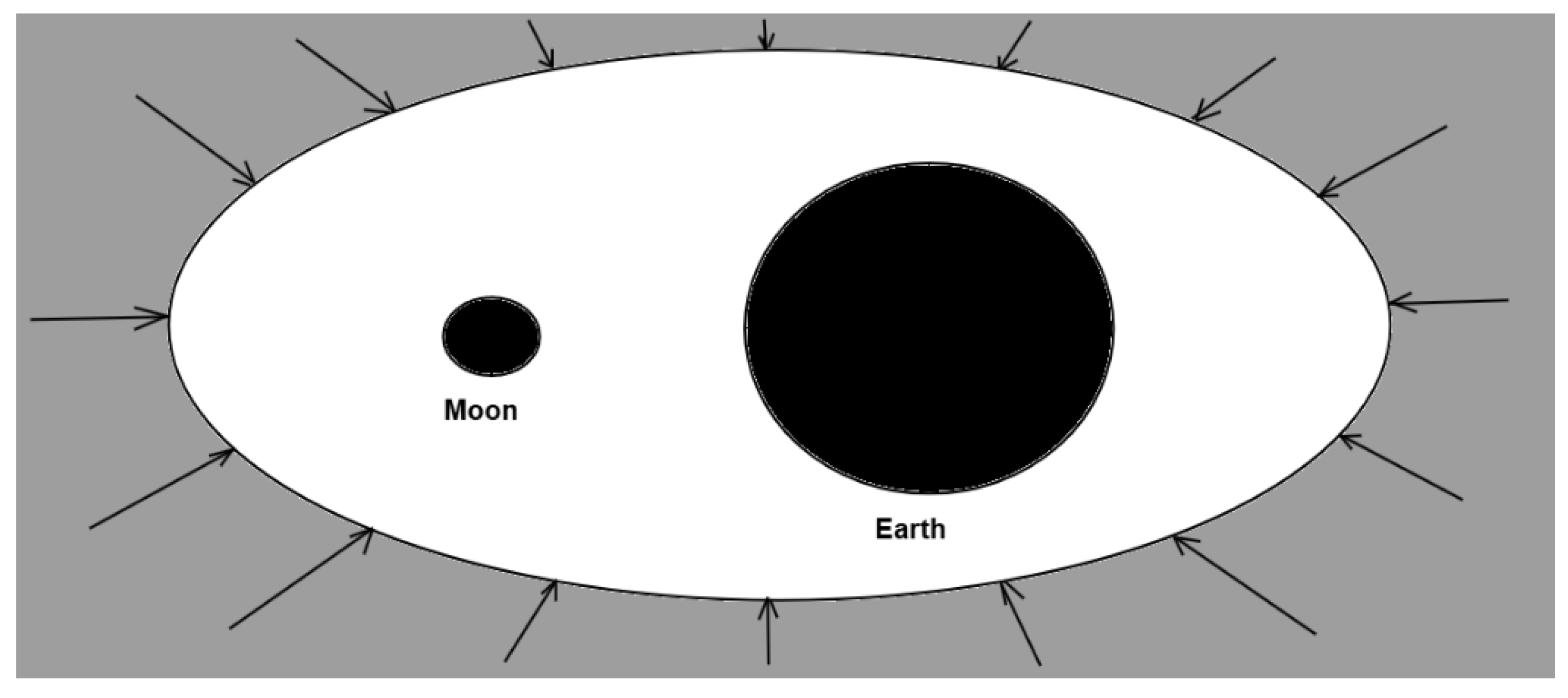
Figure 2.
Explosion of supernova and astrophysical jet from SMBH.
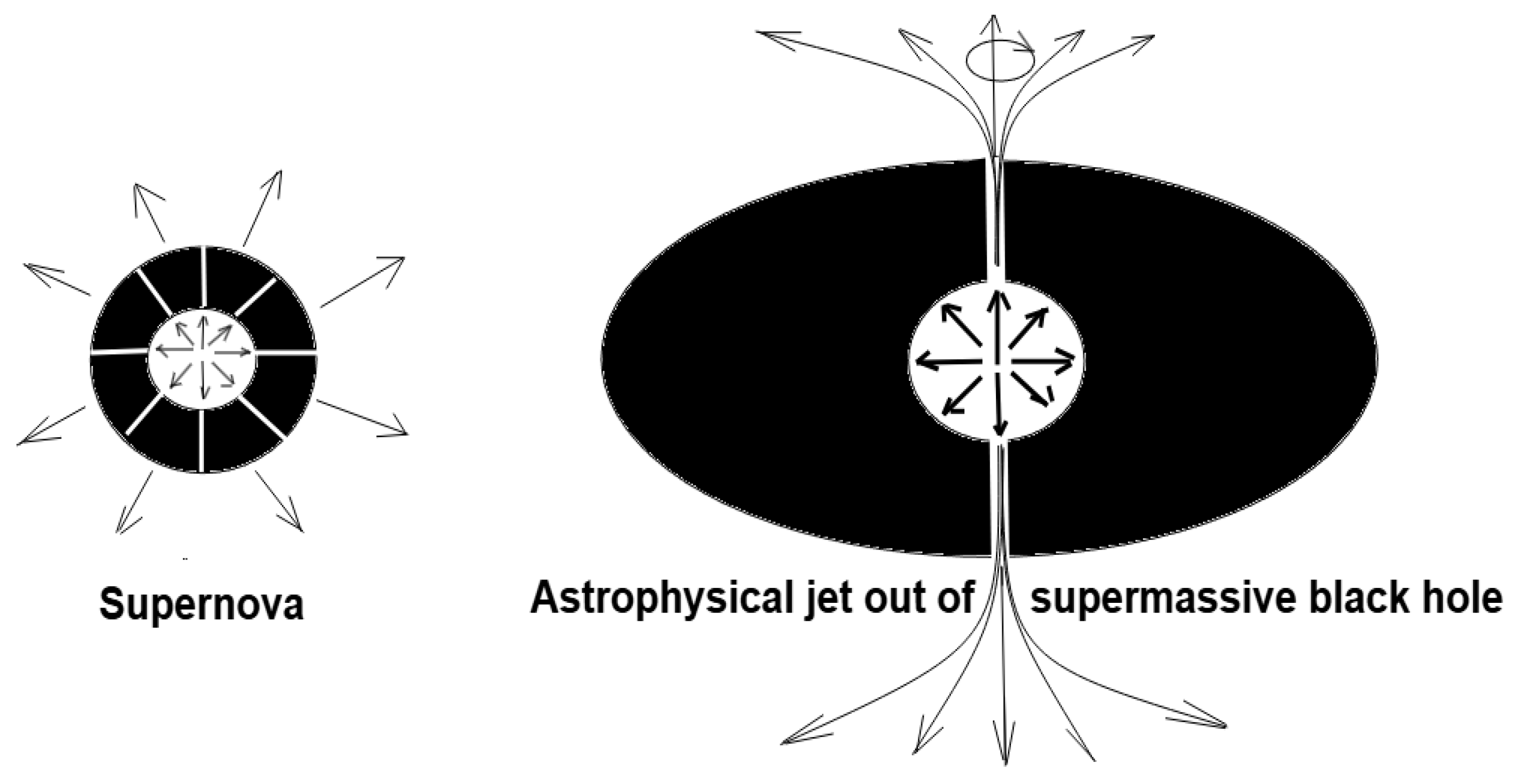
Figure 3.
Penrose’s Singularity Conundrum.
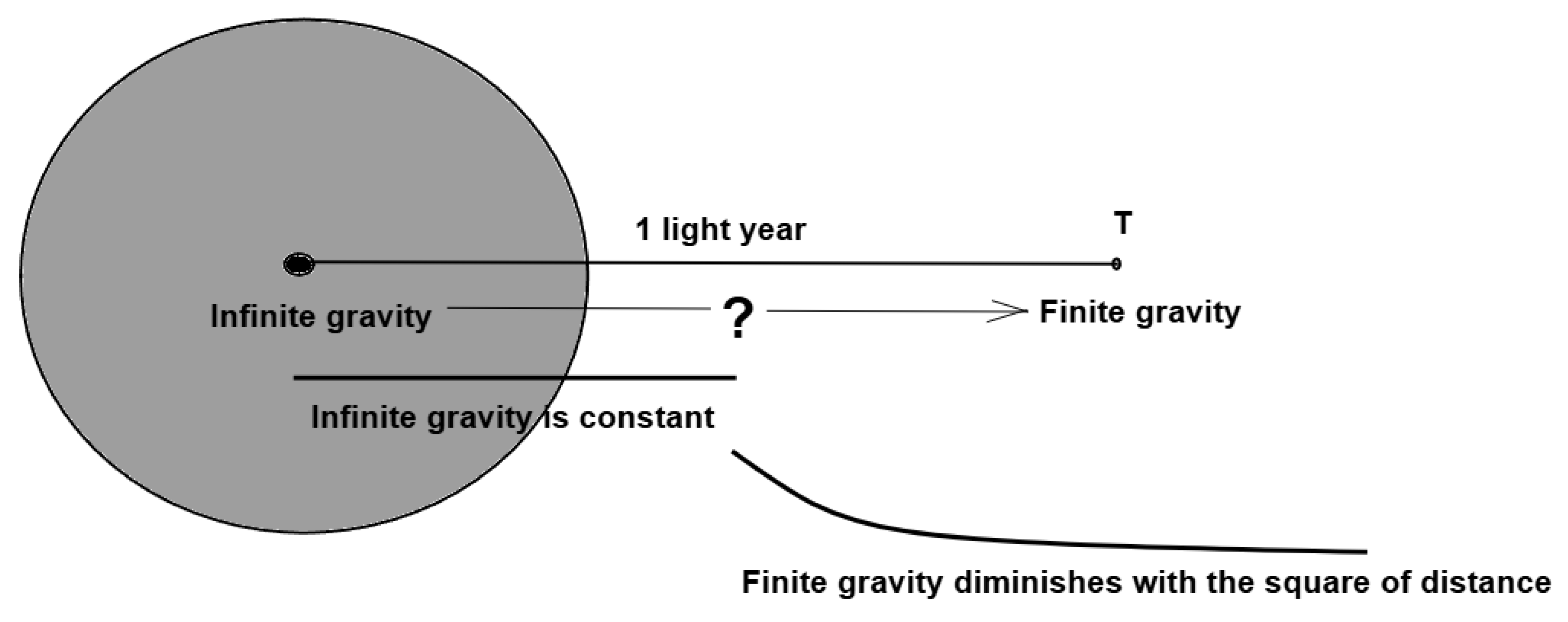
Figure 4.
Bending of light is caused by decrease and increase of energy density of dark energy.
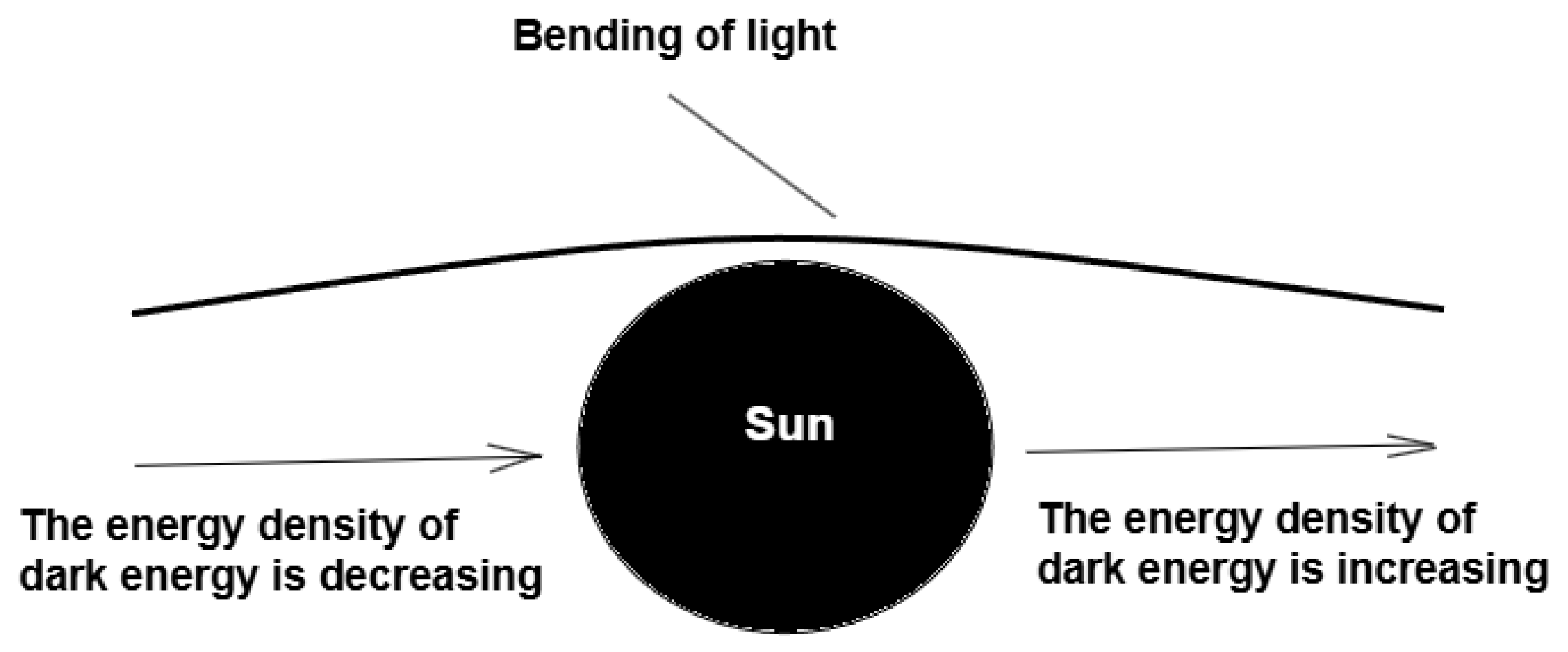
Figure 5.
Gravitational mass and gravitational force.
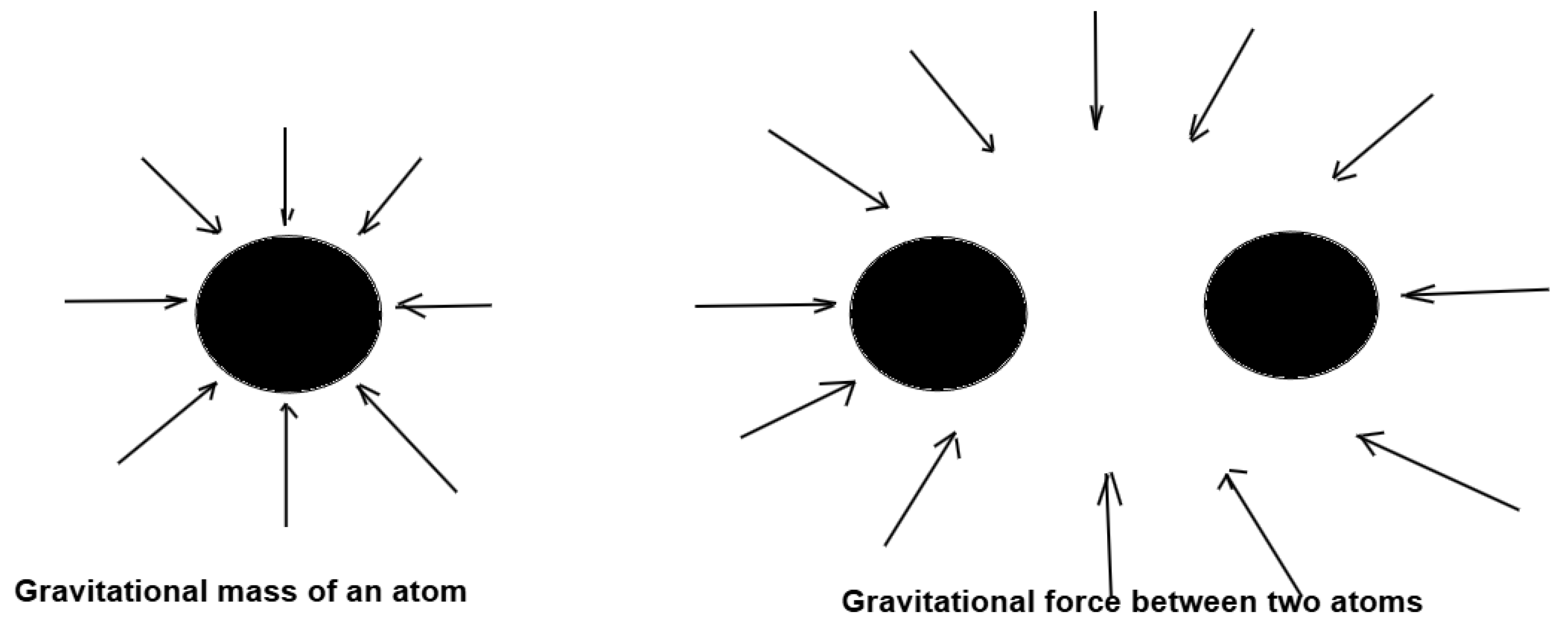
Figure 6.
Energy density of dark energy at the point T.
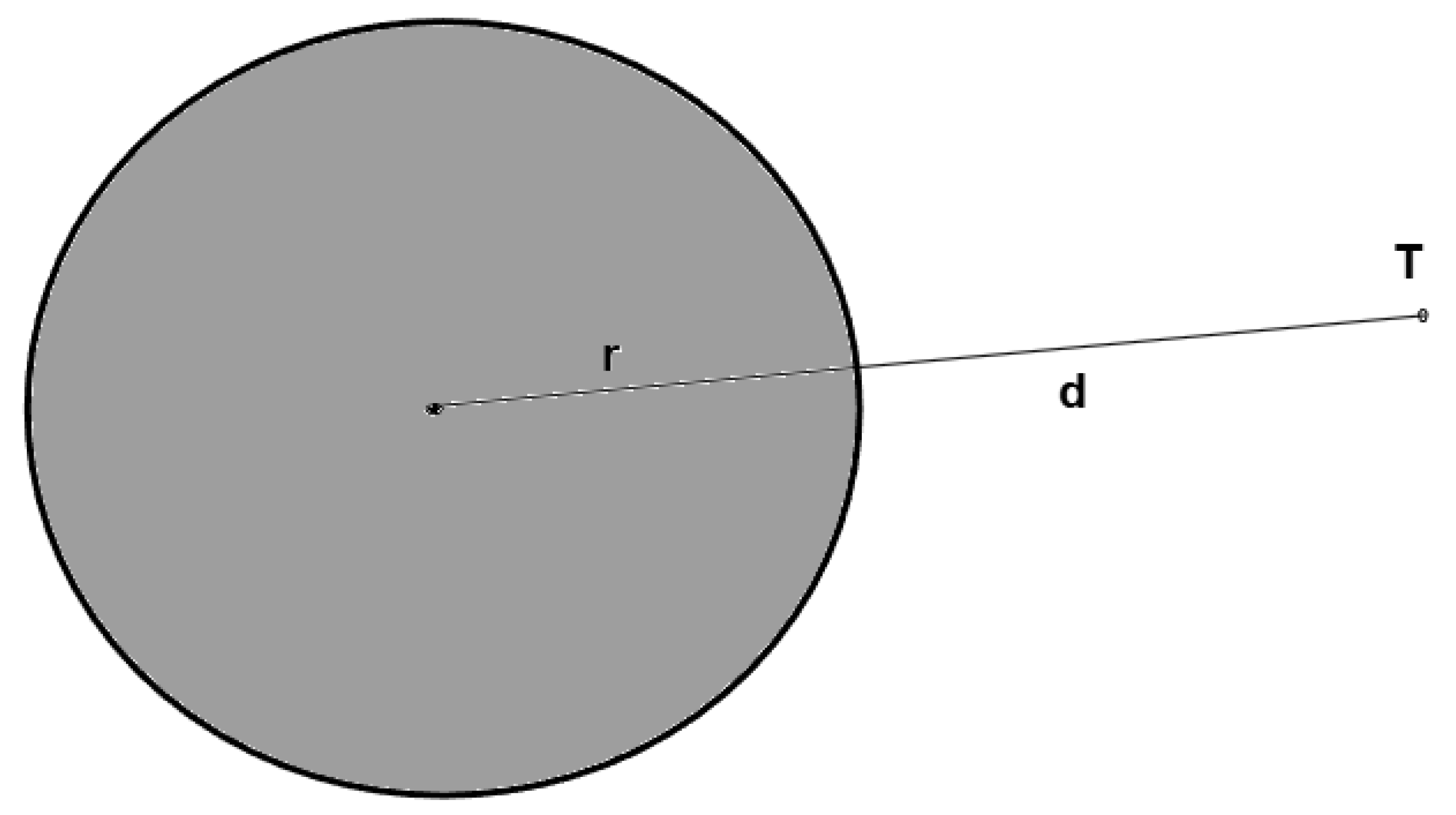
Figure 7.
Two black holes with the same mass m and different radii.
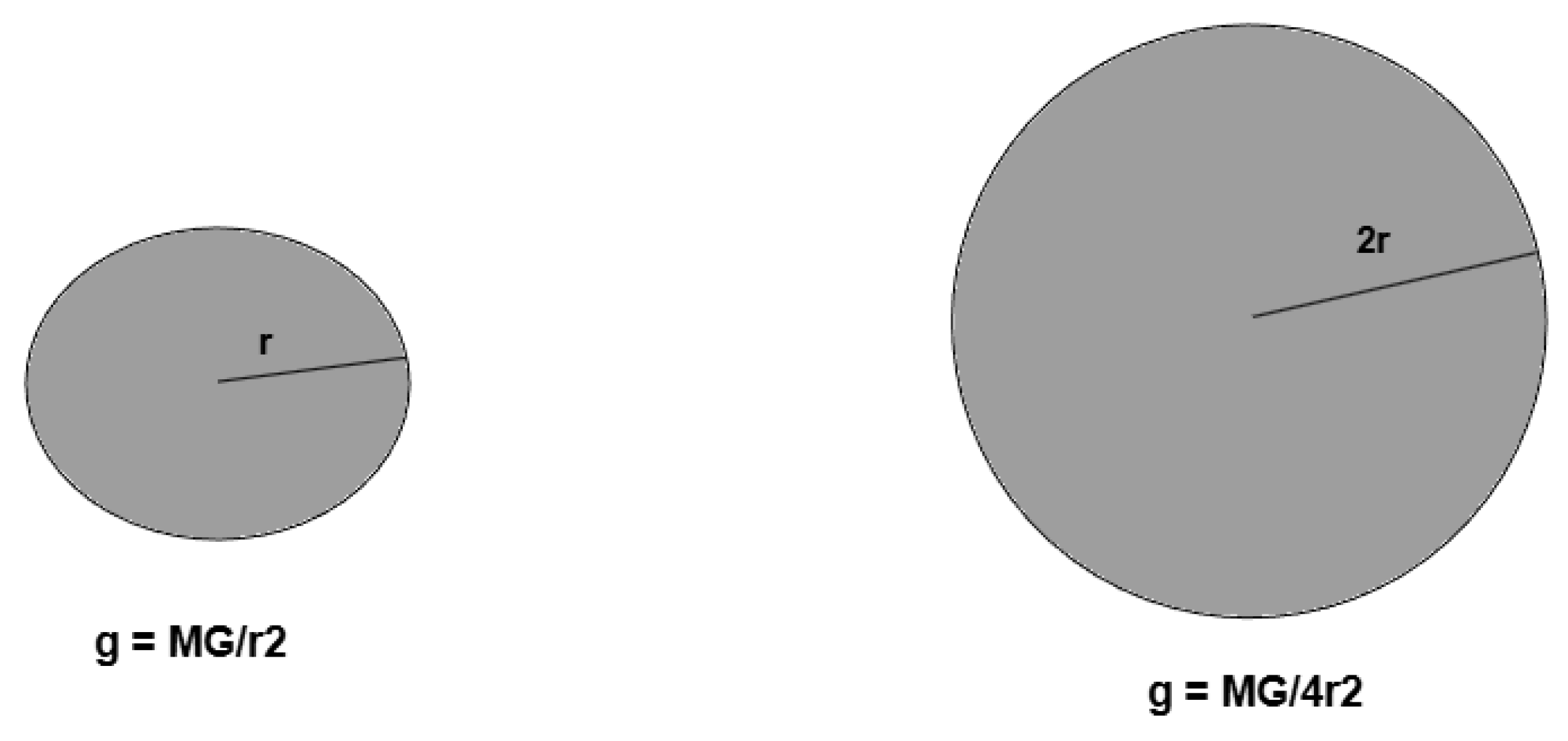
Figure 8.
Newton’s Shell Theorem inside black star.
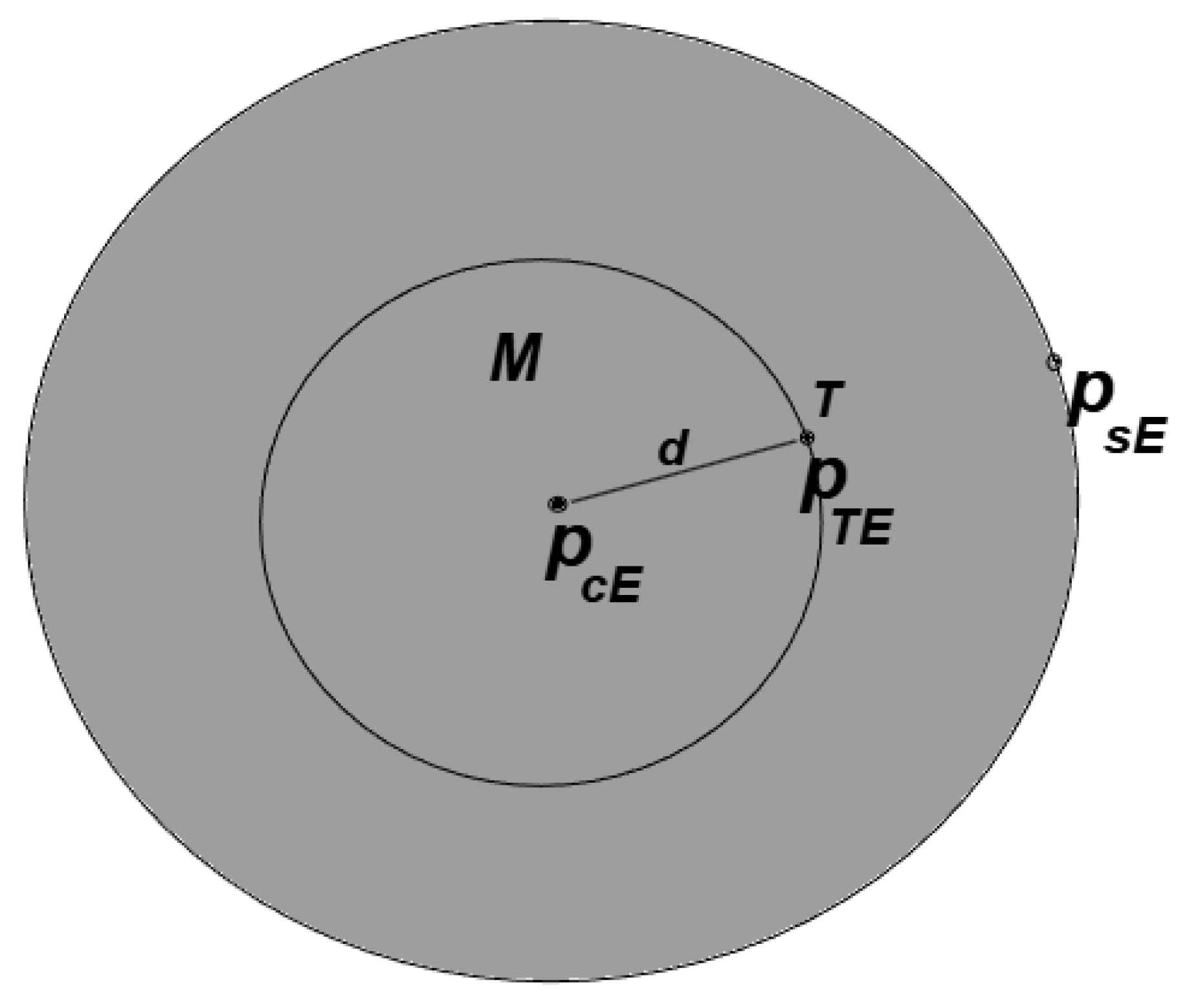
Figure 9.
Relations between energy density of dark energy, radius and gravitational acceleration of a black star.
Figure 9.
Relations between energy density of dark energy, radius and gravitational acceleration of a black star.
Disclaimer/Publisher’s Note: The statements, opinions and data contained in all publications are solely those of the individual author(s) and contributor(s) and not of MDPI and/or the editor(s). MDPI and/or the editor(s) disclaim responsibility for any injury to people or property resulting from any ideas, methods, instructions or products referred to in the content. |
© 2025 by the author. Licensee MDPI, Basel, Switzerland. This article is an open access article distributed under the terms and conditions of the Creative Commons Attribution (CC BY) license (https://creativecommons.org/licenses/by/4.0/).
Copyright: This open access article is published under a Creative Commons CC BY 4.0 license, which permit the free download, distribution, and reuse, provided that the author and preprint are cited in any reuse.